
Life, 1913-07-31 · page 25 of 36
Life — July 31, 1913 — page 25: what you’re looking at
What you’re looking at
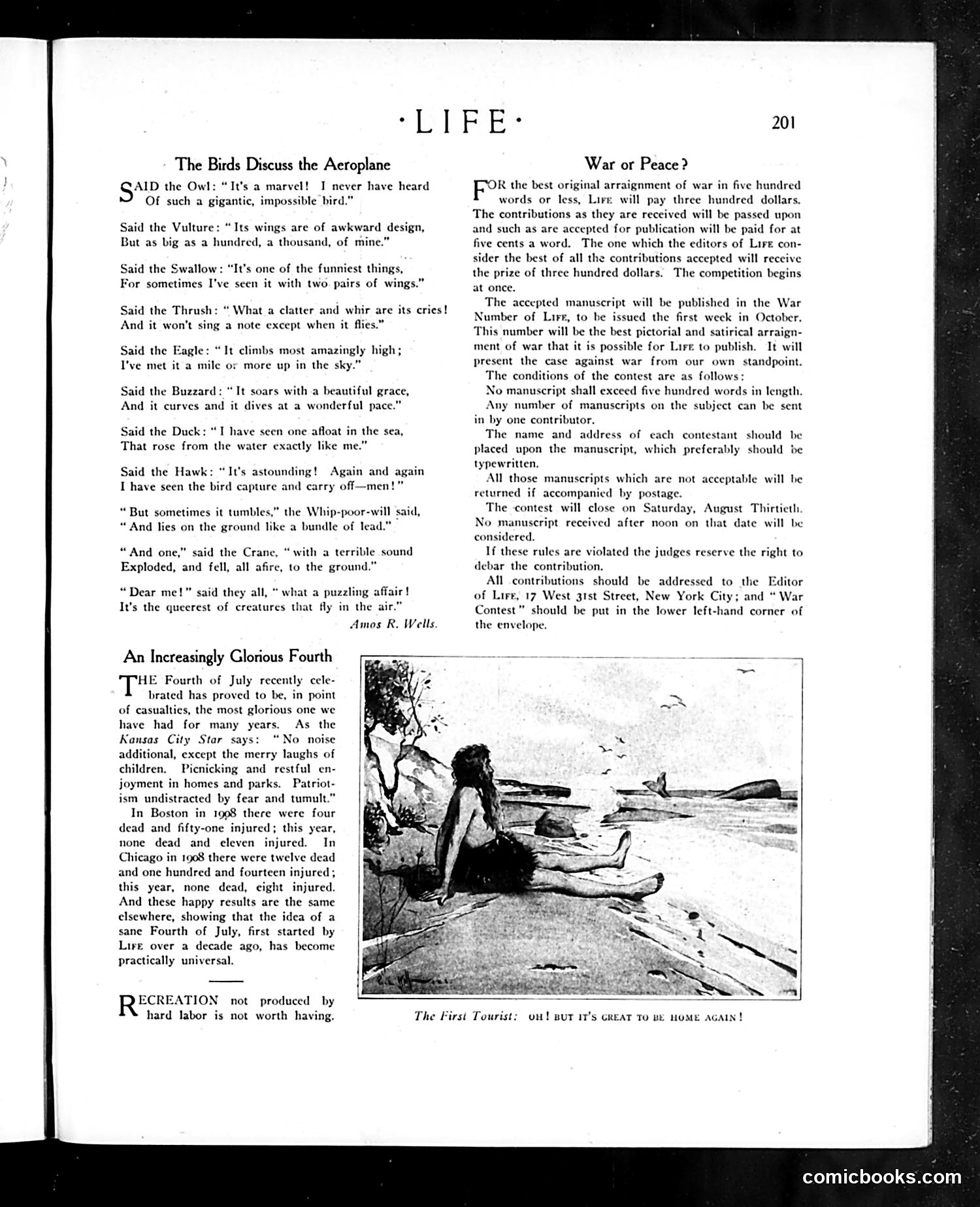
**"The Birds Discuss the Aeroplane"** is a satirical poem about early aviation. Various birds comment on airplanes with bewilderment, each noting specific oddities: the owl calls it an "impossible bird," the hawk observes it "captures and carry off—men," and the crane describes one exploding mid-flight. The poem humorously treats the airplane as a bizarre creature through birds' eyes, likely reflecting public amazement and anxiety about this new technology (circa 1910s). **"An Increasingly Glorious Fourth"** celebrates declining Fourth of July casualties. It contrasts past years—Boston 1908: four dead, fifty-one injured; Chicago 1908: twelve dead, 114 injured—with recent safety improvements (none to eight dead). The piece credits *Life* magazine's decade-long campaign for "sane" celebrations without dangerous fireworks, suggesting editorial pride in reducing holiday violence. The illustration shows a woman resting by a shore, captioned "The First Tourist: oi! but it's GREAT to BE HOME AGAIN!"—likely mocking tourists' complaints despite leisure activities.
📄 Transcribed text from this page (OCR, searchable)
Machine-transcribed from the original scan — historical spelling and the odd misread are preserved.
*DTFE* 201 The Birds Discuss the Aeroplane AID the Owl: “It’s a marvel! I never have heard Of such a gigantic, impossible bird.” Said the Vulture: “Its wings are of awkward design, But as big as a hundred, a thousand, of mine.” Said the Swallow: “It’s one of the funniest things, For sometimes I’ve seen it with two pairs of wings.” Said the Thrush: “ What a clatter and whir are its cries! And it won't sing a note except when it fli Said the Eagle: “It climbs most amazingly high; I've met it a mile or more up in the sky.” Said the Buzzard: “It soars with a beautiful grace, And it curves and it dives at a wonderful pace.” Said the Duck: “I have seen one afloat in the sea, That rose from the water exactly like me.” S. the Hawk: “It's astounding! Again and again T have seen the bird capture and carry off—men!” “But sometimes it tumbles,” the Whip-poor-will said, “And lies on the ground like a bundle of lead.” “And one,” said the Crane, “with a terrible sound Exploded, and fell, all afire, to the ground.” “Dear me!” said they all, “ what a puzzling affair! It’s the queerest of creatures that fly in the air.” Amos R. Wells. An Increasingly Glorious Fourth HE Fourth of July recently cele- brated has proved to be, in point of casualties, the most glorious one we have had for many years. As the Kansas City Star says: “No noise additional, except the merry laughs of children. Picnicking and restful en- joyment in homes and parks. Patriot- ism undistracted by fear and tumult.” In Boston in 1998 there were four dead and fifty-one injured; this year, none dead and eleven injured. In Chicago in 1908 there were twelve dead and one hundred and fourteen injured; this year, none dead, eight injured. And these happy results are the same elsewhere, showing that the idea of a sane Fourth of July, first started by Lire over a decade ago, has become practically universal. War or Peace? R the best original arraignment of war in five hundred words or less, Lire will pay three hundred dollars. The contributions as they are received will be passed upon and such as are accepted for publication will be paid for at five cents a word. The one which the editors of Lire con- sider the best of all the contributions accepted will receive the prize of three hundred dollars. The competition begins at once. The accepted manuscript will be published in the War umber of Lire, to be issued the first week in October. This number will be the best pictorial and satirical arraign- ment of war that it is possible for Lire to publish. It will present the case against war from our own standpoint. The conditions of the contest are as follow: No manuscript shall exceed five hundred words in length. Any number of manuscripts on the subject can be sent in by one contributor. The name and address of each contestant should be placed upon the manuscript, which preferably should be typewritten. All those manuscripts which are not acceptable will be returned if accompanied by postage. The contest will close on Saturday, August Thirtieth No manuscript received after noon on that date will be considered. If these rules are violated the judges reserve the right to debar the contribution, All contributions should be addressed to the Editor of Lire, 17 West 31st Street, New York City; and “ War Contest” should be put in the lower left-hand corner of the envelope. CREATION not produced by hard labor is not worth having. The First Tourist: oi! put it’s GREAT To BE HOME AGAIN! comicbooks.com