
Life, 1913-07-31 · page 17 of 36
Life — July 31, 1913 — page 17: what you’re looking at
What you’re looking at
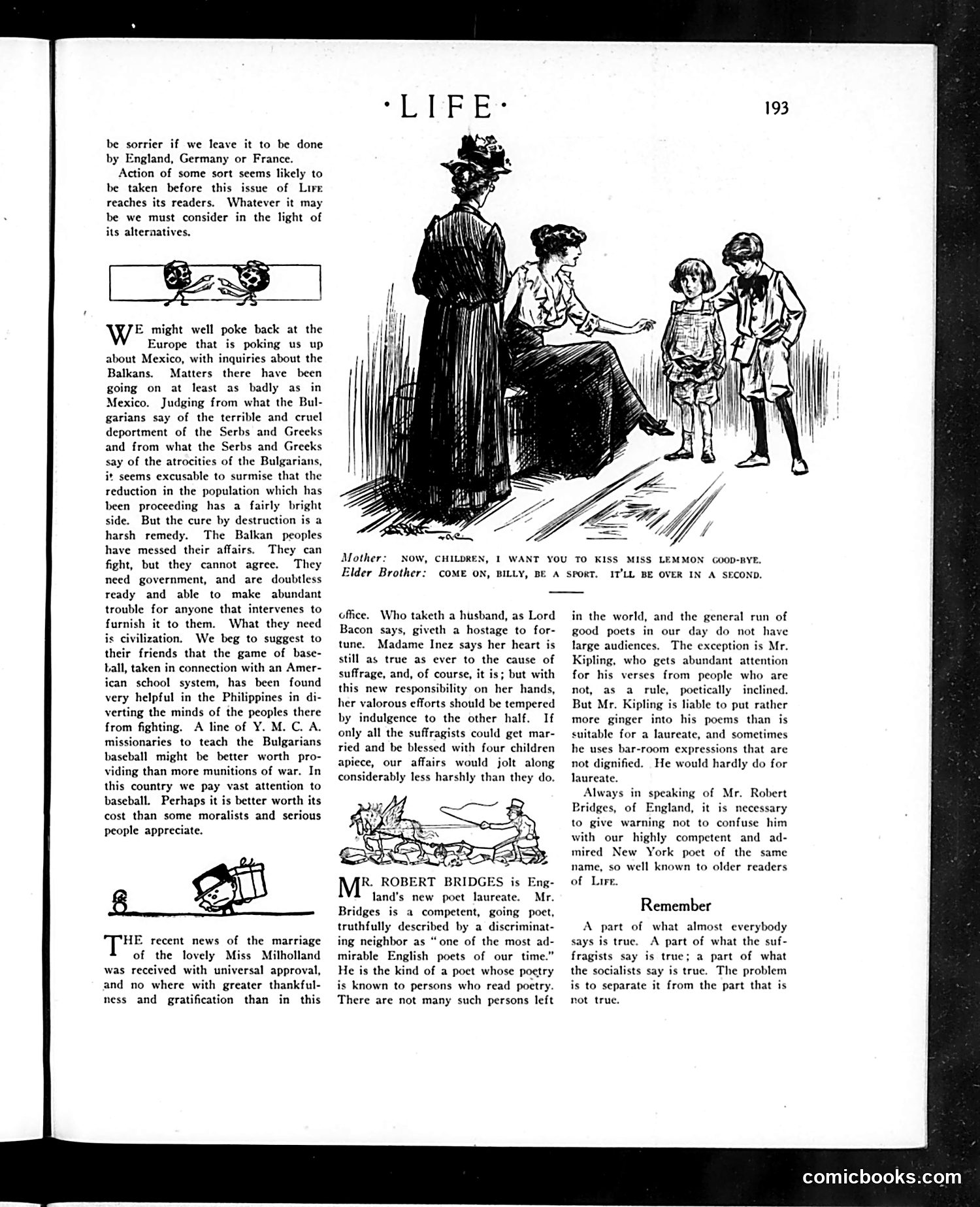
This page from *Life* magazine (likely early 1910s, based on references) contains satirical commentary on contemporary issues: **Main cartoon**: Shows a mother saying goodbye to children, with an elder brother encouraging a younger boy ("Billy") to kiss "Miss Lemmon" goodbye—a humorous domestic scene about childhood reluctance and social propriety. **Text commentary**: The article discusses the recent marriage of "Miss Milholland" (likely Inez Milholland, a famous suffragist), sarcastically suggesting that if all suffragists married and had children, their reform efforts would become "less harsh." This mocks both the suffrage movement and traditional views that women's activism should yield to domestic duties. **Other topics**: The page also addresses Balkan conflicts (comparing them to American problems in Mexico), and praises Robert Bridges as England's new poet laureate while distinguishing him from a similarly-named American poet. The overall tone is characteristically *Life*'s blend of social satire, with particular skepticism toward women's political activism.
📄 Transcribed text from this page (OCR, searchable)
Machine-transcribed from the original scan — historical spelling and the odd misread are preserved.
be sorrier if we leave it to be done by England, Germany or France. Action of some sort seems likely to be taken before this issue of Lire reaches its readers. Whatever it may be we must consider in the light of its alternatives, E might well poke back at the Europe that is poking us up about Mexico, with inquiries about the Balkans. Matters there have been going on at least as badly as in Mexico. Judging from what the Bul- garians say of the terrible and cruel deportment of the Serbs and Greeks and from what the Serbs and Greeks say of the atrocities of the Bulgarians, it seems excusable to surmise that the reduction in the population which has been proceeding has a fairly bright side. But the cure by destruction is a harsh remedy. The Balkan peoples have messed their affairs. They can fight, but they cannot agree. They need government, and are doubtless ready and able to make abundant trouble for anyone that intervenes to furnish it to them. What they need is civilization. We beg to suggest to their friends that the game of base- ball, taken in connection with an Amer- ican school system, has been found very helpful in the Philippines in di- verting the minds of the peoples there from fighting. A line of Y. M. C. A. missionaries to teach the Bulgarians baseball might be better worth pro- viding than more munitions of war. In this country we pay vast attention to baseball. Perhaps it is better worth its cost than some moralists and serious people appreciate. HE recent news of the marriage of the lovely Miss Milholland was received with universal approval, and no where with greater thankful- ness and gratification than in this Mother: Now, CHILDREN, Elder Brother: office. Who taketh a husband, as Lord Bacon says, giveth a hostage to for- tune. Madame Inez says her heart is still as true as ever to the cause of suffrage, and, of course, it is; but with this new responsibility on her hands, her valorous efforts should be tempered by indulgence to the other half. If only all the suffragists could get mar- ried and be blessed with four children apiece, our affairs would jolt along considerably less harshly than they do. R. ROBERT BRIDGES is Eng: land’s new poct laureate. Mr. Bridges is a competent, going poet, truthfully described by a discriminat- ing neighbor as “one of the most ad- mirable English poets of our time.” He is the kind of a poct whose poetry is known to persons who read poetry. There are not many such persons left 1 WANT YOU TO KISS MISS LEMMON GOOD-BYE. COME ON, BILLY, BE A Sport. IT'LL BE OVER IN A SECOND. in the world, and the general run of good poets in our day do not have large audiences, The exception is Mr. Kipling, who gets abundant attention for his verses from people who are not, as a rule, poetically inclined. But Mr. Kipling is liable to put rather more ginger into his poems than is suitable for a laureate, and sometimes he uses bar-room expressions that are not dignified. He would hardly do for laureate. Alw: in speaking of Mr. Robert Bridges, of England, it is necessary to give warning not to confuse him with our highly competent and ad- mired New York poet of the same name, so well known to older readers of Lire. Remember A part of what almost everybody says is true. A part of what the suf- fragists say is true; a part of what the socialists say is true. The problem is to separate it from the part that is not truc. comicbooks:com