
A complete issue · 48 pages · 1913
Life — July 3, 1913
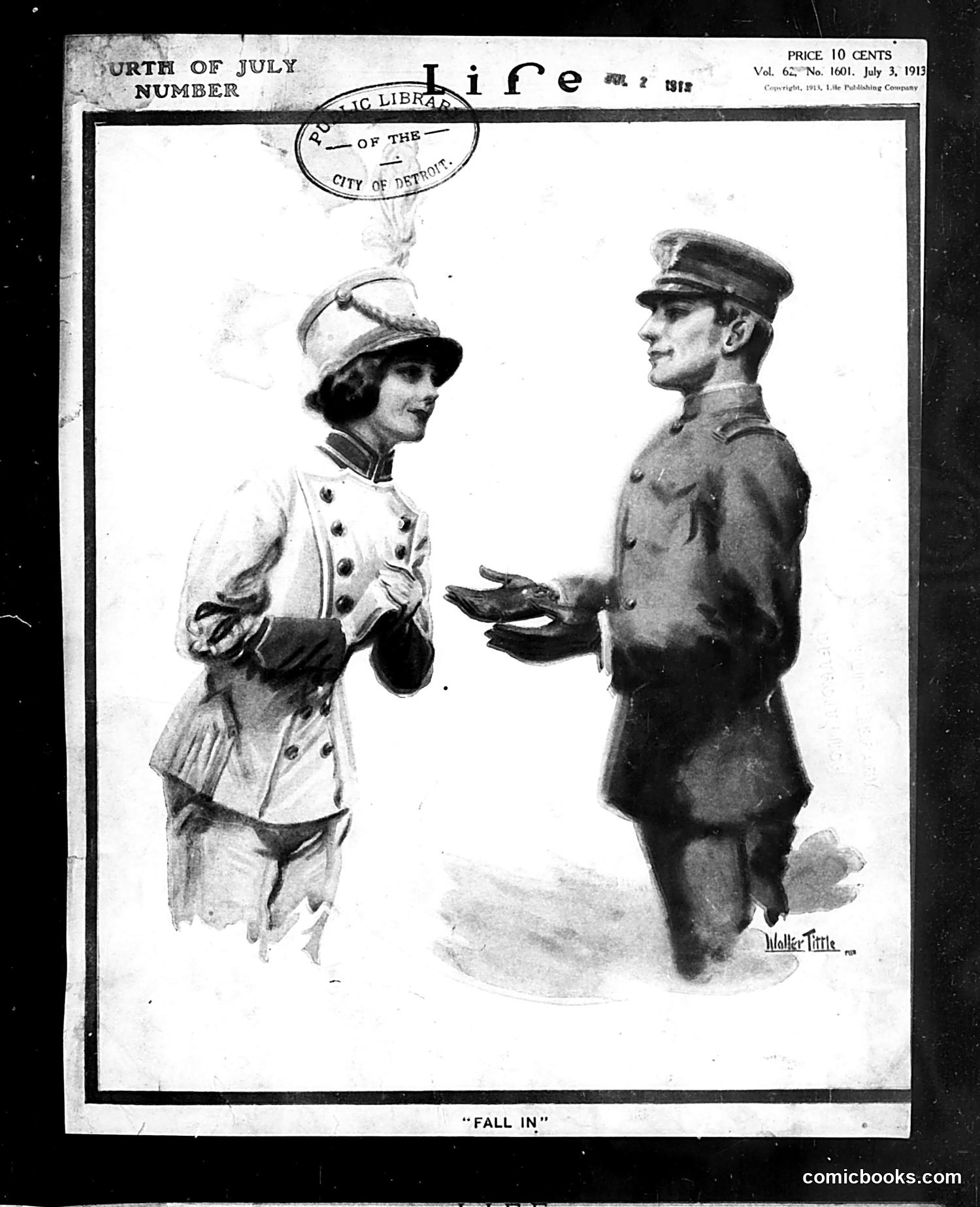
This is the cover of Life magazine's Fourth of July 1912 number. The cartoon, titled "Fall In," depicts a woman in military uniform (left) and a man in military dress (right) facing each other. The woman appears to be a suffragist or military recruit, while the man represents a soldier or military authority figure. The satire likely comments on the women's suffrage movement gaining momentum in 1912. The title "Fall In" suggests women "falling in line" with military or political authority—possibly mocking either suffragists' organized activism or, conversely, critiquing resistance to women's expanded roles. The military uniforms suggest themes of duty, citizenship, and women's participation in civic life that were contentious during this pre-WWI period.
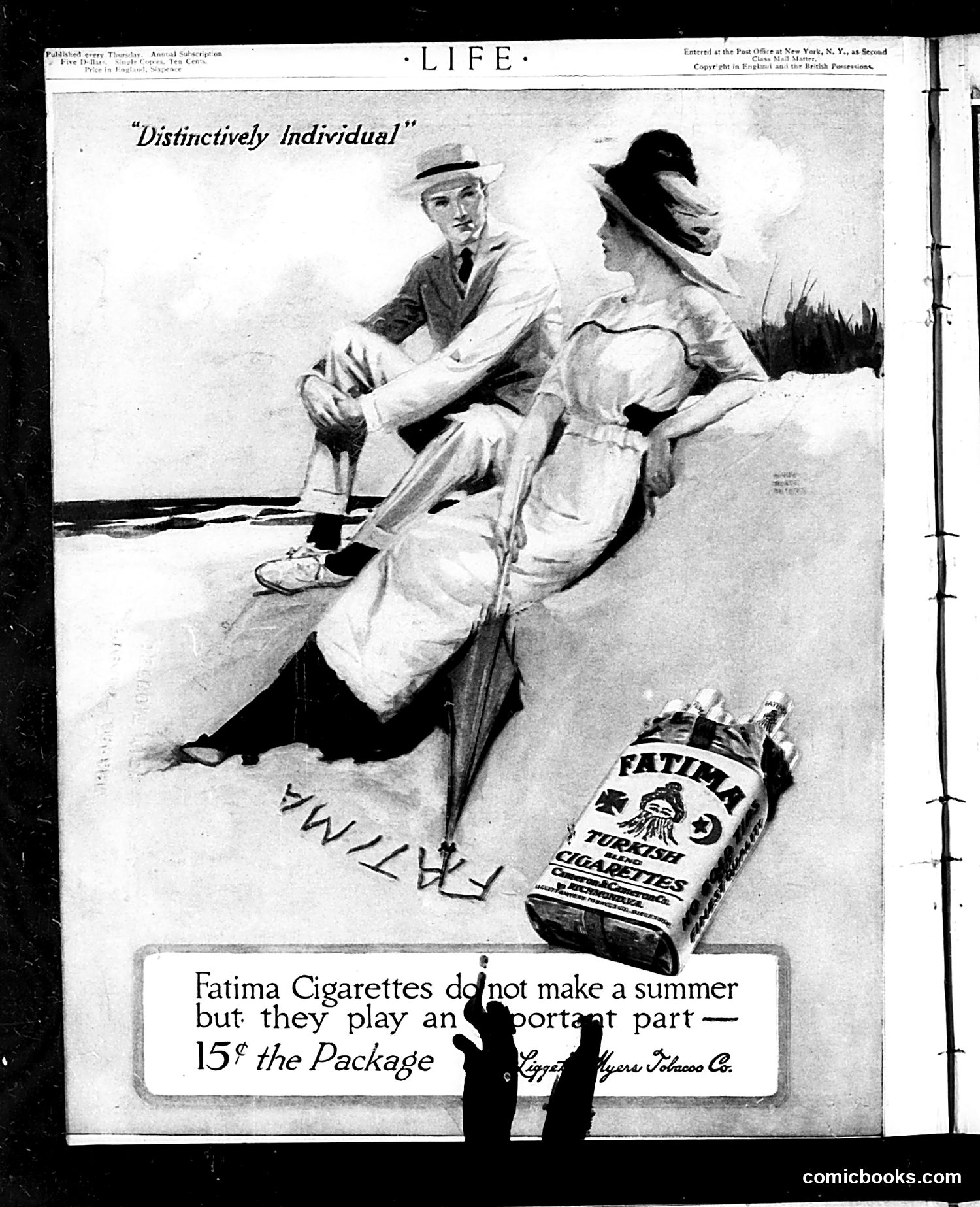
This is a **cigarette advertisement**, not political satire. The page shows a man and woman at the beach with the headline "Distinctively Individual." The ad copy reads: "Fatima Cigarettes do not make a summer but they play an important part—15¢ the Package" (by Liggett & Myers Tobacco Co.). The humor is mild and gender-focused for the era: the woman's exaggerated beach outfit and pose suggest that Fatima cigarettes are an essential summer accessory for stylish people. The "distinctively individual" tagline implies smoking these cigarettes marks one as fashionable and unique. This reflects early 20th-century advertising that marketed cigarettes as lifestyle products associated with modernity and personal expression, particularly targeting women—a relatively new market then.
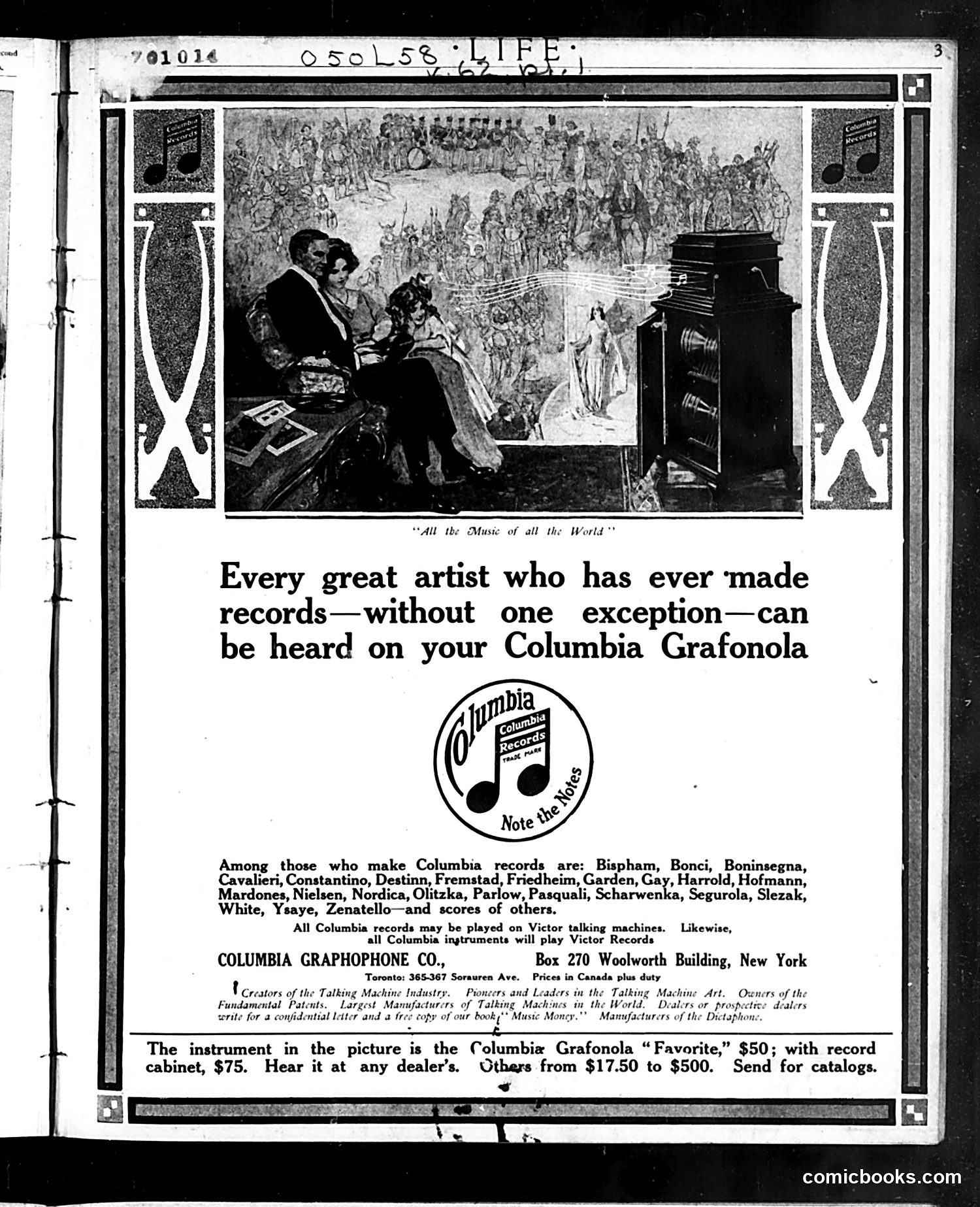
This is primarily a **Columbia Grafonola advertisement**, not satirical content. The page showcases the company's phonograph player with an image of a well-dressed couple listening to music while an illustrated crowd scene appears on the wall behind them. The advertisement's claim—that "Every great artist who has ever made records—without one exception—can be heard on your Columbia Grafonola"—is the selling point. It lists famous performers of the era (Caruso, Melba, Galli-Curci, and others) to establish Columbia's superiority. The decorative musical note borders and the modest price range ($17.50–$500) suggest this targets middle-class consumers. Rather than satire, this represents early 20th-century marketing strategy: using celebrity endorsement and aspirational imagery to sell consumer technology.
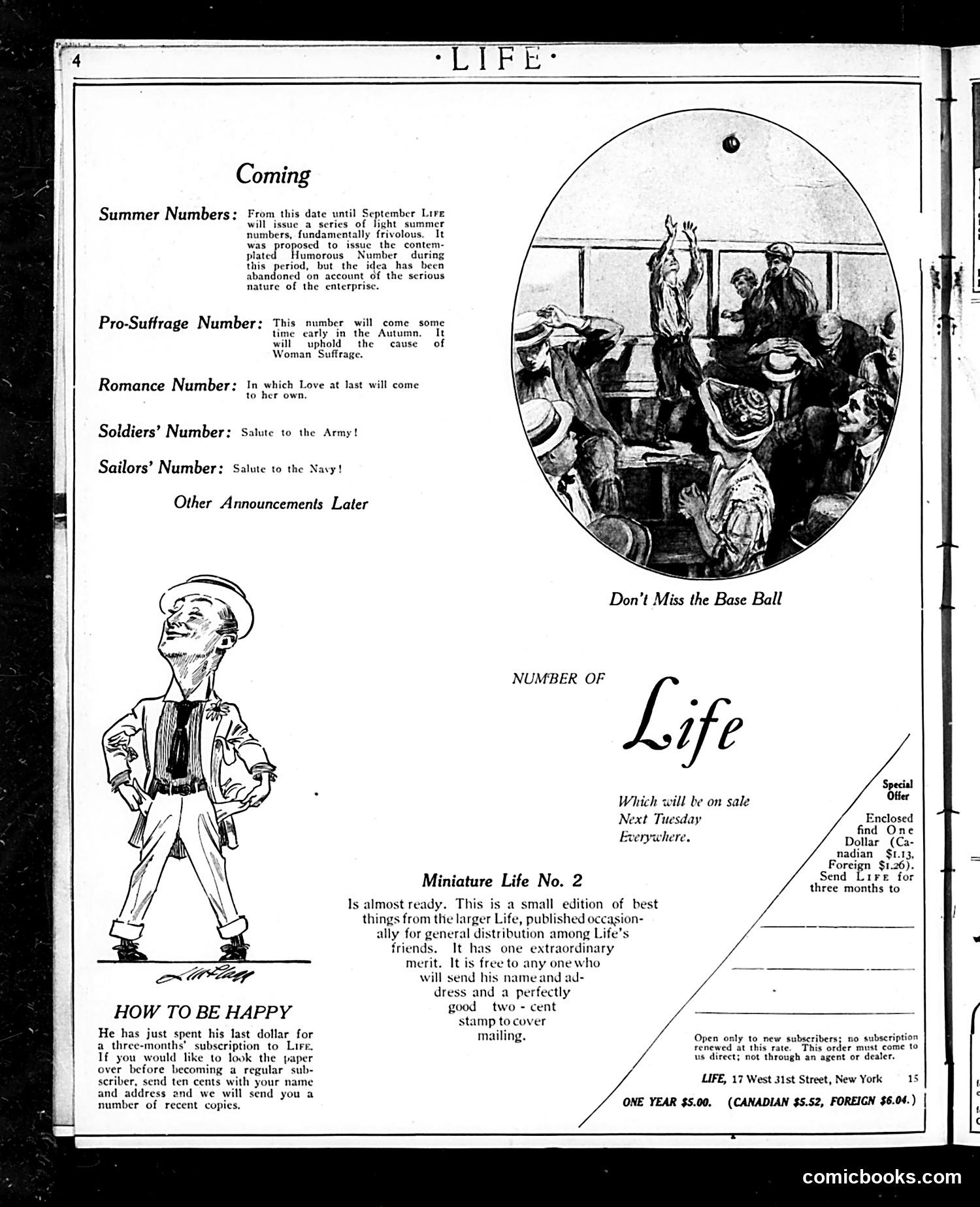
This page is primarily **advertising** for Life magazine's upcoming special issues, mixed with subscription promotion. The **"Coming" section** announces themed issues: a Summer Numbers series, a Pro-Suffrage Number supporting women's voting rights, a Romance Number, and issues honoring soldiers and sailors—likely referencing World War I era concerns. The **left cartoon** ("How to Be Happy") shows a cheerful man in a suit, illustrating Life's tongue-in-cheek advice about gaining a three-month subscription for ten cents. The **upper right oval illustration** labeled "Don't Miss the Base Ball" depicts a social gathering, promoting upcoming baseball coverage. The **"Miniature Life No. 2" announcement** describes a small, free edition for distribution. Overall, this is a **period sales pitch** blending light satire with subscription offers, reflecting early 20th-century magazine marketing.
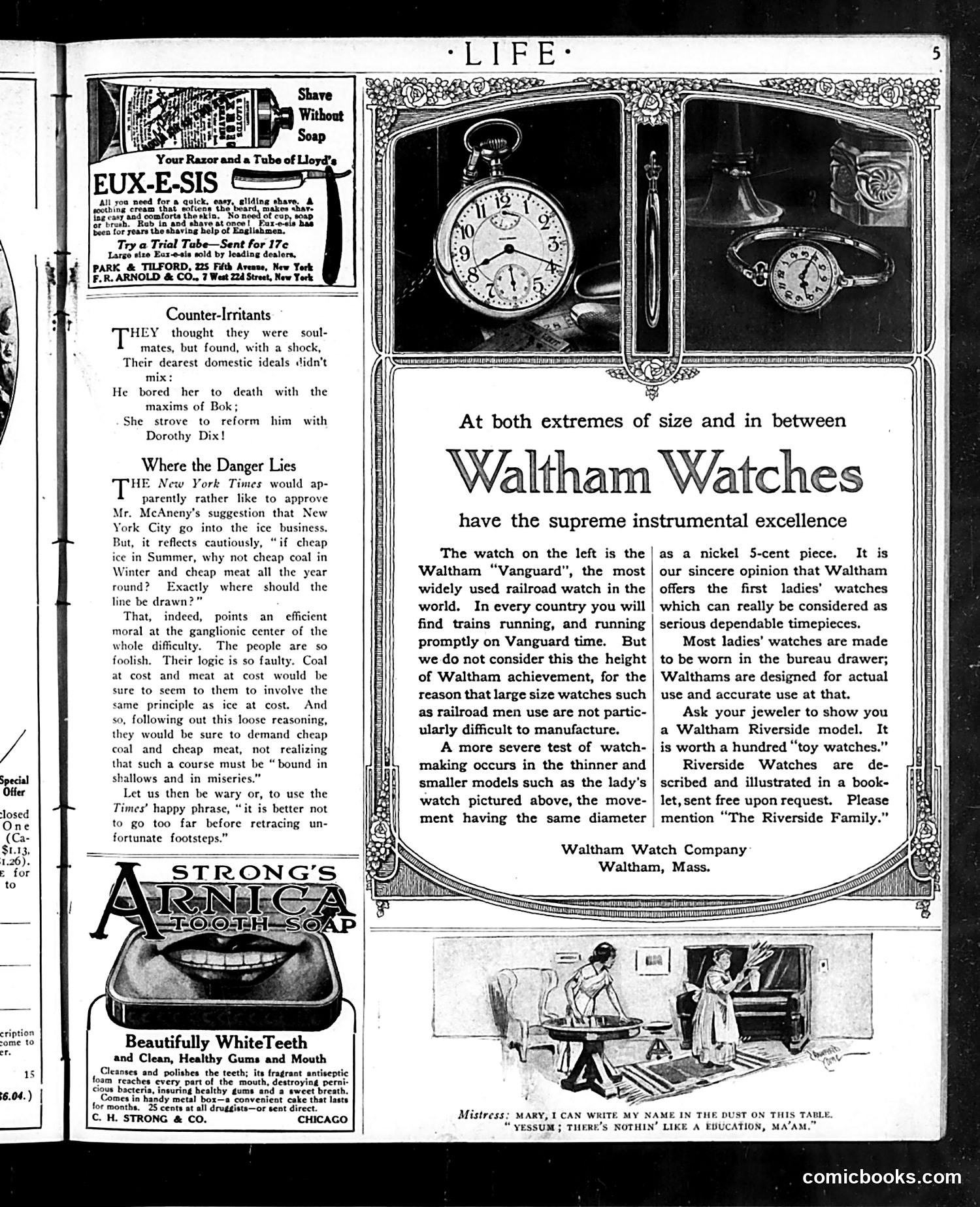
This page is primarily **advertising rather than satire or political commentary**. The main content features: 1. **Waltham Watches advertisement** (center/right): Displays pocket watches and wristwatches, emphasizing their "supreme instrumental excellence" and reliability for railroad use. The ad notes that Waltham offers quality across all price points, from expensive "Vanguard" models to affordable ladies' watches. 2. **Product advertisements** (left/bottom): Including Eux-E-Sis shaving cream and Strong's Arnica Tooth Soap—typical early 20th-century patent medicines. 3. **"Counter-Irritants" column** (left): A brief satirical piece about marital discord, unrelated to the advertisements. The page reflects typical *Life* magazine formatting: mixing commercial ads with light social humor.
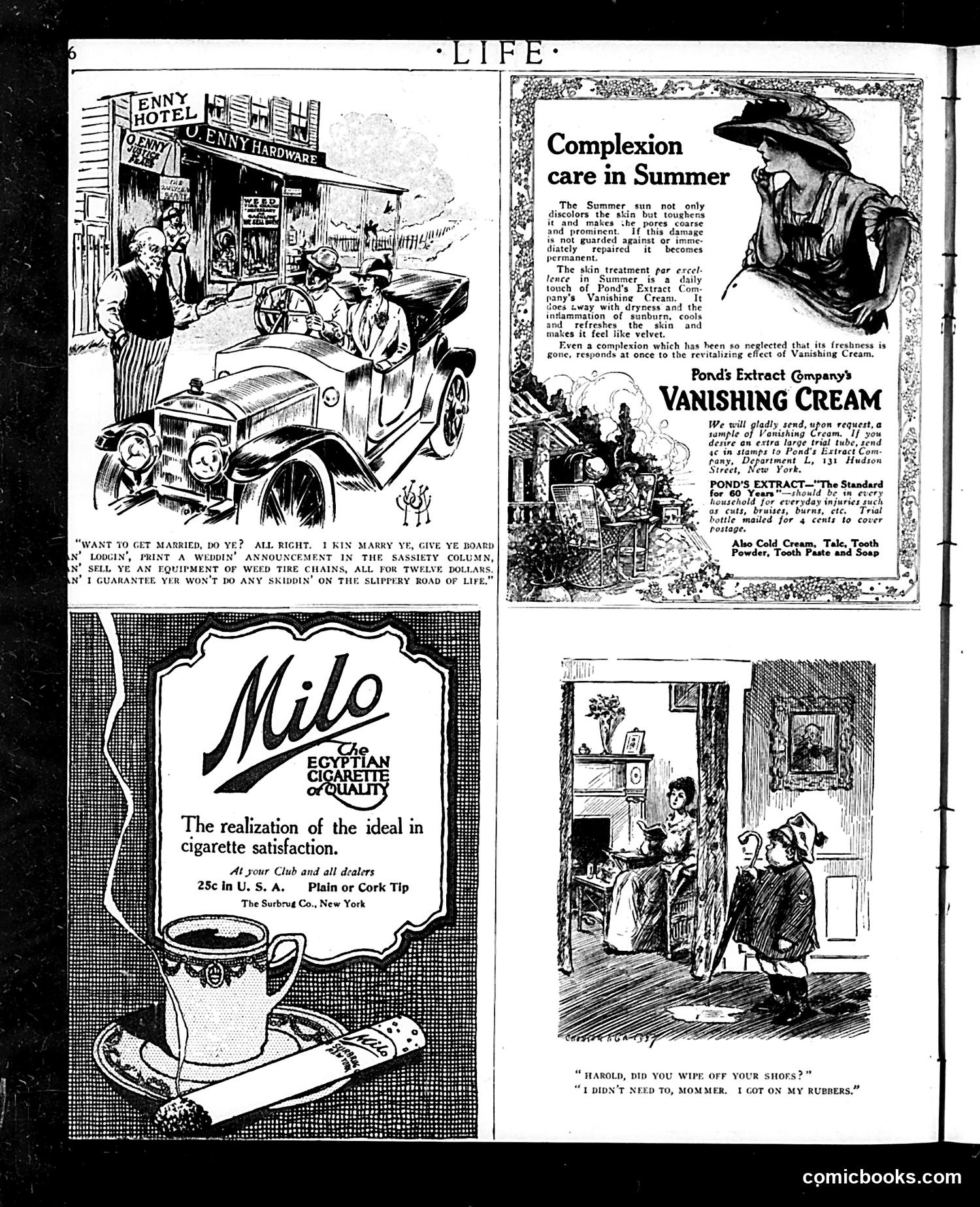
This page is primarily **advertising and light humor** rather than political satire. **Top left cartoon**: A humorous scene at "Jenny Hotel" and hardware store where a man in a car proposes marriage with an elaborate (and absurd) list of dowry demands—"weed tire chains," "equipment," etc. The joke is about mercenary courtship and automobile culture of the era. **Top right**: Advertisement for Pond's Vanishing Cream, a skincare product promising sun damage protection—reflecting early 20th-century beauty standards and women's concerns about summer complexion damage. **Bottom left**: Milo Egyptian cigarette advertisement. **Bottom right**: A domestic humor cartoon showing a child explaining to mother that rubbers (galoshes) made wiping shoes unnecessary—a simple joke about childhood logic. The page reflects consumer culture and domestic comedy of its era.
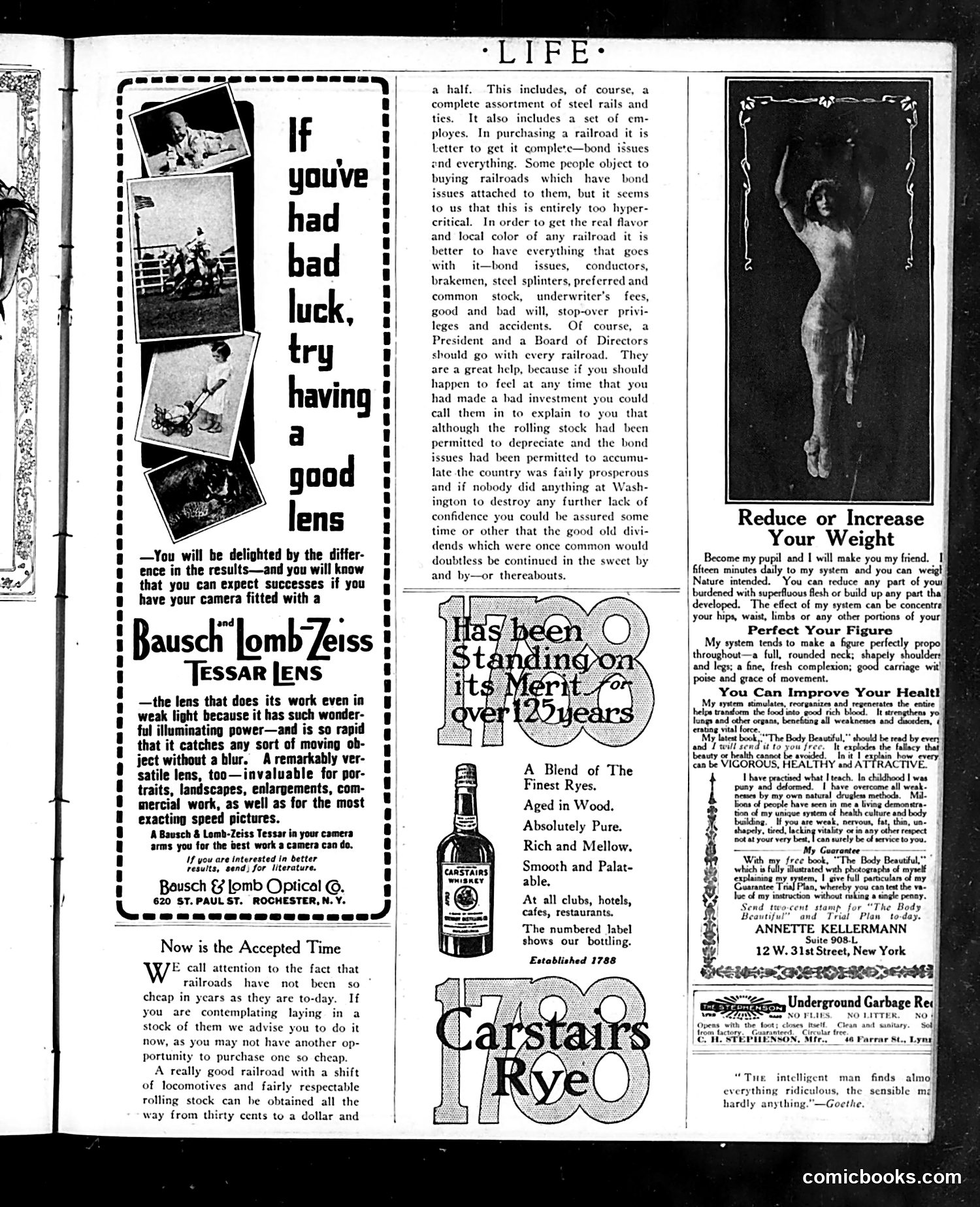
This page is primarily **advertising**, not political satire. The main content includes: 1. **Bausch & Lomb Zeiss Tessar Lens** advertisement (left) promoting camera lenses for photography 2. **Weight reduction/health advertisement** (right) promoting a system to modify body shape 3. **Carstairs Rye whiskey** advertisement (center-bottom) emphasizing its 125+ year history 4. **Carstairs Rye** advertisement (bottom) highlighting its quality The only editorial text ("Now is the Accepted Time") briefly discusses railroad stock investments as affordable opportunities. This appears to be a standard 1920s-era Life magazine page mixing consumer advertising with light financial commentary. There is no discernible political cartoon or social satire present—just commercial messaging typical of the period.
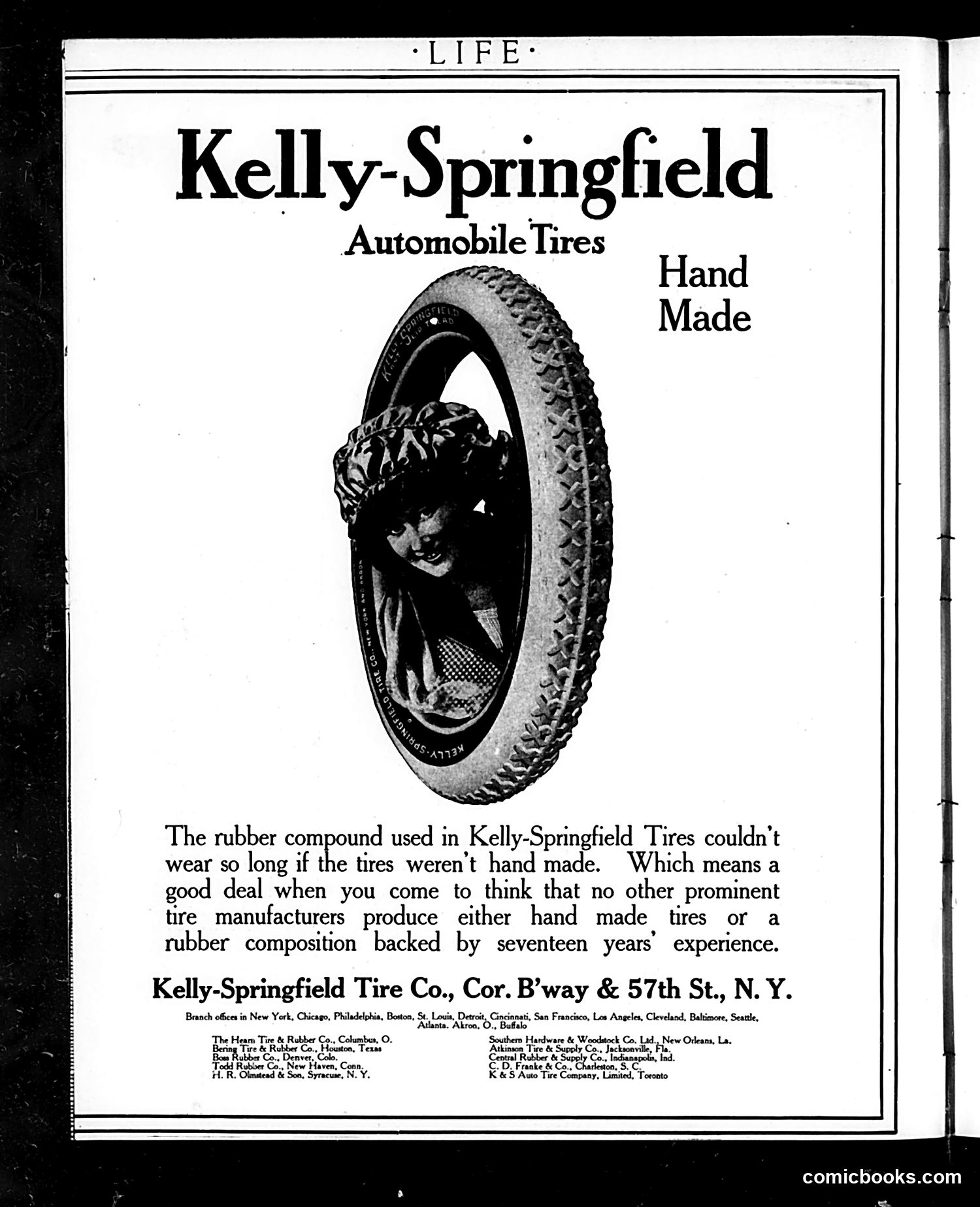
This is an **advertisement, not political satire or commentary**. It's a full-page ad for Kelly-Springfield Automobile Tires, appearing in Life magazine. The image shows a tire with what appears to be a hand emerging from or gripping it, illustrating the advertiser's claim that their tires are "Hand Made." The ad's pitch emphasizes that the rubber compound used in Kelly-Springfield tires requires hand manufacturing to achieve durability—a marketing angle suggesting superior quality compared to competitors. The ad explicitly states "no other prominent tire manufacturers produce either hand made tires or a rubber composition backed by seventeen years' experience." This reflects early automotive-era advertising, when "hand made" was marketed as a sign of quality and craftsmanship.
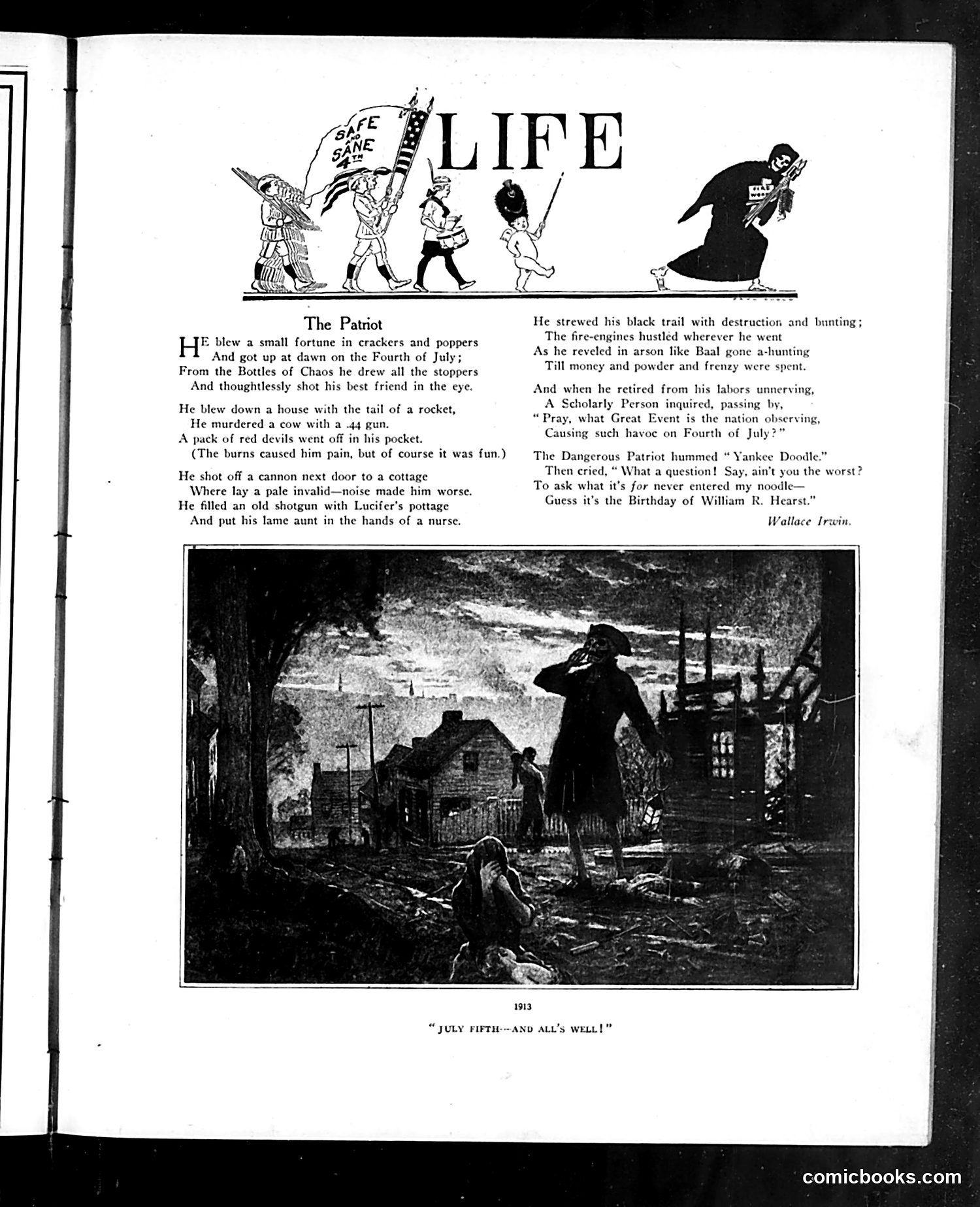
This is a scathing satirical poem by Wallace Irwin mocking an extremist patriot who commits destructive acts in the name of Fourth of July celebration and patriotism. The figure—depicted in the illustration as a menacing silhouette among burned buildings—"blew a small fortune in crackers and poppers," murdered livestock with a gun, and shot cannons near homes, causing property damage and injury. The satire's core joke: this self-proclaimed "Dangerous Patriot" believes his destructive behavior serves the nation, even humming "Yankee Doodle" while causing havoc. The closing reference to "Birthday of William R. Hearst" appears to mock sensationalist newspaper coverage glorifying such recklessness. The poem critiques how patriotic fervor can justify irresponsible, dangerous behavior.
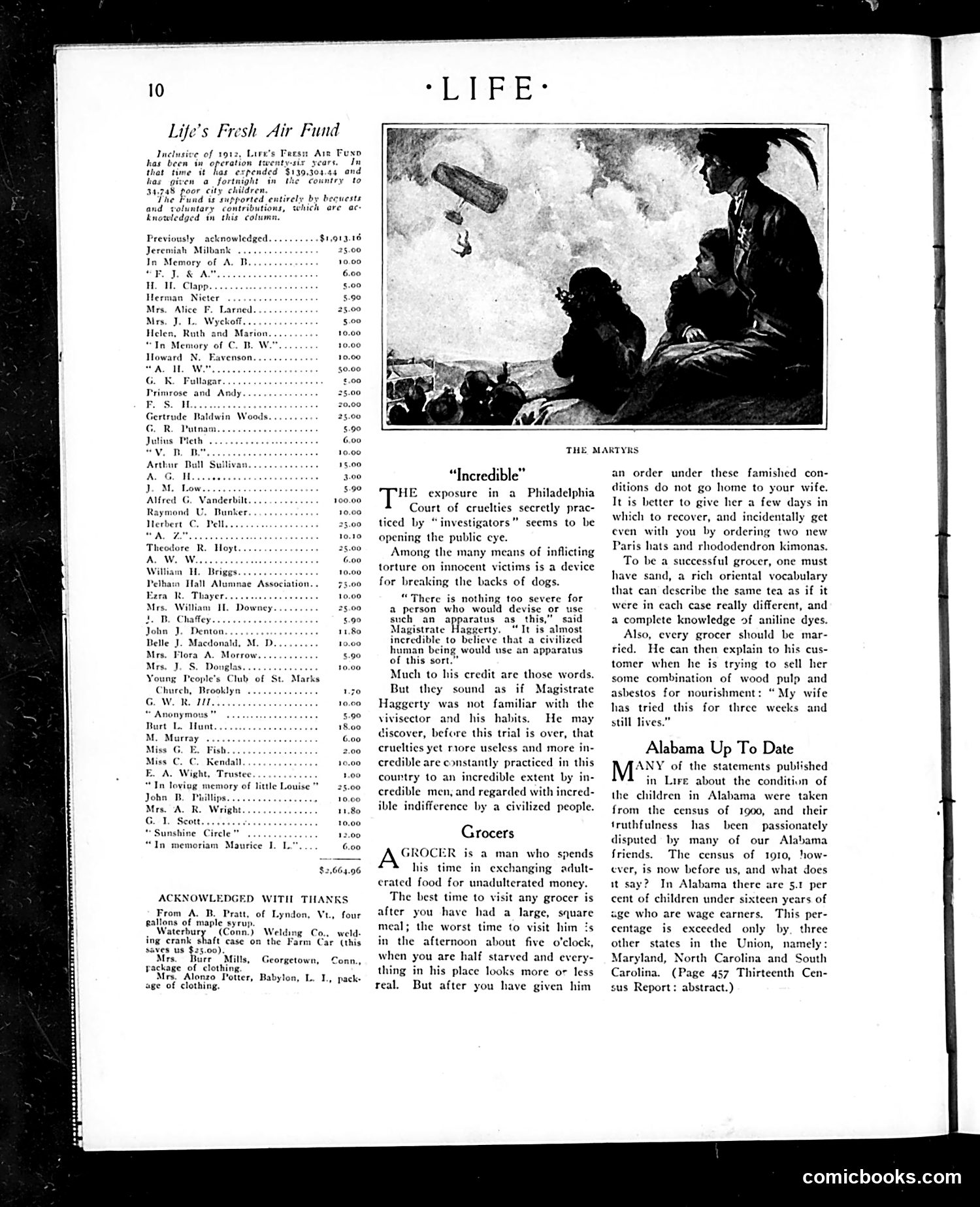
This political cartoon depicts what appears to be victims of police brutality or investigative misconduct in Philadelphia. The accompanying article "Incredible" criticizes a "Court of cruelties secretly practiced by 'investigators'" and describes brutal tactics including devices for breaking dogs' backs—used as torture apparatus on innocent people. The cartoon's dark imagery shows suffering victims, emphasizing the article's core argument: that law enforcement used extreme, sadistic methods against suspects. The text quotes a magistrate defending such practices as necessary, while the author counters that civilized people should find such cruelty abhorrent. This reflects early 20th-century *Life* magazine's muckraking tradition, exposing police corruption and abuse in American cities.
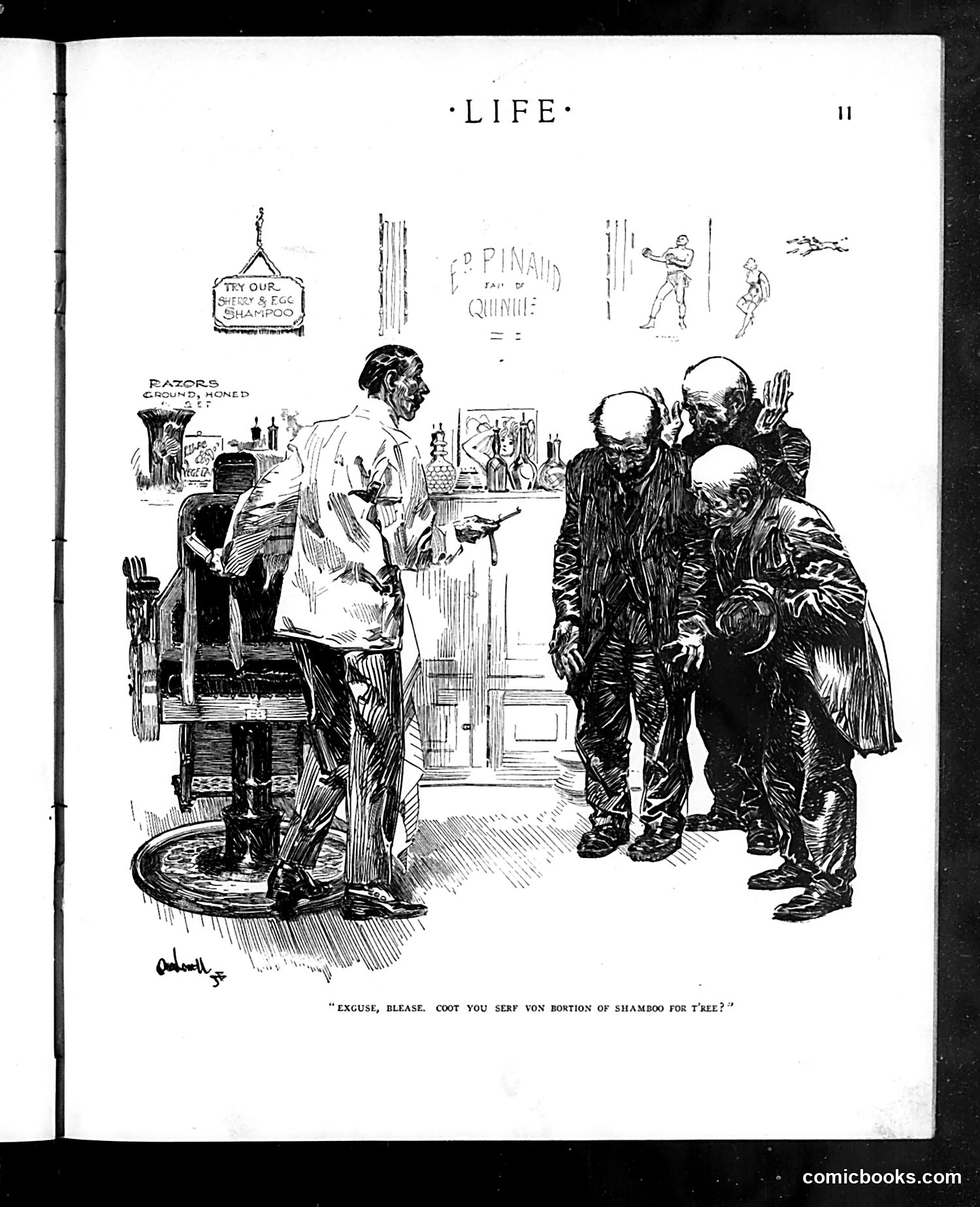
This satirical cartoon from *Life* magazine depicts a barber shop scene. A barber (left) is shaving a customer in a chair while three bald or balding men on the right observe with apparent interest. The caption reads: "EXCUSE, PLEASE. COOT YOU SERF VON BORTION OF SHAMPOO FOR FREE?" The humor relies on ethnic caricature—the observers speak with a stereotypical Germanic or Eastern European accent (phonetic misspelling: "coot," "serf," "von," "bortion"). The joke plays on the stereotype of immigrant men haggling or requesting free services. The background shows typical barber shop advertisements, including one for shampoo. The satire targets immigrant populations and their perceived business practices, reflecting early 20th-century American attitudes toward foreign-born residents.
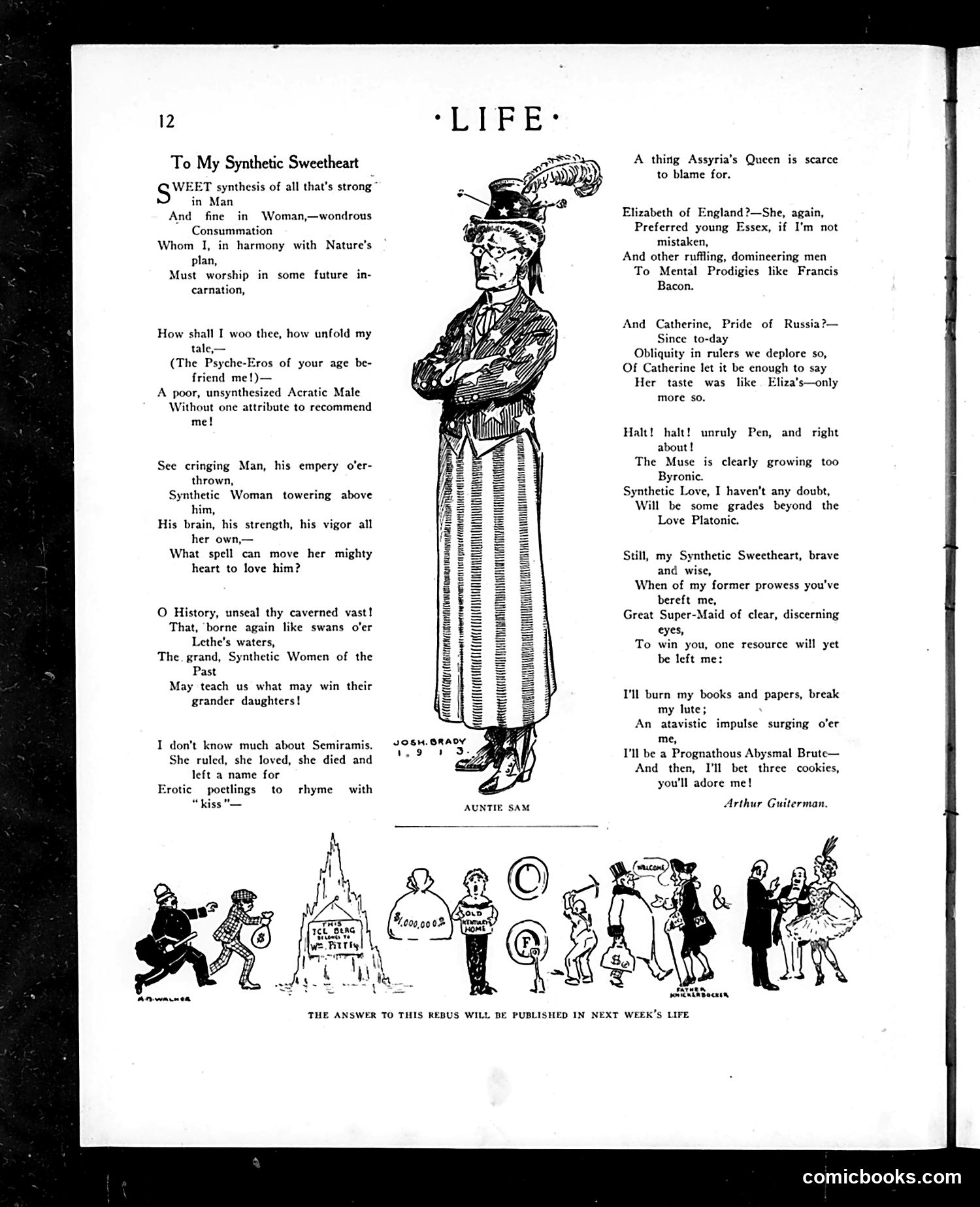
This page from *Life* magazine contains a poem titled "To My Synthetic Sweetheart" by Arthur Guiterman, illustrated with a drawing labeled "Auntie Sam" (a female version of Uncle Sam, identifiable by the star-spangled hat and patriotic costume). The satirical poem mocks the concept of a "synthetic" or artificial woman—critiquing idealized feminine qualities as unrealistic. The right column makes references to historical female rulers (Elizabeth of England, Catherine of Russia) to argue against the notion of the "perfect woman." The tone is humorous misogyny, treating the search for an ideal woman as inherently futile. The bottom shows a rebus puzzle—the answer to be published next week—which was typical interactive content for *Life* magazine during this era. The overall satire targets romanticized notions of womanhood and synthetic perfection.
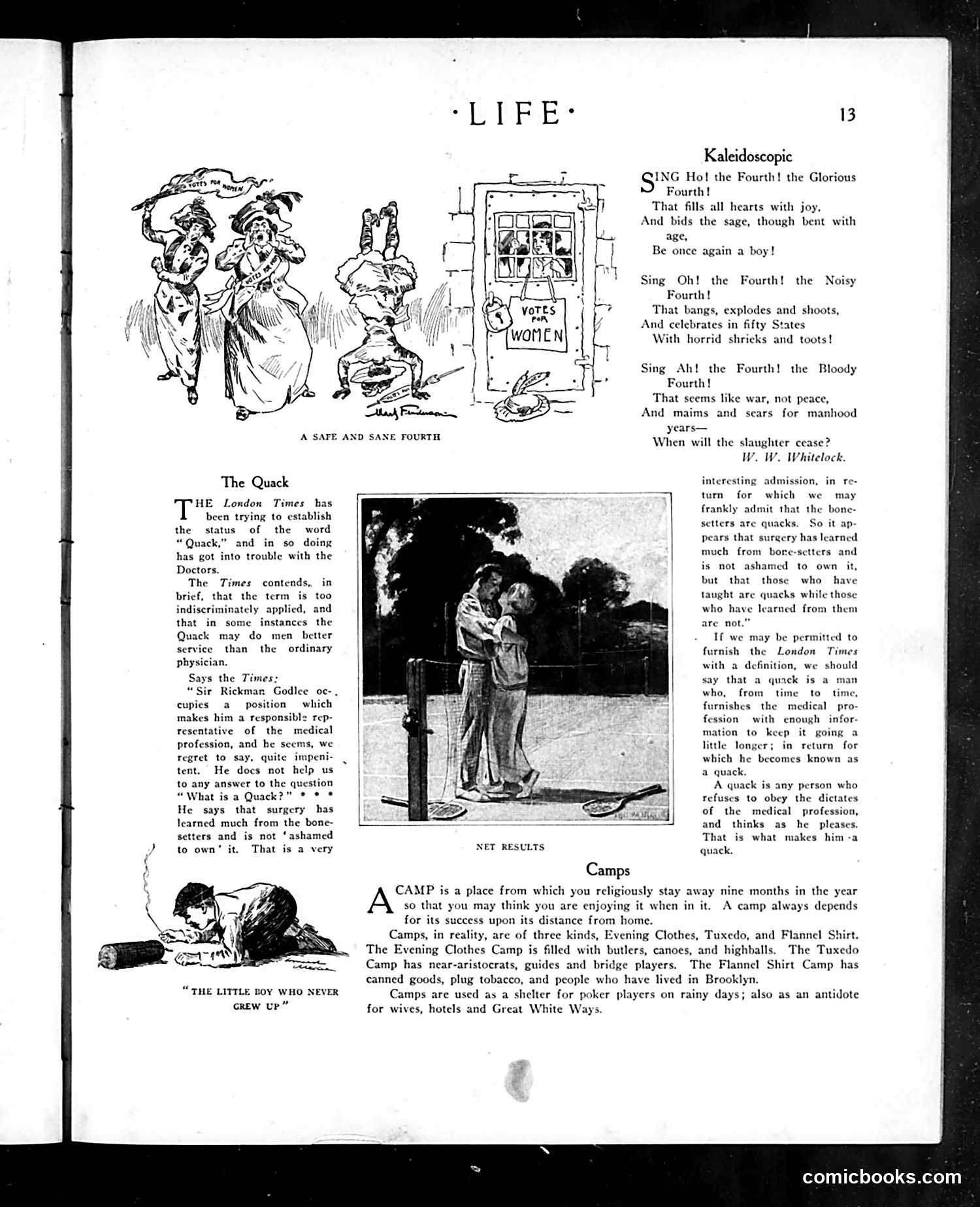
**Top Cartoon ("A Safe and Sane Fourth"):** Depicts chaotic Fourth of July celebrations with figures injured or maimed—one appears to have lost limbs, another is bandaged. This satirizes the widespread injuries and deaths from fireworks and explosives during Independence Day celebrations, which were a serious public health concern in early 20th-century America. The title's irony suggests the impossibility of a truly "safe" Fourth given contemporary practices. **"The Quack" Section:** Discusses how the *London Times* distinguishes between legitimate physicians and "quacks"—medical practitioners offering dubious treatments. The text explains that a quack is someone who ignores medical profession standards for profit. **"Camps" Section:** Humorously defines various social camps (Evening Clothes, Tuxedo, Flannel Shirt) as lifestyle categories, using satirical descriptions of their typical inhabitants and activities.
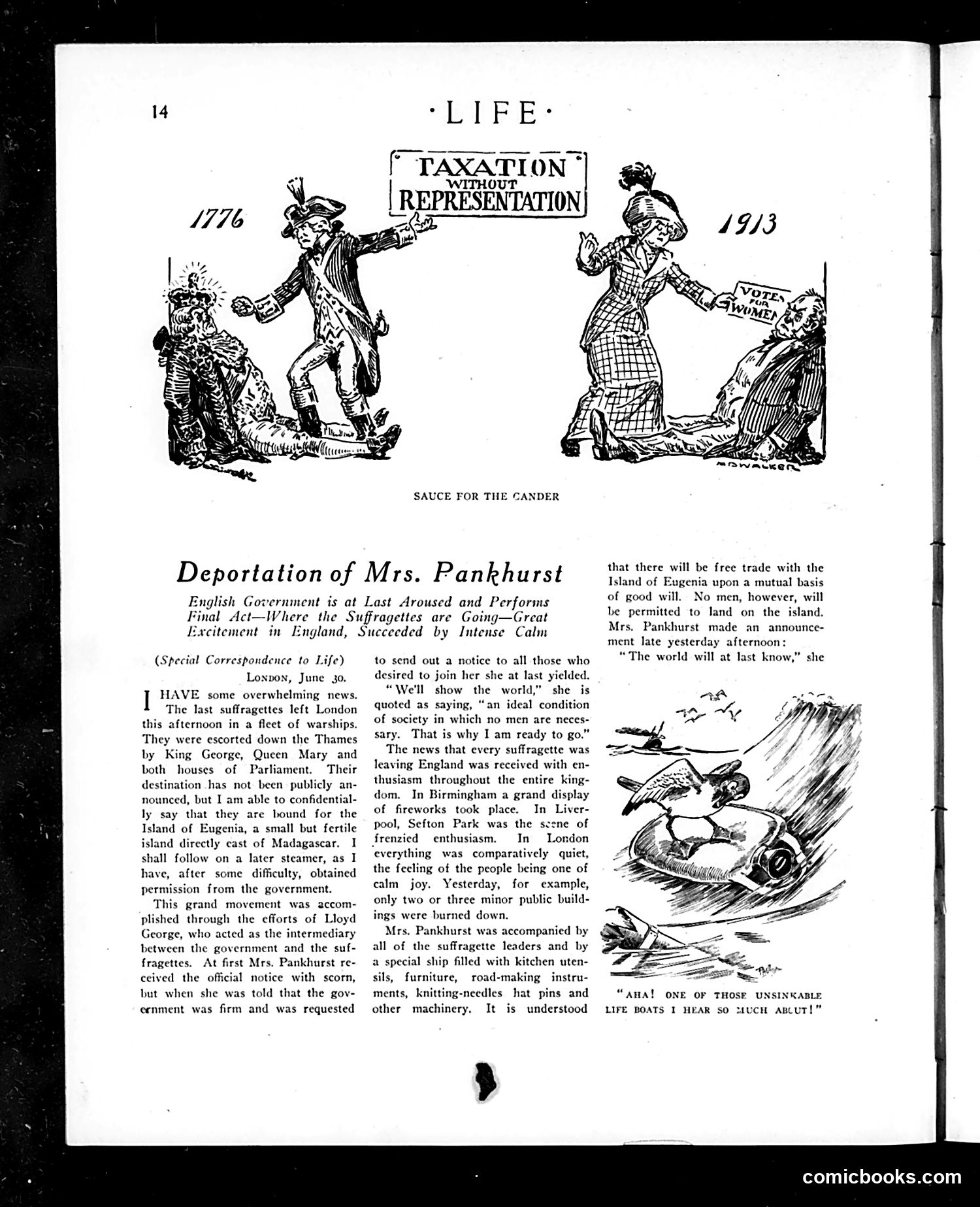
The top cartoon compares two historical moments of women's political struggle, separated by 137 years (1776-1913). **Left panel (1776):** depicts the American Revolution's "Taxation Without Representation" complaint, showing a colonist confronting British authority. **Right panel (1913):** parallels this with the suffragette movement, showing a woman holding a "Votes for Women" sign confronting what appears to be a male authority figure. **The satire's point:** American women in 1913 faced the same fundamental injustice as colonists—being taxed and governed without political voice or voting rights. By equating suffragettes with Revolutionary patriots, the cartoon elevates women's demands as fundamentally American and just. The accompanying article describes Mrs. Pankhurst's deportation, connecting British suffragettes' struggle to this American comparison.
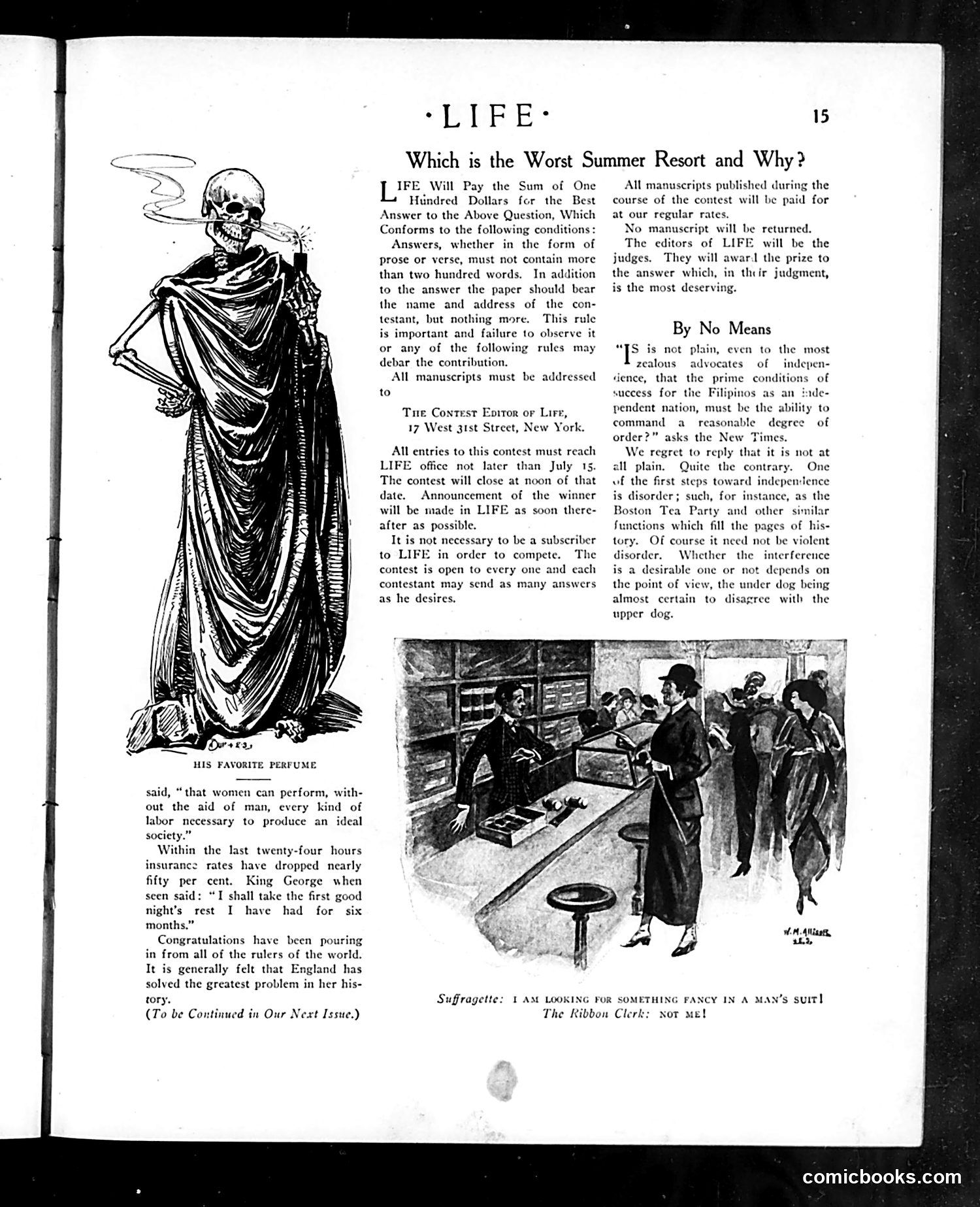
This page contains two distinct items: **Left side**: A skeleton labeled "His Favorite Perfume" accompanies text celebrating women's suffrage in Britain (likely the 1918 Representation of the People Act). The skeleton is Death personified—dark satire suggesting that granting women voting rights has killed something, presumably traditional male dominance. King George's quoted relief about finally getting rest suggests the suffrage question had exhausted political leadership. The piece mocks conservative fears about women's equality as apocalyptic. **Right side**: A cartoon labeled "Suffragette" depicts a woman in a ribbon shop asking for "something fancy in a man's suit," with the clerk refusing ("Not me!"). This jokes about suffragettes' perceived unfemininity and gender transgression—the visual gag equates political activism with literal masculine dress, mocking both the movement and traditional notions of proper female behavior. The page overall demonstrates Life's satirical treatment of early 20th-century feminism through grotesque and comedic imagery.
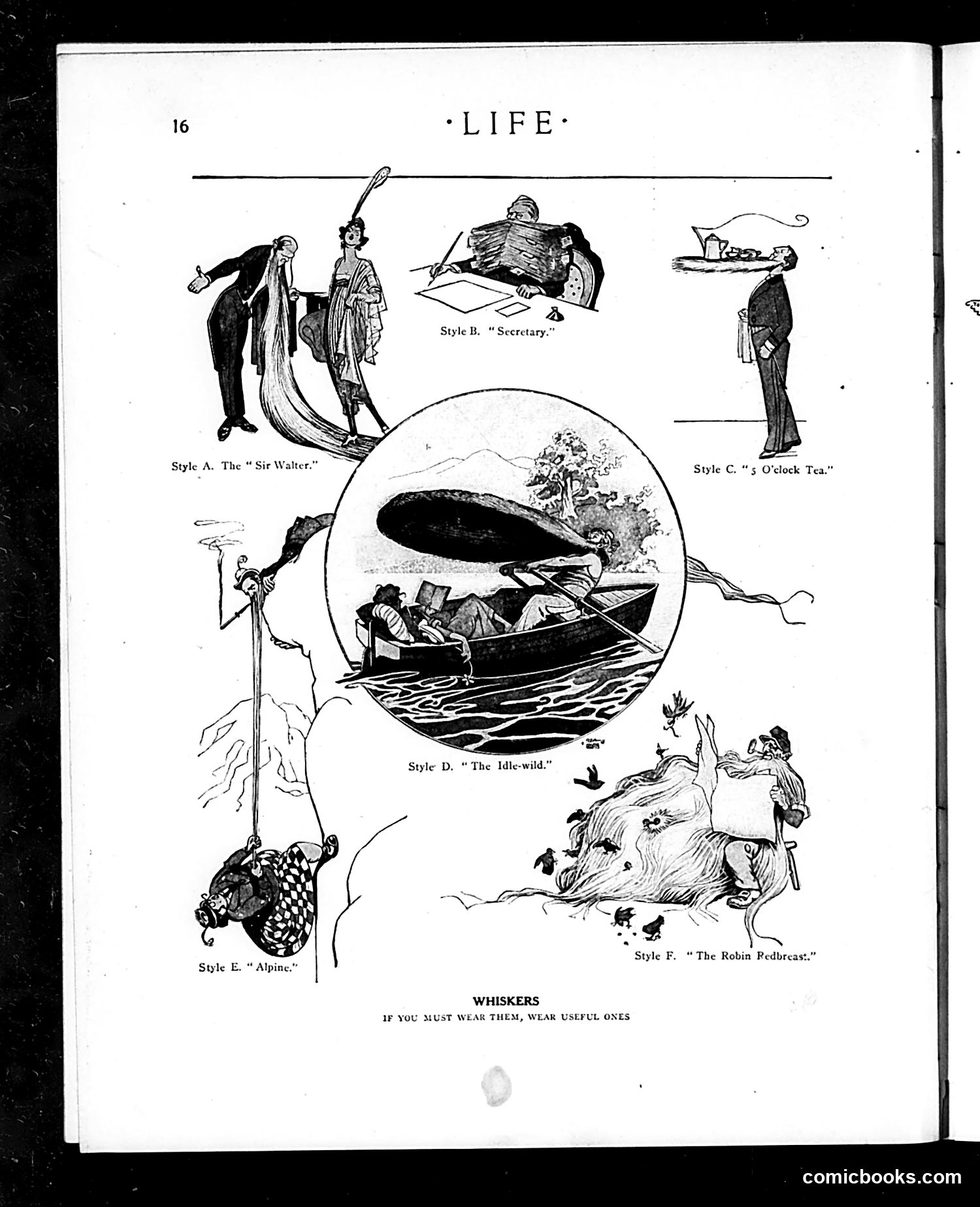
This page from *Life* magazine satirizes men's facial hair styles by pairing six different whisker styles with humorous names and scenarios. Each illustration shows a man sporting a distinct beard or mustache configuration paired with a stereotypical lifestyle or profession: - Style A: "The Sir Walter" (romantic gentleman) - Style B: "Secretary" (bureaucratic type) - Style C: "'O'clock Tea" (leisure class) - Style D: "The Idle-wild" (bohemian boatman) - Style E: "Alpine" (mountain climber) - Style F: "The Robin Redbreast" (naturalist) The headline—"If you must wear them, wear useful ones"—suggests the satire mocks fashionable whiskers as impractical affectation, implying men should adopt beards matching their actual occupations or pursuits rather than merely following fashion trends.
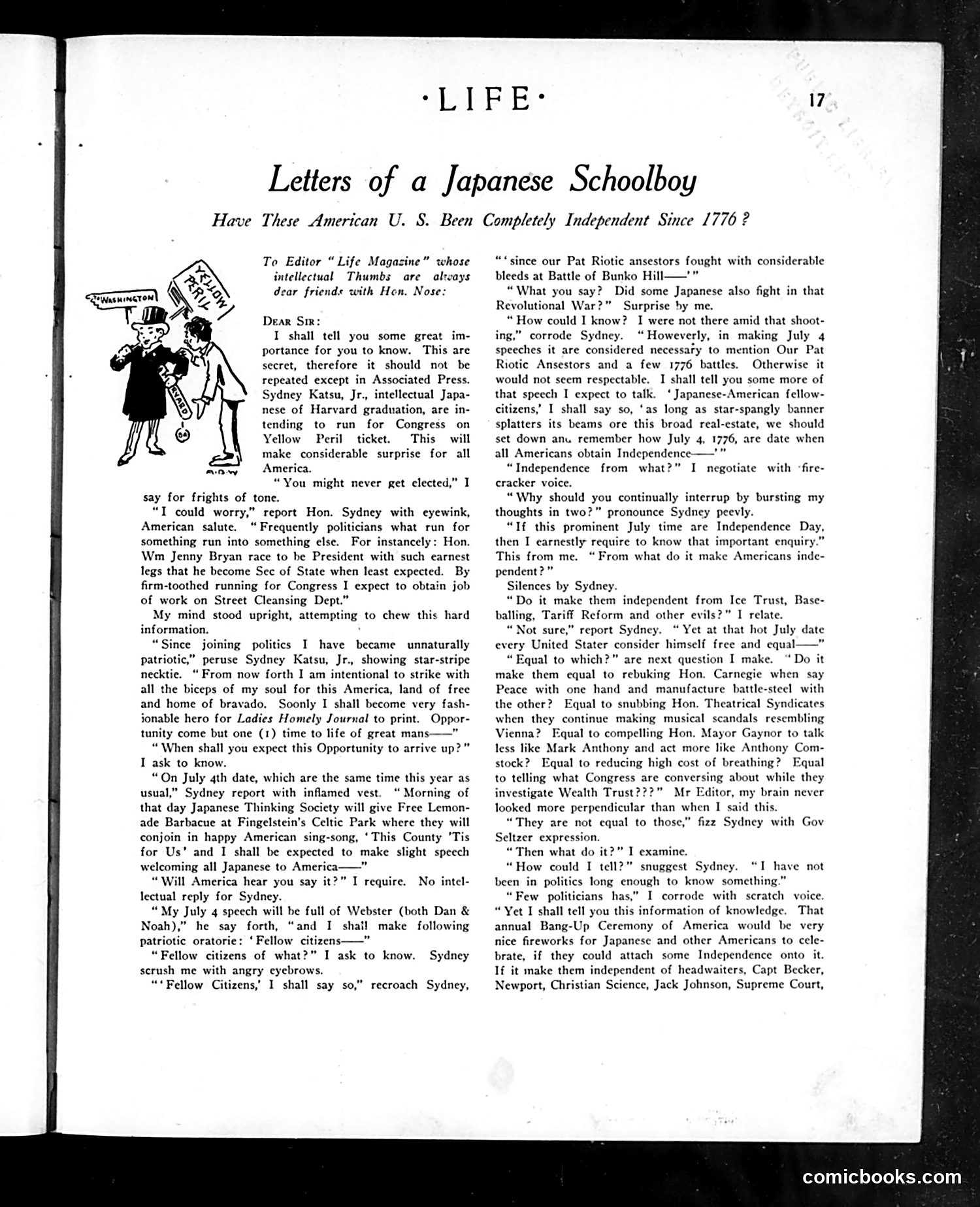
This is satirical commentary on Japanese-American assimilation and political aspiration, written as a humorous letter from "Sydney Katsu, Jr.," a Japanese Harvard graduate planning to run for Congress on the "Yellow Peril ticket." The humor relies on broken English mimicking a foreign accent—a common (if offensive by modern standards) early-20th-century American comedic device. Sydney's character embodies contradictions: he claims patriotic fervor while admitting ignorance about American history (not knowing if Japanese fought in the Revolutionary War), and he'll invoke "Pat Riotic Ansestors" despite being Japanese. The satire targets both American politics (politicians' hollow patriotic rhetoric) and anxieties about Asian immigration and political participation. The "Yellow Peril" reference confirms this plays on contemporary fears. The piece implicitly questions what "American independence" and citizenship truly mean when defined circularly through patriotic platitudes rather than substantive understanding—a critique applicable to both the character and American political discourse itself.
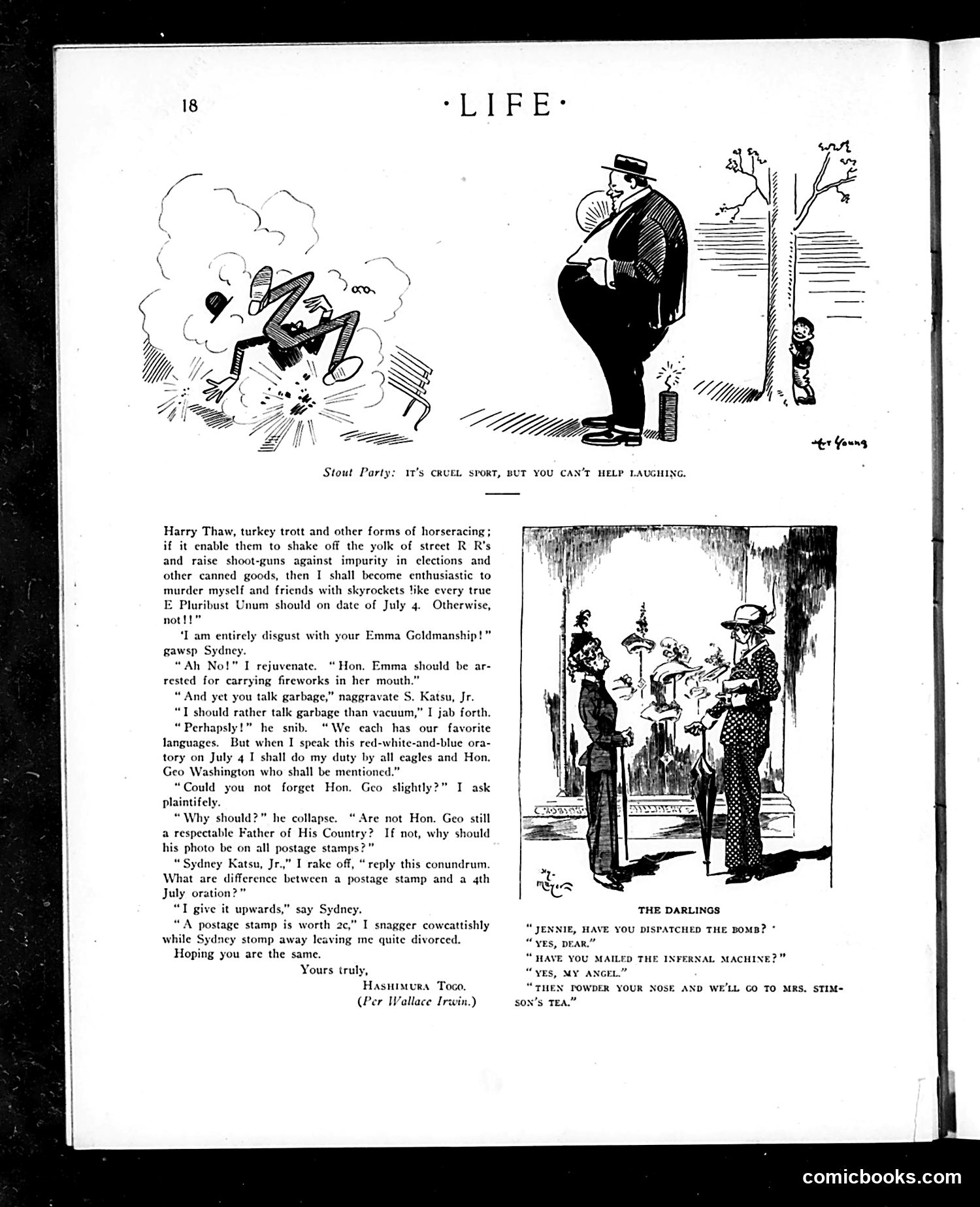
This page satirizes early-1900s anarchist and radical movements in America. The text, credited to Wallace Irwin (a humor writer), features a character named Hasimura Togo—likely a Japanese immigrant—discussing Emma Goldman, the famous anarchist activist, in broken English for comic effect. The satire mocks anxieties about "foreign" radicalism: Goldman was arrested for carrying fireworks (a reference to bomb-making fears). The protagonist contrasts her with patriotic symbols like George Washington and Fourth of July celebrations—ridiculing the contrast between radical talk and American traditions. The lower cartoon, "The Darlings," darkly jokes about domestic anarchist terrorism: a couple casually discusses "dispatching the bomb" and mailing "the infernal machine" before attending tea—treating violent anarchist acts as mundane household tasks. The humor relies on period fears of immigrant-led bombings and anarchist plots.
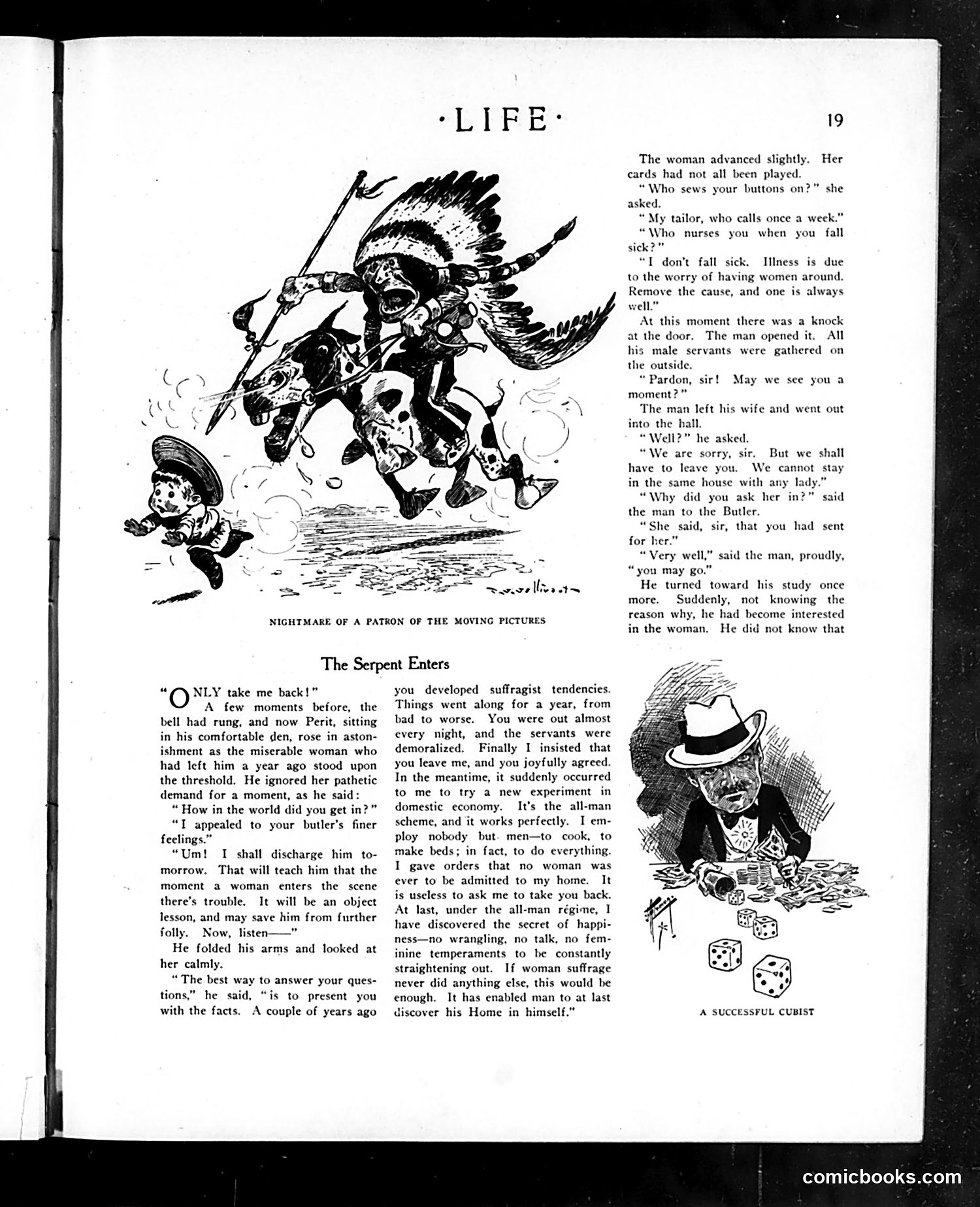
This 1910s-era satire mocks the "anti-suffrage" argument that women's demand for voting rights destroys domestic life. The story presents a man who expelled his suffragist wife, then hired an all-male household staff to achieve perfect peace and happiness—proving women cause all domestic chaos. The joke subverts his triumph: when his ex-wife returns, his male servants immediately quit rather than work alongside a woman, revealing the absurdity of his position. His "perfect" all-male system collapses the moment it encounters actual women. The top cartoon labeled "Nightmare of a Patron of the Moving Pictures" appears to satirize cinema patrons' anxieties about social change, though its exact reference is unclear. The satire targets anti-suffrage rhetoric by showing that removing women doesn't create male independence—it only exposes how dependent men actually are on women's labor, even while denying it.
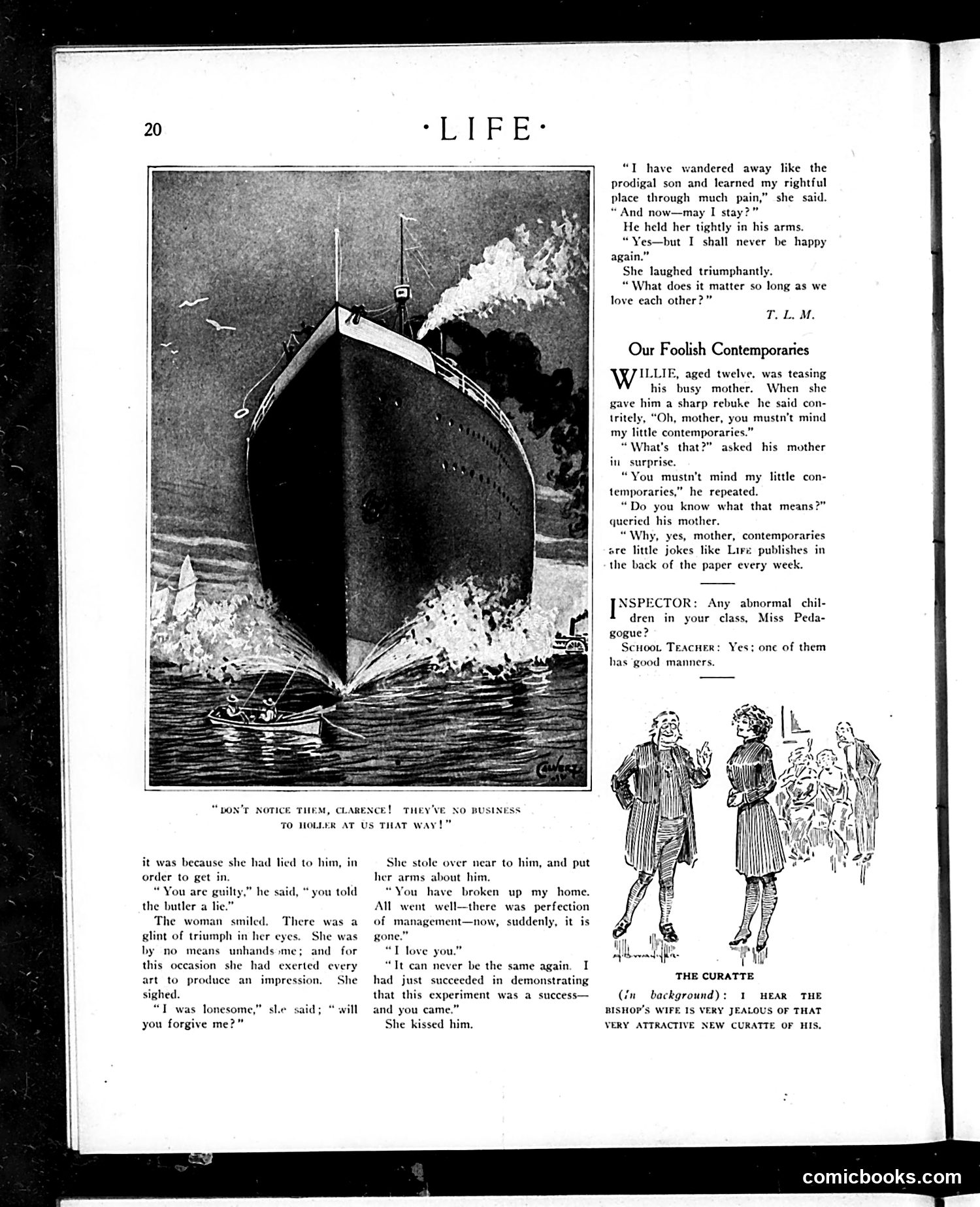
The large illustration depicts a dramatic ocean liner encounter, with the caption "DON'T NOTICE THEM, CLARENCE! THEY'VE NO BUSINESS TO HOLLER AT US THAT WAY." This appears to reference the *Titanic* disaster (1912), satirizing the wealthy and indifferent to the plight of those in lifeboats—a commentary on class callousness during catastrophe. The narrative text below concerns infidelity and reconciliation, illustrating broader themes about deception and forgiveness among the upper classes. The "Foolish Contemporaries" section is a humor feature where young Willie misunderstands "contemporaries" as "little jokes" published by *Life* magazine itself—a self-referential joke about the magazine's own satirical humor column. The final snippet mocks clergy jealousy, suggesting a bishop's wife resents the new curate's attractiveness—typical domestic scandal humor of the era.
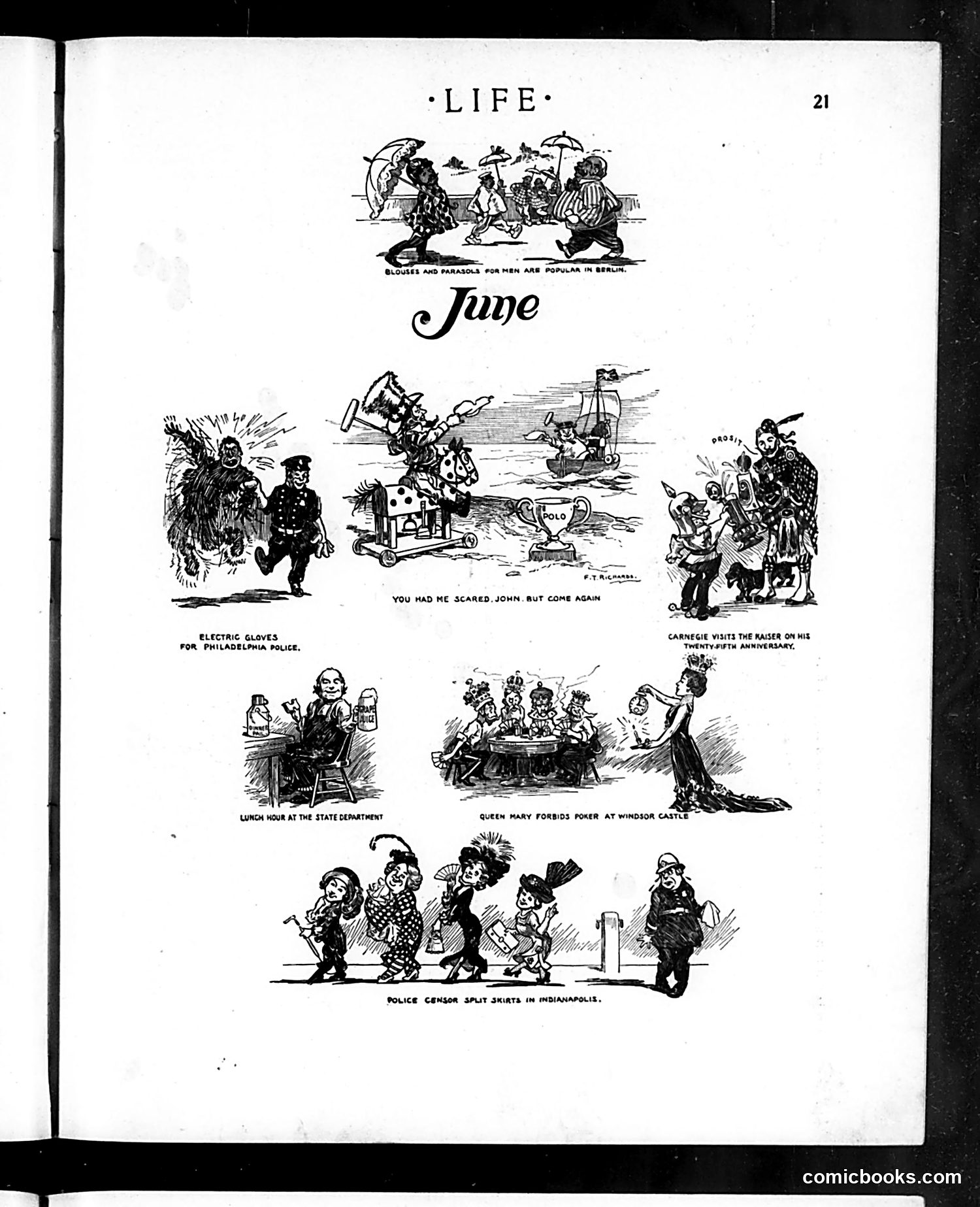
This satirical page presents six cartoon vignettes mocking early 1900s American news and social controversies: **Top left:** Philadelphia police equipped with electric gloves—likely referencing executions or new law-enforcement technology. **Top right:** Carnegie's anniversary visit—appears to reference industrialist Andrew Carnegie, satirizing wealthy philanthropists. **Center:** "You Had Me Scared, John, But Come Again"—unclear reference, possibly political. **Lower left:** "Lunch Hour at the State Department"—bureaucratic satire. **Center-bottom:** "Queen Mary Forbids Poker at Windsor Castle"—mocking British royal propriety. **Bottom:** "Police Censor Split Skirts in Indianapolis"—satirizing moral policing of women's fashion, specifically the then-scandalous hemlines appearing on skirts. The cartoons collectively mock authority figures, moral panic over social change, and hypocritical governance typical of Life's satirical approach.
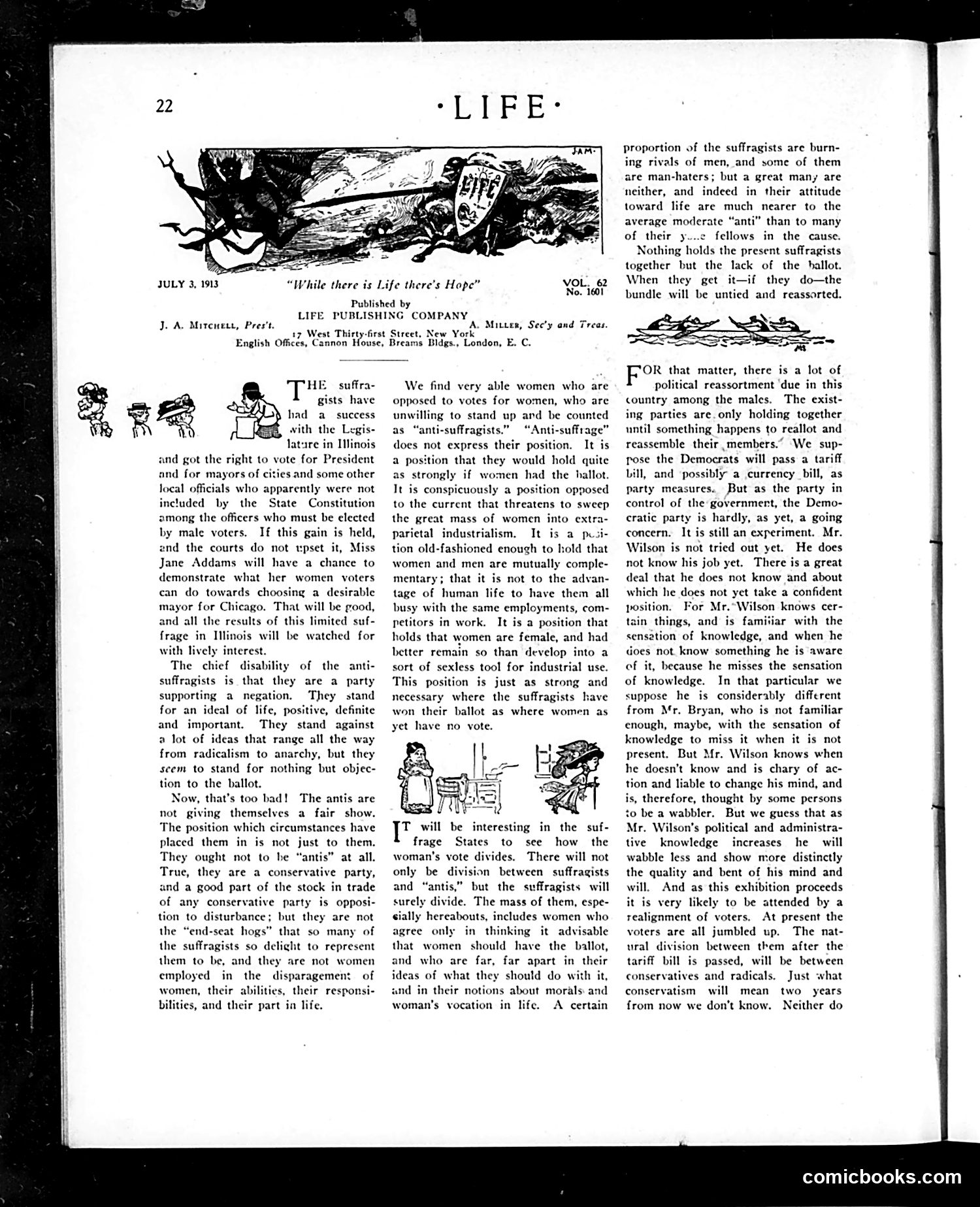
This editorial discusses the recent grant of limited women's suffrage in Illinois—allowing women to vote for president and some local officials. The author argues that anti-suffragists are strategically disadvantaged because they only stand *against* something (women voting) rather than articulating a positive vision. The piece acknowledges that intelligent women oppose suffrage, not from misogyny but from a conservative philosophy: that men and women are "mutually complementary" and shouldn't compete equally in industrial work. The author respects this position while supporting women's vote. Notably, the editorial predicts that once women gain suffrage, the suffragist coalition will fracture—they're currently united only by lacking the ballot. References to Jane Addams (the famous Chicago settlement house founder) suggest she might run for mayor once women could vote. The cartoons (featuring various caricatures) appear to illustrate these political divisions, though specific figures are unclear from the image quality.
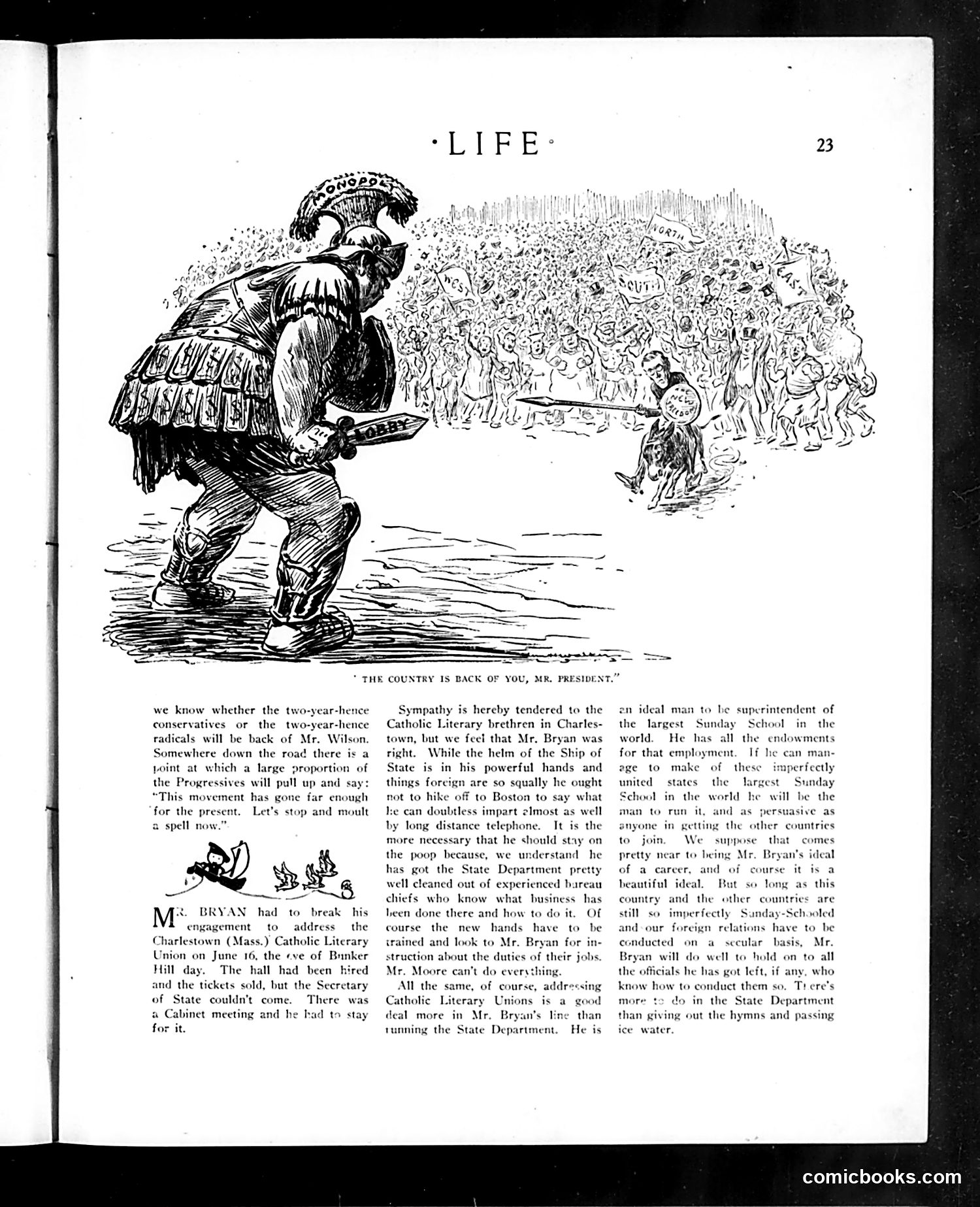
This 1912 *Life* magazine page satirizes Secretary of State William Jennings Bryan's management capabilities. The large cartoon depicts Bryan as a military/political figure addressing a crowd, with the caption ironically asserting popular support for the president (likely Wilson). The accompanying text mocks Bryan for canceling a speaking engagement to attend a Cabinet meeting, suggesting he's indispensable at the State Department because experienced bureau chiefs have departed. The satire's core joke: Bryan is ideally suited to run a "Sunday School" but poorly suited to handle complex foreign diplomacy. The piece implies his strength lies in moral persuasion and religious instruction, not statecraft. The commentary suggests Bryan is holding the department together through sheer presence, as newer staff require his constant instruction—a backhanded criticism of his actual diplomatic competence during a period of significant international tensions.
This page appears to be from *Life* magazine, but the OCR text is garbled and unreadable, consisting only of scattered letters and symbols. The black-and-white photograph shows what appears to be children or young people in a fenced yard or pen-like enclosure. The image quality and composition suggest this may be documentation of institutional or confined conditions, possibly from an orphanage, detention facility, or similar setting. Without legible accompanying text, I cannot definitively identify the specific historical context, location, or satirical intent. The fence structure and cramped conditions suggest the piece may critique inadequate child welfare or institutional practices, but this remains speculative without readable caption or article text to support interpretation.
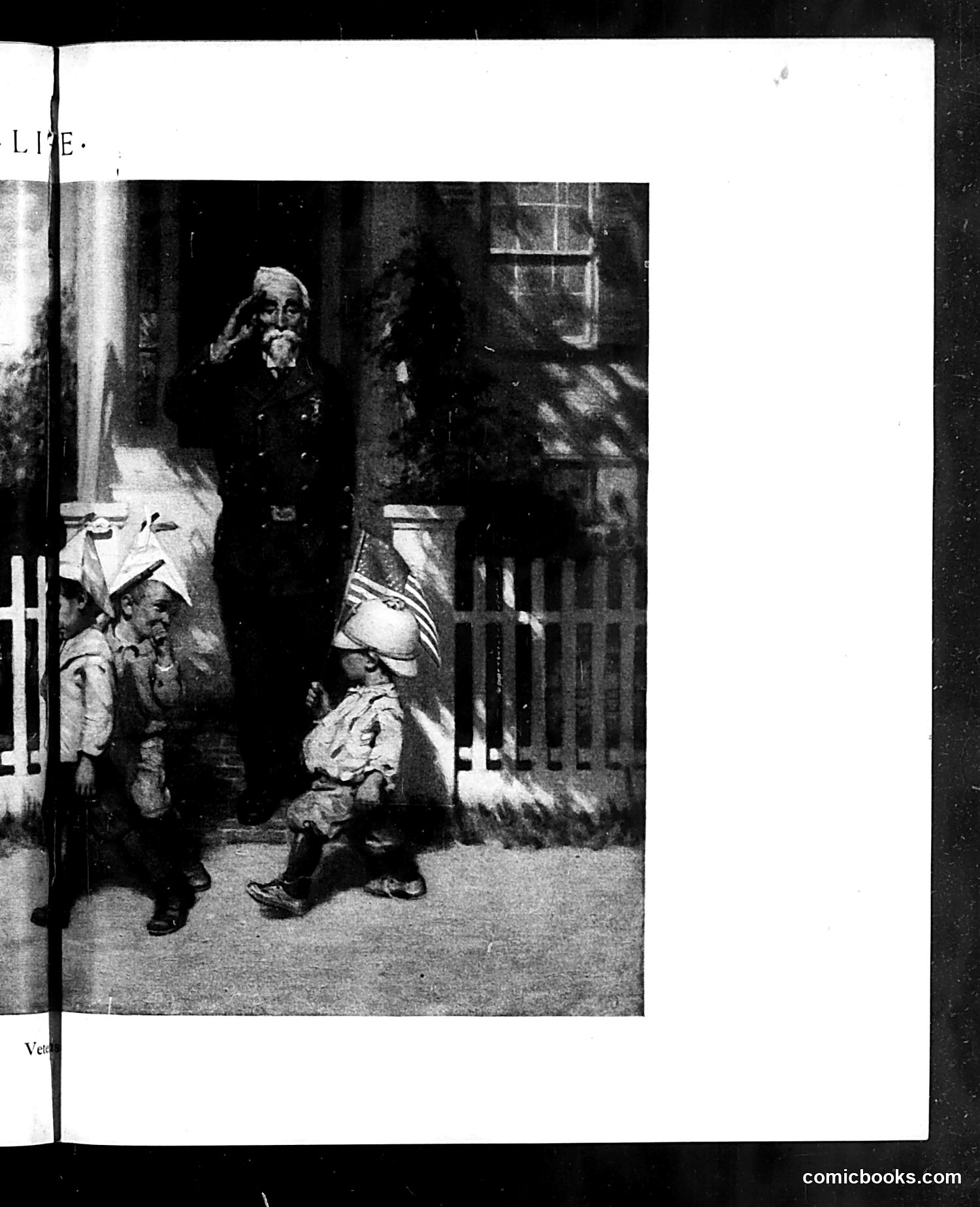
This page from *Life* magazine shows a black and white photograph or illustration depicting what appears to be a street scene with several figures. An elderly bearded man in dark clothing stands prominently, observing two younger figures—one appears to be doing a headstand or acrobatic pose while another watches nearby. A wooden fence and building are visible in the background. Without clear OCR text accompanying the image, the specific satirical point remains unclear. The scene could be commenting on generational differences, urban life, or social behavior of the period. However, without identifying captions, dates, or additional context text visible in the image itself, I cannot confidently identify the specific figures or political/social references this was meant to satirize.
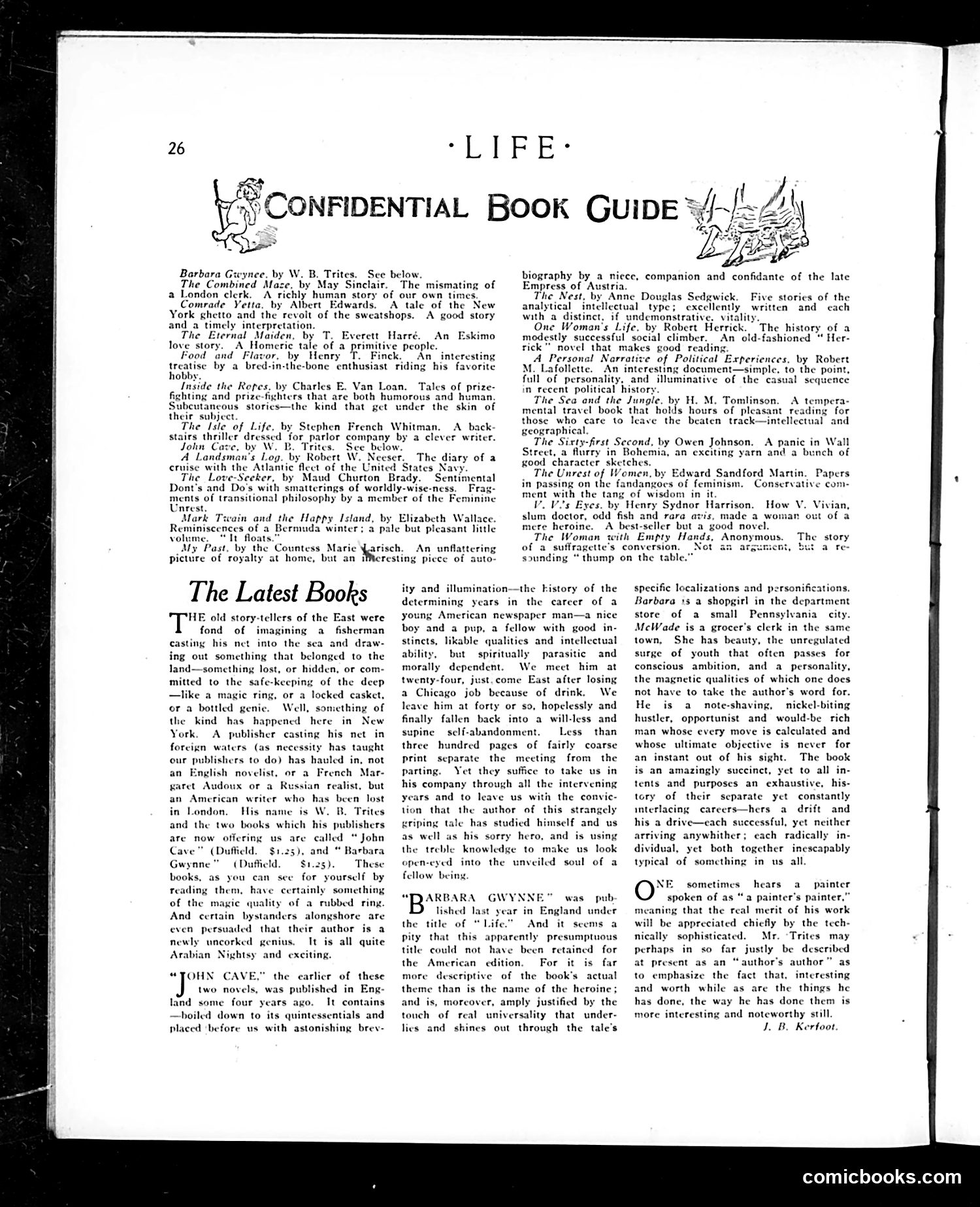
This is a book review page from *Life* magazine's "Confidential Book Guide" section. It's not a political cartoon but rather literary criticism and promotion. The page reviews contemporary novels (early 1900s) and includes a notable editorial essay about discovering W.B. Trites, an American writer lost to obscurity in London. The reviewer uses a whimsical metaphor—comparing the publisher's discovery to fishermen in Eastern tales pulling magical objects from the sea—to humorously explain how they unexpectedly found this "newly uncorked genius." The reviews reflect early 20th-century concerns: labor unrest ("Comrade Yetta" about sweatshops), social climbing, political memoirs (Robert M. La Follette's Progressive politics), and travel literature. The tone is sophisticated and somewhat condescending toward popular tastes, typical of *Life*'s satirical stance as an arbiter of cultural refinement for educated readers.
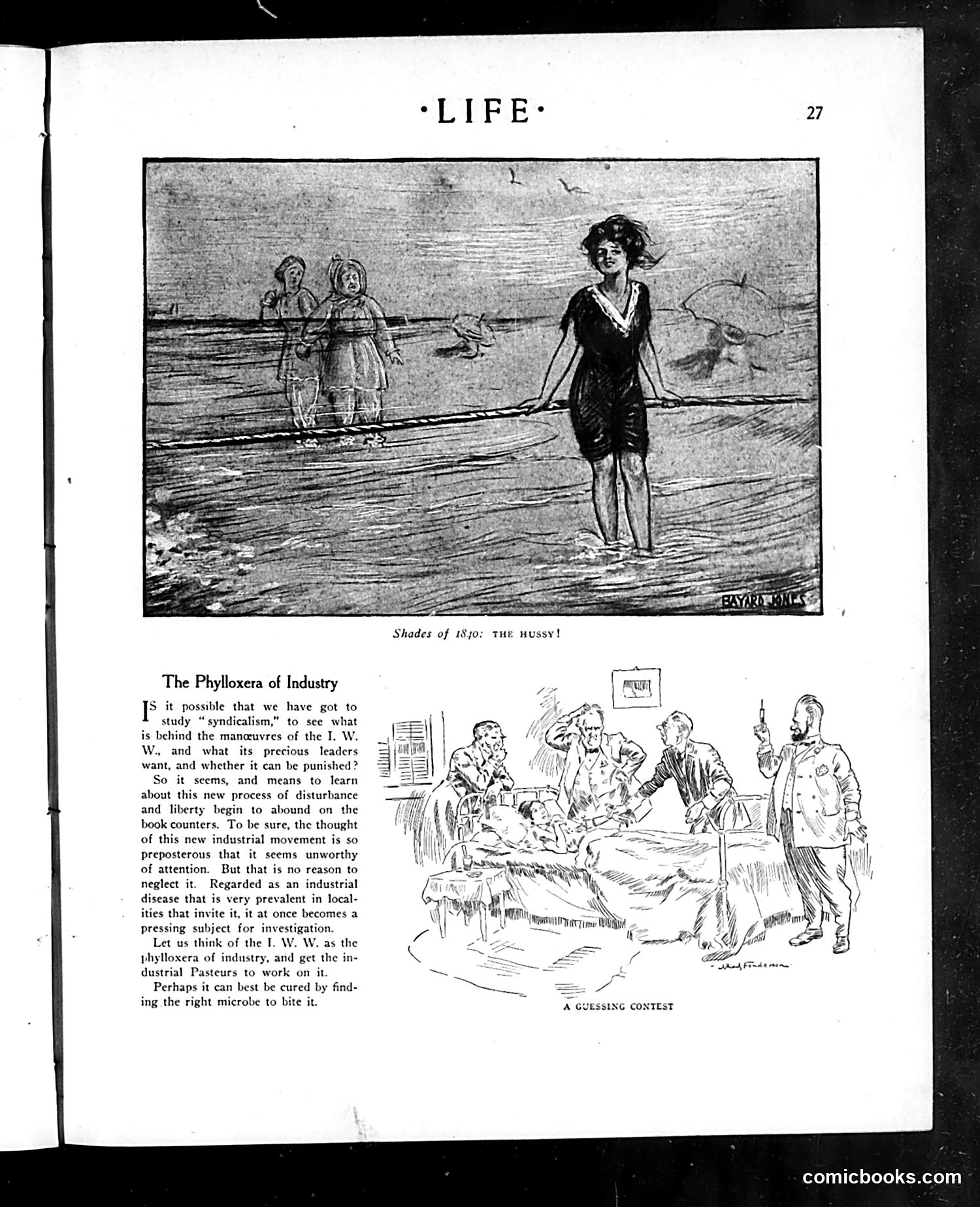
This 1910 *Life* magazine page contains two satirical pieces about labor and social issues. **Top cartoon** ("Shades of 1810: The Hussy!"): Shows a woman in a bathing suit at the beach while two others watch scandalized. The title references 1810, suggesting outrage over modern women's freedom and attire—a common conservative complaint of the era. **Main article** ("The Phylloxera of Industry"): Attacks the Industrial Workers of the World (I.W.W.), a radical labor union. The author dismisses syndicalism and labor activism as a "disease" afflicting industry, comparing it to phylloxera (an agricultural pest). He sarcastically proposes finding an intellectual "microbe" to combat it—suggesting radical ideas require counter-ideas rather than acknowledging legitimate worker grievances. The accompanying sketch shows military or government officials examining something, likely representing authorities addressing labor unrest. The piece reflects the era's class anxieties and anti-radical sentiment.
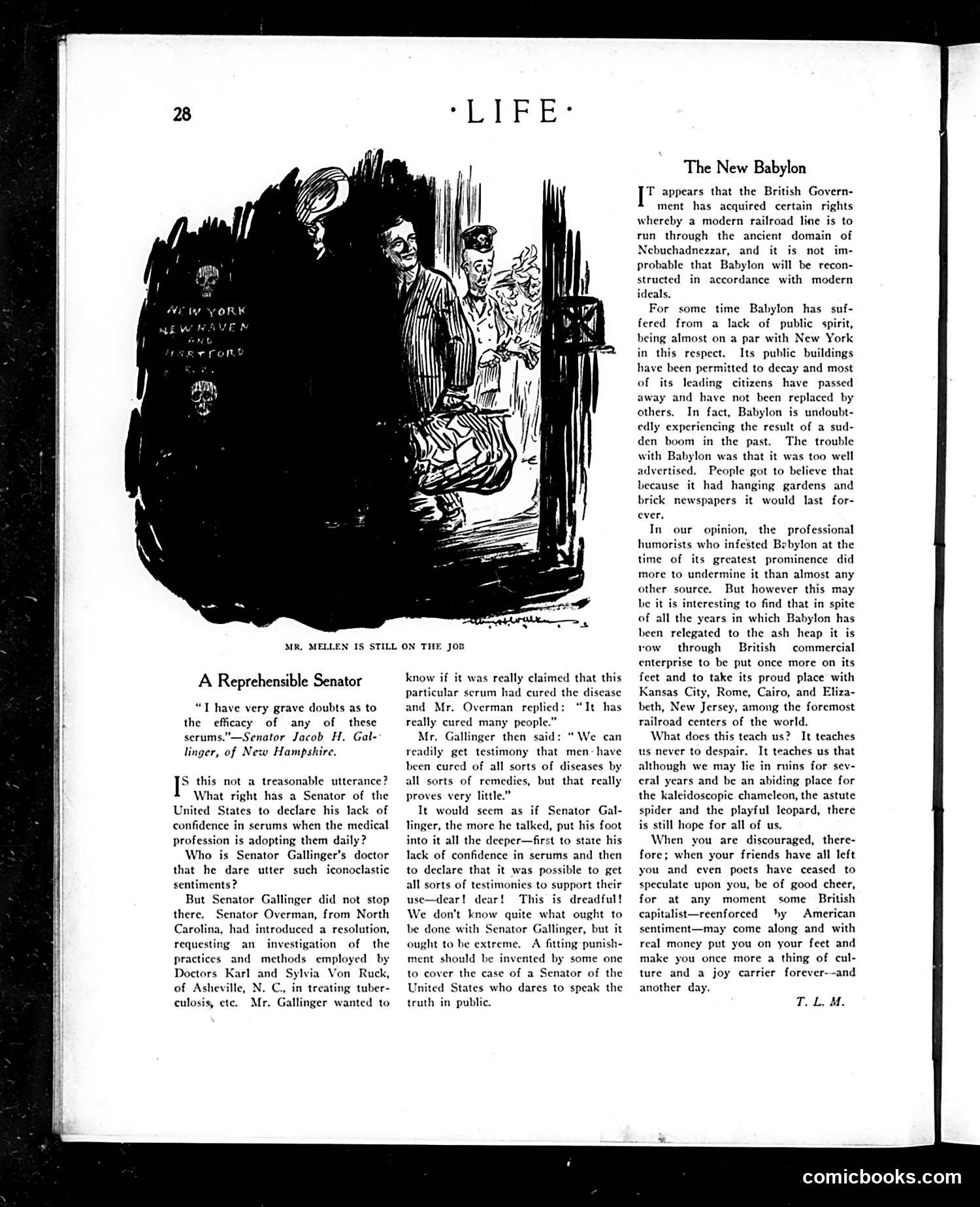
The page contains two satirical pieces: **"A Reprehensible Senator"** critiques Senator Jacob Gallinger of New Hampshire for publicly doubting the efficacy of medical serums and questioning testimonials supporting their use. The satire is ironic—Life mock-outrage that a senator would "dare to speak the truth in public," exposing that medical testimonials prove little. The cartoon (captioned "Mr. Mellen is Still on the Job") depicts figures in what appears to be a medical or scientific context, though the specific reference is unclear. **"The New Babylon"** humorously compares ancient Babylon's decline to modern New York City's decay, suggesting both suffer from lack of public spirit. It satirizes how over-advertising (Babylon's "hanging gardens and brick newspapers") created false permanence. The piece mocks that British capitalists and American sentiment might revive Babylon as a railroad center alongside Kansas City and Elizabeth, New Jersey—absurdly grouping ancient splendor with mundane modern industrial towns as proof that ruins can be resurrected. Both pieces use irony and hyperbole to critique contemporary institutions and attitudes.
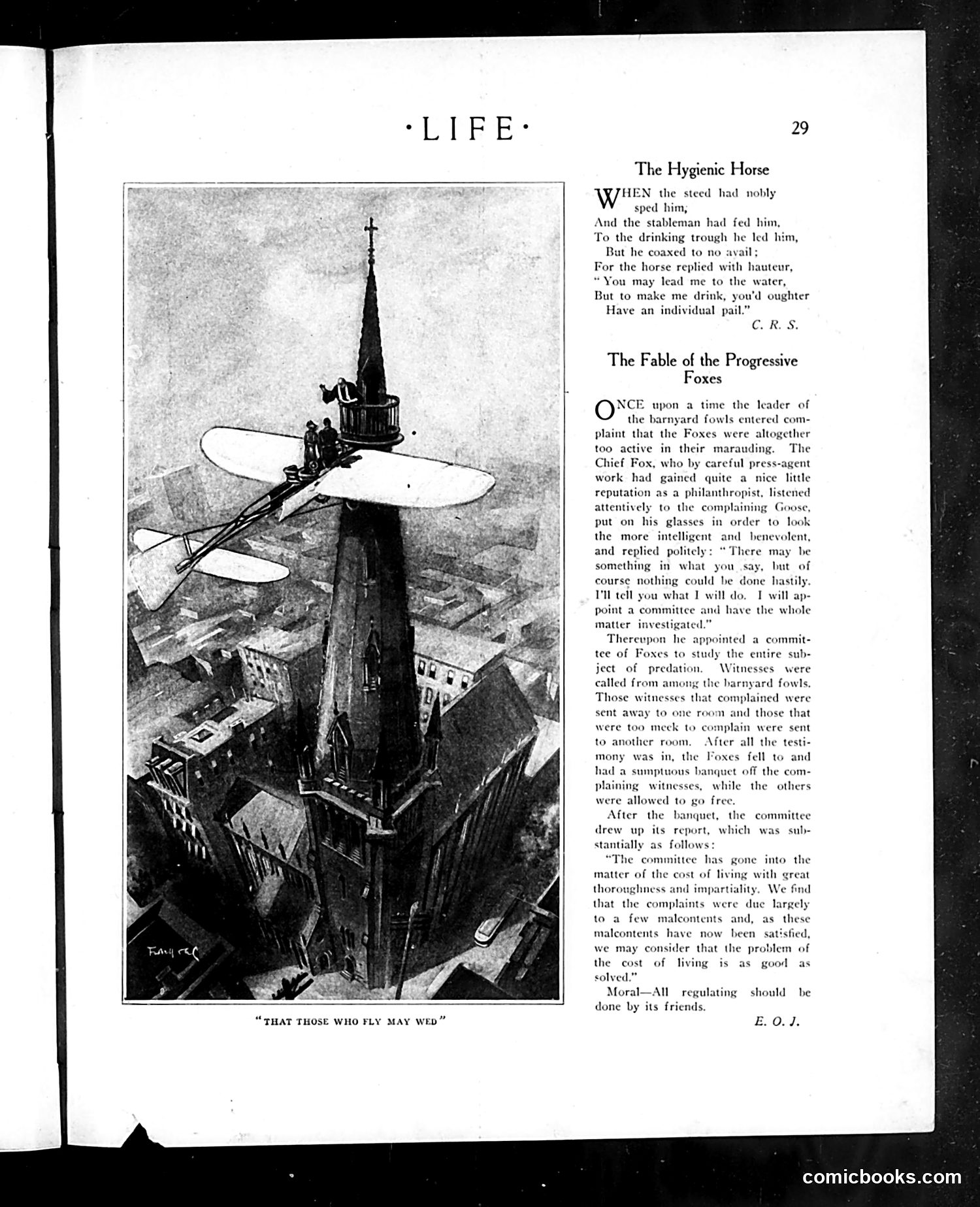
This satirical fable mocks progressive-era reform efforts and regulatory commissions. A Chief Fox—representing a reform-minded politician or regulator—responds to complaints from barnyard fowls (ordinary citizens) about foxes (predatory interests) by appointing a committee of foxes to investigate predation. The committee manipulates the process by segregating complaining witnesses from meek ones, then holds a banquet featuring the vocal complainants as the meal. Their report dismisses the problem as solved, caused only by "malcontents" now satisfied. The satire targets how industries or corrupt officials control the very regulatory bodies meant to constrain them. By placing the "foxes" in charge of investigating themselves, the fable suggests that reform commissions often become tools of the interests they're supposed to regulate. The moral—"All regulating should be done by its friends"—drips with irony, meaning the opposite: regulation by interested parties is useless.
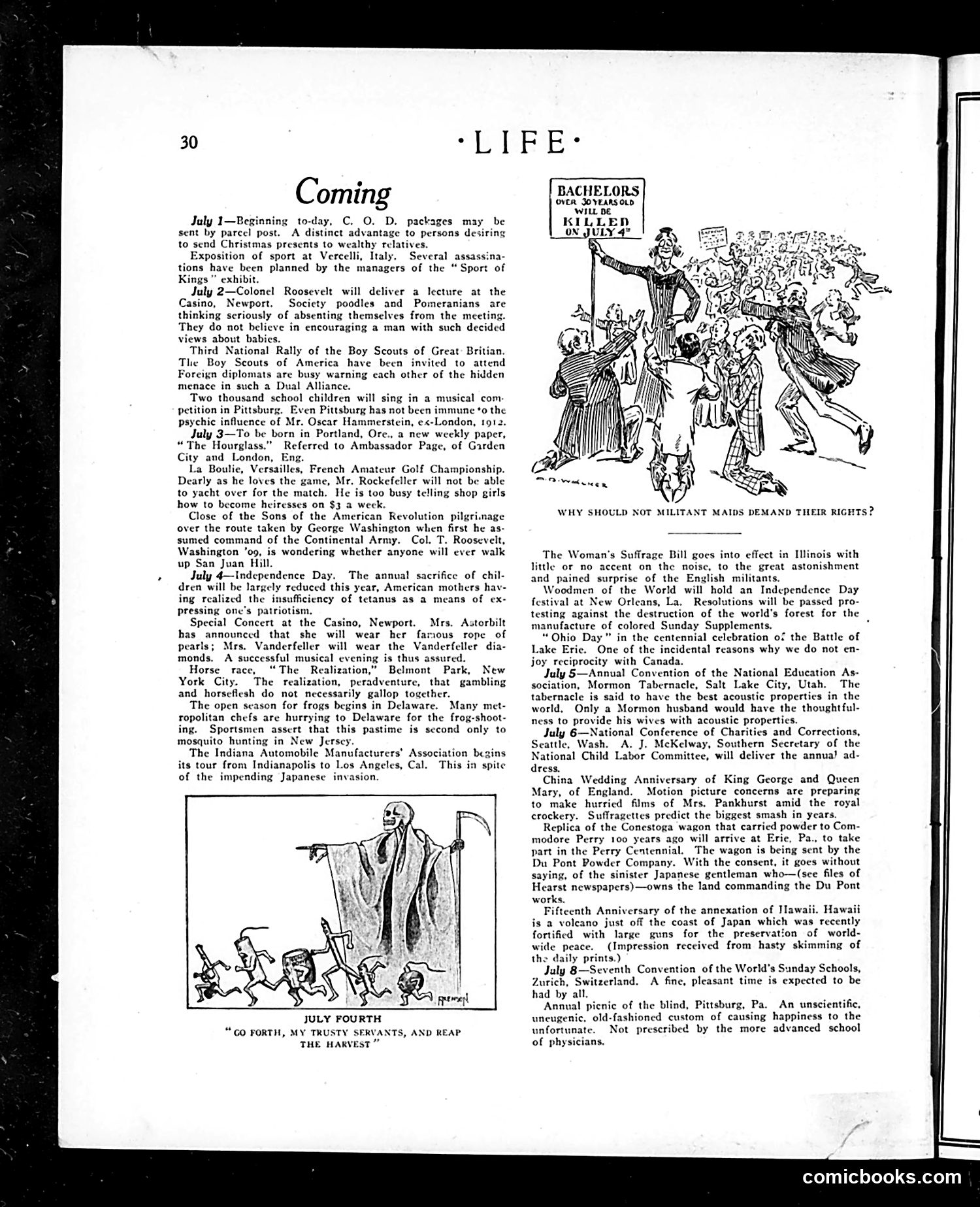
This page from *Life* magazine (circa 1912) contains two satirical cartoons mocking contemporary American society. The upper cartoon depicts Lady Liberty distributing votes to "bachelors over 30 years old" who will be "killed on July 4th"—a dark joke about the male-only franchise. The caption "Why Should Not Militant Maids Demand Their Rights?" references the women's suffrage movement, particularly British "militant" suffragettes who were making headlines through disruptive protests. The lower cartoon, captioned "Go Forth, My Trusty Servants, and Reap the Harvest," shows Uncle Sam commanding children toward an explosion, satirizing Independence Day celebrations where children were injured or killed by fireworks. The text confirms this, noting Americans were "reducing" the "annual sacrifice of children" this year because mothers realized "tetanus" wasn't worth the patriotic display. Both cartoons use dark humor to critique social inequities (female disenfranchisement) and dangerous traditions (fireworks injuries).
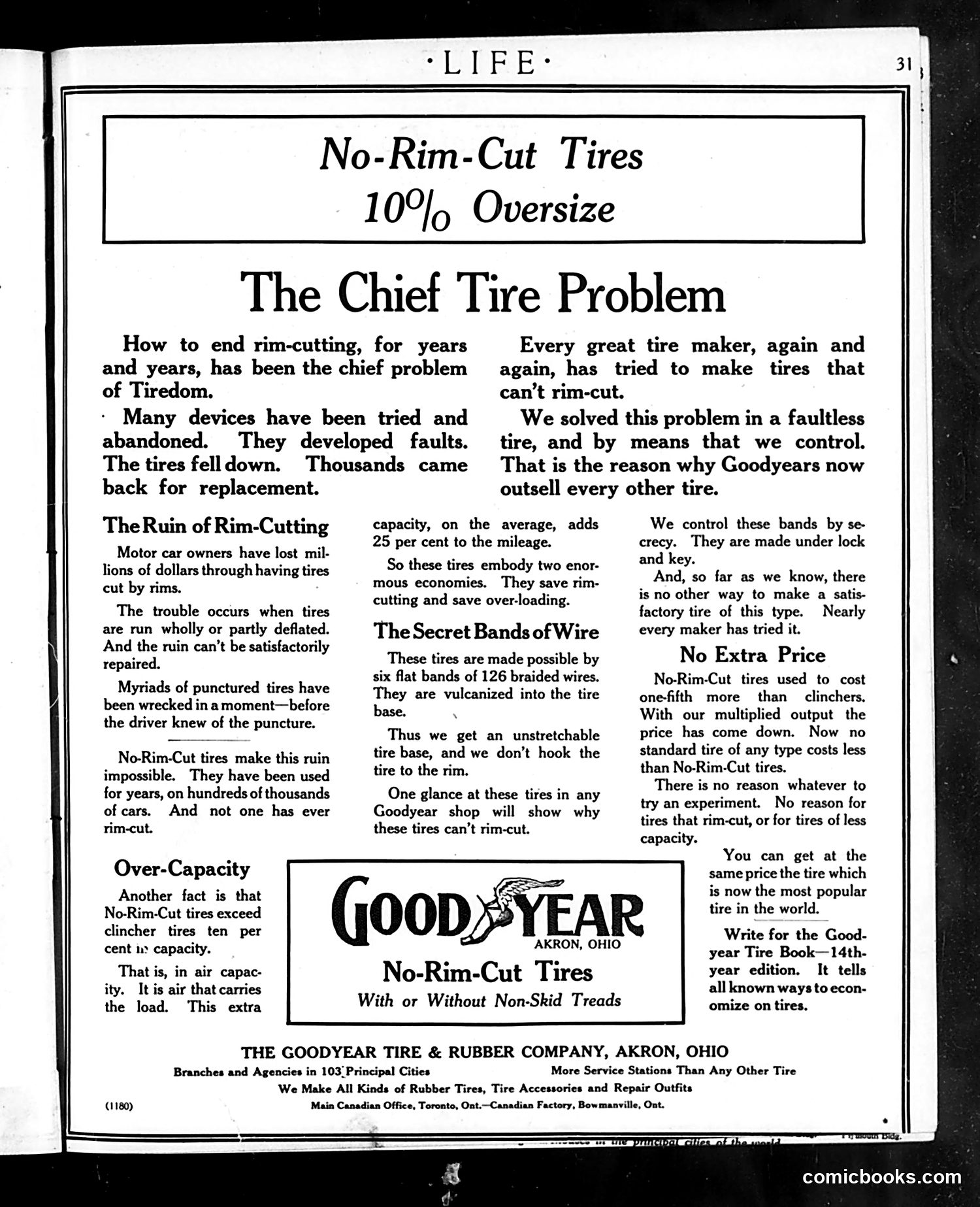
This is **not a cartoon or satire**—it's a full-page advertisement for Goodyear tires from an early 20th-century issue of *Life* magazine. The ad addresses a genuine automotive problem of the era: "rim-cutting," where partially deflated tires would be damaged by contact with wheel rims, causing expensive failures. Goodyear claims to have solved this through "No-Rim-Cut" tires using six braided wire bands vulcanized into the tire base, creating an unstretchable foundation that doesn't hook to the rim. The ad emphasizes competitive advantages: 10% oversizing, 10% greater air capacity (adding 25% to mileage), and now—importantly—**no price premium** over standard tires. Goodyear stresses that competitors have tried and failed to solve this problem, and that their solution is proprietary ("made under lock and key"). This represents early automotive marketing leveraging a specific technical solution as a market differentiator.
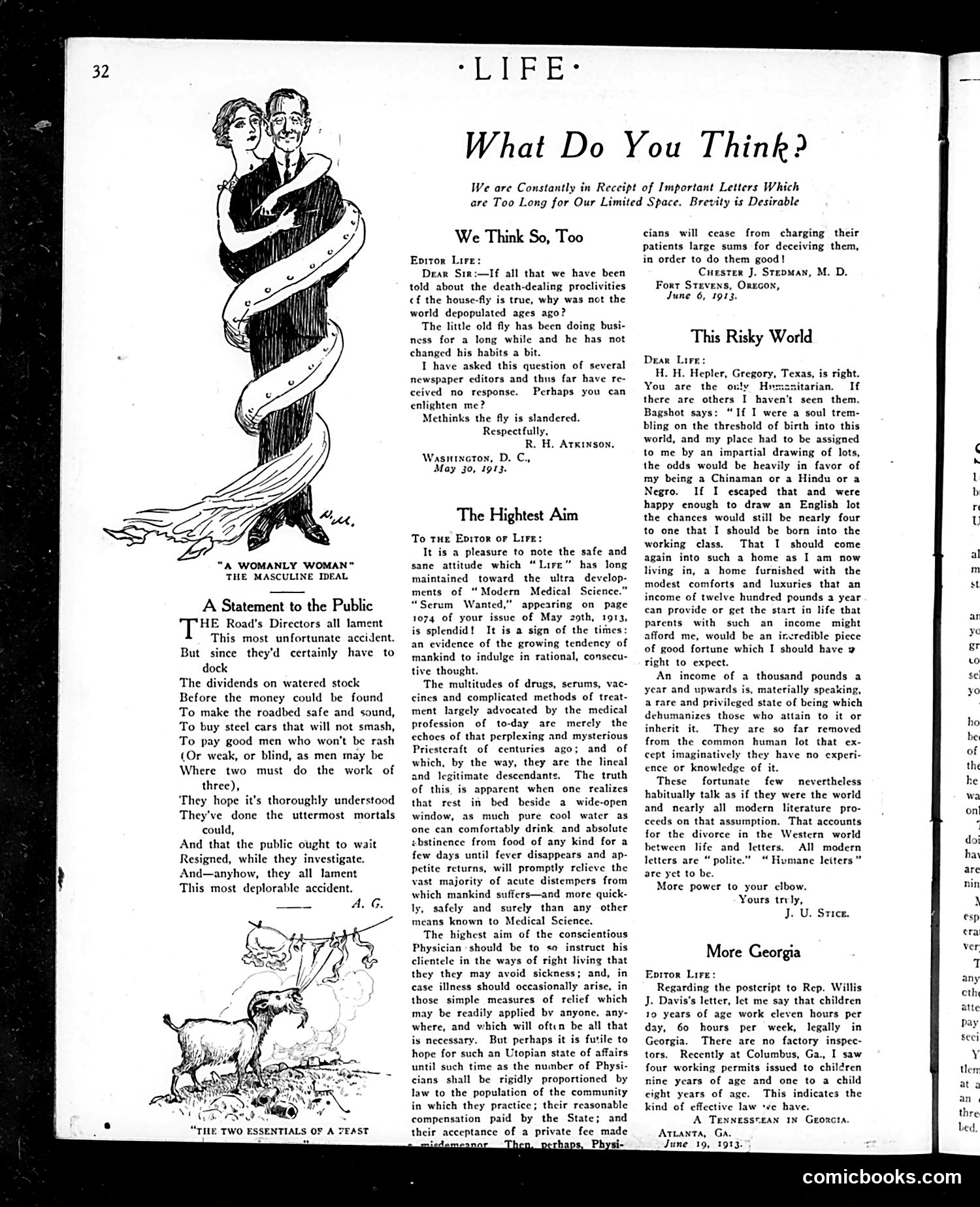
This page presents reader letters and editorial commentary typical of Life's satirical format circa 1913. **Top cartoon ("A Womanly Woman"):** Depicts a couple wrapped together in a snake-like coil, satirizing contemporary gender ideals. The caption suggests irony about what constitutes "masculine" and "womanly" behavior—likely mocking rigid social conventions of the era. **"Statement to the Public":** A biting satire on railroad company negligence. It mocks a railroad's excuse-making after an accident: they claim poverty prevents safety improvements (safe cars, qualified workers) while protecting "watered stock" dividends. The satire argues the company offers empty "lament" while refusing accountability—a commentary on corporate irresponsibility and profit prioritization over public safety. **Reader letters section:** Includes earnest public correspondence on topics like housefly dangers and medical practice, alongside Life's dismissive responses, reflecting the magazine's role critiquing pseudoscience and pretension. The overall tone mocks institutional hypocrisy and modern absurdities.
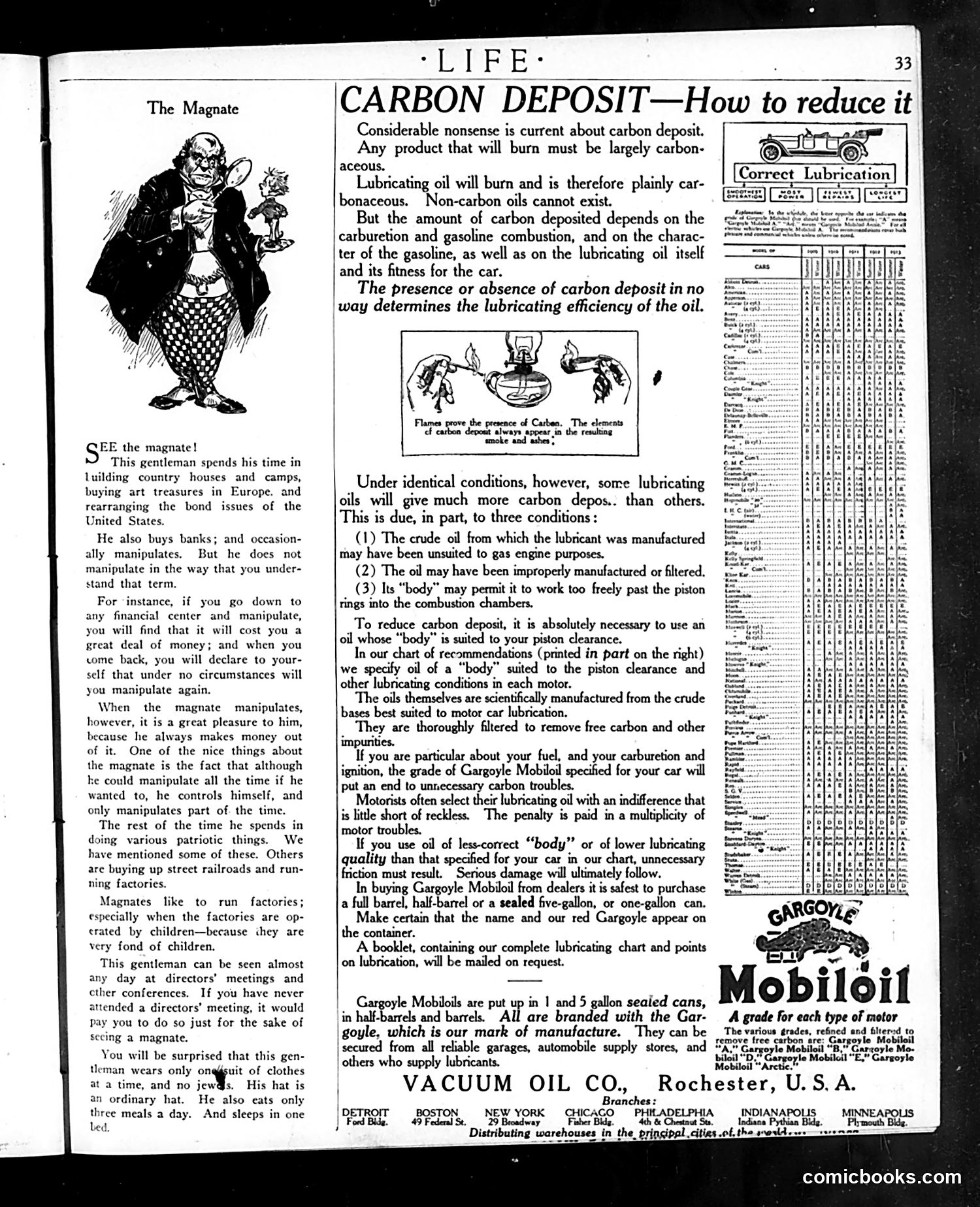
**The Cartoon:** The left side features a caricatured figure labeled "The Magnate"—a wealthy, well-dressed gentleman depicted with exaggerated features, holding what appears to be a small figure or object. **The Satire's Point:** This is Life magazine's mockery of America's wealthy industrialist class. The accompanying text sarcastically praises magnates who spend time "building country houses and camps" and "rearranging bond issues" while manipulating finances for personal profit. **Key Satirical Elements:** - The contrast between magnates' claimed "patriotic" activities (buying railroads, running factories) and their actual self-interest - Particular barb: they operate factories using child labor "because they are very fond of children"—obviously ironic - The notion that magnates "control themselves" by only manipulating finances "part of the time" - Amazement that such powerful men wear ordinary clothes and eat three meals daily—suggesting readers see them as almost superhuman The satirical tone criticizes wealthy industrialists' financial manipulation, labor exploitation, and their celebration in society despite clear ethical problems.
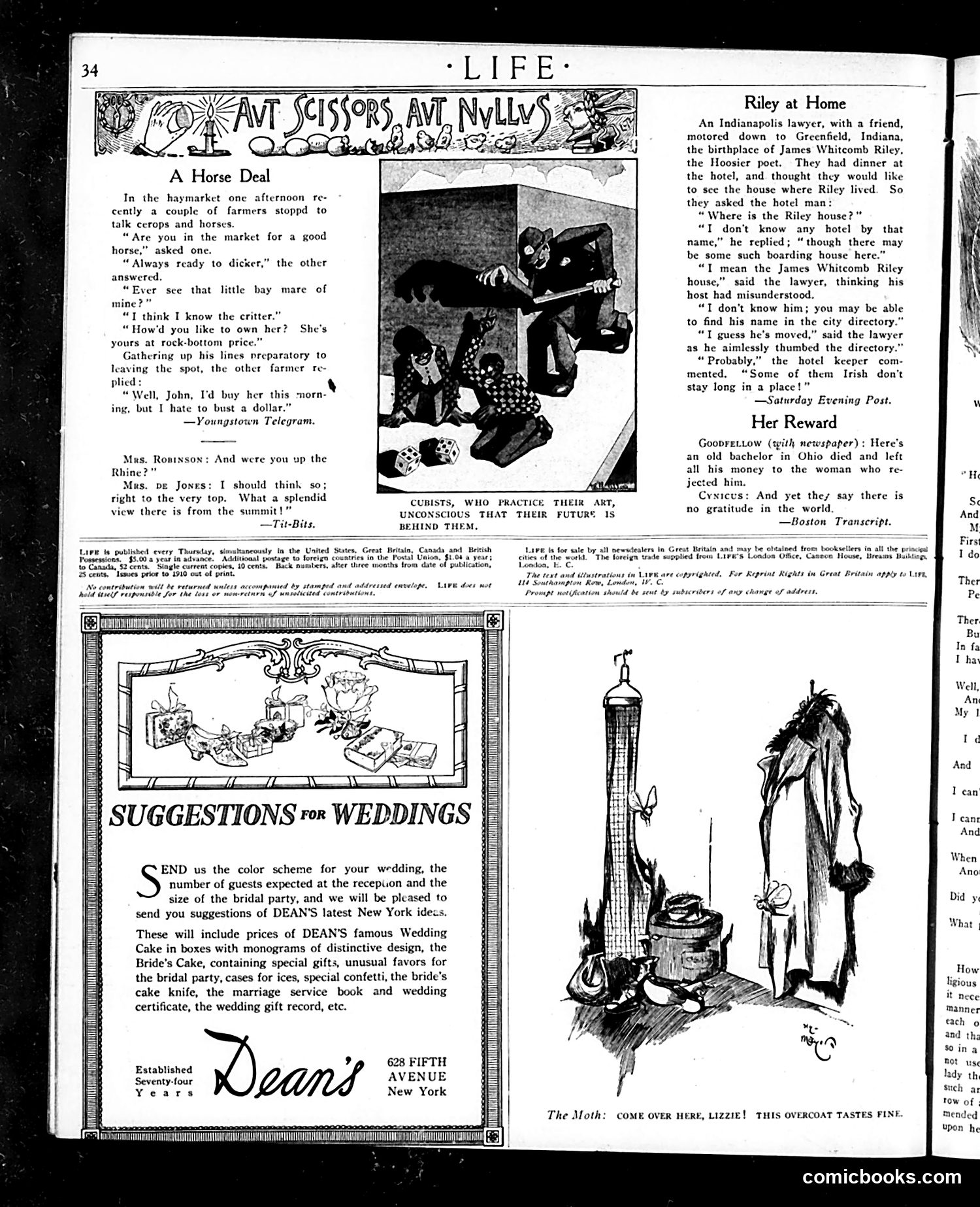
This page contains several brief humorous anecdotes and advertisements typical of early 20th-century Life magazine's satirical format. **"A Horse Deal"**: A farmer's joke about rural negotiations—one farmer won't buy a good horse because he refuses to "bust a dollar," meaning he won't spend even one dollar. The humor lies in the absurd penny-pinching. **"Cubists" cartoon**: A visual joke mocking Cubism, the avant-garde art movement. The caption suggests Cubists practice their art "unconscious that their future is behind them"—implying the movement is already outdated or will soon be forgotten. This reflects early 20th-century skepticism about modernist art. **"Riley at Home"**: An anecdote about visiting poet James Whitcomb Riley's birthplace in Indiana. A hotel clerk doesn't recognize Riley's name and assumes he's Irish and transient—a gentle ethnic joke suggesting Irish people were considered mobile, lower-class laborers. **Other items**: Brief newspaper humor and a Dean's wedding services advertisement. The page reflects common satirical targets: rural simplicity, modernist pretension, and ethnic stereotypes.
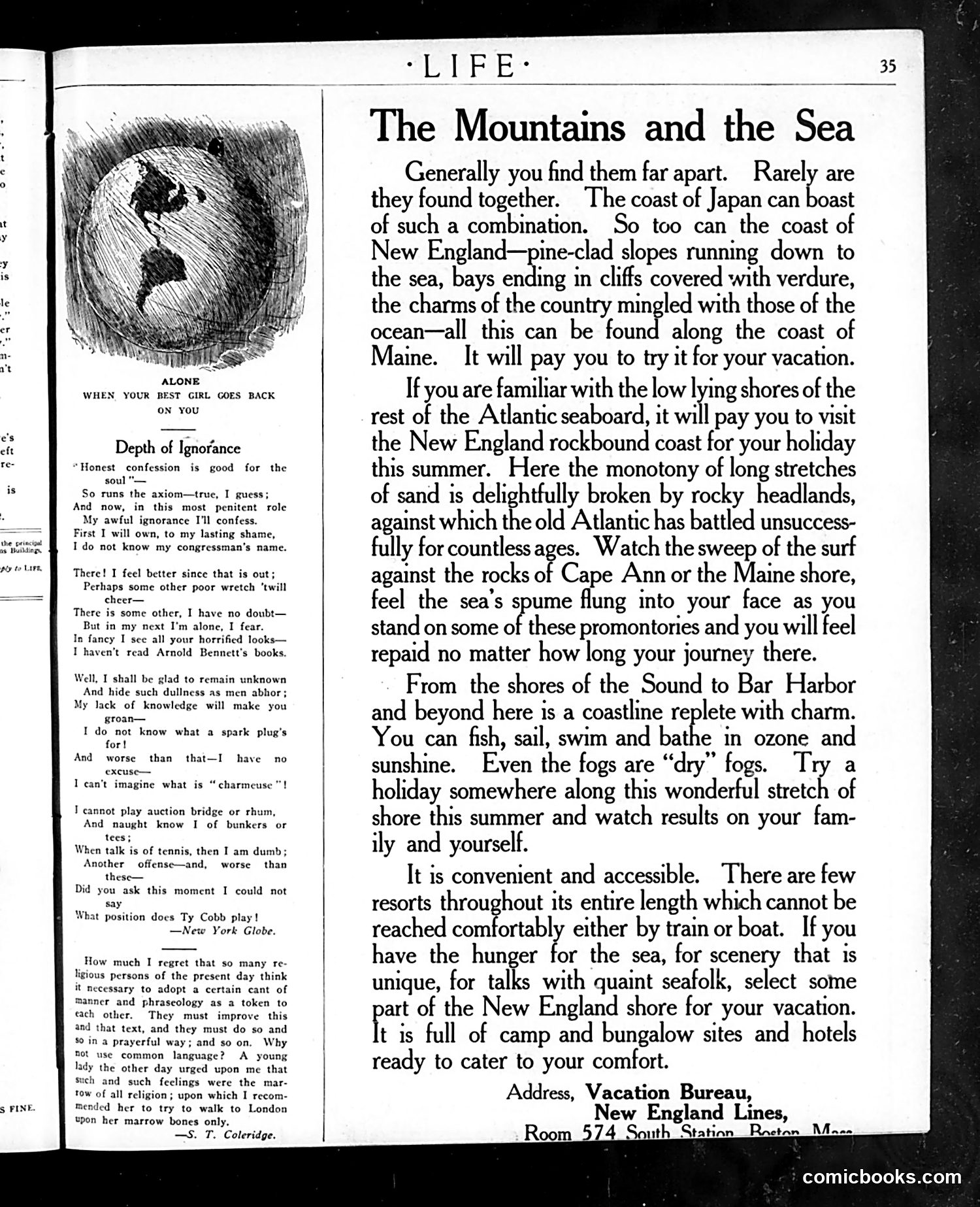
The cartoon features a sorrowful face with the caption "WHEN YOUR BEST GIRL GOES BACK ON YOU," illustrating romantic rejection through exaggerated emotional display. The accompanying poem is satirical social commentary on early 20th-century American ignorance and pretension. The speaker confesses embarrassing gaps in knowledge—not knowing his congressman's name, being unfamiliar with fashionable fabric ("charmeuse"), unable to play bridge or golf, and crucially, not knowing baseball star Ty Cobb's position. These specific references suggest the poem mocks the public's selective knowledge: citizens ignored civics but obsessed over celebrity sports figures and fashionable consumer goods. The humor targets both the speaker's obliviousness and the shallow priorities of society generally. The inclusion of a Coleridge quote about religious phoniness reinforces the satirical theme: people adopt affected manners and language rather than speaking plainly. The page overall critiques American cultural superficiality around the time period.
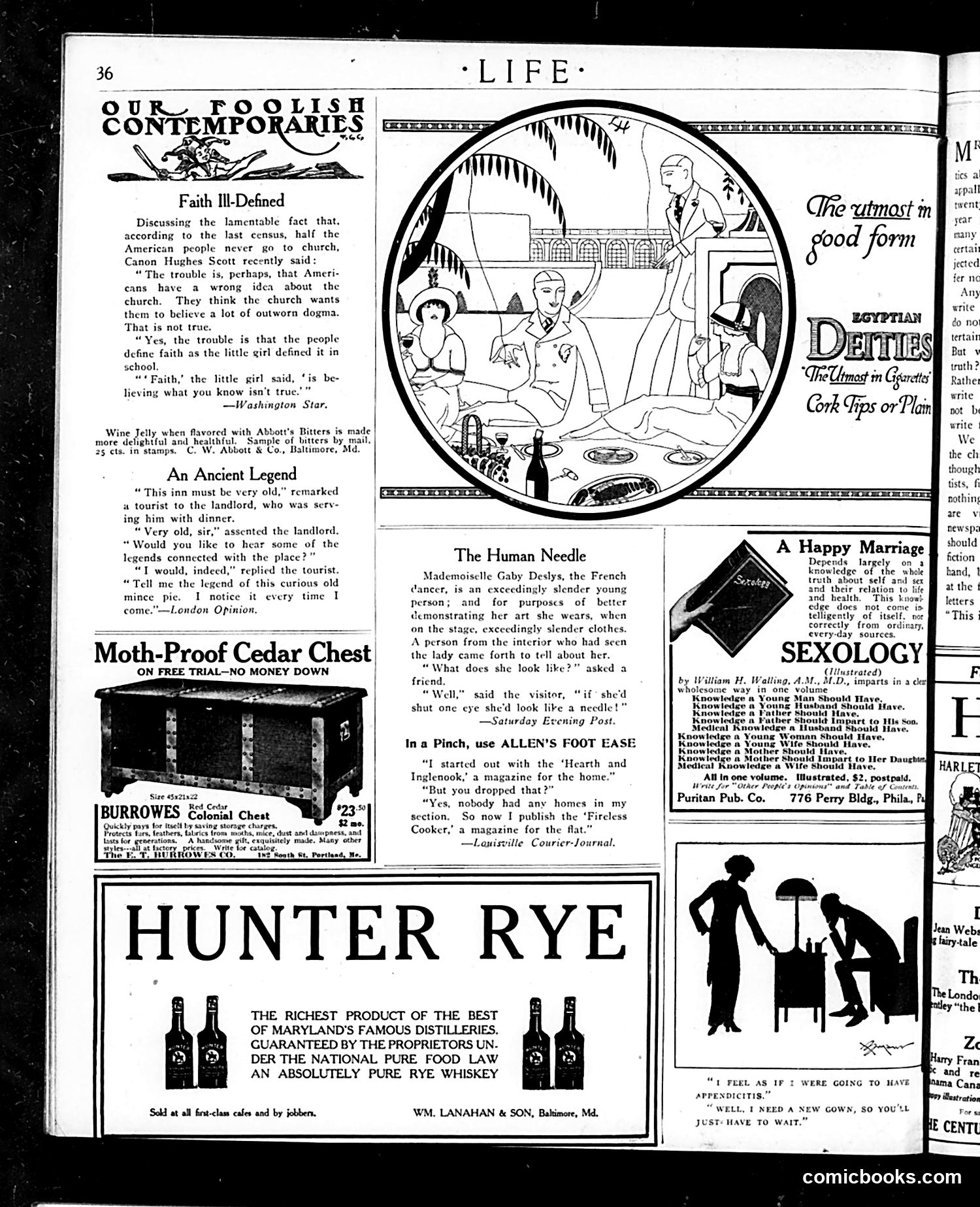
This page mixes satirical commentary with period advertising, typical of Life magazine's format. **"Our Foolish Contemporaries"** features Canon Hughes Scott's quote about Americans' church attendance, satirizing the disconnect between religious institutions and public belief. The anecdote about a schoolgirl defining faith as "believing what you know isn't true" undercuts Scott's defense of the church, suggesting organized religion requires blind acceptance of outdated doctrine. **"The Human Needle"** jokes about French dancer Mademoiselle Gaby Deslys's extreme thinness—a visitor claims that if she closed one eye, she'd resemble a needle, exaggerating her skeletal appearance for comedic effect. **The marital cartoon** at bottom right satirizes gender dynamics: a wife claiming appendicitis symptoms to justify purchasing a new gown while her husband must wait. It mocks both feminine hypochondria and marital manipulation as contemporary social behaviors. **Advertisements** for Hunter Rye whiskey, cedar chests, and other products occupy substantial space, reflecting Life's revenue model.
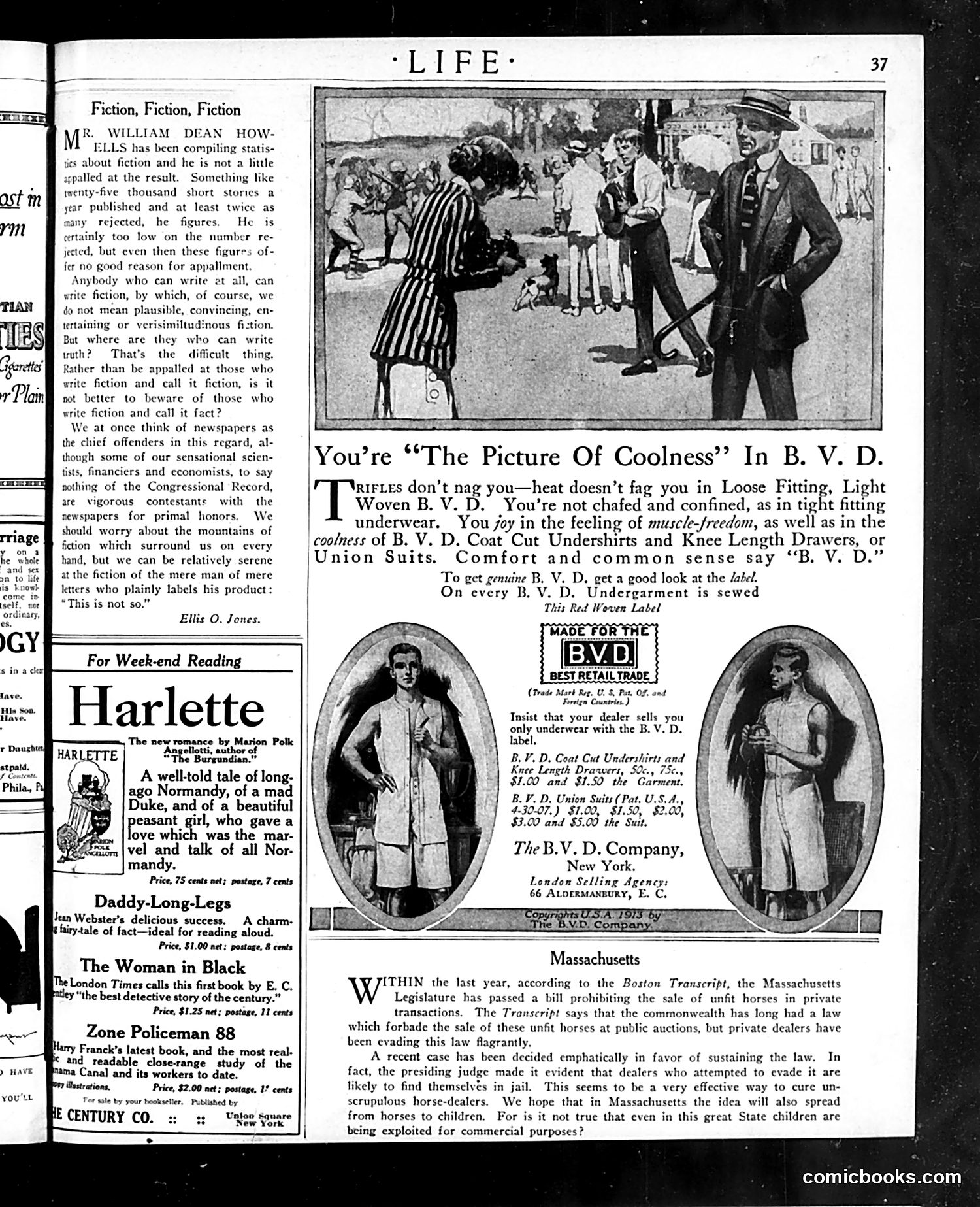
This page mixes editorial commentary with advertising and book reviews. The main content critiques how fiction is categorized: **The Editorial ("Fiction, Fiction, Fiction"):** Columnist Ellis O. Jones comments on William Dean Howells' statistics about short-story publishing. The piece distinguishes between writers who label their work as fiction versus those who write fiction but call it fact—particularly criticizing newspapers for blending sensationalism with factual reporting. The implicit target is journalistic dishonesty masked as objective reporting. **The Advertisement:** A large B.V.D. underwear ad features a street scene with well-dressed men and the slogan "You're 'The Picture of Coolness' in B.V.D." It emphasizes comfort and freedom of movement in loose-fitting garments. **Additional Content:** The page includes book recommendations (Harlette, Daddy-Long-Legs, etc.) and a brief Massachusetts news item about legislation regulating the sale of unfit horses—seemingly unrelated filler content typical of the era's magazine layouts. The page reflects early 20th-century concerns about media credibility and consumer product marketing.
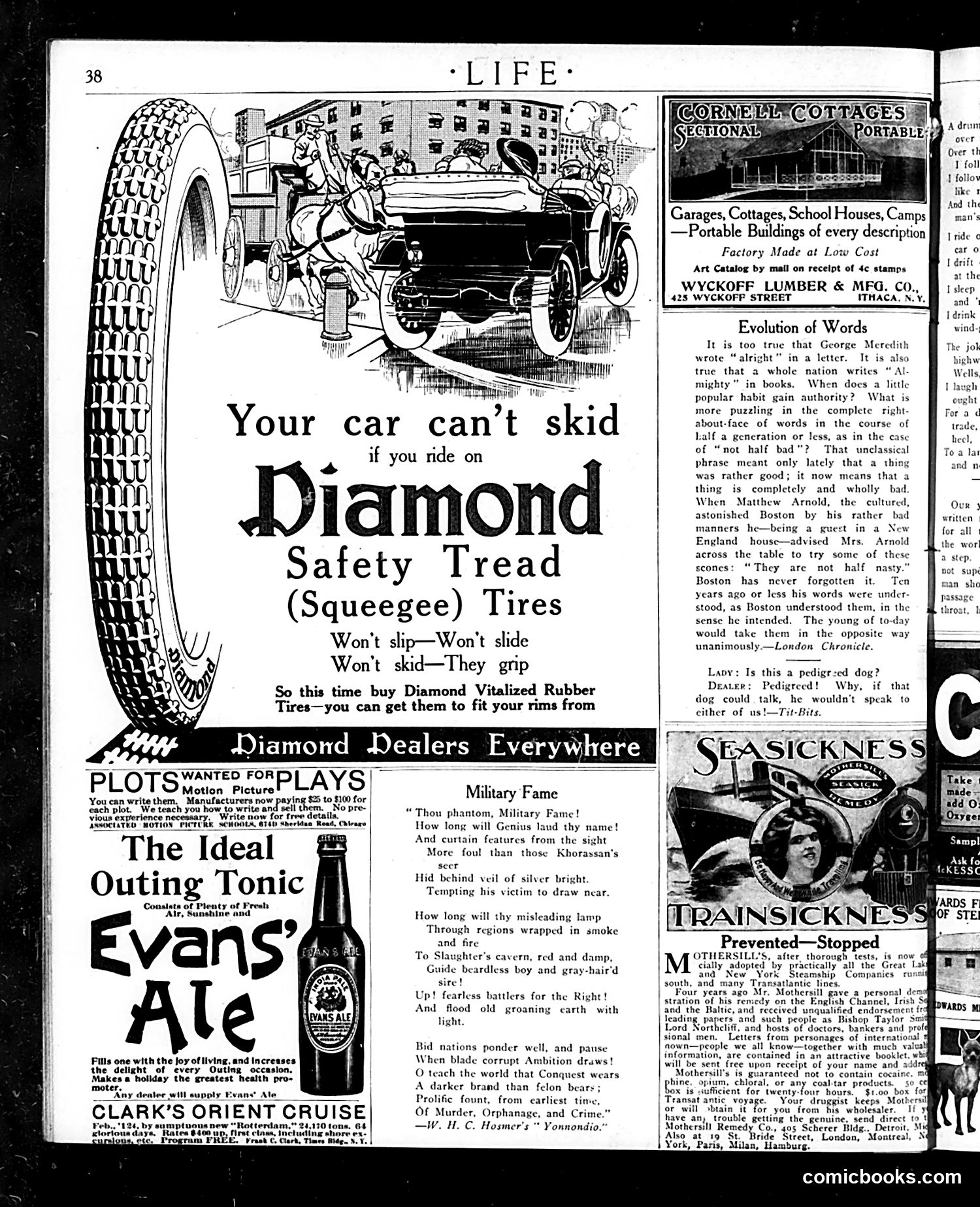
This page is primarily **advertising**, not satirical editorial content. The main elements are: **Large Advertisement (Left):** Diamond Safety Tread Tires—a car tire ad promising grip and no skidding, typical early automotive marketing emphasizing safety features. **Other Ads:** Evans' Ale (an "outing tonic"), Clark's Orient Cruise ship travel, Associated Motion Picture School, and Mothersill's seasickness remedy. **Editorial Content (Right):** - "Evolution of Words"—a linguistic piece discussing how meanings shift (using "not half bad" as example) - "Military Fame"—a poem by W.H.C. Hosmer criticizing war and military ambition as sources of "Murder, Orphanage, and Crime" - A brief humor item contrasting "pedigreed" dogs with one too disreputable to speak The page represents typical early-20th-century Life magazine content: a mix of commercial ads and light social commentary without overt political satire.
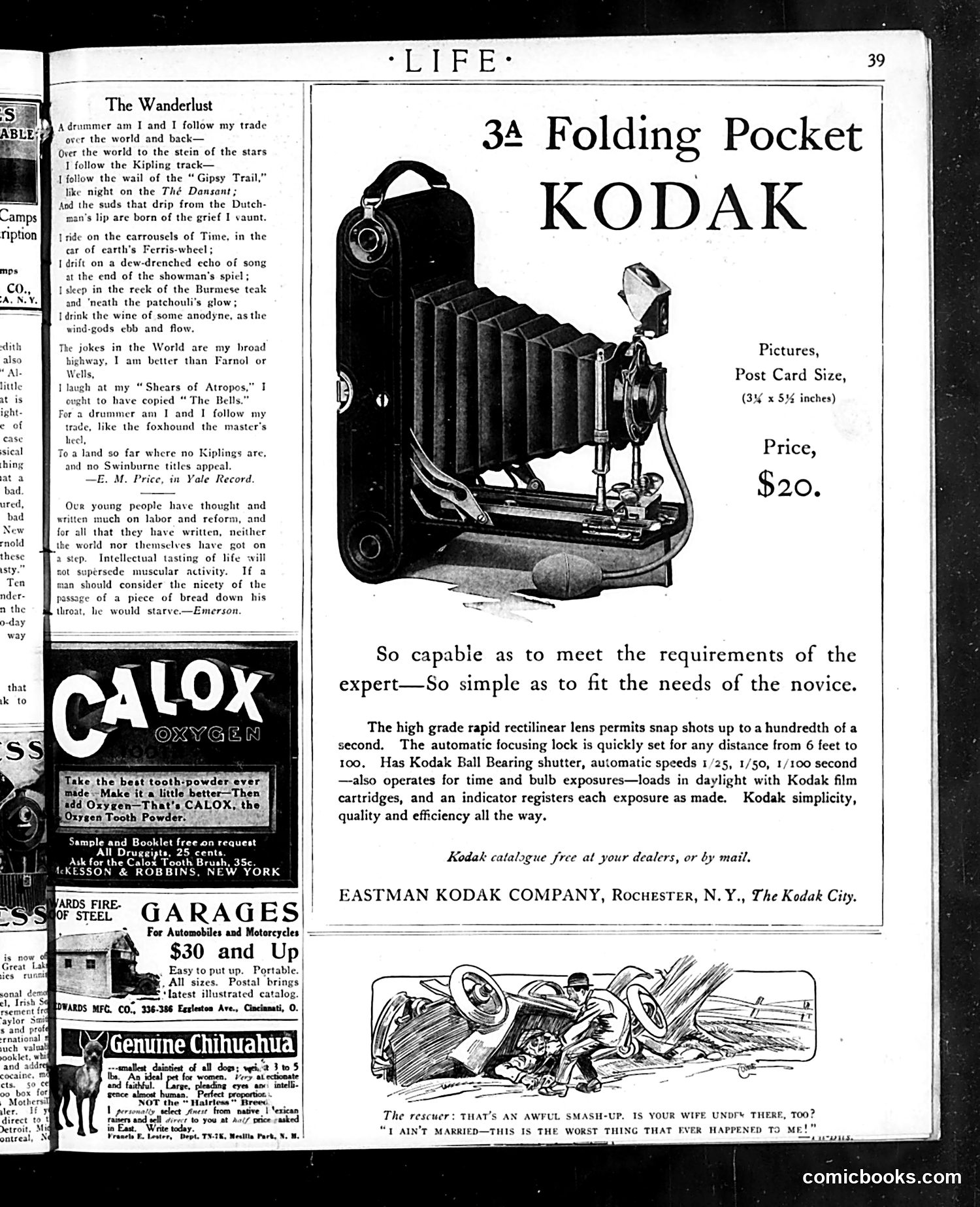
This page contains primarily **advertisements and poetry**, not political satire. **Main Content:** - "The Wanderlust" is a romantic poem by E.M. Price celebrating travel and adventure, referencing Kipling and other literary figures - An Emerson quote about intellectualism versus practical action - Large **Kodak camera advertisement** dominating the right side, promoting a "3A Folding Pocket" model for $20 - Supporting ads for Calox tooth powder, portable garages, and Chihuahua dogs **The Bottom Cartoon:** A single-panel joke shows a car crash. A man says "That's an awful smash-up. Is your wife under there, too?" with the response "I ain't married—this is the worst thing that ever happened to me!" This is a **marital joke**—the humor relies on the period stereotype that marriage is worse than a car accident. It reflects common early-20th-century "nagging wife" comedy tropes. **Historical Context:** This appears to be from approximately 1915-1920s Life magazine, before its mid-century transformation into a photo magazine.
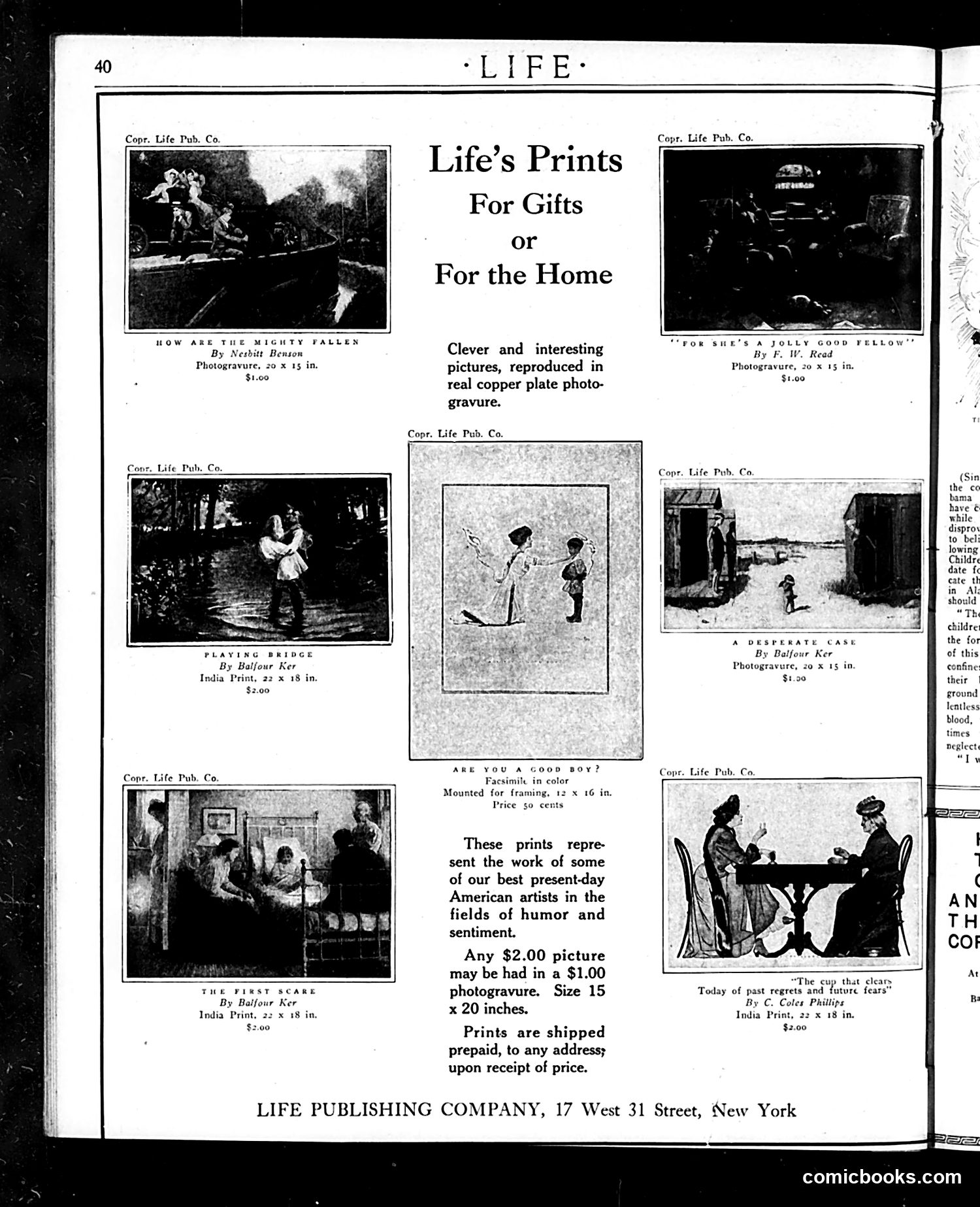
This is a **catalog advertisement** for Life Publishing Company's art prints, not a political cartoon. The page promotes reproductions of works by contemporary American artists (Balfour Ker, Nesbitt Benson, F.W. Read, C. Coles Phillips) available for home decoration or gift-giving. The prints depict **domestic and sentimental scenes**: a couple playing bridge, children in outdoor settings, a woman with a man ("For She's a Jolly Good Fellow"), and intimate moments between adults. The subjects reflect early 20th-century leisure and genteel life. **Key sales pitch**: Copper plate photogravure reproductions offered at reduced prices ($1-2), available by mail order. The advertisement emphasizes these as "clever and interesting pictures" representing "our best present-day American artists in the fields of humor and sentiment." This reflects the era's commercialization of art prints as affordable home decoration for middle-class consumers.
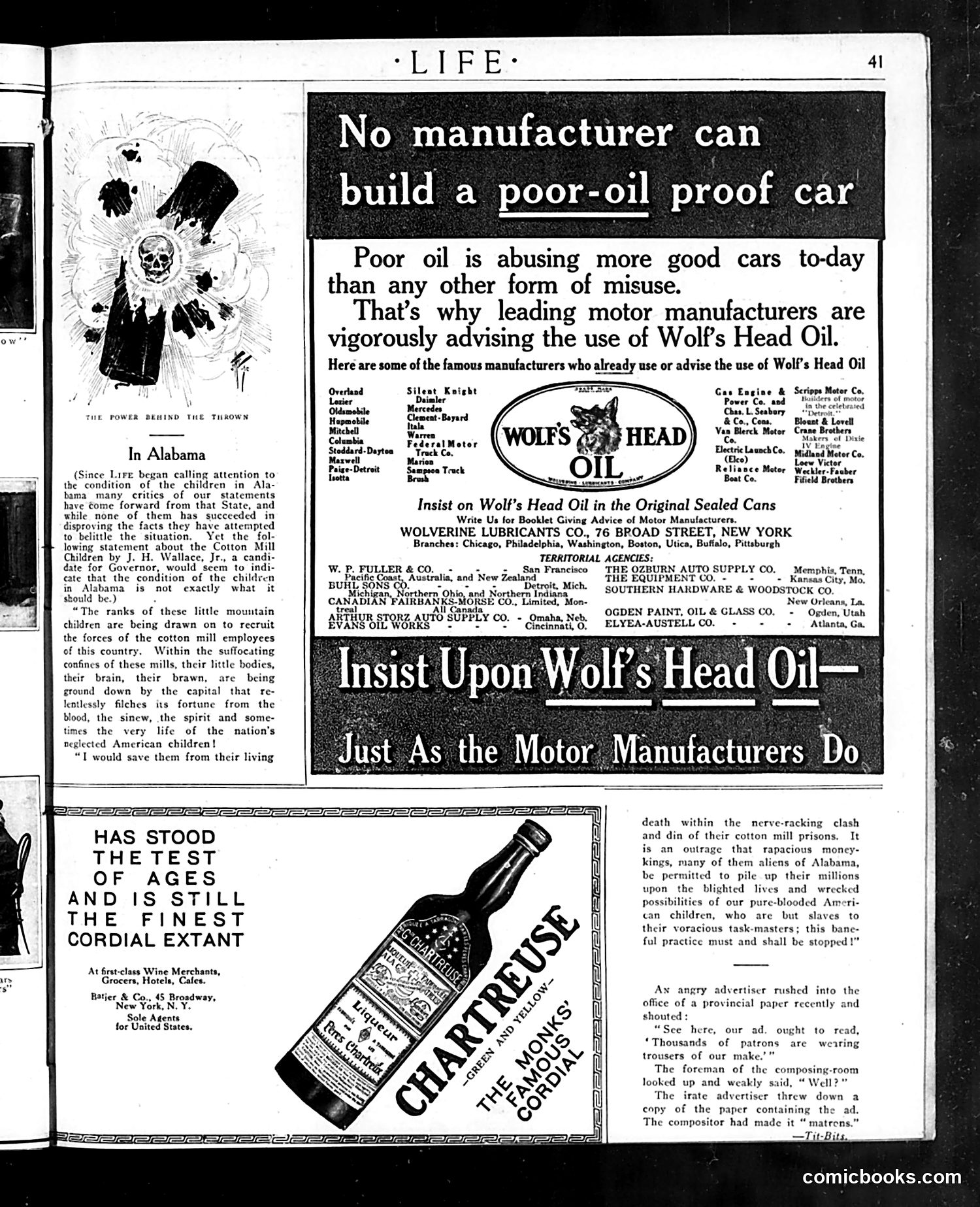
This page contains two distinct elements: **Top Section - Political Editorial:** A cartoon titled "The Power Behind the Throne" depicts a shadowy figure controlling a puppet-like politician. It accompanies commentary on child labor in Alabama cotton mills, quoting gubernatorial candidate J.H. Wallace Jr.'s condemnation of exploitation. The satire suggests that while politicians speak against child labor abuses, the economic forces ("the power behind the throne") perpetuating these conditions remain unchecked. The cartoon critiques the gap between political rhetoric and actual reform. **Lower Sections - Advertisements:** These are unrelated to the political content—promoting Wolf's Head Oil lubricant and Chartreuse liqueur, plus a brief humorous anecdote about a printing error ("matrons" instead of "patrons" in an advertisement). The editorial juxtaposes genuine social outrage about child exploitation with commercial advertisements, reflecting the magazine's dual nature as both satirical commentary and advertising vehicle.
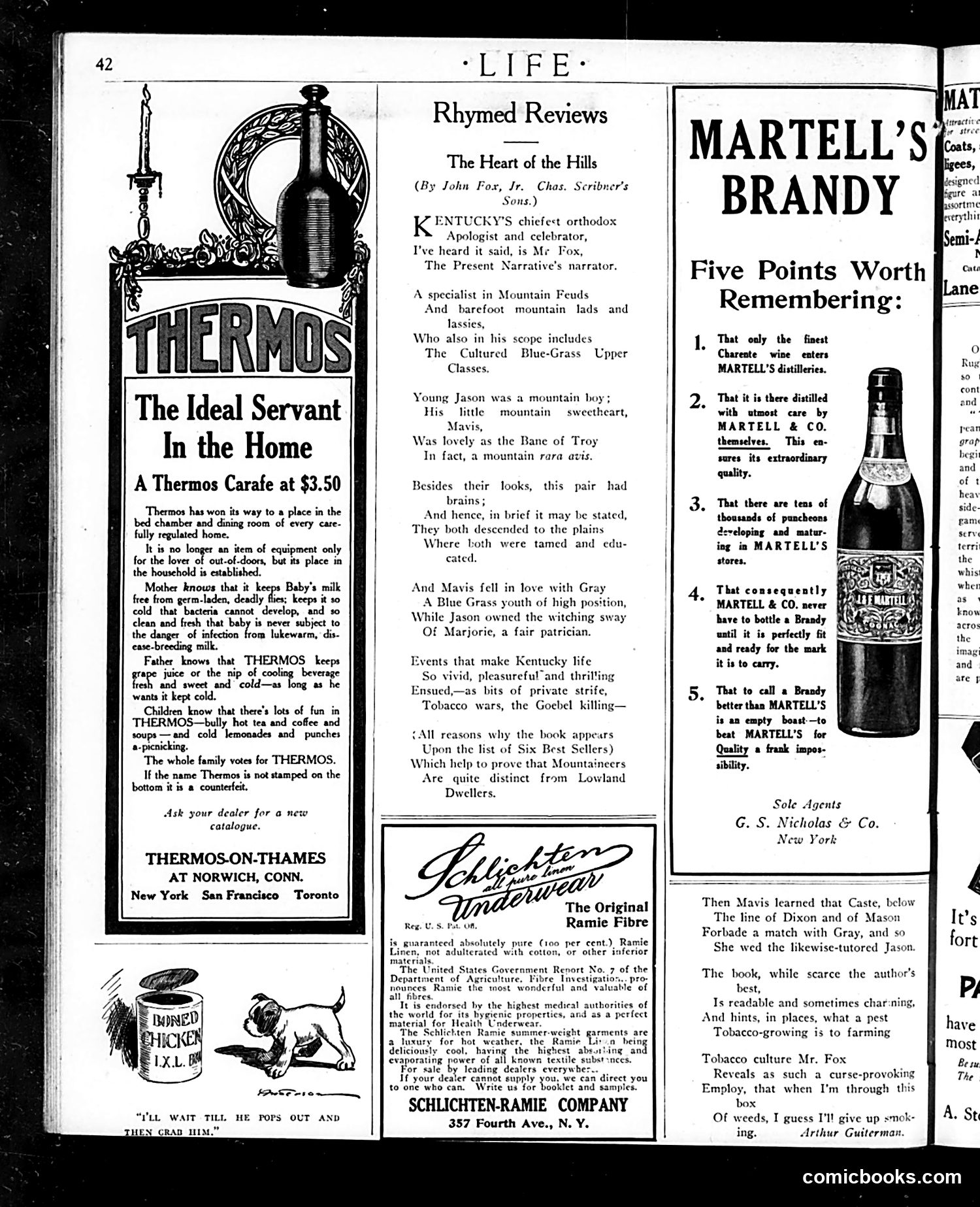
**Advertisements:** The page is primarily advertising, not satire. The Thermos carafe ad promotes the product as an essential household item for preserving food and beverages safely—emphasizing that it prevents bacterial growth in milk, a significant health concern in the pre-refrigeration era. The "Ideal Servant" framing reflects early 20th-century marketing that positioned consumer goods as modern household solutions. **Literary Review:** The "Rhymed Reviews" section offers a comic verse summary of John Fox Jr.'s novel *The Heart of the Hills*, satirizing the book's plot and Fox's reputation as Kentucky's literary chronicler. The reviewer mocks the predictable romantic drama and mountain-versus-aristocracy tensions that apparently made it a bestseller. **Other Ads:** Schlichten-Ramie Company advertises pure ramie fiber underwear as hygienic and cooling; Martell's Brandy emphasizes quality control and aging processes. The page reflects 1910s consumer culture and literary tastes.
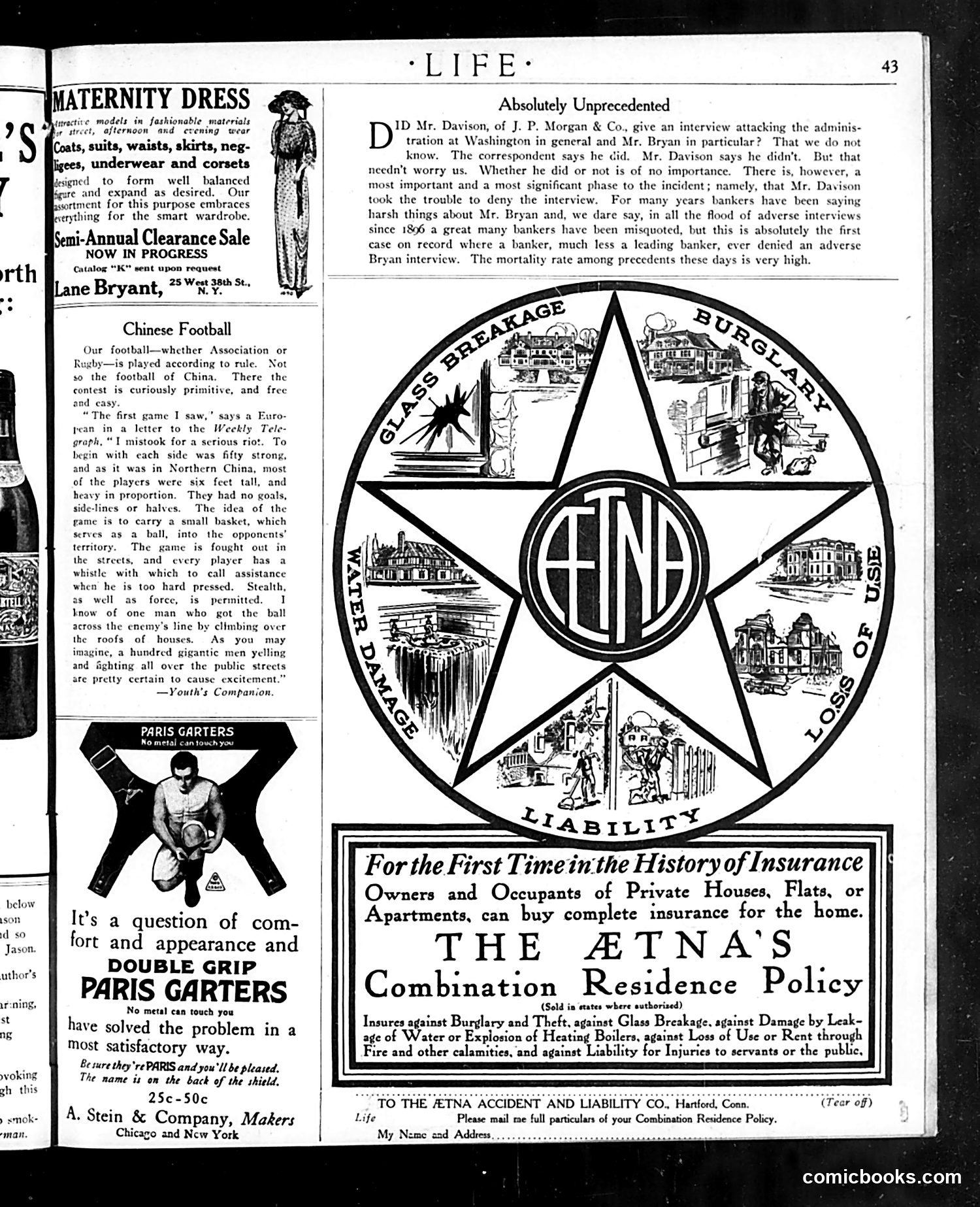
This page is primarily **advertising and editorial content** rather than political satire. The main editorial piece discusses **William Jennings Bryan**, the three-time presidential candidate. The unsigned article notes that J.P. Morgan banker Mr. Davison allegedly gave an interview attacking both the Washington administration and Bryan. The satire's point: Davison felt compelled to publicly *deny* giving such an interview—a first in the author's recollection. The piece sarcastically observes that bankers have criticized Bryan for years (since 1896), yet never before has one bothered denying misquotation. This suggests Bryan's political influence remains significant enough to prompt defensive responses from Wall Street figures. The page also contains advertisements for women's maternity fashion, Paris garters (suspenders), and Aetna insurance, reflecting typical 1910s magazine content. The brief "Chinese Football" piece is a humorous travel anecdote about rough street football in China—not political commentary.
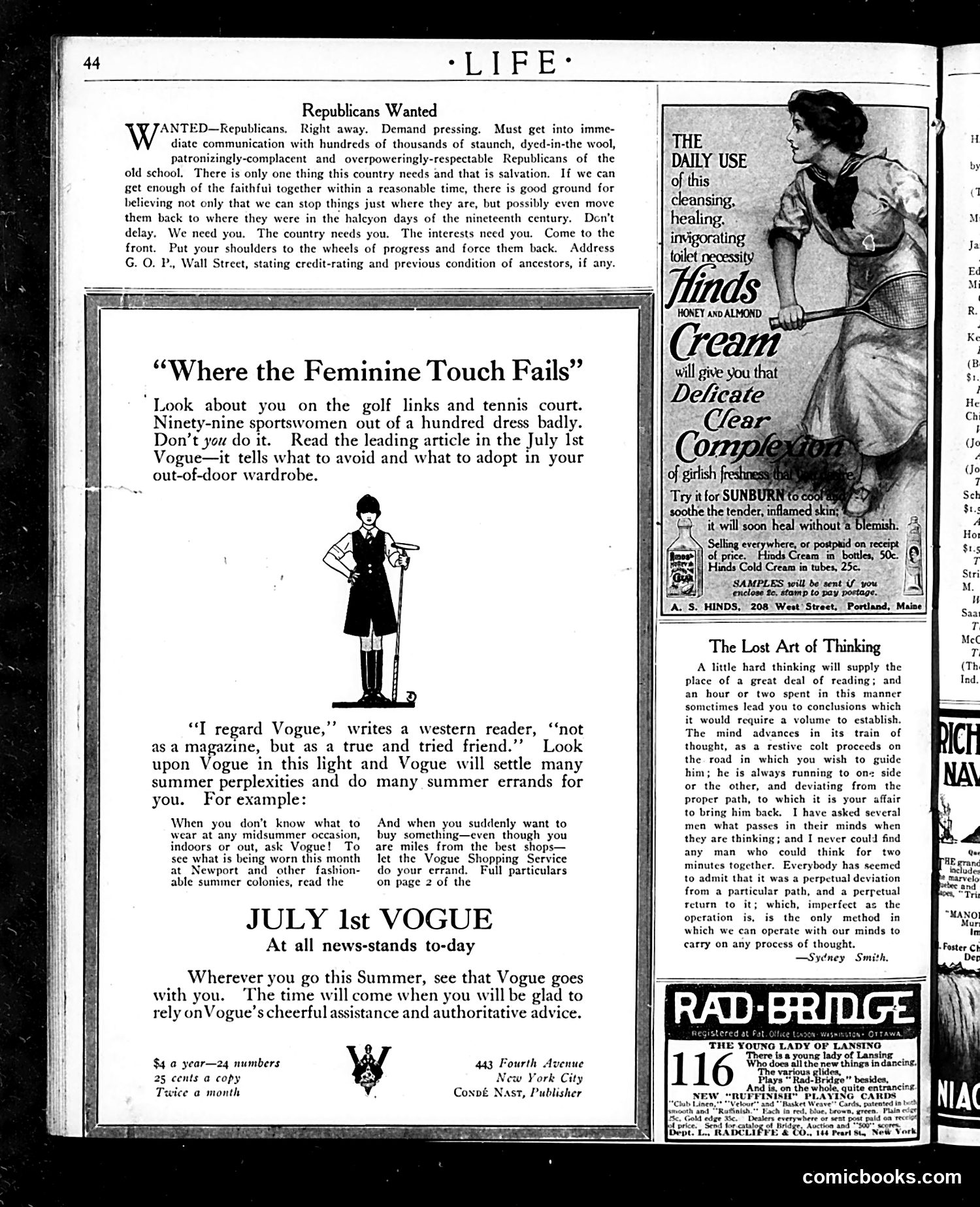
This page contains political and social satire typical of early 20th-century Life magazine. **"Republicans Wanted" (top):** A mock classified ad satirizing the Republican Party's nostalgia for the 19th century. The humor lies in the exaggerated desperation and the absurd requirement to provide "credit-rating and previous condition of ancestors"—mocking both Republican conservatism and the party's obsession with respectability and inherited status. It suggests Republicans are desperately clinging to the past rather than addressing present concerns. **"Where the Feminine Touch Fails":** An advertisement masquerading as editorial commentary, satirizing women's fashion choices. The cartoon shows a woman in poor golfing attire. The piece mocks women who dress badly for sports, while ironically promoting Vogue magazine as the authority on feminine fashion—poking fun at both gender stereotypes and consumer culture's solutions to social problems. The remaining content is primarily advertising for Hinds Cream and other products, interspersed with unrelated editorial content.
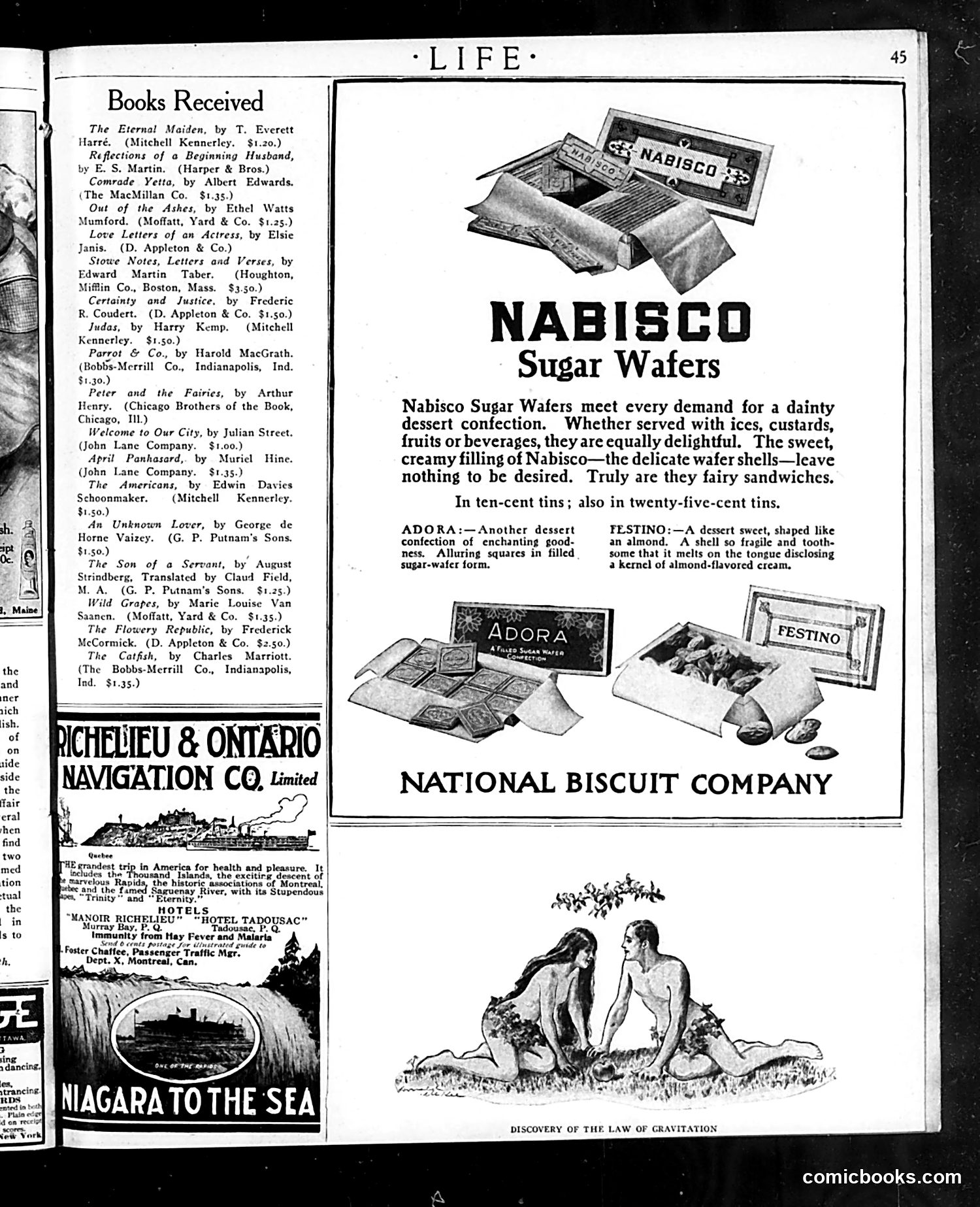
This page is primarily **advertising and book reviews**, not political satire. The left column lists new book releases with publishers and prices (typical early 20th-century literary notices). The main content features **product advertisements**: Nabisco Sugar Wafers and related confections (Adora and Festino brands) from the National Biscuit Company. These ads emphasize the products as "dainty dessert confections" suitable for serving with various beverages. Below the advertisements is a **travel advertisement** for the Richelieu & Ontario Navigation Company, promoting scenic boat trips through Canadian waterways including the Thousand Islands and Saguenay River, marketed for health and leisure. The page concludes with an illustration labeled "Discovery of the Law of Gravitation"—likely a classical or humorous reference, though its specific meaning is unclear from the image alone. The content reflects early 20th-century consumer culture and leisure advertising.
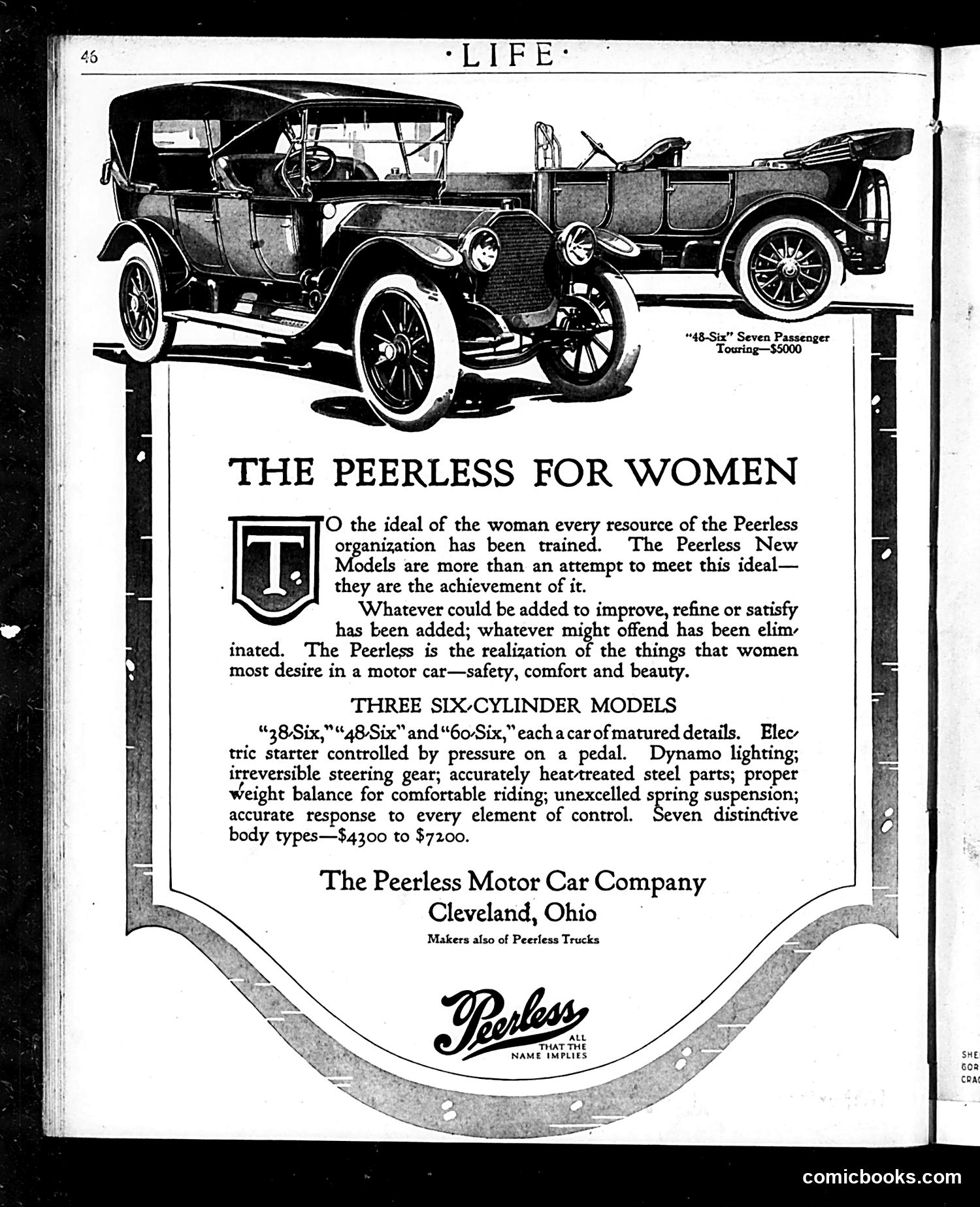
This is a **automobile advertisement**, not a political cartoon. It appears from a vintage issue of *Life* magazine and promotes the Peerless Motor Car Company of Cleveland, Ohio. The ad targets women specifically, a notable marketing approach for the era (likely 1910s-1920s). It emphasizes features appealing to female buyers: "safety, comfort and beauty"—framing the car as designed by women's preferences rather than mechanical specifications alone. The advertisement showcases three six-cylinder models ("38-Six," "48-Six," "60-Six") with modern conveniences like electric starters (pedal-operated, requiring no hand-crank) and dynamo lighting. Prices range $4,300-$7,200, positioning it as a premium vehicle. The gendered marketing reflects early automotive industry recognition that women represented a significant purchasing demographic, though the language subtly suggests women prioritize aesthetics and comfort over performance—a common gender stereotype of the period.
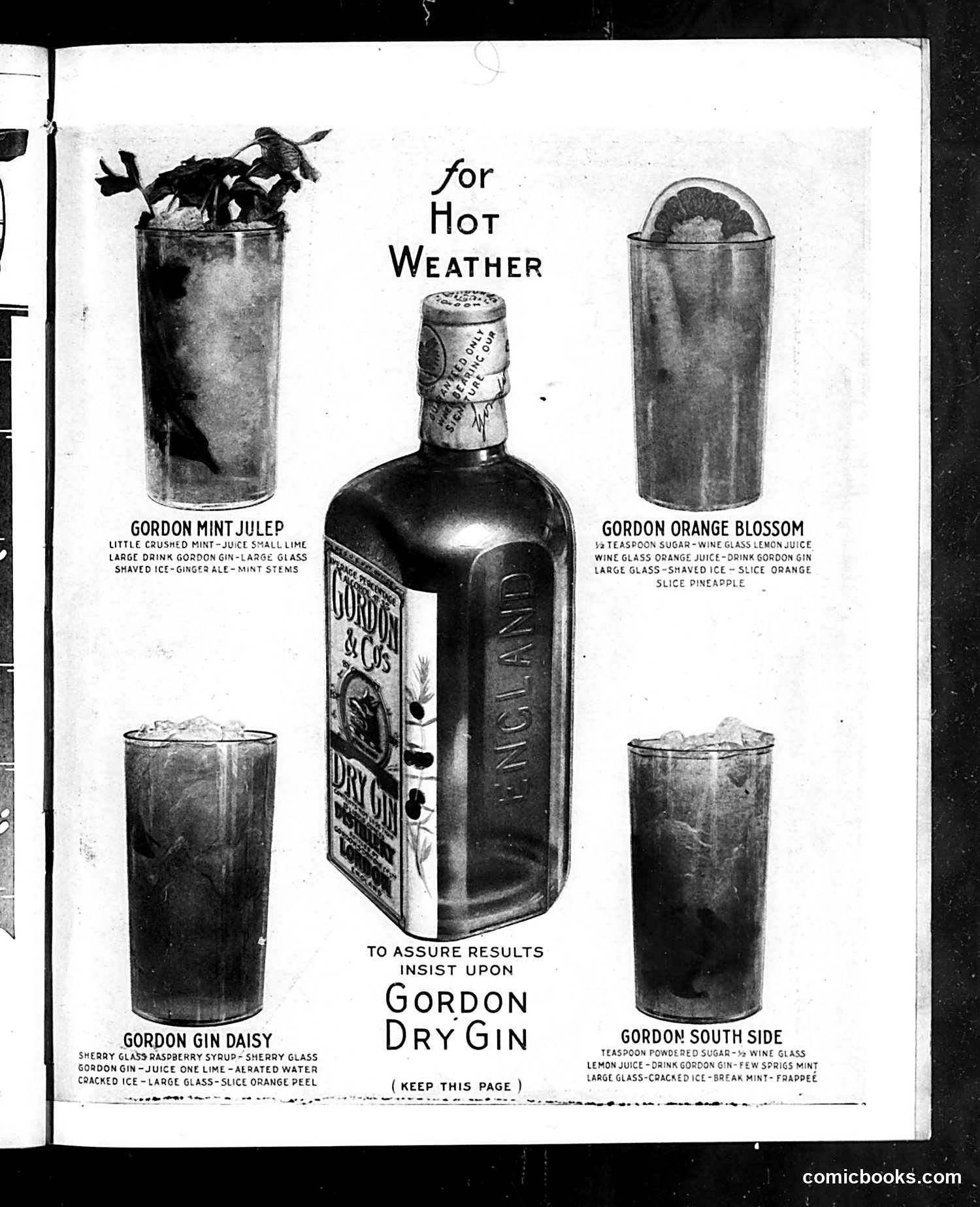
This is a **straight advertisement**, not satire or political commentary. It's a vintage promotional page for Gordon Dry Gin showing four summer cocktail recipes for hot weather: the Mint Julep, Gin Daisy, Orange Blossom, and South Side. The page functions as a practical recipe guide—note the instruction "(KEEP THIS PAGE)" at bottom, suggesting readers were meant to tear it out and save it. Each drink features gin as the base spirit combined with juice, syrup, ice, and garnishes typical of early-to-mid 20th century cocktail culture. The styling and layout are typical period advertising: the central product bottle surrounded by finished drinks, straightforward recipe text, and emphasis on quality ingredients. There's no hidden meaning—it's simply encouraging consumers to purchase Gordon Gin and use it to make refreshing summer beverages.
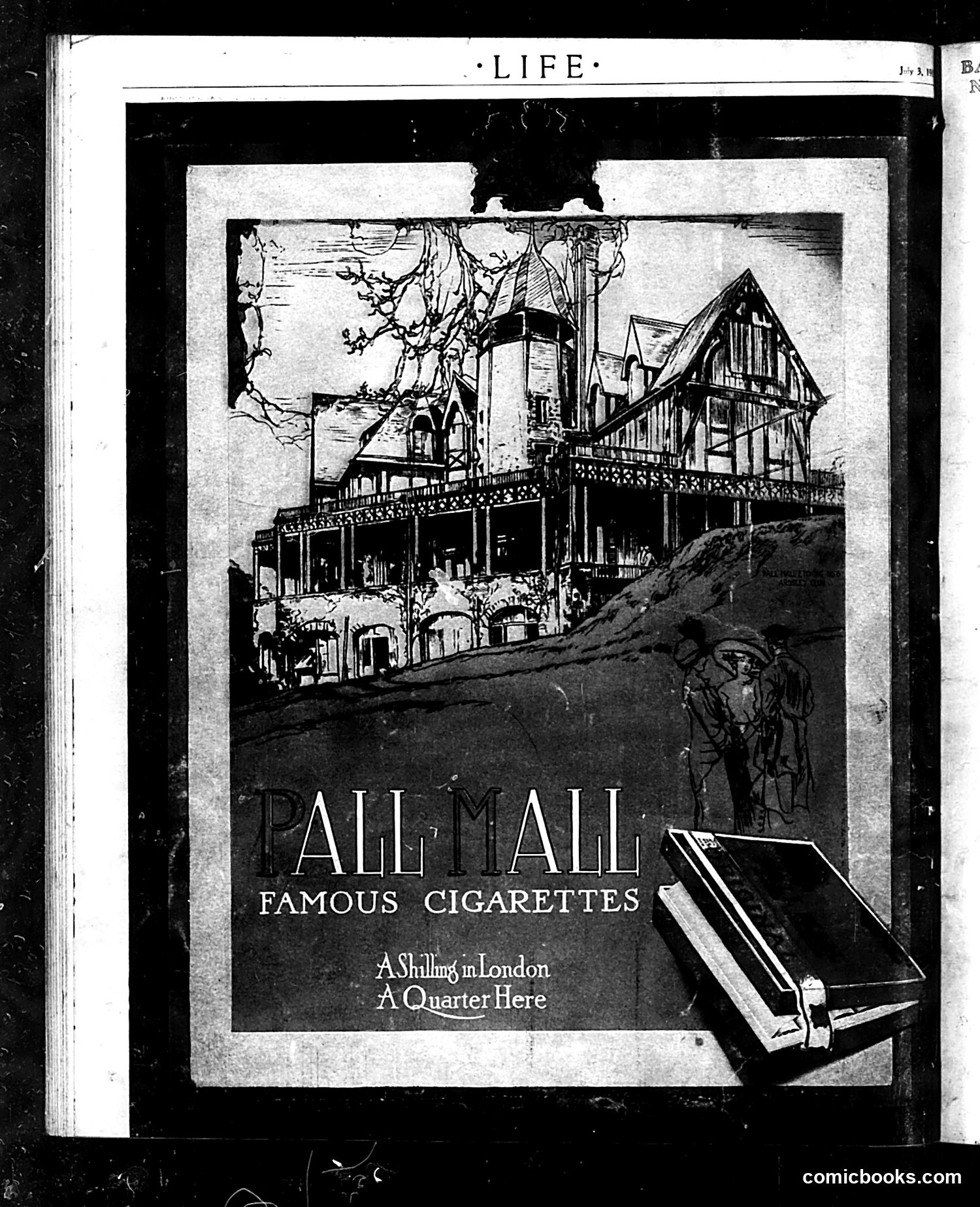
This page is primarily **advertising content**, not editorial satire or political cartoon. It features a full-page advertisement for "All Mali" brand cigarettes. The ad shows an ornate Victorian or Tudor-style mansion with decorative architectural details, bare tree branches overhead, and a figure in period dress on the grounds. A cigarette package is displayed prominently in the lower right. The text promises "A Shilling in London / A Quarter Here"—advertising price points for British versus American markets. This is a straightforward commercial advertisement rather than political commentary or satirical content. The magazine *Life* regularly included such advertisements alongside its editorial material.