
Life, 1913-07-03 · page 14 of 48
Life — July 3, 1913 — page 14: what you’re looking at
What you’re looking at
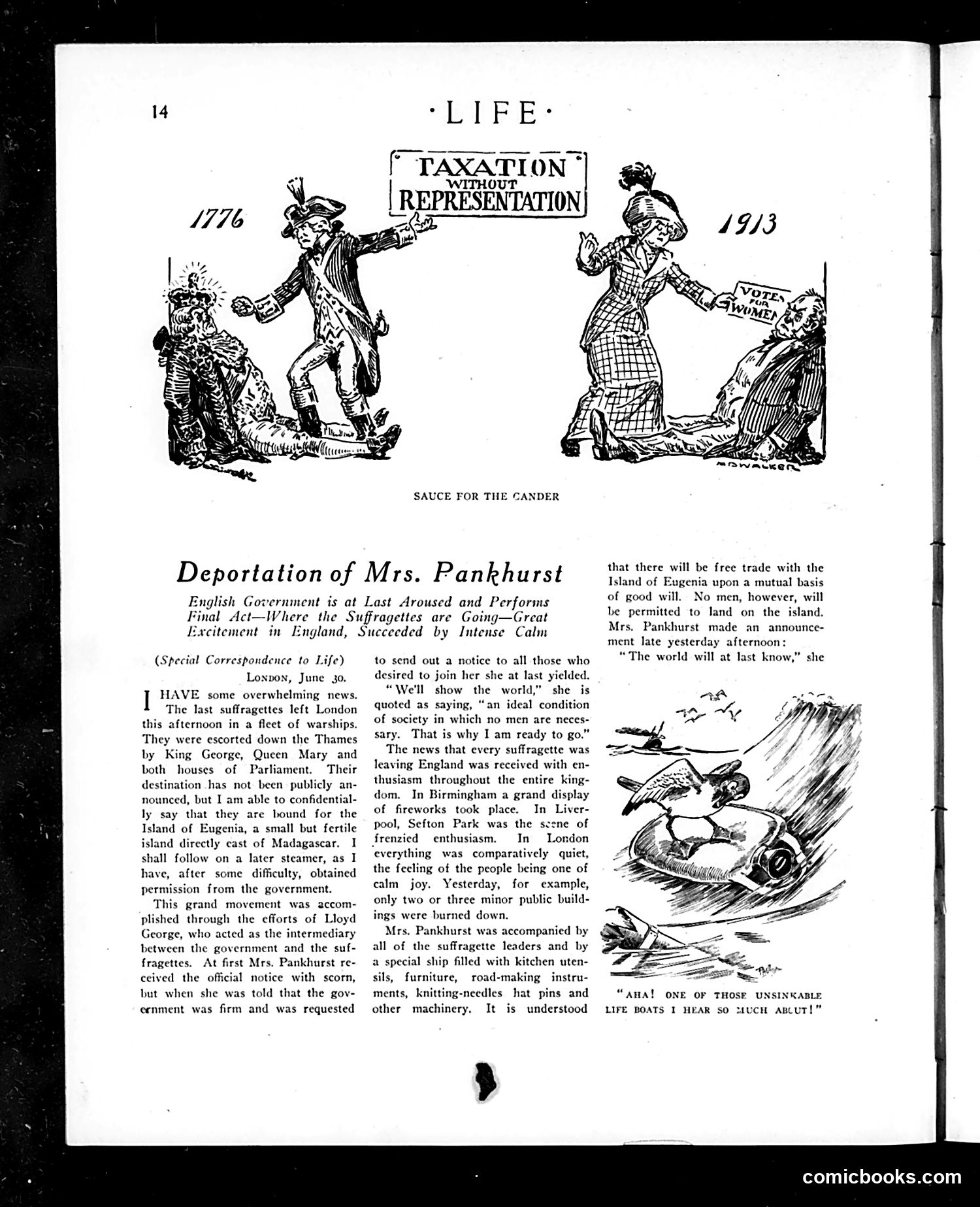
The top cartoon compares two historical moments of women's political struggle, separated by 137 years (1776-1913). **Left panel (1776):** depicts the American Revolution's "Taxation Without Representation" complaint, showing a colonist confronting British authority. **Right panel (1913):** parallels this with the suffragette movement, showing a woman holding a "Votes for Women" sign confronting what appears to be a male authority figure. **The satire's point:** American women in 1913 faced the same fundamental injustice as colonists—being taxed and governed without political voice or voting rights. By equating suffragettes with Revolutionary patriots, the cartoon elevates women's demands as fundamentally American and just. The accompanying article describes Mrs. Pankhurst's deportation, connecting British suffragettes' struggle to this American comparison.
📄 Transcribed text from this page (OCR, searchable)
Machine-transcribed from the original scan — historical spelling and the odd misread are preserved.
TAXATI ON” LF REPRESENTATION SAUCE FOR THE CANDER Deportation of Mrs. Pankhurst English Government is at Last Aroused and Performs inal Act—Where the Suffragettes are Going—Great Excitement in England, Succeeded by Intense Calm (Special Correspondence to Life) Loxpon, June 30. HAVE some overwhelming news. The last suffragettes left London this afternoon in a fleet of warships. They were escorted down the Thames by King George, Queen Mary and both houses of Parliament. Their destination has not been publicly an- nounced, but I am able to confidential- ly say that they are bound for the Island of Eugenia, a small but fertile island directly cast of Madagascar. I shall follow on a later steamer, as I have, after some difficulty, obtained permission from the government. This grand movement was accom- plished through the efforts of Lloyd George, who acted as the intermediary between the government and the suf- fragettes. At first Mrs. Pankhurst re- ceived the official notice with scorn, but when she was told that the gov- cenment was firm and was requested to send out a notice to all those who desired to join her she at last yielded. “We'll show the world,” she is quoted as saying, “an ideal condition of society in which no men are neces- sary. That is why I am ready to go.” The news that every suffragette was leaving England was received with en- thusiasm throughout the entire king- dom. In Birmingham a grand display of fireworks took place. In Liver- pool, Sefton Park was the scene of frenzied enthusiasm. In London ‘everything was comparatively quiet, the feeling of the people being one of calm joy. Yesterday, for example, only two or three minor public build- ings were burned down. Mrs, Pankhurst was accompanied by all of the suffragette leaders and by a special ship filled with kitchen uten- sils, furniture, road-making instru- ments, knitting-needles hat pins and other machinery, It is understood } that there will be free trade with the Island of Eugenia upon a mutual basis of good will. No men, however, will be permitted to land on the island. Mrs. Pankhurst made an announce- ment late yesterday afternoon: “The world will at last know,” ” she ae “anal ONE OF THOSE U: LIFE BOATS I HEAR SO =tUCH ABCUT!” comicbooks.com