
Life, 1913-07-03 · page 32 of 48
Life — July 3, 1913 — page 32: what you’re looking at
What you’re looking at
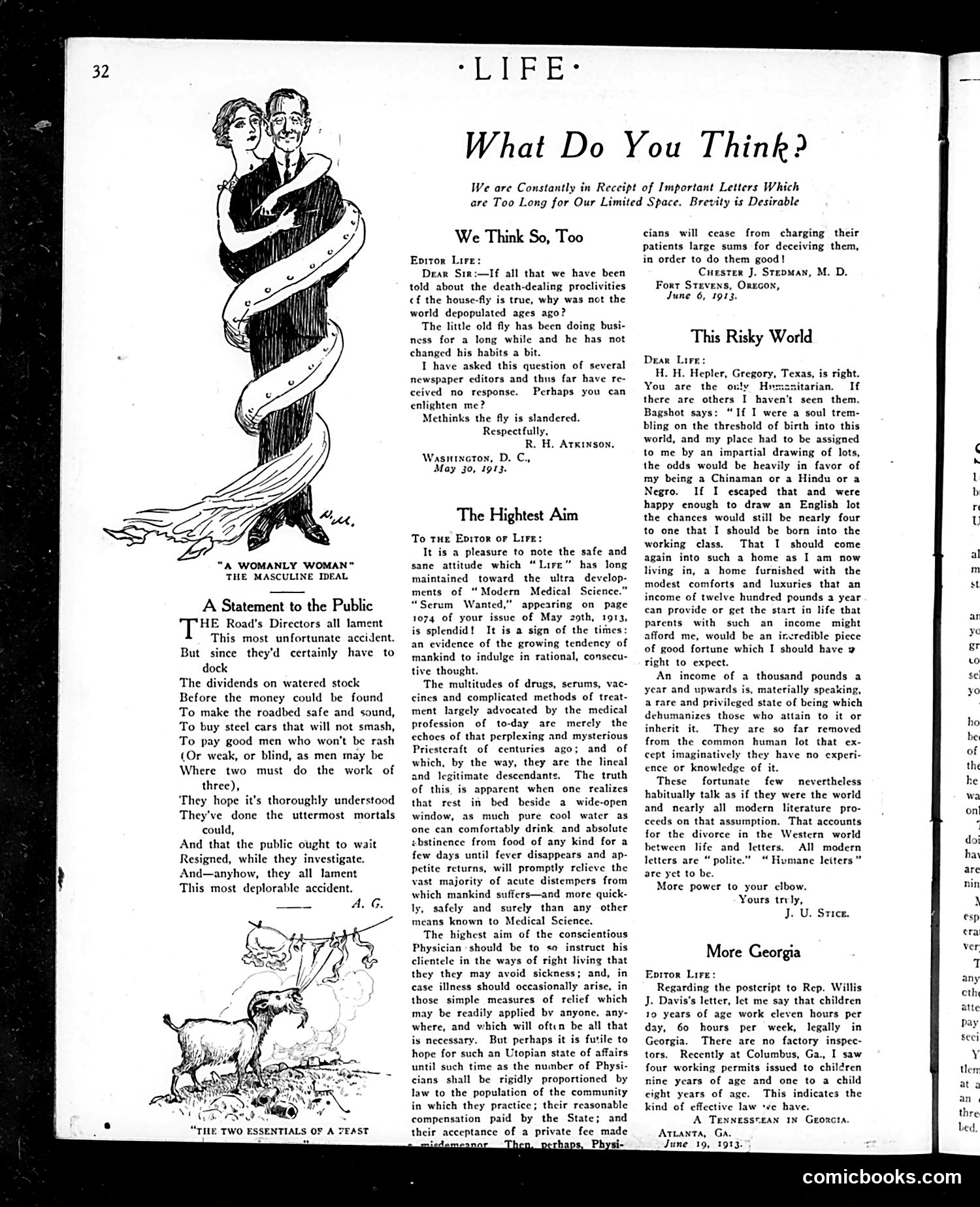
This page presents reader letters and editorial commentary typical of Life's satirical format circa 1913. **Top cartoon ("A Womanly Woman"):** Depicts a couple wrapped together in a snake-like coil, satirizing contemporary gender ideals. The caption suggests irony about what constitutes "masculine" and "womanly" behavior—likely mocking rigid social conventions of the era. **"Statement to the Public":** A biting satire on railroad company negligence. It mocks a railroad's excuse-making after an accident: they claim poverty prevents safety improvements (safe cars, qualified workers) while protecting "watered stock" dividends. The satire argues the company offers empty "lament" while refusing accountability—a commentary on corporate irresponsibility and profit prioritization over public safety. **Reader letters section:** Includes earnest public correspondence on topics like housefly dangers and medical practice, alongside Life's dismissive responses, reflecting the magazine's role critiquing pseudoscience and pretension. The overall tone mocks institutional hypocrisy and modern absurdities.
📄 Transcribed text from this page (OCR, searchable)
Machine-transcribed from the original scan — historical spelling and the odd misread are preserved.
“A WOMANLY WOMAN” THE MASCULINE IDEAL A Statement to the Public HE Road's Directors all lament This most unfortunate accident. But since they’d certainly have to dock The dividends on watered stock Before the money could be found To make the roadbed safe and sound, To buy steel cars that will not smash, To pay good men who won't be rash (Or weak, or blind, as men may be Where two must do the work of three), ‘They hope it’s thoroughly understood They’ve done the uttermost mortals could, And that the public ought to wait Resigned, while they investigate. And—anyhow, they all lament This most deplorable seid = ‘WO ESSENTIALS OF A FEAST GRRE What Do You Think? We are Constantly in Receipt of Important Letters Which are Too Long for Our Limited Space. Brevity is Desirable We Think So, Too Epitor Lr: Dear Sir:—If all that we have been told about the death-dealing proclivities cf the house-fly is true, why was not the world depopulated ages ago? The little old fly has been doing busi- ness for a long while and he has not changed his habits a bit. T have asked this question of several newspaper editors and thus far have re- ceived no response. Perhaps you can enlighten me? Methinks the fly is slandered. Respectfully, R. H. Atxinson. Wasixcrox, D. C., May 30, 1913. The Hightest Aim To tHe Epitor or Lire: It is a pleasure to note the safe and sane attitude which “Lire” has long maintained toward the ultra develop- ments of “Modern Medical Science.” “Serum Wanted,” appearing on page 1074 of your issue of May 29th, 1913, is splendid! It is a sign of the times: an evidence of the growing tendency of mankind to indulge in rational, consecu- tive thought. The multitudes of drugs, serums, vac- cines and complicated methods of treat- ment largely advocated by the medical profession of to-day are merely the echoes of that perplexing and mysterious Priesteraft of centuries ago; and of which, by the way, they are the lineal and legitimate descendants. The truth of this. is apparent when one realizes that rest in bed beside a wide-open window, as much pure cool water as one can comfortably drink and absolute ebstinence from food of any kind for a few days until fever disappears and ap- petite returns, will promptly relieve the vast majority of acute distempers from which mankind suffers—and more quick- ly, safely and surely than any other means known to Medical Science. The highest aim of the conscientious Physician ‘should be to so instruct his clientele in the ways of right living that they they may avoid sickness; and, in case illness should occasionally arise, in those simple measures of relief which may be readily applied by anyone, any- where, and which will often be all that is necessary. But perhaps it is futile to hope for such an Utopian state of affairs until such time as the number of Physi- cians shall be rigidly proportioned by law to the population of the community in which they practice; their reasonable compensation paid by the State; and their acceptance of a private fee made i PI cians will cease from charging their patients large sums for deceiving them, in order to do them good! Cuester J. Steowan, M. D. Fort STEVENS, OREGOX, June 6, 1913. This Risky World Dear Lire: H. H. Hepler, Gregory, Texas, i is right. You are the on!y Hr: there are others I haven't seen them. Bagshot says: “If I were a soul trem- bling on the threshold of birth into this world, and my place had to be assigned to me by an impartial drawing of lots, the odds would be heavily in favor of my being a Chinaman or a Hindu or a Negro. If I escaped that and were happy enough to draw an English lot the chances would still be nearly four to one that I should be born into the working class. That I should come again into such a home as I am now living in, a home furnished with the modest comforts and luxuries that an income of twelve hundred pounds a year can provide or get the start in life that parents with such an income might afford me, would be an incredible piece of good fortune which I should have 2 right to expect. ‘An income of a thousand pounds a year and upwards is, materially speaking, a rare and privileged state of being which dehumanizes those who attain to it or inherit it. They are so far removed from the common human lot that ex- cept imaginatively they have no experi- ence or knowledge of it. These fortunate few nevertheless habitually talk as if they were the world and nearly all modern literature pro- ceeds on that assumption. That accounts for the divorce in the Western world between life and letters. All modern letters are “polite.” “ Humane letters” are yet to be. More power to your elbow. Yours troly, J. U. Stice. More Georgia Eprtor Lire: Regarding the postcript to Rep. Willis J. Davis's letter, let me say that children to years of age work cleven hours per day, 60 hours per week, legally in Georgia. There are no factory inspec- tors. Recently at Columbus, Ga. I saw four working permits issued to children nine years of age and one to a child cight years of age. This indicates the kind of effective law ‘ve have. A TenNesst£an 1n Georcta. Attanta, Ga. June 19, 1913: comicbooks.com