
Life, 1913-07-03 · page 33 of 48
Life — July 3, 1913 — page 33: what you’re looking at
What you’re looking at
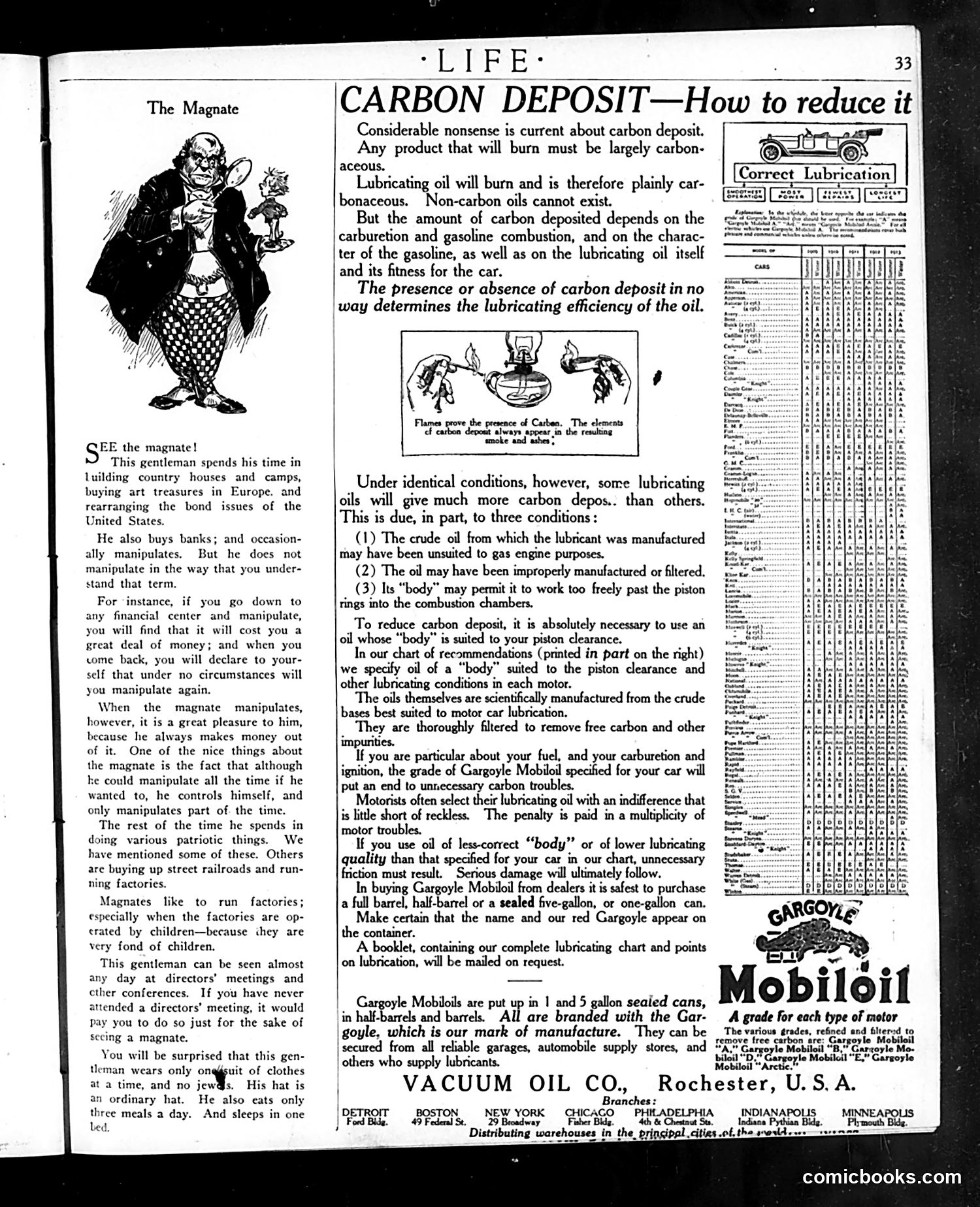
**The Cartoon:** The left side features a caricatured figure labeled "The Magnate"—a wealthy, well-dressed gentleman depicted with exaggerated features, holding what appears to be a small figure or object. **The Satire's Point:** This is Life magazine's mockery of America's wealthy industrialist class. The accompanying text sarcastically praises magnates who spend time "building country houses and camps" and "rearranging bond issues" while manipulating finances for personal profit. **Key Satirical Elements:** - The contrast between magnates' claimed "patriotic" activities (buying railroads, running factories) and their actual self-interest - Particular barb: they operate factories using child labor "because they are very fond of children"—obviously ironic - The notion that magnates "control themselves" by only manipulating finances "part of the time" - Amazement that such powerful men wear ordinary clothes and eat three meals daily—suggesting readers see them as almost superhuman The satirical tone criticizes wealthy industrialists' financial manipulation, labor exploitation, and their celebration in society despite clear ethical problems.
📄 Transcribed text from this page (OCR, searchable)
Machine-transcribed from the original scan — historical spelling and the odd misread are preserved.
The Magnate EE the magnate! This gentleman spends his time in luilding country houses and camps, buying art treasures in Europe. and rearranging the bond issues of the United States. He also buys banks; and occasion- ally manipulates. But he does not manipulate in the way that you under- stand that term. For ‘instance, if you go down to any financial center and manipulate, you will find that it will cost you a great deal of money; and when you come back, you will declare to your- self that under no circumstances will you manipulate again. When the magnate manipulates, however, it is a great pleasure to him, because he always makes money out of it. One of the nice things about the magnate is the fact that although he could manipulate all the time if he wanted to, he controls himself, and only manipulates part of. the time. The rest of the time he spends in doing various patriotic things. We have mentioned some of these. Others are buying up street railroads and run- ning factories. Magnates like to run factories; especially when the factories are op- crated by children—because ihey are very fond of children. This gentleman can be seen almost any day at directors’ meetings and ether conferences. If you have never attended a directors’ meeting, it would p you to do so just for the sake of secing a magnate. You will be surprised that this gen- tleman wears only onggsuit of clothes ata time, and no jews. His hat is an ordinary hat. He also eats only three meals a day. And sleeps in one Led. |in half-barrels and barrels. PERE: 33 CARBON DEPOSIT—How to re fo reduce it it Considerable nonsense is current about carbon deposit. Any product that will burn must be largely carbon- aceous. Lubricating oil will burn and is therefore plainly car- bonaceous. Non-carbon oils cannot exist. But the amount of carbon deposited depends on the carburetion and gasoline combustion, and on the charac- ter of the gasoline, as well as on the lubricating oil itself and its fitness for the car. The presence or absence of carbon deposit inno way determines the lubricating efficiency of the oil. eS of Carben, ‘The elements ‘ef carbon deo alvars soeea in the resulting Under identical conditions, however, some lubricating oils will give much more carbon depos.. than others. This is due, in part, to three conditions : (1) The crude oil from which the lubricant was manufactured may have been unsuited to gas engine purposes. (2) The oil may have been improperly manufactured or filtered. (3) Its “body” may permit it to work too freely past the piston rings into the combustion cham! To reduce carbon deposit, it is absolutely necessary to use an oil whose “body” is suited to your piston clearance. In our chart of recommendations (printed in part on the right) we specify oil of a “body” suited to the piston clearance and other lubricating conditions in each motor. The oils themselves are scientifically manufactured from the crude bases best suited to motor car lubrication. They are thoroughly filtered to remove free carbon and other icipaaities. Tf you are particular about your fuel, and your carburetion and ignition, the grade of Gargoyle Mobiloil specified for your car will put an end to unnecessary carbon troubles. Motorists often select their lubricating oil with an indifference that is litle short of reckless. The penalty is paid in a multiplicity of motor troubles. If you use oil of less-correct “body” or of lower lubricating quality than that specified for your car in our chart, unnecessary friction must result. us damage will ultimately follow. In buying Gargoyle Mobiloil from dealers it is safest to purchase a full barrel, half-barrel or a sealed five-gallon, or one-gallon can. Make certain that the name and our red Gargoyle appear on the container. A booklet, containing our complete lubricating chart and points on lubrication, will be mailed on request. Gargoyle Mobiloils are put wp in | and 5 gallon sealed cans, are branded with the Gar- goyle, which is our mark of manufacture. They can be secured from all reliable garages, automobile supply stores, and others who supply lubricants. VACUUM OIL CO,, Branches: BOSTON. NEW YORK CHICAGO = PHILADELPHIA 49 Federal Se. 29 Beoadway Fisher Bldg. th & Chestnut Sta. Distributing warehouses in the prinsipal cities of. the sovit. —l; ASR Saber Perm Erpsret | con: a (LUE Ah i é wih te the in it A grade for each type of motor The various grades, refined and filter:d to EEE free carbon sre: Gargoyle Mol Rochester U. S.A. INDIANAPOLIS MINNEAPOLIS comicbooks.com