
Life, 1913-07-03 · page 26 of 48
Life — July 3, 1913 — page 26: what you’re looking at
What you’re looking at
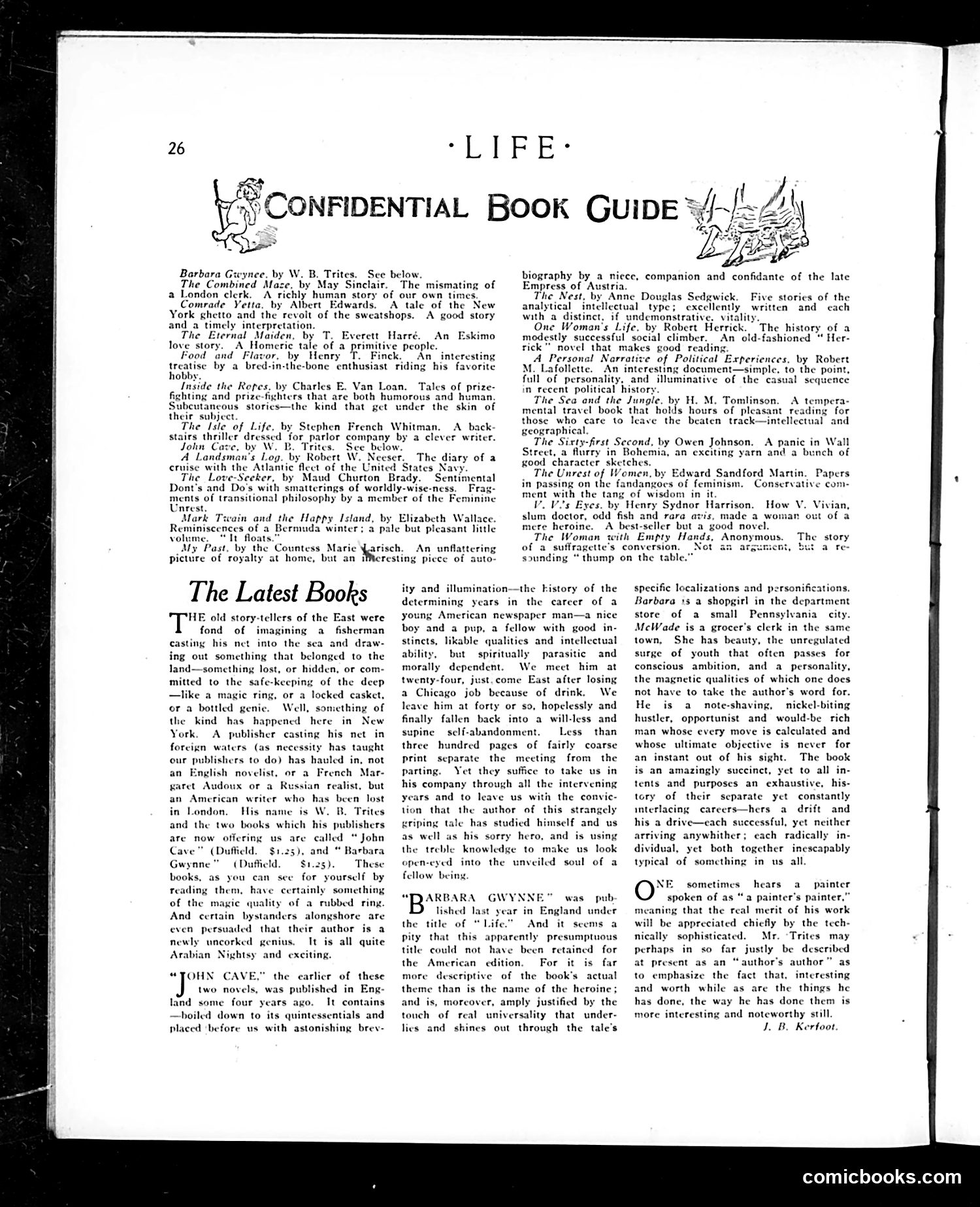
This is a book review page from *Life* magazine's "Confidential Book Guide" section. It's not a political cartoon but rather literary criticism and promotion. The page reviews contemporary novels (early 1900s) and includes a notable editorial essay about discovering W.B. Trites, an American writer lost to obscurity in London. The reviewer uses a whimsical metaphor—comparing the publisher's discovery to fishermen in Eastern tales pulling magical objects from the sea—to humorously explain how they unexpectedly found this "newly uncorked genius." The reviews reflect early 20th-century concerns: labor unrest ("Comrade Yetta" about sweatshops), social climbing, political memoirs (Robert M. La Follette's Progressive politics), and travel literature. The tone is sophisticated and somewhat condescending toward popular tastes, typical of *Life*'s satirical stance as an arbiter of cultural refinement for educated readers.
📄 Transcribed text from this page (OCR, searchable)
Machine-transcribed from the original scan — historical spelling and the odd misread are preserved.
‘LIP E® . CONFIDENTIAL BOOK GUIDE % Barbara Gwynce. by W. B. Trites. See below. The Combined Maze, by May Sinclair. The mismating of a London clerk. A richly human story of our own times Comrade Yetta. by Albert Edwards. A tale of the New York ghetto and the revolt of the sweatshops. A good story and_a timely interpretation. The Eternal Maiden, by T, Everett Harré. An Eskimo love story. A Homeric tale of a primitive people. Food and Flavor, by Henry T. Finck. An_ interesting treatise by a bredcin-the-bone enthusiast riding his favorite hobby. Inside the Ropes, by Charles E. Van Loan. Tales of prize- fighting and prize-fighters that are both humorous and human. Subcutancous storics—the kind that get under the skin of their subject The Isle of Life. by Stephen French Whitman. A back- stairs thriller dressed for parlor company by a clever writer. John Cave, by W. B. Trites. below. j.} biography by a niece, companion and confidante of the late E s of Austria. est, by Anne Douglas Sedgwick. Five stories of the analytical intellectual type; excellently written and cach with a distinct, if undemonstrative. vitality. One Woman's Life. by Robert Herrick. The history of a modestly successful social climber. An old-fashioned “ Her- rick” novel that makes good reading A Personal Narrative of Political Experiences. by Robert M. Lafollette. An interesting document—simple, to the point, fuil of personality, and illuminative of the casual sequence in recent political history. The Sea ond the Jungle. by H. M. Tomlinson. A tempera- mental travel book that holds hours of pleasant reading for those who care to leave the beaten track—intellectual and geographical The Sixty-first Second, by Owen Johnson. A panic in Wall Street, a flurry in Bohemia, an exciting yarn and a bunch of A Landsman’s Log. by Robert W. e with the Unrest. Mark Twain and the Happy Island, by Elizabeth Wallace. Reminiscences of a Bermuda winter; a pale but pleasant little volume “It floats.” My Past. by the Countess Mari picttire of royalty at hom: The Latest Books HE old story-tellers of the East were fond of imagining a fisherman asting his net into the sea and draw- ing out something that belonged to the land—something lost, or hidden, or com- mitted to the safe-keeping of the deep —like a magic ring, or a locked casket, or a bottled genic. Well, something of the kind has happened here in) New York. A publisher casting his net in foreign waters (as necessity has taught our publishers to do) has hauled in, not an English novelist, or a French Mar- garect Audoux or a Russian realist, but an American writer who has been lost in London, His name is W. B. Trites and the two books which his publishers are now offering us are called “John Cave” (Duffield. $1.25), and “ Barbara Gwynne” (Duffield. $1.25). These books, as you can see for yourself by reading them, have certainly something of the magic quality of a rubbed ring. And certain bystanders alonyshore ate even persuaded that their author is a newly uncorked genius, It is all quite Arabian Nightsy and exciting. “JOHN CAVE,” the carlicr of these J two novels, was published in Eng- Tt contains —boiled down to its quintessentials and us with astonishing brev- land some four years ago. placed ‘before eset. Atlantic lect of the United States Navy. The Love-Sceker, by Maud Churton Brady. Dont's and Do's with smatterings of worldly-wise-ncss ments of transitional philosophy by a member of the Feminine arisch, r but an Mast piece of auto- The diary of a Sentimental Frag- ment mere heroine. An unflattering ity and illumination—the history of the determining years in the career of a young American newspaper man—a nice boy and a pup, a fellow with good in- stincts, likable qualitics and intellectual ability, but spiritually parasitic and morally dependent. We meet him at twenty-four, just.come East after losing a Chicago job because of drink. We leave him at forty or so, hopelessly and finally fallen back into a will-less and supine — sclf-abandonme: Less than three hundred pages of fairly coarse print separate the meeting from the parting. Yet they suffice to take us in his company through all the intervening years and to leave us with the convic- tion that the author of this. strangely griping tale has studied himself and us as well as his sorry hero, and is using the treble knowledge to make us look open-eyed into the unveiled soul of a fellow being. “PQARBARA GWYNNE” was pub: lished last year in England under the title of “Life.” And it pity that this apparently presumptuous title could not have been retained for the American edition. For it is far descriptive of the book's actual theme than is the name of the heroine; and is, morcover, amply justified by the touch of real universality that under- lies and shines out through the tale’s seems a more good character sketches. The Unrest of Women, by Edward Sandford Martin. Papers in passing on the fandangocs of feminism. h the tang of wisdom in it. V. Vs Eyes. by Henry Sydnor Harrison. slum doctor, odd fish and rara avis, made a woman out of a A best-seller but a good novel. The Woman with Empty Hands, Anonymous of a suffragette’s conversion. Not an argum sounding “thump on the table. Conservative com- How V. Vivian, The story but a re- specific localizations and personifications, Barbara 1s a shopgirl in the department store of a small Pennsylvania city. McWade is a grocer’s clerk in the same town, She has beauty, the unregulated surge of youth that often passes for conscious ambition, and a personality, the magnetic qualities of which one does not have to take the author's word for. He is a note-shaving, nickel-biting hustler, opportunist and would-be rich man whose every move is calculated and whose ultimate objective is never for an instant out of his sight. The book is an amazingly succinct, yet to all in- tents and purposes an exhaustive, his- tory of their separate yet constantly interlacing careers—hers a drift and his a drive—each successful, yet neither arriving anywhither; each radically in- dividual, yet both together inescapably typical of something in us all. sometimes hears a paint. meaning that the real merit of his work will be appreciated chiefly by the tech- nically sophisticated. Mr. “Trites_ may : perhaps in so far justly be described at present as an “author's author” as to emphasize the fact that, interesting and worth while as are the things he has done, the way he has done them is more interesting and noteworthy still. J. B. Kerfoot comicbooks.com