
Life, 1913-07-03 · page 22 of 48
Life — July 3, 1913 — page 22: what you’re looking at
What you’re looking at
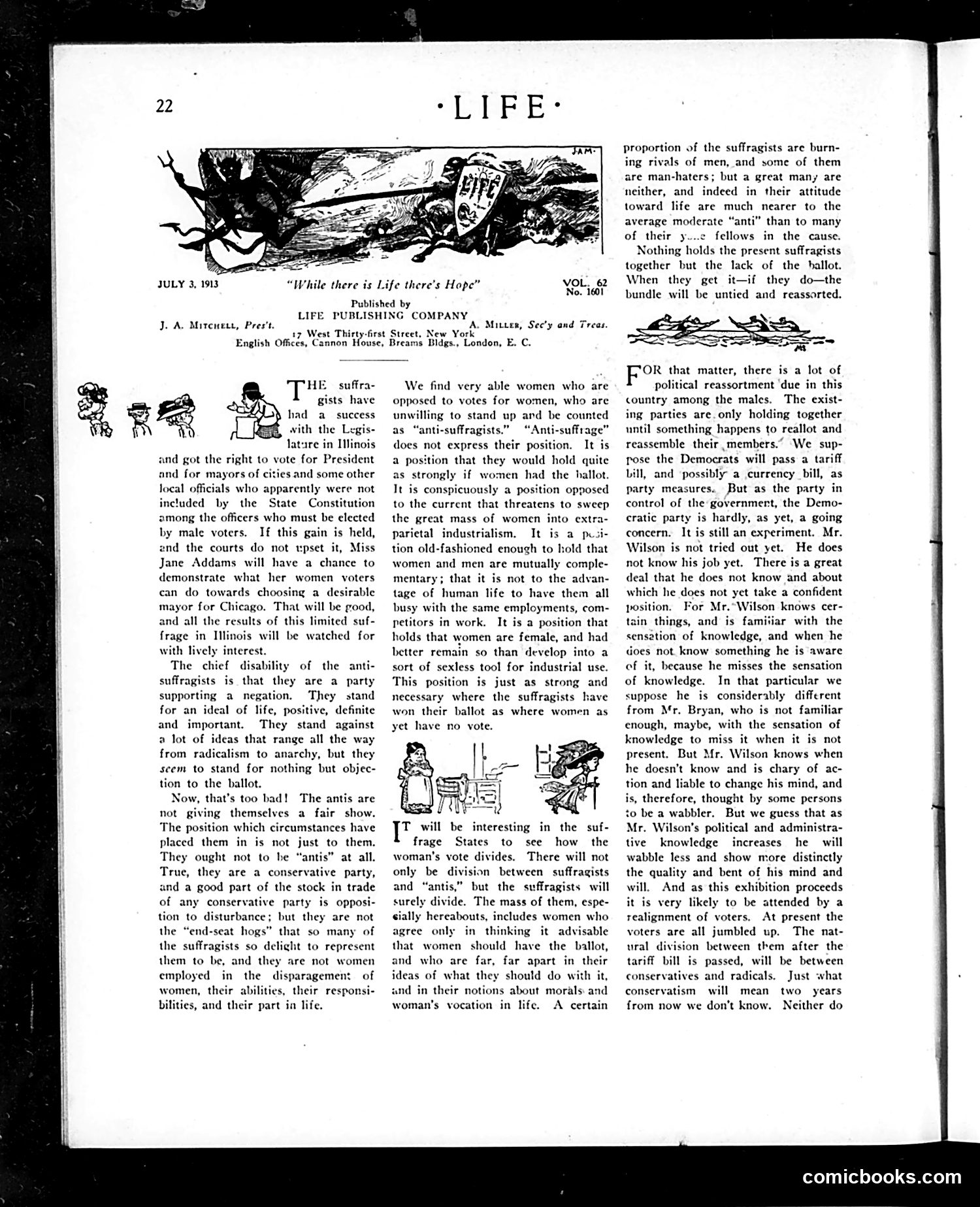
This editorial discusses the recent grant of limited women's suffrage in Illinois—allowing women to vote for president and some local officials. The author argues that anti-suffragists are strategically disadvantaged because they only stand *against* something (women voting) rather than articulating a positive vision. The piece acknowledges that intelligent women oppose suffrage, not from misogyny but from a conservative philosophy: that men and women are "mutually complementary" and shouldn't compete equally in industrial work. The author respects this position while supporting women's vote. Notably, the editorial predicts that once women gain suffrage, the suffragist coalition will fracture—they're currently united only by lacking the ballot. References to Jane Addams (the famous Chicago settlement house founder) suggest she might run for mayor once women could vote. The cartoons (featuring various caricatures) appear to illustrate these political divisions, though specific figures are unclear from the image quality.
📄 Transcribed text from this page (OCR, searchable)
Machine-transcribed from the original scan — historical spelling and the odd misread are preserved.
had a i iy ‘ with the Legis- JULY 3, 1913 While there is Life there’s Hope” 62 No. 1601 Published by LIFE J. A. Mitcnent, Pres’t. PUBLISHING COMPANY A. Mutter, See’y and Treas. t7 West Thirty-first Street, New York . English Offices, Cannon House, Breams Bidgs., London, E. C. HE gists have suffra- success lature in Ilinois and got the right to vote for President and for mayors of cities and some other local officials who apparently were not included by the State Constitution among the officers who must be elected by male voters, If this gain is held, znd the courts do not upset it, Miss Jane Addams will have a chance to demonstrate what her women voters can do towards choosing a desirable mayor for Chicago. That will be good, and all the results of this limited suf- frage in Illinois will be watched for with lively interest. The chief disability of the anti- suffragists is that they are a party supporting a negation. They stand for an ideal of life, positive, definite and important. They stand against a lot of ideas that range all the way from radicalism to anarchy, but they seem to stand for nothing but objec- tion to the ballot. Now, that’s too bad! The antis are not giving themselves a fair show. The position which circumstances have placed them in is not just to them. They ought not to be “antis” at all. True, they are a conservative party, and a good part of the stock in trade of any conservative party is opposi- tion to disturbance; but they are not the “end-seat hogs” that so many of the suffragists so delight to represent them to be, and they are not women employed in the disparagement of women, their abilities, their responsi- bilities, and their part in life. We find very able women who are opposed to votes for women, who are unwilling to stand up ard be counted as nti-suffragists.” “Anti-suffrage” does not express their position. It is a position that they would hold quite as strongly if women had the hallot. It is conspicuously a position opposed to the current that threatens to sweep the great mass of women into extra- parietal industrialism. It is a pcsi- tion old-fashioned enough to hold that women and men are mutually comple- mentary; that it is not to the advan- tage of human life to have them all busy with the same employments, com- petitors in work. It is a position that holds that women are female, and had better remain so than develop into a sort of sexless tool for industrial use. This position is just as strong and necessary where the suffragists have won their ballot as where women as yet have no vote. teen T will be interesting in the suf- frage States to see how the woman's vote divides. There will not only be division between suffragists and “antis,” but the suffragists will surely divide. The mass of them, espe- sially hereabouts, includes women who agree only in thinking it advisable that women should have the ballot, and who are far, far apart in their ideas of what they should do with it, and in their notions about morals and woman's vocation in life. A certain Proportion of the suffragists are burn- ing rivals of men, and some of them are man-haters; but a great many are neither, and indeed in their attitude toward life are much nearer to the average moderate “anti” than to many of their y...c fellows in the cause. Nothing holds the present suffragists together but the lack of the hallot. When they get it—if they do—the bundle will be untied and reassorted. a 'OR that matter, there is a lot of political reassortment ‘due in this country among the males. The exist- ing parties are.only holding together until something happens to reallot and reassemble their members.” We sup- rose the Democrats will pass a tariff Lill, and possibly a currency bill, as party measures. But as the party in control of the governmert, the Demo- cratic party is hardly, as yet, a going concern. It is still an experiment. Mr. Wilson is not tried out yet. He does not know his job yet. There is a great deal that he does not know and about which he does not yet take a confident position. For Mr.*Wilson knows cer- tain things, and is famitiar with the sensation of knowledge, and when he does not know something he is aware of it, because he misses the sensation of knowledge. In that particular we suppose he is considerably different from Mr. Bryan, who is not familiar enough, maybe, with the sensation of knowledge to miss it when it is not present. But Mr. Wilson knows when he doesn’t know and is chary of ac- tion and liable to change his mind, and is, therefore, thought by some persons to be a wabbler. But we guess that as Mr. Wilson’s political and administra- tive knowledge increases he will wabble less and show more distinctly the quality and bent of his mind and will. And as this exhibition proceeds it is very likely to be attended by a realignment of voters. At present the voters are all jumbled up. The nat- ural division between them after the tariff bill is passed, will be between conservatives and radicals. Just what conservatism will mean two years from now we don’t know. Neither do comicbooks.com