
A complete issue · 48 pages · 1913
Life — April 10, 1913
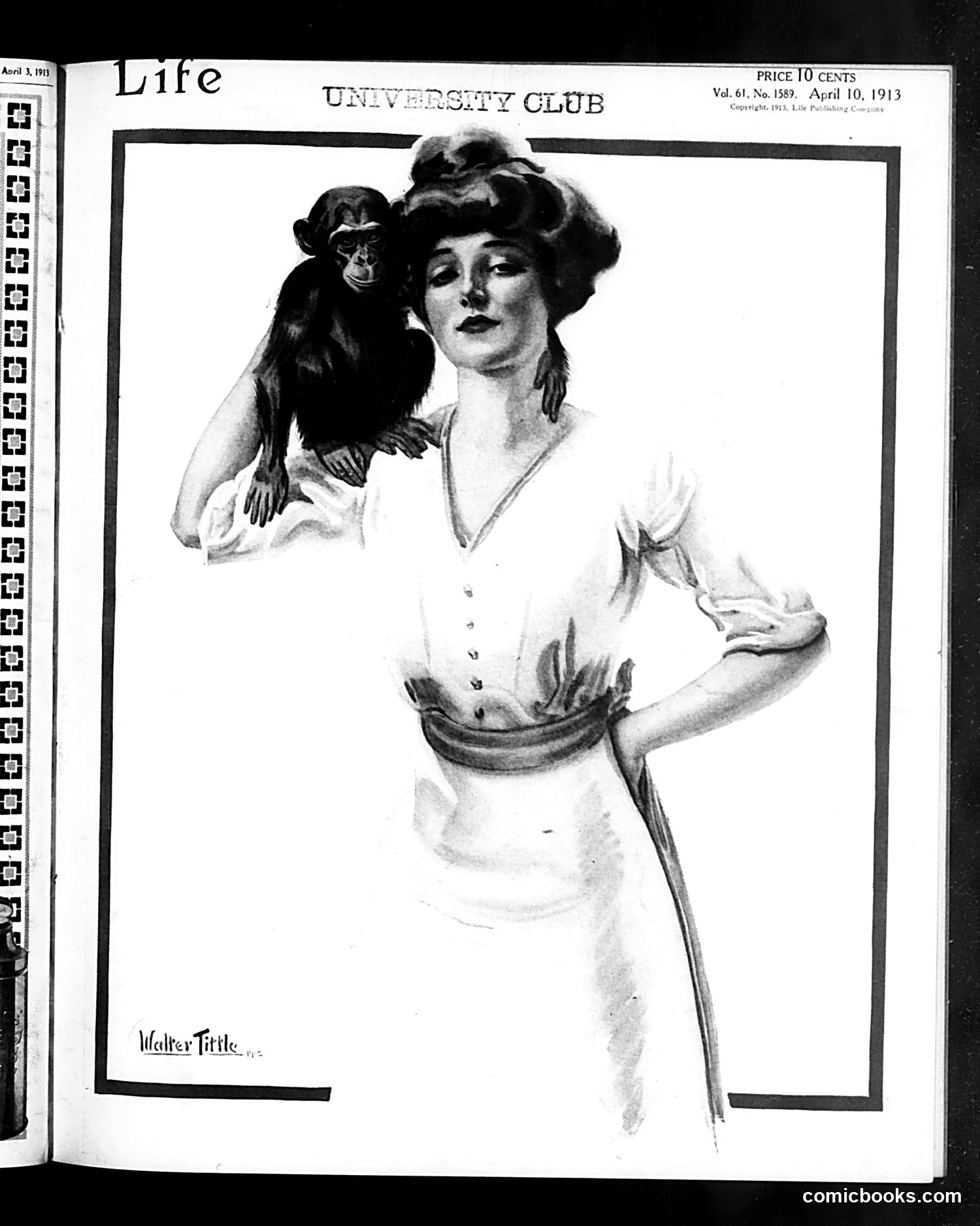
This is a cover illustration from *Life* magazine (April 10, 1913) by artist Walter Tittle. It depicts a fashionably dressed woman in Edwardian attire holding a small chimpanzee on her shoulder. The image likely satirizes the early 20th-century fascination with exotic animals as status symbols among wealthy women. The juxtaposition of refined, elegant fashion with an ape suggests mockery of this trend—implying that keeping such animals as accessories was absurd or undignified, even as it reflected actual practices among the wealthy elite. The title "University Club" remains unclear without additional context, but may reference a specific social institution or membership organization. The satire targets both conspicuous consumption and the affectations of high society.
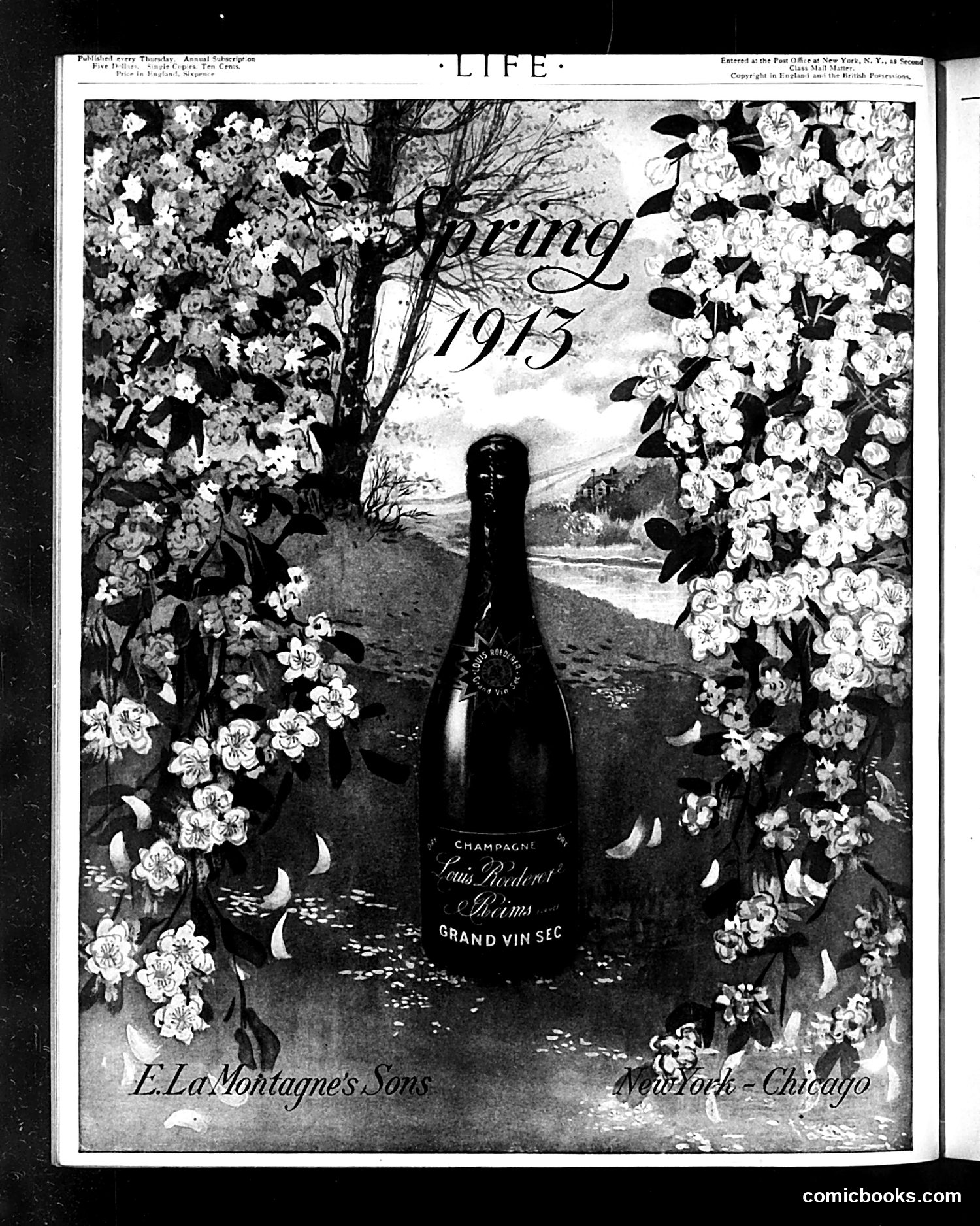
This page is **primarily a champagne advertisement**, not political satire. It features a bottle of "Louis Roederer" champagne labeled "Grand Vin Sec" (dry champagne), positioned centrally among flowering vines and branches. The scenic background shows a river landscape. The text identifies the distributor as "L. La Montagne's Sons" with offices in "New York - Chicago," suggesting this advertisement targeted wealthy American consumers. The "Spring 1913" text and floral framing evoke renewal and celebration—typical marketing messaging for luxury goods. This represents how Life magazine, though known for satire, generated revenue through high-end product advertising aimed at affluent readers during the early 20th century.
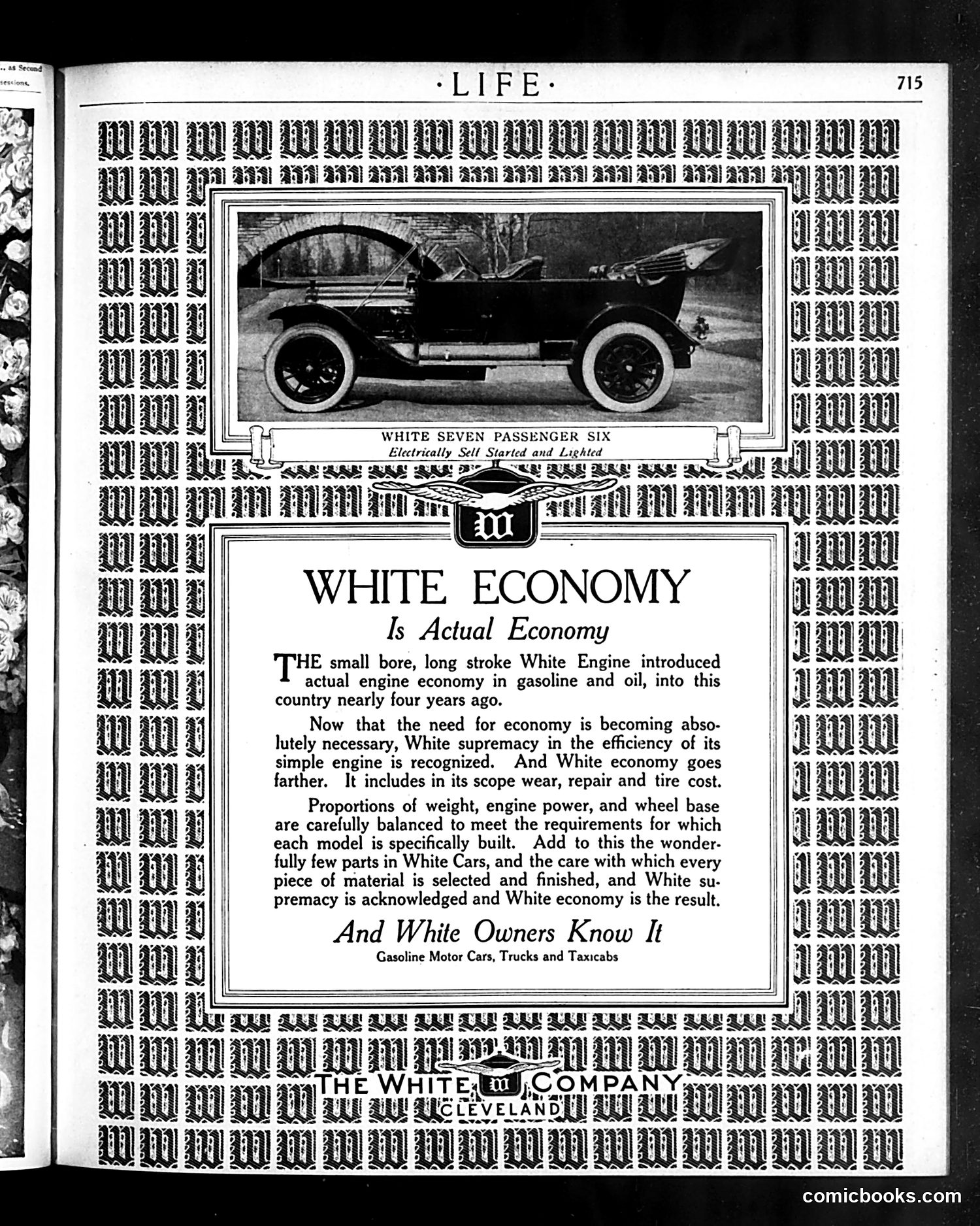
This page is primarily a **product advertisement**, not satire or political commentary. It promotes the White Motor Company's "White Seven Passenger Six" automobile. The ad emphasizes the vehicle's practical features: electric self-starting, lighting, and fuel economy through White's "small bore, long stroke" engine design. The tagline "WHITE ECONOMY Is Actual Economy" argues their vehicles offer genuine savings through durability, requiring less maintenance, repair, and tire replacement. The only visual element is a photograph of the automobile itself—a touring car typical of the 1910s era. There is no cartoon, caricature, or satirical commentary present. This is straightforward commercial marketing in Life magazine, highlighting mechanical efficiency and cost-effectiveness to appeal to middle-class American consumers of that period.
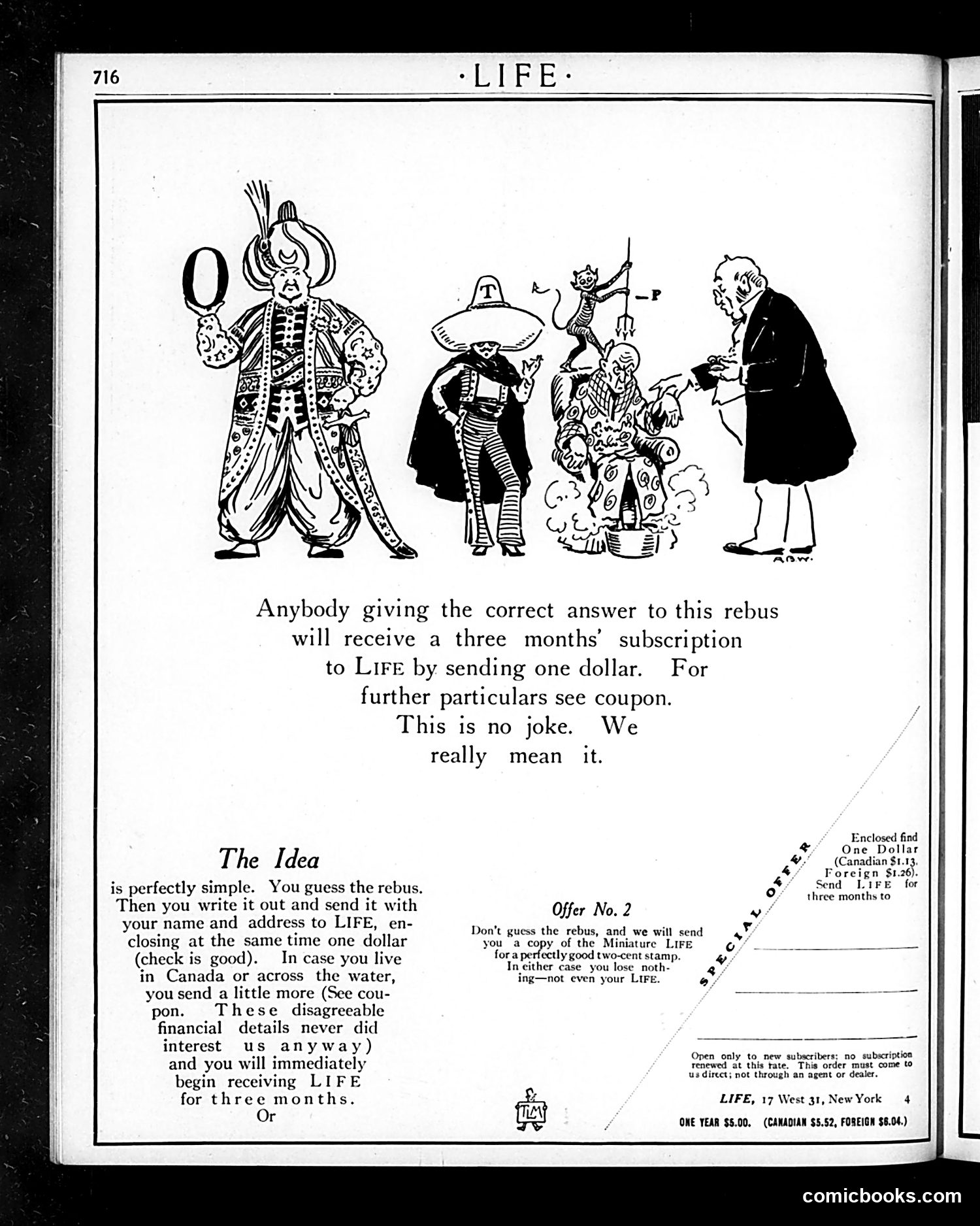
This page is primarily an **advertisement for Life magazine itself**, presented as a contest/puzzle offer. The illustration shows four figures in costume: an ornately-dressed Oriental figure holding a mirror, a military officer in plumed helmet, small fantastical creatures, and an elderly woman. These form a **rebus puzzle**—a visual riddle where images represent words or phrases that readers must decipher. The text promises a three-month Life subscription (for one dollar) to anyone solving the rebus correctly. It emphasizes the offer's legitimacy ("This is no joke. We really mean it") and includes an alternative offer for those who don't solve it. This was a common promotional strategy for magazines, using puzzles and prizes to attract new subscribers. The specific meaning of the visual rebus is unclear without additional context or solution.
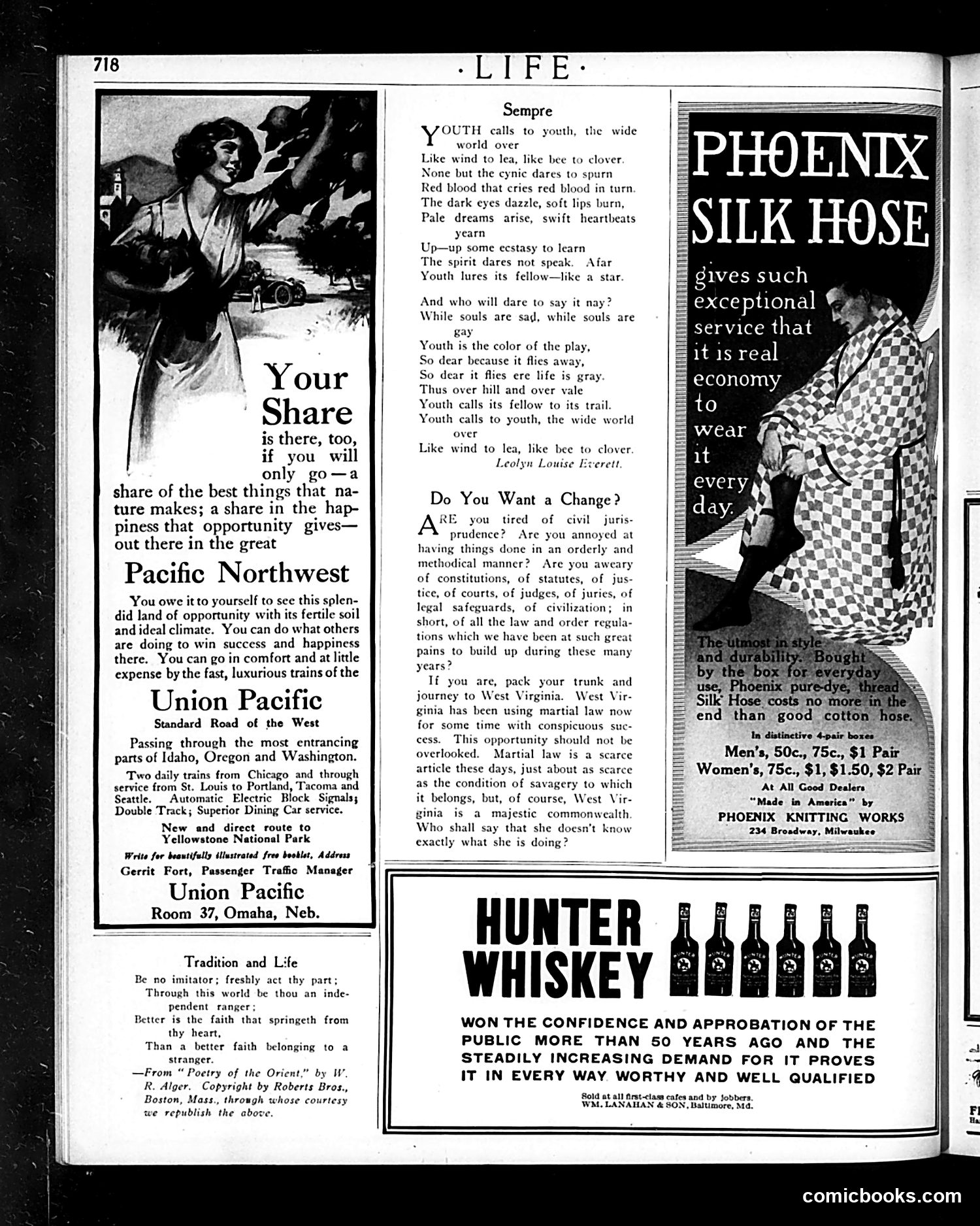
This page is primarily **advertising and poetry**, not political satire. The left side features a Union Pacific Railroad advertisement using romantic imagery of a young woman to promote travel to the Pacific Northwest. The copy emphasizes opportunity and natural beauty as incentives. The center contains a poem titled "Sempre" about youth, followed by "Do You Want a Change?" which discusses civil unrest and martial law in West Virginia—likely referencing labor disputes or constitutional concerns of the era. The right side advertises **Phoenix Silk Hose** (hosiery) and **Hunter Whiskey**. The page contains no political cartoons or caricatures. Its primary function is commercial advertising interspersed with literary and topical content typical of Life magazine's format during this period.
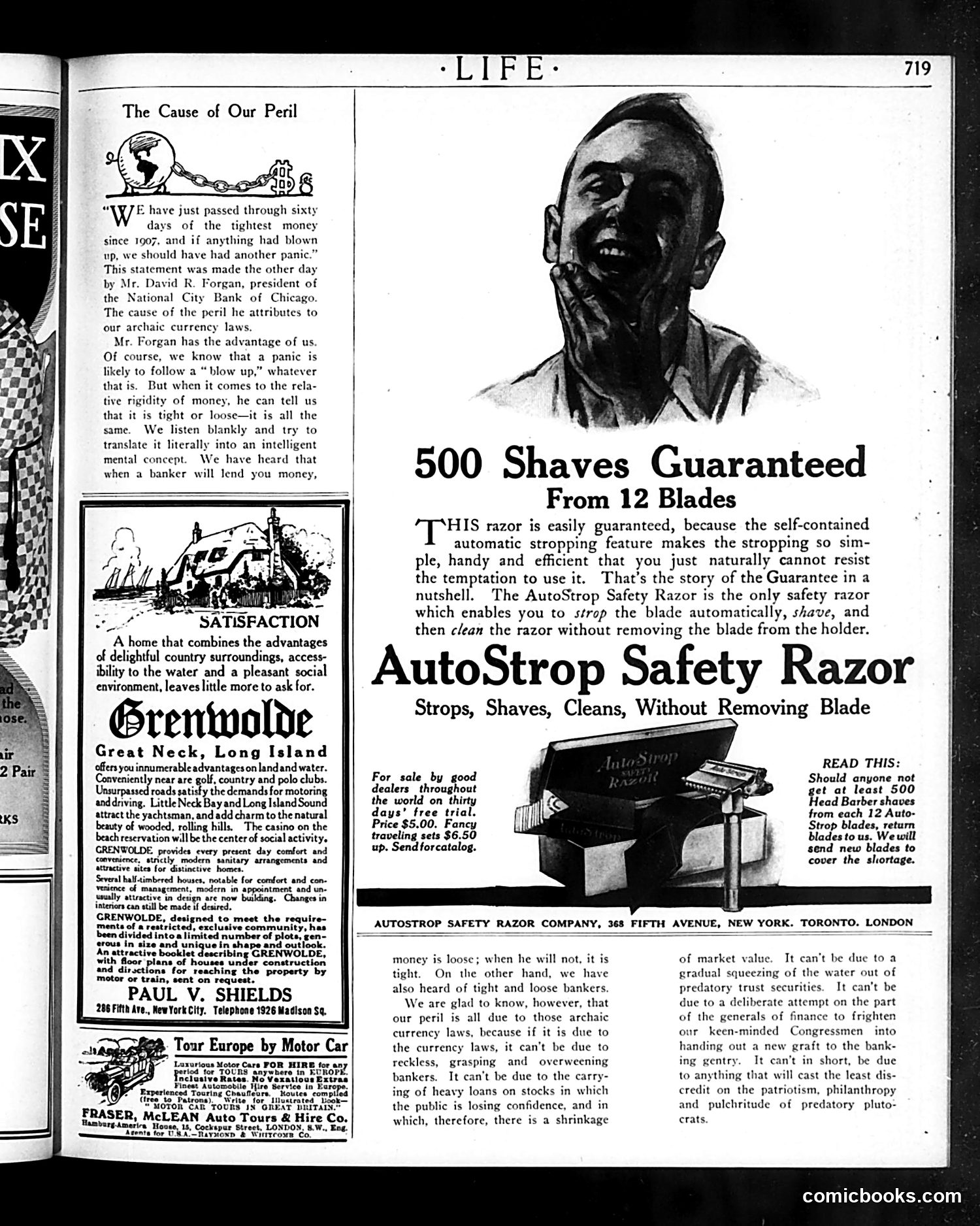
This page is primarily **advertising** rather than political satire. The dominant content features an AutoStrop Safety Razor ad with a portrait of a man and claims of "500 Shaves Guaranteed From 12 Blades." The left side contains a brief article titled "The Cause of Our Peril," which quotes David R. Forgan, president of the National City Bank of Chicago, on tight money conditions and banking panics since 1907. The article discusses currency laws and banker lending practices. Below that are advertisements for **Grentwolde** (a residential community) and **Fraser Motor Car Tours** in Europe. The page reflects early 20th-century concerns about monetary policy and financial stability, but the satirical content is minimal—this is primarily a commercial publication page.
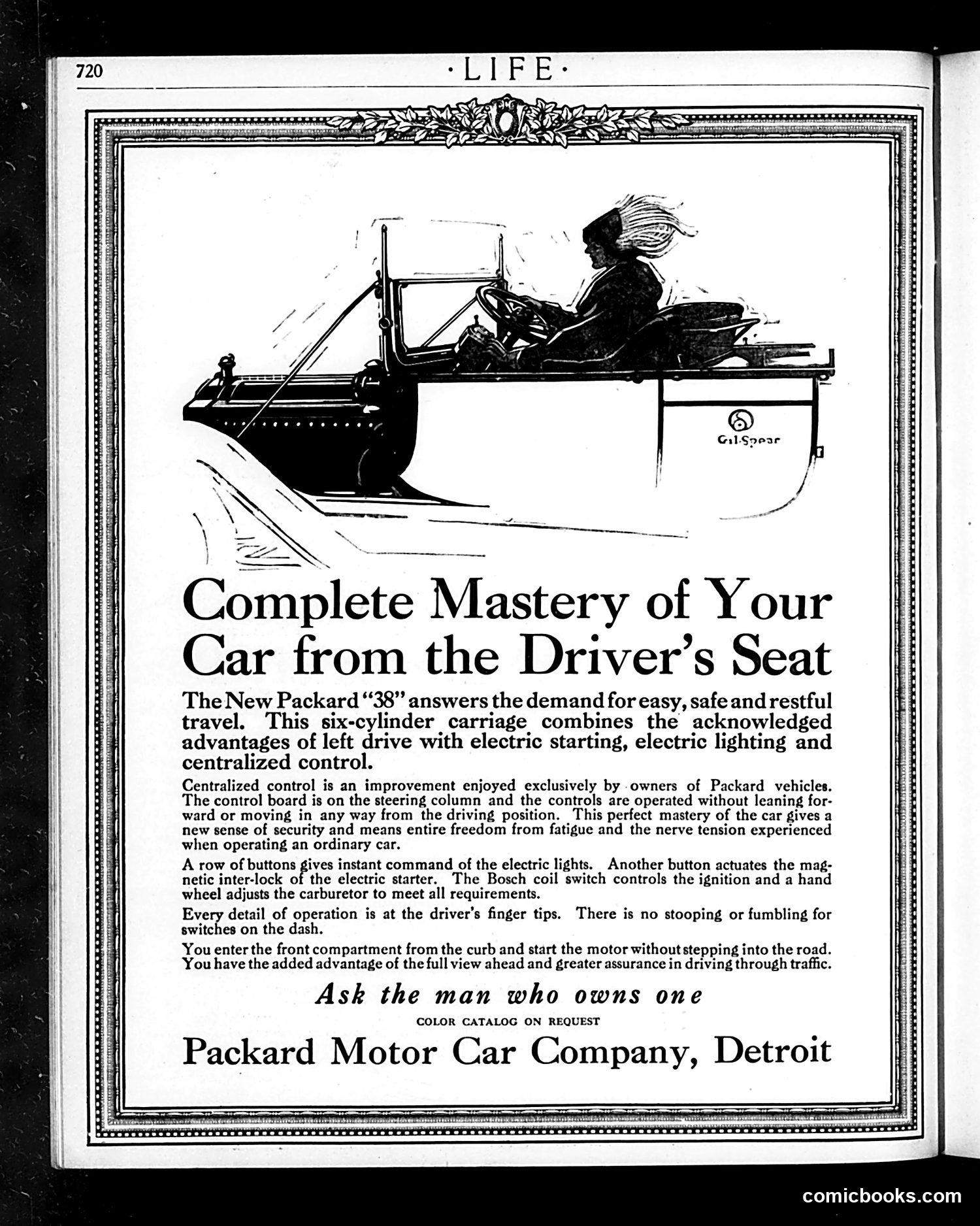
This is a full-page advertisement, not a political cartoon. It promotes the 1938 Packard automobile, specifically highlighting its "centralized control" feature that allows drivers to operate lights, ignition, and other functions from the steering wheel without fumbling for multiple switches on the dashboard. The illustration shows a woman driver operating the car with ease and comfort. The ad emphasizes this as a luxury feature—"perfect mastery of the car"—that reduces driver fatigue and "nerve tension." The tagline "Ask the man who owns one" was Packard's actual advertising slogan. For modern readers: this showcases early automotive convenience features we now take for granted, presented as cutting-edge luxury technology.
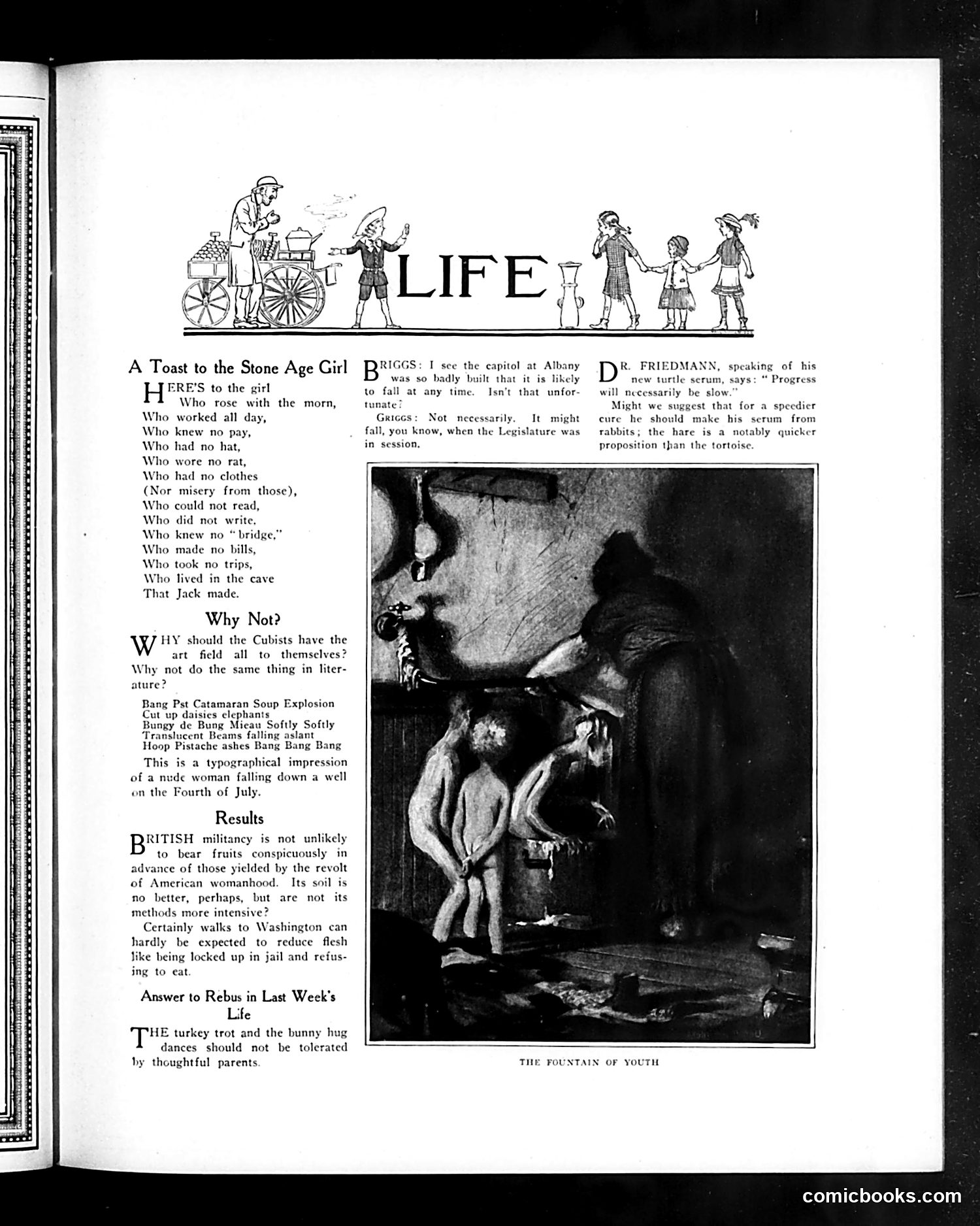
This page from *Life* magazine contains three satirical pieces: 1. **"A Toast to the Stone Age Girl"** — A poem mocking women's suffrage by listing primitive characteristics (couldn't read, write, make hills, take trips), sarcastically praising a woman who lived in a cave. This attacks the women's rights movement by suggesting women lacked capacity for civic participation. 2. **"Why Not?"** — Questions why Cubists don't dominate literature like they dominate visual art, then lists absurdist poetic phrases. This mocks Modernist artistic movements as pretentious nonsense. 3. **"Results"** and **"Answer to Rebus"** — Brief political commentary comparing British and American militancy, and dismissing "turkey trot" dances as inappropriate. The page represents early 20th-century conservative satire opposing progressive social and artistic movements.
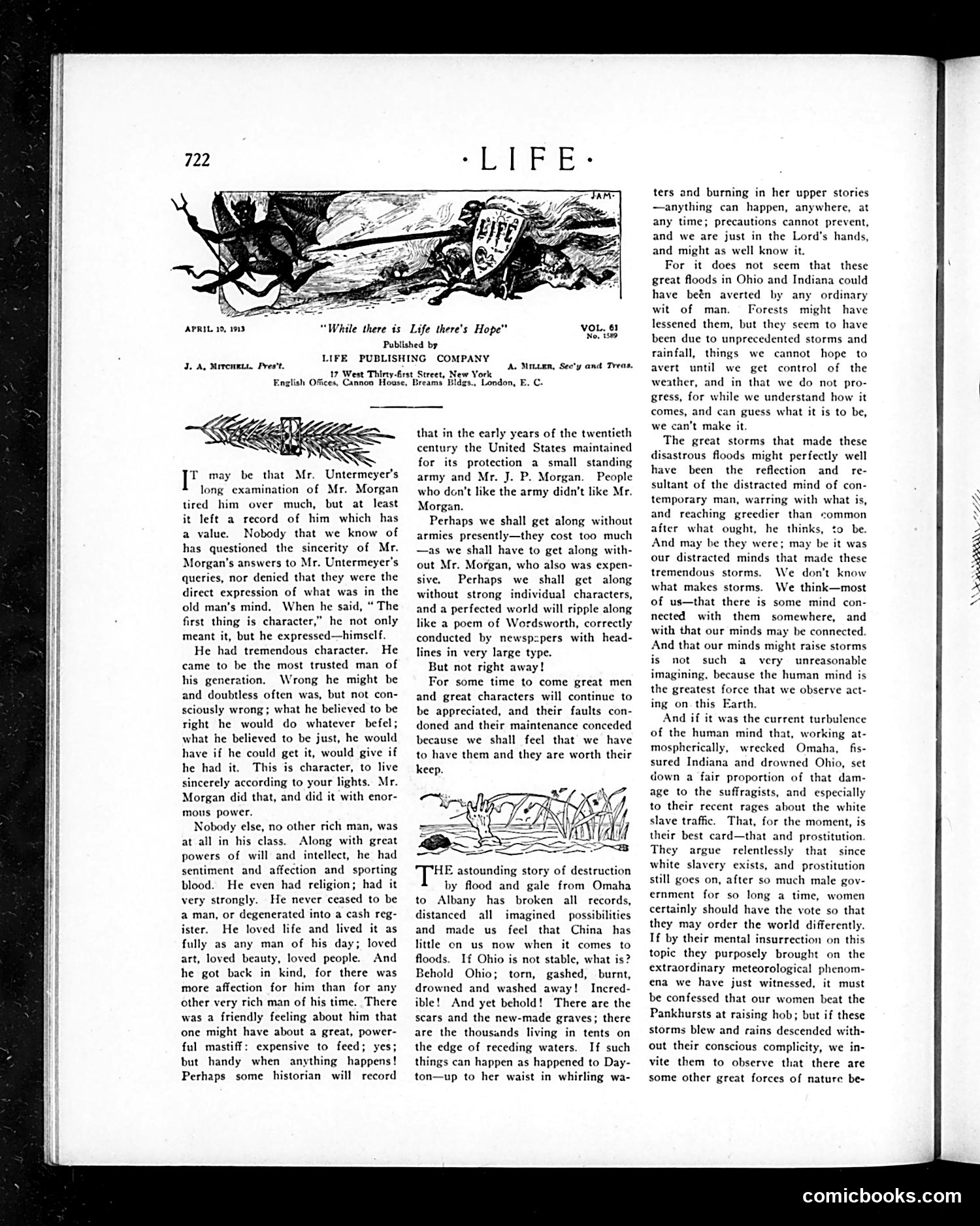
The editorial discusses the 1913 Ohio and Indiana floods, arguing they couldn't have been prevented by ordinary precautions. The author uses this disaster to critique the worship of powerful men like J.P. Morgan and J. Pierpont Morgan, suggesting Americans over-rely on individual "great men" to solve problems. The cartoon (top) depicts **Death** as a skeletal figure wielding a scythe amid flood waters, illustrating nature's indifference to human power and wealth. The satire's point: even Morgan's tremendous influence cannot control natural disasters, yet Americans obsess over such figures as if they could solve all problems. The piece advocates for recognizing limits to individual power and accepting life's inherent uncertainties.
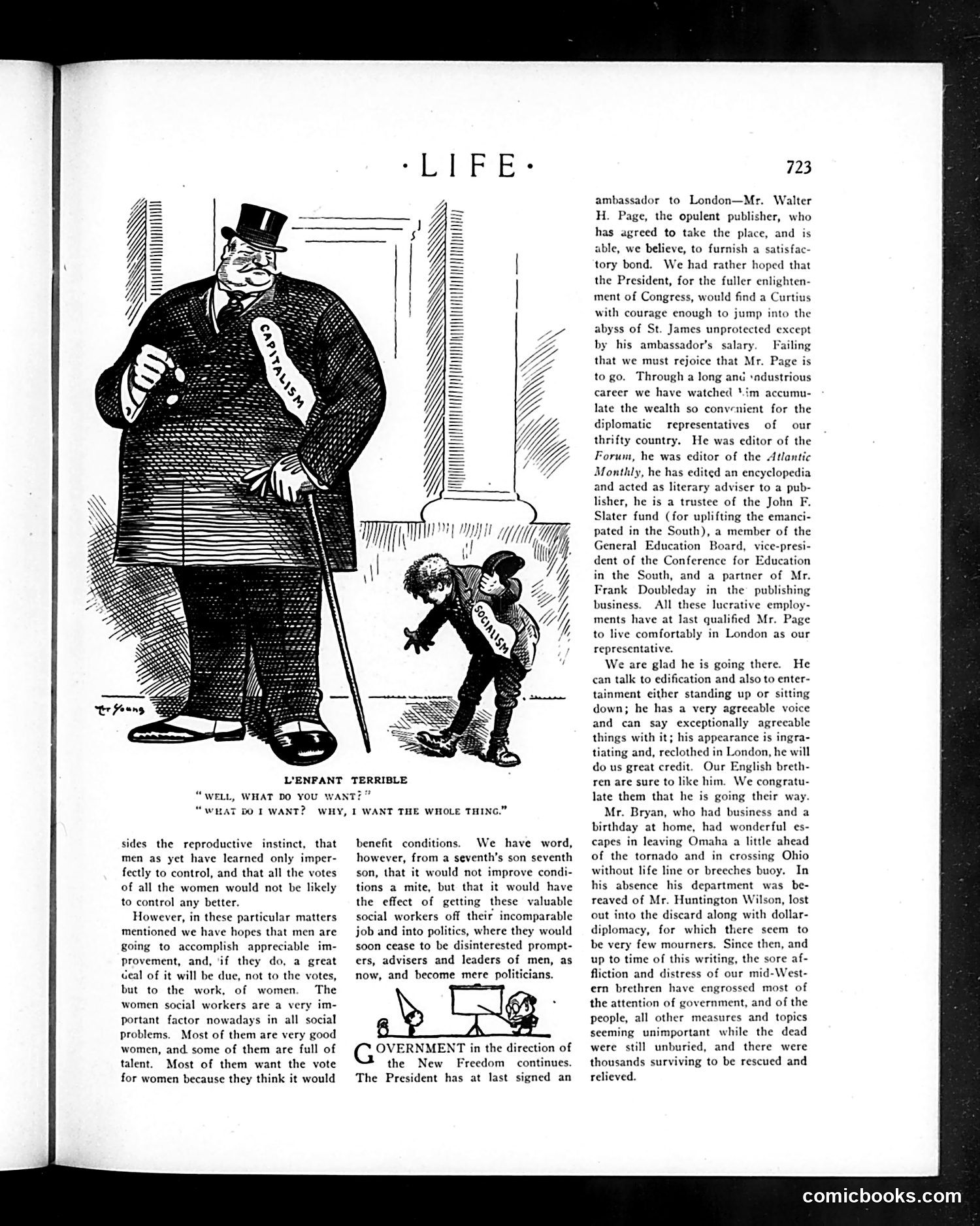
This cartoon depicts a size-contrast joke between a large, well-dressed gentleman labeled "CANADA" and a tiny, mischievous child labeled "ENGLAND," with the caption: "Well, what do you want?" / "What do I want? Why, I want the whole thing." The satire comments on Britain's imperial ambitions and colonial appetite. The "terrible child" (enfant terrible) represents England's persistent demands for territorial expansion, portrayed as childish greed. Canada, rendered as an adult figure, confronts this unreasonable expectation. The adjacent text discusses government direction and social reform under "the New Freedom," suggesting this reflects early 20th-century debates about British imperialism versus emerging nationalist sentiments in dominions like Canada seeking greater autonomy.
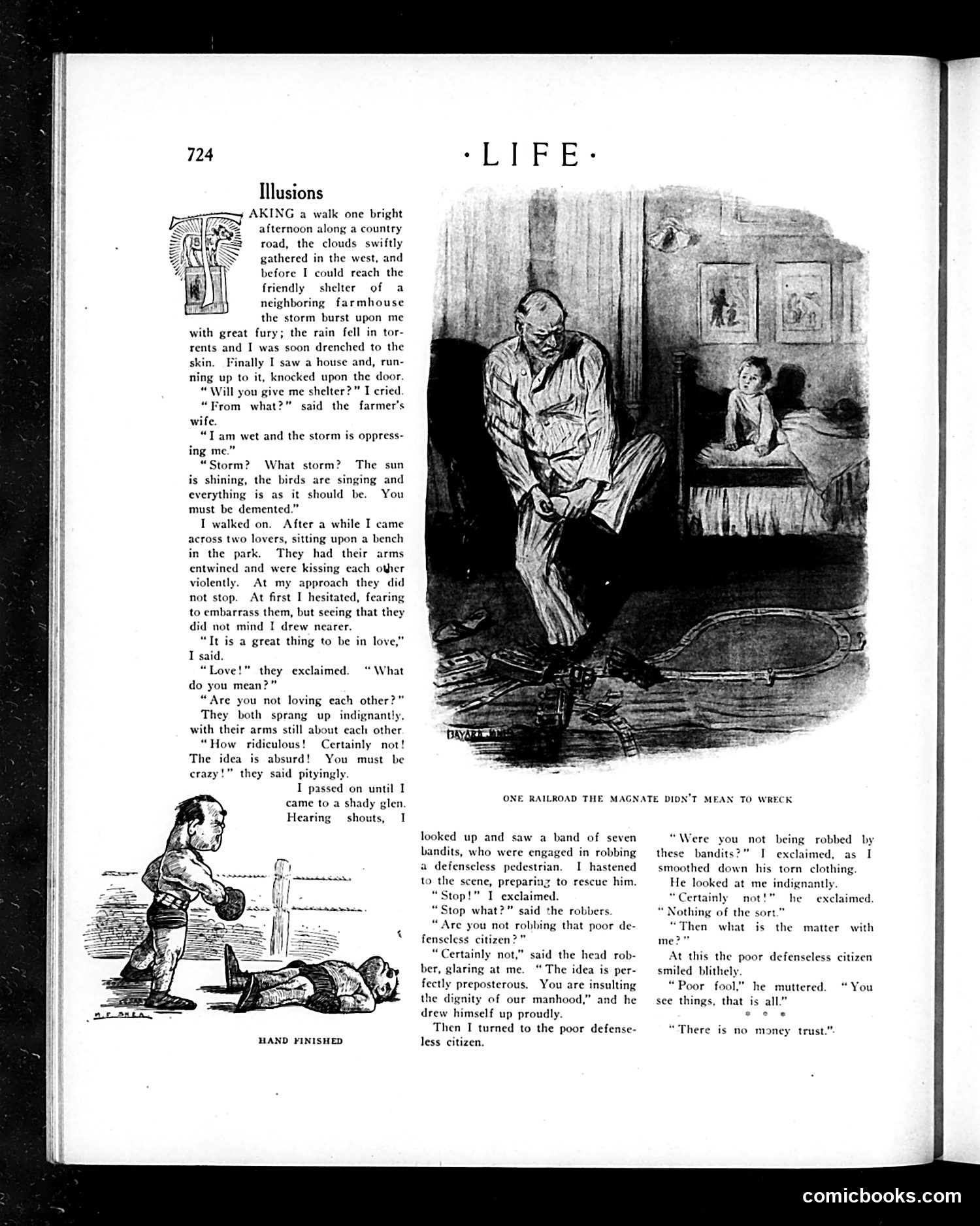
This page presents a satirical essay titled "Illusions" accompanied by three illustrations. The narrative mocks romantic idealization and social pretense through several vignettes: 1. **The storm shelter scene**: A farmer's wife refuses a soaked traveler shelter, claiming poverty while the sun shines—exposing hypocrisy. 2. **The lovers in the park**: The narrator ridicules a couple kissing publicly as "absurd" and "crazy," suggesting Edwardian-era social disapproval of overt public affection. 3. **The robbery scene** (captioned "Hand Finished"): Robbers attack a defenseless citizen, but when the victim claims poverty, the robbers react indignantly—the joke being that even thieves maintain pretenses of dignity and "manhood," revealing how deeply social illusions penetrate all levels of society. The satire targets hypocrisy across classes.
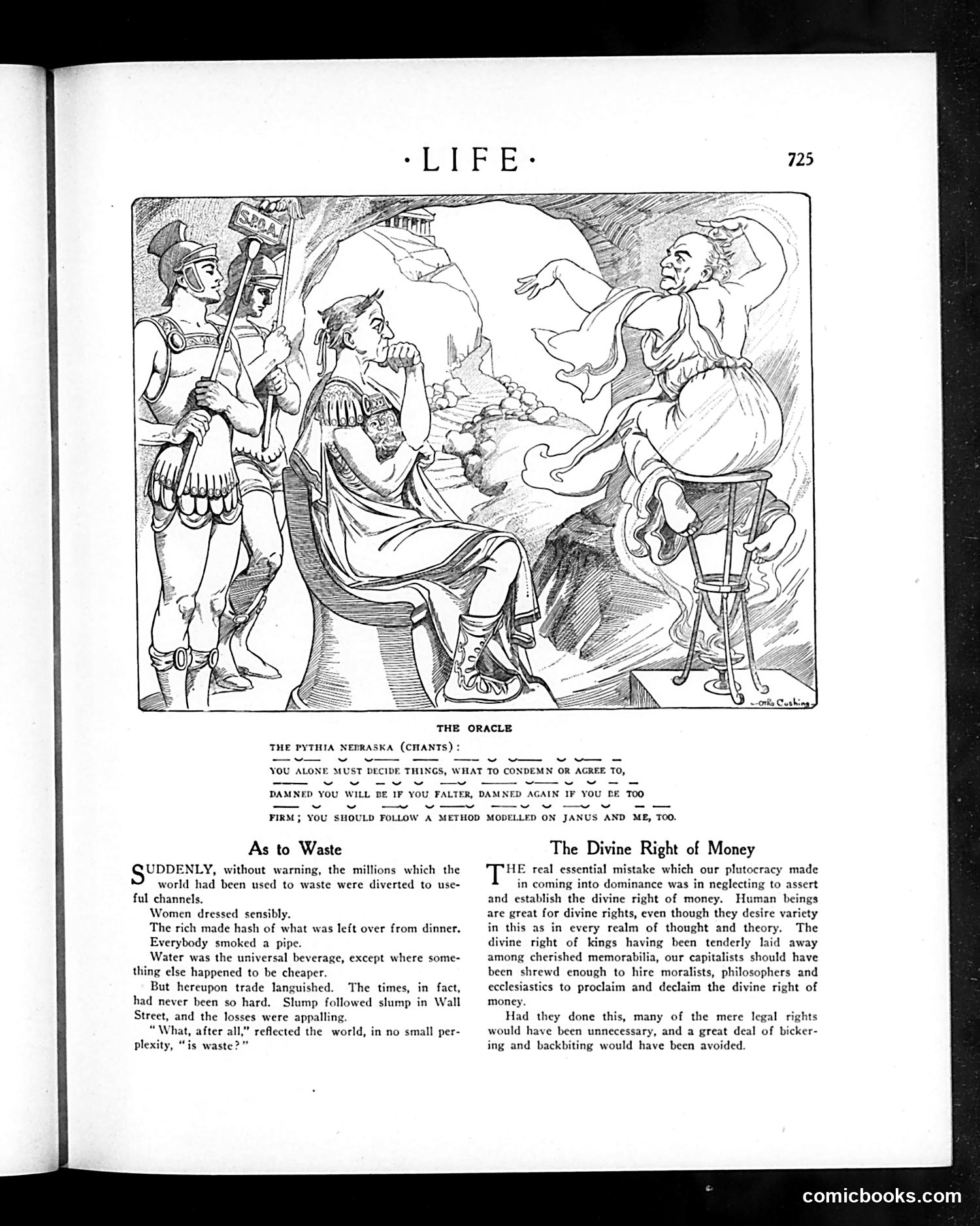
This cartoon satirizes decision-making authority, likely during the Progressive Era. It depicts two Roman military/political figures consulting an oracle (the Pythia from Greek mythology), shown as an eccentric figure on an elevated seat. The oracle's chant warns against both indecision and overconfidence—a commentary on political leadership struggles. The accompanying articles critique waste and "the divine right of money," suggesting concerns about plutocracy and economic inequality. The satire implies that contemporary leaders, like the Roman figures seeking guidance, are confused about proper governance and may be wrongly worshipping wealth as supreme authority rather than pursuing rational policy. The cartoon criticizes both weak and dogmatic leadership while questioning whether capitalists have assumed undeserved moral authority.
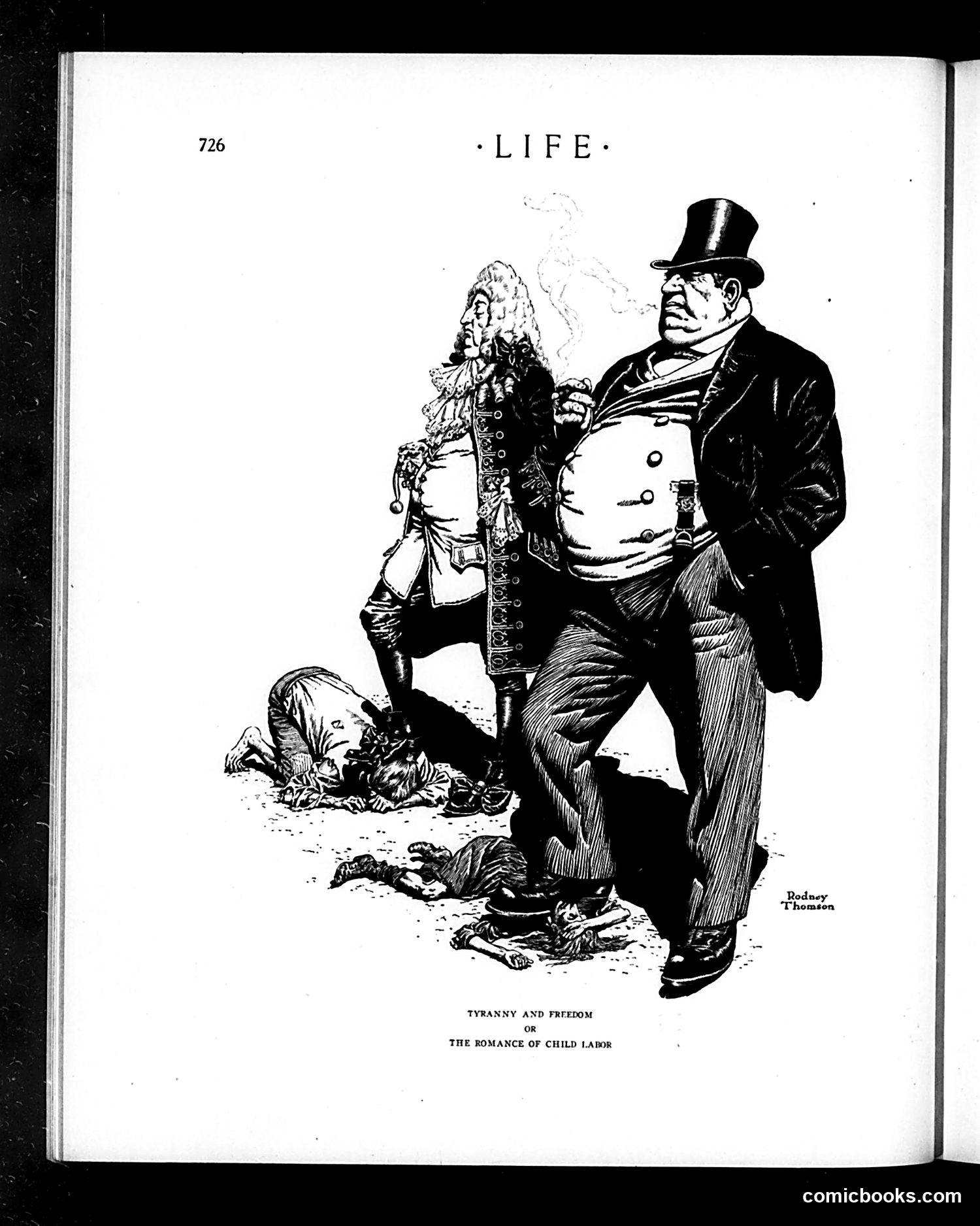
This satirical cartoon by Rodney Thomson depicts two well-dressed gentlemen—appearing to represent wealthy industrialists or factory owners—standing over impoverished children working on the ground. The title's sarcastic phrase "romance of child labor" mocks the era's industrial exploitation. The cartoon critiques the brutal reality of child labor in factories and mills, which was widespread in early 20th-century America. The contrast between the prosperous, top-hatted men and the suffering children illustrates how factory owners profited from cheap child labor. The "tyranny" referenced in the title suggests the cartoon condemns this system as oppressive, while "freedom" is ironic—children had no freedom from exploitation. This reflects growing Progressive Era reformist sentiment against child labor practices.
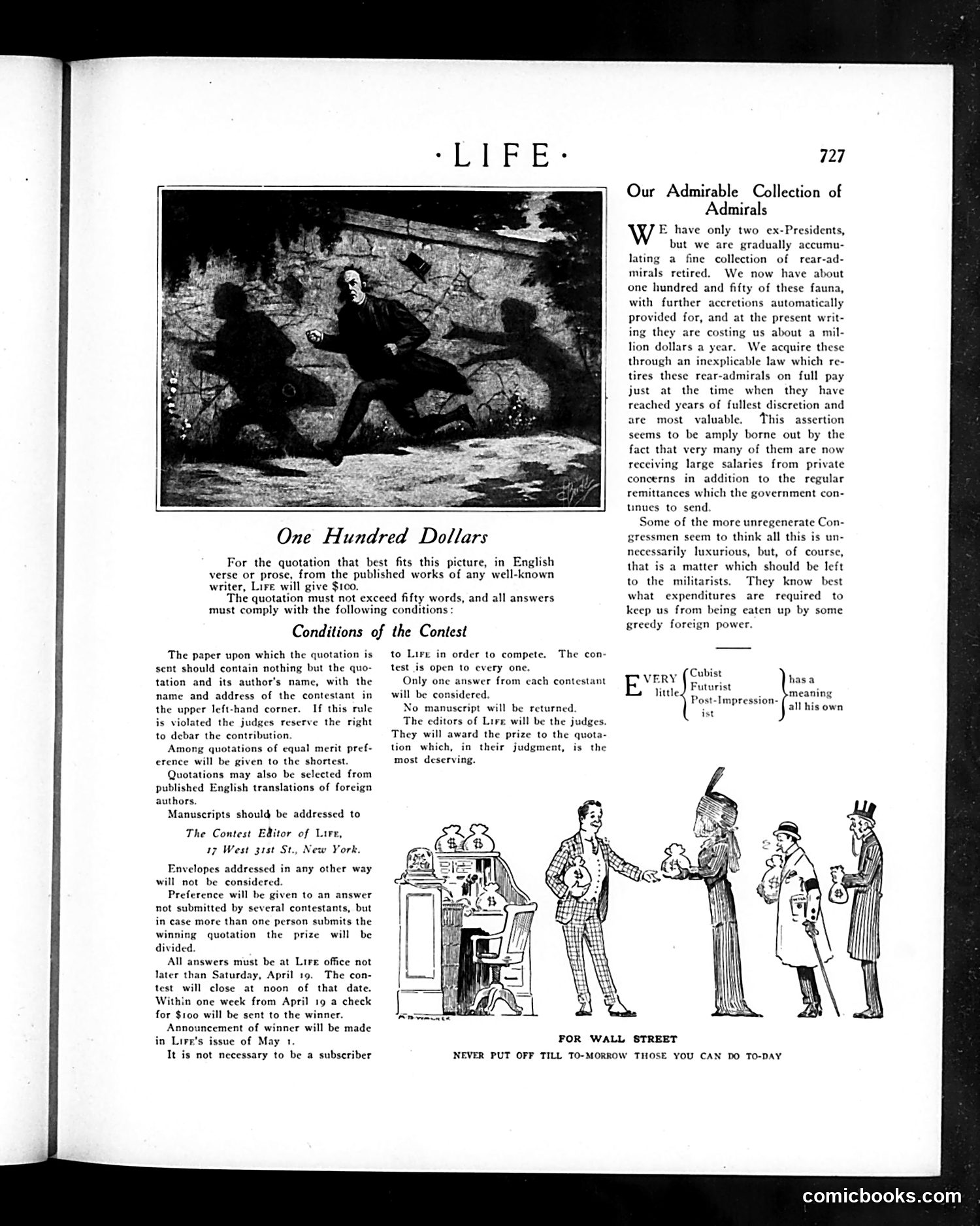
This page contains two distinct sections: **Top: A Literary Contest** featuring a black-and-white photograph of three men in what appears to be a dungeon or prison. Life magazine offers $100 for the best literary quotation (under 50 words) from published works that fits this image. The contest details and submission rules occupy most of the text. **Bottom: Political Satire** criticizing excessive military spending. The article "Our Admirable Collection of Admirals" sarcastically attacks the practice of retiring rear-admirals on full pay—approximately 150 officers costing a million dollars annually. The satire points out the absurdity: these officers receive government pensions while simultaneously earning large salaries from private companies. Life mocks congressmen who question this "luxury," using heavy irony to suggest military interests prioritize spending over fiscal responsibility. The small cartoon below illustrates Wall Street types, likely reinforcing the connection between military expenditure and financial interests.
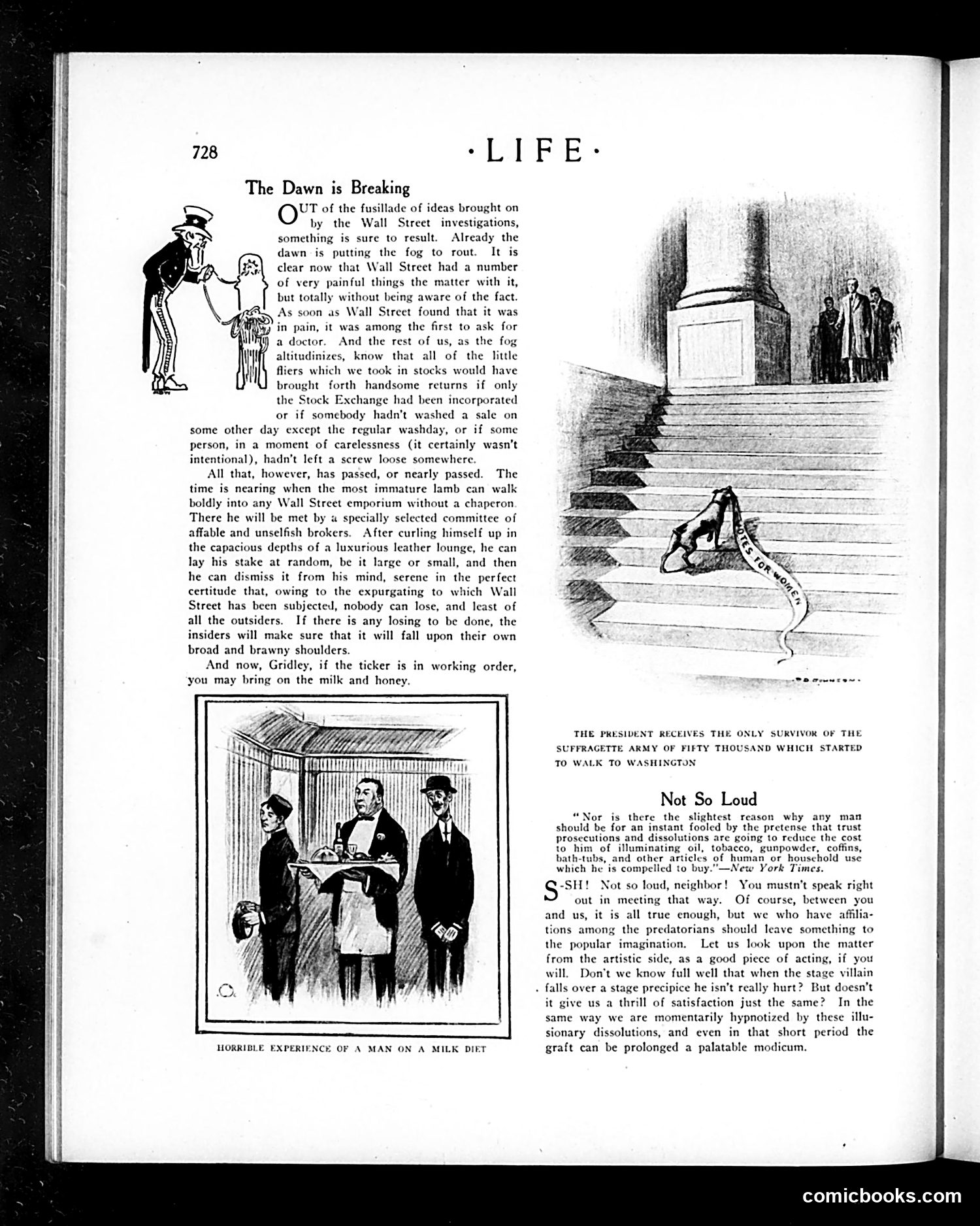
This page satirizes the aftermath of early-1900s Wall Street investigations (likely the Pujo Committee hearings on banking practices). **"The Dawn is Breaking"** mocks the public's naive optimism that reforms will genuinely help ordinary investors. The text sarcastically suggests that soon small investors can gamble on stocks without fear—implying this is false comfort. The joke: insiders will ensure *they* don't lose money, not the public. **"Not So Loud"** criticizes the theater of reform itself. It quotes the *New York Times* noting that trust-busting won't actually lower consumer prices for essentials (oil, tobacco, coffins, etc.). The cartoon counsels silence about this truth, comparing the fake reforms to stage illusions—people enjoy the *show* of justice even knowing it's not real. The satire targets both complicit elites ("predatorians") and a gullible public willing to be hypnotized by performative reform. The lower cartoon about "milk diet" appears unrelated to the political content.
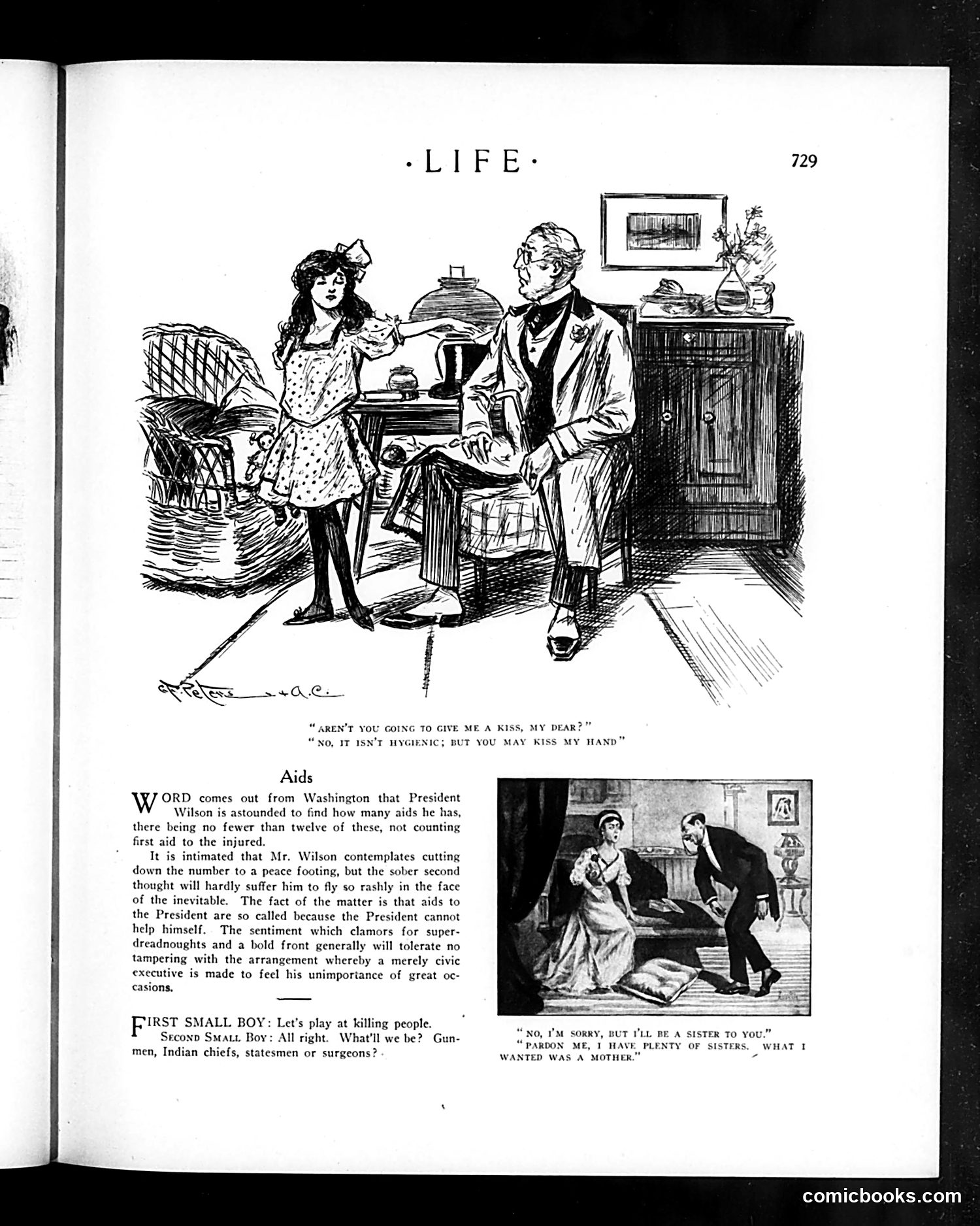
**Top Cartoon:** A man and woman demonstrate the "hygiene" excuse—she refuses to kiss him but offers her hand instead. This satirizes the post-WWI obsession with germ theory and social hygiene as reasons to avoid physical contact. **"Aids" Article:** Mocks President Wilson for employing twelve presidential aides. Life sarcastically suggests Wilson "cannot help himself" and needs these aids, playing on the double meaning—the aides are necessary because the president is helpless, not because the work is truly demanding. The satire criticizes both Wilson's administration bloat and the public's acceptance of executive inefficiency. **Bottom Comics:** Two brief jokes about social roles and relationships. The first depicts children playing "killing people" with various occupations. The second shows a rejected suitor told "I'll be a sister to you," with him responding he wanted a mother, not a sister—mocking sentimental Victorian romantic excuses. The page collectively ridicules post-war social pretenses, government inefficiency, and outdated relationship conventions.
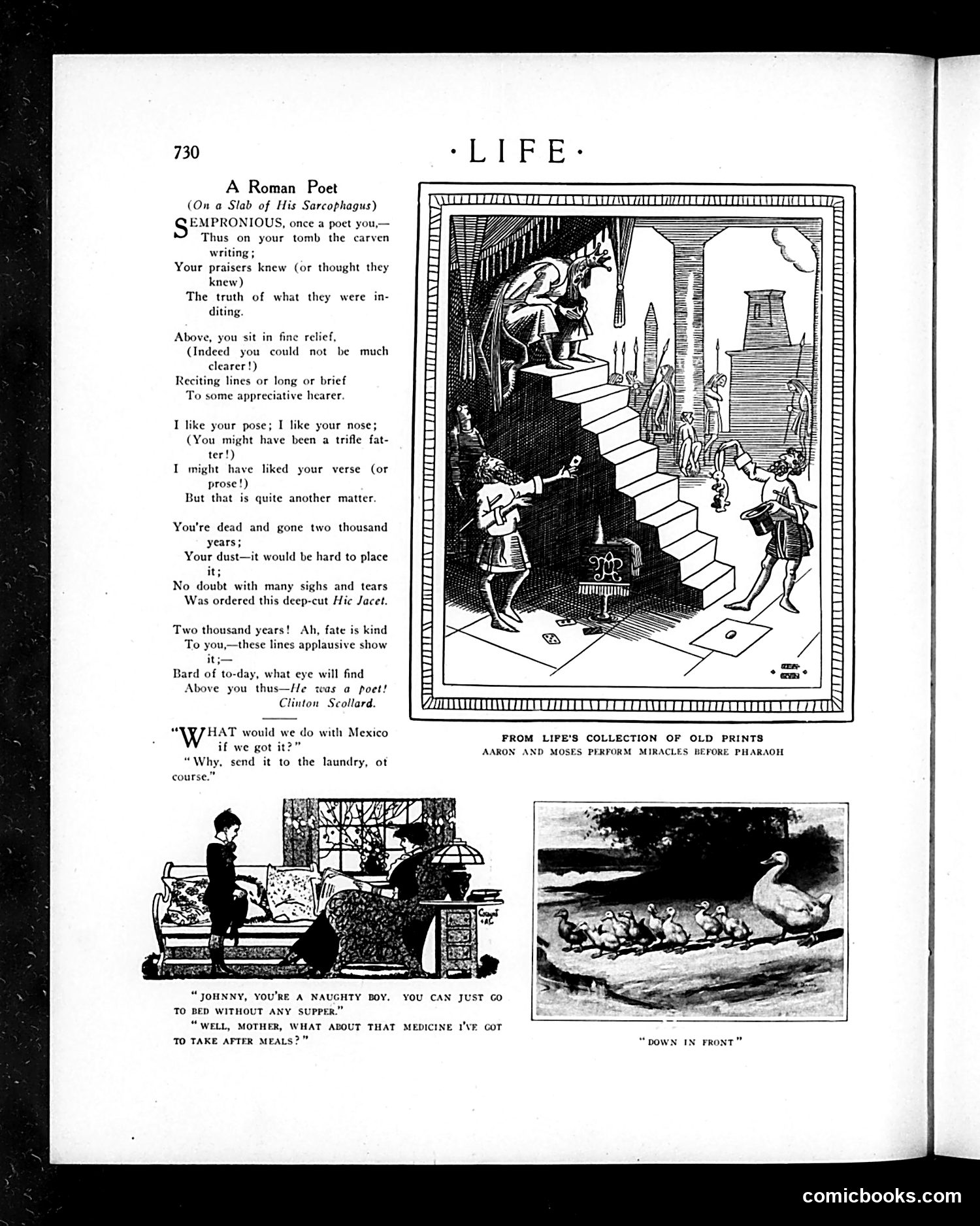
**Main Content:** The page features a poem by Clinton Scollard about a Roman poet commemorated on his sarcophagus. It's a meditation on mortality and legacy—the speaker admires the carved relief of the ancient poet but notes that while his image endures, posterity will likely forget modern poets after two thousand years. **The Cartoons:** 1. **Top right**: A reproduction of an old print depicting Aaron and Moses performing miracles before Pharaoh (biblical reference). 2. **Middle left**: A domestic scene where a mother threatens her naughty son Johnny with no supper, but he responds by asking about medicine he must take after meals—a cheeky deflection of the punishment. 3. **Bottom right**: Titled "Down in Front," showing a large goose confronting smaller ducks—likely a joke about theater etiquette, where someone blocking others' view is told to sit down. **Tone:** This is typical *Life* magazine fare—literary content mixed with gentle domestic humor and visual gags, appealing to educated, middle-class readers of the early 20th century.
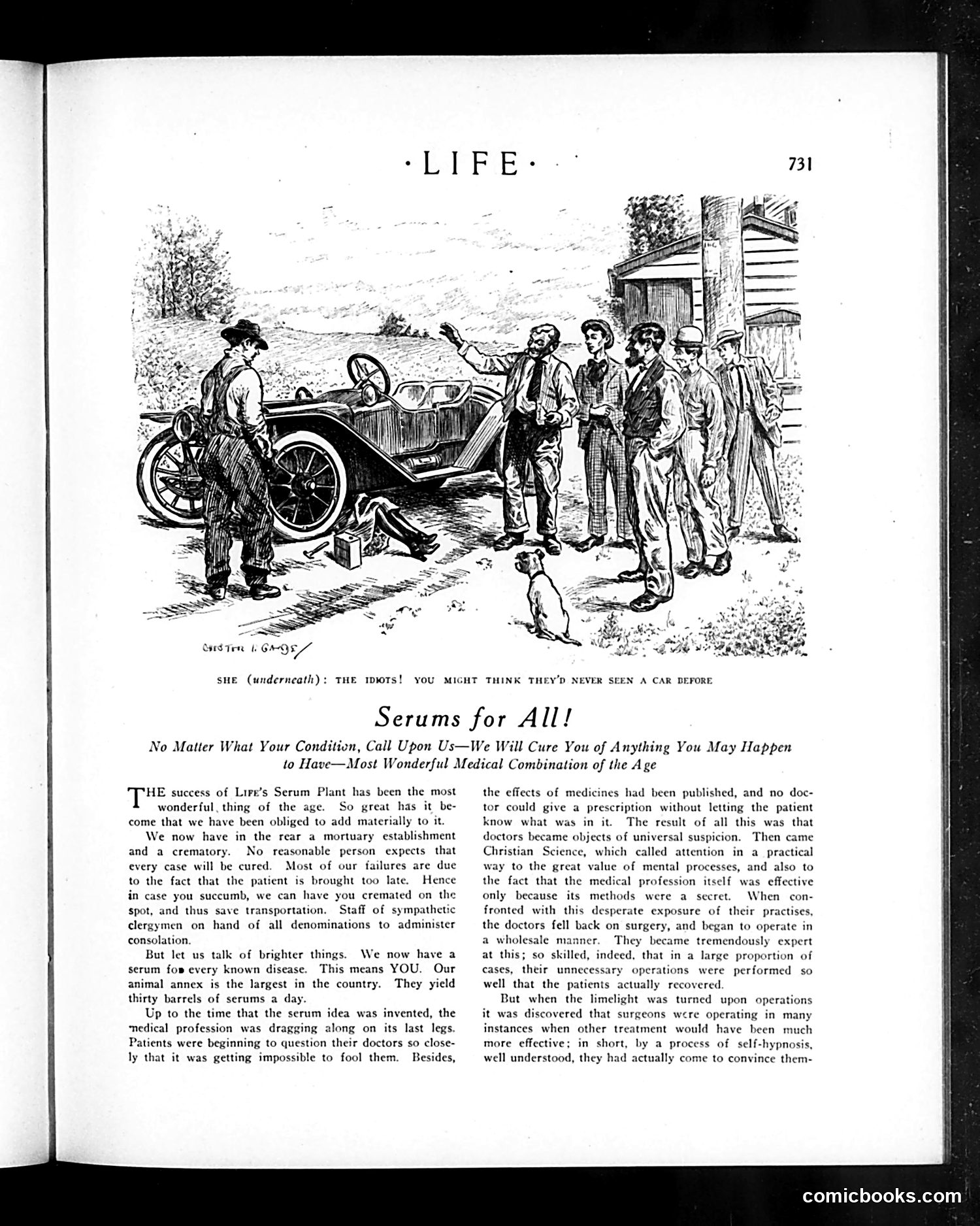
This cartoon satirizes early 20th-century medical fraud and the era's obsession with miracle "serums" as cure-alls. The sketch shows rural folks gawking at an automobile—presented as idiots who've never seen modern technology—while the accompanying text mocks dubious medical establishments claiming to cure "anything." The satire targets doctors who, facing patient skepticism about traditional medicine, pivoted to promoting secret serums and unnecessary surgeries. Life ridicules the profession's loss of credibility: patients demanded transparency about medications, so physicians retreated into surgical procedures they claimed only *they* understood. The text sarcastically notes surgeons became so skilled at unnecessary operations that patients sometimes recovered anyway—self-deception disguised as expertise. The car scene suggests these rural "idiots" mirror gullible patients blindly accepting whatever doctors prescribe. The crematory mentioned in the ad copy darkly jokes that the serum plant profits from its own failures.
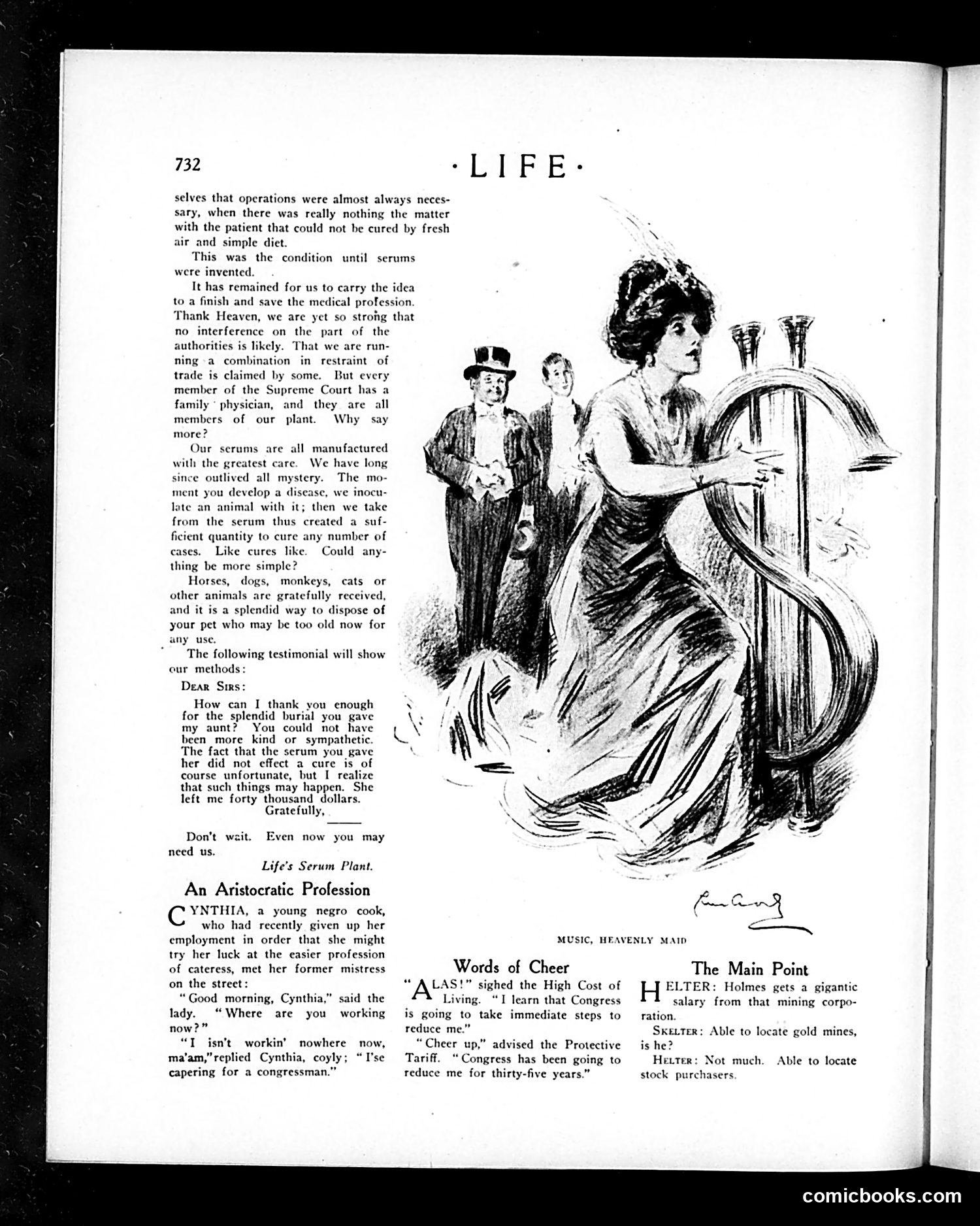
This page contains **three separate satirical pieces** mocking early 20th-century American institutions: 1. **"Life's Serum Plant"**: A scathing critique of pharmaceutical monopolies and medical fraud. The "serum manufacturers" boast of a corrupt system where Supreme Court justices are their family physicians, ensuring legal protection. The satire peaks with a testimonial from someone whose aunt died from their serum but left her $40,000—implying the real business is inheritance manipulation, not medicine. 2. **"An Aristocratic Profession"**: A brief joke about a Black woman named Cynthia who quit domestic service to become a "cateress" (caterer) for a congressman—likely satirizing how politicians or wealthy patrons exploit service workers while pretending to offer "better" employment. 3. **"Words of Cheer" and "The Main Point"**: Quick gags about the High Cost of Living and mining stock fraud, mocking corporate deception and the powerlessness of regulatory bodies like Congress. The overall theme: **institutional corruption**—medicine, politics, and finance all rigged to benefit the wealthy while harming ordinary people.
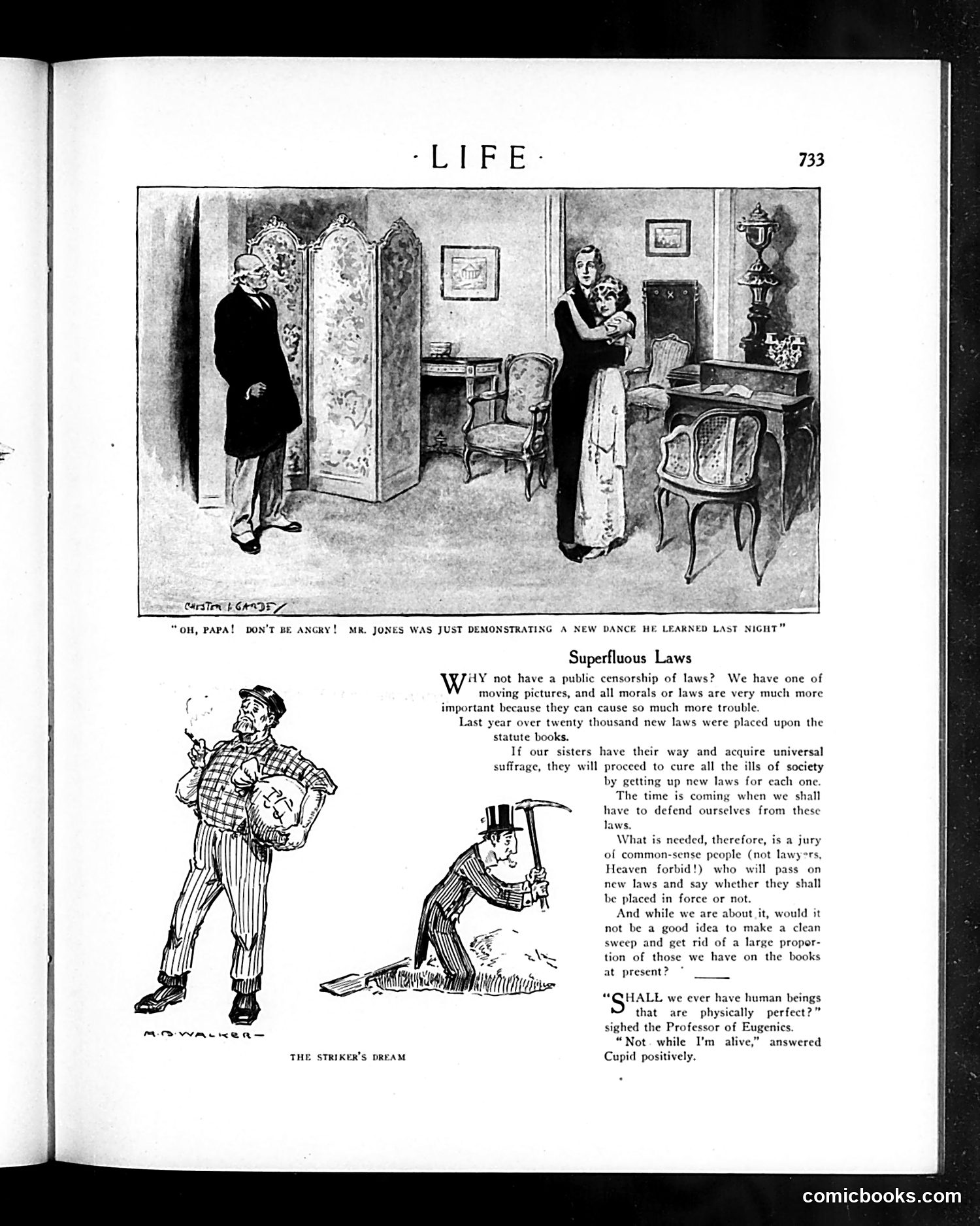
The top cartoon depicts a domestic scene where a father catches a man dancing with his daughter. She excuses it as just a dance demonstration—likely referencing the "modern" dances (like the Charleston or Turkey Trot) that scandalized early 20th-century moralists who viewed them as sexually improper. The article "Superfluous Laws" satirizes legislative overreach. It argues that America produces too many new laws (over 20,000 added annually) and warns that women's suffrage will make this worse by creating even more legislation. The author proposes a "jury of common-sense people" to evaluate new laws before enactment, and suggests eliminating outdated statutes entirely. The bottom cartoon, "The Striker's Dream," shows a laborer imagining violent retribution against authority—likely referencing labor unrest and class conflict of the era. The piece reflects anxieties about women's political power, rapid social change, and government overreach typical of 1910s-era American conservatism.
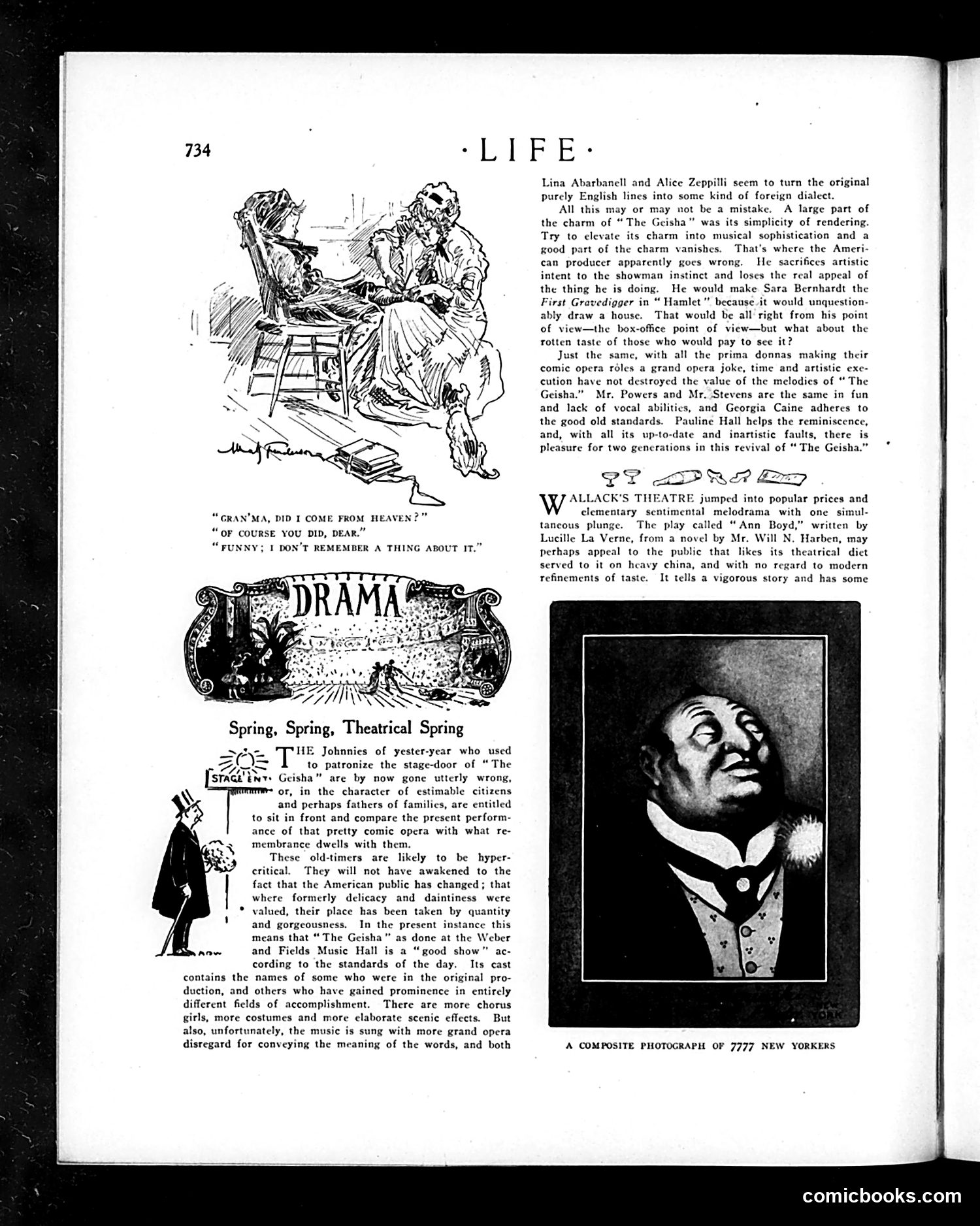
This page critiques the modern theatrical production of "The Geisha," a comic opera revival at Weber and Fields Music Hall. The top cartoon shows an exchange about heavenly origin—likely satirizing the pretentious elevation of what was originally a simple, charming show into grandiose "grand opera." The drama section attacks how contemporary American producers and performers have transformed the delicate original into something overwrought. The author argues that singers like Lina Abarbanell and Alice Zeppilli artificially adopt foreign accents and exaggerated operatic styles, destroying the work's appeal. The comparison to making Sarah Bernhardt a gravedigger in *Hamlet* illustrates how producers sacrifice artistic integrity for box-office appeal. The critique reflects early 20th-century anxieties about lowered theatrical standards: American audiences now prefer "quantity and gorgeousness" over "delicacy and daintiness." Yet some veteran performers (Powers, Stevens, Caine, Hall) maintain traditional standards, offering "pleasure for two generations."
This page contains theater reviews from early 20th-century Broadway. Two cartoons accompany the text: **First cartoon:** Illustrates "What Happened to Mary"—a play about a naive young woman raised on a Chesapeake Bay island who encounters urban dangers after moving to the city. The reviewer satirizes the plot's implausibility: a girl with such "self-possession" and "command of dictionary language" would logically recognize she was in danger in a boarding-house. **Second cartoon:** Depicts Helen Keller's stage appearance, noting how unusual it is to witness "the birth and development of a human mind" performed theatrically—her education overcoming blindness and deafness. The page emphasizes **Vera Tanguay** as a notable performer asserting independence against theatrical monopolies controlling performers' work. Overall, this reflects early 1900s Broadway criticism, mixing genuine theatrical analysis with gentle mockery of plot absurdities and social commentary on women performers' autonomy.
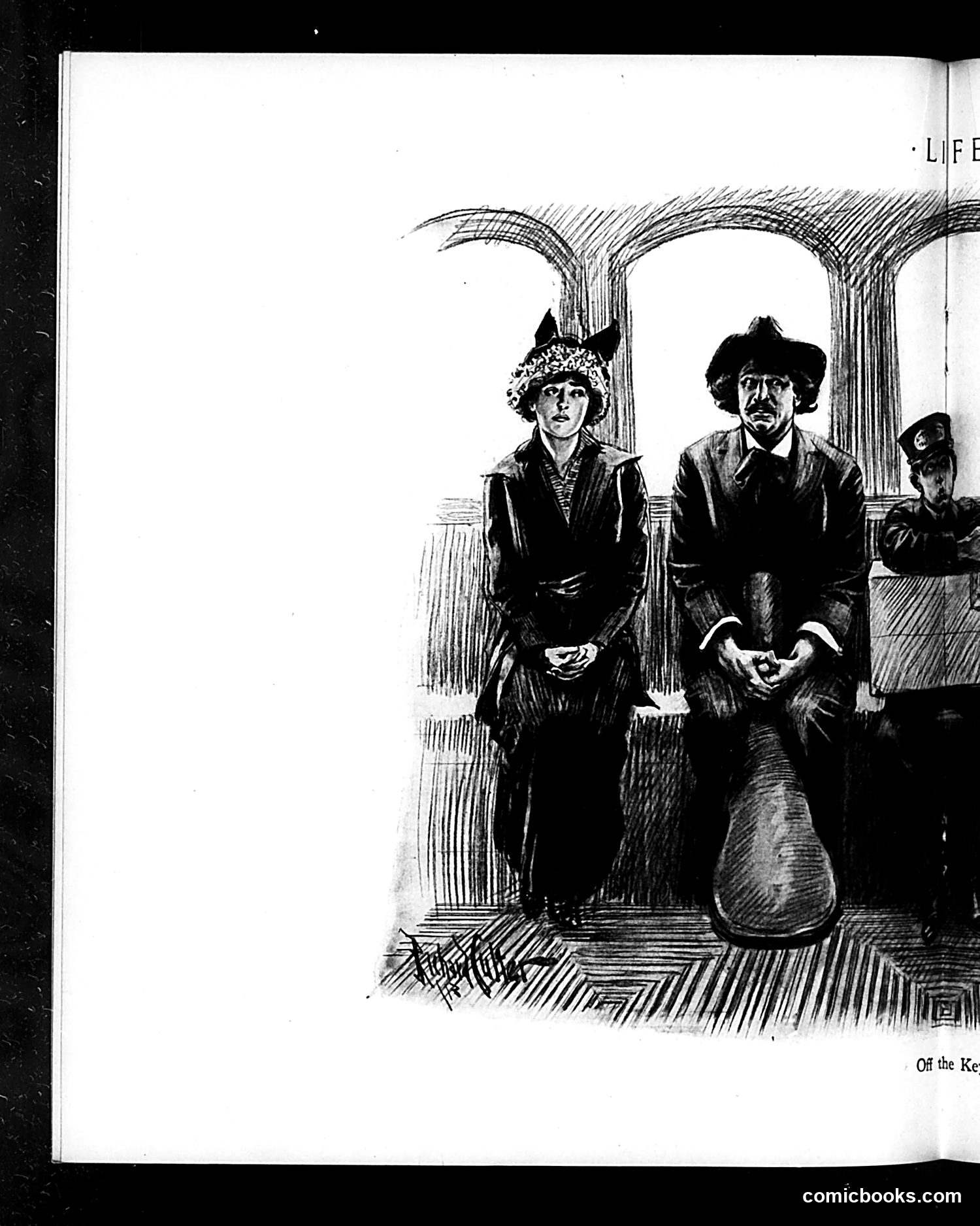
This is a satirical illustration from *Life* magazine showing three figures in what appears to be an official or formal setting with classical columns in the background. The two central figures wear period clothing with distinctive hats—the figure on the left wears what appears to be a decorative crown or elaborate headpiece, while the man on the right wears a wide-brimmed hat. A third figure is partially visible on the right. Without clearer identifying text or captions visible on this page, I cannot definitively identify which specific political or historical figures these represent or pinpoint the exact satire being targeted. The formal architectural setting and formal dress suggest commentary on political authority or officialdom, but the specific point of the cartoon remains unclear from the image alone.
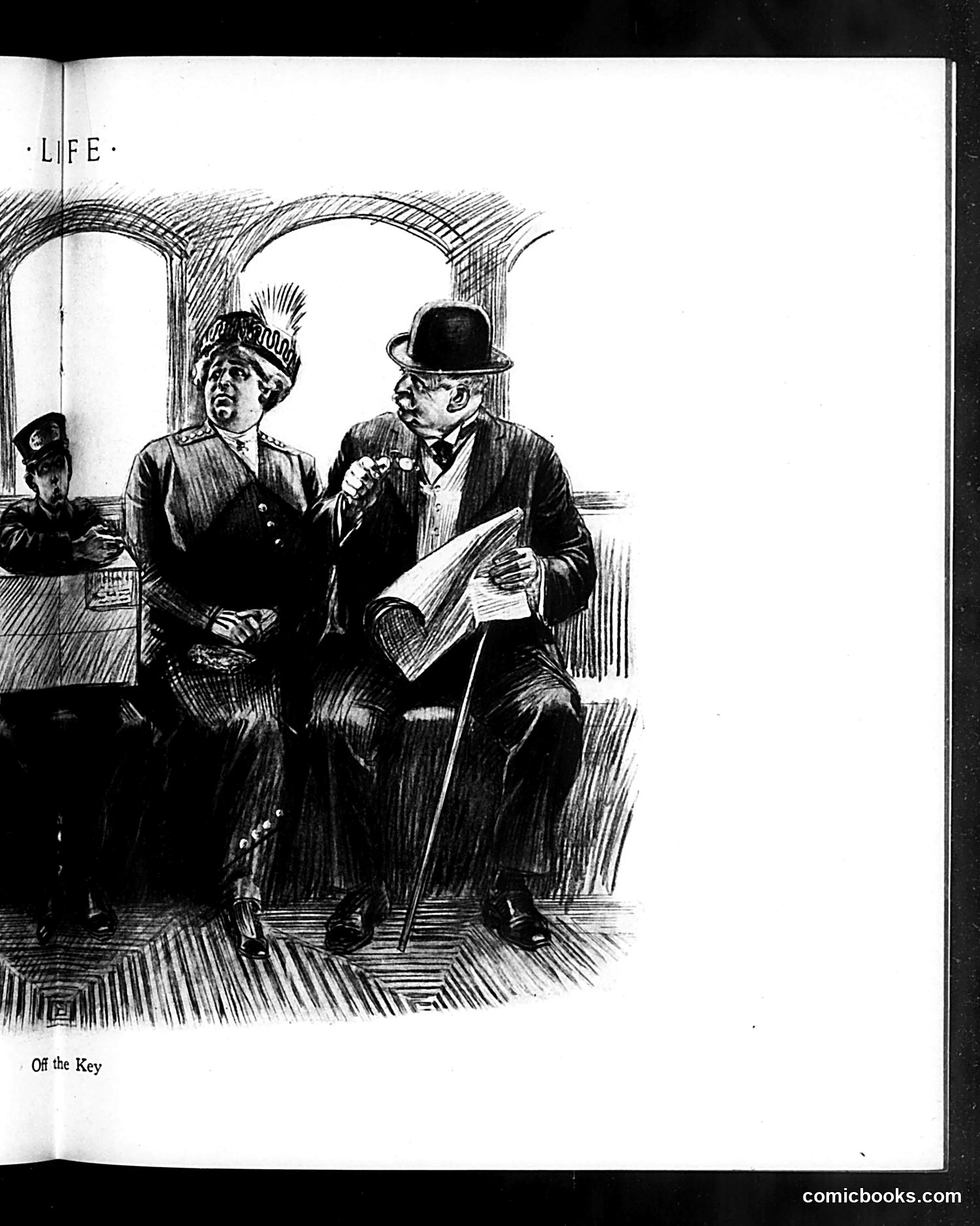
This cartoon appears in Life magazine's "Life" section and is titled "Off the Key." The image shows two men in formal attire (bowler hats, suits) engaged in conversation. One holds what appears to be a document or paper. A third figure is partially visible on the left. The cartoon likely satirizes a political or social interaction of its era, though without additional context like a date or caption, the specific reference is unclear. The title "Off the Key" suggests the joke concerns someone being "off"—perhaps misguided, incorrect, or out of place in some negotiation or official matter represented by the document. The formal dress and setting suggest government, business, or diplomatic contexts typical of Life's political satire.
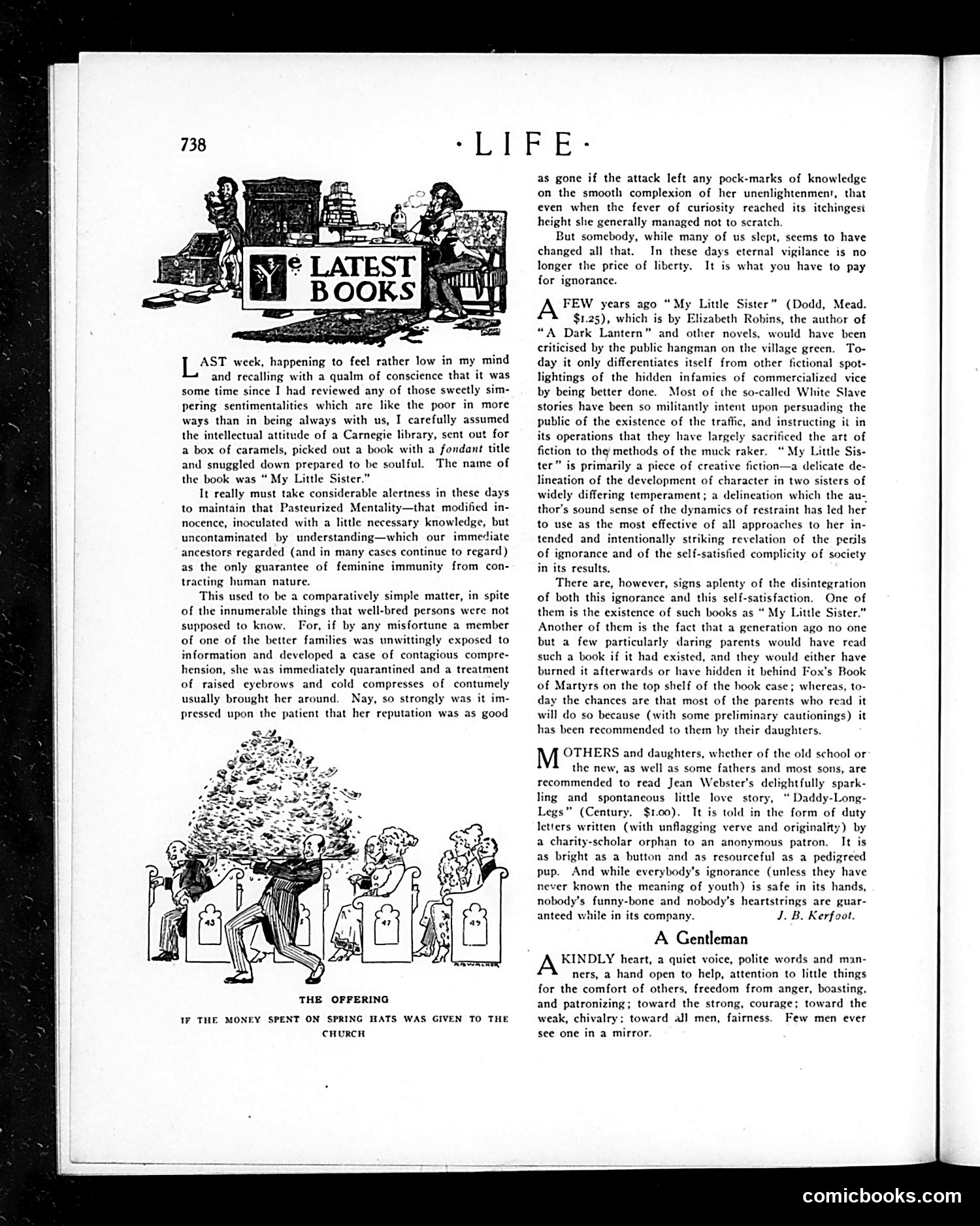
This page contains a book review by the magazine's critic, discussing Elizabeth Robins' novel "My Little Sister"—a work addressing the "white slave trade" (human trafficking for prostitution), a major Progressive Era reform issue. **The Satire:** The lengthy opening essay satirizes the traditional expectation that upper-class women maintain willful ignorance about sexual vice and "human nature." The critic mocks the old practice of quarantining young ladies who accidentally gained knowledge, treating information like a contagious disease requiring "raised eyebrows and cold compresses." **The Point:** The critic celebrates that social attitudes have shifted—modern parents now *recommend* such books to daughters, whereas previous generations would have hidden or burned them. This reflects Progressive-era debates about female education and whether protecting women through ignorance actually served their interests. **The Cartoon Below:** "The Offering" depicts churchgoers donating to collections, sardonically captioning it: "If the money spent on spring hats was given to the church"—critiquing wealthy women's fashion spending versus charitable giving.
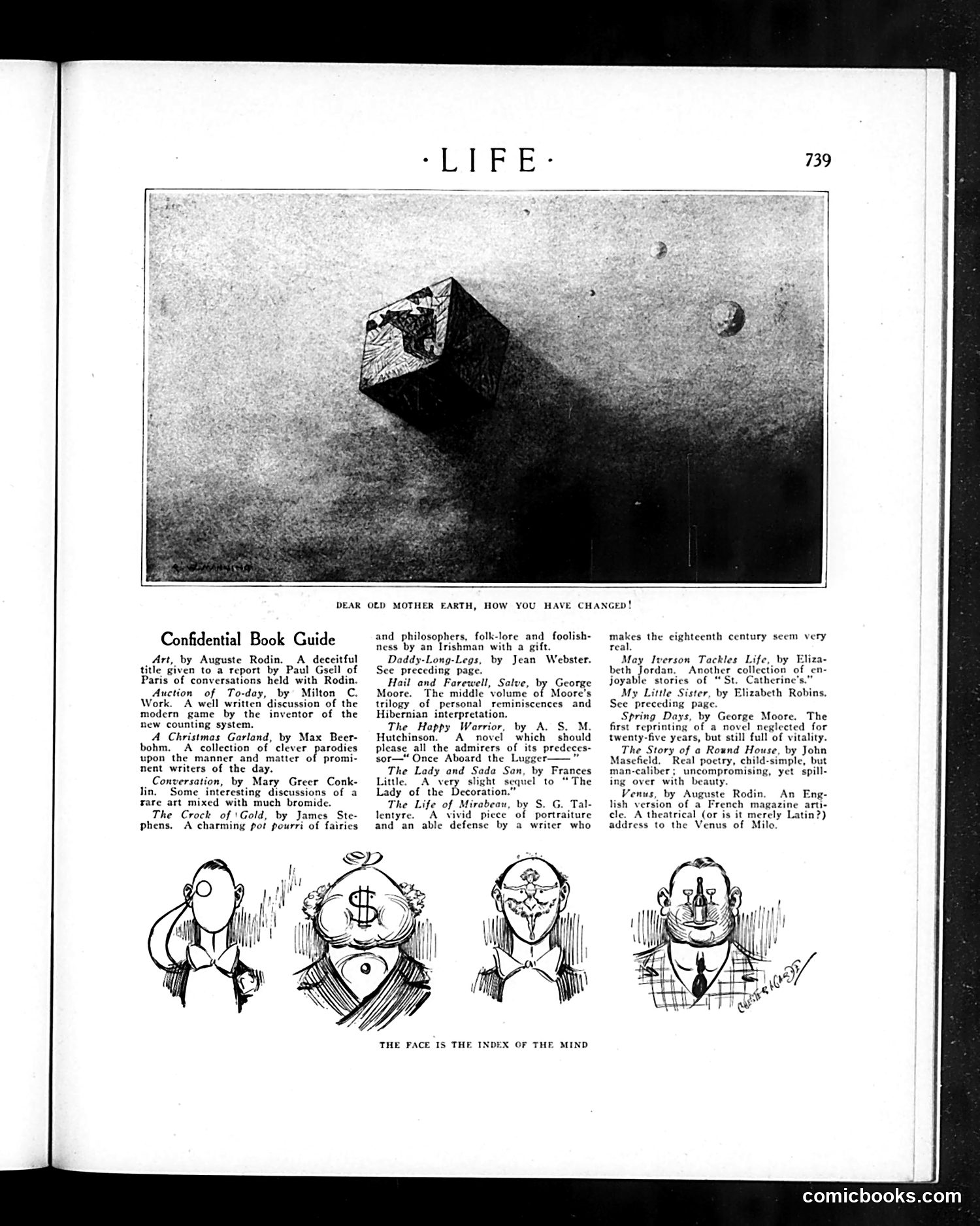
This page combines a serious photographic image with satirical book reviews and character sketches. **Top Image:** "Dear Old Mother Earth, How You Have Changed!" shows Earth as a small, exhausted figure hunched against a dark, deteriorating landscape—apparently critiquing industrial damage or environmental degradation in the early 20th century. **Bottom Section:** Four caricatured heads illustrate "The Face Is the Index of the Mind"—a physiognomy joke suggesting character can be read from facial features. The figures appear to represent different personality types (greed, gluttony, cunning, intellectualism based on the symbolic imagery on their faces). **Book Reviews:** The "Confidential Book Guide" offers tongue-in-cheek assessments of contemporary literature, mixing genuine criticism with gentle mockery. References include works by Rodin, George Moore, and Jean Webster—popular Edwardian-era authors now largely forgotten. The overall page reflects early 1900s middlebrow literary culture, combining environmental concern with popular pseudoscientific ideas about character and appearance.
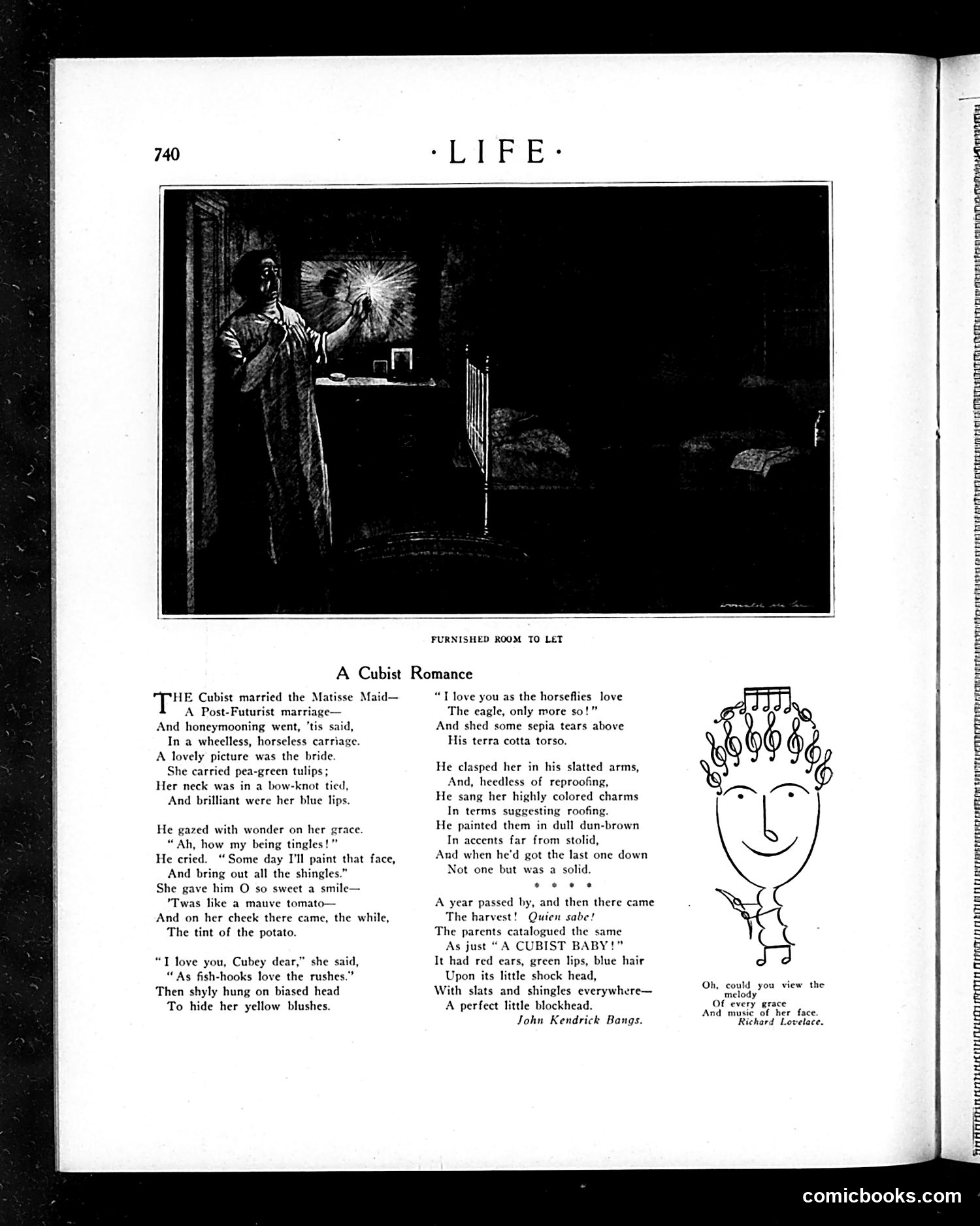
This humorous poem by John Kendrick Bangs mocks early 20th-century avant-garde art movements—specifically Cubism and Futurism. The joke centers on the absurdity of these new styles through an exaggerated love story between a "Cubist" and a "Matisse Maid" (referencing Henri Matisse, a Fauvist painter). The satire works by describing their romance and baby using the distorted, geometrically fragmented language of Cubist art: unnatural colors ("pea-green," "yellow"), broken perspectives ("slatted arms," "bow-knot neck"), and emotional descriptions rendered as visual oddities ("mauve tomato," "terra cotta torso"). The punchline—their baby is a "perfect little blockhead" with mismatched colors and shapes—suggests that Cubism produces ugly, incomprehensible results. The accompanying crude illustration of a geometric head reinforces the mockery. This reflects widespread public and critical skepticism about modernist art in the 1910s-1920s, when such movements seemed baffling and pretentious to conventional audiences.
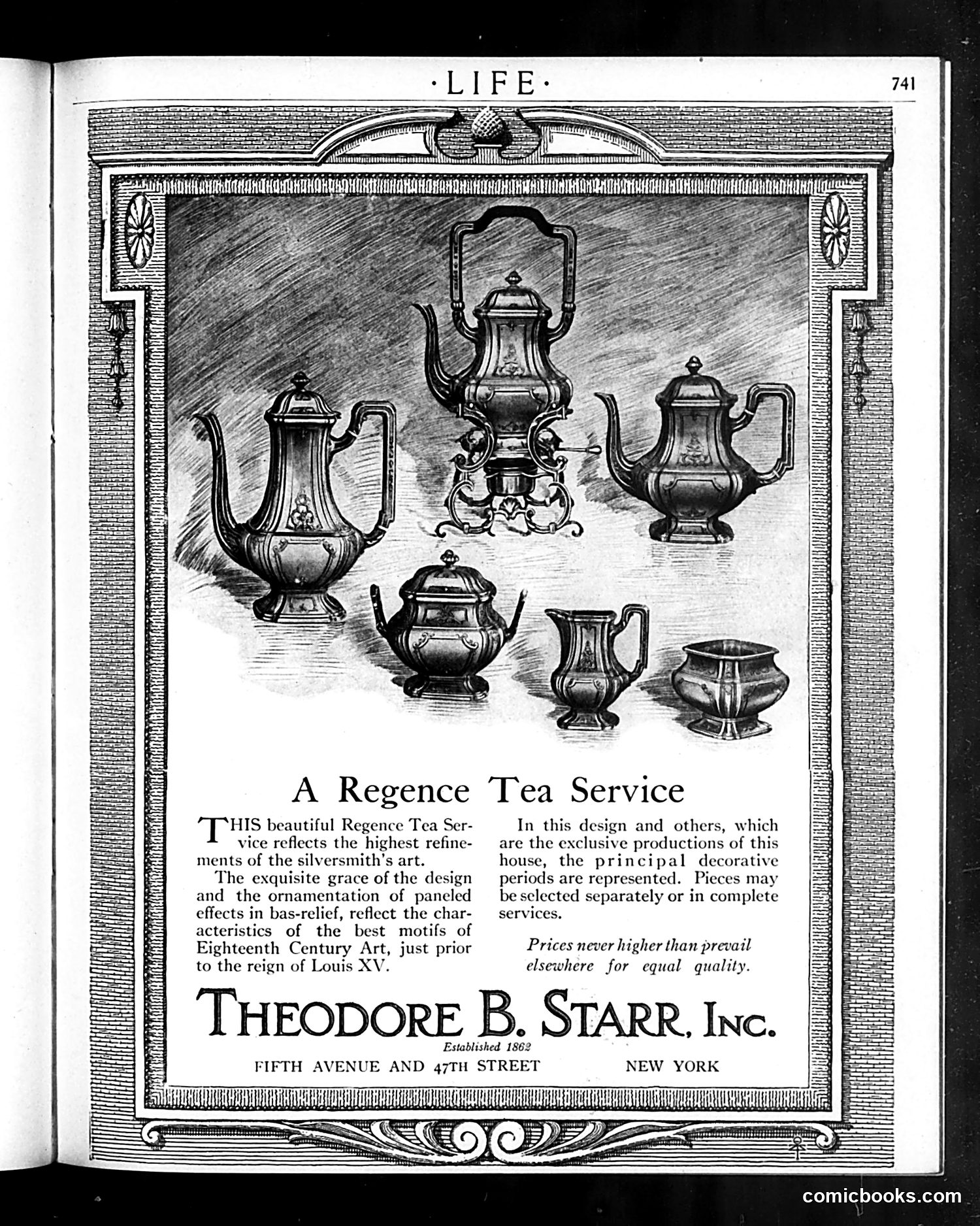
This page contains **no cartoon or satire**—it is a straightforward **advertisement** for luxury silver tea service by Theodore B. Starr, Inc., a New York silversmith established in 1862. The image shows six ornate silver vessels (teapots, coffee pots, creamers, and sugar bowl) arranged to display their elegant design. The text describes the "Regence Tea Service" as reflecting refined silversmith craftsmanship, noting its design echoes Eighteenth Century aesthetics from the period just before Louis XV's reign. The advertisement emphasizes exclusivity and competitive pricing. There is no political commentary, caricature, or satirical content—this is simply a high-end product placement typical of *Life* magazine, which mixed humor with upscale advertising to attract wealthy readers.
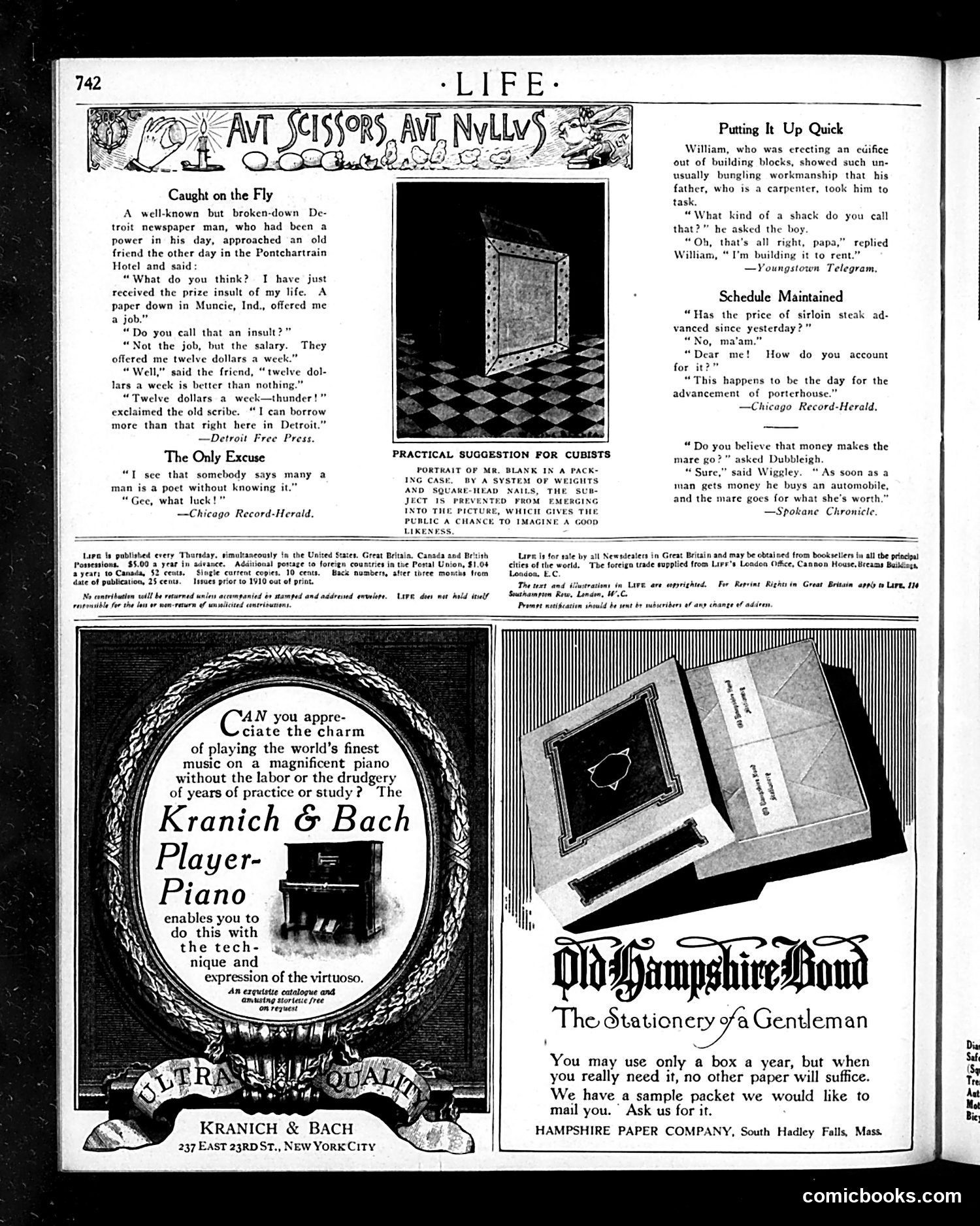
This page contains five brief humorous anecdotes typical of early 20th-century American magazines, plus advertisements. **The jokes satirize:** 1. **"Caught on the Fly"**: A fallen Detroit newspaper editor is insulted by receiving a job offer—not because of the position itself, but the meager $12 weekly salary. He boasts he can borrow more than that locally, mocking his own financial desperation. 2. **"Putting It Up Quick"**: A boy builds shoddy toy blocks and dismisses criticism by saying he's building it "to rent"—satirizing slum landlords who construct deliberately poor housing for profit. 3. **"The Only Excuse"**: A one-liner about poets who don't realize they're poets. 4. **"Schedule Maintained"**: A waiter explains steak prices unchanged because it's porterhouse day—absurd logic about restaurant scheduling. 5. **"Money Makes the Mare Go"**: Once men earn money, they buy automobiles instead of supporting their wives. The page also includes a "Practical Suggestion for Cubists"—a jab at modern art's incomprehensibility, suggesting obscuring subjects with weights and nails so viewers imagine quality.
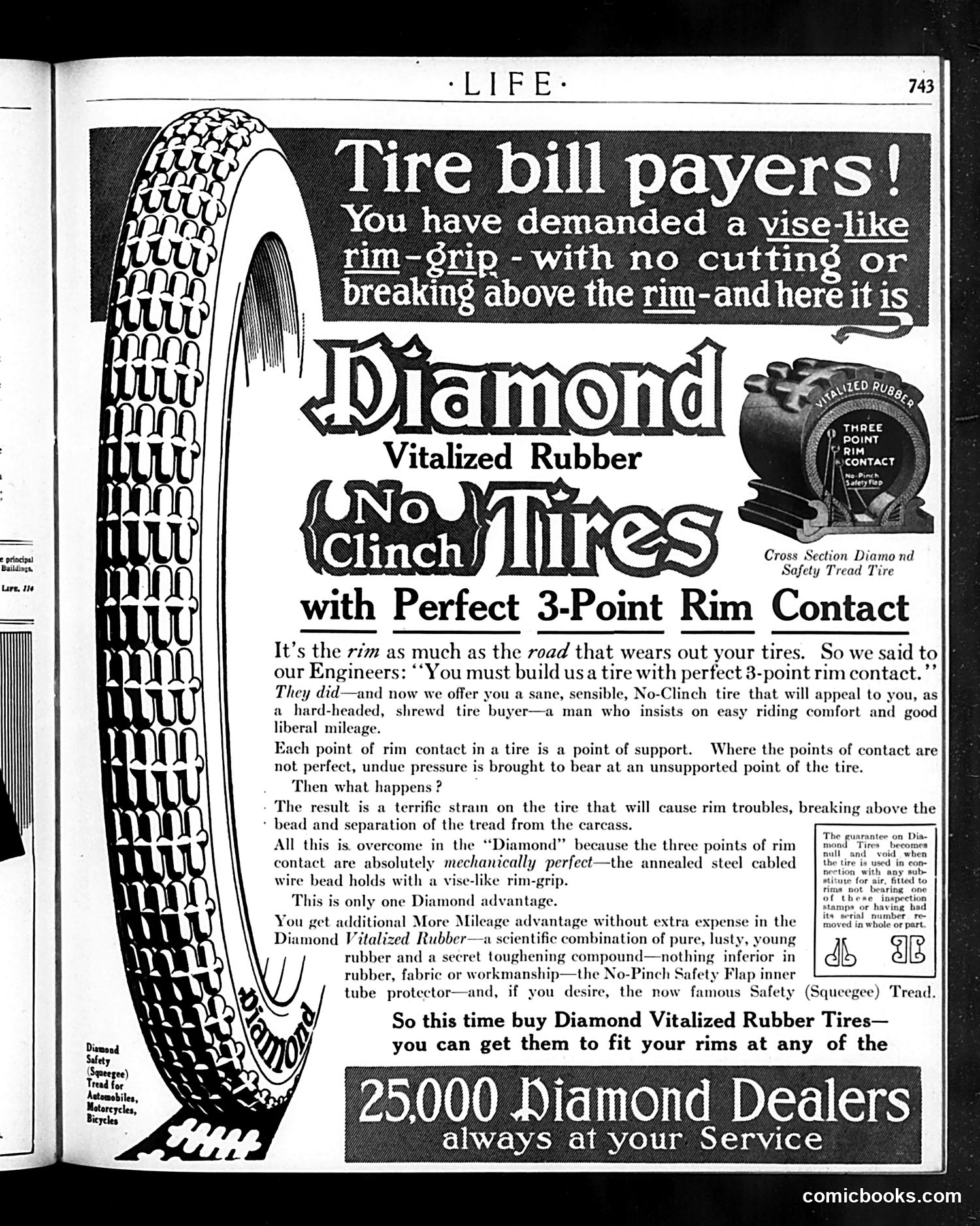
This is primarily a **tire advertisement**, not political satire. It's a full-page ad for Diamond Vitalized Rubber Tires from an era when tire quality and rim fit were significant consumer concerns. The ad addresses "tire bill payers"—car owners frustrated with frequent tire failures—claiming Diamond tires solve the problem through "perfect 3-point rim contact." The copy explains that poor rim contact causes uneven pressure, leading to bead separation and tread failure. Diamond's solution is mechanically superior rim grip. The page emphasizes consumer appeal by addressing the "hard-headed, shrewd tire buyer" who wants comfort and mileage, positioning Diamond as the sensible choice. The "No-Clinch" design and "Safety Tread" are marketed as technical innovations. This reflects early automotive-era advertising that educated consumers about mechanical specifications while building brand loyalty through technical superiority claims. The 25,000 dealer network suggests Diamond was a major national brand at the time.
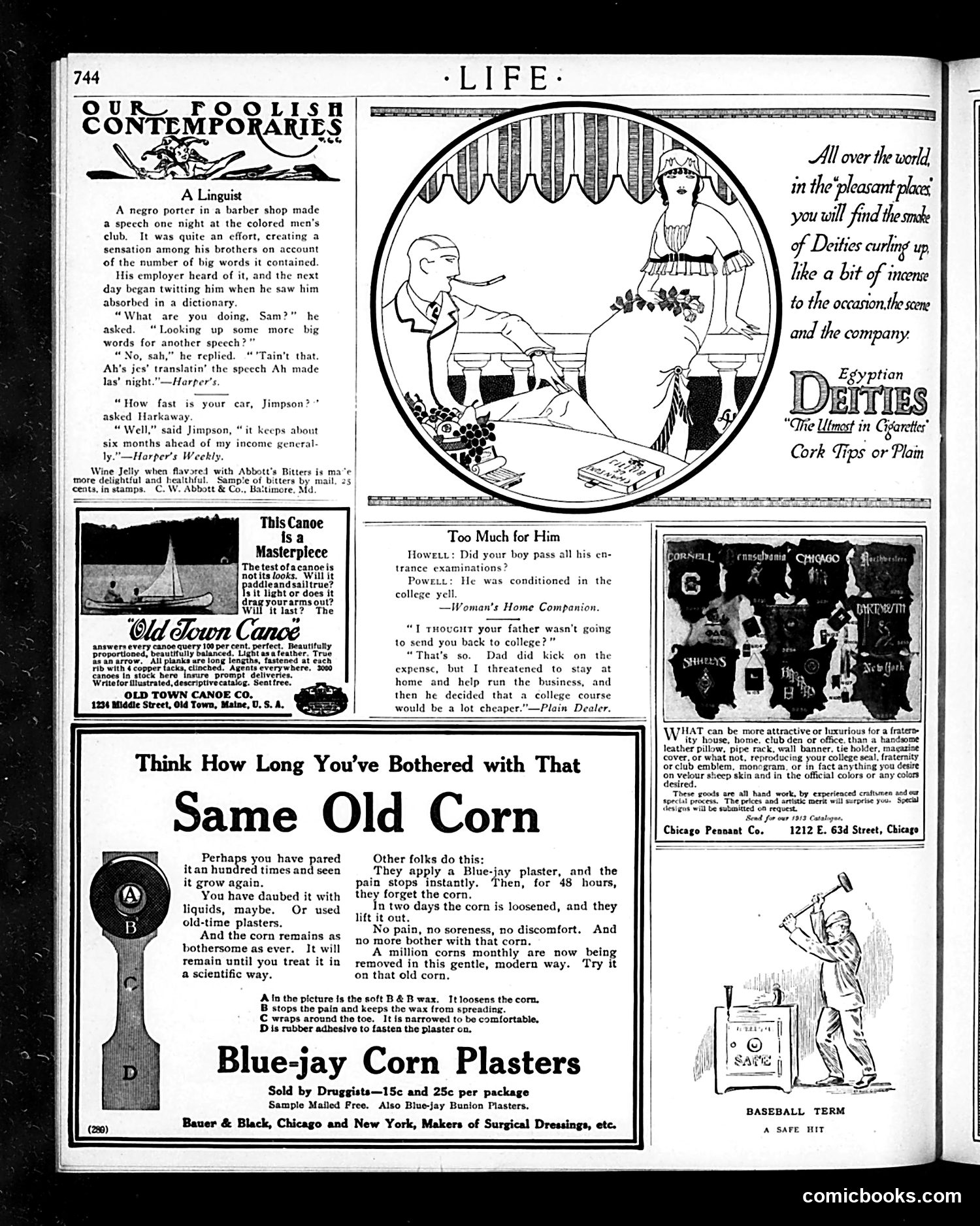
This page is primarily **advertising with brief humorous anecdotes**, typical of Life's mixed content format. The top section, "Our Foolish Contemporaries," contains short jokes mocking everyday pretension: 1. **"A Linguist"**: A Black barber-shop porter gives a speech using many "big words," then is caught looking them up in a dictionary—not to use them again, but to *translate* his own speech back into plain English. The joke satirizes the gap between attempted sophistication and actual understanding. 2. **"Too Much for Him"**: A college student failed entrance exams, prompting his father to refuse funding. The son threatened to quit school and work at home instead—whereupon Dad suddenly agreed college was "cheaper." This mocks parental economic priorities over education. The remainder consists of product advertisements: Old Town Canoes, Blue-jay Corn Plasters, Egyptian Deities cigarettes, and Chicago Pennant Company leather goods. These ads were Life's revenue source. No political cartoons appear on this page; it's a hybrid advertising/humor compilation typical of early 20th-century magazines.
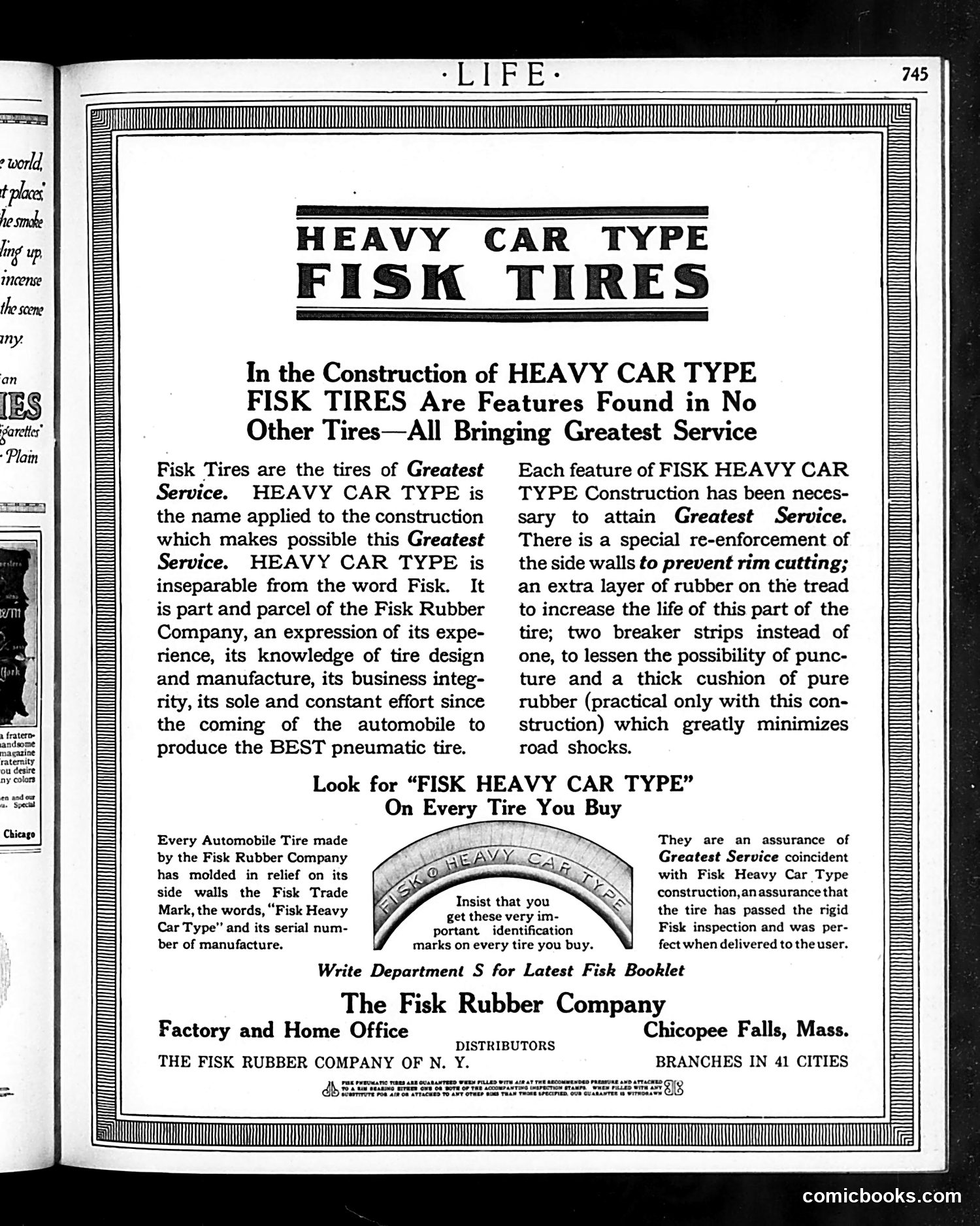
This page is a **full-page advertisement** for Fisk Rubber Company tires, not satire or editorial content. There are no cartoons or caricatures to analyze. The ad promotes "Heavy Car Type" Fisk Tires, emphasizing their superior construction features: reinforced sidewalls to prevent rim damage, extra tread rubber for durability, double breaker strips to reduce punctures, and thick rubber cushioning to minimize road shock. The advertisement uses persuasive marketing language typical of early 20th-century industrial advertising, claiming these features are "found in no other tires." Readers are instructed to look for identification marks molded into the tire's sidewall—the Fisk trademark and "Heavy Car Type" designation—as assurance of authenticity and quality. The Fisk Rubber Company operated from Chicopee Falls, Massachusetts, with branches in 41 cities.
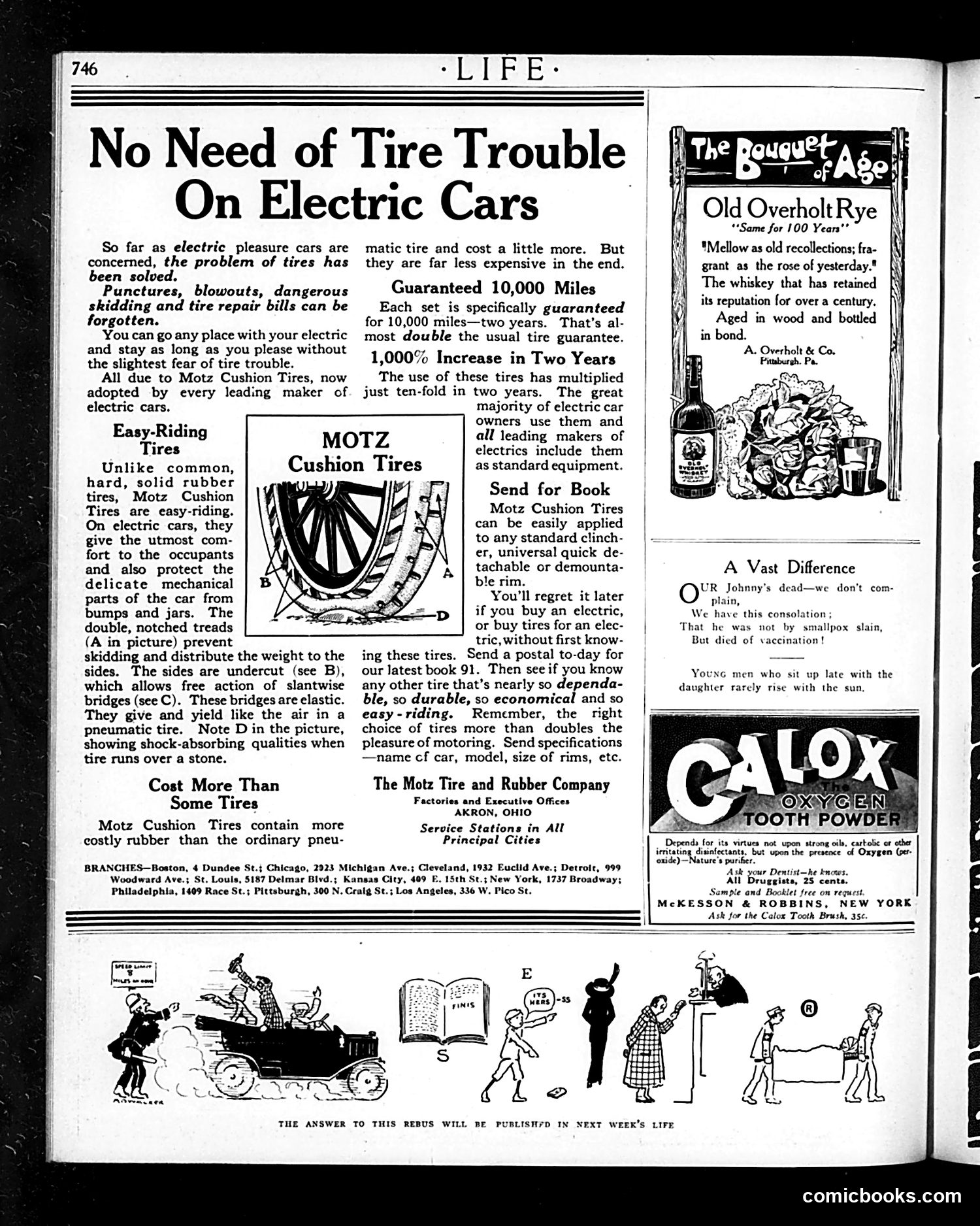
This page is primarily **advertising** for Motz Cushion Tires, marketed specifically for electric automobiles. The main text promotes these tires as solving puncture and blowout problems that plagued early cars, with technical diagrams showing their cushioned design. The satirical content appears in the small cartoon section titled "A Vast Difference," which mocks vaccination hesitancy. It presents a darkly ironic epitaph: parents console themselves that their deceased son "Johnny" died from vaccination rather than smallpox—treating vaccination as an alternative danger rather than protection. This reflects genuine early-20th-century vaccine skepticism, when many people distrusted the new medical procedure. The page also includes advertisements for Old Overholt Rye whiskey and Calox Tooth Powder, typical of Life's revenue model during this era.
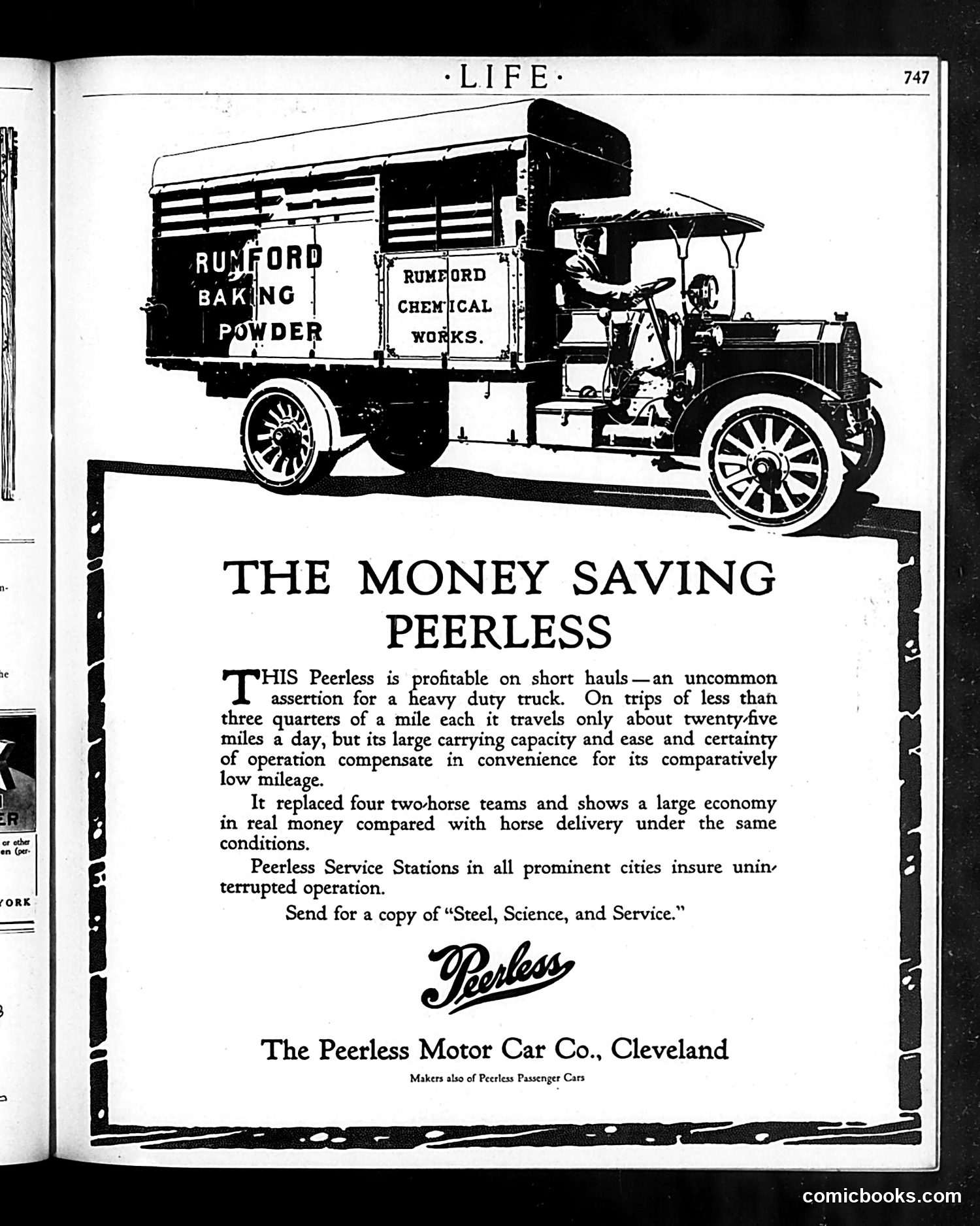
This is a commercial advertisement, not satire or editorial content. It promotes the Peerless Motor Car Company's delivery truck, positioned as an economical alternative to horse-drawn wagons. The ad emphasizes that despite modest daily mileage (twenty-five miles), the truck's large cargo capacity and reliability make it cost-effective compared to maintaining four two-horse teams. The illustrated truck carries cargo for "Rumford Baking Powder" and "Rumford Chemical Works," serving as a real-world example of commercial application. The advertisement targets business owners considering motorized transport, highlighting practical advantages—convenience, certainty of operation, and nationwide service stations—rather than speed. This reflects early automotive marketing strategy when trucks were still competing directly with animal-powered delivery systems.
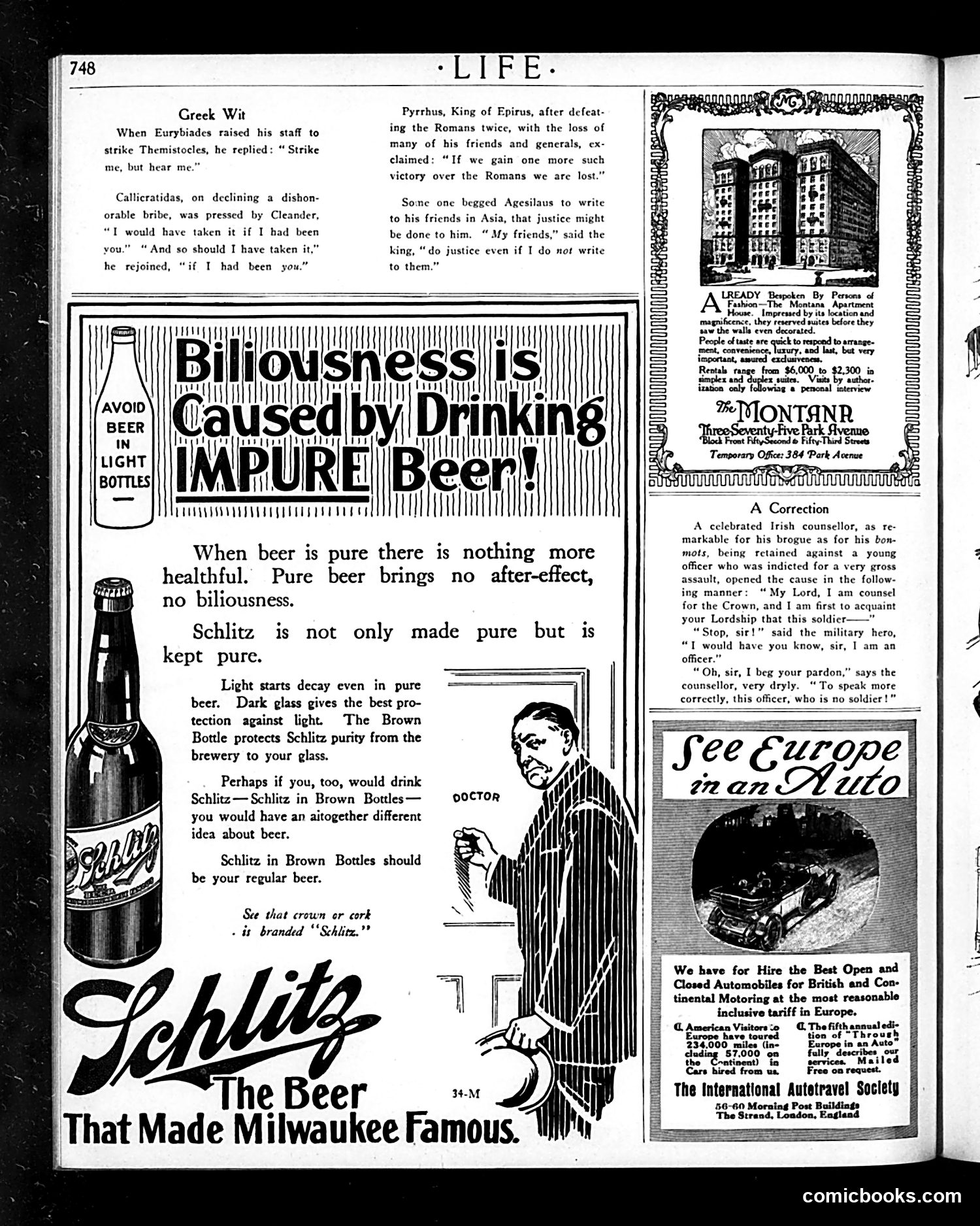
This page is primarily **advertising**, not political satire. The dominant content is a Schlitz beer advertisement claiming purity prevents biliousness (digestive upset). The ad features a doctor figure and emphasizes brown bottles protect beer from light decay—a legitimate early 20th-century concern before modern refrigeration. The page also includes: - **"Greek Wit"** section: Classical anecdotes about ancient Greek and Roman leaders demonstrating virtue (refusing bribes, accepting criticism gracefully). These are moral lessons, not satire. - **Real estate and auto rental ads**: Standard period advertisements. The only potential humor appears in **"A Correction,"** a brief Irish anecdote playing on a counselor's linguistic slip—confusing a military officer with a soldier—that relies on class distinctions and accent stereotypes common to period comedy. There is no identifiable political cartoon on this page.
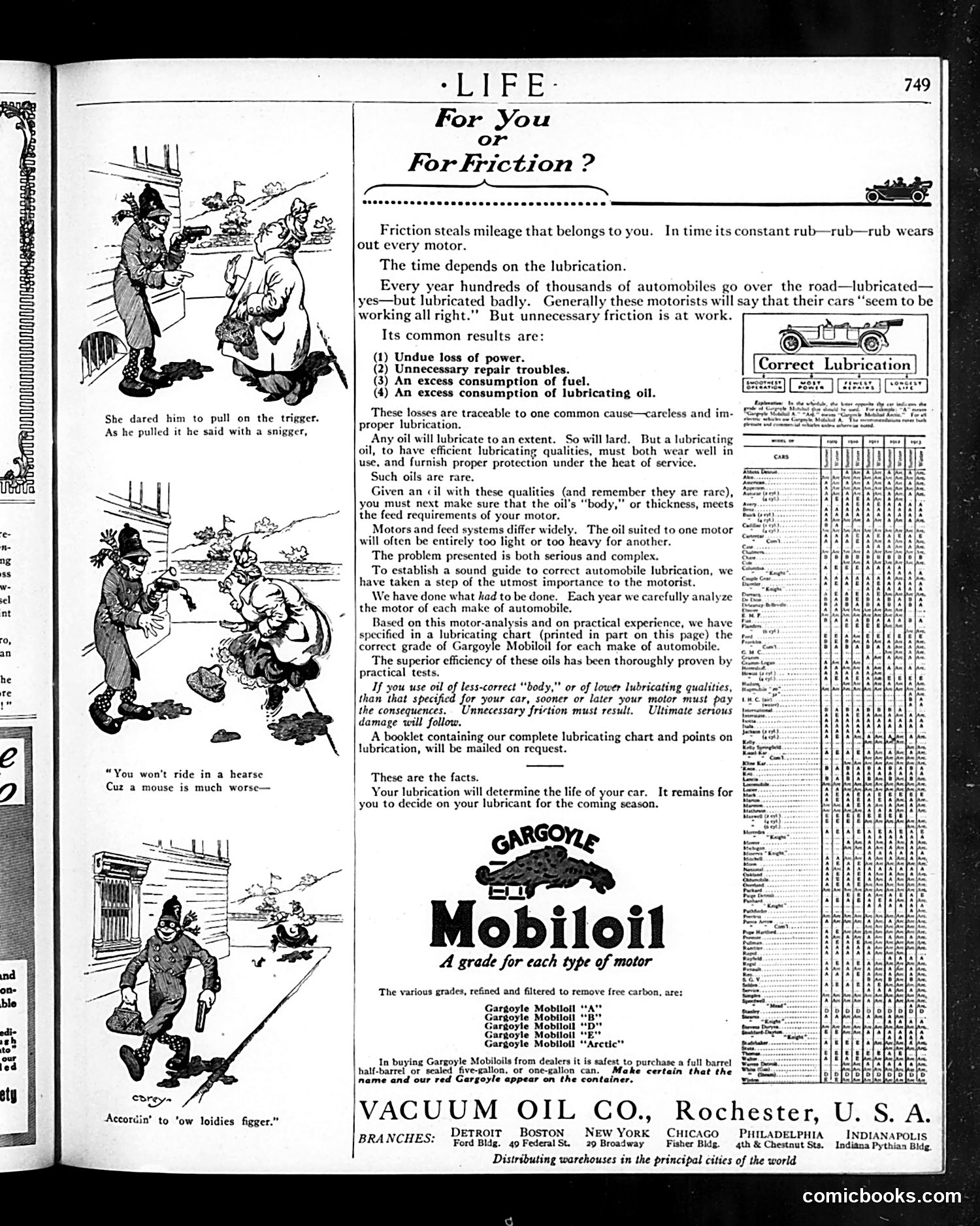
This page is primarily a **Gargoyle Mobiloil lubricating oil advertisement** disguised as educational content, interspersed with cartoons. The three small cartoons (left side) use broad, exaggerated caricatures—appearing to depict working-class or ethnic figures in comedic scenarios—to deliver wordplay about friction and wear. The humor relies on crude visual stereotyping typical of early 20th-century American comics. Captions like "You won't ride in a hearse / Cuz a mouse is much worse" and "Accordin' to 'ow loidies figger" suggest phonetic dialect humor. The advertisement's "serious" portion warns that improper motor lubrication causes unnecessary friction, power loss, and repair costs. It promotes Gargoyle Mobiloil as the scientifically correct solution, offering a detailed chart specifying the proper oil grade for each automobile make. The satire is subtle: Life presents commercial messaging as urgent consumer advice while the crude cartoons provide entertainment. This blending of advertising with comedy was characteristic of Life's commercial approach during this period.
This is not a cartoon or satire—it's a **full-page advertisement** for *Vogue*'s Spring Fashions issue, placed in *Life* magazine (circa 1913). The ad promotes the authority and reliability of *Vogue*'s spring fashion selections, arguing that after fashion houses have presented their collections, *Vogue* serves as the definitive arbiter of which styles will endure. It emphasizes that the magazine features both Parisian designers (Callot, Drécoll, Chéruit, etc.) and selections made by New York's most fashionable women for their own wardrobes. The text also highlights the issue's editorial content—an essay on fashion by Agnes Repplier, society photography, and fashion advice—alongside extensive advertising from major retailers, positioning *Vogue* as a comprehensive shopping guide. There is no satire here; this is straightforward luxury-market advertising leveraging *Life*'s educated readership to promote *Vogue* as the authoritative source for 1913 spring fashion.
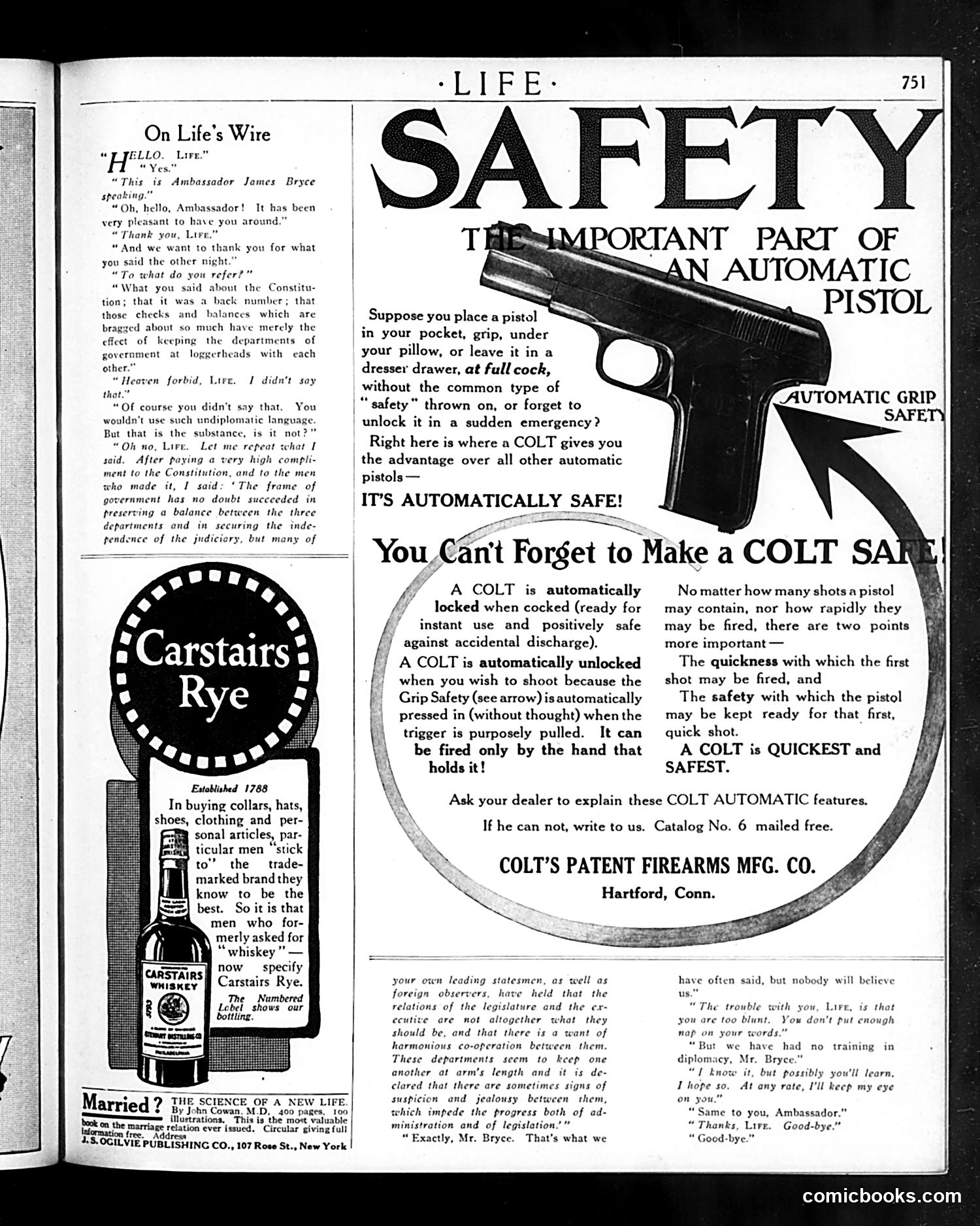
This page contains a political dialogue cartoon featuring **Ambassador James Bryce**, a prominent British diplomat visiting America around the early 1900s. The conversation satirizes Bryce's criticism of the U.S. Constitution's system of checks and balances, which he allegedly called outdated. Life's fictional "Life" character gently traps Bryce into admitting he said exactly what he denied—a common satirical technique mocking diplomatic evasion and doublespeak. The cartoon jokes that despite Bryce's diplomatic training, Americans like "Life" are too blunt and direct to appreciate such verbal maneuvering. The page also contains advertisements (Colt pistols, Carstairs Rye whiskey, and a marriage guide), typical of Life magazine's mixed content format.
This page is **primarily advertisements with a "Books Received" section** at top left. There are no political cartoons or satirical commentary to analyze. The content consists of: **Books Section**: A brief listing of recently published books with titles, authors, and prices—typical literary notice. **Advertisements**: Multiple full and half-page ads for: - Pompeian Bronze wire screen cloth (corrosion-resistant) - Switzerland tourism (St. Moritz Grand Hotel) - "Sexology" book (illustrated guide on marriage/sexuality) - Allen's Foot-Ease powder - Various travel and health products The page reflects **early 20th-century consumer culture**: advertising targets middle-class readers with products for home improvement, travel, health, and self-improvement literature. The "Sexology" ad is notably frank for the era, suggesting Life's audience appreciated candid discussion of intimate topics. **No satire or political commentary is present**—this is a standard advertising-heavy magazine page from approximately 1910-1920.
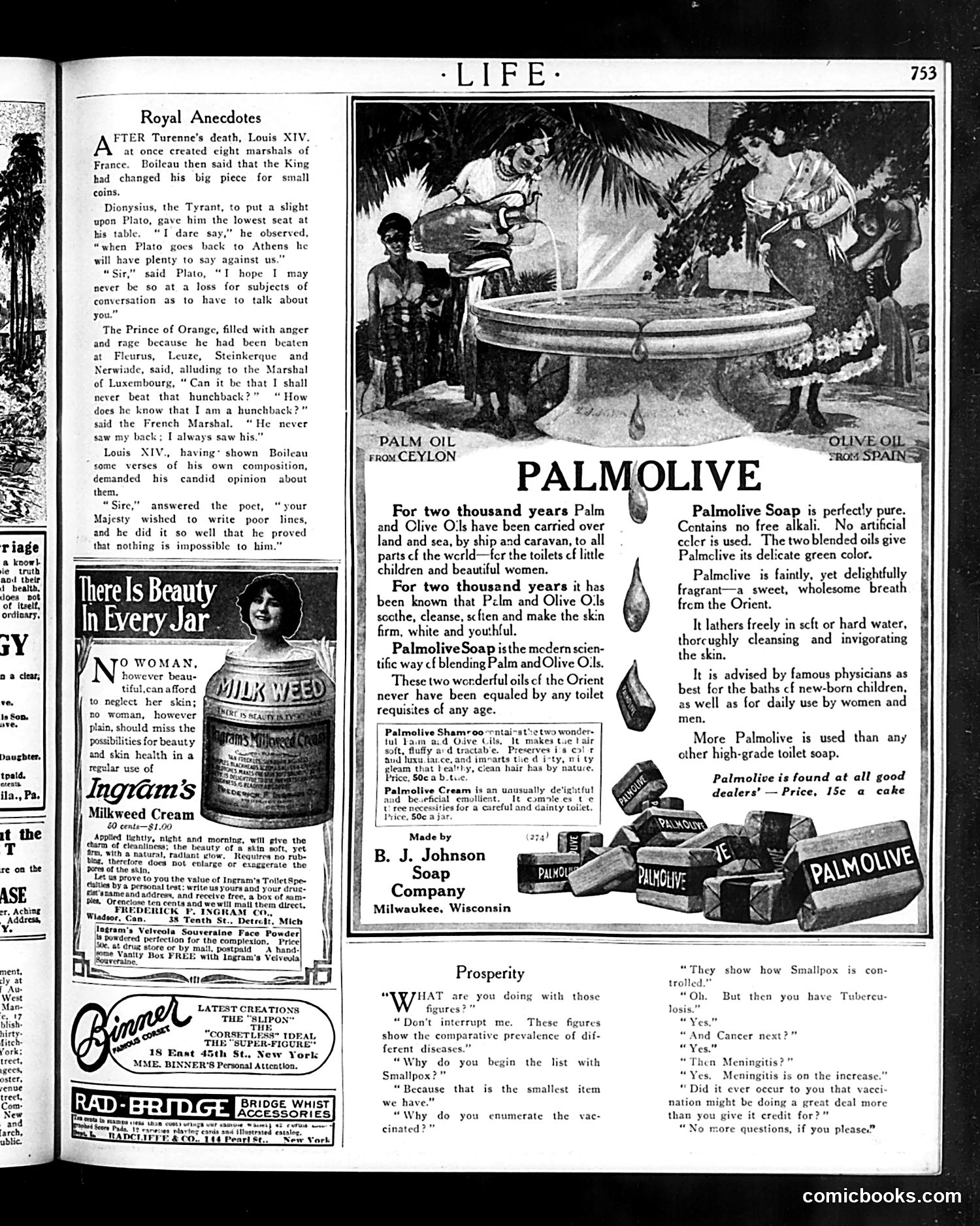
This Life magazine page features two distinct sections: **Left side**: "Royal Anecdotes" presents witty historical anecdotes about European royalty (Louis XIV, Plato, various French and Orange princes). These are satirical jabs at aristocratic vanity—the humor lies in clever comebacks that deflate pompous rulers. For example, Plato's retort to Dionysius mocks the tyrant's pettiness. **Right side**: The "Prosperity" cartoon is a darker joke. A figure discussing disease statistics begins with "Smallpox" as "the smallest item we have," then enumerates vaccinated diseases. The implication is bitter satire: the speaker is congratulating himself on controlling smallpox through vaccination, yet the list grows—suggesting diseases remain prevalent despite medical progress. It's commentary on the limits of public health achievement. The page also contains period advertisements for beauty products (Ingram's Milkweed Cream, Palmolive Soap), typical of Life's commercial content.
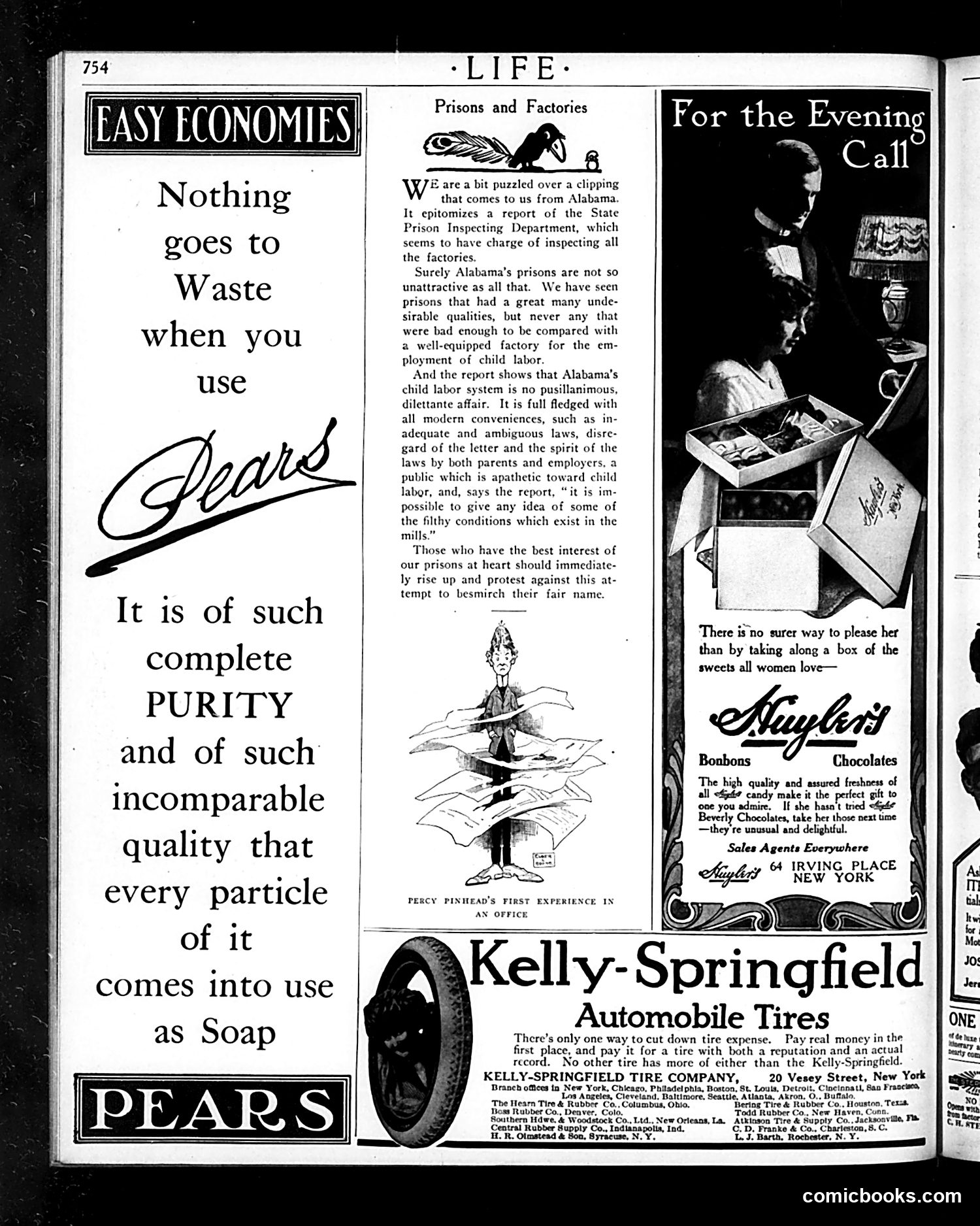
This page contains **satirical commentary on child labor in Alabama**, not a traditional cartoon. The central article, "Prisons and Factories," mocks Alabama's State Prison Inspecting Department for a report that inadvertently compares the state's prison system *favorably* to its child labor factories. Life's satirists find this absurd: prisons shouldn't be considered better places than factories. The joke is bitter—Alabama's child labor conditions are so deplorable that they make prisons look attractive by comparison. The article highlights the hypocrisy: inadequate laws, parental and employer disregard for children's welfare, public apathy, and "filthy conditions" in mills. The closing line sardonically suggests those protecting prisons' reputation should protest this unflattering comparison. The page also contains period advertisements (Pears soap, Nuyler's chocolates, Kelly-Springfield tires) and a small cartoon labeled "Percy Pinhead's First Experience in an Office"—unrelated to the main satire. The satire exposes Progressive Era concerns about industrial exploitation of children in Southern mills.
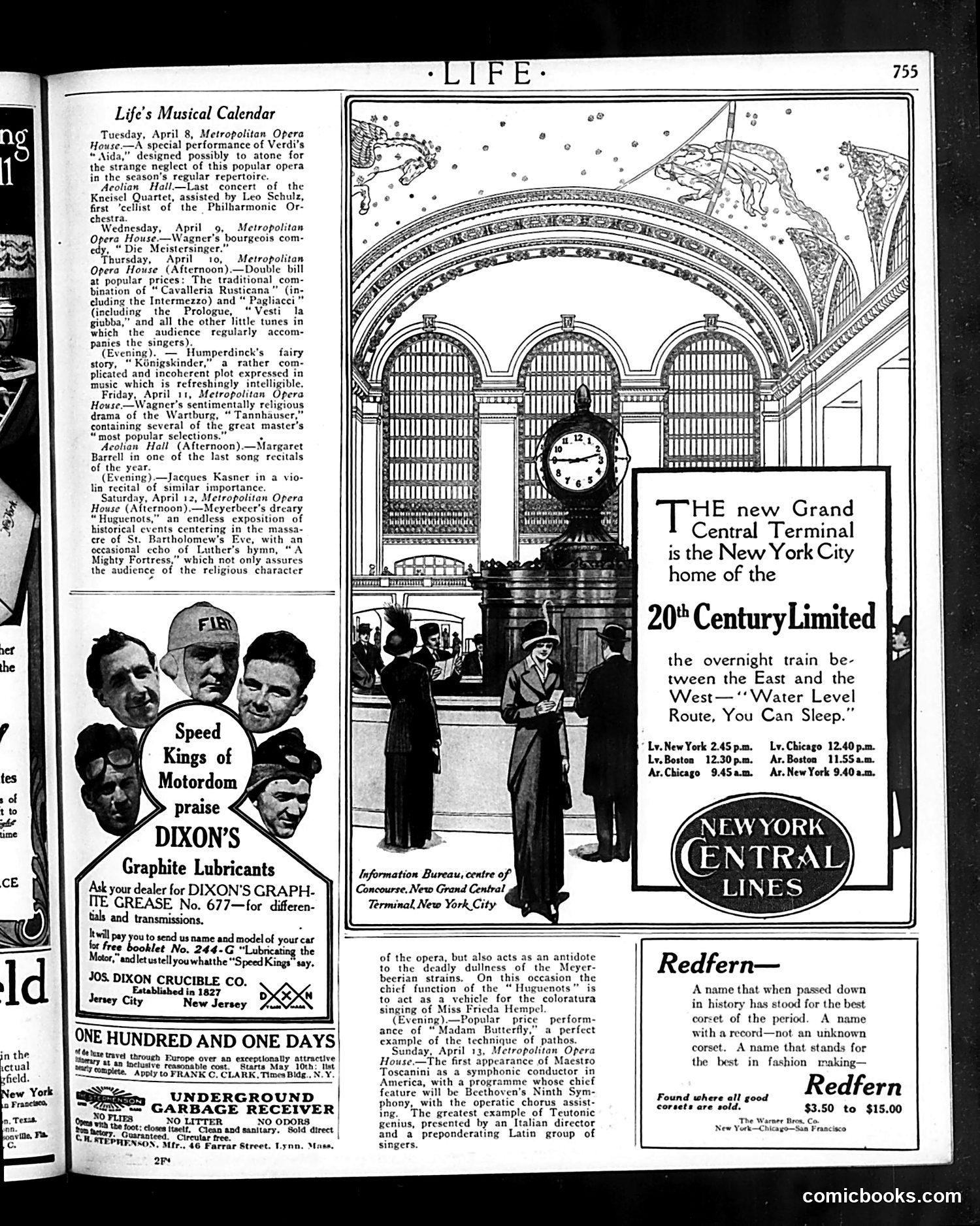
This page mixes entertainment coverage with period advertisements. The main content is "Life's Musical Calendar"—a weekly listing of New York opera and concert performances at venues like the Metropolitan Opera House and Aeolian Hall, covering April 8-13. The calendar reviews standard operatic repertoire (Verdi, Wagner, Meyerbeer) with witty, dismissive commentary typical of Life's satirical voice. For example, Meyerbeer's "Huguenots" is called "dreary" and "an endless exposition." The advertisements reveal what mattered to affluent 1920s readers: the new Grand Central Terminal (promoting the "20th Century Limited" overnight train), Dixon's graphite lubricants for cars, and Redfern corsets—positioned as fashion's gold standard. The "Speed Kings of Motordom" ad for Dixon's lubricants appears to feature racing drivers, though specific identities are unclear from the image. This is primarily a culture/lifestyle page for wealthy, urban readers interested in opera and modern transportation.
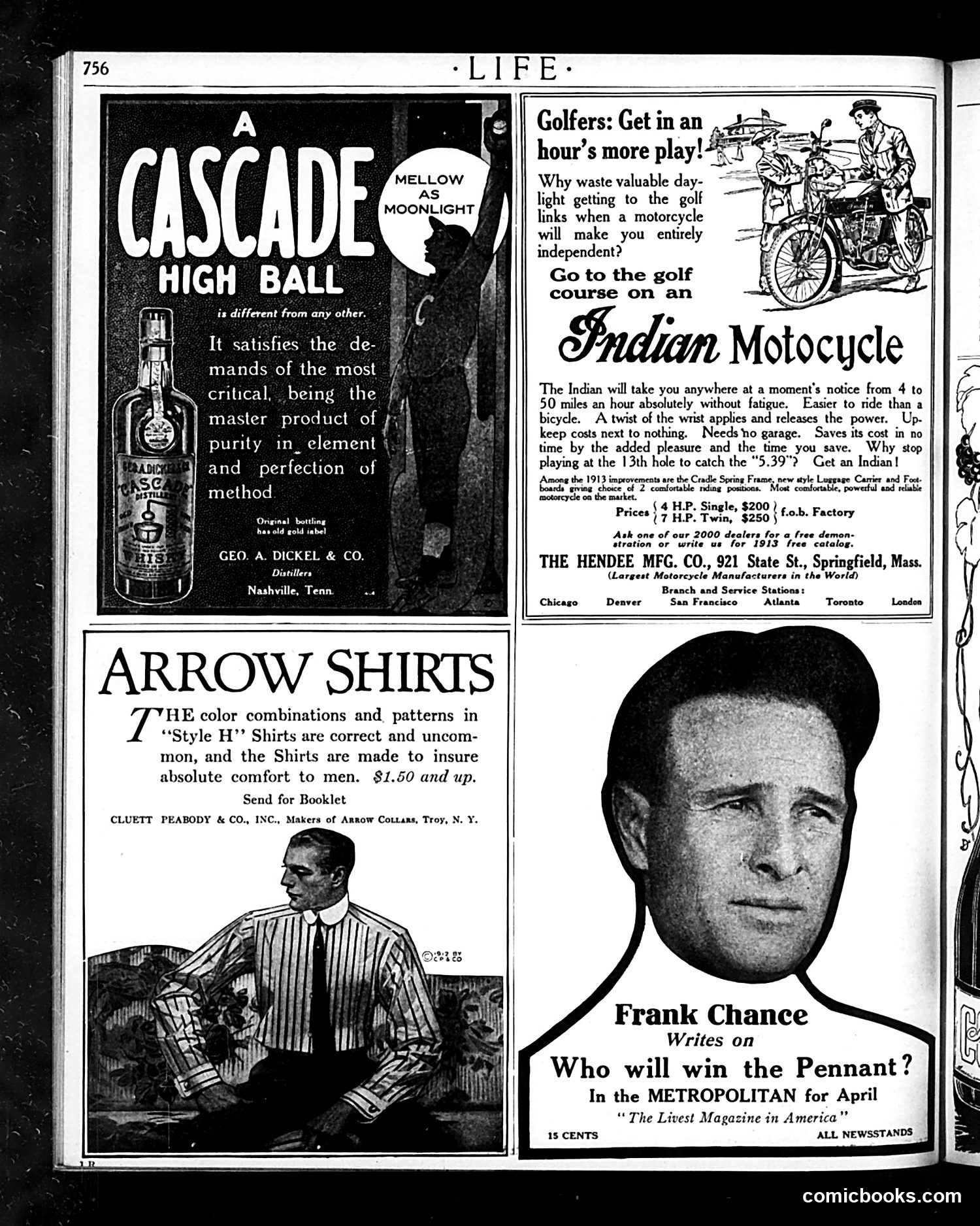
This page contains no political cartoons—it's primarily **advertising**. Four distinct ads appear: 1. **Cascade High Ball whiskey** (top left): A product advertisement emphasizing purity and distillation quality. 2. **Indian Motorcycle** (top right): Promotes motorcycles to golfers as time-saving transportation to golf courses, highlighting speed (50 mph) and convenience over bicycles. 3. **Arrow Shirts** (bottom left): Markets "Style H" shirts for men at $1.50 and up, emphasizing color combinations and comfort. 4. **Metropolitan Magazine** (bottom right): Features **Frank Chance**, a famous baseball player (likely of the Chicago Cubs), promoting an upcoming article about pennant predictions in the April issue of *Metropolitan* magazine. The page reflects early 1910s consumer culture and leisure activities (golf, baseball) marketed to men. No satire or political commentary is present.
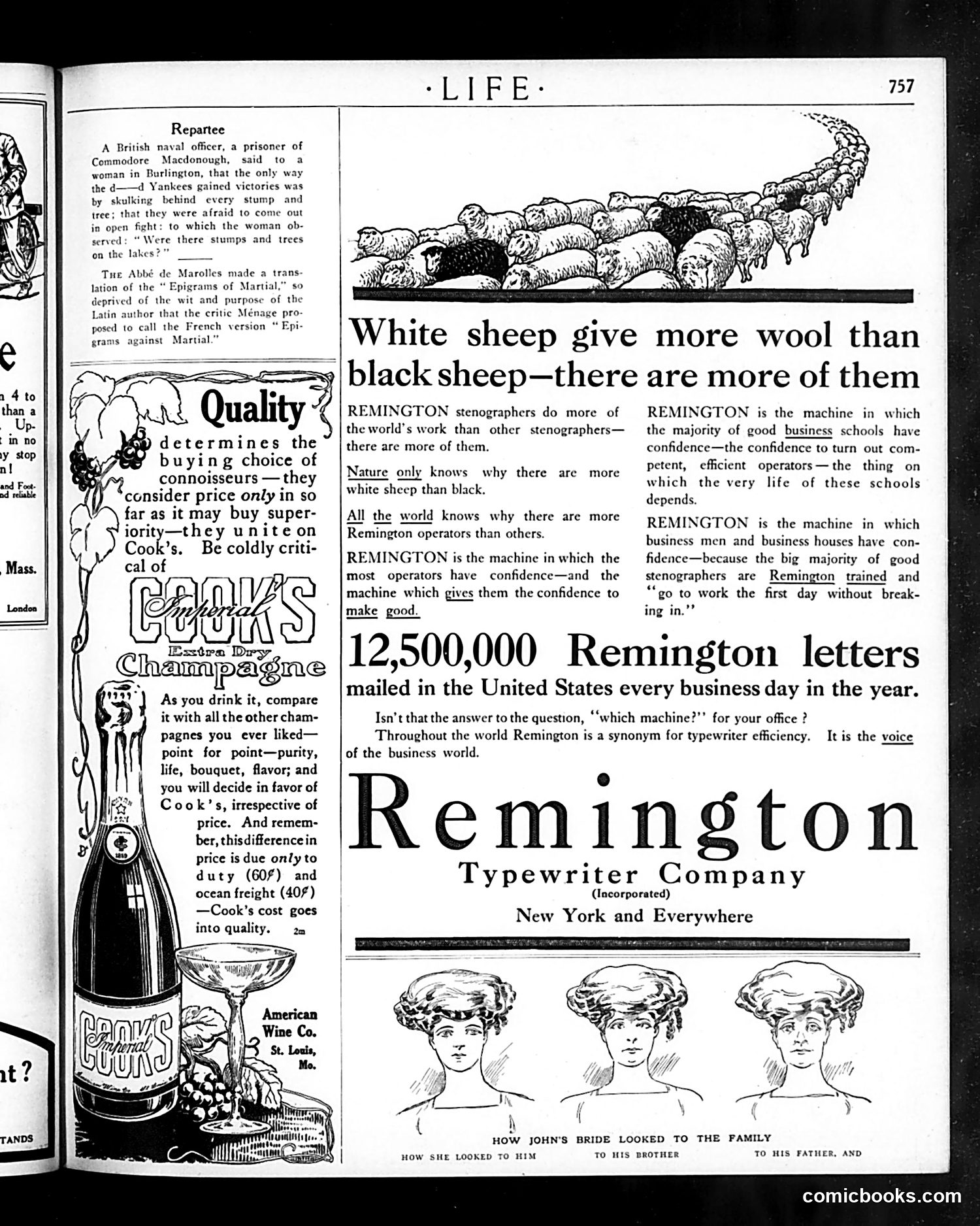
This page contains three distinct pieces of content: **"Repartee" (top left):** A brief anecdote from the War of 1812 mocking British naval officer Commodore Macdonough. A captured British officer insults American combat tactics as cowardly; a Burlington woman cleverly retorts that such hiding places wouldn't exist on lake battlefields—a pointed jab at American naval victories. **Remington Typewriter Ad (center/right):** A commercial comparing white sheep's wool productivity to Remington typewriter market dominance. The analogy suggests Remington's superiority stems from adoption rates rather than inherent quality. The ad emphasizes that business schools and trained stenographers prefer Remington machines, citing 12.5 million daily letters as proof of market leadership. **Bottom cartoon:** Three sketches showing how John's bride appeared differently to family members versus to John himself—likely satirizing the contrast between a woman's public presentation versus her husband's romantic perception. The page is primarily **advertising-driven content** with minor historical/satirical elements.
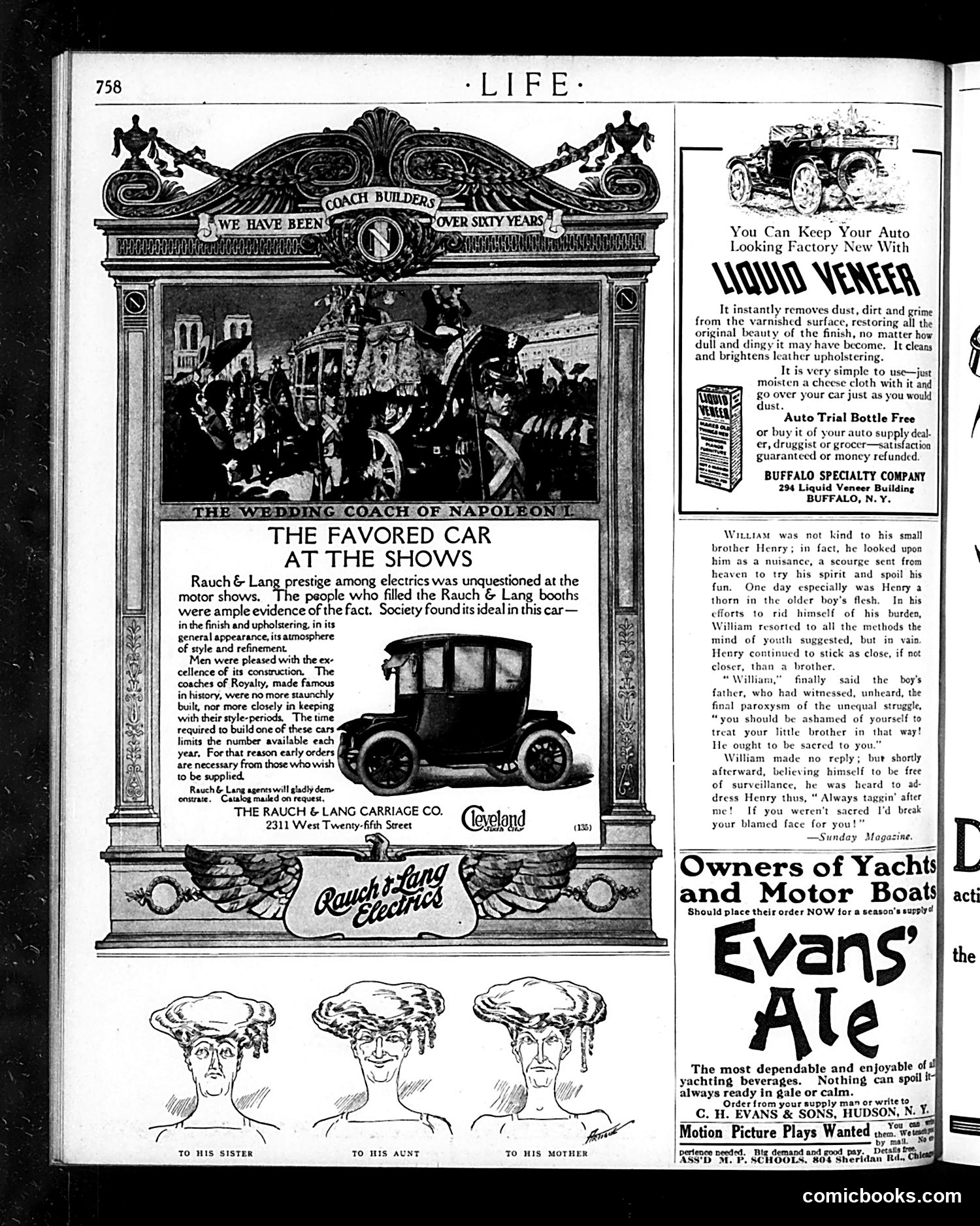
This page contains **primarily advertising** with a notable short humorous story. The main feature is a **Rauch & Lang automobile advertisement**, presenting their electric cars as the choice of high society at motor shows. The ad emphasizes craftsmanship comparable to "coaches of Royalty," appealing to wealthy, refined buyers. Below is a **comic story about sibling rivalry**: A boy named William mistreats his younger brother Henry constantly. Their father reproves William, saying Henry "ought to be sacred to you." William appears reformed but is later overheard telling Henry that if he *weren't* sacred, William would beat him—darkly comic because William's respect stems purely from his father's moral command, not genuine affection. The three illustrated heads at bottom appear to show different family members' reactions (labeled "to his sister," "to his aunt," "to his mother"), likely depicting their varied responses to the family drama. The page otherwise features ads for **Liquid Veneer** car polish, **Evans' Ale**, and miscellaneous notices—typical of Life's revenue model.
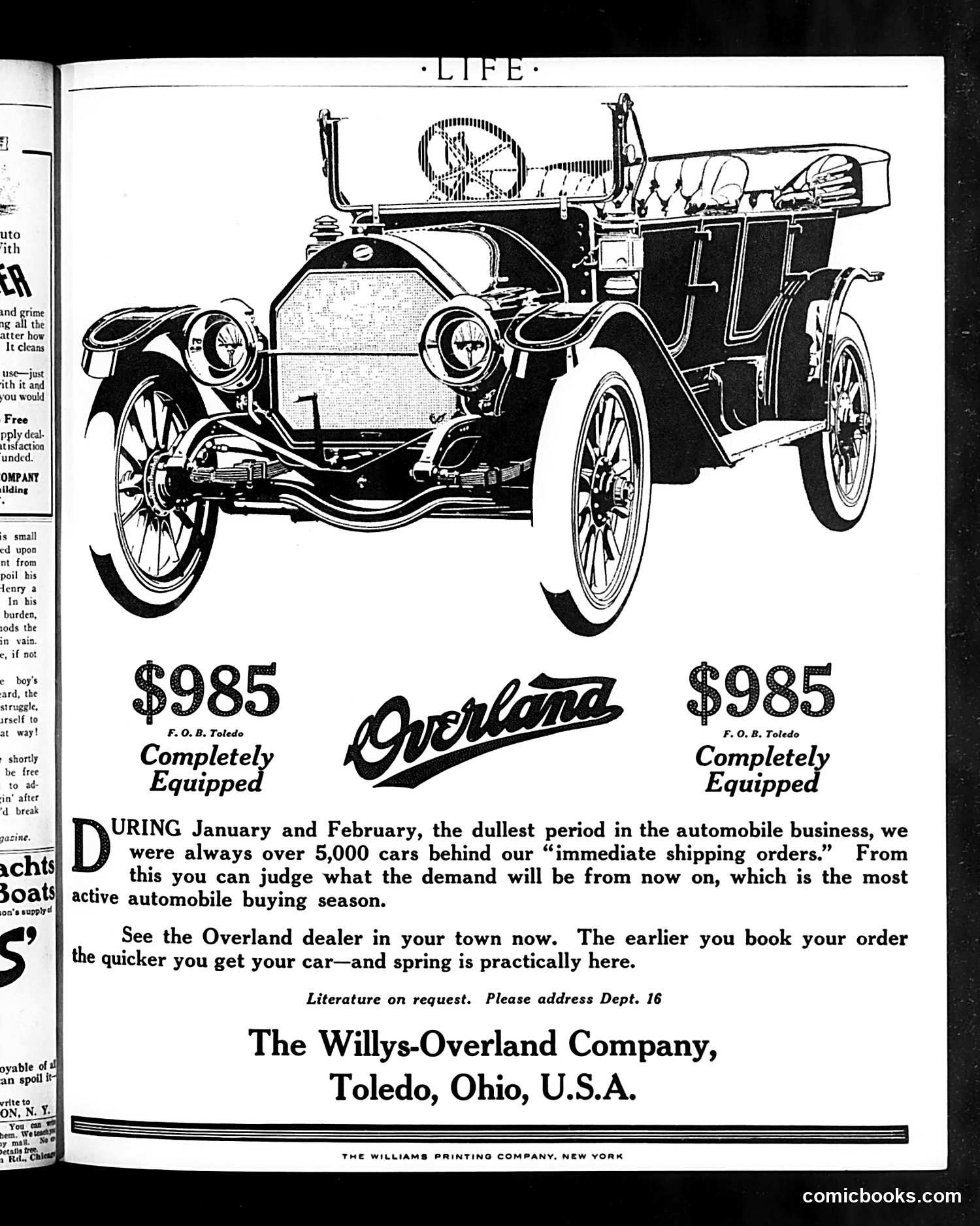
This is **not a cartoon or satire—it's a straightforward automobile advertisement** from Life magazine's pages. The Willys-Overland Company advertises their "Overland" car model at $985 (F.O.B. Toledo), presented as "Completely Equipped." The ad uses a detailed technical illustration showing the vehicle's engineering. The sales pitch claims that during the slow winter months (January-February), they were consistently 5,000+ cars behind on orders, positioning this as evidence of enormous spring demand. The company urges readers to visit local dealers and book orders early to secure faster delivery. The only quasi-humorous element is the implicit message: the car is so popular you can't get one quickly, so you'd better order now—a common sales tactic. This reflects genuine 1910s automobile market dynamics, when demand outpaced manufacturing capacity. This page demonstrates how Life magazine, while known for satirical cartoons, also carried conventional advertising to generate revenue.
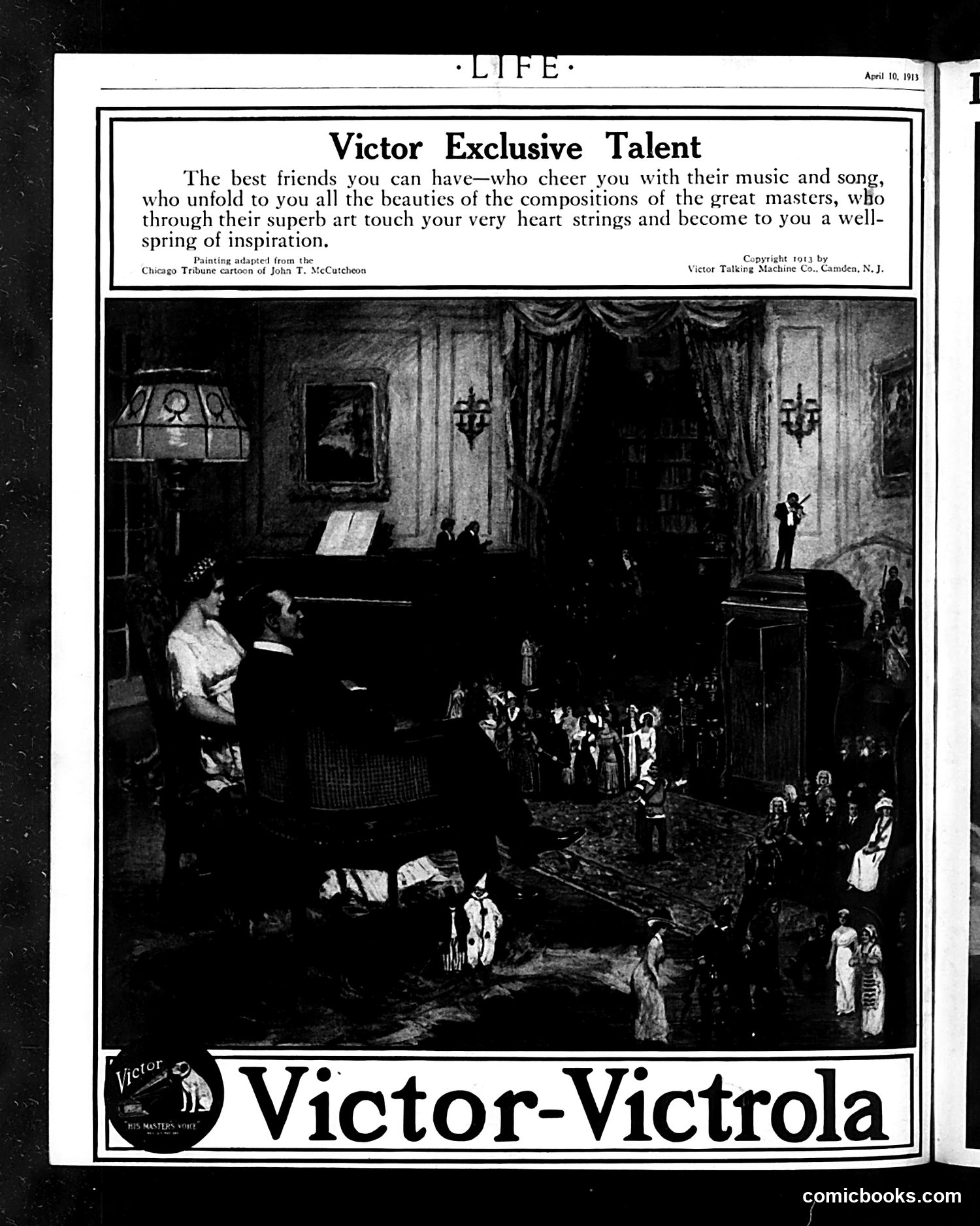
This is a Victor Talking Machine Company advertisement, not political satire. The illustration depicts an elegant parlor scene where a couple listens to a Victrola (early phonograph) while tiny, ethereal figures of musicians and performers materialize in the room—a fantastical visualization of how recorded music brings "live" performance into the home. The ad's text romanticizes the phonograph as providing access to great musical compositions and masters. The surreal imagery of miniature performers emerging from the machine reflects early 1900s wonder at recording technology itself. This was cutting-edge consumer marketing: selling the Victrola not merely as a device, but as a gateway to culture and inspiration. The cartoon style comes from the ad's artistic approach rather than from satirical intent.