
Life, 1913-04-10 · page 22 of 48
Life — April 10, 1913 — page 22: what you’re looking at
What you’re looking at
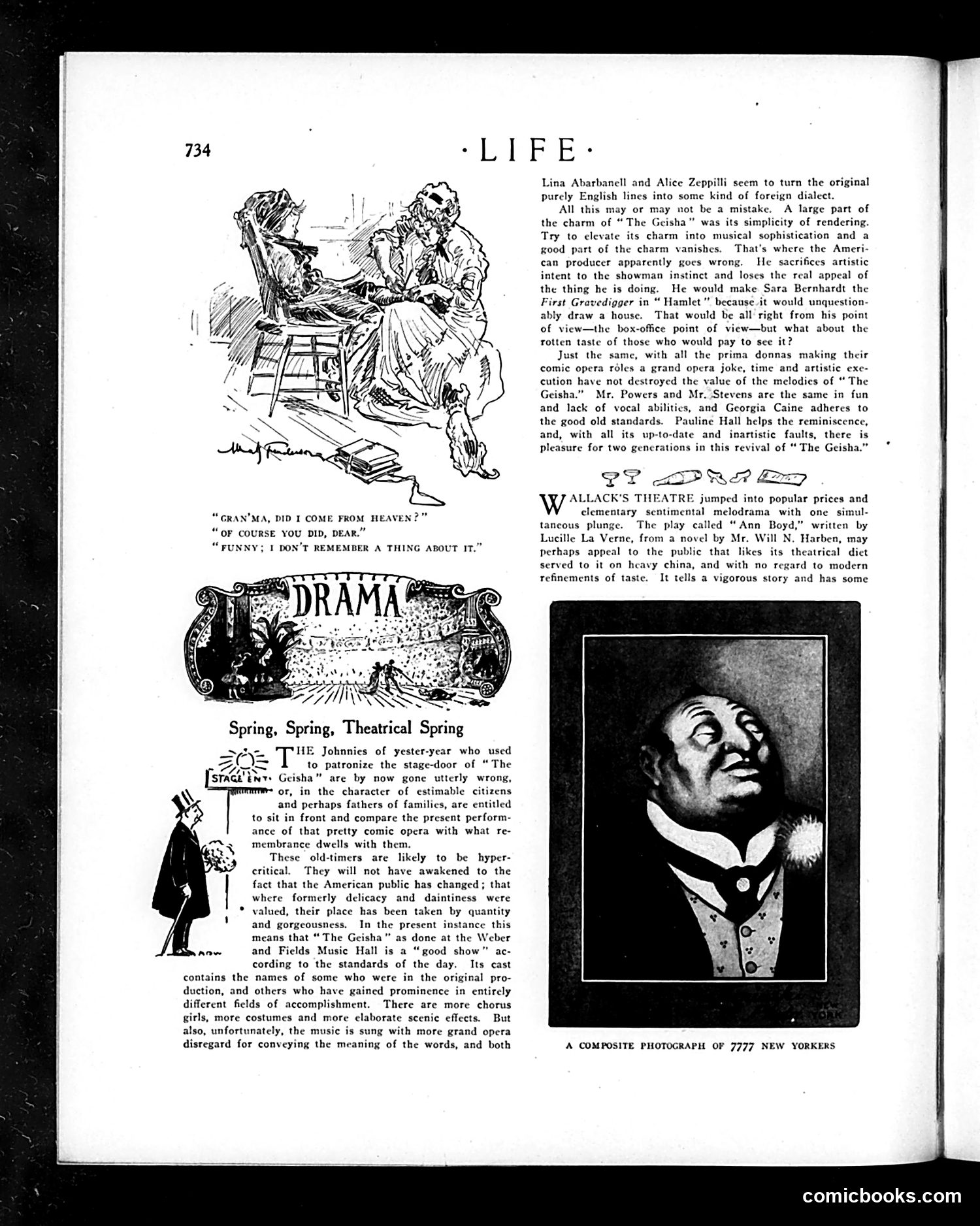
This page critiques the modern theatrical production of "The Geisha," a comic opera revival at Weber and Fields Music Hall. The top cartoon shows an exchange about heavenly origin—likely satirizing the pretentious elevation of what was originally a simple, charming show into grandiose "grand opera." The drama section attacks how contemporary American producers and performers have transformed the delicate original into something overwrought. The author argues that singers like Lina Abarbanell and Alice Zeppilli artificially adopt foreign accents and exaggerated operatic styles, destroying the work's appeal. The comparison to making Sarah Bernhardt a gravedigger in *Hamlet* illustrates how producers sacrifice artistic integrity for box-office appeal. The critique reflects early 20th-century anxieties about lowered theatrical standards: American audiences now prefer "quantity and gorgeousness" over "delicacy and daintiness." Yet some veteran performers (Powers, Stevens, Caine, Hall) maintain traditional standards, offering "pleasure for two generations."
📄 Transcribed text from this page (OCR, searchable)
Machine-transcribed from the original scan — historical spelling and the odd misread are preserved.
“LIFE: DID 1 COME FROM HEAVEN?” YOU DID, DEAR.” 3 1 DON’T REMEMBER A THING ABOUT IT.” Spring, Spring, Theatrical Spring ane HE Johnnies of yester-year who used ZO= to patronize the stage-door of “The STAGE' ENT: Geisha” are by now gone utterly wrong, or, in the character of estimable citizens and perhaps fathers of families, are entitled to sit in front and compare the present perform- ance of that pretty comic opera with what re- membrance dwells with them. These old-timers are likely to be hyper- critical. They will not have awakened to the fact that the American public has changed; tha where formerly delicacy and daintiness were valued, their place has been taken by quantity and gorgeousness. In the present instance this means that “ The Geisha” as done at the Weber and Fields Music Hall is a “good show” ac- cording to the standards of the day. Its cast contains the names of some who were in the original pro- duction, and others who have gained prominence in entirely different fields of accomplishment. There are more chorus girls, more costumes and more elaborate scenic effects. But also, unfortunately, the music is sung with more grand opera disregard for conveying the meaning of the words, and both Lina Abarbanell and Alice Zeppilli seem to turn the ori purely English lines into some kind of foreign dialect. All this may or may not be a mistake. A large part of the charm of “The Geisha” was its simplicity of rendering. Try to elevate its charm into musical sophistication and a good part of the charm vanishes. That's where the Ameri- can producer apparently gocs wrong. He sacrifices artistic intent to the showman instinct and loses the real appeal of the thing he is doing. He would make Sara Bernhardt the First Gravedigger in “ Hamlet” because it would unquestion- ably draw a house. That would be all right from his point of view—the box-office point of view—but what about the rotten taste of those who would pay to see it? Just the same, with all the prima donnas making their comic opera réles a grand opera joke, time and artistic exe- cution have not destroyed the value of the melodies of “ The Geisha.” Mr. Powers and Mr. Stevens are the same in fun and lack of vocal abilities, and Georgia Caine adheres to the good old standards. Pauline Hall helps the reminiscence, and, with all its up-to-date and inartistic faults, there is Pleasure for two generations in this revival of “ The Geisha.” ALLACK'S THEATRE jumped into popular prices and elementary sentimental melodrama with one simul- taneous plunge. The play called “Ann Boyd,” written by Lucille La Verne, from a novel by Mr. Will N. Harben, may perhaps appeal to the public that likes its theatrical dict served to it on heavy china, and with no regard to modern refinements of taste. It tells a vigorous story and has some A COMPOSITE PHOTOGRAPH OF 7777 NEW YORKERS comicbooks.com