
Life, 1913-04-10 · page 23 of 48
Life — April 10, 1913 — page 23: what you’re looking at
What you’re looking at
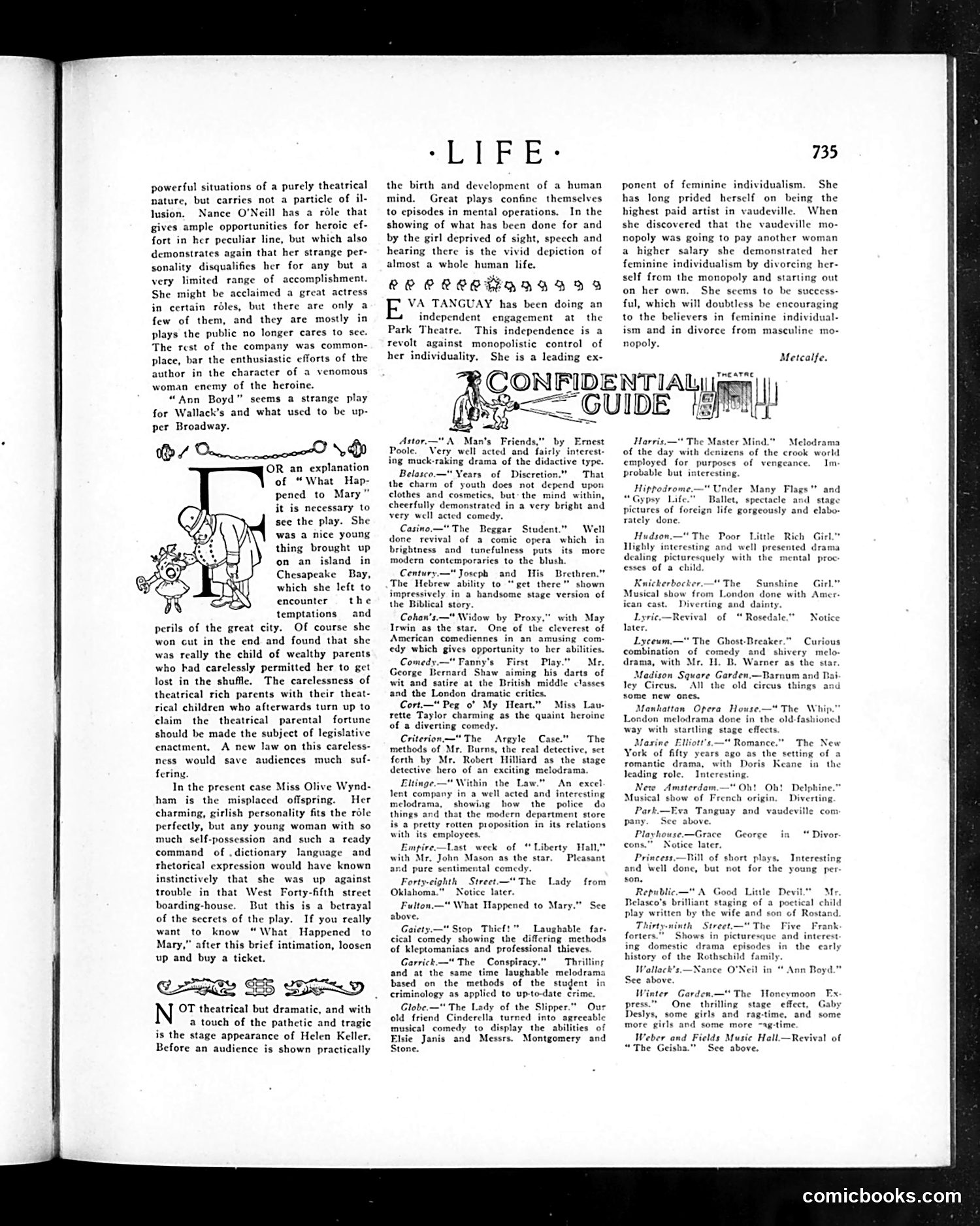
This page contains theater reviews from early 20th-century Broadway. Two cartoons accompany the text: **First cartoon:** Illustrates "What Happened to Mary"—a play about a naive young woman raised on a Chesapeake Bay island who encounters urban dangers after moving to the city. The reviewer satirizes the plot's implausibility: a girl with such "self-possession" and "command of dictionary language" would logically recognize she was in danger in a boarding-house. **Second cartoon:** Depicts Helen Keller's stage appearance, noting how unusual it is to witness "the birth and development of a human mind" performed theatrically—her education overcoming blindness and deafness. The page emphasizes **Vera Tanguay** as a notable performer asserting independence against theatrical monopolies controlling performers' work. Overall, this reflects early 1900s Broadway criticism, mixing genuine theatrical analysis with gentle mockery of plot absurdities and social commentary on women performers' autonomy.
📄 Transcribed text from this page (OCR, searchable)
Machine-transcribed from the original scan — historical spelling and the odd misread are preserved.
powerful situations of a purely theatrical nature, but carries not a particle of il- lusion. Nance O'Neill has a role that gives ample opportunities for heroic ef- fort in her peculiar line, but which also demonstrates again that her strange per- sonality disqualifies her for any but a very limited range of accomplishment. She might be acclaimed a great actress in certain rdles, but there are only a few of them, and they are mostly in plays the public no longer cares to see. The rest of the company was common- place, bar the enthusiastic efforts of the author in the character of a venomous woman enemy of the heroine. “Ann Boyd” seems a strange play for Wallack’s and what uscd to be up- per Broadway. (O/ On noo Vb OR an explanation of “What Hap- pened to Mary” it is necessary to see the play. She was a nice young thing brought up on an island in Chesapeake Bay, which she left to encounter the temptations and perils of the great city. Of course she won cut in the end and found that she was really the child of wealthy parents who had carelessly permitted her to get lost in the shuffle. The carelessness of theatrical rich parents with their theat- rical children who afterwards turn up to claim the theatrical parental fortune should be made the subject of legislative enactment, A new law on this carcless- ness would save audiences much suf- fering. In the present case Miss Olive Wynd- ham is the misplaced offspring. Her charming, girlish personality fits the rdle perfectly, but any young woman with so much self-possession and such a ready command of .dictionary language and rhetorical expression would have known instinctively that she was up against trouble in that West Forty-fifth street boarding-house. But this is a betrayal of the secrets of the play. If you really want to know “What Happened to Mary,” after this brief intimation, loosen up and buy a ticket. OT theatrical but dramatic, and with a touch of the pathetic and tragic is the stage appearance of Helen Keller. Before an audience is shown practically ESE the birth and development of a human mind. Great plays confine themselves to episodes in mental operations. In the showing of what has been done for and by the girl deprived of sight, speech and hearing there is the vivid depiction of almost a whole human life. RR PCRCRHAIABSDY VA TANGUAY has been doing an independent engagement at the Park Theatre. This independence is a revolt against monopolistic control of her individuality. She is a leading ex- CONFIDENTIAL ee “A Man's Friends,” by Ernest ole. Very well acted and fairly interest- i muck-raking drama of the didactive type. Belasco—""Years. of Discretion.” That the charm of youth does not depend upon clothes and cosmetics, but the mind within, cheerfully demonstrated in a very bright and very well acted comedy. Casino.—" The Begear Student." Well done revival of a comic opera which in brightness and tunefulness puts its more modern contemporaries to the blush. Century.—" Joseph His Brethren." ‘The Hebrew ability to “get there” shown impressively in a handsome stage version of the Biblical story. Cohen’s.—" Widow by Proxy,” with May Irwin as the star. One of the cleverest of American comediennes in an amusing com- edy which gives opportunity to her abilities. Comedy.—" Fanny's First Play.” Mr. George Bernard Shaw aiming his darts of wit and satire at the British middle classes and the London dramatic critics. Cort.—" Peg o” My Heart.” Miss Lau- rette Taylor charming as the quaint heroine of a diverting comedy. Criterion—" The Argyle Case." The methods of Mr, Burns, the real detective, set forth by Mr. Robert Hilliard as the stage detective hero of an exciting melodrama. Eltinge. —" Within lent company the Law.” An excel a well acted and interesting melodrama, showing how the police do things and that the modern department store is a pretty rotten proposition in its relations with its employees. Empire-—Last_ week of "Liberty Tall,” with Mr, John Mason as the star, Pleasant and pure sentimental comedy. Forty-eighth Street —" The Oklahoma.” Notice later. Fulton.—" What Happened to Mary.” See above. Gaiety.—" Stop Thief!” Laughable far- cical comedy showing the differing methods of kleptomaniacs and professional thieves. Garrick.—" The Conspiracy.” Thrilling and at the same time laughable melodrama based on the methods of the stugent in criminology as applied to up-to-date crime Globe.—" The Lady of the Slipper.” Our old friend Cinderella turned into agreeable musical comedy to display the abilities of Elsie Janis and Messrs. Montgomery and Stone. Lady from <— GUIDE 735 She being the ponent of feminine individualism. has long prided highest paid artist in vaudeville. When she discovered that the vaudeville mo- nopoly was going to pay another woman igher salary she demonstrated her ¢ individualism by divorcing her- self from the monopoly and starting out on her own, She scems to be success- ful, which will doubtless be encouraging to the believers in feminine individual- ism and in divorce from masculine mo- nopoly. herself on Metcalfe. Trearne Ne Harris.—" The Master Mind.” Melodrama of the day with denizens of the crook world employed for purposes of probable but interesting. Hippodrom Gypsy I pictures of foreig rately done. Hudson.—" The Poor Little Rich Highly interesting and well presented drama dealing picturesquely with the mental proc esses of a child. Knickerbocker.—" The Musical show from L ican cast. Divertin Lyric.—Revival of later. Lyceum.—" The Ghost-Breaker.” Curious combination of comedy and shivery melo- drama, with Mr. H. B. Warner as the star. Madison Square Garden.—Barnum and Dai: ley Circus. All the old circus things some new ones. Manhattan Opera House.—" The Whip.” London melodrama done in the old-fashioned way with startling stage effects Marine Eltiott’s,—"* Romance.” The New York of fifty years ago as the setting of a romantic drama, with Doris leading role. Interesting Newe Amsterdem.—" O Delphine. Musical show of Fr Diver Park.—Ewva Tanguay and vaudeville com: pany. See above Playhouse-—Grace cons.” Notice later. vengeance. Im: Under Many Flags" and Ballet, spectacle and stage life gorgeously and elabo- Sunshine Girl ndon done with Amer: and dainty, “ Rosedale. tice Keane in the George in“ Divor Princess.—Dill of short plays, Interesting and Well done, but not for the young per son. Republic.—" A Good Little Devil." Mr Relasco’s brilliant staging of a poetical child play written by the wife and son of Rostand. Thirty-ninth Street.—" The Five Frank forters.” Shows in picturesque and interest ing domestic drama episodes in the early history of the Rothschild fs Wallack’s.—Nance O'Neil i See above. Winter Gerden.—" The Honeymoon Fx press.” One thrilling stage effect, Deslys, some girls and rag-time, and some more girls and some more ~ag-time. Weber and Fields Music Hell.—Revival of “The Geisha.” See above. * Ann Royd.” comicbooks.com