
Life, 1913-04-10 · page 26 of 48
Life — April 10, 1913 — page 26: what you’re looking at
What you’re looking at
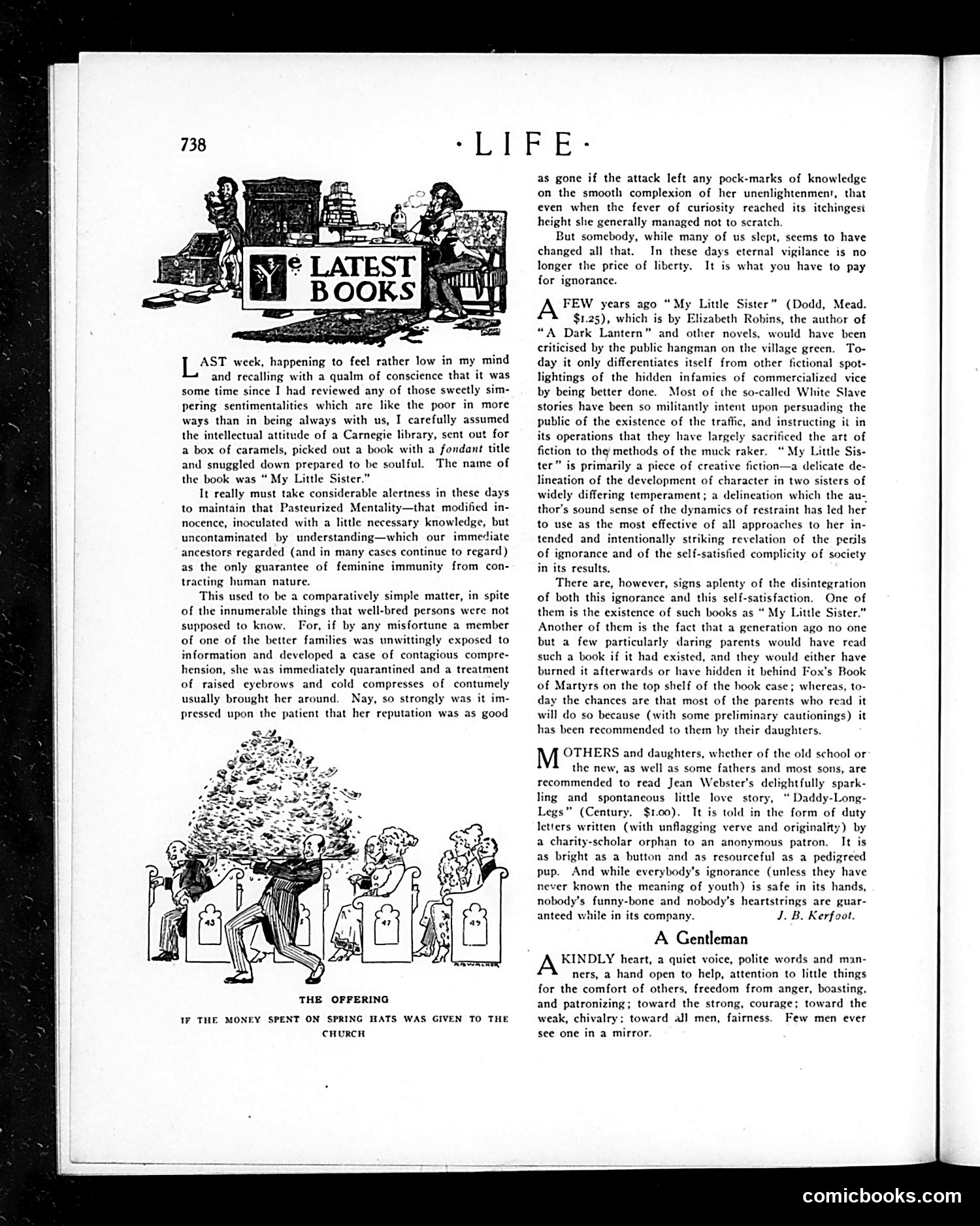
This page contains a book review by the magazine's critic, discussing Elizabeth Robins' novel "My Little Sister"—a work addressing the "white slave trade" (human trafficking for prostitution), a major Progressive Era reform issue. **The Satire:** The lengthy opening essay satirizes the traditional expectation that upper-class women maintain willful ignorance about sexual vice and "human nature." The critic mocks the old practice of quarantining young ladies who accidentally gained knowledge, treating information like a contagious disease requiring "raised eyebrows and cold compresses." **The Point:** The critic celebrates that social attitudes have shifted—modern parents now *recommend* such books to daughters, whereas previous generations would have hidden or burned them. This reflects Progressive-era debates about female education and whether protecting women through ignorance actually served their interests. **The Cartoon Below:** "The Offering" depicts churchgoers donating to collections, sardonically captioning it: "If the money spent on spring hats was given to the church"—critiquing wealthy women's fashion spending versus charitable giving.
📄 Transcribed text from this page (OCR, searchable)
Machine-transcribed from the original scan — historical spelling and the odd misread are preserved.
~ LPF E- | Bees week, happening to feel rather low in my mind and recalling with a qualm of conscience that it was some time since I had reviewed any of those sweetly sim- pering sentimentalities which are like the poor in more ways than in being always with us, I carefully assumed the intellectual attitude of a Carnegie library, sent out for a box of caramels, picked out a book with a fondant title and snuggled down prepared to be soulful. The name of the book was “ My Little Sister.” It really must take considerable alertness in these days to maintain that Pasteurized Mentality—that modified in- nocence, inoculated with a little necessary knowledge, but uncontaminated by understanding—which our immediate ancestors regarded (and in many cases continue to regard) as the only guarantee of feminine immunity from con- tracting human nature. This used to be a comparatively simple matter, in spite of the innumerable things that well-bred persons were not supposed to know. For, if by any misfortune a member of one of the better families was unwittingly exposed to information and developed a case of contagious compre- hension, she was immediately quarantined and a treatment of raised eyebrows and cold compresses of contumely usually brought her around. Nay, so strongly was it im- pressed upon the patient that her reputation was as good THE OFFERING IF THE MONEY SPENT ON SPRING HATS WAS GIVEN TO THE CHURCH as gone if the attack left any pock-marks of knowledge on the smooth complexion of her unenlightenment, that even when the fever of curiosity reached its itchingesi height she generally managed not to scratch. But somebody, while many of us slept, seems to have changed all that. In these days eternal vigilance is no longer the price of liberty. It is what you have to pay for ignorance. FEW years ago “My Little Sister” (Dodd, Mead. $1.25), which is by Elizabeth Robins, the author of “A Dark Lantern” and other novels, would have been criticised by the public hangman on the village green. To- day it only differentiates itself from other fictional spot- lightings of the hidden infamies of commercialized vice by being better done. Most of the so-called White Slave stories have been so militantly intent upon persuading the public of the existence of the traffic, and instructing it in its operations that they have largely sacrificed the art of fiction to the methods of the muck raker. “ My Little Sis- ter” is primarily a piece of creative fiction—a delicate de- lineation of the development of character in two sisters of widely differing temperament; a delineation which the au- thor’s sound sense of the dynamics of restraint has led her to use as the most effective of all approaches to her in- tended and intentionally striking revelation of the perils of ignorance and of the self-satisfied complicity of society in its results, There are, however, signs aplenty of the disintegration of both this ignorance and this self-satisfaction. One of them is the existence of such books as “ My Little Sister.” Another of them is the fact that a generation ago no one but a few particularly daring parents would have read such a book if it had existed, and they would either have burned it afterwards or have hidden it behind Fox's Book of Martyrs on the top shelf of the hook case; whereas, to- day the chances are that most of the parents who read it will do so because (with some preliminary cautionings) it has been recommended to them by their daughters. OTHERS and daughters, whether of the old school or the new, as well as some fathers and most sons, are recommended to read Jean Webster's delightfully spark- ling and spontaneous little love story, “ Daddy-Long- Legs” (Century. $1.00). Tt is told in the form of duty letters written (with unflagging verve and originalfty) by a charity-scholar orphan to an anonymous patron. It is as bright as a button and as resourceful as a pedigreed pup. And while everybody’s ignorance (unless they have never known the meaning of youth) is safe in its hands, nobody’s funny-bone and nobody’s heartstrings are guar- anteed while in its company. J.B. Kerfoot. A Gentleman KINDLY heart, a quiet voice, polite words and man- ners, a hand open to help, attention to little things for the comfort of others, freedom from anger, boasting, and patronizing; toward the strong, courage; toward the weak, chivalry; toward all men, fairness. Few men ever see one in a mirror. comicbooks.com