
A complete issue · 44 pages · 1912
Life — August 22, 1912
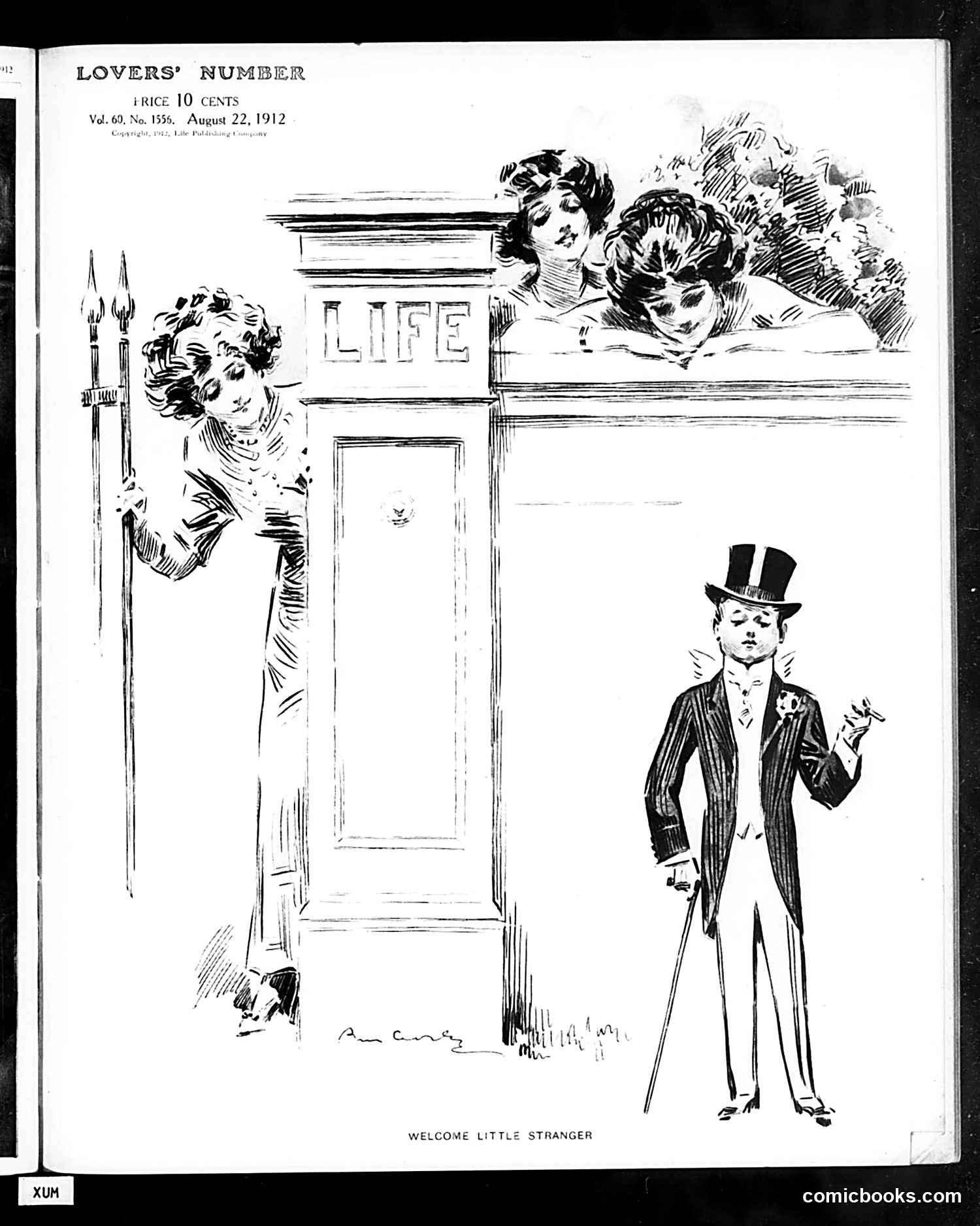
This is a "Lovers' Number" special issue. The cartoon depicts a domestic scenario with comedic tension: a woman stands at a doorway with two other women visible above (possibly representing gossip or interference), while a well-dressed man in top hat and formal attire approaches from the right, appearing somewhat hesitant or awkward. The caption "Welcome Little Stranger" suggests the arrival of a baby, making this satirical commentary on how a husband reacts to—or is received by household members upon—becoming a father. The man's formal, somewhat detached posture and the women's animated presence above humorously captures early 20th-century domestic anxieties about marriage, parenthood, and shifting household dynamics, likely resonating with Life's middle-class readership.
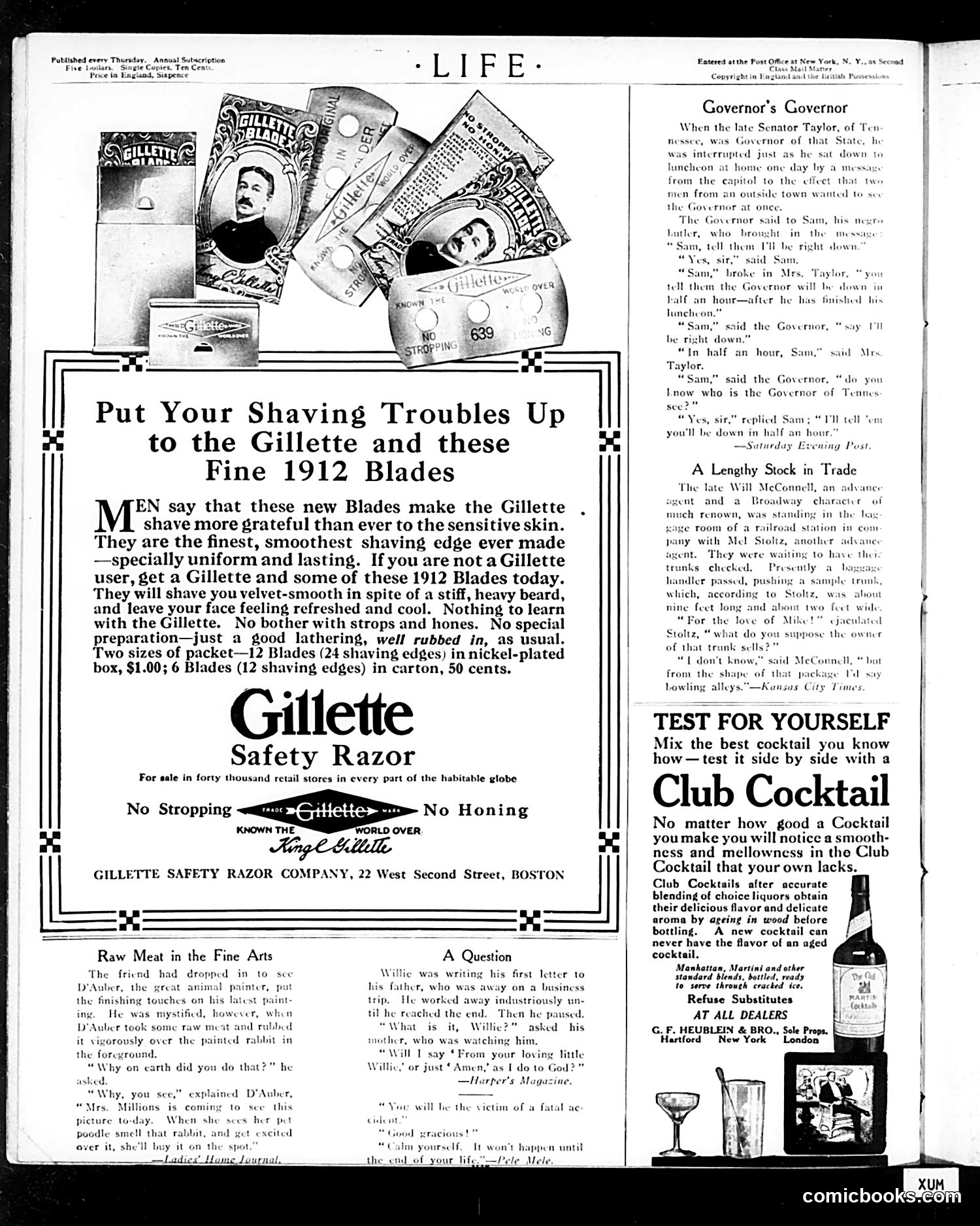
This page is primarily **advertising**, not satire or political commentary. The dominant content is a Gillette Safety Razor advertisement featuring product images and promotional copy claiming the 1912 blades are "the finest, smoothest shaving edge ever made." The ad promises smooth shaving without stropping or honing. The right column contains three brief humorous anecdotes: "Governor's Governor" (a joke about a Tennessee governor), "A Lengthy Stock in Trade" (about Will McCormell and a railroad package), and "A Question" (about a son writing to his absent father). Below is an advertisement for Club Cocktail liquor. The page reflects early 1900s consumer culture and light humor typical of *Life* magazine during this period, but contains no identifiable political cartoons or satirical commentary on current events.
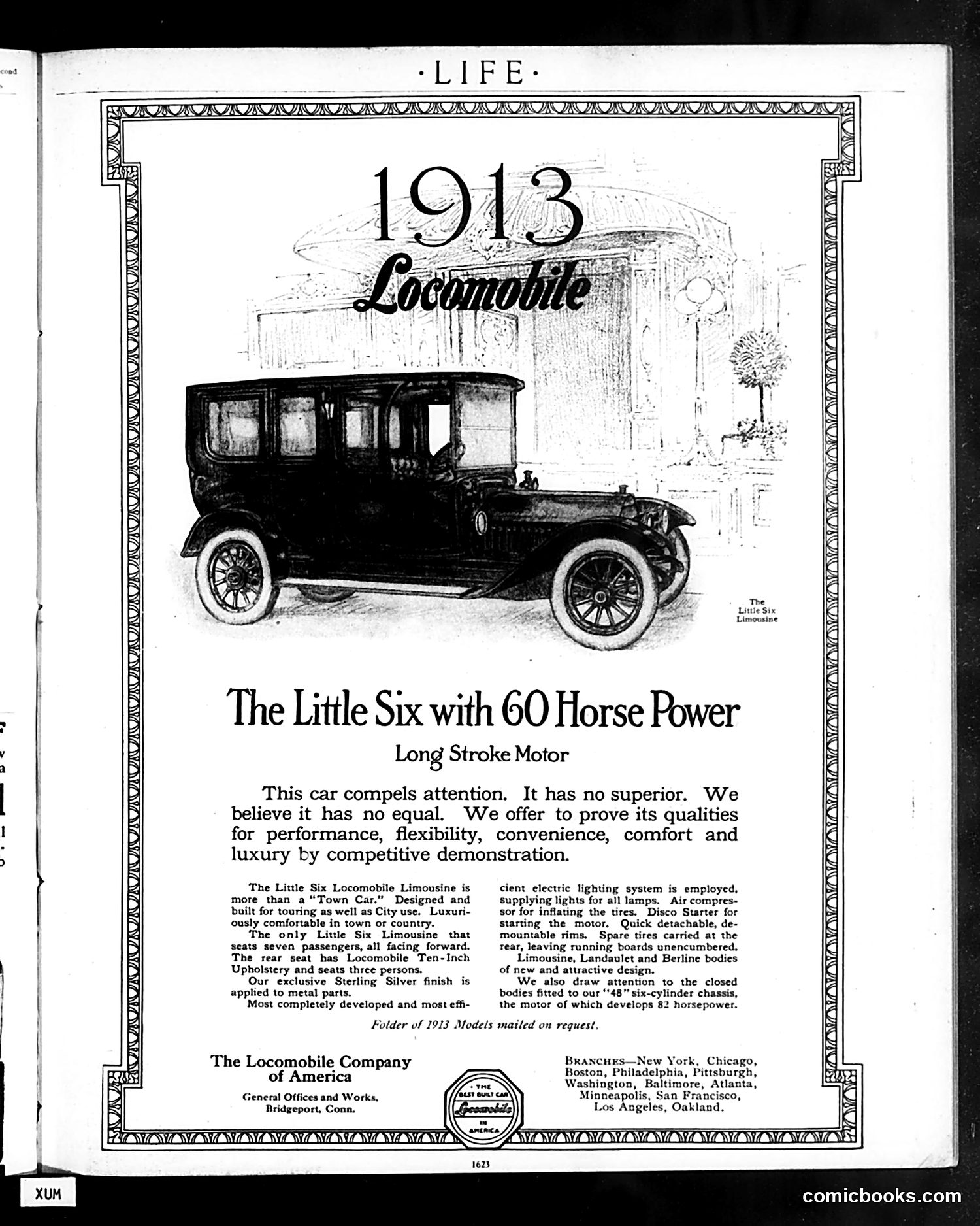
This page is **not a cartoon or satire**—it's a **straightforward automobile advertisement** for the 1913 Locomotile "Little Six" luxury car. The ad promotes the vehicle's technical specifications (60 horsepower, long-stroke motor, electric lighting) and luxury features (leather upholstery, enclosed body design). It emphasizes the car's quality through competitive claims ("no superior," "no equal") and offers to demonstrate superiority through actual performance tests. The Locomotile Company lists branches across major American cities and their Connecticut headquarters. This represents early automotive advertising in *Life* magazine, which carried both satirical content and paid advertisements. There is no political or social commentary here—simply period marketing for a high-end automobile.
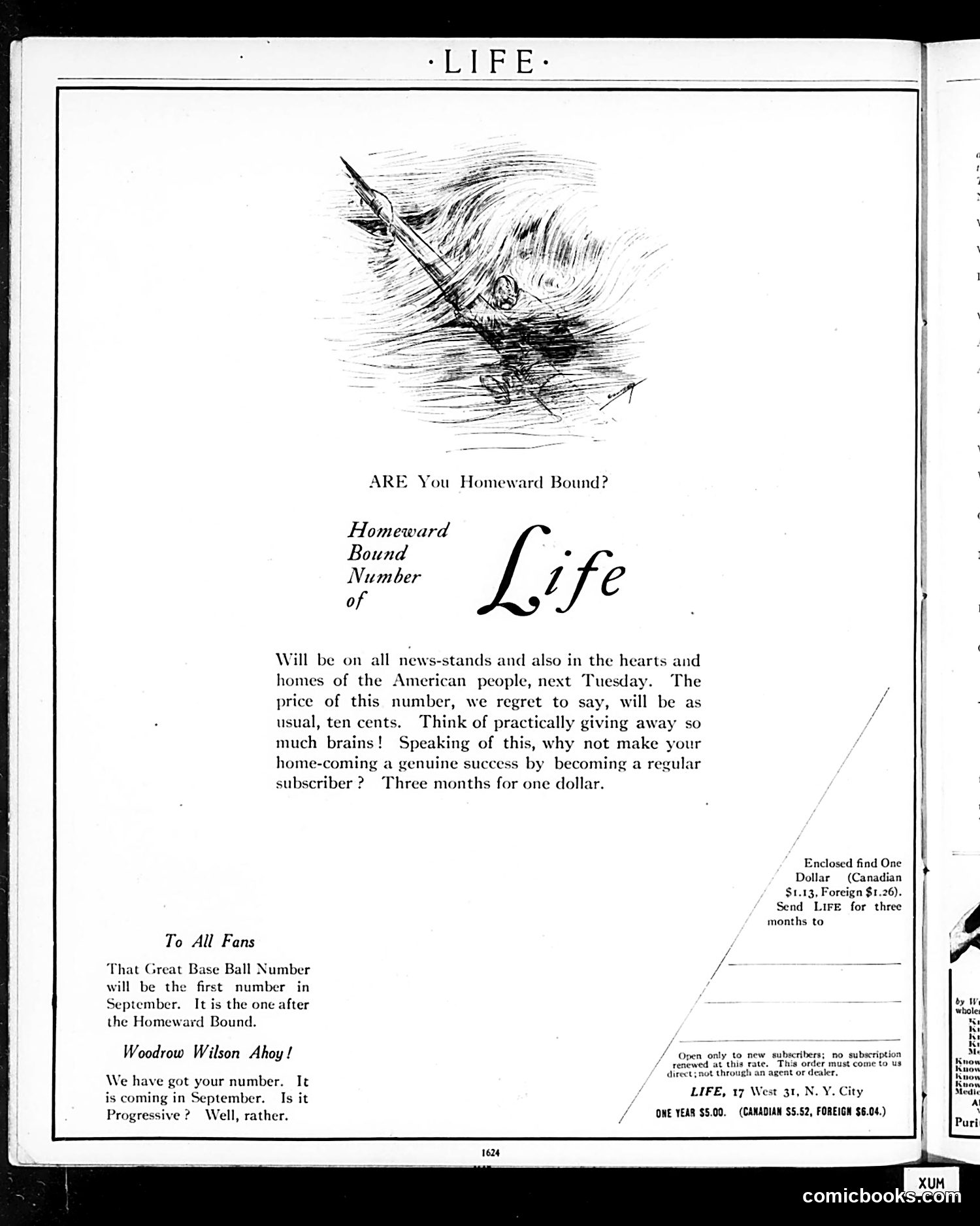
This is primarily **advertising** rather than satirical editorial content. The page promotes Life magazine's "Homeward Bound Number," scheduled for the following Tuesday, priced at ten cents. The sketch at top shows a sailboat in rough waters, illustrating the "homeward bound" maritime theme. The text uses nautical metaphor to encourage subscriptions, offering three months for one dollar. Two small sections address specific audiences: 1. **"To All Fans"**: References a "Great Base Ball Number" coming in September, the issue after the "Homeward Bound" number, suggesting Life's broad appeal. 2. **"Woodrow Wilson Ahoy!"**: Cryptically references obtaining "your number," coming in September—likely alluding to Wilson administration news or policy, though the specific reference is unclear without additional context. The page is essentially a subscription pitch using topical hooks.
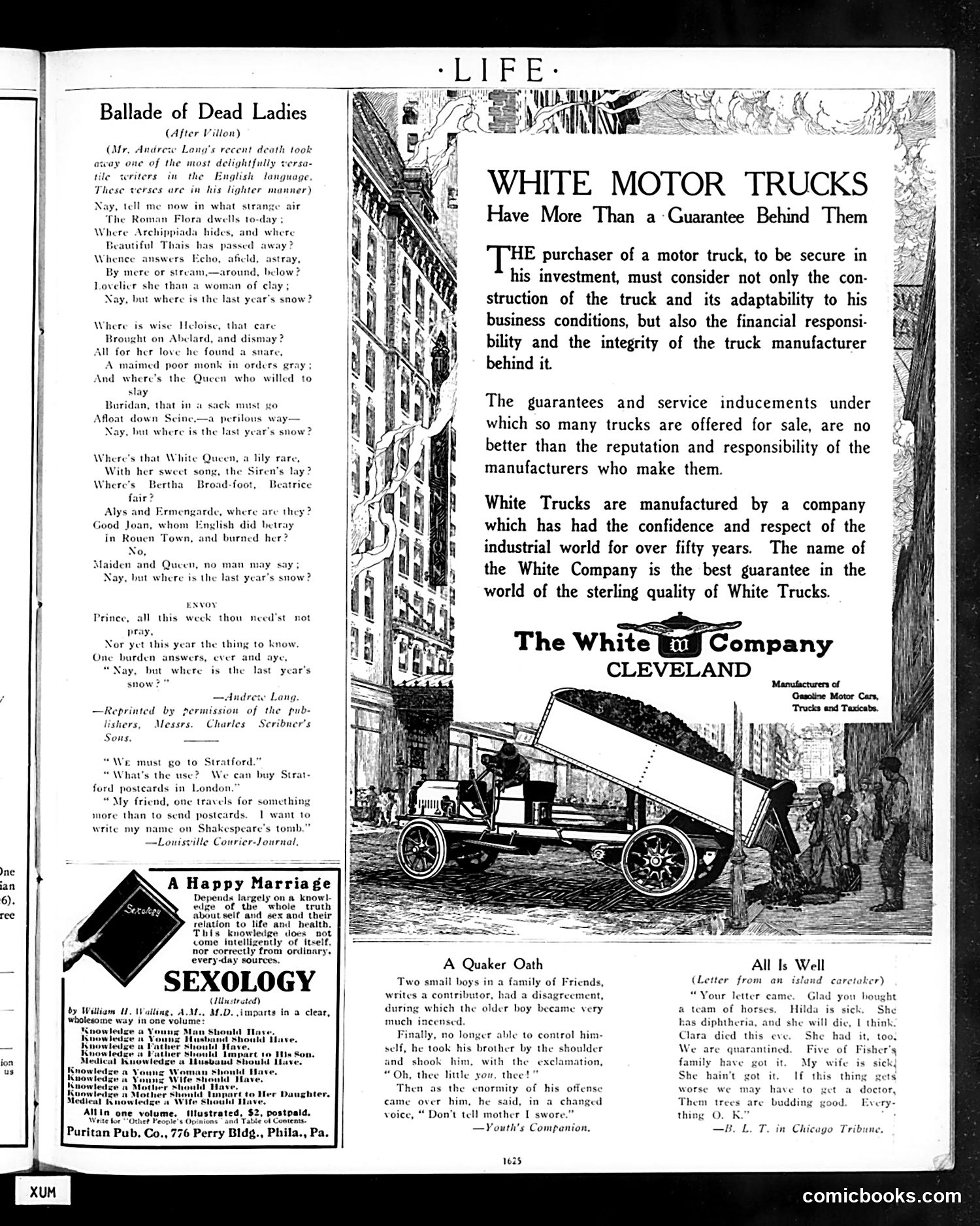
This page is primarily **advertising and editorial content** rather than political satire. The dominant feature is a **White Motor Trucks advertisement** from Cleveland, emphasizing the company's 50-year reputation as a guarantee of quality. The accompanying illustration shows a truck actively dumping material on a city street. The left column contains literary content: a poem titled "Ballade of Dead Ladies" (attributed to Andrew Lang) and several brief humorous items including "A Happy Marriage" and "Sexology" advertisements. Below the truck ad are three short satirical pieces ("A Quaker Oath," "All Is Well") offering mild social commentary through fictional anecdotes about family life and relationships—typical of Life's light humor format. The page reflects early 20th-century advertising integration with editorial content.
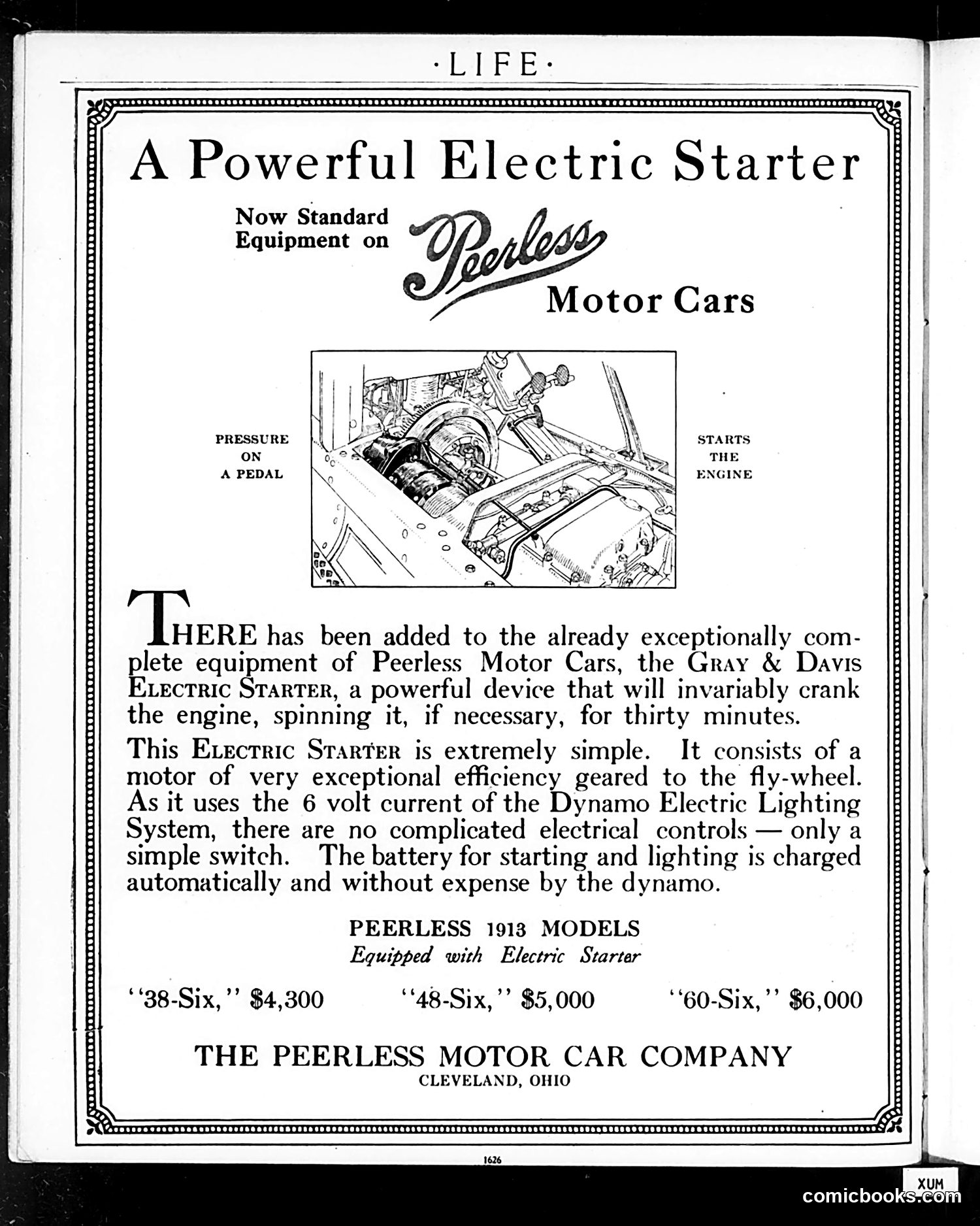
This is **not a cartoon or satirical content** — it's a straightforward advertisement for Peerless Motor Cars, published in Life magazine circa 1913. The ad promotes the "Gray & Davis Electric Starter," a then-revolutionary automotive feature. The illustration shows a driver using a foot pedal to start the engine electrically, rather than hand-cranking (the dangerous, labor-intensive method previously required). Key selling points highlighted: - Simple operation (just a pedal and switch) - Uses the car's existing 6-volt electrical system - Battery charges automatically via the dynamo - No complicated electrical controls needed The ad lists three 1913 Peerless models with prices ($4,300–$6,000). This represents genuine technological progress — the electric starter became standard equipment and fundamentally improved automobile practicality and safety.
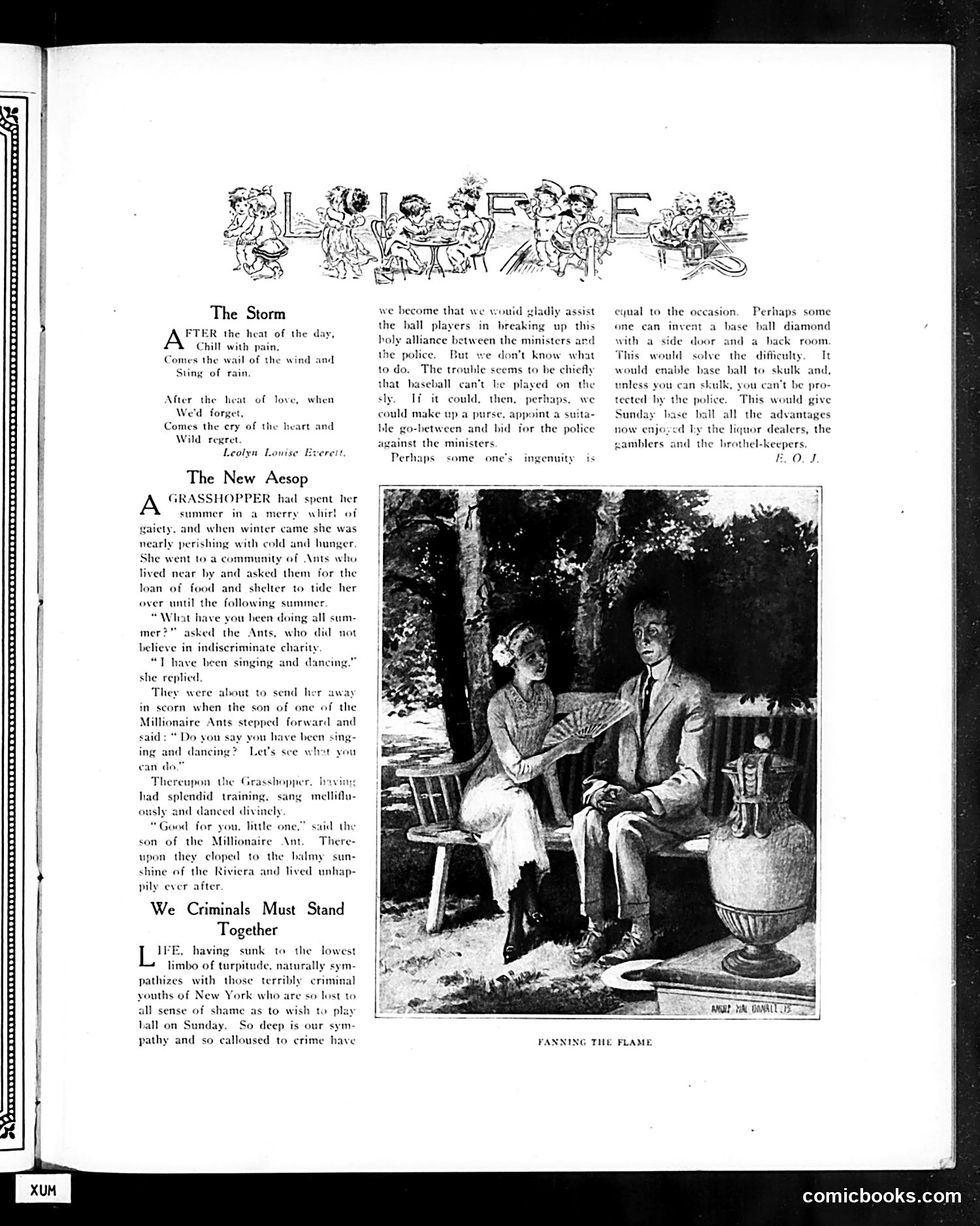
This page contains three separate pieces of satirical writing and one illustration titled "Fanning the Flame." **"The Storm"** and **"After the heat of love"** are brief poetic verses about emotional turbulence, likely commenting on social upheaval of the era. **"The New Aesop"** retells a fable about a Grasshopper and Ants, modernizing Aesop's moral. The Grasshopper spent summer singing while Ants worked; when winter came, wealthy Ants' son rescued her through charity rather than the traditional moral lesson about industry. **"We Criminals Must Stand Together"** appears to criticize low-class New Yorkers who sympathize with criminals, suggesting shame about baseball on Sundays. The photograph **"Fanning the Flame"** shows two women in what appears to be a romantic or intimate moment, likely satirizing contemporary attitudes toward relationships or morality. The specific historical context remains unclear without additional publication date information.
This page from Life (August 22, 1912) discusses the 1912 presidential election, specifically criticizing Dr. Wilson's acceptance of the Democratic nomination. The editorial argues Wilson's platform lacks originality compared to Roosevelt's "Bull Moose" progressive agenda. The illustrated vignette at top left depicts a figure (likely Roosevelt) riding a bull, referencing his Progressive "Bull Moose" party—a splinter group that challenged both major parties that year. The text praises Roosevelt's Chicago address and the Bull Moosers' platform, contrasting their bold vision with Wilson's more cautious approach. The satire suggests Wilson merely echoed progressive ideas without Roosevelt's authentic reformist conviction, positioning the Bull Moose movement as the genuine progressive alternative in this three-way race.
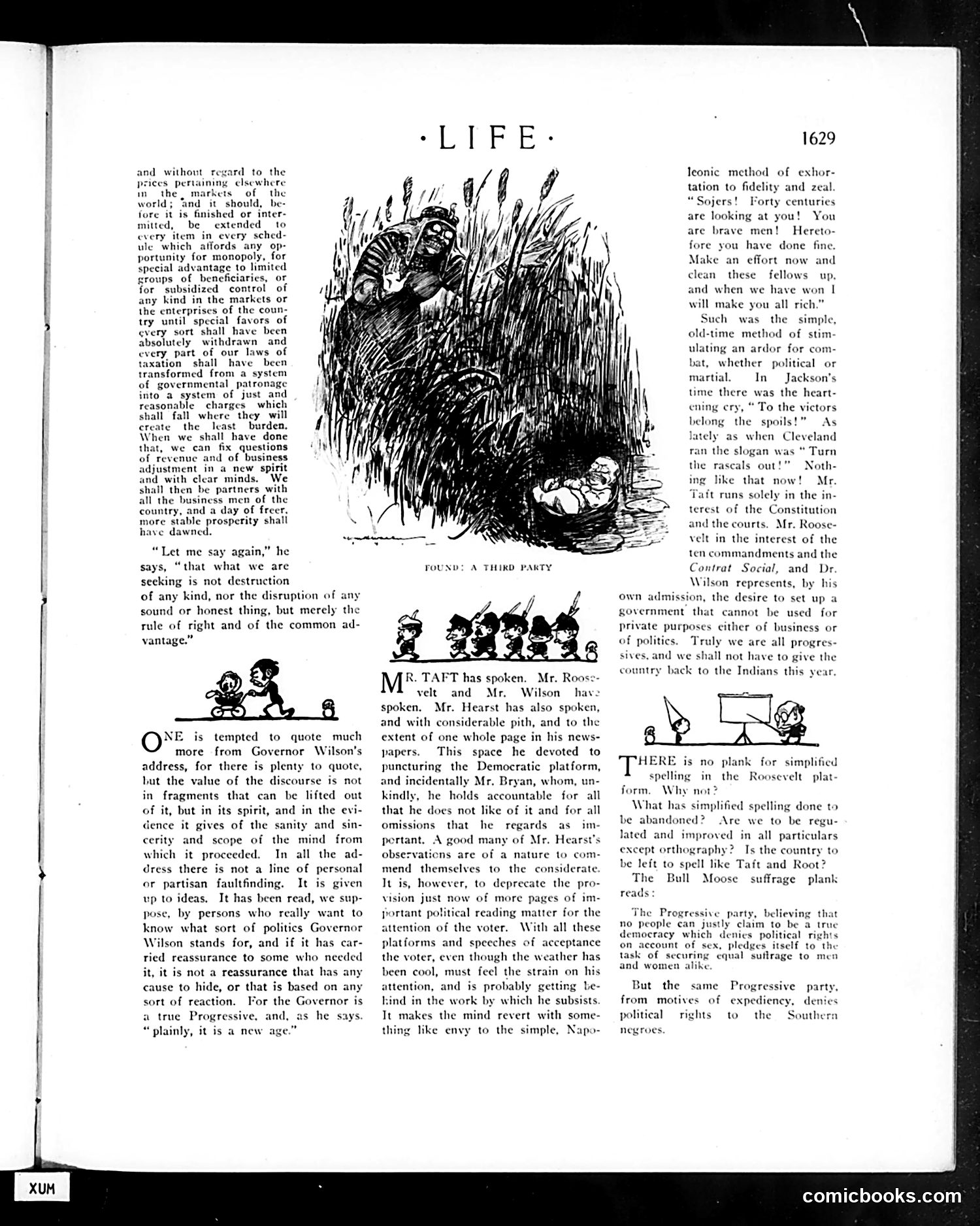
**"Found: A Third Party"** depicts a large, shaggy creature (resembling a bear or wild animal) looming over a tiny human figure in grass. Below it, a row of small caricatured figures sits in a line. The cartoon satirizes the emergence of a "third party" in American politics—a challenge to the two-party system. The text references speeches by Taft, Roosevelt, Wilson, and Hearst regarding political platforms and the Progressive movement. The cartoon suggests the third party is monstrous, uncontrollable, or absurdly small-scale compared to its ambitions. The lower illustration depicts what appear to be political figures or party representatives aligned together, possibly mocking their unity or their minor significance.
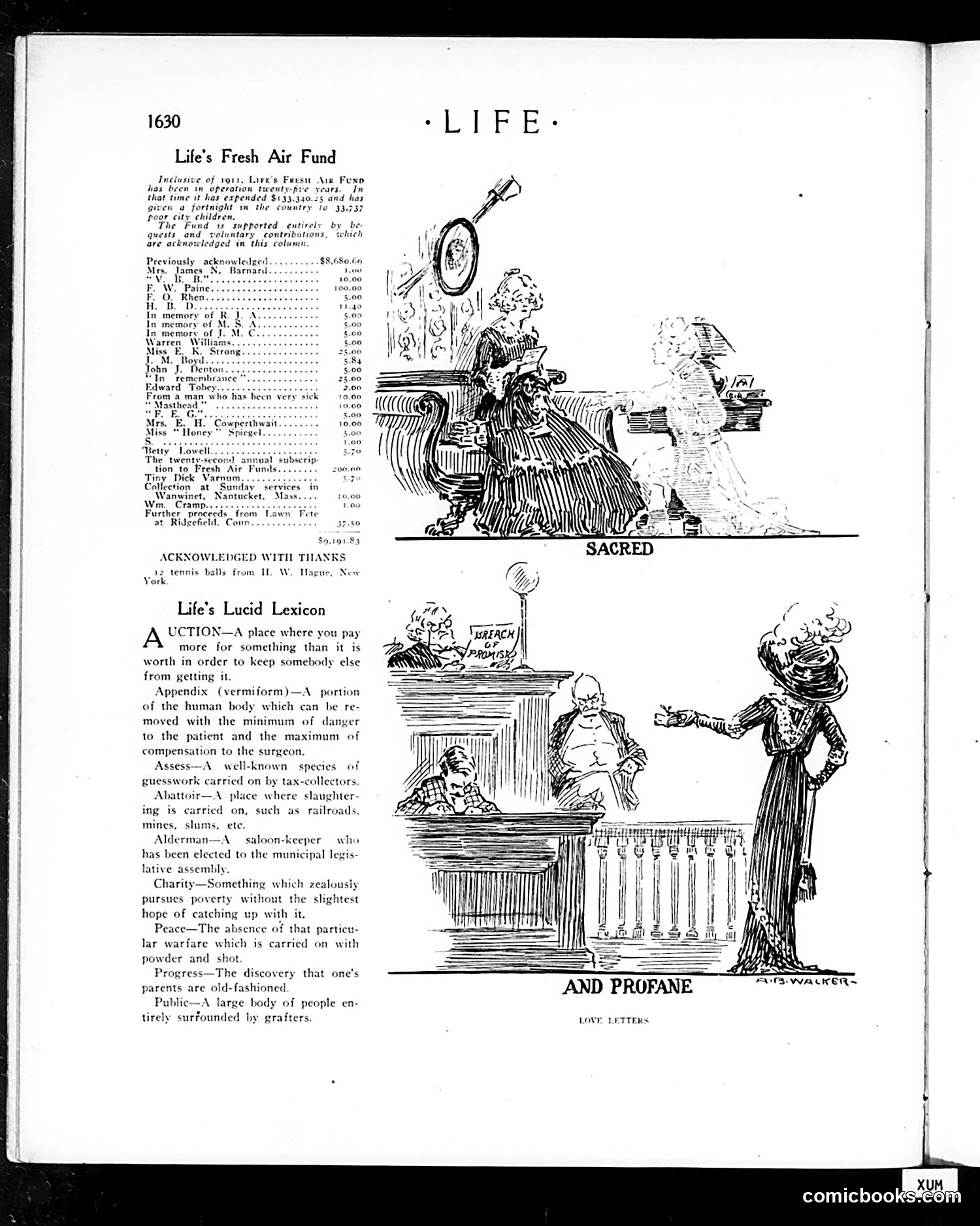
This page contains two satirical cartoons addressing social and moral concerns: **"Sacred"** (top): Shows a woman operating what appears to be a mechanical "fresh air" device, satirizing the earnest but potentially ineffective nature of charitable campaigns. The absurdly elaborate contraption mocks well-intentioned but overcomplicated philanthropic efforts. **"And Profane"** (bottom): Depicts a hierarchical building labeled "Graft" and "Promise," with figures at different levels representing corruption and hypocrisy in government or institutions. A woman gestures dismissively at this structure, suggesting public awareness of systemic graft and broken promises. Together, these cartoons critique both ineffectual charity and institutional corruption—contrasting sacred (charitable) intentions with profane (corrupt) realities. The "Lucid Lexicon" definitions reinforce satirical commentary on human nature and society.
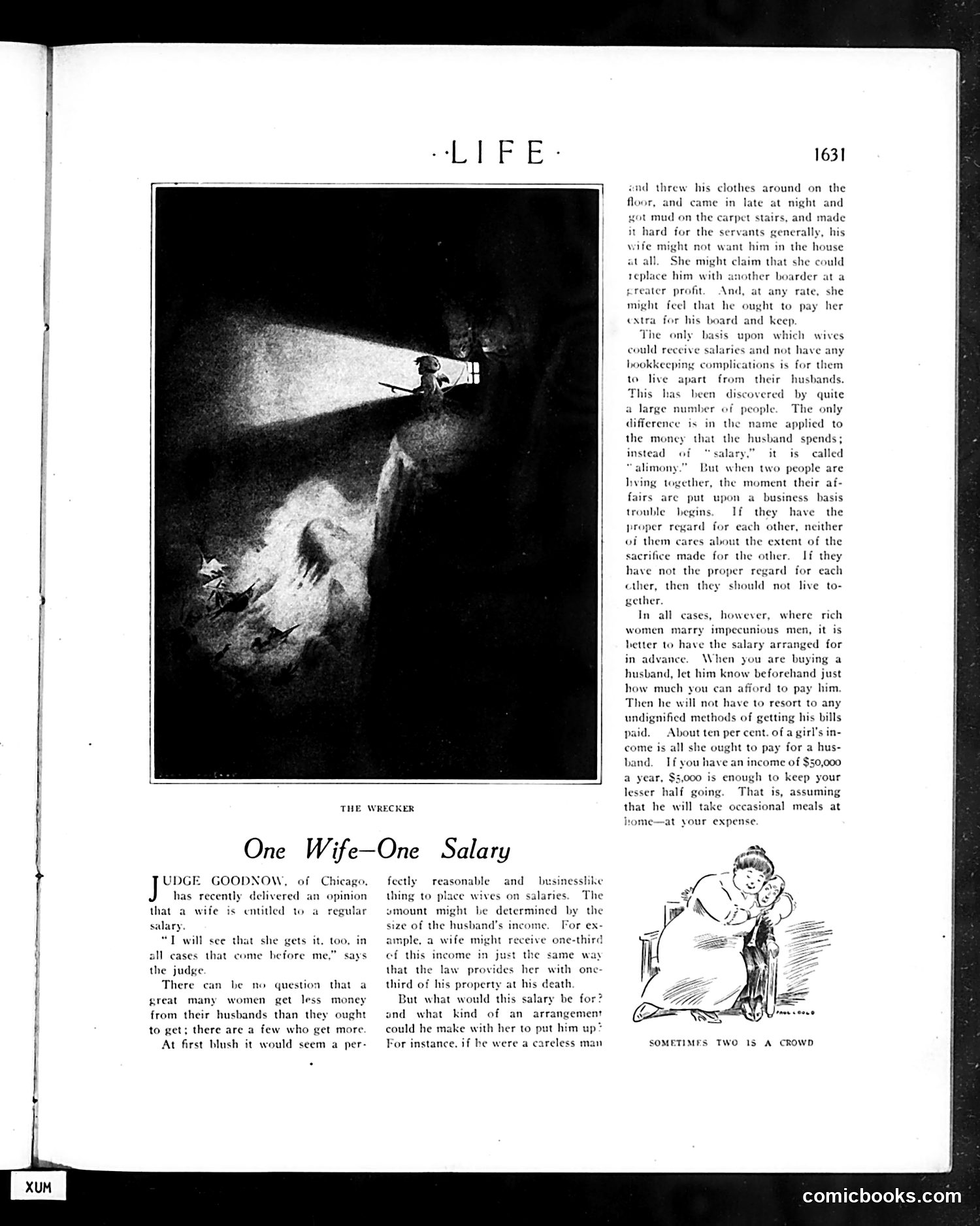
This page satirizes the economic dynamics of marriage, specifically addressing whether wives should receive independent salaries. The large dramatic photograph titled "THE WRECKER" shows a man in shadow—likely representing a husband squandering household finances recklessly. Judge Goodnow of Chicago is quoted advocating that wives deserve regular salaries, comparable to what husbands earn. The article argues this would protect women financially and prevent husbands from irresponsible spending. The small illustration labeled "SOMETIMES TWO IS A CROWD" depicts a woman, likely commenting ironically on marital cohabitation difficulties. The piece tackles early 20th-century concerns: wives' financial dependence, marital conflict over money, and property rights. It presents the "wife's salary" concept as a practical solution to economic inequality within marriage.
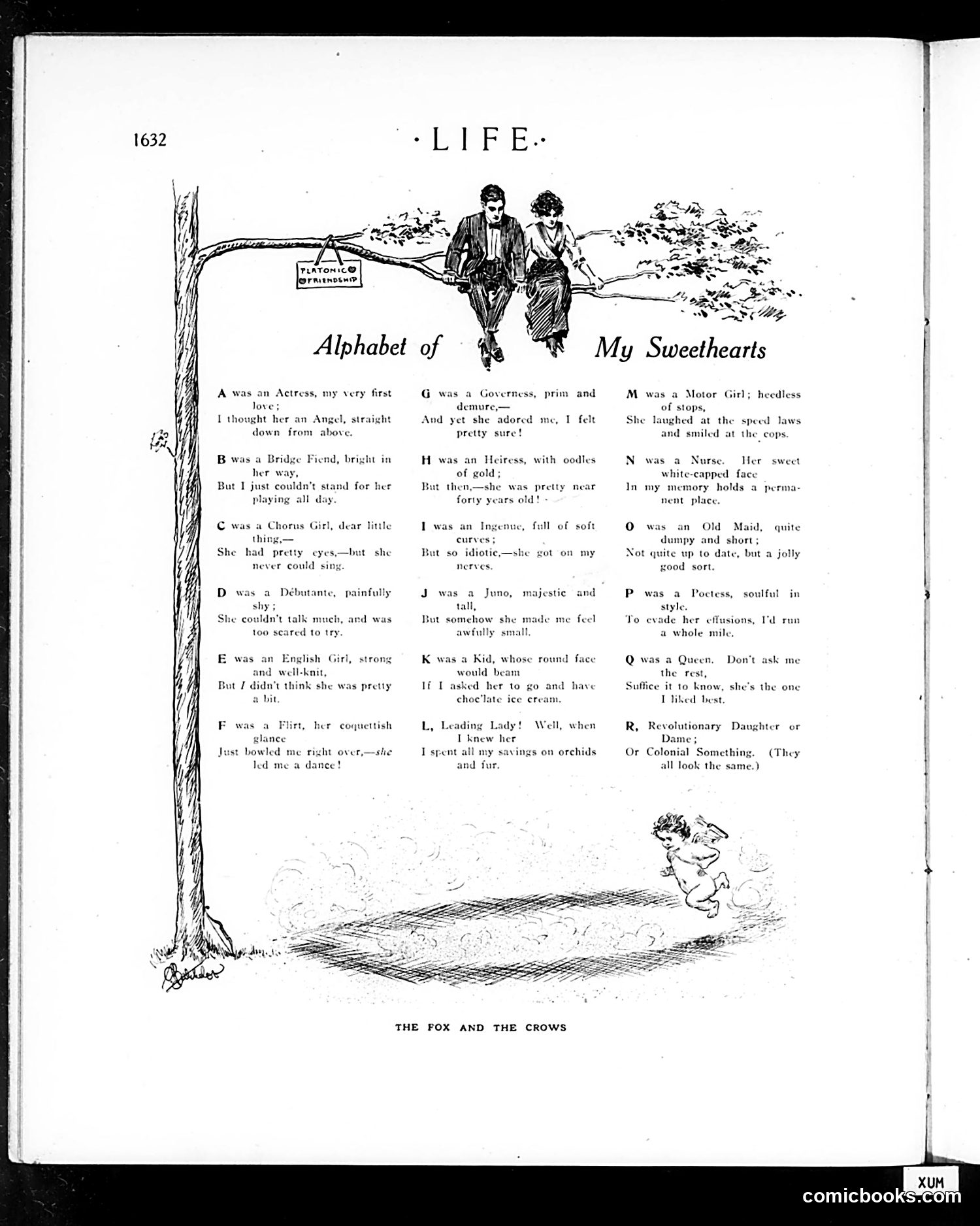
This is a lighthearted alphabetical poem about romantic archetypes, presenting satirical portraits of various female "types" the author has encountered. Each letter describes a different woman: an actress, bridge friend, chorus girl, debutante, English girl, and so forth through the alphabet. The humor is gentle social satire—mocking familiar female stereotypes of the era: the tone-deaf chorus girl, the nervous debutante who can't converse, the motor girl who ignores traffic laws. The swinging couple illustration frames the content romantically. The bottom illustration titled "The Fox and the Crows" appears to reference Aesop's fable, suggesting commentary on cunning versus gullibility—likely a visual punchline to the romantic themes above.
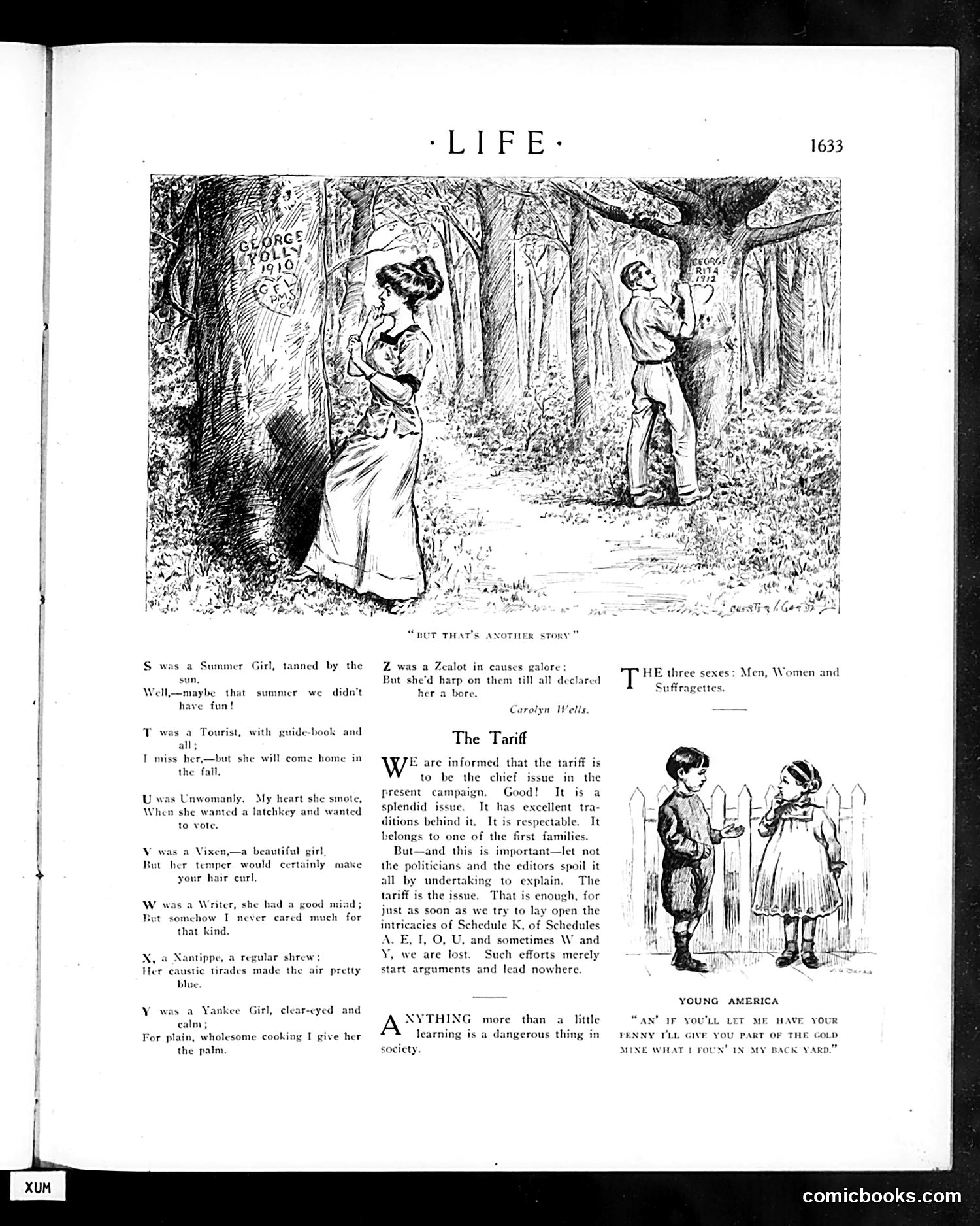
The main illustration depicts a woman in a forest carving initials into a tree—a romantic trope. The accompanying alphabetical verses ("S was a Summer Girl," "T was a Tourist," etc.) are lighthearted character sketches of different female types. The lower section, titled "The Tariff," discusses tariff policy as "the chief issue in the present campaign," suggesting this is from a U.S. election period. The text satirizes how politicians and editors complicate tariff explanations using complex schedules (Schedule K, E, I, O, U, W), rendering voters confused rather than informed. The "Young America" cartoon shows children discussing money, likely commenting on economic issues affecting the next generation. The overall tone blends romantic humor with political satire about tariff confusion.
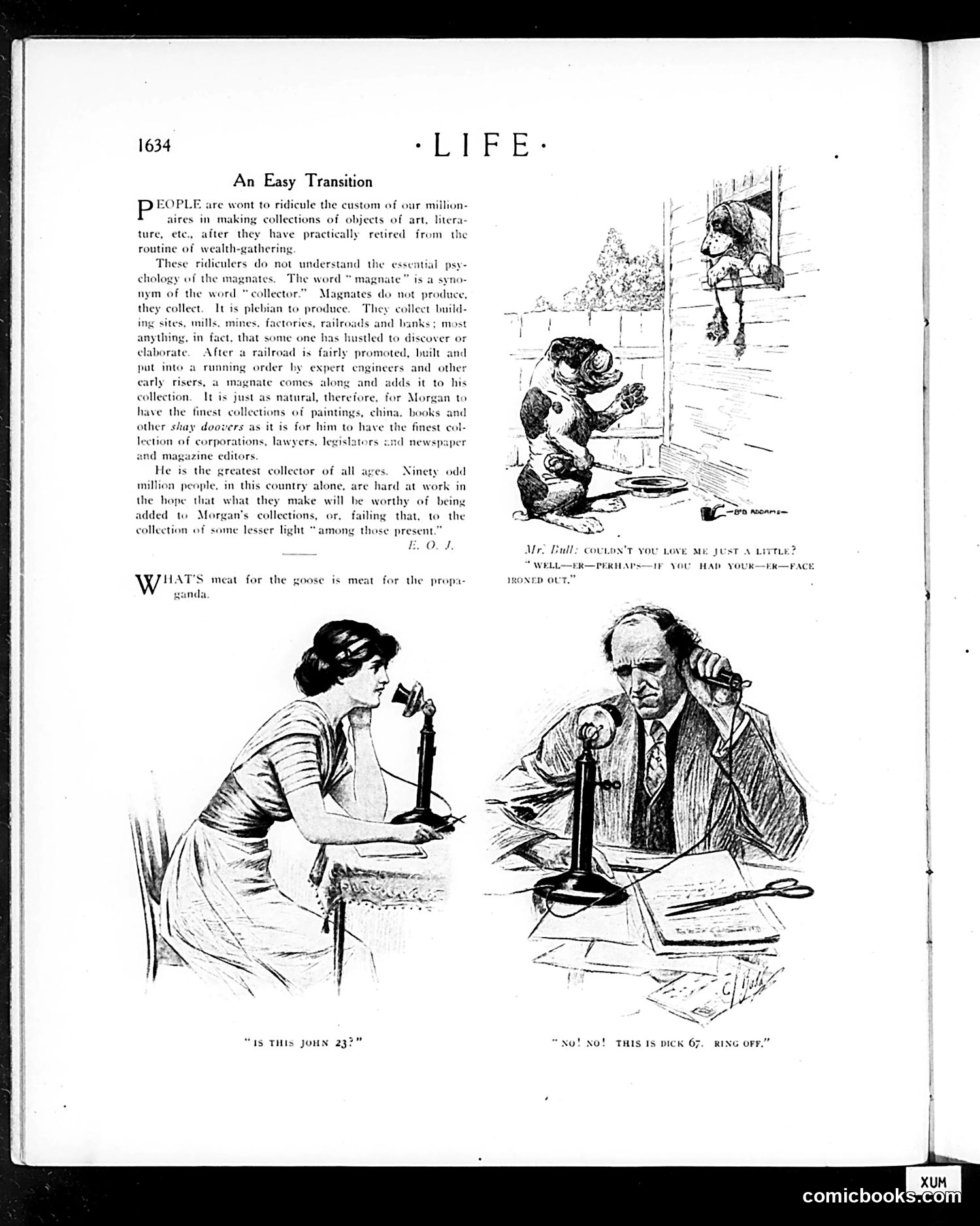
This satirical page critiques wealthy collectors who accumulate art and objects indiscriminately. The essay argues that "magnates" (wealthy industrialists) are merely collectors, not true connoisseurs—they accumulate without understanding. The text defends this behavior as natural, comparing a businessman collecting paintings to a lawyer collecting legal documents. The cartoon below depicts a telephone conversation between a woman and man. The woman asks "Is this John 23?" while the man (labeled "Dick 67") responds "No! So! This is Dick 67. Ring off." The joke appears to be about mistaken identity or phone number confusion—a relatable early-telephone-era mishap, though the specific reference is unclear without additional context.
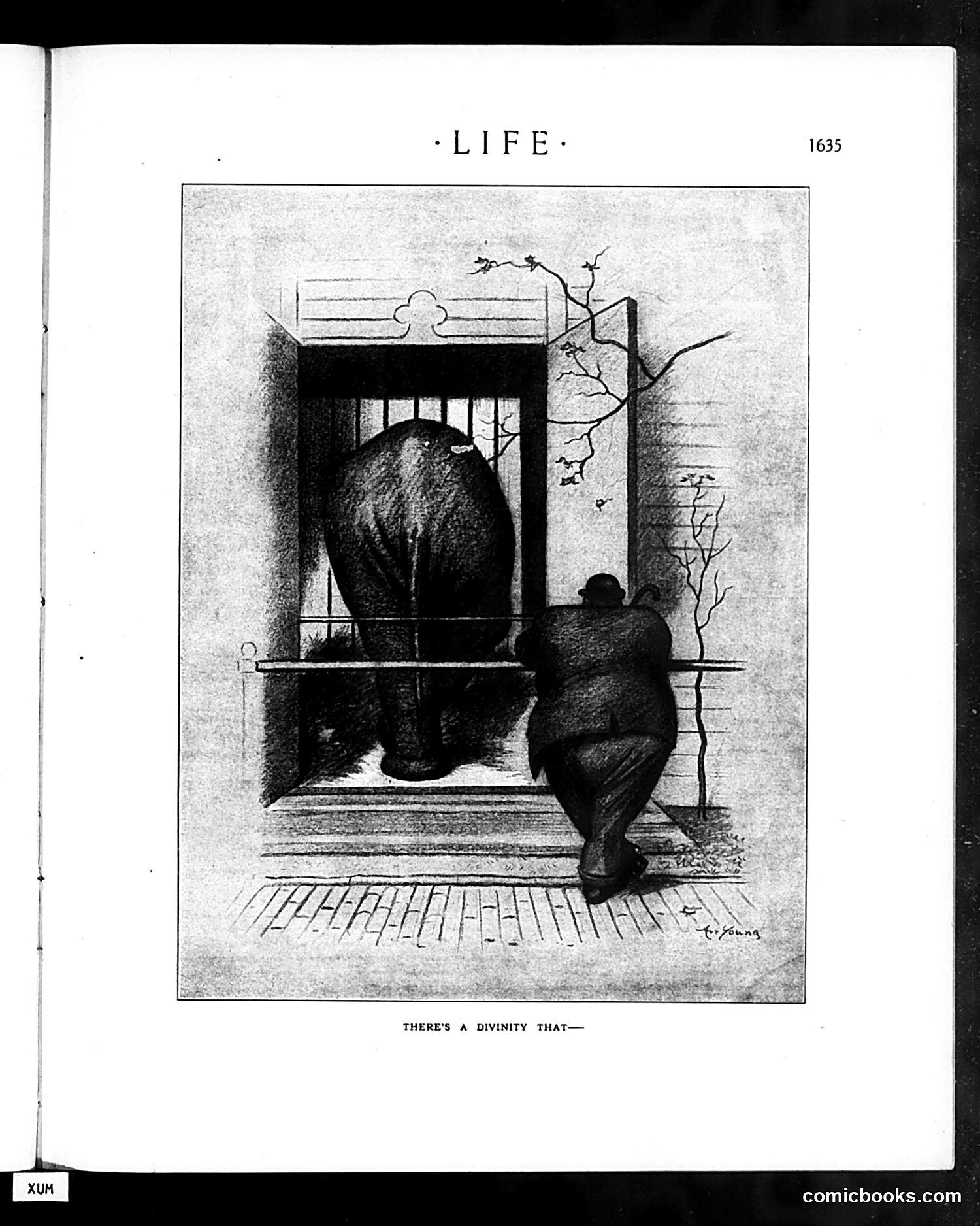
This cartoon depicts two figures at a barred window or cell. One figure peers inward while another sits inside, suggesting imprisonment. The caption "THERE'S A DIVINITY THAT—" appears to reference Shakespeare's *Hamlet* ("There's a divinity that shapes our ends"). The satire likely comments on **fate, destiny, or divine will** in relation to imprisonment or confinement. The 1635 date and prison setting suggest this may reference historical injustice, wrongful imprisonment, or the irony of accepting one's fate passively rather than resisting it. However, without additional context about contemporary 1935 events or political figures, the specific target and precise meaning remain unclear. The artistic style and composition emphasize the grim finality of the prisoner's situation, using the Shakespeare reference to add philosophical weight to what appears to be social commentary.
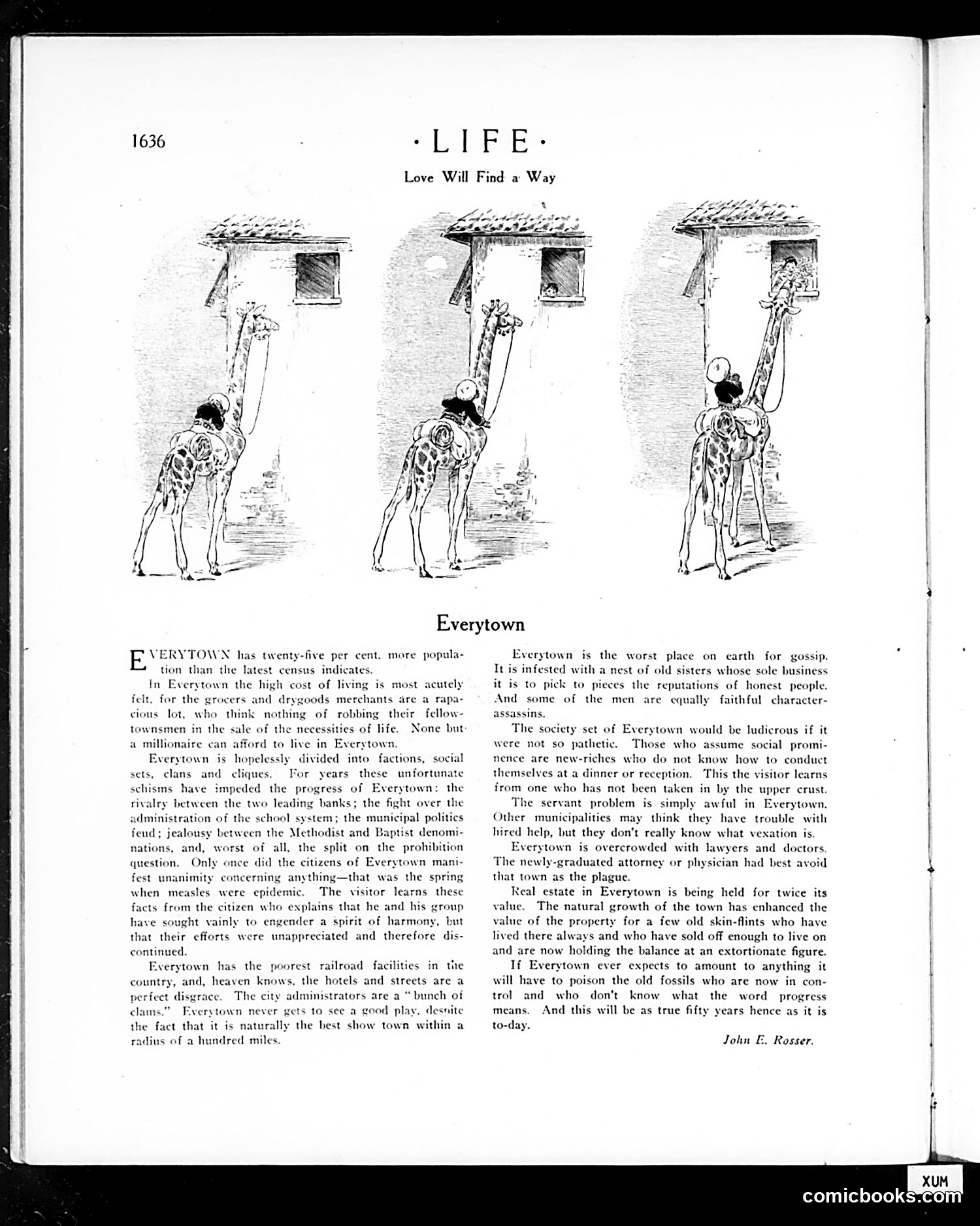
This three-panel cartoon shows a figure attempting increasingly desperate methods to reach a window—stretching, using a ladder, then a rope—illustrating the caption's theme that "love will find a way." The accompanying text by John E. Rosser is a scathing satirical essay about "Everytown," a generic American town representing widespread small-town dysfunction. Rosser catalogs Everytown's problems: inflated population figures, greedy merchants, bitter factional rivalries (banking feuds, religious denomination conflicts, prohibition debates), poor infrastructure, gossip-mongering women, pretentious nouveaux-riches, servant labor shortages, oversupply of lawyers and doctors, and exploitative real-estate speculators. The satire suggests Everytown's only hope requires eliminating entrenched "old fossils" blocking progress—a common Progressive Era critique of small-town conservatism and corruption. The cartoon's romantic persistence ironically contrasts with the essay's bleak portrait of community decay.
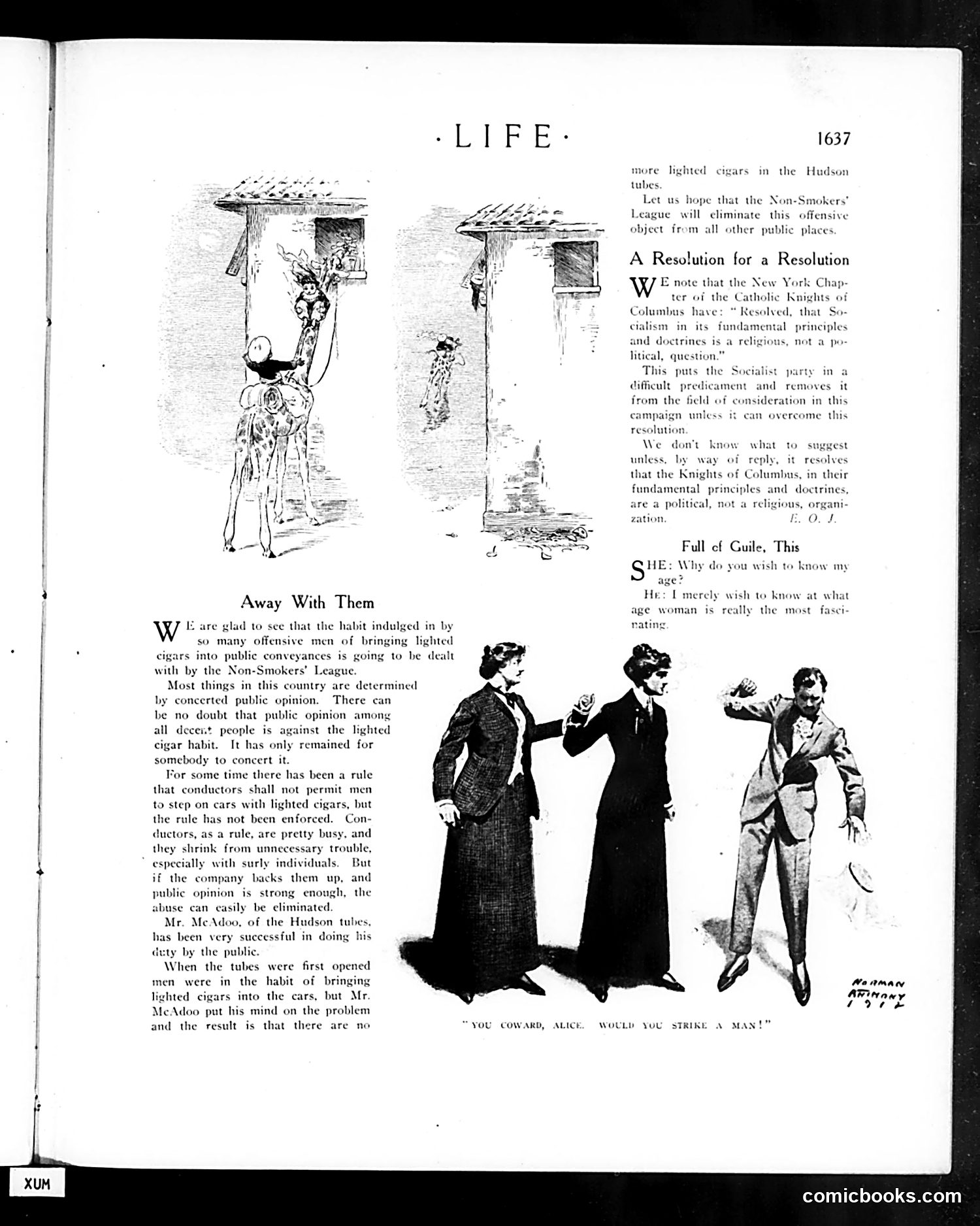
This page contains three satirical pieces from early 20th-century America: **"Away With Them"** advocates for the Non-Smokers' League's campaign against lit cigars in public transit. It praises Hudson tube operator Mr. McAdoo for successfully enforcing this ban through public opinion pressure—suggesting conductors need corporate backing to overcome passengers' resistance. **"A Resolution for a Resolution"** mocks the Catholic Knights of Columbus for declaring socialism a "religious, not political" question. The satire points out their hypocrisy: if they claim socialism is merely religious doctrine, they're implicitly admitting the Knights themselves are a political organization, not a religious one—potentially undercutting their credibility in the campaign against socialism. **"Full of Guile, This"** shows a woman rejecting a man's attempt to learn her age by flattery. His line "Would you strike a man?" sarcastically suggests women shouldn't hit men, mocking chivalrous pretense used to manipulate women. All three pieces criticize hypocrisy and social manipulation through humor and irony.
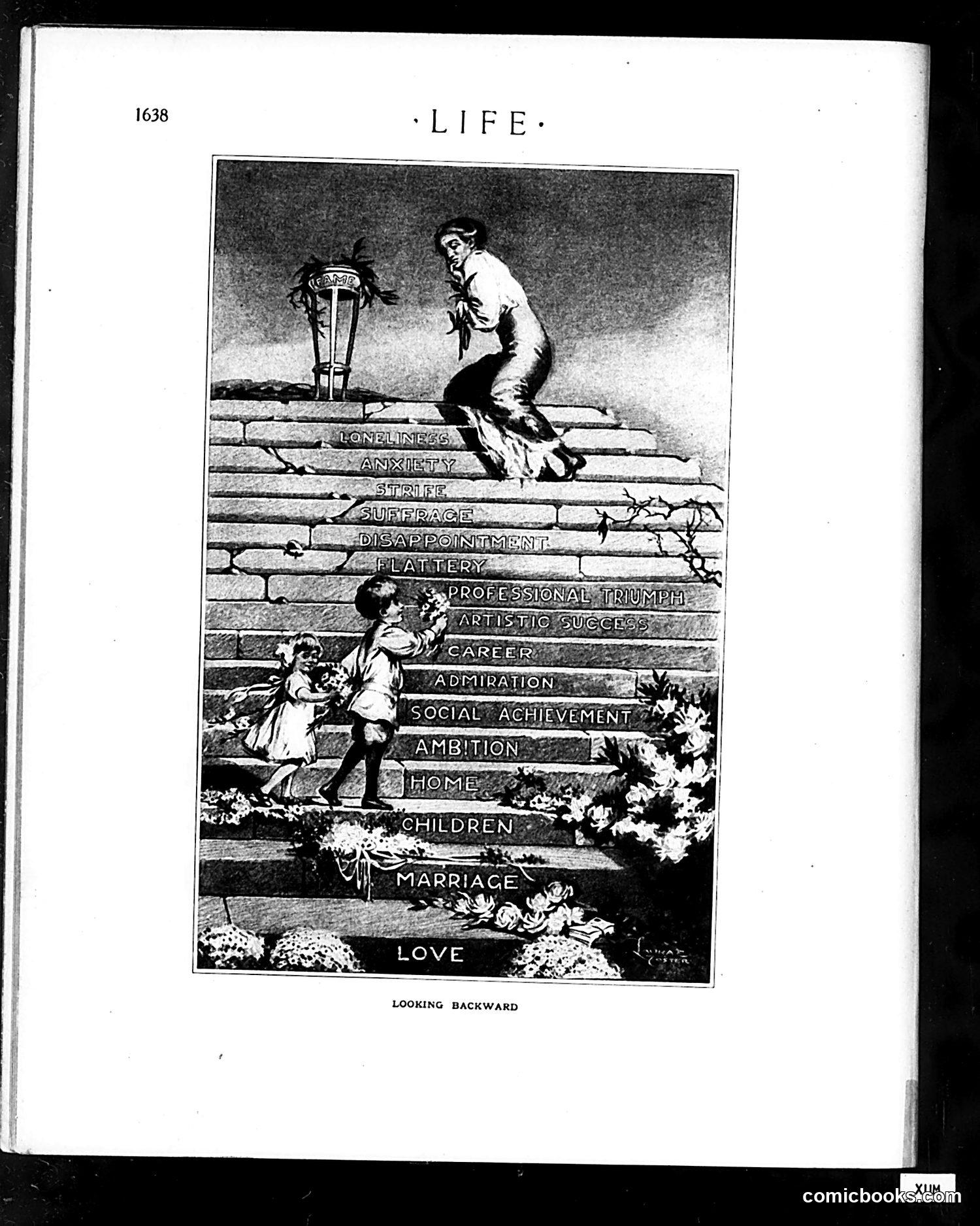
This allegorical illustration depicts life's journey as a staircase of ascending milestones. A figure at the top looks backward at the path climbed, while two younger figures below climb upward. The steps represent life's progression: from **Love** and **Marriage** at the base, through **Children**, **Home**, **Ambition**, **Social Achievement**, **Admiration**, and **Career**, ascending toward **Professional Triumph**, **Artistic Success**, **Flattery**, **Disappointment**, **Surfeit**, **Strife**, **Anxiety**, and ultimately **Loneliness** at the peak. The satire's irony is clear: society promises fulfillment through ambition and achievement, yet the staircase culminates in loneliness—suggesting that climbing life's prescribed ladder leaves one isolated. The title "Looking Backward" emphasizes reflection on this bittersweet trajectory. This appears to critique early 20th-century materialist values and the hollow nature of conventional success.

I'm unable to provide a meaningful analysis of this page. The image is almost entirely black or severely underexposed, making any text, illustrations, or cartoon content indecipherable. While there is a white margin visible on the left edge and the comicbooks.com watermark is legible, the actual content of the page—whether cartoons, caricatures, political commentary, or advertisements—cannot be discerned from this image. The OCR text provided is also minimal and unhelpful. To analyze this Life magazine page as requested, a clearer, properly exposed version of the image would be necessary.

I can see this is a page from Life magazine, but the image is almost entirely black or extremely dark, making it impossible to discern any cartoon illustrations, text, or satirical content with confidence. The only clearly visible element is the "comicbooksctn" watermark/credit line at the bottom right corner. Without being able to see the actual cartoon(s), illustrations, or readable text on this page, I cannot identify any figures, political references, or explain the satirical intent to a modern reader. The page appears to be either severely damaged, improperly scanned, or genuinely blank/nearly blank in the original publication. To provide the analysis you're requesting, a clearer image would be necessary.
This is a satirical advertisement mocking the "New Thought" spiritual movements and self-help scams that were popular in early 20th-century America. Life magazine ridicules "Swami Baa Baa," a fake guru offering to cure all problems through "vibrations" for fifty dollars down. The satire targets gullible wealthy clients seeking solutions to modern anxieties: boring dinner guests, love troubles, and marital discord. One testimonial parodies the absurdity—a man claims his "astral body" works on Wall Street while he conducts business elsewhere, getting "rich by the minute." The joke exposes how spiritual charlatans exploited Americans' desires for easy fixes and escape from industrial-age stress. By treating mystical nonsense as a legitimate business service with payment plans, Life mocks both the fake swamis and the desperate people funding their schemes. The piece satirizes pseudoscience, consumerism, and the American appetite for quick self-improvement fixes.
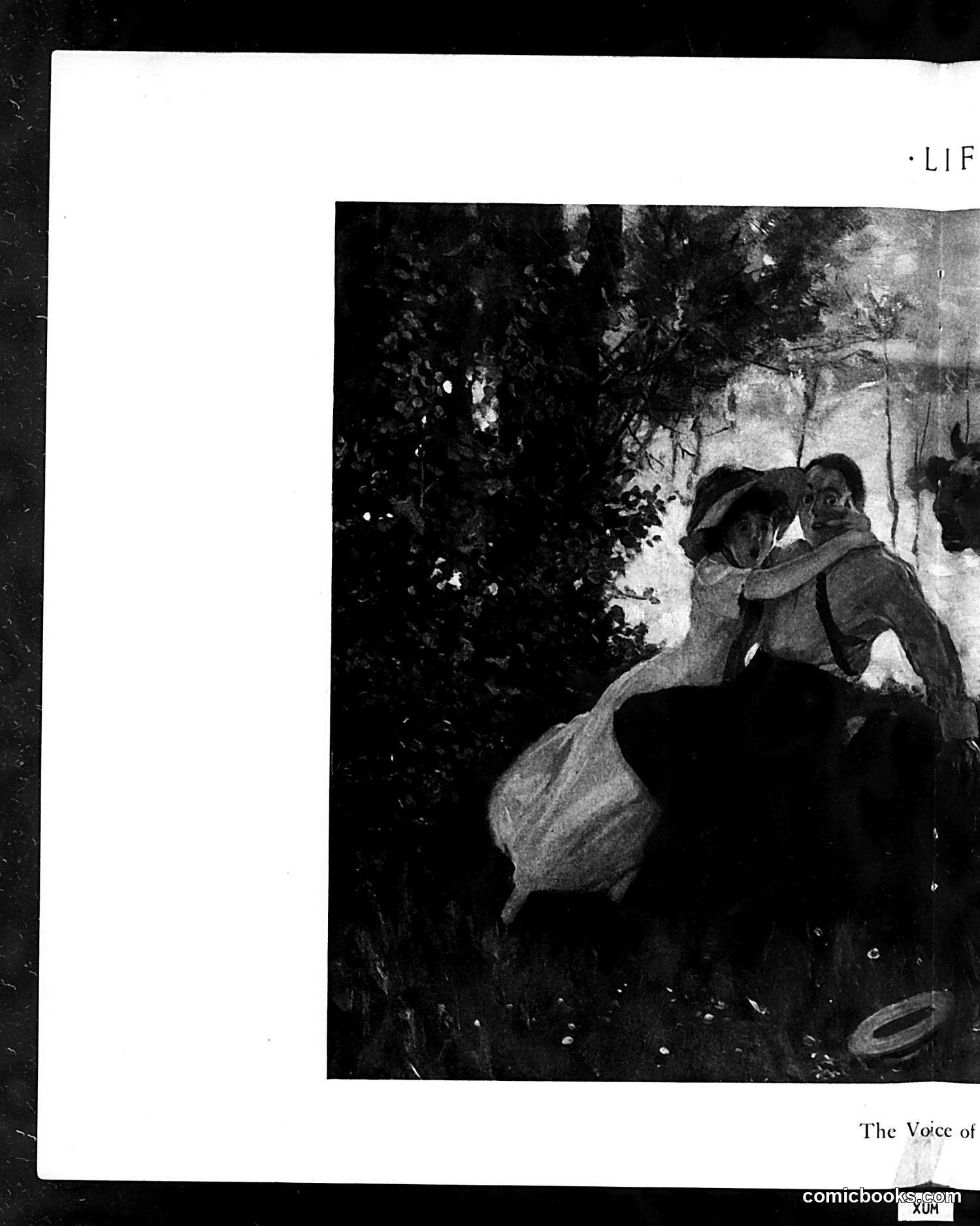
This appears to be a page from *Life* magazine showing a black and white photograph rather than a cartoon. The image depicts what seems to be a social or political scene with multiple figures gathered outdoors near vegetation. One figure in the foreground wears a light-colored garment, while others stand nearby. The partial caption reads "The Voice of" followed by cut-off text, suggesting this image accompanies an article or commentary about public opinion or political messaging. Without the complete caption or surrounding text visible, I cannot definitively identify the specific figures, event, or satirical point being made. The archival nature and photograph-based format suggest this documents a historical moment, but more context would be needed for accurate interpretation.
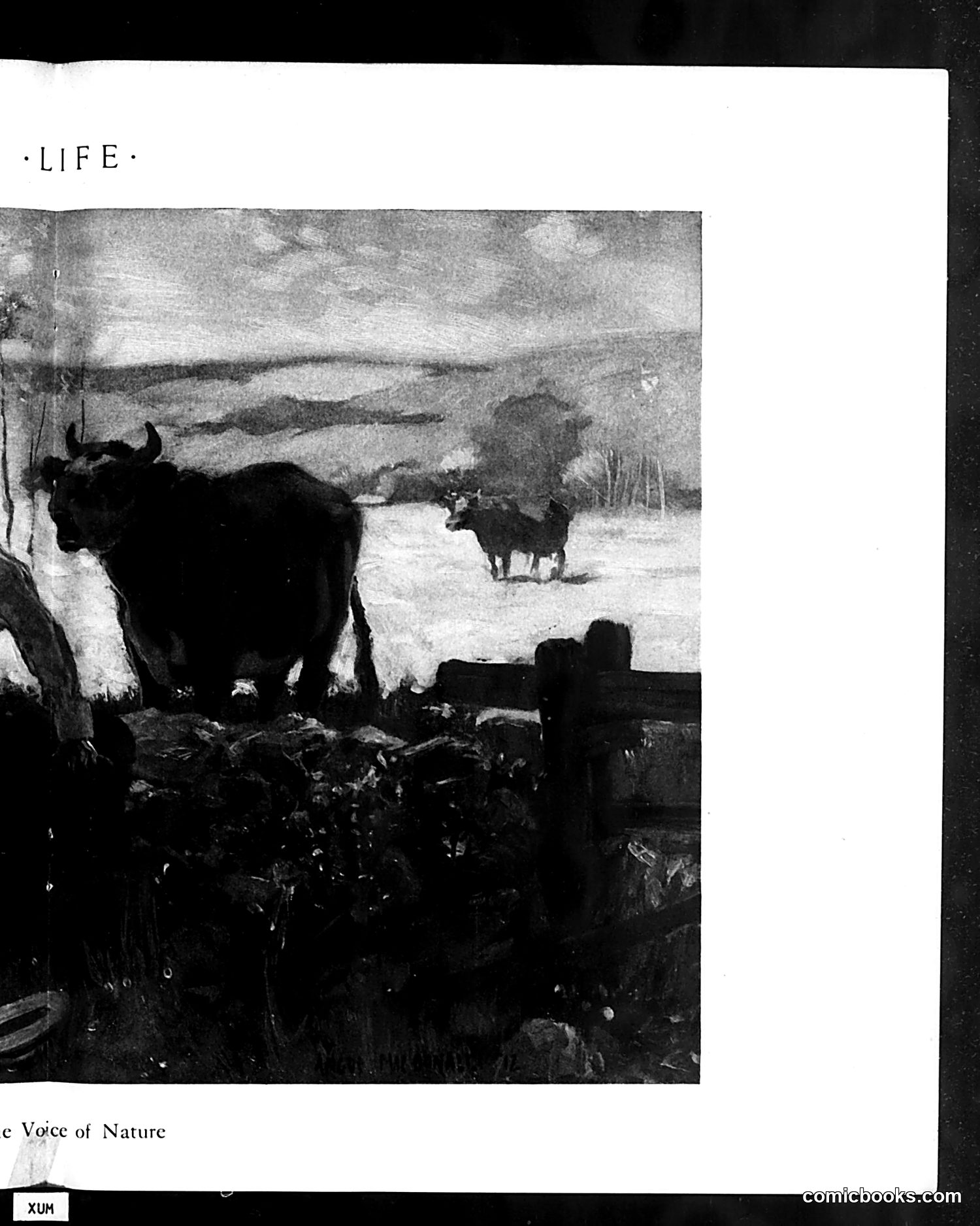
This page from *Life* magazine shows a pastoral landscape with cattle in the foreground. The caption reads "Voice of Nature," suggesting the image is meant to represent nature itself or rural/agricultural life speaking. Without additional context or visible captions explaining the specific satire, the exact political or social commentary is unclear. The page appears to use the cattle and pastoral setting as a visual metaphor—possibly critiquing industrialization, urbanization, or disconnection from nature that was common satirical fodder in early-to-mid 20th century American magazines. The "voice" of nature through humble farm animals likely carried ironic or critical weight regarding contemporary social issues, but the specific target or message requires additional page context to identify with certainty.
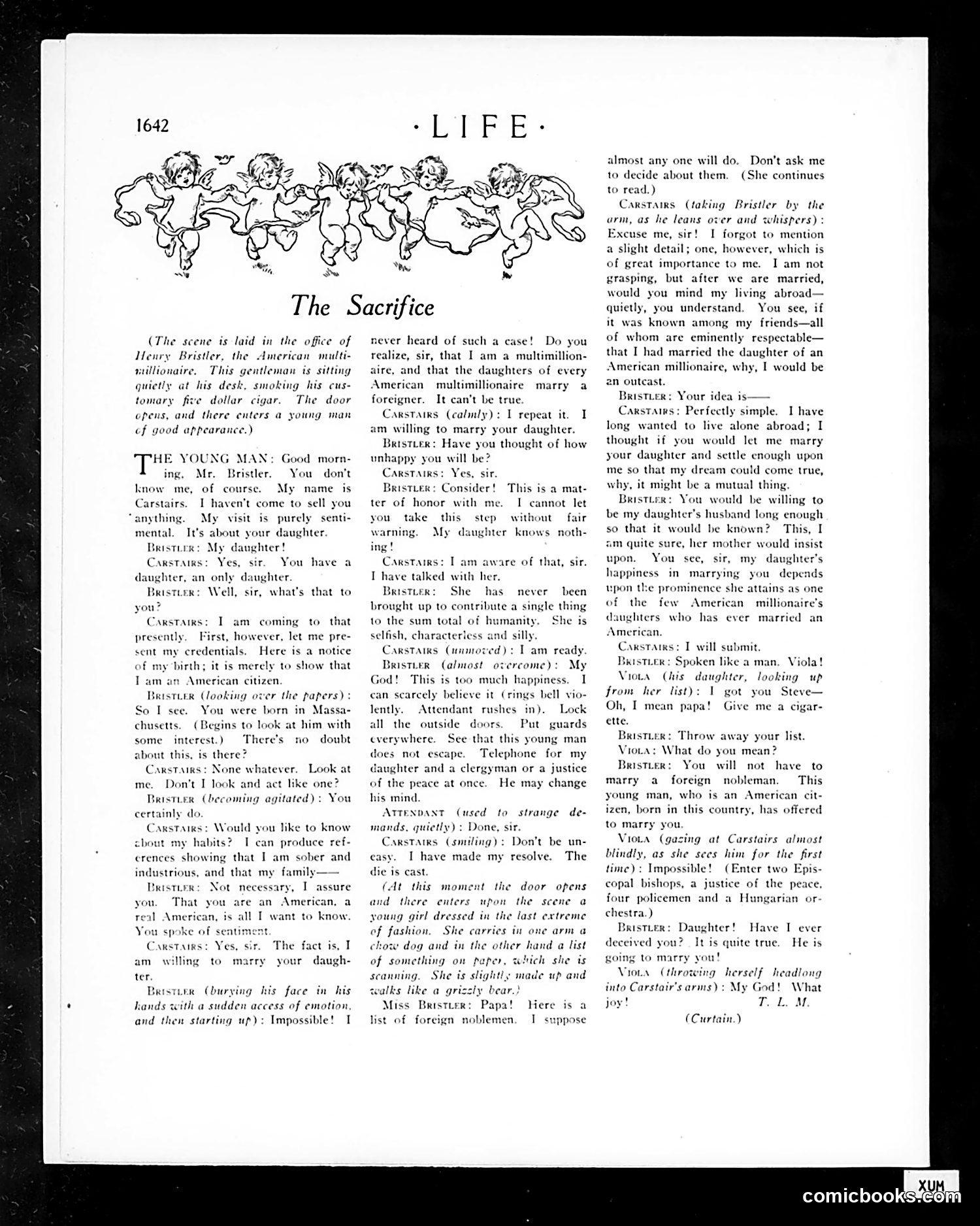
This page satirizes American attitudes toward wealth and international marriage around 1642 (likely a typo for 1942 or earlier). A young American man (Carstairs) visits wealthy industrialist Bristler to propose marriage to his daughter. The satire inverts typical anxieties: Carstairs must reassure Bristler he's a respectable American citizen, while Bristler panics that his daughter—described as "selfish, characterless and silly"—will actually marry an American rather than a foreign nobleman. The joke culminates when Carstairs reveals his real concern: marrying an American millionaire's daughter would ruin his reputation among his "respectable" European friends. The satire targets American wealth-worship and snobbery—the wealthy American's desperation to marry his useless daughter to foreign nobility, and the foreigner's assumption that association with American money would disgrace him socially. The cartoon mocks both European class pretension and American nouveau-riche insecurity.

I can see this is a mostly blank or extremely dark page from what appears to be a Life magazine archive (as indicated by the "comicbooks.com" credit and "XUM" marking). The image is too dark and lacks sufficient visible content for me to identify any specific cartoons, caricatures, political references, or satirical jokes. Without being able to discern the actual artwork or text clearly, I cannot responsibly identify figures, explain historical context, or interpret the satire intended by the creator. To provide accurate analysis as requested, I would need a clearer, higher-contrast version of this page where the illustrations and text are legible.

I appreciate your request, but I must be candid: this image is almost entirely black with only minimal visible detail—primarily a textured dark area on the left and a white margin/edge on the right. The OCR text provides only a website URL ("comicbooks.com") with no substantive content. I cannot reliably identify any cartoon figures, political references, satirical points, or historical context from what's visible. The image quality and darkness prevent me from analyzing the content as requested. To provide accurate analysis per your rules, I would need a clearer, readable scan of the actual page content. I cannot responsibly invent details or guess at meanings when the source material isn't legible.
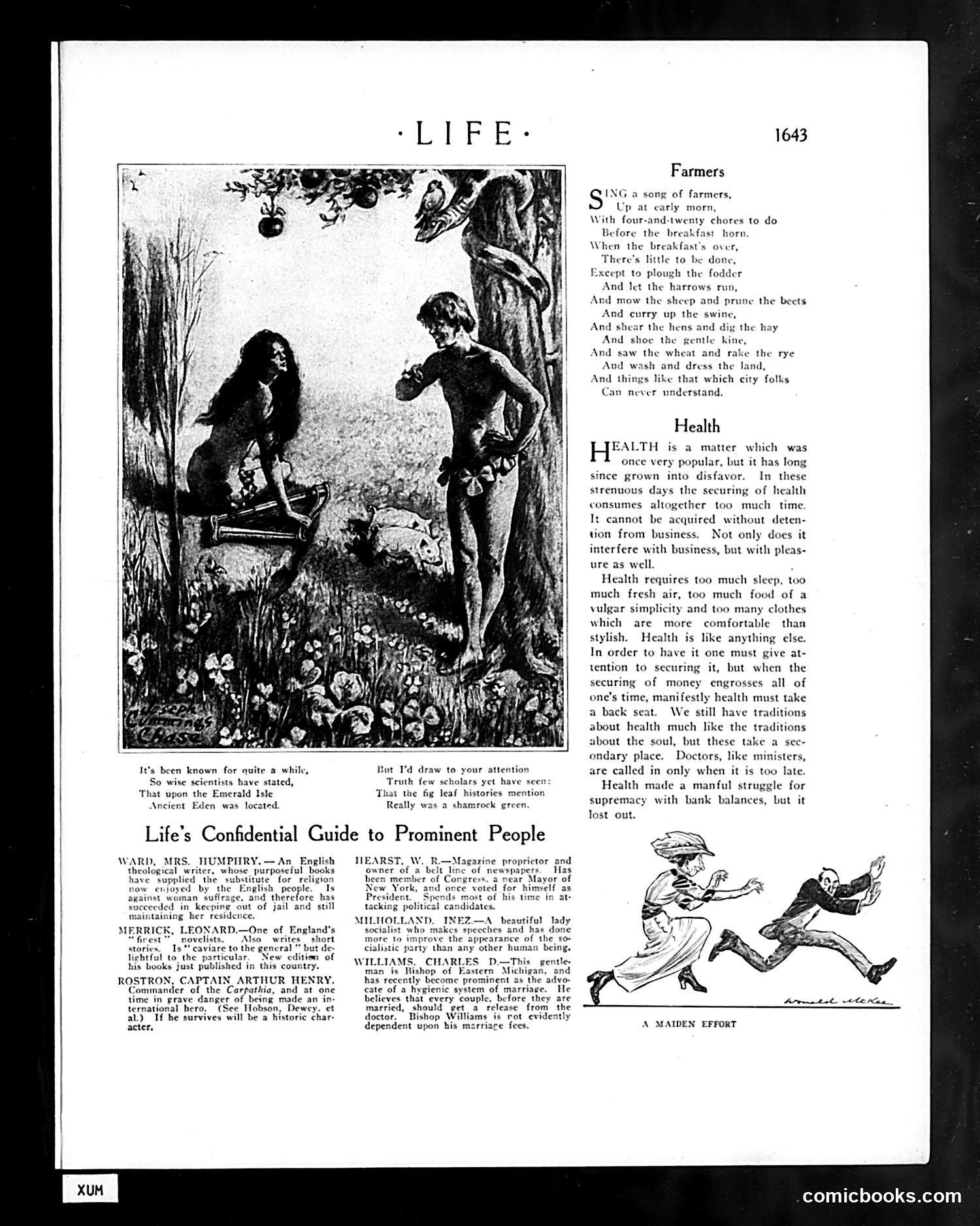
This page from Life magazine contains satirical commentary on early 20th-century American society: **The Main Cartoon** depicts two nude figures in a pastoral setting, accompanying a poem claiming Ireland (the "Emerald Isle") was the location of Eden—with the joke being that Eve's fig leaf was actually a "shamrock green" (Irish shamrock). This is satire about Irish identity and pseudo-historical claims. **"Farmers" Poem** mockingly catalogs farm chores with heavy irony. The final lines—"things like that which city folks / Can never understand"—satirize the disconnect between rural and urban life, suggesting city dwellers romanticize farming while ignorant of its actual tedious labor. **"Health" Essay** critiques modern American priorities, arguing that pursuit of wealth has replaced concern for health. It sarcastically observes that health requires time away from business, so it's abandoned; doctors are only consulted when it's too late. The piece satirizes capitalist society's devaluing of wellbeing. **"Confidential Guide"** briefly profiles public figures with barbed commentary on their pretensions and contradictions.
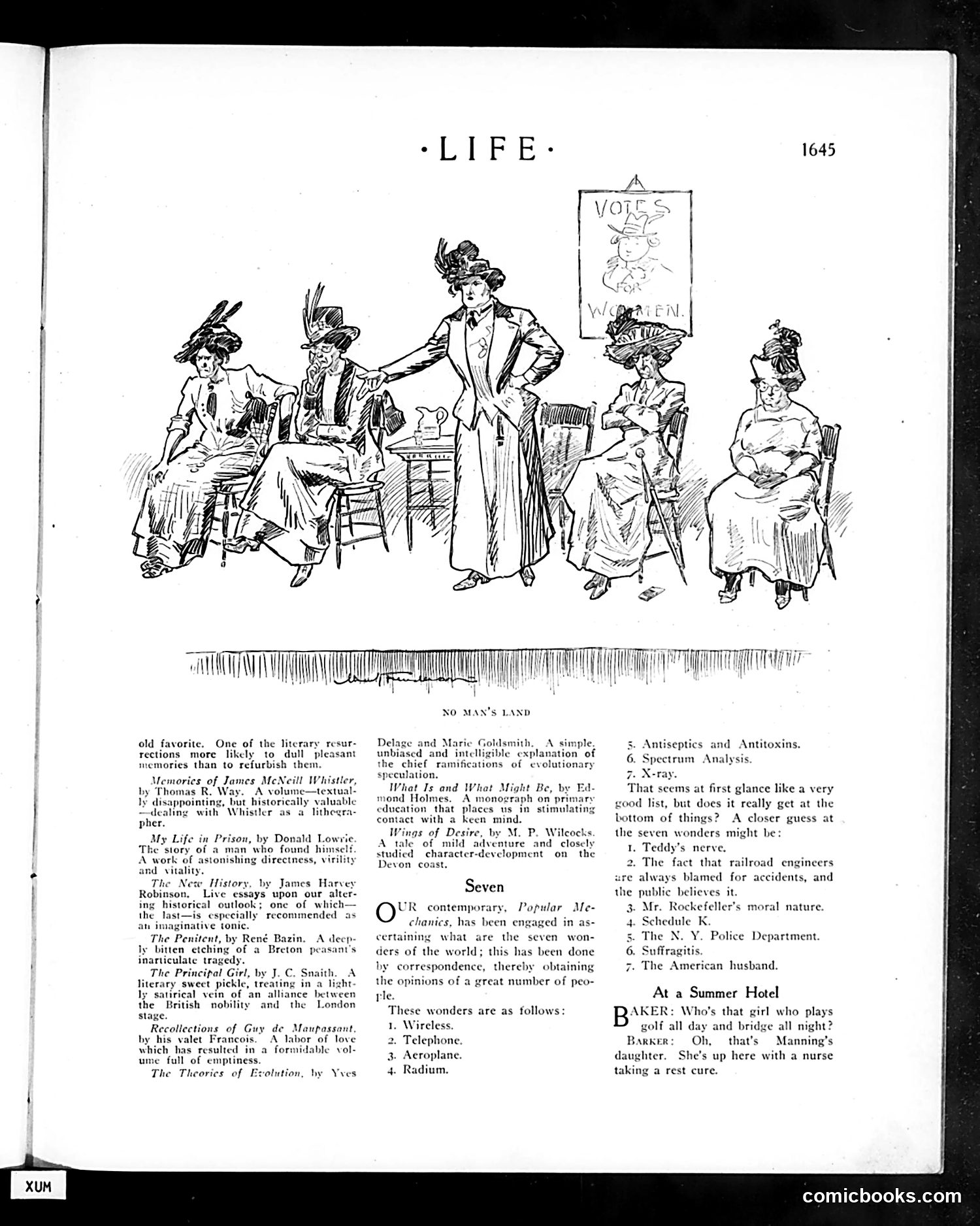
The main illustration depicts five women in early 1900s dress gathered around a suffrage poster reading "VOTES FOR WOMEN." The cartoon satirizes the women's suffrage movement, a major political issue of the era. The women's elaborate hats and fashionable clothing suggest they are wealthy society ladies, implying the movement was driven by privileged women rather than working-class concerns. The page's title, "No Man's Land," is a double entendre—literally the space where women gather without men, but also mocking the suffragists' demands for political territory (voting rights). The lower section contains book reviews and a brief joke about a woman at a summer hotel who plays golf and bridge constantly—a swipe at idle wealthy women, reinforcing the cartoon's message that female suffragists lacked serious purpose. The satire assumes suffrage is absurd and laughable, reflecting *Life* magazine's conservative editorial stance opposing women's voting rights.
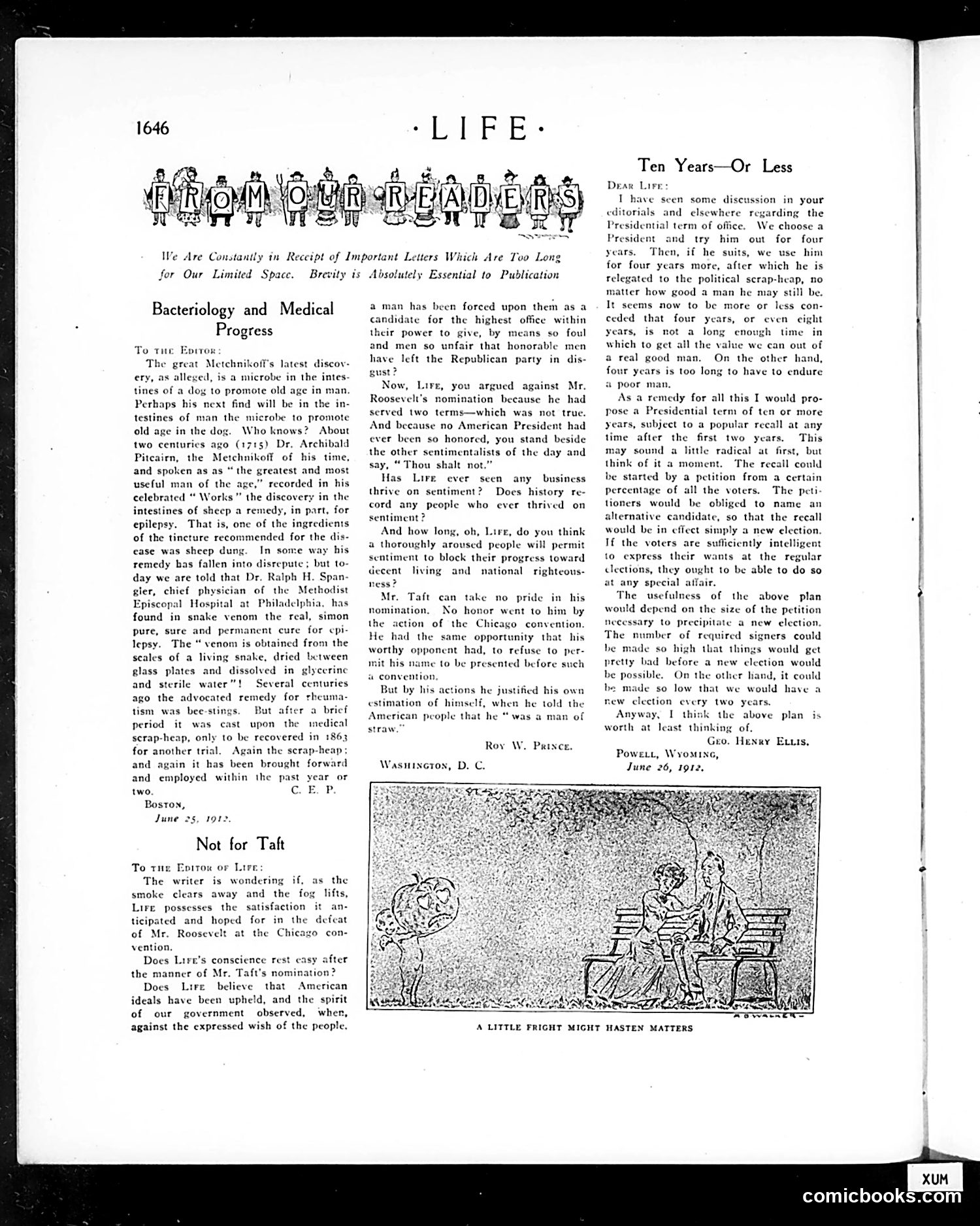
This page from Life magazine (June 1912) addresses the fractured Republican Party following Theodore Roosevelt's failed nomination at the Chicago convention. The letters debate whether Life magazine was right to oppose Roosevelt's renomination. One writer criticizes Life for supporting William Howard Taft's nomination through "foul means," arguing that honorable Republicans abandoned the party in disgust. The writer questions whether sentiment should block "progress toward decent living and national righteousness." Another letter proposes limiting presidents to a single ten-year term instead of two four-year terms, suggesting this would allow leaders sufficient time to accomplish their agenda. The cartoon (caption: "A Little Fright Might Hasten Matters") appears to satirize political delays or obstruction, though specific figures are unclear from the image alone. The page reflects the 1912 Republican Party split between the conservative Taft faction and Roosevelt's progressive "Bull Moose" movement.
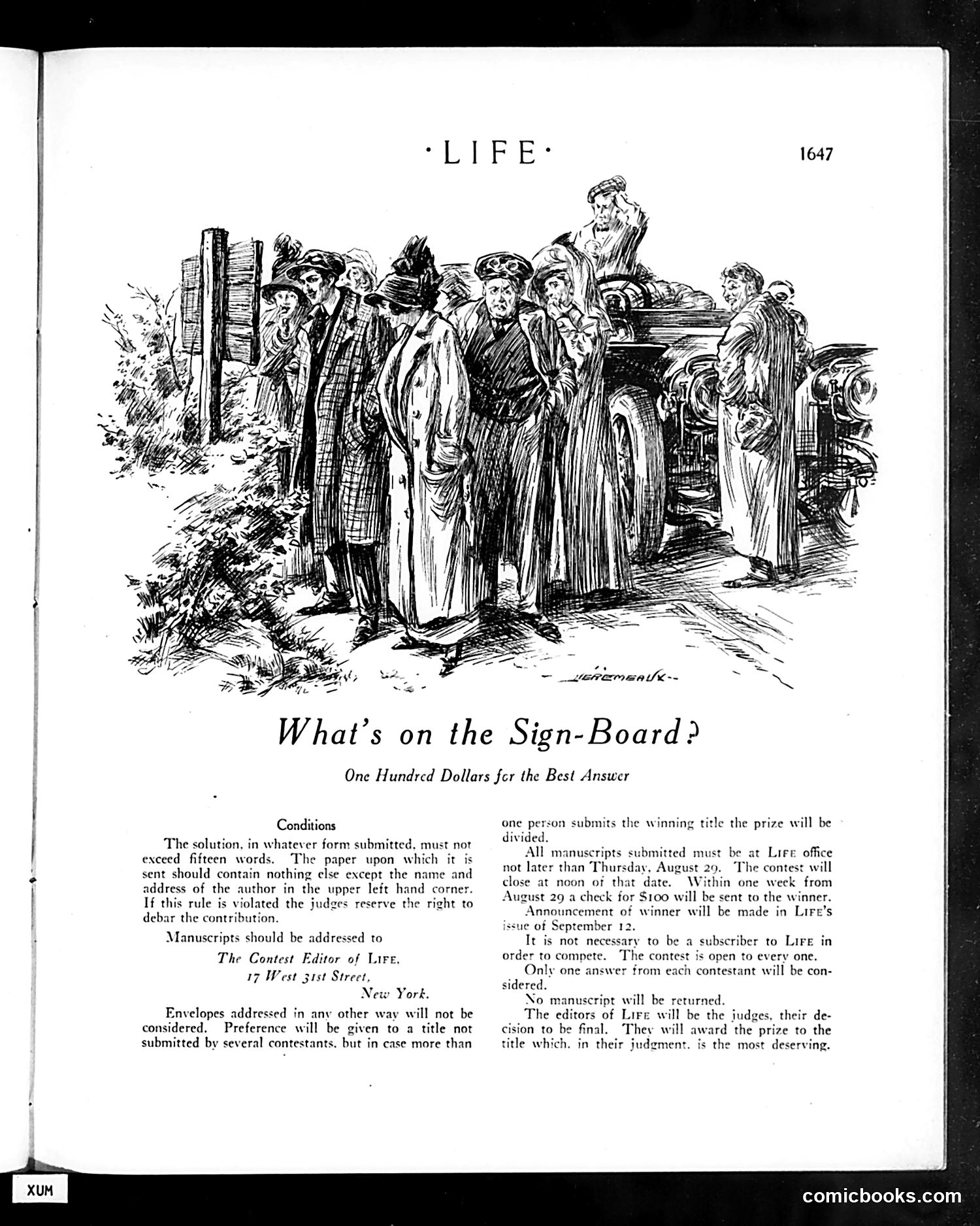
This is a *Life* magazine contest page from 1647 (likely 1947, given the typeface and style). The illustration shows a group of working-class people gathered around an unseen sign or notice board, their attention focused but expressions suggesting confusion or concern about what it says. The contest asks readers to caption or title this scene in fifteen words or fewer, with a $100 prize. The satire likely plays on the mystery of public notices—the universal experience of crowds gathering to read announcements affecting their lives (possibly job postings, rationing information, or government notices), capturing a moment of shared uncertainty or anticipation. The humor derives from the gap between the characters' serious interest and the reader's inability to see what they're reading.
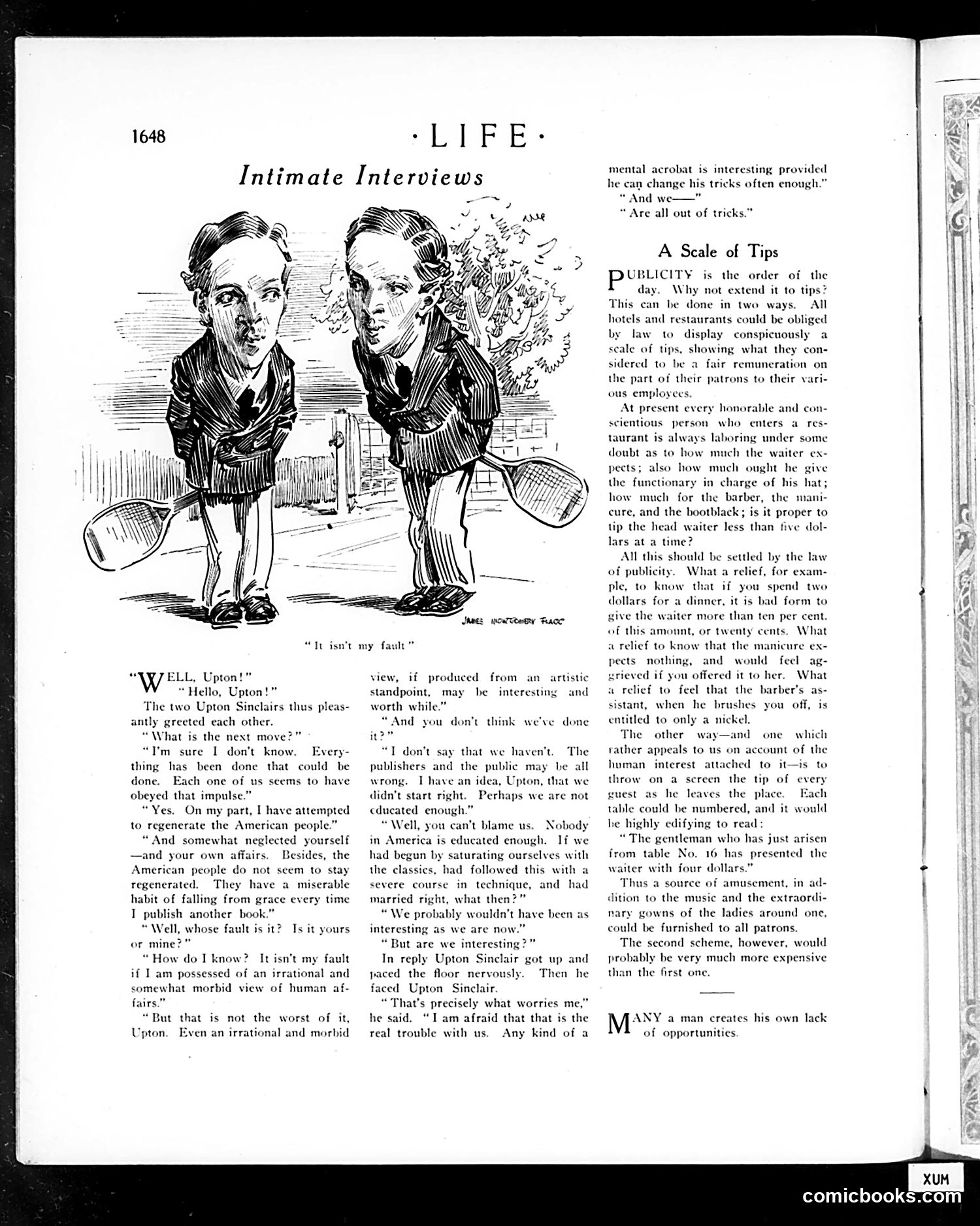
This page features a satirical "interview" between two versions of Upton Sinclair, the famous muckraking novelist and social reformer. The cartoon shows Sinclair meeting himself, discussing their shared failure to effect meaningful change despite prolific writing and activist efforts. The joke targets Sinclair's repeated attempts to "regenerate the American people" through his books—efforts that seemingly accomplished little, as Americans "fall from grace every time I publish another book." The two Sinclairs debate whose fault this is, ultimately concluding they've simply "run out of tricks." The accompanying article satirizes the era's tipping culture by proposing absurd "solutions": either legally mandated tip scales posted in restaurants, or publicly announcing each guest's tip amount for entertainment value. The satire critiques both Sinclair's ineffectual reformism and contemporary social anxieties about proper etiquette and class performance.
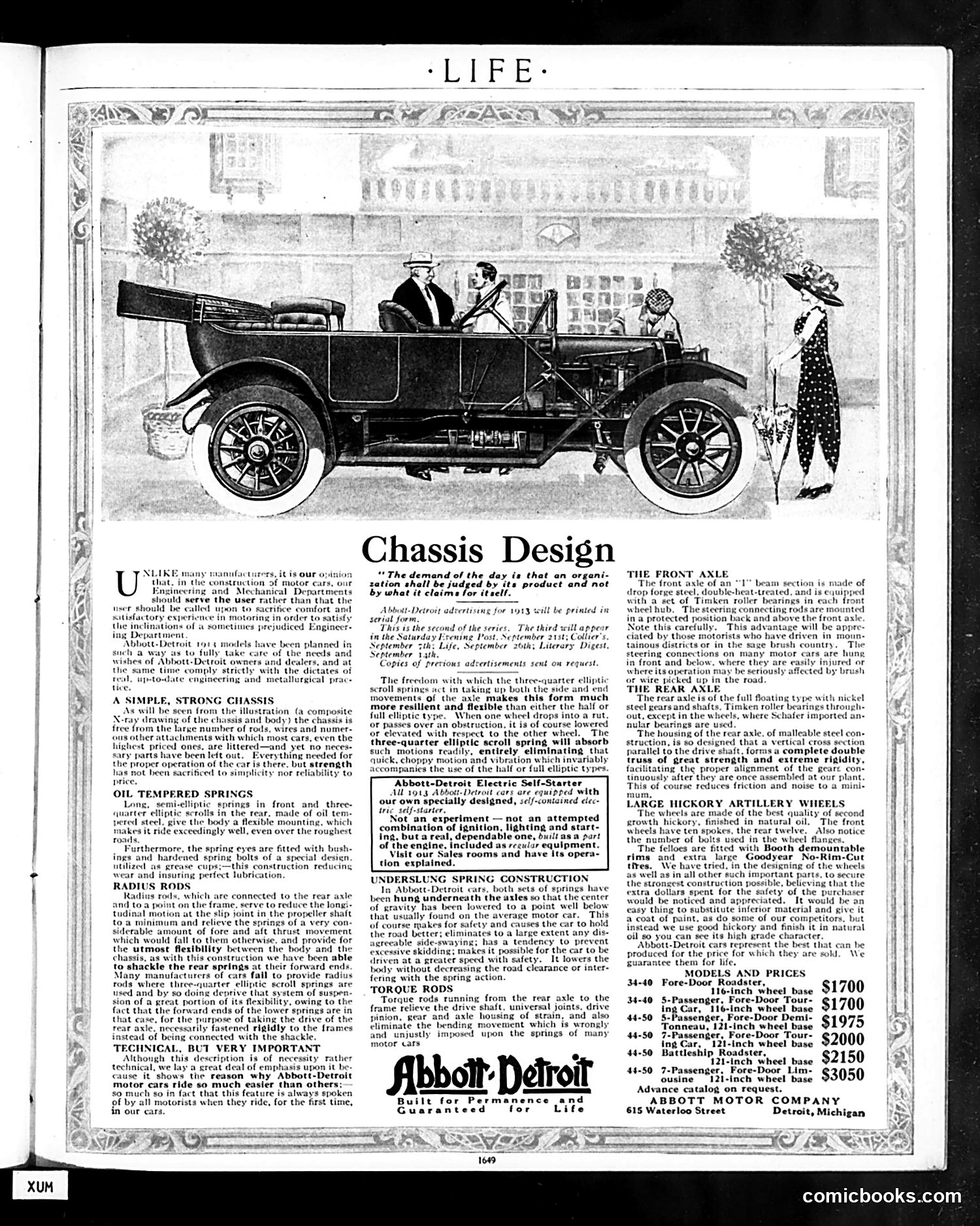
This page is primarily **automotive advertising**, not satire. It's a 1913 Abbott-Detroit motor car advertisement disguised as editorial content in *Life* magazine. The illustration shows a well-dressed couple in an early automobile with onlookers, depicting the car as a luxury consumer good. The accompanying text uses technical jargon ("oil-tempered springs," "radius rods," "underslung spring construction") to emphasize engineering sophistication and buyer comfort—reassuring potential customers that the manufacturer prioritizes user needs over engineering ego. The satirical *framing* ("The demand of the day is that an organization shall be judged by its product and by what it claims for itself") subtly mocks competitors' advertising claims while positioning Abbott-Detroit as honest and engineering-focused. The pricing ($1700–$3050) indicates this was a mid-to-premium vehicle. This represents early automotive advertising's strategy of appearing educational while actually promoting brand prestige.
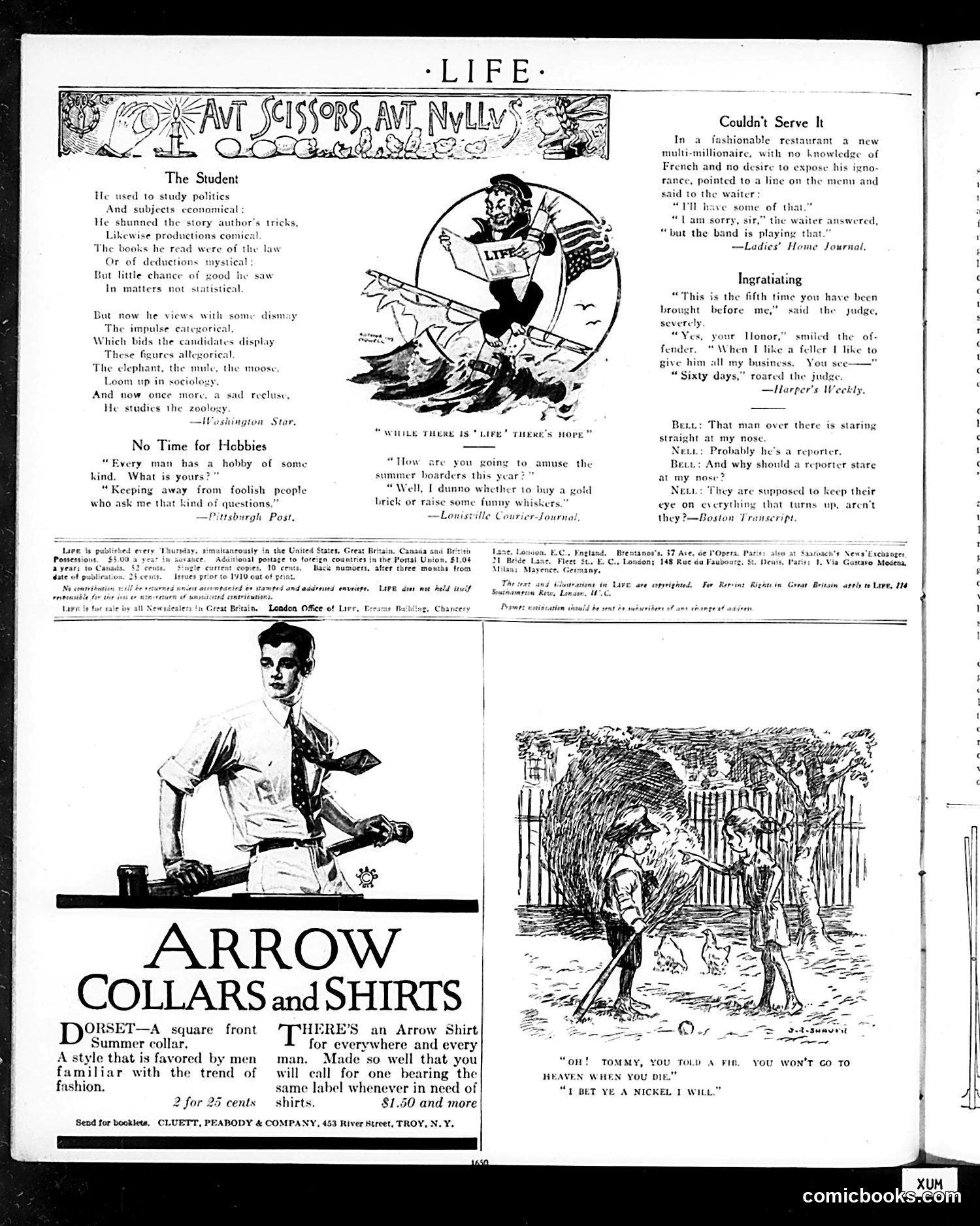
This page contains multiple unrelated humor items typical of early 20th-century Life magazine: **"The Student"** poem satirizes a young man who once studied serious subjects (politics, economics) but now obsesses over election campaign imagery—elephants, mules, moose—treating them as serious study material. The joke: he's abandoned intellectual pursuits for superficial political theater. **"No Time for Hobbies"** is a brief joke about avoiding foolish questions—typical filler humor. **The cartoons** include domestic/social humor: a man refusing to go to heaven over a nickel bet; a woman questioning why a man stares at her nose (he's likely a reporter, she concludes). **The Arrow Collars advertisement** occupies significant space, promoting men's shirts as fashionable and practical. The page exemplifies Life's mix of light satire, domestic comedy, and advertising—aimed at educated, middle-class readers. No specific political figures or major events are referenced; the satire is general social commentary.
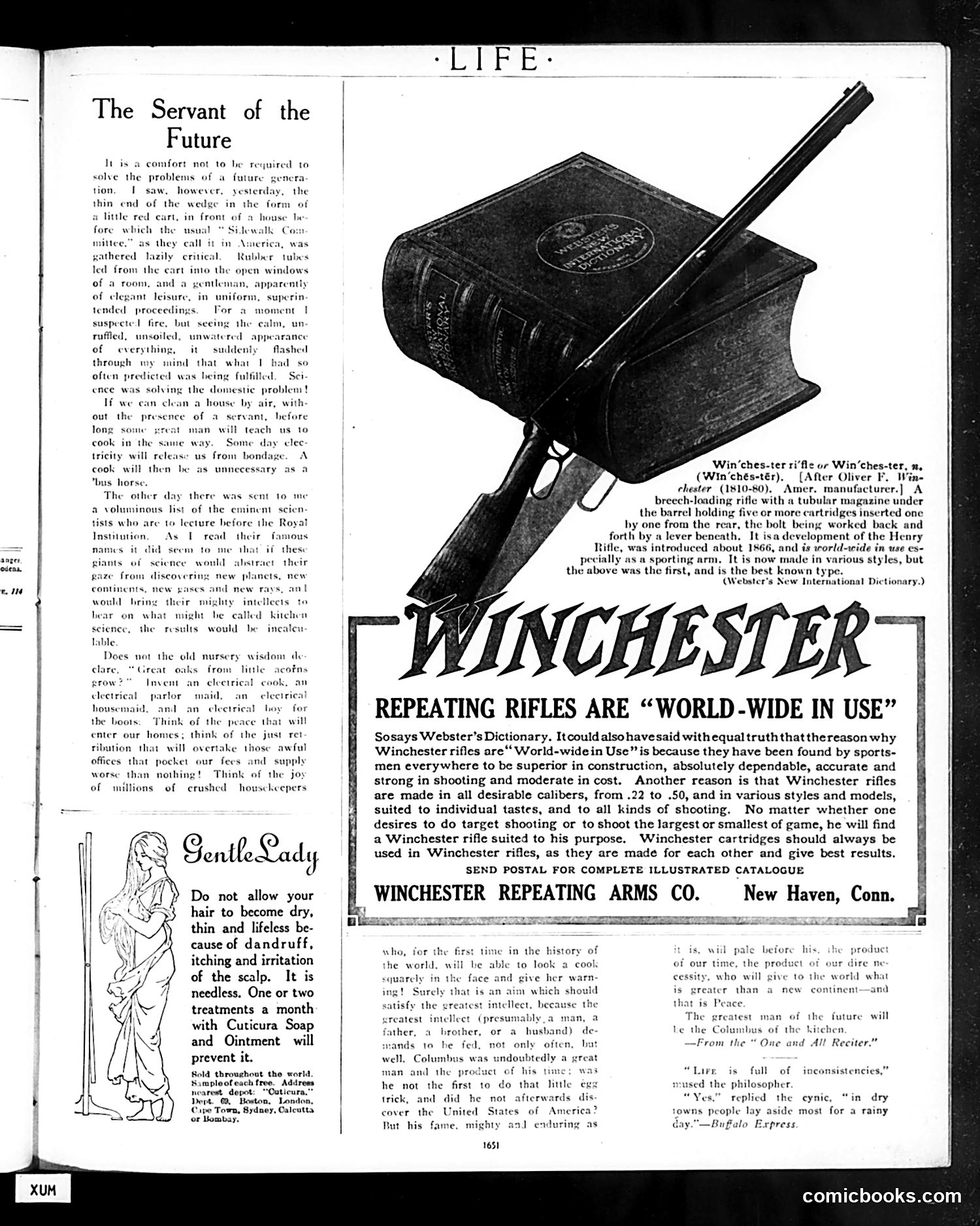
This page combines social commentary with period advertising. The main article satirizes predictions that technology will eliminate domestic servants. The author describes witnessing a "little red cart" with rubber tubes delivering air-cleaning into a home, symbolizing mechanical solutions to household labor. He playfully extrapolates: if houses can be cleaned by air, soon electricity will cook meals, making servants obsolete. The satire targets naive technological optimism—the belief that machines will solve the "servant problem" (labor scarcity/cost). The author ironically celebrates this future while subtly questioning whether technology truly replaces human work. The large Winchester Rifles advertisement below is a straightforward commercial claiming the rifles are "world-wide in use" among sportsmen for their superior construction and reliability. It represents typical period marketing emphasizing American manufacturing superiority. The "Gentle Lady" section advertises Cuticura Soap for dandruff treatment—standard health/beauty advertising of the era.
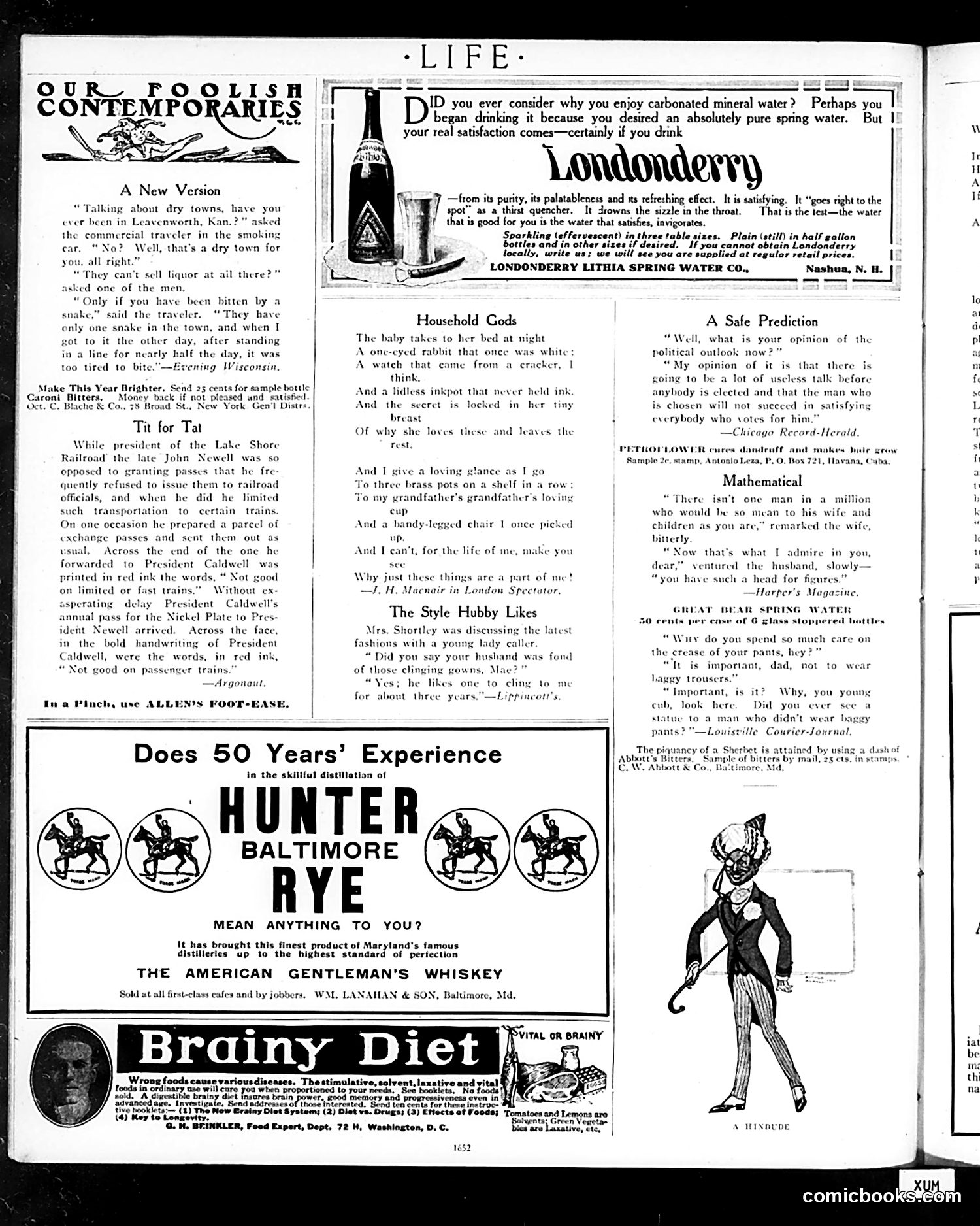
This page contains several brief humorous anecdotes and advertisements typical of early 20th-century American satirical journalism. **"A New Version"** mocks small Kansas towns during Prohibition ("dry towns"), joking that Leavenworth is so dry that even the one snake is exhausted from being consulted for illegal liquor access—a reference to folk remedies or bribes. **"Household Gods"** sentimentally lists ordinary domestic objects a woman cherishes, emphasizing emotional attachment over material value. **"A Safe Prediction"** satirizes political discourse, predicting vague complaints and universal dissatisfaction regardless of election outcomes—cynical commentary on political rhetoric. **"The Style Hubby Likes"** humorously depicts a husband praising wives who "cling" to him, playing on fashion terminology versus marital dependency. **"Tit for Tat"** recounts a railroad president's witty revenge—marking passes "not good on passenger trains" after being denied passes himself. The page primarily consists of light social satire and relationship humor rather than pointed political commentary, along with period advertisements for whiskey and mineral water.
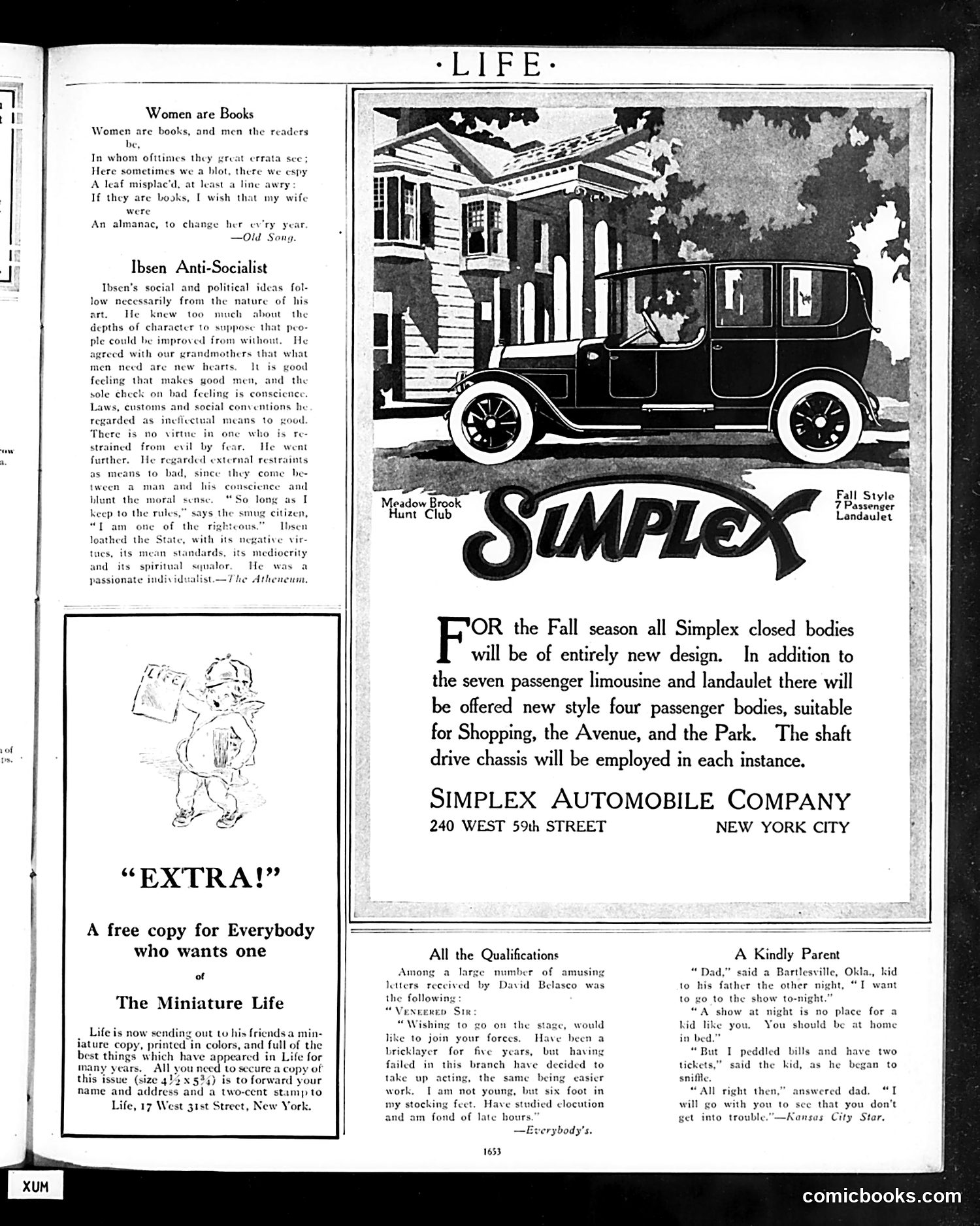
This page contains **three distinct sections**: a poetry/essay, an advertisement, and short humor pieces. The **"Women are Books"** section presents a 17th-century poem comparing women to books with printing errors, concluding with a joke wishing the author's wife were an almanac (replaceable yearly). The **"Ibsen Anti-Socialist"** essay discusses playwright Henrik Ibsen's individualism and distrust of state institutions and social conventions as external moral restraints—arguing he believed only personal conscience matters, not laws or customs. The **Simplex automobile advertisement** showcases a new 1920s-era car model with updated body styles for fall. The **"EXTRA!"** section humorously presents absurd job applications to theater producer David Belasco, including one from a would-be actor bragging about physical size and elocution lessons, and another short anecdote about a father preventing his son from attending an evening show. The page mostly serves as **advertising and light humor** rather than political satire, though the Ibsen piece engages 19th-century debates about individualism versus social order.
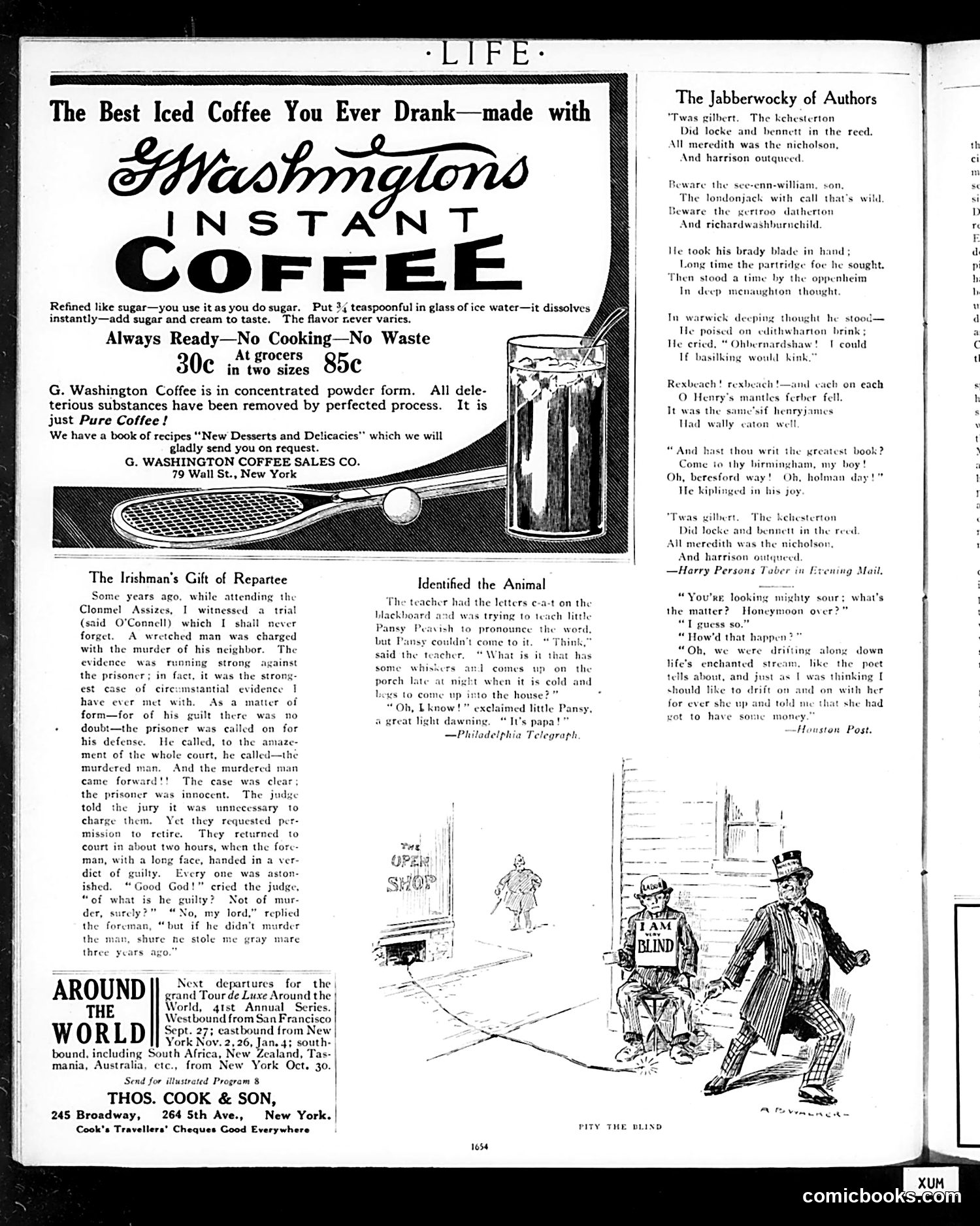
This Life magazine page contains two main humorous pieces: **"The Jabberwocky of Authors"** (top right): A parody of Lewis Carroll's "Jabberwocky" poem that mockingly combines the names of early 20th-century American and British authors—including Locke, Bennett, Meredith, Harrison, Kipling, Henry, Ferber, and others—into nonsensical verse about literary combat. The joke relies on readers recognizing these contemporary authors' names and finding absurdity in their conflation. **"Pity the Blind"** (bottom): A cartoon showing a blind beggar being led by a sighted man in fine clothes. The humor appears to derive from an ironic reversal—suggesting the well-dressed man, not the blind beggar, is the one truly disadvantaged or foolish. The page also contains advertisements for G. Washington Instant Coffee and travel services, typical of Life's commercial content from this era.
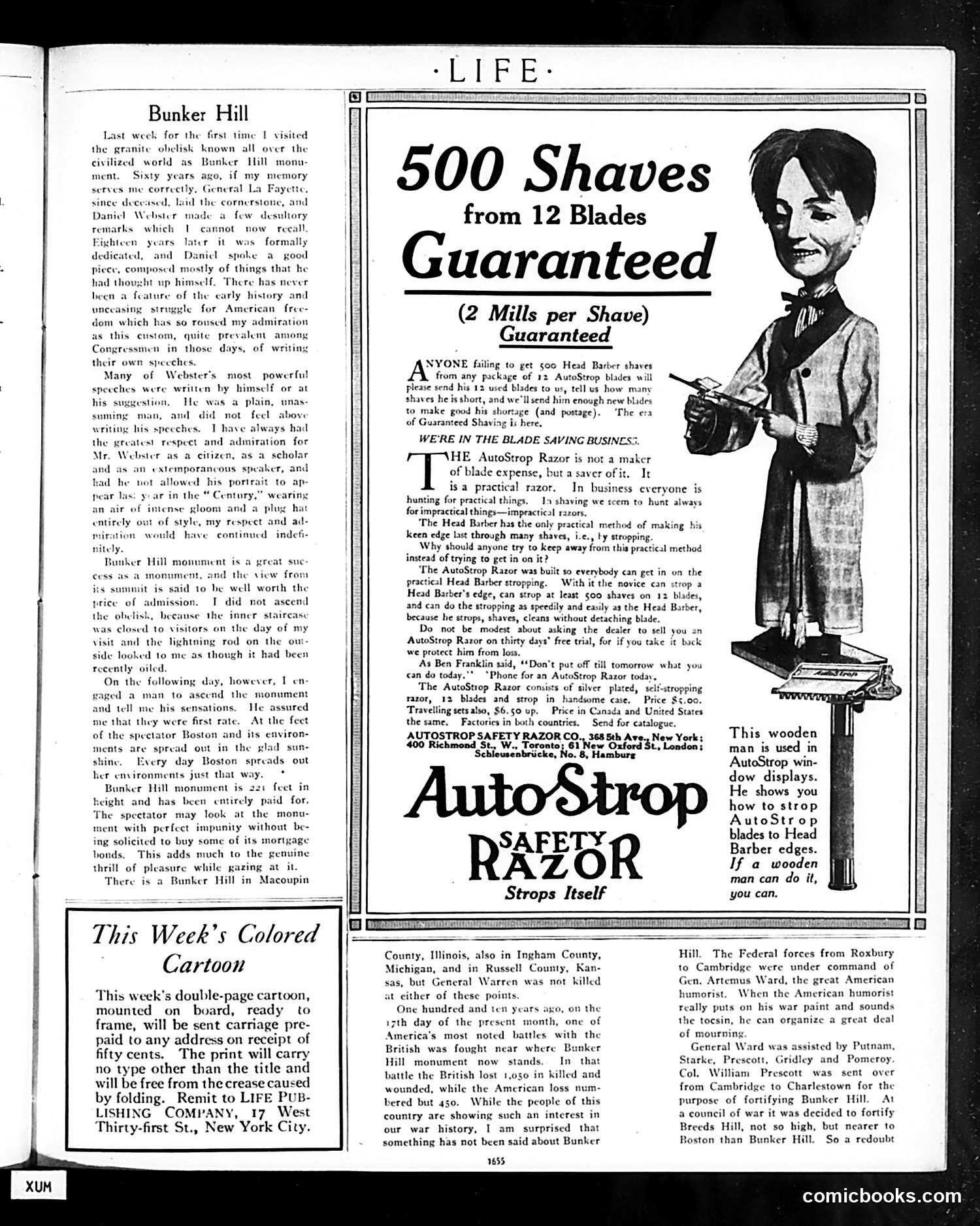
This *Life* magazine page contains two distinct elements: an essay about Bunker Hill monument and an advertisement. **The Essay**: A reflective piece praising Daniel Webster's public speaking abilities and the Bunker Hill monument itself. The author visited the 221-foot granite obelisk (dedicated formally 18 years prior) and admires both Webster's eloquence and the fact that the monument was fully paid for—requiring no mortgage bonds from visitors, a subtle dig at American commercialism. **The Advertisement**: Dominates the right side, promoting the AutoStrop Safety Razor with a guarantee of 500 shaves from 12 blades. The illustration shows a wooden barber-shop display figure demonstrating the stropping technique. The ad emphasizes practicality and savings—appealing to early 20th-century business efficiency values. The product's selling point is that it automates the barber's professional stropping method for home users. No political satire appears on this page; it's primarily editorial content and commercial advertising typical of *Life*'s era.
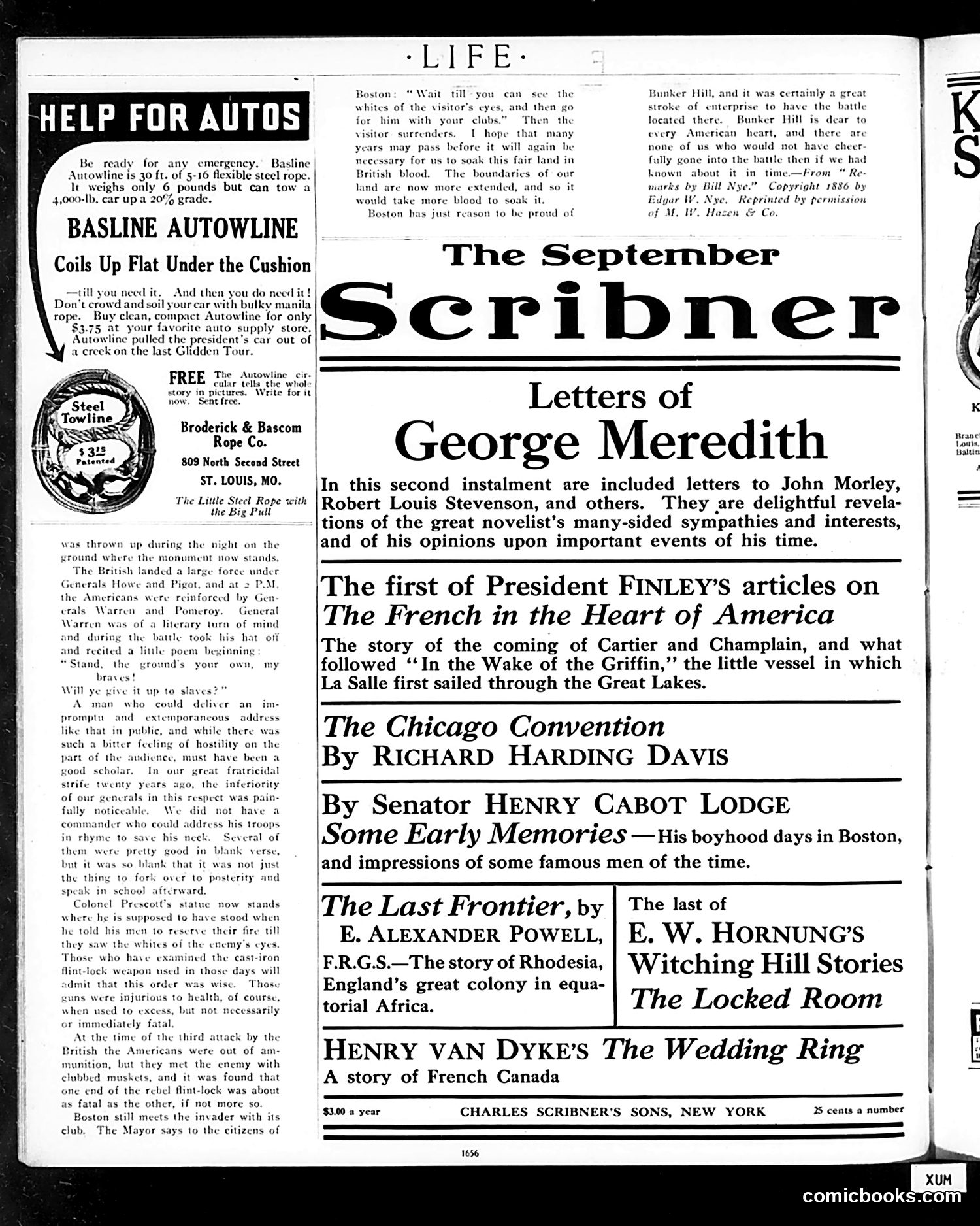
This page is primarily a **table of contents and advertising**, not a political cartoon. The left side advertises the **Basline Autowline**—a steel rope product for towing automobiles, marketed as emergency roadside assistance for motorists. The main content area announces **The September Scribner magazine**, listing its featured articles. These include letters from novelist George Meredith, an article on French colonial history in America by President Finley, coverage of the Chicago Convention by journalist Richard Harding Davis, and a memoir piece by Senator Henry Cabot Lodge about his Boston boyhood. The page also includes a lengthy text passage (visible but not fully legible) discussing the Battle of Bunker Hill, apparently a humorous historical reflection by Bill Nye, a popular 19th-century American humorist. **No political satire or cartoon is present**—this is a standard magazine advertisement and contents page from the early 1900s.
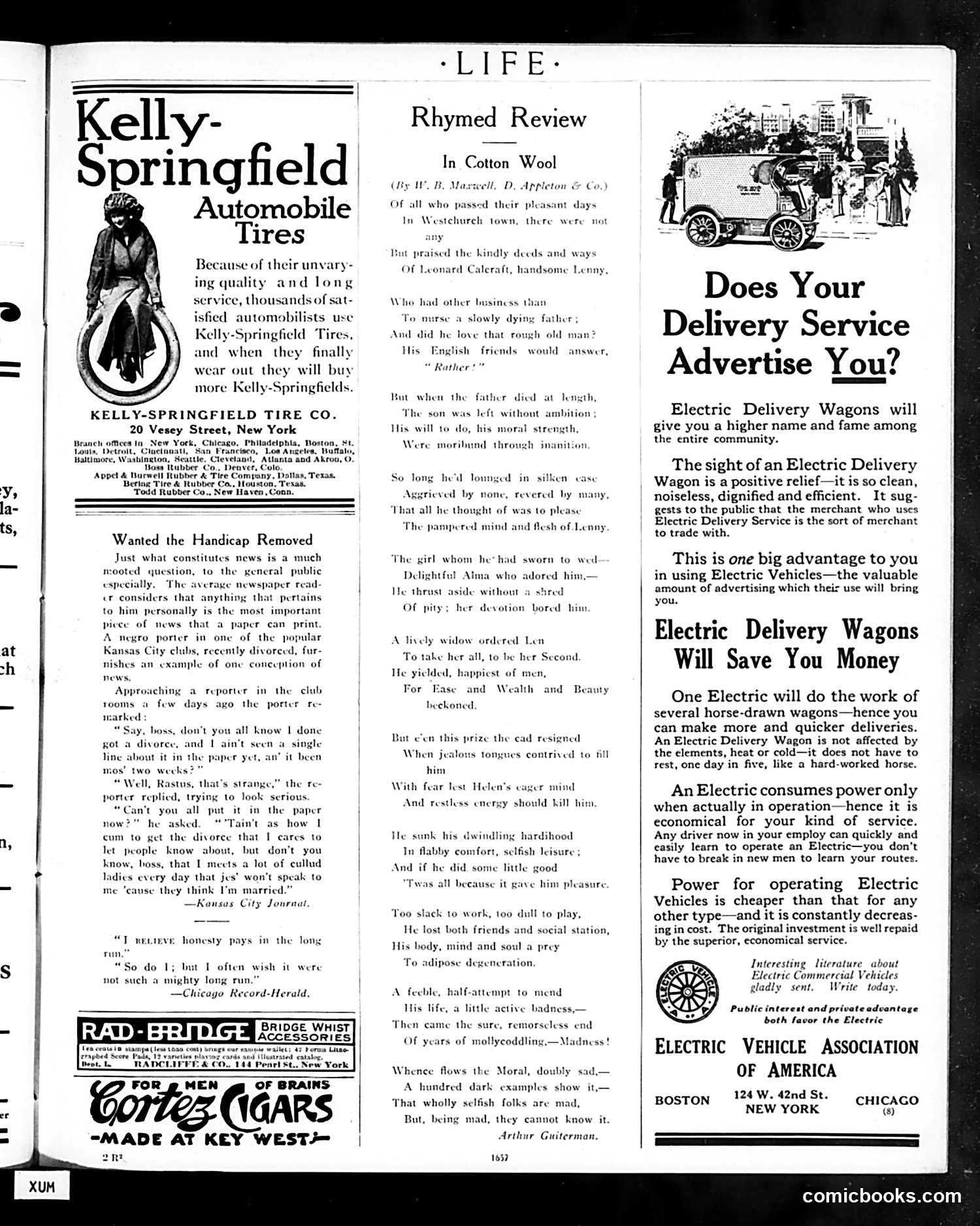
This page contains primarily **advertisements and a satirical poem**, not political cartoons. The main content is a lengthy rhymed narrative poem by Arthur Guiterman titled "In Cotton Wool," which satirizes inherited wealth and idleness. It tells of Leonard Caleraft, a gentleman who inherits money but lacks ambition or character. Rather than working or loving genuinely, he pursues ease and comfort, marrying a wealthy widow. His passivity, selfishness, and refusal to exert himself lead to mental and moral deterioration—ultimately madness. The poem's moral: "wholly selfish folks are mad." The surrounding advertisements (Kelly-Springfield Tires, Electric Delivery Wagons, Cortez Cigars) are typical period marketing. A brief humorous anecdote about a Kansas City porter seeking newspaper coverage of his divorce provides light satire on personal vanity and news values. The page reflects early-20th-century anxieties about leisure class decline and the dangers of idleness.
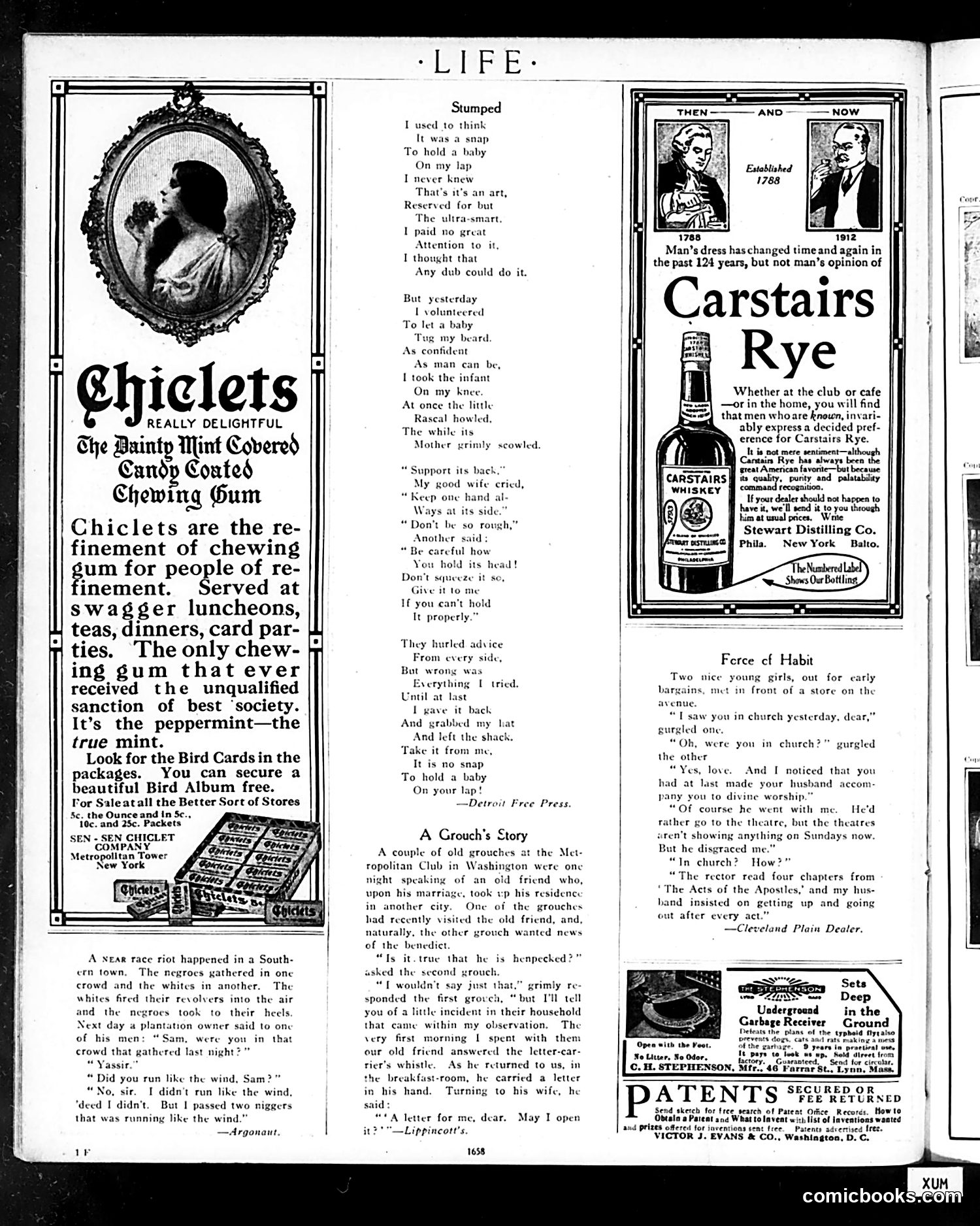
This page contains **advertisements and humorous short stories** rather than political cartoons. The main content includes: 1. **Chiclets gum ad** (left): Markets chewing gum as refined, upper-class behavior—"the only chewing gum that ever received the unqualified sanction of best society." 2. **Three humor pieces**: - "Stumped": A man discovers holding a baby is harder than expected; his wife and others criticize his technique - "A Grouch's Story": Two old men at a Washington club discuss whether their friend is henpecked; the punchline involves the friend asking permission to open his own mail - "Force of Habit": Girls note a woman's husband finally accompanies her to church (only because theaters are closed on Sundays) 3. **Carstairs Rye whiskey ad** (right): Emphasizes men's consistent preference for the brand across generations 4. **A brief racist anecdote** (lower left): A deeply offensive story about enslaved people running from gunfire The page reflects early-20th-century social attitudes and advertising approaches targeting affluent, educated readers.
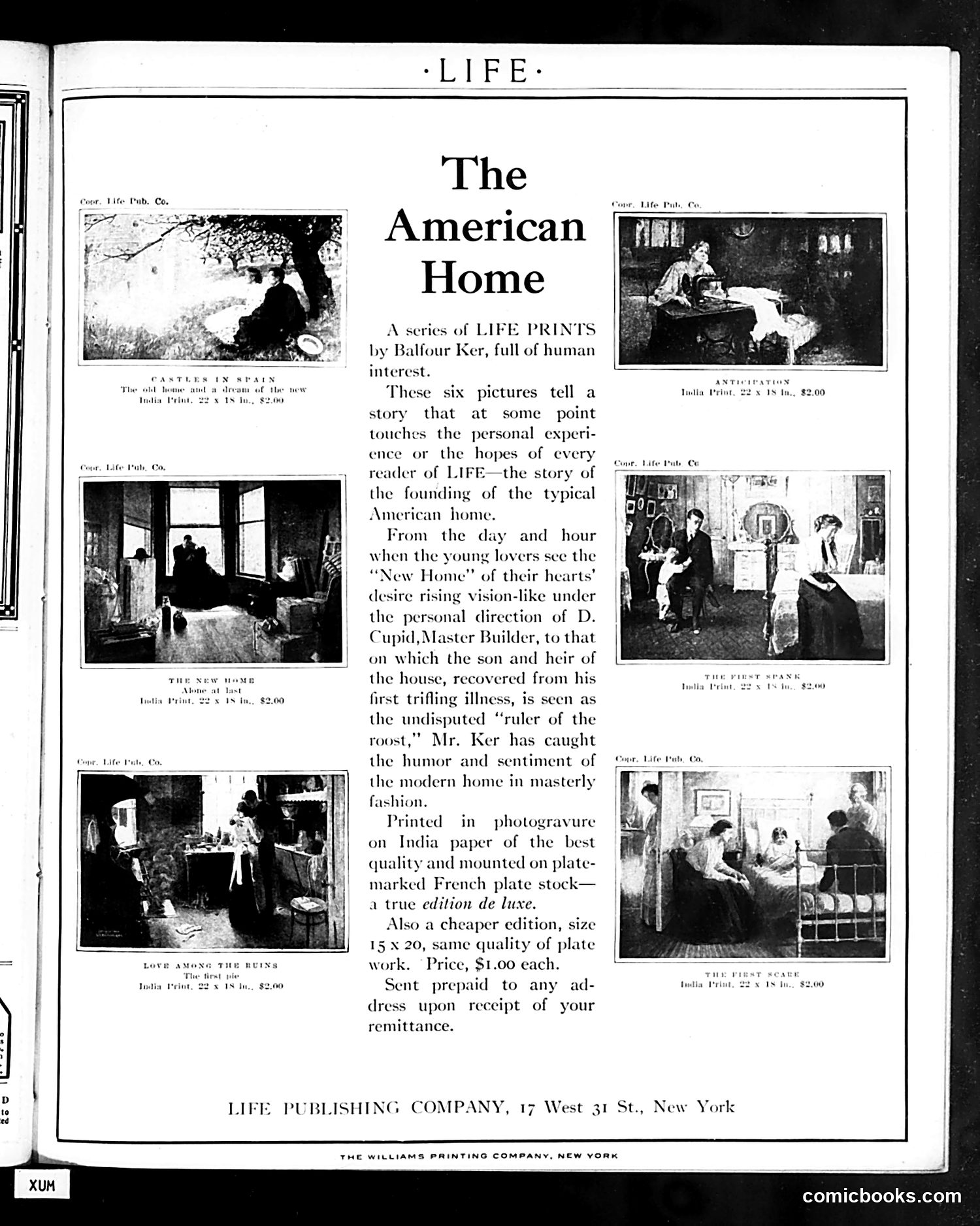
This is an advertisement for a series of six photogravure prints by artist Balfour Ker, not satirical content. The piece celebrates the sentimental narrative arc of establishing a typical American home—from young lovers envisioning their future residence (guided by "D. Cupid, Master Builder") through to a son recovering from illness and becoming "ruler of the roost." The prints sentimentalize domestic life and family milestones, capturing "humor and sentiment of the modern home." This reflects early 20th-century American cultural values emphasizing home ownership, marriage, and family as central life achievements. The advertisement emphasizes quality production (India paper, photogravure, French plate stock) and offers both luxury and cheaper editions, appealing to different economic classes—itself noteworthy for the period's class consciousness.

This is a straightforward advertisement, not satire. It promotes Welch's Grape Juice as "A Man's Drink" by showing a well-dressed man preparing a beverage with ice, grape juice, and charged (carbonated) water. The ad emphasizes the product's masculinity—marketing grape juice as sophisticated and appealing to men, which was necessary since juice was often coded as feminine or childish. The tagline and presentation suggest this is an upscale, refreshing drink suitable for gentlemen. The company offers bulk ordering and free promotional materials. This reflects early 20th-century marketing strategies targeting male consumers for non-alcoholic beverages.