
Life, 1912-08-22 · page 41 of 44
Life — August 22, 1912 — page 41: what you’re looking at
What you’re looking at
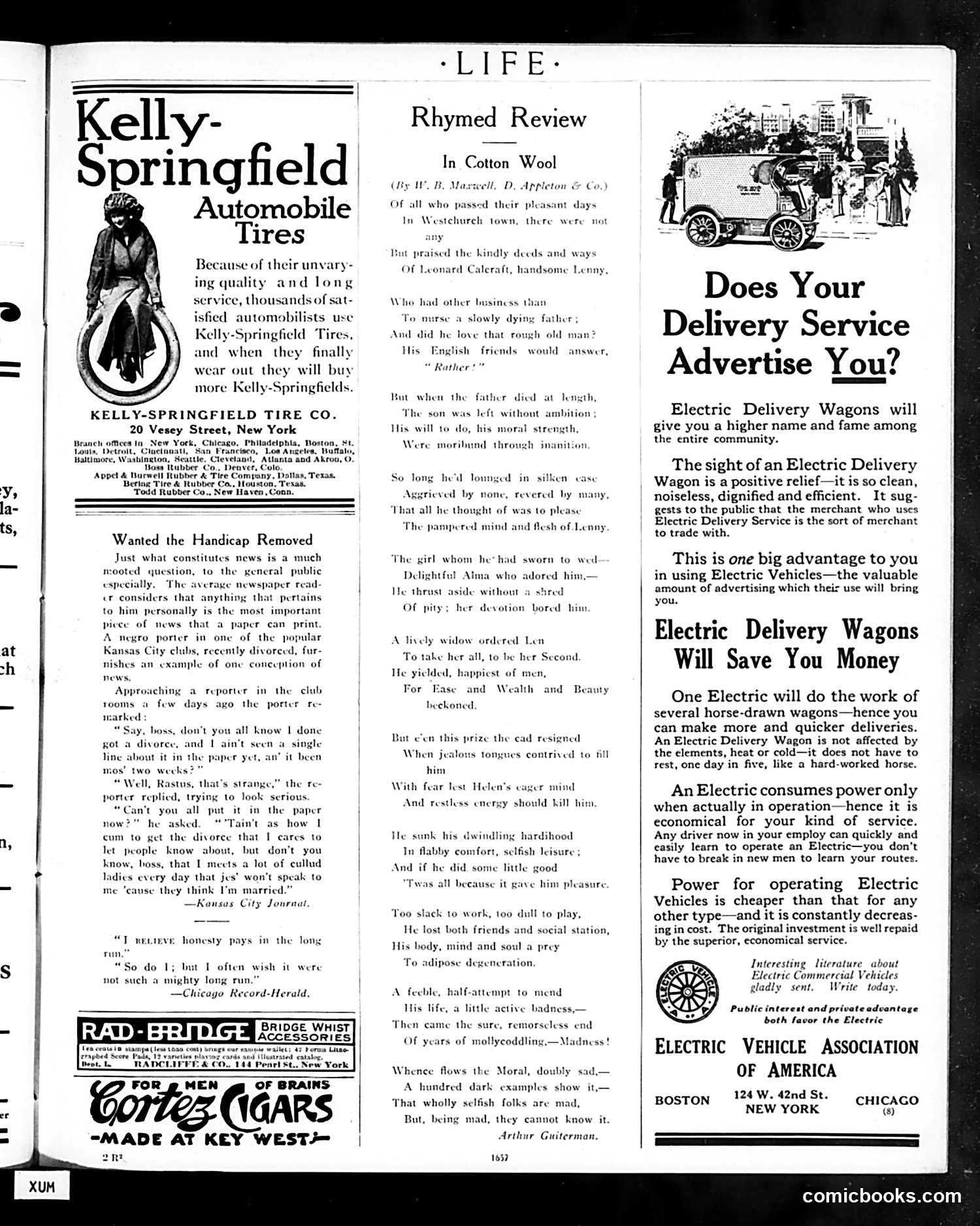
This page contains primarily **advertisements and a satirical poem**, not political cartoons. The main content is a lengthy rhymed narrative poem by Arthur Guiterman titled "In Cotton Wool," which satirizes inherited wealth and idleness. It tells of Leonard Caleraft, a gentleman who inherits money but lacks ambition or character. Rather than working or loving genuinely, he pursues ease and comfort, marrying a wealthy widow. His passivity, selfishness, and refusal to exert himself lead to mental and moral deterioration—ultimately madness. The poem's moral: "wholly selfish folks are mad." The surrounding advertisements (Kelly-Springfield Tires, Electric Delivery Wagons, Cortez Cigars) are typical period marketing. A brief humorous anecdote about a Kansas City porter seeking newspaper coverage of his divorce provides light satire on personal vanity and news values. The page reflects early-20th-century anxieties about leisure class decline and the dangers of idleness.
📄 Transcribed text from this page (OCR, searchable)
Machine-transcribed from the original scan — historical spelling and the odd misread are preserved.
Ys la- ts, at th ny + er Kelly- Springfield ee Automobile Tires Because of their unvary- ing quality and long service, thousands of sat- ished automobilists use Kelly-Springfield Tires, and when they finally wear out they will buy more Kelly-Springfields. KELLY-SPRINGFIELD TIRE CO. 20 Vesey Street, New York Ieago, Philadelphia, 1 Francisco, Loa Angetrs, . Sleveland, Atlanta and Boss tubber Co.. Denver, Colo. Appel & Burwell Rubber & Tire Company. Dalian, Texas, Bering Tire & Rubber Co., Houston, Todd Rubber Co. New Haven, Conn. Wanted the Handicap Removed Just what constitutes news is a much nooted question, to the gencral public especially, The averaye newspaper read- cr considers that anything that pertains to him personally is the most important piece of news that a paper can_ print. A negro porter in one of the popular Kansas City chibs, recently divorced, fur- nishes an example of one conception of Approaching a reporter in the club rooms a few days ago the porter re- marked y, hoss, don't you all know I done dT ain't seen a single got a divoree line about it in the paper yet, an’ it been mos’ two weeks? “Well, Rastus, that’s strang porter replied, trying to look serious. “Can't you all put it in the paper now?" he asked. ‘'Tain't as how I cum to get the divorce that I cares to let people know about, but don't you know, hoss, that I meets a lot of cullud ies every day that jes’ won't speak to ‘cause they think I'm married.” —Kansas City Journat the re- “To metieve honesty pays in the long run.” “So do 1; but I often wish it were not such a mighty long run.” —Chicaygo Record-Herald. “MADE AT al WEST 2h LIFE Rhymed Review In Cotton Wool (By WB. Max !. D. Appleton & Co.) OF all who ps sed their ple days In Westchurch town, there were not praised the kindly decd: Of Leonard € dd ways leraft, handsome Lenny, Who had other business than To nurse a slowly dying father; And did he love that re old man? His English friends would answer, “ Rather!" Bot when the father died at length, The son was left without ambiti h, His will to d his moral streng: Were moribund through inanition So long he'd lounged in. silken case \ ‘That all he thoi sieved by none, revered by many, ht of was to please The pampered mind and flesh of.Lenny The git] whom he had sworn to wed, Delightful Me thrust a Alma who adored him,— ide without a shred Of pity; her devotion bored him: A lively widow ordered Len To take her all, to be her Second. He yielded, happiest of men, For Ease and Wealth and Beauty beckoned. But c’en this prize the cad resis When jealous tongues contrived to fill him With fear lest Helen's cager mind And restless energy should kill him He sunk his dwindling hardihood In flabby comfort, selfish leisure ; And if he did some little good “Twas all beeause it gave him pleasure Too slack to work, too dull to play, He lost both friends and social station, His body, mind and soul a prey To adipose degeneration. A feeble, half-attempt to mend His life, a little active badness,— Then came the sure, remorseless end Of years of mollycoddling,—Madness! Whence flows the Moral, doubly sad,— A hundred dark examples show it,— That wholly selfish folks are mad, But, being mad, they cannot know it. Arthur Guiterman, 1637 Does Your Delivery Service Advertise You? Electric Delivery Wagons will give you a higher name and fame among the entire community. The sight of an Electric Delivery Wagon is a positive relief. is so clean, noiseless, dignified and efficient. It sug- gests to the public that the merchant who uses Electric Delivery Service is the sort of merchant to trade with. This is one big advantage to you in using Electric Vehicles—the valuable amount of advertising which their use will bring you. Electric Delivery Wagons Will Save You Money One Electric will do the work of several horse-drawn wagons—hence you can make more and quicker deliveries. An Electric Delivery Wagon is not affected by the elements, heat or cold—it does not have to rest, one day in five, like a hard-worked horse. An Electric consumes power only when actually in operation—hence it is economical for your kind of service. Any driver now in your employ can quickly and easily learn to operate an Electric—you don’t have to break in new men to learn your routes. Power for operating Electric Vehicles is cheaper than that for any other type—and it is constantly decreas- ing in cost. The original investment is well repaid by the superior, economical service. Anlereeline literature about lectric Commercial Vehicles falls sent. Write today. Public interest and pri doantage both favor the Electric ELECTRIC VEHICLE ASSOCIATION OF AMERICA 124 W. 42nd St. A NEW YORK cn Go BOSTON comicbooks.com