
Life, 1912-08-22 · page 9 of 44
Life — August 22, 1912 — page 9: what you’re looking at
What you’re looking at
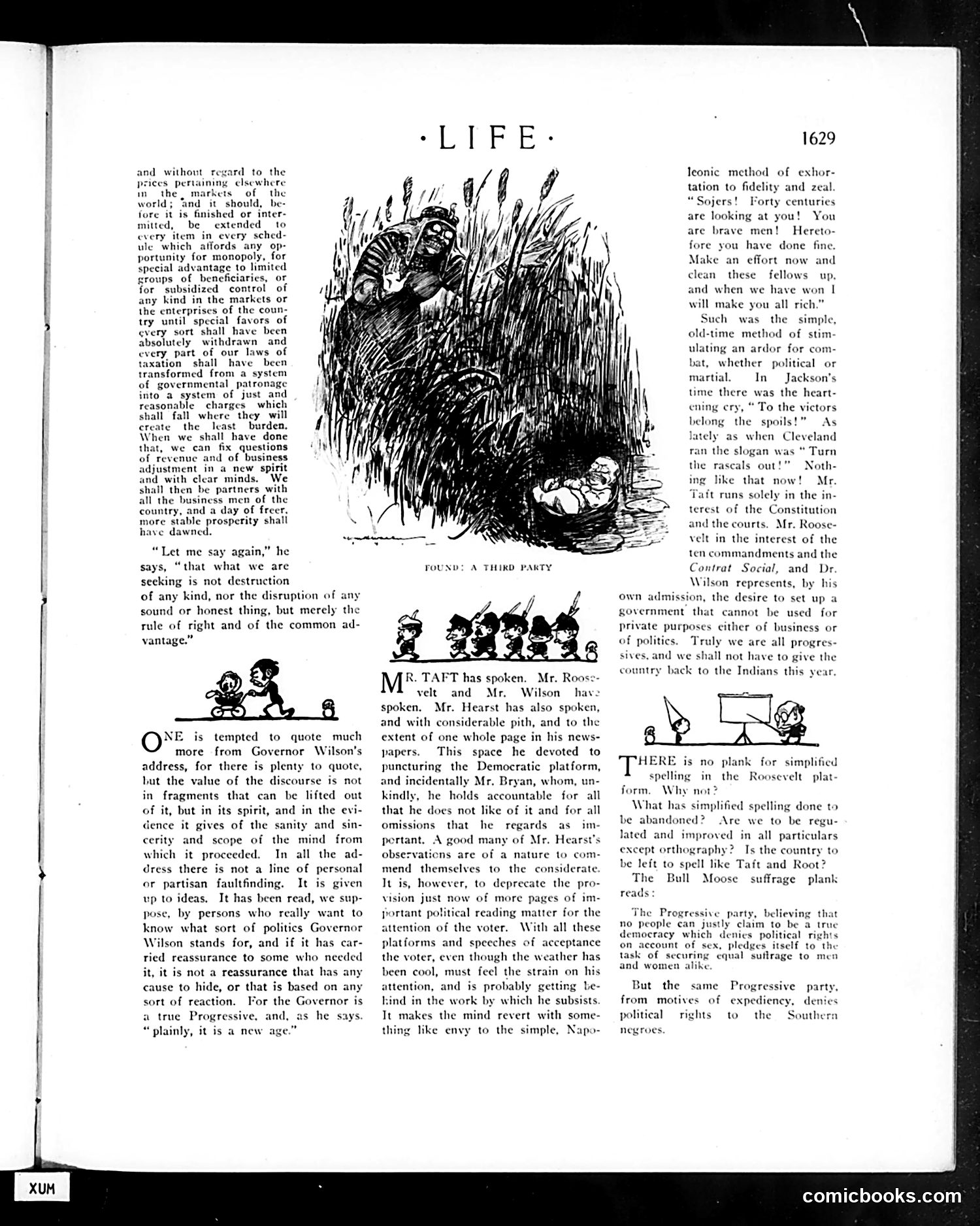
**"Found: A Third Party"** depicts a large, shaggy creature (resembling a bear or wild animal) looming over a tiny human figure in grass. Below it, a row of small caricatured figures sits in a line. The cartoon satirizes the emergence of a "third party" in American politics—a challenge to the two-party system. The text references speeches by Taft, Roosevelt, Wilson, and Hearst regarding political platforms and the Progressive movement. The cartoon suggests the third party is monstrous, uncontrollable, or absurdly small-scale compared to its ambitions. The lower illustration depicts what appear to be political figures or party representatives aligned together, possibly mocking their unity or their minor significance.
📄 Transcribed text from this page (OCR, searchable)
Machine-transcribed from the original scan — historical spelling and the odd misread are preserved.
and without regard to the prices pertaining elsewhere m the, markets of the world; ‘and it should, be- fore it is finished or inter- mitted, be extended to every item in every sched- ule which affords any op- portunity for monopoly, for special advantage to limited groups of beneficiaries, or for subsidized control of any kind in the markets or the enterprises of the coun- try until special favors of ¢very sort shall have been Absolutely withdrawn and every part of our laws of taxation shall have been transformed from a system of governmental patronage into a system of just and reasonable charges which shall fall where they will create the least burden. When we shall have done that, we can fix questions of revenue and of business adjustment in a new spirit and with clear minds. We shall then be partners with all the business men of the country, and a day of freer, more stable prosperity shall have dawned. “Let me say again,” he says, “that what we are seeking is not destruction of any kind, nor the disruption of any sound or honest thing, but merely the rule of right and of the common ad- vantage.” E is tempted to quote much more from Governor Wilson's address, for there is plenty to quote, but the value of the discourse is not in fragments that can be lifted out of it, but in its spirit, and in the evi- dence it gives of the sanity and sin- cerity and scope of the mind from which it proceeded, In all the ad- dress there is not a line of personal or partisan faultfinding. It is given up to ideas, It has been read, we sup- pose, by persons who really want to know what sort of politics Governor Wilson stands for, and if it has car- ried reassurance to some who needed it, it is not a reassurance that has any cause to hide, or that is based on any sort of reaction. For the Governor is a true Progressive, and, he says. “plainly, it is a new age.” R. TAFT has spoken. Mr. Roose- velt and Mr. Wilson have spoken. Mr. Hearst has also spoken, and with considerable pith, and to the extent of one whole page in his news- papers. This space he devoted to puncturing the Democratic platform, and incidentally Mr. Bryan, whom, un- kindly, he holds accountable for all that he does not like of it and for all omissions that he regards as im- pertant, A good many of Mr. Hearst's observations are of a nature to ¢ mend themselves to the considerate. It is, however, to deprecate the pro- vision just now of more pages of im- portant political reading matter for the attention of the voter. With all these platforms and speeches of acceptance the voter, even though the weather has been cool, must feel the strain on his attention, and is probably getting be- ind in the work by which he subsists. It makes the mind revert with some- thing like envy to the simple, Napo- 1629 leonic method of exhor- tation to fidelity and zeal. “Sojers! Forty centuries are looking at you! You are brave men! Hereto- fore you have done fine. Make an effort now and clean these fellows up. and when we have won | will make you all rich.” Such was the simple, old-time method of stim- ulating an ardor for com- bat, whether political. or martial. In Jackson's time there was the heart- To the v belong the spoils!” As ely as when Cleveland ran the slogan was “ Turn the rascals out!" Noth- ing like that now! Mr. Taft runs s y in the in- terest of the Constitution and the courts. Mr. Roose- velt in the interest of the ten commandments and the Contrat Social, and Dr. Wilson represents, by own admission, the desire to set up government that cannot be used f Private purposes cither of business or of politics. Truly we are all progres- sives, and we shall not have to give the country back to the Indians this year. ening ery tors HERE is no plank for simplified spelling in the Roosevelt plat- form. Why not? What has simplified spelling done to be abandoned? Are we to be regu- lated and improved in all particulars except orthography? Is the country to be left to spell like Taft and Root? The Bull Moose suffrage plank reads: The Progressive party, believing that no people can justly claim to be a true democracy which denies political rights on account of sex, pledges itself to the task of securing equal suffrage to men and women alike But the same Progressive party, from motives of expediency political rights to the negroes. den: ithern comicbooks.com