
Life, 1912-08-22 · page 11 of 44
Life — August 22, 1912 — page 11: what you’re looking at
What you’re looking at
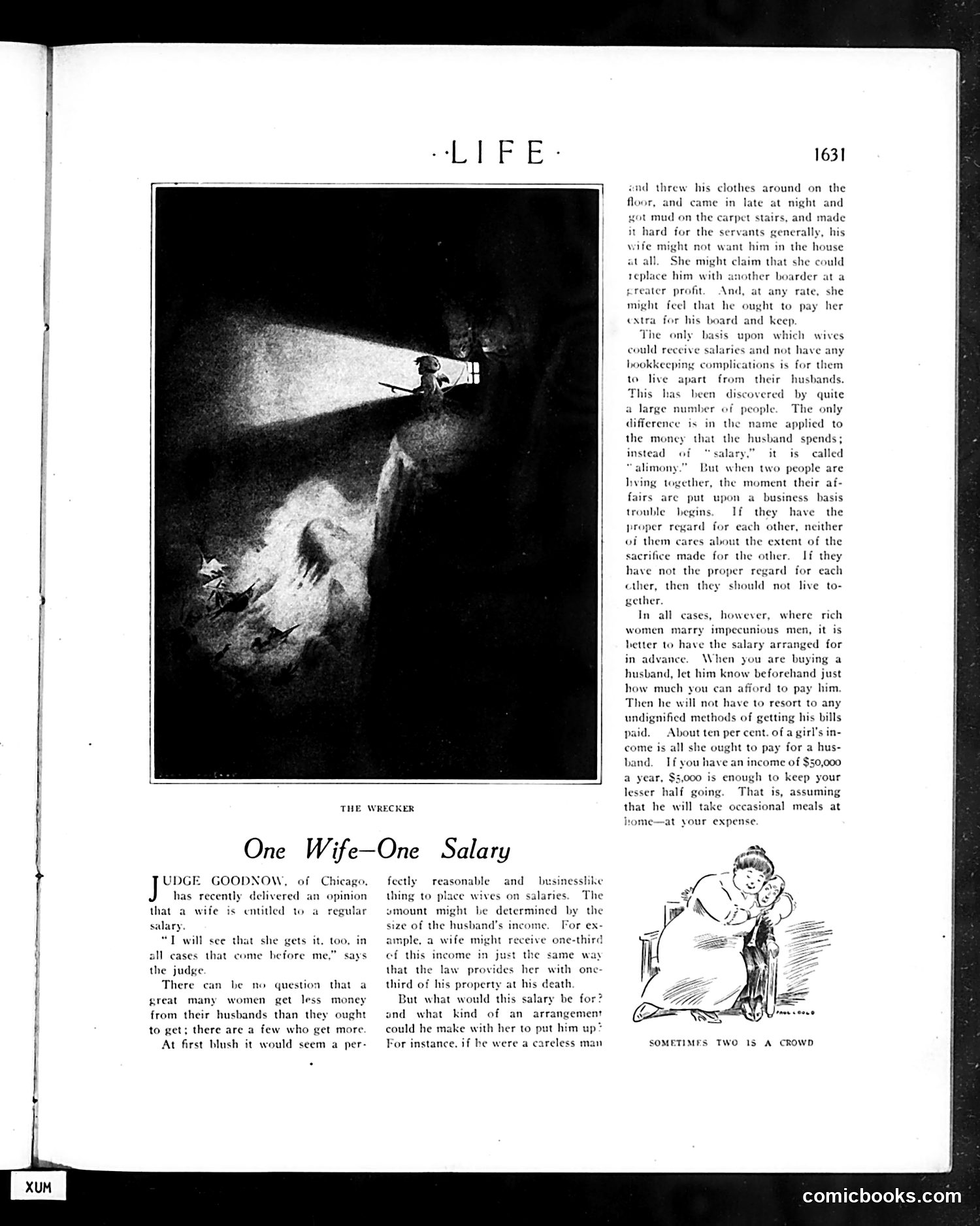
This page satirizes the economic dynamics of marriage, specifically addressing whether wives should receive independent salaries. The large dramatic photograph titled "THE WRECKER" shows a man in shadow—likely representing a husband squandering household finances recklessly. Judge Goodnow of Chicago is quoted advocating that wives deserve regular salaries, comparable to what husbands earn. The article argues this would protect women financially and prevent husbands from irresponsible spending. The small illustration labeled "SOMETIMES TWO IS A CROWD" depicts a woman, likely commenting ironically on marital cohabitation difficulties. The piece tackles early 20th-century concerns: wives' financial dependence, marital conflict over money, and property rights. It presents the "wife's salary" concept as a practical solution to economic inequality within marriage.
📄 Transcribed text from this page (OCR, searchable)
Machine-transcribed from the original scan — historical spelling and the odd misread are preserved.
ae THE WRECKER One Wife—One Salary UDGE GOODNOW, of Chicago. has recently delivered an opinion that a wife is entitled to a regular salary. “Twill sce that she gets it, too, in all cases that come hefore me,” says the judge. There can be no question that a great many women get less money from their husbands than they ought to get; there are a few who get more. At first blush it would seem a per- fectly reasonable and — businesslike thing to place wives on salaries. The amount might be determined by the size of the husband's income. For ex- mple, a wife might receive one-third cf this income in just the same way that the law provides her with one- third of his property at his death But what would this salary be for? and what kind of an arrangement could he make with her to put him up? For instance. if he were a careless man 1631 end threw his clothes around on the floor, and came in late at night and ot mud on the carpet stairs, and made it hard for the servants generally, his wife might not want him in the house at She might claim that she could replace him with another boarder ata treater profit. And, at any rate, she might feel that he ought to pay her extra for his board and keep. The only basis upon which wives could receive salaries and not have any bookkeeping complications is for them to live apart from. their husbands. This has been discovered by quite a large number of people. The only difference is in the name applied to the moncy that the husband spends; instead of “salary,” it’ is called “alimony.” But when two people are hving together, the moment their af ¢ put upon a business basis trouble begins. If they have the proper regard for each other, neither of them cares about the extent of the sacrifice made for the other. Ii th have not the proper regard for each ether, then they should not live to- gether. In all cases, however, where rich it is women marry impecunious me hetter to have the salary arranged for in advance. When you are buying a husband, let him know beforehand just how much you can afford to pay him Then he will not have to resort to any undignified methods of getting his bills paid. About ten per cent. of a girl's in- come is all she ought to pay for a hus- band. If you have an income of $50,000 a year, $3,000 is enough to keep your lesser half going. That is, assuming that he will take occasional meals at jiome—at your expense. \ C= ws SOMETIMFS TWO 13 A CROWD comicbooks.com