
Life, 1912-08-22 · page 32 of 44
Life — August 22, 1912 — page 32: what you’re looking at
What you’re looking at
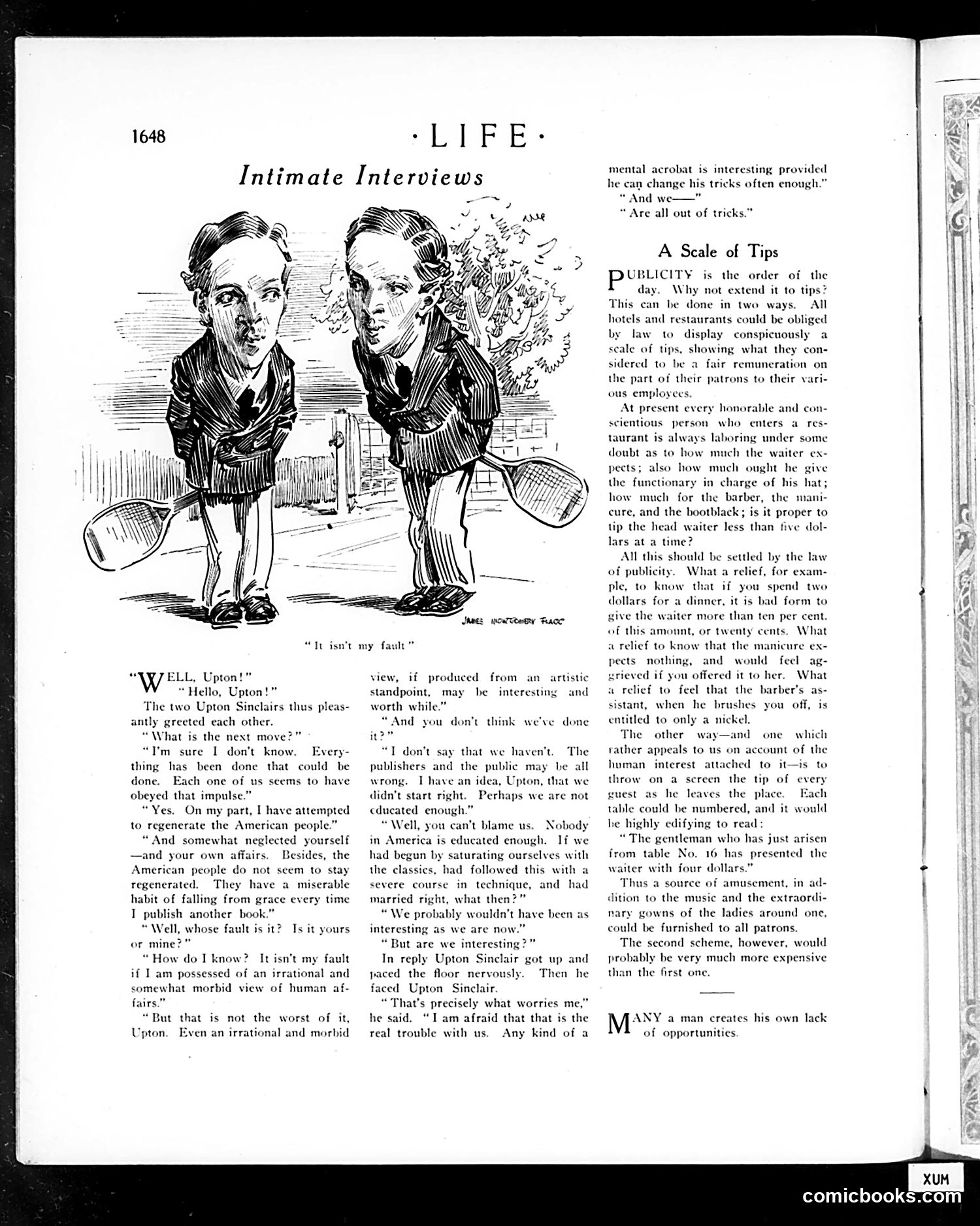
This page features a satirical "interview" between two versions of Upton Sinclair, the famous muckraking novelist and social reformer. The cartoon shows Sinclair meeting himself, discussing their shared failure to effect meaningful change despite prolific writing and activist efforts. The joke targets Sinclair's repeated attempts to "regenerate the American people" through his books—efforts that seemingly accomplished little, as Americans "fall from grace every time I publish another book." The two Sinclairs debate whose fault this is, ultimately concluding they've simply "run out of tricks." The accompanying article satirizes the era's tipping culture by proposing absurd "solutions": either legally mandated tip scales posted in restaurants, or publicly announcing each guest's tip amount for entertainment value. The satire critiques both Sinclair's ineffectual reformism and contemporary social anxieties about proper etiquette and class performance.
📄 Transcribed text from this page (OCR, searchable)
Machine-transcribed from the original scan — historical spelling and the odd misread are preserved.
rLIFE= Intimate Interviews WONTeemy Face “Tt isn't my fault” ae ELL, Upton!” “ Hello, Upton!” The two Upton Sinclairs thus pleas- antly greeted each other. “What is the next move “T'm sure I don't know. Every- thing has been done that could be done. Each one of us seems to have obeyed that impulse.” “Yes. On my part, I have attempted to regenerate the American people.” “And somewhat neglected yourself —and your own affairs. Besides, the American people do not seem to stay regenerated. They have a miserable habit of falling from grace every time I publish another book “Well, whose fault is it? Is it yours or mine?” “How do I know? It isn’t my fault if I am possessed of an irrational and at morbid view of human af- “But that is not the worst of it, Upton. Even an irrational and morbid view, if produced from an_ artistic standpoint, may worth while.” “And you don’t think we've done it?” be interesting and “T don’t say that we haven't. The publishers and the public may be all wrong. I have an idea, Upton, that we didn’t start right. Perhaps we are not educated enough.” “Well, you can’t blame us. Nobody in America is educated enough. If we had begun by saturating ourselves with the classics, had followed this with a severe course in technique, and had married right, what then?” “We probably wouldn't have been as interesting as we are now.” “But are we interesting?" In reply Upton Sinclair got up and ed the floor nervously. Then he d Upton Sinclair. That’s precisely what worries me he said. “Tam afraid that that is the real trouble with us. Any kind of a mental acrobat is interesting provided he can change his tricks often enough.” “And we—”" “Are all out of tricks.” A Scale of Tips UBLICITY is the order of the day. Why not extend it to tips? This can be done in two ways. All hotels and restaurants could be obliged by law to display conspicuously a scale of tips, showing what they con- sidered to be a fair remuneration on the part of their patrons to their vari- ous employees. At present every honorable and con- scientious person who enters a_res- taurant is always laboring under some doubt to how much the waiter ¢ pects; also how much ought he gi the functionary in charge of his how much for the barber, the » cure, and the bootblack ; is it proper to tip the head waiter less than five dol- lars at a time? All this should be settled by the of publicity. What a relief, for ple, to know that if you spend two dollars fi dinner, it is bad form to " m- give the waiter more than ten per cent. of this amount, or twenty cents. What a relief to know that the manicure ex- pects nothing, and would feel ag- xrieved if you offered it to her. What a relief to feel that the barber's. sistant, when he brushes you off, is entitled to only a nickel. The other way—and one which rather appeals to us on account of the human interest attached to it—is to the tip of every throw on a guest as he leaves the place. Each re table could be numbered, and it would he highly edifying to read: “The gentleman who has just arisen from table No. 16 has presented the waiter with four dollars.” Thus a source of amusement, in ad- dition to the music and the extraordi- nary gowns of the ladies around one, could be furnished to all patrons. The second scheme, however, would probably be very much more than the first one, ANY a man creates his own lack of opportunities | SP! ¢@ 7 a aN yr comicbooks.com