
Life, 1912-08-22 · page 28 of 44
Life — August 22, 1912 — page 28: what you’re looking at
A restored page from Life, 1912-08-22. Page through the whole issue in the reader above.
📄 Transcribed text from this page (OCR, searchable)
Machine-transcribed from the original scan — historical spelling and the odd misread are preserved.
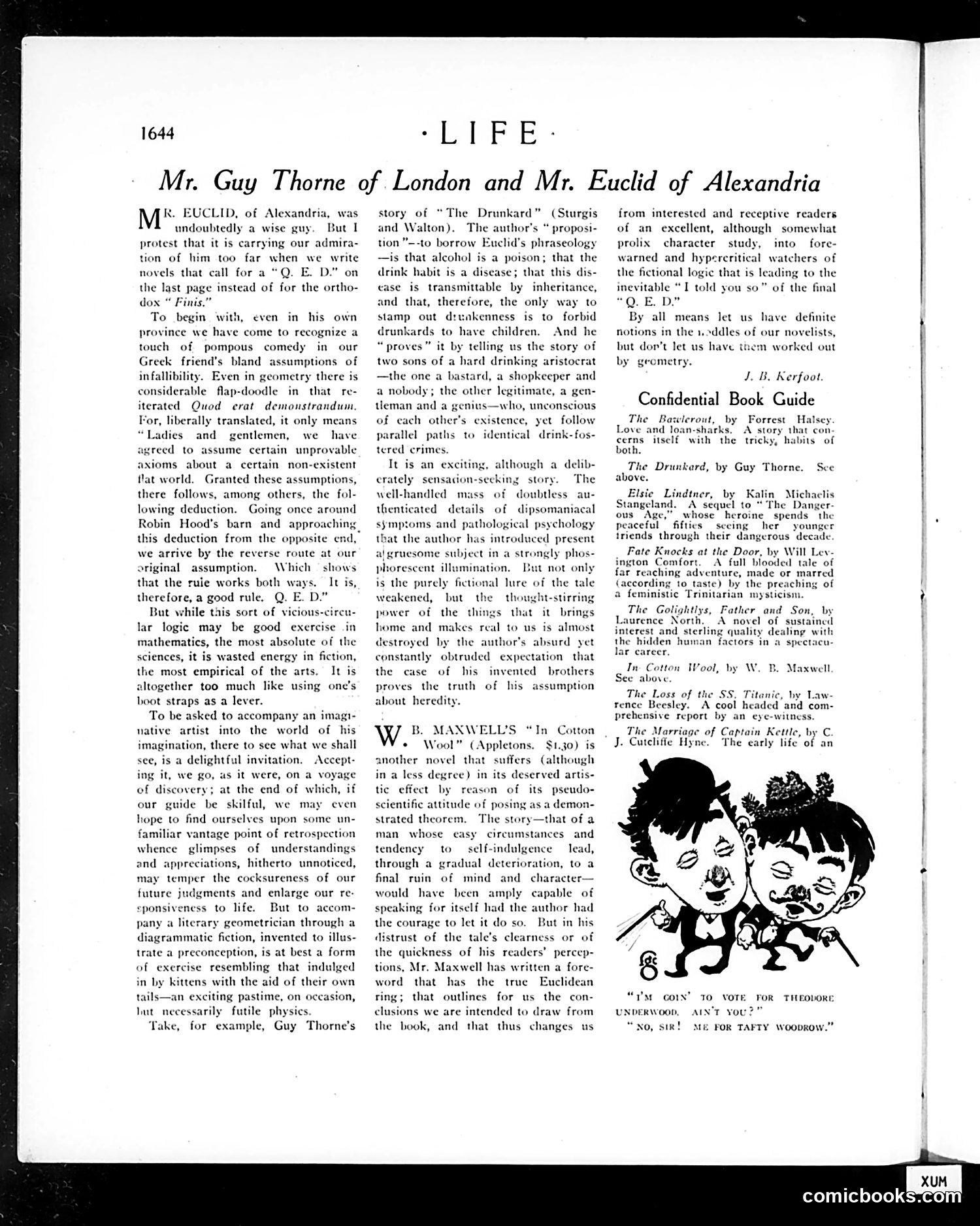
1644 ~LIPE- Mr. Guy Thorne of London and Mr. Euclid of Alexandria ME EUCLID, of Alexandria, w undoubtedly a wise guy. But I protest that it is carrying our admira- tion of him too far when we write novels that call for a “Q. E. D.” on the last instead of for the ortho- dox “ Finis.” To begin with, even in his own province we have come to recognize a touch of pompous comedy in our Greek friend’s bland assumptions of infallibility. Even in geometry there is considerable flap-doodle in. that re- iterated Quod erat demonstrandum., For, liberally translated, it only means “Ladies and gentlemen, we have agreed to assume certain unprovable axioms about a certain non-existent Hat world. Granted these assumptions, there follows, among others, the fol- lowing deduction. Going once around Robin Hood’s barn and approaching this deduction from the opposite end, we arrive by the reverse route at our original assumption. © Which that the rule works both ways. It is, therefore, a good rule, Q. E. D.” But while this sort of vi lar logic may be good exercise .in mathematics, the most absolute of the sciences, it is wasted energy in fiction, the most empirical of the arts. It is altogether too much like using one’s hoot straps as a lever. To be asked to accompany an imagi- native artist into the world of his gination, there to see what we shall is a delightful invitation. Accept- ing it, we go, as it were, on a voyage of discovery; at the end of which, if our guide be skilful, we may even hope to find ourselves upon some un- familiar vantage point of retrospection whence glimpses of understandings and appreciations, hitherto unnoticed, may temper the cocksureness of our future judgments and enlarge our re- sponsiveness to lif But to accom- pany a literary geometrician through a diagrammatic fiction, invented to illus- trate a preconception at best a form of exercise resembling that indulged in by kittens with the aid of their own tails—an exciting pastime, on occasion, Int necessarily futile physics. ‘Take, for example, Guy Thorne’s shows ‘jous-cireu- story of “The Drunkard” (Sturgis and Walton). The author's “ propos tion "=-to borrow Euclid’s phraseology —is that alcohol is a poison; that the drink habit is a disease; that this dis- ease is transmittable by inheritance, and that, therefore, the only way to stamp out drunkenness is to forbid drunkards to ha children. And he it by telling us the story of two sons of a hard drinking aristocrat —the one a bastard, a shopkeeper and a nobody; the other legitimate, a gen- tleman and a of cach other's existence, yet follow parallel paths to identical drink-fos- enitis—who, unconscious tered crimes. It is an exciting erately sensacion-seeking story. well-handled mass of thenticated details of symptoms and pathological psychology that the author has introduced present although a delib- The au- doubtless dipsomaniacal algruesome subject in a strongly phos- phorescent illumination. But not only is the purely fictional lure of the tale weakened, but th thought-stirring power of the things that it brings home and makes real to us is almost destroyed by the author’s absurd yet constantly obtruded expectation that the case of his invented brothers proves the truth of his assumption about heredity. W. B. MAXWELL’S “ © Wool” (Appletons. $1.30) is another novel that suffers (although in a less degree) in its deserved artis- tic effect by reason of its pseudo- scientific attitude of posing as a demon- strated theorem. The story—that of a man whose easy circumstances and tendency to self-indulgence lead, through a gradual deterioration, to a final ruin of mind and = character— would have been amply capable of speaking for itself had the author had the courage to let it do so. But in his distrust of the tale’s clearness or of n Cotton the quickness of his readers’ percep- tions, Mr. Maxwell has written a fore- word that has the true Euclidean ing; that outlines for us the con- clusions we are intended to draw from the book, and that thus changes us. from interested and receptive readers of an excellent, although somewhat prolix character study, into fore- warned and hypereritical watchers of the fictional logic that is leading to the inevitable “I told you so” of the final By all means let us have definite notions in the 1.oddles of our novelists, but don’t let us have them worked out by geometry. J.B. Kerfoot. Confidential Book Guide The Bawlerout, by Forrest Halsey Love and Joan-sharks. A story that con cerns itself with the tricky, habits of both, The Drunkard, by Guy Thorne. above. Isic Lindtner, by Stangeland. Kalin Michaclis A sequel to“ The Danger ous Age,” whose heroine spends the peaceful ' fifties seeing her younger triends through their dangerous decade Fate Knocks at the Door, by Will Li ington Comfort. A full blooded tale of far reaching adventure, made or marred (according to taste) by the preaching of a feministic Trinitarian mysticism. The Golightlys, Father and Son, by Laurence North.’ A novel of sustained interest and sterling quality dealing with the hidden human factors in a spectacu- lar career. In Cotton Wool, by W. B. ¢ above The Loss of the SS, Titanic, by Law- rence Beesley. A cool headed and com- prehensive report by an eye-witness. The Marriage of Captain Kettle, by C. J. Cutclitie Hyne. The early life of an Maxwell VM GOIN’ 10 VOTE FOR THEODORE AIN'T you?" ME FOR TAFTY Woopgow.” NDERWOOD, comicbook