
A complete issue · 44 pages · 1912
Life — July 11, 1912
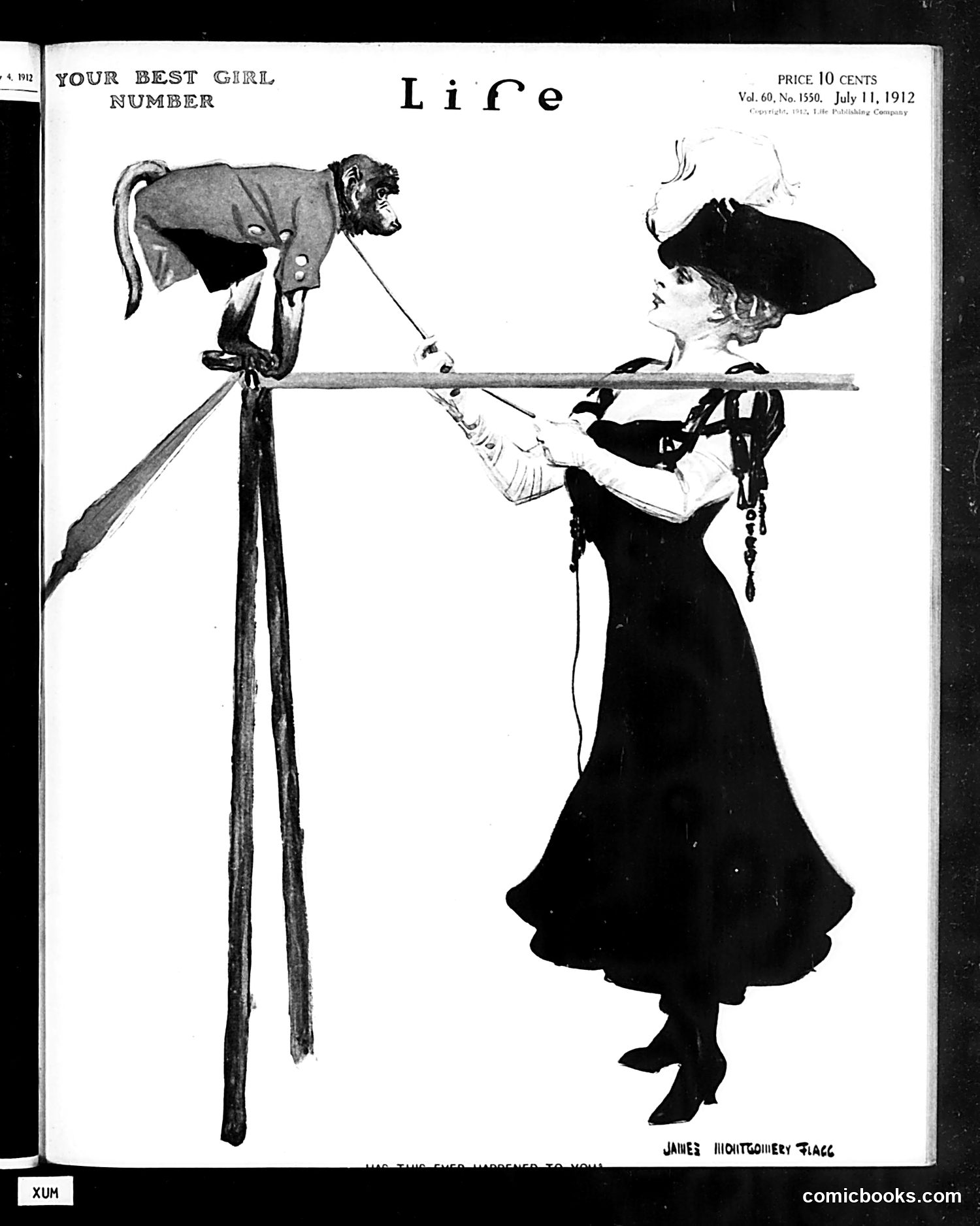
This cover illustration by James Montgomery Flagg depicts a fashionable woman operating a monkey on a tightrope—a visual pun on the phrase "your best girl number," which appears at top left. The cartoon plays on early 20th-century courtship conventions: the woman controls the monkey as a performer might manipulate a trained act, suggesting she "controls" her romantic partner or suitor. The monkey's exaggerated features and performing posture emphasize the absurdity of romance and male behavior under female direction. The elaborate Edwardian dress and decorative details underscore the satirical tone about gender dynamics and romantic relationships in this era. The visual metaphor suggests women's subtle but effective power in matters of courtship and romance.
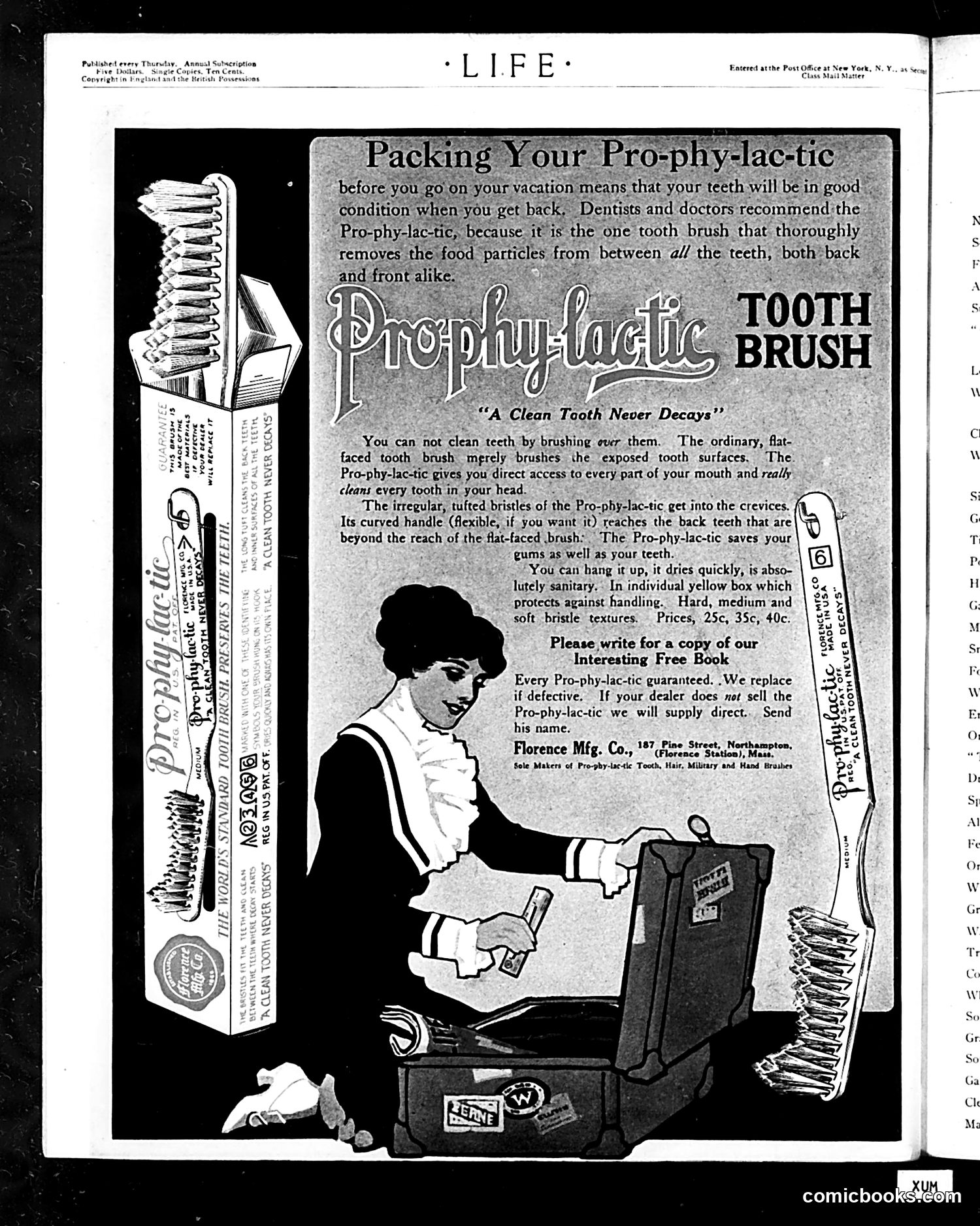
This page is primarily a **product advertisement** for the Pro-phy-lac-tic toothbrush, not political satire. The ad emphasizes the brush's superior design: its curved handle and tufted bristles allegedly reach between all teeth, unlike flat-faced competitors. The illustrated woman packing a suitcase for vacation represents the target consumer—middle-class Americans concerned with dental hygiene while traveling. The "joke" is practical rather than satirical: dentists recommend this brush because it cleans thoroughly. The manufacturer (Florence Mfg. Co., Northampton) makes claims typical of early-20th-century advertising—scientific endorsement, competitive superiority, and affordable pricing (25-35¢). There is **no political content**—this is straightforward commercial messaging.
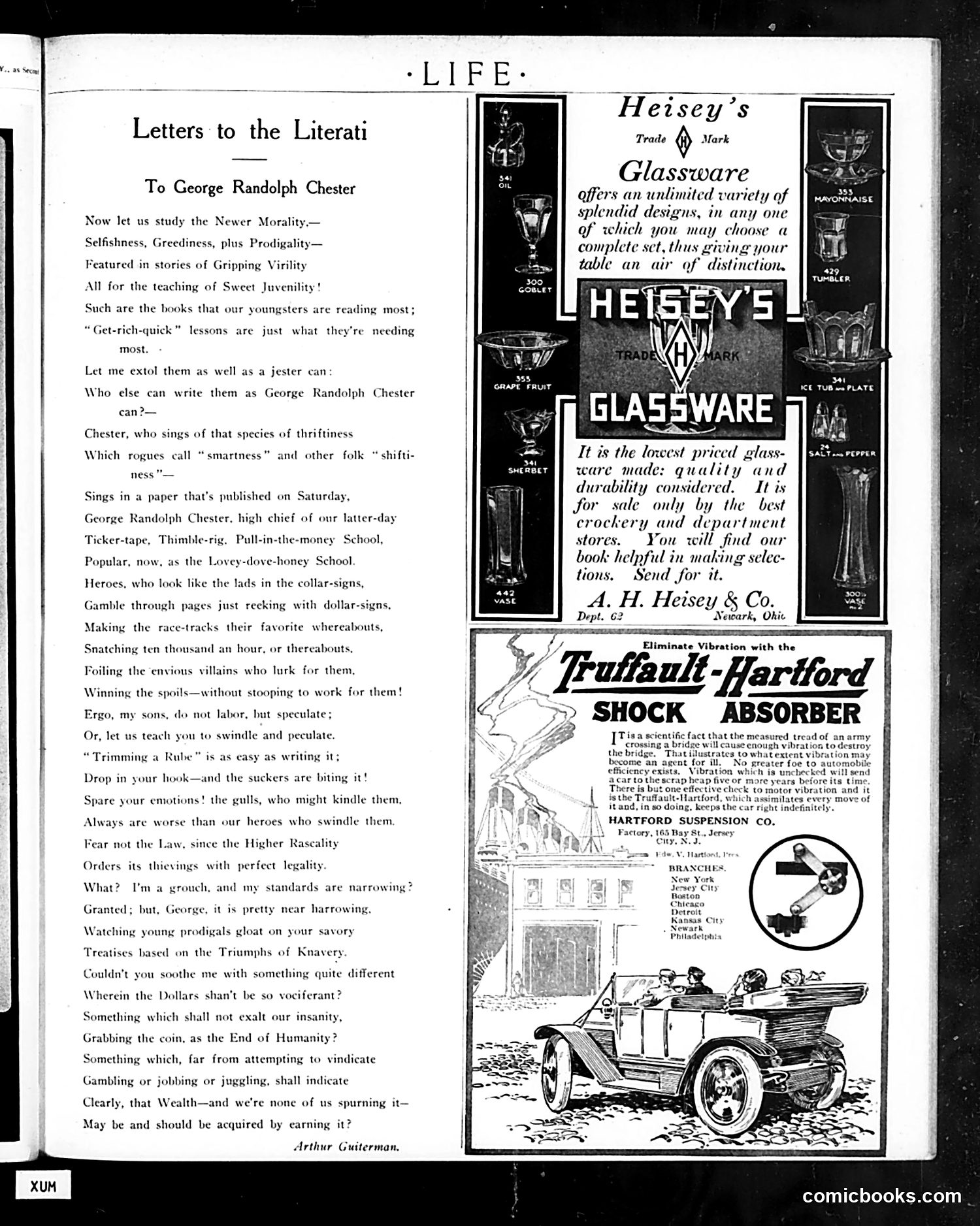
This page is **primarily advertising** with a minor satirical poem. The left column contains "Letters to the Literati"—a poem by Arthur Guterman mocking George Randolph Chester, a popular author of the era known for writing sensationalist stories about wealth-seeking and moral shortcuts ("Get-rich-quick" schemes). Guterman's satire criticizes Chester's books for glorifying dishonesty, gambling, and financial manipulation rather than honest labor. The poem suggests Chester teaches readers to "swindle and speculate" and avoid work—celebrating vice rather than virtue. The right side features period advertisements: Heisey's Glassware and the Truffault-Hartford Shock Absorber for automobiles. The satire reflects Progressive Era concerns about commercial literature promoting materialism and fraud over ethical conduct.
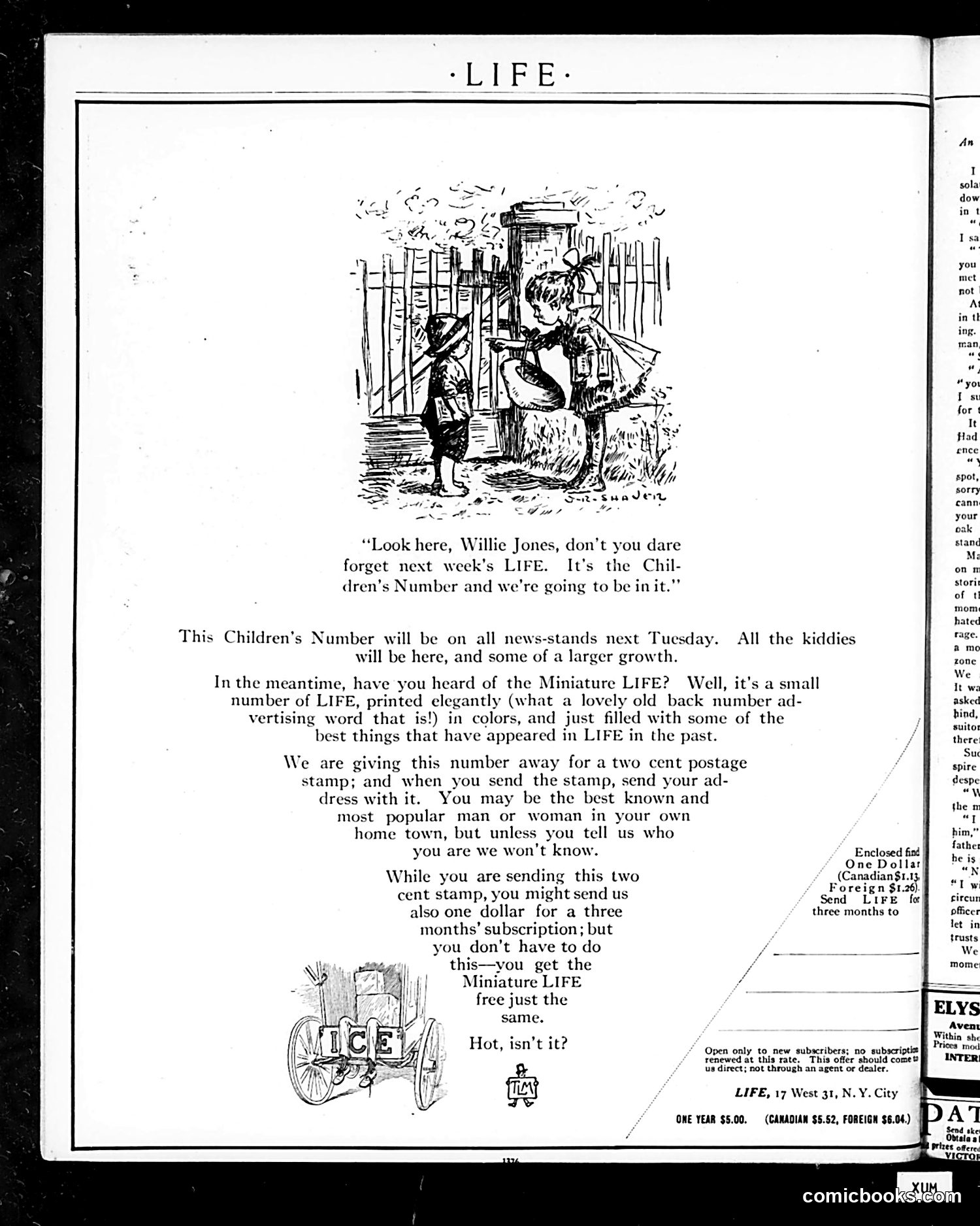
This page is primarily **promotional material** for Life magazine's upcoming "Children's Number" issue, to appear the following Tuesday on newsstands. The cartoon at top shows two children discussing the special issue, with one warning the other not to forget it. Below, the advertisement describes a "Miniature LIFE" — a smaller, elegantly-printed back issue collection of Life's best past content — available free with a two-cent postage stamp and readers' nomination of their town's "best known and most popular man or woman." The humor is gentle: the page uses children's enthusiasm to market the special issue and promote subscriptions (one dollar for three months). The ice-cream wagon logo adds whimsical appeal to the offer. This reflects Life's early 20th-century role as a **family-oriented humor and general-interest magazine**, distinct from its later photojournalism focus.
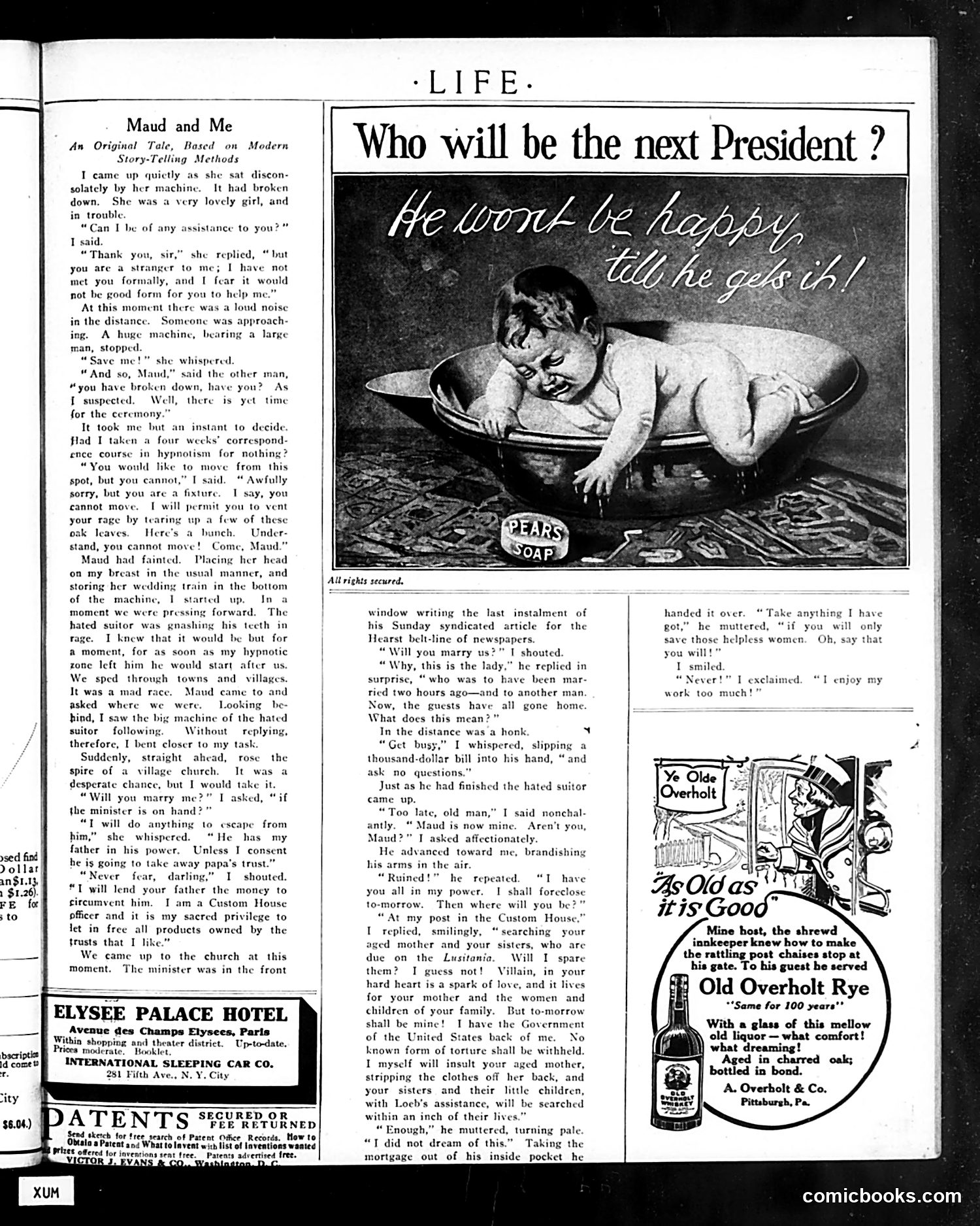
This page from *Life* magazine contains a short story ("Maud and Me") and advertisements rather than political cartoons. The main visual element is an advertisement for Pears' Soap featuring a cherub or baby figure with the headline "Who will be the next President?" and "He won't be happy till he gets it!" The satirical reference here appears to be commentary on presidential ambition—comparing a candidate's desire for the presidency to a spoiled infant's demands. However, **without a clear date on this page, I cannot identify which specific presidential election or candidate is being mocked**. The satire suggests contemporary anxiety about overly ambitious politicians, but the particular target remains unclear without additional context about when this issue was published.
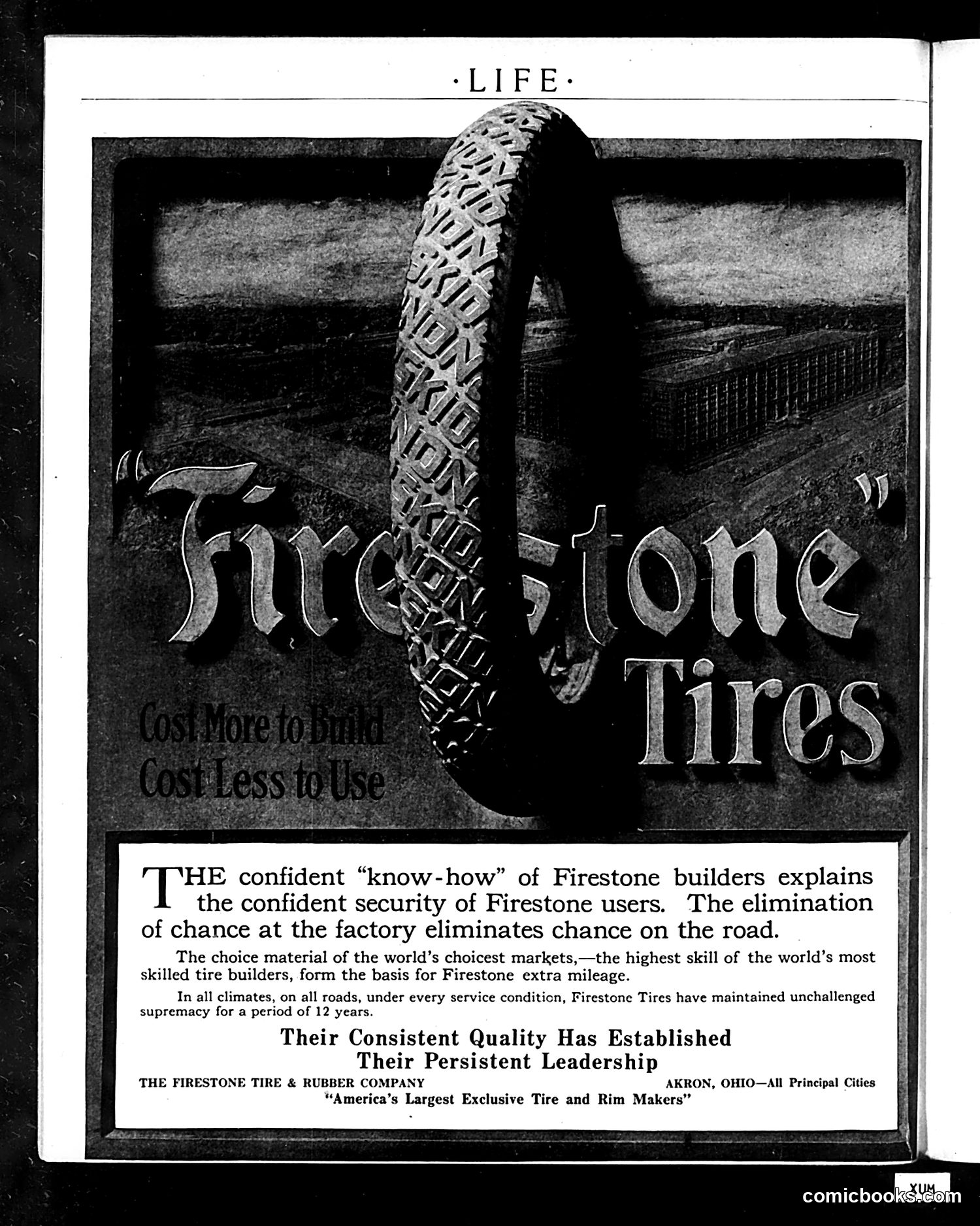
This is primarily a **Firestone Tires advertisement**, not political satire. The page appeared in *Life* magazine during the early 20th century. The ad features a large tire photographed against a rural landscape with a fence. The tagline promises tires that are "Cost More to Build / Cost Less to Use." The marketing copy emphasizes Firestone's manufacturing quality and reliability over a 12-year period, claiming "unchallenged supremacy" in all driving conditions. The company identifies itself as "America's Largest Exclusive Tire and Rim Makers," based in Akron, Ohio. There is **no cartoon or satire here**—it's straightforward product advertising using testimonial-style marketing common to the era. The visual appeal relies on the tire's tread pattern and durability messaging rather than humor.
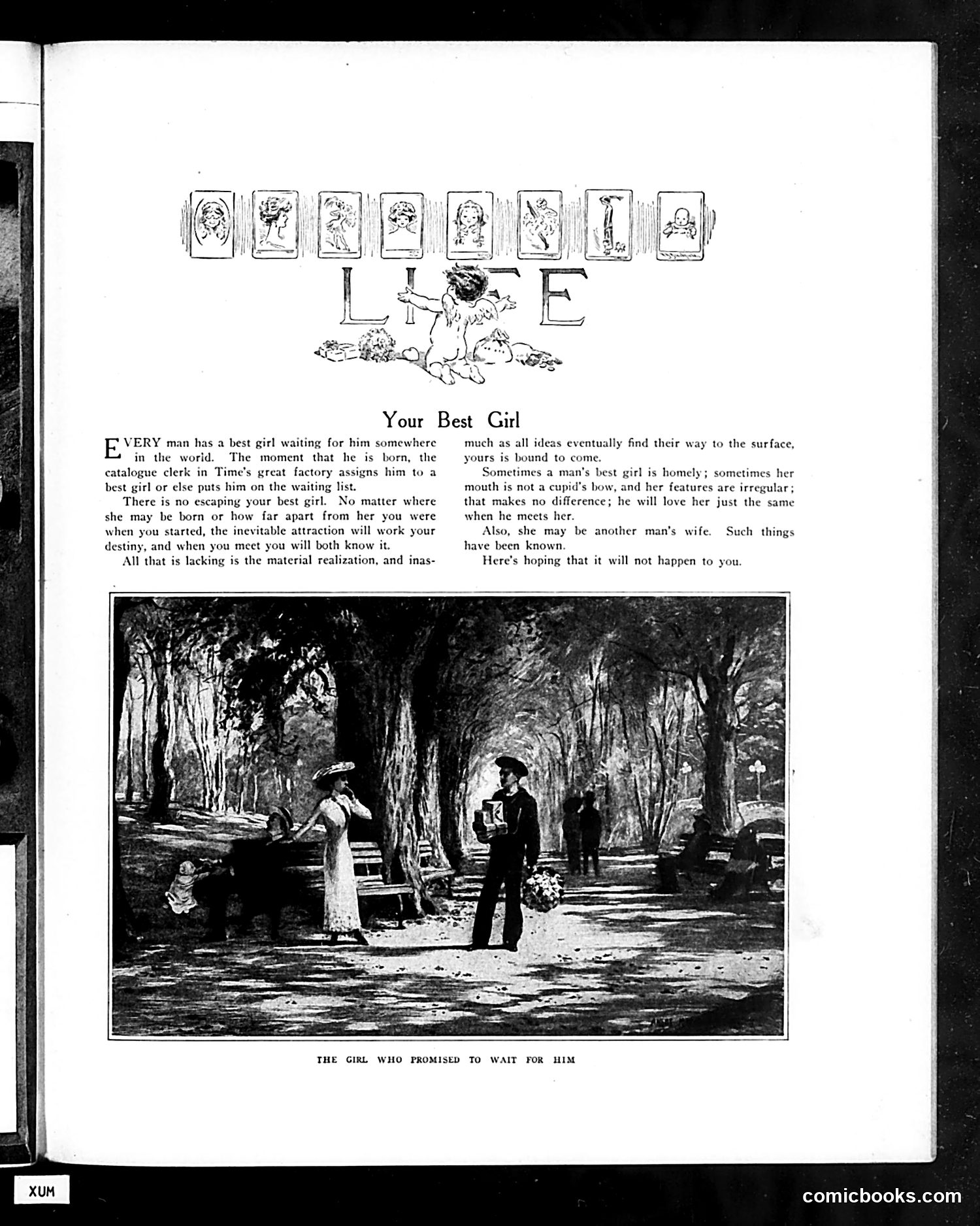
This page presents romantic advice framed as fortune-telling. The header features eight tarot or fortune-telling cards above the word "LIFE," with an illustration of a fortune teller below. The article "Your Best Girl" uses fate/destiny language to discuss romantic inevitability. It suggests every man has a predetermined "best girl" waiting somewhere, and that no matter circumstances or choices, they will eventually meet. The text acknowledges complications (she might be plain, or already married) but expresses hope the reader will be spared such complications. The accompanying illustration shows a couple meeting in a tree-lined avenue, likely representing this fated romantic encounter. The satire gently mocks both romantic fatalism and the magazine's own fortune-telling conventions while offering reassurance to readers about their romantic futures.
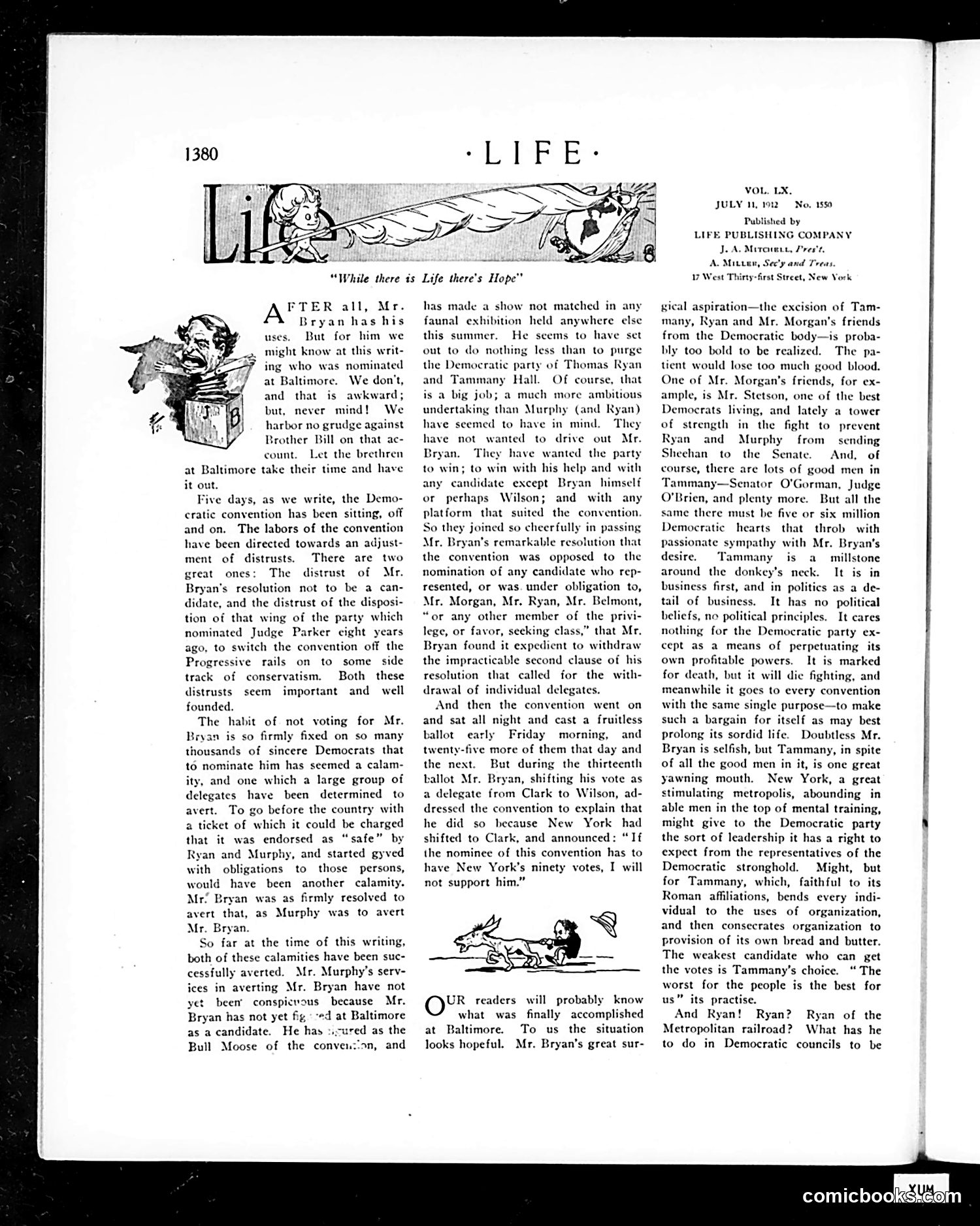
This page discusses William Jennings Bryan's activities at the Democratic National Convention. The text criticizes Bryan for manipulating the convention to prevent certain candidates' nominations while avoiding commitment to any specific alternative candidate himself. The article suggests Bryan was strategically positioning himself as kingmaker rather than nominee. Key figures mentioned include Thomas Ryan (a wealthy Democrat), Judge O'Gorman, and Senator O'Gorman. The satire mocks Bryan's apparent contradiction: he wielded significant power to block others while claiming political principle, essentially prolonging "his sordid life" through political maneuvering. The cartoons (visible but small) likely reinforce these themes of political manipulation and hypocrisy during this consequential 1912 election cycle.
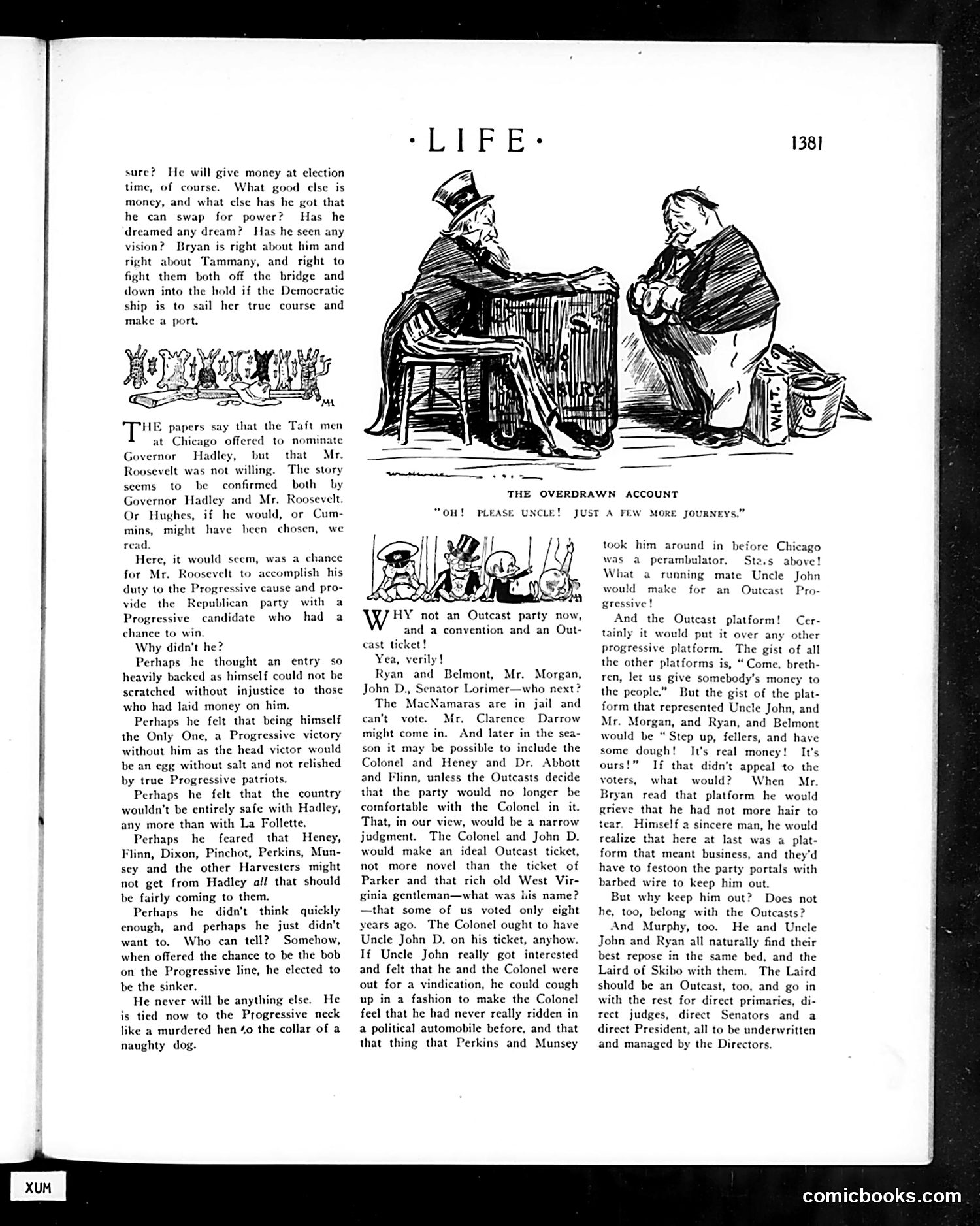
The cartoon satirizes Roosevelt's potential candidacy for the Progressive ("Bull Moose") Party in the 1912 election. The image shows Uncle Sam as a banker confronted by a well-dressed figure (Roosevelt) requesting "just a few more journeys"—a reference to Roosevelt's political ambitions after his presidency. The accompanying text debates whether Roosevelt should lead a Progressive ticket, discussing potential candidates like Hiram Johnson and Colonel John D. while criticizing the idea that Roosevelt could simply resurrect his political fortunes. The satire suggests Roosevelt has overdrawn his political "account" and lacks the capital to mount a successful challenge, positioning him as a political borrower whose credit has been exhausted.
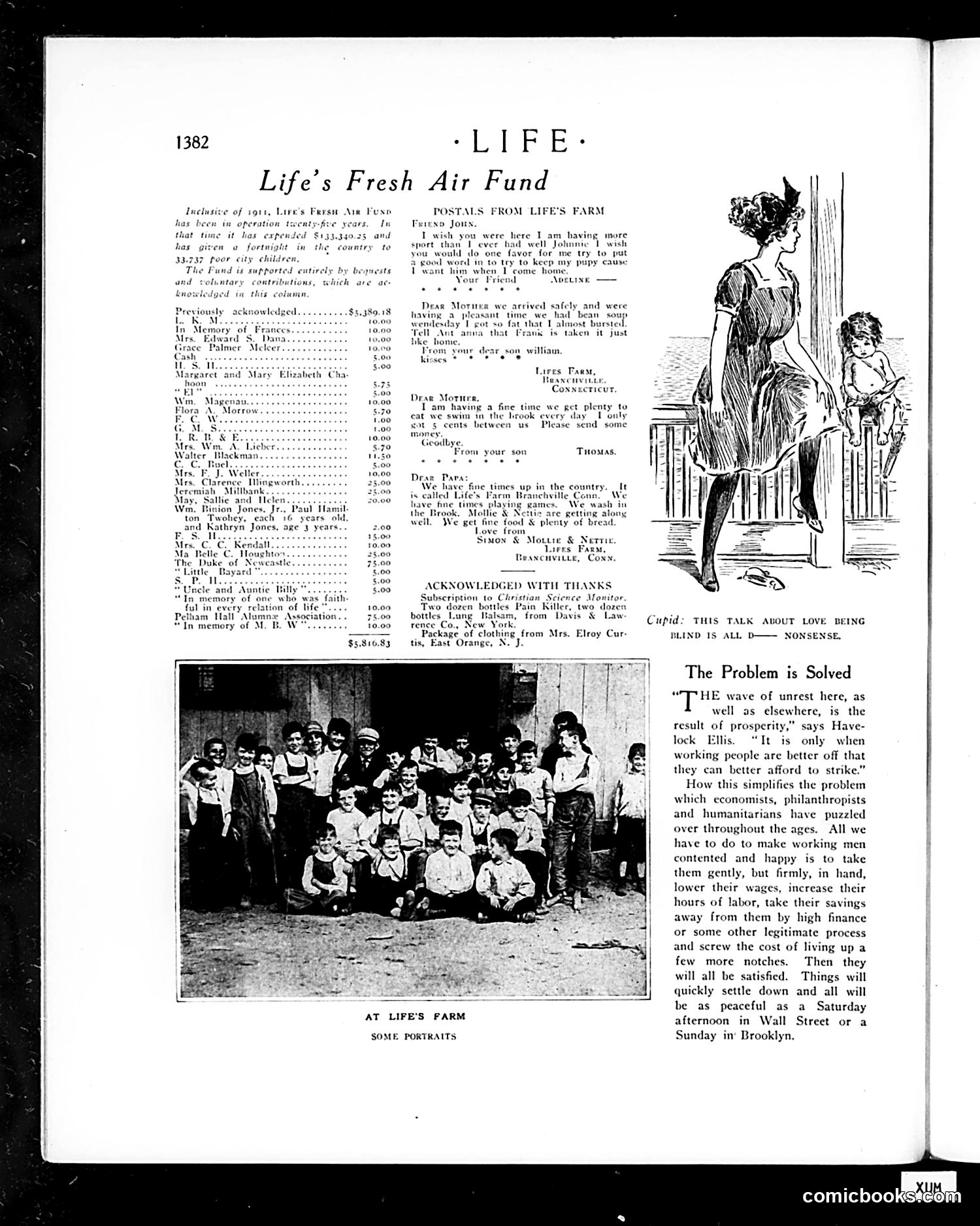
This page documents Life magazine's charitable "Fresh Air Fund," which sent poor city children to farms for health and recreation. The left column lists donors and contributions totaling $1,816.83. The central photograph shows a large group of children and adults at "Life's Farm" in Branchville, Connecticut—a visual demonstration of the fund's beneficiaries. The right side contains an illustrated article titled "The Problem is Solved," which sarcastically critiques economic inequality. It mocks the notion that poverty can be solved simply by lowering workers' wages, increasing their labor hours, and reducing their savings—implying such harsh measures would make the poor "as peaceful as a Saturday afternoon in Wall Street." The satire targets wealthy indifference to working-class suffering.
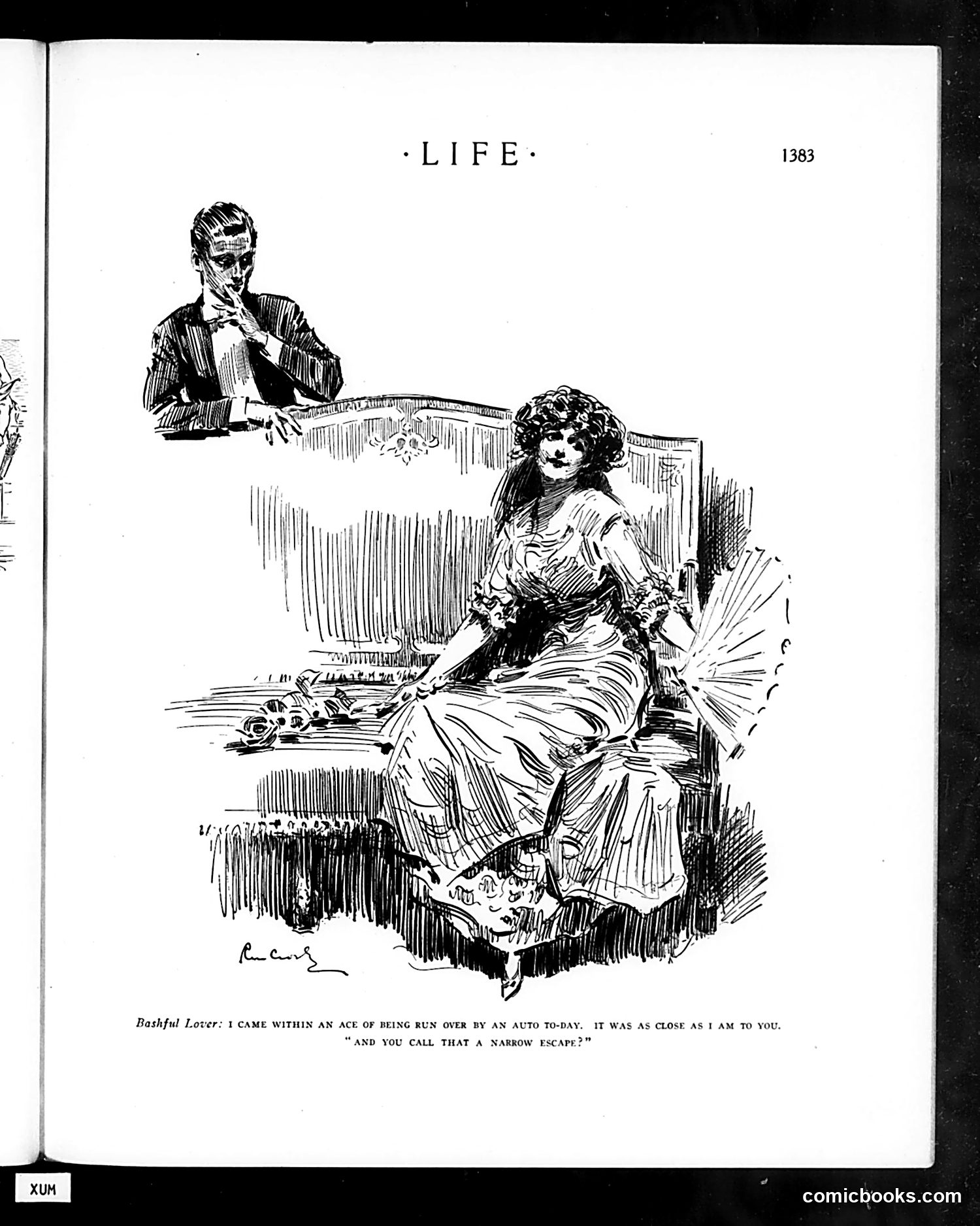
This is a romantic comedy sketch from *Life* magazine (page 1383). The illustration shows a well-dressed man standing behind a woman seated in an armchair. The caption presents their dialogue: the man claims he narrowly escaped being hit by an automobile, calling it "as close as I am to you," and sarcastically asks if she considers that "a narrow escape." The joke relies on a familiar romantic trope: the bashful suitor attempting intimate contact with a woman who maintains emotional distance or reserve. The cartoon satirizes both male romantic persistence and female resistance to unwanted proximity—a common theme in early 20th-century humor about courtship and social propriety.
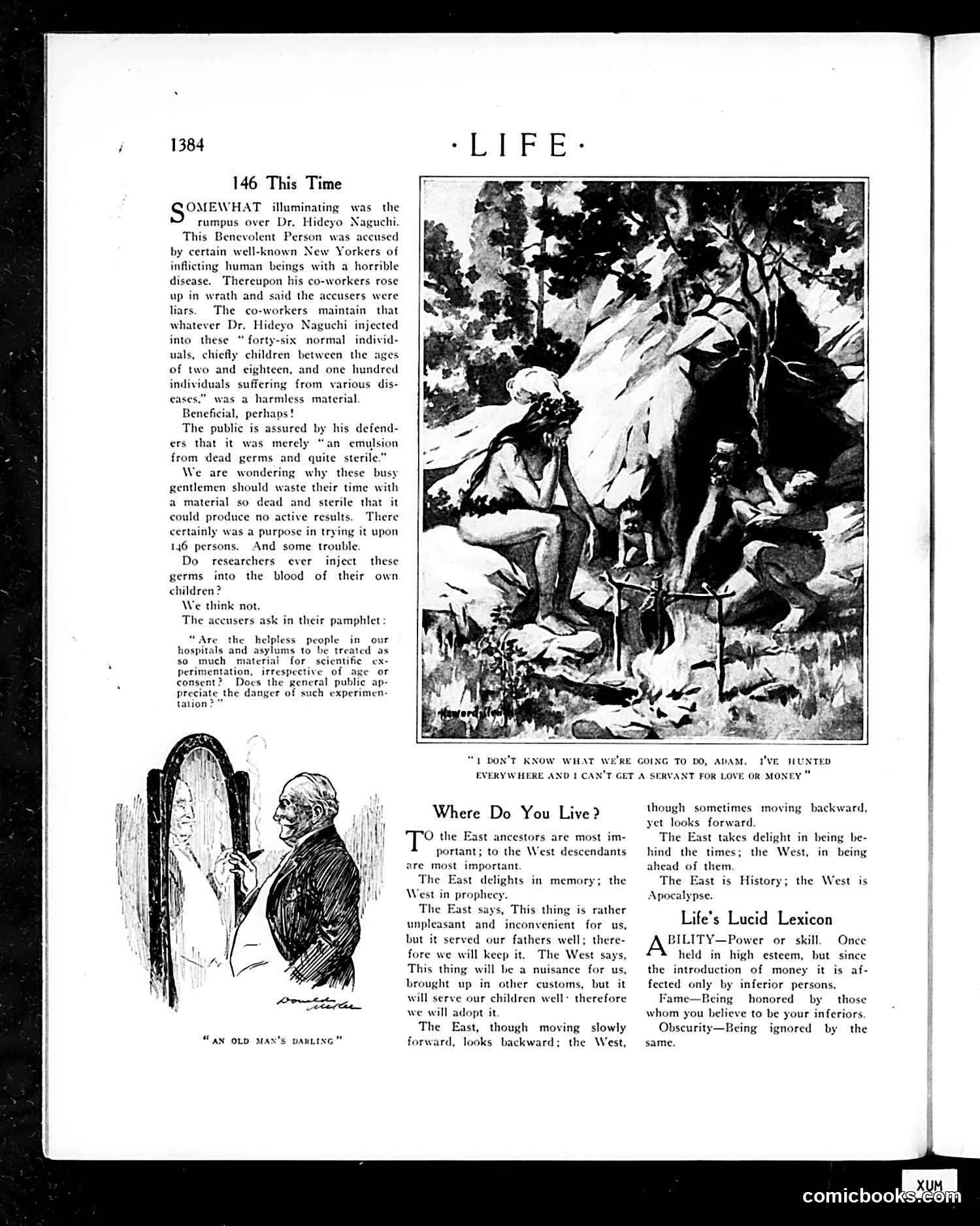
The page contains two distinct items: **Top Article "This Time"**: Discusses Dr. Hideyo Naguchi, a renowned scientist accused by New Yorkers of conducting unethical medical experiments—injecting disease germs into 146 people (mostly children) claiming the material was "harmless." The piece sarcastically questions whether researchers would inject these germs into their own children, and challenges the public to reconsider such experimentation on hospital patients without proper consent. **Cartoon "An Old Man's Darling"**: A satirical sketch showing an elderly man admiring his reflection, suggesting vanity or self-delusion about aging. **"Where Do You Live?" Section**: Philosophical commentary contrasting East (tradition, memory, looking backward) with West (prophecy, progress, looking forward), presented as a cultural debate about which approach serves society better.
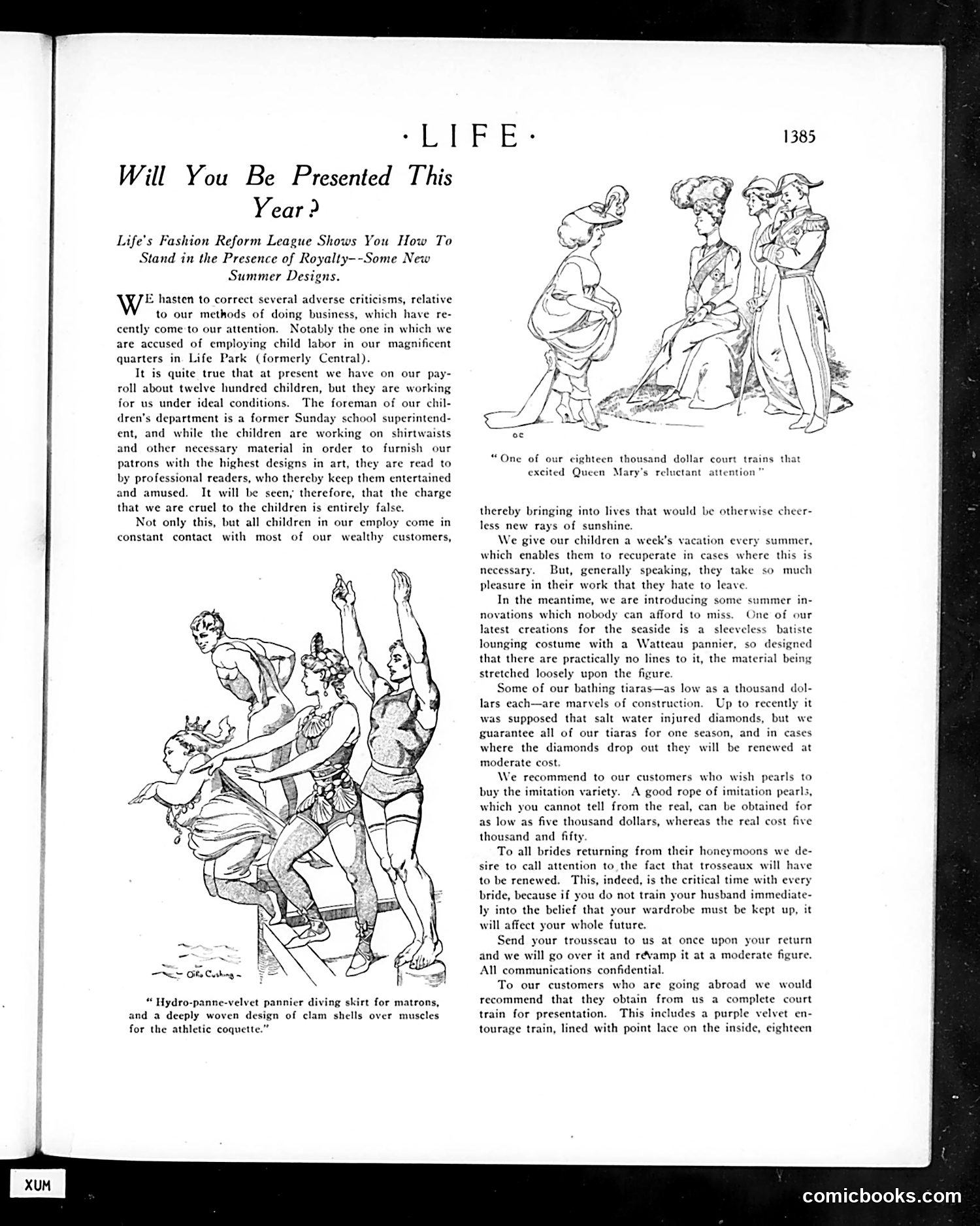
This page is primarily **commercial advertising** disguised as editorial content for an upscale department store (likely Marshall Field's, based on context clues about "our magnificent quarters in Lake Park"). The text defends the store against accusations of child labor, claiming their young workers are treated well and supervised by educated managers. This reflects real Progressive Era anxieties about exploitative labor practices in retail. The two illustrations show fashionable women in elaborate bathing costumes and court presentation gowns—typical luxury goods advertisements of the period. The caption about the "$18,000 court train" emphasizes exclusivity and high prices for wealthy customers. The page satirizes how wealthy merchants deflected labor criticism while promoting expensive fashion to the elite, highlighting the class divide in early 20th-century America.
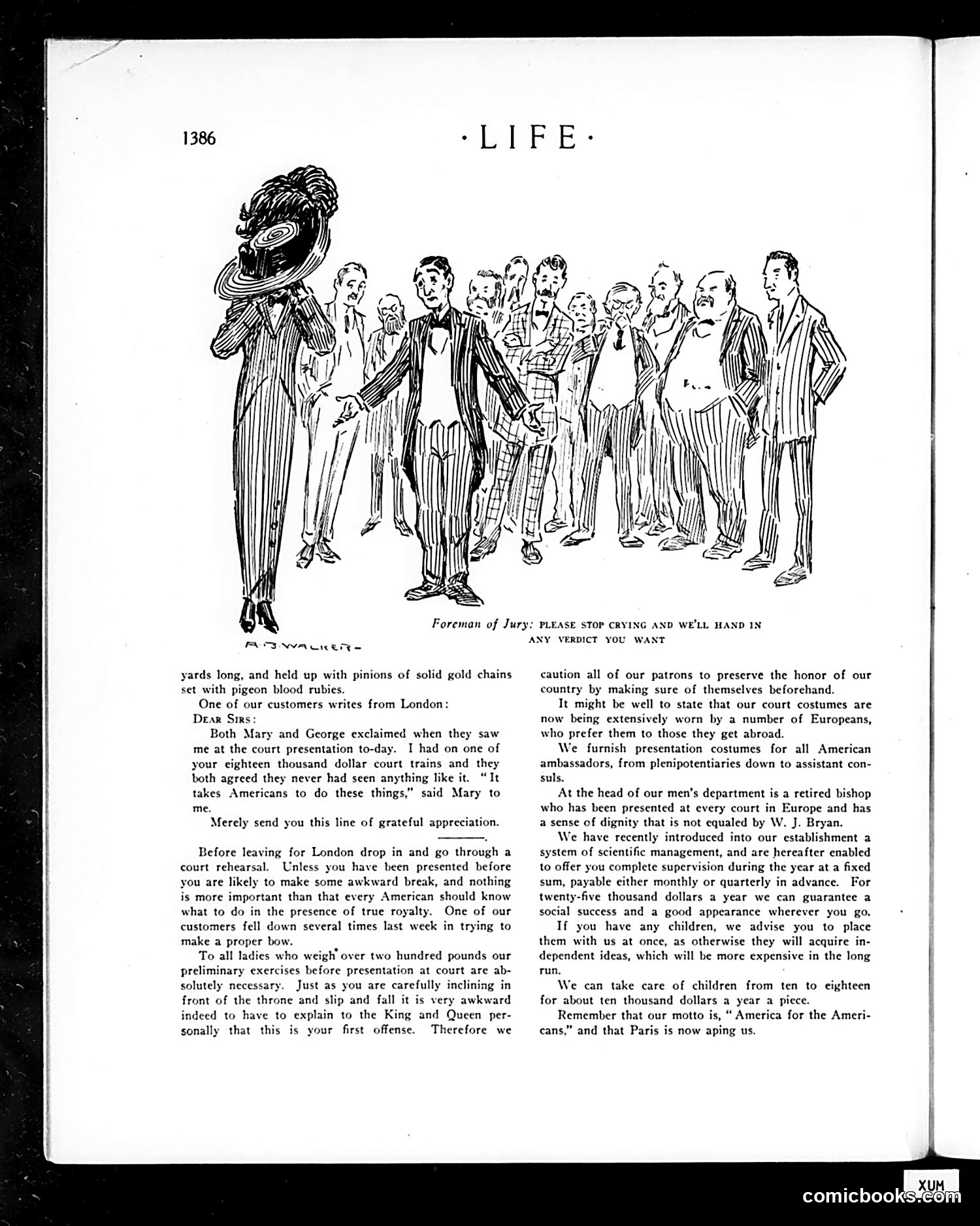
The main cartoon depicts a flamboyantly dressed figure (left) presenting themselves to a jury of formally-dressed men. The caption reads: "Foreman of Jury: PLEASE STOP CRYING AND WE'LL HAND IN ANY VERDICT YOU WANT" The satire targets American court presentation and fashion excess. The figure's elaborate hat, chains, and theatrical clothing suggest someone attempting to impress through ostentatious display—likely mocking wealthy Americans' pretentious European fashions and courtroom behavior. The accompanying text discusses American court customs and etiquette, including advice on proper presentation before British royalty and recommendations for hiring a household management service. The satire suggests Americans lack sophistication in formal settings and must be coached in basic decorum—a common early-20th-century theme mocking American nouveau riche behavior abroad.
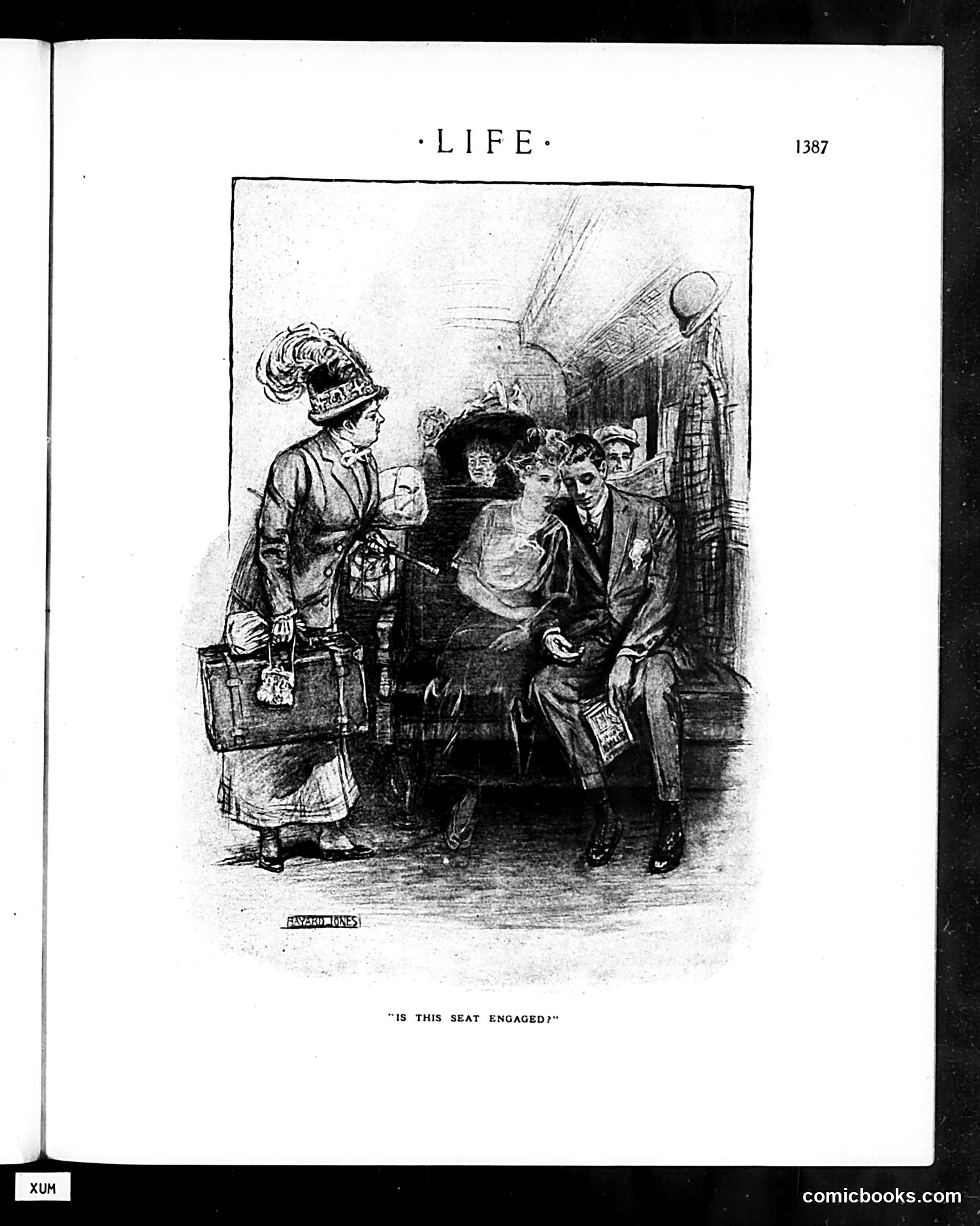
This satirical cartoon from *Life* magazine depicts a social etiquette situation at what appears to be a public venue—likely a theater, train, or similar gathering space. A fashionably dressed woman with an elaborate feathered hat stands confronting a seated couple and man, asking if the seat is occupied. The humor targets Victorian-era social conventions around public seating and personal space. The woman's ornate appearance and imperious manner suggest she expects deference, while the seated figures' body language indicates resistance or annoyance at her presumption. The cartoon satirizes the friction between rigid social hierarchies and democratic public spaces where seats were technically available to anyone—a common tension point in early 20th-century urban social life where old aristocratic assumptions clashed with modern, crowded public settings.
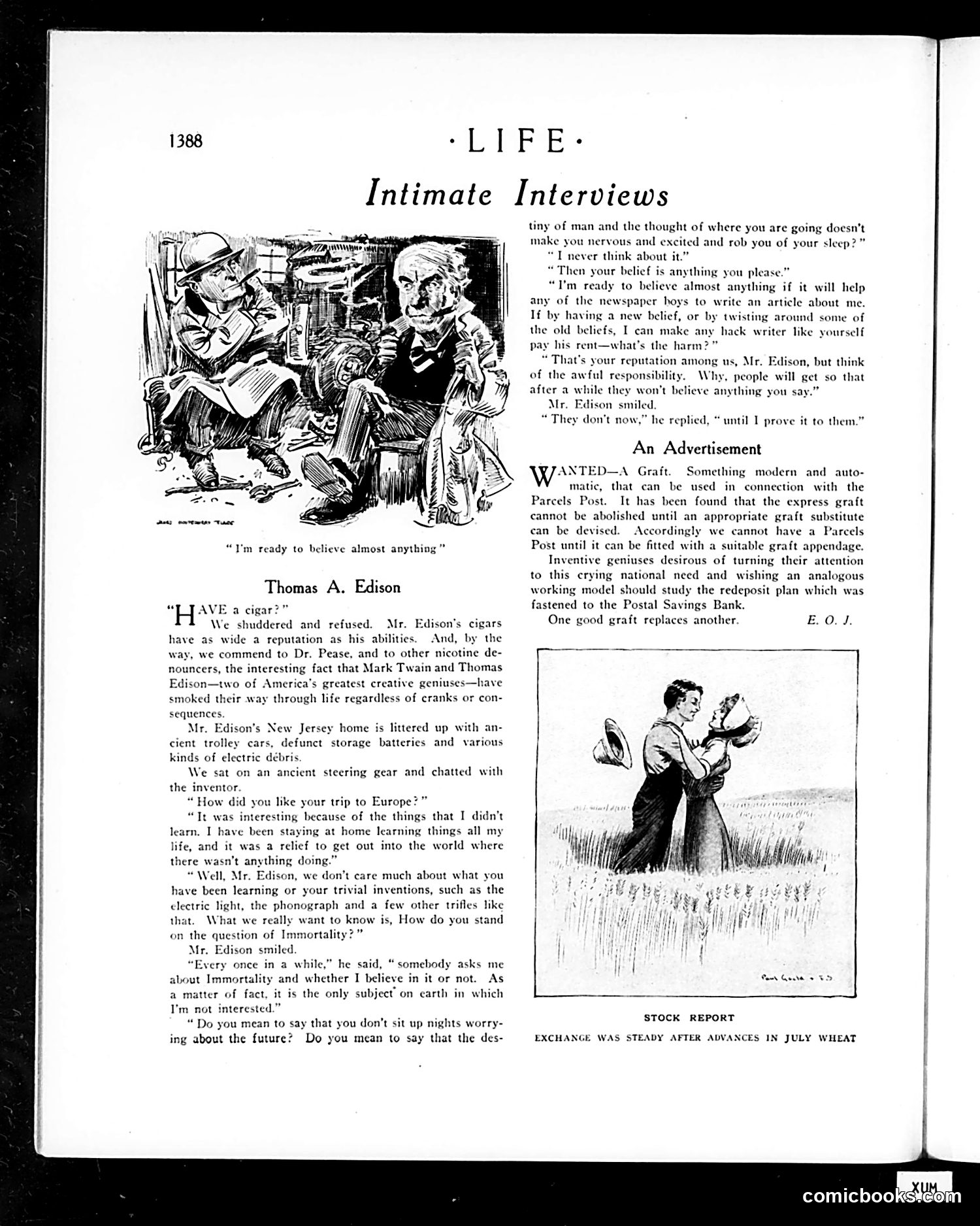
This page presents an "Intimate Interview" with Thomas Edison, the famous inventor. The cartoon depicts Edison as a pragmatist willing to adopt any belief if it benefits others (here, helping newspaper writers earn money). The satire targets Edison's reputation for making bold public pronouncements on subjects beyond his expertise—he was known for casual claims about immortality, spiritualism, and other non-scientific matters. The interview's humor comes from Edison dismissing "trivial inventions" like the electric light and phonograph, then admitting he doesn't actually worry about immortality or philosophy. Life magazine mocks both Edison's cavalier attitude toward truth and the public's gullible reception of his opinions. The accompanying advertisement parodies government corruption by jokingly proposing a "modern graft" system for the Parcels Post—satirizing real concerns about postal corruption and bureaucratic inefficiency of the era.
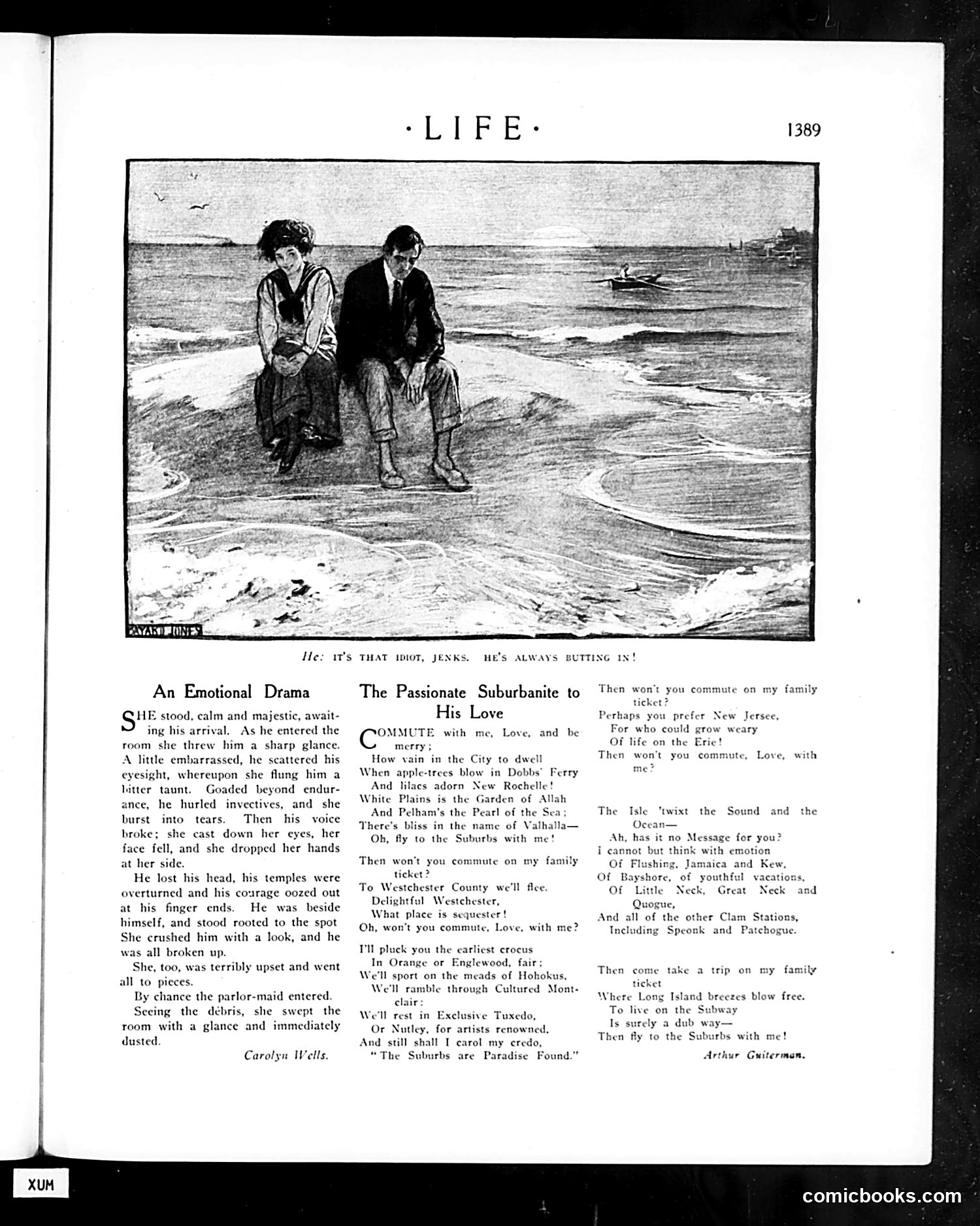
This page contains two satirical pieces from *Life* magazine. **"An Emotional Drama"** (by Carolyn Wells) is a tongue-in-cheek prose sketch mocking overwrought domestic melodrama. It describes a couple's escalating emotional outburst—taunt, tears, invectives, broken voice—rendered in exaggerated, theatrical language. The joke: when their maid enters and simply dusts, the "debris" is literal, deflating the pretense of their emotional turmoil into mundane reality. **"The Passionate Suburbanite to His Love"** (by Arthur Guiterman) is comic verse satirizing the suburban booster mentality. A man relentlessly cajoles his love to abandon the city and join him in commuting from Westchester County and Long Island suburbs. He rhapsodizes over place names (Dobbs Ferry, New Rochelle, Tuxedo) as romantic paradises, repeatedly pleading "won't you commute, Love, with me?" The satire targets both suburban real-estate enthusiasm and the desperate, repetitive sales-pitch tone of the suitor's appeal.
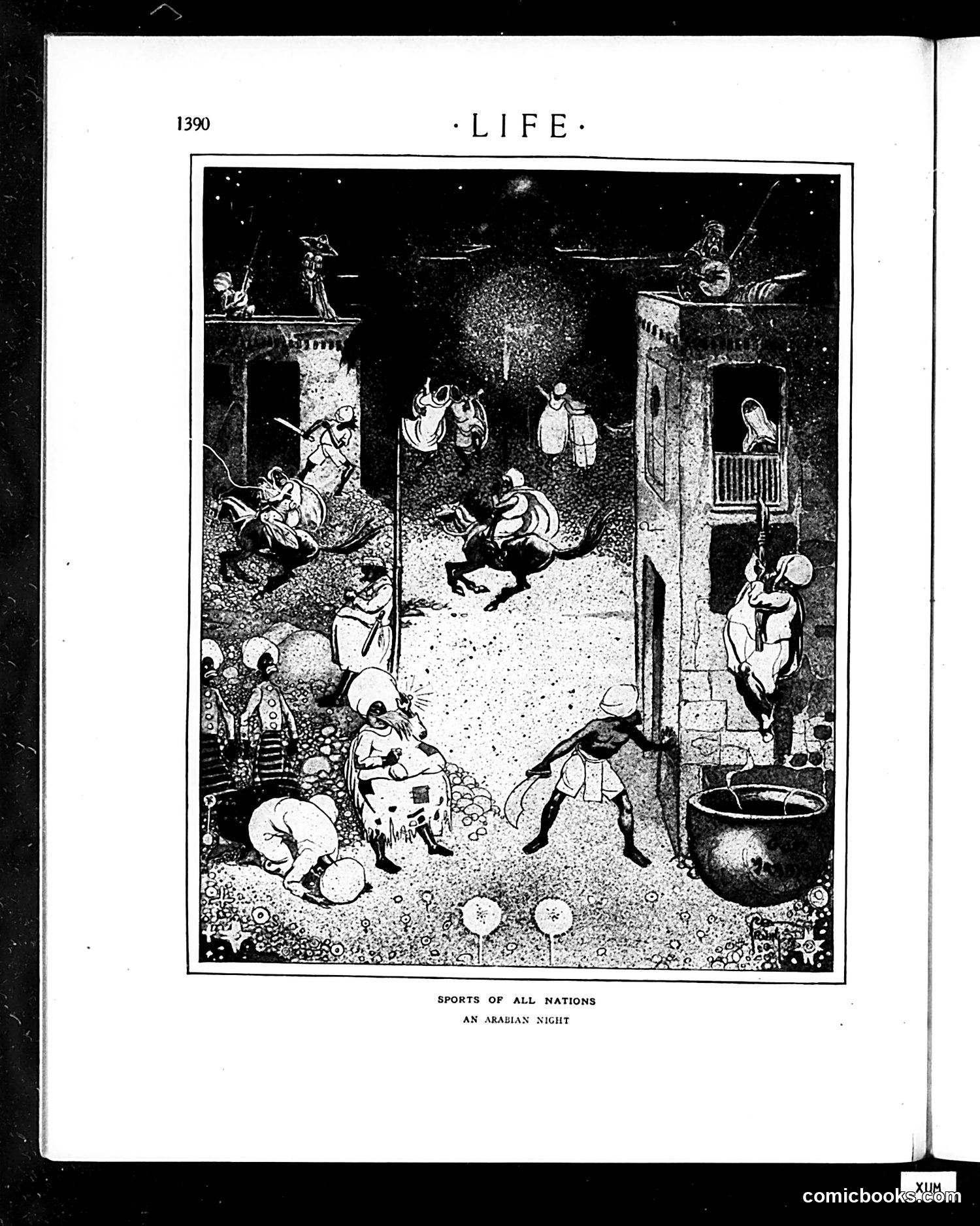
This satirical illustration depicts an exotic, fantastical scene labeled as Arabian in style. The image shows various figures engaged in acrobatic and playful activities within a fortified courtyard setting—tumbling, juggling, and performing athletic feats. The castle towers and architectural elements suggest an orientalist fantasy rather than realistic depiction. The satire likely plays on Western stereotypes of Middle Eastern culture as exotic, theatrical, and frivolous—reducing a complex region to entertainment spectacle. By framing these activities as "sports of all nations," the piece may mock either Western fascination with "Oriental" culture or contemporary attitudes that viewed non-Western peoples through an escapist, fantastical lens rather than seriously. The publication in *Life* magazine suggests this reflected early 20th-century popular attitudes toward non-Western cultures.
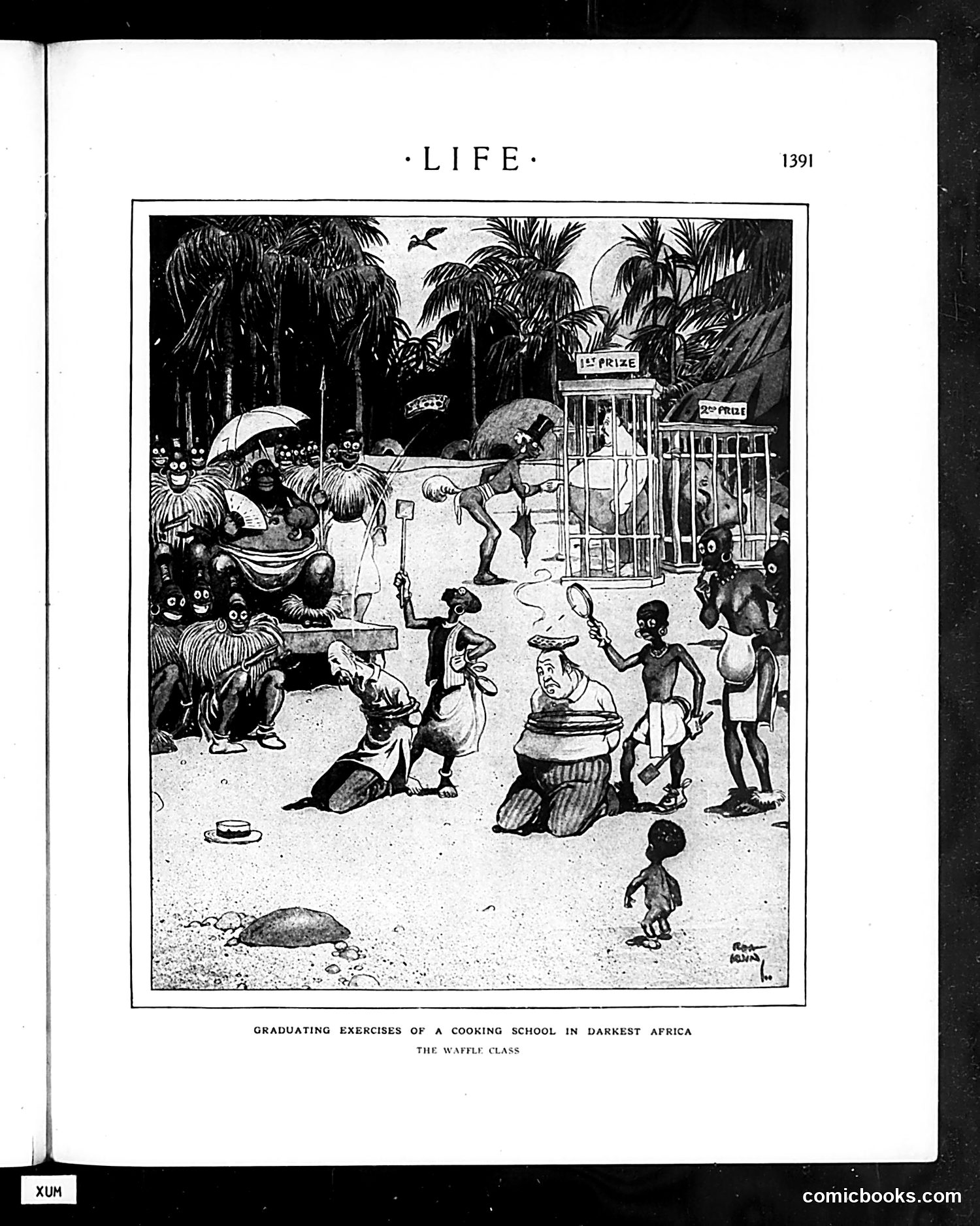
This is a racist satirical cartoon from *Life* magazine depicting African people as primitive and uncivilized. The title's phrase "Darkest Africa" reflects a common Victorian-era term used to portray Africa as backwards and unknowable. The "joke" relies on dehumanizing caricature: the figures are drawn with exaggerated features common to racist imagery of the era. The absurdist premise—a "cooking school" teaching waffles in Africa—mocks both African capability and Western condescension about "civilizing" non-Western peoples. The visible elements include carnival-like structures, caged animals, and onlookers, all reinforcing a framework that treated African people as exotic spectacles for Western entertainment and ridicule. This represents the casual, normalized racism embedded in early 20th-century American popular media.
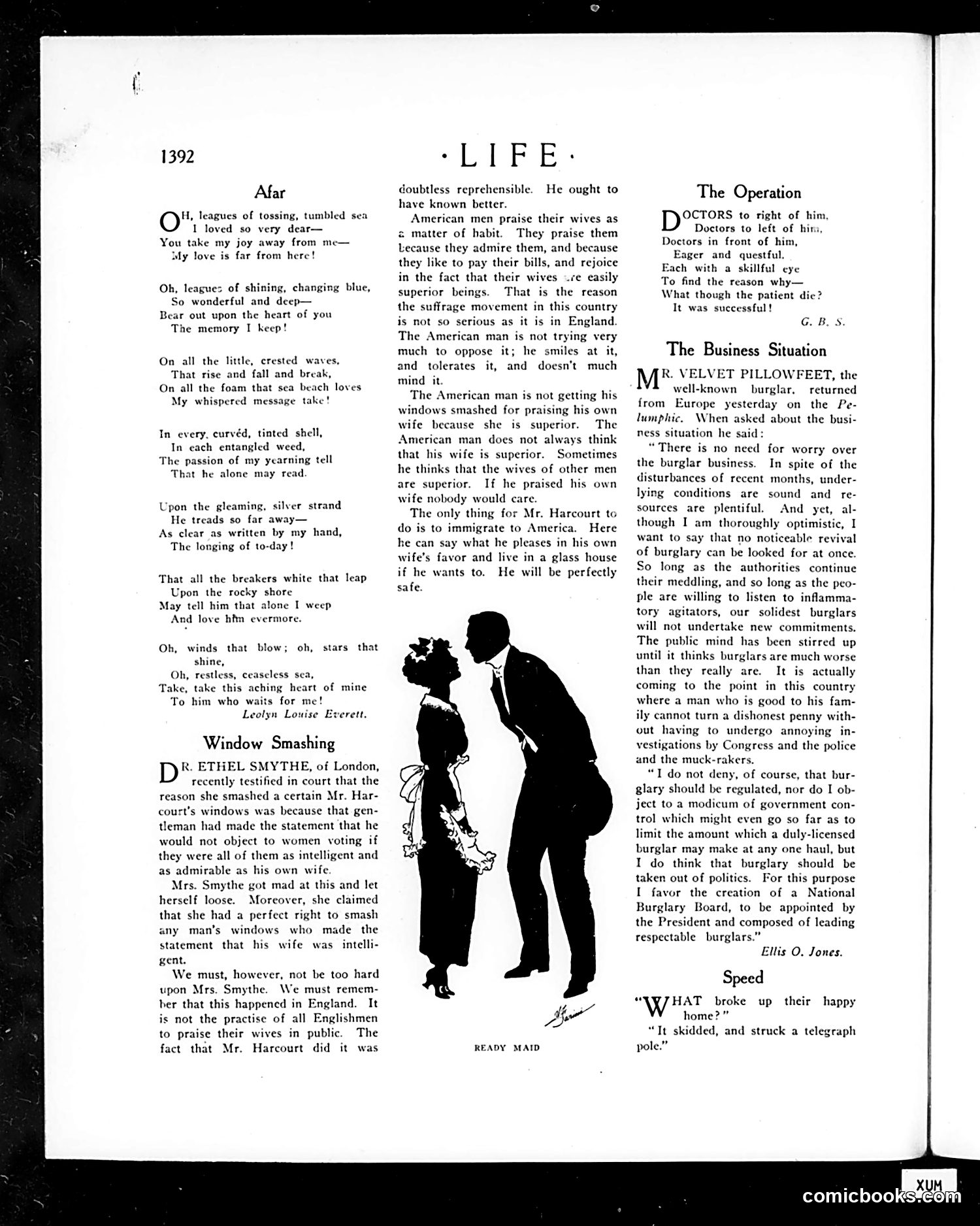
This 1912 *Life* page satirizes gender politics and American attitudes toward women's rights through three pieces: **"Window Smashing"** mocks British suffragist Dr. Ethel Smythe, who reportedly smashed windows after a man (Mr. Harcourt) said he'd support women's voting if they were as intelligent as his wife. The satire contrasts English and American men: English gentlemen don't publicly praise wives (thus provoking violence), while American men casually praise theirs without consequence. The piece suggests Americans tolerate suffrage because they're indifferent rather than principled. **"The Operation"** uses dark humor about surgical incompetence—doctors surrounding a patient who dies, yet call it "successful"—likely mocking professional arrogance. **"The Business Situation"** features a burglar giving economic commentary, absurdly presenting crime as a legitimate industry affected by public opinion and law enforcement. The satire criticizes both crime and possibly the serious economic discussion surrounding it. Overall, the page reflects early 20th-century American attitudes: patronizing toward women's suffrage, cynical about professional institutions, and satirizing social disorder.
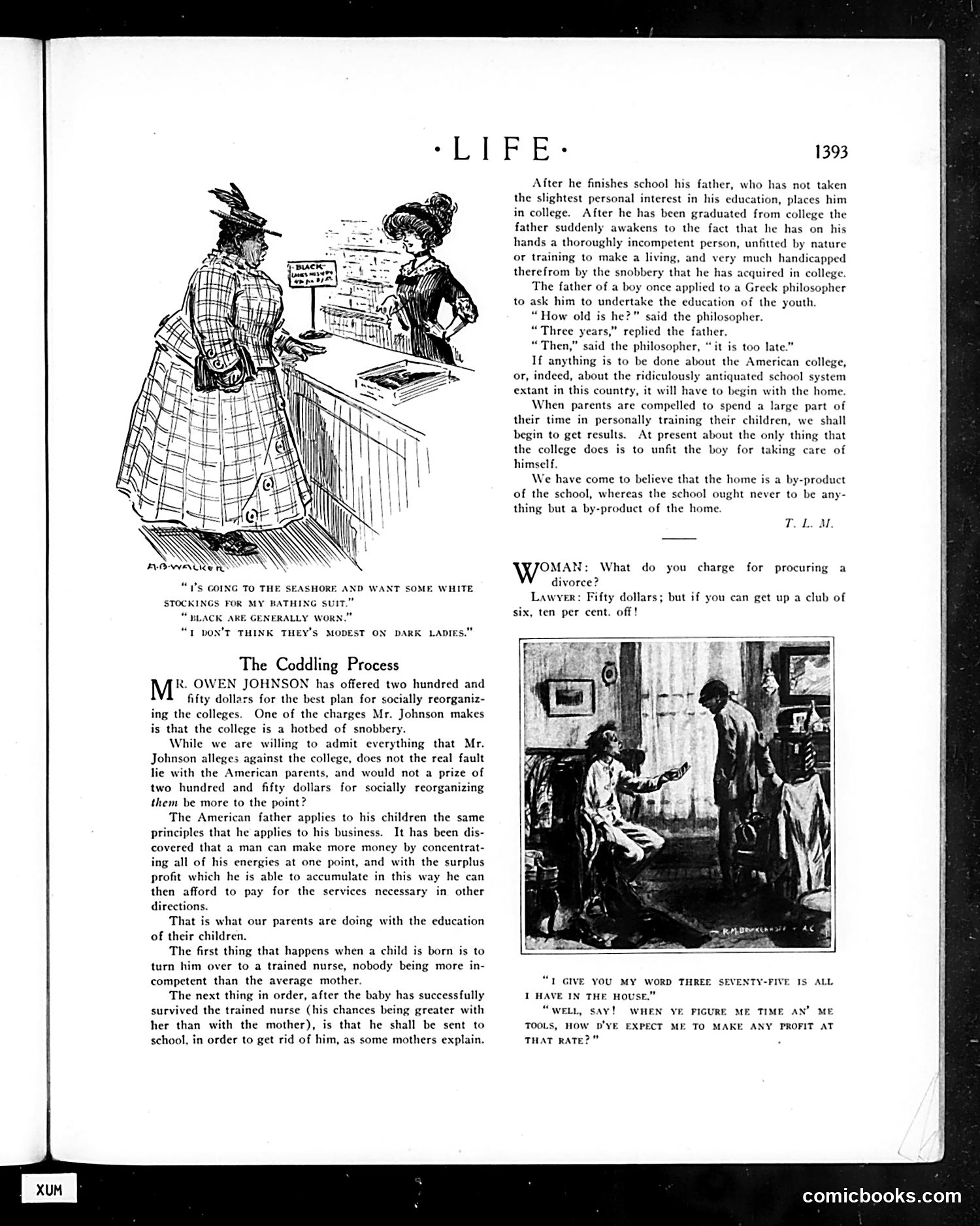
This page critiques American parenting and education through multiple satirical pieces. **"The Coddling Process"** (main article) attacks wealthy parents who outsource child-rearing entirely—hiring nurses, then schools—to avoid personal responsibility. The author argues parents apply business efficiency principles to children: concentrate effort elsewhere, pay professionals to handle "maintenance." The satire's target: affluent Americans who believe education alone will produce competent adults, when actually home training matters most. **Top cartoon**: A woman asks a shopkeeper for white stockings for her bathing suit, claiming "black are generally worn" but "I don't think they're modest on dark ladies"—likely satirizing racist attitudes about propriety and race. **Lawyer joke**: Mocks divorce's commercialization—a lawyer offers bulk discounts for divorce "clubs," suggesting divorce has become routine, commodified business. All content critiques American social hypocrisy: neglectful parenting dressed as progressive modernism, racism masked as etiquette concerns, and the reduction of serious matters to profit margins.
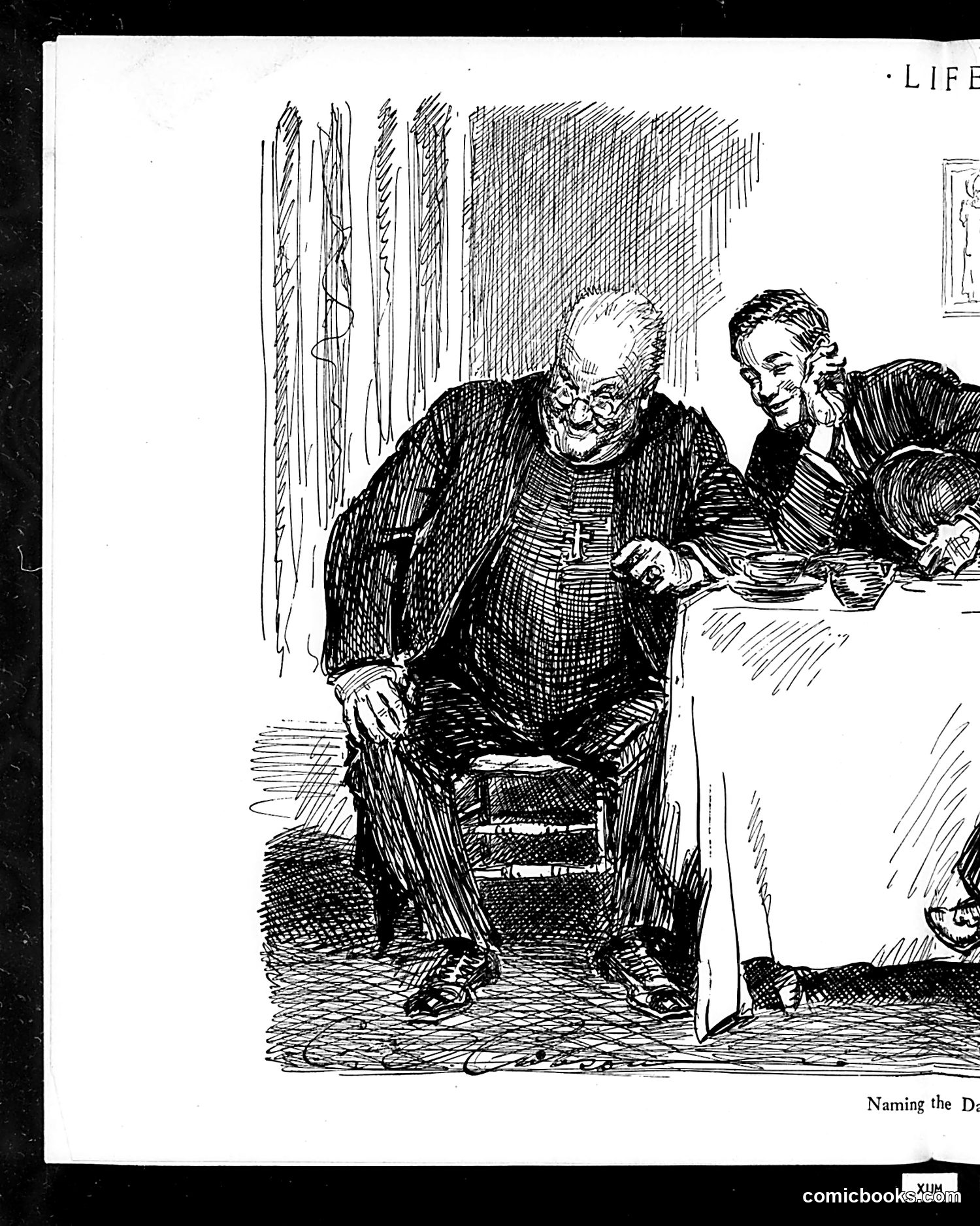
This appears to be a satirical cartoon from *Life* magazine showing an elderly man seated at a table with a younger man beside him. The caption reads "Naming the D[...]" (text cut off). The image depicts what seems to be a naming or christening scene, rendered in the magazine's characteristic ink-sketch style. The elderly figure's exaggerated facial features and posture suggest caricature, typical of *Life*'s political satire. The younger man leans in attentively. Without the complete caption, the specific political or social reference remains unclear. The scene could reference a formal naming ceremony, inheritance, or succession of some kind. The formal dress and indoor setting suggest a matter of institutional or social importance rather than a purely domestic affair. The actual subject and satirical point cannot be determined with certainty from the visible text alone.
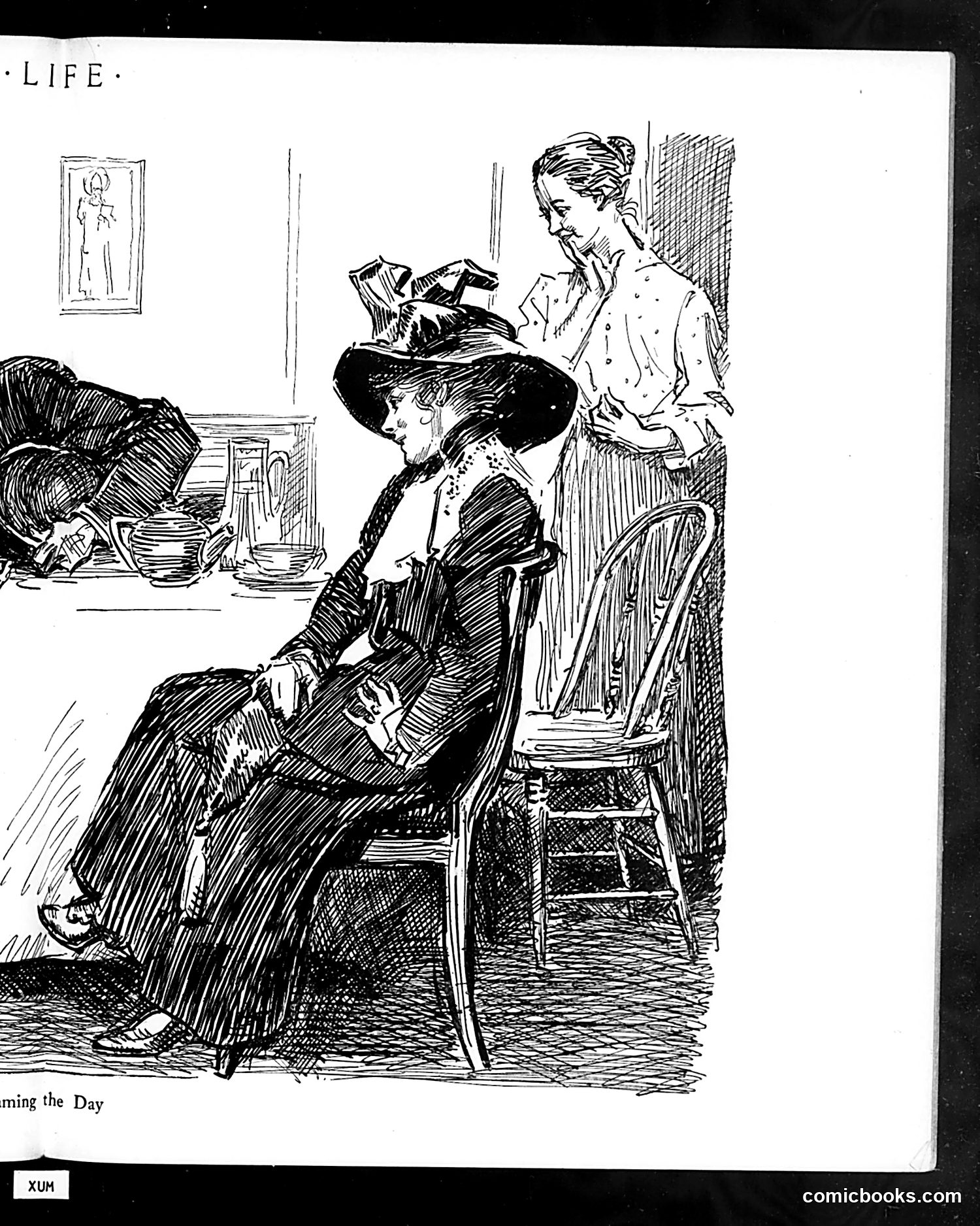
This appears to be a domestic scene from an early 20th-century Life magazine illustration titled (partially visible) "ming the Day." The image shows two women in a modest kitchen or domestic space: one seated wearing a large feathered hat and dark dress, the other standing in simpler attire. A small religious icon or saint image hangs on the wall above. The satire likely concerns **class distinctions and pretension**. The seated woman's elaborate, fashionable hat and formal dress contrast sharply with the humble domestic setting and simple furnishings, suggesting either **social aspiration beyond her means** or **pretentious behavior in inappropriate circumstances**. The standing woman's more practical appearance emphasizes this contrast. Without the complete caption, the specific social commentary remains unclear, but the visual joke targets feminine vanity or class-consciousness.
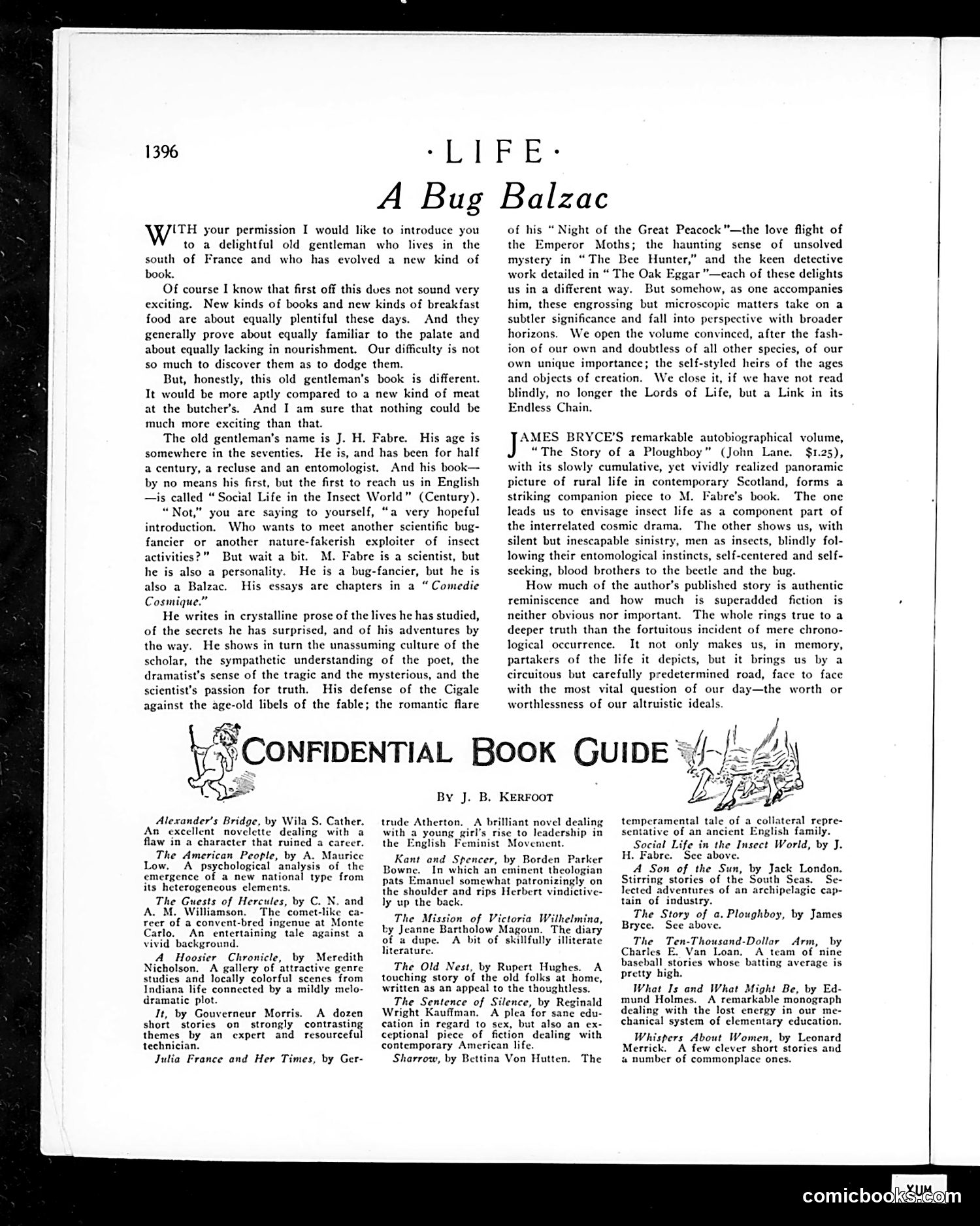
This is a literary essay introducing English readers to J. H. Fabre's *Social Life in the Insect World*, a French naturalist's entomological studies. The "Balzac" comparison references Honoré de Balzac, the great 19th-century French novelist, suggesting Fabre combines scientific precision with literary artistry and human insight. The satire is gentle: the reviewer playfully acknowledges that a book about insects sounds unpromising (compared unfavorably to new breakfast cereals), yet argues Fabre transcends typical "bug-fancier" writing through his poetic prose and philosophical depth. His observations about insects supposedly humble human pretension—we're not "Lords of Life" but merely "a Link in its Endless Chain." The accompanying "Confidential Book Guide" reviews other contemporary titles. This reflects early 20th-century middlebrow literary culture where magazines guided educated readers toward "serious" literature.
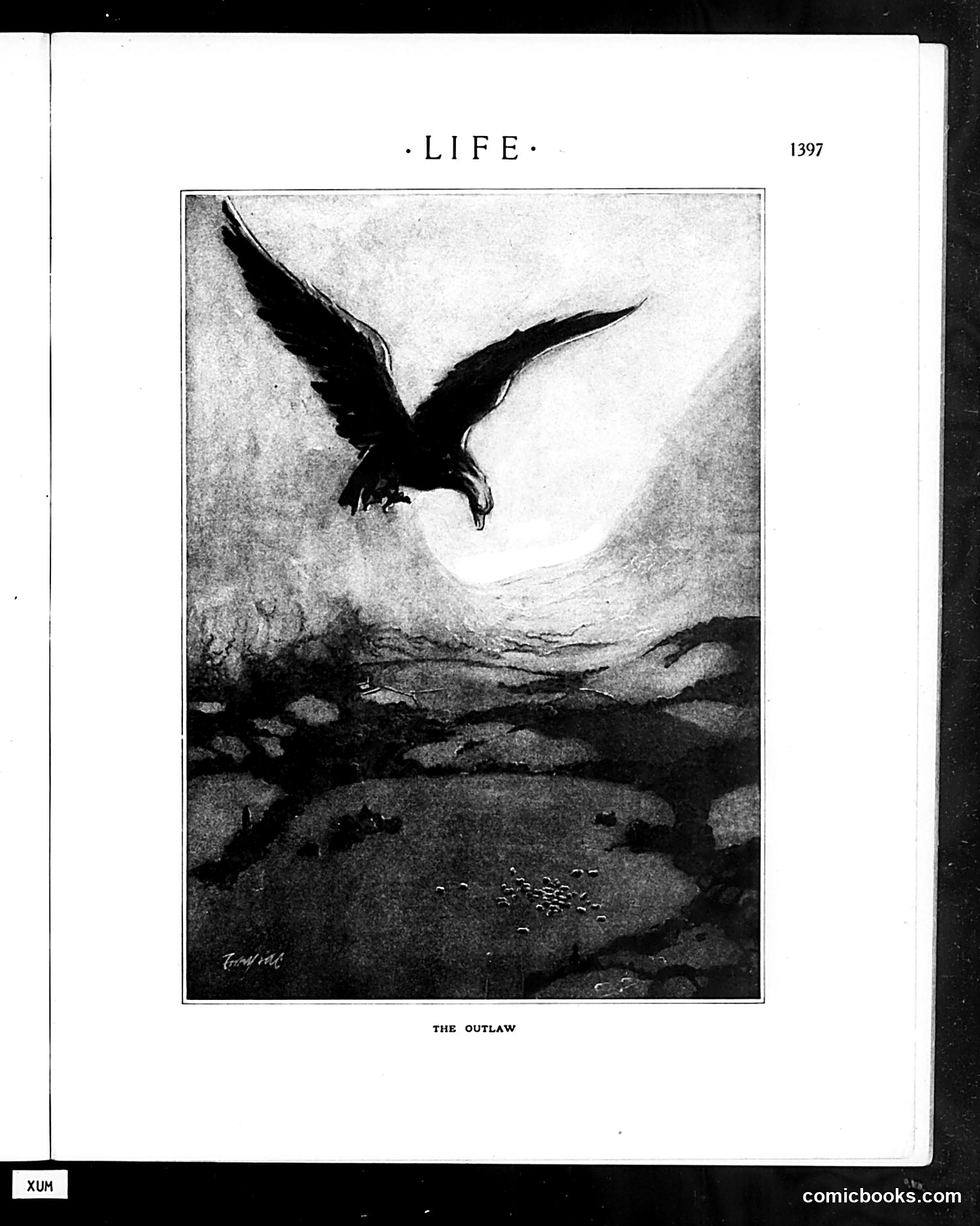
This page features a dramatic black and white illustration titled "The Outlaw," depicting a large bird of prey (appears to be an eagle or vulture) descending against a pale sky over a dark, rocky landscape. The composition is ominous and threatening. Without additional context from the magazine's date or surrounding articles, the specific political reference remains unclear. However, given Life's satirical nature, the predatory bird likely represents a threatening force—possibly a political enemy, invading power, or social menace—swooping down upon vulnerable terrain below. The stark imagery suggests danger or an impending threat to the nation or its people. The signature appears to read "Goldberg" or similar, indicating the artist's credit.
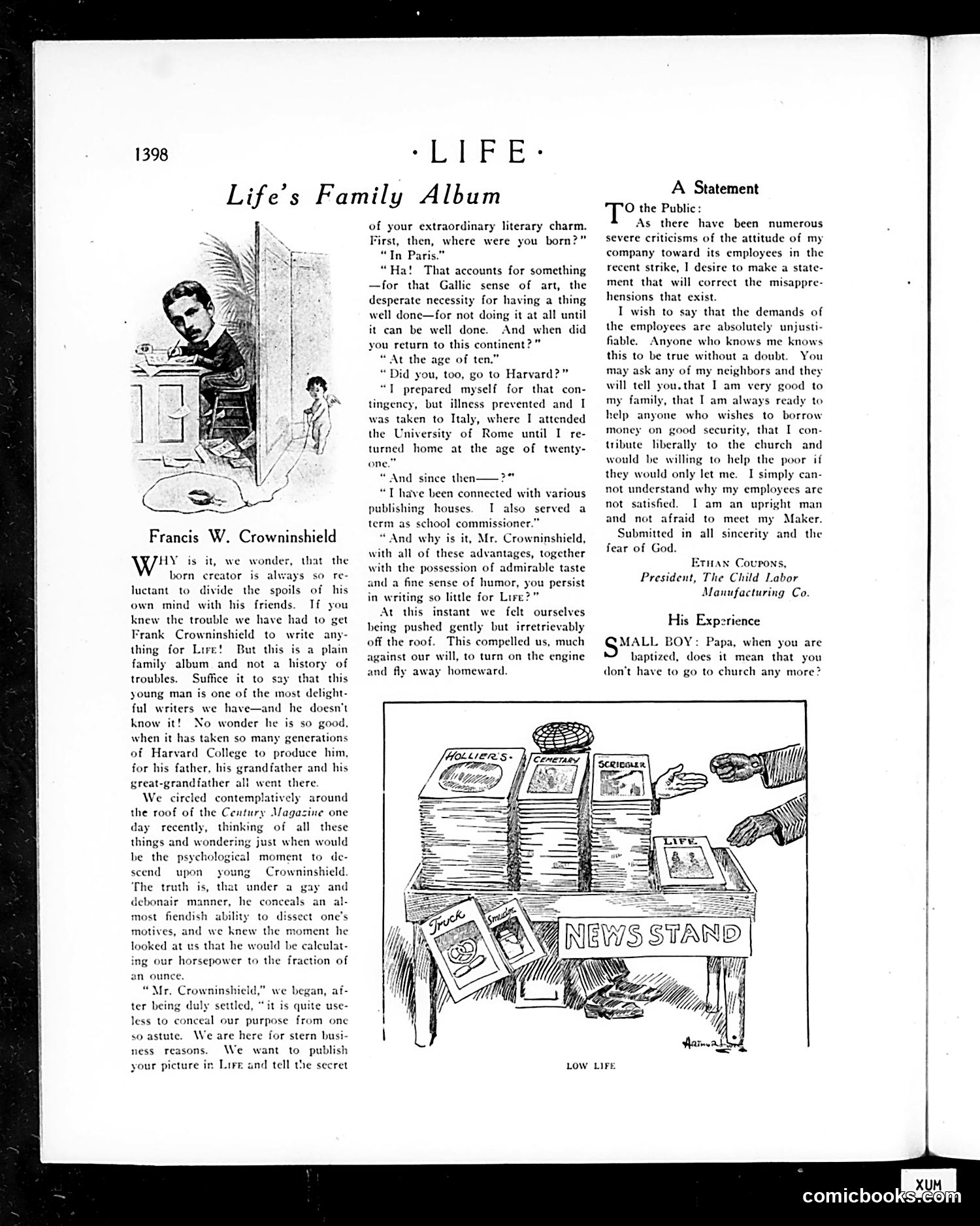
This page from *Life* magazine features two satirical pieces: **"Life's Family Album" (Main Article):** An interview with Francis W. Crowninshield, a prominent literary figure and editor. The satire playfully critiques his reluctance to write for *Life*, attributing his talent to generational Harvard pedigree. The joke culminates when Crowninshield's sharp perception allegedly causes the interviewer to be "pushed gently but irretrievably off the roof"—hyperbolic punishment for pestering him. **"A Statement to the Public" (Right Column):** Biting satire of a wealthy industrialist's response to labor strike criticism. The executive defends himself by citing personal virtue (generosity to family, church donations) while completely missing the point—that employees deserve fair wages and working conditions. His company is named "The Child Labor Manufacturing Co.," making the hypocrisy explicit. **"Low Life" (Cartoon):** A visual joke about a boy's religious misunderstanding—that baptism exempts one from attending church. All three pieces mock the self-deception of the privileged classes regarding social responsibility.
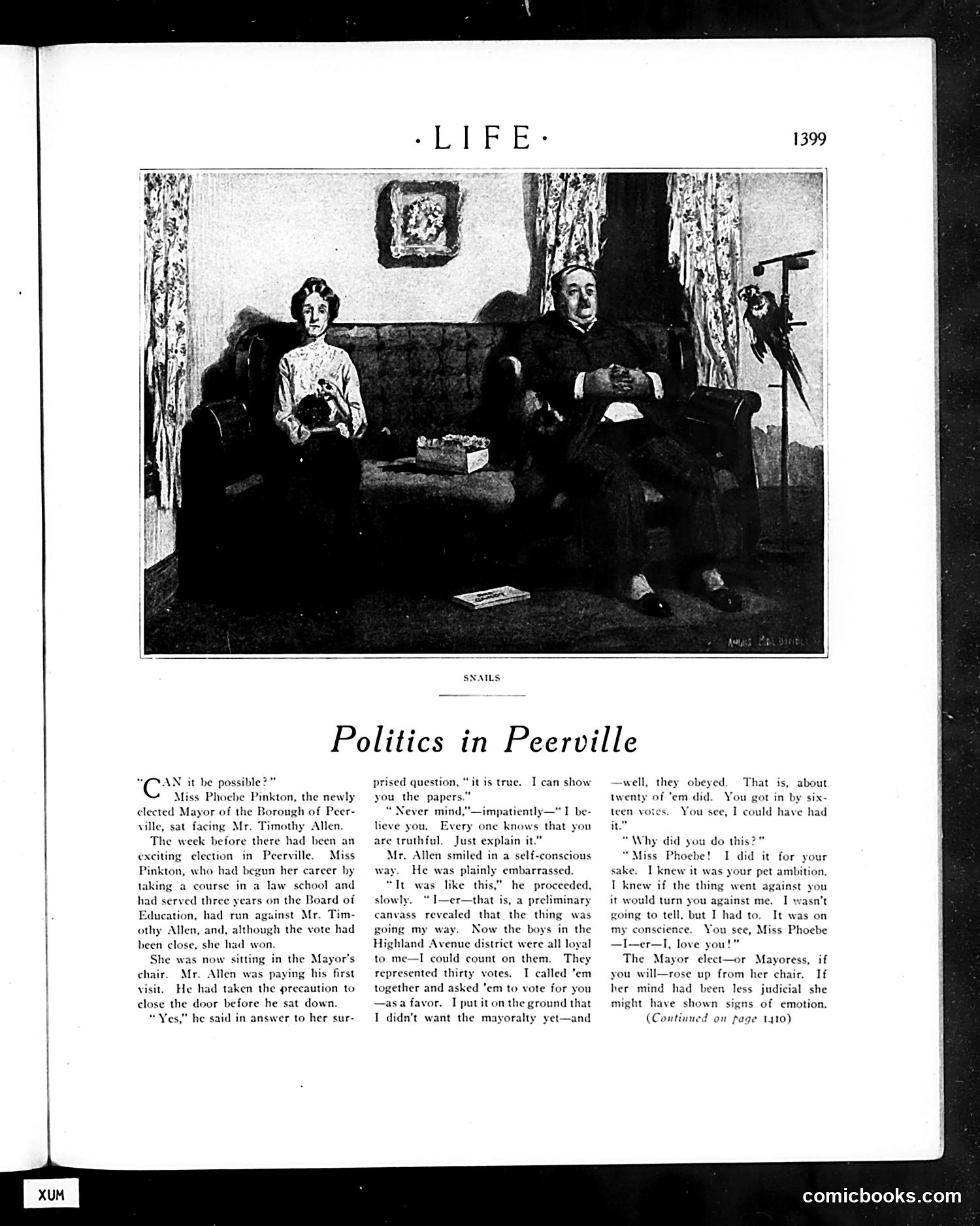
This is a satirical short story (not a cartoon) about a newly elected female mayor, Miss Phoebe Pinkton, confronting her opponent Timothy Allen. The joke hinges on gender and political expectations of the era. Allen reveals he deliberately lost the mayoral election by asking his loyal voters to support Pinkton instead—a shocking admission of intentional defeat. His motivation: romantic. He confesses he "loves" her and knew she wanted the position desperately, so he sacrificed his own ambition to win her affection. The satire mocks both characters: Allen's paternalistic chivalry (deciding what's best for a woman) and the implication that a female politician's ambitions are merely personal desires rather than serious political aims. The phrase "Mayor elect—or Mayoress" in the text also signals contemporary uncertainty about how to even address a female office-holder. The humor derives from the absurdity of sacrificing an election for romance in ostensibly serious politics.
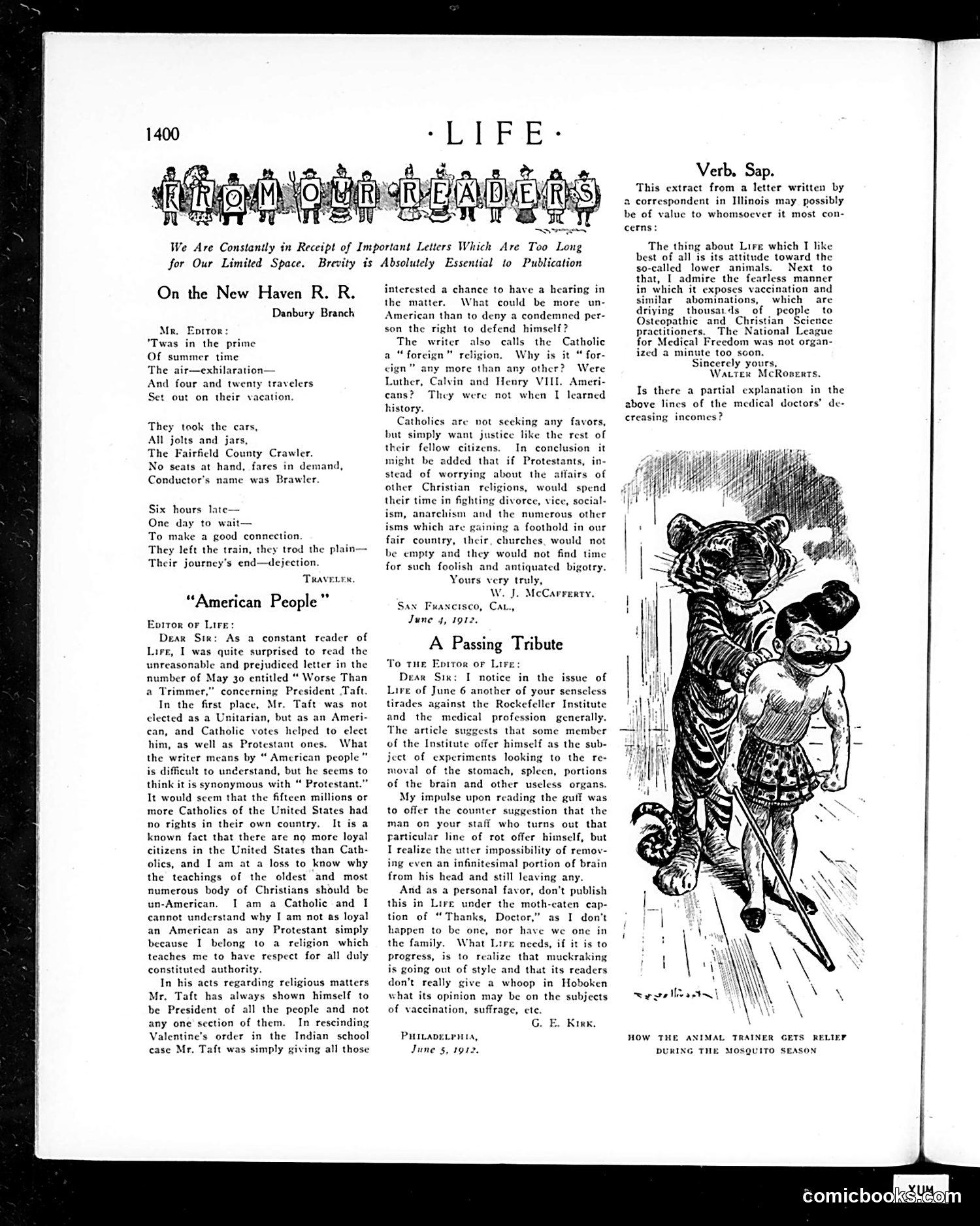
This page presents reader letters debating contemporary issues rather than political cartoons. The main content includes: **"American People" letter**: A Catholic reader defends Catholics' loyalty and Americanism against a previous letter criticizing President Taft. The writer argues that Catholics aren't seeking "favors" but equal treatment, and challenges the notion that Catholicism is "foreign." This reflects early 20th-century anti-Catholic prejudice in America. **"A Passing Tribute" letter**: A sarcastic response to Life's criticism of the Rockefeller Institute's medical experiments. The writer sarcastically suggests Life's own staff "offer" themselves for brain removal, implying Life's editorial attacks lack intelligence. **The cartoon** (captioned "How the Animal Trainer Gets Relief During the Mosquito Season") shows a tiger or large cat being scratched/groomed, appearing to reference pest control or relief from summer annoyances—likely humorous filler unrelated to the letters. The page exemplifies Life's satirical mission: publishing reader debates on social divisions while maintaining sharp editorial wit.
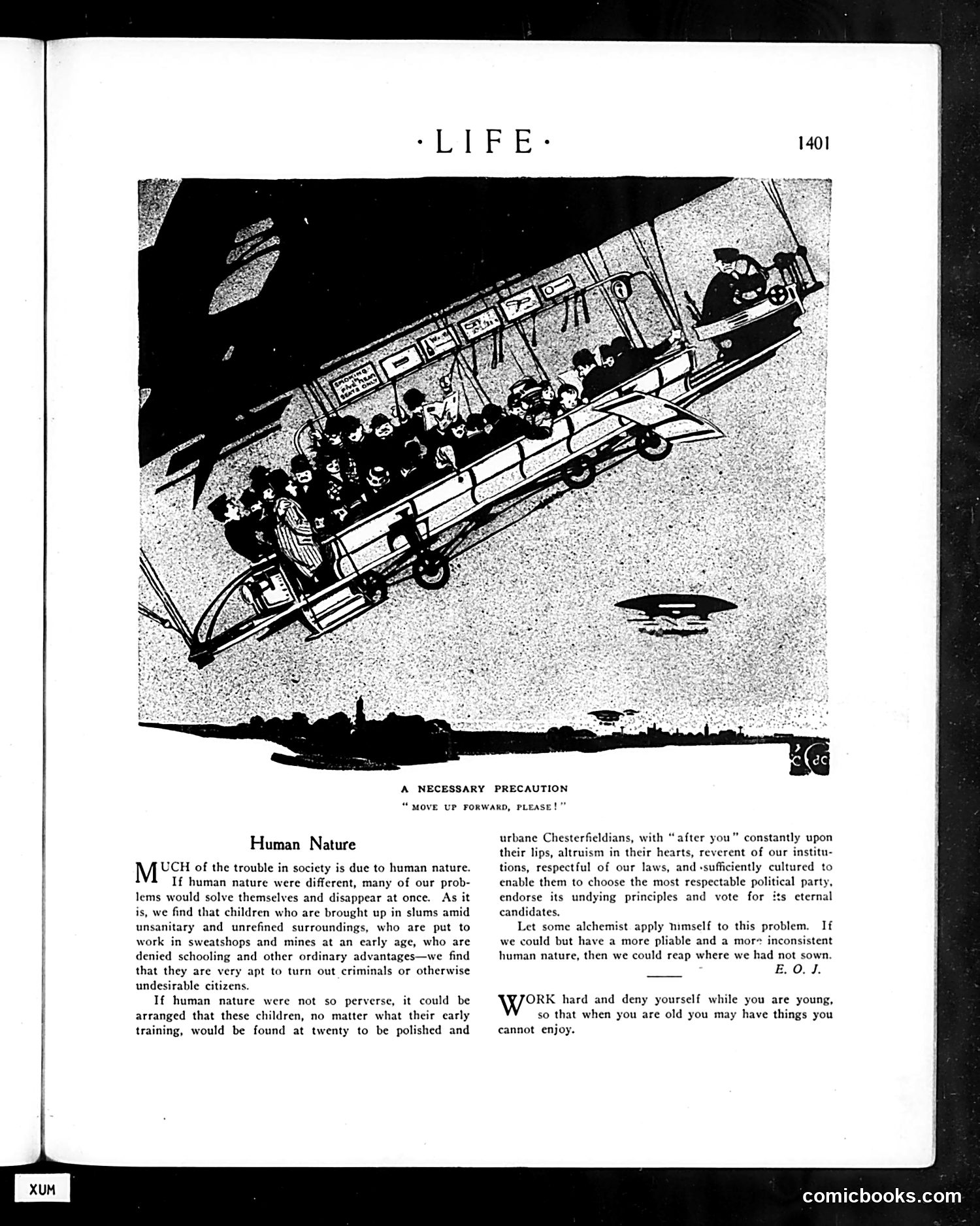
The cartoon depicts a crowded airship or flying vessel with passengers being herded aboard by an attendant saying "Move up forward, please!" The image's title, "A Necessary Precaution," suggests ironic commentary on safety or crowd control. The accompanying essay "Human Nature" is a sarcastic critique of social Darwinism and victim-blaming. The author (E.O.J.) argues that society blames poverty and crime on inherent human nature rather than addressing actual causes: slums, child labor, denied education, and poor conditions. The satire's point: wealthy society refuses to acknowledge that environmental deprivation—not moral deficiency—produces "criminals or otherwise undesirable citizens." The essay mocks the notion that impoverished children *should naturally* become refined gentlemen despite systemic oppression. It concludes with another jab: work and self-denial in youth supposedly enables enjoyment in old age—a promise rarely fulfilled. The cartoon's crowding likely reinforces themes of exploitation and social pressure on working-class people.
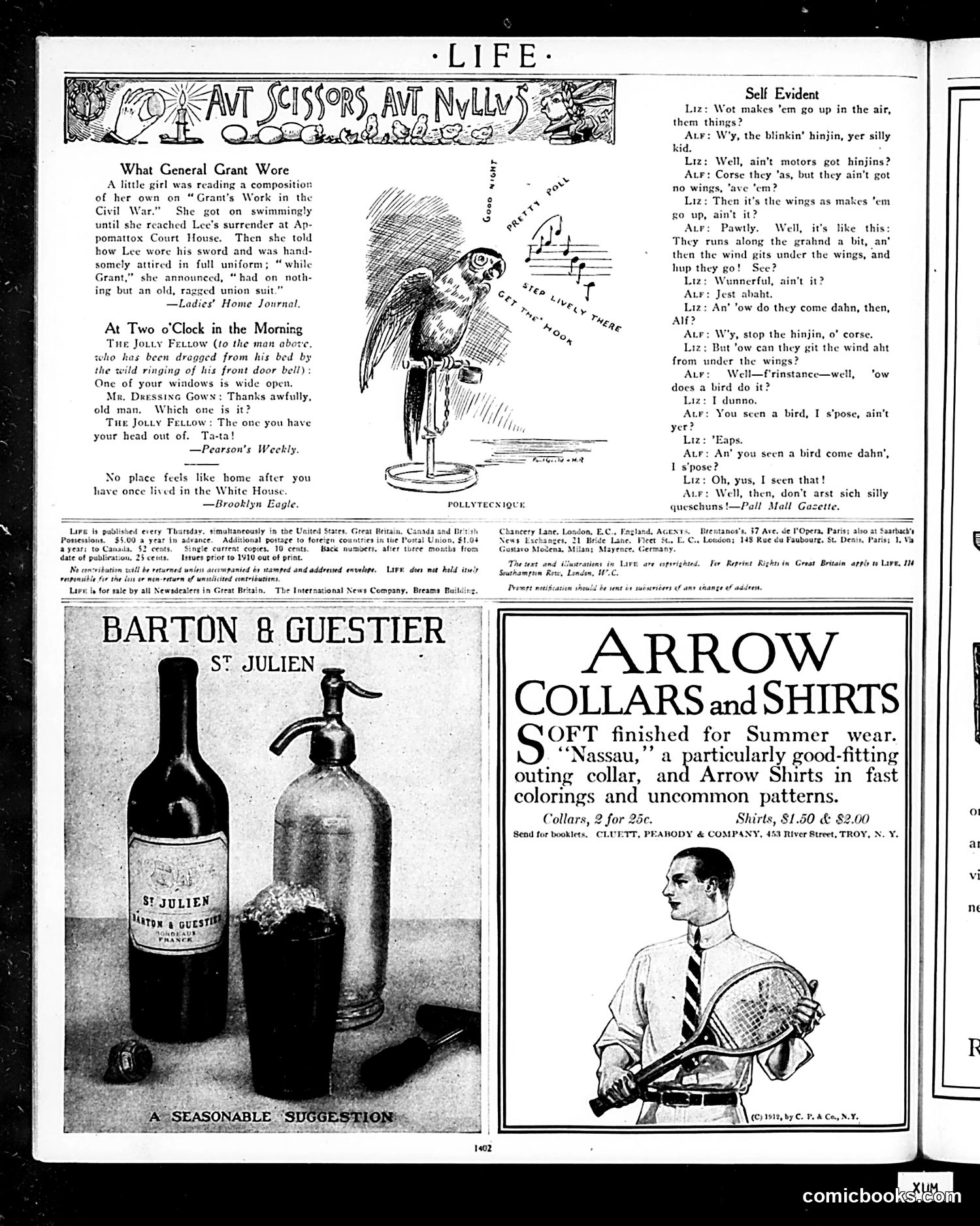
This page contains three distinct humor pieces typical of early 20th-century satire: **"What General Grant Wore"** mocks a schoolgirl's composition about the Civil War, joking that while Robert E. Lee appeared formal in his sword and uniform at Appomattox, Grant wore only a ragged union suit (underwear). The humor lies in the absurd image and the reversal of expectations about military dignity. **"At Two o'Clock in the Morning"** is a brief comedic exchange where a man alerts another that his window is open, only to reveal he means the man's head is sticking out—implying foolish behavior. **"Self Evident"** features two working-class British characters (Cockney dialect) attempting to explain how airplanes work. The humor derives from their complete confusion: they assume airplanes need motors like cars, then struggle illogically to explain how planes descend, finally dismissing the question as silly. The page also includes period advertisements for wine and Arrow brand collars/shirts. The cartoon illustrations support each anecdote with period-appropriate visual humor.
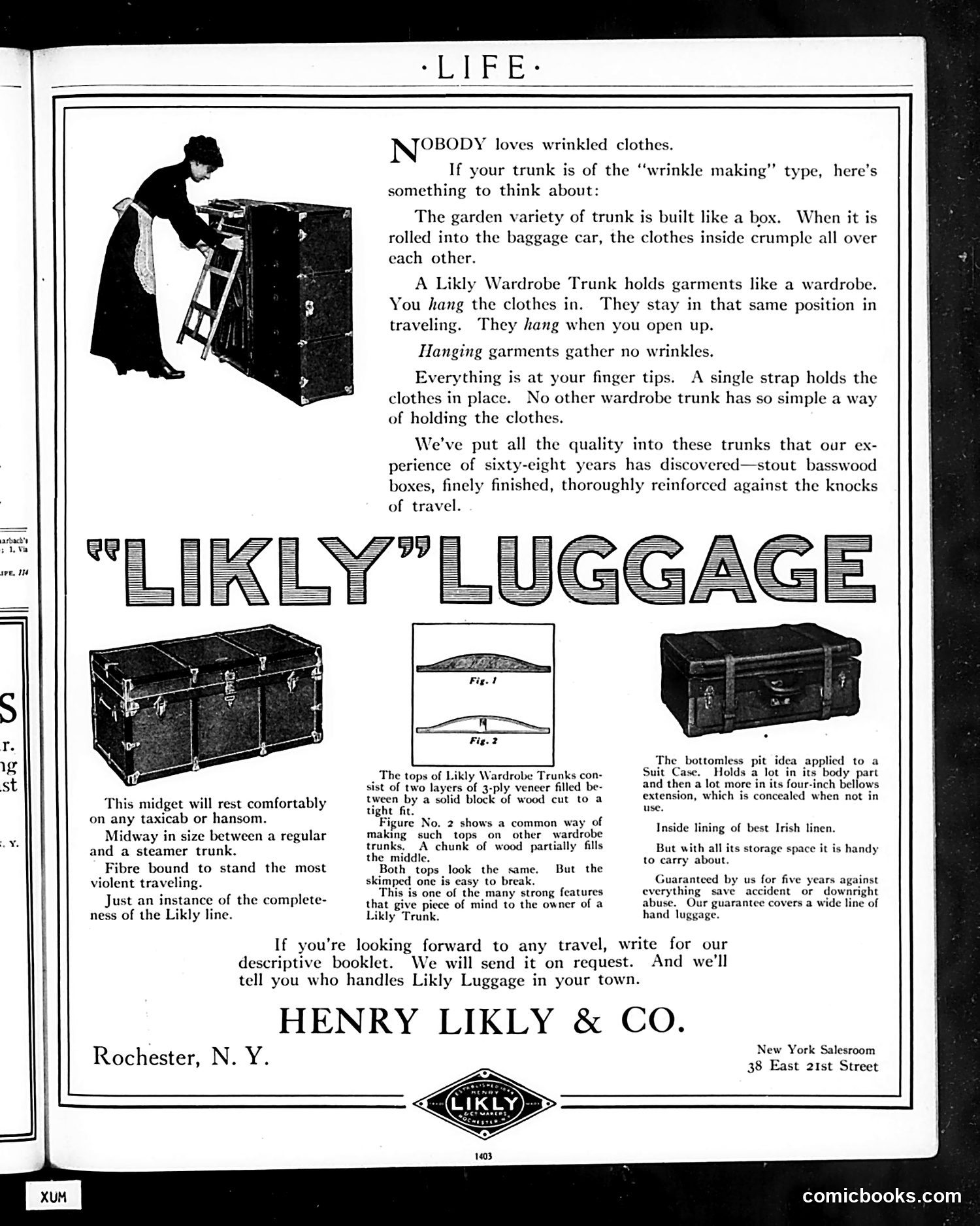
This is **not a cartoon or satire page**—it's a straightforward product advertisement for Likly Luggage, a trunk and suitcase manufacturer based in Rochester, New York. The page addresses a practical consumer problem: ordinary trunks wrinkle clothes during travel because garments are packed tightly together. Likly's solution is the "Wardrobe Trunk," which hangs clothes inside like a closet, keeping them wrinkle-free. The advertisement emphasizes quality construction (68 years of experience, stout basswood, reinforced design) and includes technical details comparing trunk lid construction—showing how competitors' designs are inferior. Additional products shown include a smaller "midget" trunk and a suit case with expandable bellows. This reflects early 20th-century travel culture when trunks were essential luggage, and business/leisure travel required formal clothing that needed protection from wrinkles.
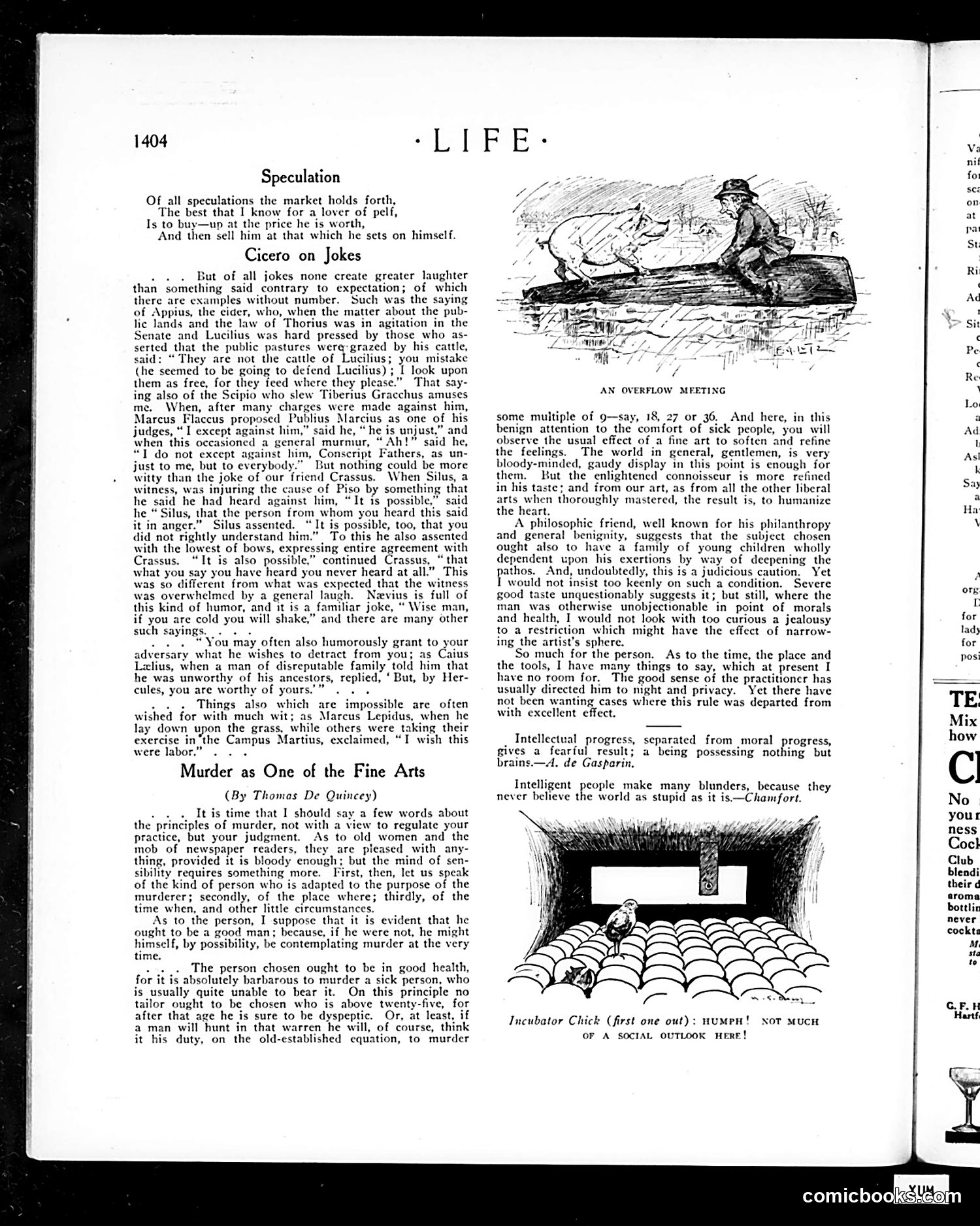
This page contains two distinct pieces of satirical writing: **"Speculation"** is a brief poem mocking stock market speculation and self-interested profiteering—common themes in Gilded Age satire. **"Cicero on Jokes"** presents classical Roman anecdotes about wit and unexpected humor, likely included as intellectual content for Life's educated readership. **"Murder as One of the Fine Arts"** is an excerpt from Thomas De Quincey's famous 1827 essay. The satire here is *philosophical*: De Quincey tongue-in-cheek discusses murder as if it were an aesthetic pursuit requiring refined taste and careful consideration—absurdly treating brutal crime with the language of high art. The deadpan delivery ("the person ought to be in good health") is the joke. This was published as provocative intellectual humor, not endorsement. The two cartoons (an overflow meeting and an incubator chick) appear unrelated to the text and likely accompany separate articles.
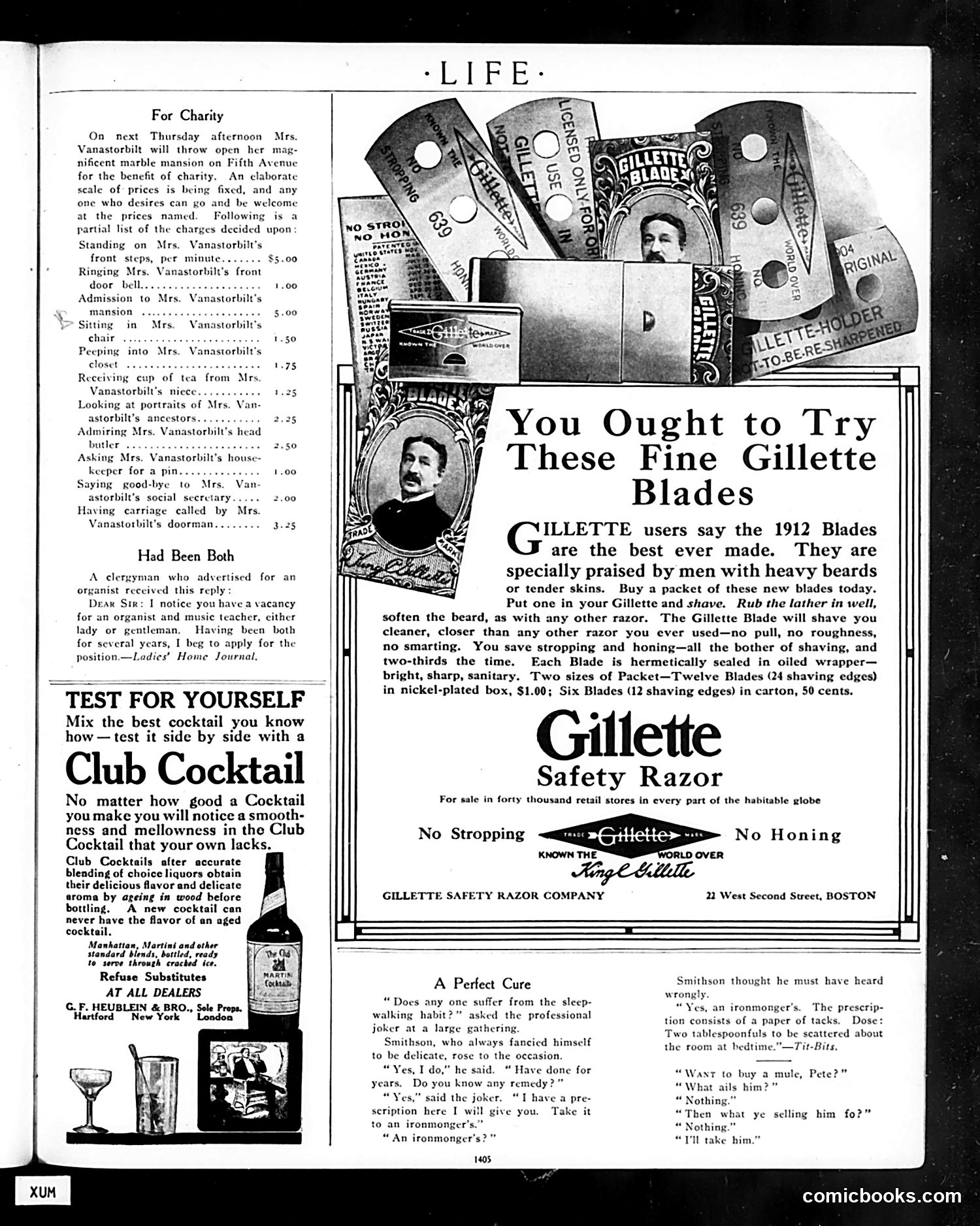
This page contains **advertisements and satirical humor pieces**, not political cartoons. The main satire is a **"For Charity" piece mocking wealthy Manhattan society**, specifically the Vanderbilt family. It lists absurdly inflated prices for trivial access to Mrs. Vanderbilt's mansion—paying to stand on her front steps, ring her doorbell, or receive tea from her niece. The joke targets the era's extreme wealth inequality and the performative charity of the ultra-rich, who monetize even minor contact with their homes and servants. The page also includes period advertisements (Gillette Safety Razors, Club Cocktails) and unrelated humor pieces about mistaken advice and mule-trading. For modern readers: the satire exposes how the Gilded Age wealthy profited from "charity" events that were really about status display and extracting money from the middle class desperate for social access.
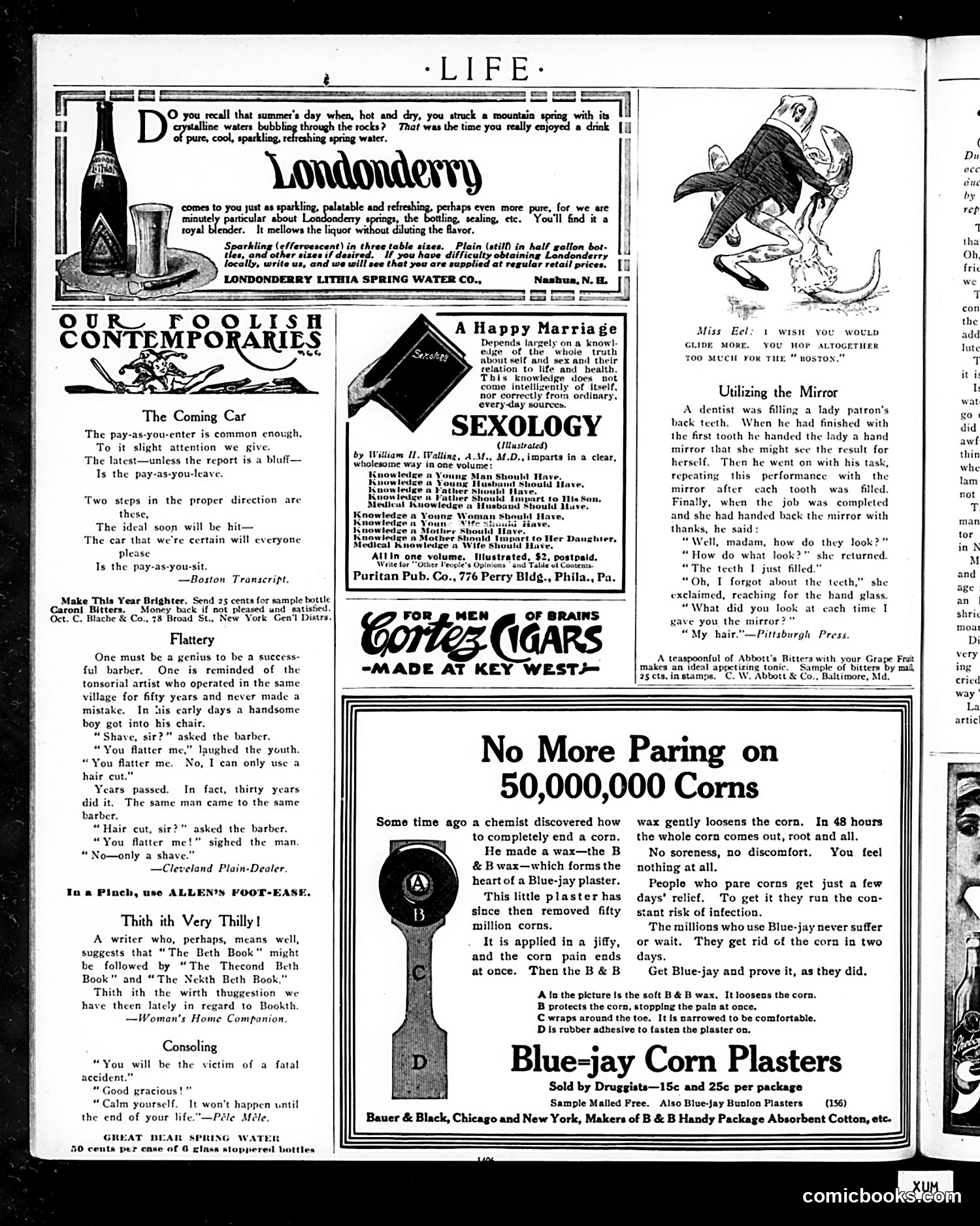
This page is primarily **advertising**, with brief satirical pieces interspersed. The main content includes: **Advertisements:** - Londonderry Lithia Spring Water (promoting health benefits) - Gortez Cigars ("For Men of Brains") - Blue-jay Corn Plasters (the largest ad, promoting a wax-based corn treatment) - Caron Bitters, Allen's Foot-Ease, Great Bear Spring Water **Satirical Humor Pieces:** - "The Coming Car": jokes about transit payment methods progressing toward the absurd "pay-as-you-sit" - "Flattery": a barber anecdote where a vain customer denies needing a haircut for 30 years - "Utilizing the Mirror": a dentist observes his female patient examining her hair in the mirror rather than her newly-filled teeth, stereotyping women's vanity The page reflects early-20th-century advertising and gentle social satire, with gender stereotypes (women fixated on appearance) presented as humor.
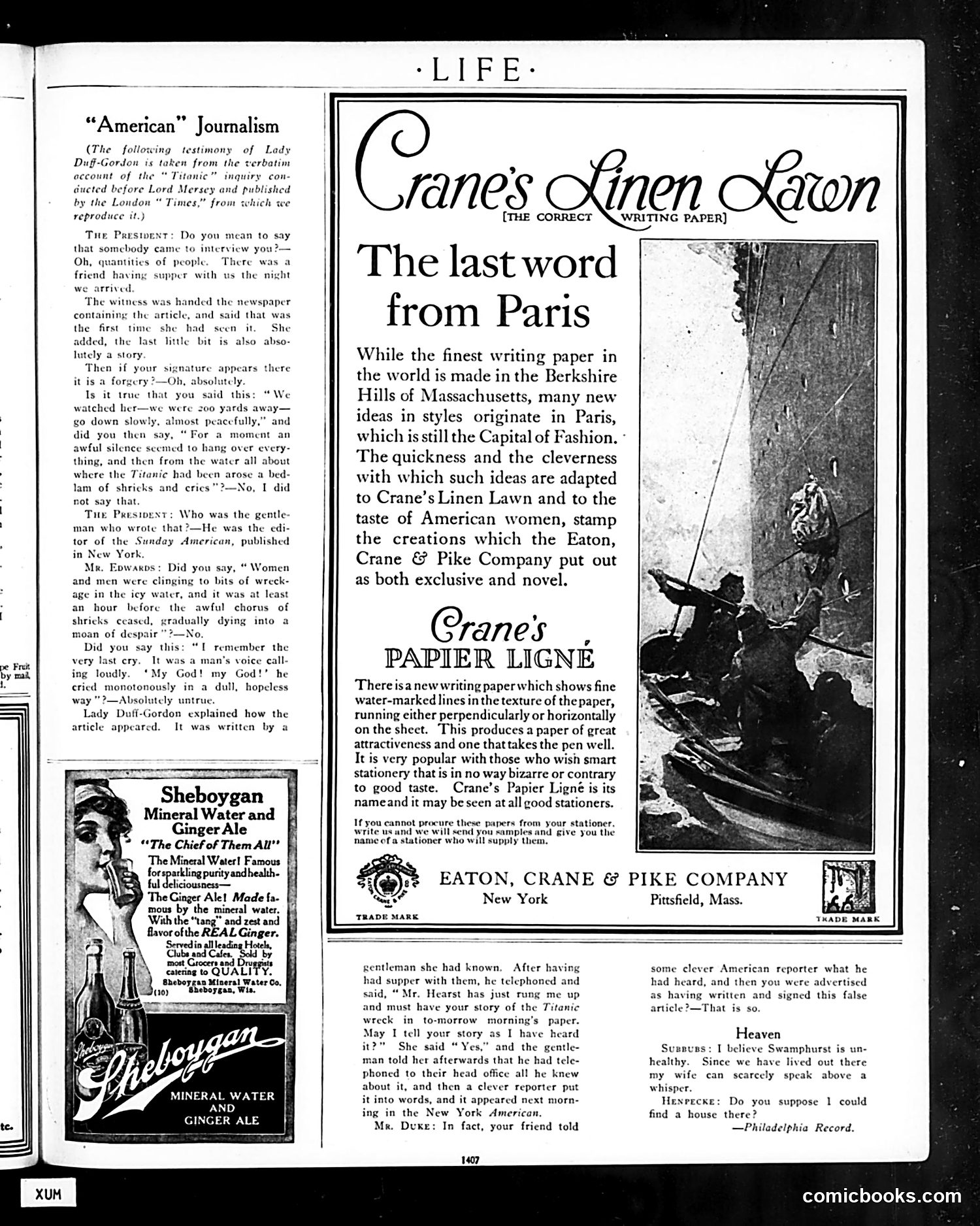
This page satirizes sensationalist American newspaper practices, specifically mocking the *New York American* (a William Randolph Hearst publication). The left column reproduces testimony from Lady Duff-Gordon's account of the Titanic inquiry, showing she denied making dramatic statements attributed to her in print—about drowning victims' cries, the ship's descent, etc. The satire's point: A gentleman acquaintance telephoned her account to Hearst's office, and a "clever reporter" then fabricated vivid, emotionally inflammatory quotes entirely—which appeared under her name in the *American*. This exposes how Hearst-era "yellow journalism" invented dramatic copy wholesale, falsely attributing it to witnesses. The rest of the page contains unrelated advertisements (Sheboygan water, Crane's writing paper), typical of Life's format.
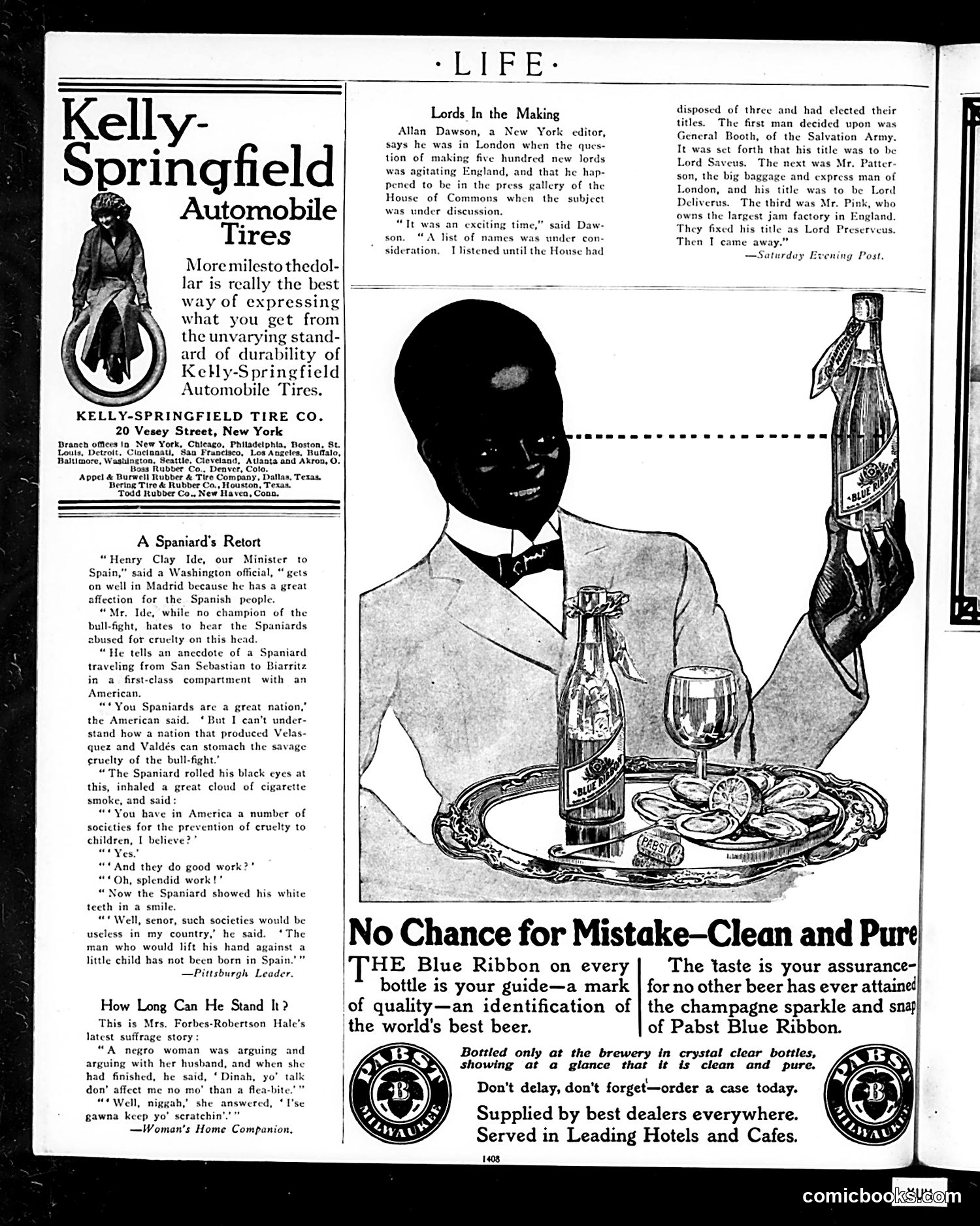
This page contains three distinct pieces of satirical humor: **"Lords In the Making"** mocks the British government's creation of new peerages. A New York editor recalls witnessing Parliament debate naming five hundred new lords, noting how job titles became absurd pun-based nobility: a baggage handler becomes "Lord Deliverus," a jam factory owner "Lord Preserveus." The satire targets both British class pretension and the arbitrary nature of aristocratic titles. **"A Spaniard's Retort"** presents a joke defending Spanish bullfighting against American moral criticism. A Spaniard counters an American's condemnation by noting America has societies preventing child cruelty—implying Americans are hypocrites tolerating worse violence at home. The humor relies on uncomfortable 1910s racial attitudes (the anecdote uses a demeaning dialect). **"How Long Can He Stand It?"** uses a racist dialect joke about a Black woman's nagging, framed as pro-suffrage humor but deeply offensive by modern standards. The page is primarily advertising (Kelly-Springfield tires, Pabst Blue Ribbon beer), with these satirical pieces interspersed—typical of *Life* magazine's format.
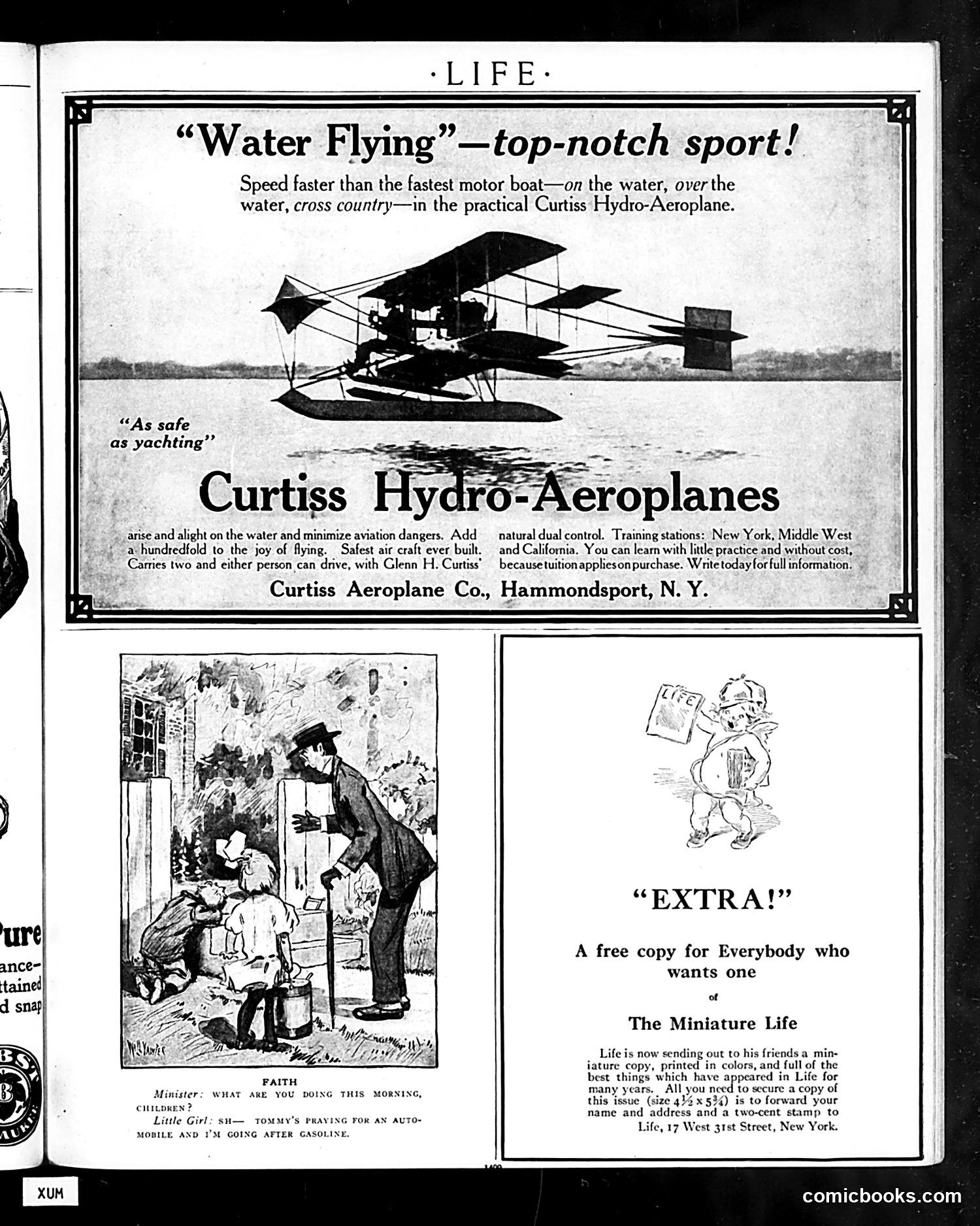
This page combines **advertising** with a **satirical cartoon**. ## The Advertisement The top features a Curtiss Hydro-Aeroplane advertisement—an early seaplane marketed as a recreational "sport" combining speed with safety ("as safe as yachting"). This reflects the 1910s aviation boom when flying was emerging as a luxury activity. ## The Cartoon: "Faith" The cartoon below satirizes **religious hypocrisy**. A minister scolds children for praying about automobiles, saying "What are you doing this morning, children?" The girl replies: "Tommy's praying for an automobile and I'm going after gasoline." The joke: The minister objects to children's materialistic prayers, yet the girl's pragmatic response suggests that praying alone is insufficient—one must also *work* (get gasoline) to achieve worldly goods. It mocks both the minister's sanctimony and the era's growing consumerism, where spiritual faith competes with desires for modern conveniences. The page also advertises Life magazine's miniature edition available free to readers.
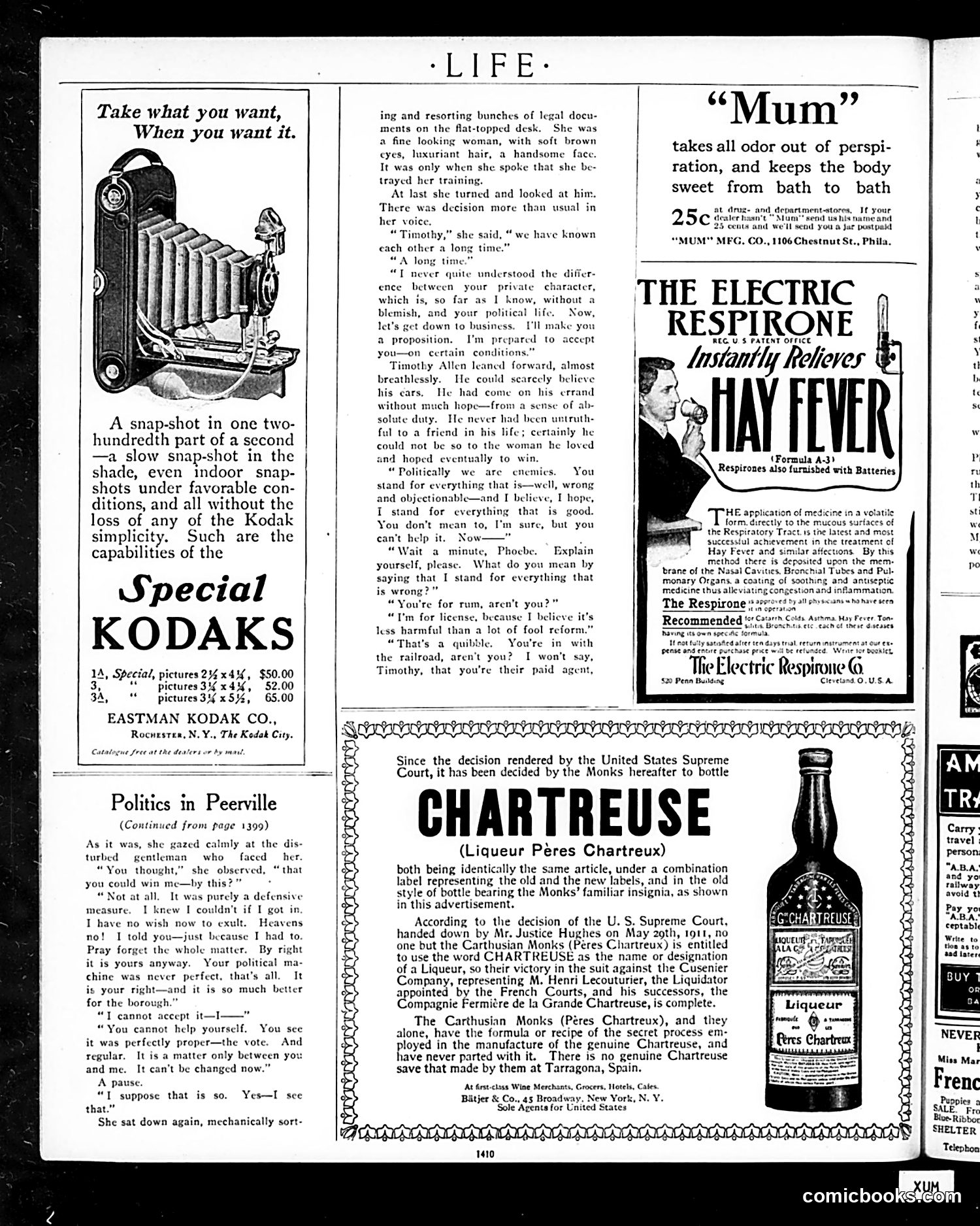
This page contains primarily **advertisements and serialized fiction**, not political satire or editorial cartoons. The main content is "Politics in Peerville," a serialized story depicting a romantic/political drama between Timothy Allen (a corrupt politician) and Phoebe (a reform-minded woman). Phoebe leverages her romantic interest to demand Timothy abandon his corrupt practices—specifically his ties to railroads and pro-alcohol stance. She refuses his proposal unless he reforms politically. The "satire" is gentle social commentary on the tension between personal morality and political corruption in early 20th-century American politics. The advertisements are period-typical: Kodak cameras, "Mum" deodorant, and the "Electric Respirone" (a quack medical device claiming to cure hay fever). These reflect contemporary consumer culture and dubious patent medicines common to the era. No specific historical figures or events are referenced—this appears to be fictional social commentary rather than topical satire.
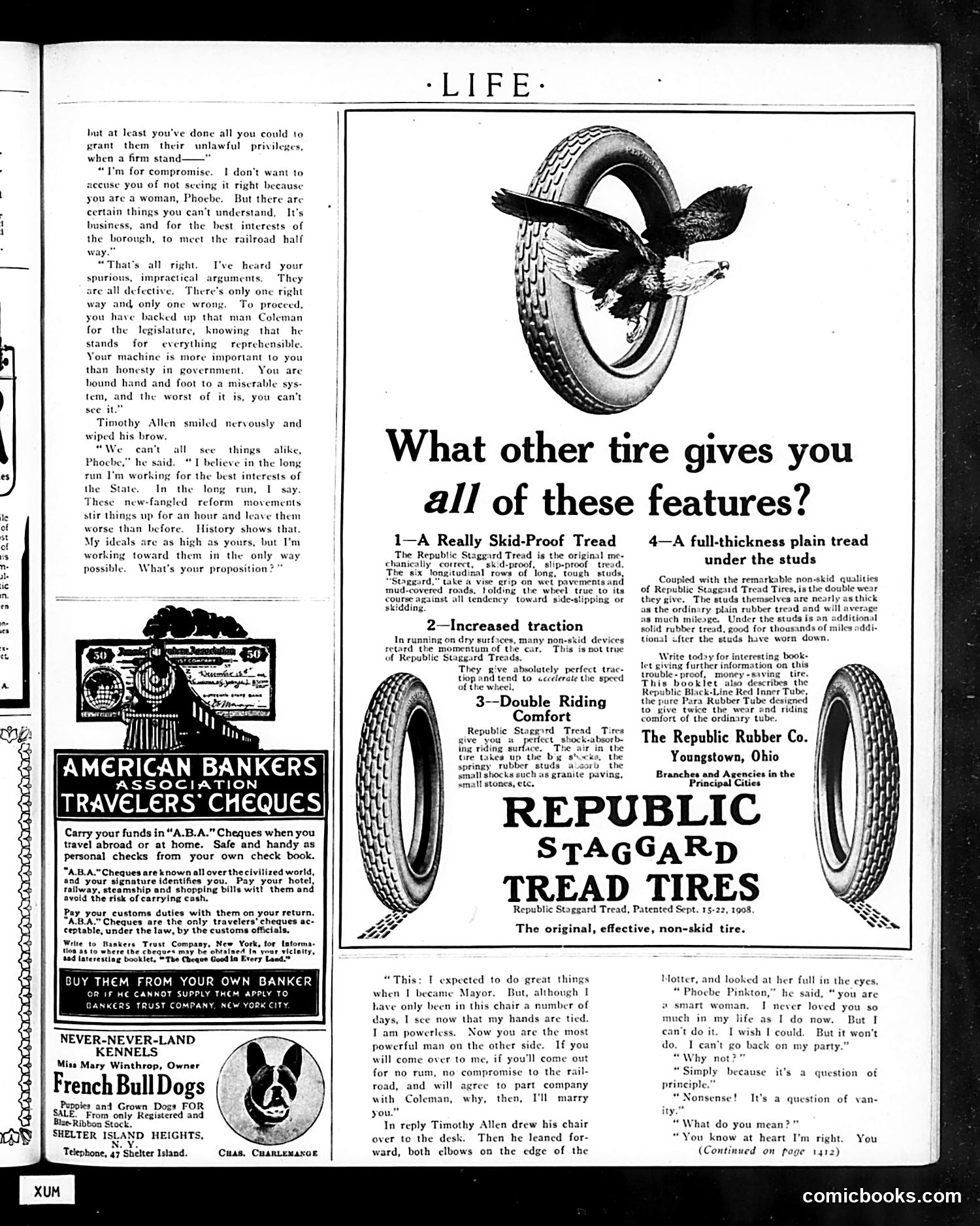
This page presents a political dialogue between Timothy Allen and a woman named Phoebe regarding municipal governance and political compromise. Allen defends backing a politician named Coleman for the legislature despite Coleman's "reprehensible" positions, arguing that practical politics requires compromise and that long-term progress outweighs immediate reform movements. Phoebe counters that Allen's political machine prioritizes expediency over honest government. The satire critiques machine politics and political corruption of the Progressive Era—the tension between idealistic reform movements and entrenched political operatives who justify questionable alliances as pragmatic necessity. The conversation illustrates how politicians rationalize unprincipled compromises. The page also contains period advertisements (American Bankers Association traveler's cheques, Republic Staggard Tread Tires, French Bull Dogs kennels) typical of Life's revenue model.
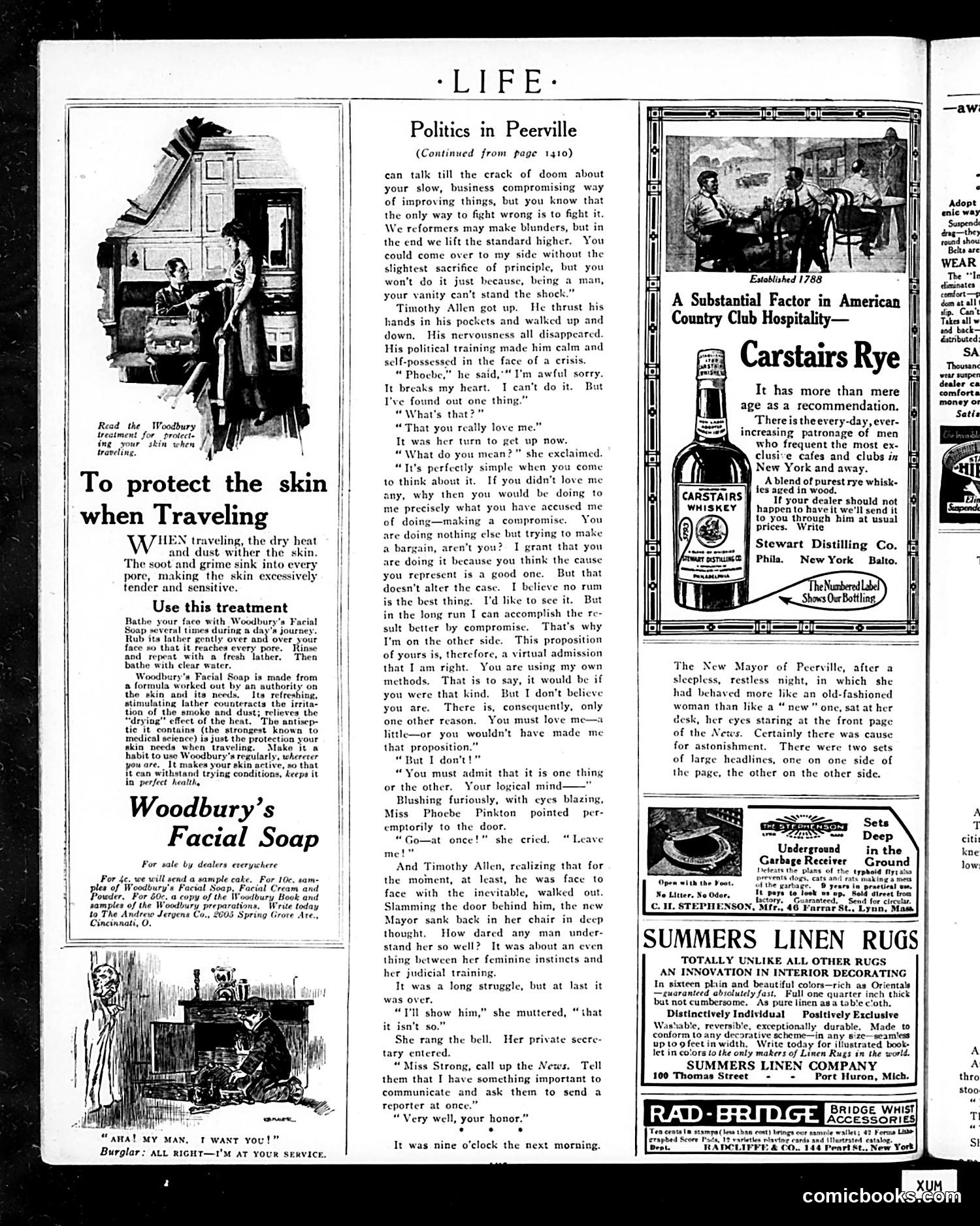
This page is primarily **advertising with one serialized story segment**. The main comic/cartoon element is a small illustration titled "Burglar: ALL RIGHT—I'M AT YOUR SERVICE," showing a homeowner summoning a burglar as if he were a servant. It's a visual pun on the phrase's double meaning—dark humor about crime. The substantial text content is "Politics in Peerville," a serialized short story (continued from page 1410) depicting a romantic/political dispute between Timothy Allen and Miss Phoebe Pinkton. Allen argues that her willingness to negotiate with him proves she loves him, despite her political disagreement. She orders him out. The story appears to satirize earnest political reformers and their personal contradictions. The page otherwise consists of period advertisements for Woodbury's Facial Soap and other products, typical of Life's revenue model at this era.
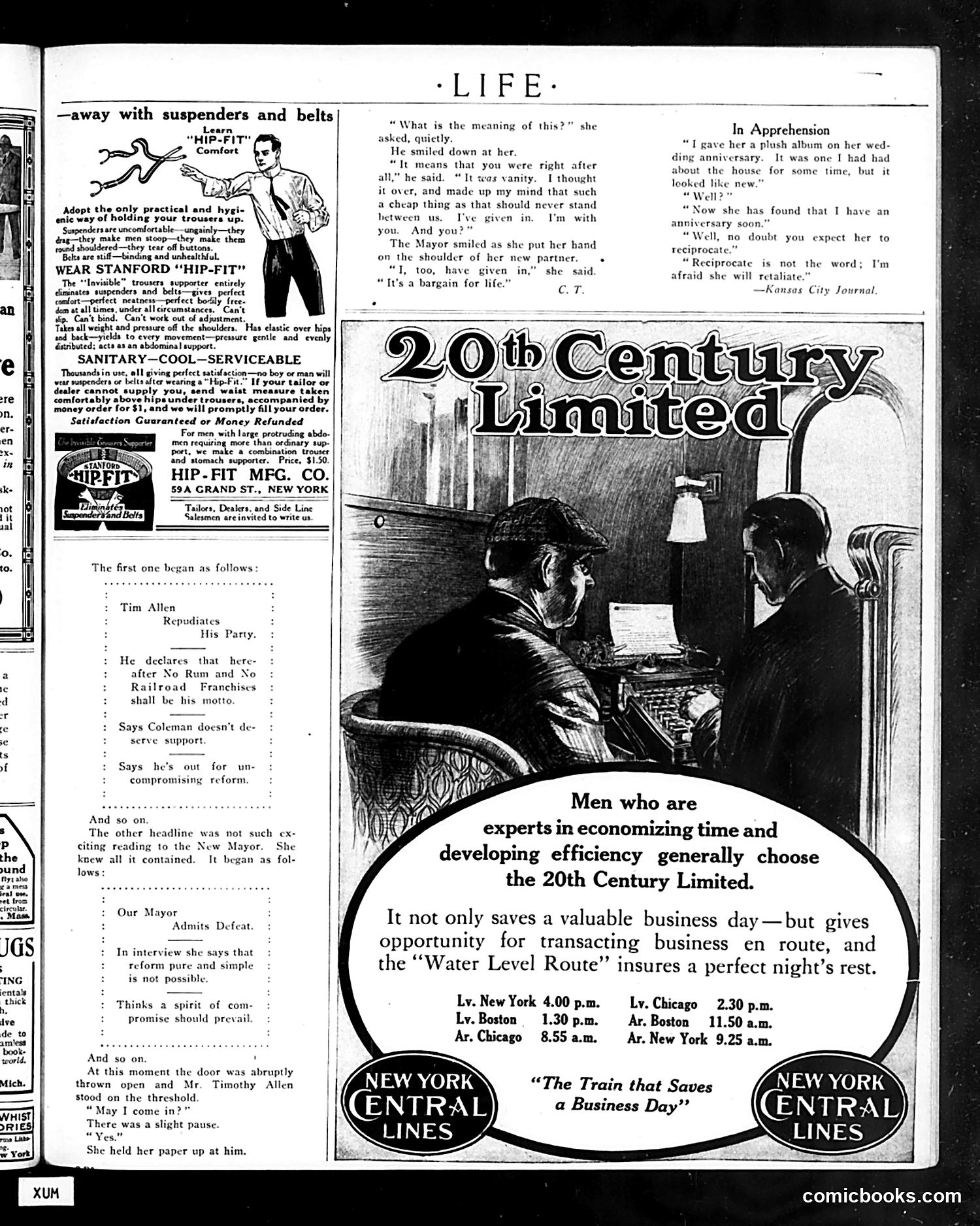
This page contains mixed content: primarily **advertisements** (Hip-Fit suspenders, 20th Century Limited train service) alongside short satirical pieces typical of Life magazine's format. The main satirical content concerns **local politics**, likely New York City mayoral politics (references "the New Mayor," who is female—unusual for the era, suggesting this is either fictional satire or refers to a specific historical figure). The joke: a reformer politician (Tim Allen) who loudly denounced "Rum and Railroad Franchises" now privately admits to the Mayor that idealistic reform is impossible; she, in turn, reveals she too has abandoned her reform principles. The satire mocks political hypocrisy and the inevitability of compromise. The smaller item "In Apprehension" is a domestic humor piece about gift-giving expectations in marriage—satirizing how reciprocal gift-giving becomes a source of marital tension. The advertisements reflect early 20th-century concerns: proper undergarment support and efficient business travel.
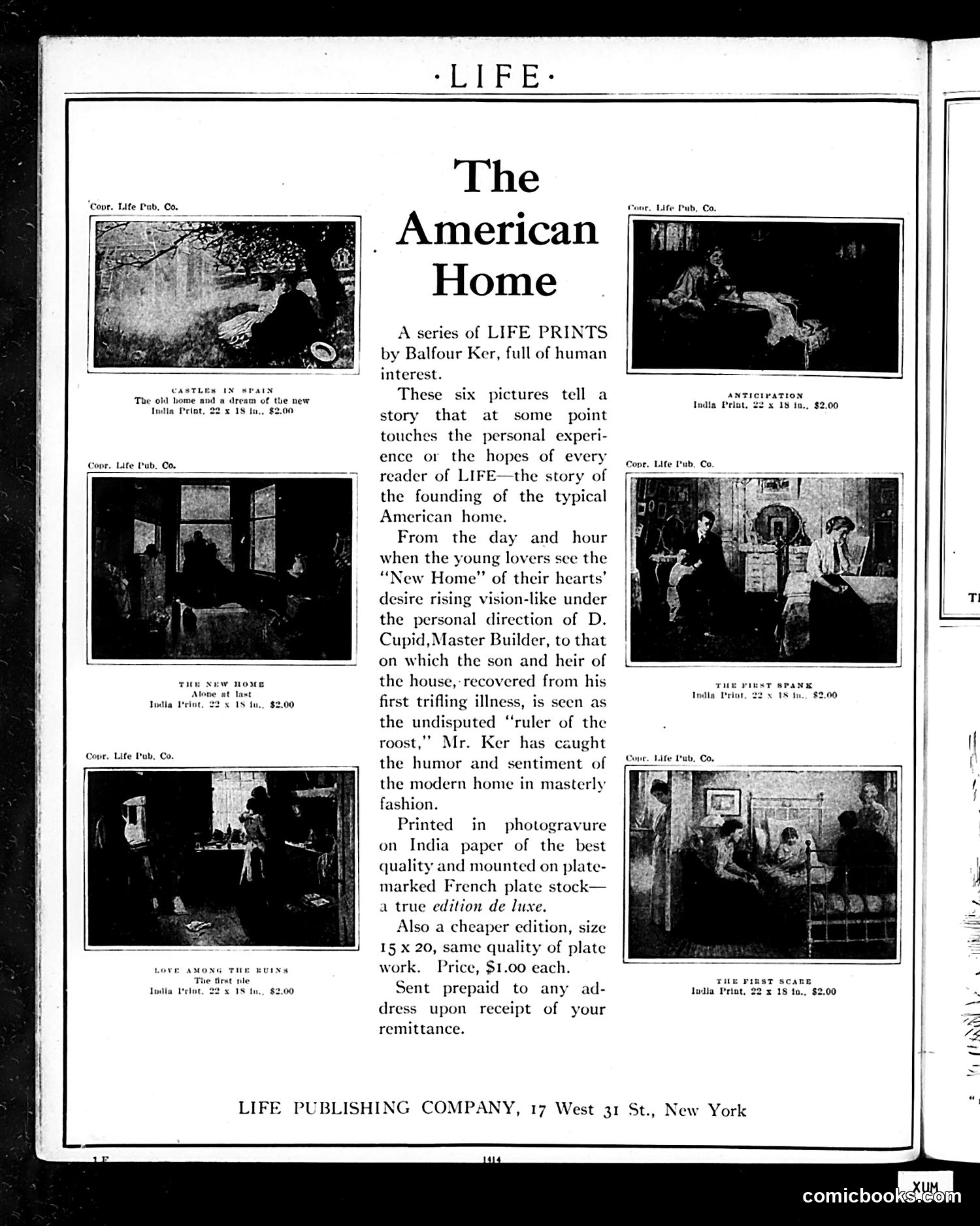
This is primarily an **advertisement** for a print series rather than satire. Life Publishing Company is marketing six photogravure prints by artist Balfour Ker depicting the sentimental narrative of building an American home—from young lovers' dreams through to their son becoming "ruler of the roost." The humor is gentle and domestic rather than political. The series romanticizes the typical American middle-class experience: courtship, construction under "D. Cupid, Master Builder" (personifying Cupid as a contractor), and domestic life with children. The page offers two editions: a deluxe version on India paper ($2.00) and a cheaper 15x20 version ($1.00 each). The visible print titles—"Castles in Italy," "The New Home," "Love Among the Ruins," "Anticipation," "The First Spark," "The First Scare"—suggest a narrative arc celebrating homeownership and family formation as quintessentially American aspirations. This reflects early 20th-century magazine advertising targeting middle-class domesticity.
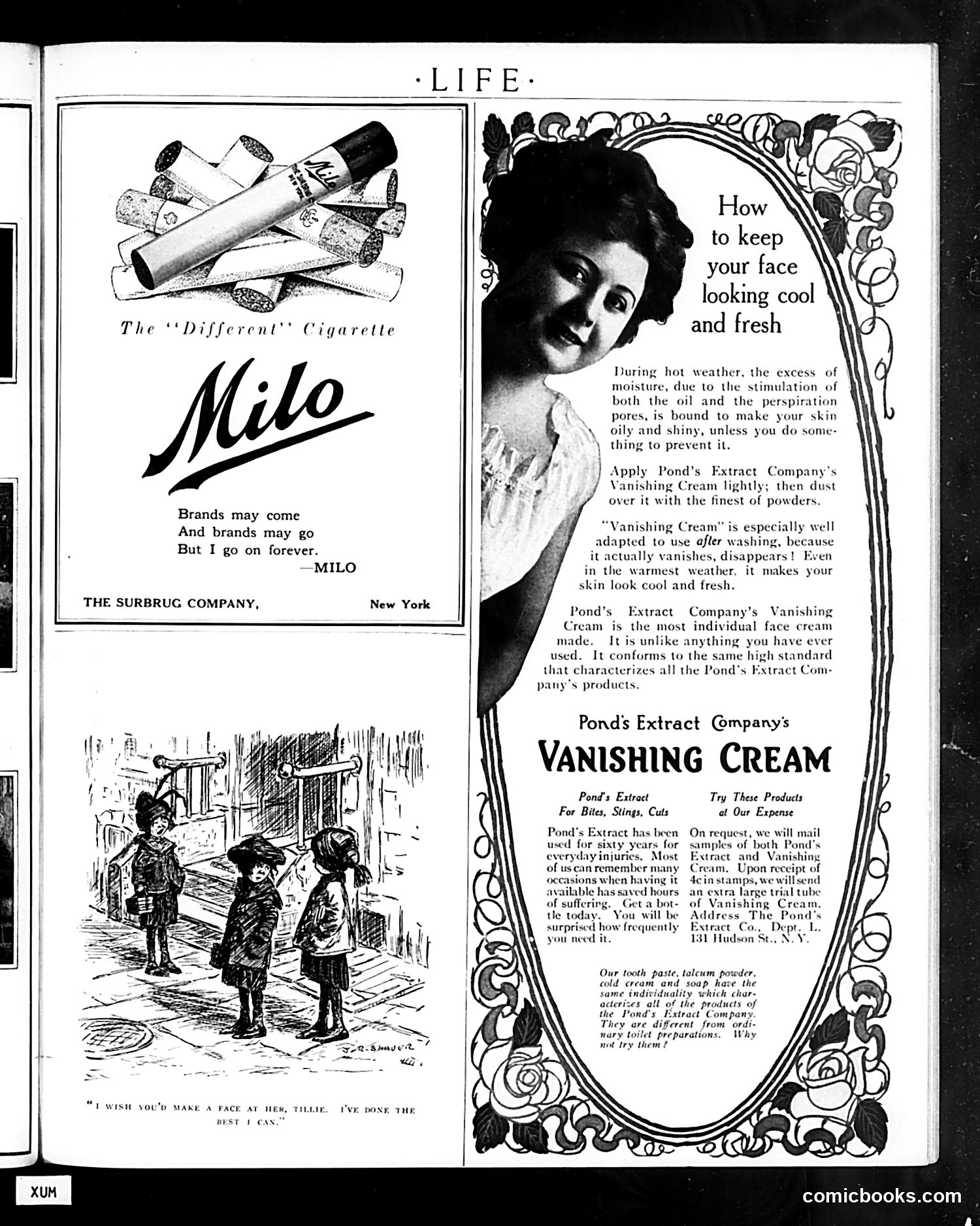
This page combines satirical cartoons with period advertisements, typical of Life's format. **The Cartoons:** The bottom cartoon shows two children, with one saying "I wish you'd make a face at her, Tillie, I've done the best I can." This appears to be gentle humor about childhood mischief—a kid encouraging his companion to make faces at another child, having already tried himself. The satire likely mocks children's simple, innocent pranks rather than commenting on specific figures. **The Advertisements:** The page features two ads: Milo cigarettes (claiming eternal brand loyalty) and Pond's Vanishing Cream (promising to keep skin fresh in hot weather). These aren't satirical—they're genuine period advertising, reflecting early 20th-century beauty and tobacco marketing. **Historical Note:** The juxtaposition of cigarette and cosmetics ads alongside humor about children reflects an era before modern advertising restrictions, when such products were marketed openly without health warnings.
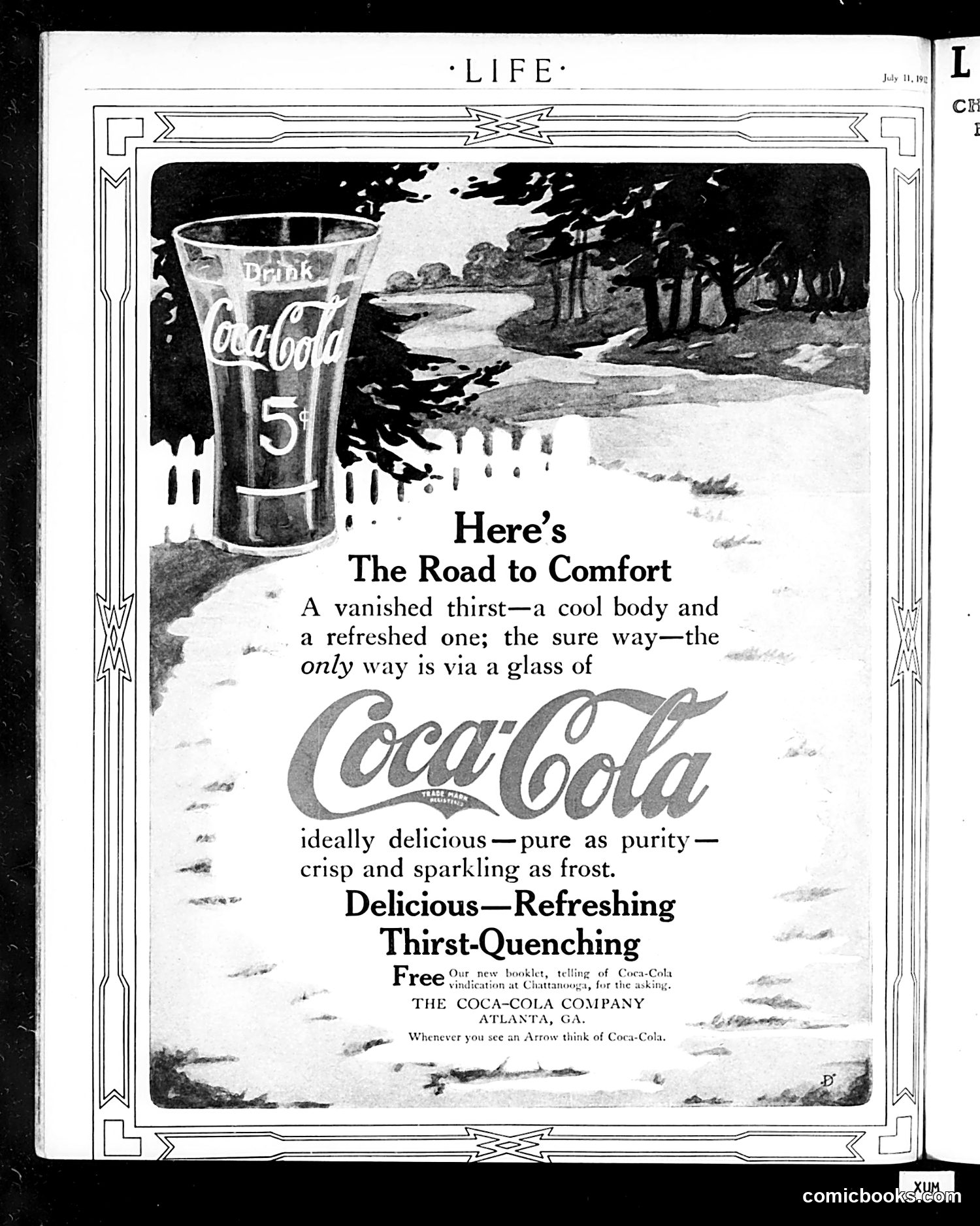
This is primarily a **Coca-Cola advertisement**, not political satire. It appears in *Life* magazine from July 11, 1912 (visible in header). The ad uses pastoral imagery—a peaceful landscape with a country road and trees—to associate the beverage with comfort, refreshment, and relaxation. A glass of Coca-Cola bearing a "5¢" price mark dominates the left side. **Key marketing claims:** - Promises to quench thirst and provide bodily refreshment - Emphasizes purity and quality ("pure as purity," "crisp and sparkling as frost") - Positions the drink as "the only way" to achieve comfort **Notable detail:** The ad mentions a "Free" booklet about Coca-Cola "vindication at Chattanooga"—likely referring to legal/regulatory battles the company faced regarding its ingredients and safety claims, which were contentious in the early 1900s. The slogan "Whenever you see an Arrow think of Coca-Cola" references the company's Arrow trademark advertising campaign. This reflects early-20th-century consumer marketing strategy combining idealized imagery with health/purity claims.