
Life, 1912-07-11 · page 35 of 44
Life — July 11, 1912 — page 35: what you’re looking at
What you’re looking at
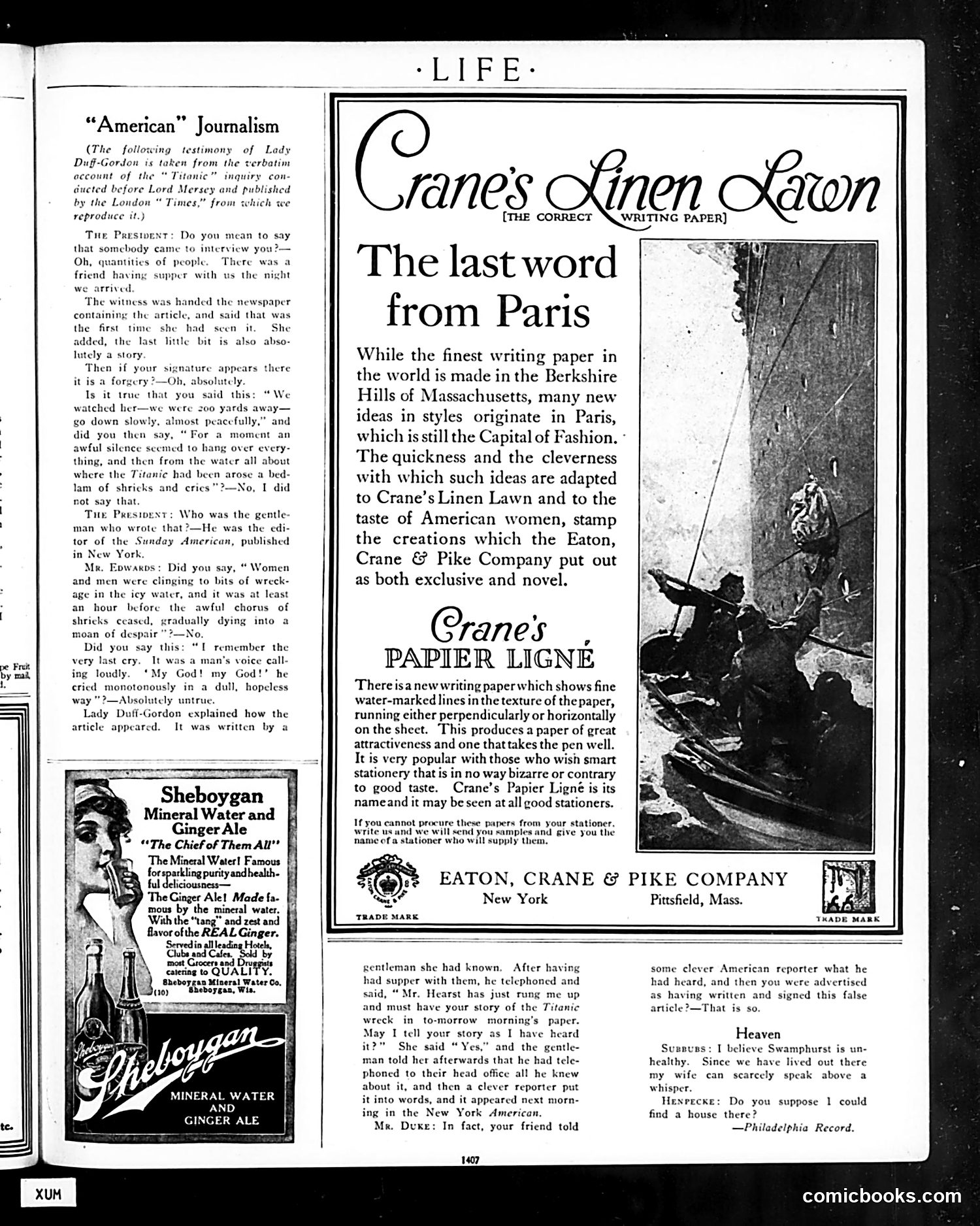
This page satirizes sensationalist American newspaper practices, specifically mocking the *New York American* (a William Randolph Hearst publication). The left column reproduces testimony from Lady Duff-Gordon's account of the Titanic inquiry, showing she denied making dramatic statements attributed to her in print—about drowning victims' cries, the ship's descent, etc. The satire's point: A gentleman acquaintance telephoned her account to Hearst's office, and a "clever reporter" then fabricated vivid, emotionally inflammatory quotes entirely—which appeared under her name in the *American*. This exposes how Hearst-era "yellow journalism" invented dramatic copy wholesale, falsely attributing it to witnesses. The rest of the page contains unrelated advertisements (Sheboygan water, Crane's writing paper), typical of Life's format.
📄 Transcribed text from this page (OCR, searchable)
Machine-transcribed from the original scan — historical spelling and the odd misread are preserved.
“American” Journalism (The following testimony of Lady Duf-Gordon is taken from the verbatim eccount of the “Titanic” inquiry con- ducted before Lord Mersey and published by the London “ Times,” from which we reproduce it.) Tue Prestoext: Do you mean to say that somebody came to interview you ?— Oh, quantities of people. There was a friend havi we arrived supper with us the night The witness was handed the newspaper containing the article, and said that was the first time she had scen it, She added, the last little bit is also abso- lutely a story. Then if your signature ‘ars there it is a forgery ?—Oh, absolu Is it true that you is: We watched her—we were 200 yards away— go down slowly, almost peacefully,” and did you then say, “ For a moment an awful silence seemed to hang over every thing, and then from the water all about where the Titanic had been arose a bed- lam of shricks and cries” ?—No, I did not say that, Tue Presipext: Who was the gentle- man who wrote that?—He was the edi- tor of the Sunday American, published in New York. Mk. Epwaxps: Did you say, “ Women and men were clinging to bits of wreck- age in the icy water, and it was at least an hour before the awful chorus of shrieks ceased, gradually dying into a moan of despair” Did you say this: “f remember the very last cry. It was a man's voice call- ing loudly. My God! my God!’ he cried monotonously in a dull, hopeless way "?—Absolutely untrue. Lady Duff-Gordon explained how the article appeared. It was written by a Sheboygan Mineral Water and Ginger Ale * “The Chief of ThemAll”" The Mineral Water! Famous The Ginger Ale! Made f: mous by the mineral water. ‘With the “tang” and zest and flavor ofthe REAL Ginger. Serrectio pil leadin Hele Clubs and Cales, ‘Sold by Boat Croce tod Drege catering to QUALI Bhebdoygan Mineral Water’ (10) eheboygans Wis. MINERAL WATER | AND GINGE! (Saneso inen Oaon The last word from Paris While the finest writing paper in the world is made in the Berkshire Hills of Massachusetts, many new ideas in styles originate in Paris, which is still the Capital of Fashion. The quickness and the cleverness with which such ideas are adapted to Crane’s Linen Lawn and to the taste of American women, stamp the creations which the Eaton, Crane & Pike Company put out as both exclusive and novel. Crane's . PAPIER LIGNE There isa new writing paper which shows fine water-marked lines in the texture of thepaper, running either perpendicularly or horizontally on the sheet. This produces a paper of great attractiveness and one that takes the pen well. Tt is very popular with those who wish smart stationery that is in no way bizarre or contrary to good taste. Crane’s Papier Ligné is its nameand it may be seen at all good stationers. If you cannot procure these papers from your stationer. write usand we will send you samples and give you the name of a stationer who will supply them, we TRADE MARK New York WRITING PAPER] EATON, CRANE & PIKE COMPANY Pittsfield, Mass. TKADE MARK gentleman she had known. After having had supper with them, he telephoned and said, “Mr. Hearst has just rung me up and must have your story of the Titanic wreck in to-morrow morning's paper. May I tell your story as I have heard it?” She said “Yes,” and the gentle- man told her afterwards that he had tele- phoned to their head office all he knew about it, and then a clever reporter put it into words, and it appeared next morn- ing in the New York American. Mr. Duxe: In fact, your friend told 1407 some clever American reporter what he had heard, and then you were advertised as having written and signed this false article ?—That is so. Heaven T bel Swamphurst is un- healthy. Since we have lived out there my wife can scarcely speak above a whisper. Hexrecxe: Do you suppose 1 could find a house there? —Philadelphia Record. comicbooks.com