
Life, 1912-07-11 · page 24 of 44
Life — July 11, 1912 — page 24: what you’re looking at
What you’re looking at
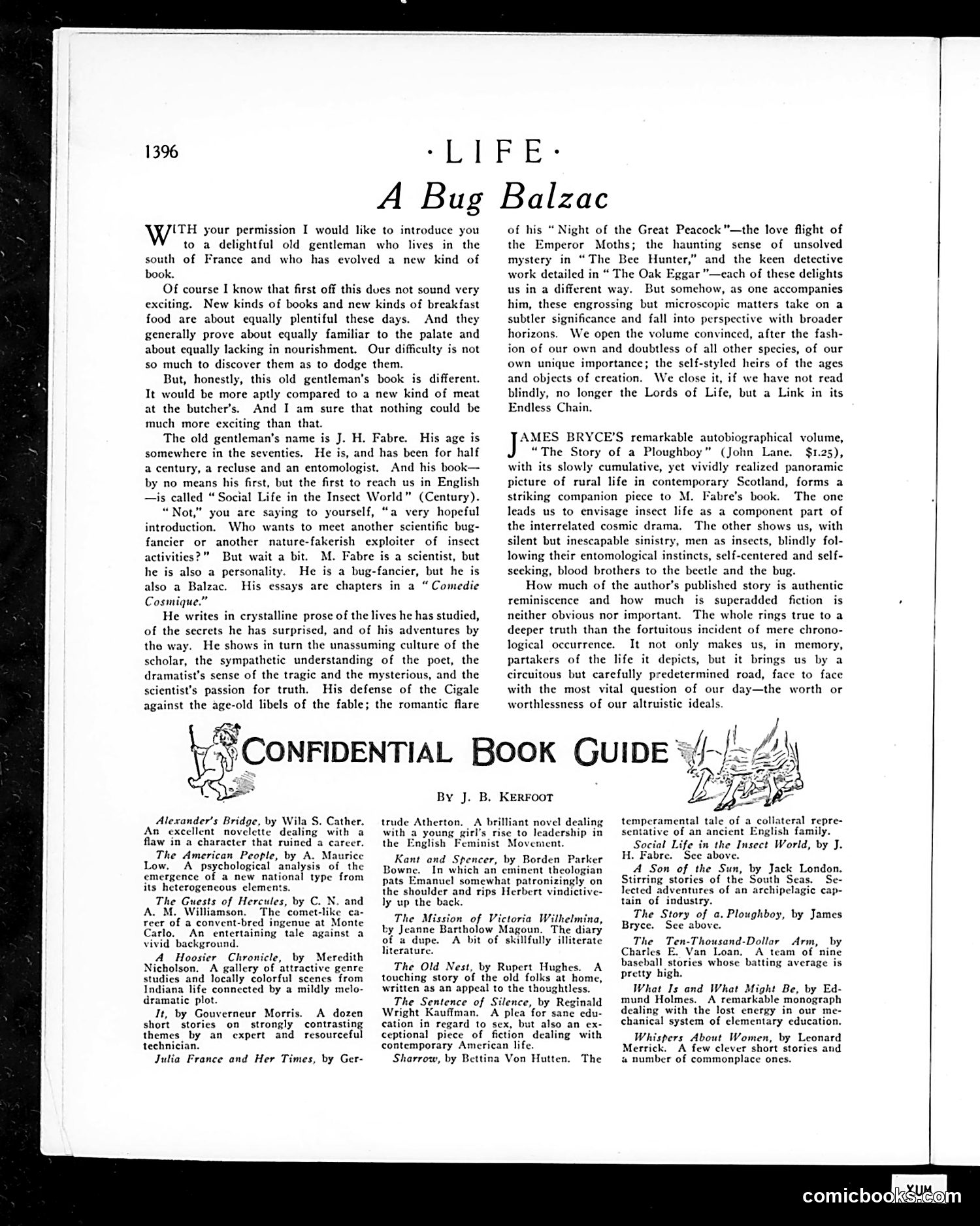
This is a literary essay introducing English readers to J. H. Fabre's *Social Life in the Insect World*, a French naturalist's entomological studies. The "Balzac" comparison references Honoré de Balzac, the great 19th-century French novelist, suggesting Fabre combines scientific precision with literary artistry and human insight. The satire is gentle: the reviewer playfully acknowledges that a book about insects sounds unpromising (compared unfavorably to new breakfast cereals), yet argues Fabre transcends typical "bug-fancier" writing through his poetic prose and philosophical depth. His observations about insects supposedly humble human pretension—we're not "Lords of Life" but merely "a Link in its Endless Chain." The accompanying "Confidential Book Guide" reviews other contemporary titles. This reflects early 20th-century middlebrow literary culture where magazines guided educated readers toward "serious" literature.
📄 Transcribed text from this page (OCR, searchable)
Machine-transcribed from the original scan — historical spelling and the odd misread are preserved.
eee A Bug Balzac ITH your permission I would like to introduce you to a delightful old gentleman who lives in the south of France and who has evolved a new kind of book. Of course I know that first off this dues not sound very exciting. New kinds of books and new kinds of breakfast food are about equally plentiful these days. And they generally prove about equally familiar to the palate and about equally lacking in nourishment. Our difficulty is not so much to discover them as to dodge them. But, honestly, this old gentleman's book is different. It would be more aptly compared to a new kind of meat at the butcher’ And I am sure that nothing could be much more exciting than that. The old gentleman's name is J. H. Fabre. His age is somewhere in the seventies. He is, and has been for half a century, a recluse and an entomologist. And his book— by no means his first, but the first to reach us in English —is called “Social Life in the Insect World” (Century). “Not,” you are saying to yourself, “a very hopeful introduction. Who wants to meet another scientific bug- fancier or another nature-fakerish exploiter of insect activities?” But wait a bit. M. Fabre is a scientist, but he is also a personality. He is a bug-fancier, but he is also a Balzac. His essays are chapters in a “Comedie Cosmique.” He writes in crystalline prose of the lives he has studied, of the secrets he has surprised, and of his adventures by the way. He shows in turn the unassuming culture of the scholar, the sympathetic understanding of the poet, the dramatist’s sense of the tragic and the mysterious, and the scientist’s passion for truth. His defense of the Cigale against the age-old libels of the fable; the romantic flare s a) ?\} Alexander's Bridge, by Wila S. Cather. — trude Atherton. An excellent novelette dealing with a with a young CONFIDENTIAL BOOK GUIDE’ By J. B. KERFOOT A brilliant novel dealing rise to leadership in of his “ Night of the Great Peacock"”—the love flight of the Emperor Moths; the haunting sense of unsolved mystery in “The Bee Hunter,” and the keen detective work detailed in “ The Oak Eggar "—each of these delights us in a different way. But somehow, as one accompanies him, these engrossing but microscopic matters take on a subtler significance and fall into perspective with broader horizons. We open the volume convinced, after the fash- ion of our own and doubtless of all other species, of our own unique importance; the self-styled heirs of the ages and objects of creation. We close it, if we have not read blindly, no longer the Lords of Life, but a Link in its Endless Chain. AMES BRYCE'S remarkable autobiographical volume, The Story of a Ploughboy” (John Lane. $1.25), with its slowly cumulative, yet vividly realized panoramic picture of rural life in contemporary Scotland, forms a striking companion piece to M. Fabre’s book. The one leads us to envisage insect life as a component part of the interrelated cosmic drama. The other shows us, with silent but inescapable sinistry, men as insects, blindly fol- lowing their entomological instincts, self-centered and self- seeking, blood brothers to the beetle and the bug. How much of the author’s published story is authentic reminiscence and how much is superadded fiction is neither obvious nor important. The whole rings true to a deeper truth than the fortuitous incident of mere chrono- logical occurrence. It not only makes us, in memory, partakers of the life it depicts, but it brings us by a circuitous but carefully predetermined road, face to face with the most vital question of our day—the worth or worthlessness of our altruistic ideals. te ys mental tale of a collateral repre- ive of an ancient English family. flaw in a character that ruined a career. The American People, by A. Maurice Low. A psychological ‘analysis of the emergence of a new national type from its heterogencous elements. The Guests of Hercules, by C. A. M. Williamson. The ‘comet- reer of a convent-bred ingenue at Monte Carlo. An entertaining tale against a vivid background. A Hoosier Chronicle, by Meredith Nicholson. A gallery of attractive genre studies and locally colorful scenes from Indiana life connected by a mildly melo- dramatic plot. It, by Gouverneur Morri A dozen short stories on strongly contrasting by an expert and resourceful an. France and Her Times, by Ger- the English Feminist. Movement. Kant and Spencer, by Borden Parker Bowne. In which an eminent theologian pats Emanuel somewhat patronizingly on the shoulder and rips Herbert vindictive- ly up the back. The Mission of Victoria Wilhelmina, ty Jeanne Bartholow Magoun. The diary of a dupe. A bit of skillfully illiterate literature. The Old Nest, by Rupert Hughes. A touching story of the old folks at home, written as an appeal to the thoughtless. The Sentence of Silence, by Reginald Wright Kauffman. A plea for sane edu- cation in regard to sex, but also an ex- ceptional piece of fiction dealing with contemporary American life. Sharrow, by Bettina Von Hutten, The Social Life in the Insect World, by J. H. Fabre. Sce above. A Son of the Sun, by Jack London. Stirring stories of the South Seas. Si lected adventures of an archipelagic cap- tain of industry. The Story of a. Ploughboy, by James Bryce. See above. The Ten-Thousand-Dollar Charles E. Van Loan, baseball stories whose batting pretty high. What Is and What Might Be, by Ed- mund Holmes, A remarkable monograph dealing with the lost energy in our me- chanical system of elementary education. Whispers About Women, by Leonard Merrick. A few clever short stories and & number of commonplace ones. Arm, by A team of nin erage comicbooks:¢om