
Life, 1912-07-11 · page 32 of 44
Life — July 11, 1912 — page 32: what you’re looking at
What you’re looking at
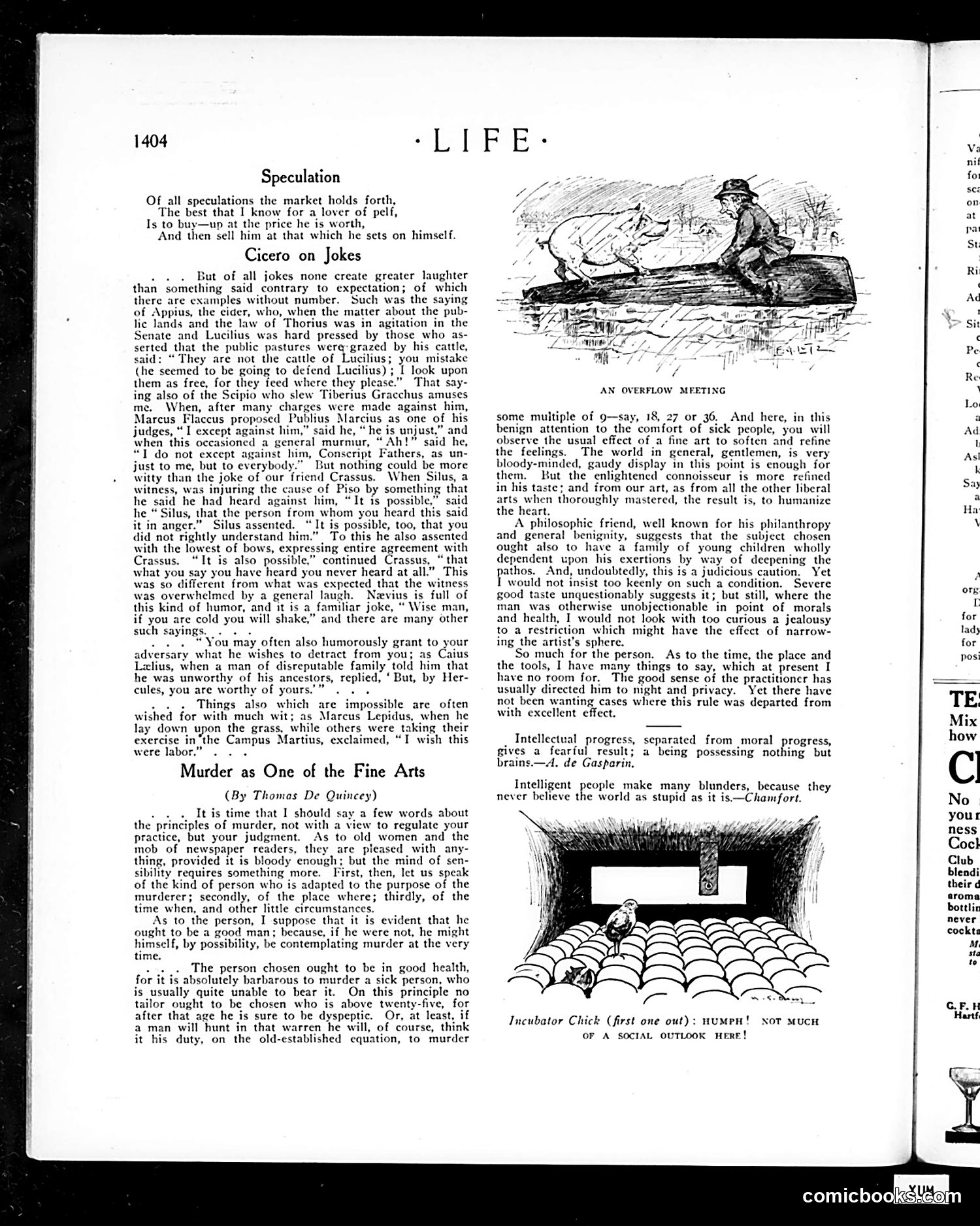
This page contains two distinct pieces of satirical writing: **"Speculation"** is a brief poem mocking stock market speculation and self-interested profiteering—common themes in Gilded Age satire. **"Cicero on Jokes"** presents classical Roman anecdotes about wit and unexpected humor, likely included as intellectual content for Life's educated readership. **"Murder as One of the Fine Arts"** is an excerpt from Thomas De Quincey's famous 1827 essay. The satire here is *philosophical*: De Quincey tongue-in-cheek discusses murder as if it were an aesthetic pursuit requiring refined taste and careful consideration—absurdly treating brutal crime with the language of high art. The deadpan delivery ("the person ought to be in good health") is the joke. This was published as provocative intellectual humor, not endorsement. The two cartoons (an overflow meeting and an incubator chick) appear unrelated to the text and likely accompany separate articles.
📄 Transcribed text from this page (OCR, searchable)
Machine-transcribed from the original scan — historical spelling and the odd misread are preserved.
1404 Speculation Of all speculations the market holds forth, The best that I know for a lover of pelf, Is to buy—up at the price he is worth, And then sell him at that which he sets on himself. Cicero on Jokes . . . But of all jokes none create greater laughter than something said contrary to expectation; of which there are examples without number. Such was the saying of Appius, the cider, who, when the matter about the pub- lic lands and the law of Thorius was in agitation in the Senate and Lucilius was hard pressed by those who as- serted that the public pastures were-grazed by his cattle, said: “They are not the cattle of Lucilius; you mistake (he seemed to be going to defend Lucilius) ; I look upon them as free, for they feed where they please.” That say- ing also of the Scipio who slew Tiberius Gracchus amuses me. When, after many charges were made against him, Marcus Flaccus proposed Publius Marcius as one of his judges, “I except against him,” said he, “he is unjust,” and when this occasioned a general murmur, “ Ah!” said he, “T do not except inst him, Conscript Fathers, as un- just to me, but to everybody.” But_nothing could be more witty than the joke of our friend Crassus. When Silus, a witness, was injuring the cause of Piso by something that he said he had heard against him, “It is possible,” said he “ Silus, that the person from whom you heard this said it in anger.” Silus assented. “It is possible, too, that you did not rightly understand him.” To this he also assented with the lowest of bows, expressing entire agreement with Crassus. “It is also possible,” continued Crassus, “ that what you say you have heard you never heard at all.” This was so different from what was expected that the witness was overwhelmed by a general laugh. Nevius is full of this kind of humor, and it is a familiar joke, “ Wise man, if you are cold you will shake,” and there are many other such sayings. . . . « « “You may often also humorously grant to your adversary what he wishes to detract from you; as Caius Lzlius, when a man of disreputable family told him that he was unworthy of his ancestors, replied, ‘ But, by Her- cules, you are worthy of yours”... . . , Things also which are impossible are often wished for with’ much wi Marcus Lepidus, when he lay down upon the grass, while others were taking their exercise in*the Campus Martius, exclaimed, “I wish this were labor.” Murder ss One of the Fine Arts (By Thomas De Quincey) . « « It is time that I should say a few words about the principles of murder, not with a view to regulate your practice, but your judgment. s to old women and the mob of newspaper readers, they are pleased with any- thing, provided it is bloody enough; but the mind of sen- sibility requires something more. First, then, let us speak of the kind of person who is adapted to the purpose of the murderer; secondly, of the place where; thirdly, of the time when, and other little circumstances. As to the person, I suppose that it is evident that he ought to be a good man; because, if he were not, he might himself, by possibility, be contemplating murder at the very time. +. . The person chosen ought to be in good health, for it is absolutely barbarous to murder a sick person, who is usually quite unable to bear it. On this principle no tailor ought to be chosen who is above twenty-five, for after that age he is sure to be dyspeptic. Or, at least, if a man will hunt in that warren he will, of course, think it his duty, on the old-established equation, to murder AN OVERFLOW MEETING some multiple of 9— 18, 27 or 36. And here, in this benign attention to the comfort of sick people, you will observe the usual effect of a fine art to soften and refine the feelings. The world in general, gentlemen, is very bloody-minded, gaudy display in this point is enough for them. But the enlightened connoisseur is more refined in his taste; and from our art, as from all the other liberal arts when thoroughly mastered, the result is, to humanize the heart. A philosophic friend, well known for his philanthropy and general benignity, suggests that the subject chosen ought also to have a family of young children wholly dependent upon his exertions by w of deepening the pathos. And, undoubtedly, this is a judicious caution. Yet would not insist too keenly on such a condition. Severe good taste unquestionably suggests it; but still, where the man otherwise unobjectionable in point of morals and health, I would not look with too curious a jealousy to a restriction which might have the effect of narrow- ing the artist’s sphere. So much for the person. As to the time, the place and the tools, I have many things to say, which at present I have no room for, The good sense of the practitioner has usually directed him to night and privacy. Yet there have not been wanting cases where this rule was departed from with excellent effect. , Intellectual progress, separated from moral progress, gives a fearful result; a being possessing nothing but brains.—A. de Gasparin, Intelligent people make many blunders, because they never believe the world as stupid as it is—Chamfort. Incubator Chick (first one out): wuMPH! NoT MUCH OF A SOCIAL OUTLOOK HERE! comicbooheem