
A complete issue · 40 pages · 1912
Life — January 11, 1912
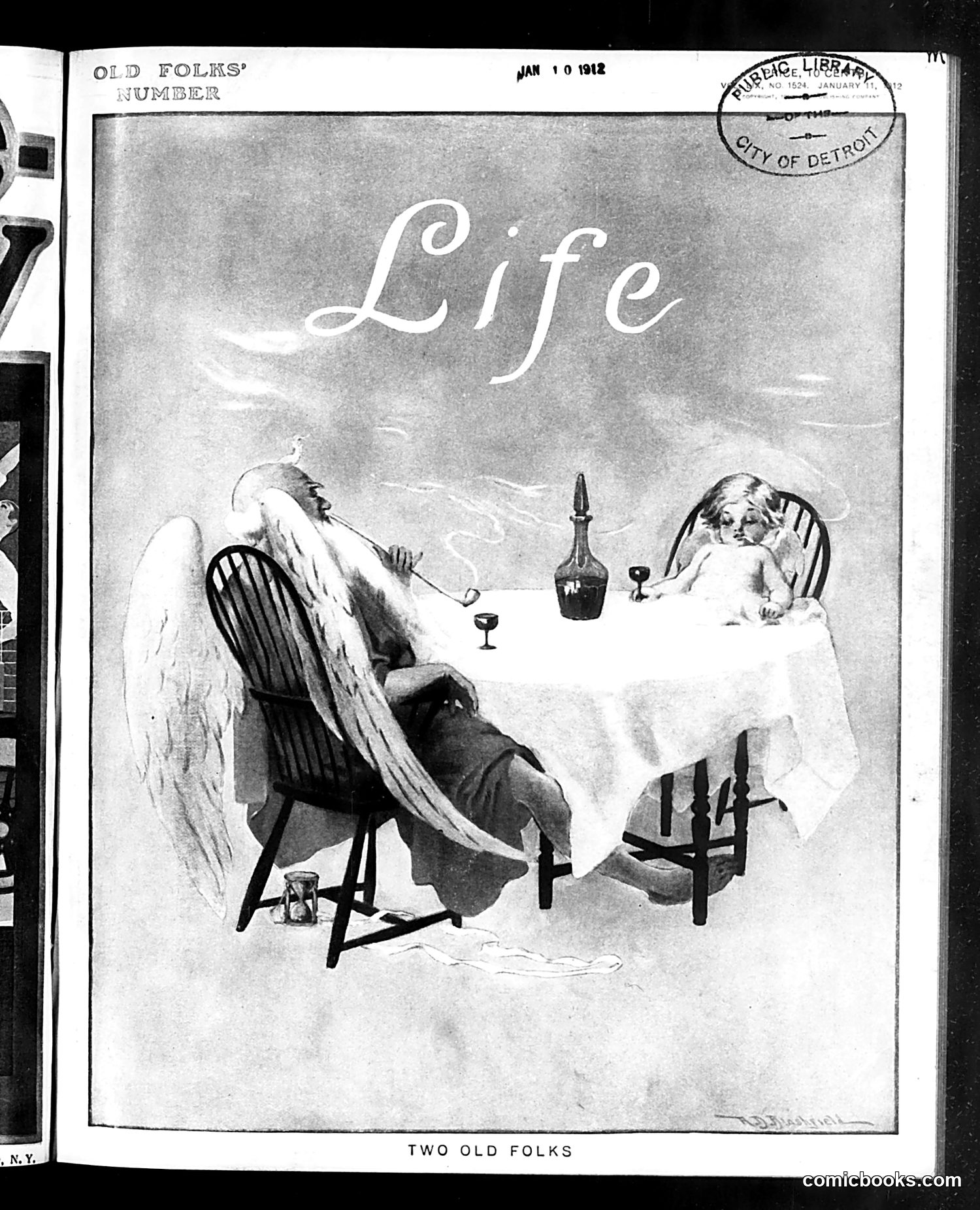
This cover illustration depicts two elderly figures dining together at a table with wine and candles. The figure on the left has prominent wings, identifying them as **Death** (or the Grim Reaper). The figure on the right appears to be an elderly person, likely representing old age or humanity in advanced years. The satirical point appears to be a memento mori joke—a darkly humorous commentary on mortality and the inevitability of death in old age. The intimate dinner setting with wine creates an ironic tone, treating Death as a dining companion to the elderly. This reflects the magazine's characteristic use of allegorical figures to comment on human condition and the passage of time, typical of early 20th-century satirical humor.
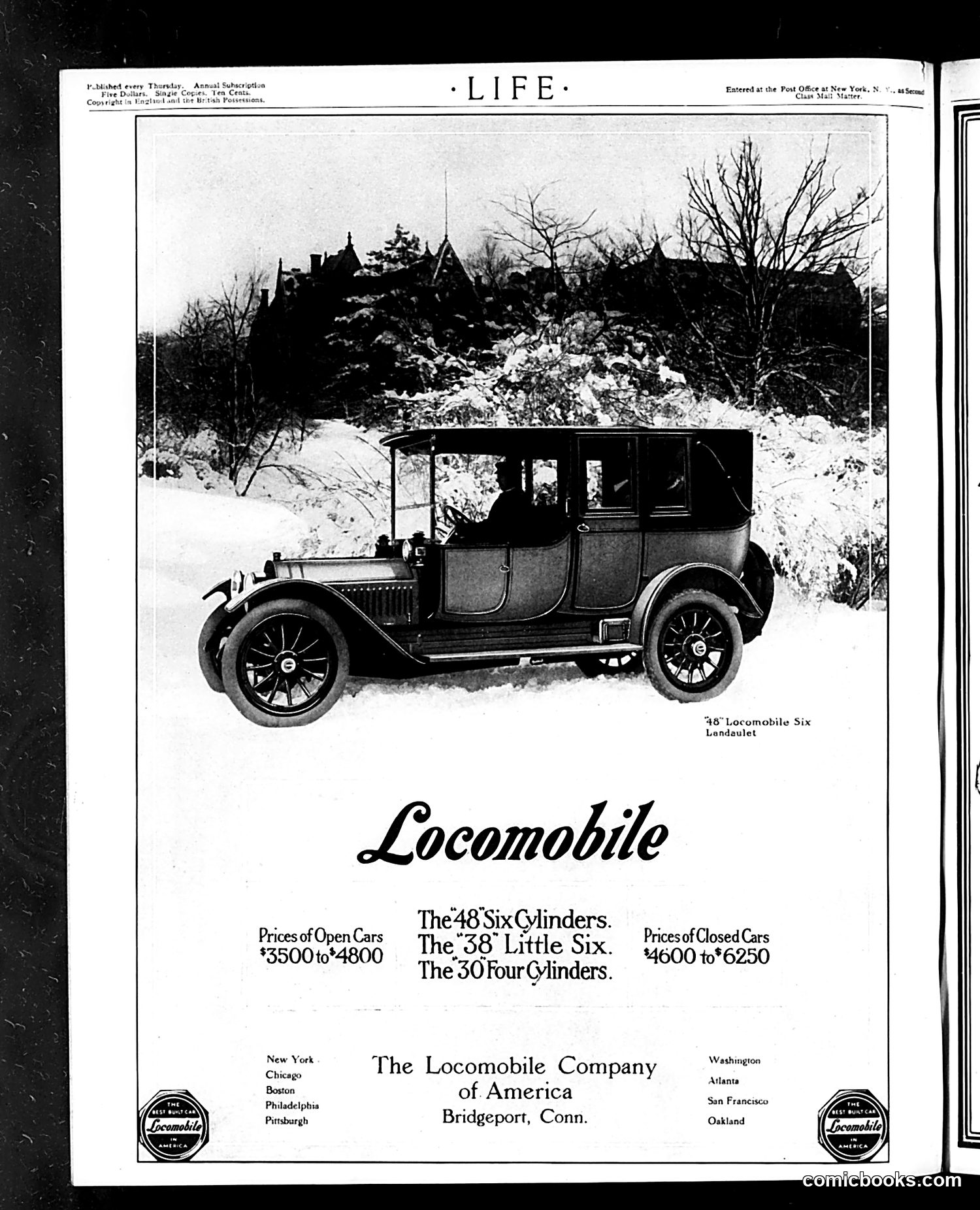
This page is **primarily an advertisement**, not political satire. It's a Locomotile automobile ad from Life magazine, featuring a "48 Six Cylinders" luxury car model photographed in a snowy winter landscape with a castle visible on a hillside in the background. The ad emphasizes the vehicle's prestige through the romantic castle setting and lists three models with pricing: the 48 Six Cylinders ($3500-$4800 for open cars; $4600-$6250 for closed), the 38 Little Six, and the 50 Four Cylinders. The Locomotile Company of America, based in Bridgeport, Connecticut, lists offices across major American cities. This is a straightforward luxury goods advertisement with no satirical content—typical of Life's commercial pages during the early automobile era.
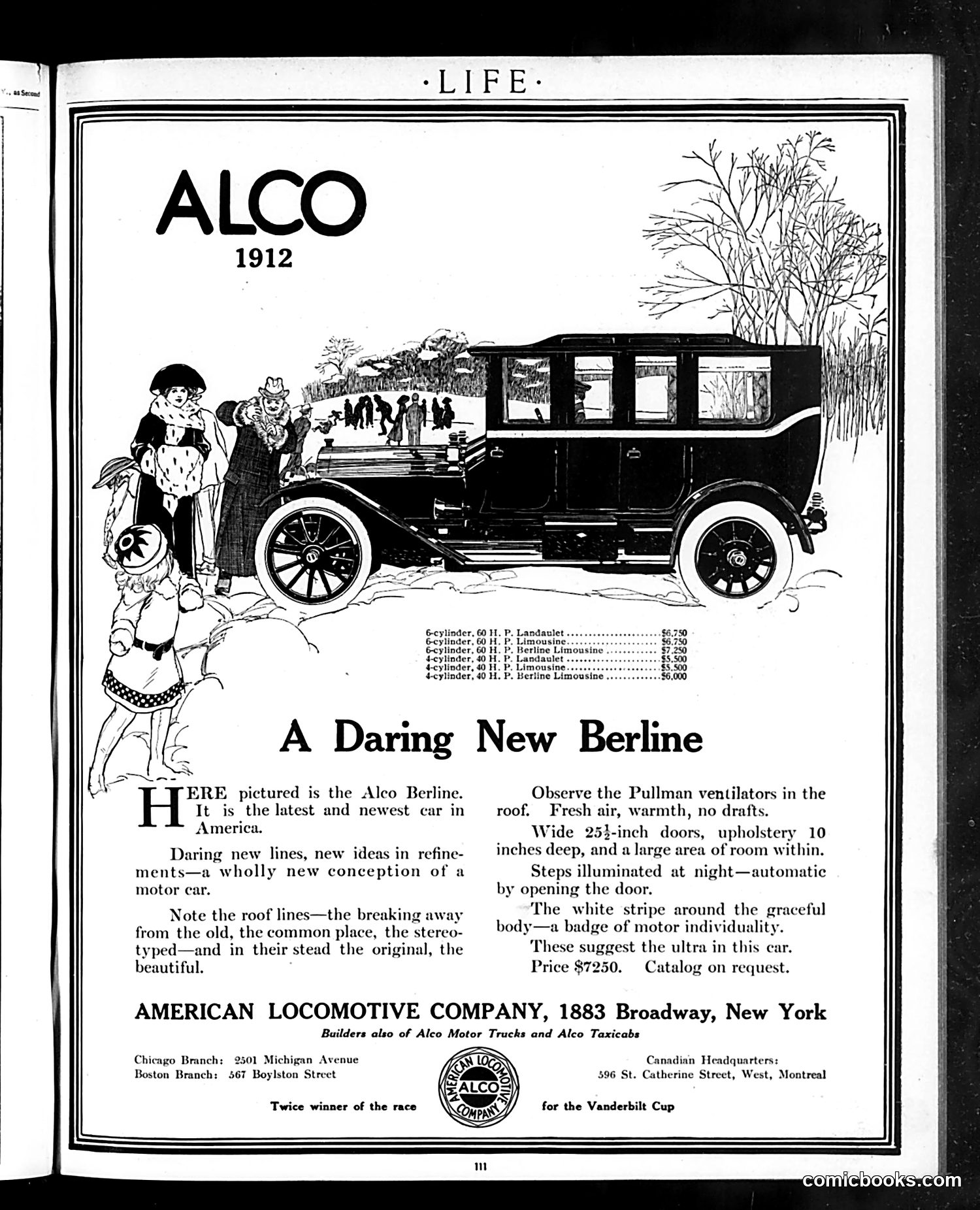
This is **not a cartoon or satire**—it's a straightforward automobile advertisement for the 1912 Alco Berlin motorcar, published in *Life* magazine. The illustration shows three well-dressed figures (a woman and two men) admiring the vehicle. The ad emphasizes modern features: the innovative roof design with Pullman ventilators, spacious interior (25½-inch doors), illuminated steps, and distinctive white stripe trim. The copywriting highlights "daring new lines, new ideas in refinements," positioning the $7,250 Alco as cutting-edge automotive technology. The American Locomotive Company marketed this as a luxury vehicle combining style with practical innovations that distinguished it from "common place" competitors. This represents early 1900s automotive advertising targeting affluent consumers through *Life*'s educated readership.
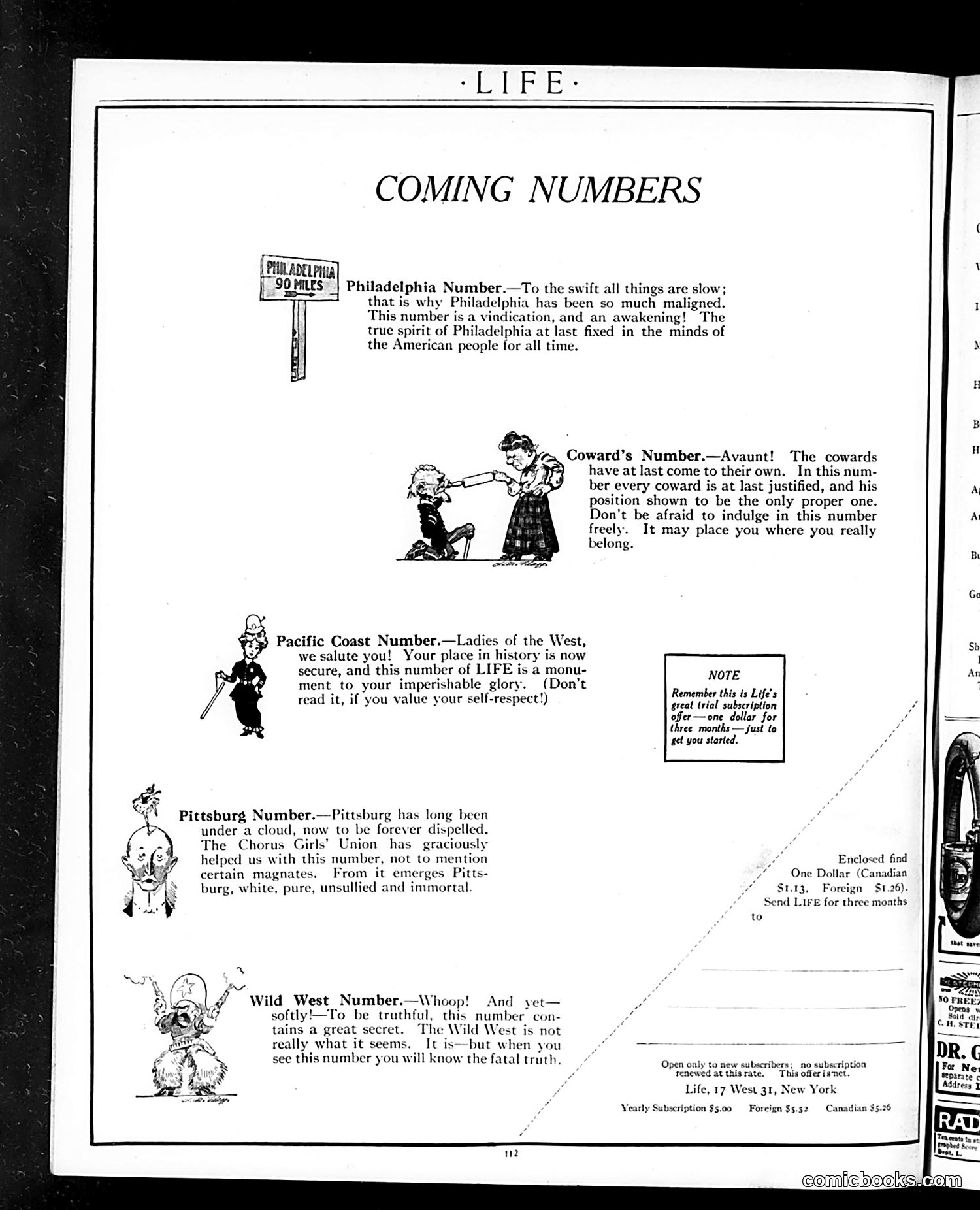
This page advertises upcoming special issues of Life magazine, each with regional themes mocking local stereotypes: **Philadelphia Number**: Criticizes Philadelphia as slow and maligned, claiming this issue will vindicate the city's reputation. **Coward's Number**: A darkly humorous issue suggesting cowards are finally justified in their timidity, with the cartoon showing two figures in conflict. **Pacific Coast Number**: Flatters Western women as having secured their "place in history." **Pittsburgh Number**: References the "Chorus Girls' Union," suggesting the issue will reveal Pittsburgh as refined and pure—ironic given the city's industrial reputation. **Wild West Number**: Promises to reveal secrets about the Wild West that differ from popular perception. Each number uses regional pride and stereotype-based humor to encourage subscriptions. The note offers a trial subscription for one dollar.
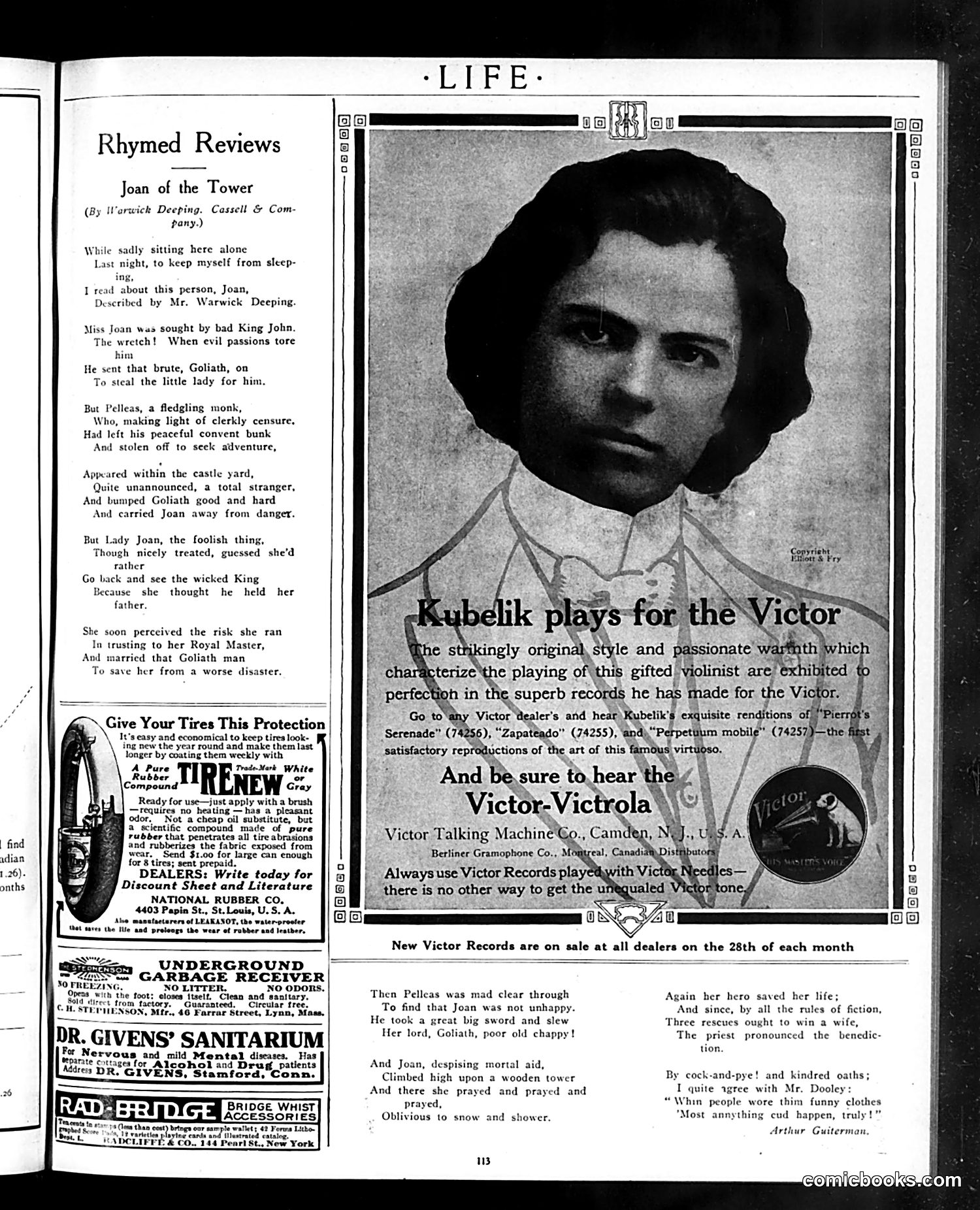
This page is primarily **advertising and entertainment content** rather than political satire. The main feature is an advertisement for **Kubelik**, a violinist promoting Victor Victrola phonographs and Victor Records. The ad emphasizes his "strikingly original style and passionate warmth" and lists three specific recordings available. The left side contains **"Rhymed Reviews"** — a humorous poem about "Joan of the Tower" (appears to be a literary or theatrical work by Warwick Deeping). The verse narrates Joan's rescue from King John by a monk named Pelicas, using comedic rhyming verse. The remaining content consists of period advertisements for tire protection, rubber compounds, a sanitarium, and bridge accessories—typical early 20th-century magazine filler with no political commentary evident.
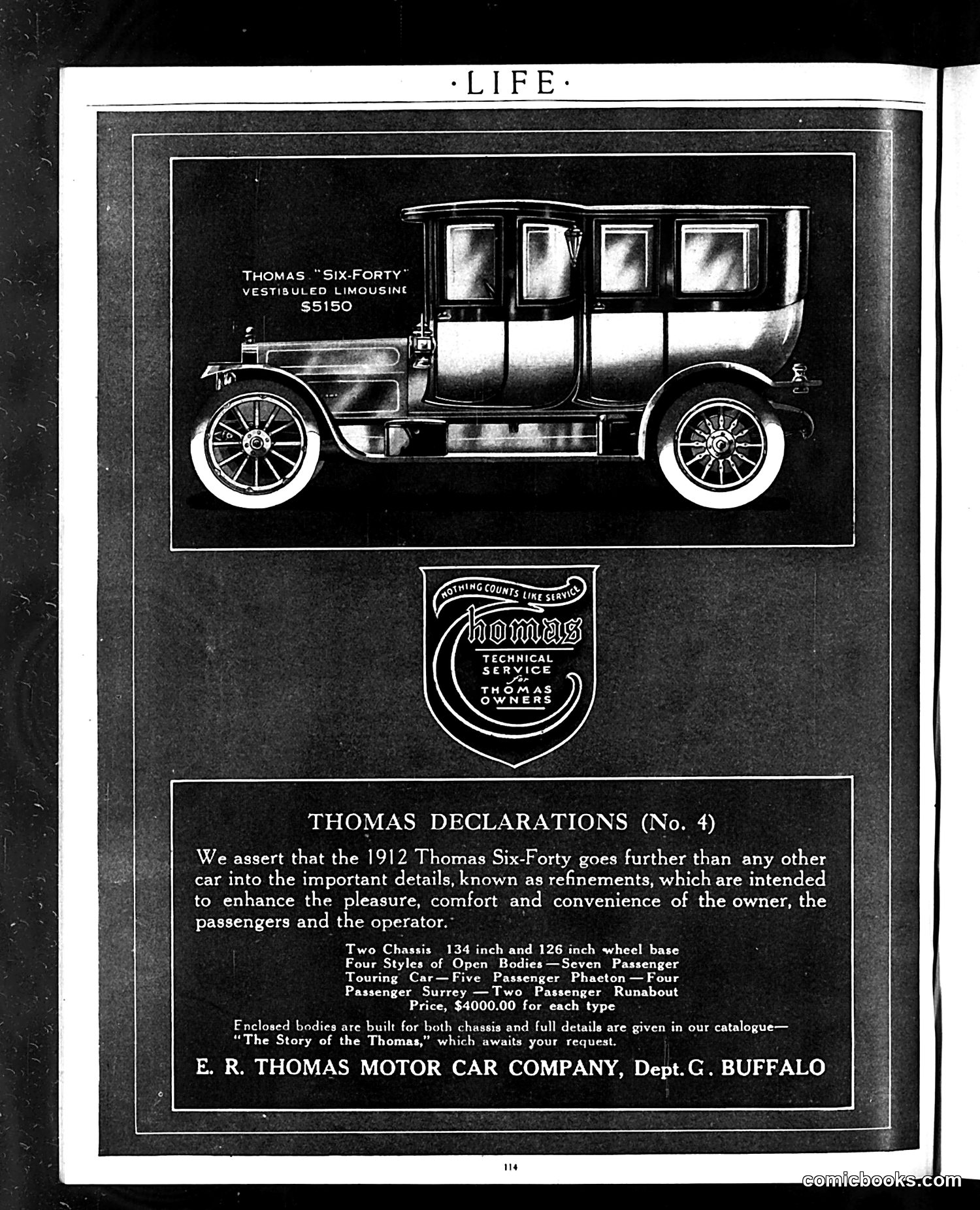
This page is **not a cartoon or satire**—it's a straightforward **automobile advertisement** from Life magazine, circa 1912. The image shows a Thomas "Six-Forty" Vestibuled Limousine (model S5150), a luxury passenger vehicle. The ad includes a company seal and "Thomas Declarations (No. 4)," where E.R. Thomas Motor Car Company asserts their vehicle offers superior refinements for "pleasure, comfort and convenience." The text lists specifications: two chassis sizes (134 and 126 inch wheelbase), four body styles (seven-passenger touring car, five-passenger phaeton, four-passenger surrey, two-passenger runabout), priced at $4,000 each. **No political or social satire is present.** This is period advertising marketing an early automobile as a premium luxury product.
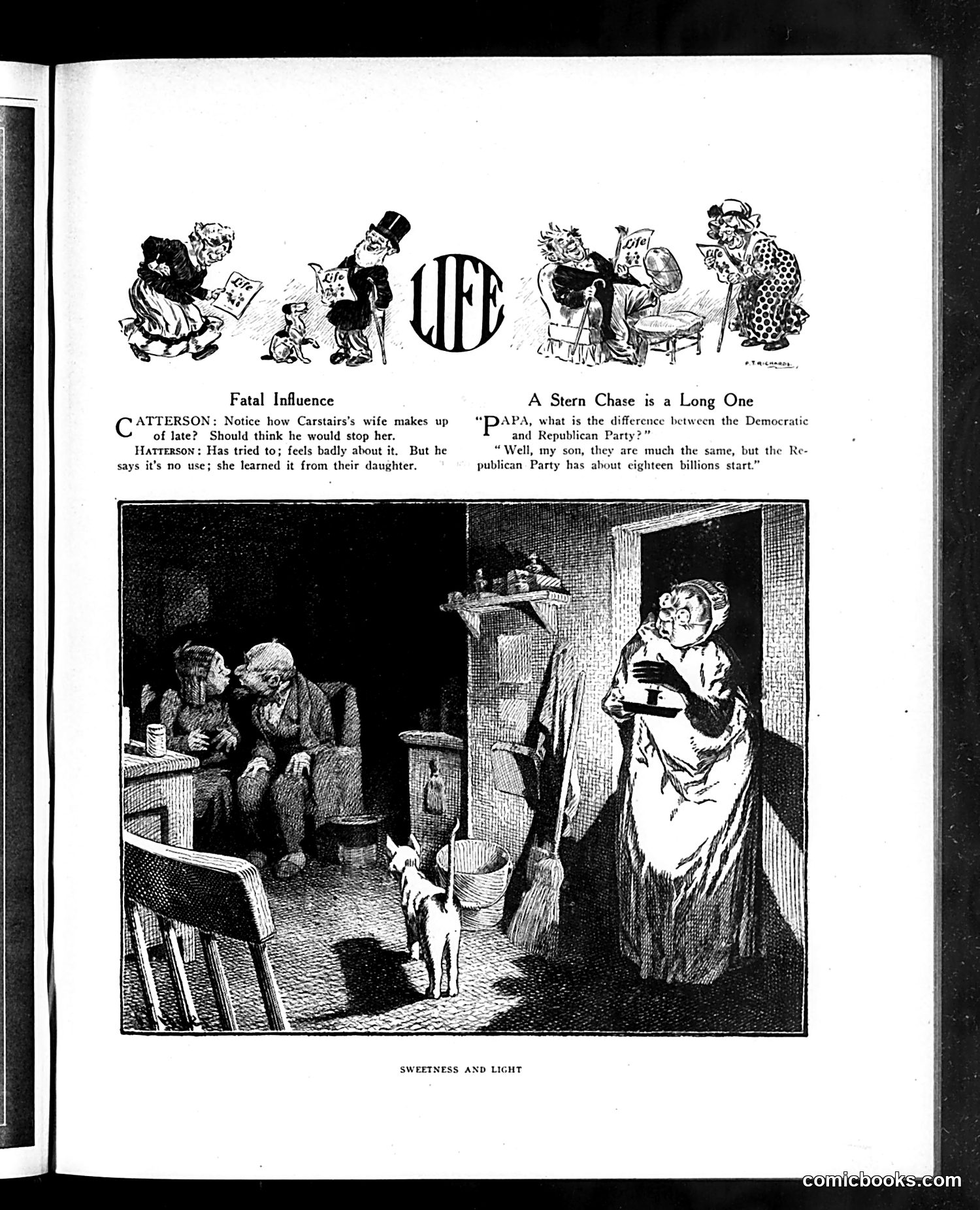
This page contains three humor pieces from Life magazine (a satirical publication, now public domain). **Top section**: Two brief jokes. "Fatal Influence" jokes about a wife's bad ideas spreading to her husband through their daughter. "A Stern Chase is a Long One" presents a father-son conversation about political party differences, with the father claiming Republicans have "eighteen billions" more (likely referencing 1920s-era political/economic arguments). **Main cartoon** ("Sweetness and Light"): Shows a domestic scene where a woman appears to be striking or disciplining a small dog, while a man watches from another room. The caption's title suggests ironic commentary on domestic harmony—the actual scene contradicts the genteel notion of "sweetness and light," satirizing the gap between idealized domestic life and reality. The page reflects early 20th-century American humor styles and political discourse.
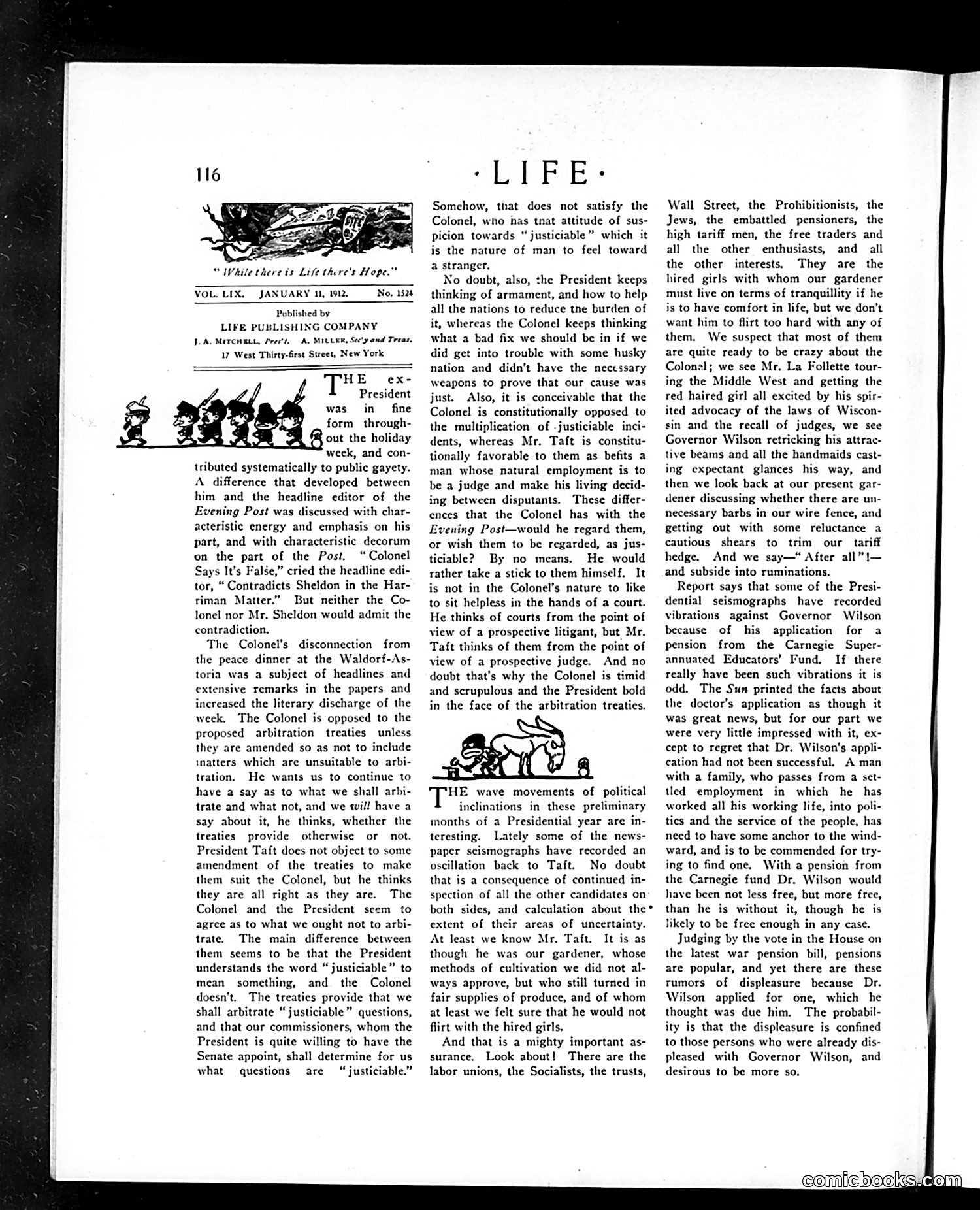
This page contains editorial commentary on President Taft's policy disagreements with Colonel Roosevelt (likely Theodore Roosevelt, who served as president 1901-1909). The text discusses their differing views on arbitration treaties and the Colonel's criticism of the Waldorf-Astoria dinner controversy. The small cartoon shows two figures in conflict—appearing to represent Taft and Roosevelt, visualizing their political rift. The article notes the "wave movements of political inclinations" among candidates and records oscillation back to Taft, while discussing Governor Wilson and various political constituencies (labor unions, Socialists, trusts, tariff advocates). The satire critiques the administration's handling of policy disputes and internal party divisions during this contentious pre-election period.
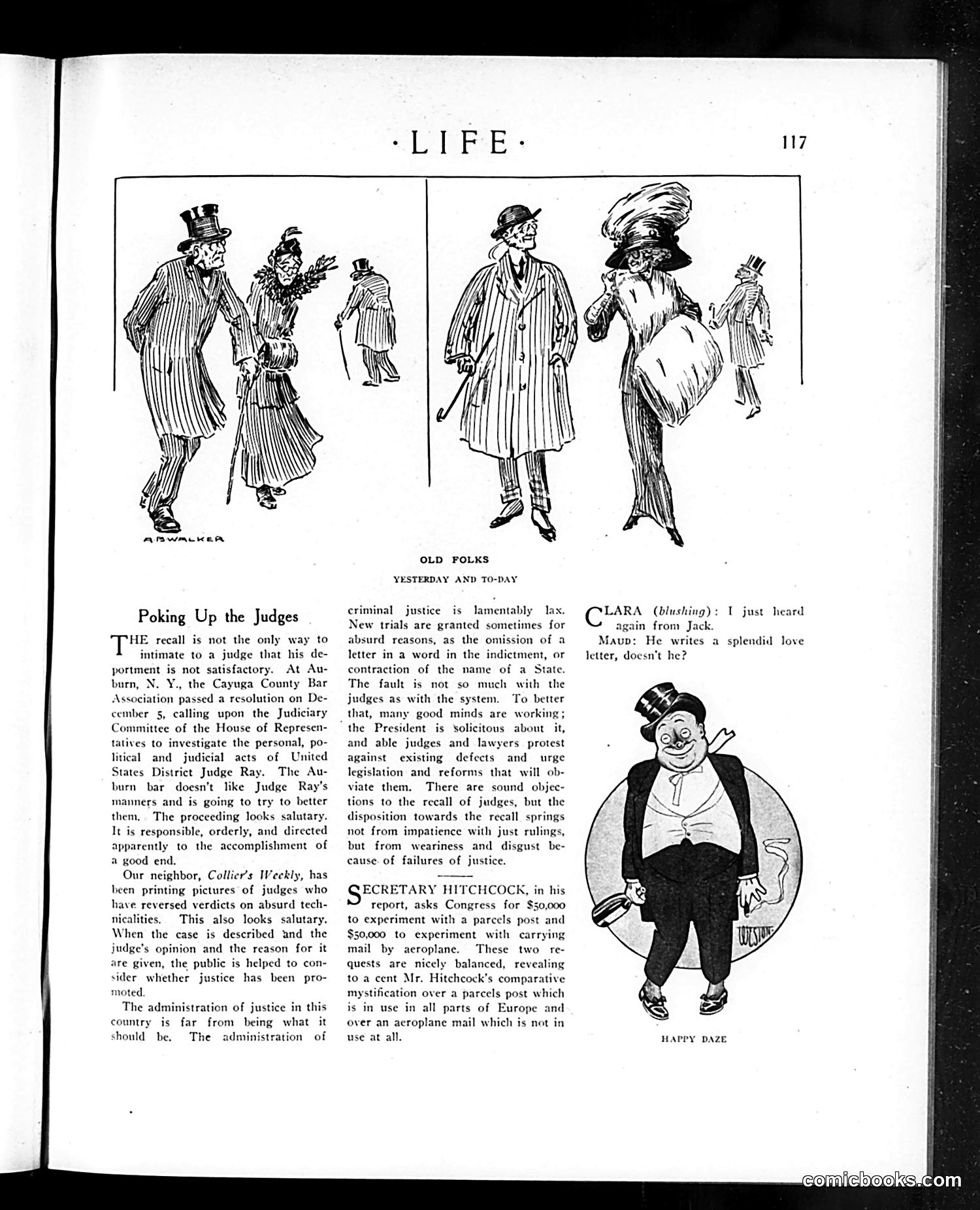
This satirical article critiques the judicial system's failures. The top illustration shows well-dressed figures in top hats representing judges and legal professionals, likely commenting on their formal detachment from justice. The main text discusses how the Cayuga County Bar Association called for investigating judicial conduct, with judges reversing verdicts and criminal justice being "lamentably lax." The article sarcastically notes that public scrutiny of judicial failures is useful for determining "whether justice has been promoted." The "Happy Daze" cartoon (bottom right) depicts a portly figure—likely Secretary Hitchcock—requesting Congressional funds for experimental postal and aeronautical delivery systems. This appears to mock government spending proposals and bureaucratic inefficiency as absurdly balanced against each other.
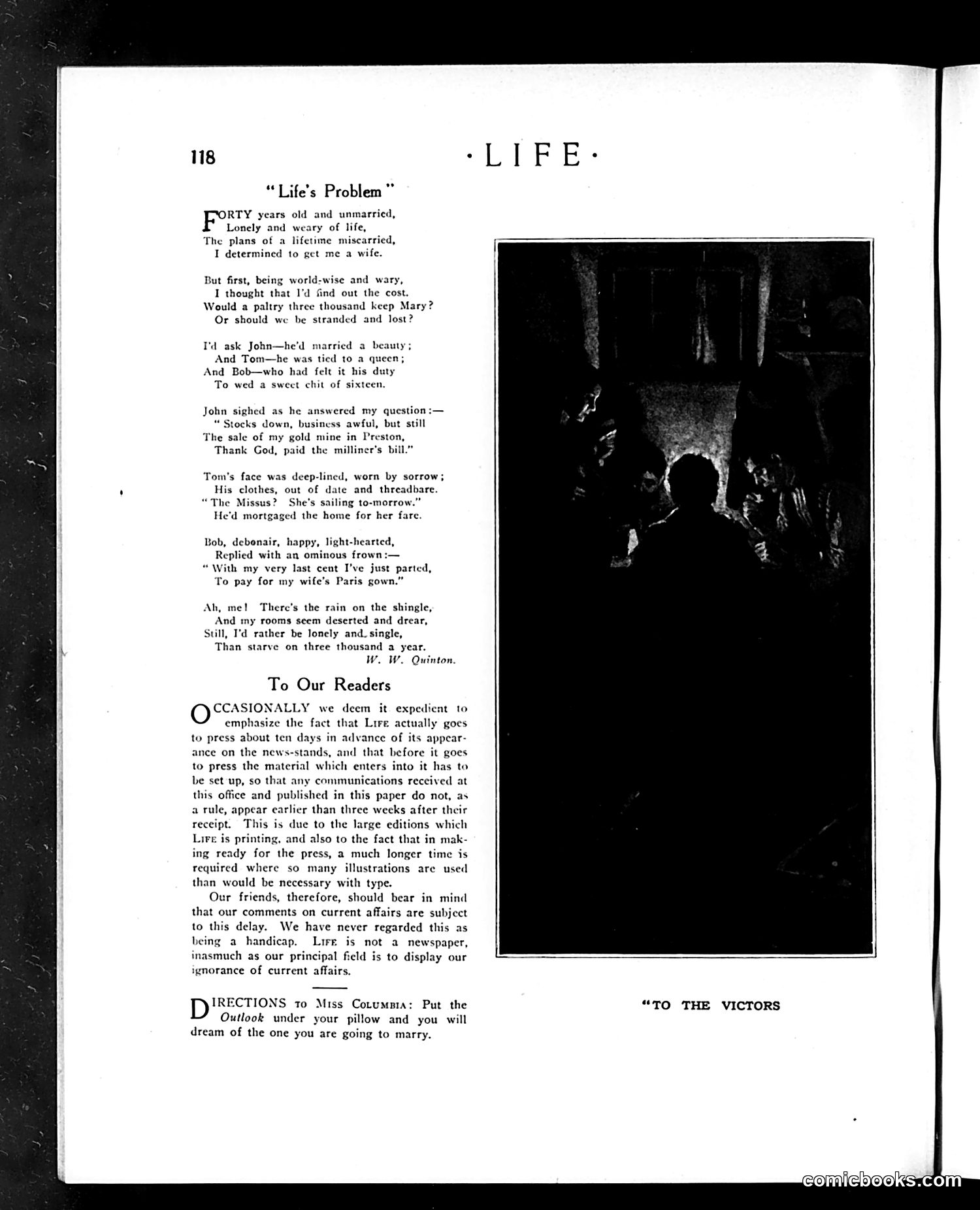
This page contains a poem by W. H. Oulton titled "Life's Problem," depicting a forty-year-old unmarried man seeking a wife. He consults three married friends about the financial implications: - **John**: Reports his gold mine sale covers expenses - **Tom**: Claims his ship sails tomorrow, having mortgaged his home - **Bob**: Admits he's spent his last cent on his wife's Paris gown The satire critiques **marriage as financially ruinous for men**, with each friend representing a different economic disaster caused by matrimony. The poem suggests that marriage inevitably leads to financial ruin regardless of initial wealth or circumstances—a common theme in early 20th-century satirical literature mocking both marriage and women's spending habits. The accompanying photograph labeled "TO THE VICTORS" remains unclear without additional context.
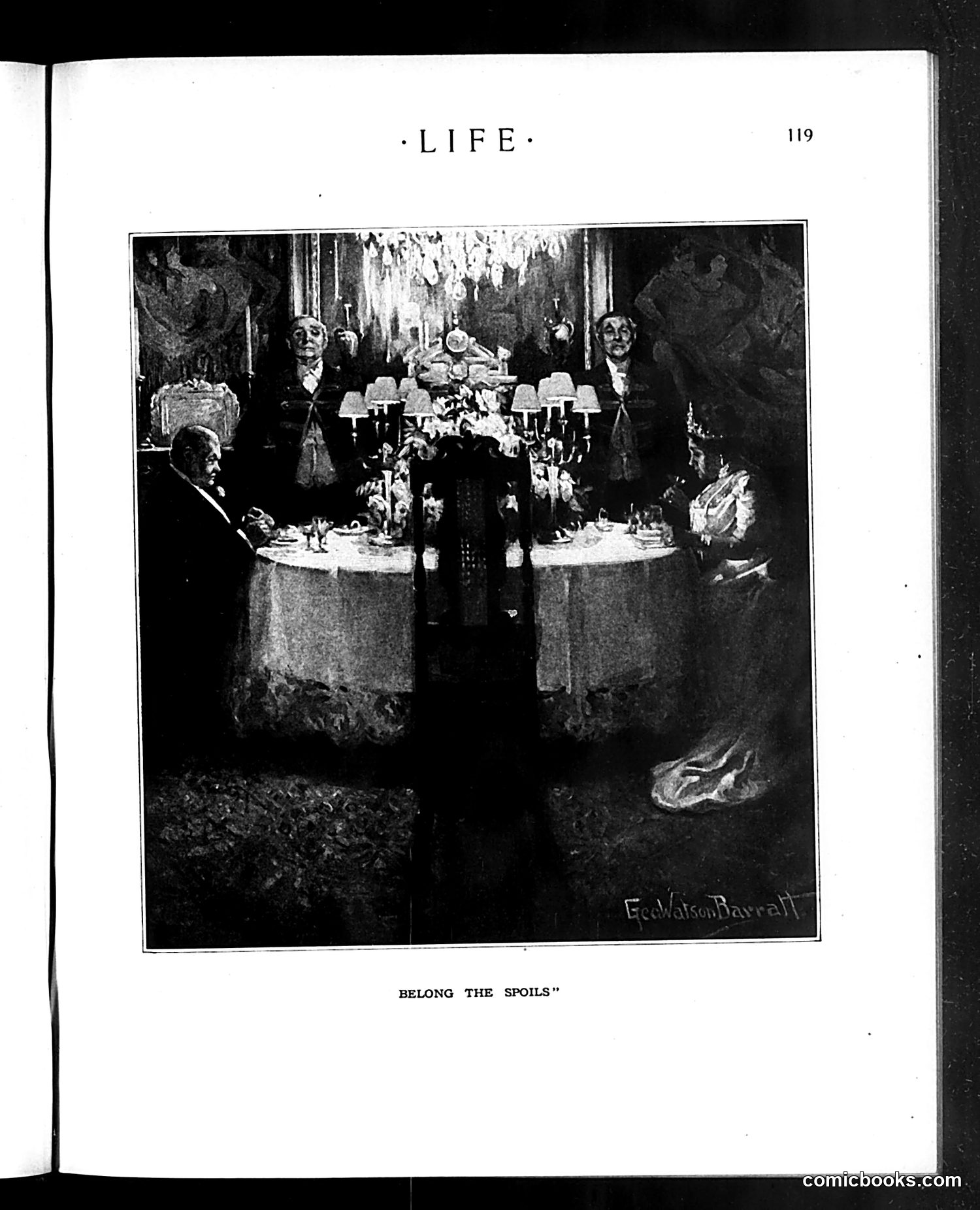
This satirical illustration depicts an opulent formal dinner scene, likely critiquing political corruption and patronage. The title references the common practice of politicians distributing government positions and contracts to supporters after winning elections—the "spoils" of political victory. The image shows elegantly dressed figures in a luxurious setting with chandeliers, fine dining, and elaborate decorations. The composition suggests wealthy elites feasting while benefiting from political favor-trading. The artist, Ed. Watson-Barrett (visible in signature), appears to condemn this system of cronyism and the inequality it represents. Without identifying specific individuals, the cartoon satirizes how political victors historically rewarded loyal supporters through patronage rather than merit-based appointments—a practice Life magazine frequently criticized.
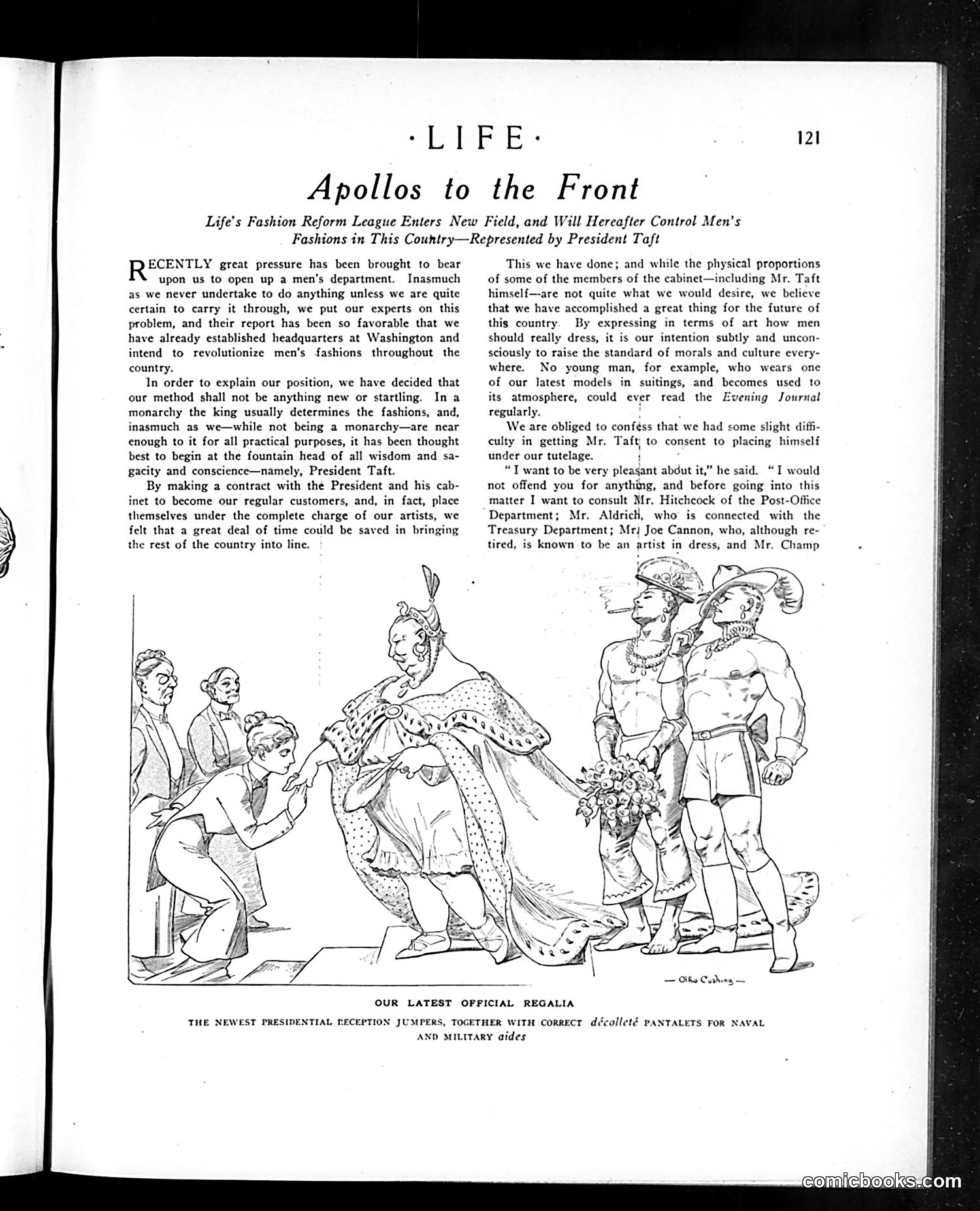
This page satirizes Life magazine's "Fashion Reform League" initiative to modernize American men's clothing. The text announces they've secured President Taft's cooperation to establish a men's department and revolutionize male fashion nationwide. The cartoon mocks this ambition by depicting classical Greek and Roman male figures (likely representing "ideal" masculine forms) being fitted with modern clothing by tailors. The satire suggests that attempting to reform men's fashion is absurd—even mythological ideals couldn't succeed at it. The caption references "official regalia" and "presidential reception jumpers" with "dishabille pantalets for naval and military aides," humorously exaggerating the pretentiousness of fashion reform efforts during the Taft administration (1909-1913).
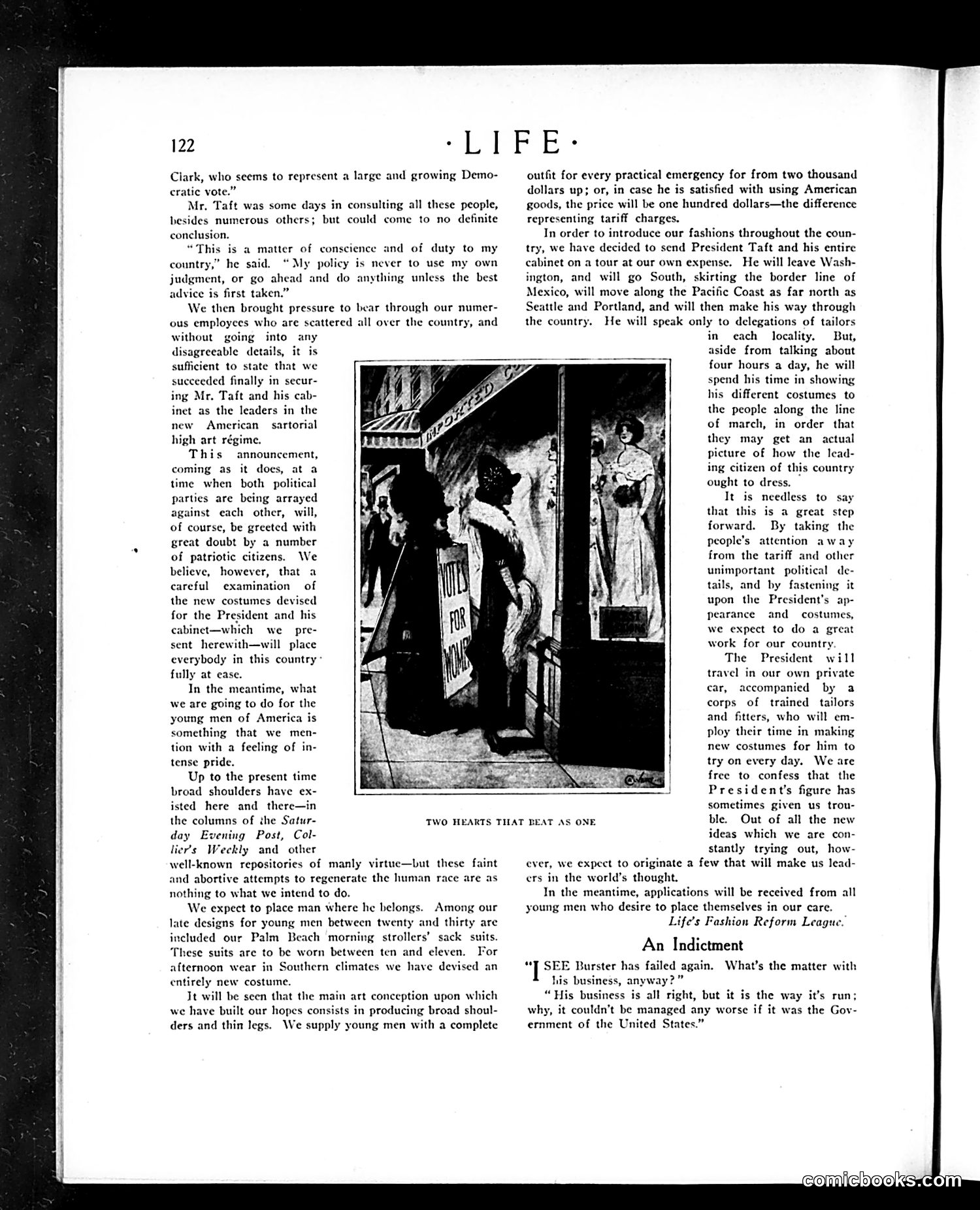
This cartoon satirizes President William Howard Taft's fashion tour. The text reveals Taft's administration planned to send the president and his cabinet on a cross-country tour to showcase American fashion and distract the public from tariff debates and political conflicts. The image depicts two figures (likely Taft and a cabinet member) in what appears to be a doorway or entrance—"two hearts that beat as one" refers sarcastically to their political unity. The satire suggests this fashion spectacle is a manipulative public relations stunt designed to redirect public attention away from serious policy disagreements. By focusing on costumes rather than substantive issues, the magazine mocks this as an ineffective distraction from real governance problems.
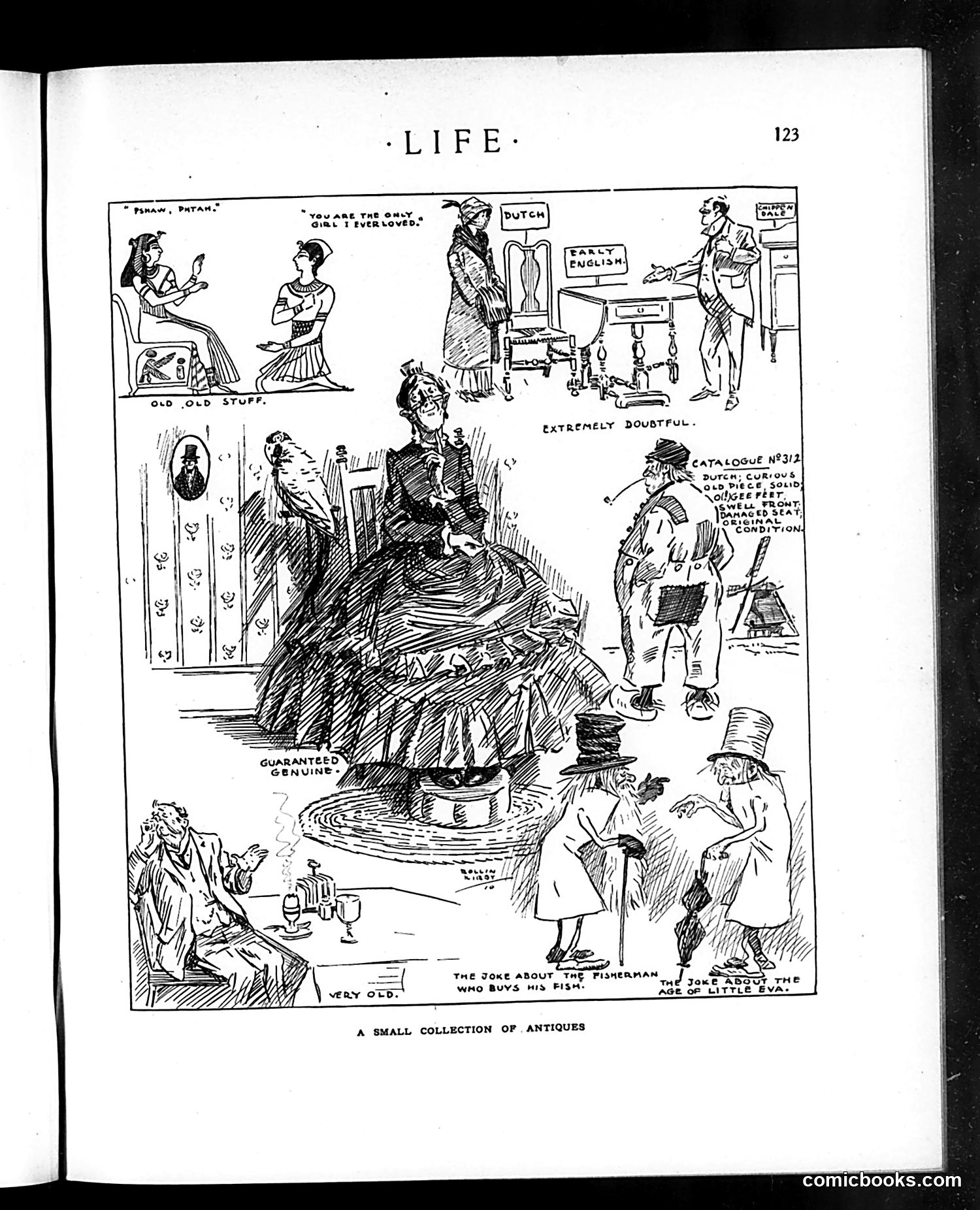
This cartoon mocks the antiques trade and wealthy collectors' obsession with "genuine" old items. The central figure is a woman selling various worn-out objects as valuable antiques—a stuffed parrot, old furniture, broken items—each labeled with dubious authenticity claims ("Guaranteed Genuine," "Original Condition" despite visible damage). The smaller vignettes satirize related absurdities: a man buying a fish from a fisherman (likely commenting on unnecessary middlemen or paying premium prices for common goods), women fawning over "old stuff," and men haggling over catalogued "Dutch" and "English" furniture with inflated provenance. The joke targets both credulous wealthy buyers and dishonest dealers who profit by attaching false historical significance and "authenticity" to mundane or damaged objects. It's social satire about class pretension and the antiques market's deception.
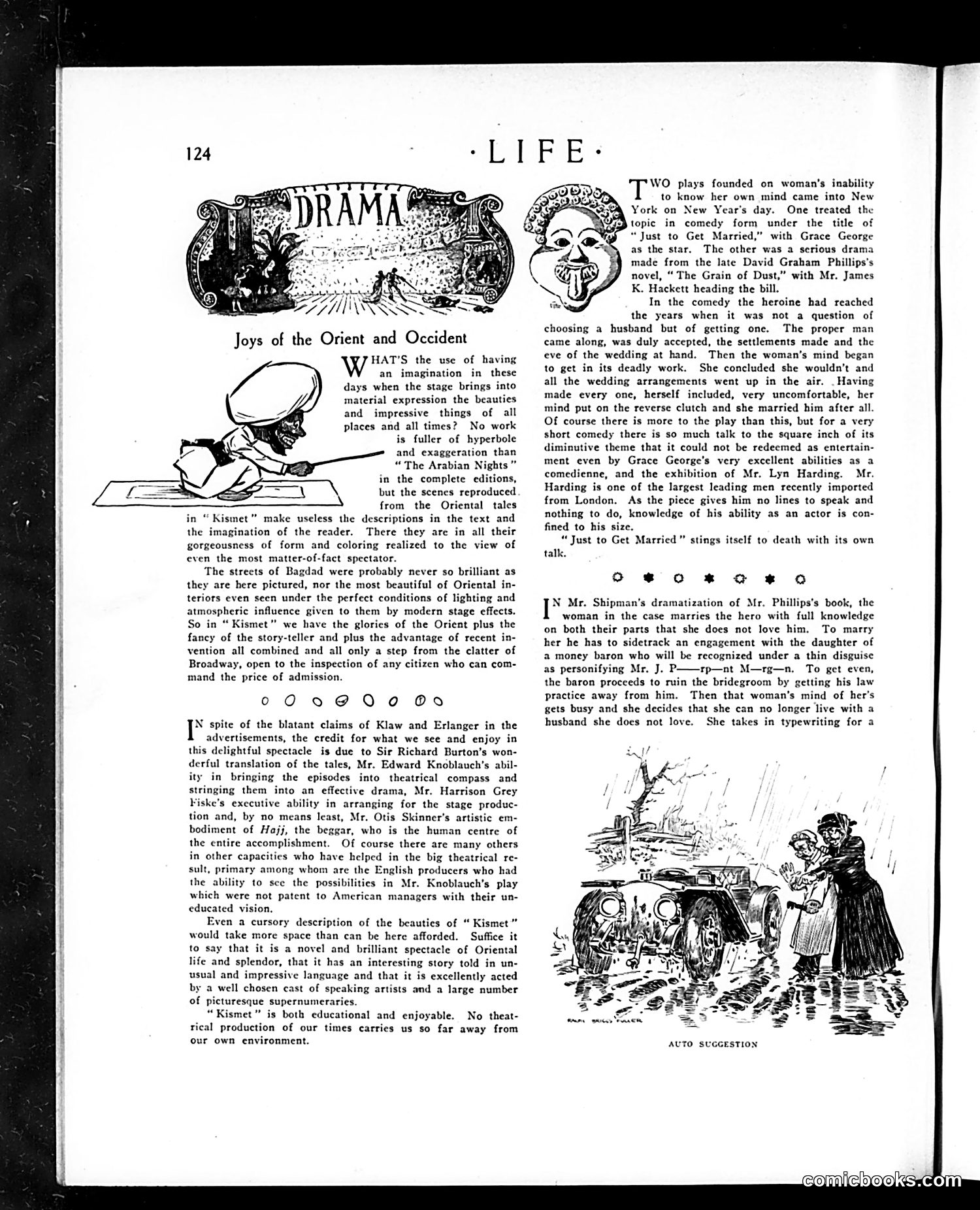
This page reviews two theatrical productions from New Year's Day (early 1900s). **"Kismet"**: The main review praises this elaborate stage adaptation of Arabian Nights tales. The critic celebrates how modern theatrical technology—lighting, scenery, stage effects—brings the exotic Oriental settings to vivid life, surpassing even readers' imaginations of the source material. The review credits multiple contributors (playwright Knoblauch, producer Fiske, actor Otis Skinner) while somewhat dismissively noting that English producers recognized the play's potential when American managers "with their uneducated vision" did not. **"Just to Get Married"** and **"The Grain of Dust"**: Two plays about women's indecision regarding marriage opened simultaneously. The comedy features a heroine who accepts a proposal, then cancels the wedding, then reverses course again—satirizing women's supposed inability to make firm decisions. The review suggests this flimsy premise is padded with excessive dialogue. The "Auto Suggestion" illustration (right) appears unrelated to the text.
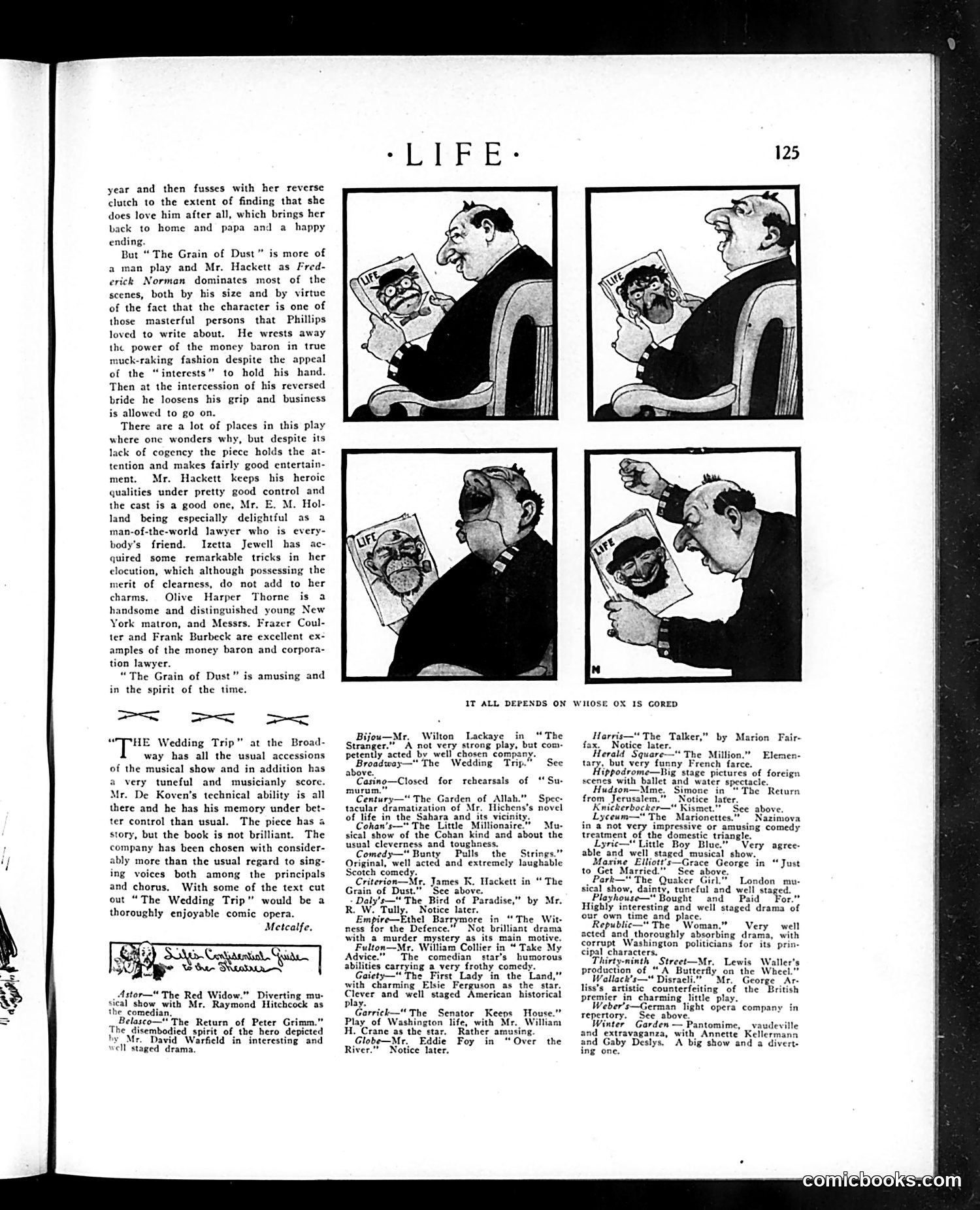
This page contains theater reviews and a four-panel cartoon titled "It All Depends on Whose Ox is Gored." The cartoon depicts a man reading what appears to be "Life" magazine, shown in four sequential panels with increasingly agitated expressions—a visual gag about how one's reaction to satirical content depends on whether the satire targets oneself or one's rivals. The title, a play on the proverb "it all depends on whose ox is gored" (meaning people's opinions shift based on personal interest), is the cartoon's satirical point: people find satire hilarious when it mocks their enemies but offensive when directed at them. The page primarily comprises theater reviews—discussing plays like "The Grain of Dust" and "The Wedding Trip"—reflecting Life's role as cultural commentary. The reviews evaluate performances by actors including James K. Hackett and Ethel Barrymore, typical of the magazine's arts criticism during the early 20th century.
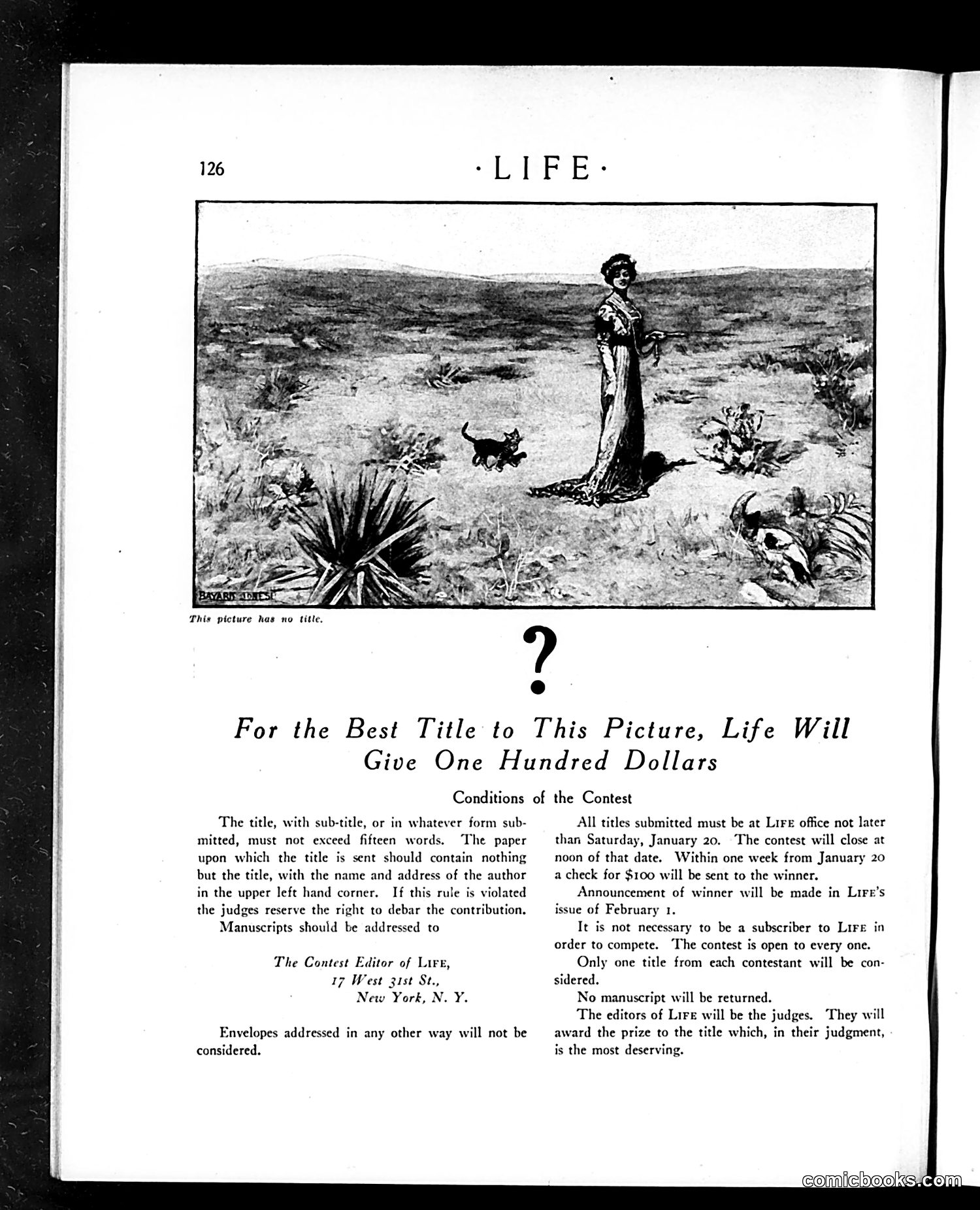
This page contains a titling contest from *Life* magazine. The untitled illustration shows a elegantly dressed woman in a desert landscape with sparse vegetation and a small dog or coyote. The barren, arid setting contrasts sharply with her refined appearance and flowing gown. *Life* is soliciting reader submissions for the wittiest title to accompany this image, offering $100 as the prize—a substantial sum for the era. The contest deadline is January 20, with the winner announced February 1. The satire likely plays on the incongruity: a fashionable woman inexplicably positioned in an inhospitable wasteland. Readers would submit clever titles exploiting this visual absurdity—perhaps commenting on romantic disappointment, isolation, or the foolishness of following fashion into unsuitable circumstances. This was a common *Life* feature: combining cryptic imagery with reader participation to generate both content and engagement.
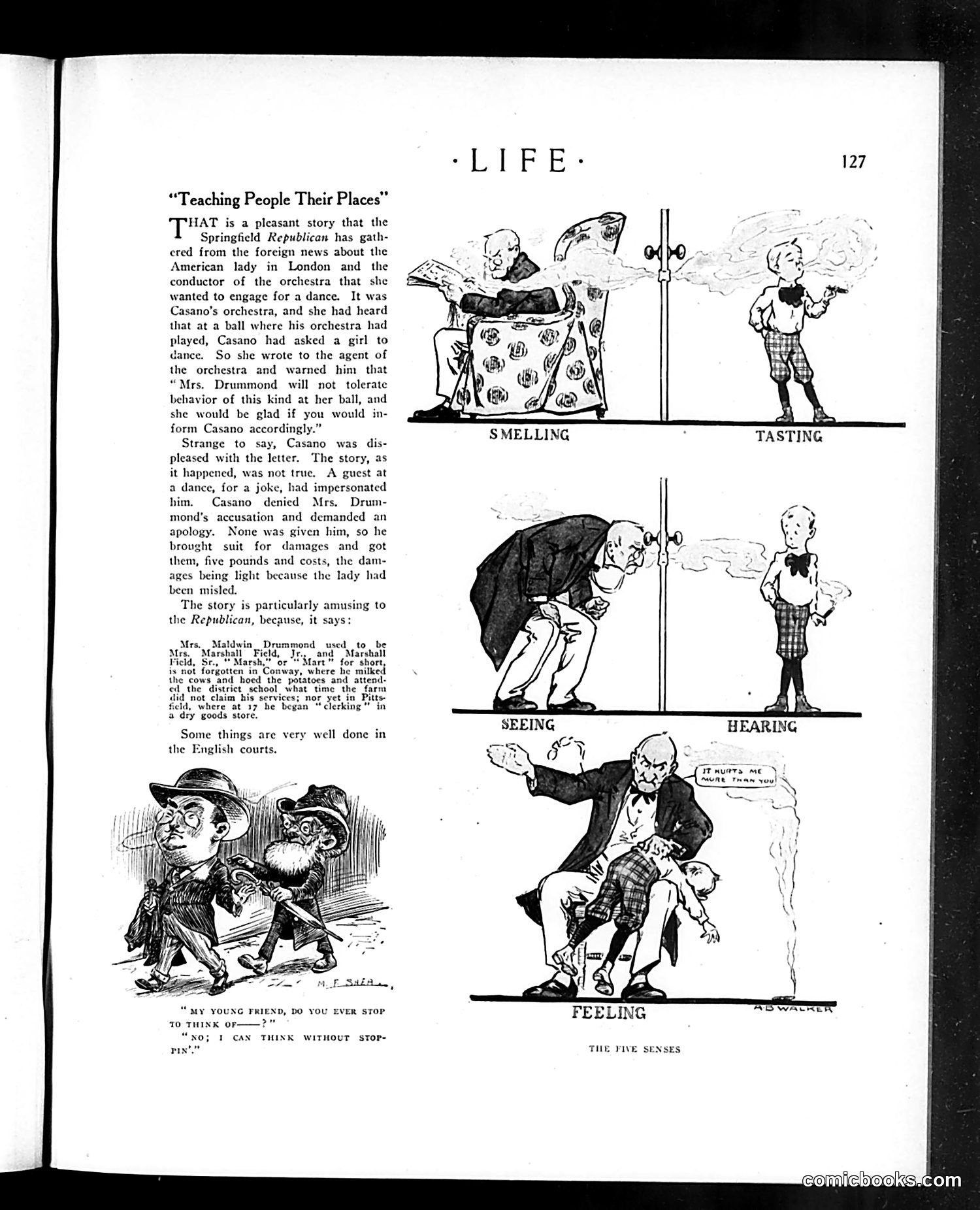
This page mocks an American socialite's presumption and the English legal system's correction of it. Mrs. Drummond (formerly married to Marshall Field Jr., the wealthy Chicago department store heir) attempted to control conductor Casano's behavior at her ball, based on false gossip. When she refused to apologize for the false accusation, Casano sued and won damages in English court. The satire cuts two ways: it ridicules the American wealthy woman for her snobbish attempt to "teach people their places" while praising English courts for holding her accountable. The "Five Senses" cartoon below illustrates the theme humorously—each sense represents human behavior and character, suggesting the American lady lacked good judgment (common sense). The page celebrates that even the socially prominent face legal consequences in England.
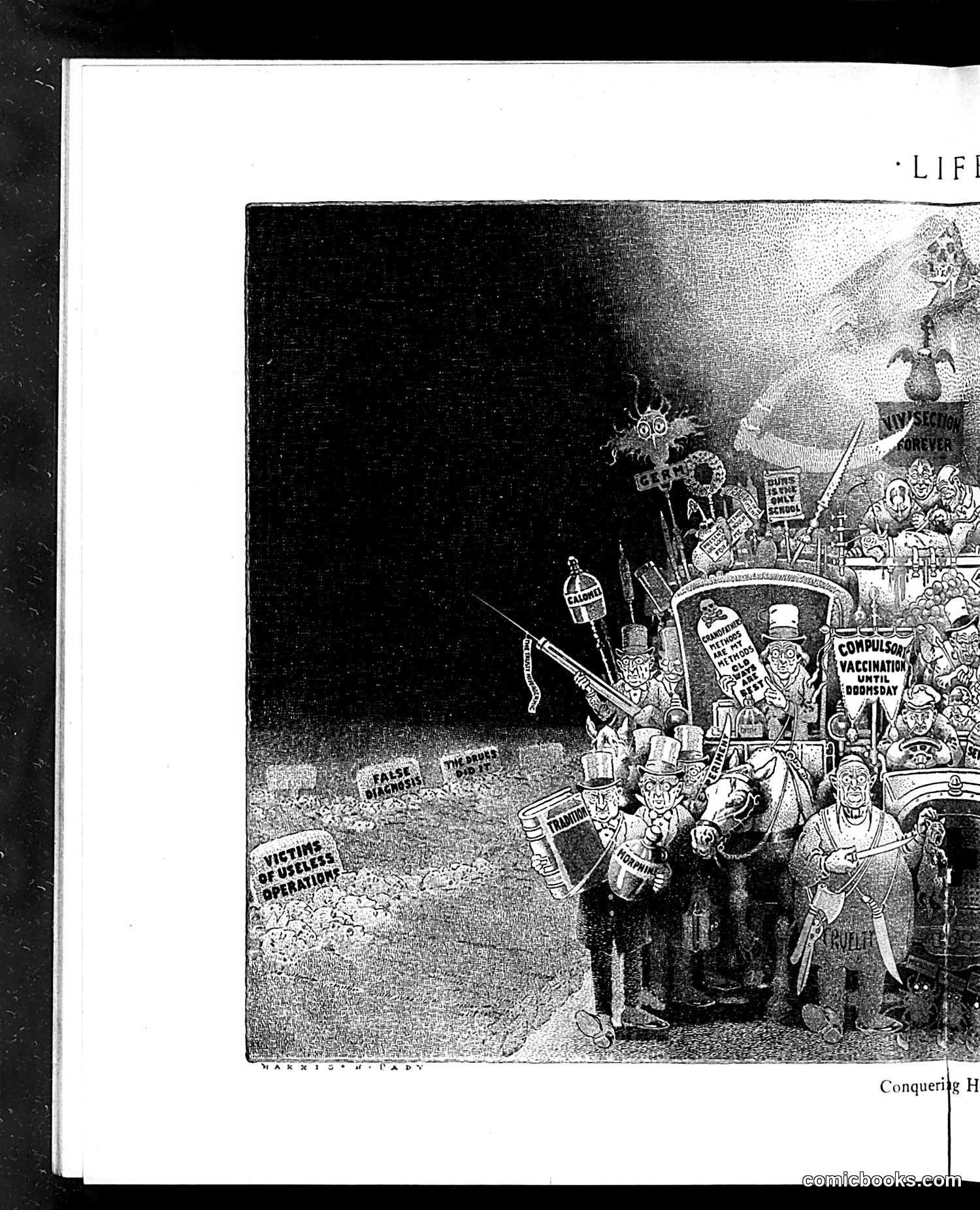
This satirical cartoon depicts various figures and demons emerging from what appears to be Hell or the underworld, labeled "Victims of False Allegations" on the left side. The composition suggests commentary on public accusations or scandals. The right side shows a procession of caricatured figures, including someone labeled "Compulsion Vaccination Until Doomsday" and references to "Trumps" (unclear if referring to cards or a person). Signs reference false allegations and manipulation. The cartoon appears to criticize what the artist views as baseless accusations or hysteria, while mocking mandatory policies. The demonic imagery suggests the author considered these accusations or policies dangerously destructive. Without a visible date or clearer OCR text, the specific scandal or policy remains uncertain.
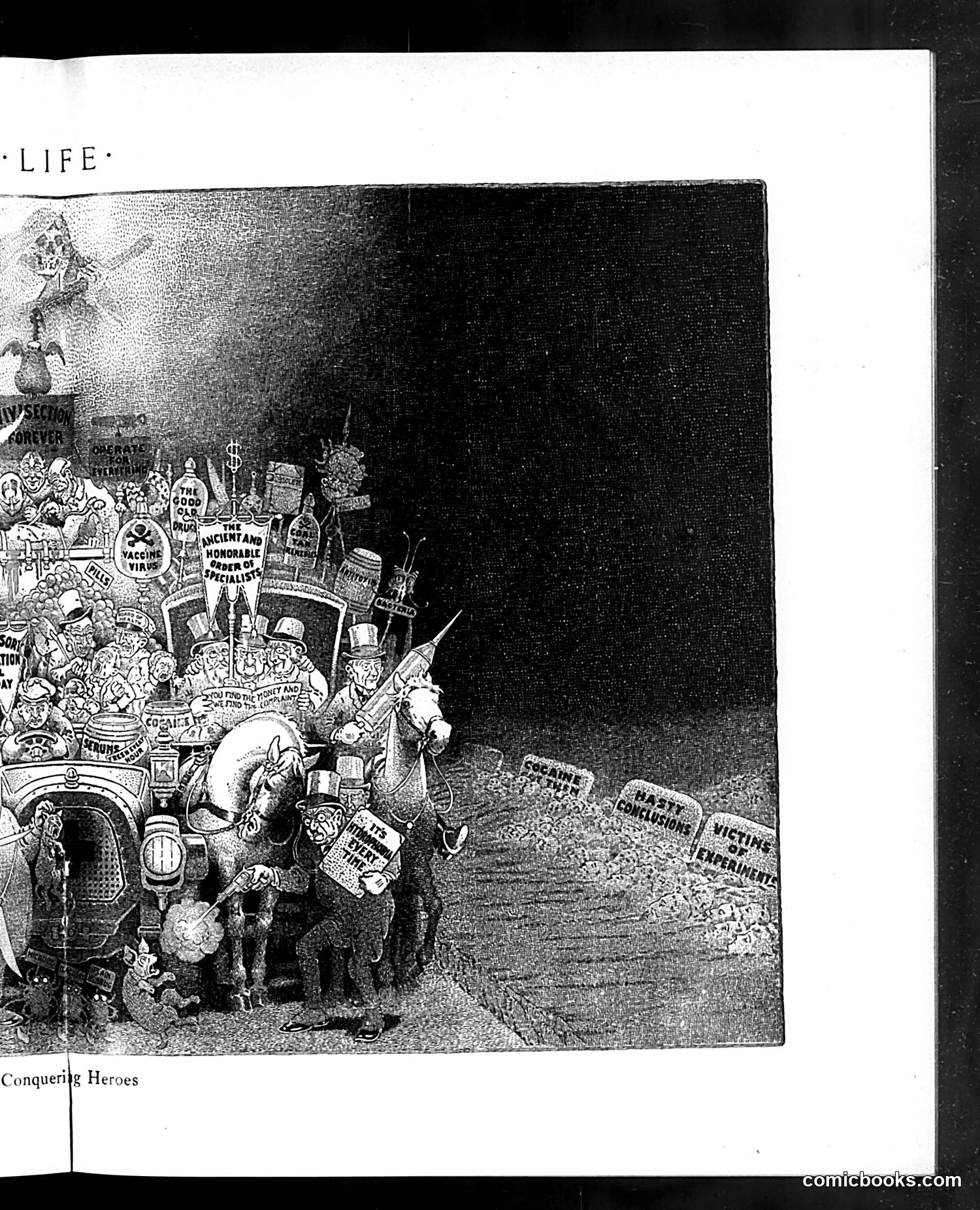
This political cartoon satirizes medical and scientific establishment figures riding triumphantly into battle. The image depicts a chaotic procession of doctors, scientists, and institutional representatives mounted on horses and in carriages, laden with bottles, signs, and medical apparatus. Visible text references include "VACCINE VIRUS," "ANCIENT AND HONORABLE ORDER OF CAPITALISTS," and various medical/pharmaceutical symbols. The figures appear to represent the medical-industrial complex presenting itself as heroic "conquerors." The satire suggests these institutions are more interested in profit and self-promotion than genuine health. The overwrought, carnival-like quality of the "conquest" mocks their grandiose self-presentation. This likely critiques early-20th-century tensions between corporate medicine, public health claims, and skepticism about commercial medical interests.
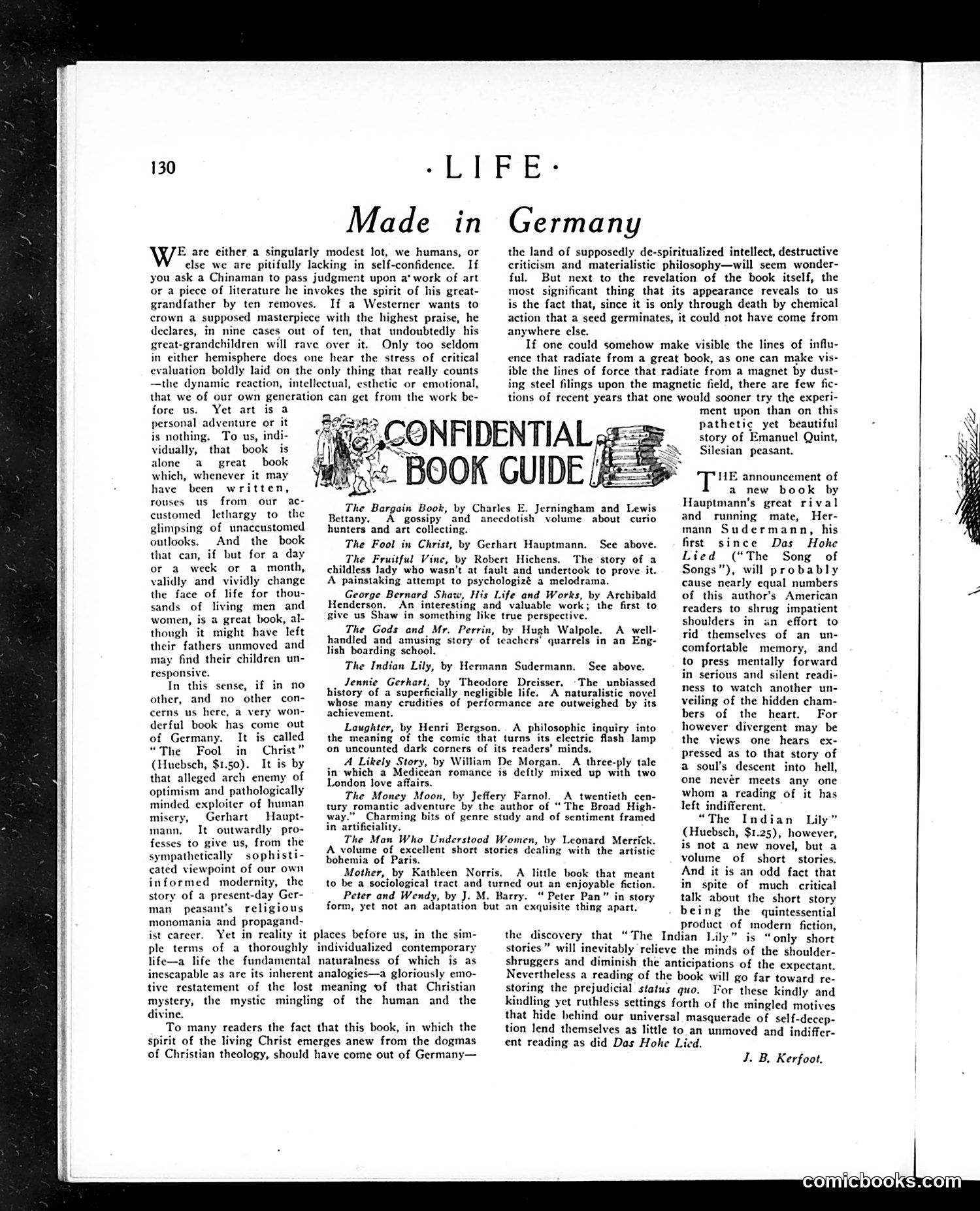
This is a **book review and advertising section** from Life magazine, not a political cartoon. The page reviews recent German literature, particularly praising Gerhart Hauptmann's novel *The Fool in Christ*. The article argues that great art should be judged by its **immediate emotional impact on readers today**, not by posthumous reputation. It celebrates this German novel as an example of work that powerfully affects contemporary audiences. The "Confidential Book Guide" box lists multiple new publications with brief descriptions. Notable is the emphasis on German authors (Hauptmann, Sudermann, Hichens), reflecting early 20th-century literary culture when German literature held significant prestige in English-speaking circles. The page's title "Made in Germany" is **ironic praise**—acknowledging Germany's reputation for intellectual and materialistic philosophy while celebrating its artistic output. This predates anti-German sentiment associated with World War I, positioning German culture as intellectually sophisticated and worthy of serious critical attention.
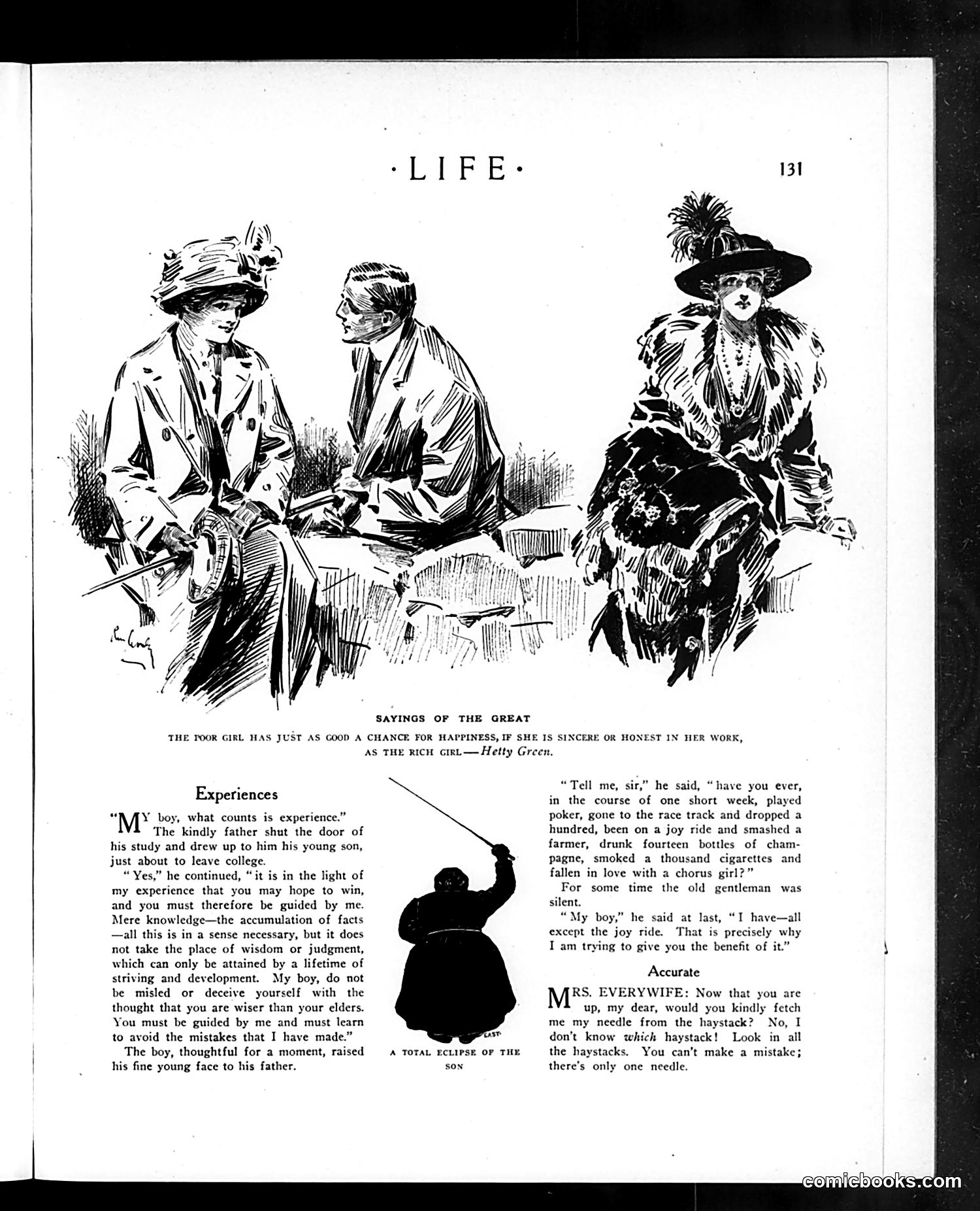
This page from *Life* magazine contains three separate satirical pieces: 1. **"Sayings of the Great"** (top): A quote attributed to Hetty Green (a real wealthy businesswoman) about poor girls having equal opportunity for happiness if honest. The accompanying sketch shows three fashionable women in conversation—social satire about class and women's prospects. 2. **"Experiences"** (main story): A humorous dialogue where a father lectures his college-bound son about the value of experience over mere knowledge. The joke's punchline: the father admits he's done all the reckless things (gambling, drinking, romance) he warns against—*except* a joy ride—which is why he wants his son to experience it. The illustration "A Total Eclipse of the Son" visualizes the father literally eclipsing/overshadowing the son, reinforcing the irony. 3. **"Accurate"** (bottom right): A brief domestic joke where a wife asks her husband to fetch her needle from "the haystack" without specifying which one, claiming there's no way to make a mistake since there's "only one needle"—obvious absurdist humor about wives' illogical demands. The overall theme mocks generational advice-giving and domestic relations.
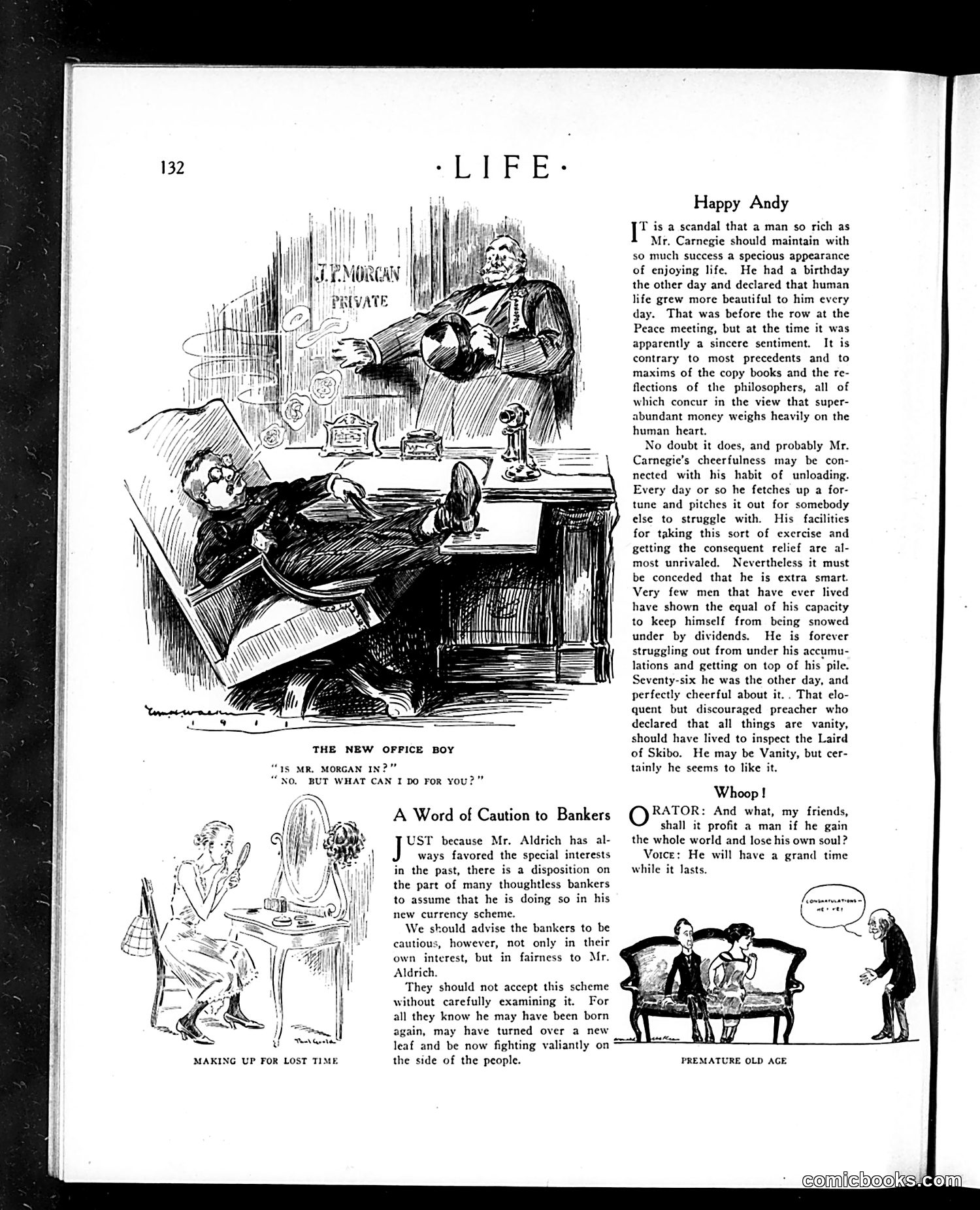
This page contains three satirical pieces mocking wealthy industrialists and financial reformers: **"The New Office Boy"** (top cartoon): A joke about J.P. Morgan's absence from his office—suggesting even his office boy has power and importance. **"A Word of Caution to Bankers"**: Sarcastically advises bankers to scrutinize Senator Nelson Aldrich's currency reform proposal. The satire implies Aldrich has historically favored "special interests" over the people, so his sudden concern for fairness seems suspicious. The piece sardonically suggests he may have had a moral conversion—clearly implying he hasn't. **"Happy Andy"**: Mocks Andrew Carnegie's claim that life grows more beautiful with age. The writer expresses mock scandal that such a wealthy man appears genuinely happy, noting most philosophy holds that money brings misery. The satire suggests Carnegie's cheerfulness stems from his obsessive charitable giving—constantly unloading wealth to avoid being "snowed under" by dividends. **"Whoop!"**: A brief dialogue satirizing hollow rhetoric about wealth and morality. All pieces target the hypocrisy and public relations efforts of Gilded Age billionaires.
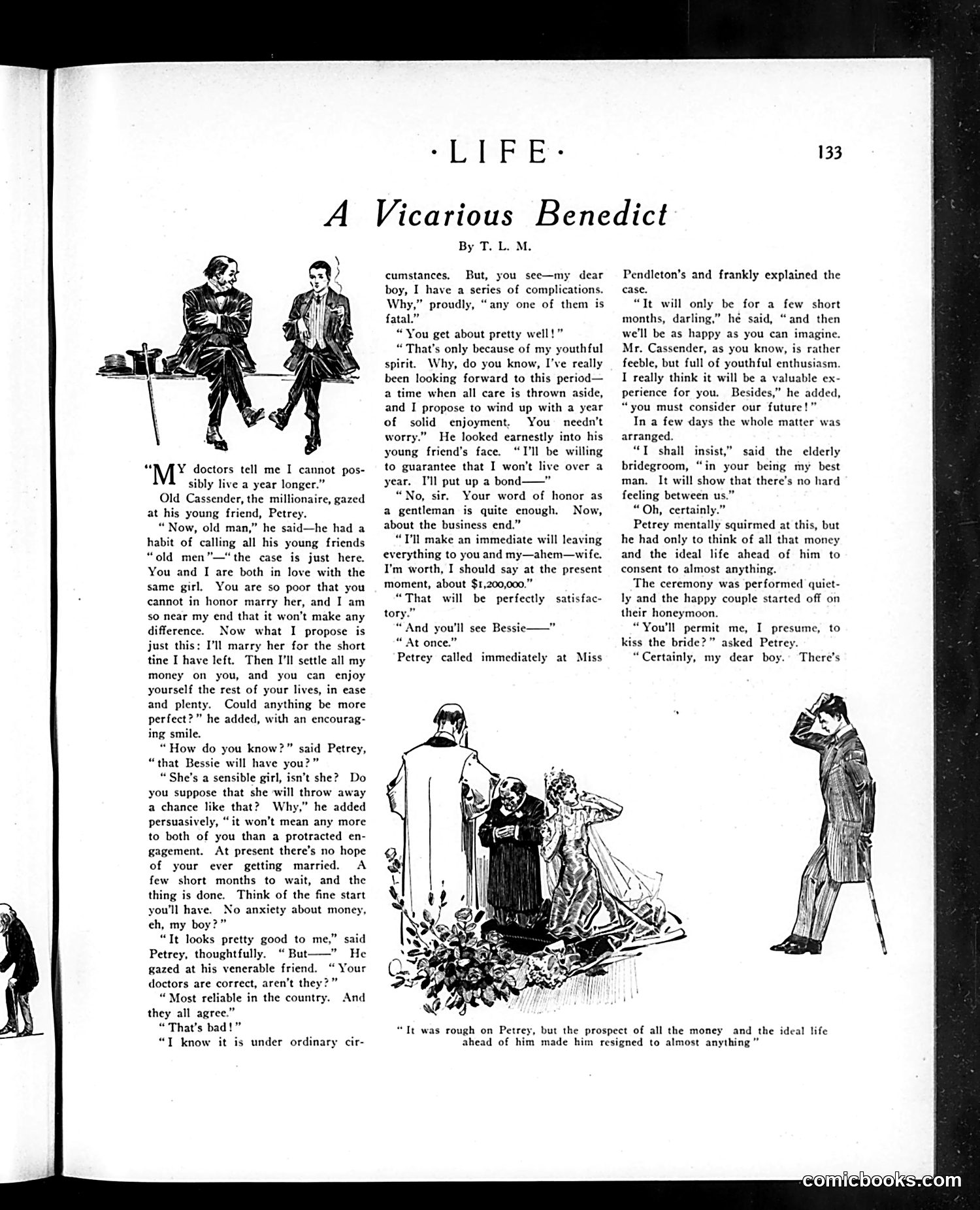
This satirical story mocks the mercenary attitudes toward marriage among the wealthy. The plot involves millionaire Cassender proposing to marry young Bessie Pendleton, then immediately will his $1.2 million fortune to his poor friend Petrey—allowing Petrey to marry her after Cassender's imminent death (his doctors say he has less than a year to live). The satire targets multiple failings: Cassender's cynical reduction of marriage to a financial transaction; Petrey's willingness to sacrifice romantic honor for money; and Bessie's apparent acceptance of marrying a dying man for economic security. The story suggests that among the wealthy, love is subordinate to wealth, and that even young people will abandon principles when money is involved. The sardonic title "A Vicarious Benedict" (a "benedict" being a newly married man) underscores how Petrey achieves marriage vicariously—through another man's temporary union and death—rather than through genuine courtship.
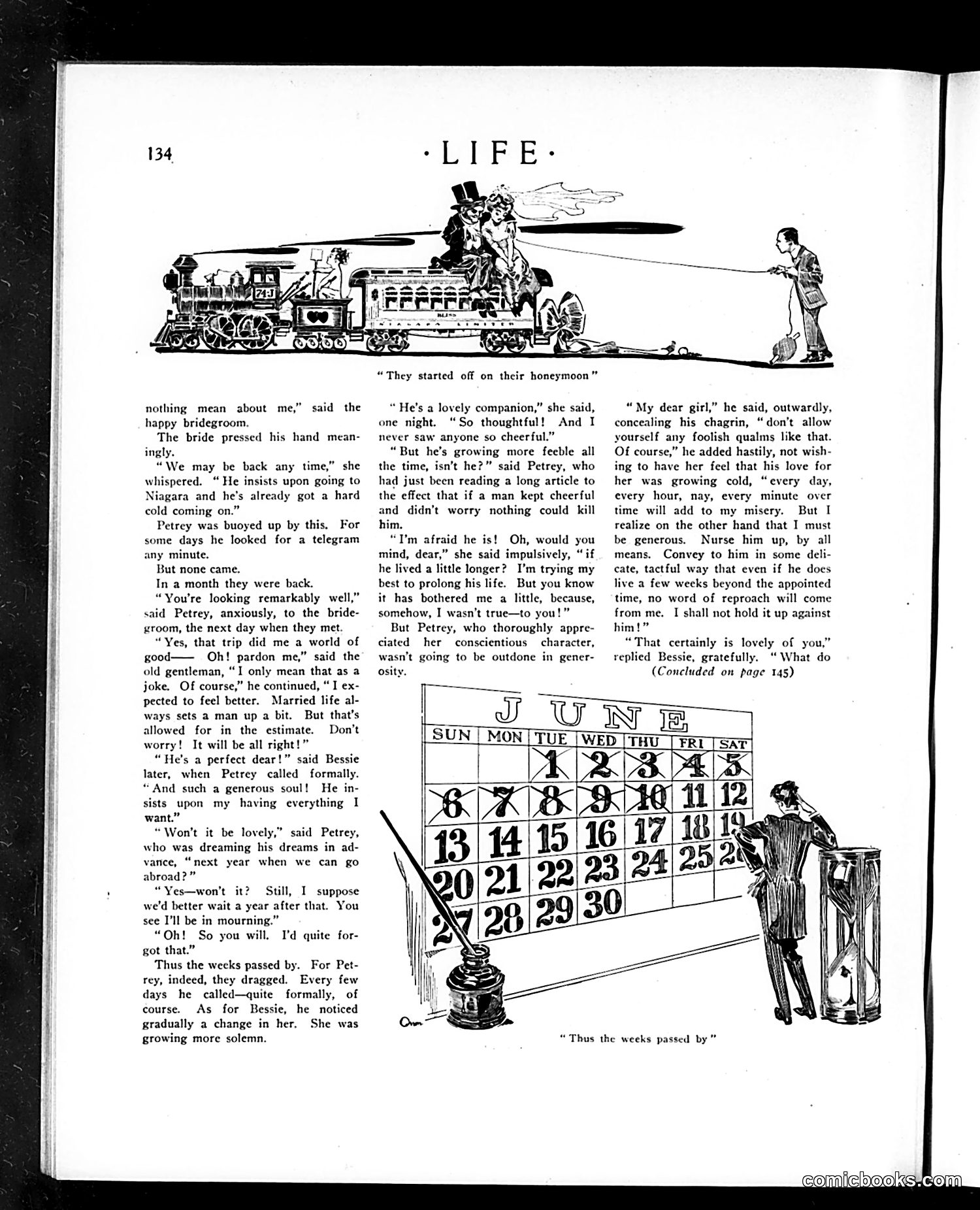
This is a satirical short story from *Life* magazine about a newlywed couple where the husband appears to be in poor health. The joke centers on Petrey, a man courting Bessie, who marries someone else—a sickly older gentleman. Petrey expects the husband to die soon so he can marry Bessie. However, the story subverts this expectation: Bessie's husband remains alive (the "cold coming on" doesn't kill him), and worse for Petrey, Bessie now seems obligated to keep him alive and healthy. The satire mocks the romantic assumption that obstacles conveniently disappear, as well as Petrey's transparent selfishness masked as concern. The calendar illustration represents "weeks passing by"—time dragging for the impatient suitor. The humor relies on the husband's unexpected durability and Petrey's dawning realization that his scheme has backfired.
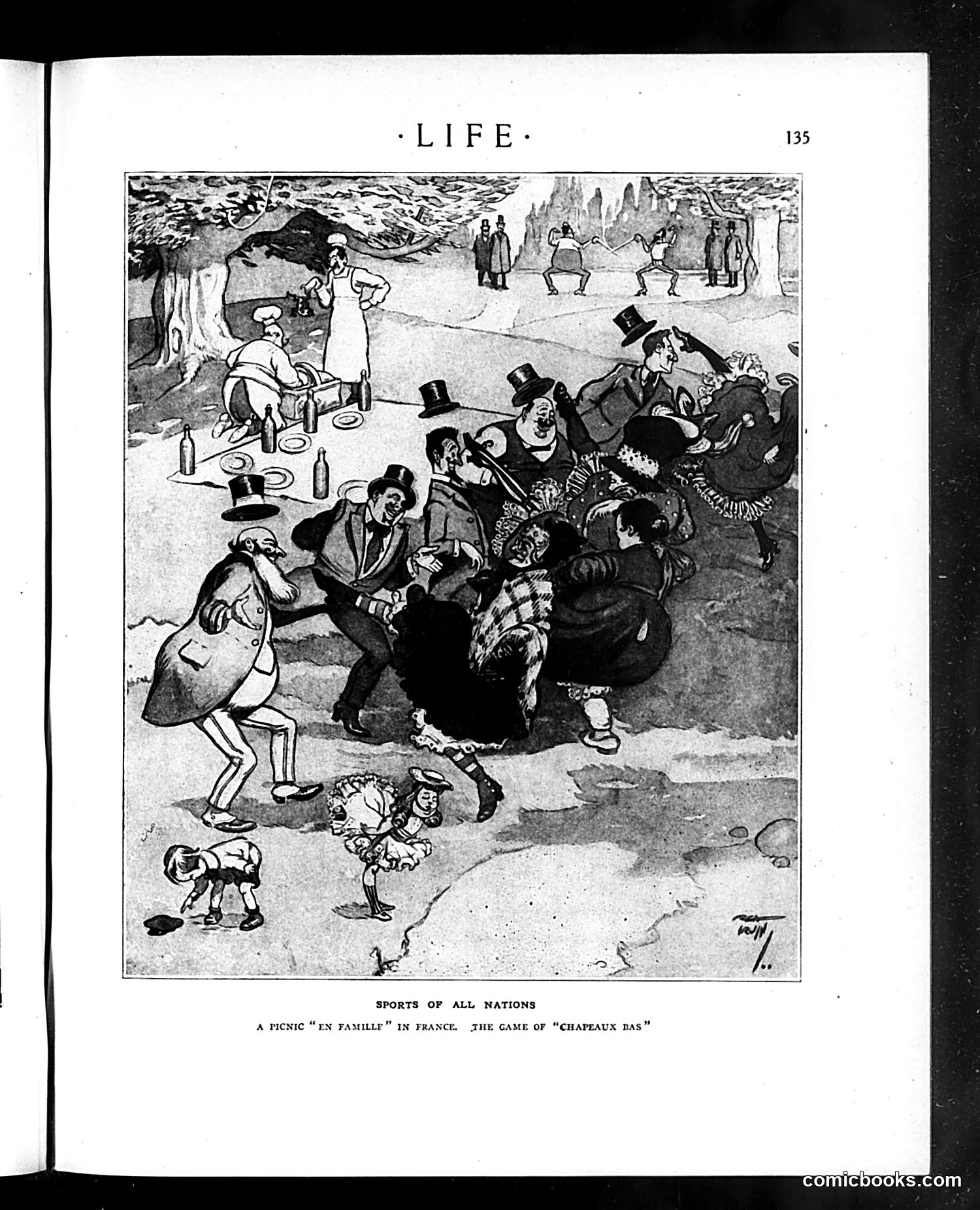
This satirical cartoon depicts a French family picnic where people are playing "Chapeaux Bas" (literally "hats off"), a game apparently involving removing and managing top hats. The humor targets French social pretension and formality—even casual outdoor recreation is portrayed as an elaborate, stuffy affair requiring formal dress and etiquette. The well-dressed figures in top hats and fine clothing suggest that French society rigidly maintains class appearance and propriety, even during leisure. Children are present ("en famille"), yet the adults remain formally attired. The "Sports of All Nations" heading implies Life magazine is mocking how different cultures approach recreation, positioning the French as unnecessarily formal compared to presumably more relaxed Anglo-American customs. The cartoon reflects early 20th-century American stereotypes about French formality and social pretension.
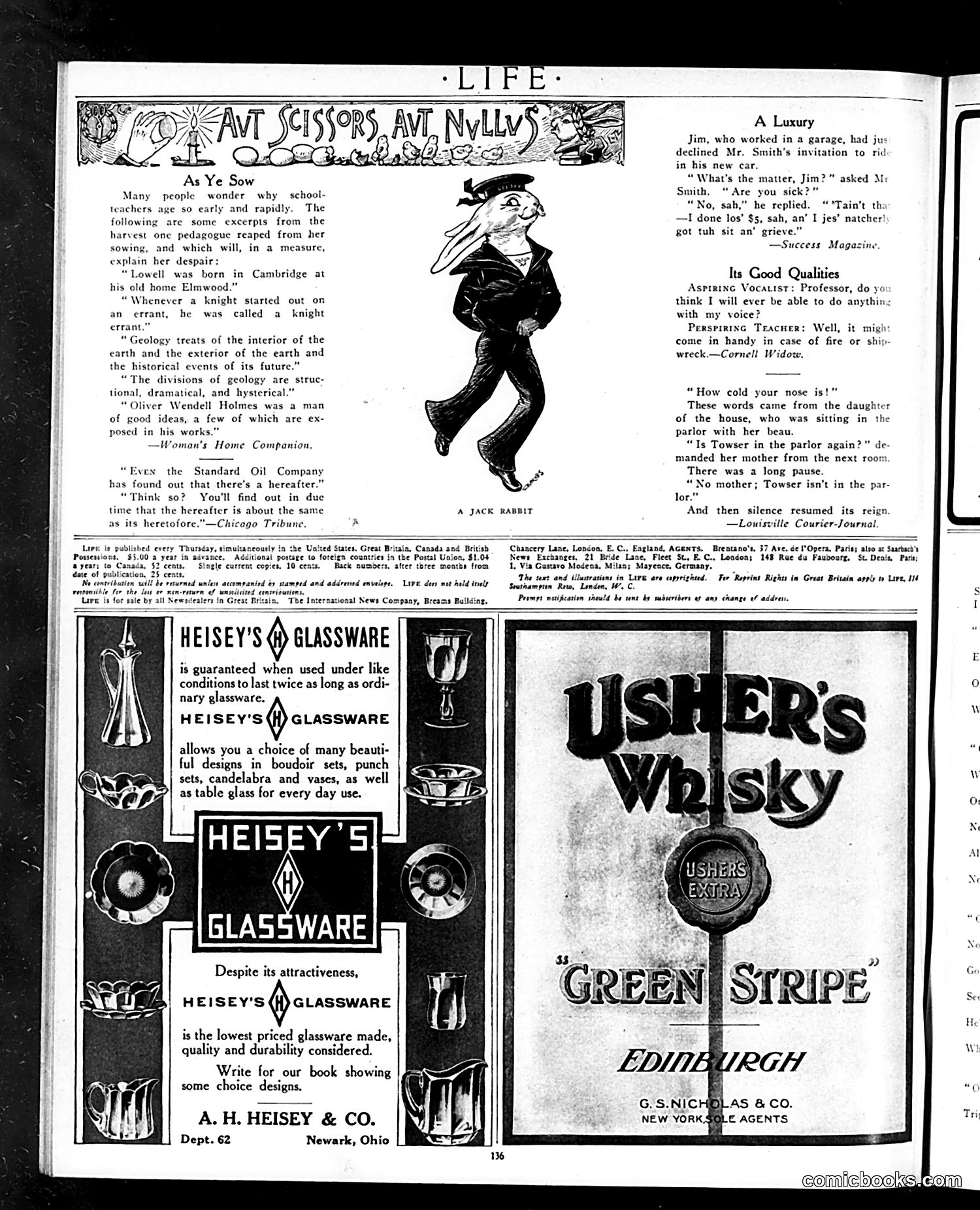
This page contains several humorous anecdotes satirizing American education and social conventions, plus advertisements. **"As Ye Sow"** mocks schoolteachers by presenting absurd student answers—logical but ridiculous interpretations showing students take teachers literally ("a knight errant" = a knight wandering). The satire suggests teachers' exhaustion stems from students' willful misunderstanding. **"A Luxury"** jokes about class and grief: an unemployed garage worker mourns his $5 loss more than accepting a wealthy man's car invitation—implying poor people's emotional attachment to small sums. **"Its Good Qualities"** is a professor/student joke playing on double meaning: a poor singer's voice might be useful only for fire alarms or shipwrecks. **"How Cold Your Nose Is!"** presents a domestic joke: a daughter's suitor asks about her cold nose, prompting the mother to ask if the family dog is present—implying the suitor might be behaving like an animal. The remaining items are period advertisements for glassware and whisky, unrelated to the satire above.
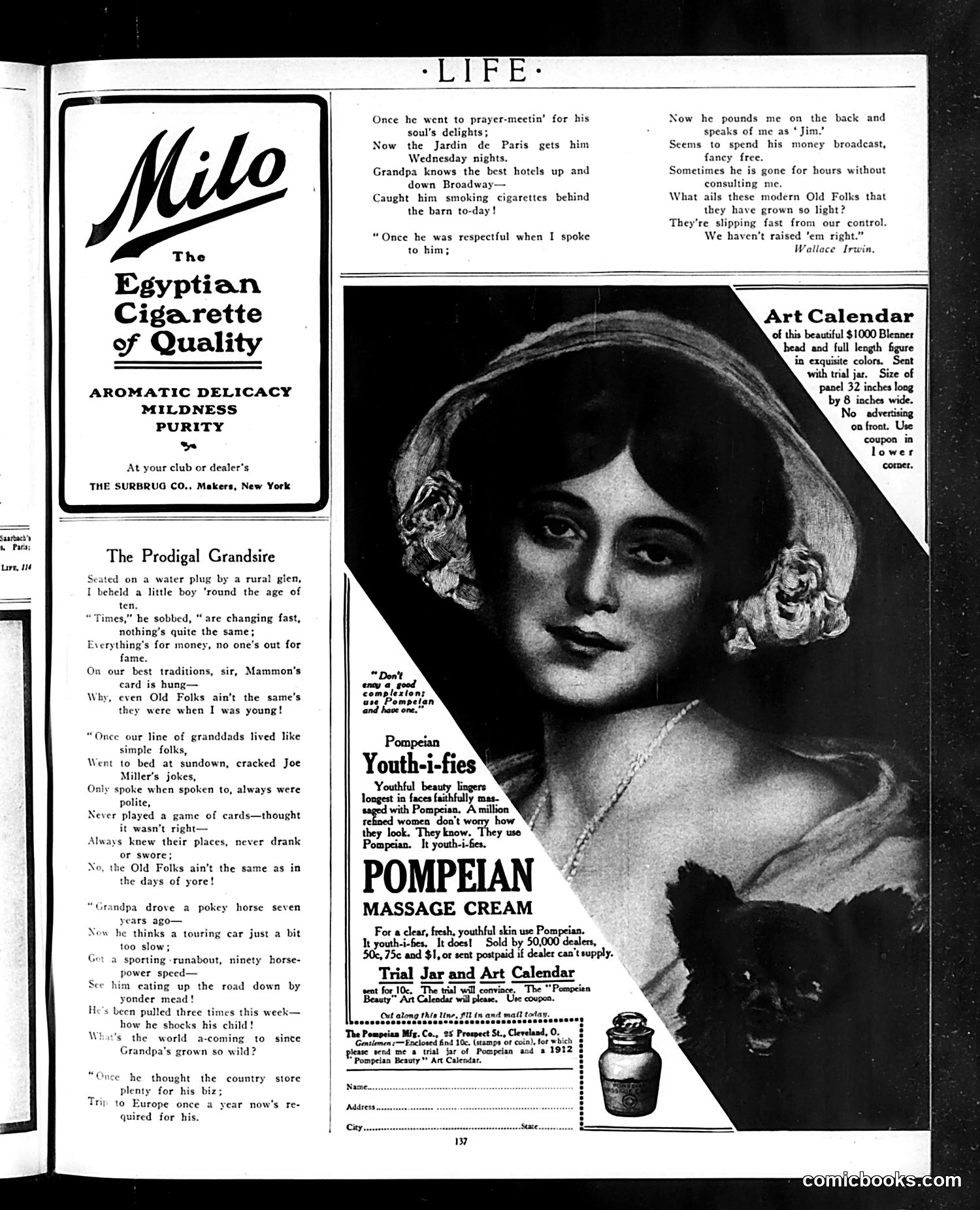
This piece by Wallace Irwin inverts the traditional "prodigal son" narrative. Instead of youth corrupted by modern ways, it's *elderly people* abandoning old-fashioned values. A young boy laments that grandfathers have become unrecognizable: they now frequent fancy Broadway venues (the "Jardin de Paris"), smoke cigarettes, drive fast automobiles recklessly, spend money freely, and behave disrespectfully toward their grandchildren. They've abandoned the austere virtues of previous generations—piety, frugality, formal manners, and predictable rural simplicity. The satire targets generational anxiety about modernization. Rather than blaming youth for abandoning tradition, Irwin suggests that *older people themselves* are most seduced by 1920s urban pleasures and consumerism—undermining their moral authority to criticize younger generations' behavior. It's a clever inversion: the cartoon implies that modernity corrupts everyone, regardless of age, and that elders complaining about youth are themselves equally guilty of abandoning "proper" values.
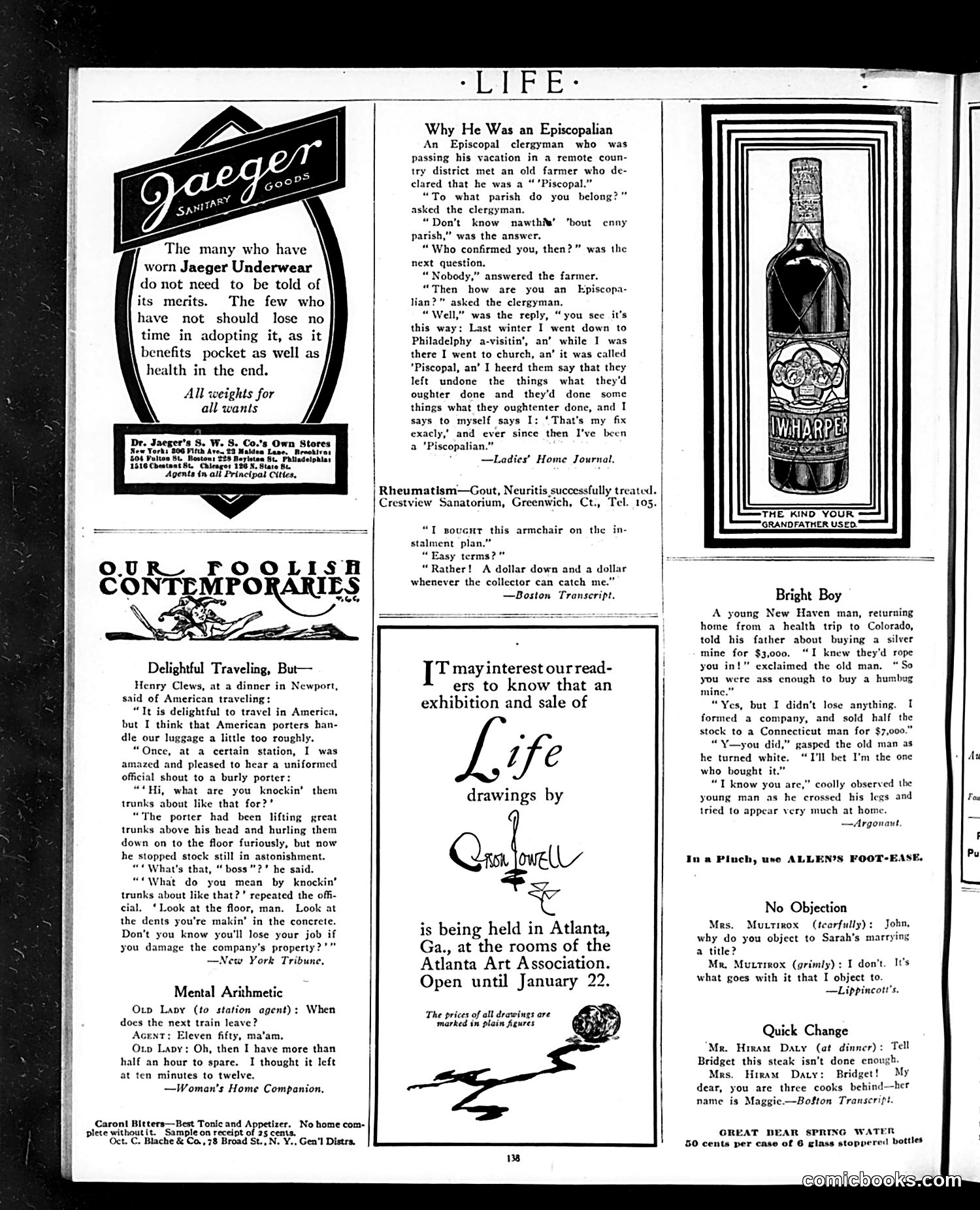
This page from *Life* magazine contains mostly **humorous anecdotes and light social commentary** rather than political cartoons. ## Key Content: **"Why He Was an Episcopalian"** satirizes rural ignorance and class differences. A farmer claims to be "Piscopal" (Episcopal) solely because he attended one service where the liturgy happened to match his personal moral failings—he liked that they confessed to "leaving undone the things what they'd oughter done." The joke mocks both the farmer's accidental religiosity and, implicitly, the formality of Episcopal practice. **"Bright Boy"** is a con-artist tale where a young man swindles his own father by selling him half-stake in a worthless silver mine, then flipping it to someone else—likely his father—for profit. It celebrates financial cunning over honesty. The remaining items are brief jokes about **porter mistreatment**, **mental arithmetic**, and **installment debt**—all reflecting early-20th-century urban anxieties about labor, women's education, and consumer credit. The page is primarily **advertising** (Jaeger Underwear, foot powder) interspersed with these light satirical vignettes targeting middle-class readers.
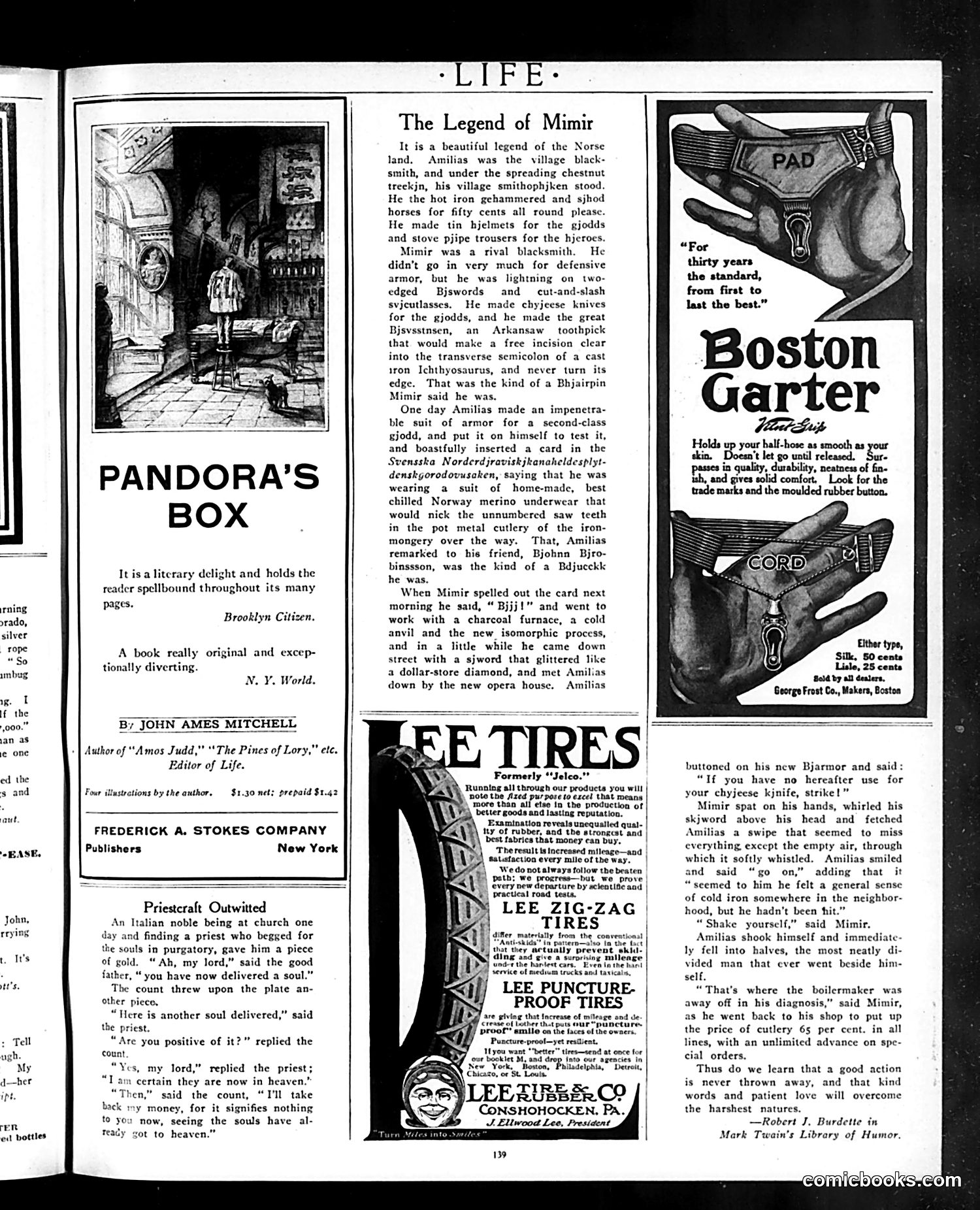
This page mixes literary advertisements with satirical content typical of early 20th-century *Life* magazine. **"Pandora's Box"** is a book advertisement by John Ames Mitchell (the magazine's editor), presenting favorable reviews. No political satire here—it's straightforward marketing. **"The Legend of Mimir"** appears to be humorous pseudo-Norse mythology. The text deliberately mangles Norse names and terminology ("Bjswords," "Bdjucckk," "Bjarmor") while narrating a smithing competition between two blacksmiths. The joke seems to mock grandiose Norse-mythology storytelling through deliberate misspellings and absurdist details—treating epic legend with comedic bathos. **"Priestcraft Outwitted"** is a brief moral anecdote: a nobleman repeatedly pays a priest to deliver souls from purgatory, then demands his money back, noting the souls are already in heaven anyway. The satire targets priestly opportunism and religious fraud—a common *Life* magazine theme. The remaining content is **tire and garter advertisements**, not editorial material. The page reflects *Life's* blend of literary reviews, religious satire, and commercial advertising typical of the era.
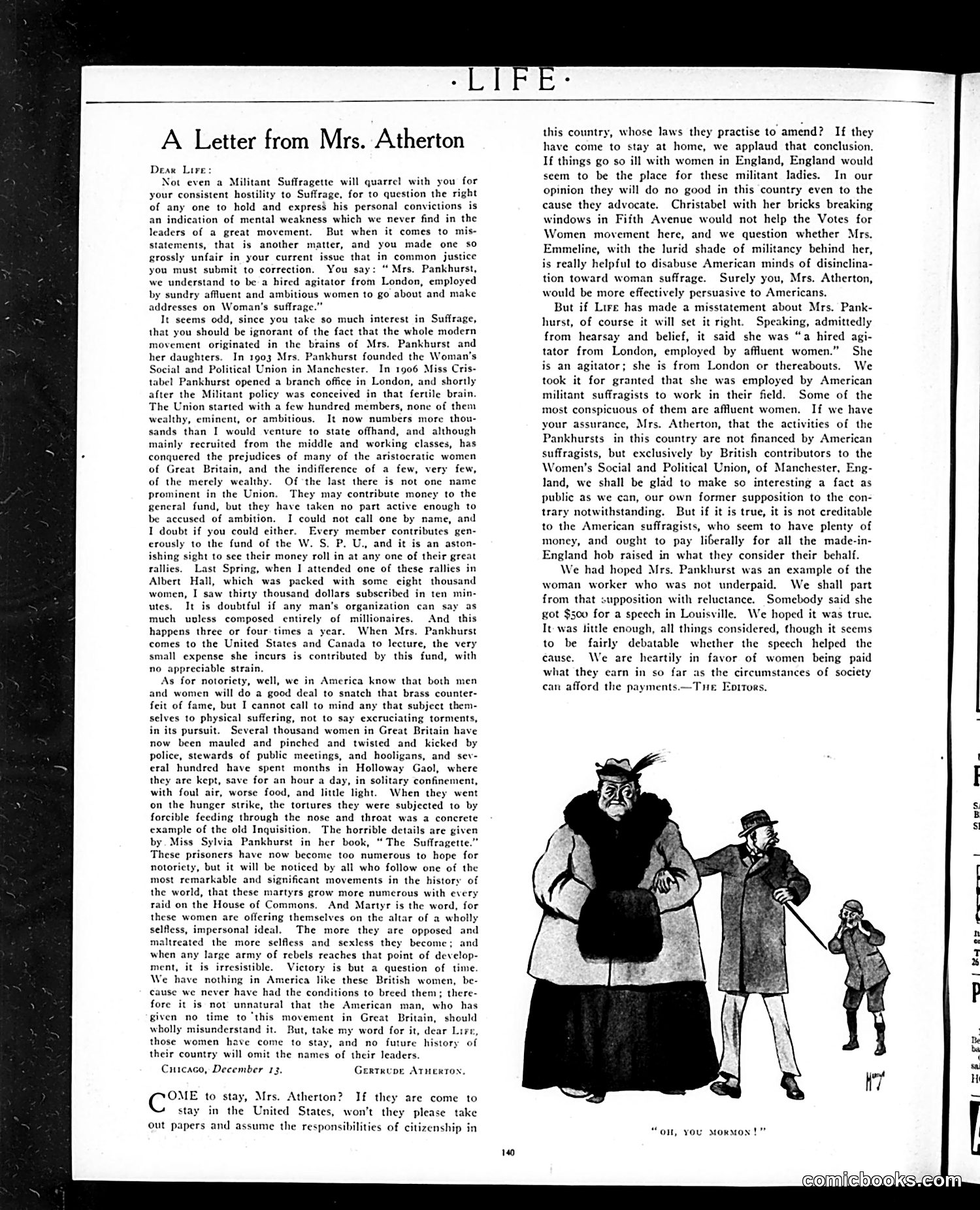
This page contains a letter defending British suffragettes (led by Emmeline Pankhurst) against *Life* magazine's criticisms, plus a satirical cartoon at bottom. **The cartoon** shows a large woman in dark clothing scolding two smaller figures—likely representing Mormon men with multiple wives. The caption "Oh, you Mormons!" is the joke's punchline. **The satire**: The cartoonist equates the suffragettes' aggressive tactics with Mormon polygamy as equally un-American and offensive. By pairing British militant feminists with Mormonism (historically America's most controversial religious/social practice), the cartoon ridicules suffragettes as foreign threats to American values. **Context**: This reflects American anti-suffrage sentiment using xenophobia—portraying British suffragettes as dangerous outsiders whose methods and ideology don't belong in America, similar to how Mormonism was viewed as alien and immoral. The letter itself rebuts *Life*'s claim that Pankhurst was a "hired agitator," detailing suffragettes' sacrifices and grassroots funding.
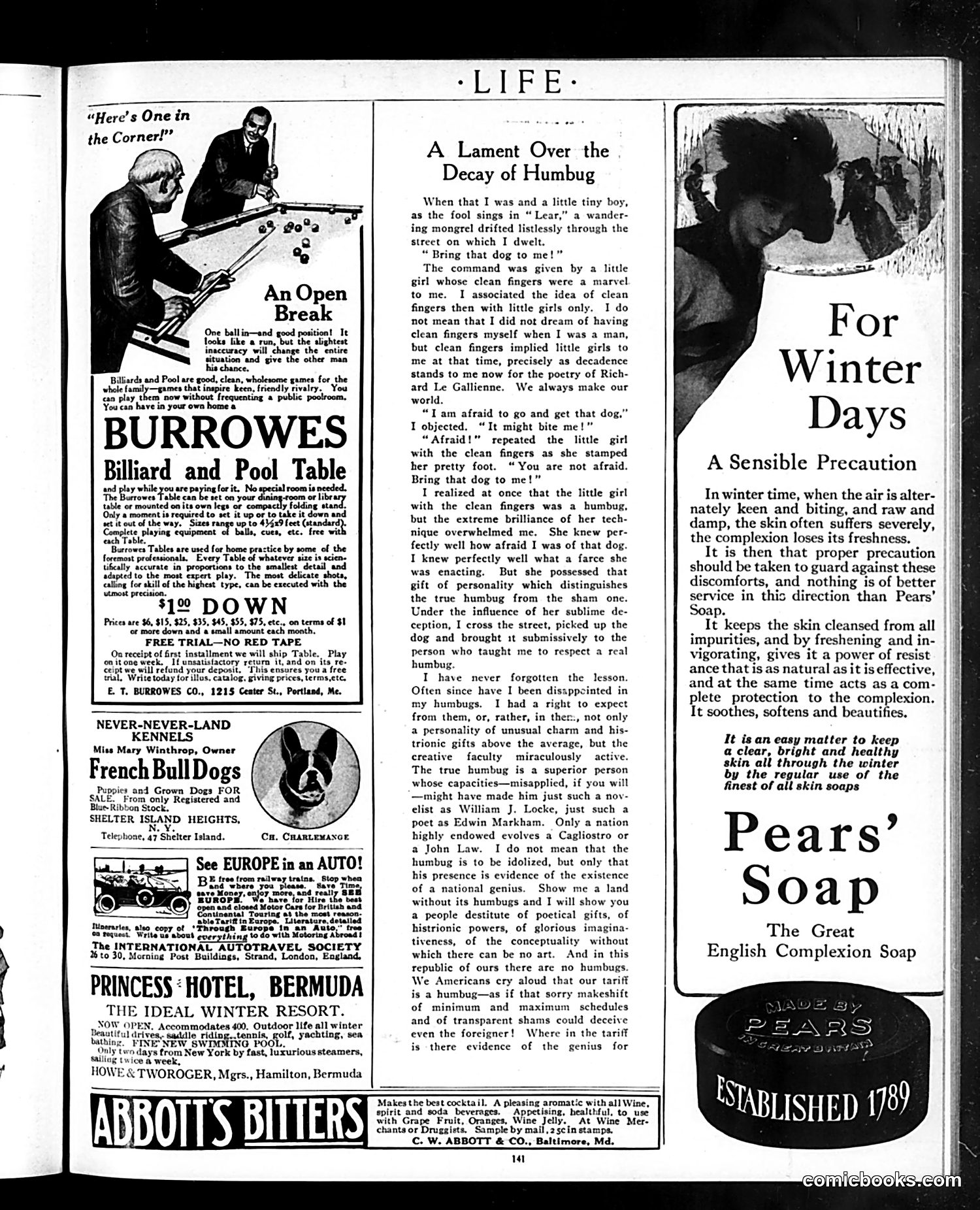
The left cartoon shows two men playing billiards, with one positioned to make a shot while the other watches. The caption "Here's One in the Corner!" is a billiards term. The accompanying text explains that "one ball in—read position! It looks like a run, but the slightest inaccuracy will change the entire situation and give the other man all his choices." **The satire**: This appears to be a metaphorical commentary on strategic positioning and tactical advantage in competition—likely a political or social commentary on how seemingly advantageous positions can prove deceptive or unstable. The "open break" concept suggests unexpectedness in outcomes. The main article, "A Lament Over the Decay of Humbug," is a nostalgic essay by the author reflecting on encountering a young girl who masterfully manipulated him through confident deception. He argues that true "humbug" (charming deception) is a lost art—distinguished from mere "sham" by its brilliance and personality. The piece laments the decline of this sophisticated social skill in modern times. **Context**: This reflects early 20th-century attitudes valuing clever social manipulation as an admirable, entertaining human capacity.
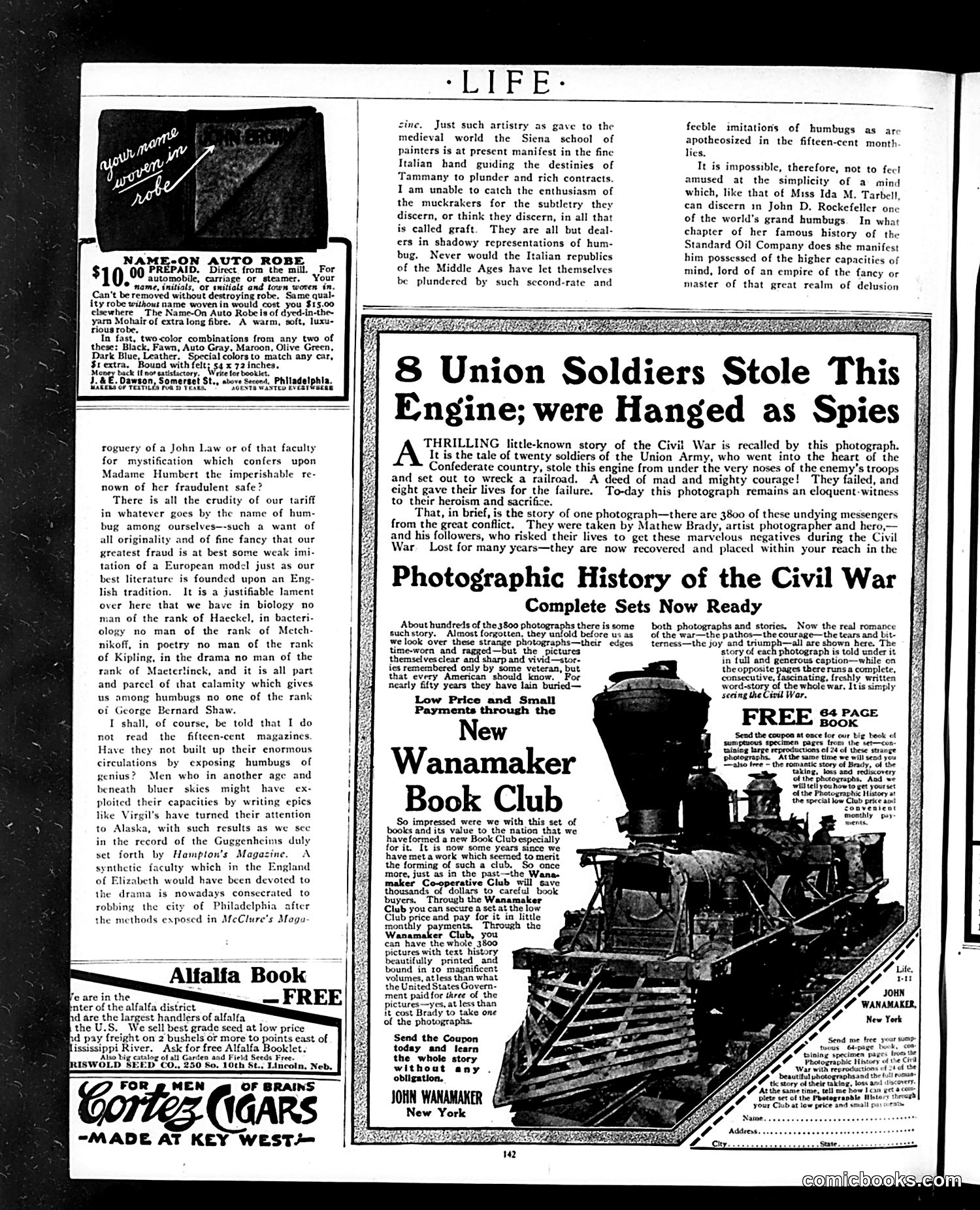
This page contains primarily **advertisements and editorial content**, not political cartoons. The main article criticizes American "humbug" (fraud/deception) as artistically inferior to European examples. The author laments that unlike historical con artists or literary figures of genius, American fraudsters—including Tammany Hall politicians and Standard Oil's Rockefeller—lack sophistication. He mocks muckraking journalists like Ida Tarbell for treating these crude swindlers as grand villains, when they're merely pedestrian crooks copying European models without originality. The **headline story** about "8 Union Soldiers" who stole a Confederate engine promises a Civil War anecdote with accompanying photographs, though the full story isn't visible here. **Advertisements** dominate: an auto robe, alfalfa seeds, and cigars. A prominent ad promotes the "Wanamaker Book Club," offering a 64-page photographic history of the Civil War. The page reflects early 1900s concerns: Progressive Era muckraking, corporate corruption (Rockefeller/Standard Oil), and Civil War nostalgia.
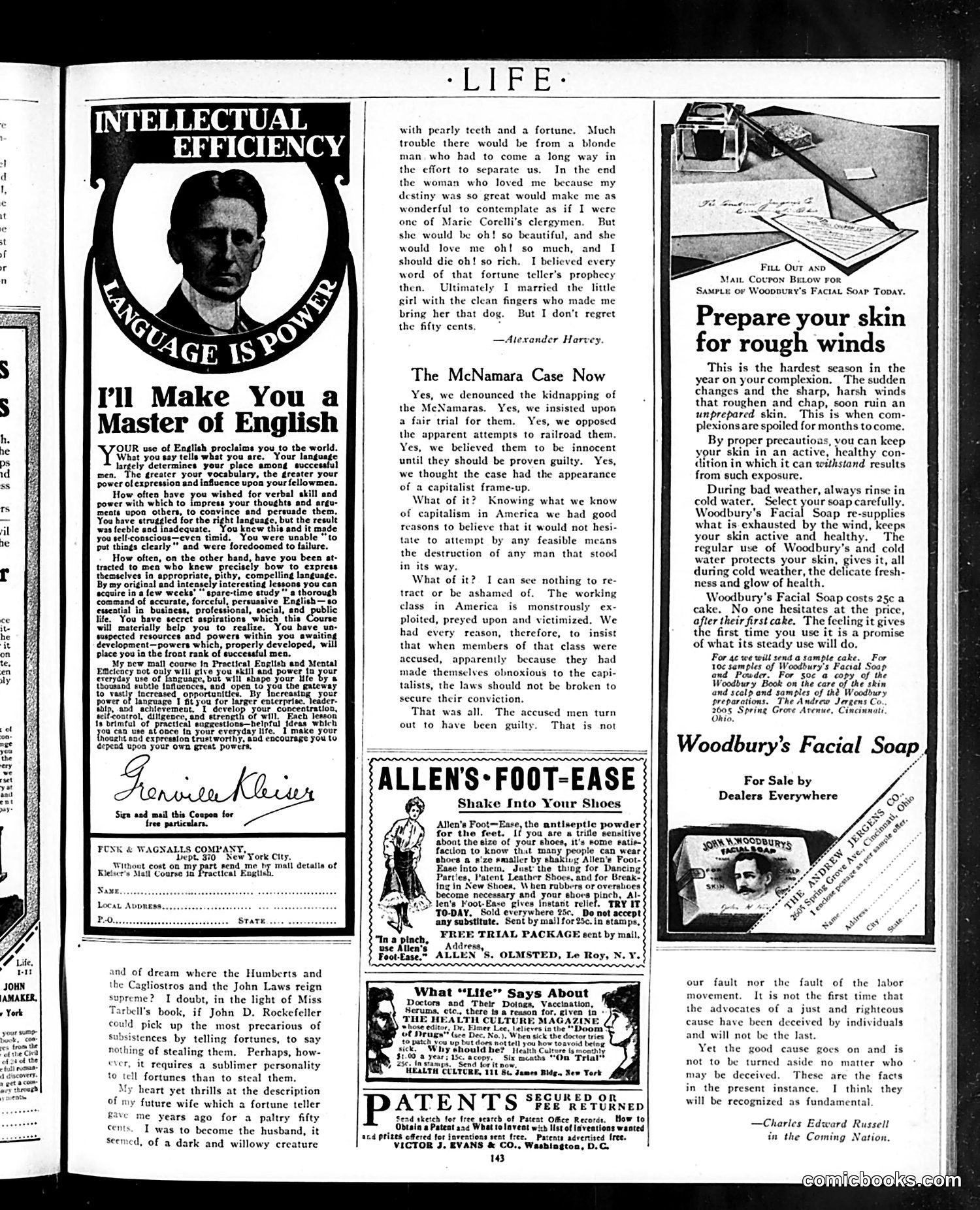
This page mixes personal narrative with early 20th-century advertisements and social commentary. The main text appears to be Alexander Harvey's reflective essay about marriage and fortune-telling, contrasting romantic idealism with practical reality—a common satirical theme in Life magazine. The political content centers on "The McNamara Case," referencing the 1911 Los Angeles Times bombing and subsequent trial of labor activists James and John McNamara. The text criticizes capitalist bias in the American justice system, arguing that wealthy interests would suppress labor organizing "by any feasible means" and that accused workers faced predetermined guilt regardless of evidence. This reflects Life's progressive-era skepticism toward industrial power structures. The advertisements (English language courses, foot powder, facial soap) represent typical magazine monetization of the era. The page overall exemplifies Life's dual purpose: satirizing contemporary society while funding itself through commerce.
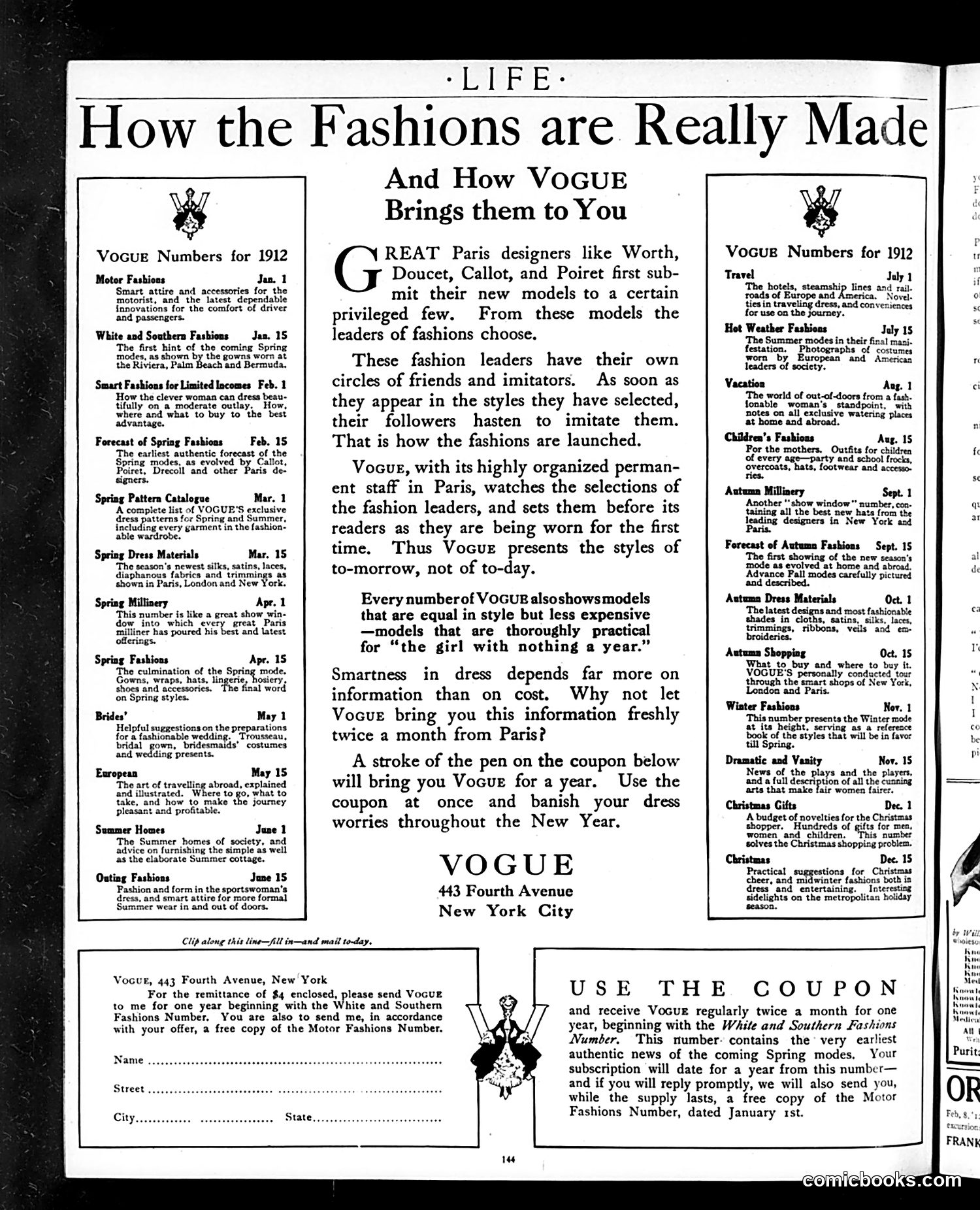
This is primarily a **Vogue magazine subscription advertisement**, not political satire. The page explains Vogue's business model to readers. The key message: Parisian designers (Worth, Doucet, Callot, Poiret) create exclusive models for wealthy "fashion leaders." These leaders' social circles then imitate the styles, creating fashion trends that eventually reach ordinary women. Vogue claims its value is showing these emerging styles **first**, "twice a month from Paris," before competitors catch up. The implicit satire is gentle—the page humorously acknowledges the hierarchical fashion system while simultaneously selling readers the dream of access. It promises that by subscribing, even "the girl with nothing a year" can appear stylish through information rather than expense. The extensive list of monthly issues in the margins demonstrates Vogue's comprehensive coverage and encourages year-round subscription using a mail-in coupon.
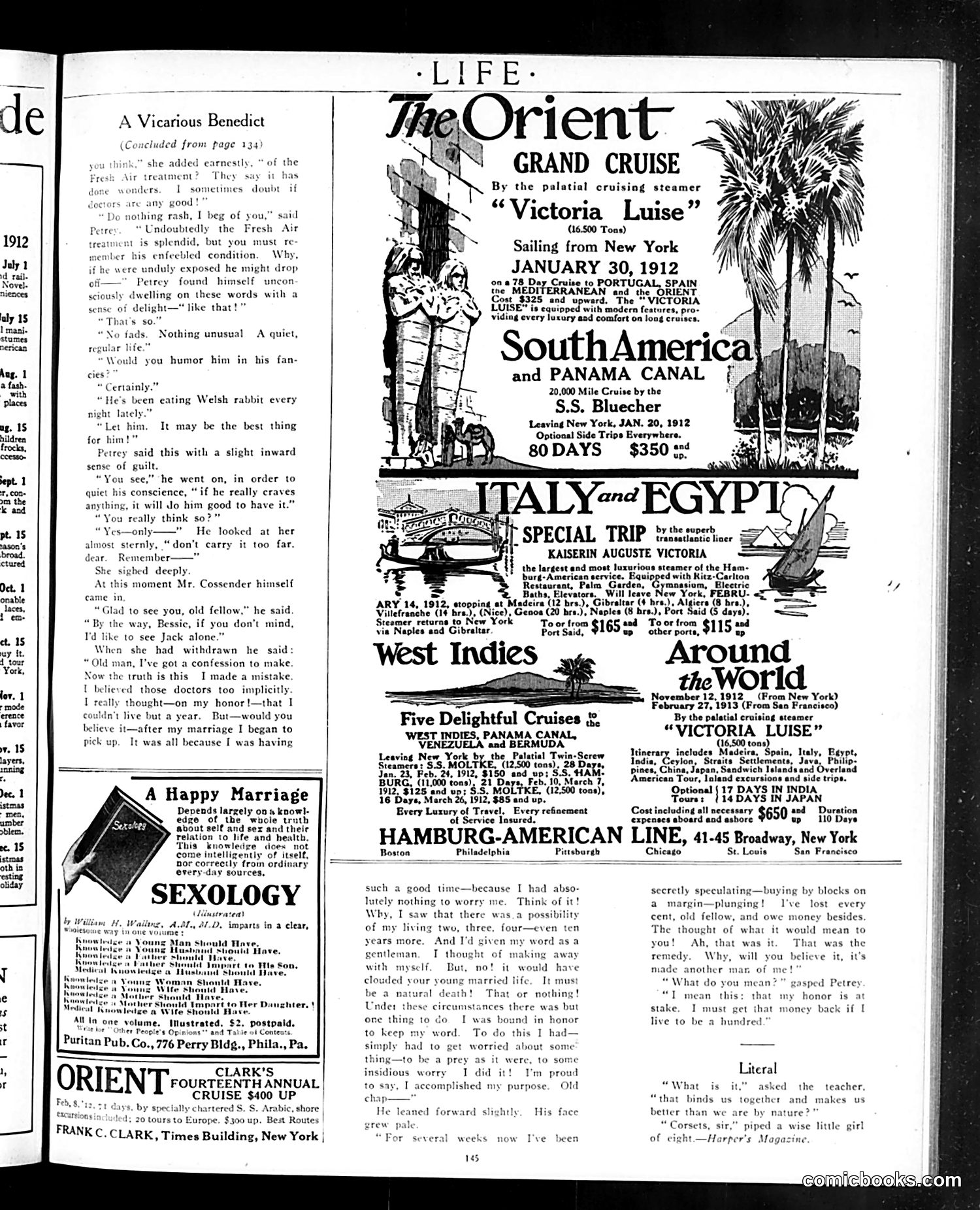
This page is primarily **advertising**, featuring luxury cruise ship promotions from major steamship lines (Hamburg-American, Victoria Luise, S.S. Bluecher, Kaiserin Auguste Victoria). The ads showcase early 20th-century leisure travel to exotic destinations: South America, Panama Canal, Italy, Egypt, West Indies, and around-the-world voyages—destinations representing the height of Edwardian-era wealth and sophistication. The narrative story "A Vicarious Benedict" appears to be a comedy about a hypochondriac man who believed doctors' predictions he'd die within a year, but recovered after marriage—the irony being that happiness and companionship cured what medicine couldn't. The small "Sexology" advertisement at bottom-left promises practical marital knowledge, typical of early 1900s self-help publishing. The page reflects **Gilded Age leisure culture**: international travel was exclusively for the wealthy, and cruise advertising emphasized luxury, exotic locales, and escape from ordinary life.
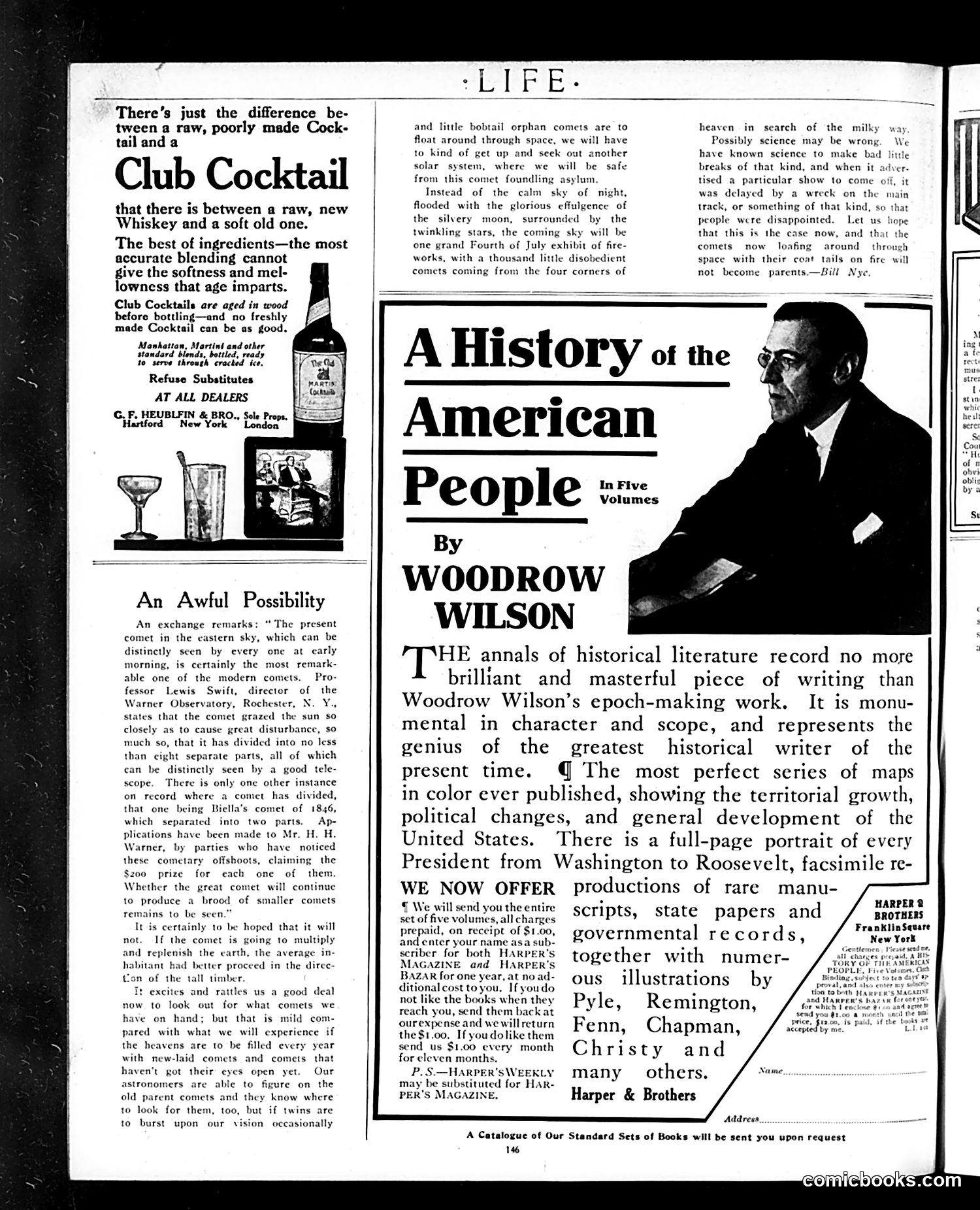
This page mixes advertising with humorous commentary. The left side features a **Club Cocktail advertisement** emphasizing that aged spirits are superior to raw ones. The main satirical piece, "An Awful Possibility," discusses a real astronomical event: a comet visible in the eastern sky that had fragmentmented into eight pieces after passing close to the sun. The humor derives from a fake worry: if this comet "multiplies and replenishes the earth" by producing offspring comets, the sky will become cluttered with disobedient celestial bodies "coming from the four corners of heaven" like a chaotic Fourth of July fireworks display. The piece mocks both public anxiety about comets and the absurdity of the prize being offered ($200 per new comet fragment discovered). Bill Nye's signature ending suggests people should "proceed in the direction of the tall timber"—flee to the woods. The right side advertises **Woodrow Wilson's "A History of the American People"** in five volumes, praising its maps and presidential portraits.
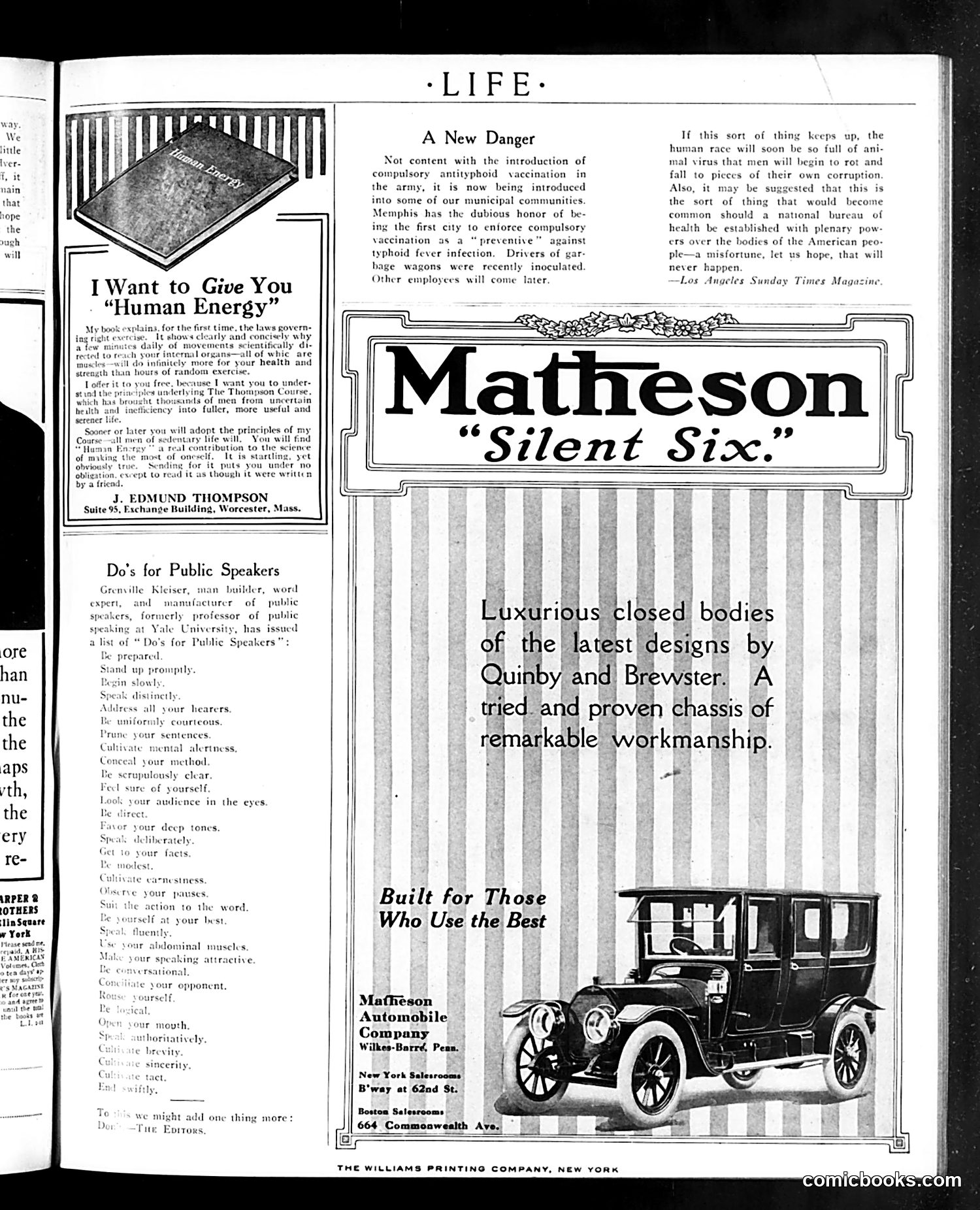
This page contains **editorial commentary and period advertisements** rather than cartoons. The main content piece, "A New Danger," critiques **compulsory antityphoid vaccination** recently introduced in Memphis and the U.S. Army. The author argues this public health measure represents dangerous government overreach—suggesting mandatory vaccination could lead to a "national bureau of health" controlling citizens' bodies, which the Los Angeles Times editorial quoted here warns could corrupt the human race. This reflects early 20th-century **anti-vaccination sentiment and libertarian concerns about government medical authority**, contrasting sharply with modern public health consensus. The page also includes ads for a self-help book on "Human Energy," public speaking tips, and a Matheson automobile, typical of period Life magazine's mix of satirical content and commercial advertisements.
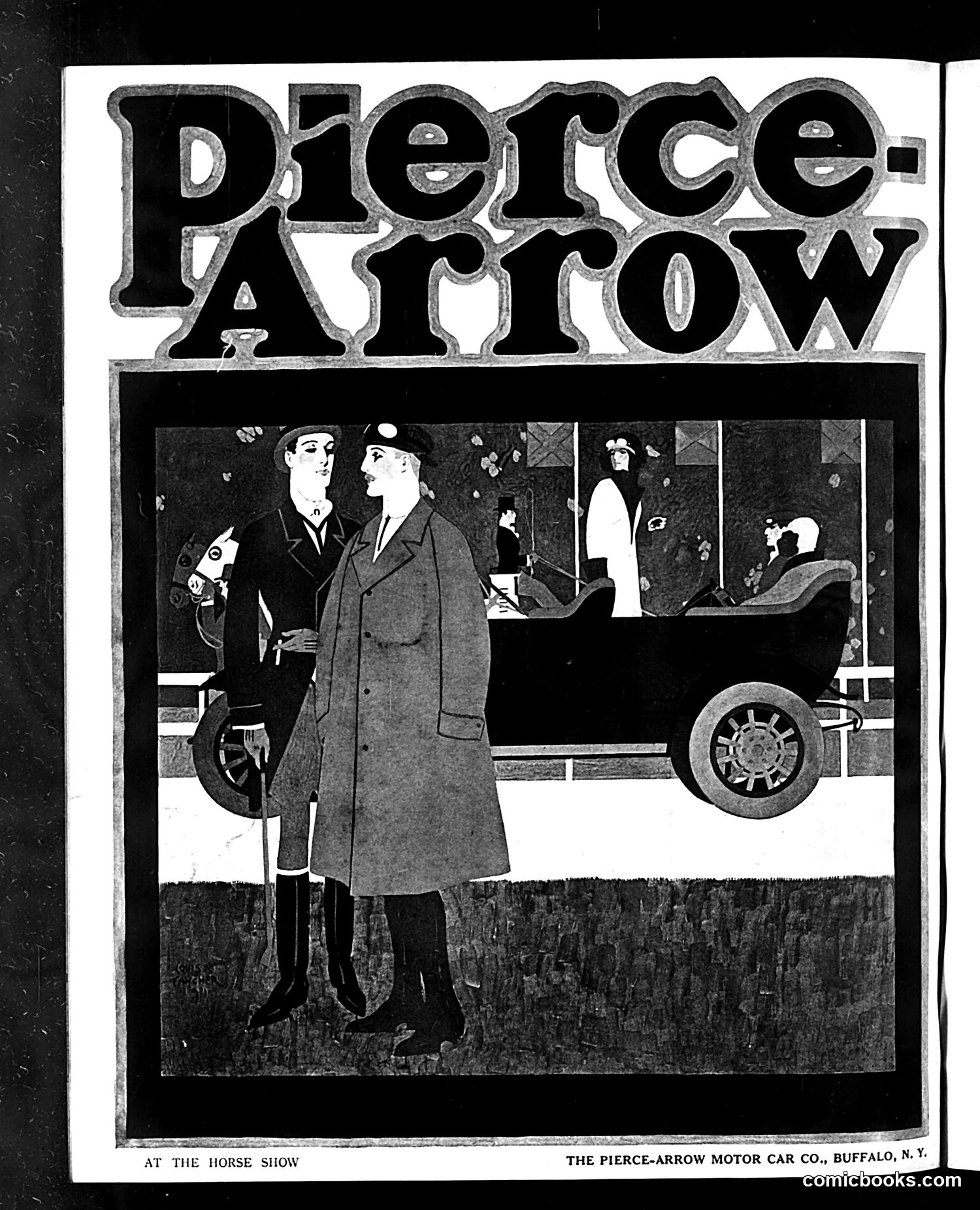
This is a period advertisement for the Pierce-Arrow Motor Car Company of Buffalo, New York. The image shows two well-dressed men in overcoats at a horse show, with a Pierce-Arrow automobile visible in the background. One man holds what appears to be a riding crop or similar equestrian equipment. The satire is implicit: at a traditional horse show—an event centered on equestrian culture and horsemanship—the advertisement juxtaposes the old world of horses with the new automobile technology. The sophisticated gentlemen, dressed in elite attire, represent the wealthy clientele who would patronize both venues, suggesting that Pierce-Arrow automobiles appeal to the same refined, upper-class audience that attends prestigious horse shows. The ad implies the car represents modernity and progress while maintaining social prestige.