
Life, 1912-01-11 · page 17 of 40
Life — January 11, 1912 — page 17: what you’re looking at
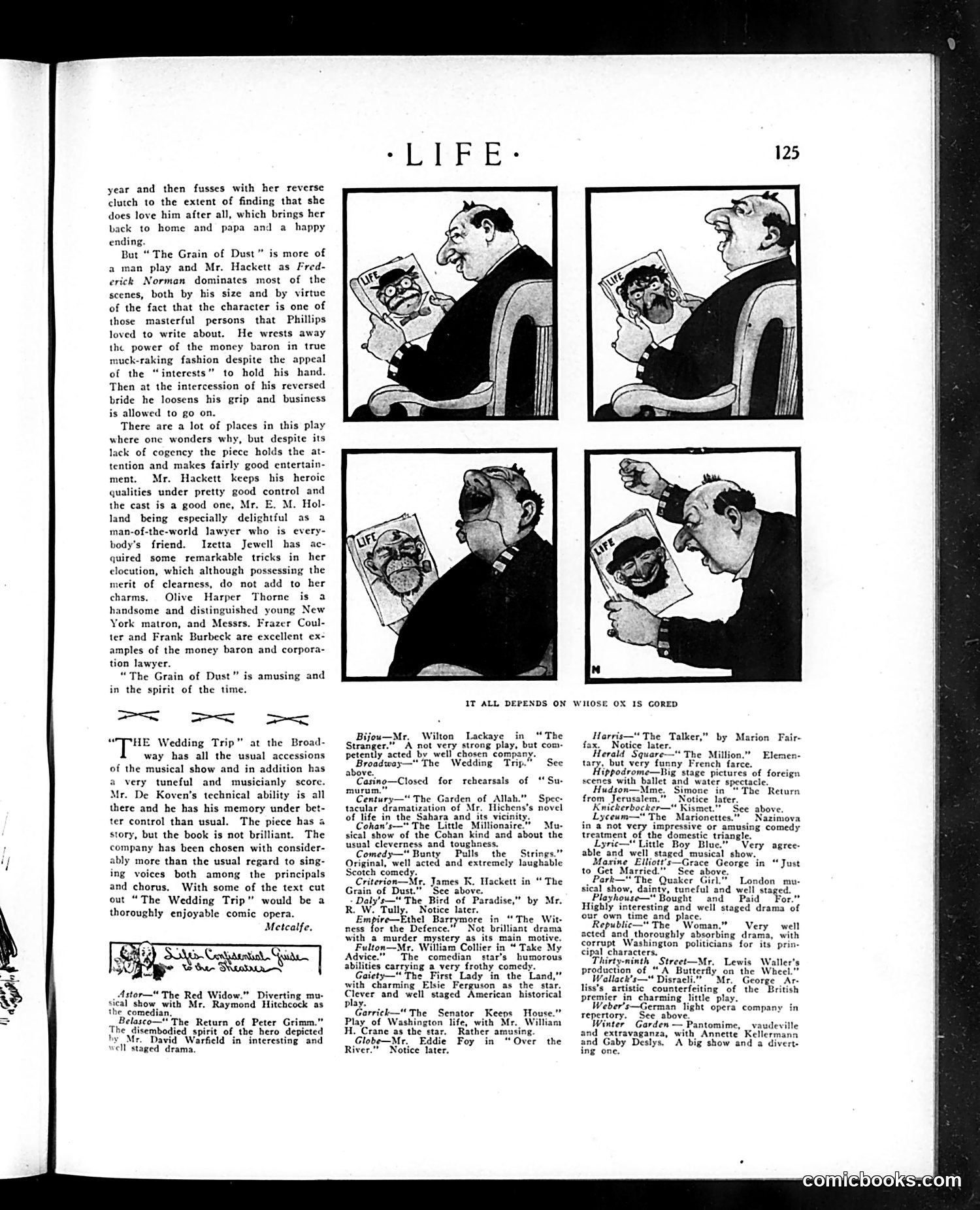
What you’re looking at
This page contains theater reviews and a four-panel cartoon titled "It All Depends on Whose Ox is Gored." The cartoon depicts a man reading what appears to be "Life" magazine, shown in four sequential panels with increasingly agitated expressions—a visual gag about how one's reaction to satirical content depends on whether the satire targets oneself or one's rivals. The title, a play on the proverb "it all depends on whose ox is gored" (meaning people's opinions shift based on personal interest), is the cartoon's satirical point: people find satire hilarious when it mocks their enemies but offensive when directed at them. The page primarily comprises theater reviews—discussing plays like "The Grain of Dust" and "The Wedding Trip"—reflecting Life's role as cultural commentary. The reviews evaluate performances by actors including James K. Hackett and Ethel Barrymore, typical of the magazine's arts criticism during the early 20th century.
📄 Transcribed text from this page (OCR, searchable)
Machine-transcribed from the original scan — historical spelling and the odd misread are preserved.
year and then fusses with her reverse clutch to the extent of finding that she does love him after all, which brings her back to home and papa and a happy ending. But “The Grain of Dust” is more of a man play and Mr. Hackett as Fred- erick Norman dominates most of the scenes, both by his size and by virtue of the fact that the character is one of those masterful persons that Phillips loved to write about. He wrests away the power of the money baron in true muck-raking fashion despite the appeal of the “interests” to hold his hand. Then at the intercession of his reversed bride he loosens his grip and business is allowed to go on. There are a lot of places in this play where one wonders why, but despite its lack of cogency the piece holds the at- tention and makes fairly good entertain- ment. Mr. Hackett keeps his heroic qualities under pretty good control and the cast is a good one, Mr. E. M. Hol- land being especially delightful as a man-of-the-world lawyer who is every- body's friend. Izetta Jewell has ac- quired some remarkable tricks in her clocution, which although possessing the merit of clearness, do not add to her charms. Olive Harper Thorne is a handsome and distinguished young New York matron, and Messrs. Frazer Coul- ter and Frank Burbeck are excellent ex- amples of the money baron and corpora- tion lawyer. “The Grain of Dust” is amusing and in the spirit of the time. a a “"THE Wedding Trip” at the Broad- way has all the usual accessions of the musical show and addition has a very tuneful and musicianly score. Mr. De Koven’s technical ability is all there and he has his memory under bet- ter control than usual. The piece has 3 story, but the book is not brilliant. The company has been chosen with consider- ably more than the usual regard to sing- ing voices both among the principals and chorus, With some of the text cut out “The Wedding Trip” would be a thoroughly enjoyable comic opera. Metcalfe. Astor—“ The Red Widow.” Diverting mu- sical show with Mr. Raymond Hitchcock as the comedi ., ,Belasco—" The Return of Peter Grimm.” The disembodied spirit of, the hero depicted y Mr. David Warfield in interesting and well staged drama. 1T ALL DEPENDS ON WHOSE OX 1S CORED Bijou—Mr, Wilton Lackaye in “The Stranger.” A not very strong play, but com- petently acted by well chosen company. Broadway—" The Wedding Trip.” See abort Casino—Closed for “Su murum.”” Century—" The Garden of Allah.” Spec- tacular dramatization of Mr. Hichens’s novel of life in the, Sahara and_its vicinit: Cohan’s—" The Little Millionaire.” Mu- sical show of the Cohan kind and about the usual cleverness and toughness. Comedy—" Bunty Pulls the Strings.” Original, well acted and extremely laughable Scotch comedy. Criterion—Mr. James K. Hackett in “ The Grain of Dust.” ‘See above. Daly’s—" The Bird of Paradise," by Mr. RW. Tally. | Notice later. Empire—Ethel Barrymore in The Wit- ness for the Defence." Not brilliant drama with a murder mystery as its main motive. Fulton—Mr. William Collier in “ Take My Advice.” The comedian star's humorous abilities carrying a very frothy comedy. ie irst Lady in the Lan v G Ferguson as the star. Clever and well staged American historical play. Garrick—" The Senator Keeps House.” Play of Washington life, with Mr. William H. Crane as the star. Rather amusing Globe—Mr. Eddie Foy in “Over the River.” Notice later. rehearsals of Horris—“ The Talker,” by Marion Fair- fax, Notice later. Herald Square- tary, but very funny French farce. ippodrome—Dig stage pictures of foreign scenes with ballet and water spectacle. Hudson—Mme, Simone in “The Return from Jerusalem.” "Notice later. Knickerbocker—* Ki _ Lyceum—"The Marionettes. in a not very impressive or amusing comedy treatment of the domestic triangle. Lyric— Little Boy Blue.” Very agree- able and well staged musical show. Maxine Elliott’s—Grace George in “Just to Get Married." See above, _Park—" The Quaker Girl.” London mu- sical show, dainty, tuneful and well staged. Playhouse—" Bought and Paid For.” Highly interesting and well staged drama of our own time and place. Republic—" The Woman.” Very well acted and thoroughly absorbing drama, with corrupt Washington politicians for its’ prin- cipal characters. Thirty-ninth "Street—Mr. Lewis Waller's production of “A Butterfly on the Wheel.” Wallack's— Disraeli.” Mr. George | Ar- liss’s artistic counterfeiting of the British premier in charming little play. Weber’s—German light opera company in repertory. See above. Winter Garden — Pantomime, _ vaude- and extravaganza, with Annette Kellern and Gaby Deslys.” A big show and a di ing one. Naziniova