
Life, 1912-01-11 · page 32 of 40
Life — January 11, 1912 — page 32: what you’re looking at
What you’re looking at
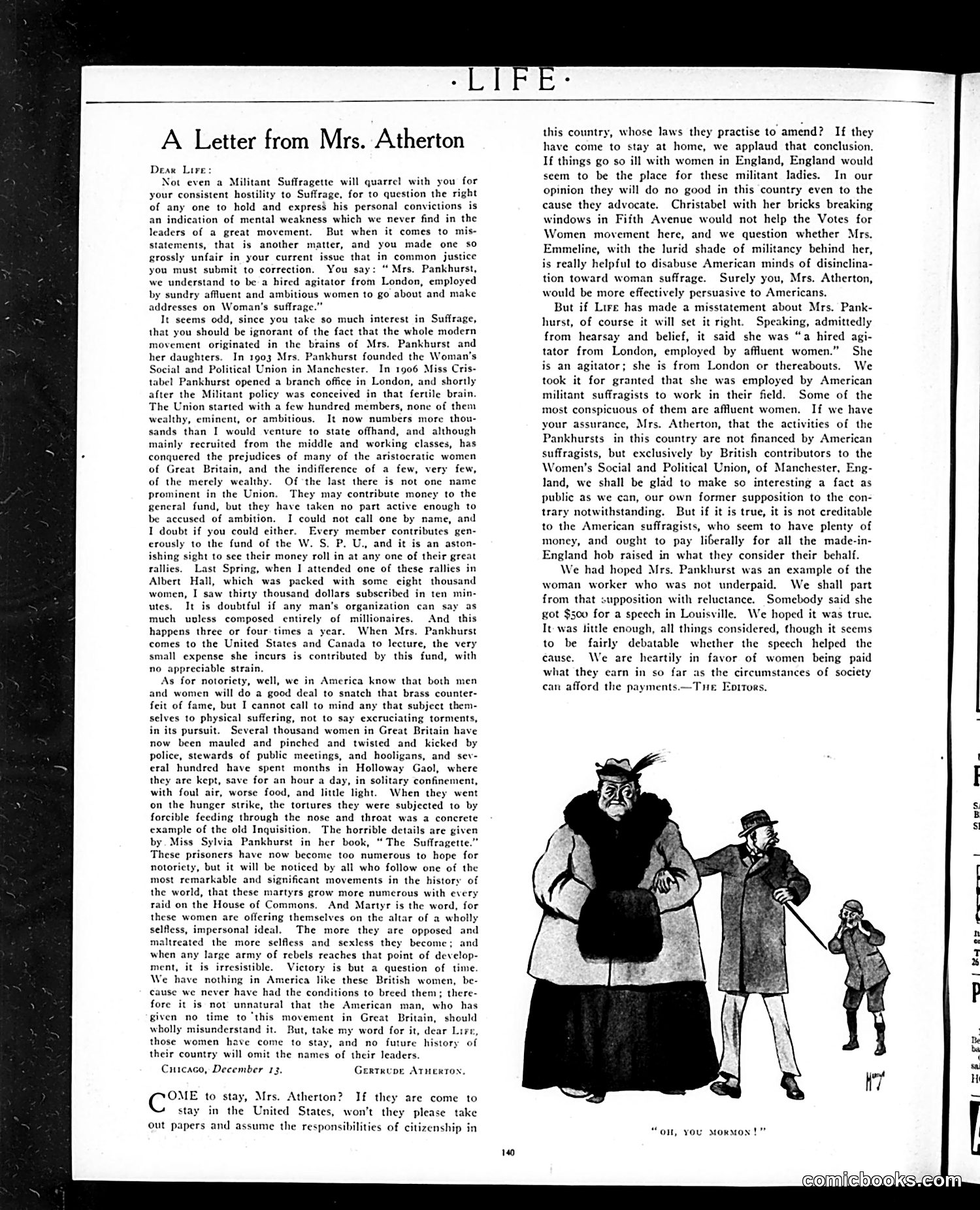
This page contains a letter defending British suffragettes (led by Emmeline Pankhurst) against *Life* magazine's criticisms, plus a satirical cartoon at bottom. **The cartoon** shows a large woman in dark clothing scolding two smaller figures—likely representing Mormon men with multiple wives. The caption "Oh, you Mormons!" is the joke's punchline. **The satire**: The cartoonist equates the suffragettes' aggressive tactics with Mormon polygamy as equally un-American and offensive. By pairing British militant feminists with Mormonism (historically America's most controversial religious/social practice), the cartoon ridicules suffragettes as foreign threats to American values. **Context**: This reflects American anti-suffrage sentiment using xenophobia—portraying British suffragettes as dangerous outsiders whose methods and ideology don't belong in America, similar to how Mormonism was viewed as alien and immoral. The letter itself rebuts *Life*'s claim that Pankhurst was a "hired agitator," detailing suffragettes' sacrifices and grassroots funding.
📄 Transcribed text from this page (OCR, searchable)
Machine-transcribed from the original scan — historical spelling and the odd misread are preserved.
A Letter from Mrs. Atherton Deaw Live: Not even a Militant Suffragette will quarrel with you for your consistent hostility to Suffrage, for to question the right of any one to hold and express his personal convictions is an indication of mental weakness which we never find in the leaders of a great movement. But when it comes to mis- statements, that is another matter, and you made one so grossly unfair in your current issue that in common justice you must submit to correction. You say: “Mrs. Pankhurst, we understand to be a hired agitator from London, employed by sundry affluent and ambitious women to go about and make addresses on Woman's suffrage.” It seems odd, since you take so much interest in Suffrage, that you should be ignorant of the fact that the whole modern movement originated in the brains of Mrs. Pankhurst and her daughters. In 1903 Mrs. Pankhurst founded the Woman's Social and Political Union in Manchester. In 1906 Miss Cris- tabel Pankhurst opened a branch office in London, and shortly after the Militant policy was conceived in that fertile brain. The Union started with a few hundred members, none of them wealthy, eminent, or ambitious. It now numbers more thou- sands than I would venture to state offhand, and although mainly recruited from the middle and working classes, has conquered the prejudices of many of the aristocratic women of Great Britain, and the indifference of a few, very few, of the merely wealthy. Of the last there is not one name prominent in the Union. They may contribute money to the gencral fund, but they have taken no part active enough to be accused of ambition. I could not call one by name, and I doubt if you could either. Every member contributes gen- crously to the fund of the W. S. P. U,, and it is an aston- ishing sight to see their money roll in at any one of their great rallies. Last Spring, when I attended one of these rallies in Albert Hall, which was packed with some cight thousand women, I saw thirty thousand dollars subscribed in ten min- utes. It is doubtful if any man’s organization can say as much upless composed entirely of millionaires. And this happens three or four times a year. When Mrs. Pankhurst comes to the United States and Canada to lecture, the very small expense she incurs is contributed by this fund, with no appreciable strain. As for notoriety, well, we in America know that both men and women will do a good deal to snatch that brass counter- fcit of fame, but I cannot call to mind any that subject them- selves to physical suffering, not to say excruciating torments, in its pursuit. Several thousand women in Great Britain have now been mauled and pinched and twisted and kicked by police, stewards of public meetings, and hooligans, and sev- eral hundred have spent months in Holloway Gaol, where they are kept, save for an hour a day, in solitary confinement, with foul air, worse food, and little light. When they went on the hunger strike, the tortures they were subjected to by forcible feeding through the nose and throat was a concrete example of the old Inquisition. The horrible details are given by. Miss Sylvia Pankhurst in her book, “The Suffragette.” These prisoners have now become too numerous to hope for notoricty, but it will be noticed by all who follow one of the most remarkable and significant movements in the history of the world, that these martyrs grow more numerous with every raid on the House of Commons. And Martyr is the word, for these women are offering themselves on the altar of a wholly selfless, impersonal ideal. The more they are opposed and maltreated the more selfless and sexless they become; and when any large army of rebels reaches that point of develop- ment, it is irresistible. Victory is but a question of time We have nothing in America like these British women, be- cause we never have had the conditions to breed them ; ther fore it is not unnatural that the American man, who has given no time to ‘this movement in Great Britain, should wholly misunderstand it. But, take my word for it, dear Lire, those women have come to stay, and no future history of their country will omit the names of their leaders. Cuicaco, December 13. Gertrupe ATHERTON, COE to stay, Mrs. Atherton? If they are come to stay in the United States, won't they please take out papers and assume the responsibilities of citizenship in this country, whose laws they practise to amend? If they have come to stay at home, we applaud that conclusion. If things go so ill with women in England, England would seem to be the place for these militant ladies. In our opinion they will do no good in this country even to the cause they advocate. Christabel with her bricks breaking windows in Fifth Avenue would not help the Votes for Women movement here, and we question whether Mrs. Emmeline, with the lurid shade of militancy behind her, is really helpful to disabuse American minds of disinclina- tion toward woman suffrage. Surely you, Mrs. Atherton, would be more effectively persuasive to Americans. But if Lire has made a misstatement about Mrs. Pank- hurst, of course it will set it right. Speaking, admittedly from hearsay and belief, it said she was “a hired agi- tator from London, employed by affluent women.” She is an agitator; she is from London or thereabouts. We took it for granted that she was employed by American militant suffragists to work in their field. Some of the most conspicuous of them are affluent women. If we have your assurance, Mrs. Atherton, that the activities of the Pankhursts in this country are not financed by American suffragists, but exclusively by British contributors to the Women’s Social and Political Union, of Manchester, Eng- land, we shall be glad to make so interesting a fact as public as we can, our own former supposition to the con- trary notwithstanding. But if it is true, it is not creditable to the American suffragists, who seem to have plenty of money, and ought to pay liberally for all the made-in- England hob raised in what they consider their behalf. We had hoped Mrs. Pankhurst was an example of the woman worker who was not underpaid. We shall part from that supposition with reluctance. Somebody said she got $300 for a speech in Louisville. We hoped it was true. It- was little enough, all things considered, though it seems to be fairly debatable whether the speech helped the cause. We are heartily in favor of women being paid what they earn in so far as the circumstances of society can afford the payments.—Tne Enttors.