
Life, 1912-01-11 · page 16 of 40
Life — January 11, 1912 — page 16: what you’re looking at
What you’re looking at
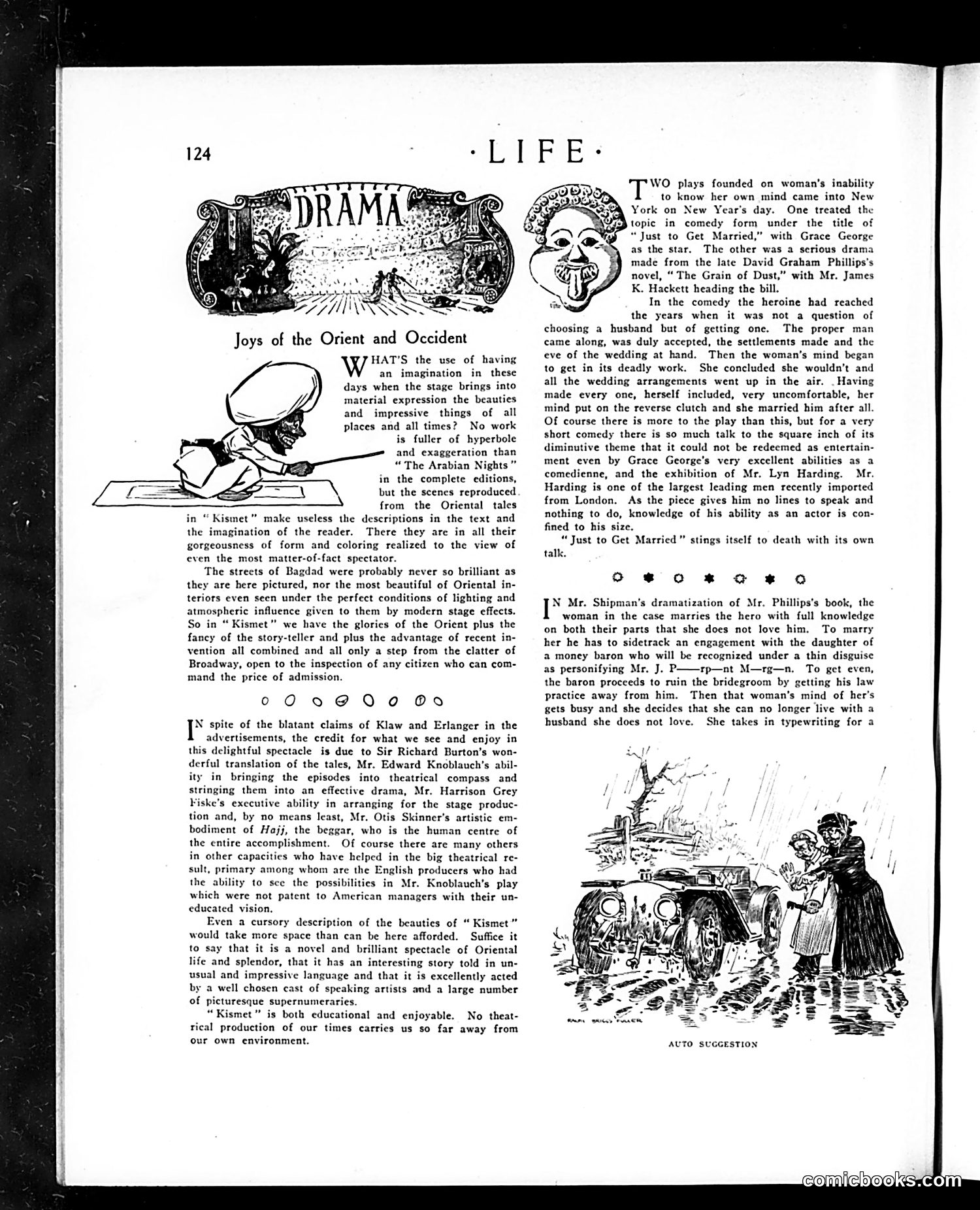
This page reviews two theatrical productions from New Year's Day (early 1900s). **"Kismet"**: The main review praises this elaborate stage adaptation of Arabian Nights tales. The critic celebrates how modern theatrical technology—lighting, scenery, stage effects—brings the exotic Oriental settings to vivid life, surpassing even readers' imaginations of the source material. The review credits multiple contributors (playwright Knoblauch, producer Fiske, actor Otis Skinner) while somewhat dismissively noting that English producers recognized the play's potential when American managers "with their uneducated vision" did not. **"Just to Get Married"** and **"The Grain of Dust"**: Two plays about women's indecision regarding marriage opened simultaneously. The comedy features a heroine who accepts a proposal, then cancels the wedding, then reverses course again—satirizing women's supposed inability to make firm decisions. The review suggests this flimsy premise is padded with excessive dialogue. The "Auto Suggestion" illustration (right) appears unrelated to the text.
📄 Transcribed text from this page (OCR, searchable)
Machine-transcribed from the original scan — historical spelling and the odd misread are preserved.
Joys of the Orient and Occident HAT’S the use of having an imagination in these days when the stage brings into material expression the beauties and impressive things of all places and all times? No work is fuller of hyperbole and exaggeration than “The Arabian Nights” in the complete editions, but the scenes reproduced from the Oriental tales in “ Kismet" make useless the descriptions in the text and the imagination of the reader. There they are in all their gorgeousness of form and coloring realized to the view of even the most matter-of-fact spectator. The streets of Bagdad were probably never so brilliant as they are here pictured, nor the most beautiful of Oriental in- teriors even seen under the perfect conditions of lighting and atmospheric influence given to them by modern stage effects. So in “Kismet” we have the glories of the Orient plus the fancy of the story-teller and plus the advantage of recent in- vention all combined and all only a step from the clatter of Broadway, open to the inspection of any citizen who can com- mand the price of admission. °0009000 00 I spite of the blatant claims of Klaw and Erlanger in the advertisements, the credit for what we see and enjoy in this delightful spectacle is due to Sir Richard Burton’s won- derful translation of the tales, Mr. Edward Knoblauch’s abil- ity in bringing the episodes into theatrical compass and stringing them into an effective drama, Mr. Harrison Grey Fiske's executive ability in arranging for the stage produc- tion and, by no means least, Mr. Otis Skinner's artistic em- bodiment of Hajj, the beggar, who is the human centre of the entire accomplishment. Of course there are many others in other capacities who have helped in the big theatrical re- sult, primary among whom are the English producers who had the ability to sce the possibilities in Mr. Knoblauch’s play which were not patent to American managers with their un- educated vision. Even a cursory description of the beauties of “ Kismet” would take more space than can be here afforded. Suffice it to say that it is a novel and brilliant spectacle of Oriental life and splendor, that it has an interesting story told in un- usual and impressive language and that it is excellently acted by a well chosen cast of speaking artists and a large number of picturesque supernumeraries. “Kismet” is both educational and enjoyable. No theat- rical production of our times carries us so far away from our own environment. WO plays founded on woman's inability to know her own mind came into New York on New Year's day. One treated the topic in comedy form under the title of “Just to Get Married,” with Grace George as the star, The other was a serious drama made from the late David Graham Phillips's novel, “ The Grain of Dust,” with Mr. James K. Hackett heading the bill. In the comedy the heroine had reached the years when it was not a question of choosing a husband but of getting one. The proper man came along, was duly accepted, the settlements made and the eve of the wedding at hand. Then the woman’s mind began to get in its deadly work. She concluded she wouldn't and all the wedding arrangements went up in the air. . Having made every one, herself included, very uncomfortable, her mind put on the reverse clutch and she married him after all. Of course there is more to the play than this, but for a very short comedy there is so much talk to the square inch of its diminutive theme that it could not be redecmed as entertain- ment even by Grace George's very excellent abilities as a comedienne, and the exhibition of Mr. Lyn Harding. Mr. Harding is one of the largest leading men recently imported from London. As the piece gives him no lines to speak and nothing to do, knowledge of his ability as an actor is con- fined to his size. “Just to Get Married” stings itself to death with its own talk. o € 0 * G € 6 Is Mr. Shipman’s dramatization of Mr. Phillips's book, the woman in the case marries the hero with full knowledge on both their parts that she does not love him. To marry her he has to sidetrack an engagement with the daughter of a money baron who will be recognized under a thin disguise as personifying Mr. J. P——rp—nt M—rg—n. To get even, the baron proceeds to ruin the bridegroom by getting his law practice away from him. Then that woman's mind of her's gets busy and she decides that she can no longer live with a husband she docs not love. She takes in typewriting for a AUTO SUGGESTION