
Life, 1912-01-11 · page 22 of 40
Life — January 11, 1912 — page 22: what you’re looking at
What you’re looking at
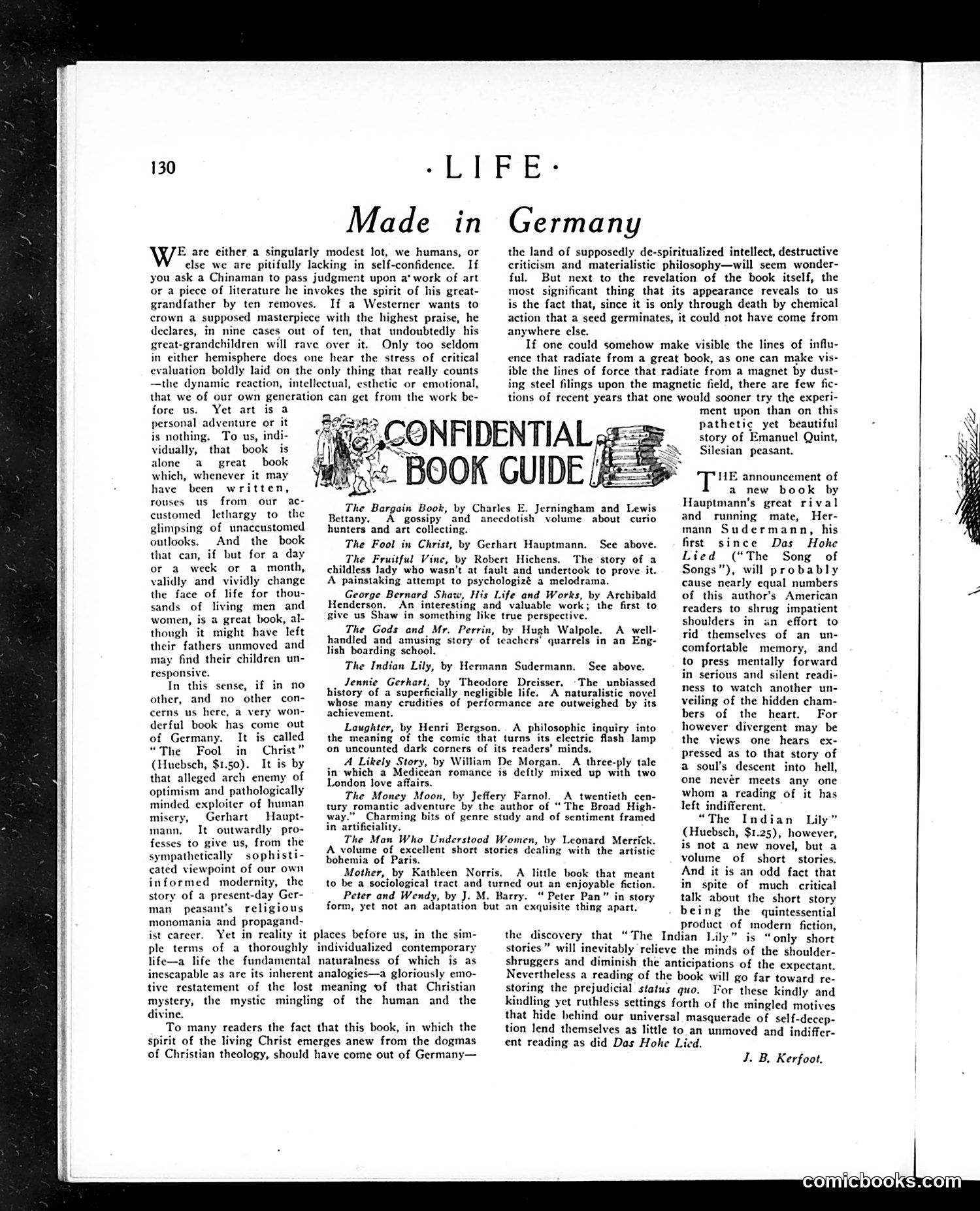
This is a **book review and advertising section** from Life magazine, not a political cartoon. The page reviews recent German literature, particularly praising Gerhart Hauptmann's novel *The Fool in Christ*. The article argues that great art should be judged by its **immediate emotional impact on readers today**, not by posthumous reputation. It celebrates this German novel as an example of work that powerfully affects contemporary audiences. The "Confidential Book Guide" box lists multiple new publications with brief descriptions. Notable is the emphasis on German authors (Hauptmann, Sudermann, Hichens), reflecting early 20th-century literary culture when German literature held significant prestige in English-speaking circles. The page's title "Made in Germany" is **ironic praise**—acknowledging Germany's reputation for intellectual and materialistic philosophy while celebrating its artistic output. This predates anti-German sentiment associated with World War I, positioning German culture as intellectually sophisticated and worthy of serious critical attention.
📄 Transcribed text from this page (OCR, searchable)
Machine-transcribed from the original scan — historical spelling and the odd misread are preserved.
Made in W are cither a singularly modest lot, we humans, or else we are pitifully lacking in self-confidence. If you ask a Chinaman to pass judgment upon a’ work of art or a piece of literature he invokes the spirit of his great- grandfather by ten removes. If a Westerner wants to crown a supposed masterpiece with the highest praise, he declares, in nine cases out of ten, that undoubtedly his great-grandchildren will rave over it. Only too seldom in either hemisphere does one hear the stress of critical evaluation boldly laid on the only thing that really counts —the dynamic reaction, intellectual, esthetic or emotional, that we of our own generation can get from the work be- fore us. Yet art is a am personal adventure or it Beapap indi- ah Ot is nothing. To us ‘ vidually, that book is alone a great book which, whenever it may have been written, rouses us from our ac- 4 -LIFE- ONFIDENTIAL =e. : BOOK GUIDE (2% Germany the land of supposedly de-spiritualized intellect, destructive criticism and materialistic philosophy—will seem wonder- ful. But next to the revelation of the book itself, the most significant thing that its appearance reveals to us is the fact that, since it is only through death by chemical action that a seed germinates, it could not have come from anywhere else. If one could somehow make visible the lines of influ- ence that radiate from a great book, as one can make v! ible the lines of force that radiate from a magnet by dust- ing steel filings upon the magnetic field, there are few fic- tions of recent years that one would sooner try the experi- ment upon than on this pathetic yet beautiful story of Emanuel Quint, Silesian peasant. HE announcement of a new book by customed lethargy to. the glimpsing of unaccustomed outlooks. And the book that can, if but for a day or a week or a month, validly and vividly change the face of life for thou- sands of living men and women, is a great book, al- The Bargain Book, by Charles E. Jerningham and Lewis Bettany. A gossipy’ and anecdotish volume about curio hunters and art collecting. The Fool in Christ, by Gerhart Hauptmann. Sce above. The Fruitful Vine, by Robert Hichens, The story of a childless lady who wasn’t at fault and undertook to prove it. A painstaking attempt to psychologizé a melodrama. George Bernard Shaw, His Life and Works, by Archibald Henderson. An interesting and valuable work; the first to give us Shaw in something like true perspective. The Gods and Mr. Perrin, by Hugh Walpole. A well- Hauptmann’s great rival and running mate, Her- mann Sudermann, his first since Das Hohe Lied (“The Song of Songs”), will probably cause nearly equal numbers of this author’s American readers to shrug impatient shoulders in an effort to i though it might have left their fathers unmoved and may find their children un- responsive. In this sense, if in no other, and no other con- cerns us here, a very won- derful book has come out of Germany. It is called “The Fool in Christ” (Huebsch, $1.50). It is by that alleged arch enemy of optimism and pathologically minded exploiter of human misery, | Gerhart mann. It outwardly pro- fesses to give us, from the sympathetically sophisti- cated viewpoint of our own informed modernity, the story of a present-day Ger- man peasant’s religious monomania and propagand- ist career. Yet in reality it places before us, in the sim- ple terms of a thoroughly individualized contemporary life—a life the fundamental naturalness of which is as inescapable as are its inherent analogies—a gloriously emo- tive restatement of the lost meaning vf that Christian mystery, the mystic mingling of the human and the divine. To many readers the fact that this book, in which the spirit of the living Christ emerges anew from the dogm of Christian theology, should have come out of Germany— lish boarding school. achievement. A Likely Story, by Wi London love affairs. Haupt- way. in artificiality. bohemia of Paris. form, yet not an ad handled and amusing story of teachers’ quarrels in an Eng- The Indian Lily, by Hermann Sudermann. _ Jennie Gerhart, by Theodore Drcisser. history of a superficially negligible life. whose many crudities of performance are outweighed by its Laughter, by Henri Bergson. the meaning of the comic that turns its electric flash lamp on uncounted dark corners of its readers’ minds. am De Morgan. A three-ply tale in which a Medicean romance is deftly mixed up with two The Money Moon, by Jeffery Farnol. tury romantic adventure by the author of “ The Broad High- Charming bits of genre study and of sentiment framed The Man Who Understood Women, by Leonard Merrick. A volume of excellent short storics dealing with the artistic Mother, by Kathleen Norris. to be a sociological tract and turned out an enjoyable fiction. Peter and Wendy, by J. M. Barry. “Peter Pan” in story ptation but an exquisite thing apart, rid themselves of an un- comfortable memory, and to press mentally forward See above. Py = ‘ 7 Th biassed in serious and silent readi- e_ unbiasse ‘A naturalistie. novel ness to watch another un- veiling of the hidden cham- bers of the heart. For however divergent may be the views one hears ex- pressed as to that story of a soul's descent into hell, one nevér meets any one whom a reading of it has left indifferent. “The Indian Lily” (Huebsch, $1.25), however, is not a new novel, but a volume of short stories. And it is an odd fact that in spite of much critical talk about the short story being the quintessential product of modern fiction, the discovery that “The Indian Lily” is “only short stories” will inevitably relieve the minds of the shoulder- shruggers and diminish the anticipations of the expectant. Nevertheless a reading of the book will go far toward re- storing the prejudicial status quo. For these kindly and kindling yet ruthless settings forth of the mingled motives that hide behind our universal masquerade of self-decep- tion lend themselves as little to. an unmoved and indiffer- ent reading as did Das Hohe Lied. A philosophic inquiry into A twentieth cen- A little book that meant J. B, Kerfoot.