
Life, 1912-01-11 · page 8 of 40
Life — January 11, 1912 — page 8: what you’re looking at
What you’re looking at
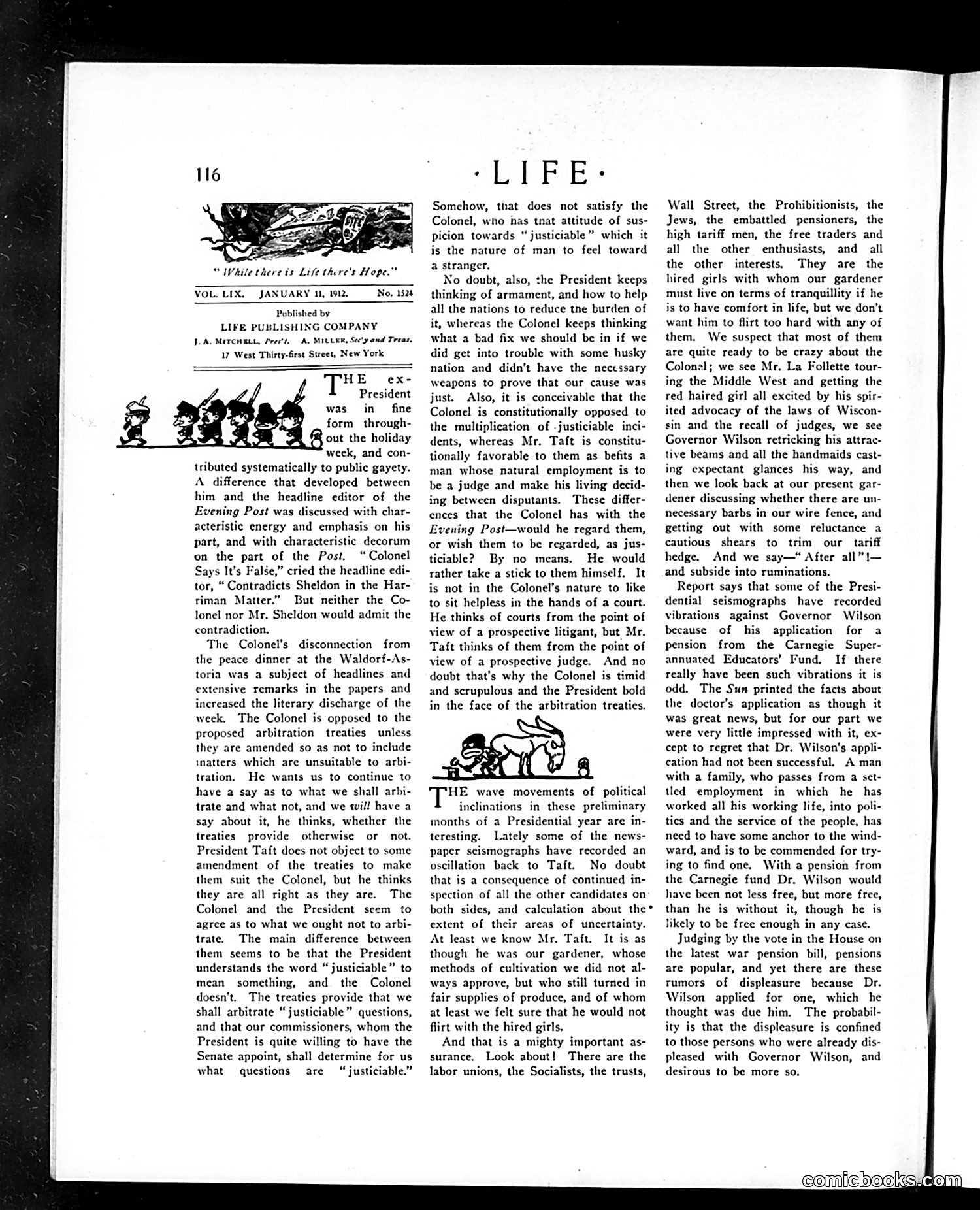
This page contains editorial commentary on President Taft's policy disagreements with Colonel Roosevelt (likely Theodore Roosevelt, who served as president 1901-1909). The text discusses their differing views on arbitration treaties and the Colonel's criticism of the Waldorf-Astoria dinner controversy. The small cartoon shows two figures in conflict—appearing to represent Taft and Roosevelt, visualizing their political rift. The article notes the "wave movements of political inclinations" among candidates and records oscillation back to Taft, while discussing Governor Wilson and various political constituencies (labor unions, Socialists, trusts, tariff advocates). The satire critiques the administration's handling of policy disputes and internal party divisions during this contentious pre-election period.
📄 Transcribed text from this page (OCR, searchable)
Machine-transcribed from the original scan — historical spelling and the odd misread are preserved.
“ While there is Life there's Hope.” VOL. LIX, JANUARY 11, 1912, No. 1528 Poblished by LIFE PUBLISHING COMPANY JA. METCHRLE, Pret, A, MILLER, Sec’y and Treas. 17 West Thirty-first Street, New York HE ex- President was in fine form through- ¥ out the holiday week, and con- tributed systematically to public gayety. A. difference that developed between him and the headline editor of the Evening Post was discussed with char- acteristic energy and emphasis on his part, and with characteristic decorum on the part of the Post. “Colonel Says It’s False,” cried the headline edi- tor, “Contradicts Sheldon in the Har- riman Matter.” But neither the Co- lonel nor Mr. Sheldon would admit the contradiction, The Colonel’s disconnection from the peace dinner at the Waldorf-As- toria was a subject of headlines and extensive remarks in the papers and increased the literary discharge of the week, The Colonel is opposed to the proposed arbitration treaties unless they are amended so as not to include inatters which are unsuitable to arbi- tration. He wants us to continue to have a say as to what we shall arbi- trate and what not, and we till have a say about it, he thinks, whether the treaties provide otherwise or not. President Taft does not object to some amendment of the treaties to make them suit the Colonel, but he thinks they are all right as they are. The Colonel and the President seem to agree as to what we ought not to arbi- trate. The main difference between them seems to be that the President understands the word “ justiciable” to mean something, and the Colonel doesn’t. The treaties provide that we shall arbitrate “ justiciable” questions, and that our commissioners, whom the President is quite willing to have the Senate appoint, shall determine for us what questions are “ justiciable.” “LP Somehow, that does not satisfy the Colonel, who has tnat attitude of sus- picion towards “ justiciable” which it is the nature of man to feel toward a stranger, No doubt, also, the President keeps thinking of armament, and how to help all the nations to reduce tne burden of it, whereas the Colonel keeps thinking what a bad fix we should be in if we did get into trouble with some husky nation and didn't have the necessary weapons to prove that our cause was just. Also, it is conceivable that the Colonel is constitutionally opposed to the multiplication of -justiciable inci. dents, whereas Mr. Taft is constitu- tionally favorable to them as befits a man whose natural employment is to be a judge and make his living decid- ing between disputants. These differ- ences that the Colonel has with the Evening Post—would he regard them, or wish them to be regarded, as jus- ticiable? By no means. He would rather take a stick to them himself. It is not in the Colonel’s nature to like to sit helpless in the hands of a court. He thinks of courts from the point of view of a prospective litigant, but Mr. Taft thinks of them from the point of view of a prospective judge. And no doubt that’s why the Colonel is timid and scrupulous and the President bold in the face of the arbitration treaties. HE wave movements of political inclinations in these preliminary months of a Presidential year are in- teresting. Lately some of the news- paper seismographs have recorded an oscillation back to Taft. No doubt that is a consequence of continued in- spection of all the other candidates on both sides, and calculation about the extent of their areas of uncertainty. At least we know Mr. Taft. It is as though he was our gardener, whose methods of cultivation we did not al- ways approve, but who still turned in fair supplies of produce, and of whom at least we felt sure that he would not flirt with the hired girls, And that is a mighty important as- surance. Look about! There are the labor unions, the Socialists, the trusts, Wall Street, the Prohibitionists, the Jews, the embattled pensioners, the high tariff men, the free traders and all the other enthusiasts, and all the other interests. They are the hired girls with whom our gardener must live on terms of tranquillity if he is to have comfort in life, but we don’t want him to flirt too hard with any of them. We suspect that most of them are quite ready to be crazy about the Colonel; we see Mr. La Follette tour- ing the Middle West and getting the red haired girl all excited by his spir- ited advocacy of the laws of Wiscon- sin and the recall of judges, we see Governor Wilson retricking his attrac- tive beams and all the handmaids cast- ing expectant glances his way, and then we look back at our present gar- dener discussing whether there are un- necessary barbs in our wire fence, and getting out with some reluctance a cautious shears to trim our tariff hedge. And we say—“ After all”!— and subside into ruminations. Report says that some of the Presi- dential seismographs have recorded vibrations against Governor Wilson because of his application for a pension from the Carnegie Super- annuated Educators’ Fund. If there really have been such vibrations it is odd. The Sun printed the facts about the doctor’s application as though it was great news, but for our part we were very little impressed with it, ex- cept to regret that Dr. Wilson's appli- cation had not been successful. A man with a family, who passes from a set- tled employment in which he has worked all his working life, into poli- tics and the service of the people, has need to have some anchor to the wind- ward, and is to be commended for try- ing to find one. With a pension from the Carnegie fund Dr. Wilson would have been not less free, but more free, than he is without it, though he is likely to be free enough in any case. Judging by the vote in the House on the latest war pension bill, pensions are popular, and yet there are these rumors of displeasure because Dr. Wilson applied for one, which he thought was due him. The probabil- ity is that the displeasure is confined to those persons who were already dis- pleased with Governor Wilson, and desirous to be more so. comichooks (4a