
A complete issue · 38 pages · 1911
Life — August 31, 1911
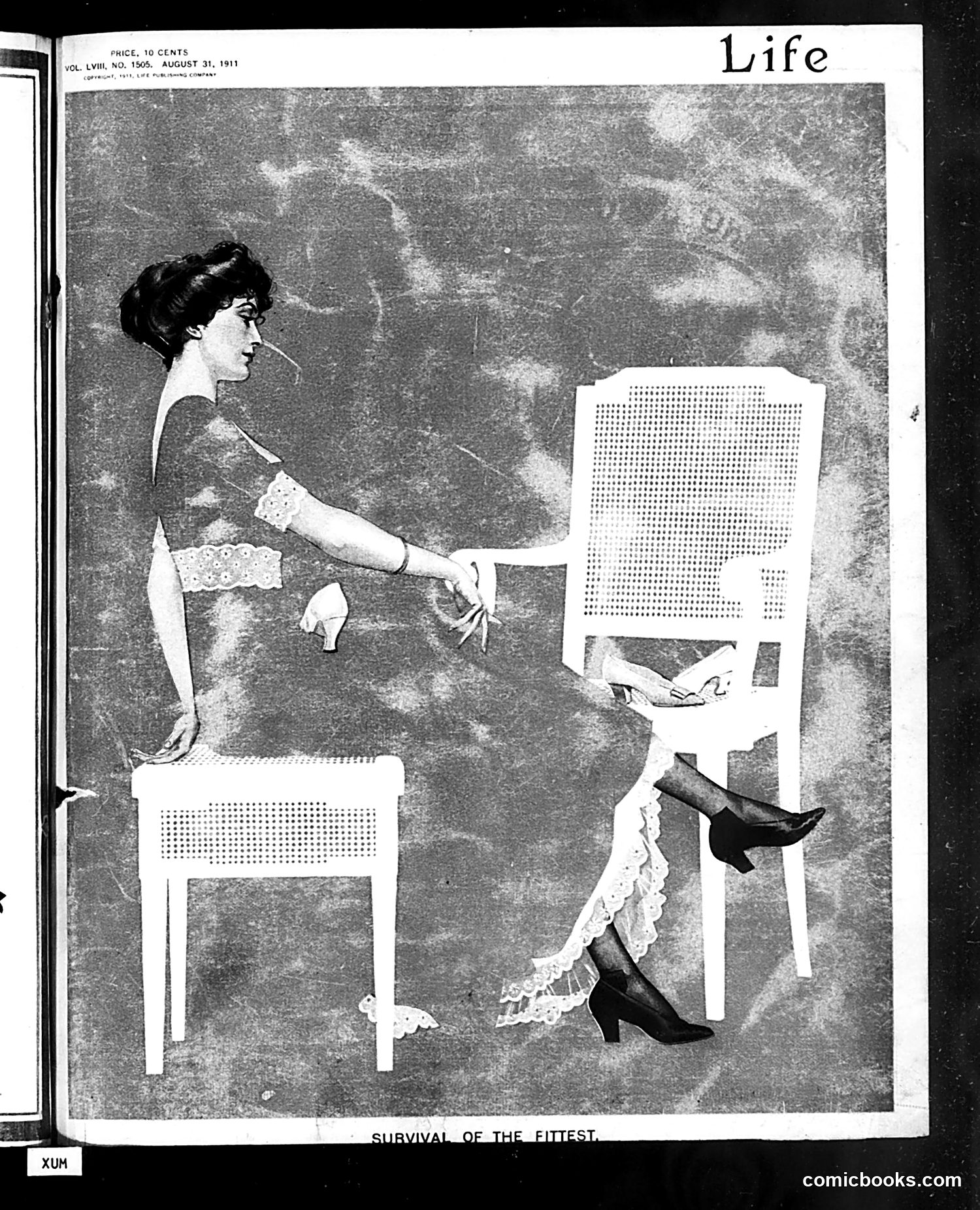
This satirical illustration critiques early 20th-century fashion's impracticality for women. The caption "Survival of the Fittest" invokes Darwin's evolutionary theory ironically: a woman in fashionable attire—including a restrictive corset, long skirt, and elaborate hat—sits beside a man in practical business wear, both at desks. The joke targets how women's constrictive fashion literally handicaps them. Her uncomfortable clothing, designed primarily for appearance rather than function, contrasts sharply with men's utilitarian dress. The satire suggests that in competitive modern society, women are disadvantaged not by nature but by oppressive fashion conventions that inhibit movement and practicality—making "survival" metaphorically difficult for the fashionably-dressed woman.
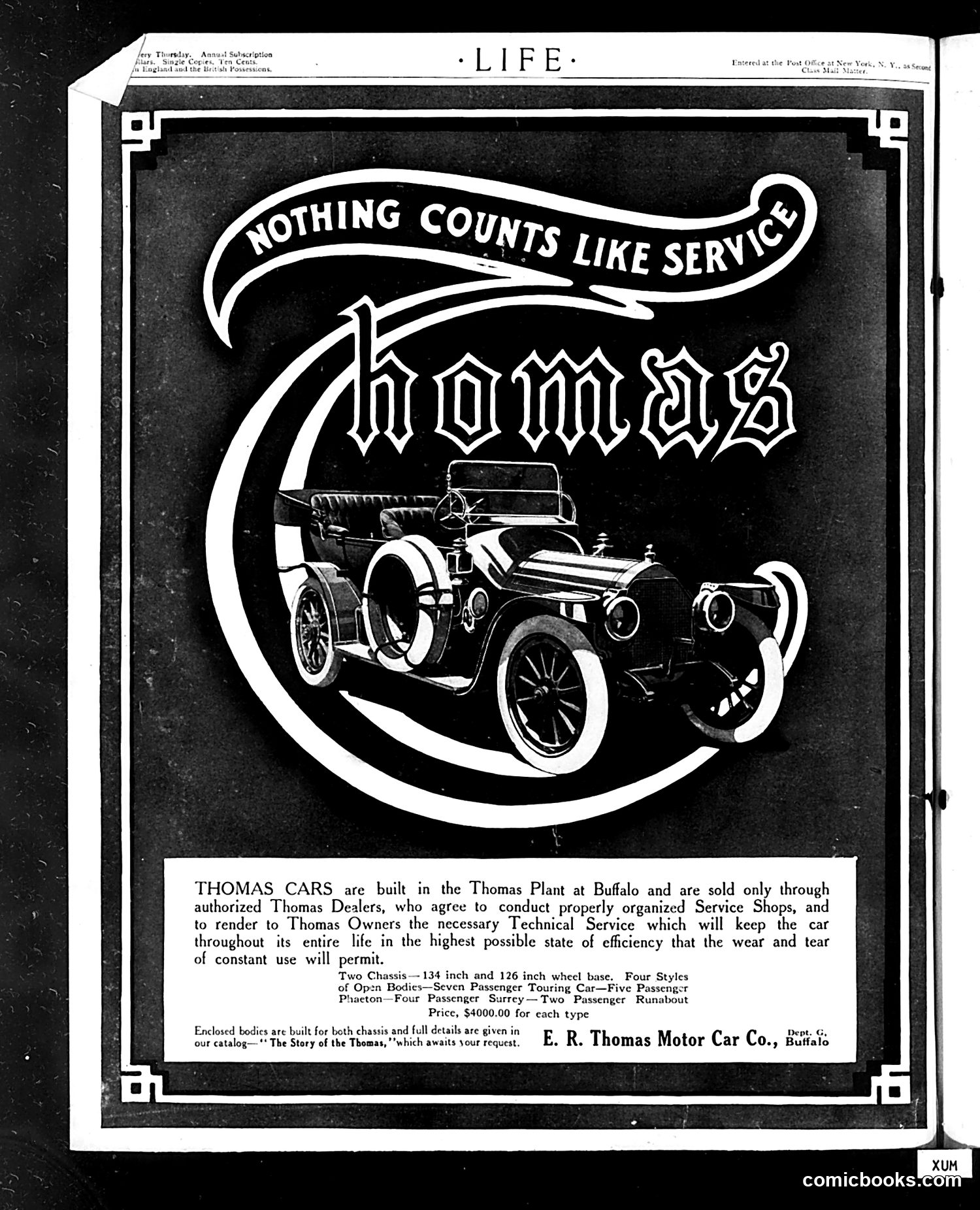
This page is **primarily advertising, not satire or political commentary**. It's a full-page ad for Thomas automobiles, manufactured by the E.R. Thomas Motor Car Company in Buffalo, New York. The ad emphasizes reliable service through authorized dealers, using the slogan "Nothing Counts Like Service." The illustration shows an early 1900s touring car with prominent headlights and large wheels—typical of that era's automotive design. The text highlights Thomas's commitment to maintaining a network of service shops and providing "Technical Service" to keep vehicles operating efficiently. The ad lists various body styles available and notes a standard price of $4,000 per vehicle—substantial money in that period. This represents early automotive-era marketing focused on dealer networks and after-sale service as competitive advantages.
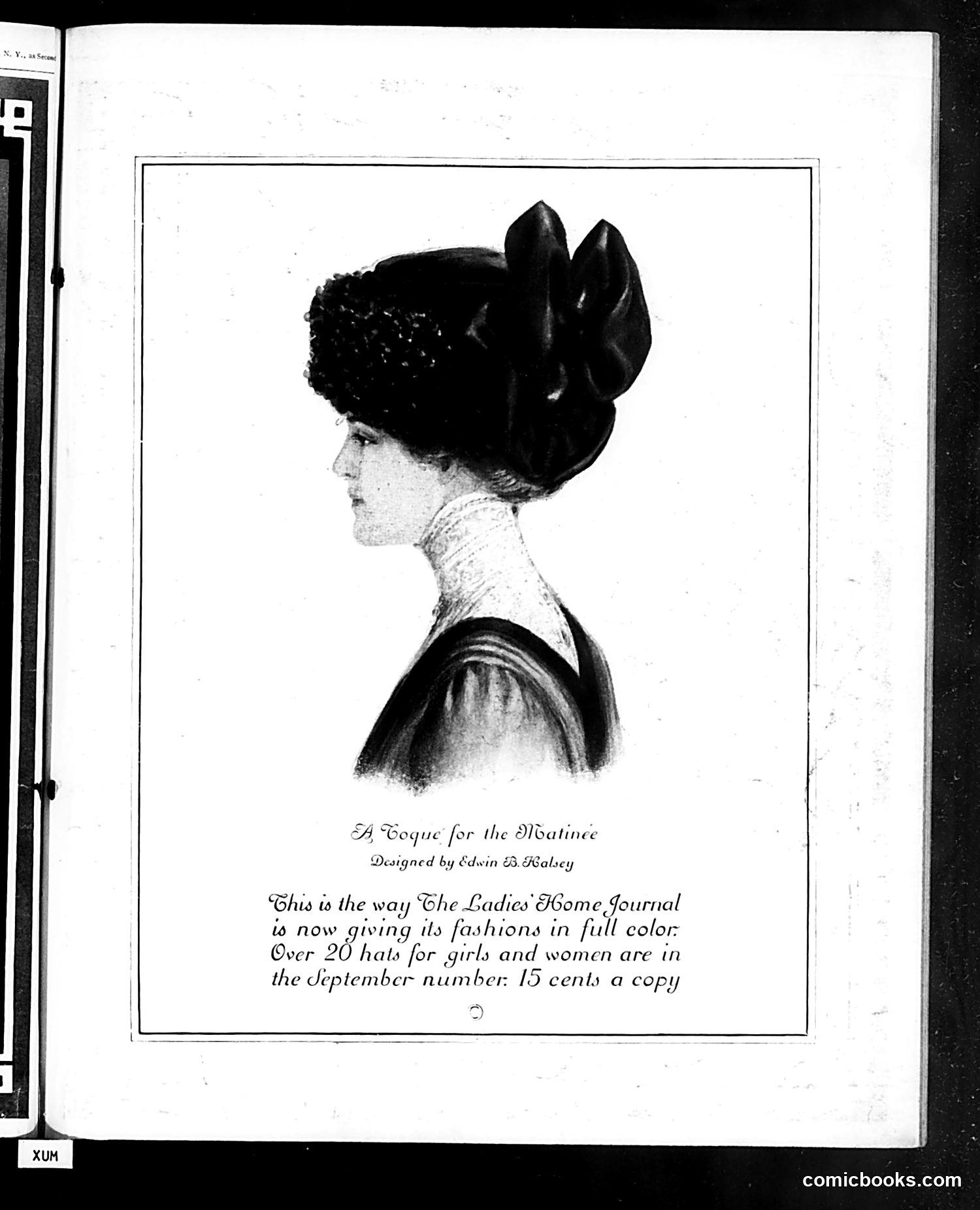
This is primarily a **fashion advertisement** rather than political satire. It depicts an elegant woman's hat design credited to "Edwin B. Rosley," shown in profile with a distinctive black velvet creation featuring two prominent upright plumes or feathers. The text below advertises *The Ladies' Home Journal*, promoting their September issue as featuring "over 20 hats for girls and women...in full color" for 15 cents per copy. The phrase "toque for the matinee" references a fashionable hat style suitable for daytime theater attendance—a common social outing for women of that era. This reflects early 20th-century *Life* magazine's role in showcasing consumer goods and fashion trends to affluent readers, rather than offering satirical commentary.
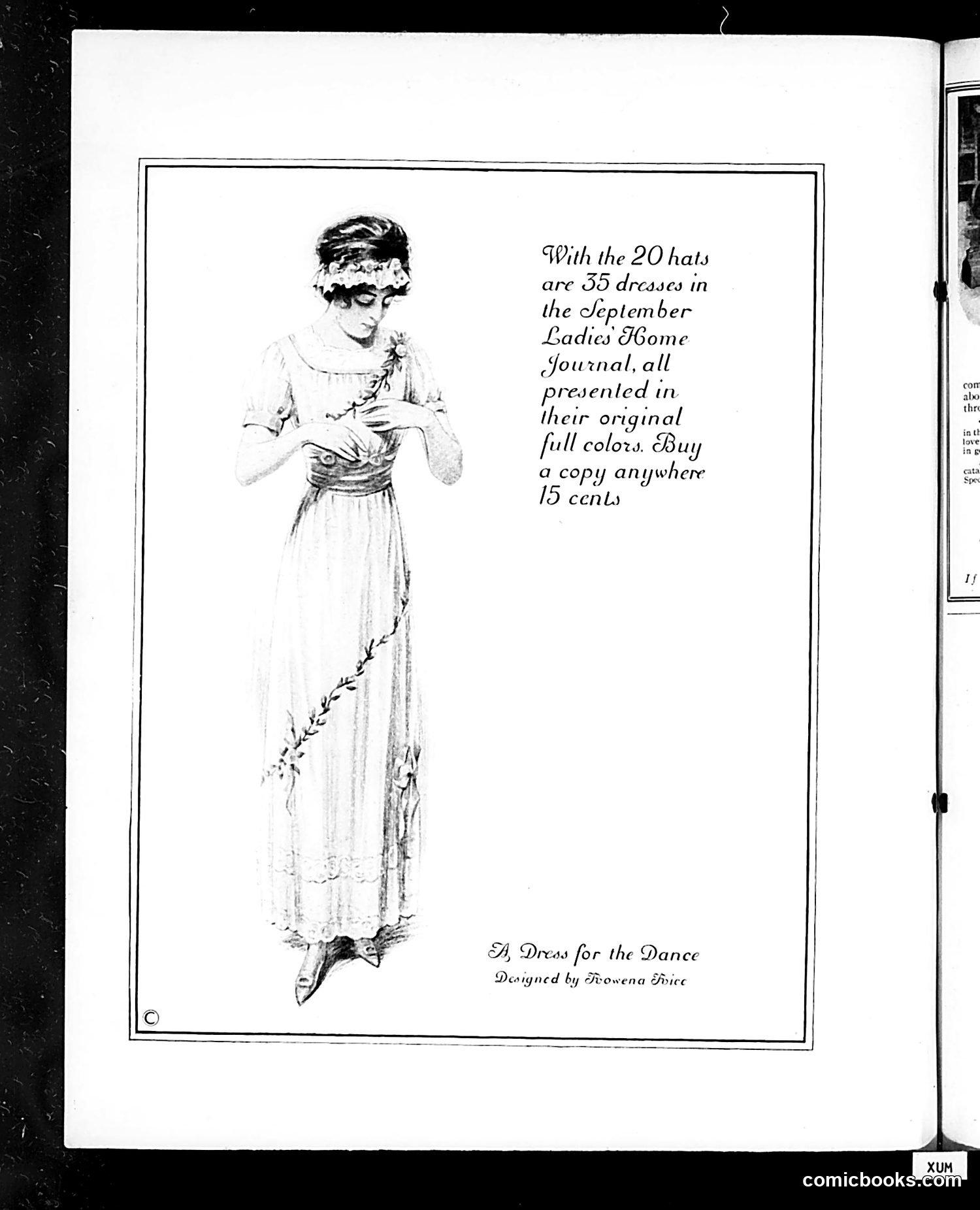
This page is primarily **advertising content**, not political satire or comics. It features an elegant fashion illustration of a woman in an Empire-waist evening gown, advertising "A Dress for the Dance" designed by Rosena Price. The accompanying text promotes the September issue of *Ladies' Home Journal*, highlighting that it contains 20 hats and 35 dresses shown in full color, available for purchase at 15 cents. The illustration exemplifies early 20th-century high fashion aesthetics—the flowing silhouette, decorative details, and refined line work typical of period fashion advertising. There is no political commentary or satirical intent; this is straightforward commercial promotion from *Life* magazine's advertising pages.
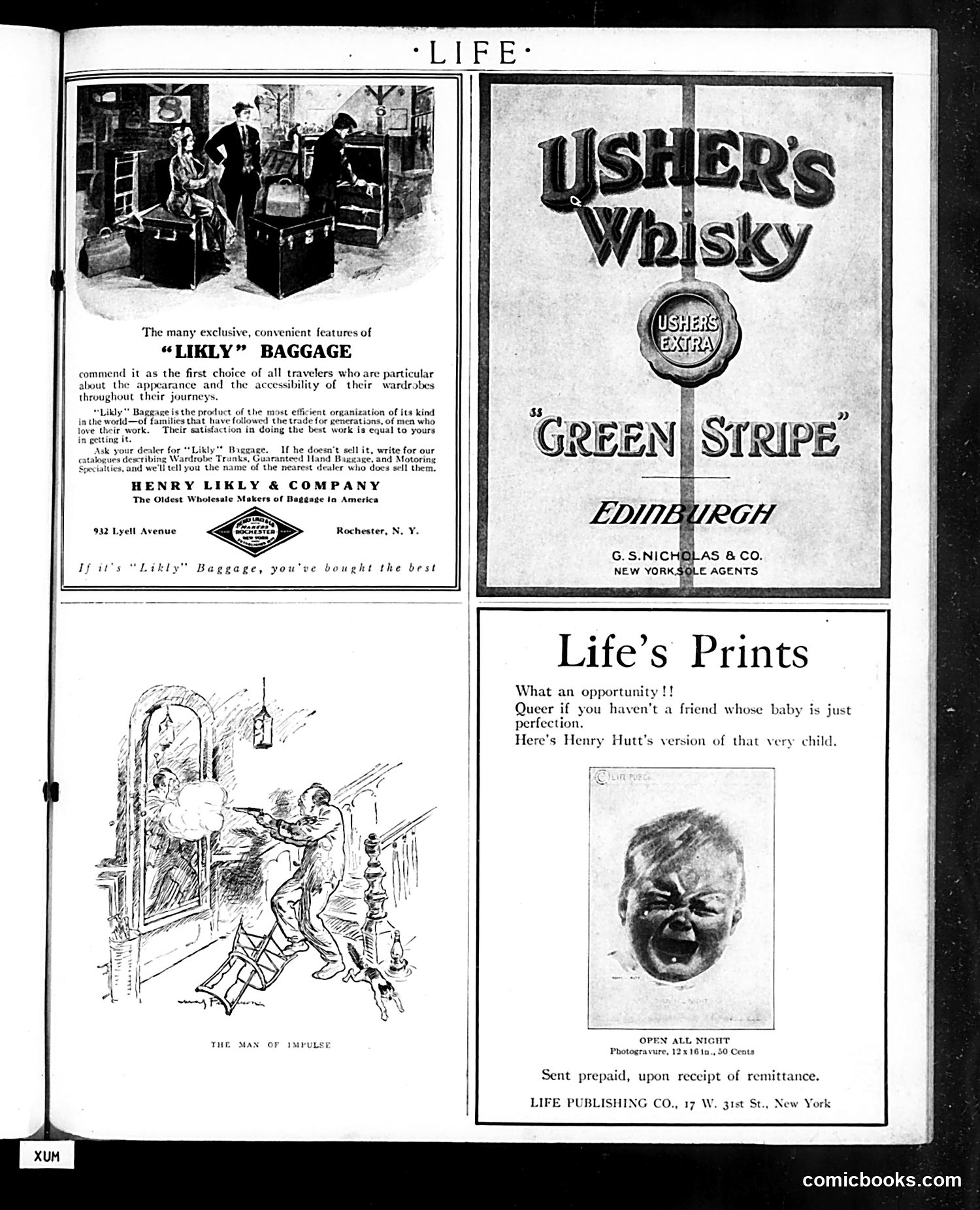
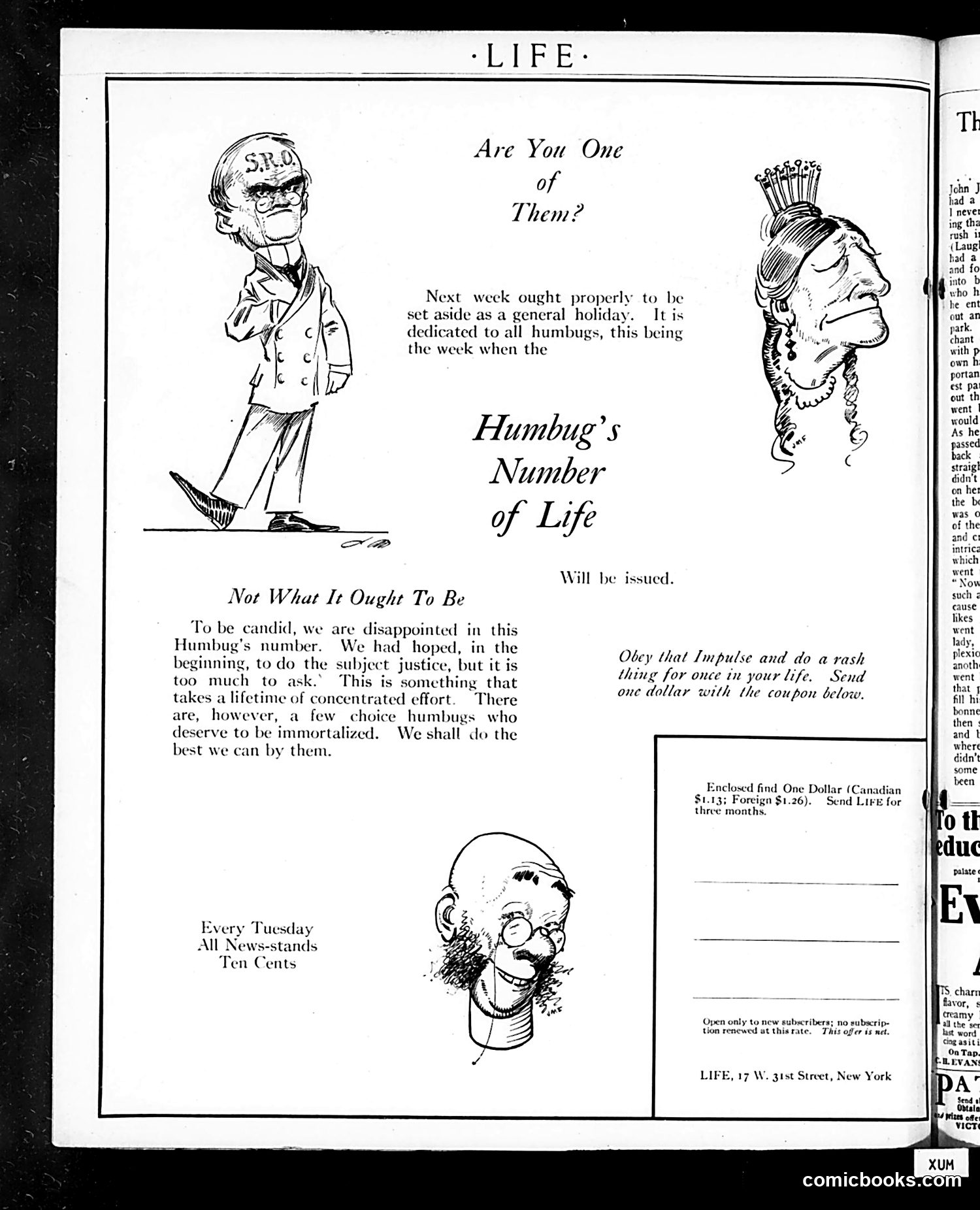
This page from *Life* magazine satirizes "humbug"—pretentious or deceitful people. The heading "Are You One of Them?" invites readers to self-identify with the caricatured figures shown. The left cartoon depicts a man labeled "S.P.D." (initials unclear) marked as "Not What It Ought To Be." The right shows an elaborately dressed woman, suggesting upper-class pretension. The text beneath critiques how certain humbug deserves immortalization, promising to feature such figures in an upcoming issue called "Humbug's Number of Life." The page functions as both satire and advertisement for the magazine's subscription offer (one dollar for three months). The joke invites readers to recognize phoniness in society while encouraging them to subscribe to *Life* for further satirical commentary.
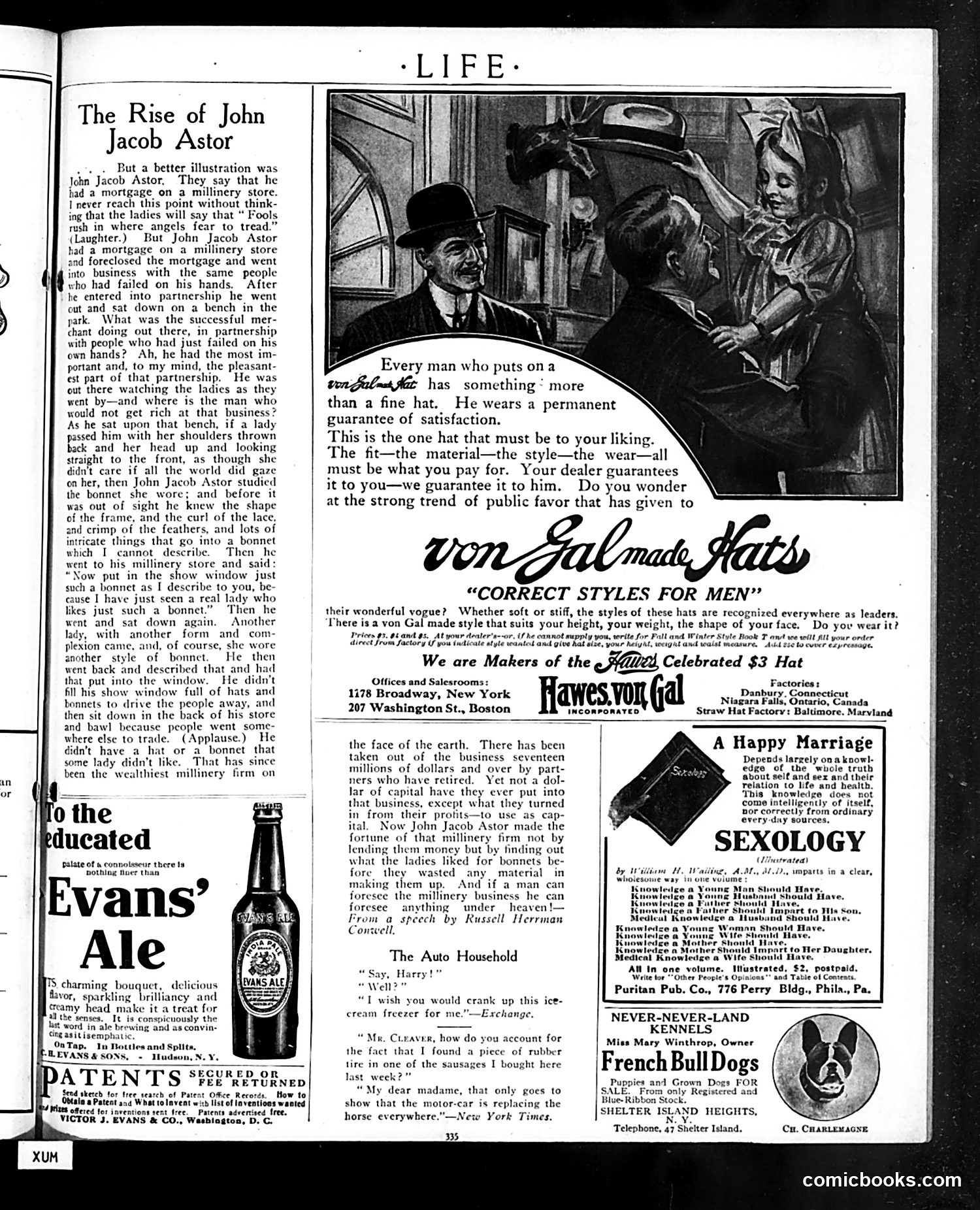
This is primarily an **advertising page**, not satirical content. The page features multiple ads rather than political cartoons. The main article, "The Rise of John Jacob Astor," discusses a wealthy businessman who succeeded by understanding customer needs—a business success story rather than satire. The dominant advertisement is for **Von Galmade Hats** ("Correct Styles for Men"), featuring an illustration of a man trying on hats at a millinery store. The ad emphasizes personalized fitting and quality. Other advertisements include Evans' Ale, a patent medicine for hay fever, a book called "Sexology," the Never-Never-Land Kennels (French Bulldogs), and "The Auto Household" advice column about ice-cream freezers and motor-cars. This represents typical early 20th-century *Life* magazine content: commercial advertising mixed with lifestyle articles.
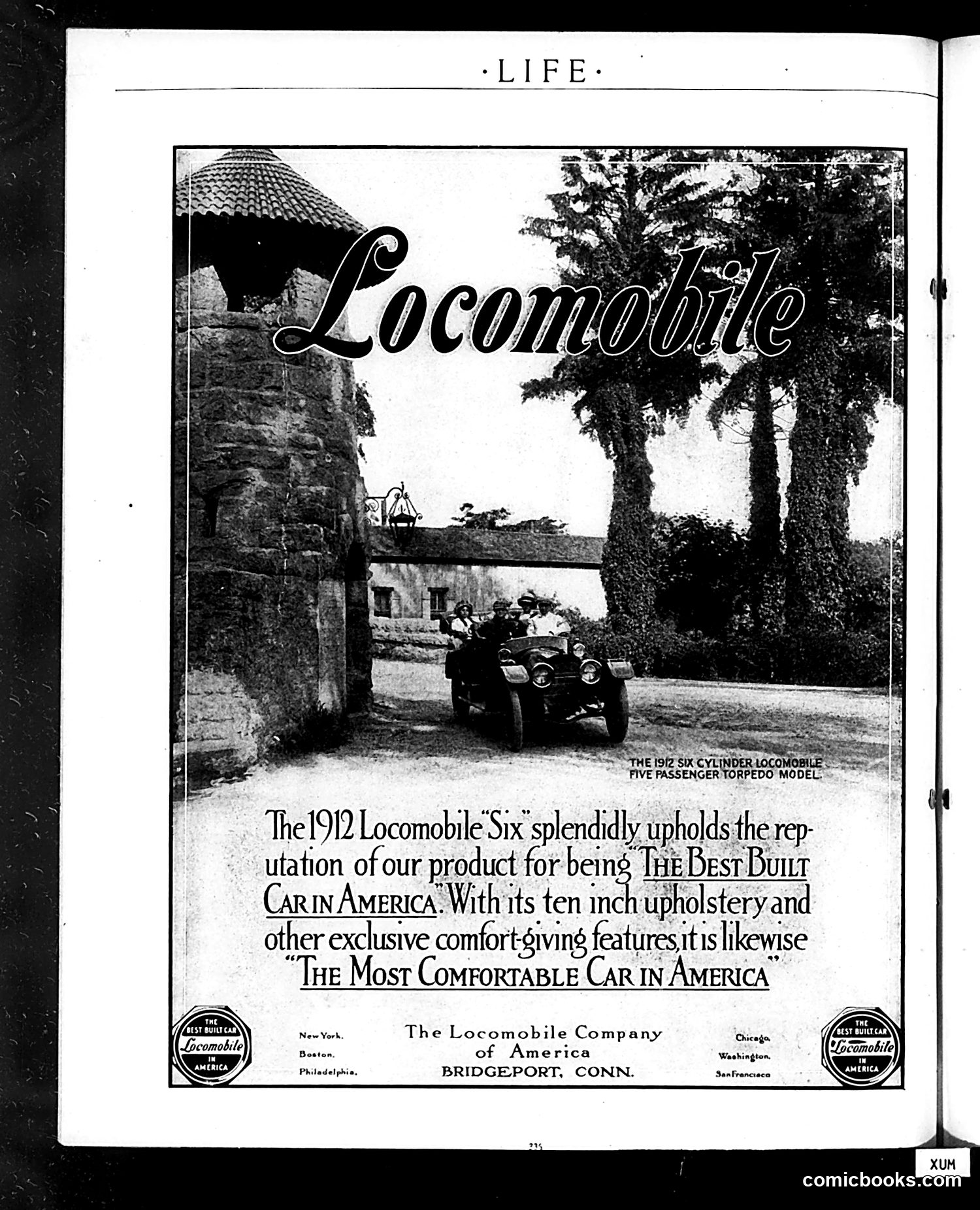
This is **not a cartoon or satirical content** — it's a straightforward **advertisement** for the 1912 Locomobile automobile, published in *Life* magazine. The page shows a photograph of a luxury car posed beneath an ivy-covered stone structure (possibly a castle or historic building), emphasizing the vehicle's elegance and prestige. The ad claims the Locomobile is "**The Best Built Car in America**" and "**The Most Comfortable Car in America**," highlighting its ten-inch upholstery and comfort features as selling points to wealthy consumers. The Locomobile Company of America, based in Bridgeport, Connecticut, uses *Life*'s prominent advertising space to target the magazine's affluent readership. This represents early 20th-century automotive marketing aimed at establishing brand prestige among the upper class.
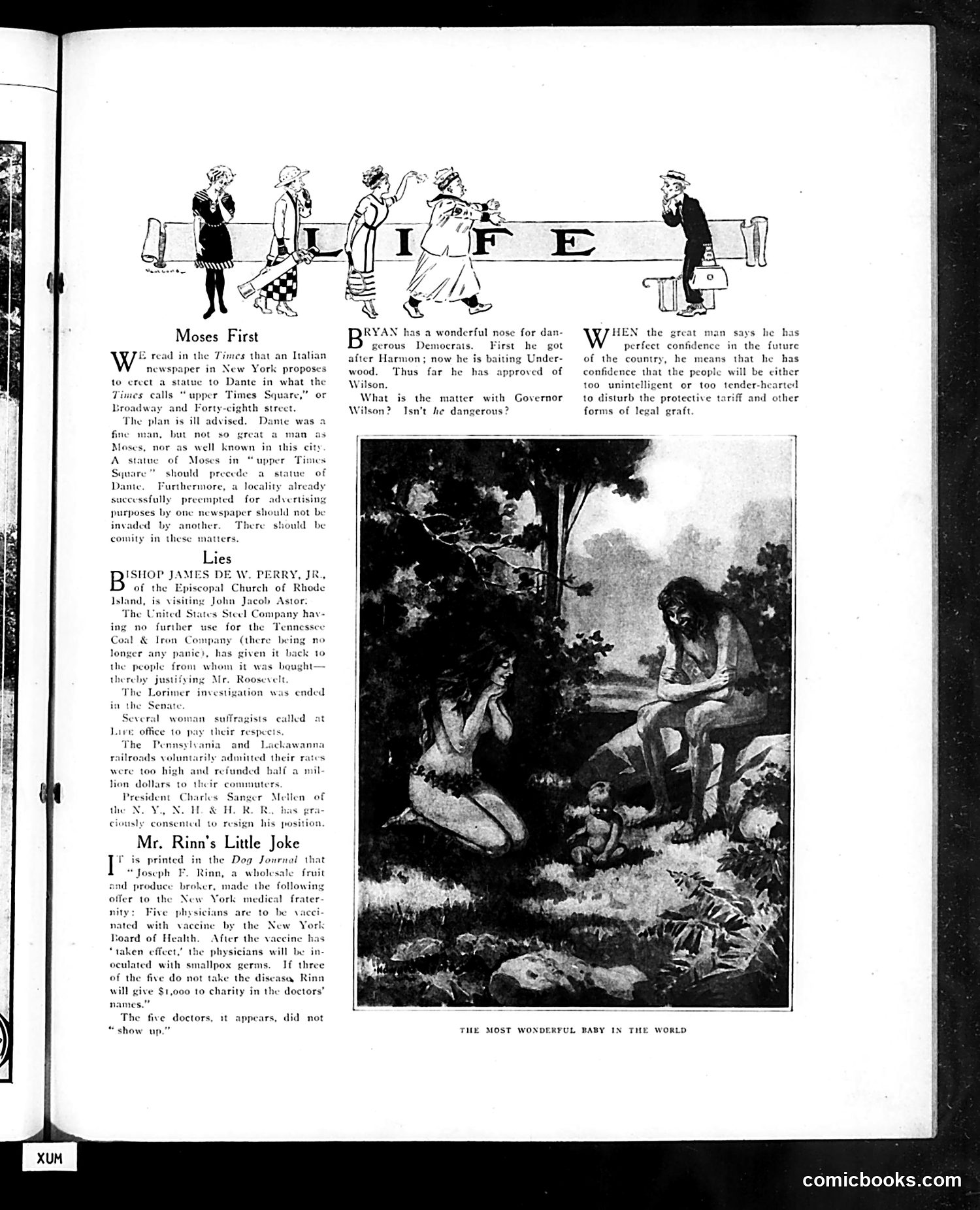
The top illustration shows figures walking across a tightrope labeled "LIFE," satirizing political balance. The page contains three opinion pieces: **"Moses First"** critiques a proposal to name a statue of Moses after Dante, arguing against one newspaper monopolizing advertising under the guise of civic monument-naming. **"Lies"** attacks Bishop James De W. Perry Jr. for misrepresenting the Tennessee Coal & Iron Company's justification when giving back seized property—a reference to Roosevelt's controversial 1907 acquisition during the panic. **"Mr. Rinn's Little Joke"** mocks a fruit broker's cynical offer to the medical fraternity: five physicians vaccinated with smallpox germs will receive $1,000 if they don't contract the disease—satirizing both medical ethics and mercenary practices. The photograph shows "The Most Wonderful Baby in the World."
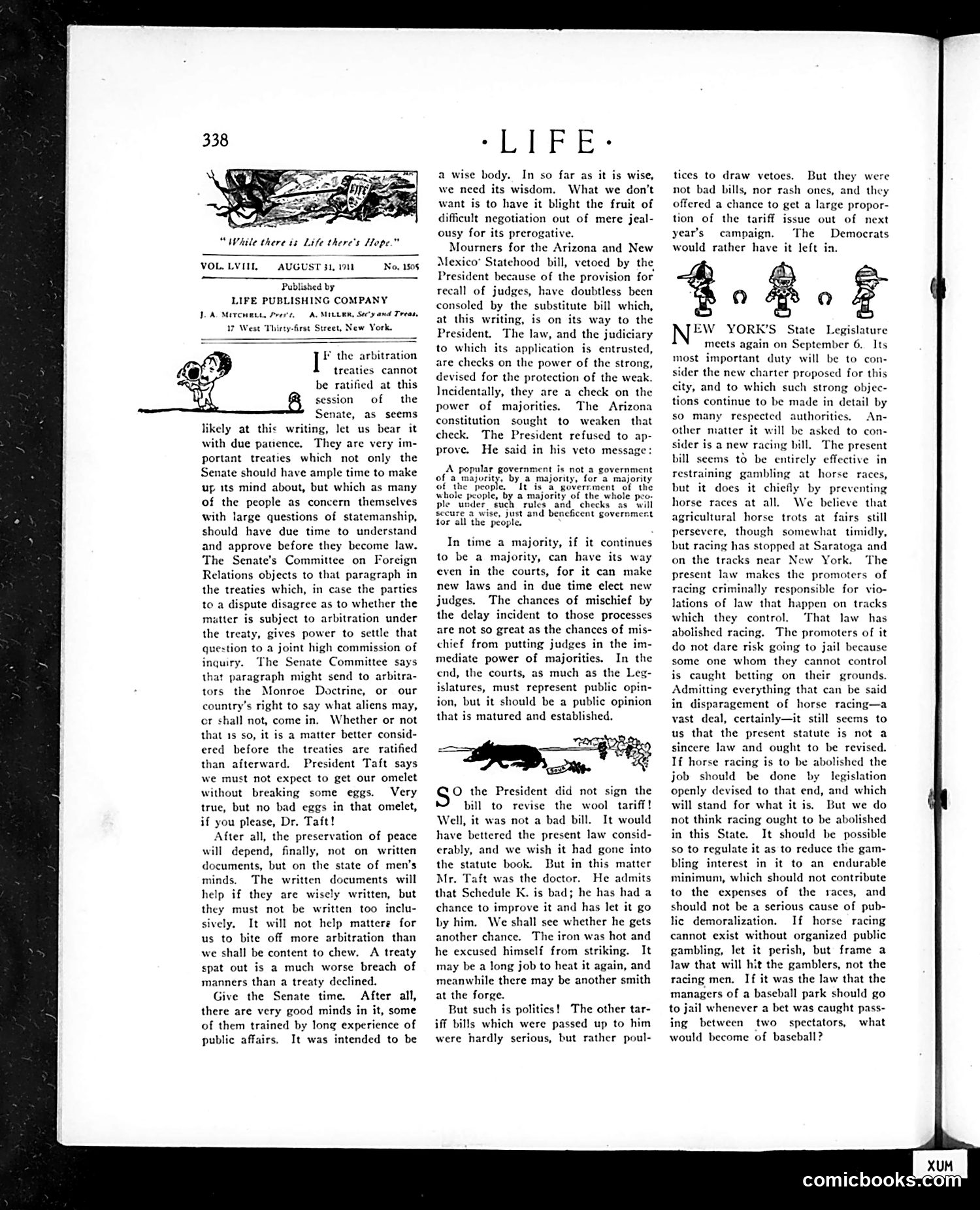
This editorial page discusses President Taft's veto of an Arizona statehood bill and debates about horse-racing regulation in New York. **The cartoon** (top left) shows a small figure labeled "While there is Life there's Hope," appearing to reference optimism despite political setbacks. **Key political content:** The editorial critiques Taft for rejecting Arizona's statehood due to concerns about judicial recall provisions, arguing the President overstepped by vetoing a bill aimed at protecting citizens' power. The text presents this as Taft being overly cautious about constitutional checks on executive power. **Secondary topic:** The page also discusses efforts to regulate or abolish horse-racing gambling in New York, framing it as a public morality issue requiring legislative action rather than track-owner self-regulation. The tone is skeptical of both Taft's constitutional conservatism and industry self-policing.
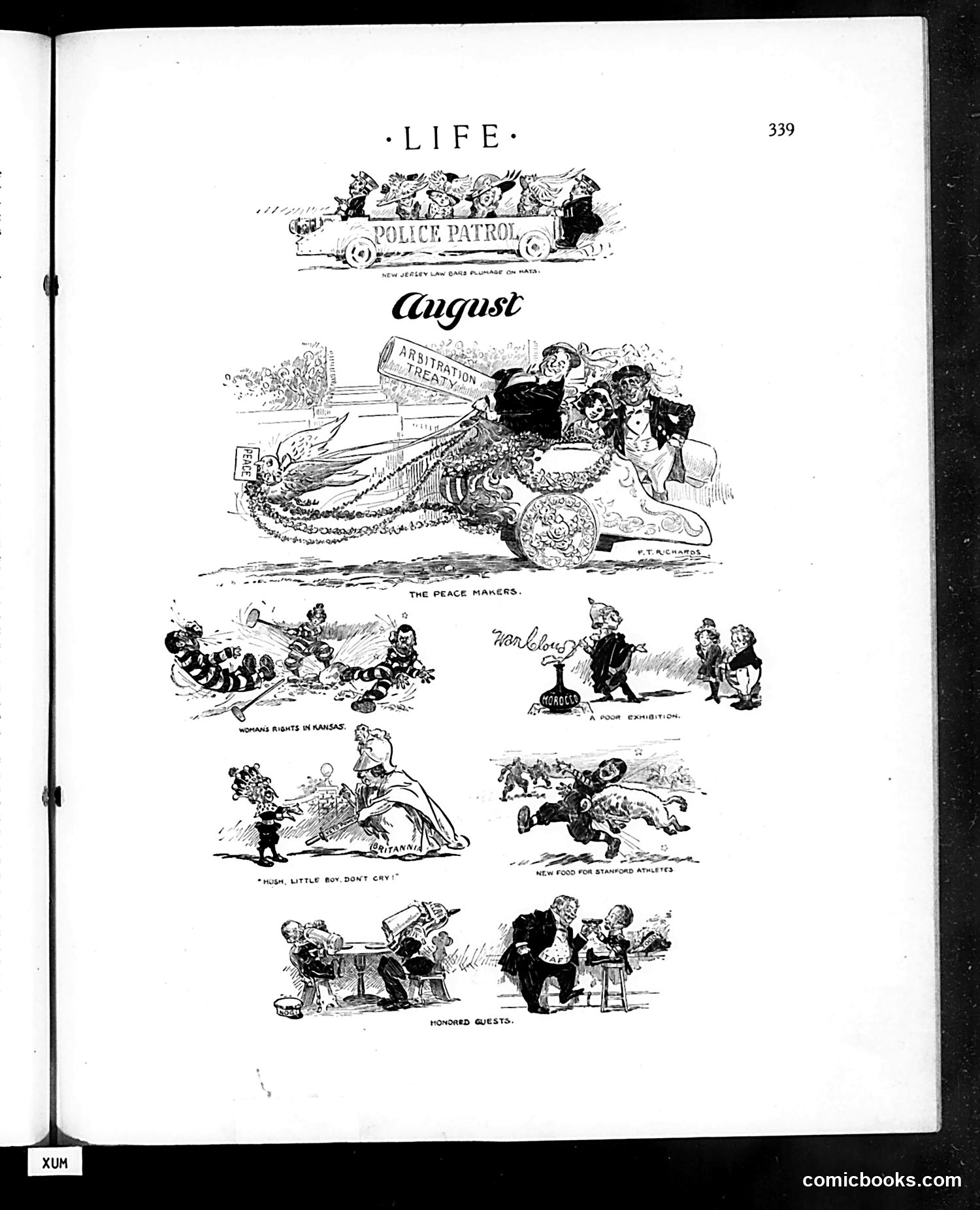
This satirical page from *Life* magazine presents multiple cartoons commenting on August 1919 events. The dominant image, "The Peace Makers," depicts figures riding in a chariot labeled "Arbitration Treaty"—likely referring to post-World War I peace negotiations and the League of Nations debate. Other cartoons address contemporary issues: - "Women Rights in Kansas" - "High, Little Boy, Don't Cry" (appears domestic/social commentary) - "A Poor Exhibition" - "New Food for Stanford Athletes" - "Honored Guests" The cartoons use exaggerated caricature and visual metaphor typical of *Life*'s satirical style. Without clearer context on specific figures or events, the exact political targets remain difficult to specify with certainty, though the content reflects post-war American social and political debates of the period.
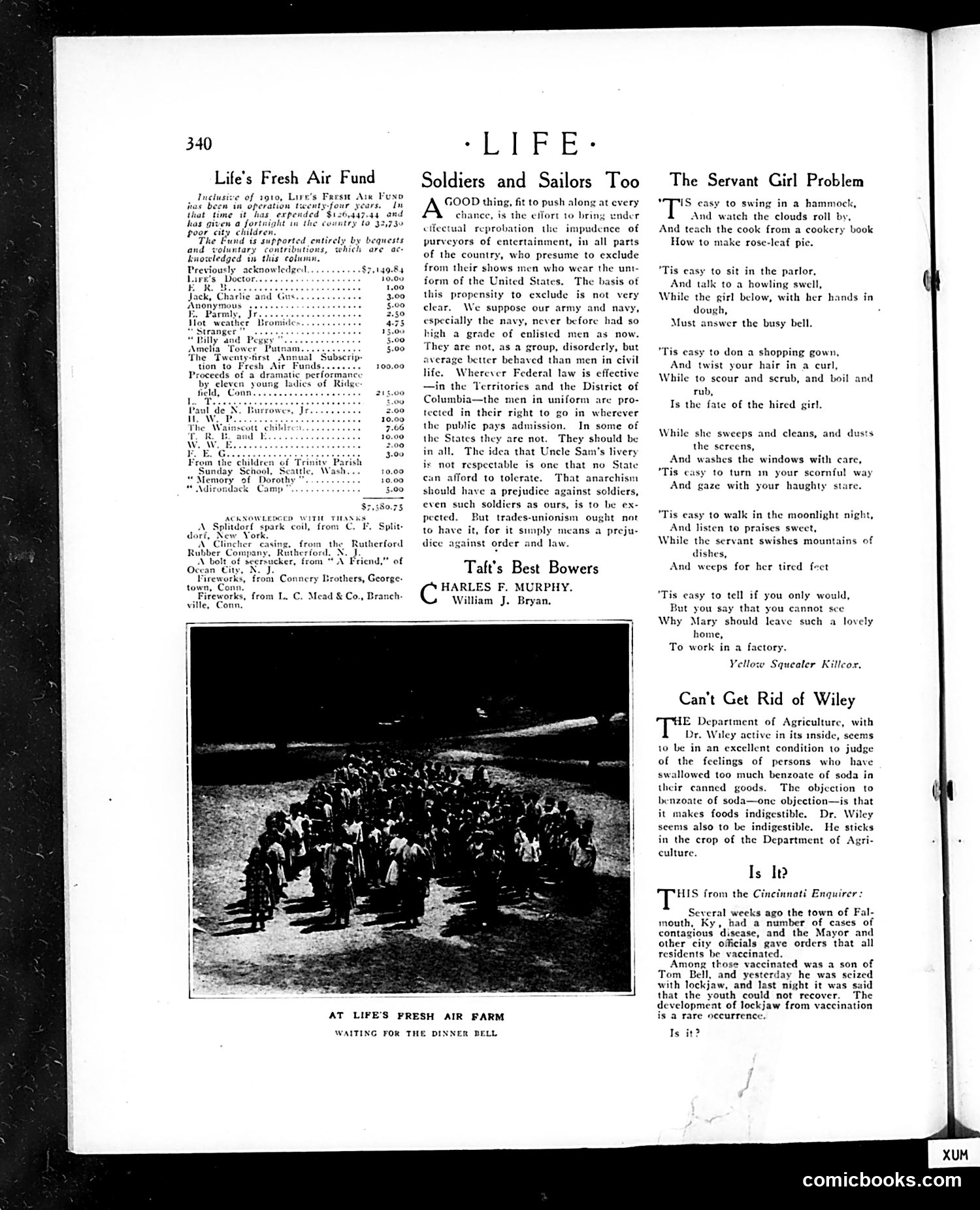
This page contains three distinct articles with commentary on contemporary issues: 1. **"Soldiers and Sailors Too"** argues that military personnel should have access to public entertainment venues without discrimination—a surprisingly progressive stance for the era. 2. **"The Servant Girl Problem"** presents satirical poetry about the difficulties of domestic service work, mocking both the servant's limited opportunities and the employers' unrealistic expectations. The poem suggests servant girls had few options beyond factory work. 3. **"Can't Get Rid of Wiley"** critiques Dr. Wiley of the Department of Agriculture, apparently suggesting he's stubbornly resistant to removing benzoate of soda as a food additive despite health concerns. The photograph shows "Life's Fresh Air Farm"—a charitable enterprise providing outdoor recreation for urban residents.
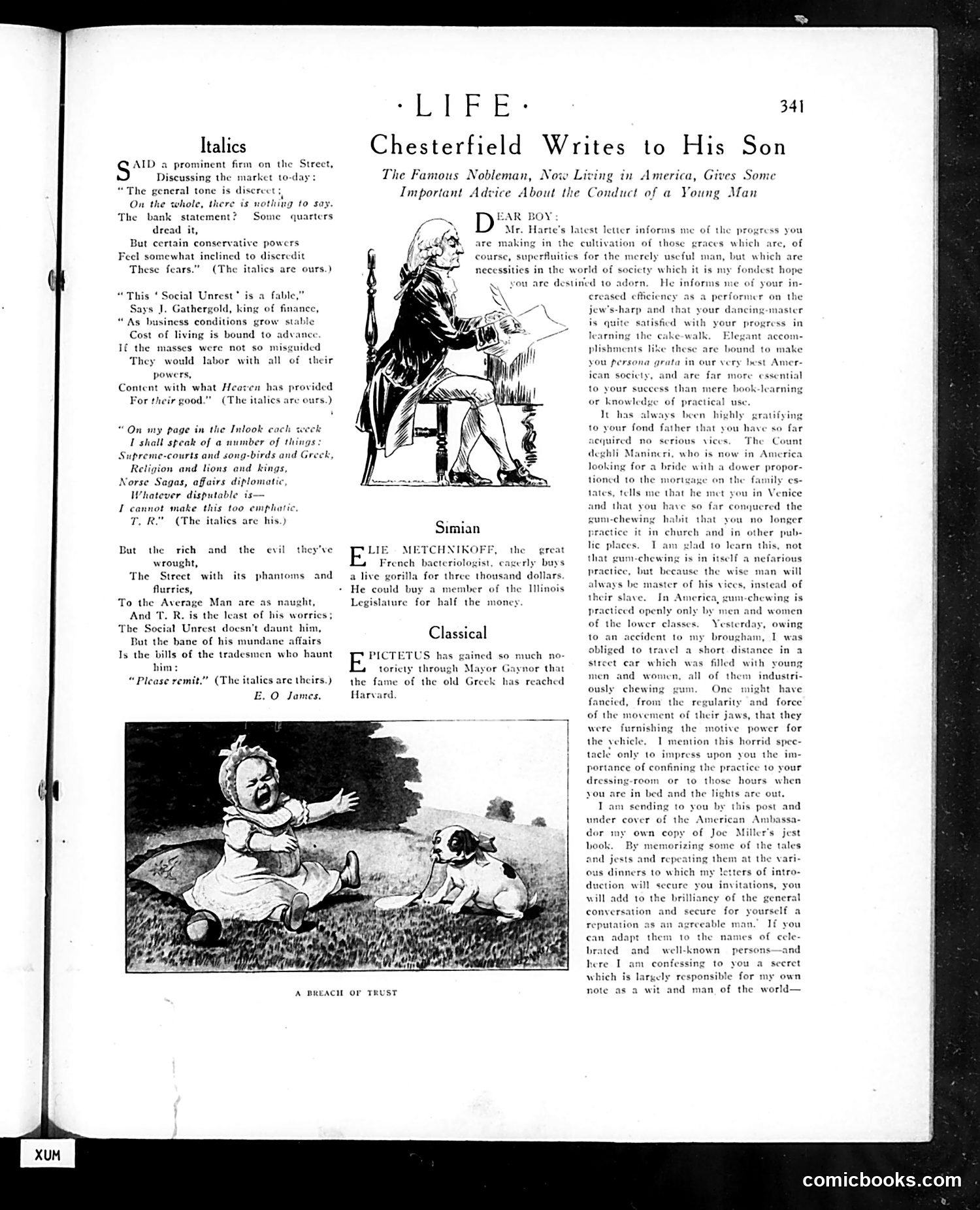
This cartoon depicts a child and dog in a natural setting, illustrating the concept of broken trust suggested by the caption. The image appears to be social commentary on betrayal or broken promises, though the specific historical reference is unclear from the visual alone. The page also contains sections titled "Italics," "Simian," and "Classical"—typical Life magazine departments featuring satirical commentary. The main article, "Chesterfield Writes to His Son," presents advice about conduct for young men in American society, reflecting early 20th-century concerns about propriety and social behavior among the upper classes. Without additional context about the publication date, the specific "breach of trust" referenced remains ambiguous.
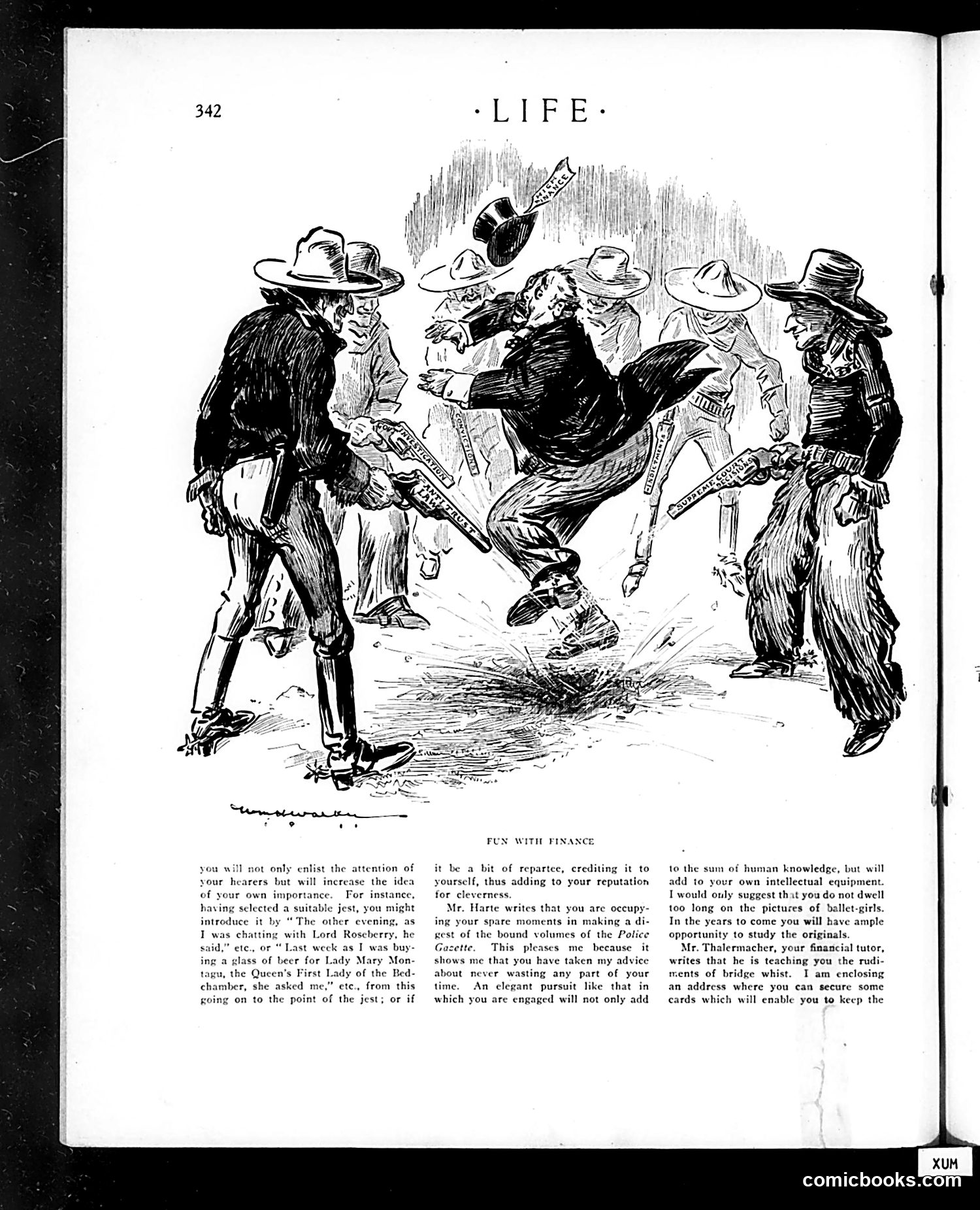
This satirical cartoon depicts a group of men in Western attire (cowboys/frontier figures) engaged in what appears to be a chaotic financial transaction or deal. The central figure is being lifted or thrown in the air, suggesting upheaval or loss of control. The accompanying text discusses financial matters, reputation, and the importance of time management in business pursuits. It references "Mr. Harte" and mentions the "Police Gazette," suggesting this critiques financial practices or speculation of the era. The satire appears to mock the volatile, unpredictable nature of financial dealings in early American business culture—depicting finance as a wild, uncontrolled affair where participants lose their footing, literally and figuratively. The Western setting may suggest frontier capitalism or "Wild West" business practices.
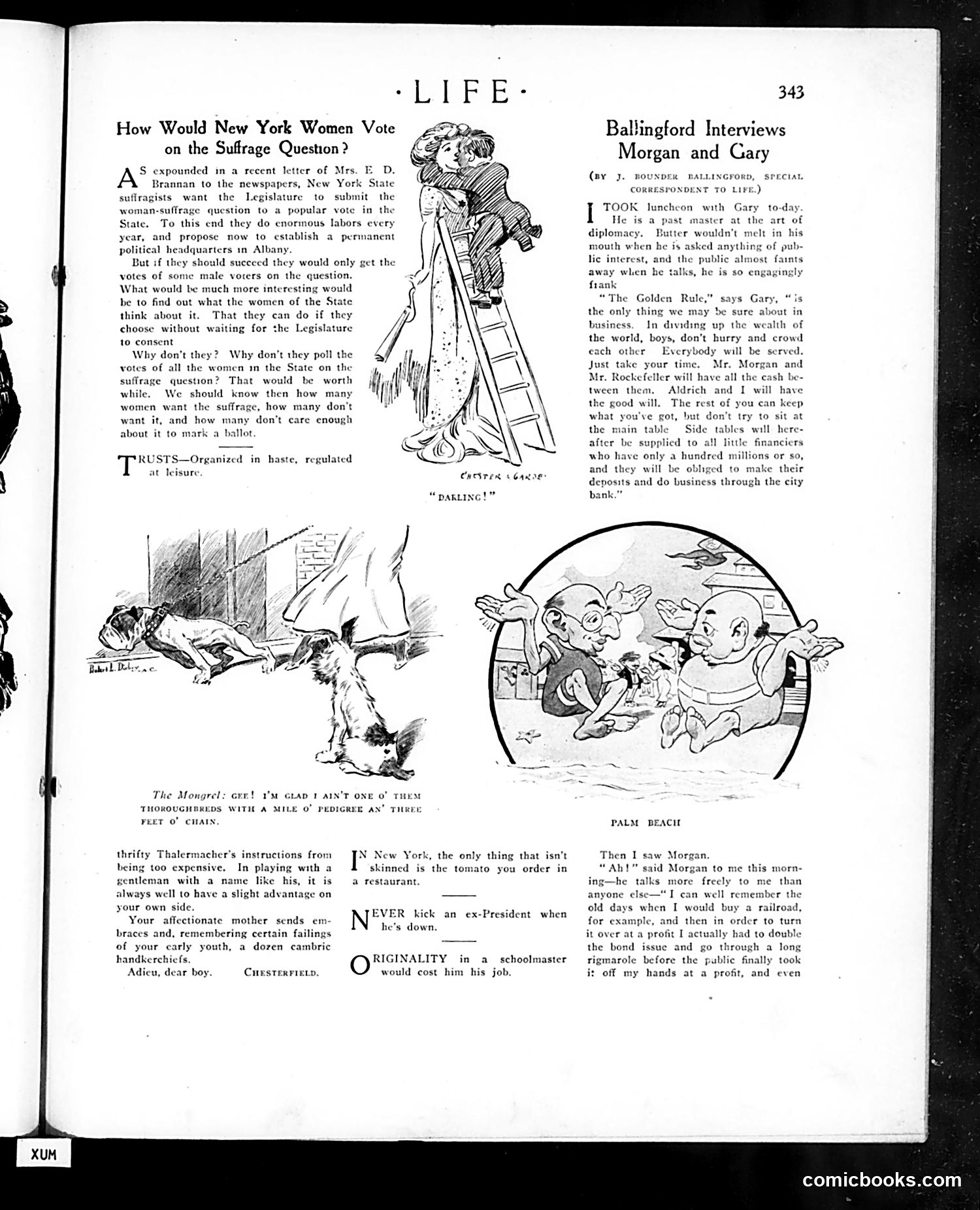
This page satirizes the women's suffrage debate in New York State. The left article mocks suffragists' strategy: rather than petition the Legislature for a popular vote, the piece suggests they should simply poll women directly to determine actual support—implying their confidence may be unfounded. The cartoon above shows a woman climbing a ladder toward a ballot box, labeled "Paling!"—visual commentary on women's difficult struggle for voting rights. The "Mongrel" cartoon below uses a chained dog to likely mock class pretensions, contrasting thoroughbreds with common stock. On the right, the "Ballingford Interviews" section presents satirical dialogue with wealthy industrialists (Morgan and Gary, clearly J.P. Morgan and likely steel magnate Gary). Gary's sanctimonious claims about the "Golden Rule" while acknowledging Morgan and Rockefeller monopolize wealth is biting satire—exposing the hypocrisy of robber barons preaching fairness while hoarding resources.
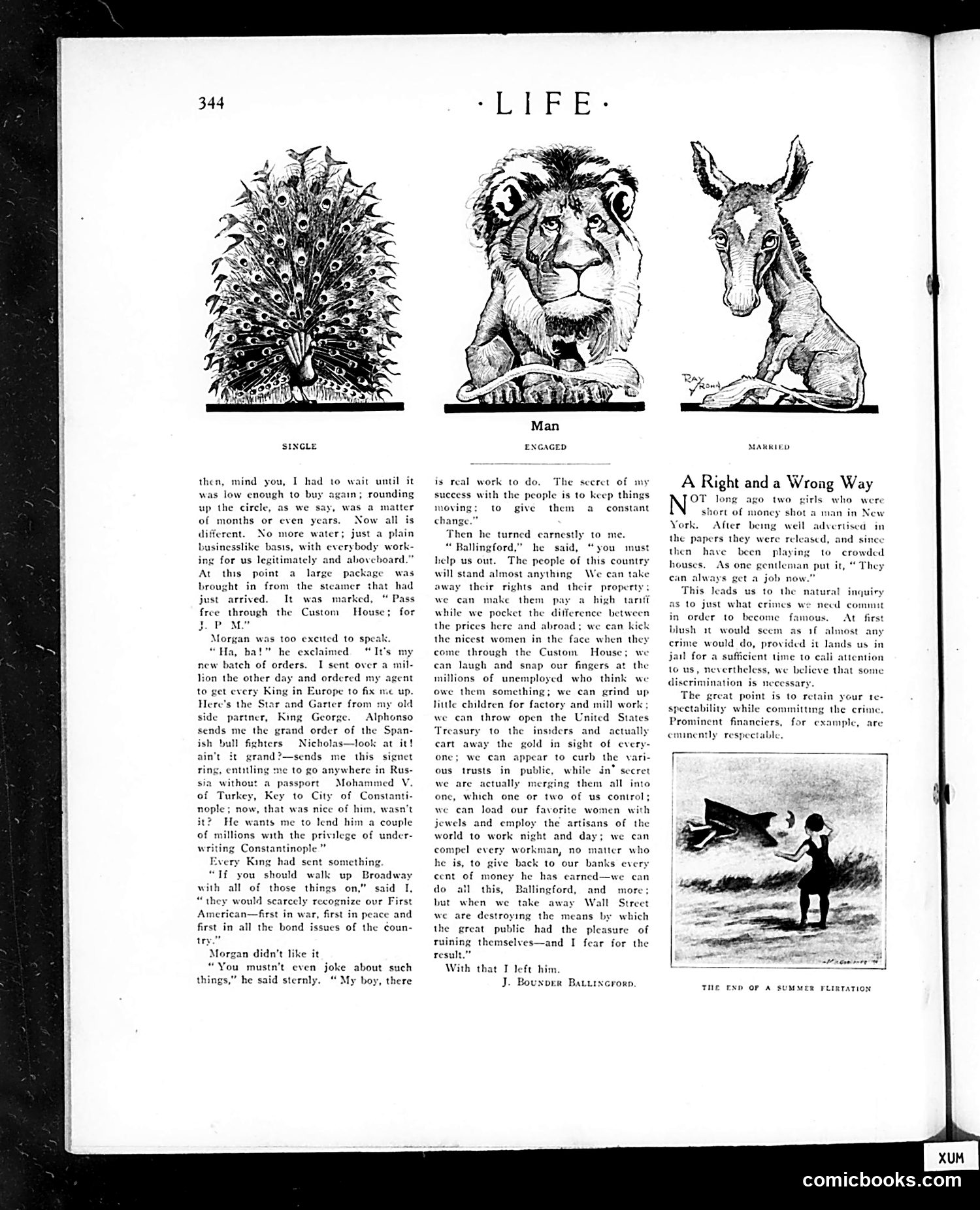
This page satirizes the unchecked power of wealthy industrialists, particularly **J.P. Morgan** (the "Morgan" referenced). The three illustrated heads represent different life stages of a wealthy man—single, engaged, married—mimicking a common satirical format. The main text depicts a fictional tycoon bragging to his associate "Ballingford" about collecting honors (orders, signet rings, titles) from European monarchs as casually as business transactions. More pointedly, the character explicitly catalogs the abuses the wealthy can commit with impunity: exploiting workers, manipulating tariffs, controlling trusts, even physically assaulting ordinary people—while the public tolerates it because they're distracted by spectacle and "kept moving." The accompanying article "A Right and a Wrong Way" continues the critique: two women who committed murder for money received fame and theater engagements, while the wealthy can commit far worse crimes yet remain respectable—the joke being that financial power grants immunity ordinary criminals lack. The satire targets **plutocracy, corruption, and the moral bankruptcy of unregulated capitalism**.
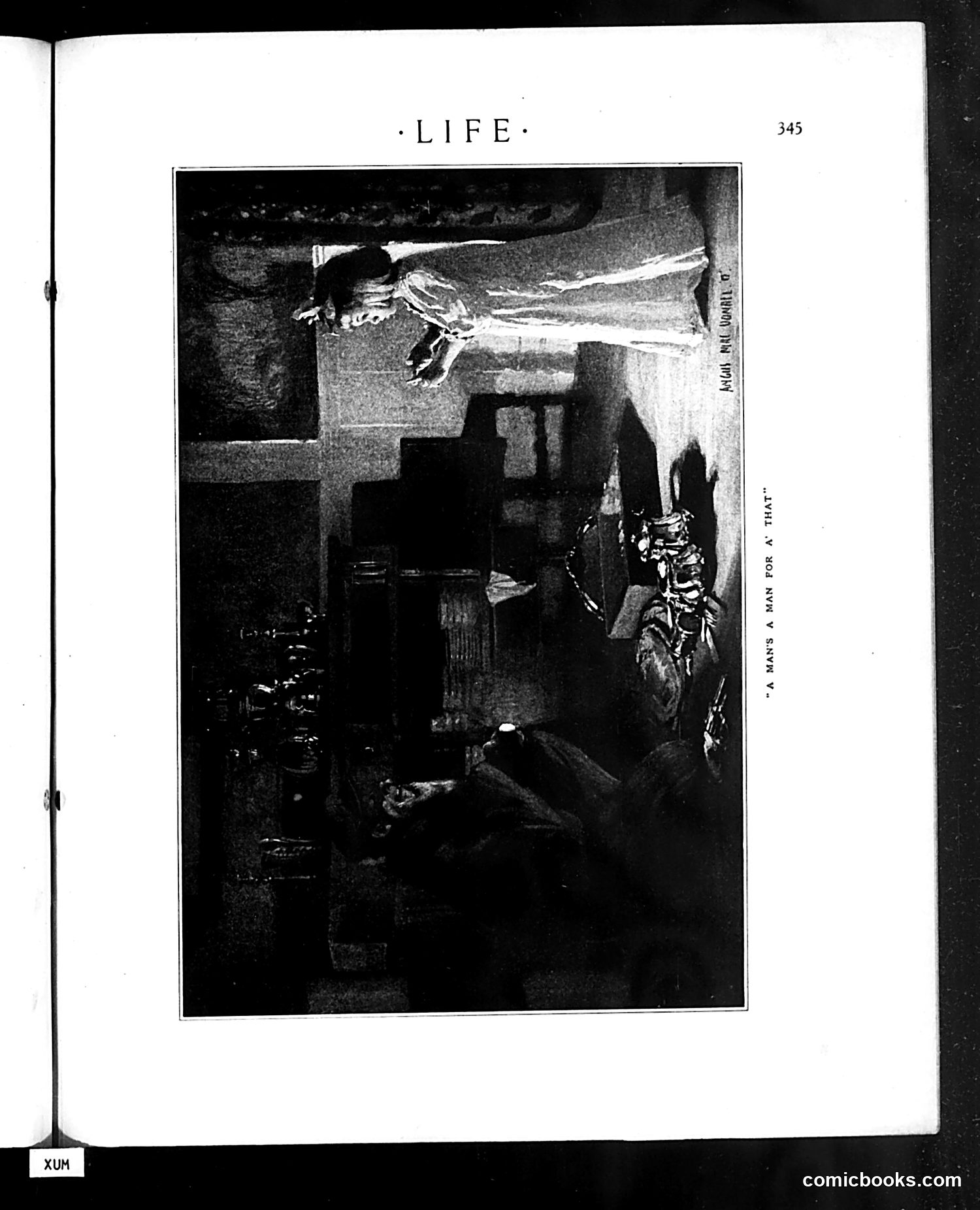
This page from *Life* magazine (page 345) contains a single black and white photograph or illustration that appears to be rotated 90 degrees. The image shows what seems to be an interior domestic scene with figures and furniture, though the rotation and image quality make specific details difficult to discern clearly. The caption text, when rotated correctly, reads "A MAN FOR A MART" (or similar), suggesting this is likely satirical commentary on consumer culture or commercial relationships—common themes in early-to-mid 20th century *Life* magazine satire. Without clearer visibility of specific figures or more legible text, I cannot confidently identify particular individuals or political references. The satirical intent appears social rather than purely political.
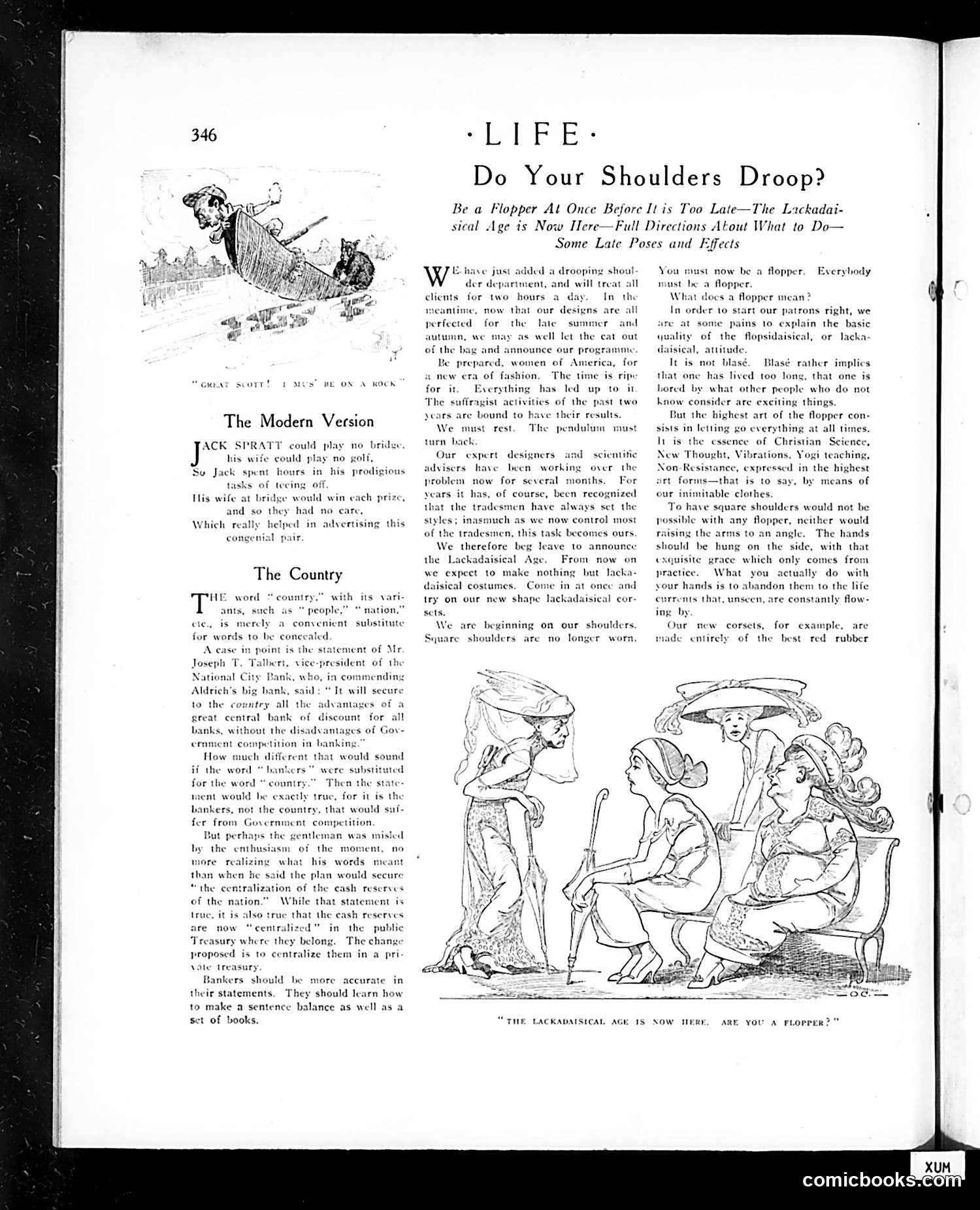
This page satirizes two distinct social trends of the Jazz Age (appears to be 1920s based on references): **"Do Your Shoulders Droop?" (Main Article):** The headline mocks the sudden fashion obsession with "floppers"—young women rejecting Victorian posture. The text ironically frames drooping shoulders as a new cult, combining references to spiritual movements (Christian Science, Yoga, "Non-Resistance") with shallow fashion advice. The satirical point: women are abandoning practical posture for fashionable slouching, following designers' dictates rather than health. The cartoon illustration shows women adopting exaggerated drooping poses, emphasizing the absurdity. **"The Country" (Left Column):** This critiques banker Joseph T. (likely referring to Joseph Seligman or similar banking figures) who justified centralized banking by claiming it served "the country," when actually it served bankers' private interests. The satire exposes the linguistic sleight-of-hand: substituting "the bankers' estates" for "the country" reveals the true beneficiary. This likely references debates over the Federal Reserve System or similar centralized banking proposals. Both pieces mock fashionable conformity and deceptive rhetoric.
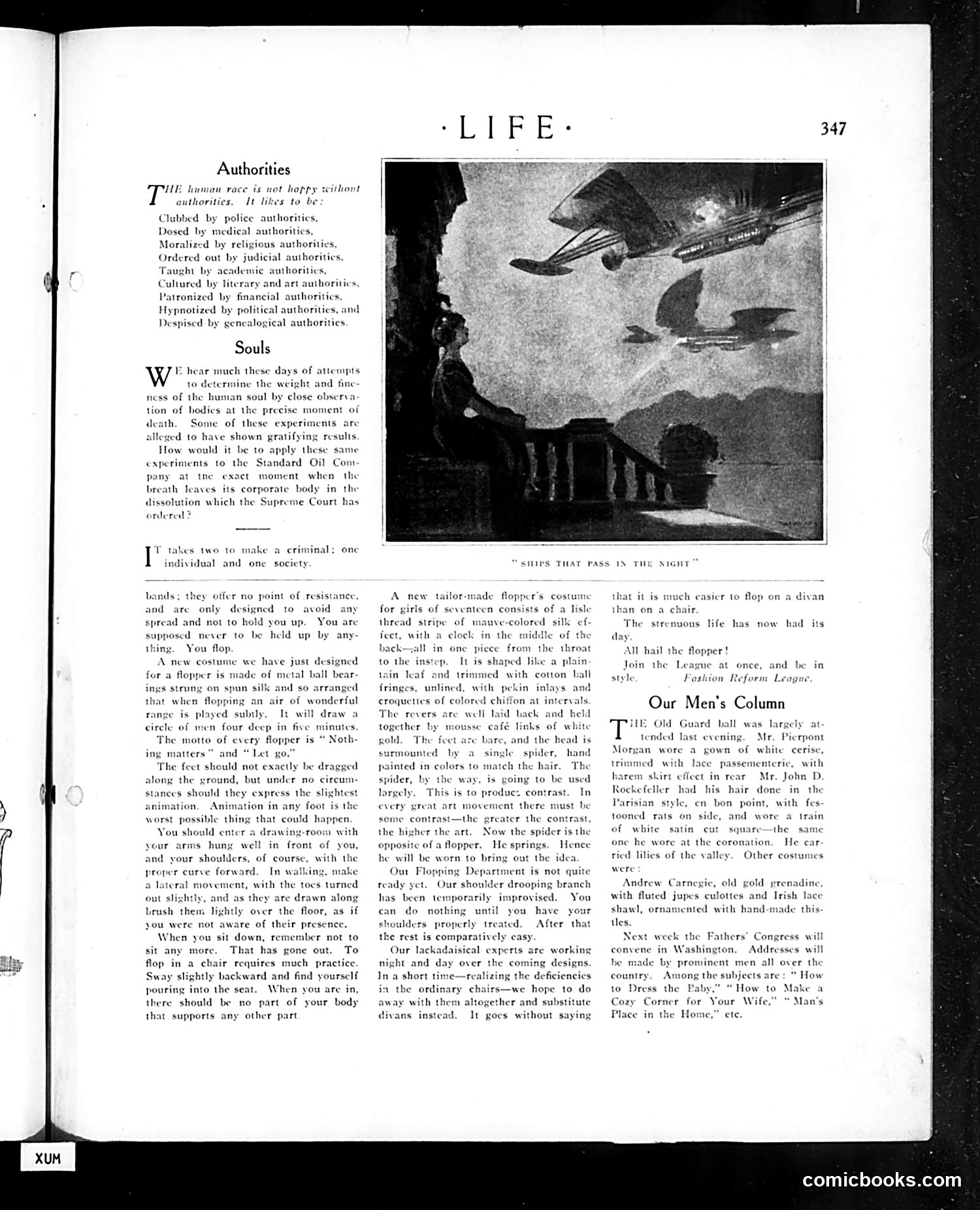
This page combines satirical commentary on social conformity with fashion humor typical of 1920s Life magazine. **"Authorities" section**: A biting list satirizing how humans submit to various institutional powers—police, medical, religious, judicial, academic, and financial authorities. The final jab at "genealogical authorities" mocks snobbish class consciousness. **"Souls" section**: A darkly humorous piece proposing to weigh corporate "souls" at death, specifically referencing the Standard Oil Company and a recent Supreme Court dissolution order. It's political satire suggesting large corporations are soulless entities deserving the same experimental scrutiny applied to human mortality. **"Flopper" fashion and etiquette**: The dominant content mocks the 1920s "flapper" craze—young women's new liberated dancing style and revealing fashions. The satirical instructions (slouching posture, specific arm positions, sitting by "pouring into" chairs) exaggerate the deliberately ungraceful aesthetic flapper culture embraced as rebellion against Victorian propriety. **"Our Men's Column"**: Brief society notes about fashionable men's accessories and upcoming events. The overall tone is irreverent commentary on modern manners and youth culture.
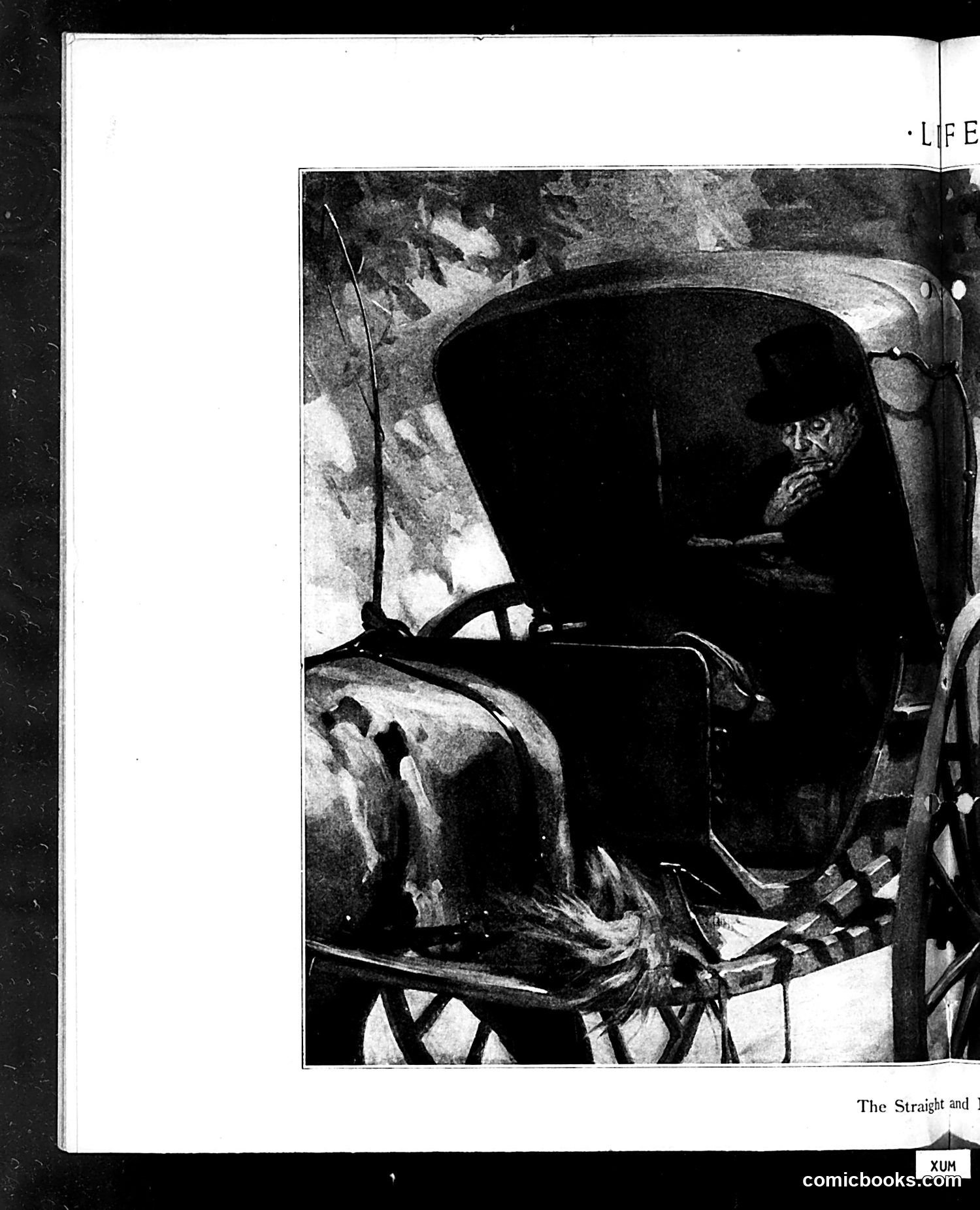
This page from *Life* magazine shows a black and white photograph of a person sitting in what appears to be an old automobile or vehicle, viewed through the car's window. The figure is wearing a hat and appears to be in profile. The partial caption reads "The Straight and" (text continues beyond the visible portion), suggesting this is part of a larger satirical commentary. Without the complete caption or additional context, the specific political or social reference is unclear. The image itself shows vintage automotive styling, likely from the early 20th century, but the intended satirical point cannot be reliably determined from the visible information alone.
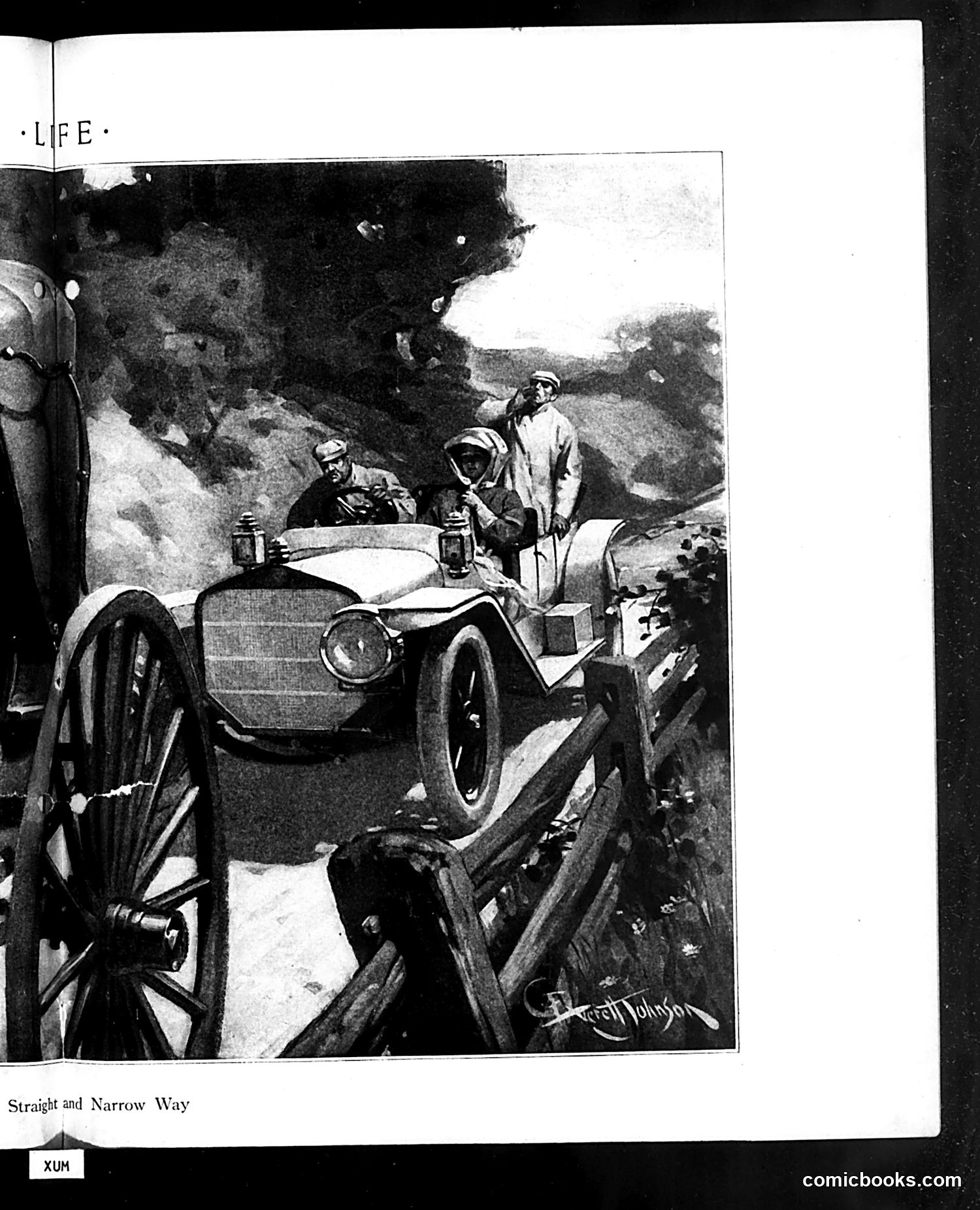
This illustration depicts an early automobile on a treacherous mountain road, with three men in period dress (likely early 1900s) navigating the vehicle. The title "Straight and Narrow Way" is a biblical reference meaning the path of virtue and morality. The satire appears to comment on the dangers and challenges of early motorcar driving—a new, precarious technology. The winding, narrow mountain road with visible hazards (steep drop-offs, rough terrain) contrasts ironically with the "straight and narrow" moral metaphor, suggesting that driving these newfangled machines requires constant vigilance and puts one's safety in jeopardy. The joke likely critiques either the recklessness of early automobile enthusiasts or society's anxieties about this emerging technology.
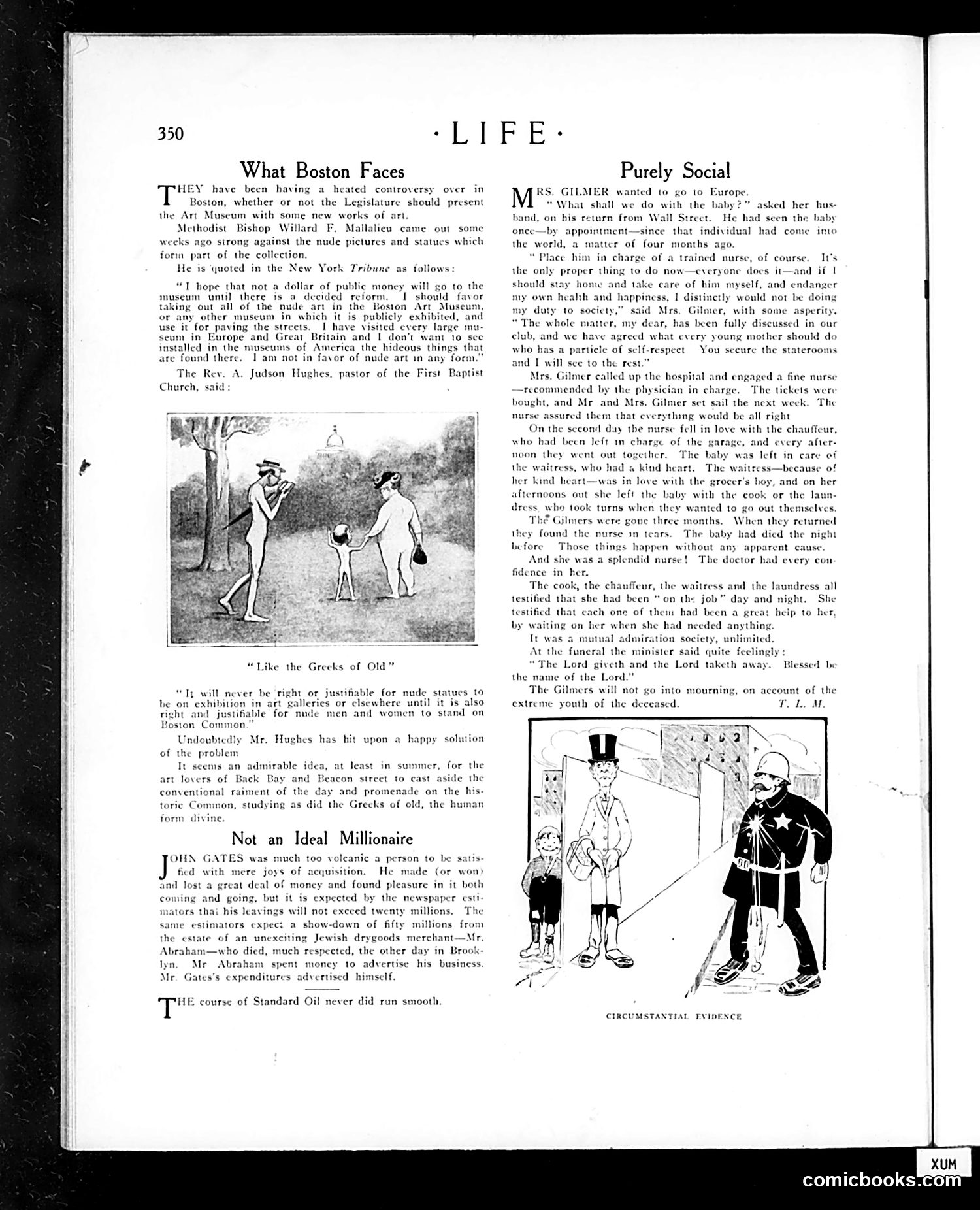
This page contains three separate satirical pieces: **"What Boston Faces"** critiques a real 1900s controversy over nude art in Boston's museums. Methodist Bishop Mallalieu opposed public funding for museums displaying classical nudity. Reverend Hughes sarcastically responds that if nude statues are immoral, then nude Bostonians should freely parade on Boston Common. The satire mocks prudish hypocrisy: classical art depicting the human form was acceptable to society, yet the clergy treated it as scandalous. **"Not an Ideal Millionaire"** contrasts two wealthy men: John Gates (volatile industrialist) versus an unnamed Jewish drygoods merchant named Abraham. Gates spent ostentatiously; Abraham lived modestly but advertised his business. The satire suggests Abraham's respectable wealth accumulation through honest commerce exceeds Gates's flashy approach. **"Purely Social"** satirizes wealthy mothers abandoning infants to hired nurses while vacationing in Europe. Mrs. Gilmer outsources childcare completely—the baby passes through the hands of a nurse, waitress, cook, and laundress, each neglecting it for personal pursuits. The infant dies during the parents' absence, critiquing upper-class maternal irresponsibility and selfishness.
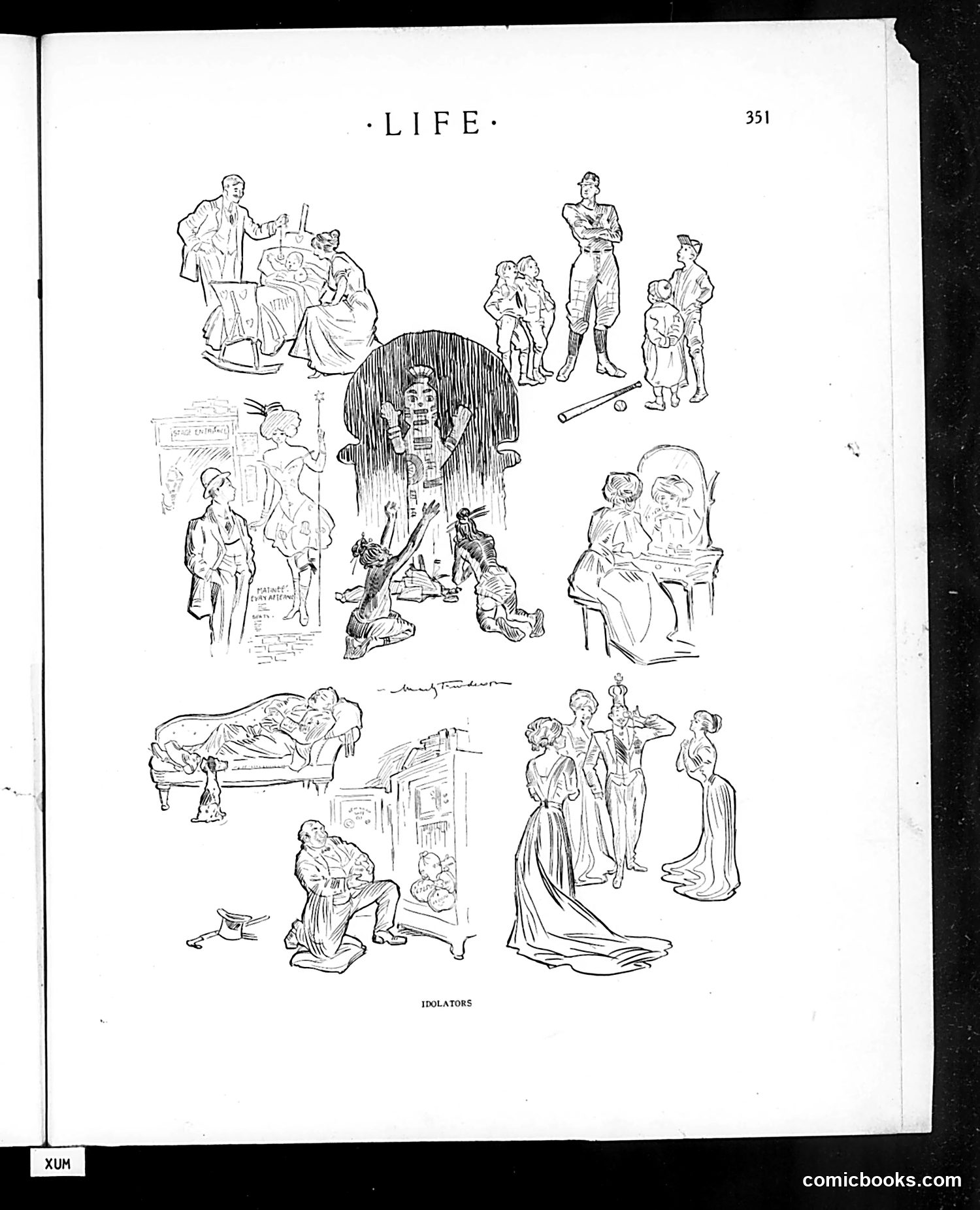
This satirical illustration page is titled "Idolators" and depicts various scenes of people worshipping or excessively devoted to different figures and objects. The sketches show: - A large central idol being revered by kneeling figures - Groups of people in various states of devotion and submission - Domestic scenes suggesting blind obedience within families - A figure reclining passively while others serve The satire appears to critique how people mindlessly worship authority figures, celebrities, or material possessions—treating them as idols deserving religious-like devotion. The multiple vignettes suggest this "idolatry" pervades multiple social contexts: religious, domestic, and public life. Without a visible date, the specific targets remain unclear, but the message condemns uncritical hero-worship and loss of independent thinking in modern society.
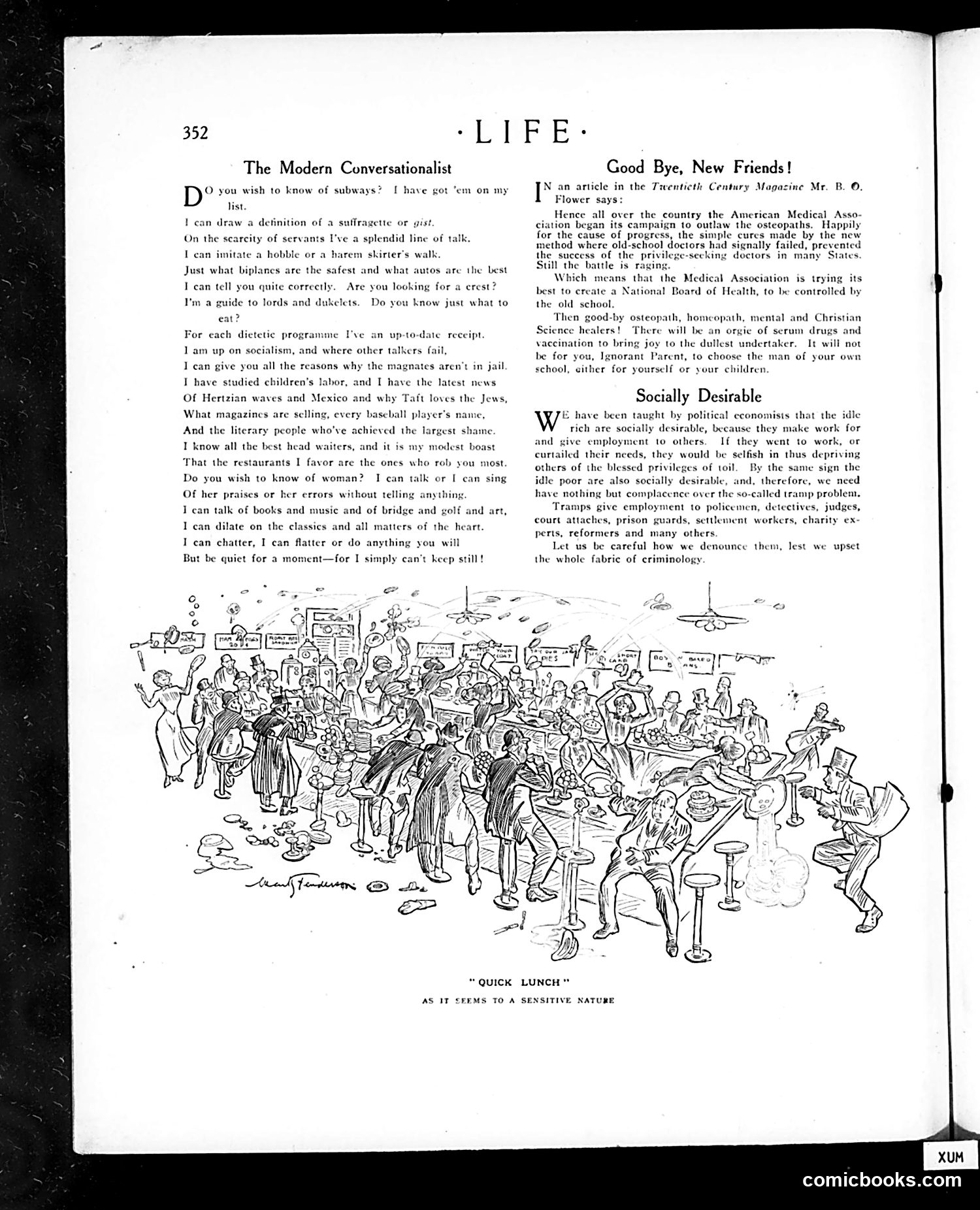
This page contains three distinct satirical pieces mocking early 20th-century American society. **"The Modern Conversationalist"** parodies people obsessed with appearing knowledgeable on every topic—from subways and suffragettes to servants, aviation, Mexican politics, and Taft's Jewish support. The speaker boasts of endless expertise while admitting inability to stay silent, satirizing vapid cocktail-party chatter and superficial intellectualism. **"Good Bye, New Friends"** attacks the American Medical Association's campaign against osteopaths and alternative healers. The author argues doctors monopolize healthcare for profit, warning that eliminating competition will result in forced vaccinations and serum treatments benefiting undertakers, not patients. **"Socially Desirable"** ironically argues that both idle rich and poor tramps serve society by providing employment to police, judges, and reformers. The satire suggests society benefits from maintaining poverty and crime rather than solving them. The cartoon "Quick Lunch" (bottom) depicts a crowded, chaotic luncheon scene, presumably illustrating the sensory overload and absurdity contemporary Life readers found humorous.
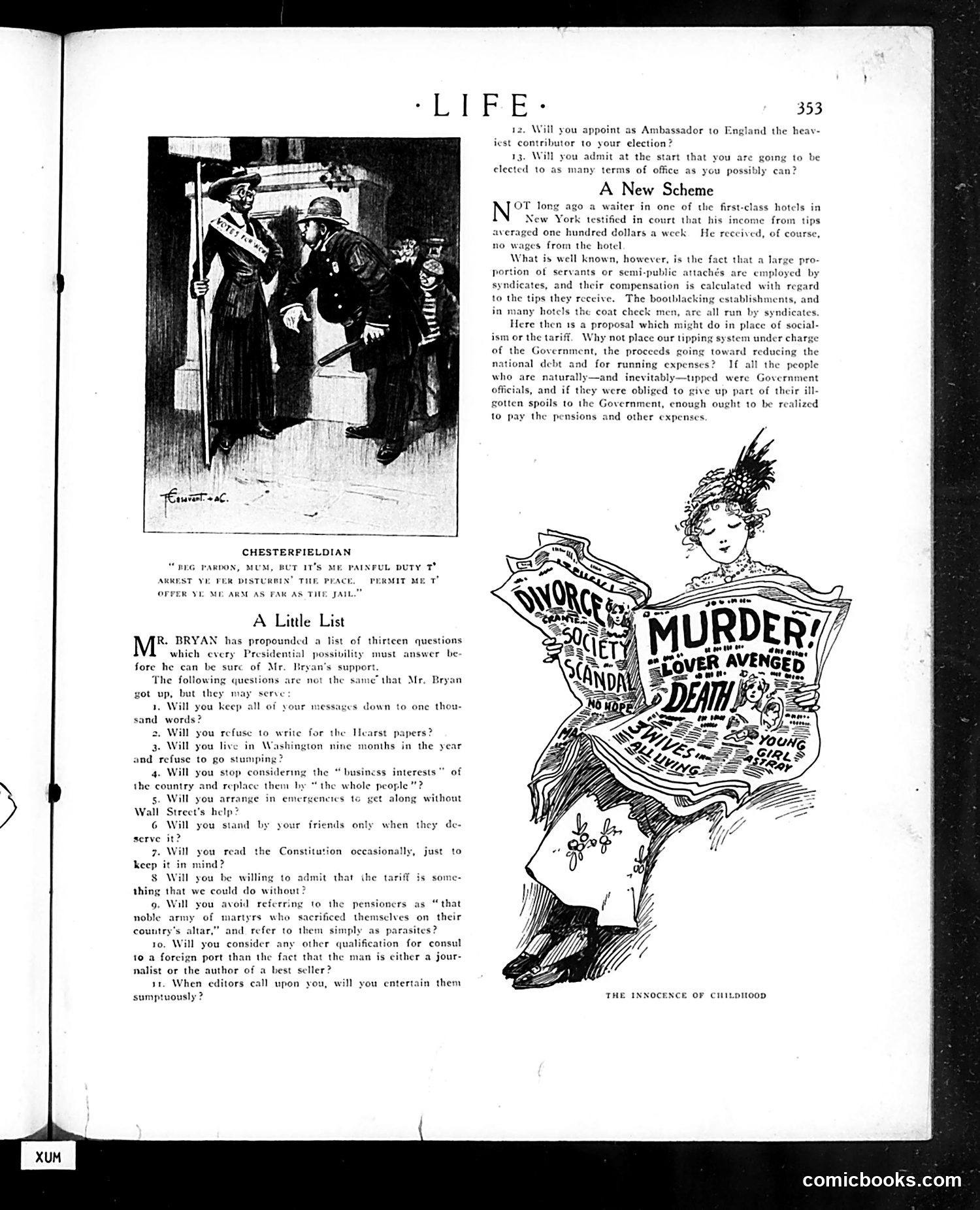
This page contains two distinct satirical pieces targeting early 20th-century American politics and society. **"A Little List"** parodies William Jennings Bryan's famous practice of demanding that Presidential candidates answer questions before earning his endorsement. The satire mocks progressive reformist concerns: it demands candidates limit speechmaking, refuse Hearst newspaper work, live in Washington, prioritize "the whole people" over business interests, avoid Wall Street influence, and acknowledge that military pensioners are parasites rather than heroes. The humor lies in listing absurdly principled expectations—essentially impossible standards—suggesting Bryan's demands were similarly unrealistic. **"A New Scheme"** proposes placing the tipping system under government control to reduce national debt, satirizing both the widespread reliance on tips in service industries and Progressive-era enthusiasm for government solutions to social problems. **The right illustration** titled "The Innocence of Childhood" depicts a woman reading sensational publications (Murder, Divorce, Death, etc.), satirizing media corruption and its effects on public consciousness—a common Progressive critique.
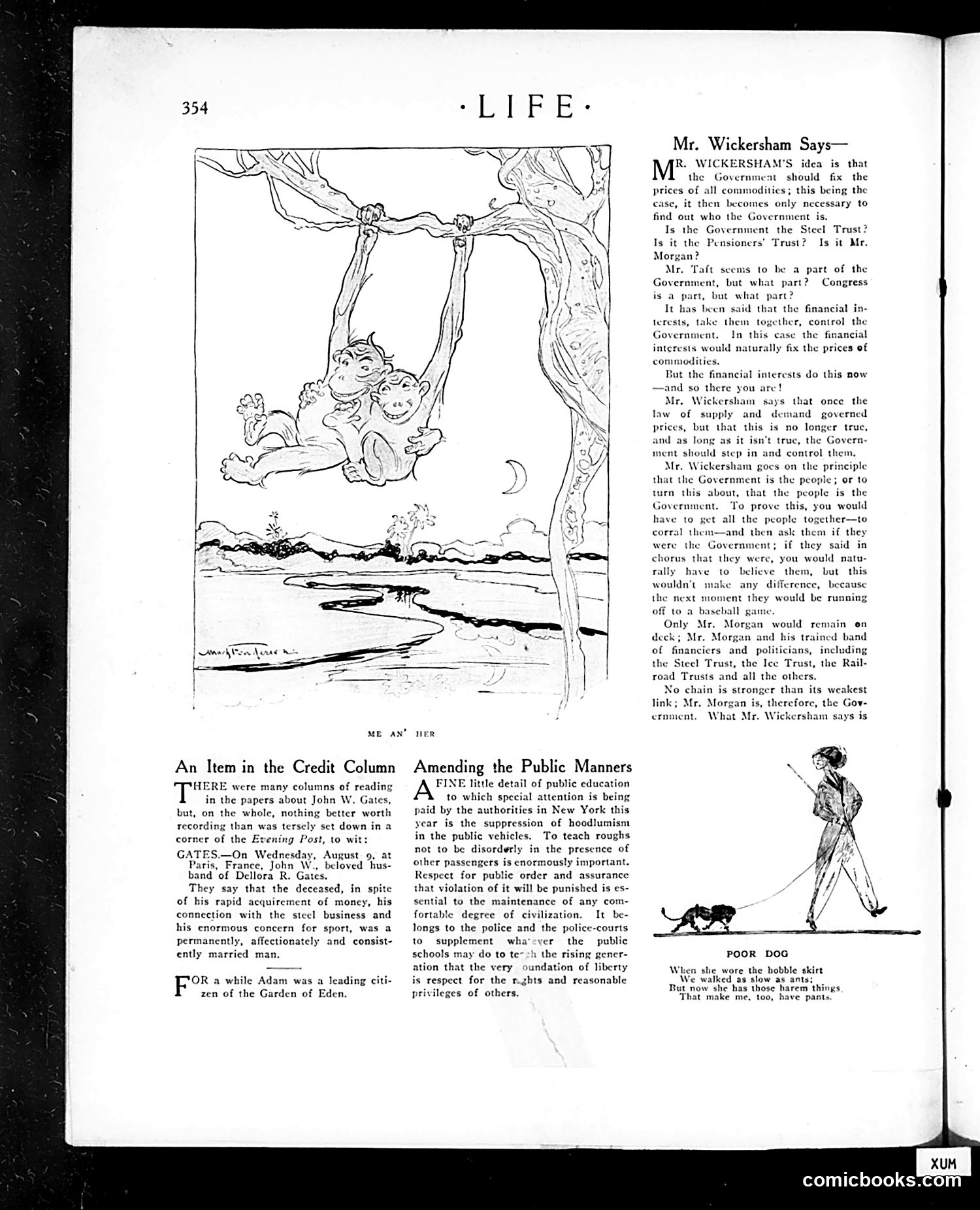
This page contains three satirical pieces from early 20th-century Life magazine: **"An Item in the Credit Column"** mocks John W. Gates (a steel magnate who died August 9, likely 1911), suggesting that despite his ruthless business dealings and obsession with money and sport, he maintained a stable marriage—presented as his only redeeming quality through dry, deadpan humor. **"Amending the Public Manners"** straightforwardly discusses New York's anti-hoodlumism campaign in public transit, arguing respectful civic behavior is foundational to liberty. **"Mr. Wickersham Says"** satirizes Attorney General James Sherman Wickersham's proposal that government should fix commodity prices. The satire's point: asking *who* is the government? The financial trusts control it anyway, particularly J.P. Morgan and his network—so government price-fixing merely legitimizes their existing monopoly power. The accompanying cartoon shows wealthy figures on a swing while others toil. **"Poor Dog"** is a light humorous poem about how women's changing fashions (from restrictive hobble skirts to looser harem pants) affect his walking pace.
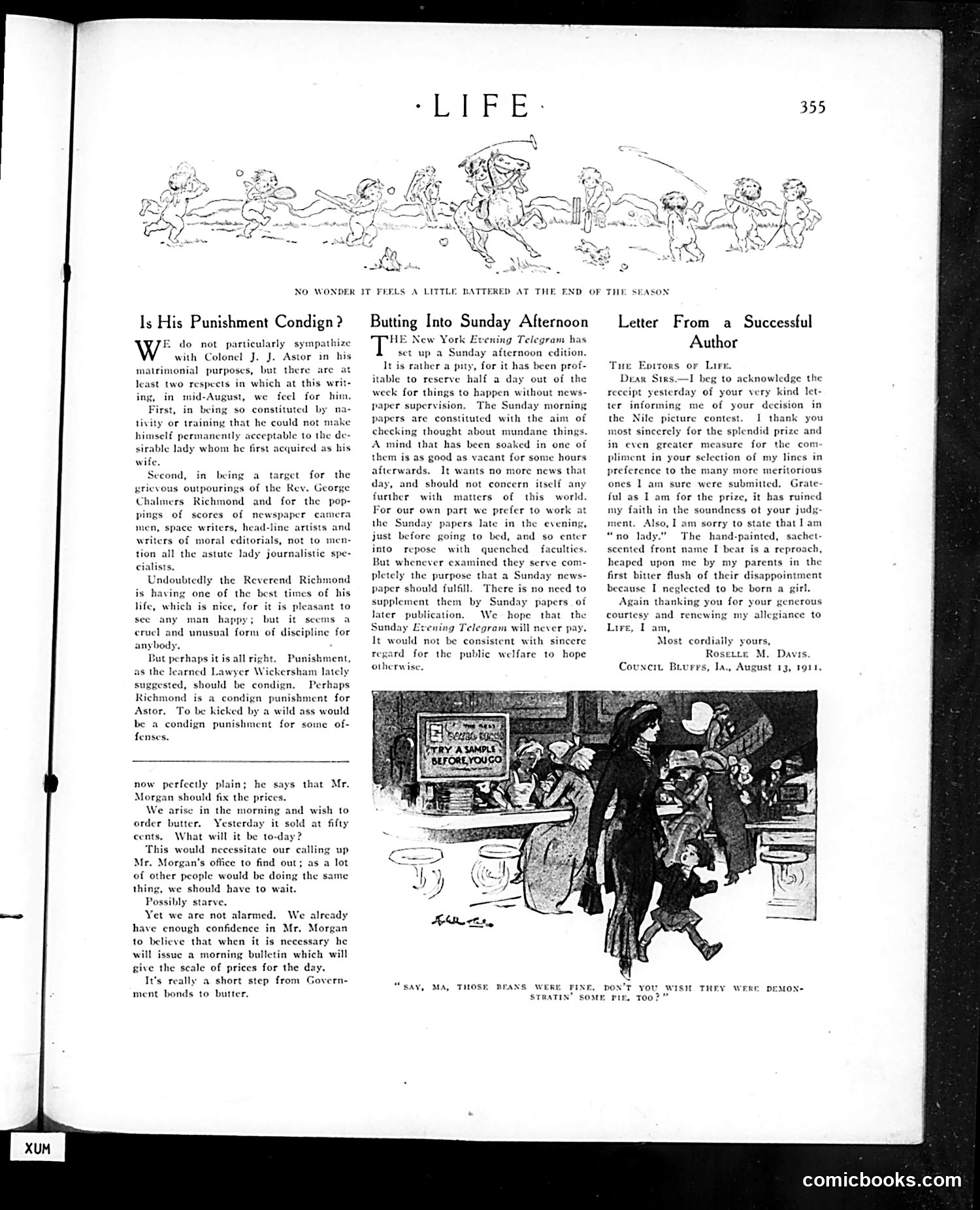
This page contains three distinct pieces of satire reflecting early 20th-century American concerns: **"Is His Punishment Condign?"** mocks Colonel J.J. Astor's divorce and remarriage, which scandalized high society. The article sarcastically suggests that public harassment from Reverend Richmond and press photographers constitutes appropriate "punishment" for his marital conduct—a dig at both Astor's behavior and the media's invasive coverage of wealthy people's personal affairs. **"Butting Into Sunday Afternoon"** critiques the New York *Evening Telegram*'s new Sunday edition, arguing newspapers already sufficiently occupy readers' minds. The piece ironically suggests readers should trust J.P. Morgan (the famous financier) to set butter prices, satirizing both newspaper influence and unregulated corporate power during the Progressive Era. **The cartoon** depicts a domestic scene where someone asks why beans couldn't be "demonstratin' some pie, too?"—likely satirizing food quality or rationing concerns. **"Letter From a Successful Author"** humorously presents a writer thanking *Life* for a contest prize while paradoxically insulting their own judgment for selecting her work.
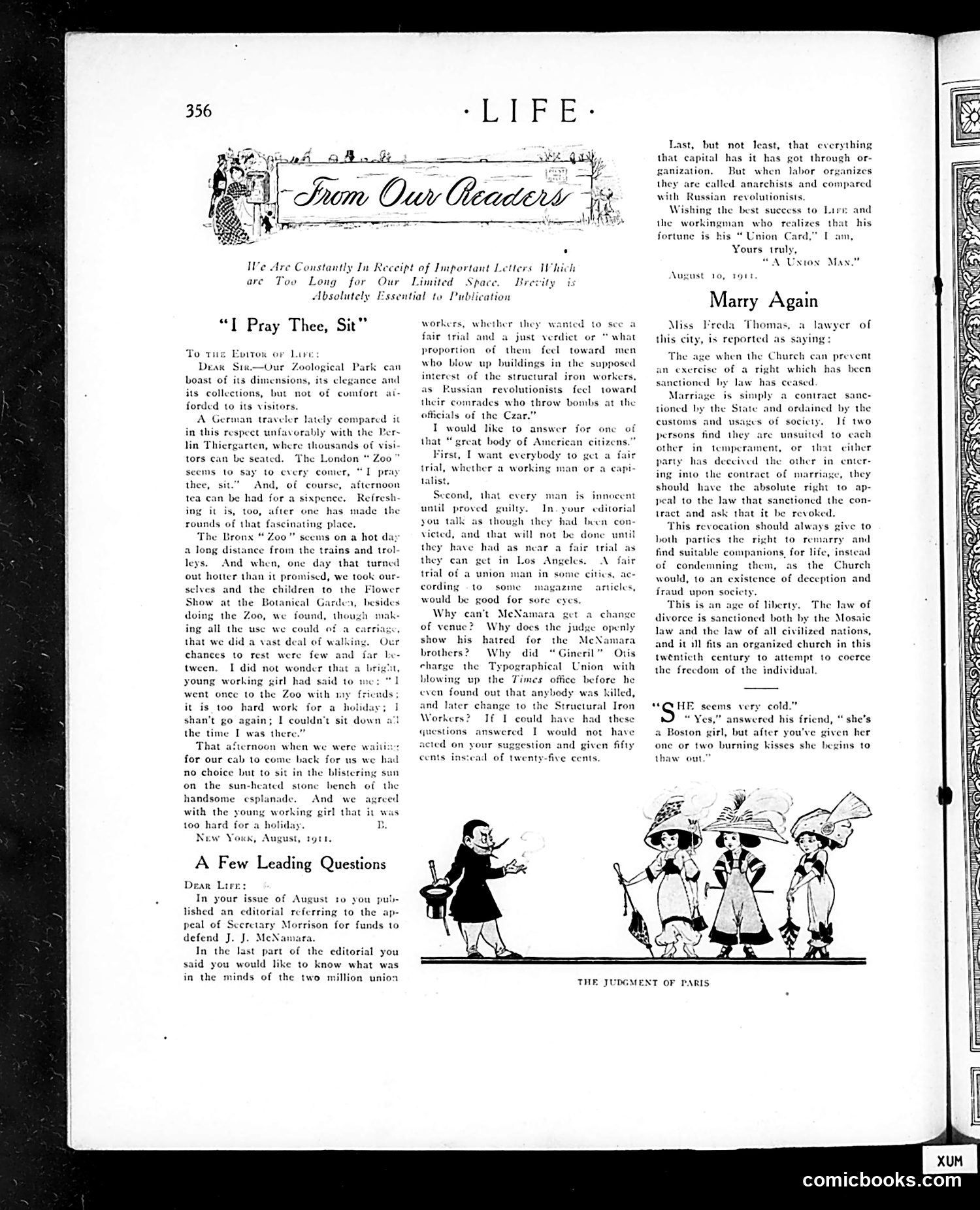
This Life magazine page (August 1911) contains reader letters debating labor rights and marriage law, with a small cartoon titled "The Judgment of Paris" at the bottom. **The Cartoon:** Shows three fashionably-dressed women being judged by a man in formal dress—a classical allusion to the mythological Paris choosing among goddesses. It satirizes shallow, competitive feminine vanity and the male gaze that reduces women to objects of aesthetic judgment. **Letters Content:** The substantive content addresses two serious issues: (1) the McNamara case involving union dynamiting of the Los Angeles Times building, with a writer defending fair trials and labor organizing rights while criticizing judicial bias; and (2) marriage and divorce law, where Miss Freda Thomas argues the Church shouldn't control women's right to remarry. **Context:** This reflects 1911 Progressive Era tensions between labor rights, judicial fairness, women's autonomy, and institutional (Church/State) authority over personal life. The contrast between the frivolous cartoon and serious letters reflects Life's satirical range.
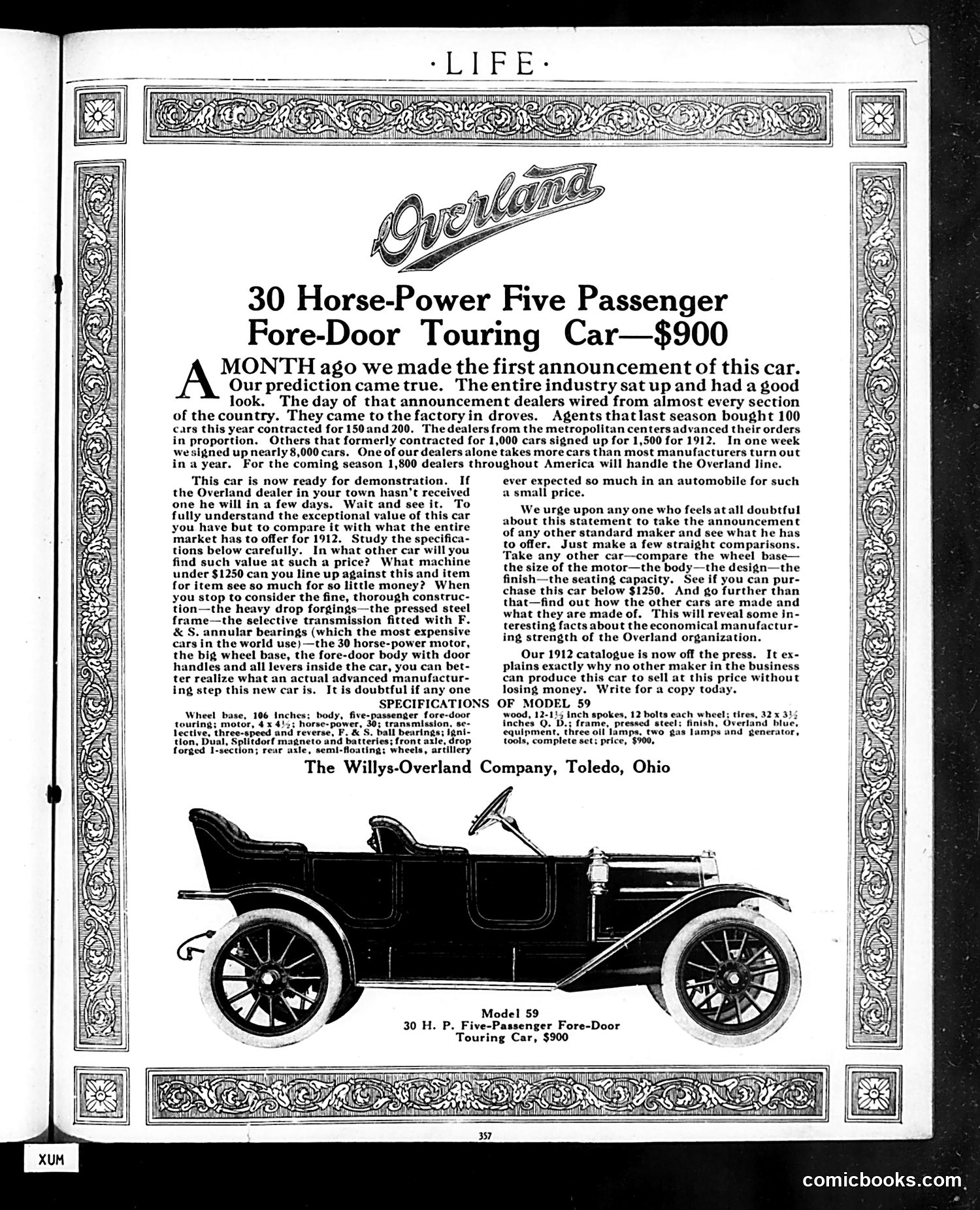
This is **not a cartoon or satire**—it's a straightforward advertisement for the Overland automobile company, appearing in Life magazine circa 1912. **The Content:** The ad promotes the Model 59 Overland, a 30-horsepower touring car priced at $900. The text claims unprecedented market success: dealers nationwide allegedly ordered thousands of units within days of the initial announcement, with one dealer supposedly purchasing more cars than entire manufacturers produced annually. **The Pitch to Modern Readers:** The advertisement emphasizes value—repeatedly challenging competitors to match the car's specifications (106-inch wheelbase, pressed-steel frame, selective transmission) at comparable price points. The language suggests this was a genuinely affordable, well-engineered vehicle for middle-class buyers. **Historical Context:** In 1912, $900 represented roughly a year's wages for average workers, making this a significant purchase. The ad's aggressive competitive claims reflect the early automobile industry's rapid expansion and fierce manufacturing competition.
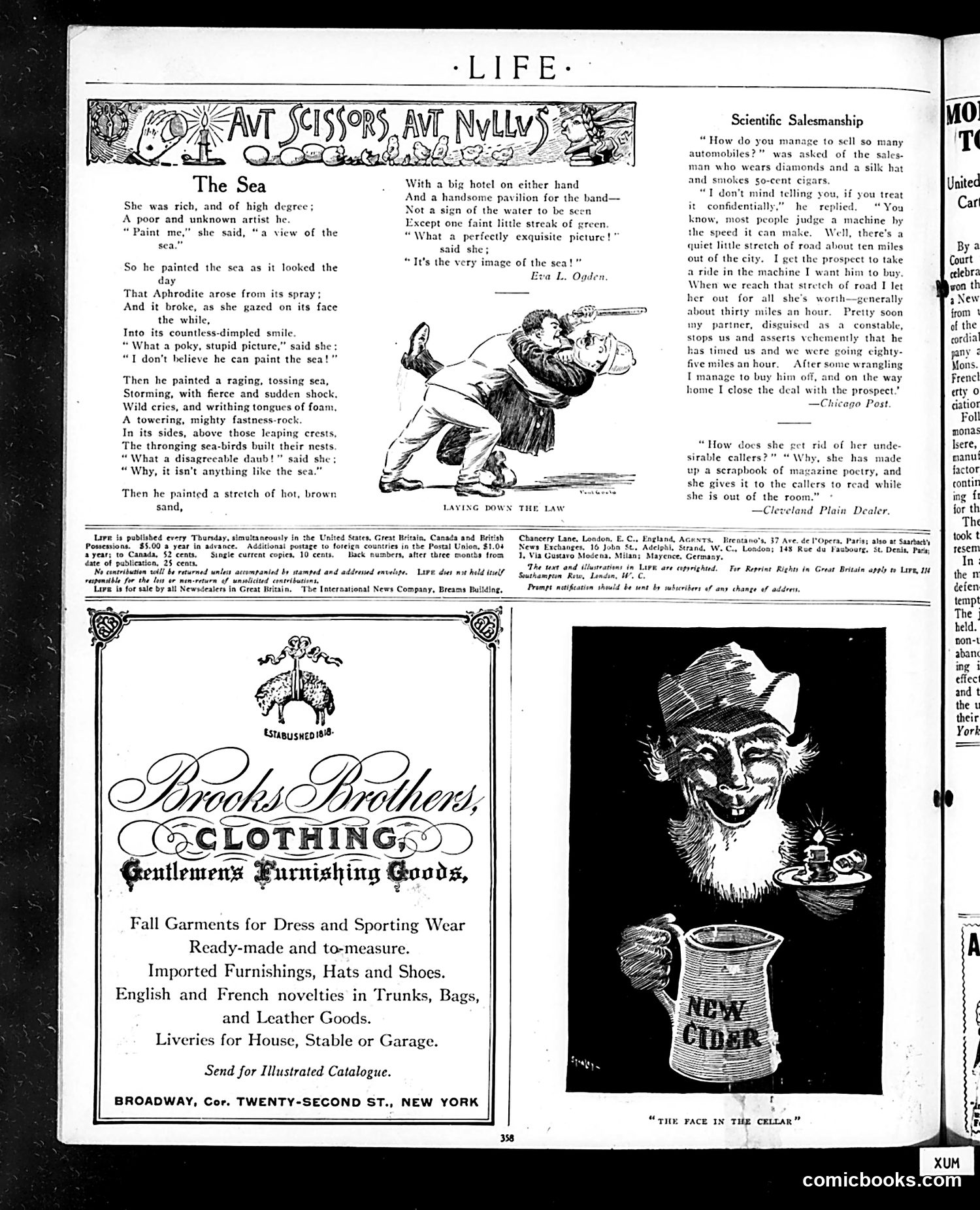
This satirical poem mocks subjective taste and artistic appreciation. A wealthy woman commissions a poor artist to paint the sea, rejecting two genuinely artistic renderings—one romantic (Venus-inspired), one dramatic (stormy)—as "stupid" and "disagreeable." She praises only his third painting: a mundane beach scene featuring a hotel and bandstand, with barely any water visible. The satire targets affluent patrons who lack aesthetic judgment, preferring commercial banality to authentic art. The woman values only what's familiar and comfortable (the hotel, the band pavilion)—material comfort masquerading as artistic taste. The artist's frustration is implicit: his skill means nothing against her philistinism. The accompanying "Scientific Salesmanship" anecdote reinforces the theme: both pieces satirize how people are manipulated into poor judgments through deception and flattery rather than genuine merit.
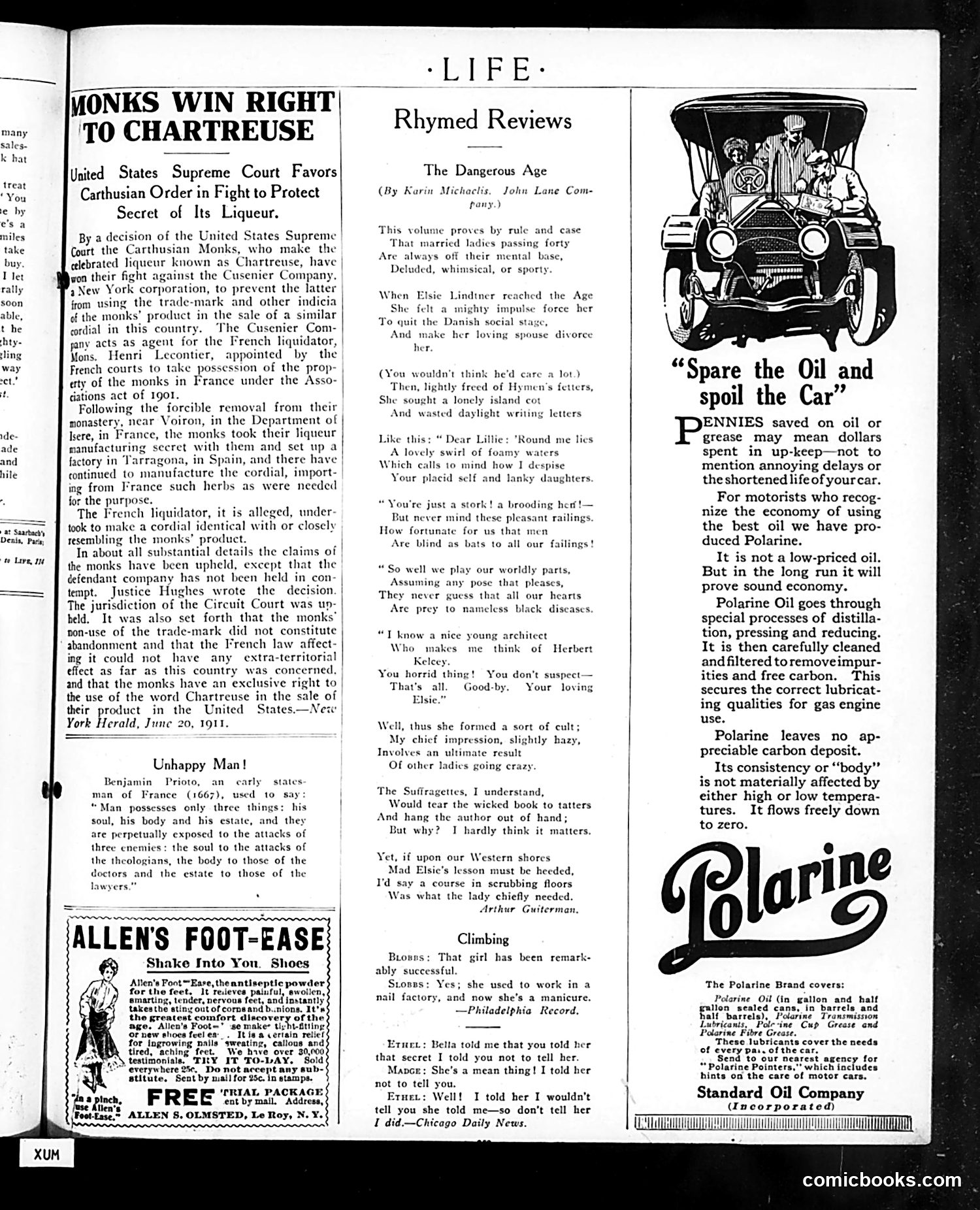
This page contains three distinct sections: a legal news article, book reviews, and advertisements. **"Monks Win Right to Chartreuse"** reports a Supreme Court decision protecting French Carthusian monks' exclusive rights to their liqueur trademark against a competing American company. The monks had fled France after 1901 government expropriations and continued manufacturing in Spain—the court upheld their trademark claims despite the French liquidator's efforts to commercialize the brand. **"Rhymed Reviews"** satirizes a novel called *The Dangerous Age*, mocking the premise that married women over forty become mentally unstable and impulsive. The reviewer uses humorous verse to lampoon both the book's sexist premise and a female character who abandons her marriage for romantic escapades. The remainder is advertising for **Allen's Foot-Ease** powder and **Polarine oil**, typical commercial content of the era. The satire targets both legal overreach and patronizing attitudes toward women—themes characteristic of Life magazine's reformist humor.
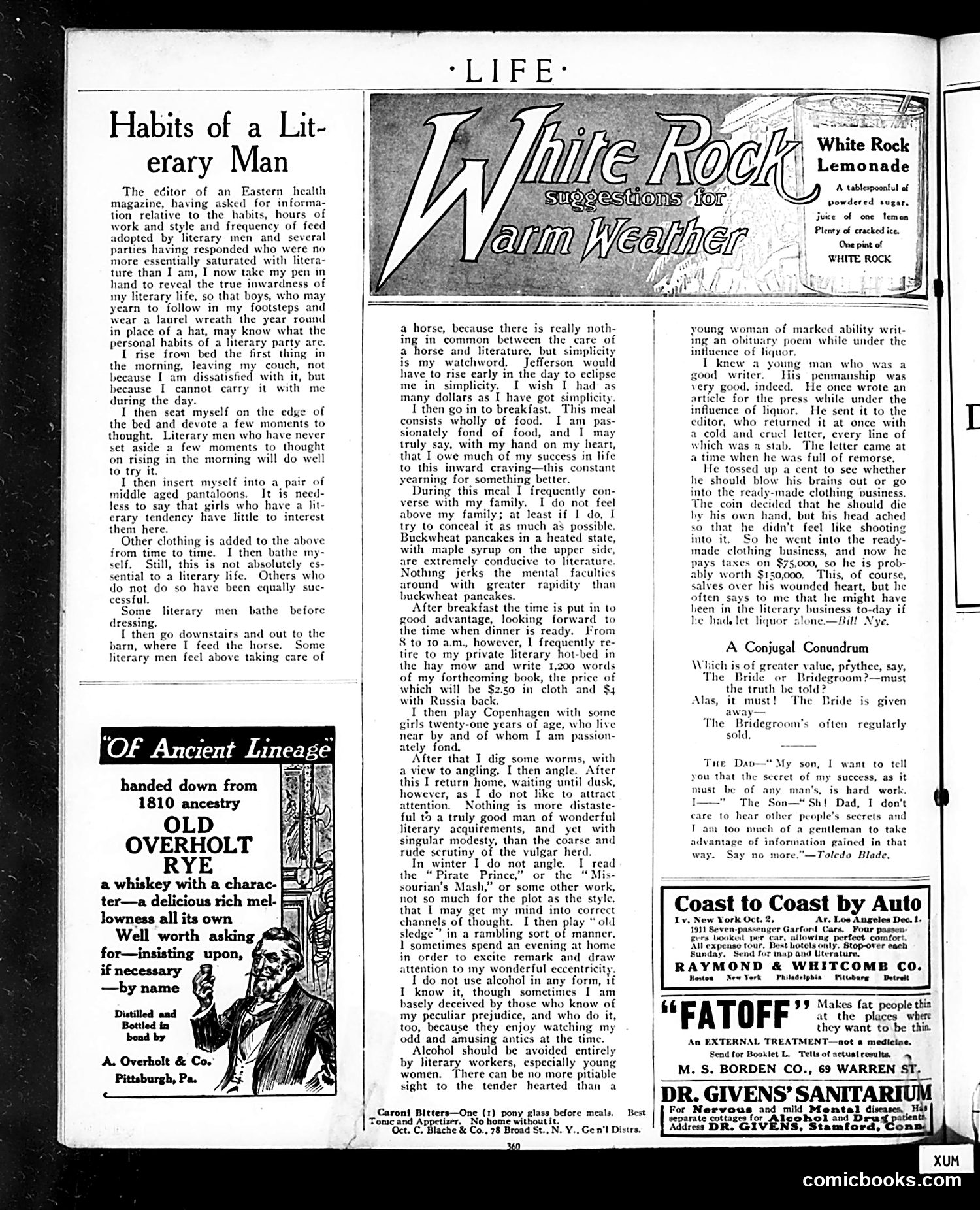
This humorous essay satirizes pompous literary men who affect superiority while living ordinary lives. The author mockingly describes a "literary man's" daily routine—rising, dressing, feeding his horse, eating buckwheat pancakes—presenting mundane activities as if they required philosophical justification. The satire targets the pretension of writers who consider themselves above manual labor (like caring for horses) or public attention, yet whose actual accomplishments are modest. The joke intensifies when he mentions writing 1,200 words daily for a $2.50 book, plays games with local girls, and fishes—activities hardly befitting the "wonderful literary acquirements" he claims. The piece mocks the self-importance of mediocre writers who adopt affected mannerisms and speak of their "peculiar prejudice" against alcohol while engaging in thoroughly ordinary pursuits. It's gentle satire on literary pretension and vanity.
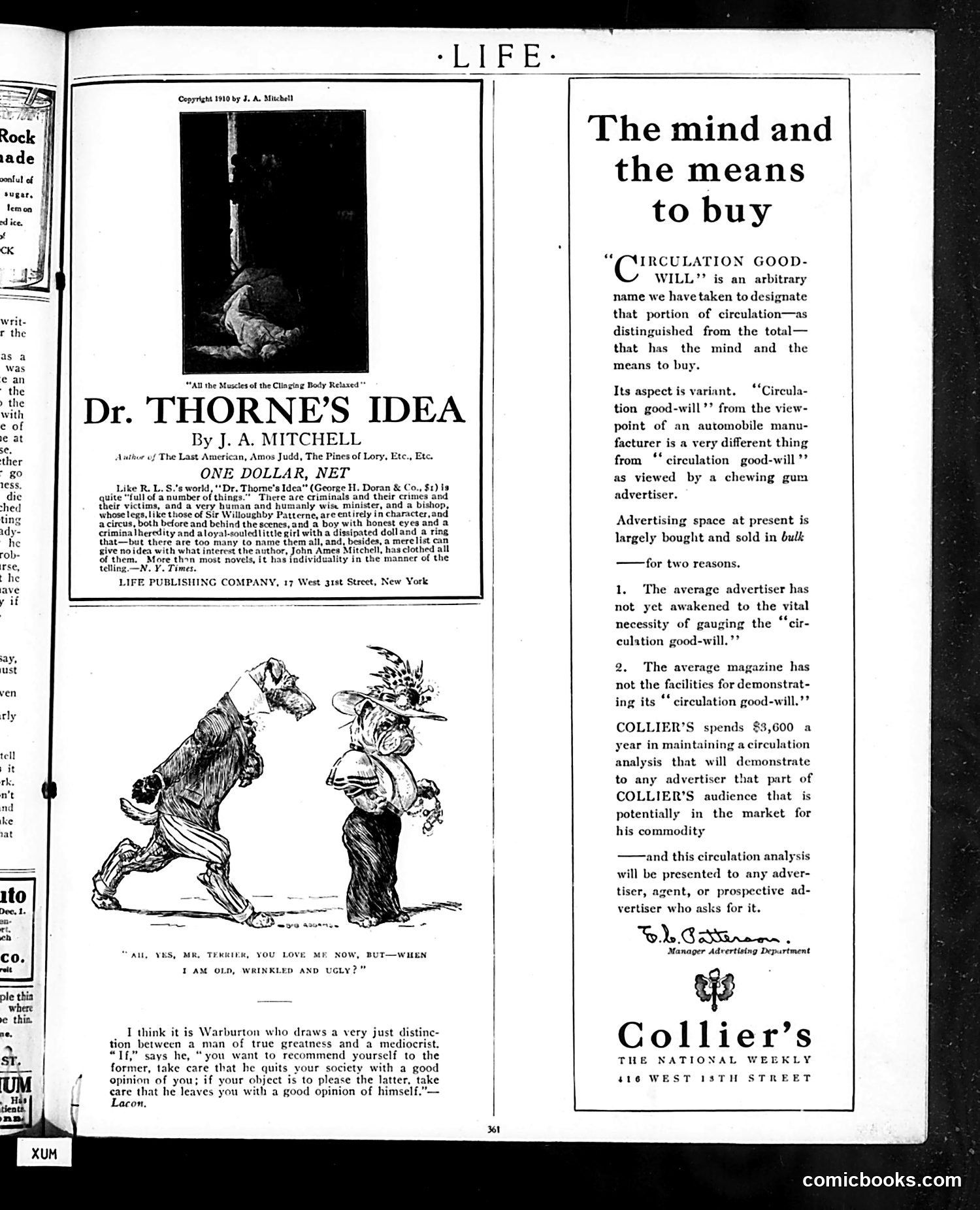
This page contains two distinct elements: **Left side:** A book advertisement for "Dr. Thorne's Idea" by J. A. Mitchell, featuring a cartoon labeled "Am, Yes, Mr. Terrier, You Love Me Now, But—When I Am Old, Wrinkled and Ugly?" The cartoon depicts a small dog and a woman in an exaggerated pose, illustrating a romantic dialogue about aging and fidelity. It's a humorous commentary on vanity and conditional affection—likely satirizing the shallow nature of romantic promises. **Right side:** An advertisement from Collier's magazine promoting its "circulation good-will" analysis service to advertisers. Collier's argues that advertising space shouldn't be bought blindly in bulk, but rather targeted to readers who actually have "the mind and the means to buy." They boast spending $3,600 annually to analyze which readers represent real purchasing potential—an early pitch for data-driven advertising targeting, a novel concept in this era.
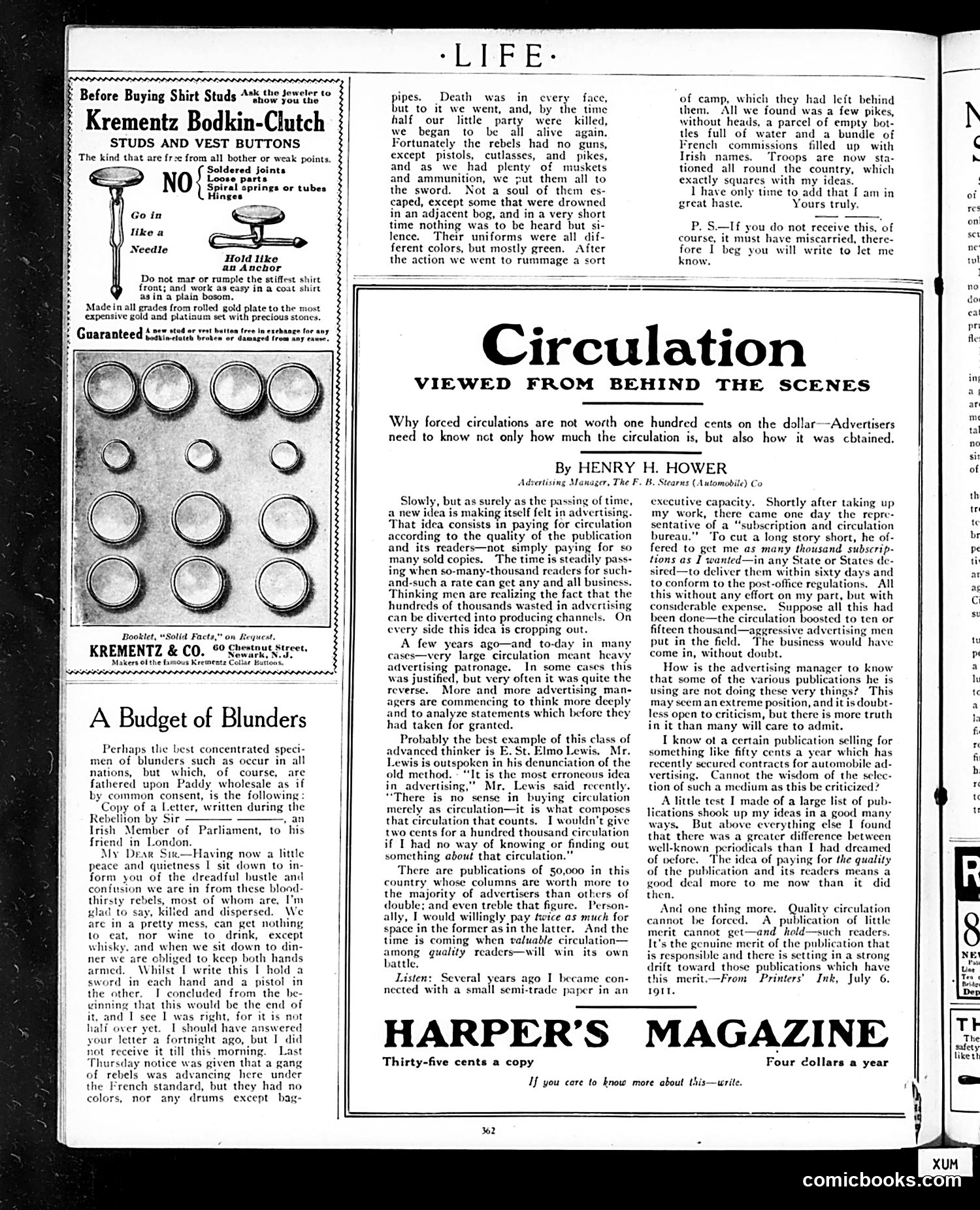
This page contains **advertising and editorial content**, not political cartoons. The main satirical piece is **"A Budget of Blunders,"** a humorous letter supposedly written by an Irish Member of Parliament during Ireland's rebellion. The joke relies on absurd contradictions: the writer describes rebels advancing while simultaneously claiming he wasn't "half over yet" having already won; rebels carried only pistols and pikes while he possessed muskets; he holds two swords and a pistol while writing. The humor targets Irish stereotypes and incompetence through a deliberately nonsensical account of military victory. The page's substantial article, **"Circulation Viewed from Behind the Scenes"** by Henry H. Hower, discusses advertising strategy—arguing that publication circulation quality matters more than raw numbers. This reflects early 20th-century debates about advertising effectiveness. The remainder comprises **product advertisements** for Krementz shirt studs and Harper's Magazine, typical of period publications. The satire is mild and domestic, not political.
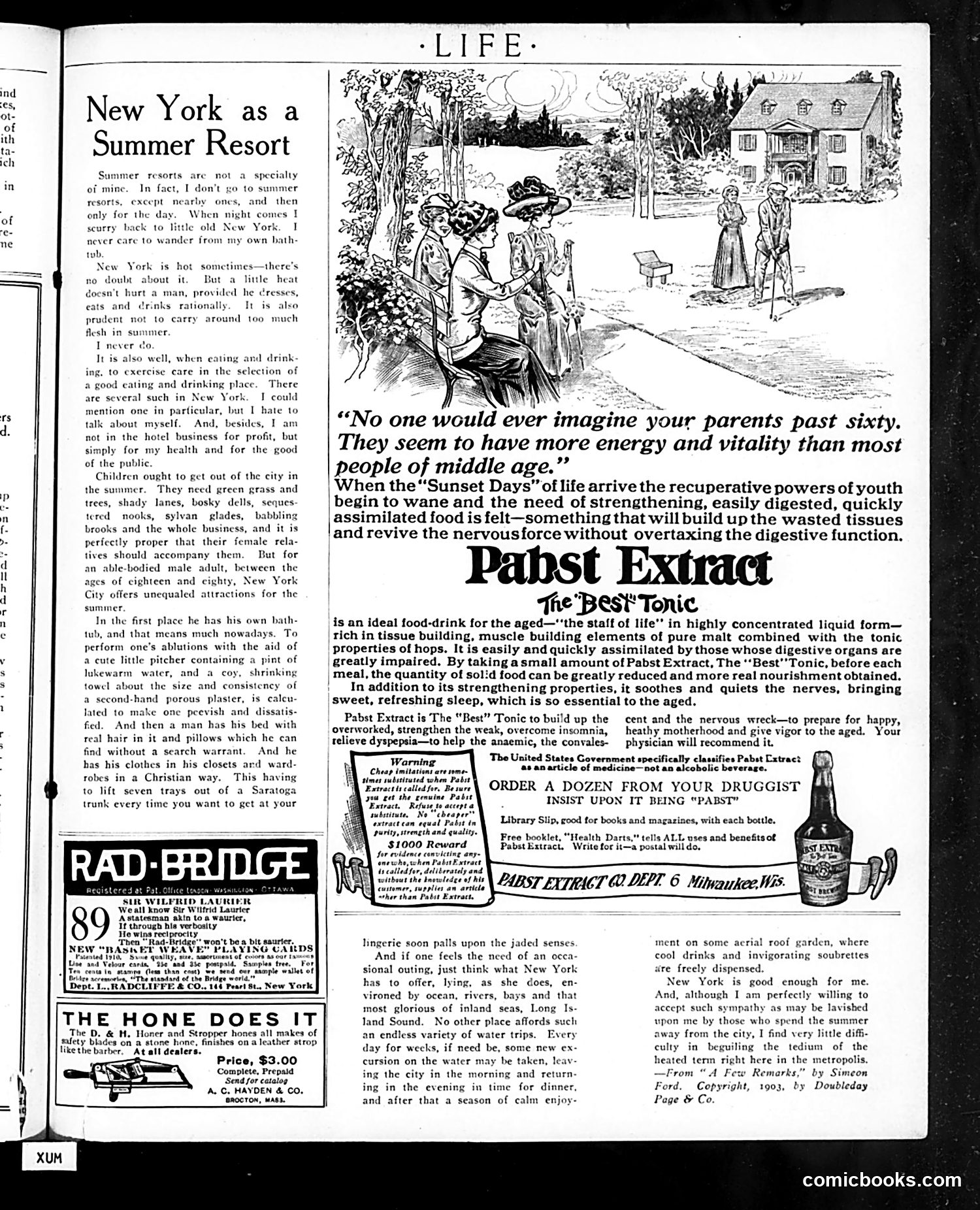
This page presents **New York as a Summer Resort**—an essay arguing that New York City itself offers superior amenities to traditional resort destinations. The author humorously champions urban conveniences (private bathtubs, closets, proper bedding) over the discomforts of country resorts. The accompanying illustration shows well-dressed Edwardian-era figures at leisure near a mansion, depicting the aspirational leisure class this essay addresses. **The primary content is advertising**: A full-page Pabst Extract advertisement dominates the right side. This malt tonic marketed itself as a health supplement for aging bodies—claiming to restore "energy and vitality" and aid digestion for the elderly. The ad features a testimonial quote praising parents' vigor "past sixty," then pivots to selling Pabst Extract as the solution. **Historical context**: This reflects early 1900s patent medicine culture, when unregulated tonics made broad health claims. The ad even notes U.S. Government classification as medicine (not alcohol), suggesting regulatory grey areas of the era. The satire is subtle—the essay's practical urbanism contrasts with the ad's grand health promises, both targeting affluent readers seeking wellness and comfort.
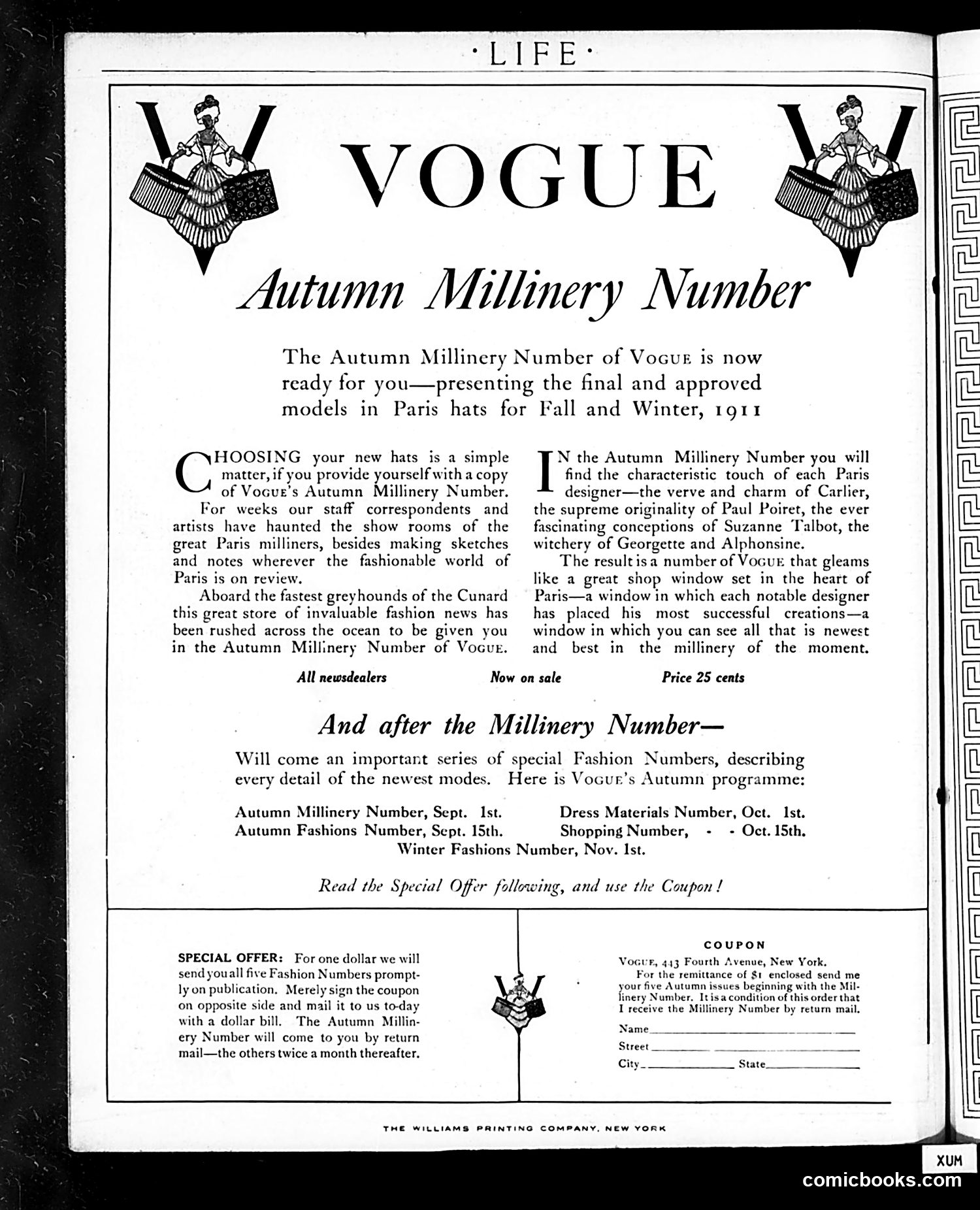
This is not a cartoon or satirical page—it's a **Vogue magazine advertisement/promotional piece** from 1911. There is no satire or political content to decode. The page announces Vogue's "Autumn Millinery Number" (a special fashion issue focused on women's hats) and promotes it as containing "final and approved models in Paris hats for Fall and Winter, 1911." It emphasizes that Vogue's correspondents visited prestigious Parisian milliners like Paul Poiret and others, then rushed the designs across the Atlantic via Cunard steamship. The pitch targets fashionable women by positioning the issue as essential shopping guidance—essentially a curated catalog of the season's best hat designs presented as "a great shop window set in the heart of Paris." A coupon offers a special deal: one dollar for all five upcoming Vogue fashion numbers. This is straightforward commercial advertising from Life magazine's advertising section, not editorial content or satire.
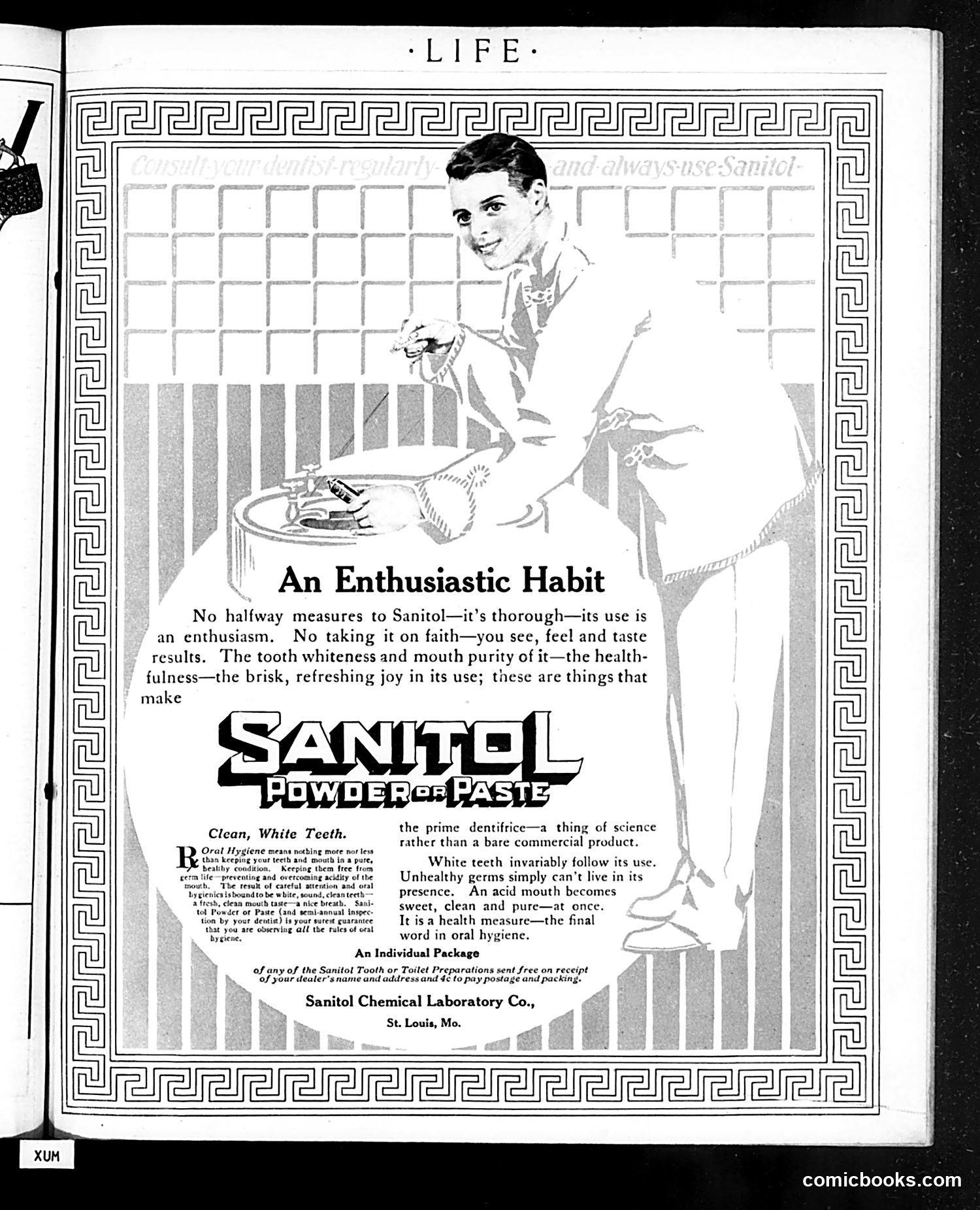
This is a **toothpaste advertisement**, not political satire. The page shows a well-dressed man enthusiastically using Sanitol Powder or Paste, a dental hygiene product manufactured by the Sanitol Chemical Laboratory Company in St. Louis, Missouri. The ad emphasizes that Sanitol requires no "halfway measures"—users will directly *feel* results through tooth whiteness and mouth purity. The marketing copy stresses oral hygiene as a "health measure" and the final word in cleanliness, claiming an "acid mouth" becomes "sweet, clean and pure" with use. This represents early 20th-century consumer advertising targeting middle-class Americans concerned with personal hygiene and modern cleanliness standards.
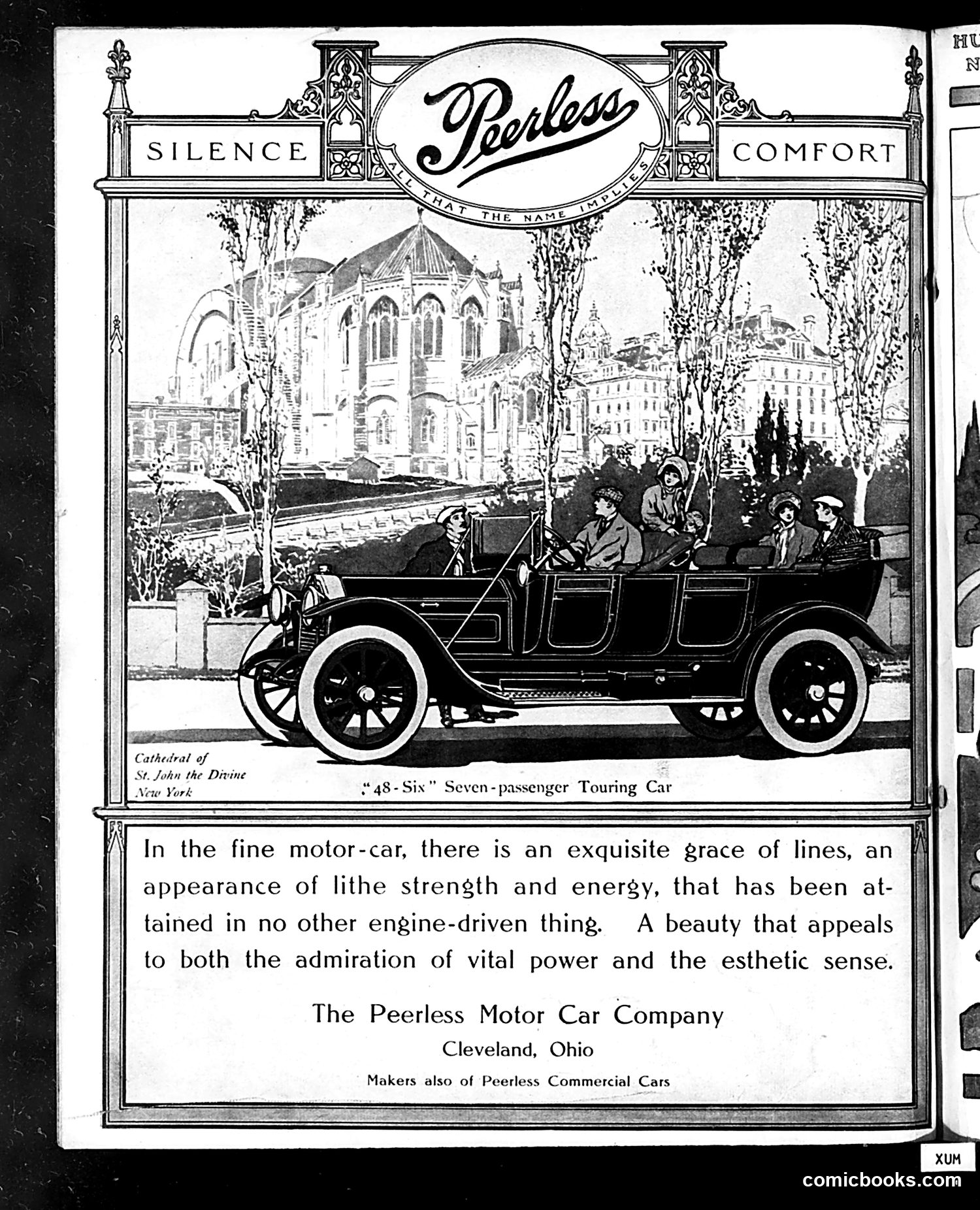
This is **primarily an advertisement**, not satirical content. It promotes the Peerless Motor Car Company's "48-Six" seven-passenger touring car, manufactured in Cleveland, Ohio. The image shows a well-dressed group of passengers in an elegant automobile passing the Cathedral of St. John the Divine in New York City. The advertisement's text emphasizes aesthetic refinement and power—positioning the car as combining both "vital power and the esthetic sense." The header words "SILENCE" and "COMFORT" frame the Peerless brand name, suggesting these are the car's key selling points to prospective buyers. **For modern readers:** This represents early automotive advertising targeting affluent consumers who valued both technological sophistication and social status. The cathedral backdrop and well-dressed passengers signal luxury and respectability—the car as a status symbol for the wealthy.