
Life, 1911-08-31 · page 10 of 38
Life — August 31, 1911 — page 10: what you’re looking at
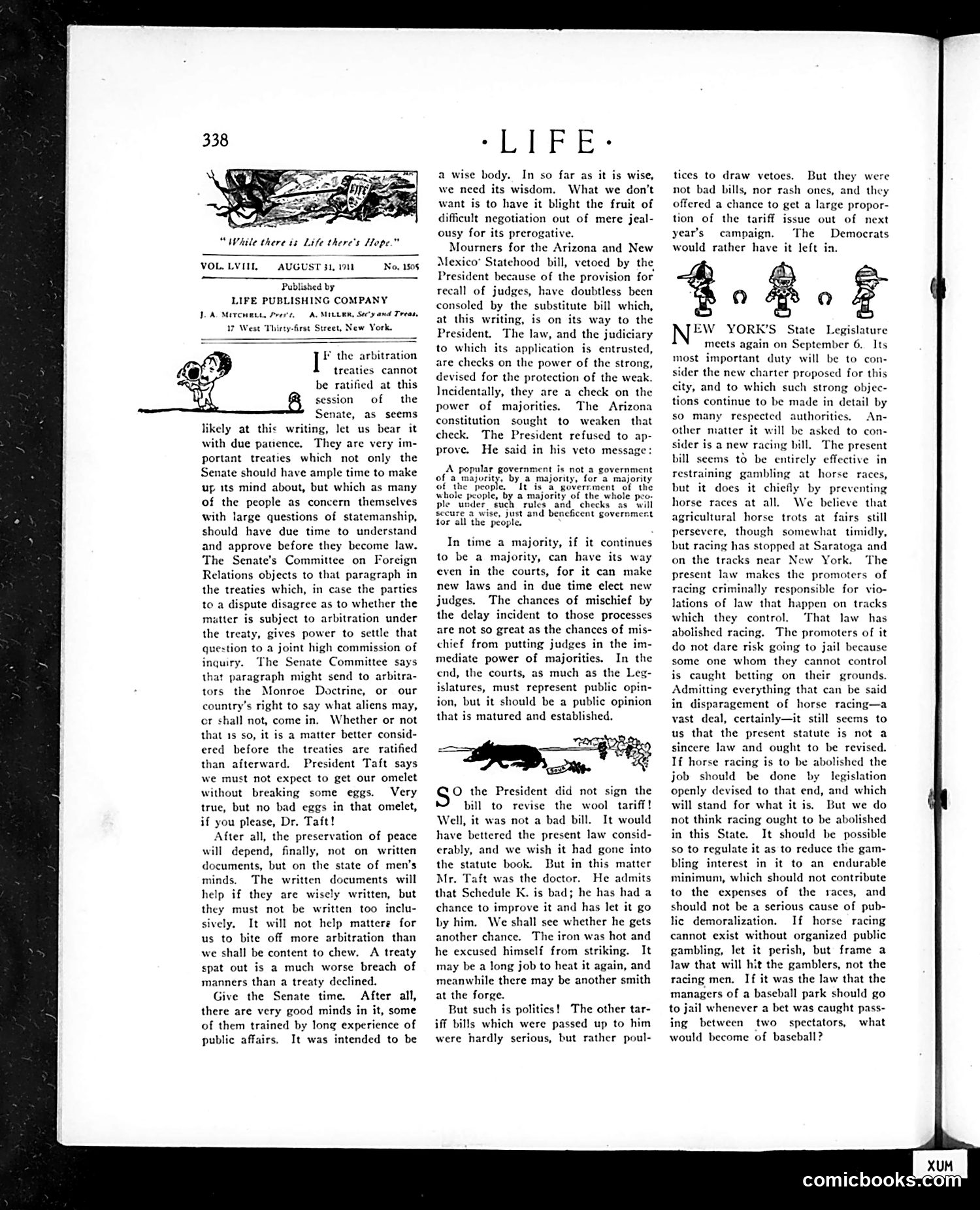
What you’re looking at
This editorial page discusses President Taft's veto of an Arizona statehood bill and debates about horse-racing regulation in New York. **The cartoon** (top left) shows a small figure labeled "While there is Life there's Hope," appearing to reference optimism despite political setbacks. **Key political content:** The editorial critiques Taft for rejecting Arizona's statehood due to concerns about judicial recall provisions, arguing the President overstepped by vetoing a bill aimed at protecting citizens' power. The text presents this as Taft being overly cautious about constitutional checks on executive power. **Secondary topic:** The page also discusses efforts to regulate or abolish horse-racing gambling in New York, framing it as a public morality issue requiring legislative action rather than track-owner self-regulation. The tone is skeptical of both Taft's constitutional conservatism and industry self-policing.
📄 Transcribed text from this page (OCR, searchable)
Machine-transcribed from the original scan — historical spelling and the odd misread are preserved.
“While there is Life there's Hope.” VOL. LVII, = AUGUST 31, 1911 No, 150 Published by LIFE PUBLISHING COMPANY JA. Mer Peeve, W West Thies AL MILER, See’ and Treas, w York. first Street, D I’ the arbitration treaties cannot be ratified at this session of the Senate, as seems likely at this writing, let us bear it with due patience. They are very im- portant treaties which not only the Senate should have ample time to make ‘up its mind about, but which as many of the people as concern themselves with large questions of statemanship, should have due time to understand and approve before they become law. The Senate’s Committee on Foreign Relations objects to that paragraph in the treaties which, in case the parties to a dispute disagree as to whether the matter is subject to arbitration under the treaty, gives power to settle that question to a joint high commission of ingui The Senate Committee says that paragraph might send to arbitra- tors the Monroe Doctrine, or our country’s right to say what aliens may, cr shall not, come in. Whether or not that 1s so, it is a matter better consid- ered before the treaties are ratified than afterward, President Taft says we must not expect to get our omelet without breaking some eggs. Very true, but no bad eggs in that omelet, if you please, Dr. Taft! After all, the preservation of peace will depend, finally, not on written documents, but on the state of men’s minds. The written documents will help if they are wisely written, but they must not be written too inclu- sively. It will not help mattere for us to bite off more arbitration than we shall be content to chew. A treaty spat out is a much worse breach of manners than a treaty declined. Give the Senate time, After all, there are very good minds in it, some of them trained by long experience of public affairs. It was intended to be *LIP E> a wise body. In so far as it is wise, we need its wisdom. What we don't want is to have it blight the fruit of difficult negotiation out of mere jeal- ousy for its prerogative. Mourners for the Arizona and New Mexico’ Statehood bill, vetoed by the President because of the provision for recall of judges, have doubtless been consoled by the substitute bill which, at this writing, on its way to the President, The law, and the judiciary to which its application is entrusted, are checks on the power of the strong, devised for the protection of the weak. Incidentally, they are a check on the power of majorities. The Arizona constitution sought to weaken that check. The President refused to ap- prove. He said in his veto message: A popular government is not a government najority, by a majority, for a majority ‘ople, “It isa goverrment of the ‘ople, by a majority of the whole peo- ler_ such rules and checks as will a wise, just and beneficent government the people. In time a majority, if it continues to be a majority, can have its way nin the courts, for it can make new laws and in due time elect new judges. The chances of mischief by the delay incident to those processes are not so great as the chances of mis- chief from putting judges in the im- mediate power of majorities. In the end, the courts, as much as the Leg- islatures, must represent public opin- ion, but it should be a public opinion that is matured and established. O the President did not sign the bill to revise the wool tariff! Well, it was not a bad bill. It would have bettered the present law consid- erably, and we wish it had gone into the statute book. But in this matter Mr. Taft was the doctor. He admits that Schedule K. is bad; he has had a chance to improve it and has let it go by him. We shall see whether he gets another chance. The iron was hot and he excused himself from striking. It may be a long job to heat it again, and meanwhile there may be another smith at the forge. But such is politics!) The other tar- iff bills which were passed up to him were hardly serious, but rather poul- tices to draw vetoes. But they were not bad bills, nor rash ones, and they offered a chance to get a large propor- tion of the tariff issue out of next year’s campaign. The Democrats would rather have it left in. Go Bo F EW YORK’S State Legislature meets again on September 6. Its most important duty will be to con- ider the new charter proposed for this city, and to which such strong objec- tions continue to be made in detail by so many respected authoritie An- other matter it will be asked to cor sider is a new racing bill. The present bill seems tO be entirely effective in restraining gambling at horse races, but it does it chiefly by preventing horse races at all. We believe that agricultural horse trots at fairs. still persevere, though somewhat timidly, but racing has stopped at Saratoga and on the tracks near New York. The present law makes the promoters of racing criminally responsible for vio- lations of law that happen on tracks which they control. That law has abolished racing. The promoters of it do not dare risk going to jail because some one whom they cannot control is caught betting on their grounds. Admitting everything that can be said sparagement of horse racing—a vast deal, certainly—it still seems to us that the present statute is not a sincere law and ought to be revised. If horse racing is to be abolished the job should be done by legislation openly devised to that end, and which will stand for what it is. But we do not think racing ought to be abolished in this State. It should be possible so to regulate it as to reduce the gam- bling interest in it to an endurable minimum, which should not contribute to the expenses of the races, and should not be a serious cause of pub- lic demoralization. If horse racing cannot exist without organized public gambling, let it perish, but frame a law that will hit the gamblers, not the racing men. If it was the law that the managers of a baseball park should go to jail whenever a bet was caught pass- ing between two spectators, what would become of baseball? comicbook wo 0)