
Life, 1911-08-31 · page 34 of 38
Life — August 31, 1911 — page 34: what you’re looking at
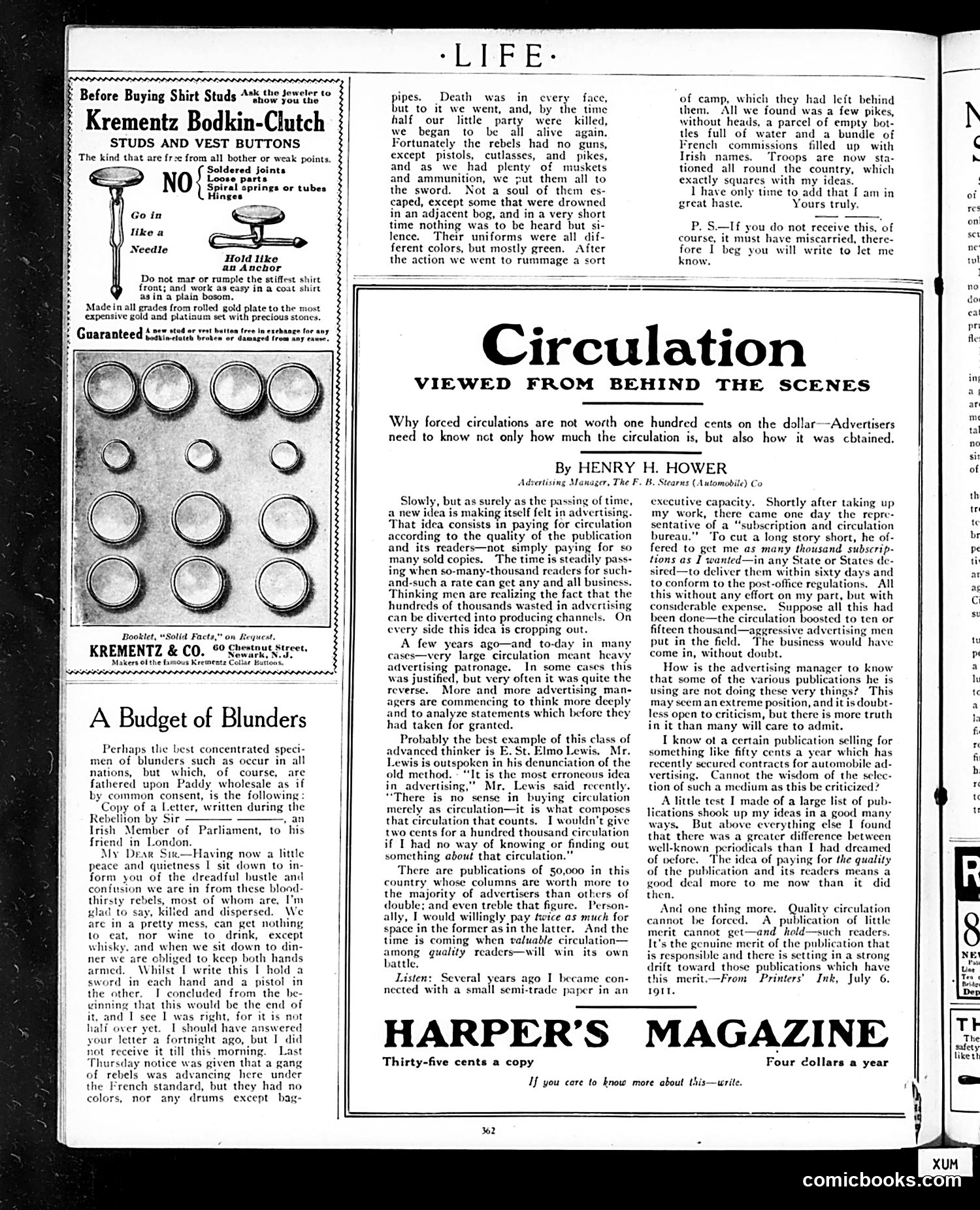
What you’re looking at
This page contains **advertising and editorial content**, not political cartoons. The main satirical piece is **"A Budget of Blunders,"** a humorous letter supposedly written by an Irish Member of Parliament during Ireland's rebellion. The joke relies on absurd contradictions: the writer describes rebels advancing while simultaneously claiming he wasn't "half over yet" having already won; rebels carried only pistols and pikes while he possessed muskets; he holds two swords and a pistol while writing. The humor targets Irish stereotypes and incompetence through a deliberately nonsensical account of military victory. The page's substantial article, **"Circulation Viewed from Behind the Scenes"** by Henry H. Hower, discusses advertising strategy—arguing that publication circulation quality matters more than raw numbers. This reflects early 20th-century debates about advertising effectiveness. The remainder comprises **product advertisements** for Krementz shirt studs and Harper's Magazine, typical of period publications. The satire is mild and domestic, not political.
📄 Transcribed text from this page (OCR, searchable)
Machine-transcribed from the original scan — historical spelling and the odd misread are preserved.
: Before Buying Shirt Studs **%,the sovcies «© Krementz Bodkin-Clutch STUDS AND VEST BUTTONS The kind that are fr-¢ from all bother or weak points. NO ie Soldered joints se parts ral oprings or tubes Goin like a linges Needle Hold like an Anchor Do not mar or rumple the stiffest shirt front; and work as easy in a coat shirt as in’a plain bosom. Made in all grades from rolled gold plate to the most ‘expensive gold and platinum set with precious stones. Guaranteed Sirti Sts usenet Hit Facts," on KREMENTZ & CO. 09 Soenntgees Makers of the famous Kremente Collar Huttoas. A Budget of Blunders Perhaps the best concentrated speci- men of blunders such as occur in all nations, but which, of course, are fathered upon Paddy wholesale as if by common consent, is the following: opy of a Letter, written during the Rebellion by Sir an Irish Member of Parliament, to his friend in London. My Dear Sik—Having now a little peace and quietness I sit down to in- form you of the dreadful bustle and confusion we are in from these blood- thirsty rebels, most of whom are, I’m glad to say, killed and dispersed. We are in a pretty mess, can get nothing to eat, nor wine to. drink, except whisk d when we sit down to din- ner we are obliged to keep both hands armed. Whilst [I write this | hold a sword in each hand and a pistol in the other. I concluded from the be- winning that this would be the end of it, and I see I was right, for it is not half over yet. I should have your letter a fortnight ago, but I did not receive it till this morning. Last ‘Thursday notice was given that a gang of rebels was advancing here under the French standard, but they had no colors, nor any drums except. bag- ipes. Death was in every face, but to it we went, and, by the time half our little party were killed, we began to be all alive again. Fortunately the rebels had no guns, except pistols, cutlasses, and pikes, and as we had plenty’ of muskets and ammunition, we put them all to the sword. Not a soul of them es- caped, except some that were drowned in an adjacent bog, and in a very short time nothing was to be heard but si- lence. Their uniforms were all dif- ferent colors, but mostly green. After the action we went to rummage a sort of camp, which they had left behind them. All we found was a few pikes, without heads, a parcel of empty bot tles full of water and a bundle of French commissions filled up with Irish names. Troops are now sta- tioned all round the country, which exactly squares with my ideas. 1 have only time to add that [am in great haste. Yours truly. P. S—If you do not receive this, of course, it must have miscarried, ther fore I beg you will write to let me know. Circulation VIEWED FROM BEHIND THE SCENES Why forced circulations are not worth one hundred cents on the dollar -Advertisers need to know not only how much the circulation is, but also how it was cbtained. By HENRY H. HOWER Advertising Manager, The F. B. Stearns (Automobile) Co Slowly, but as surely as the passing of time, a new idea is making itsclf felt in advertising. ‘That idea consists in paying for circulation cording to the quality of the publication and its readers—not simply. paying for so many sold copies. The time is steadily pass- ing when so-many-thousand readers for such- nd-such a rate can get any and all business. Thinking men are realizing the fact that the hundreds of thousands wasted in advertising can be diverted into producing channels. On every side this idea is cropping out. A few years ago—and to-day in many cases—very large circulation meant heavy advertising patronage. In some cases this was justified, but very often it was quite the reverse. More and more advertising man- agers are commencing to think more deeply and to analyze statements which before they had taken for granted. Probably the best example of this class of advanced thinker is E. St. Elmo Lewis. Mr. Lewis is outspoken in his denunciation of the old method. - “It is the most erroncous idea in_advertising,” Mr, Lewis said recently. “There is no’ sense in buying circulation merely as circulation—it is what composes that circulation that counts. I wouldn't give two cents for a hundred thousand circulation if I had no way of knowing or finding out something about that circulation.” There are publications of 50,000 in this country whose columns are worth more to the majority of advertisers than others of double; and even treble that figure. Person- ally, | would willingly pay twice as much for space in the former asin the latter. And the time is coming when valuable circulation— among guality rcaders—will win its own battle. Listen: Several years ago I became con- nected with a small semi-trade paper in an HARPER’S Thirty-five cents a copy executive capacity. Shortly after taking up my work, there came one day the repre- sentative of a “subscription and circulation bureau.” To cut a long story short, he of- fered to get me as many thousand subscrip- tions as J wanted—in any State or States de- sired—to deliver them within sixty days and to conform to the post-office regulations. All this without any effort on my part, but with considerable expense. Suppose all this had been done—the circulation boosted to ten or fifteen thousand—aggressive advertising men put in the field. The business would have come in, without doubt. How is the advertising manager to know that some of the various publications he using are not doing these very things? This may scem an extreme position, and it is doubt- less open to criticism, but there is more truth in it than many will care to admit. I know ot a certain publication selling for something like fifty cents a year which ha recently secured contracts for automobile ad- vertising. Cannot the wisdom of the sclec- tion of such a medium as this be criticized? A little test I made of a large list of pub- lications shook up my ideas in a good many ways. But above everything else I found that there was a greater difference between well-known periodicals than I had dreamed of vefore. The idea of paying for the quality of the publication and its readers means a good deal more to me now than it did then. And one thing more. Quality circulation cannot be forced. A publication of little merit cannot get—and hold—such readers. It's the genuine merit of the publication that is responsible and there is setting in a strong drift toward those publications which have this merit.—From Printers’ Ink, July 6. 1911. MAGAZINE Four dollars a year Jf you care to know more about this—write. comicbooks. co like th