
Life, 1911-08-31 · page 32 of 38
Life — August 31, 1911 — page 32: what you’re looking at
What you’re looking at
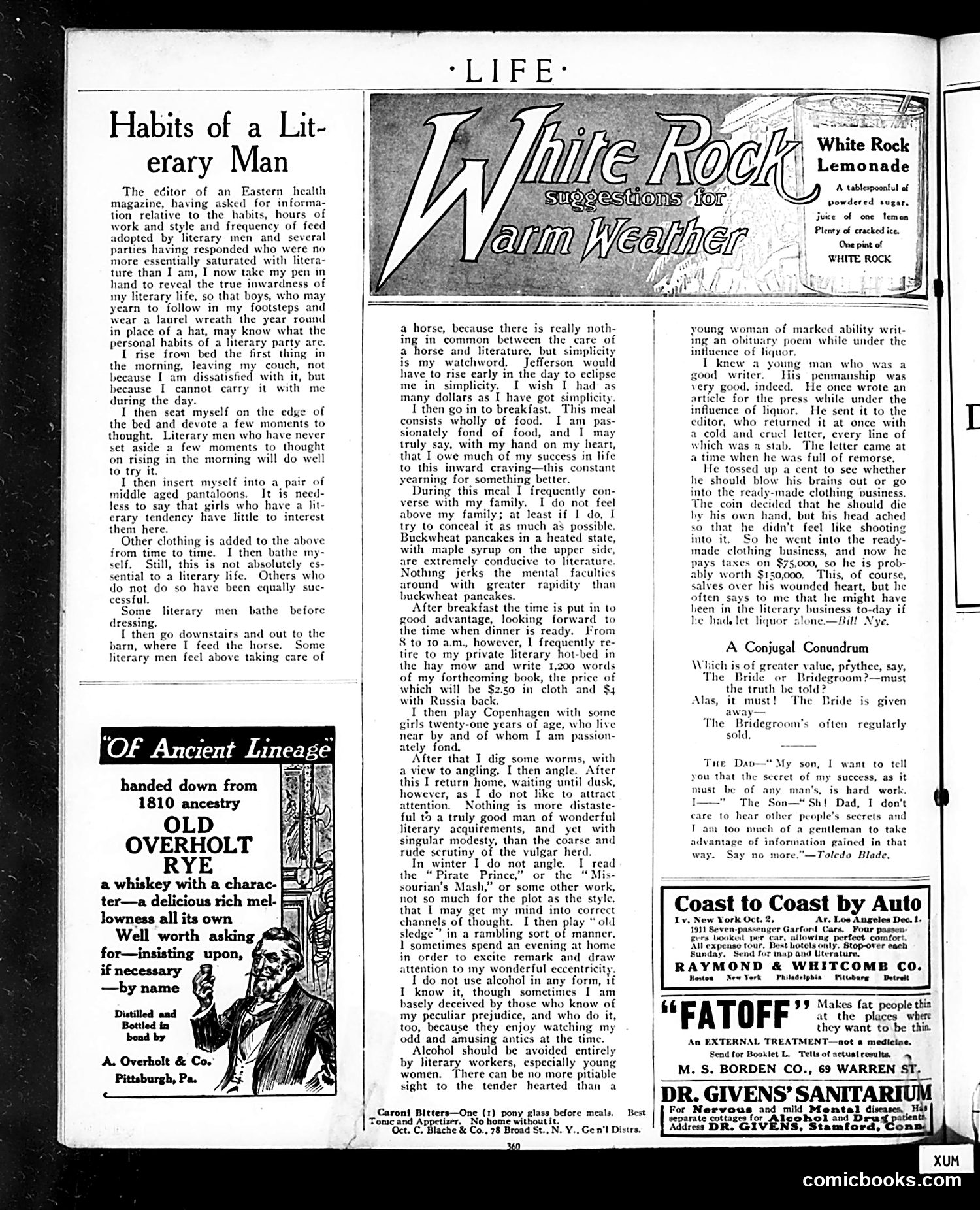
This humorous essay satirizes pompous literary men who affect superiority while living ordinary lives. The author mockingly describes a "literary man's" daily routine—rising, dressing, feeding his horse, eating buckwheat pancakes—presenting mundane activities as if they required philosophical justification. The satire targets the pretension of writers who consider themselves above manual labor (like caring for horses) or public attention, yet whose actual accomplishments are modest. The joke intensifies when he mentions writing 1,200 words daily for a $2.50 book, plays games with local girls, and fishes—activities hardly befitting the "wonderful literary acquirements" he claims. The piece mocks the self-importance of mediocre writers who adopt affected mannerisms and speak of their "peculiar prejudice" against alcohol while engaging in thoroughly ordinary pursuits. It's gentle satire on literary pretension and vanity.
📄 Transcribed text from this page (OCR, searchable)
Machine-transcribed from the original scan — historical spelling and the odd misread are preserved.
Habits of a Lit- erary Man The editor of an Eastern health magazine, having asked for informa- tion relative to the habits, hours of work and style and frequency of feed adopted by literary men and several parties having responded who were no more essentially saturated with litera- ture than I am, I now take my pen in hand to reveal the true inwardness of my literary life, so that boys, who may yearn to follow in my footsteps and wear a laurel wreath the year round in place of a hat, may know what the personal habits of a literary party are. I rise from bed the first thing in the morning, leaving my couch, not because I am dissatisfied with it, but because I cannot carry it with me during the day. ; I then seat myself on the edge of the bed and devote a few moments to thought. Literary men who have never set aside a few moments to thought on rising in the morning will do well to try it. I then insert myself into a. pair of middle aged pantaloons. It is need- ess to say that girls who have a lit- erary tendency have little to interest then here. Other clothing is added to the above from time to time. I then bathe my- self. Still, this is not absolutely es- sential to a literary life. Others who do not do so have been equally suc- cessful. Some dressing. I then go downstairs and out to the barn, where I feed the horse. Some literary men feel above taking care of literary men bathe before handed down from 1810 ancestry OLD OVERHOLT RYE a whiskey with a charac- lowness all its own Well worth asking for—insisting upon, if necessary —by name Distilled and Bottled in bond by ay A. Overholt & Co." Pittsburgh, Pa. White Rock | Lemonade A tablespoonful of powdered sugar. Juice of one temen Pleoty of cracked ice. One pint of WHITE ROCK a horse, because there is really noth- ing in common between the care of a horse and literature, but simplicity is my watchword. Jefferson would have to rise early in the day to eclipse me in simplicity. I wish I had as many dollars as I have got simplicity. I then go in to breakfast. This meal consists wholly of food. I am_pas- sionately fond of food, and I may truly say, with my hand on my hea that I owe much of my success in life to this inward craving—this constant yearning for something better. During this meal I frequently con- verse with my_ family. do not feel above my family; at east if I do, I try to conceal it as much aS possible. Buckwheat pancakes in a heated state, with maple syrup on the upper side, are extremely conducive to literature. othing jerks the mental facultics ound with greater rapidity than buckwheat pancakes. After breakfast the time is put in to good advantage, looking forward to the time when dinner is ready. Irom 8 to 10 a.m., however, I frequently re- tire to my private literary hot-bed in the hay mow and write 1,200 words of my forthcoming book, the price of which will be $2.50 in cloth and $4 with Russia back. I then play Copenhagen with some girls twenty-one years of age, who live near by and of whom [ am passion- ately fond. After that I dig some worms, with a view to angling. I then angle. After this I return home, waiting until dusk, however, as I do not like to attract attention. Nothing is more distaste- ful td a truly good man of wonderful literary acquirements, and t owith singular modesty, than the coarse and rude scrutiny of the vulgar herd. In ter I_do not angle. I read the “Pirate Prince,” or the “ Mis- sourian’s Mash,” or some other work, not so much for the plot as the style. that | may get my mind into correct channels of thought. I then play * old ; a rambling sort of manner. 1 sometimes spend an evening at home in order to excite remark and draw attention to my wonderful eccentricity. I do not use alcohol in any form, if I know it, though sometimes I am basely deceived by those who know of my peculiar prejudice, and who do it, too, because they enjoy watching my odd and amusing antics at the tim Alcohol should be avoided entirely by literary workers, especially young women. There can be no more pitiable sight to the tender hearted than a Lv, New York Oct. 2. young woman of marked ability writ- ing an obituary poem while under the intluence of liquor. T knew a young man who was a good writer.” His penmanship was very good, indeed. He once wrote an article for the press while under the influence of liquor. He sent it to the editor, who returned it at once with a cold and cruel letter, every line of which was a stab. The letter came at atime when he was full of remorse. He tossed up a cent to see whether he should blow his brains out or go into the ready-made clothing business. The coin decided that he should dic hy his own hand, but his head ached so that he didn't feel like shooting into it. he went into the ready- made clothing business, and now. he ays taxes on $75,000, so he is prob- ly worth $130,000, This, of course, salves over his wounded heart, but he often says to me that he might have heen in the literary business to-day if he hadslet liquor slone—Rill Nye. A Conjugal Conundrum of greater value, prythee, say, de or Bridegroom?—must the truth be told? Alas, it must! The away— The Bridegroom’s sold. Bride is given often regularly Tue Dav—" My son, I want to tell you that the secret of my success, as it of any man's, is hard work. The Son—“ Sh! Dad, I don't care to hear other people's secrets and Tam too muuch of a gentleman to take dvantage of information gained in that Say no more."—Toledo Blade. 1911 Seven-pascenger Garford Cara. Pour passen- gers Lookel per car, allowing perfect comfort. All expense ¥. Stopover each Sunday. Send for map and Uterature. Weston New York Philadelphia Puubarg — Detreit “FATOFF’ An EXTERNAL TREATMENT—not @ medicine. Send for Booklet L. Tells of actual rewulte, Coast to Coast by Auto Ar. Loe Angeles Dec. 1- RAYMOND & WHITCOMB Co. 9 Makes fat people thia at the places where they want to be thin. M. S. BORDEN CO., 69 WARREN ST, | t Caront Bitters—One (1) pony glass before meals. Best Tomcand Appetizer. No home without it. Oct. C. Blache & Co., 78 Broad St., N. Y., Gen'l Distrs. DR. GIVENS’ SANITARIUM | For Nervous and mild Mental diseases, His separate cottages for Alcohol and Dra: Address DR. GIVENS, Stamford, Cons th comicbooks.co