
A complete issue · 44 pages · 1911
Life — July 13, 1911
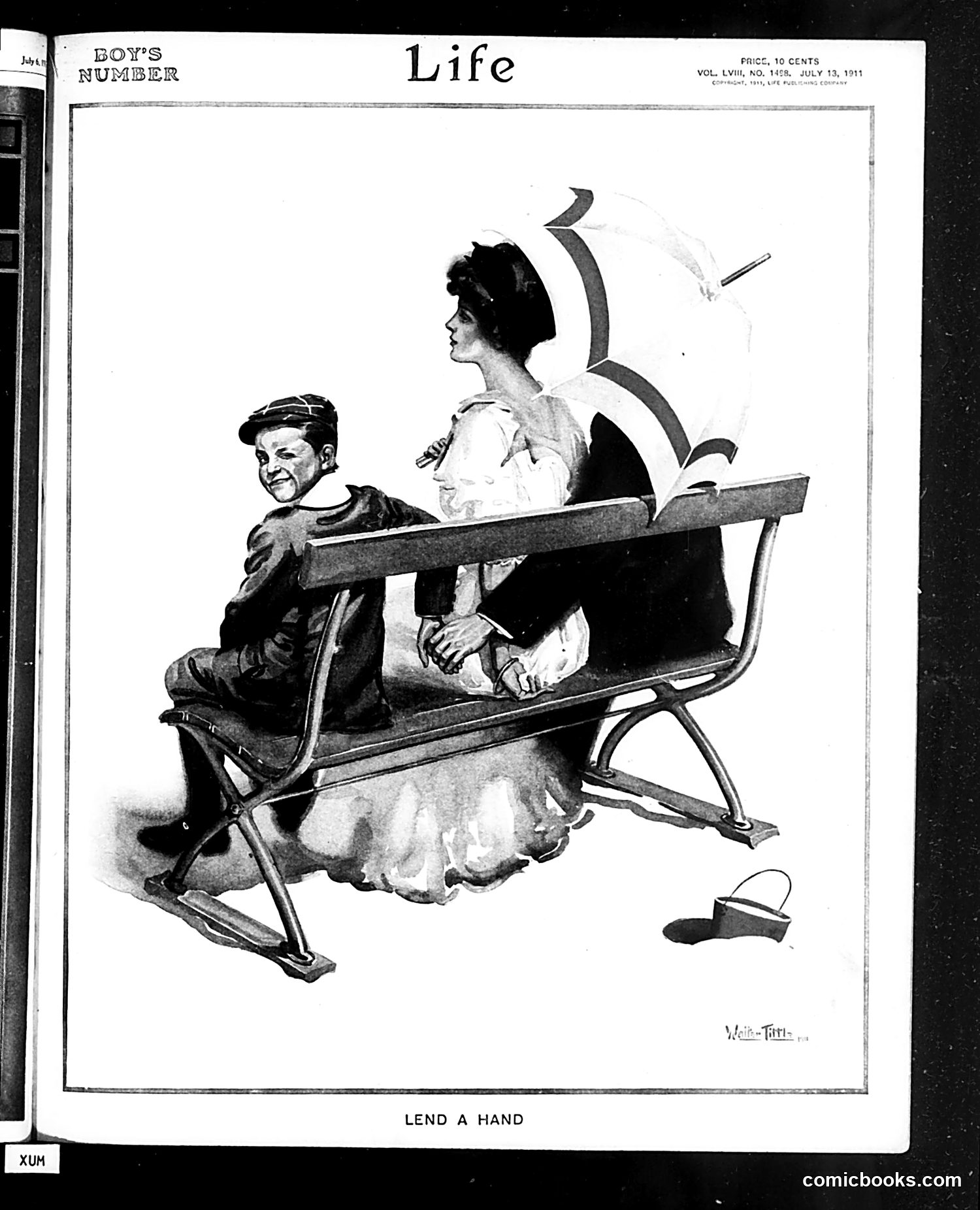
This cartoon satirizes gender roles and marital dynamics of the Edwardian era. A woman in fashionable dress sits in a modern mechanical chair or lounging device, while a small boy (likely her son) strains to operate or stabilize it, appearing to struggle with the contraption's complexity. The title "Lend a Hand" ironically suggests the woman should help, but instead depicts a child laboring to serve her comfort. The satire targets the period's expectation that men (represented here by even a young boy) should cater to women's leisure and comfort, regardless of the physical burden. The illustration criticizes the impracticality of such gender expectations and the mechanical "progress" that paradoxically made women's lives more complicated rather than easier.
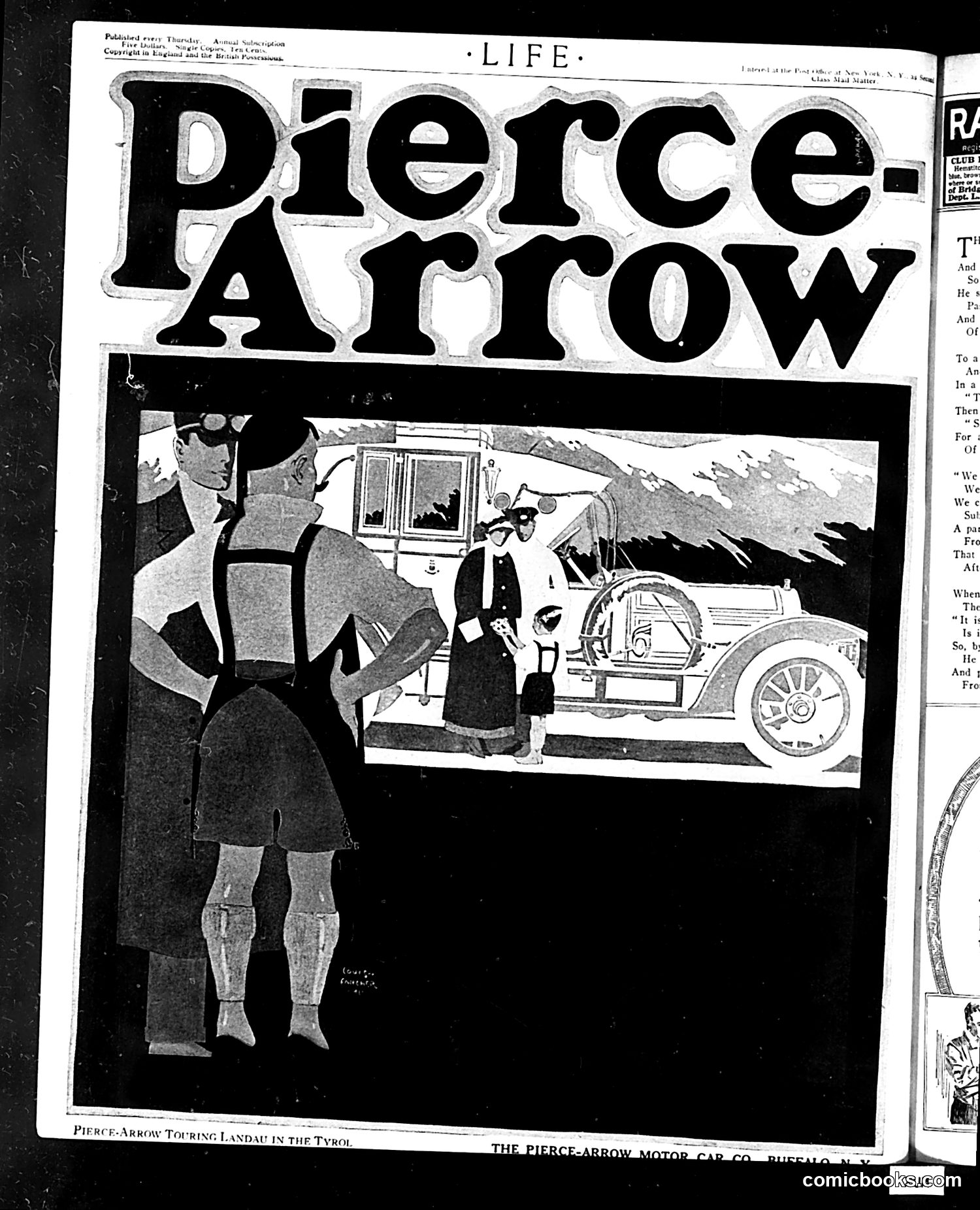
This is primarily a **product advertisement** for the Pierce-Arrow Motor Car Company of Buffalo, New York, not political satire. The page shows a stylized illustration of a fashionable woman in 1920s attire viewing an advertisement depicting a Pierce-Arrow automobile with passengers in a mountainous landscape. The "satire" is subtle and commercial: Life magazine's satirical edge comes through in the elegant, somewhat exaggerated rendering of the woman observer—her pose and fashion suggest aspirational consumerism. The ad itself promotes the Pierce-Arrow as a luxury touring vehicle capable of scenic mountain travel, appealing to wealthy readers. This represents Life's dual nature: a satirical publication that also carried upscale advertising targeting its affluent readership.
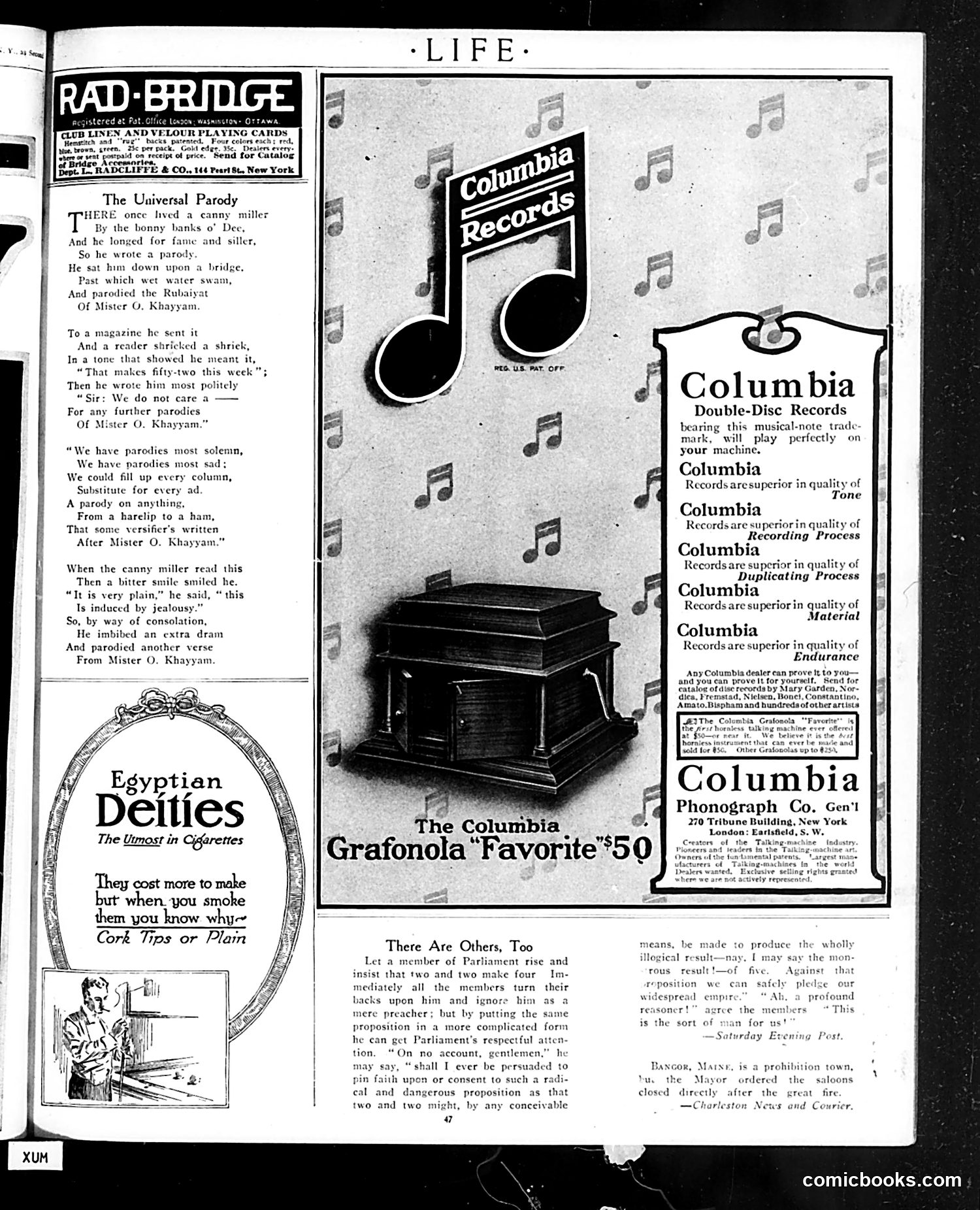
This page is primarily **advertising** (Columbia Records Grafonola and Egyptian Deities cigarettes), with a satirical poem occupying the left column. "The Universal Parody" mocks literary parody itself. The poem describes a "canny miller" who wrote a parody about a bridge and the Khayam (likely Omar Khayyam, the Persian poet). When criticized for unoriginality—that parodies are common—he responds by writing another parody *about* parodies, joking that "a parody on anything" could substitute for any content. The satire targets the prevalence of parody in contemporary literature, suggesting it had become so ubiquitous and lazy that one could parody the concept of parody itself. It's a meta-joke about artistic exhaustion.
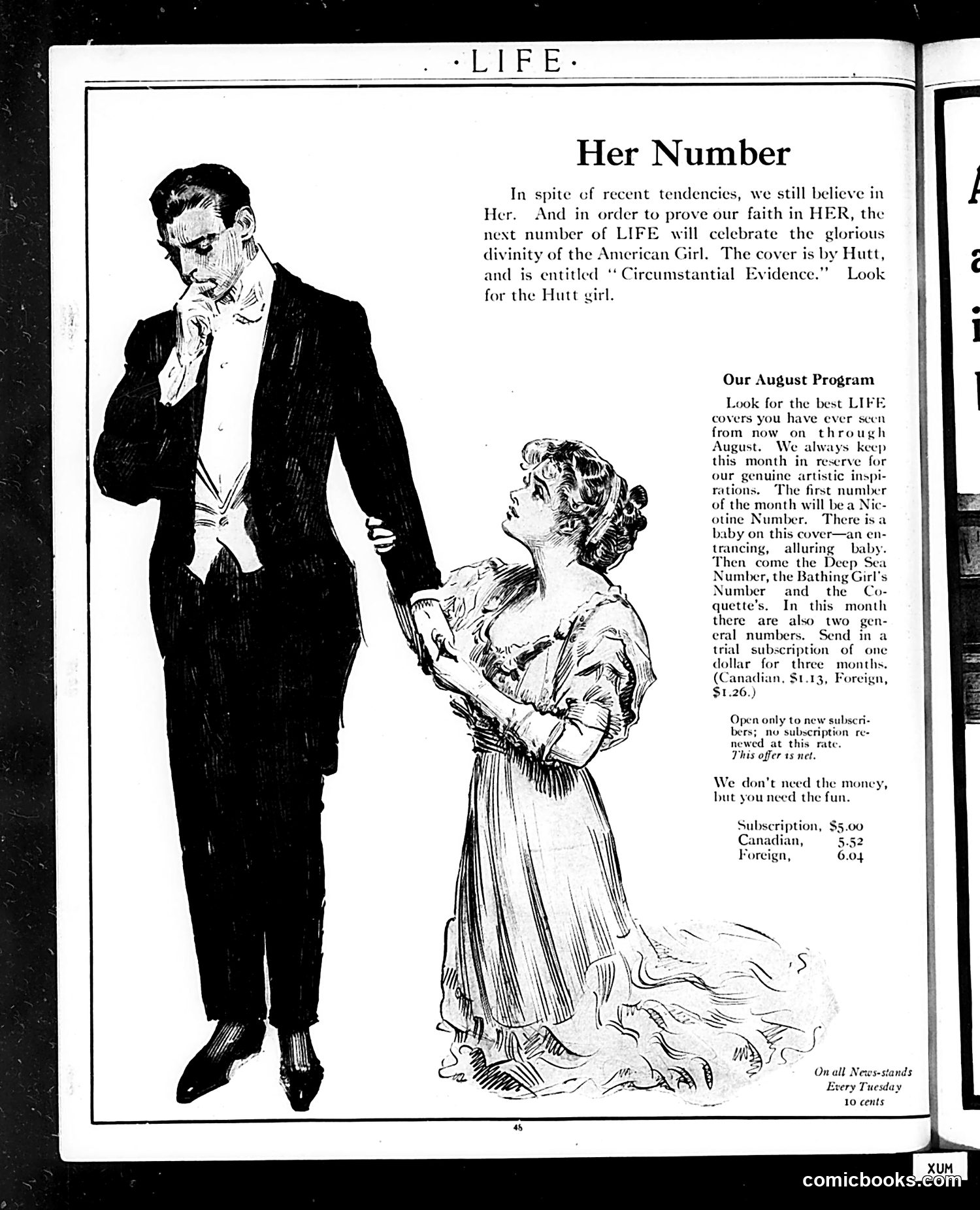
This page is primarily **advertising and editorial promotion** for Life magazine rather than political satire. The illustration shows a stylized couple in formal attire—a man in a tuxedo and a woman in an elegant gown—which appears to be decorative rather than depicting specific figures. The text announces upcoming cover issues, particularly highlighting a Hutt girl cover titled "Circumstantial Evidence." The editorial promises various themed issues throughout August, including a "Notting Number," "Deep Sea Number," and "Bathing Girl's Number." The content emphasizes Life's commitment to celebrating "the glorious divinity of the American Girl," reflecting early 20th-century magazine marketing focused on idealized feminine imagery. The subscription rates and newsstand prices indicate this is vintage advertising material rather than political commentary.
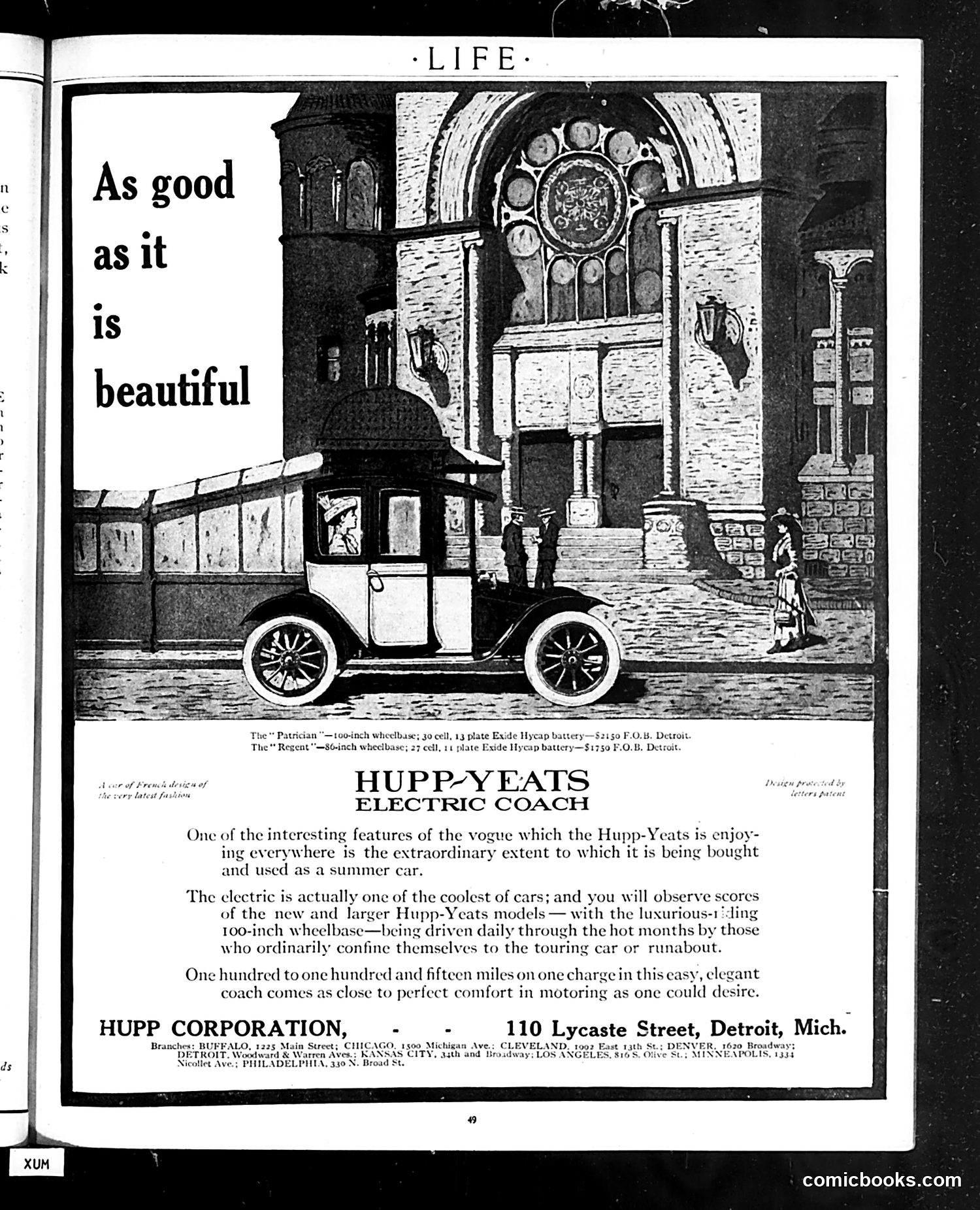
This page is **primarily an advertisement**, not satire or political commentary. It advertises the Hupp-Yeats Electric Coach, an early electric automobile manufactured by the Hupp Corporation of Detroit. The illustration shows a small, boxy electric car parked outside an ornate church or cathedral. The tagline "As good as it is beautiful" emphasizes the vehicle's aesthetic appeal alongside functionality. The ad highlights practical advantages for summer driving: electric cars were cooler than gasoline vehicles, could travel 150 miles on one charge, and offered comfortable, elegant motoring. The ecclesiastical setting may suggest reliability and respectability rather than any specific satirical point. This represents early automotive marketing targeting wealthy consumers seeking practical yet luxurious personal transportation during the electric car era of the 1910s-20s.
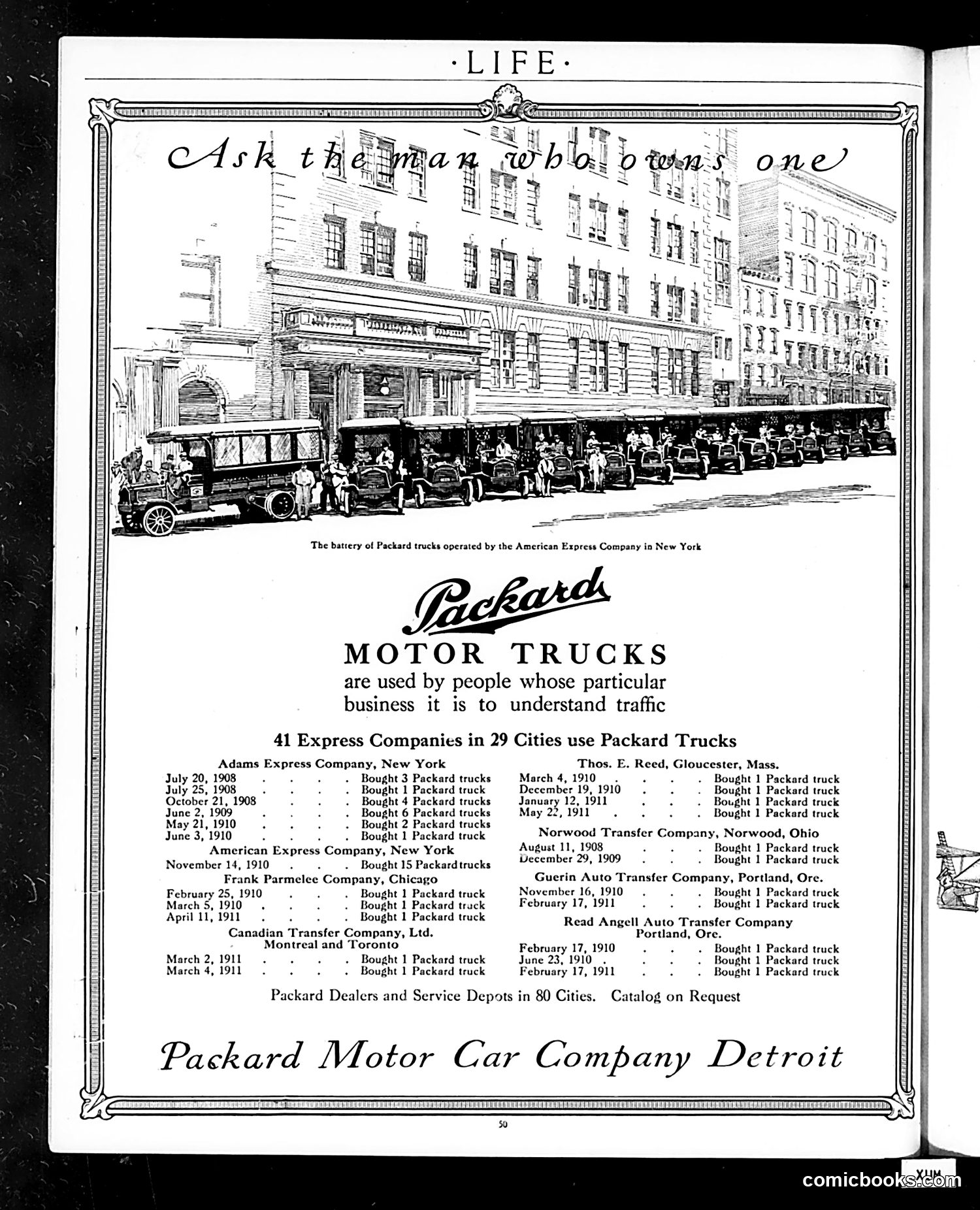
This page is **primarily an advertisement**, not political satire. It promotes Packard Motor Trucks to commercial businesses, specifically delivery and express companies. The illustration shows a fleet of Packard trucks lined up outside a New York City building, demonstrating the vehicles' use by the American Express Company. The accompanying text lists 41 express companies across 29 cities that have purchased Packard trucks, with specific purchase dates from 1908-1911. The marketing message targets business owners: "Packard Motor Trucks are used by people whose particular business it is to understand traffic." This appeals to commercial enterprises by emphasizing reliability and industry adoption. There is no political cartoon or satire present—this is straightforward early automotive advertising leveraging testimonials from established companies to build consumer confidence in Packard's commercial vehicles.
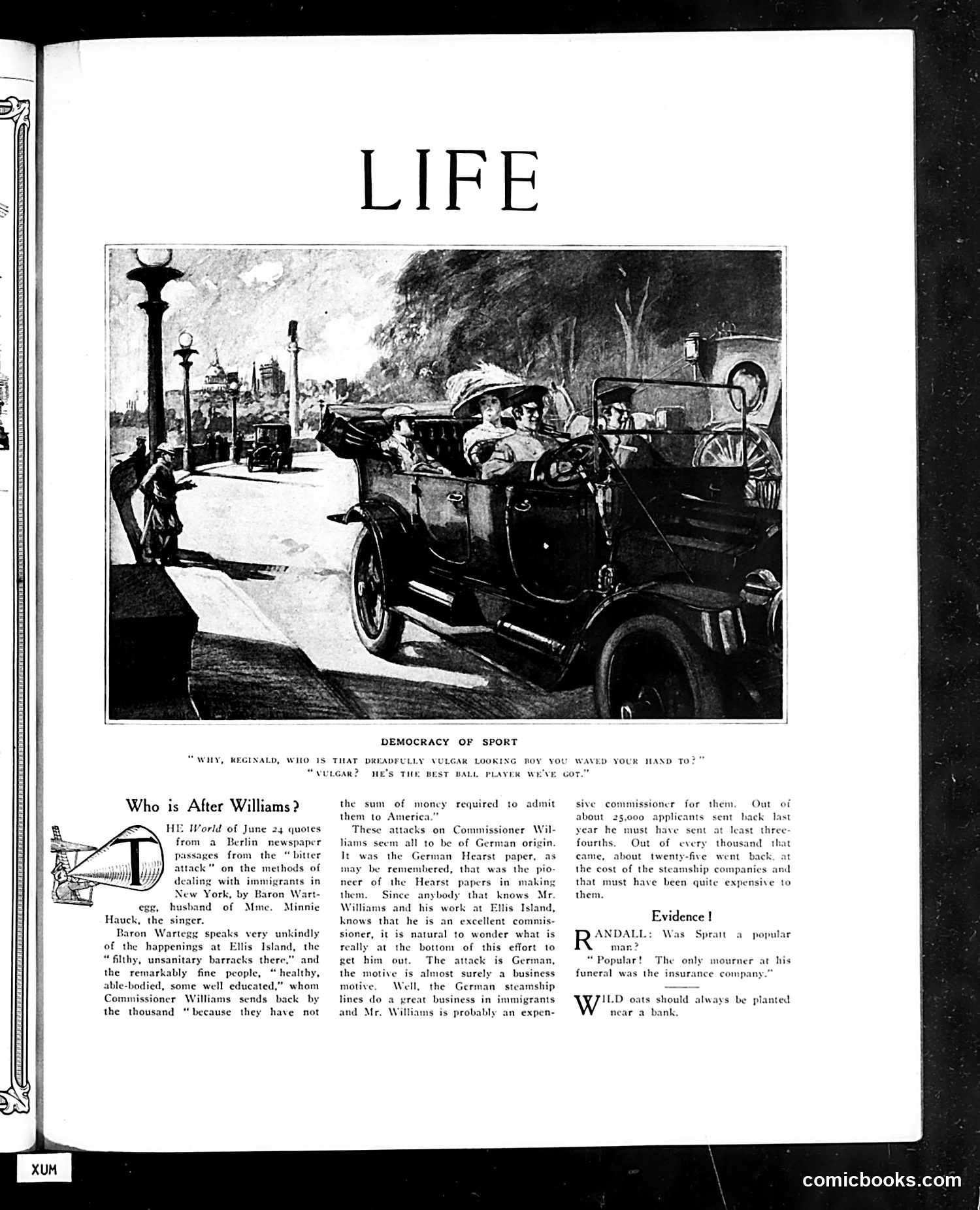
This page satirizes class tensions in early 20th-century America. The cartoon shows wealthy people in an automobile, with the caption highlighting a "vulgar looking boy" waving. The accompanying article "Who is After Williams?" discusses Commissioner Williams and attacks allegedly "of German origin" against him, suggesting xenophobic concerns about immigrant influence. The satire critiques how wealthy Americans ("democracy of sport") exclude working-class people while simultaneously blaming foreigners for social problems. The automobile—a symbol of wealth and modernity—physically separates the rich from common people, undermining the stated "democracy." The German origin references likely reflect anti-immigrant sentiment typical of pre-WWI American magazines. The overall message mocks class hypocrisy masked as democratic ideals.
This *Life* magazine page critiques New York State Democratic leadership, particularly Mayor Murphy's control of the party organization. The text argues that the Democratic machine "cannot last" and lacks the diplomatic skill to maintain power—it will lose the state unless Murphy's influence is broken. The editorial also discusses women's education and civic participation, quoting Bishop Lawrence of Boston on female virtue. The piece advocates for educated women in reform movements, naming specific female activists (Jane Addams, Miss Tarbell). A separate section comments on "Cunningham claims," referencing a political figure named Ballinger. The cartoons (small illustrations visible) appear to be humorous spot drawings typical of *Life's* satirical style, though specific details are difficult to discern in this reproduction.
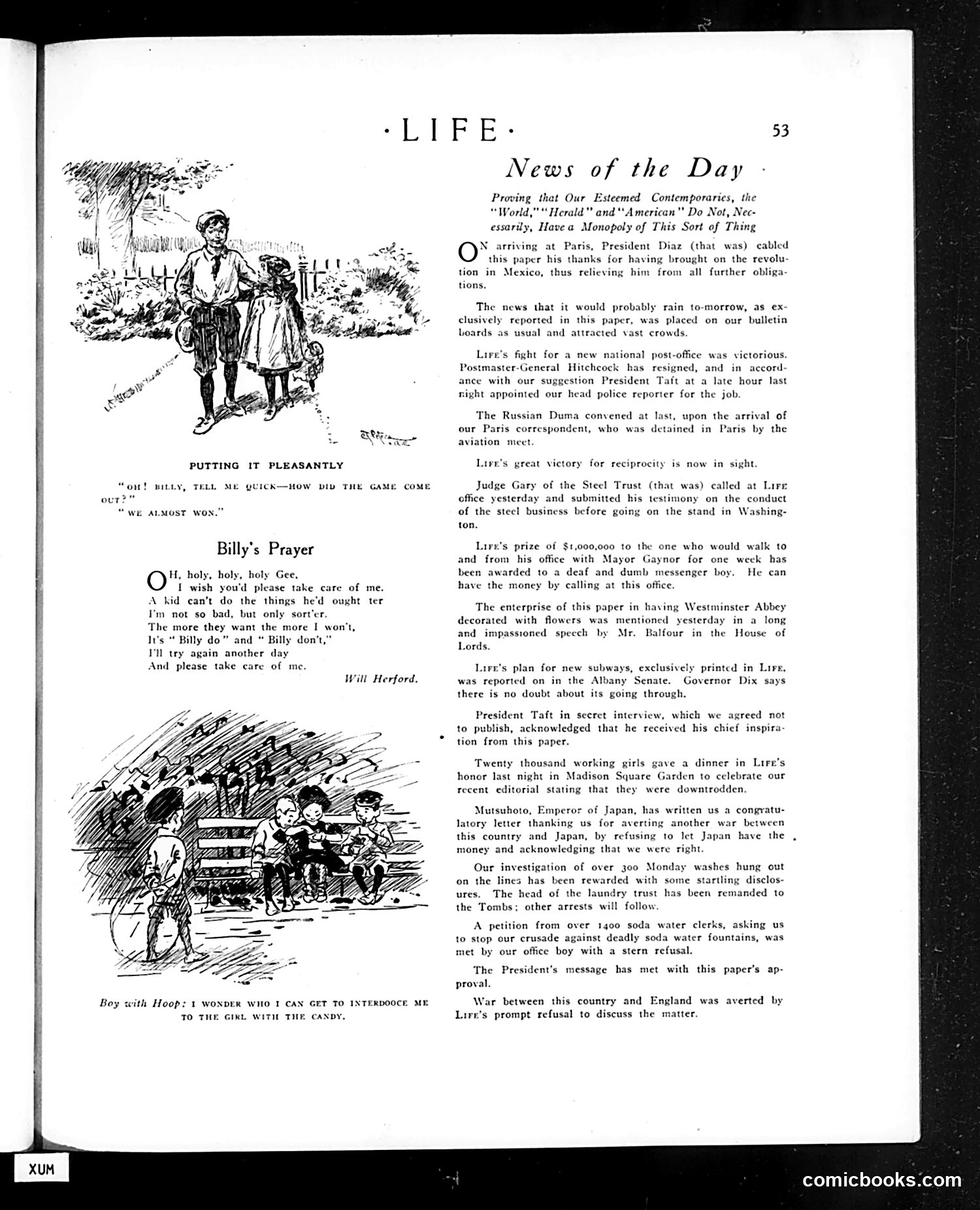
This page satirizes contemporary news through several sketches. "Putting It Pleasantly" depicts a child reporting a game loss to an adult—a domestic humor piece. "Billy's Prayer" is a sentimental poem about a child's bedtime wishes, credited to Will Herford. The main content, "News of the Day," mocks prominent figures and institutions through brief satirical items. References include President Taft receiving inspiration from Life's editorial stance, a $1,000,000 prize offer, discussions of reciprocal trade policy, and coverage of labor issues (laundry trust arrests, soda water clerks' petition). The sketch "Boy with Hoop" appears to be a domestic scene with no clear political meaning. The overall tone suggests Life positioned itself as influential in national affairs while maintaining light humor about contemporary politics and society.
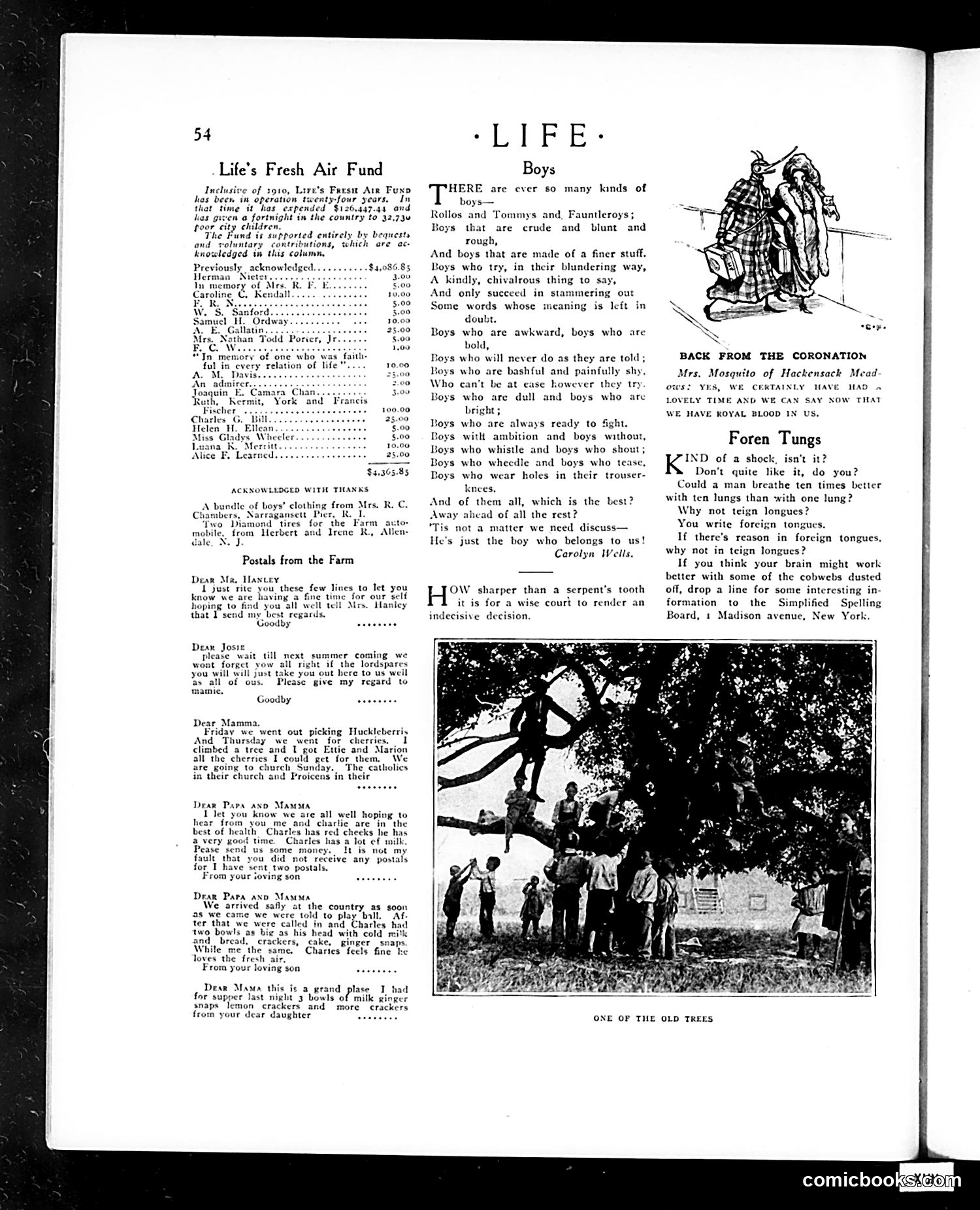
This page contains several distinct sections rather than a unified cartoon: **"Life's Fresh Air Fund"** lists donors to a children's charity program. **"Boys"** is a poem by Carolyn Wells celebrating different types of boys—some crude, some fine, some shy or bold—ultimately praising "the boy who belongs to us." **"Foren Tungs"** is a humorous piece questioning whether people could think better using foreign languages instead of English, playing on the phrase "foreign tongues." **"Back from the Coronation"** references Mrs. Mosquito of Hackensack Meadows, likely a satirical character commenting on the (British royal?) coronation. **"One of the Old Trees"** is a photograph showing children playing in/around a large tree. The page mixes light humor, domesticity, and charitable appeals typical of Life's satirical-yet-family-friendly approach.
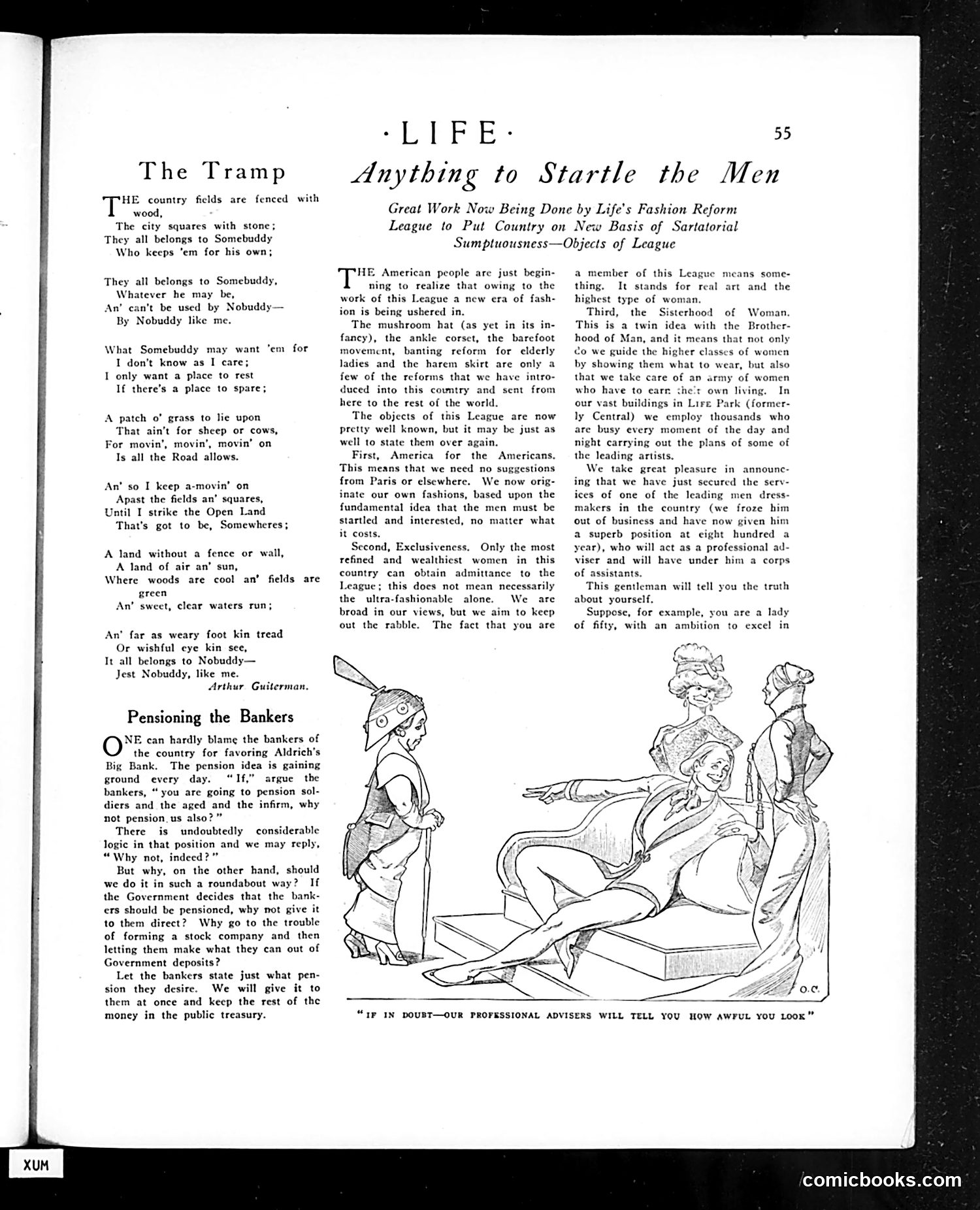
This page contains three distinct pieces of satire: 1. **"The Tramp"** (poem by Arthur Guiterman): A romantic defense of vagabonds and landlessness, celebrating those who reject property ownership and societal constraint. 2. **"Anything to Startle the Men"**: Satirizes Life's Fashion Reform League, which promotes women's practical clothing (ankle corsets, barefoot movement, reformed skirts). The text mocks how only wealthy, "refined" women adopt these reforms while scorning "the rabble," revealing the hypocrisy of supposedly progressive fashion movements. 3. **"Pensioning the Bankers"**: Political satire proposing bankers receive government pensions rather than managing risky stock companies, using ironic logic to expose banking industry conflicts of interest. The accompanying cartoon depicts fashionable women consulting a "professional adviser" about appearance—illustrating the satire about superficial fashion reform.
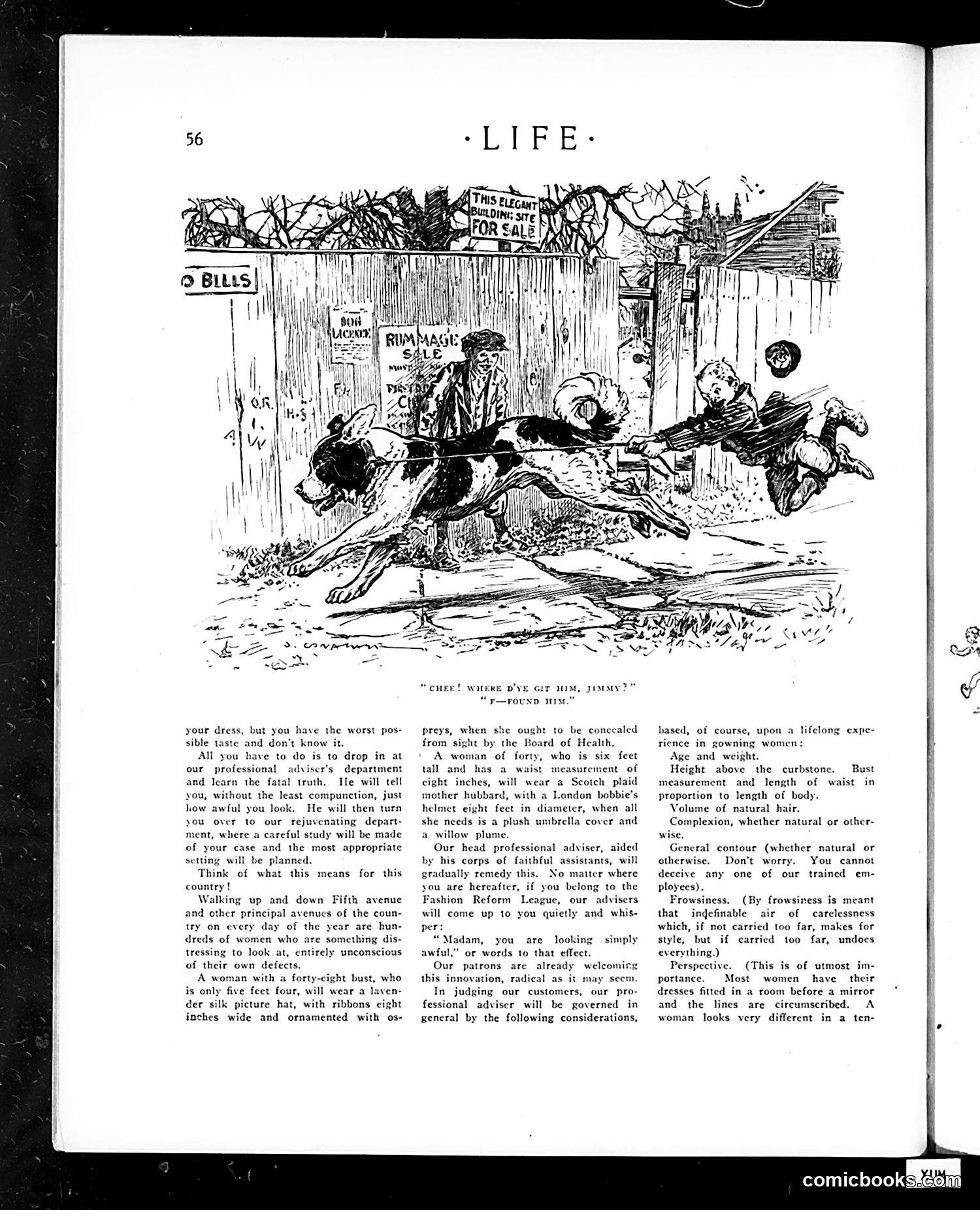
This page contains a satirical cartoon about fashion and women's appearance standards. The illustration shows a large dog being pulled along a street by multiple people, with a caption asking "CHEF! WHERE D'YE GIT HIM, JIMMY?" and the response "F—FOUND HIM." The accompanying text discusses the "Fashion Reform League" and critiques unrealistic beauty standards imposed on women. It mocks the notion that women should conform to specific measurements and appearance requirements, sarcastically suggesting that even a woman meeting such exacting standards would look like the awkwardly-proportioned dog in the cartoon. The satire targets the absurdity of rigid fashion and beauty ideals of the era, using the grotesque dog as visual metaphor for how ridiculous women appear when forced into these prescribed physical standards.
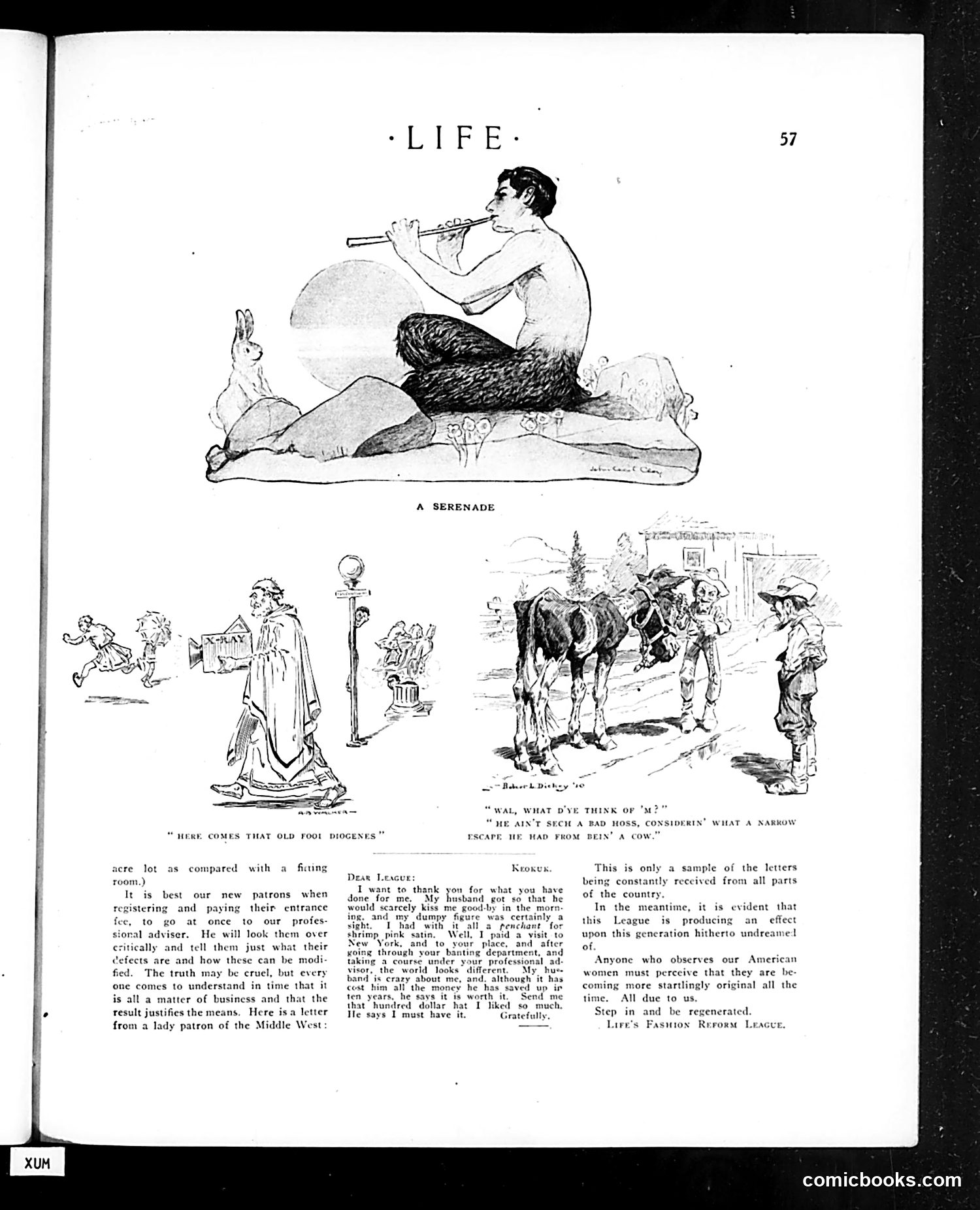
This page contains satirical illustrations mocking social pretensions and behavior. **"A Serenade"** (top): A centaur-like figure playing a flute while seated on a large moon, appearing to mock romantic or artistic affectation. **"Here Comes That Old Food Dodger"** (bottom left): Depicts an elegantly dressed woman, likely satirizing wealthy patrons who avoid paying restaurant bills. **The main cartoon** (bottom right): Shows cowboys and a horse, with the caption about a "bad hoss" and a narrow escape from a cow—apparently contrasting rustic Western authenticity with urban pretension. The accompanying text discusses patronage, business ethics, and criticizes American women's changing fashion and behavior as "hibberto undreamt of." The overall theme appears to satirize both wealthy social climbers and changing American mores of the era.
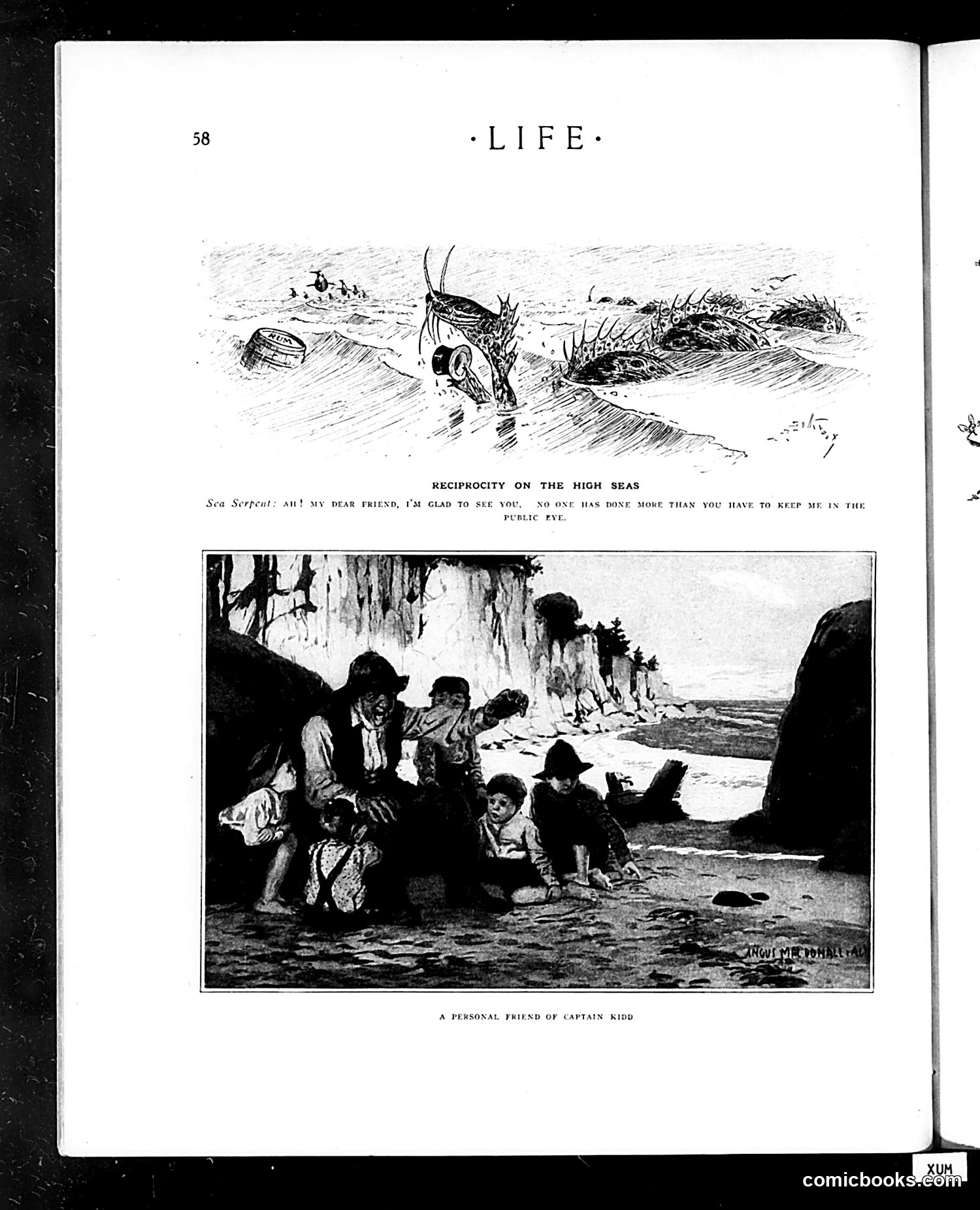
**Top cartoon:** Titled "Reciprocity on the High Seas," depicts a sea serpent speaking to an anthropomorphized character, likely representing a person or nation. The serpent says it's "glad to see you" and notes the other party has "done more than you have to keep me in the public eye"—suggesting mutual benefit from continued attention or conflict. **Bottom illustration:** Titled "A Personal Friend of Captain Kidd," shows what appears to be a coastal scene with figures on a beach near tall cliffs. The caption suggests a historical or legendary connection to the famous pirate Captain Kidd, though the specific satirical point is unclear without additional historical context about what contemporary issue this references.
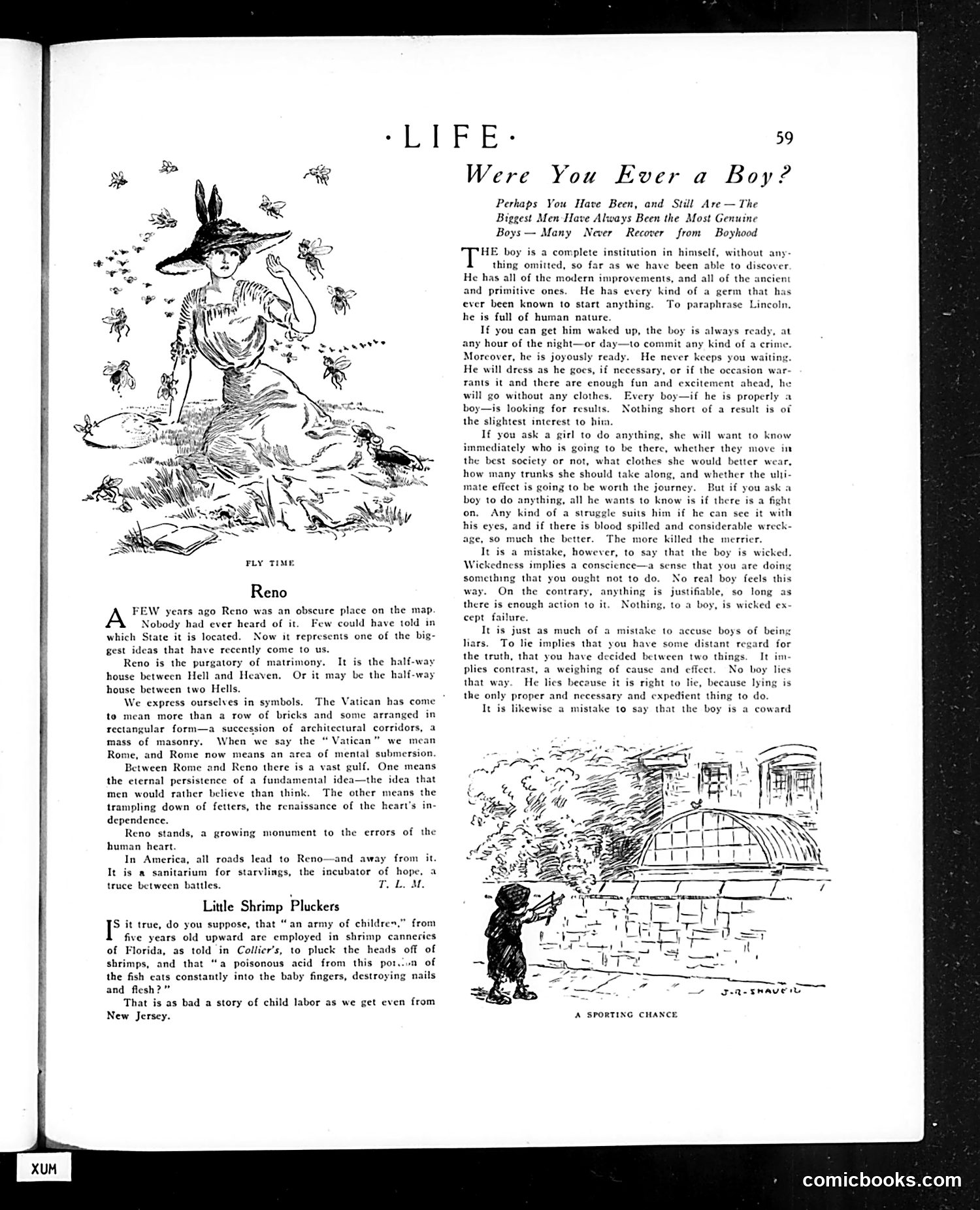
This page contains two distinct pieces of social commentary typical of early 20th-century Life magazine satire. **"Were You Ever a Boy?"** is an essay celebrating boyhood as humanity's most authentic state. It contrasts boys' action-oriented, consequence-indifferent nature with girls' concern for propriety and social standing. The piece argues boys aren't truly "wicked" or "liars" because such terms imply moral awareness they lack—they simply act without such constraints. **"Reno"** critiques Nevada's newly notorious role as a divorce destination. Calling it a "purgatory of matrimony" between "Hell and Heaven," the essay contrasts Reno (representing hearts breaking free from restraint) with Rome/the Vatican (representing tradition and blind belief). The satire suggests America's moral foundation is crumbling. **"Little Shrimp Pluckers"** briefly condemns child labor in Florida shrimp canneries—children poisoned by acid while plucking shrimp heads—comparing it unfavorably even to New Jersey's infamous labor practices. The "Fly Time" illustration depicts Peter Pan-like figures in whimsical scenes, reinforcing the boyhood theme.
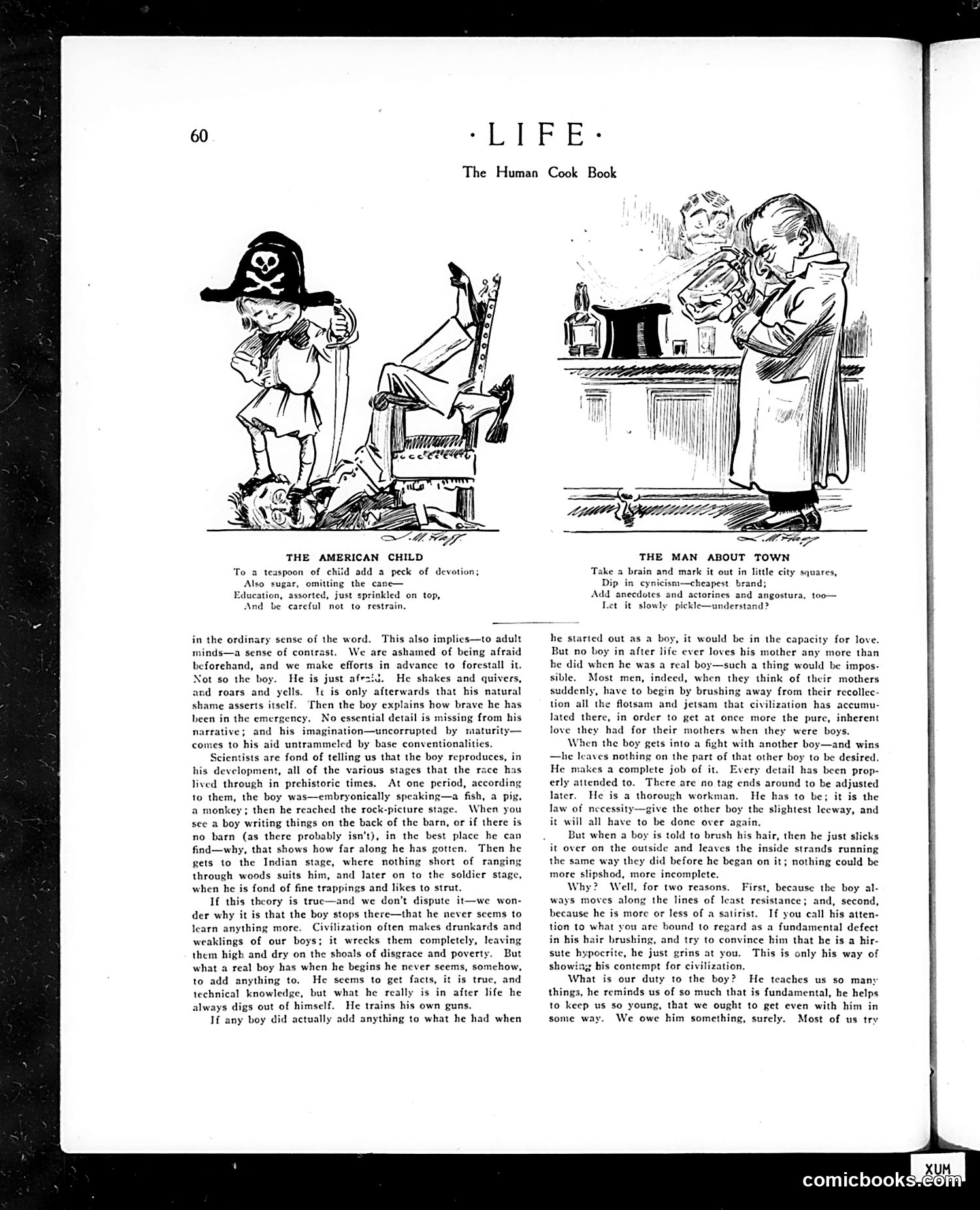
This page presents two satirical character sketches from Life's "Human Cook Book" series, using recipes as metaphors for creating recognizable social types. **"The American Child"** (left): A pirate-costumed boy represents the idealized American child—supposedly natural, imaginative, and uninhibited by civilization. The accompanying text humorously argues that boys possess inherent qualities they never improve upon; they're thorough and instinctive but resist restraint or refinement. The satire mocks both romantic notions of childhood innocence and scientific theories (popular in the era) claiming boys recapitulate human evolution. **"The Man About Town"** (right): A sophisticated urban man holding drinks represents the cynical city dweller, "pickled" in cynicism and artificial anecdotes. This contrasts sharply with the boy—suggesting civilization corrupts natural virtue rather than improving it. Together, these sketches satirize both idealized American childhood and the artificial sophistication of urban adulthood, suggesting neither produces genuinely improved humans.
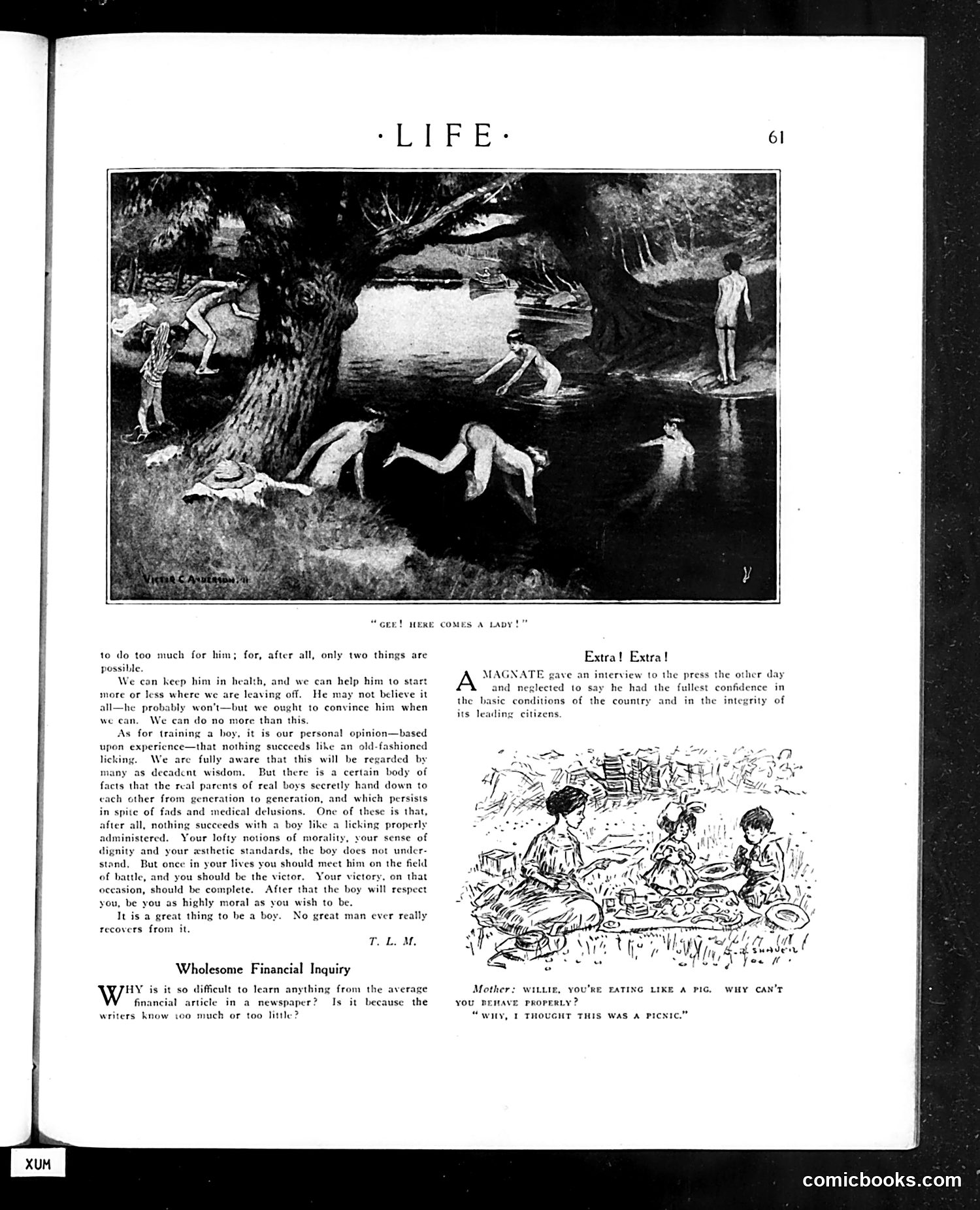
This page contains two distinct pieces of early 20th-century American satire: **Top Image ("Gee! Here Comes a Lady!"):** A photograph-style illustration depicts children playing by a riverbank. The caption's humor derives from children's crude reaction to a woman's arrival—typical of Life's genteel mockery of childhood behavior and social impropriety. **Bottom Cartoon:** A mother scolds her son Willie for eating messily at a picnic, demanding proper behavior. Willie's response—"I thought this was a picnic"—satirizes the disconnect between adult expectations of decorum and children's natural, uninhibited enjoyment. The joke critiques overly strict parenting norms. **"Wholesome Financial Inquiry" Section:** This brief text mocks financial journalists for writing incomprehensibly, suggesting their obscurity stems from either excessive knowledge or ignorance—a satirical jab at newspaper financial reporting. The broader theme: Life mocks rigid Victorian social conventions, particularly regarding child-rearing and proper behavior, positioning itself as a voice of gentle, knowing humor about American manners and pretension.
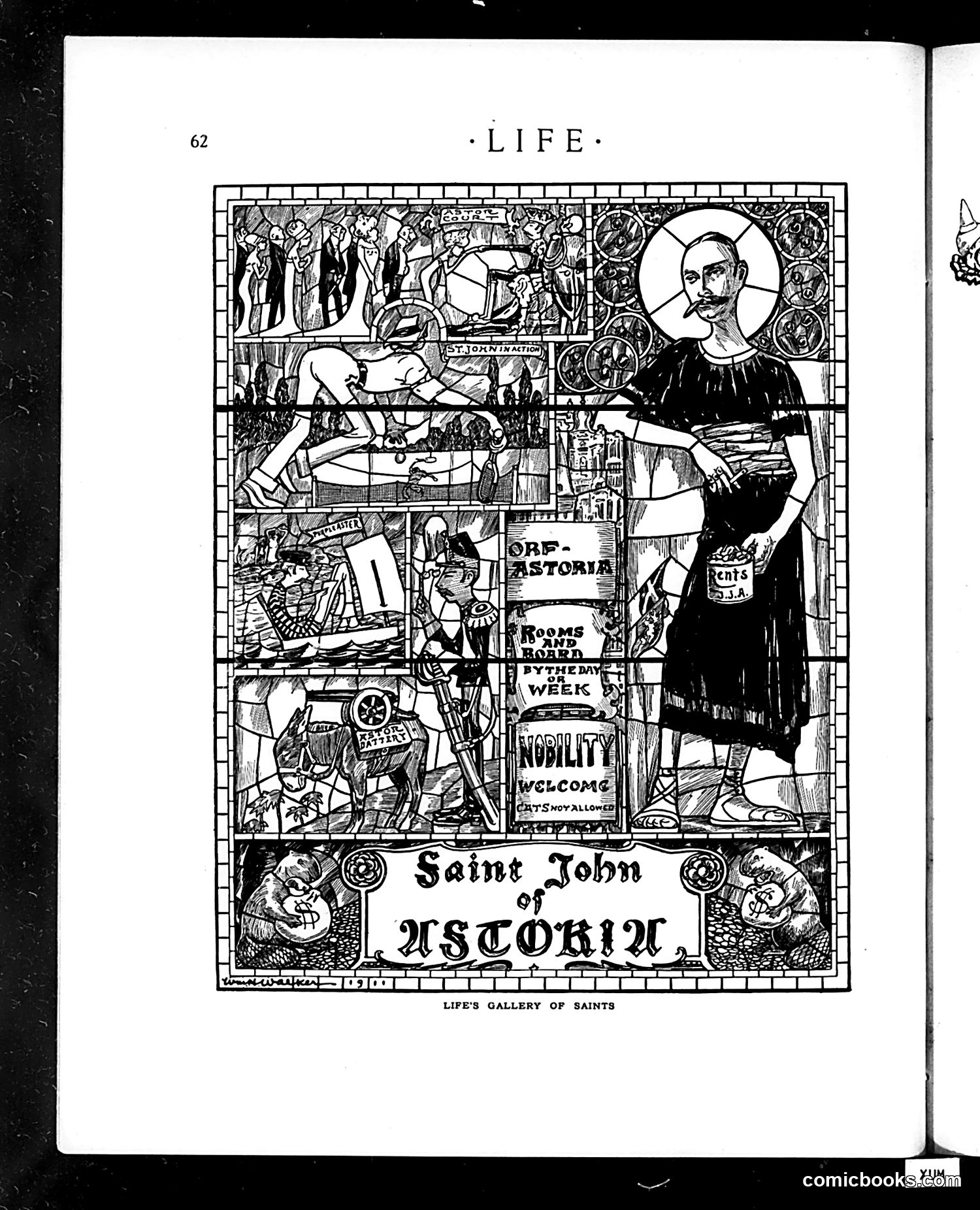
This is a satirical illustration from Life magazine's "Gallery of Saints" series, which mocked contemporary figures by depicting them as religious icons. The page shows a figure with a halo presented as "Saint John of Astoria," surrounded by scenes depicting various commercial establishments and activities—including references to "Astoria," "rooms," and what appears to be a hotel or boarding house operation. The satire likely targets a real person associated with Astoria (possibly New York or Oregon) involved in hospitality or lodging businesses, elevating this ordinary commercial operator to mock-sainthood. The busy, detailed vignettes around the central figure suggest the subject's various business dealings or social activities. Without additional context about the specific date and Astoria referenced, the precise target remains unclear, though the satire's intent—ridiculing someone's pretensions or commercial success—is evident.
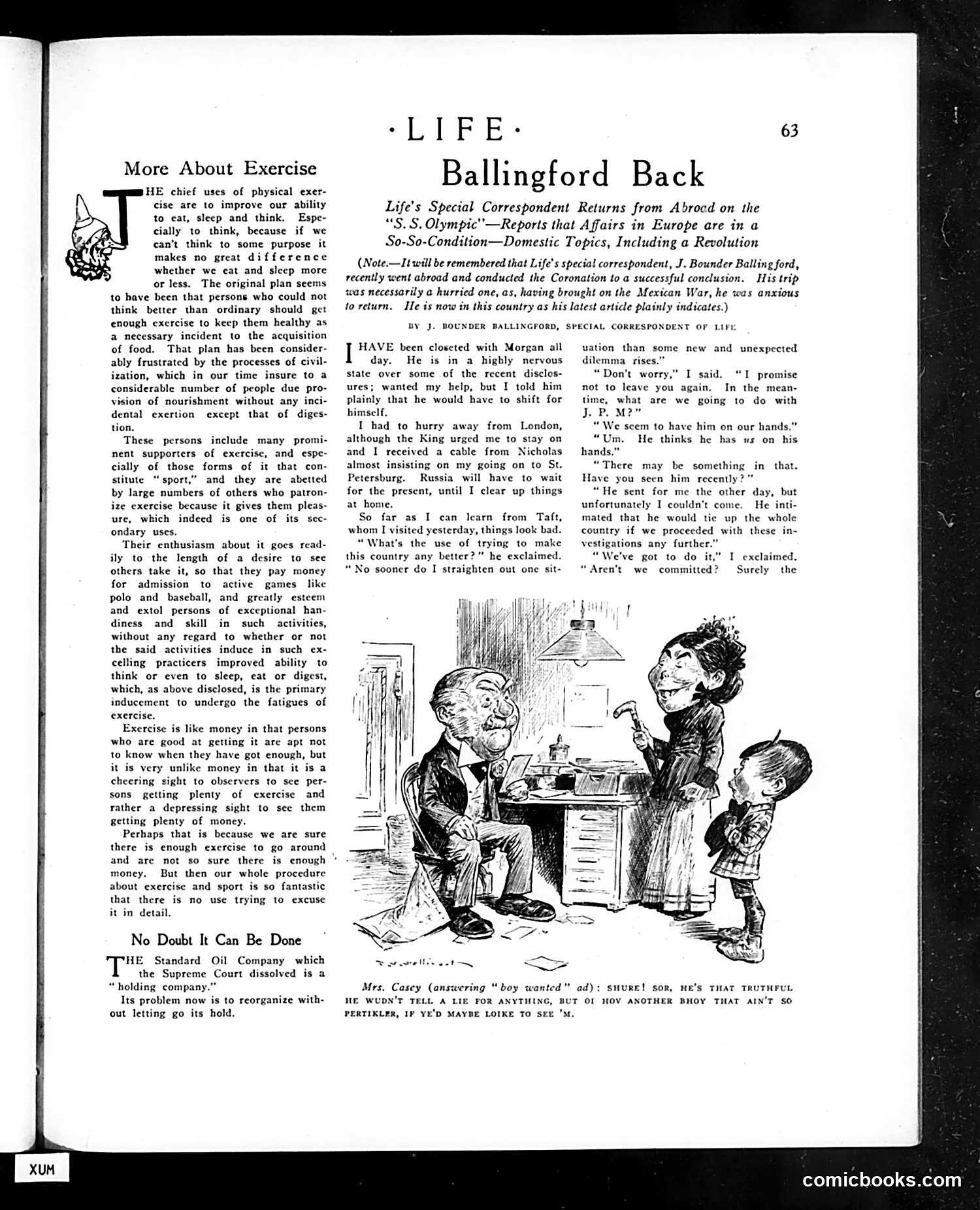
This page contains two satirical pieces from Life magazine: **"More About Exercise"** (left column): A humorous essay mocking the American obsession with sports and physical fitness. Life's writer notes that while exercise's original purpose was survival, wealthy urbanites now pursue it as leisure—then hypocritically pay to watch others play polo and baseball while claiming moral superiority. The satire: we admire athletes but don't actually care if exercise improves their thinking or health. **"Ballingford Back"** (main article): Satirizes a fictional "special correspondent" named J. Bounder Ballingford, presented as absurdly self-important. The joke is that this bumbling figure claims credit for international events (the Coronation, the Mexican War) while actually solving nothing. The accompanying cartoon shows him with nervous clients (likely J.P. Morgan) seeking his "help." The humor mocks both sensationalist journalism and wealthy men of influence who create chaos. Both pieces ridicule American vanity and the gap between pretense and reality.
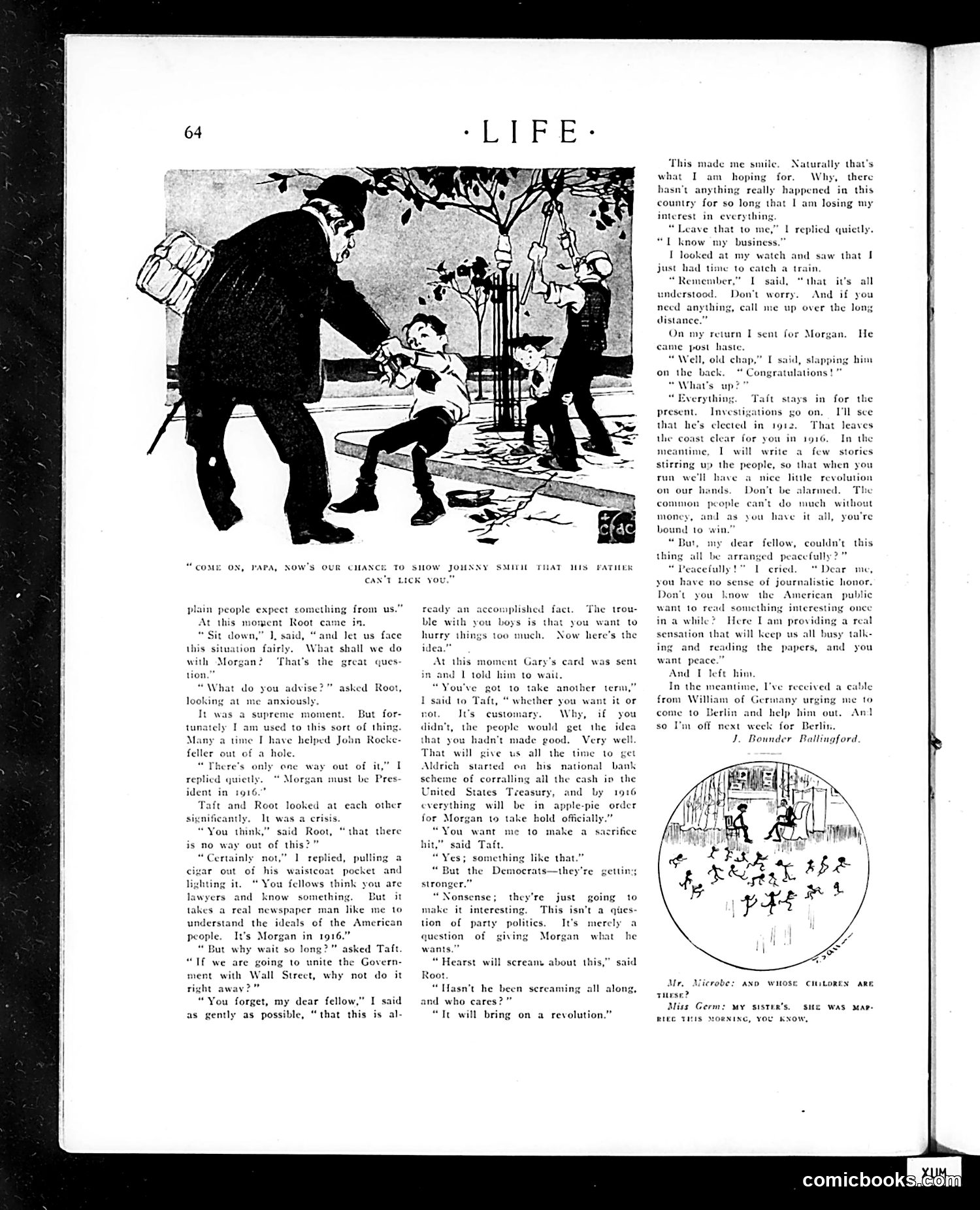
This 1916 *Life* magazine piece satirizes the intimate relationship between Wall Street financiers and the U.S. government. The narrator (appearing to be a journalist) conspires with Root (Elihu Root, Secretary of State) and Taft (President William Howard Taft) to orchestrate Morgan's (J.P. Morgan, the banker) rise to power by having Taft run for re-election as cover, while Senator Aldrich corrals Treasury funds to ensure Morgan can "take bold officially" in 1916. The satire's point: American democracy is a façade—the real government operates through backroom deals between Republican politicians and wealthy industrialists. The casual tone about manufacturing "a little revolution" to excite the public underscores the author's cynicism: ordinary citizens are manipulated spectators while elites engineer outcomes. The cartoon depicts this power structure visually: adult figures (politicians/financiers) overshadow and control the helpless child-figure (the public/democracy).
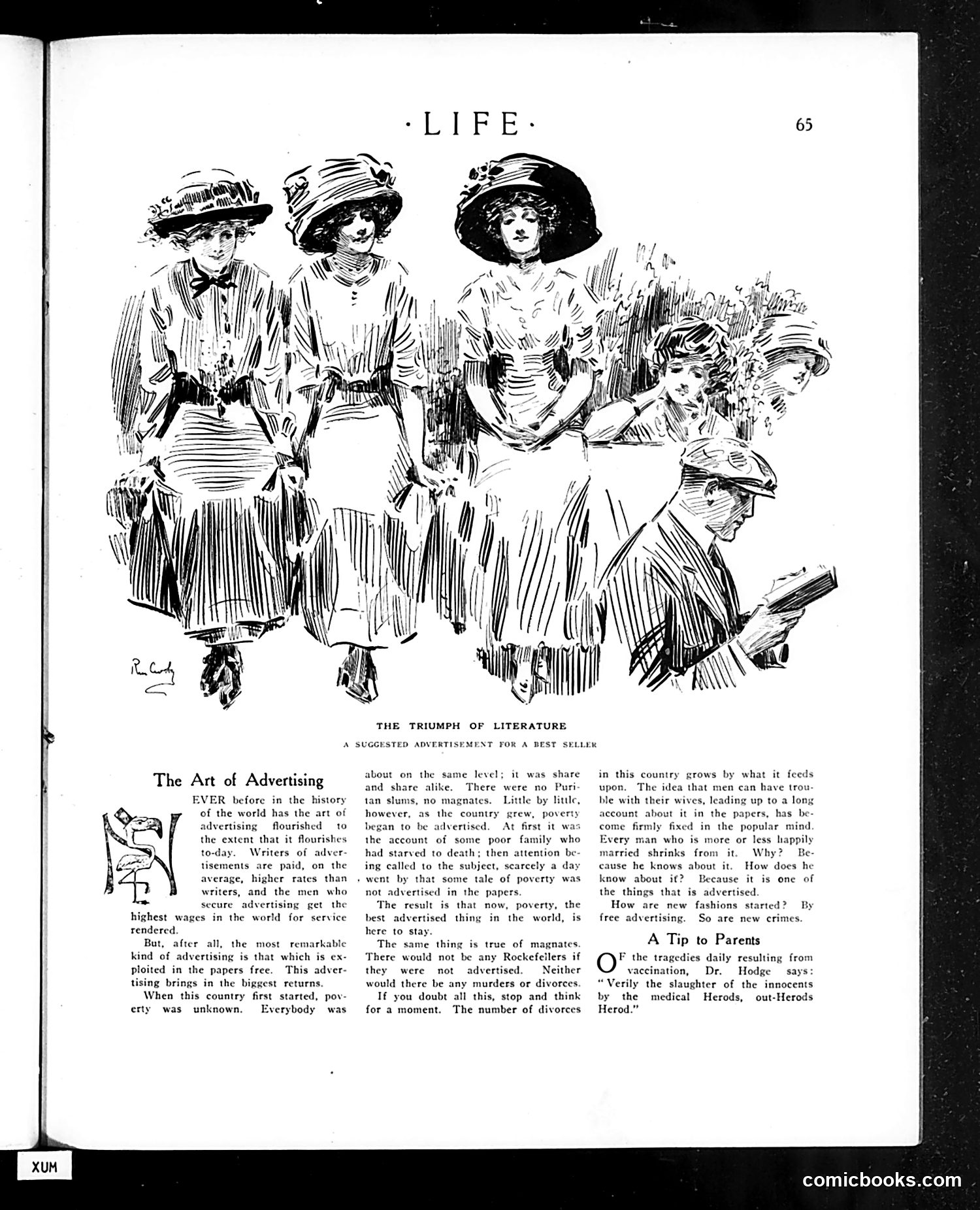
This Life magazine page satirizes the power of newspaper advertising and publicity to create social phenomena. The illustration shows fashionable women and a man reading, captioned as "A Suggested Advertisement for a Best Seller." The main article argues that modern advertising doesn't just promote existing things—it *creates* them. The author claims poverty, magnates (wealthy industrialists like Rockefellers), murders, divorces, and even fashion trends exist partly because newspapers advertise them heavily. By giving these subjects constant coverage, papers make them seem inevitable and widespread. The piece is social critique: newspapers' free publicity (sensational reporting) has become more powerful than paid advertising. The mechanism is psychological—people unconsciously imitate or expect what they read about constantly. A sidebar titled "A Tip to Parents" attacks vaccination, quoting Dr. Hodge's extreme comparison to biblical infanticide, reflecting anti-vaccination sentiment that existed in this era. The overall message: be cautious about what newspapers make seem real or important through sheer repetition.
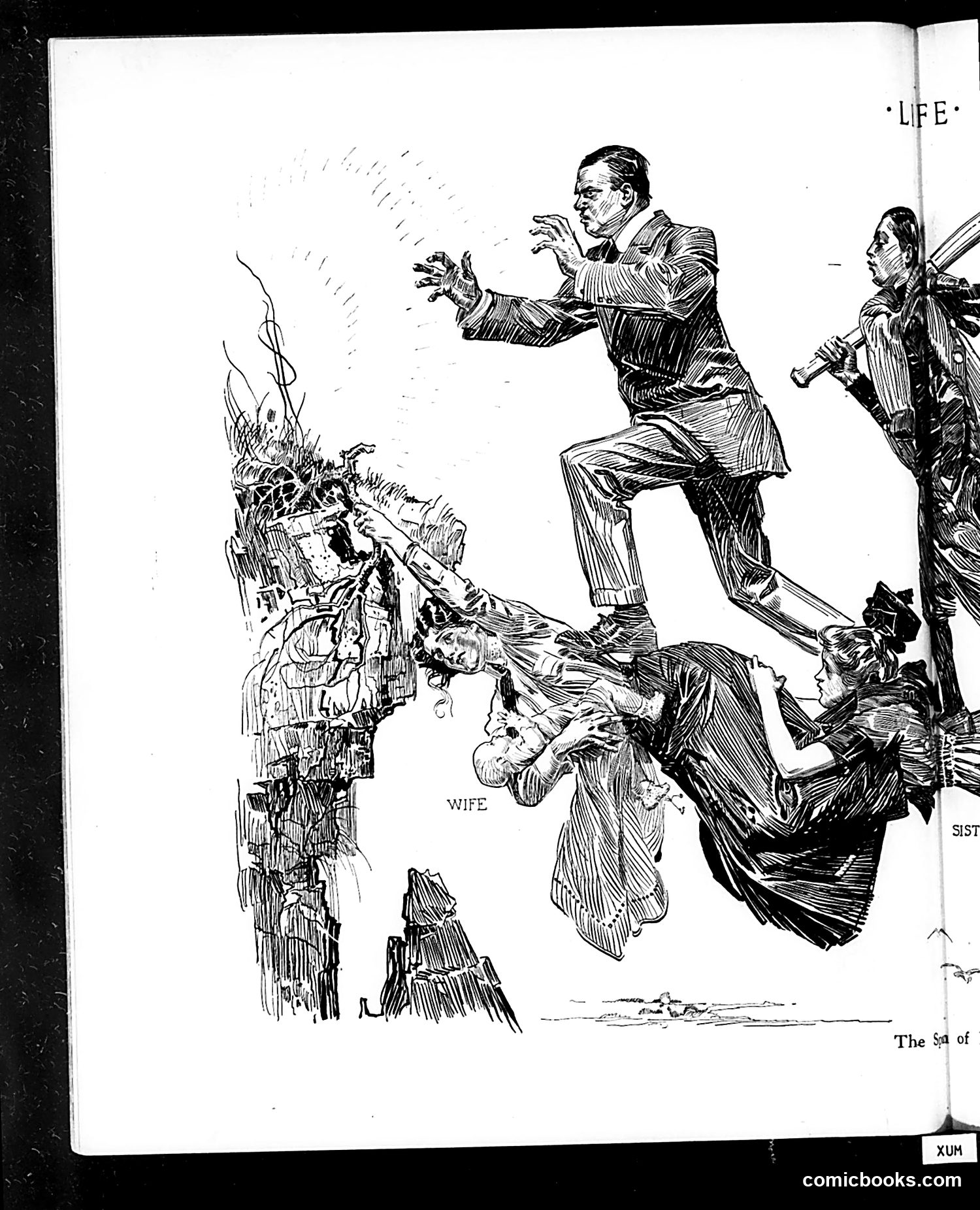
This is a satirical illustration from *Life* magazine depicting a figure labeled "WIFE" being consumed or destroyed by a burning, grotesque head or effigy on the left. A man in a suit (center) gestures dramatically, while another figure on the right labeled "SIST[ER]" appears to be wielding what looks like a club or weapon. The cartoon appears to satirize domestic conflict or marital strife, likely from the early-to-mid 20th century. The burning head suggests destruction or chaos within the household. Without additional context or visible date information, the specific political or social commentary remains unclear—though it may reference attitudes toward women's roles, domestic violence, or relationship dynamics of the era. The crude, exaggerated style is typical of *Life*'s satirical approach to social commentary.
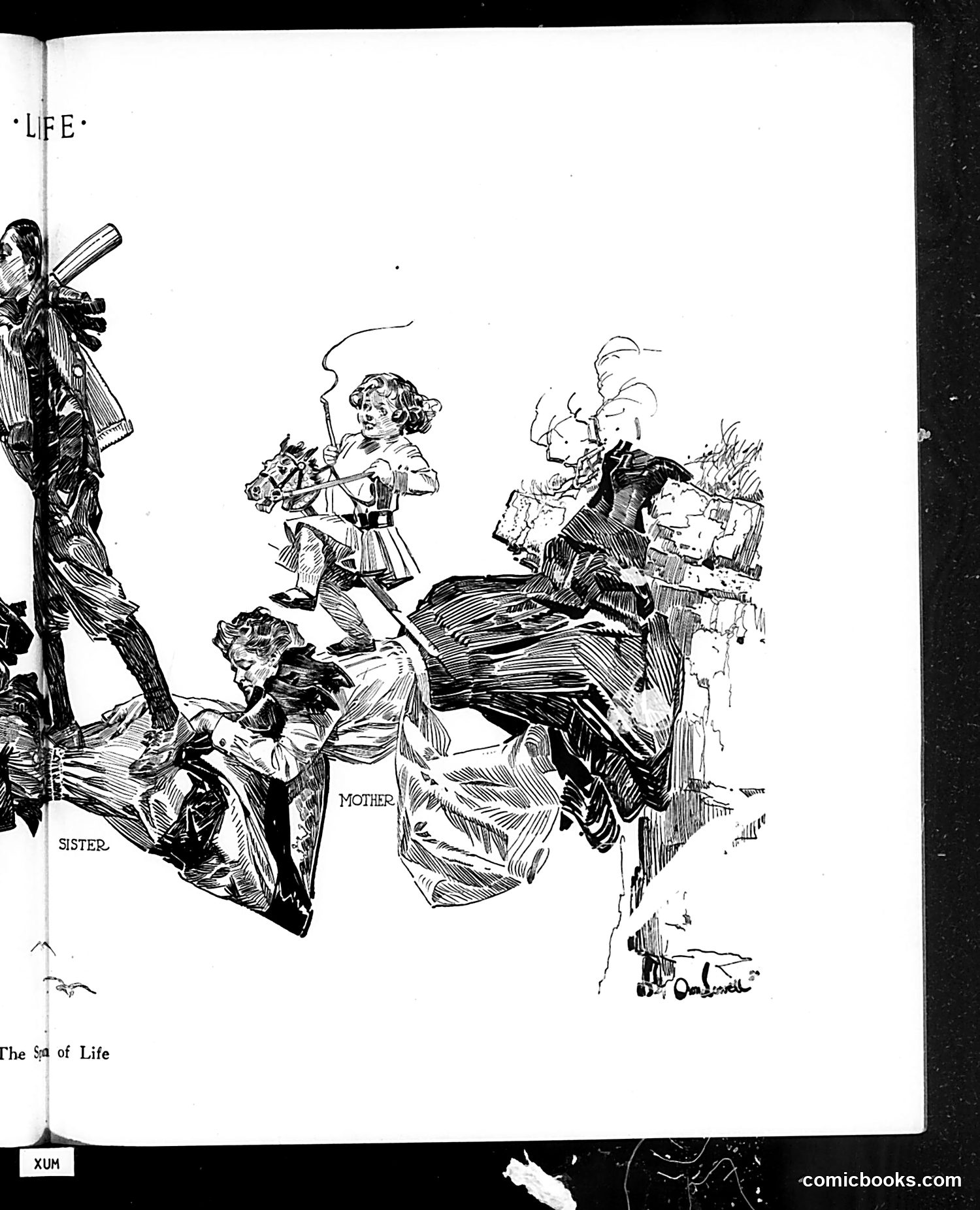
This page is titled "Life" and depicts "The Sea of Life," an allegorical illustration. The central image shows a boat on turbulent waters carrying figures labeled "Sister" and "Mother," with several passengers aboard appearing distressed or struggling. A figure on the left appears to be a sailor or captain observing the scene. The composition uses the metaphor of a ship at sea to represent life's journey and its difficulties. The style is typical of late 19th or early 20th-century satirical illustration, employing classical allegory to comment on human experience. The turbulent waters and struggling passengers suggest life's hardships, while the familial labels ("Sister," "Mother") indicate this addresses the universal human condition and family relationships navigating life's challenges. The exact social or political commentary remains unclear from the image alone.
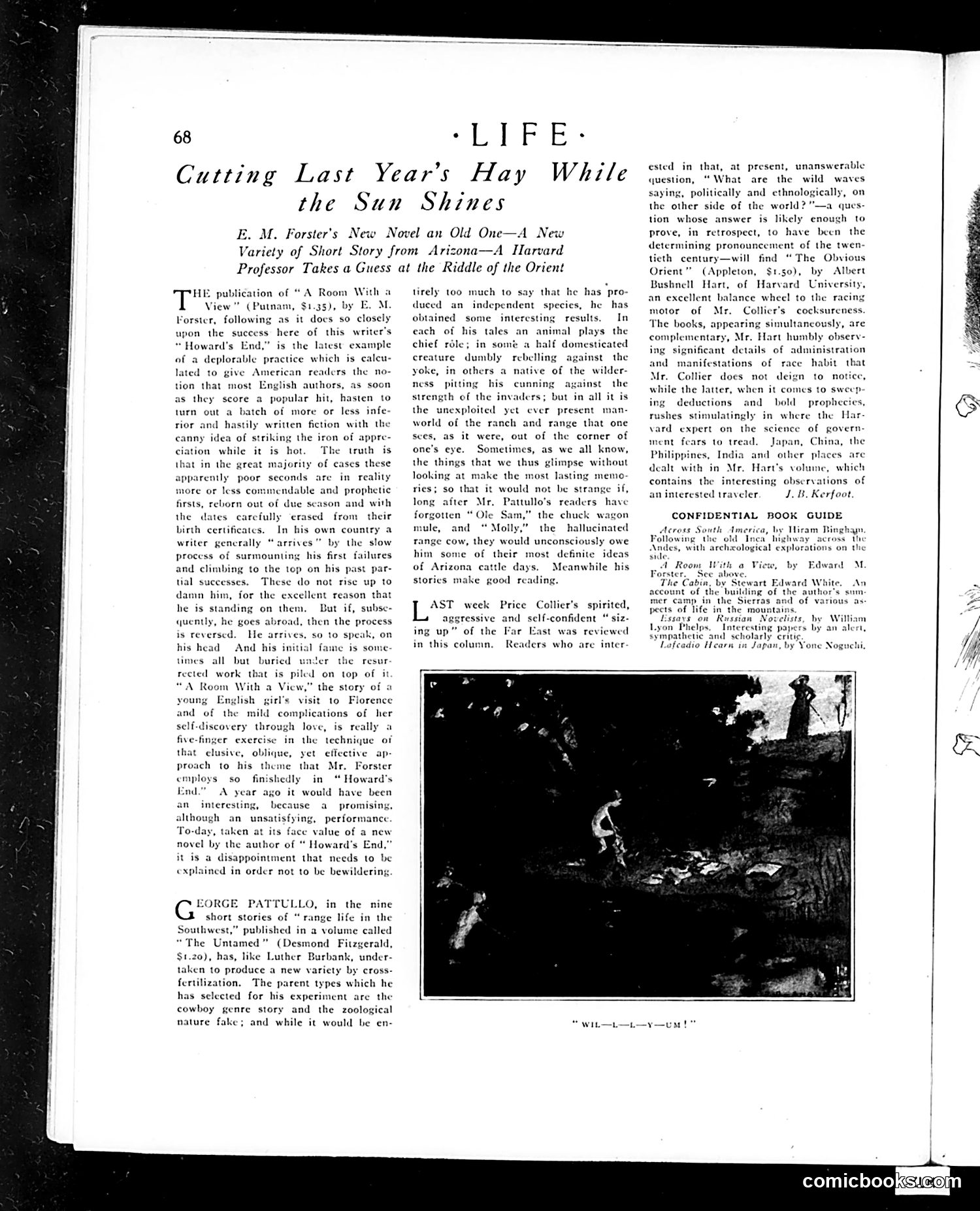
This page reviews new books by E.M. Forster and George Pattullo. The accompanying illustration shows what appears to be a cowboy or ranch worker on horseback in a desert landscape, captioned "WIL—L—L—Y—UM!" **The Satire:** The critic critiques Forster's practice of quickly publishing inferior follow-ups to successful novels ("Howard's End"), calling it a deplorable trend among English authors who "hasten to turn out a batch of more or less inferior...fiction" while public interest is hot. The author argues these rushed sequels are often weak rebirths of earlier work with "dates carefully erased." **The Context:** This reflects early 1900s publishing anxieties about commercialism and artistic integrity—successful authors being pressured to capitalize quickly on popularity rather than develop new work thoughtfully. The book reviews elsewhere on the page suggest Life's literary gatekeeping role, evaluating whether American readers should take these works seriously. The illustration relates to Pattullo's Arizona ranch stories being reviewed positively as genuine "range life" fiction.
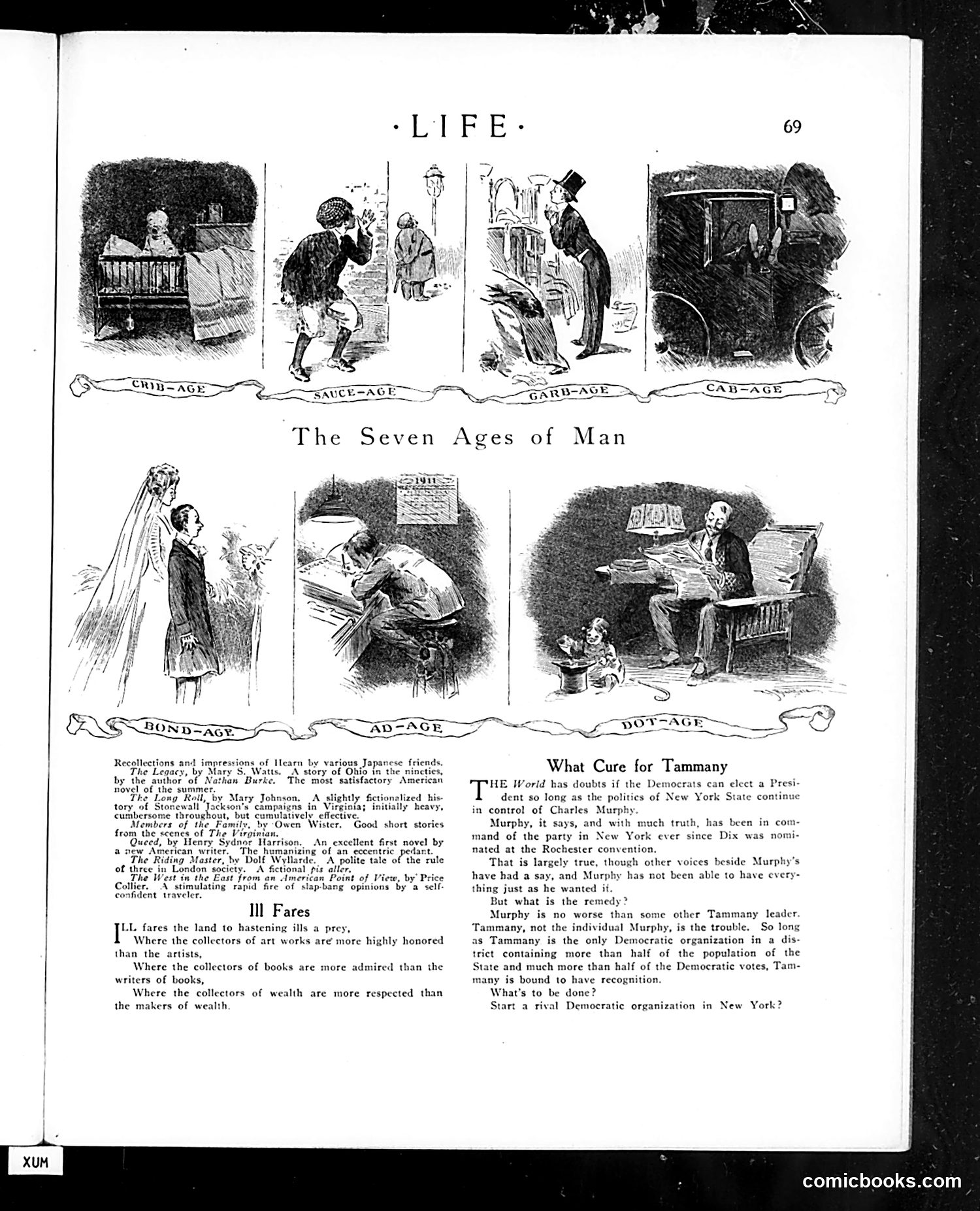
The top illustration presents a satirical take on life's stages—childhood, youth, adulthood, and old age—depicting how priorities shift: from toys and play, to romance and courtship, to professional ambition (a gentleman in top hat), to elderly dependence (a car-bound figure). The lower section critiques **Tammany Hall**, New York's powerful Democratic political machine. The text argues that **Charles Murphy** dominates Democratic politics in New York, making it impossible for Democrats nationally to elect a president while Tammany controls the state's votes. The article suggests Tammany itself—not just Murphy individually—is the systemic problem, since it monopolizes Democratic organization in the most populous region. The proposed solution: create a *rival* Democratic organization to break Tammany's stranglehold on New York politics. This reflects early 20th-century frustration with machine politics and corruption.
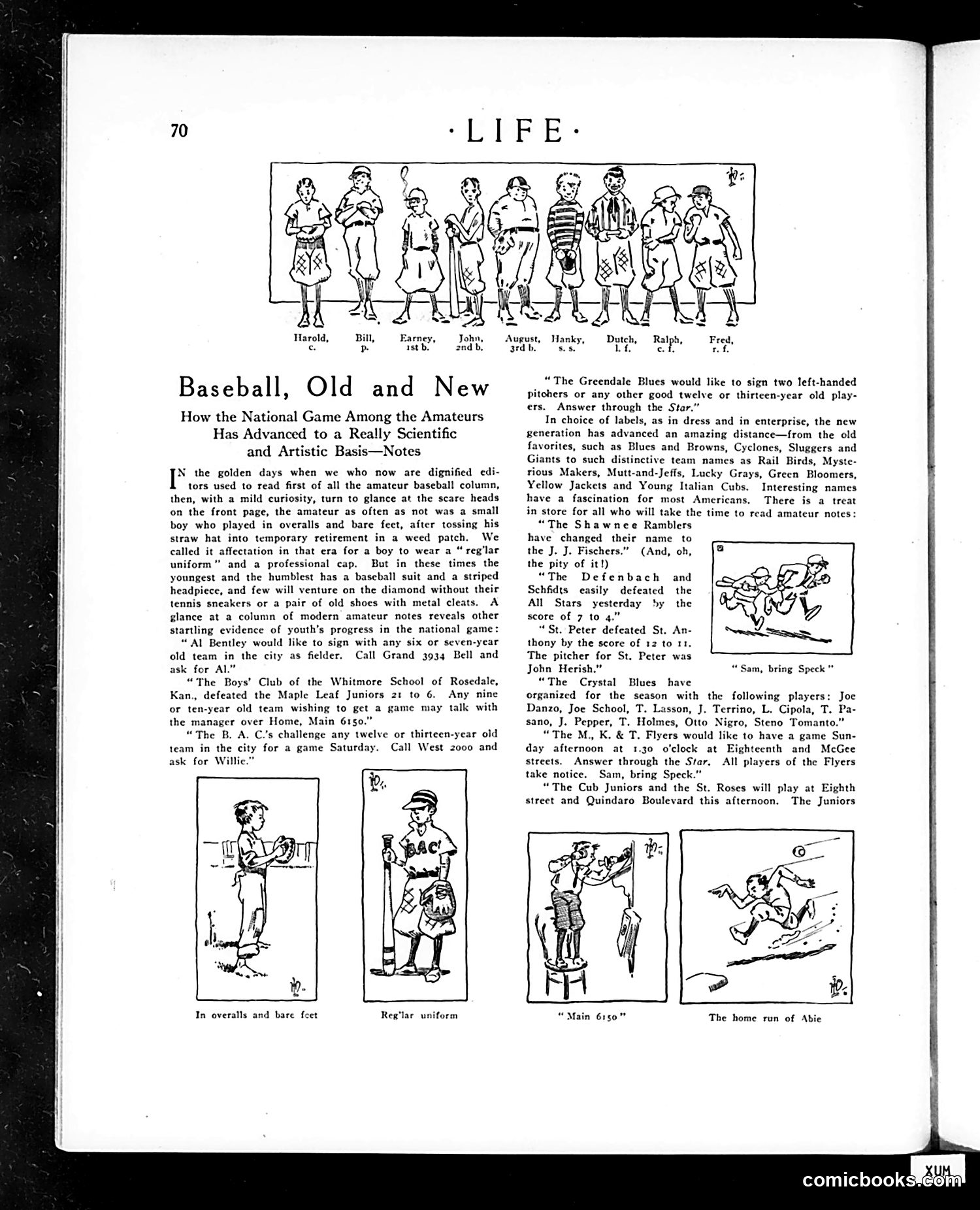
This *Life* magazine article satirizes how dramatically amateur youth baseball has become more organized and "scientific" between the old days and the present era (early 1900s). The piece contrasts barefoot boys in overalls playing casually with modern junior players now sporting official uniforms, metal cleats, and professional infrastructure. The humor lies in nostalgia for simpler times—editors once prioritized the amateur baseball column over front-page news. The caricatured team names and player rosters reflect immigrant and working-class communities (the "Young Italian Cubs," "Defenbach and Schfdts"), suggesting this modernization reaches across ethnic neighborhoods. Illustrations show the evolution: from improvised play to regulated "reg'lar uniform." The joke targets modern American society's increasing standardization and professionalization of childhood recreation—a critique of progress itself. What once was spontaneous fun has become systematized.
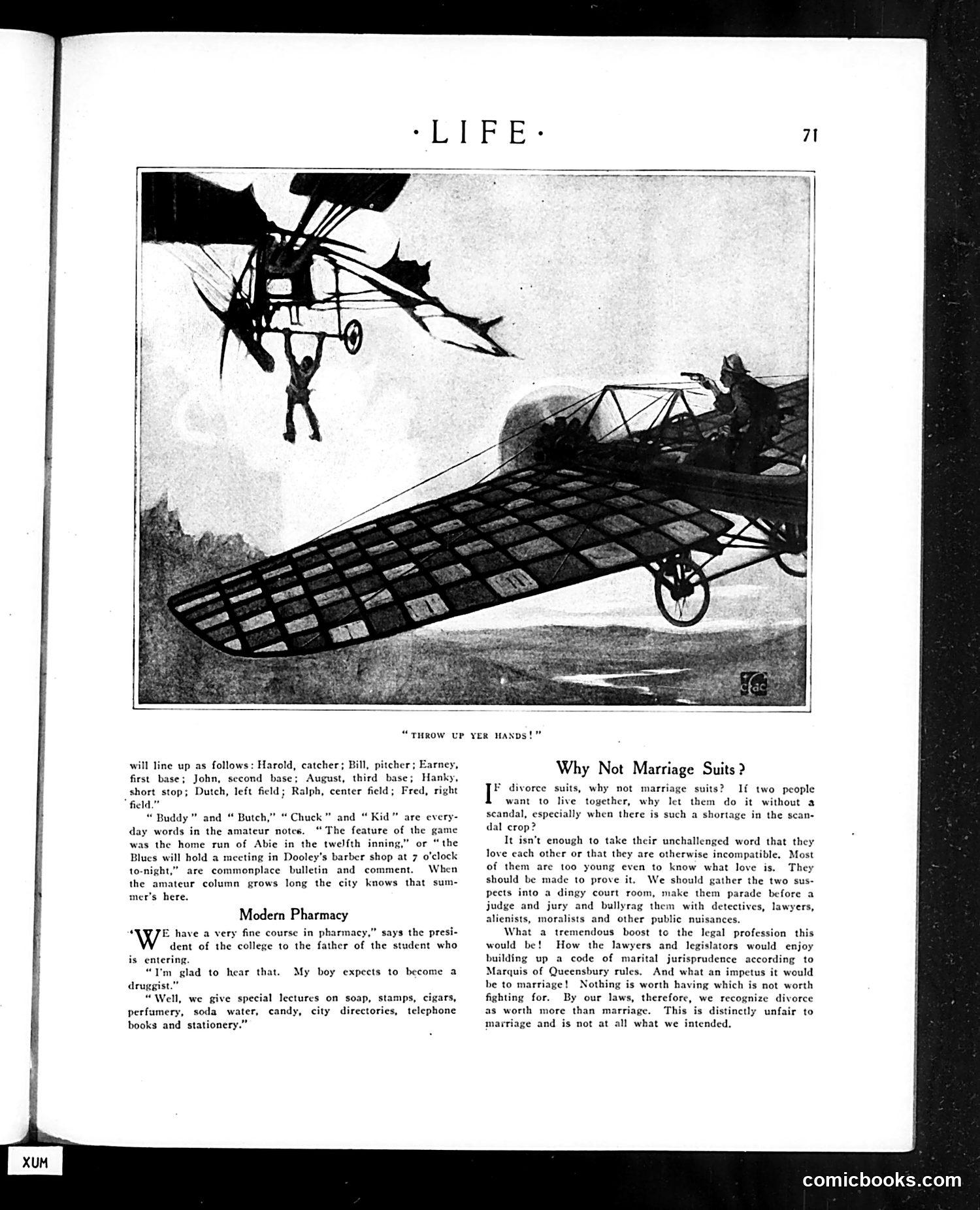
**The Cartoon:** The image shows a humorous illustration of early aircraft in collision or distress, with the caption "THROW UP YER HANDS!" This appears to be satirizing the novelty and danger of early aviation—a contemporary concern when aircraft were experimental and unpredictable. **The Text Content:** The page contains three unrelated pieces: 1. **Amateur Baseball Notes:** A lighthearted commentary on local baseball coverage, mocking the casual nicknames and gossip that dominate amateur sports reporting ("Buddy," "Butch," "Chuck"). 2. **Modern Pharmacy:** A satirical anecdote where a college president boasts about pharmacy instruction that includes teaching soap, cigars, and telephone books—clearly absurd and mocking inflated educational claims. 3. **Why Not Marriage Suits?:** A tongue-in-cheek proposal that couples seeking marriage should undergo formal legal proceedings like divorce cases, with judges and juries, to "prove" their love. The satirist argues this would benefit lawyers and make marriage seem more valuable than divorce. All three pieces use exaggeration and irony to critique contemporary institutions and social practices.
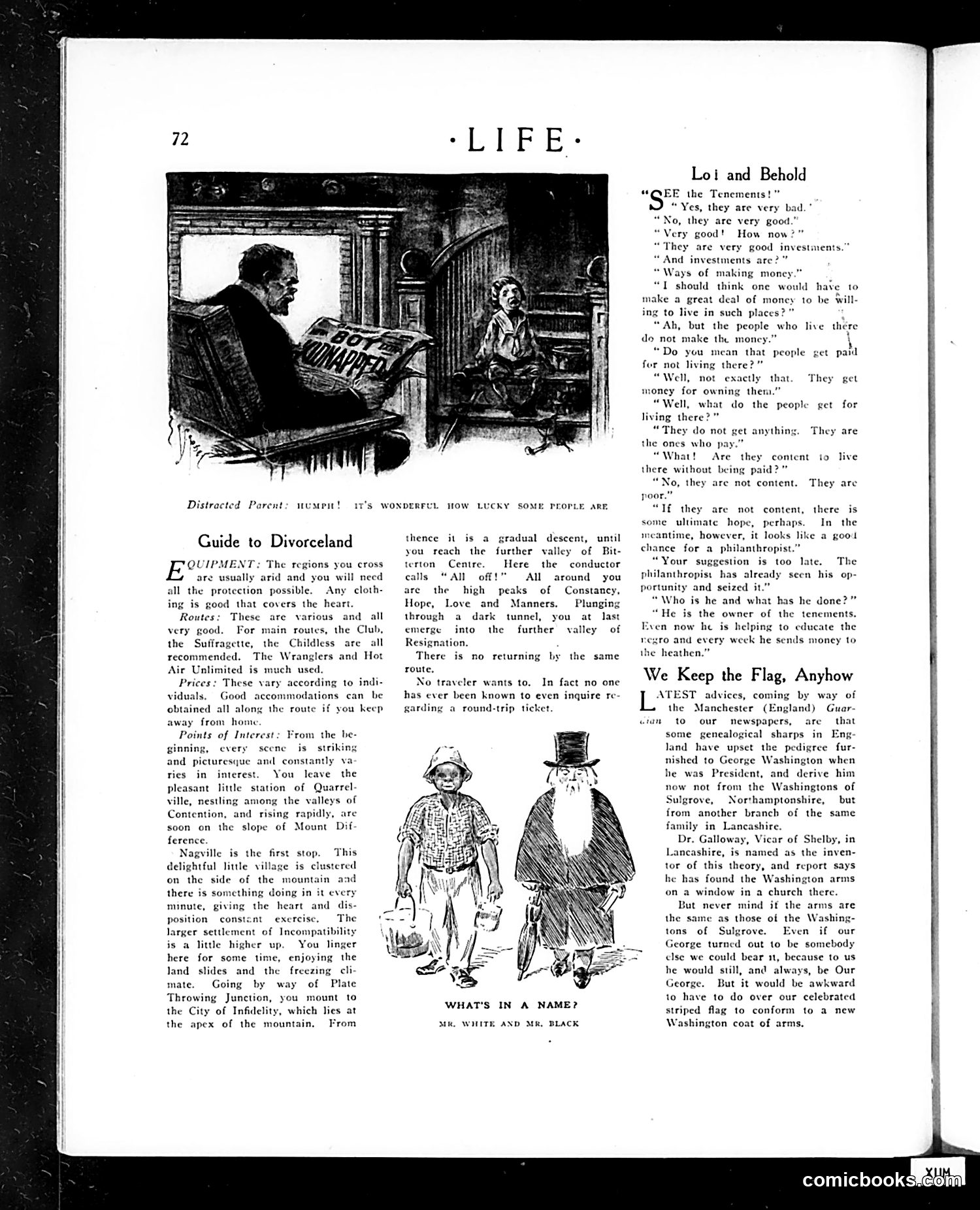
This page contains two distinct satirical pieces: **"Guide to Divorceland"** (left): A mock travel guide presenting divorce as a journey through allegorical locations—Quarrelville, Mount Difference, Nagville, Incompatibility, and ultimately the City of Infidelity. The satire mocks the stages of marital breakdown, treating divorce as a predictable, inevitable route with "no returning" and no one wanting a round-trip ticket. This reflects early 20th-century attitudes viewing divorce as scandalous dissolution. **"Loi and Behold"** (top right): A dialogue satirizing exploitative tenement landlords. The exchange reveals that wealthy investors profit from poor housing conditions while claiming philanthropic virtue—donating to education and missions while extracting money from impoverished tenants. The satire exposes the hypocrisy of gilded-age capitalism: landlords grow wealthy from others' misery yet pose as moral benefactors. **"We Keep the Flag, Anyhow"** (bottom right): A brief note about genealogical research challenging George Washington's pedigree, suggesting Americans shouldn't worry about ancestry—patriotic identity matters more than bloodline.
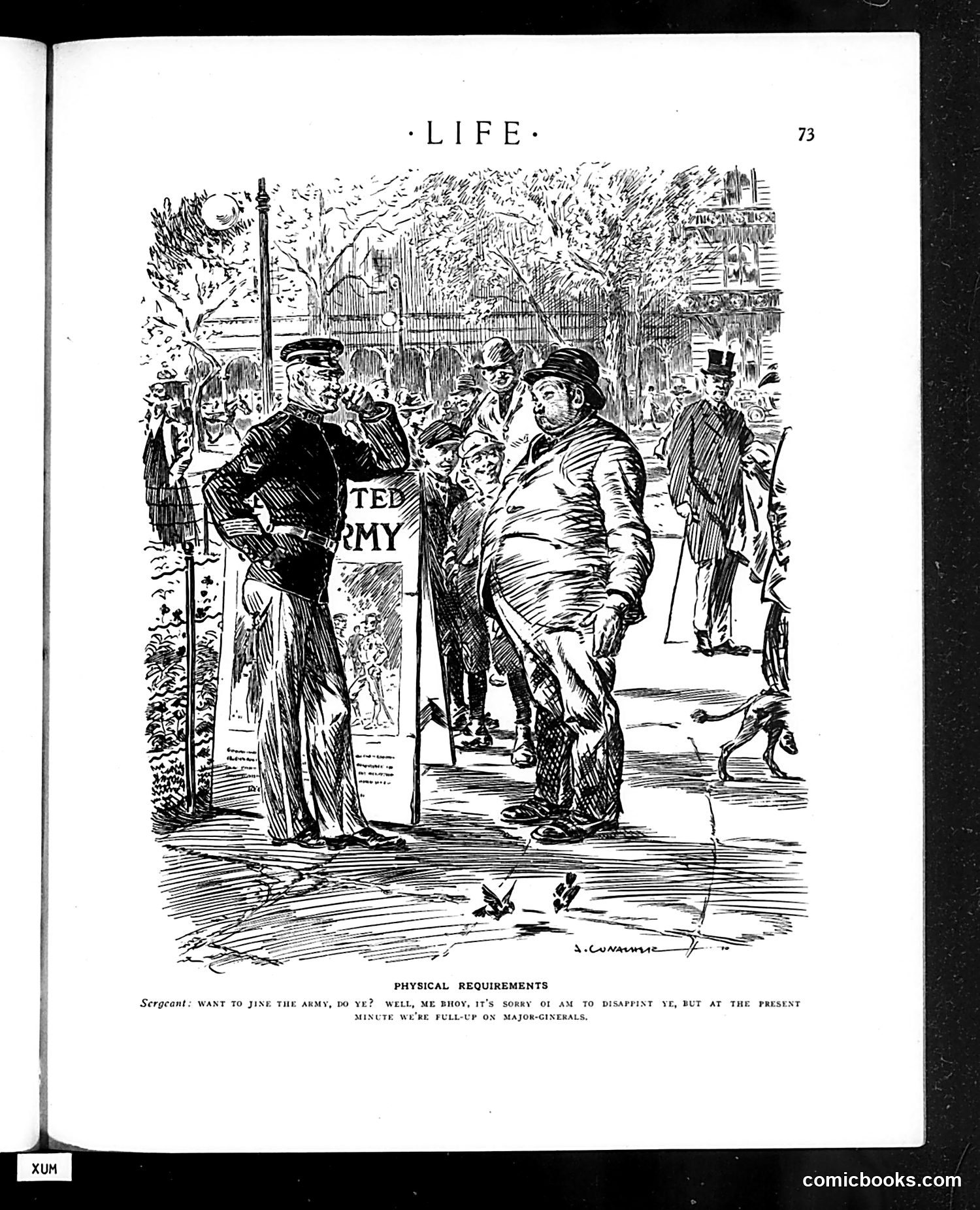
This satirical cartoon depicts a military recruiting sergeant rejecting a prospective soldier, claiming the army is currently "full-up on major-generals" rather than lacking ordinary soldiers. The joke mocks the overstaffing of high-ranking officers relative to enlisted men—a common complaint about military bureaucracy and inefficiency. The sergeant's Irish accent (rendered in dialect) and the park setting suggest this depicts a typical recruitment scene. The cartoon criticizes the imbalance in military hierarchy: the army apparently has too many generals supervising too few regular troops, making it absurd to recruit common soldiers. This reflects early 20th-century concerns about military organization and the bloated officer corps relative to combat-ready personnel.
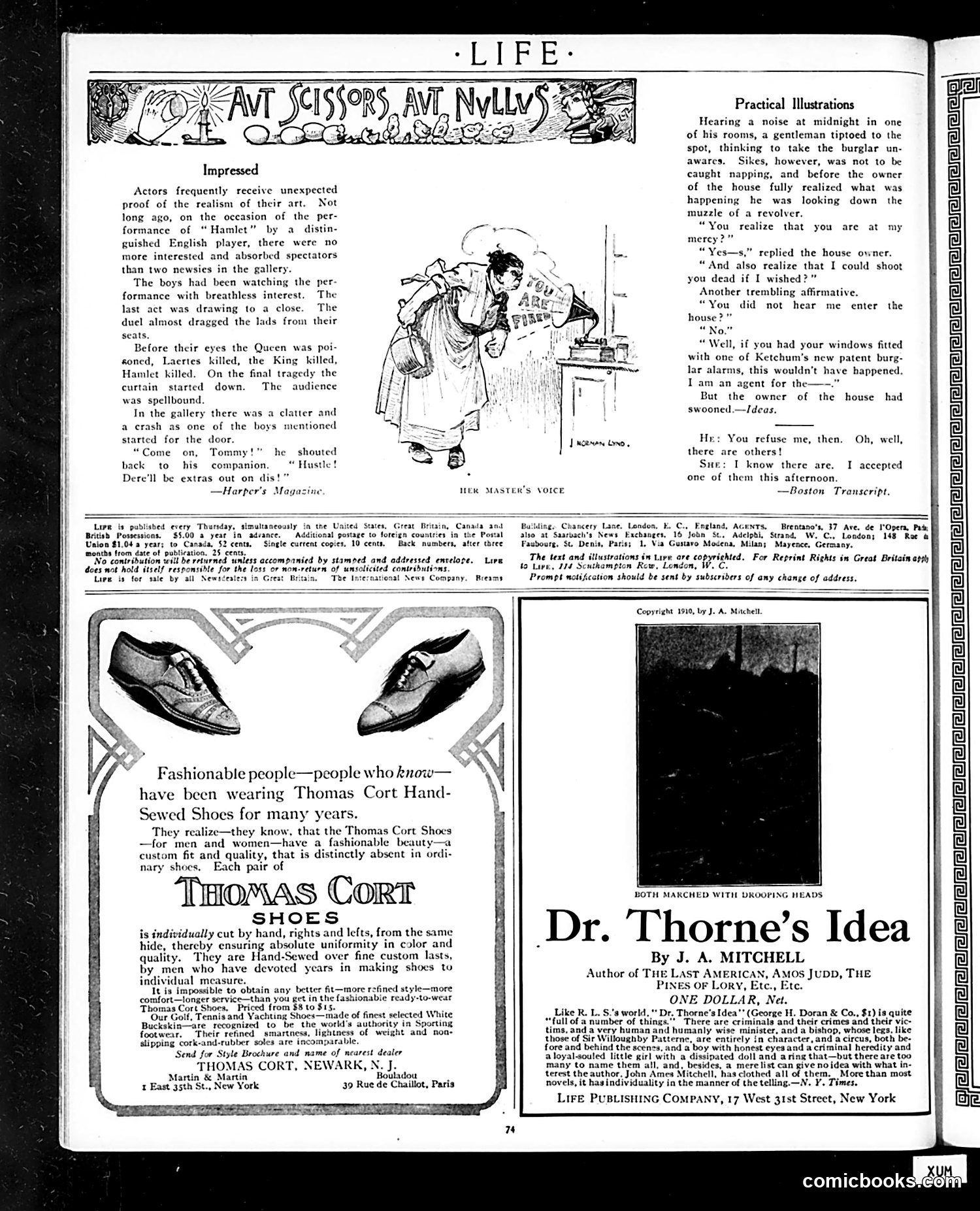
This page contains three distinct pieces of content: **"Impressed" (Top Left):** A humorous anecdote about two newsboys watching a Shakespeare performance of *Hamlet*. When the tragic final scene concludes with multiple character deaths, one boy excitedly tells his companion to leave immediately because "extras" (newspapers with updated stories) will soon be available. The joke satirizes how working-class newsboys view even high theater purely as commercial opportunity—they're not moved by Shakespeare's drama but by profit potential. **"Practical Illustrations" (Center/Right):** Three brief comedic scenarios poking fun at human nature: a burglar salesman ironically pitching his alarm system while robbing someone; a romantic rejection where the rejected suitor notes other women exist; and a widow fainting at an agent's sales pitch. These are light satirical takes on contemporary commerce and social awkwardness. **Advertisements:** The remainder consists of paid ads for Thomas Cort hand-sewn shoes and Dr. Thorne's book, typical of *Life* magazine's revenue model. The page emphasizes working-class perspectives and commercial absurdity typical of early 20th-century American satirical humor.
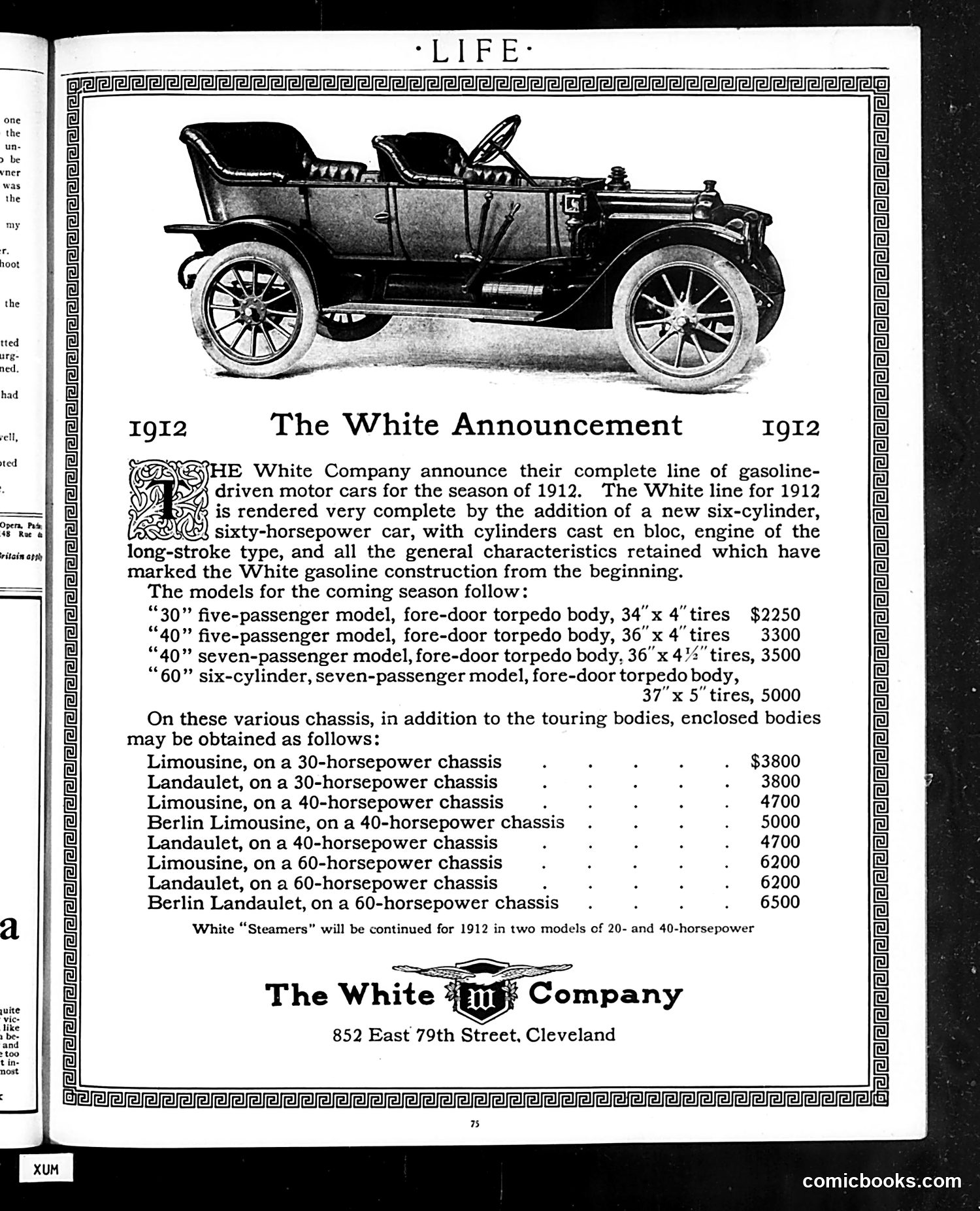
This is **not a cartoon or satire**—it's a straightforward automobile advertisement. The page features a detailed product announcement from the White Company (Cleveland, Ohio) showcasing their 1912 gasoline-powered motor car lineup. The illustration depicts a touring car from that era with an open passenger compartment. The text lists five base models ("30," "40," "40," and "60" designations) with prices ranging from $2,250 to $5,000, plus optional enclosed body styles (limousines, landaulets, berlins) costing up to $6,500. While *Life magazine* was satirical, **this particular page is commercial advertising**—the kind that filled magazines to fund publication. The formal layout and Greek-key border were standard design conventions for premium advertisements of the period.
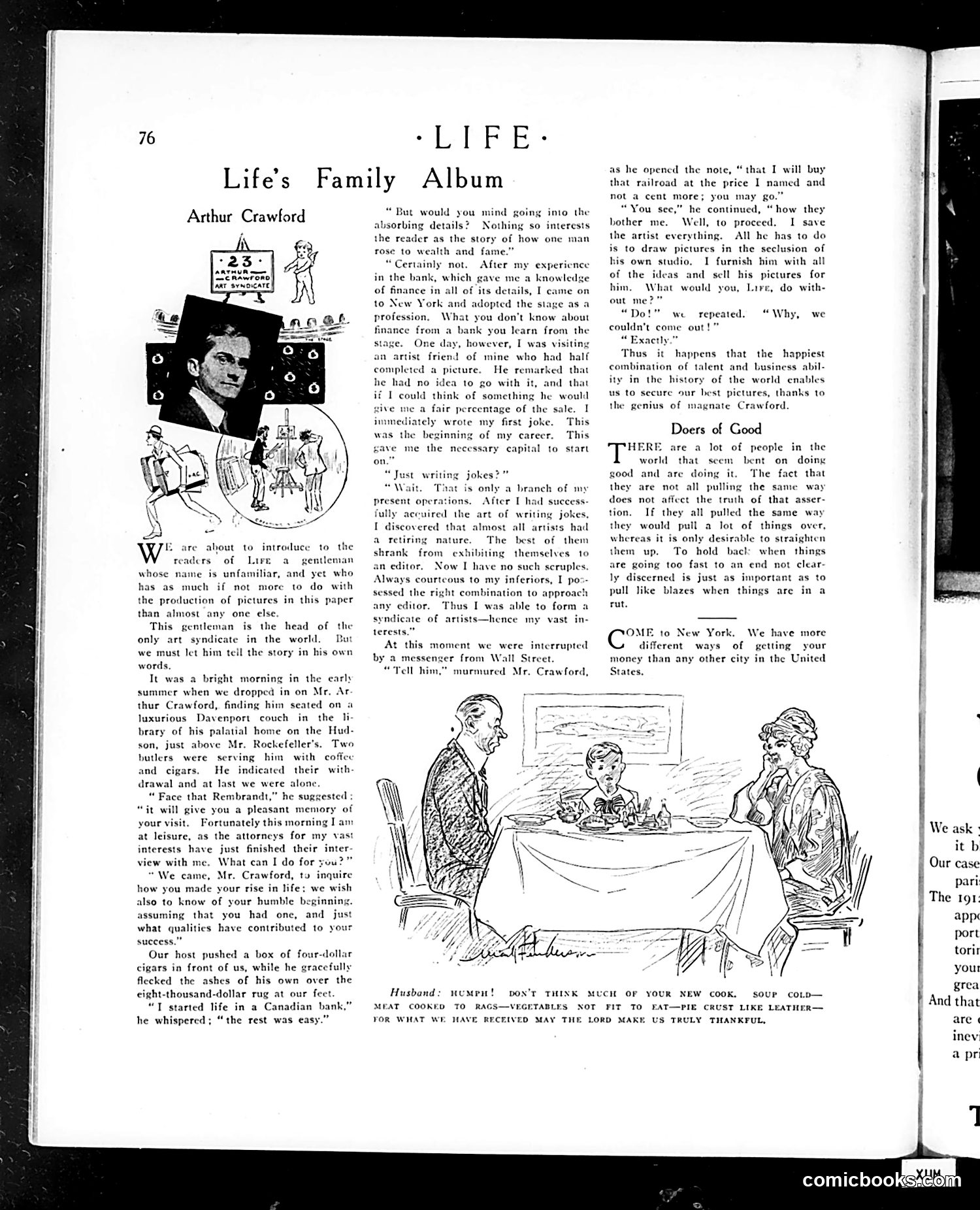
This page profiles Arthur Crawford, head of an art syndicate that supplies content to *Life* magazine. The satire mocks Crawford's self-aggrandizing account of his rise from Canadian bank clerk to wealthy magnate. Crawford's narrative—moving from banking to theatre to joke-writing to controlling artists—is presented as absurdly easy, with each transition requiring minimal effort. The humor lies in his pretentious boasting: he lounges in luxury (with butlers, four-dollar cigars, an eight-thousand-dollar rug), compares himself to Rockefeller, and claims artists depend entirely on him for ideas while he handles all business matters. The accompanying cartoon shows a domestic scene where a husband criticizes his cook while eating poorly prepared food—likely illustrating Crawford's broader point about managing incompetent talent. The satire targets wealthy businessmen who exaggerate their importance and the exploitative relationships between syndicates and artists. Crawford represents the self-made entrepreneur who credits himself entirely for success while controlling creative workers.
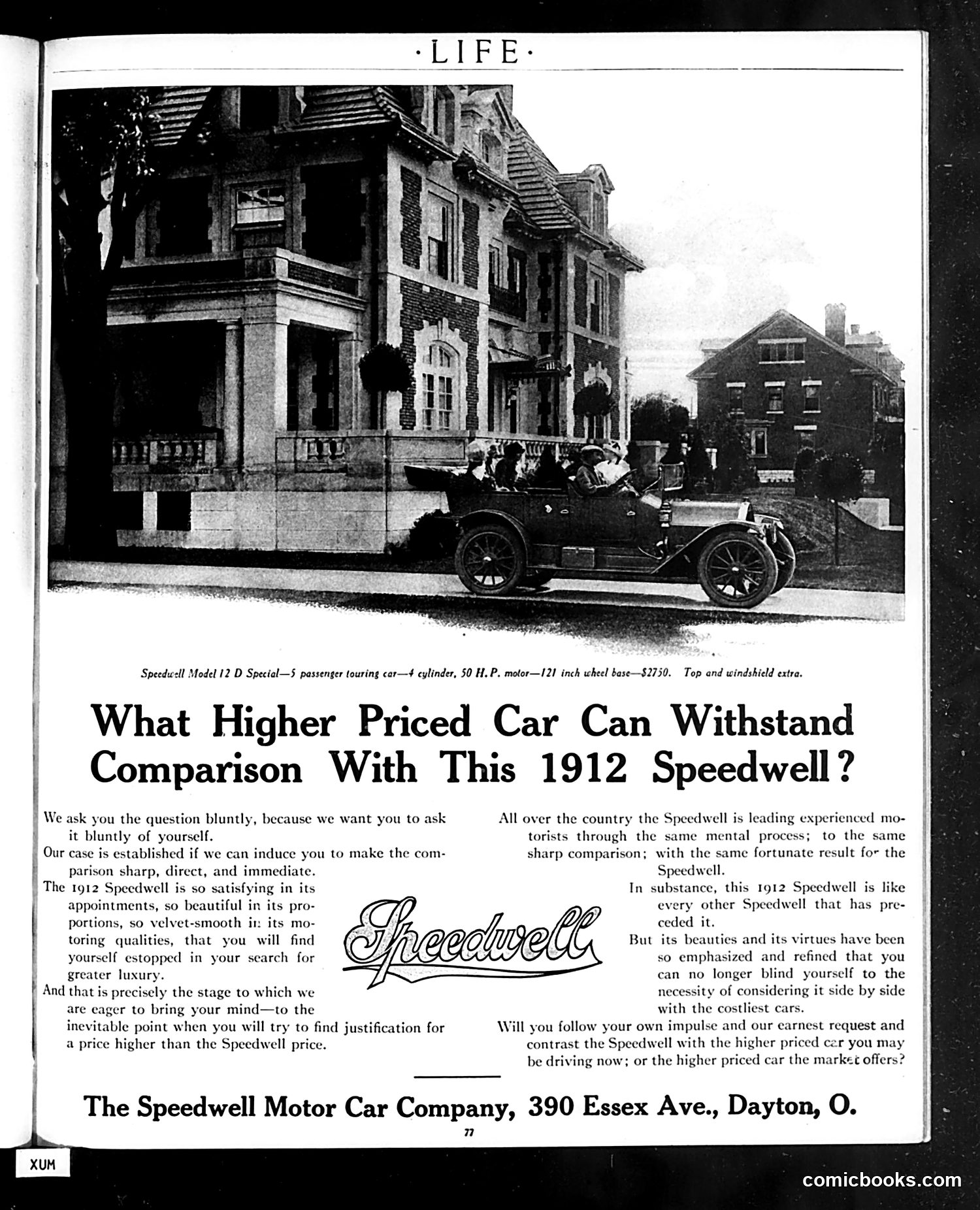
This page is primarily an **automobile advertisement**, not satire or political content. It appears in *Life* magazine's advertising section (page 77). The Speedwell Motor Car Company challenges potential buyers to compare their 1912 Model 12D Special ($2,750) against any higher-priced competitor. The ad uses a rhetorical strategy: it argues that the Speedwell is so luxurious and well-appointed that buyers seeking "greater luxury" will struggle to justify paying *more* for rival vehicles. The photograph shows the touring car parked before an elegant mansion, emphasizing its sophistication and suitability for wealthy owners. The ad's underlying claim: superior build quality and features make the Speedwell exceptional *value*—a common early automotive marketing tactic positioning mid-range cars as smart alternatives to costlier brands. There is no identifiable satire, caricature, or political reference on this page.
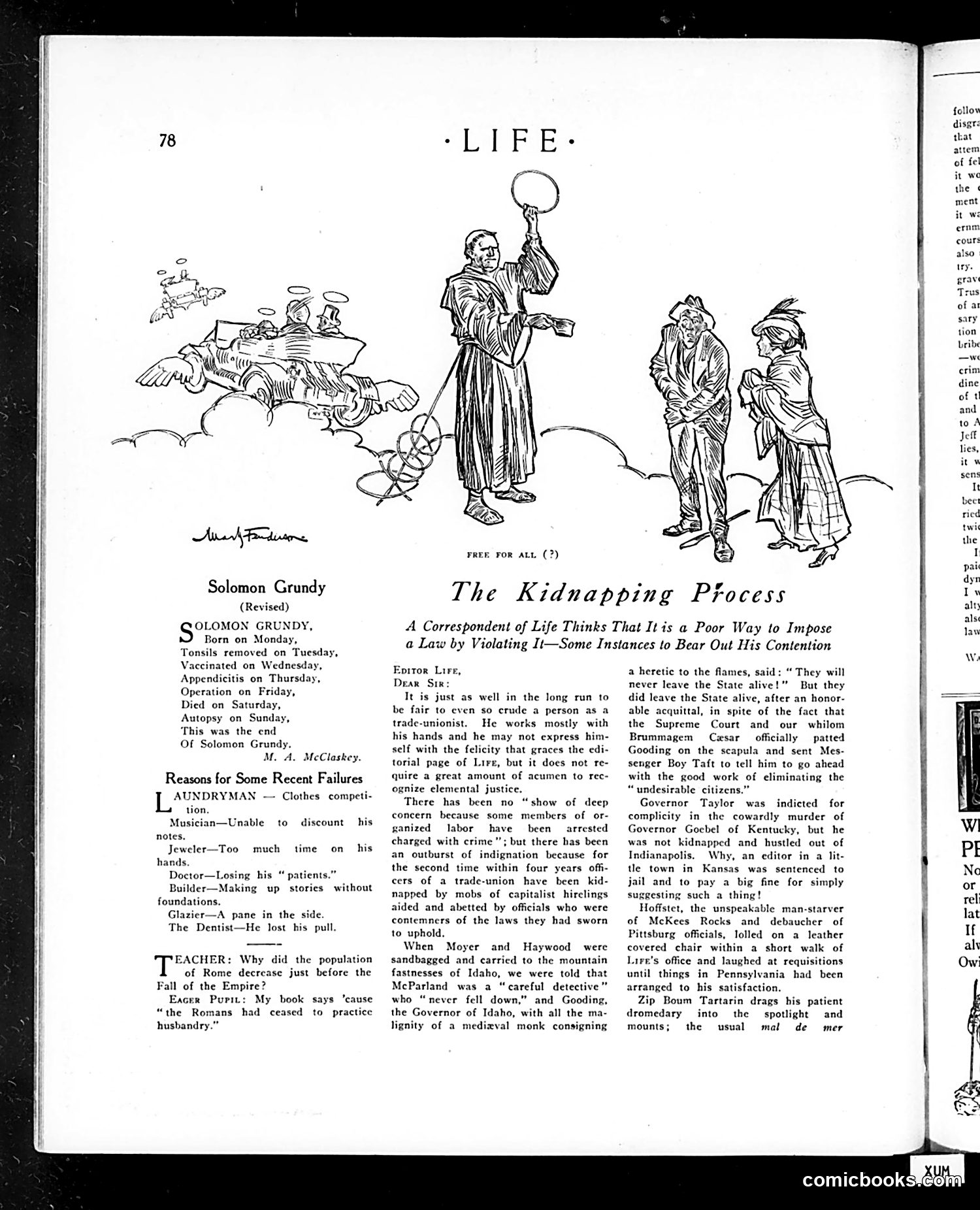
This editorial cartoon criticizes the illegal kidnapping of labor leaders by capitalist interests and government officials. The letter references the 1906 kidnapping of Western Federation of Miners leaders Charles Moyer and "Big Bill" Haywood from Colorado to Idaho—a notorious incident where they were forcibly taken across state lines to face murder charges they were eventually acquitted of. The author argues that while trade unionists face arrest for crimes, no equivalent outrage followed when capitalists and governors violated law by kidnapping them. The piece sarcastically notes that detective James McParland and Idaho Governor Frank Steunenberg (who was later assassinated) escaped consequences, while ordinary citizens faced severe punishment for merely *suggesting* kidnapping. The cartoon criticizes the double standard: wealthy interests break laws with impunity while workers face harsh penalties. "Zip Boum Tartarin" appears to reference absurdist political theater—suggesting the entire situation is farcical.
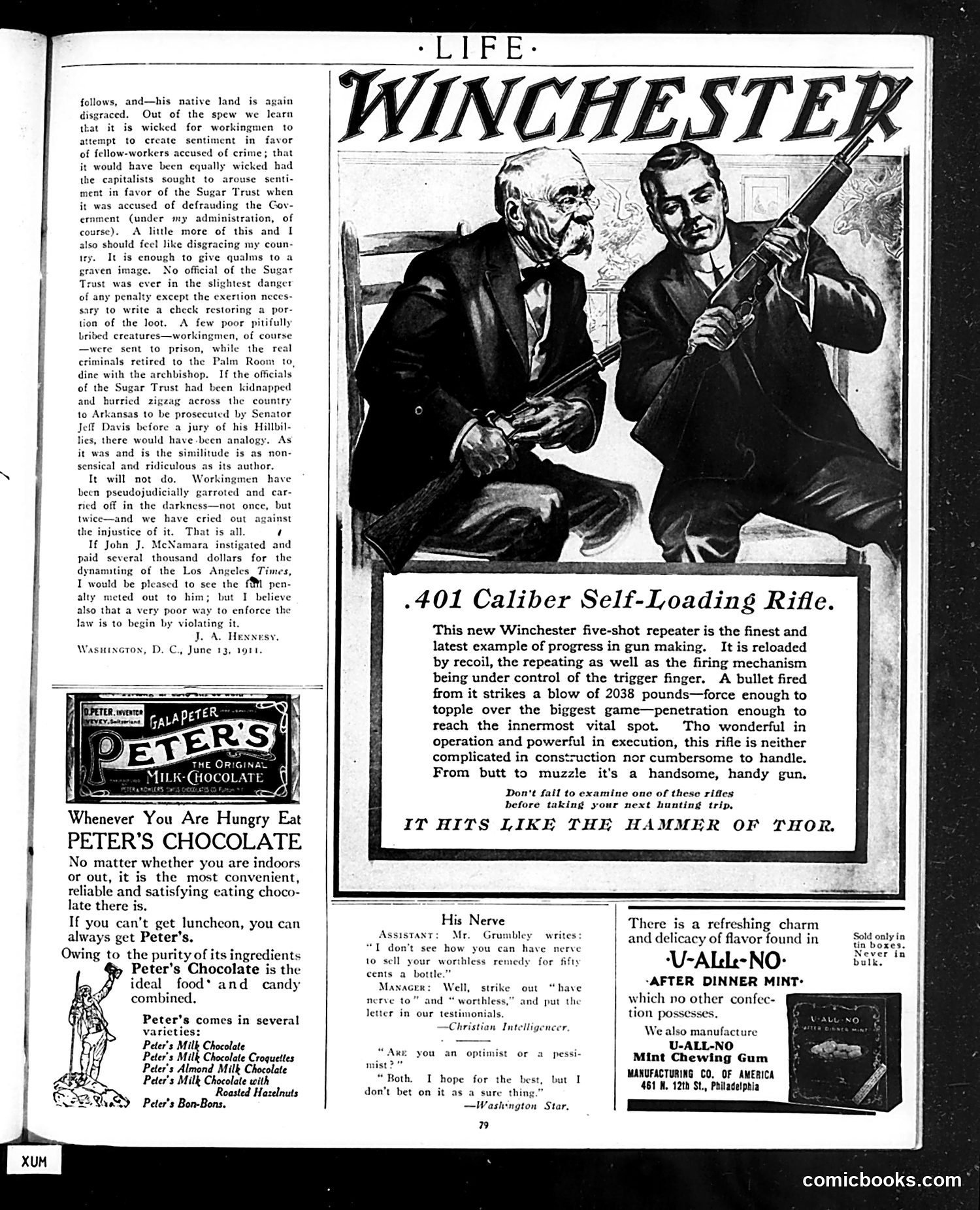
This page mixes editorial content with advertisements. The left column contains a letter from J.A. Hennessy (Washington, D.C., June 13, 1911) criticizing what appears to be a government response to labor activism. The writer references the McNamara case—likely John J. McNamara, involved in the 1910 Los Angeles Times bombing. Hennessy argues the government unfairly prosecutes working-class defendants while protecting wealthy corporate criminals (specifically mentioning the Sugar Trust), and warns that violating laws to enforce laws undermines justice itself. The right side features Winchester rifle advertising ("It Hits Like the Hammer of Thor") alongside smaller ads for Peter's Chocolate, U-All-No chewing gum, and an "After Dinner Mint" product. The advertisements are period-appropriate for 1911 Life magazine and unrelated to the editorial critique of labor prosecution.
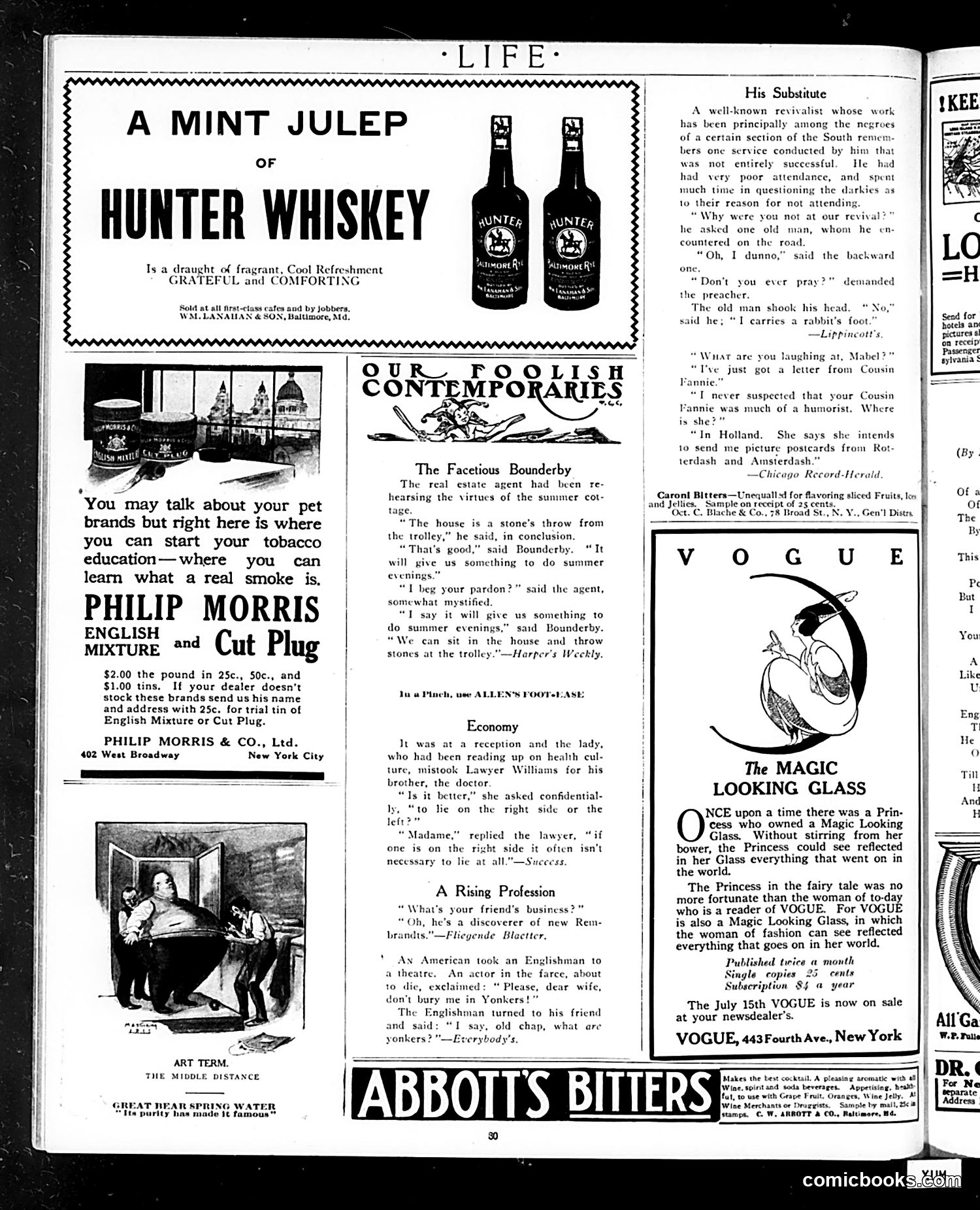
This page from *Life* magazine (a satirical publication, not the photo magazine) contains several short humorous anecdotes typical of early 20th-century American humor: **"His Substitute"**: A joke about a Black man's religious skepticism. A Southern revivalist questions why the man didn't attend services; the man replies he relies on a rabbit's foot instead of prayer. The humor reflects the era's racial stereotypes. **"The Facetious Bounderby"**: A real estate agent's sales pitch backfires when a wealthy client (Bounderby) misunderstands, thinking he can amuse himself by throwing stones at a trolley near the property. **"Economy"**: A woman mistakes a lawyer for a doctor and asks medical advice about sleeping positions; he deflects with legalistic reasoning. **"A Rising Profession"**: An American and Englishman attend a theater; confused by the word "Yonkers," the Englishman assumes it's a profession. These represent *Life*'s style: brief, observational humor playing on misunderstandings, class differences, and ethnic stereotypes common to that era's popular entertainment.
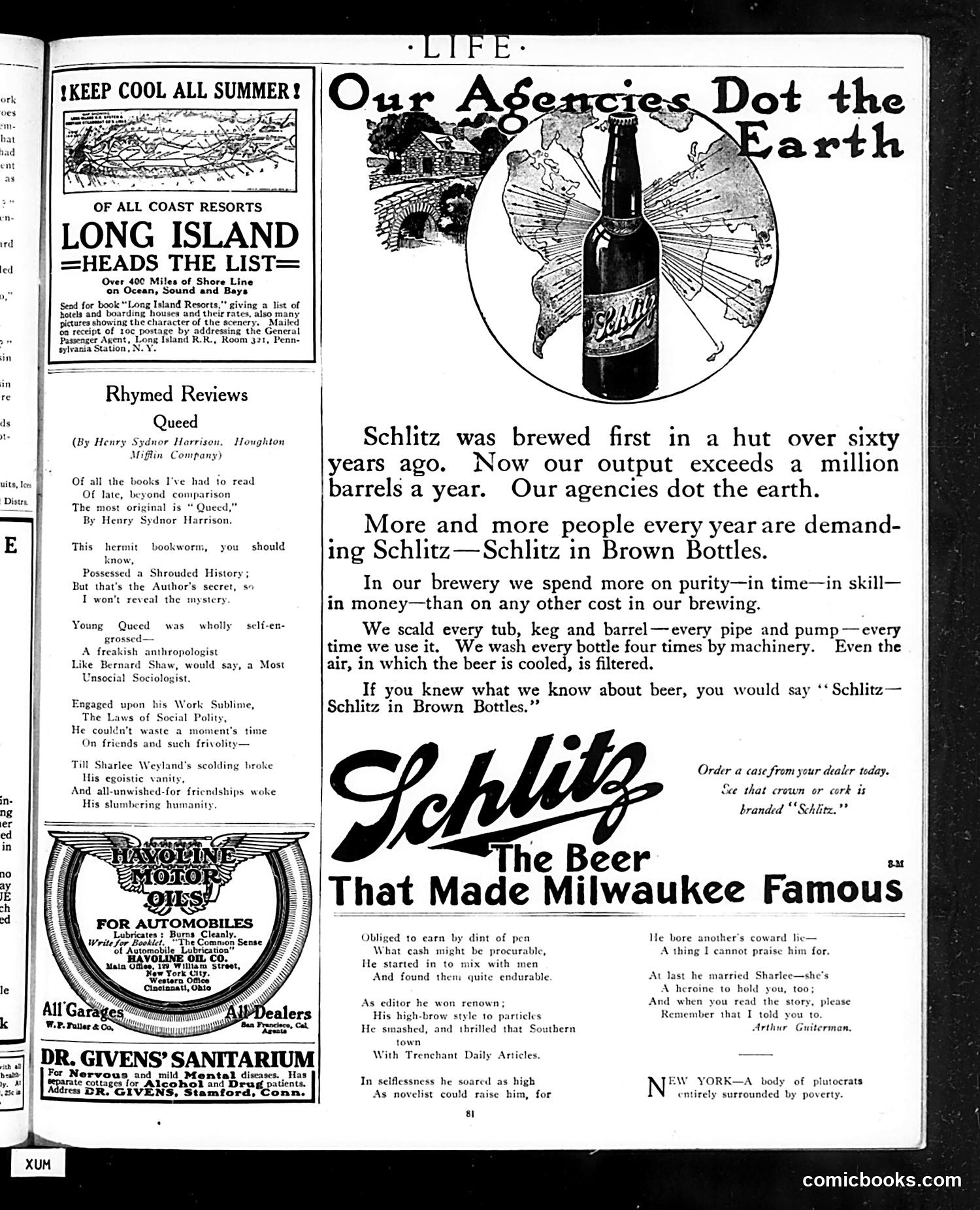
This page is primarily **advertising**, not political satire. The dominant content is a Schlitz beer advertisement occupying the right half, featuring a bottle surrounded by radiating imagery and the tagline "The Beer That Made Milwaukee Famous." The ad emphasizes industrial scale and purity—Schlitz claims output exceeding a million barrels yearly, with rigorous sanitation practices (scalding equipment, washing bottles four times, filtering air). This reflects early 20th-century industrial pride and emerging consumer concerns about food/beverage safety. The left side contains minor content: a Long Island resort advertisement, a book review of "Queed" (a novel about a self-absorbed sociologist who learns humanity), and other product ads (motor oil, sanitarium). The small item at bottom—"NEW YORK—A body of plutocrats entirely surrounded by poverty"—appears to be the magazine's only satirical element, a brief social commentary on wealth inequality, though its context is unclear from this excerpt.
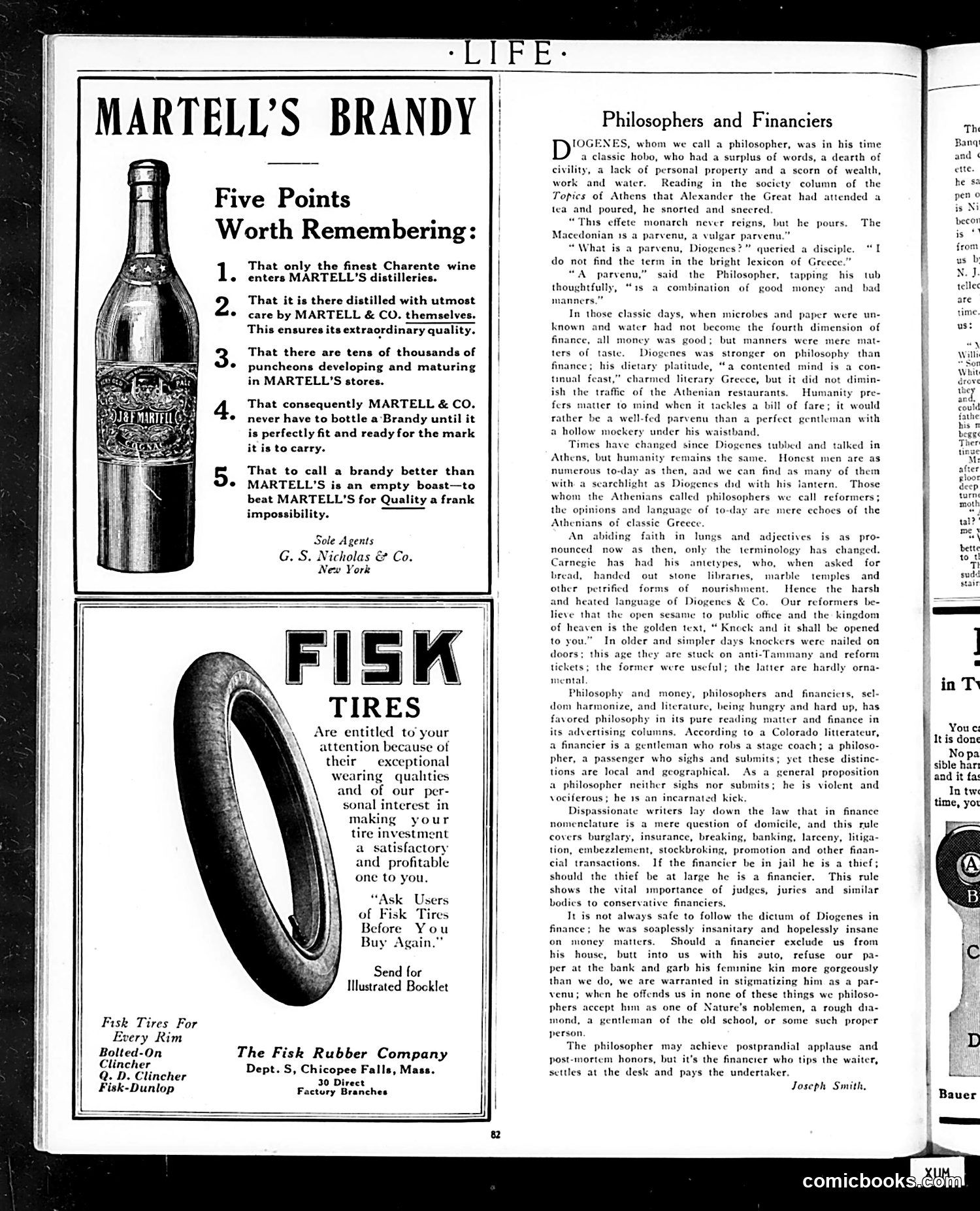
This page consists primarily of **advertisements**, not political cartoons. The three ads promote Martell's Brandy, Fisk Tires, and appear on a page featuring a satirical essay titled "Philosophers and Financiers." The essay, attributed to Joseph Smith, uses **Diogenes the ancient Greek philosopher** as a reference point to comment on modern society. The satire argues that while times have changed, human nature hasn't: wealthy parvenus (newly rich people) still lack manners, and society still prefers materially comfortable people to virtuous ones. The piece mocks **reformers and philosophers** of the author's era as self-righteous busybodies, and draws a sharp contrast between **philosophers and financiers**—suggesting they rarely coexist harmoniously. The implication is that reformers are hypocritical and ineffectual, while financiers are practical but ruthless. The tone is cynical, suggesting that moral posturing is less important than economic reality in modern life.
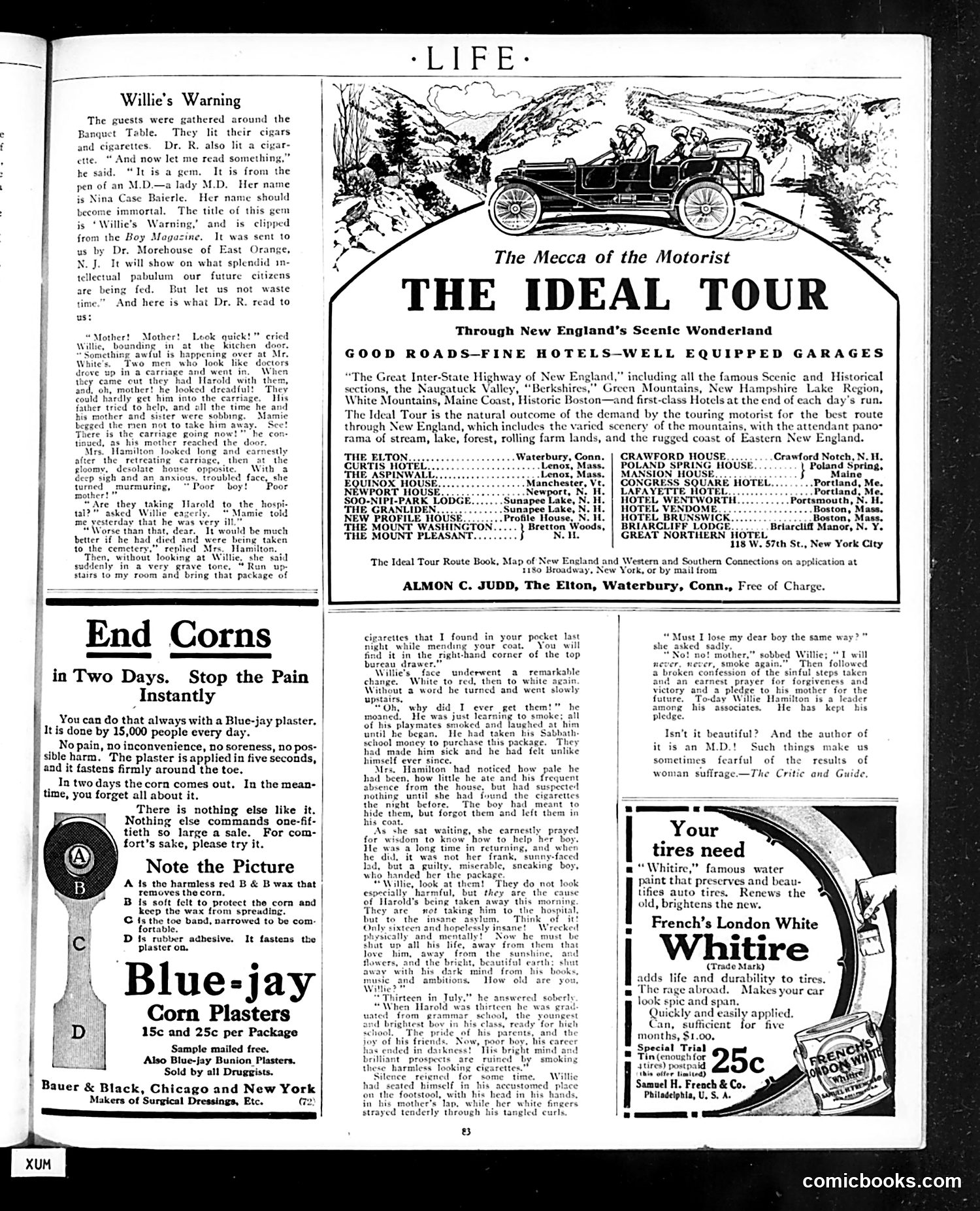
This page features a satirical story titled "Willie's Warning," presented as an example of poor-quality content fed to American children. The narrative describes young Willie overhearing adults discuss a neighbor's son, Harold, who has apparently acquired cigarettes—presented as a moral catastrophe worthy of death. The satire works by having Mrs. Hamilton declare it would be "better if he had died" than become a cigarette smoker. This grotesquely overwrought response to minor misbehavior exemplifies what *Life* magazine considered absurd, fear-mongering moral instruction in contemporary boys' magazines. The piece critiques how children's publications of the era used extreme moralizing and melodrama to discourage vice, treating minor transgressions as life-ruining sins. By presenting this earnest warning about cigarettes as obviously ridiculous, *Life* mocks both the sensationalism of youth publications and adult anxieties about corrupting influences on children.
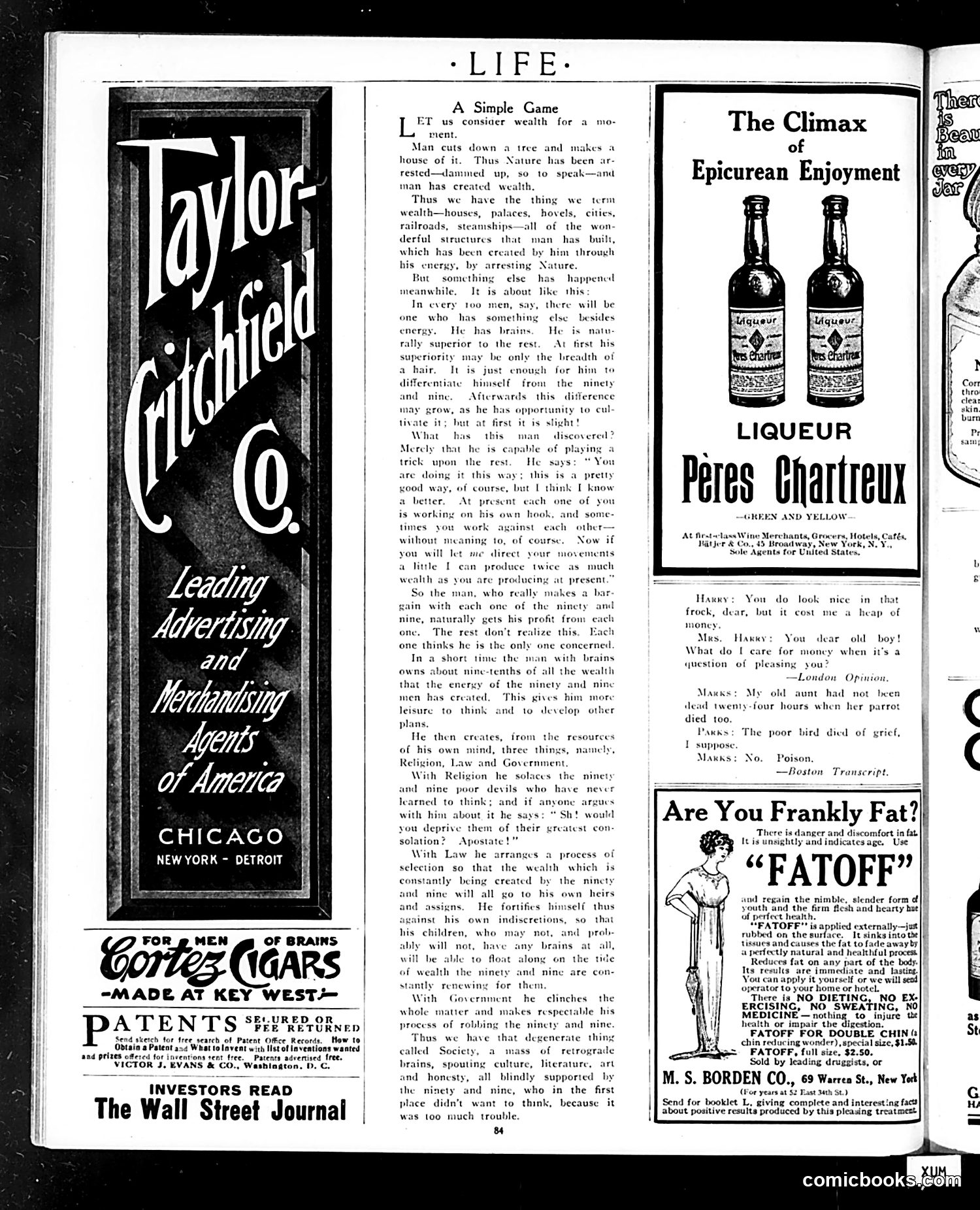
This page is primarily **advertising**, not political satire. The main content is "A Simple Game," a didactic essay about wealth creation and inequality. The essay argues that one intelligent man among ninety-nine ordinary workers can accumulate disproportionate wealth by directing their labor, then uses government and law to secure his fortune for heirs who may lack his ability. The satire here is subtle social commentary on **inherited wealth and class stratification**—the essay describes how society perpetuates inequality across generations through the mechanisms of property law and governance. The surrounding advertisements (Taylor Crichfield advertising agency, Cortez cigars, Pères Chartreux liqueur, and "Fatoff" weight-loss treatment) are period commercial content unrelated to the essay's social critique. The humor lies in the essay's frank, almost clinical explanation of economic exploitation presented as logical inevitability.
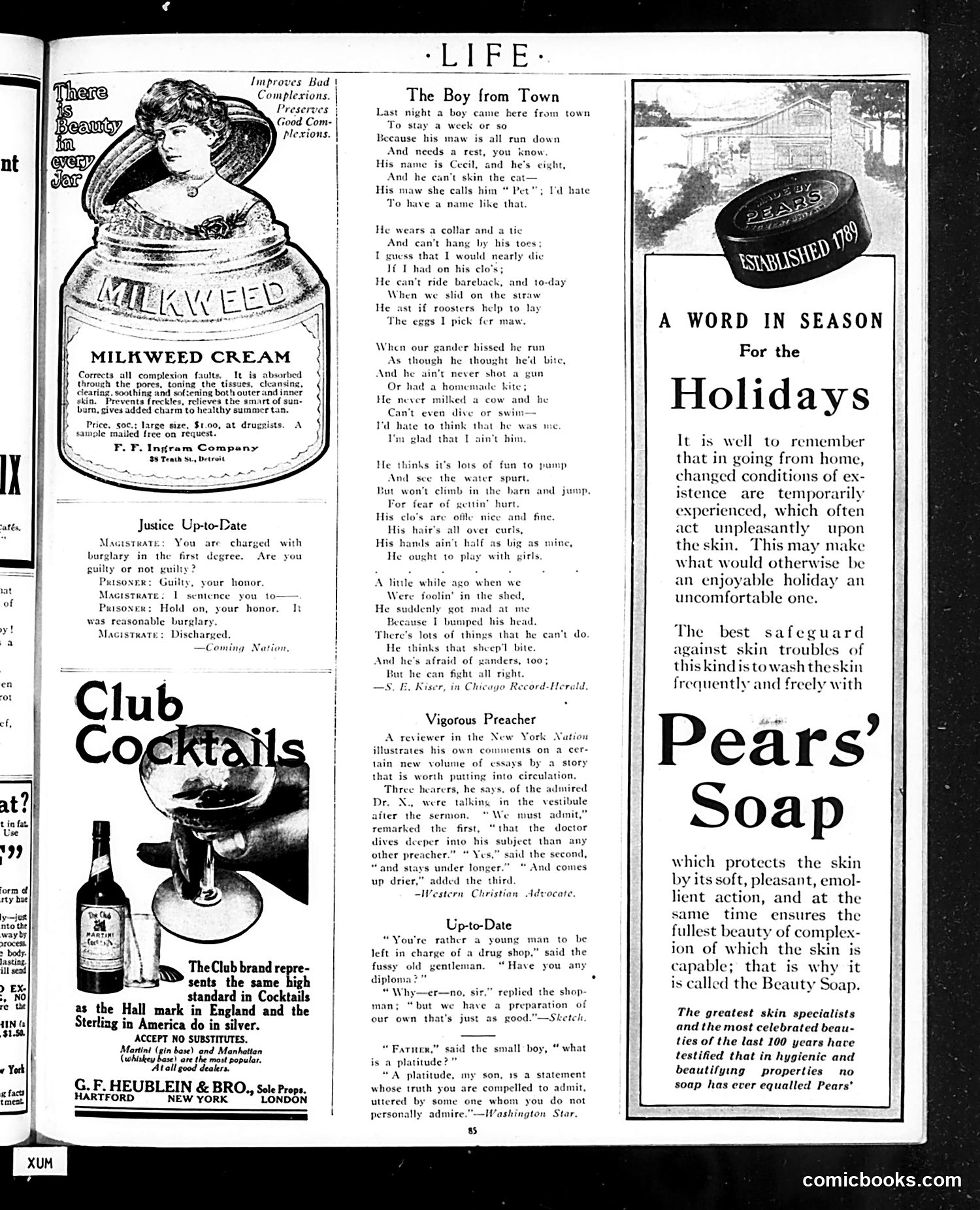
This page presents early 20th-century American humor and advertising. The main poem, "The Boy from Town," contrasts rural and urban childhood cultures through a farm child's bemused observations of a city visitor named Cecil. The satire mocks urban boys as physically soft, over-dressed, and ignorant of farm life—unable to ride bareback, skin cats, shoot guns, or understand basic rural tasks like how roosters help lay eggs. The farm child considers Cecil's curled hair and collar-and-tie outfit laughably effeminate. The "Justice Up-to-Date" and "Vigorous Preacher" sections are brief satirical vignettes poking fun at legal proceedings and sermon-giving respectively. The page is dominated by advertisements for Milkweed Cream (complexion treatment), Club Cocktails, and Pears' Soap—typical early 1900s patent medicines and consumer goods marketed with exaggerated health claims.
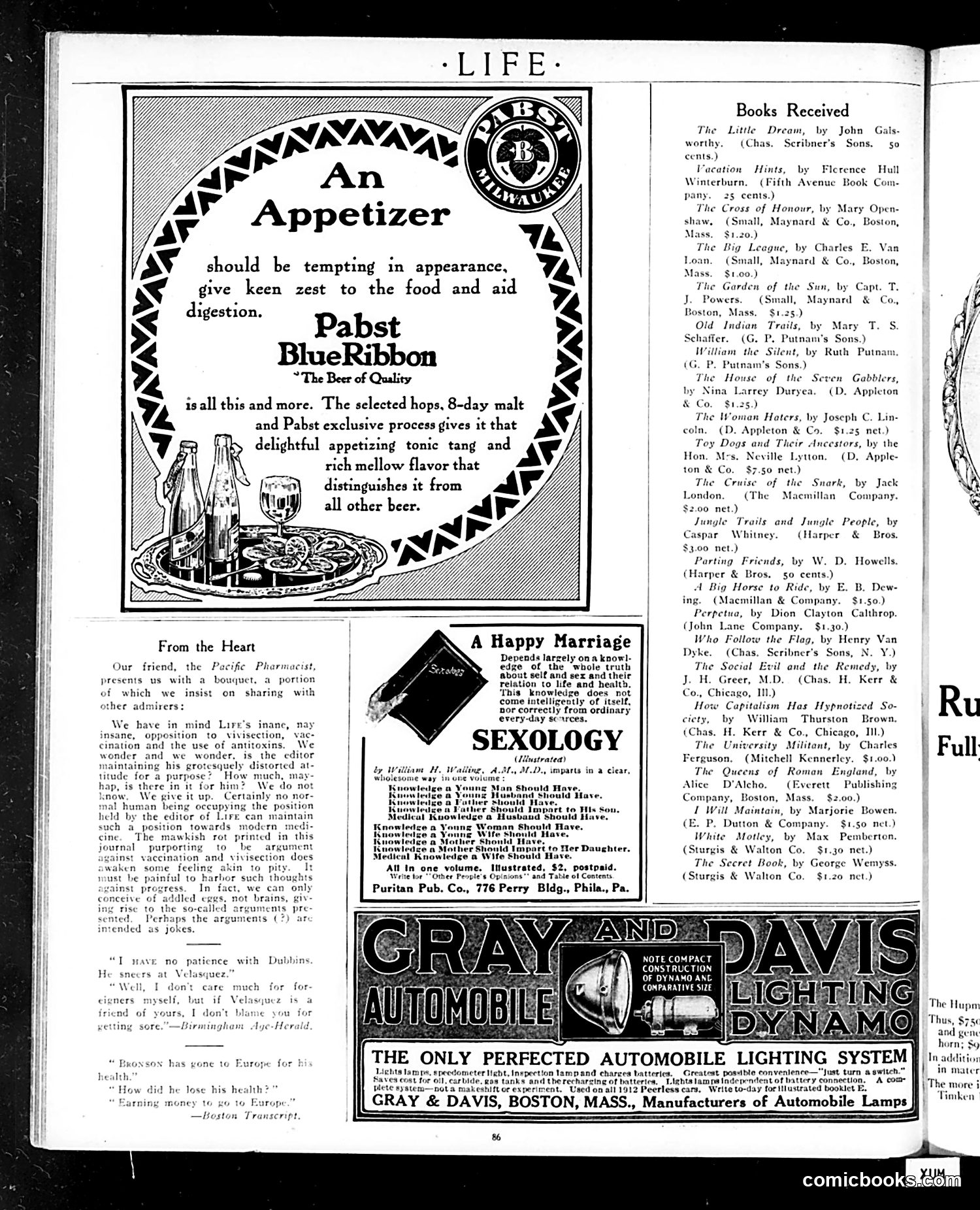
This page is primarily **advertisements and book reviews**, with minimal satirical content. The main elements are: **Pabst Blue Ribbon beer ad** (top): Standard early-20th-century advertising claiming the beer aids digestion and has superior flavor from "selected hops" and "8-day malt." **"From the Heart" editorial snippet**: Criticizes Life magazine's editor for maintaining an "insane, opposition to vivisection" (animal testing) and opposing antitoxin use—apparently the author views these positions as irrational. **"A Happy Marriage" / "Sexology" book ad**: Promotes a sex education book, reflecting early Progressive Era debates about frank discussion of sexuality. **Gray & Davis Automobile Lighting ad**: Technical advertisement for car lighting systems. **Books Received section**: A simple listing of newly published books with titles, authors, and prices. The page contains **no political cartoons or satirical illustrations**—it's a standard magazine layout mixing editorial commentary, educational advertising, and book notices typical of the era.
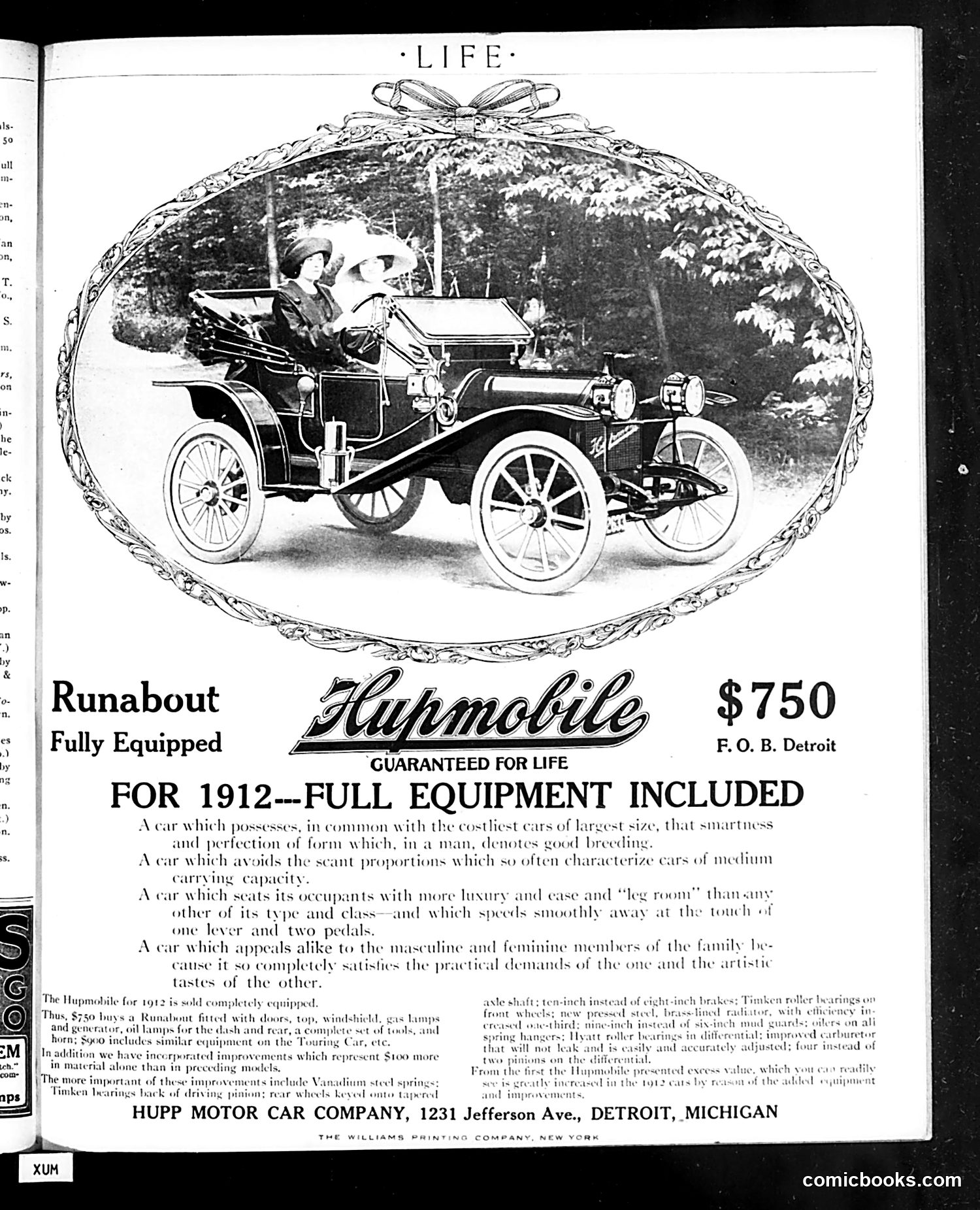
This is **not a political cartoon** but rather a **full-page automobile advertisement** from Life magazine. It promotes the Hupmobile Runabout, a mass-produced car priced at $750 (fully equipped, F.O.B. Detroit). The ad uses language typical of early automotive marketing: it appeals to both masculine practicality and feminine aesthetic taste, emphasizing the car's "smartness," comfort ("leg room"), and smooth operation via "one lever and two pedals." The illustration shows two well-dressed people in the open-air vehicle. The copy highlights technical improvements for 1912: Vanadium steel springs, Timken bearings, and ten-inch brakes. The rhetorical framing—comparing the car to "good breeding" in humans—reflects period attitudes linking consumer products to social status. This represents early-1900s automotive culture when cars were becoming accessible luxuries rather than curiosities, marketed to middle-class families.
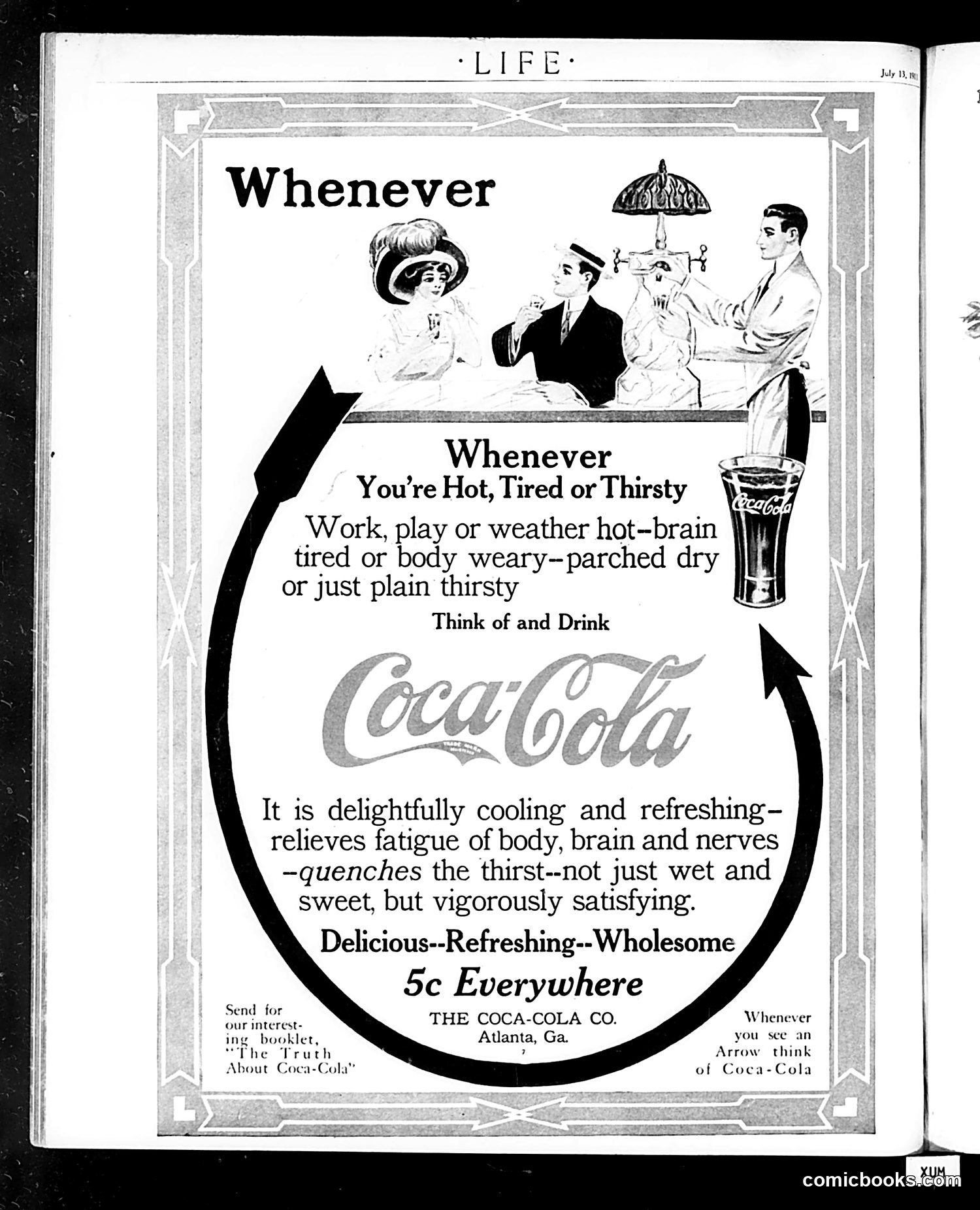
This page is a straightforward **product advertisement** from Life magazine's advertising section, not satirical content. It promotes Coca-Cola to early 20th-century consumers. The illustration depicts fashionable, well-dressed figures in social situations (a woman in a hat, men in suits, someone with an umbrella), establishing aspirational imagery. The ad's messaging targets multiple scenarios: work fatigue, physical exertion, and hot weather—positioning Coca-Cola as a universal remedy for bodily and mental exhaustion. The claims—that the drink "relieves fatigue of body, brain and nerves"—reflect early advertising practices before modern health regulations. The price ("5c Everywhere") and tagline emphasizing it's "Delicious--Refreshing--Wholesome" were standard marketing language of the era. The "Arrow" reference at bottom likely refers to a separate advertising campaign or brand symbol. This represents commercial rather than editorial content.