
Life, 1911-07-13 · page 32 of 44
Life — July 13, 1911 — page 32: what you’re looking at
What you’re looking at
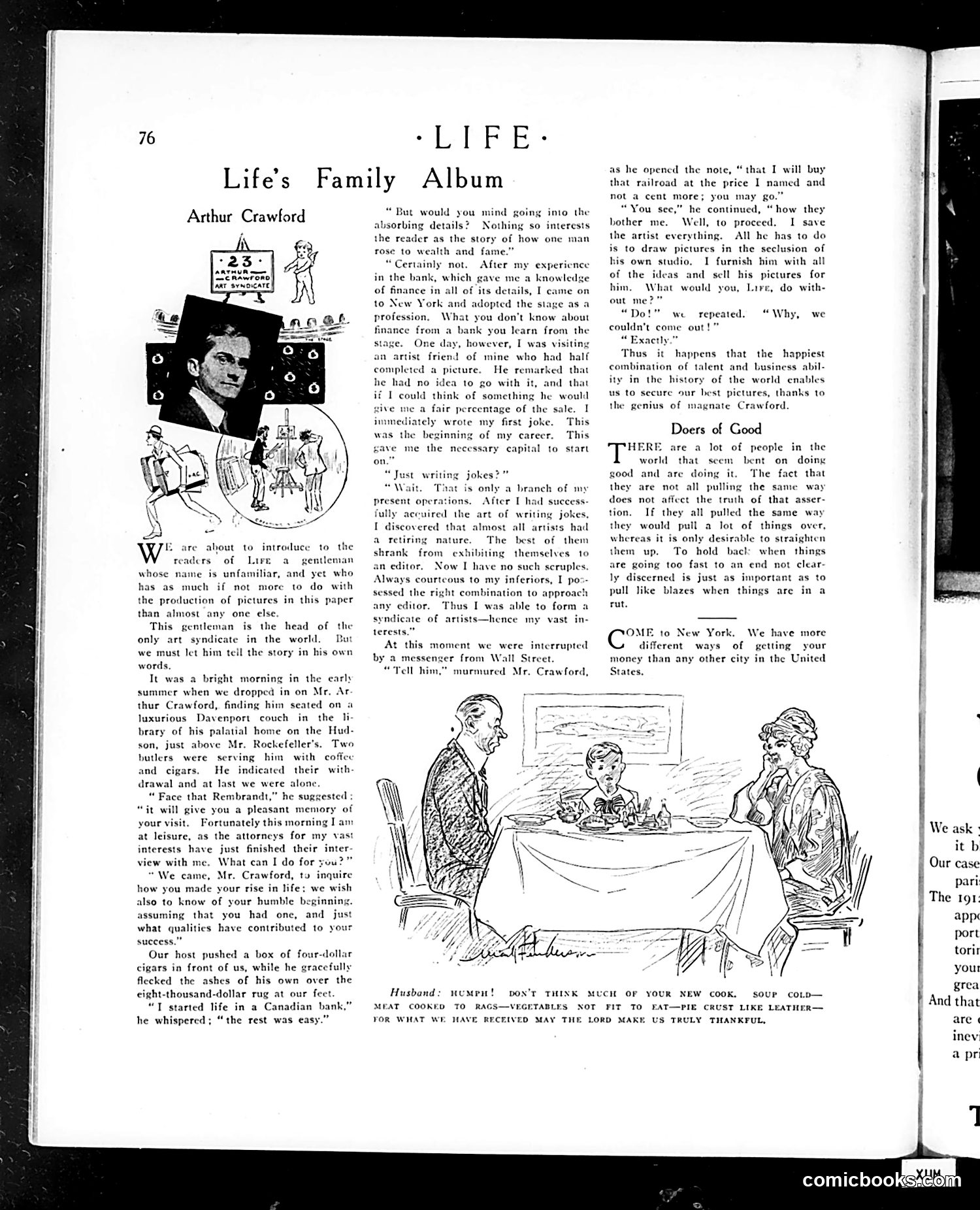
This page profiles Arthur Crawford, head of an art syndicate that supplies content to *Life* magazine. The satire mocks Crawford's self-aggrandizing account of his rise from Canadian bank clerk to wealthy magnate. Crawford's narrative—moving from banking to theatre to joke-writing to controlling artists—is presented as absurdly easy, with each transition requiring minimal effort. The humor lies in his pretentious boasting: he lounges in luxury (with butlers, four-dollar cigars, an eight-thousand-dollar rug), compares himself to Rockefeller, and claims artists depend entirely on him for ideas while he handles all business matters. The accompanying cartoon shows a domestic scene where a husband criticizes his cook while eating poorly prepared food—likely illustrating Crawford's broader point about managing incompetent talent. The satire targets wealthy businessmen who exaggerate their importance and the exploitative relationships between syndicates and artists. Crawford represents the self-made entrepreneur who credits himself entirely for success while controlling creative workers.
📄 Transcribed text from this page (OCR, searchable)
Machine-transcribed from the original scan — historical spelling and the odd misread are preserved.
Life’s Arthur Crawford WwW are ahout to introduce to the readers of Lire a gentleman whose name is unfamiliar, and yet wh has as much if not more to do with the production of pictures in this paper than almost any one else This gentleman is the head of the only art syndicate in the world, Bu we must let him teil the story in his own words It was a bright morning in the early summer when we dropped in on Mr. Ar thur Crawford, finding him seated on a luxurious Davenport couch in the li brary of his palatial home on the Hud- son, just above Mr. Rockefeller’s. Two gg him with coffer butlers were serv and cigars, He indicated their with- drawal and at last we were alone. “Face that Rembrandt,” he suggested : “it will give you a pleasant memory of your visit. Fortunately this morning I am at leisure, as the attorneys for my vast interests have just finished their inter view with m 20 What can I do for you? “We came, Mr. Crawford, ty inquire how you made your rise in life: we wish also to know of your humble beginning. assuming that you had one, and what qualities have contributed to you success.” Our host pushed a box of four-dollar ars in front of us, while he gracefully flecked the ashes of his own over the cight-thousand-dollar rug at our feet. “T started life in a Canadian bank,” he whispercd; “the rest was easy Family “But would you mind going into the -LIFE- Album orbing details? Nothing so interests the reader as the story of how one man rose to wealth and fame.” “Certainly not. After my experience in the bank, which gave me a knowledge of finance in all of its details, I came on to New York and adopted the stage profession, What you don’t know about finance from a bank you learn from the stage. One day, however, I was visiting rtist friend of mine who had half npleted a picture. He remarked that he had no idea to go with it, and that a if 1 could think of something he would ir percentage of the sale. I ly wrote my first joke. This was the beginning of my career. This gave me the necessary capital to start on.” Just writing jokes?” “Wait, Ti a branch of my present operations, After [| fully aceuired the art of writing jokes, is only I discovered that almost all artists had a retiring nature. The be: shrank from an editor. Now I have no such scruples. Always courteous to my inferiors, I po>- sessed the right combination to approa any editor. Thus I was able to form a syndicate of artists—hence my vast in- terests.” At this moment we were interrupt by a messenger from Wall Street. “Tell him," murmured Mr. Crawford, of them biting themselves 10 Husband: ucuen! DON'T THINK MUCH OF YOUR NEW COOK. as he opened the note, “that I will buy that railroad at the price I named and not cent more; you may go.” “You sce,” he continued, “how they bother me. Well, to proceed. I save the artist everything. All he has to do is to draw pictures in the seclusion of his own studio, I furnish him with all of the ideas and sell his pictures for him. What would you, Lire, do wi out me? “Do couldn't come out! = actly.” Thus it happens that the happiest combination of talent and business abil- ity in the history of the world enables we repeated.“ Why, we us to secure our best pictures, thanks to the genius of magnate Crawford. Doers of Good HERE are a lot of people in the world that seem bent on doing good and are doing it. The fact that they are not all pulling the same way does not aficct the truth of that asser- tion. If they all pulled the same way ey would pull a lot of things over, whereas it is only desirable to straighten them up. To hold back when things are going too fast to an end not clear: ly discerned is just as important as to pull like blazes when things are in a rut. OME 10 New York. We have more different’ ways of getting your money than any other city in the United States. SOUP CoLD— MEAT COOKED TO RAGS—VEGETABLES NOT FIT TO FAT—PIE CRUST LIKE LEATHER— YOR WHAT WE HAVE RECEIVED MAY TI LORD MAKE US TRULY THANKFUL, comicboo! We ask : it b Our case pari: The 191: app port torit your grea And that are inev: a pr x EO)