
Life, 1911-07-13 · page 16 of 44
Life — July 13, 1911 — page 16: what you’re looking at
What you’re looking at
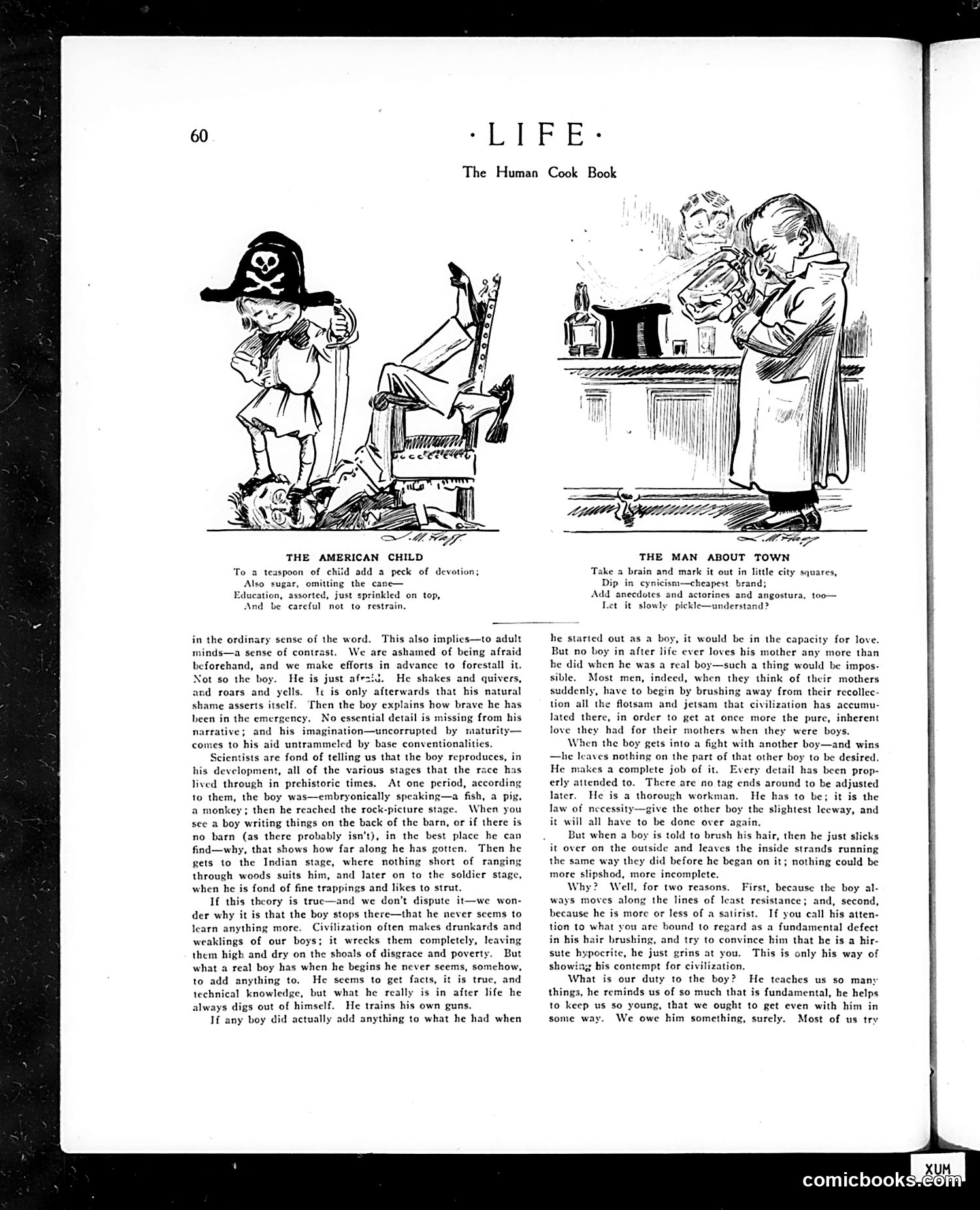
This page presents two satirical character sketches from Life's "Human Cook Book" series, using recipes as metaphors for creating recognizable social types. **"The American Child"** (left): A pirate-costumed boy represents the idealized American child—supposedly natural, imaginative, and uninhibited by civilization. The accompanying text humorously argues that boys possess inherent qualities they never improve upon; they're thorough and instinctive but resist restraint or refinement. The satire mocks both romantic notions of childhood innocence and scientific theories (popular in the era) claiming boys recapitulate human evolution. **"The Man About Town"** (right): A sophisticated urban man holding drinks represents the cynical city dweller, "pickled" in cynicism and artificial anecdotes. This contrasts sharply with the boy—suggesting civilization corrupts natural virtue rather than improving it. Together, these sketches satirize both idealized American childhood and the artificial sophistication of urban adulthood, suggesting neither produces genuinely improved humans.
📄 Transcribed text from this page (OCR, searchable)
Machine-transcribed from the original scan — historical spelling and the odd misread are preserved.
‘LIP es The Human Cook Book THE AMERICAN CHILD To a teaspoon of child add a peck of dev Also sugar, omitting the cane— Education, assorted, just sprinkled on top, And be careful not to restrain, in the ordinary sense of the word. This also implics—to adult minds—a sense of contrast. We are ashamed of being afraid beforehand, and we make efforts in advance to forestall it. Not so the boy. He is just afrzid, He shakes and quivers, and roars and yells. 1c is only afterwards that his natural shame asserts itself. Then the boy explains how brave he has heen in the emergency. No essential detail is missing from his narrative; and his imagination—uncorrupted by maturity— comes to his aid untrammeled by base conventionalities. Scientists are fond of telling us that the boy reproduces, in his development, all of the various stages that the race has lived through in prehistoric times. At one period, according to them, the boy was—embryonically speaking—a fish, a pig, a monkey; then he reached the rock-picture stage. When you see a boy writing things on the back of the barn, or if there is no barn (as there probably isn't), in the best place he can find—why, that shows how far along he has gotten. Then he gets to the Indian stage, where nothing short of ranging through woods suits him, and later on to the soldier stage, when he is fond of fine trappings and likes to strut. If this thory is true—and we don't dispute it—we won- der why it is that the boy stops there—that he never seems to learn anything more. Civilization often makes drunkards and weaklings of our boys; it wrecks them completely, leaving them high and dry on the shoals of disgrace and poverty. But what a real boy has when he begins he never seems, somehow, to add anything to. He seems to get facts, it is true, and technical knowledge, but what he really is in after life he always digs out of himself, He trains his own guns. If any boy did actually add anything to what he had when THE MAN ABOUT TOWN Take a brain and mark it out in little city squares, Dip in cynicism—cheapest brand; Add anecdotes and actorines and angostura, too— Let it slowly pickle—understand? he started out as a boy, it would be in the capacity for love. But no boy in after life ever loves his mother any more than he did when he was a real boy—such a thing would be impos- sible. Most men, indeed, when they think of their mothers suddenly, have to begin by brushing away from their recollec tion all the flotsam and jetsam that civilization has accumu- lated there, in order to get at once more the pure, inherent love they had for their mothers when they were boys. When the boy gets into a fight with another boy—and wins —he leaves nothing on the part of that other boy to be desired He makes a complete job of it. Every detail has been prop- erly attended to. There are no tag ends around to be adjusted later. He is a thorough workman. He has to be; it is the law of necessity—give the other boy the slightest leeway, and it will all have to be done over again. But when a boy is told to brush his hair, then he just slicks it over on the outside and leaves the inside strands running the same way they did before he began on it; nothing could be more slipshod, more incomplete. Why? Well, for two reasons, First, because the boy al- ways moves along the lines of least resistance; and, second, because he is more or less of a satirist. If you call his atten- tion to what you are bound to regard as a fundamental defect in his hair brushing, and try to convince him that he is a hir- sute hypocrite, he just grins at you. This is only his way of showing bis contempt for civilization. What is our duty to the boy? He teaches us so man; things, he reminds us of so much that is fundamental, he helps to keep us so young, that we ought to get even with him in some way. We owe him something, surely. Most of us try comicbookMeam