
Life, 1911-07-13 · page 8 of 44
Life — July 13, 1911 — page 8: what you’re looking at
What you’re looking at
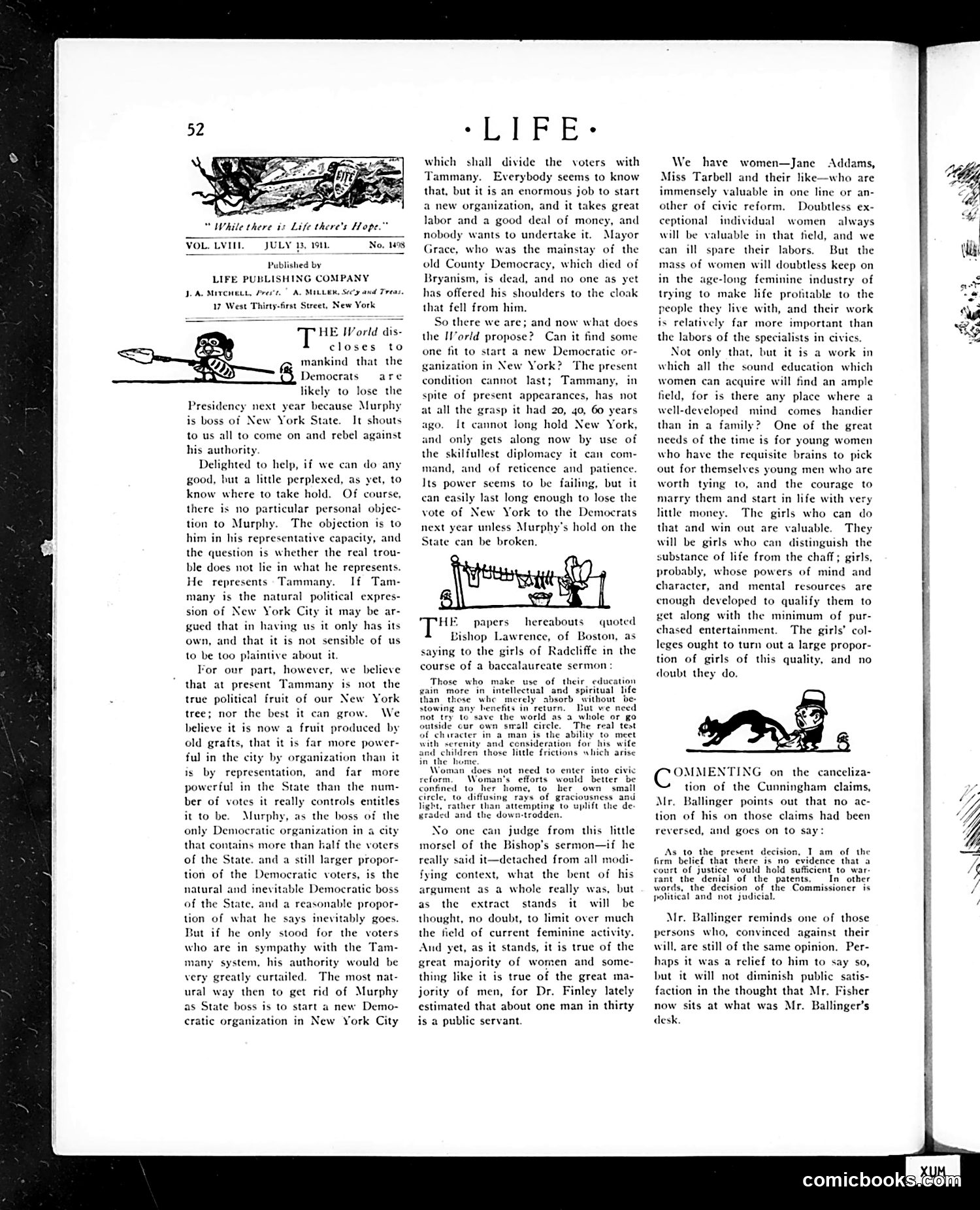
This *Life* magazine page critiques New York State Democratic leadership, particularly Mayor Murphy's control of the party organization. The text argues that the Democratic machine "cannot last" and lacks the diplomatic skill to maintain power—it will lose the state unless Murphy's influence is broken. The editorial also discusses women's education and civic participation, quoting Bishop Lawrence of Boston on female virtue. The piece advocates for educated women in reform movements, naming specific female activists (Jane Addams, Miss Tarbell). A separate section comments on "Cunningham claims," referencing a political figure named Ballinger. The cartoons (small illustrations visible) appear to be humorous spot drawings typical of *Life's* satirical style, though specific details are difficult to discern in this reproduction.
📄 Transcribed text from this page (OCR, searchable)
Machine-transcribed from the original scan — historical spelling and the odd misread are preserved.
“ While there is Life there's Hope.” No. 1498, VOL. LVI. JULY 13, 1911. Published by LIFE PUBLISHING COMPANY J. A. Mire! A. MILLER, See’y and Treas. 17 West Thirty-first Street, eLt, Pres't. few York HE World dis- closes to mankind that the Democrats are likely to lose the Presidency next year because Murphy is boss of New York State. It shouts to us all to come on and rebel against his authority Delighted to help, if we good, but a little perplexed, as yet, to know where to take hold. Of course, an do any there is no particular personal obje! tion to Murphy. The objection is to him in his representative capacity, and the question is whether the real trou- ble does not lie in what he represents. He represents Tammany. If Tam- many is the natural political expres sion of New York City it may be ar- gued that in having us it only has its own, and that it is not sensible of us to be too plaintive about it For our part, however, we believe that at present Tammany is not the true political fruit of our New York tree; nor the best it can grow. We believe it is now a fruit produced by old grafts, that it is far more power- ful in the city by organization than it is by representation, and far more powerful in the State than the num- ber of votes it really controls entitles it to be. Murphy, as the boss of the only Democratic organization in a city that contains more than half the voters of the State. and a still larger propor- tion of the Democratic voters, is the natural and inevitable Democratic boss of the State, and a reasonable propor- tion of what he says inevitably goes. But if he only stood for the voters who are in sympathy with the Tam- many system, his authority would be very greatly curtailed. The most nat- ural way then to get rid of Murphy as State boss is to start a new Demo- cratic organization in New York City ‘LIFE which shall divide the voters with Tammany. Everybody seems to know that, but it is an enormous job to start a new organization, and it takes great labor and a good deal of money, and nobody wants to undertake it. Mayor Grace, who was the mainstay of the old County Democracy, which died of Bryanism, is dead, and no one as yet has offered his shoulders to the cloak that fell from him. So there we are; and now what does the H’orld propose? Can it find some one fit to start a new Democratic or- ganization in New York? The present condition cannot last; Tammany, in spite of present appearances, has not at all the grasp it had 20, 40, 60 years ago. It cannot long hold New York, and only gets along now by use of the skilfullest diplomacy it can com- mand, and of reticence and patience. Its power scems to be failing, but it can easily last long enough to lose the vote of New York to the Democrats next year unless Murphy's hold on the State can be broken. HE papers hereabouts quoted Lishop Lawrence, of Boston, as saying to the girls of Radcliffe in the course of a baccalaureate sermon: use of their education al and. spiritual life these wh absorb without be: stowing any henefits in return. But we need not try to save the world as a whole or go outside cur own stall circle. The real test of chara is the ability to meet with serenity and consideration for his wife and children those little frictions which arise in the home man does not need to enter into civic ‘m. Woman's efforts would better be d to her home, to. her own small to diffusing rays of graciousness and ather than attempting to uplift the de graded and the down-trodden. No one can judge from this little morsel of the Bishop's sermon—if he really said it—detached from all modi- fying context, what the bent of his argument as a whole really was, but as the extract stands it will be thought, no doubt, to limit over much the field of current feminine activity. Aud yet, as it stands, it is true of the great majority of women and some- thing like it is true of the great ma- jority of men, for Dr. Finley lately estimated that about one man in thirty is a public servant. We have women—Jane Addams, Miss Tarbell and their like—who are immensely valuable in one line or an- other of civic reform. Doubtless ex- ceptional individual. women always will be valuable in that field, and we can ill spare their labors. But the mass of women will doubtless keep on in the age-long feminine industry of trying to make life profitable to the people they live with, and their work is relatively far more important than the labors of the specialists in civics. Not only that, but it is a work in which all the sound education which women can acquire will find an ample field, for is there any place where a well-developed mind comes handier than in a family? One of the great needs of the time is for young women who have the requisite brains to pick out for themselves young men who are worth tying to, and the courage to marry them and start in life with very little money. The girls who can do that and win out are valuable. They will be girls who can distinguish the substance of life from the chaff; girls, probably, whose powers of mind and character, and mental resources are enough developed to qualify them to get along with the minimum of pur- chased entertainment. The girls’ col- leges ought to turn out a large propor- tion of girls of this quality, and no doubt they do. OMMENTING on the canceliza- tion of the Cunningham claims, Mr. Ballinger points out that no ac- tion of his on those claims had been reversed, and goes on to say: As to. the present decision, Tam of the firm belief that there is no evidence that a court of justice would hold sufficient to war rant, the denial of the patents, In other words, the decision of the Commissioner is political and not judicial. Mr. Ballinger reminds one of those persons who, convinced against their will, are still of the same opinion. Per- haps it was a relief to him to say so, but it will not diminish public satis- faction in the thought that Mr. Fisher now sits at what was Mr. Ballinger’s