
A complete issue · 44 pages · 1911
Life — February 16, 1911
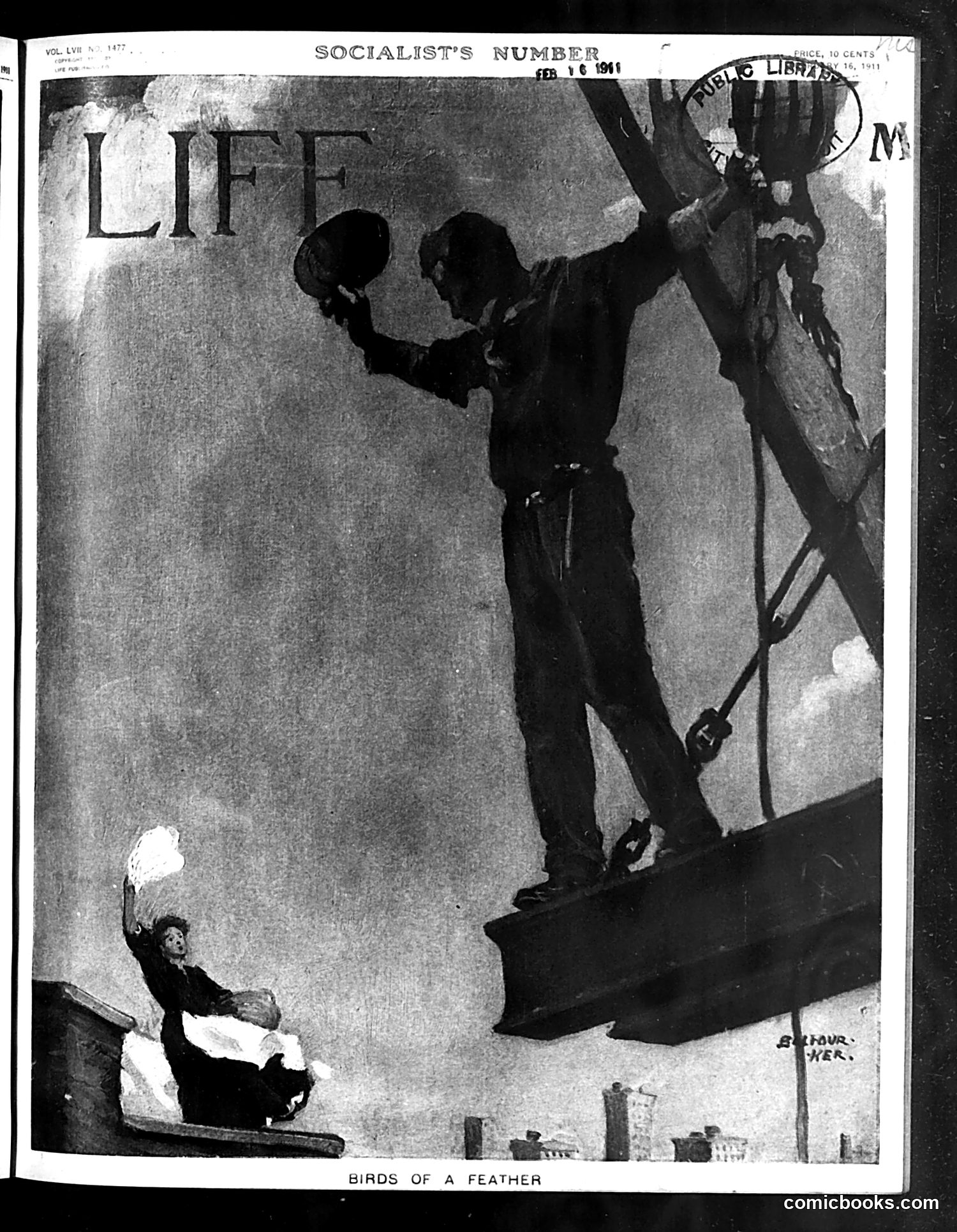
This Life magazine cover satirizes the relationship between wealthy industrialists and politicians, using the metaphor of birds of a feather flocking together. The central figure appears to be a capitalist or politician standing elevated, manipulating or controlling a smaller figure below—likely representing either a worker, the common person, or a political rival. The title "Birds of a Feather" suggests hypocrisy or collusion between those in power. Published in 1911 during the Progressive Era, this reflects widespread American concern about corruption, cronyism, and the unholy alliance between big business and government. The silhouette style emphasizes the symbolic nature of the critique rather than depicting specific individuals, making it a general indictment of systemic corruption.
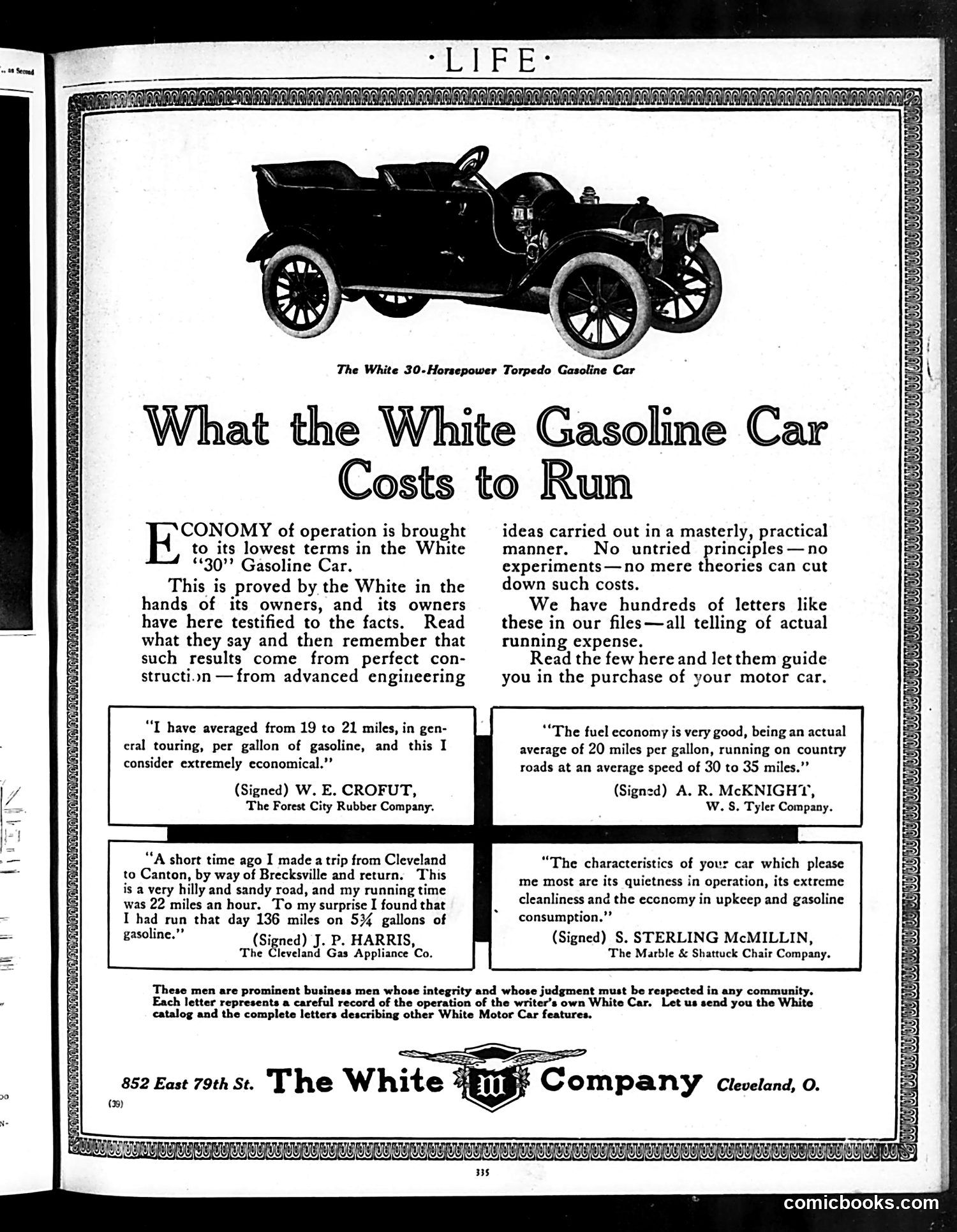
This is **not a satirical cartoon page**, but rather a **straightforward automobile advertisement** disguised as editorial content in Life magazine. The page advertises the White 30-Horsepower Torpedo Gasoline Car by presenting testimonials from four prominent businessmen. Each letter purports to document actual operating costs and performance benefits—fuel economy (19-21 miles per gallon), quietness, cleanliness, and reliability. The framing emphasizes that these are real business owners whose "integrity and judgment must be respected," lending credibility through appeal to authority rather than satire. This was common early-1900s advertising practice: using endorsements from recognizable community figures to build consumer trust. The company address (Cleveland, Ohio) and detailed specifications indicate this is genuine product promotion, not social commentary or political satire.
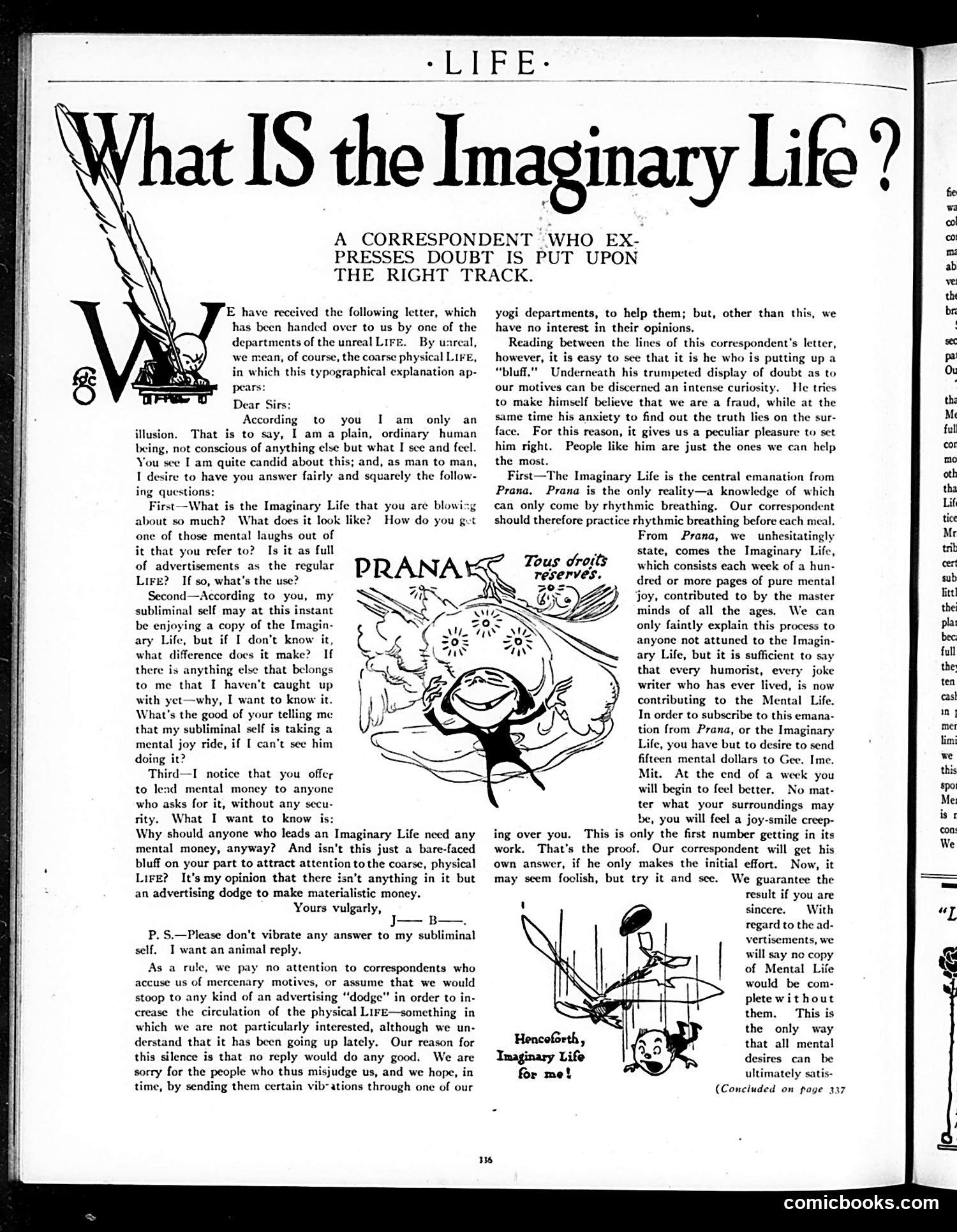
This page presents a letter-to-the-editor debate about "Prana" and the "Imaginary Life"—spiritual and mental practices gaining popularity in early 20th-century America. A correspondent questions whether Life magazine should promote mental disciplines and "Prana" (rhythmic breathing exercises) as viable alternatives to ordinary existence. The editors respond skeptically, dismissing the concept as essentially an "advertising dodge" designed to extract money from credulous readers. The cartoons mock practitioners: one shows someone in exaggerated meditation posture; another depicts a figure labeled "Henceforth, Imaginary Life for me!" in a satirical surrender to the trend. The satire targets the era's proliferation of wellness fads, New Thought movements, and self-improvement schemes promising mental transcendence—suggesting they exploit vulnerable people seeking meaning.
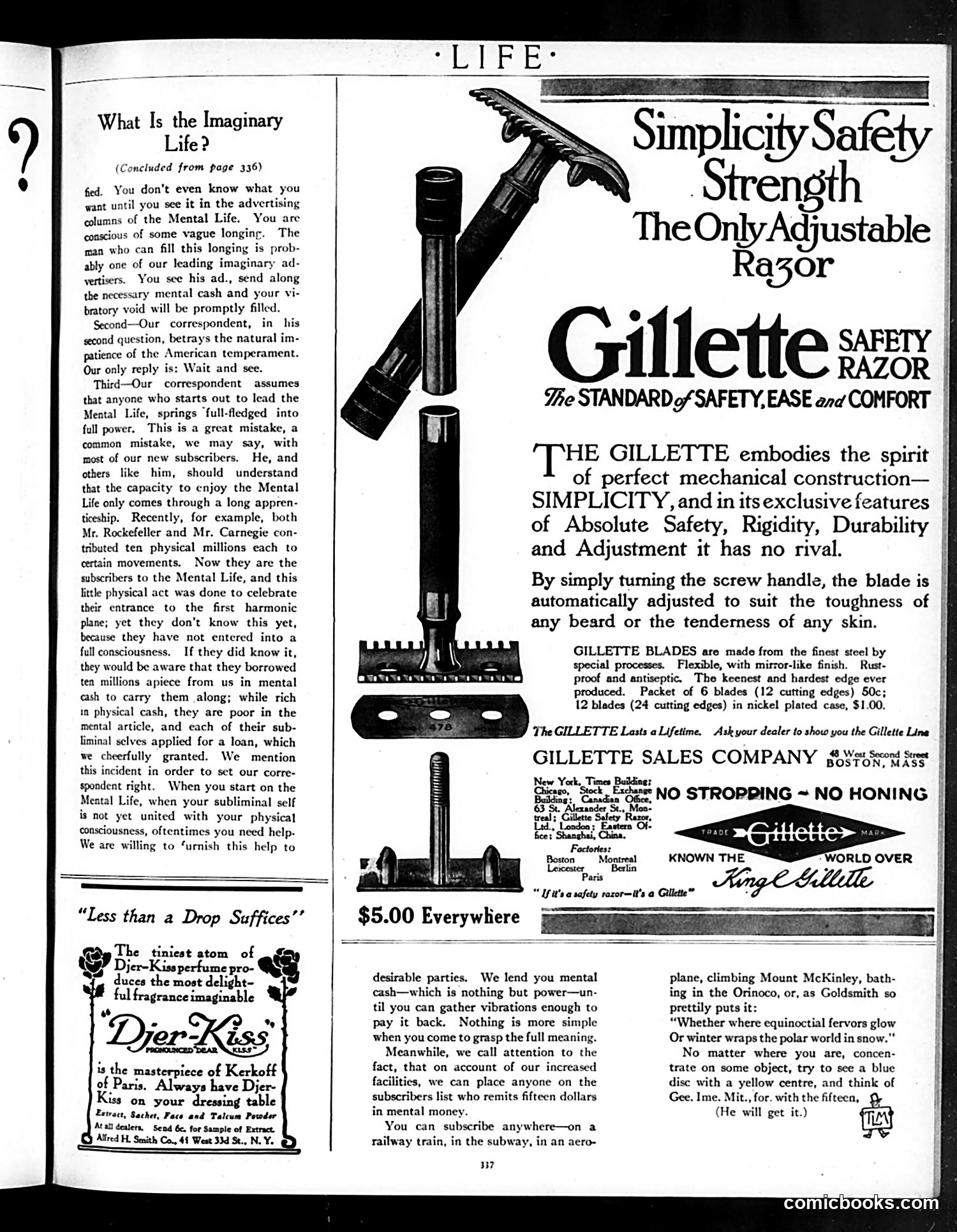
This page is primarily **advertising**, not political satire. The dominant content is a full-page Gillette Safety Razor advertisement emphasizing the product's "simplicity" and adjustability. The left column contains editorial text titled "What Is the Imaginary Life?" discussing how subscribers to "Mental Life" often lack physical consciousness alongside their intellectual pursuits. It references Rockefeller and Carnegie as examples of wealthy men who embodied both mental and physical development. Below is a smaller ad for **Djer-Kiss** perfume, marketed as "the tiniest atom" providing "the most delightful lingering fragrance." The page reflects early 20th-century consumer culture and the era's fascination with self-improvement through products and mental cultivation.
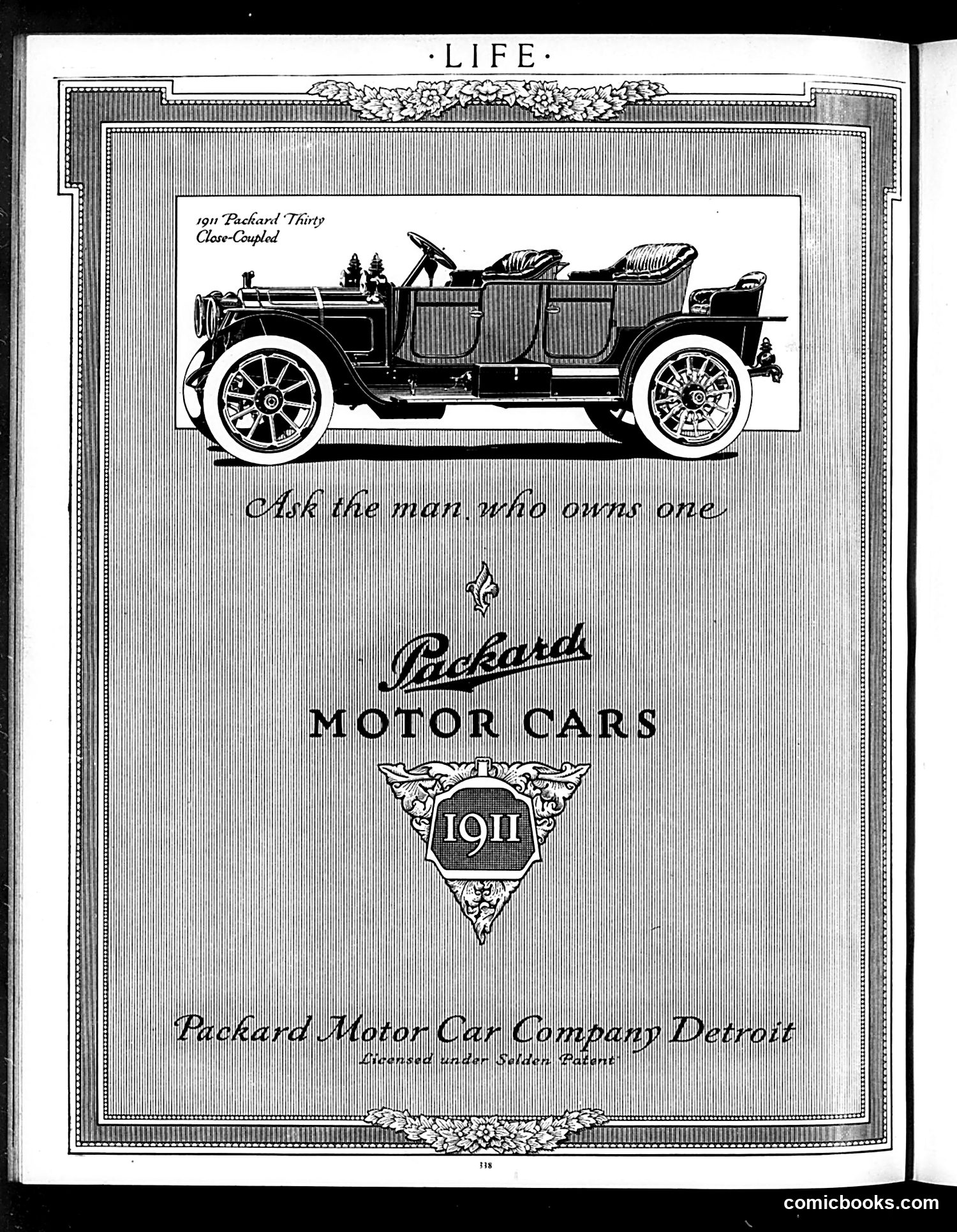
This is primarily a **Packard Motor Cars advertisement** from 1911, not a political cartoon. The page features a detailed illustration of a 1911 Packard Thirty automobile with an open touring body and multiple passenger seats. The advertisement's tagline—"Ask the man who owns one"—was Packard's famous marketing slogan, designed to build brand credibility through owner testimonials rather than manufacturer claims. The "Class-Coupled" designation and the ornate decorative border reflect the luxury positioning of Packard automobiles, targeting wealthy consumers. The ad emphasizes the vehicle's engineering and reliability as status symbols for the affluent buyer. This represents early automotive industry marketing during the automobile's transition from novelty to accessible luxury good.
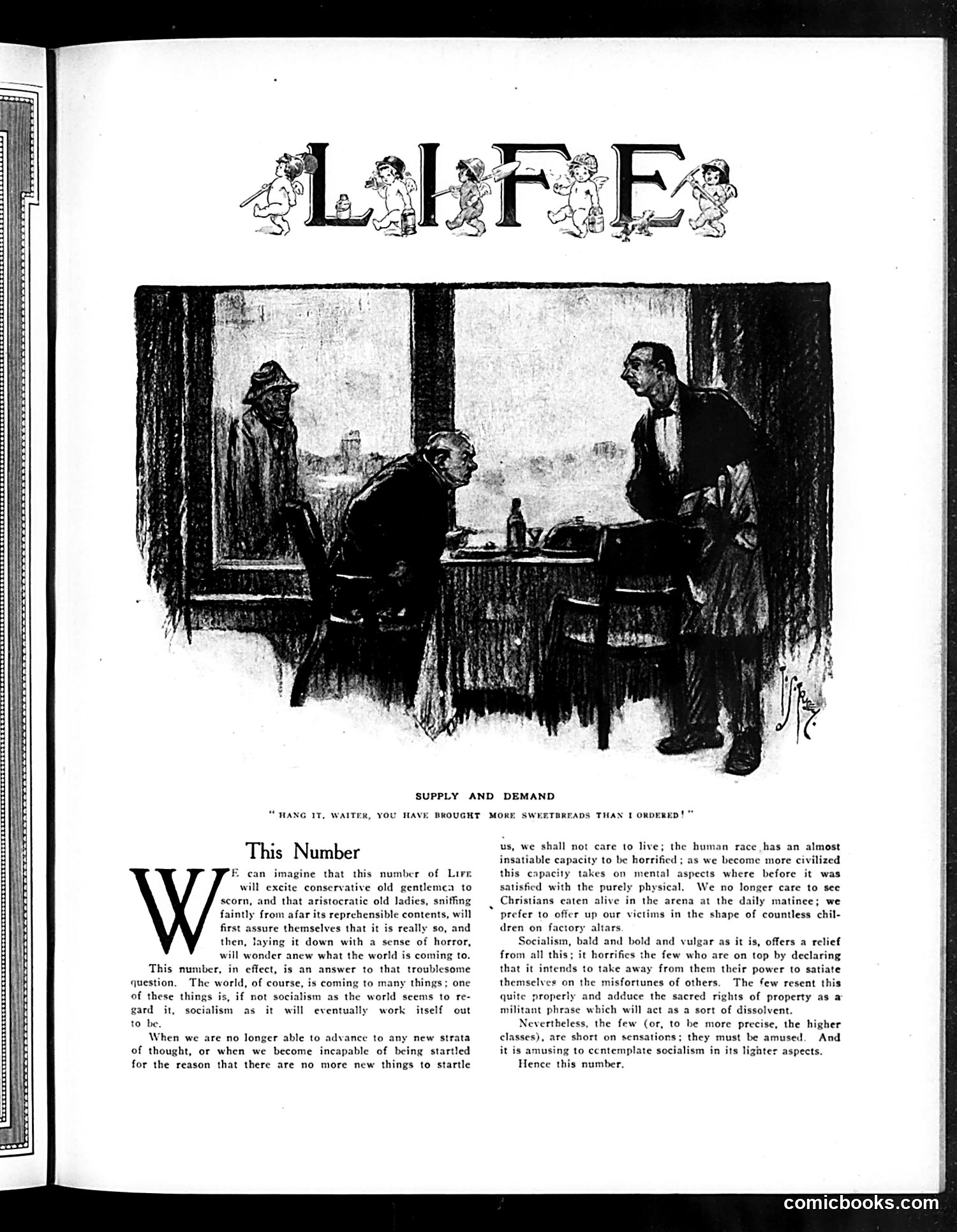
**The Cartoon ("Supply and Demand"):** A waiter confronts two diners at a restaurant table. The waiter says: "Hang it, waiter, you have brought more sweetbreads than I ordered!" This is a joke about supply exceeding demand—the diners received more food than requested. **The Editorial Text:** The accompanying essay critiques socialism's viability. The author argues that as the world "comes to many things," new ideas become exhausted, and socialism will eventually "work itself out." The piece dismisses socialist rhetoric about redistributing wealth and property rights as offering mere distraction to the poor. The author suggests that only the wealthy elite can truly enjoy leisure under any system—a cynical defense of class hierarchy against egalitarian alternatives. The satire equates minor consumer complaints with larger economic contradictions.
This page contains editorial commentary on the U.S.-Canada reciprocity trade treaty. The cartoons depict figures representing different interests: The left cartoon shows "Disco Throop" (likely a fictional character representing a Gloucester fisherman) complaining about cheap Canadian fish imports threatening the American fishing industry. The right cartoon illustrates a figure struggling with opposing forces, representing the conflicting interests between tariff protection and free trade. The text discusses Senator Lafe Young of Iowa promoting the treaty to benefit farmers, while opposing voices (fishermen, some manufacturers) warn it will harm domestic industries. The editorial expresses concern about whether Congress will accept the treaty given public opinion divisions between Republicans and Democrats on protectionist versus free-trade positions.
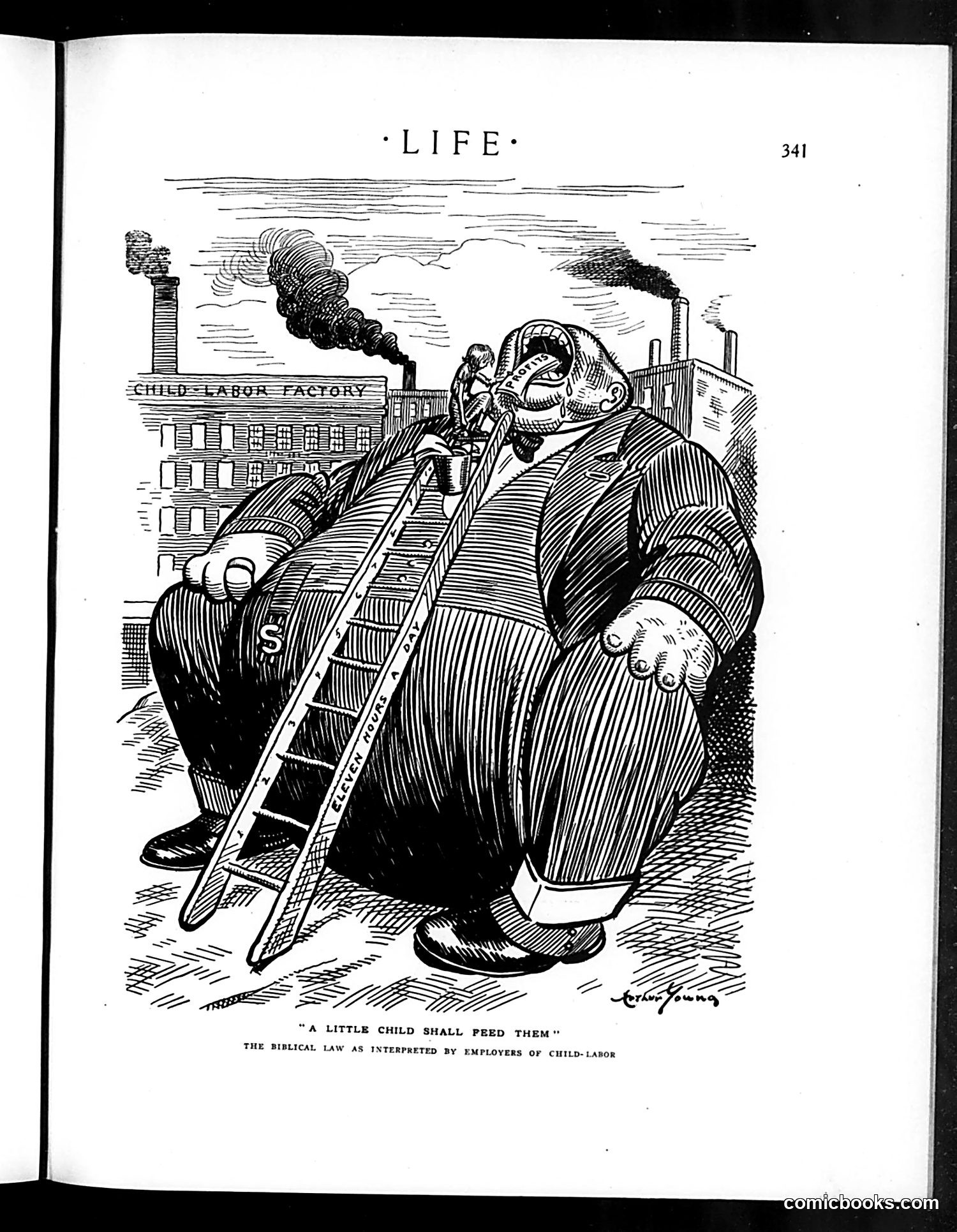
This is a satirical cartoon criticizing child labor practices in factories. The image shows a grotesquely fat, well-fed businessman climbing a ladder toward a child laborer at a "Child Labor Factory" (visible on the building). The caption quotes a biblical verse: "A Little Child Shall Feed Them," attributed to "The Biblical Law as Interpreted by Employers of Child-Labor." The satire is sharp: employers justified exploiting children by twisting scripture to suggest children should support adults. Instead, the cartoon shows the reverse—wealthy factory owners literally feeding themselves on child labor, growing fat and prosperous while children toil. This mocks both the hypocrisy of invoking religion to justify exploitation and the grotesque inequality the system created. The cartoon advocates for child labor reform.
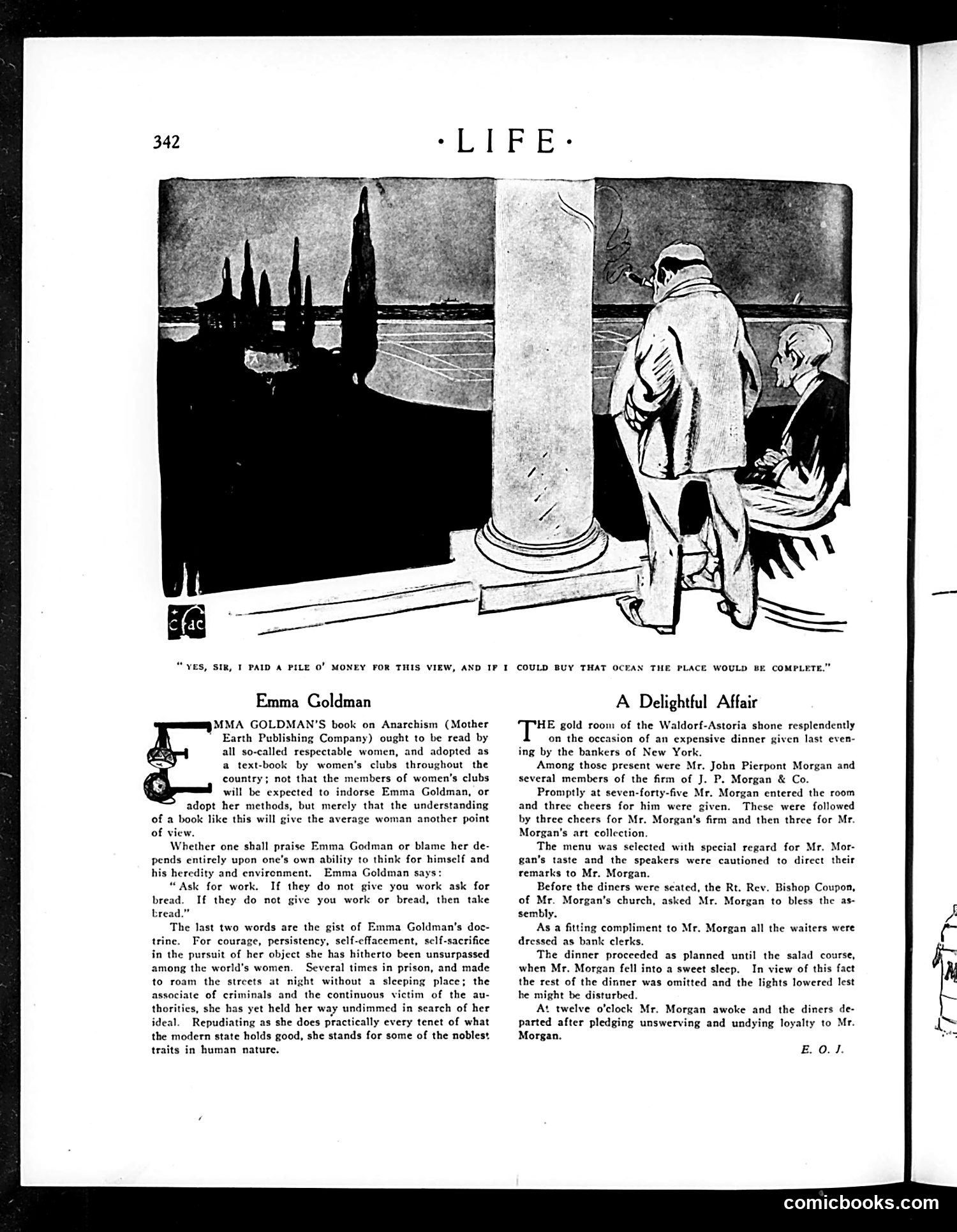
**The Cartoon:** The top illustration shows two men on a balcony overlooking a Mediterranean coastal city with cypress trees. One man gazes at the seascape while speaking to another seated figure. The caption reads: "Yes, sir, I paid a pile of money for this view, and if I could buy that ocean the place would be complete." **The Satire:** This is a straightforward joke about wealthy Americans' materialism and acquisitiveness. The humor lies in the absurd notion that even nature's most sublime features—an entire ocean—could be purchased if one had sufficient wealth. It satirizes the nouveau riche mentality of viewing everything as a commodity. **The Articles:** The page also contains two pieces: a biography of anarchist Emma Goldman and an account of a banker's dinner ("A Delightful Affair"). These appear unrelated to the cartoon.
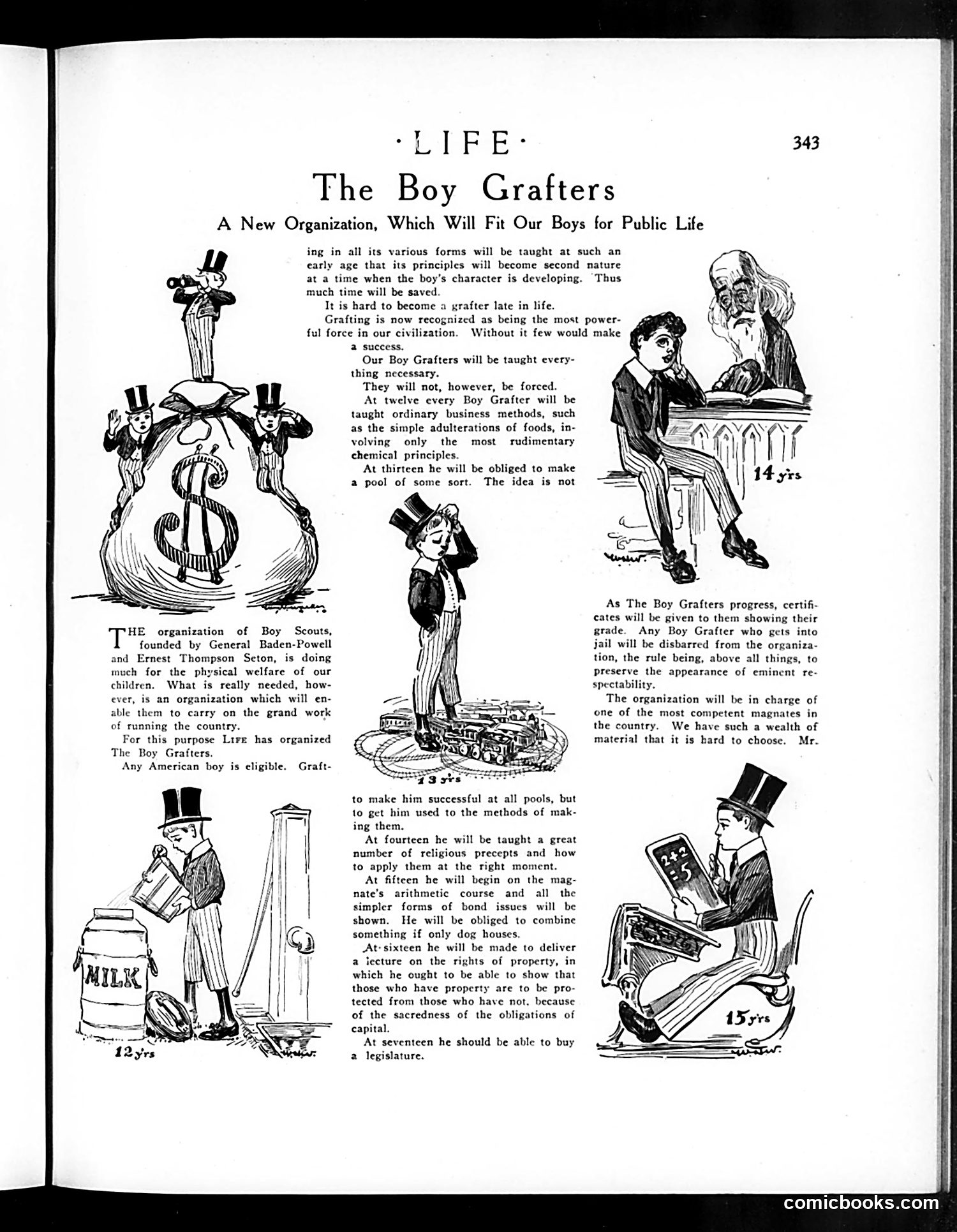
This is satire mocking the Boy Scouts organization, founded by Baden-Powell and Ernest Thompson Seton. The text proposes an alternative "Boy Grafters" organization to teach American boys the "principles" of corruption and unethical conduct—what appears to be a biting critique of Gilded Age graft and corruption. The illustrations show boys at different ages (12, 14, 15 years) being trained in: handling money dishonestly, delivering bribes ("milk"), understanding property theft, learning manipulation, and eventually "buying a legislature" at seventeen. The satire targets widespread corruption in American politics and business of the era, suggesting that if Boys Scouts teach success-building skills, then logically a "Boy Grafters" organization could systematically train young people in the endemic corruption pervading American public life.
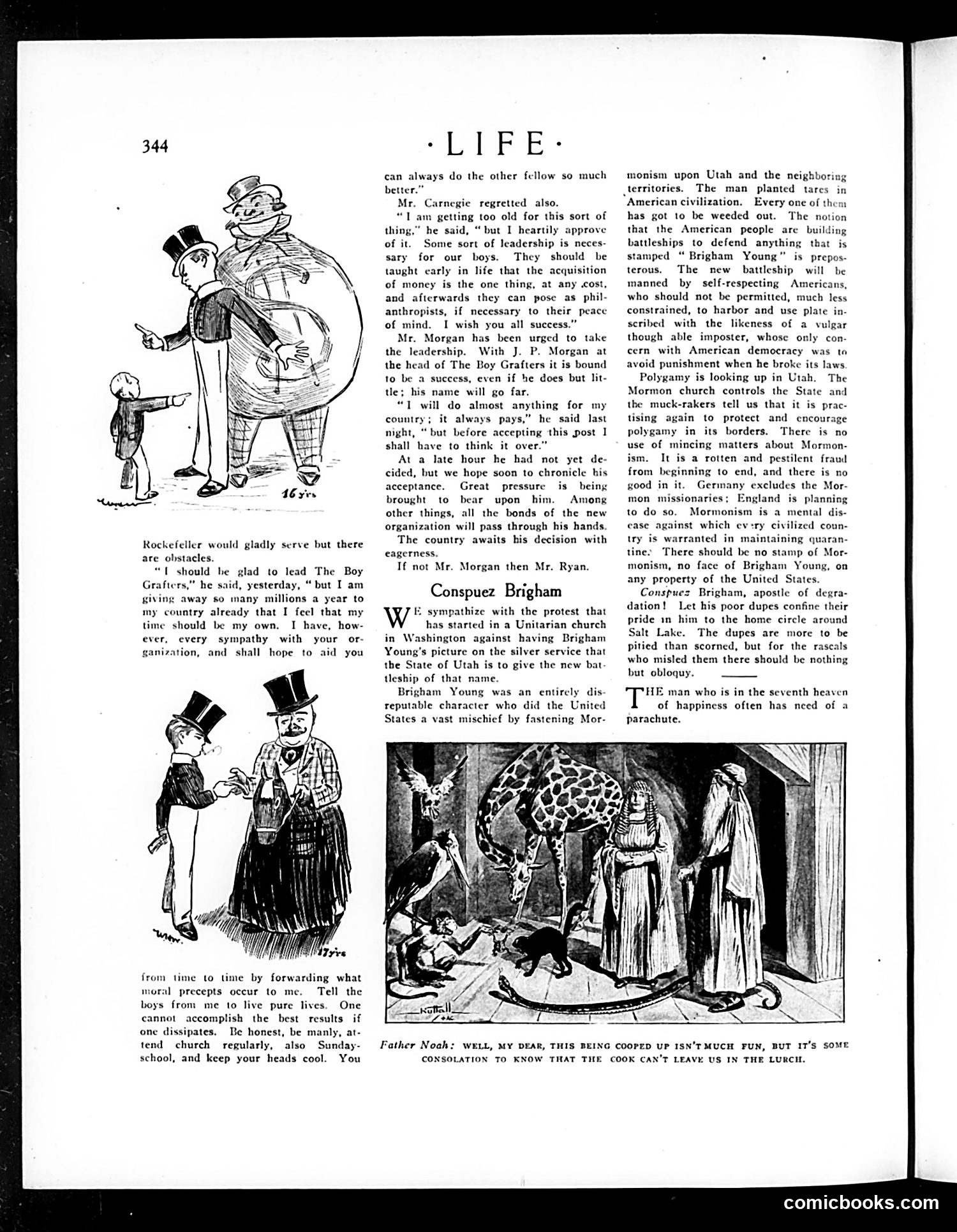
This page satirizes early 20th-century Mormon leadership and American concerns about religious authority. The main article, "Conspuez Brigham," attacks Brigham Young's legacy and Mormon influence in Utah, depicting him as a disreputable historical figure whose image shouldn't appear on state property. The cartoon illustrations show caricatured figures in top hats—likely representing wealthy Eastern businessmen or politicians—discussing Mormon leadership with disapproval. The lower illustration depicts a biblical nativity scene, possibly contrasting Christian ideals with Mormon practices. The satire's core message: Life's editors viewed Mormonism as incompatible with American democracy and Christian values, and opposed honoring Young through civic symbols, reflecting widespread anti-Mormon sentiment of the era.
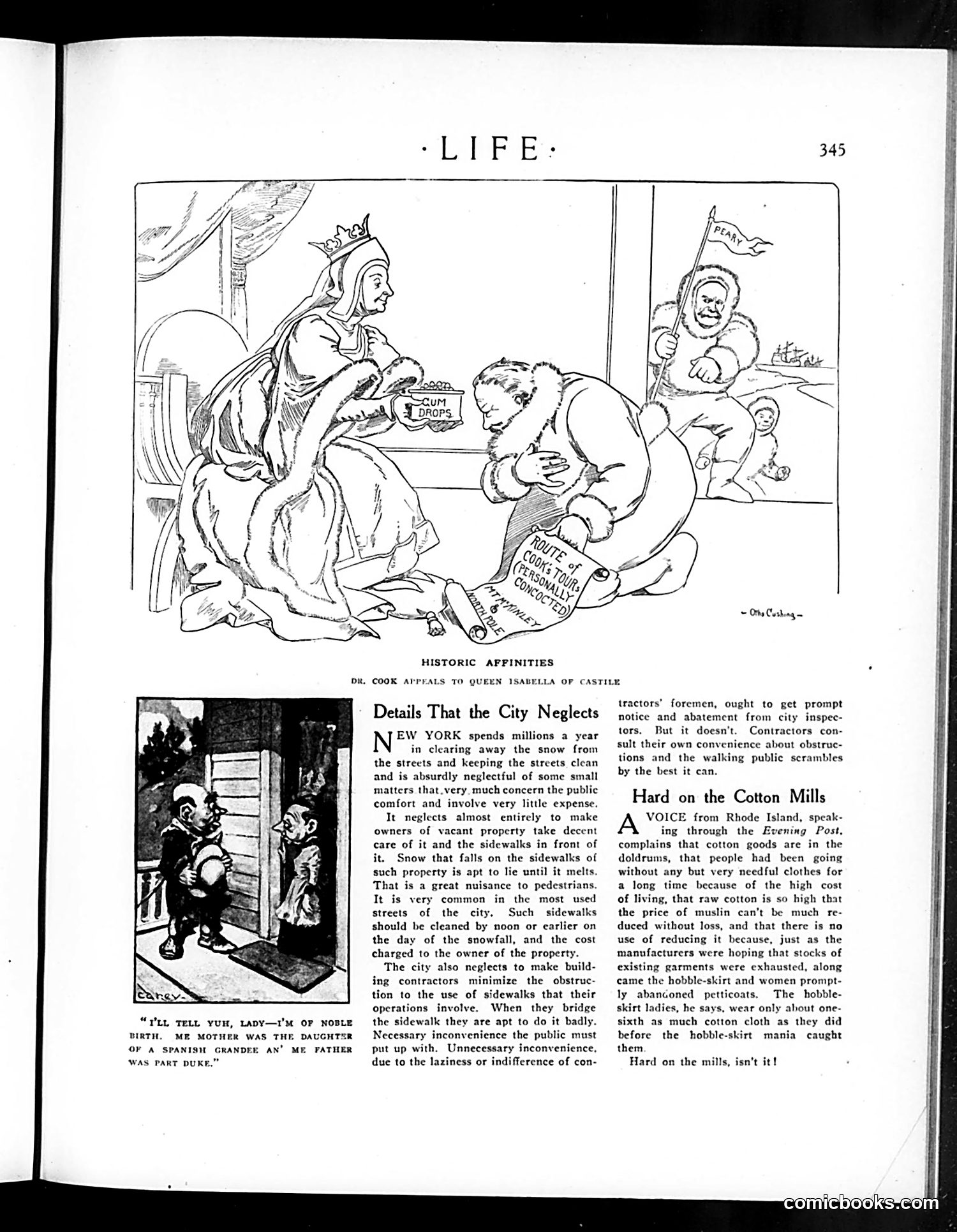
The top cartoon, titled "Historic Affinities," depicts Dr. Cook appealing to Queen Isabella of Castile. This references explorer Frederick Cook's disputed claims of Arctic discovery (circa 1908-1909), sarcastically comparing his credibility problems to historical patronage. The exaggerated figures and crowns mock his attempts at legitimacy. Below, "Details That the City Neglects" critiques New York's negligent snow removal and sidewalk maintenance, arguing property owners shirk responsibility while contractors minimize costs and obstruct public access. The third section, "Hard on the Cotton Mills," addresses labor conditions in Rhode Island textile factories, noting workers—particularly hobble-skirt-wearing women—labor in poor conditions with minimal clothing despite cotton's high cost, exposing industrial exploitation.
This page contains **satirical advice letters** from a mother to her daughter "Gladys," written in the voice of an upper-class American woman. The satire mocks wealthy society's values and hypocrisy. **Key targets:** - **Women's education**: The mother advises reading classics not to understand them, but to avoid embarrassment in conversation—knowledge as social performance, not genuine learning. - **Marriage as transaction**: Engagements are broken casually; suitors are cultivated for utility (the Bishop might help later); a man can beat a woman "as a joke" if she accepts his proposal. - **Shallow priorities**: Bridge games, motors, racing attire, and social positioning matter more than ethics or genuine relationships. - **Class cynicism**: The mother openly admits manipulation ("a mamma like me is sometimes so useful") and encourages her daughter to exploit others' feelings and finances. The satire works by having the mother state outrageous advice earnestly, exposing the moral emptiness beneath Gilded Age etiquette. It critiques how wealthy women were trained to be decorative, calculating, and morally compromised.
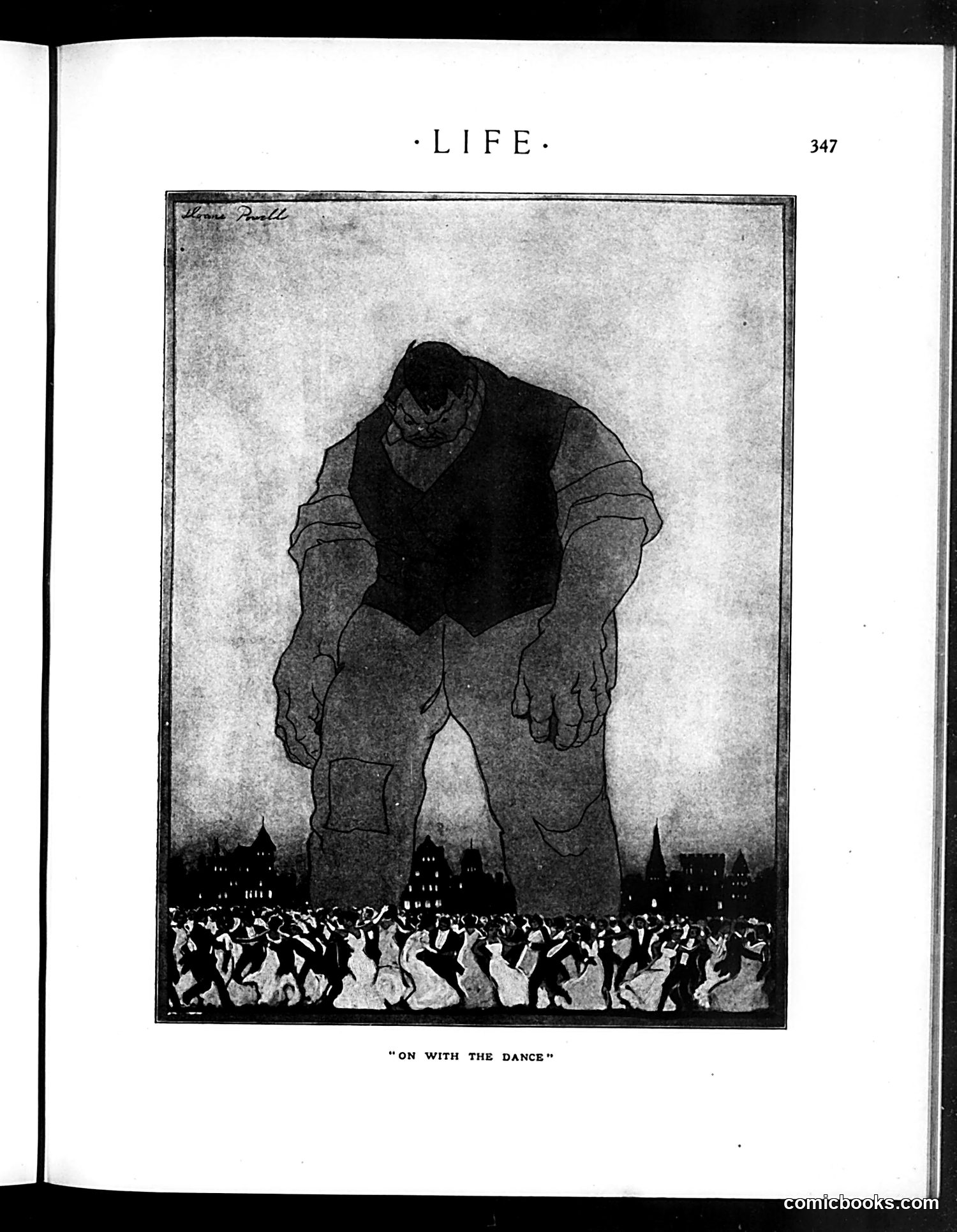
This satirical cartoon depicts a giant figure towering over a cityscape while crowds of people dance below. The image appears to critique the disconnect between catastrophic events or social crises and public indifference or distraction through entertainment. The colossal figure—rendered in a style evoking German Expressionism—looms menacingly over the urban landscape, suggesting an overwhelming threat or disaster. Meanwhile, the dancing crowds at ground level continue their revelry, seemingly oblivious or willfully ignoring the danger above them. The caption "On with the Dance" sardonically comments on society's tendency to pursue pleasure and distraction despite serious circumstances. Without additional context about the specific issue date, the exact crisis referenced remains unclear, though the imagery suggests anxiety about collective denial during a period of significant social or political turbulence.
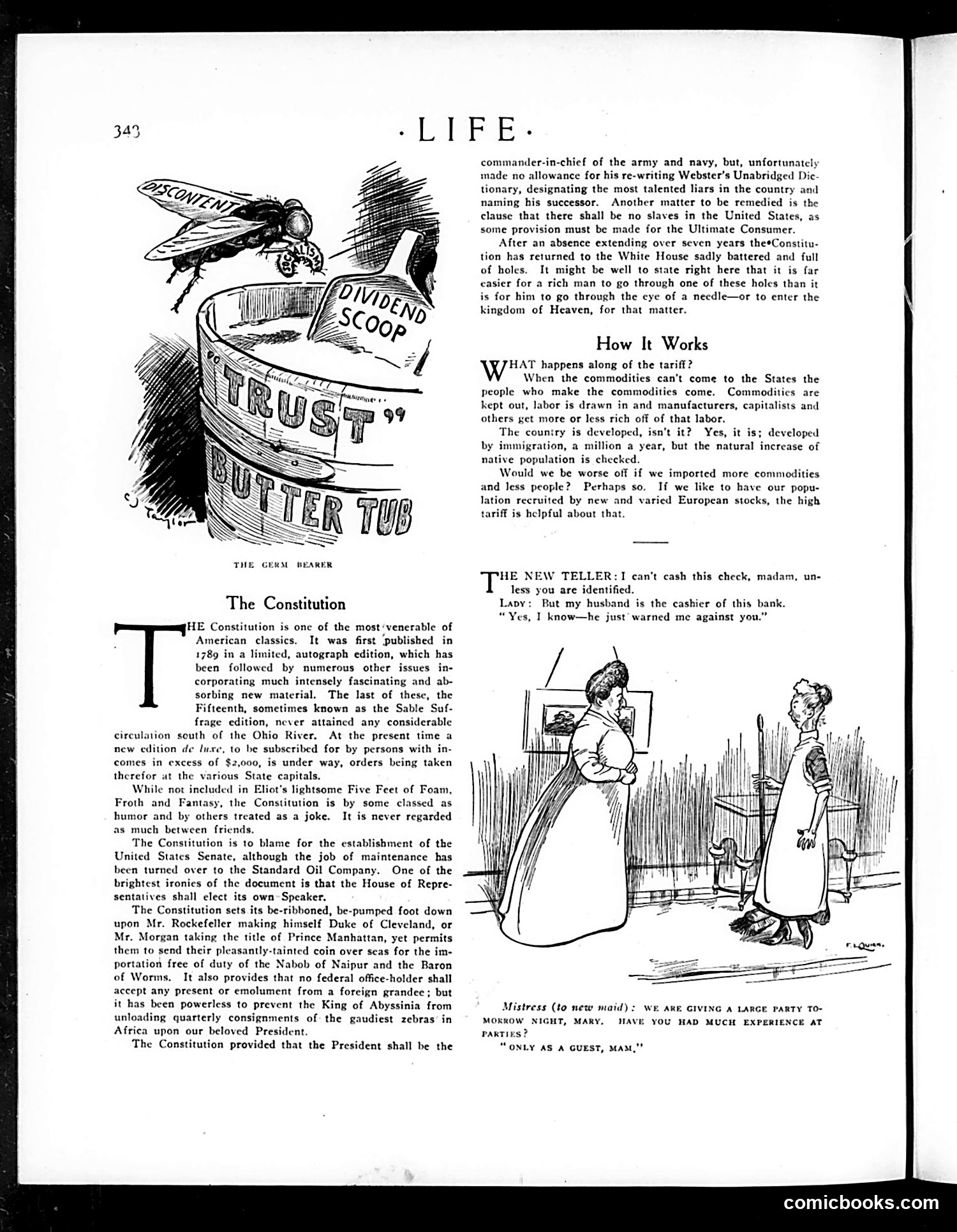
The cartoon depicts a fly labeled "DIVIDEND SCOOP" sitting atop a tiered structure labeled "TRUST," "BUTTER TUB," representing monopolistic corporate structures. The fly symbolizes how profits (dividends) are extracted from monopolies and trusts, spreading contamination like disease. The satire targets **trust monopolies** and their exploitative practices. "The Germ Bearer" suggests these corporate entities are parasitic, spreading economic harm throughout society. The butterman reference indicates dairy industry monopolies specifically. This reflects early 20th-century **anti-trust sentiment**, when monopolies were widely condemned as public enemies. The image argues that concentrated corporate wealth—represented as a disease vector—contaminates the economy and harms ordinary workers and consumers.
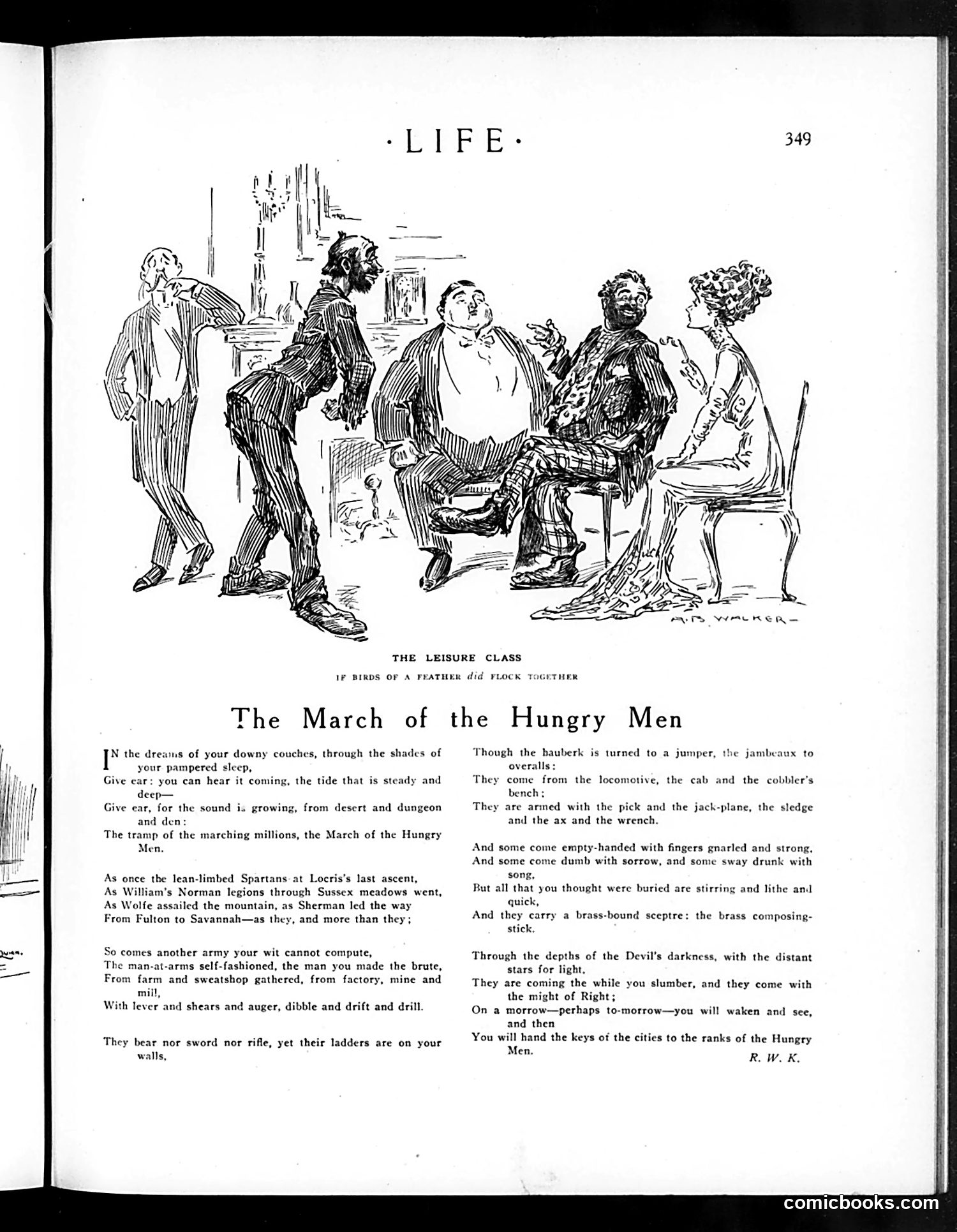
This is satirical political poetry by R.W.K. attacking the leisure class (shown in the cartoon as idle, well-dressed figures) by warning them of a coming uprising by working poor. The poem uses military metaphors to describe laborers—"the Hungry Men"—gathering from factories, mines, farms, and sweatshops. They're "armed" not with weapons but tools (picks, axes, wrenches, composing-sticks). The reference to a "brass-bound sceptre: the brass composing-stick" suggests labor organizing and printing/publishing—workers claiming authority through communication. The historical comparisons (Spartans, Norman conquest, Civil War generals) elevate this working-class movement to epic significance. The message: the wealthy should expect revolutionary change, as the organized poor will eventually "hand the keys of the cities" from them. This reflects early 20th-century labor movement anxieties among America's elite—fears of strikes, unionization, and socialist organizing.
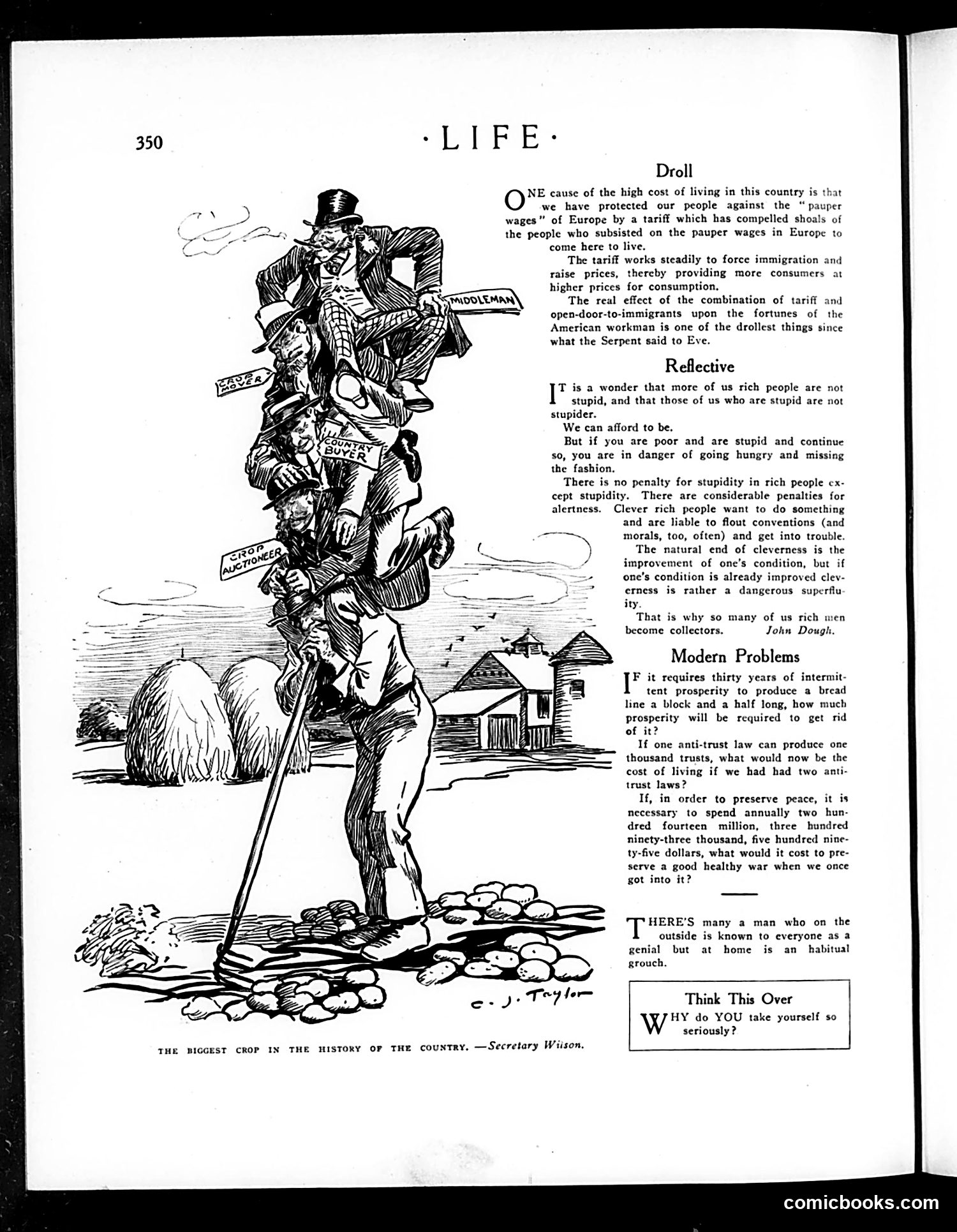
This satirical cartoon by C.J. Taylor critiques U.S. tariff and immigration policy under what appears to be the Wilson administration. The central figure—Uncle Sam—is depicted as a grotesquely tall, spindly character standing atop a massive pile of money, labeled with various economic concerns like "middleman," "tariff," and "buyer." His distorted form suggests the unnatural and unsustainable nature of the economic system. The satire argues that protective tariffs designed to shield American workers from European "pauper wages" paradoxically encourage immigration, flooding the labor market and raising consumer prices. This creates the ironic situation where the tariff harms the very workers it meant to protect. The accompanying text extends the critique to broader economic absurdities—the contradiction between anti-trust laws and trust formation, and massive military spending allegedly justified by peace-keeping. The cartoon suggests that America's economic policies produce grotesque, unintuitive results that contradict their stated intentions.
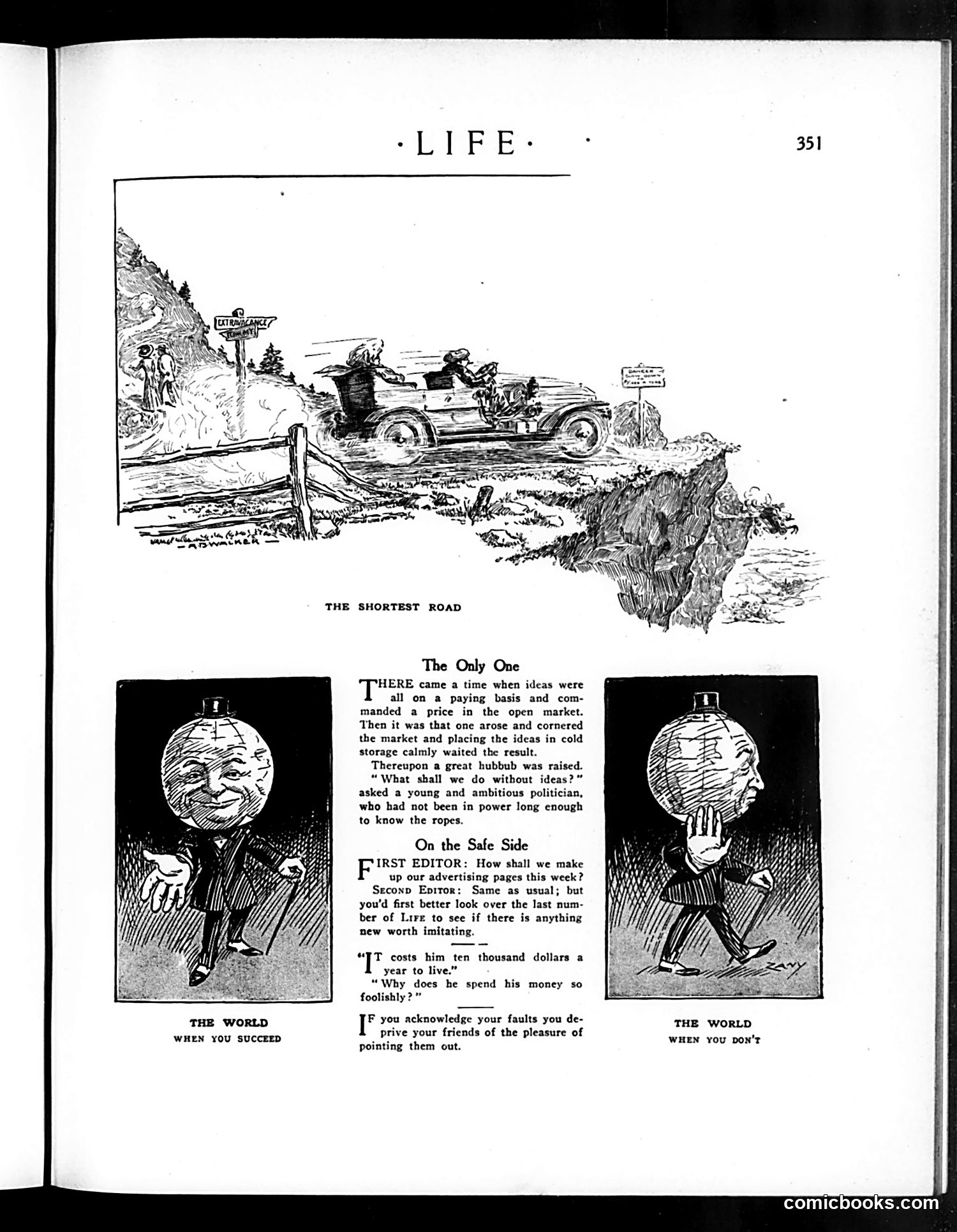
This page contains three separate satirical pieces: **"The Shortest Road"** (top): An illustration of an early automobile on a scenic mountain road, likely satirizing the "shortest distance between two points" — suggesting life's complications versus simple solutions. **"The Only One"** (center): A story mocking idea monopolies and political incompetence. It describes someone cornering the market on ideas and hoarding them, while an inexperienced politician panics about the shortage. This appears to critique both capitalist speculation and political inexperience during an era of economic anxieties. **"On the Safe Side"** (right): Two editors discuss advertising strategy, with one suggesting they simply copy whatever appeared in the previous issue of *Life*. This self-aware joke mocks both editorial laziness and the magazine industry's tendency toward unoriginal repetition. **Two face illustrations** accompany contrasting aphorisms about success versus failure and how the world treats you accordingly—satirizing human fickleness and social hypocrisy. The page exemplifies *Life*'s satirical approach: social commentary through wordplay and ironic observation of American business, politics, and media culture.
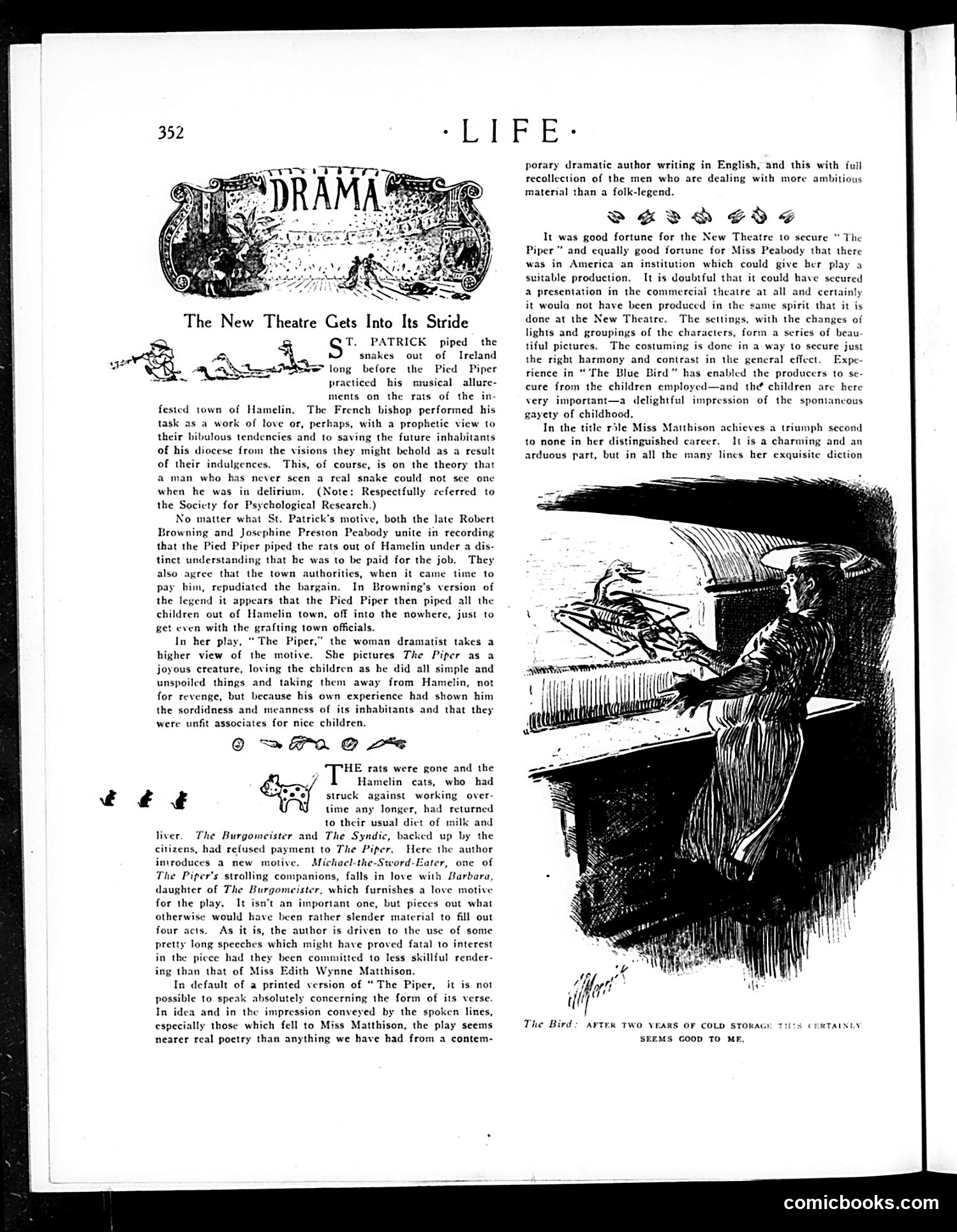
This page discusses Josephine Preston Peabody's play *"The Piper"* at the New Theatre. The article compares Peabody's dramatic interpretation of the Pied Piper legend to Robert Browning's famous poem. The key distinction: Browning portrayed the Piper as vengeful—stealing children because the town officials cheated him. Peabody's version presents him more sympathetically as someone who genuinely loves children and removes them from Hamelin's corrupt, sordid society. The article praises this morally elevated interpretation. The illustration shows a figure (likely the Piper) in medieval dress. The text also notes that Peabody adds a romantic subplot involving the Piper's companion falling for the Burgomeister's daughter—a plot device the reviewer considers somewhat artificial but necessary to fill out the four acts. Overall, the review praises the New Theatre's production values and actress Edith Wynne Matthison's performance.
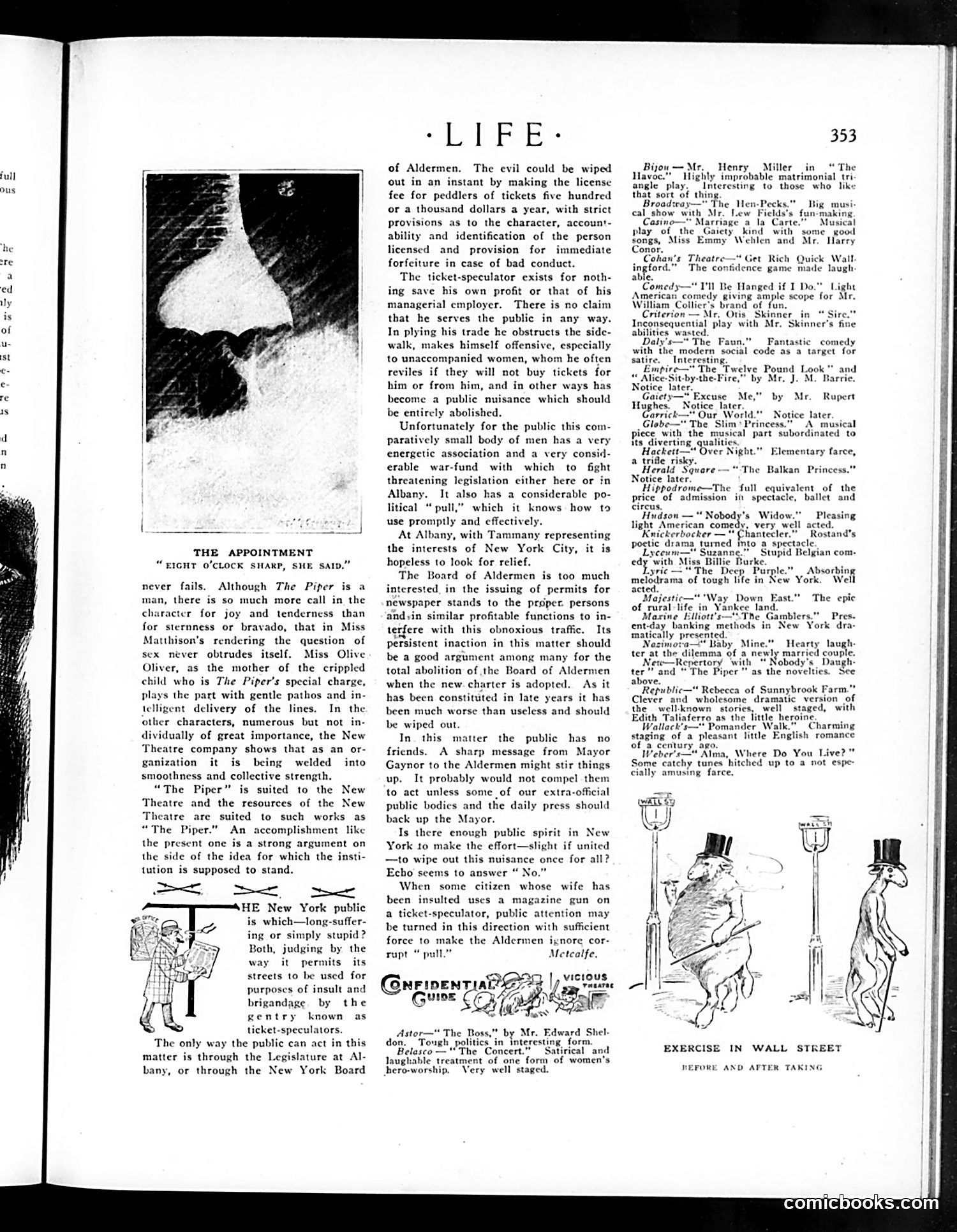
This Life magazine page (page 353) contains two distinct sections: **Left side:** A theater review of "The Piper," praising the New Theatre company's production and Miss Matthison's performance. **Main editorial (right side):** A scathing critique of ticket scalpers ("ticket-speculators") operating in New York City streets. The author argues they: - Obstruct sidewalks and harass unaccompanied women - Serve only their own profit - Have become a public nuisance The piece attacks the New York Board of Aldermen for inaction, blaming their corruption and dependence on Tammany Hall patronage. The author sarcastically suggests only public outcry—or perhaps violence ("magazine gun")—will force reform. The small cartoon at bottom right, captioned "Exercise in Wall Street: Before and After Taking," appears to be related advertising or a separate joke about financial speculation, though its specific meaning is unclear from this image.
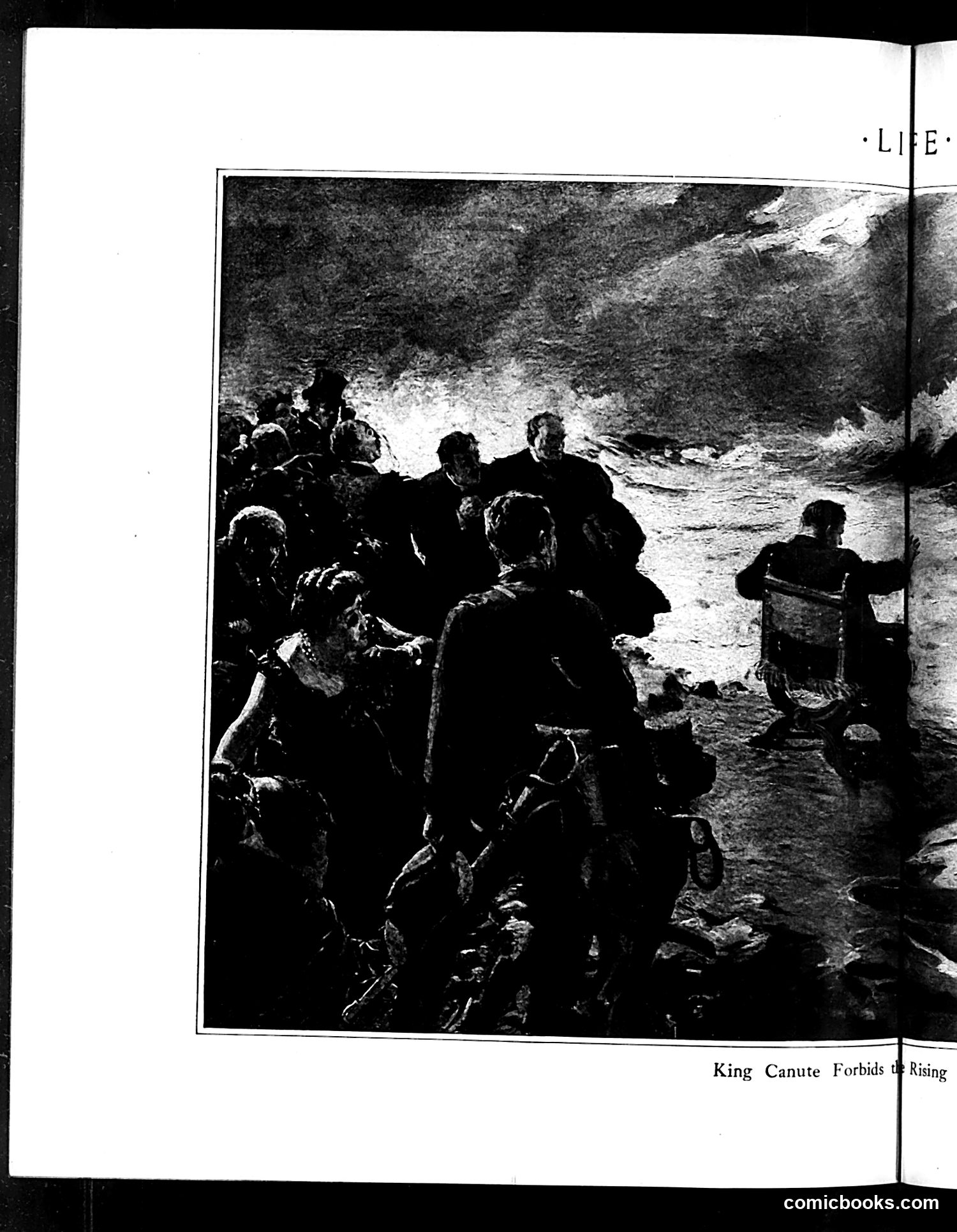
This satirical illustration references the medieval legend of King Canute, who allegedly commanded the ocean tide to stop rising—a futile gesture demonstrating the limits of royal power against nature's forces. The caption "King Canute Forbids the Rising" suggests the cartoonist is using this historical analogy to mock someone attempting to prevent an inevitable social or political development. The crowded scene shows figures gathering as waves approach, implying an unstoppable force or trend. Without a visible date or additional context on this page, the specific target remains unclear—it could reference various 20th-century political attempts to suppress growing movements or changes. The metaphor comments on the futility of resisting powerful social currents through authority alone.
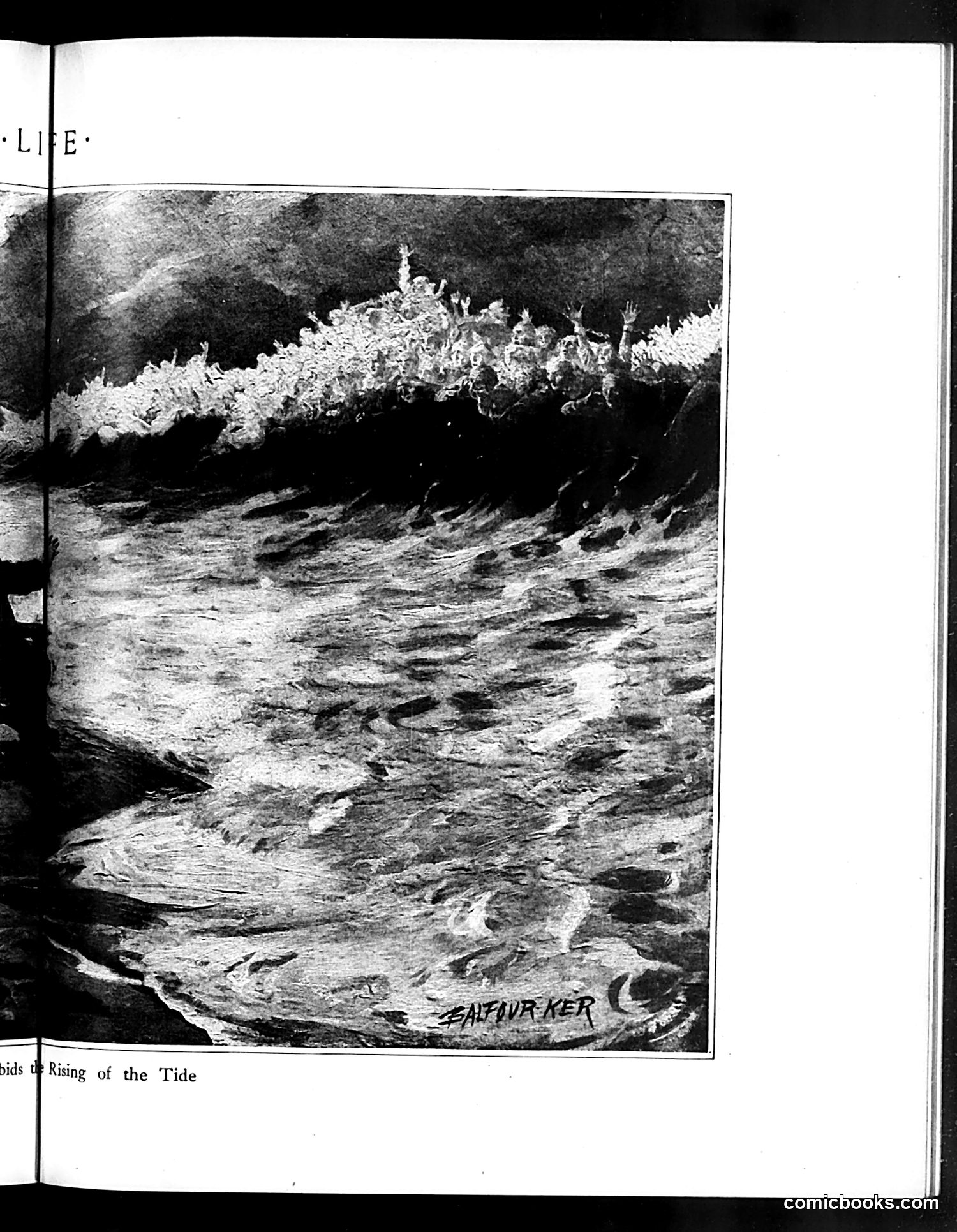
This is a dramatic black and white photograph titled "Rising of the Tide," credited to photographer Sai Halicz Ker (signature visible). The image shows a turbulent ocean scene with large waves and white foam, with what appears to be figures or hands visible in the churning water. Without additional text or context on this page, the photograph's satirical meaning is unclear. It could be metaphorical commentary on social upheaval, political turmoil, or collective action—common themes in Life magazine's social satire. The "rising tide" could reference economic or social forces, but without accompanying text or caption explaining the specific reference, the exact political or social target remains uncertain.
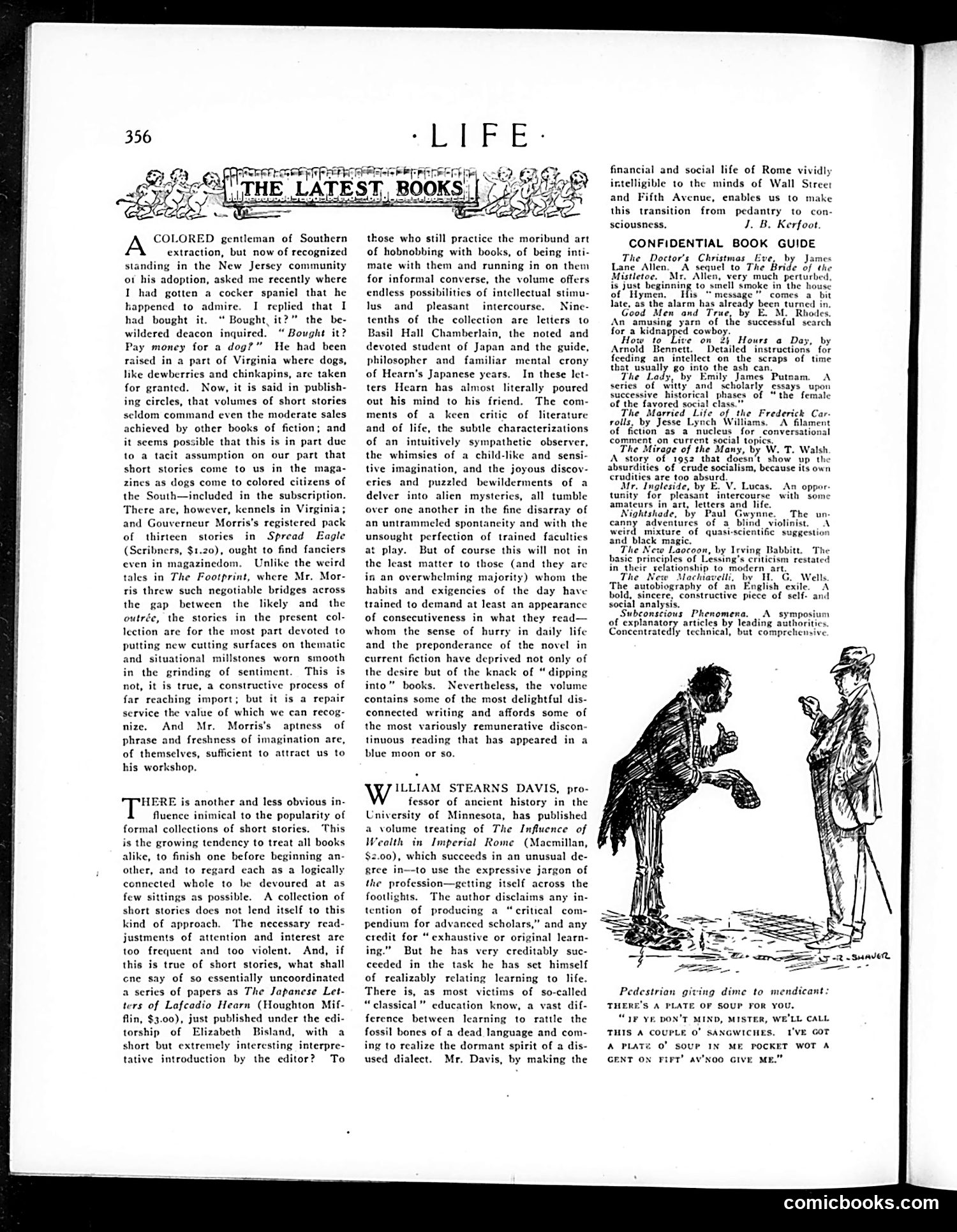
This page features book reviews in Life magazine's characteristic witty style. The main cartoon illustrates a humorous anecdote about a colored gentleman from the South who, when asked where the reviewer obtained his cocker spaniel, expresses shock at paying money for a dog—implying dogs were simply "included" as part of life in the pre-Civil War South, like natural resources. The reviewer uses this joke to critique short story collections, arguing they suffer from being perceived as "free" (like magazine inclusions) rather than standalone purchases. The page reviews three books: Gouverneur Morris's *Spread Eagle* (short stories), and Lafcadio Hearn's *Japanese Letters* (correspondence about Japan). The satire reflects early-20th-century attitudes about reading habits and class, while the opening anecdote relies on stereotypes about Southern Black life for comedic effect typical of the era.
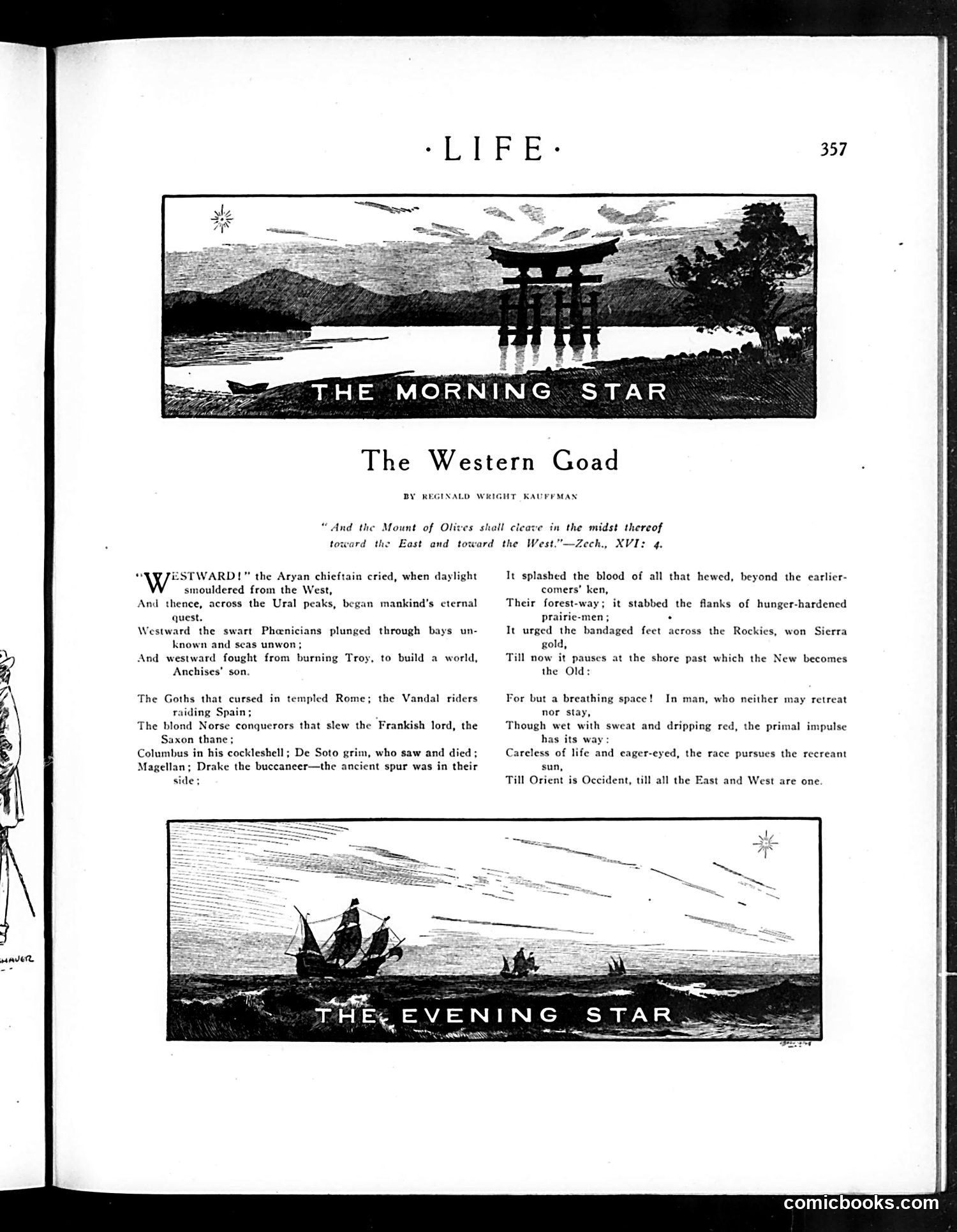
This is a serious poetic essay by Reginald Wright Kauffman, not satire. It celebrates westward expansion as humanity's eternal drive—a "goad" (driving force) pushing civilization from East to West. The poem traces Western expansion from ancient times (Phoenicians, Trojans, Goths, Norse) through Columbus, De Soto, Magellan, and Drake, culminating in American western settlement. It romanticizes conquest as inevitable human impulse, describing how expansion "splashed the blood" of indigenous peoples and "hunger-hardened prairie-men." The epigraph from Zechariah and the paired woodcuts—"The Morning Star" (Eastern origin, a pagoda) and "The Evening Star" (Western destination, sailing ships)—frame expansion as cosmic destiny: "Till Orient is Occident, till all the East and West are one." This reflects early 20th-century American triumphalism about manifest destiny and Western civilization's superiority. Modern readers would recognize it as propaganda for imperial expansion, not satire critiquing it.
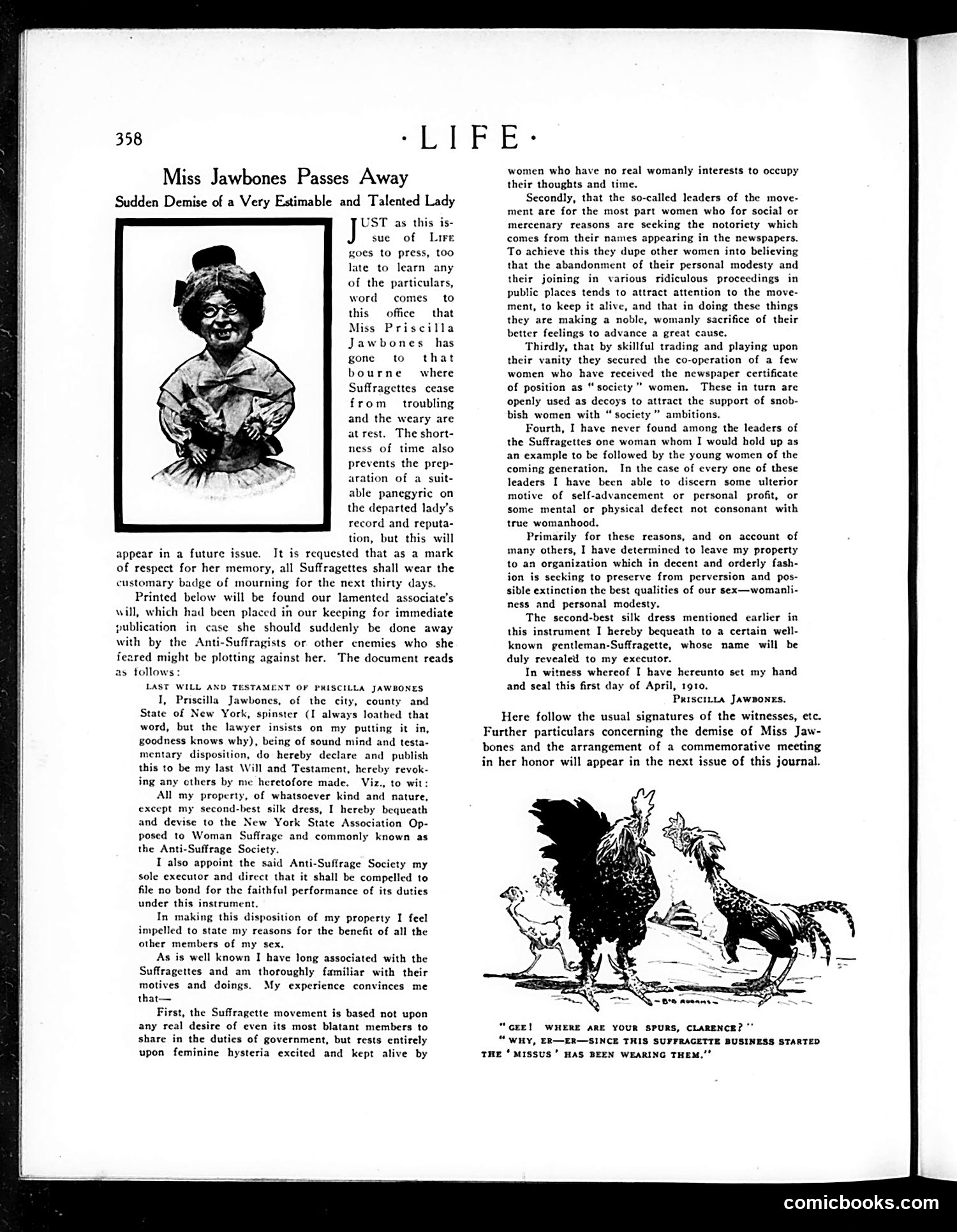
This is anti-suffrage propaganda disguised as a mock obituary. The fictional "Miss Priscilla Jawbones"—a caricatured suffragette with an exaggerated masculine jaw—has died, and Life publishes her will leaving her estate to the **Anti-Suffrage Society**. The satire attacks women's suffrage advocates through Jawbones's supposed reasoned critique: that suffragettes are motivated by hysteria, vanity, and desire for newspaper notoriety rather than genuine political conviction. The will claims their leaders exploit less intelligent women and lack true moral character. The bottom cartoon (roosters fighting) reinforces the mockery: suffragettes are portrayed as ridiculous, squabbling, undignified. **Context**: This reflects early 20th-century anti-suffrage arguments that portrayed women voters as emotionally unstable and easily manipulated. Life magazine, despite its satirical reputation, used humor here to delegitimize the women's suffrage movement.
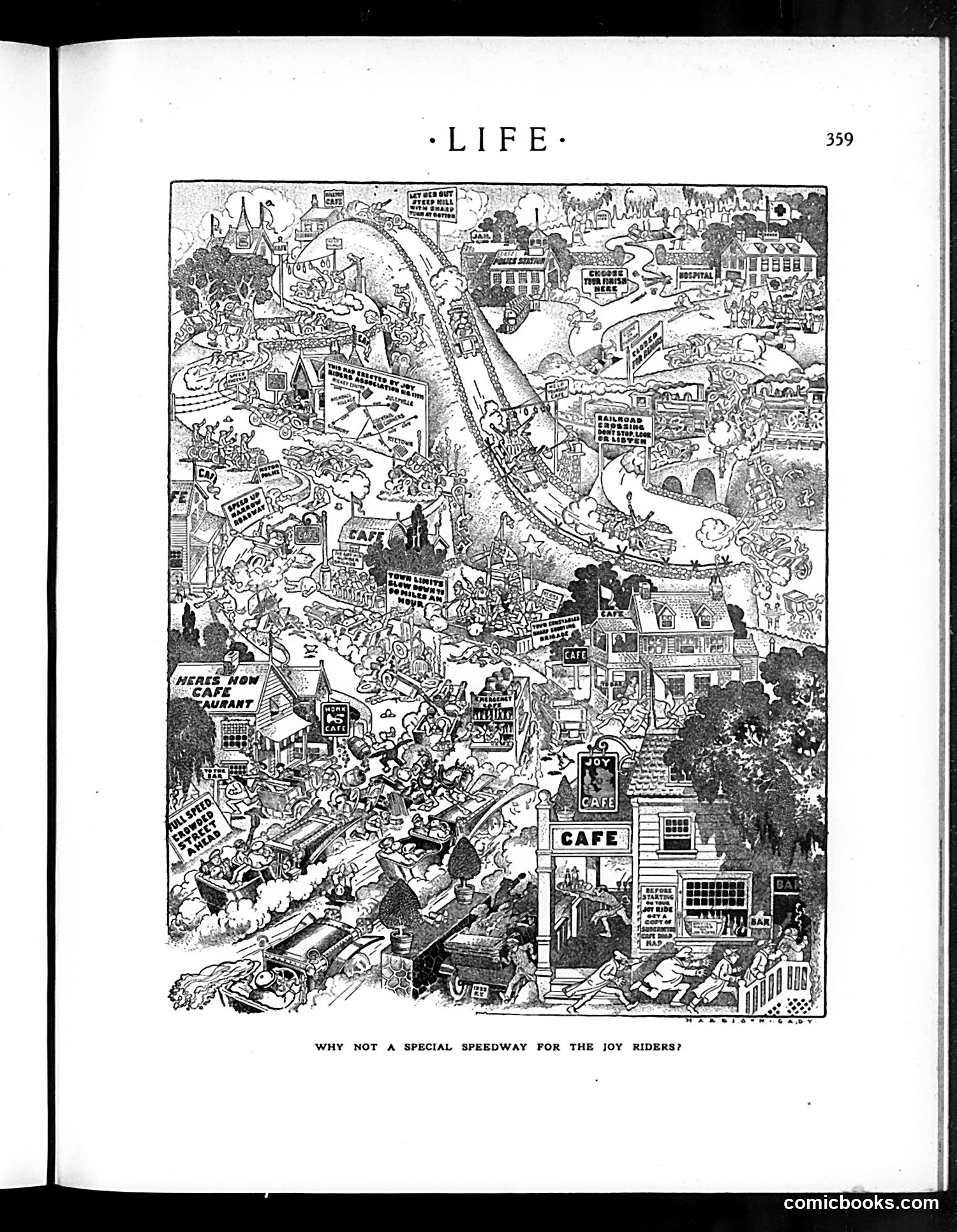
This is a densely packed satirical map-illustration critiquing dangerous "joy riding"—a widespread phenomenon of the 1920s-30s where young people recklessly drove automobiles at high speeds for entertainment. The cartoon proposes a darkly ironic solution: designate a separate speedway exclusively for these reckless drivers. The intricate illustration shows a chaotic amusement-park-like landscape filled with crashes, collisions, cafés, and automotive mayhem, suggesting what such a dedicated "joy riders' speedway" might resemble. The satire targets both the joy riders themselves and society's inability to control this dangerous behavior. By visualizing their destructive activities as a contained theme park, the cartoonist mocks both the recklessness of young drivers and the impotence of authorities to prevent traffic accidents and fatalities caused by speeding.
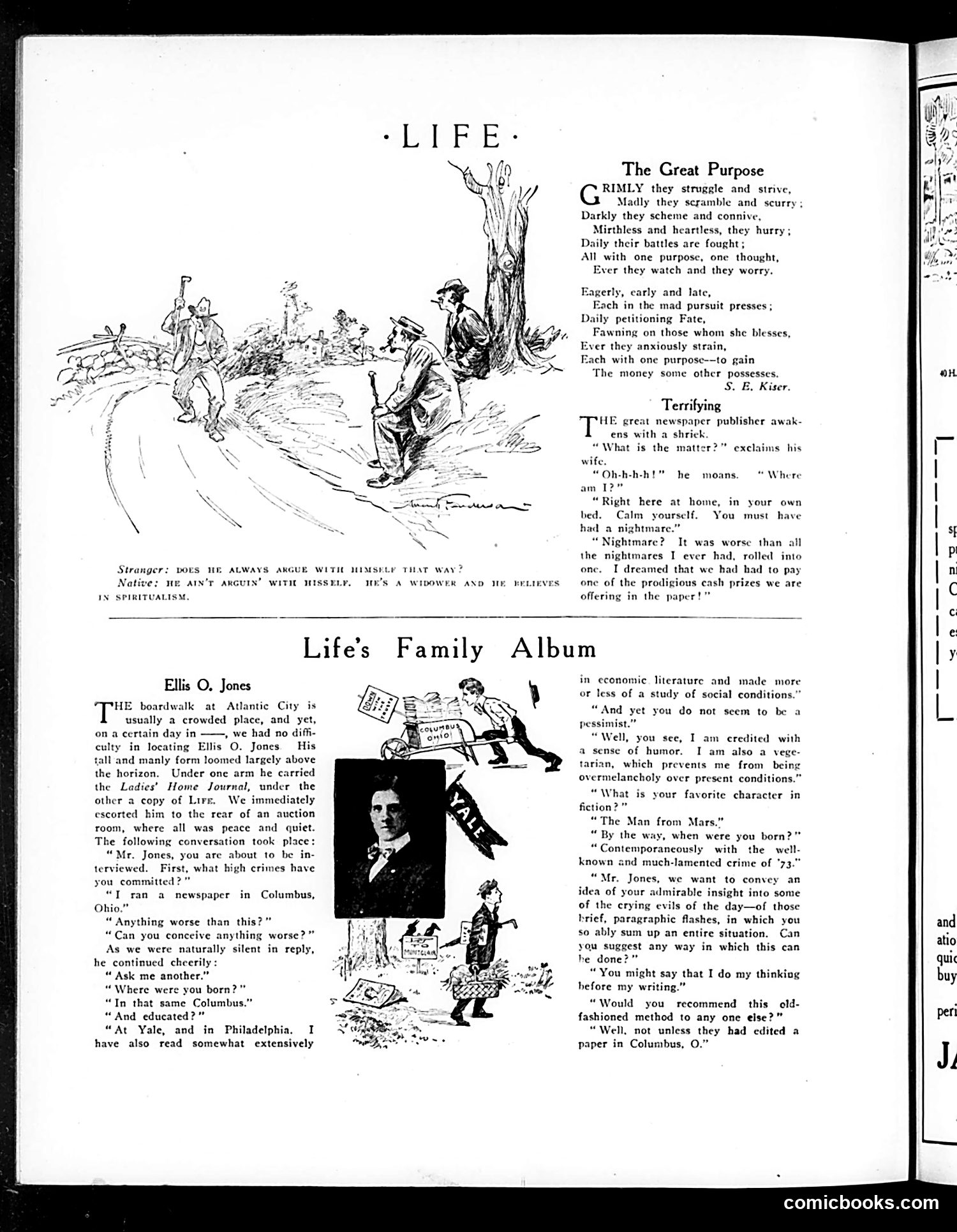
This page satirizes American ambition and newspaper culture circa early 20th century. **"The Great Purpose"** poem mocks the relentless pursuit of wealth—people "struggle and strive," "scramble and scurry," all driven by the singular obsession to gain "the money some other possesses." It's social commentary on capitalist greed. **"Terrifying"** is a joke about a newspaper publisher's nightmare: he dreams his paper must actually *pay out* the large cash prizes it advertises. The satire targets sensationalist journalism and false advertising—publishers promote extravagant prizes they hope never to award. **"Life's Family Album"** profiles Ellis O. Jones, a Columbus newspaper editor. The interview humorously establishes his credentials (Yale-educated, reads widely, vegetarian, humorous) while gently mocking his earnestness. The final exchange—his suggestion that editors should "think before writing"—is self-deprecating humor about journalism's quality. The cartoon illustrations show Jones amid newspaper/publishing activity. Overall, the page critiques press dishonesty and the era's obsession with money and success.
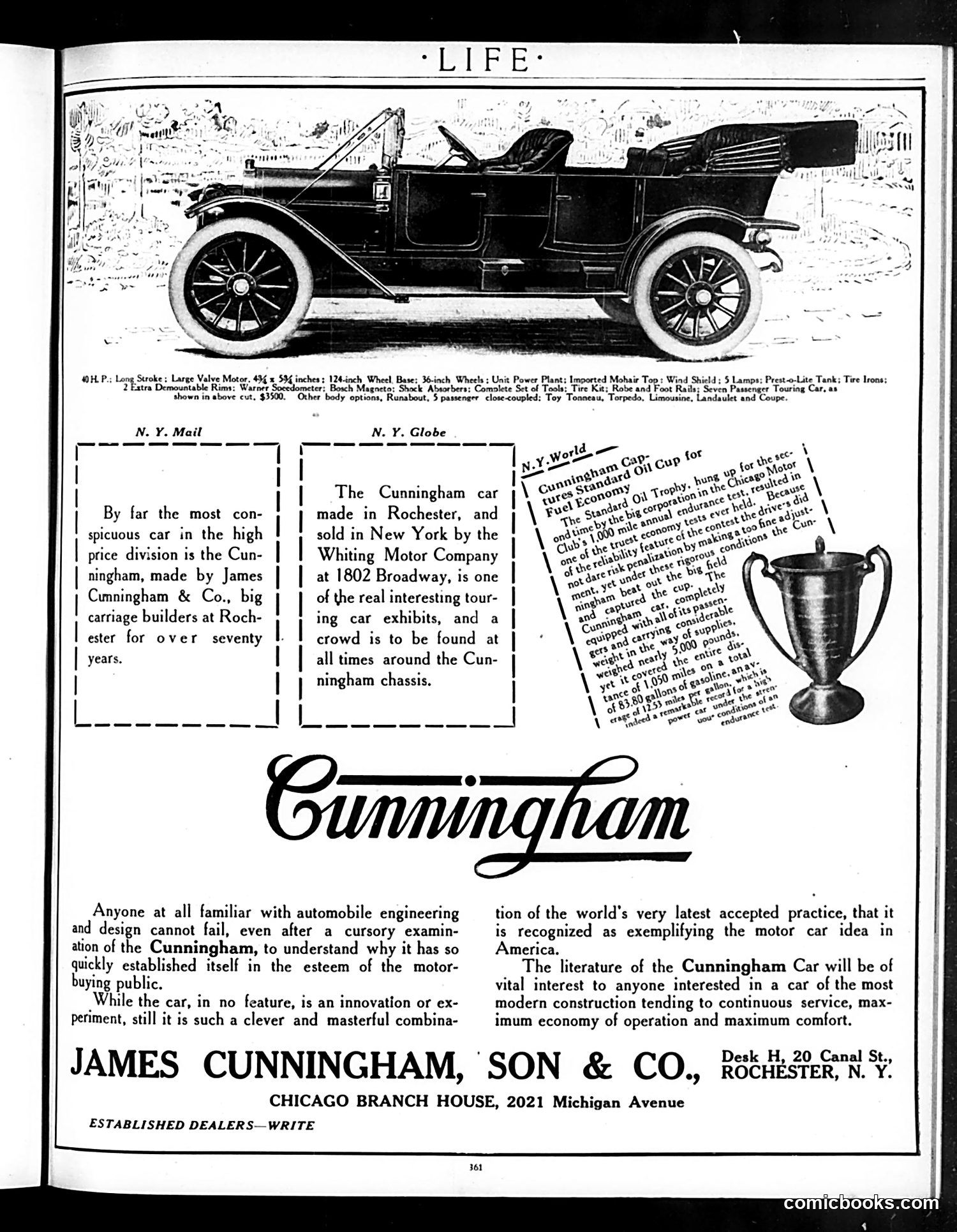
This page is **not a cartoon or satire**—it is a straightforward **automobile advertisement** from *Life* magazine. The content promotes the Cunningham car, manufactured by James Cunningham & Co. in Rochester, New York, and sold through the Whiting Motor Company at 1802 Broadway in Manhattan. The ad emphasizes the car's engineering quality, noting it represents "the world's very latest accepted practice" in motor car design. The page includes technical specifications (engine details, wheel size, etc.), a side-view illustration of the open touring car, and testimonials from the *N.Y. Mail* and *N.Y. Globe* praising it as "the most conspicuous car in the high price division." An image of a trophy references the Cunningham's racing success. The base price is listed as $3,500, with options for different body styles (Runabout, Tonneau, Torpedo, etc.). This is a premium vehicle advertisement aimed at wealthy buyers, with no satirical content present.
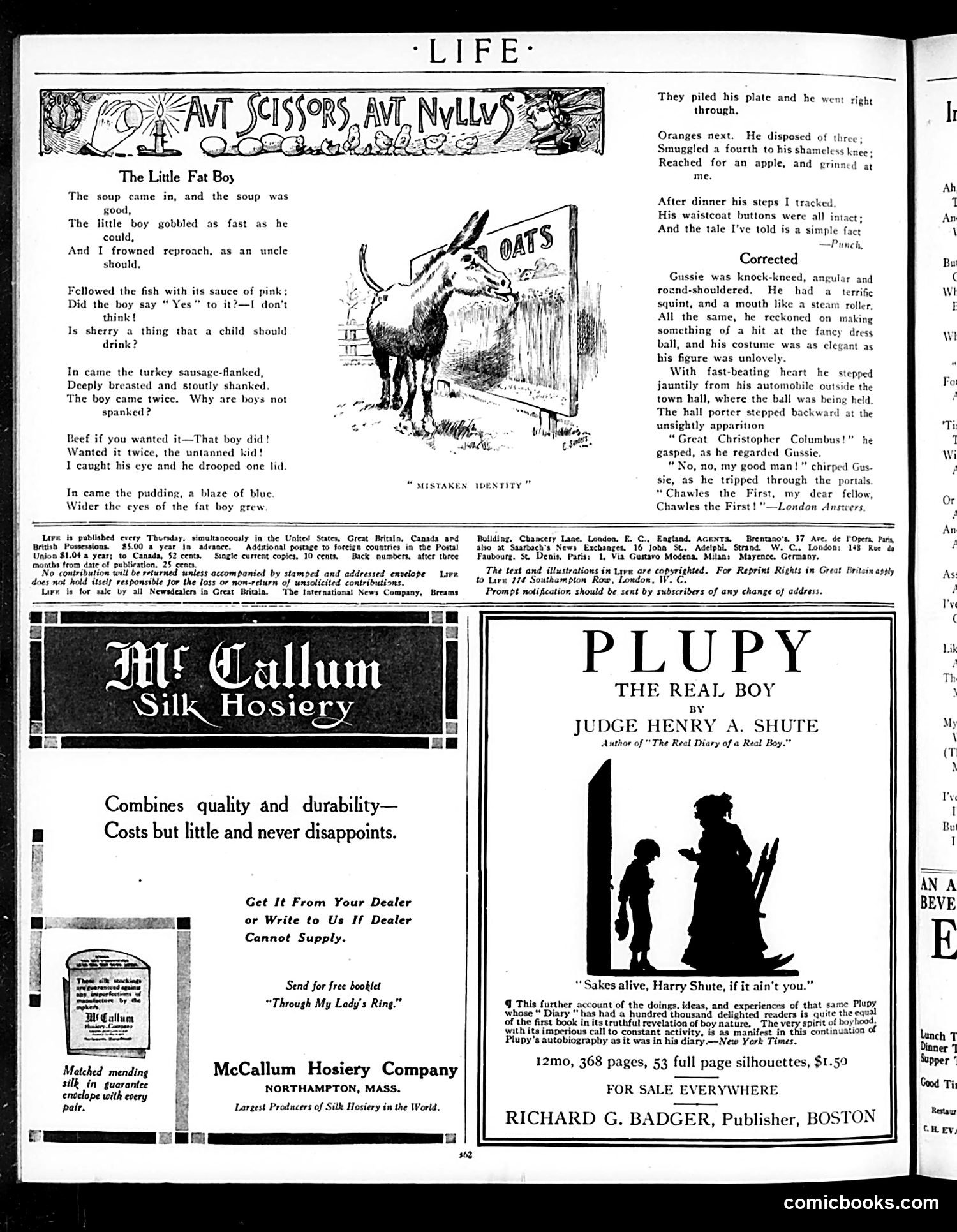
This page contains two humorous poems satirizing children's behavior at meals. **"The Little Fat Boy"** mocks a gluttonous child who ravenously consumes multiple courses—soup, fish, turkey, beef (twice), pudding, oranges, and an apple—while maintaining an innocent demeanor. The narrator, positioned as a disapproving uncle, expresses mock outrage that the boy shows no restraint despite his obvious overindulgence. The joke targets both the child's shameless appetite and adult hypocrisy about lecturing children on manners. **"Mistaken Identity"** describes Gussie, an unprepossessing youth (knock-kneed, angular, squint-eyed) who attends a fancy dress ball in an elegant costume as "Charles the First." The hall porter, horrified by Gussie's appearance, exclaims "Great Christopher Columbus!"—to which Gussie cheerfully corrects him, misunderstanding the porter's shock as mistaken identity rather than aesthetic horror. The satire mocks both the gap between costume grandeur and wearer's actual appearance, and Gussie's oblivious confidence. Both poems use gentle ridicule of children's social awkwardness for comedic effect—typical early-20th-century humor.
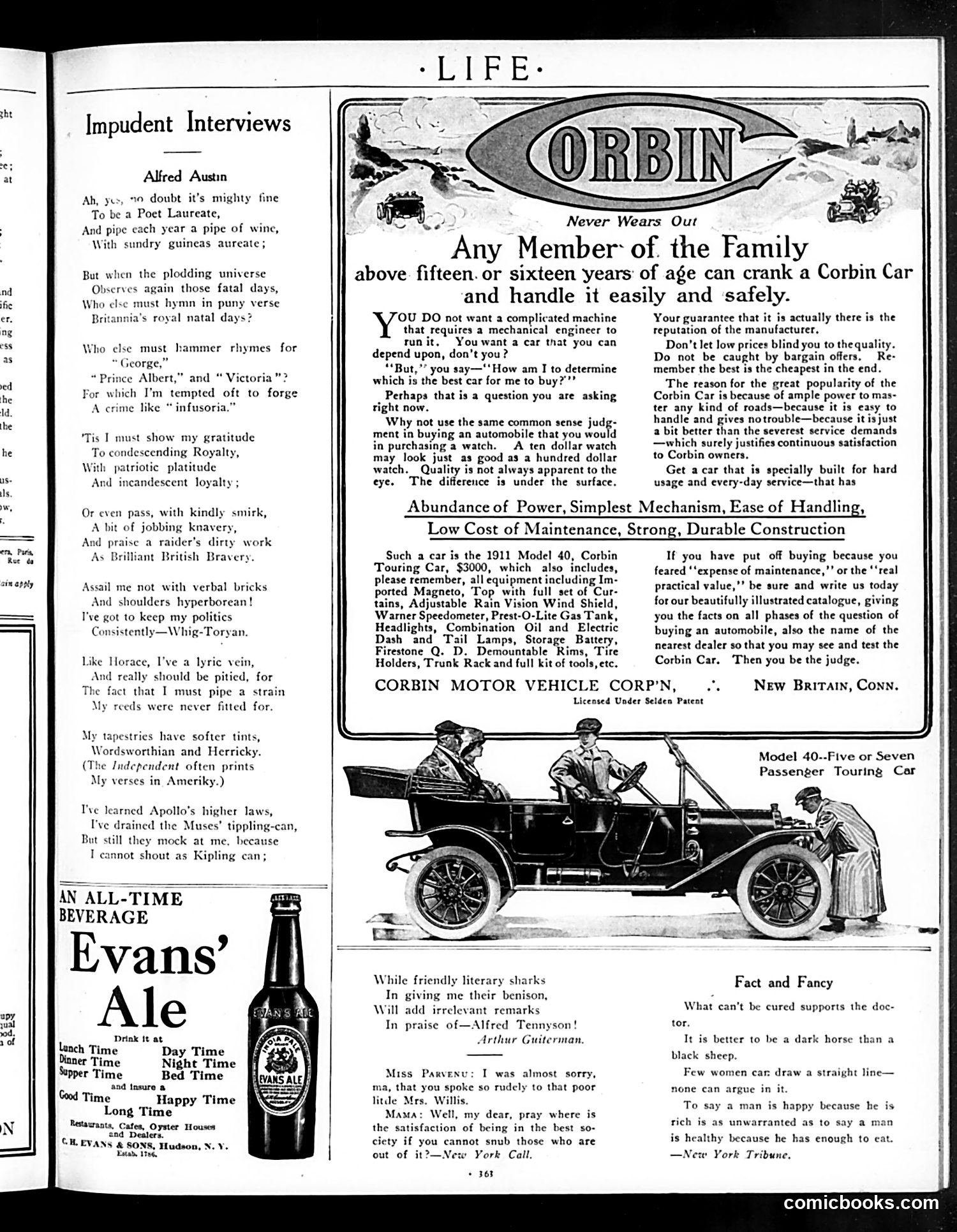
This page combines literary satire with automotive advertising, typical of early 1900s Life magazine. **Left side—"Impudent Interviews"**: A satirical poem mocking **Alfred Austin**, the British Poet Laureate. The satire ridicules the constrained role of a poet who must compose obligatory verses celebrating royal occasions ("George," "Prince Albert," "Victoria") while suppressing personal political views to maintain "Whig-Toryan" consistency. Austin complains he lacks the lyrical power of poets like Kipling, implying the position is ceremonial drudgery rather than genuine artistic work. The humor lies in presenting a supposedly honored appointment as an embarrassing servitude. **Right side—Corbin automobile advertisement**: A full-page ad for the 1911 Model 40 Corbin Touring Car, emphasizing reliability, simplicity, and value over cheap imitations. The marketing appeals to middle-class concerns about mechanical complexity and hidden defects, using a watch analogy to argue that quality justifies higher cost. The juxtaposition is incidental—simply page layout—though both pieces share themes of authenticity versus appearance.
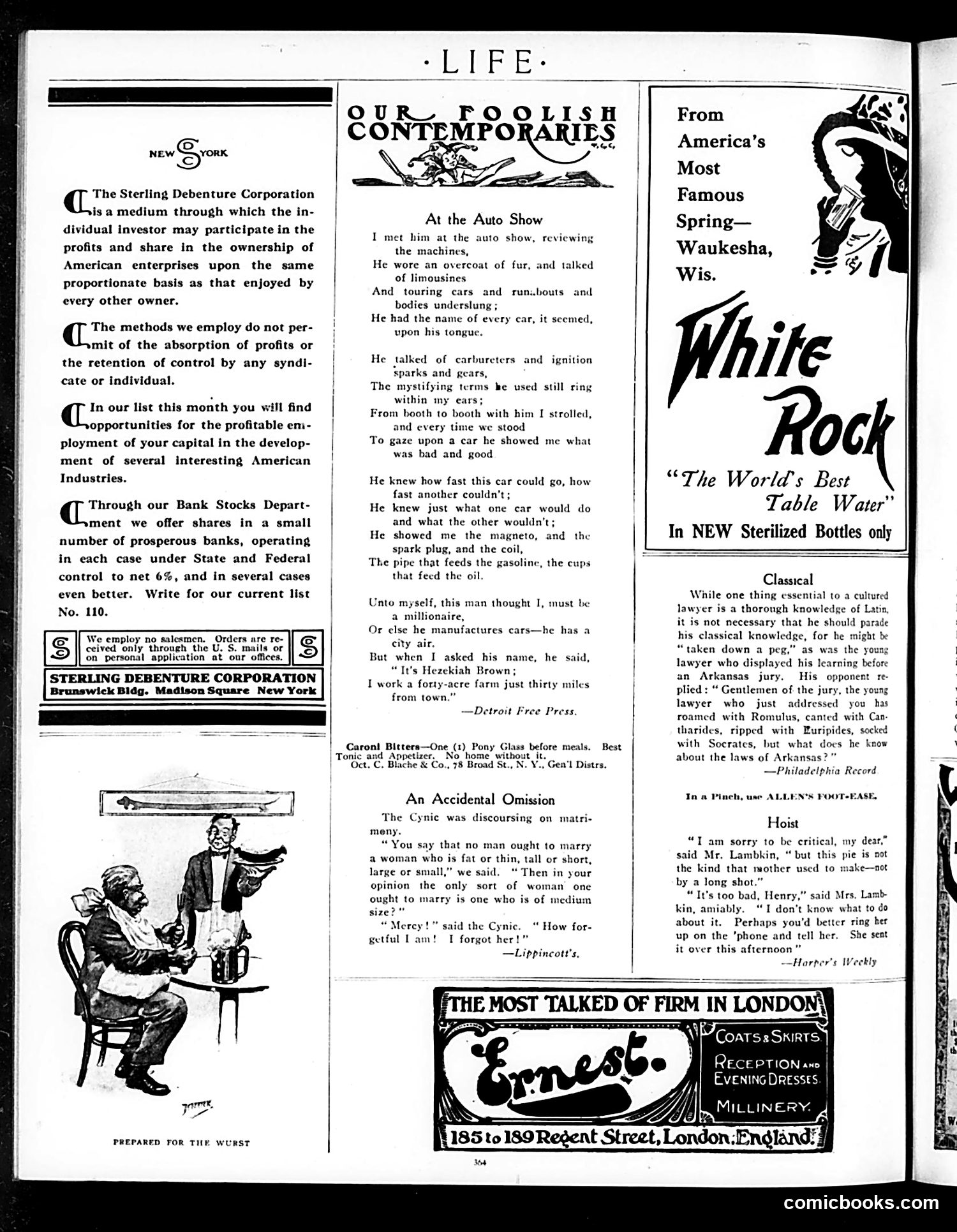
This page contains three separate humorous pieces satirizing early 20th-century American life: **"At the Auto Show"** (center): A poem mocking automotive enthusiasm. A farmer named Hezekiah Brown poses as a wealthy expert, confidently lecturing about cars—carburetors, ignition, magnetos—despite owning only a forty-acre farm thirty miles from town. The satire targets pretentious posturing and the way new technology (automobiles) inspired people to adopt false expertise and airs above their actual station. **"An Accidental Omission"** (lower center): A brief satirical dialogue where a cynic claims no woman is suitable for marriage except those of "medium size." When pressed, he claims to have forgotten this criterion entirely—a joke about men's contradictory, changing standards regarding women. **"Classical"** (right): Legal satire about a young Arkansas lawyer who pedantically references classical names (Romulus, Euripides, Socrates) to impress jurors, only to be mocked by opposing counsel for knowing classical references but not Arkansas law. The page also includes advertisements for investment firms and consumer products typical of the era.
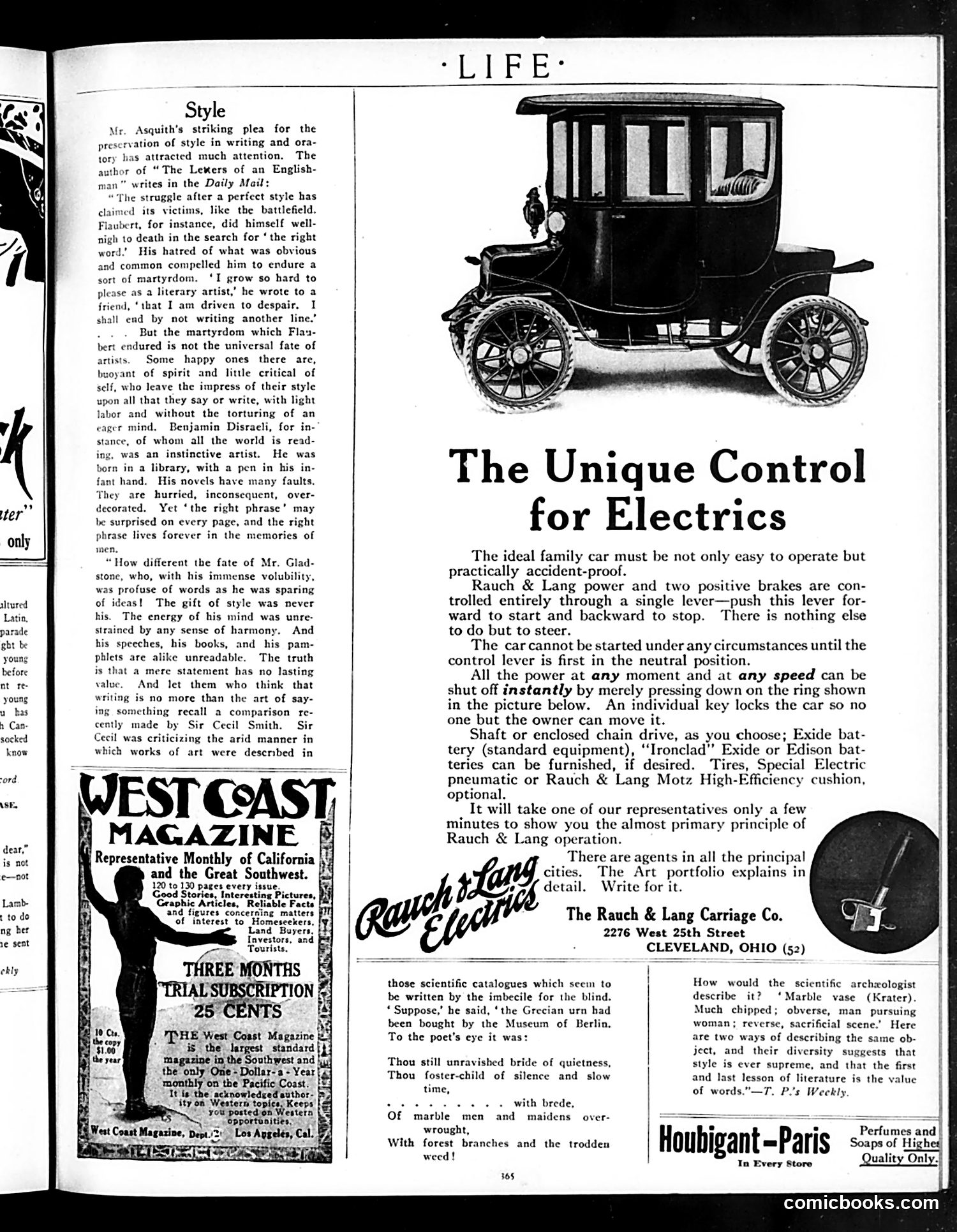
This page is primarily **advertising**, not satire or political commentary. The main content is a full-page advertisement for the **Rauch & Lang electric automobile**, headquartered in Cleveland, Ohio. The image shows an early electric car with an enclosed cabin—a luxury vehicle for the period. The ad emphasizes safety and ease of operation: a single lever controls starting/stopping, the car cannot start in any gear except neutral, and a key prevents unauthorized use. These features appealed to wealthy buyers, particularly women, who found early cars difficult and dangerous to operate. The left side contains unrelated editorial content about literary style, mentioning figures like Gustave Flaubert, Benjamin Disraeli, and William Gladstone. There's also an ad for *West Coast Magazine*. **Context for modern readers**: Electric cars were a viable luxury option in the early 1900s before gasoline engines dominated. This ad markets simplicity and safety—ironically similar to modern EV marketing claims.
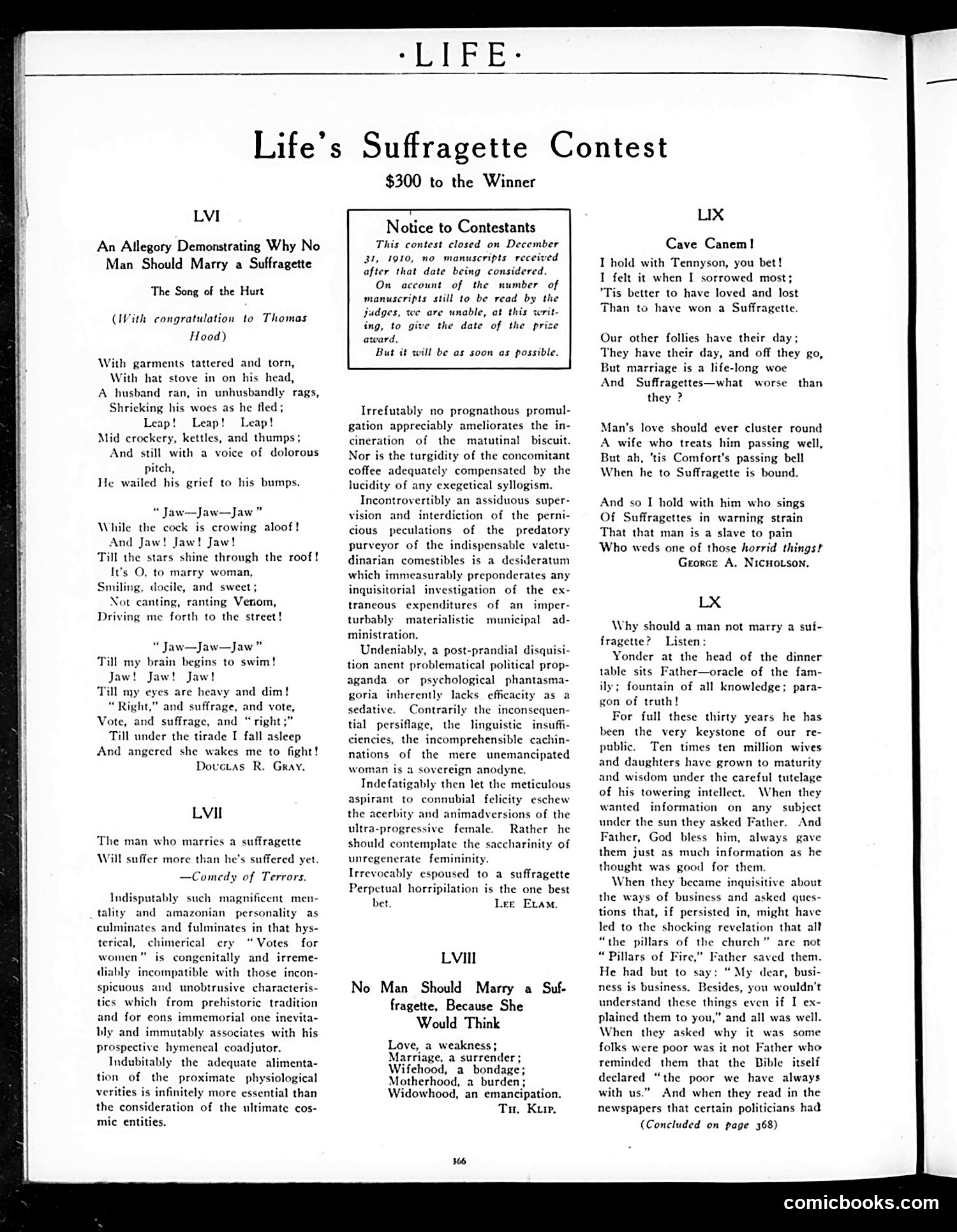
This page documents a satirical contest where Life magazine invited readers to submit arguments against women's suffrage, offering $300 to the winner. The entries ridicule female suffragists through exaggerated claims about marriage. **The satire targets suffragettes** (women fighting for voting rights) by depicting them as shrewish, argumentative, and incompatible with domestic life. One poem describes a husband fleeing his suffragette wife's constant jawing about "right" and "suffrage." Another uses deliberately overwrought vocabulary to argue that political activism makes women bad wives—suggesting their intellect makes them unsuitable partners. **The joke relies on misogyny**: the entries assume women should be "docile," not politically engaged. The contest itself is satirical commentary—Life is mocking anti-suffrage arguments by exaggerating them to absurdity. By publishing these deliberately ridiculous submissions, Life appears to be lampooning opponents of women's suffrage rather than endorsing their views, though the humor's target audience and intent remain somewhat ambiguous by modern standards.
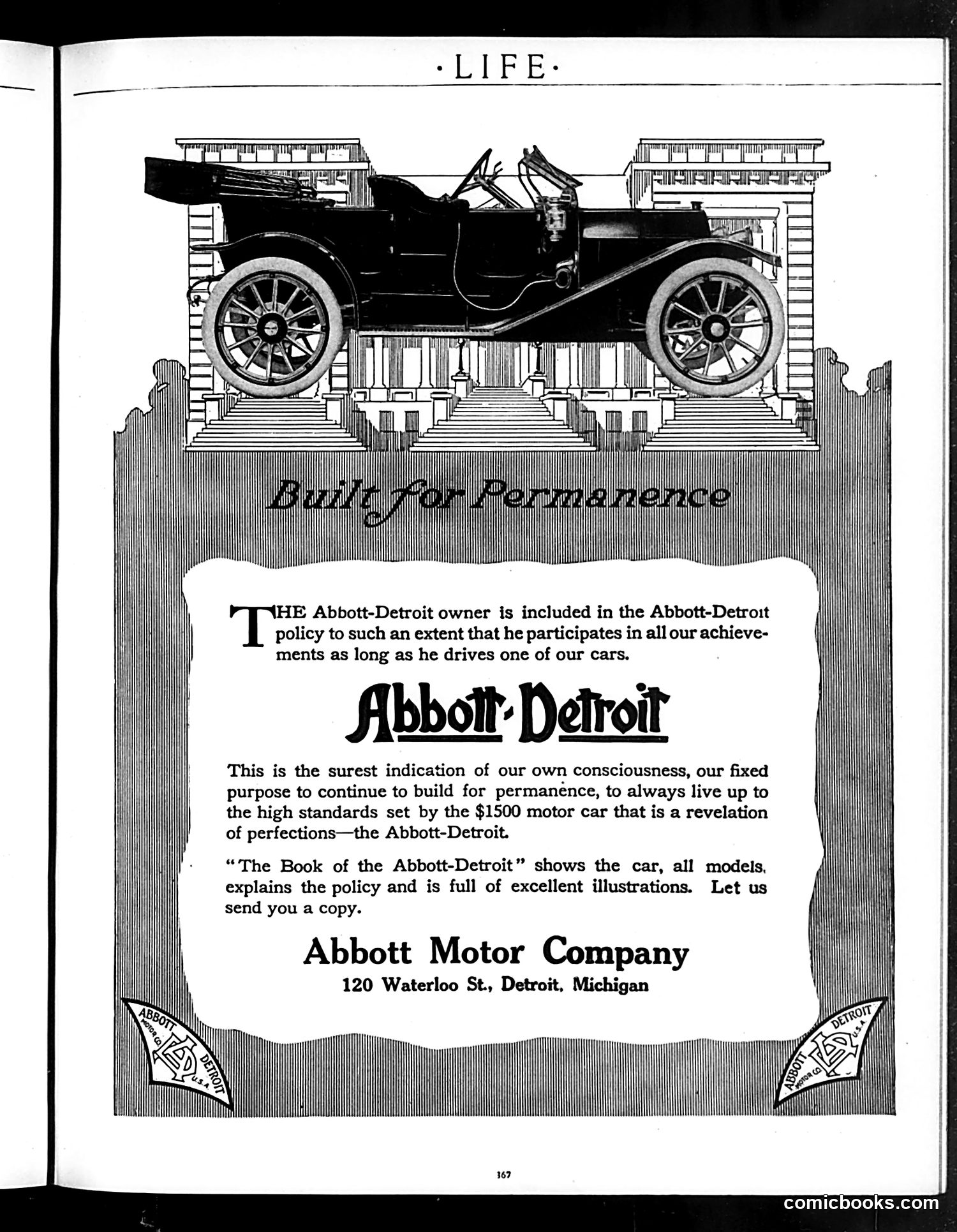
This is primarily an **advertisement**, not satire or political commentary. It appears in *Life* magazine promoting the Abbott-Detroit automobile. The page features an illustration of an early 1900s open-air touring car positioned in front of a classical building. The ad's message is straightforward marketing: Abbott-Detroit promises that car owners become partners in the company's achievements and quality standards. The company emphasizes its $1500 price point as evidence of "perfection" and durability. The phrase "Built for Performance" anchors the pitch. The advertisement mentions "The Book of the Abbott-Detroit" as promotional literature available upon request. **Historical context**: This reflects early automotive marketing when car manufacturers competed on quality claims and owner loyalty was a selling point. The Abbott Motor Company operated in Detroit, the emerging center of American automobile manufacturing in the early 20th century.
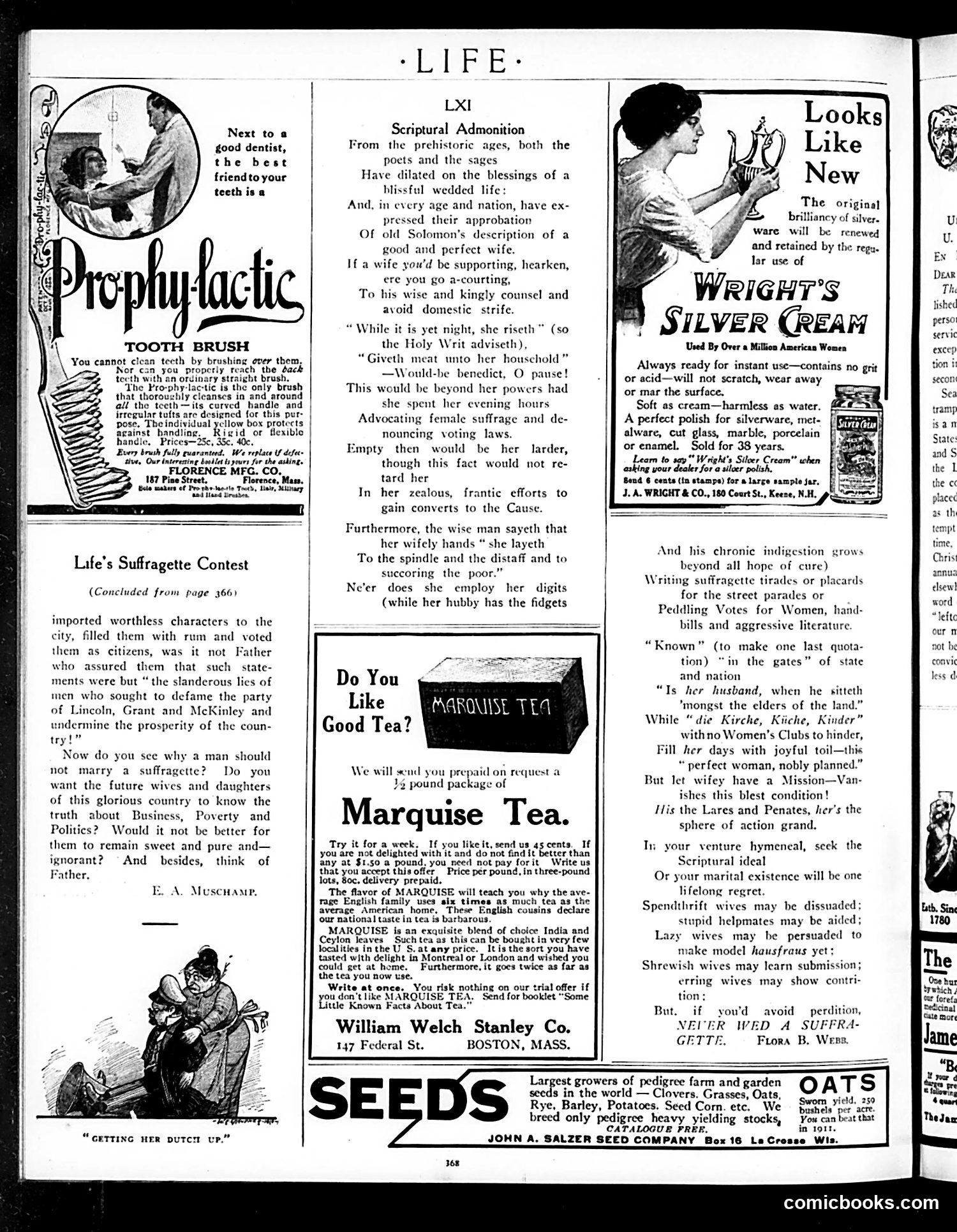
This page contains anti-suffrage propaganda disguised as humor. The central content—"Life's Suffragette Contest" (continued from page 366)—attacks women's voting rights through a mock scriptural argument. The satire claims that suffragette wives neglect their domestic duties (cooking, cleaning, managing households) while advocating for voting rights. It argues women should remain "sweet and pure and—ignorant," serving as wives and mothers rather than political participants. The cartoon "Getting Her Dutch Up" (bottom left) depicts a woman in an aggressive stance, likely mocking suffragettes as unfeminine or belligerent. The poem warns men against marrying suffragettes, suggesting their activism causes husbands' "chronic indigestion" and household chaos. This reflects early 1900s anti-suffrage arguments: that voting would make women neglect family duties and lose femininity. The page surrounds this polemic with period advertisements, typical of *Life* magazine's format.
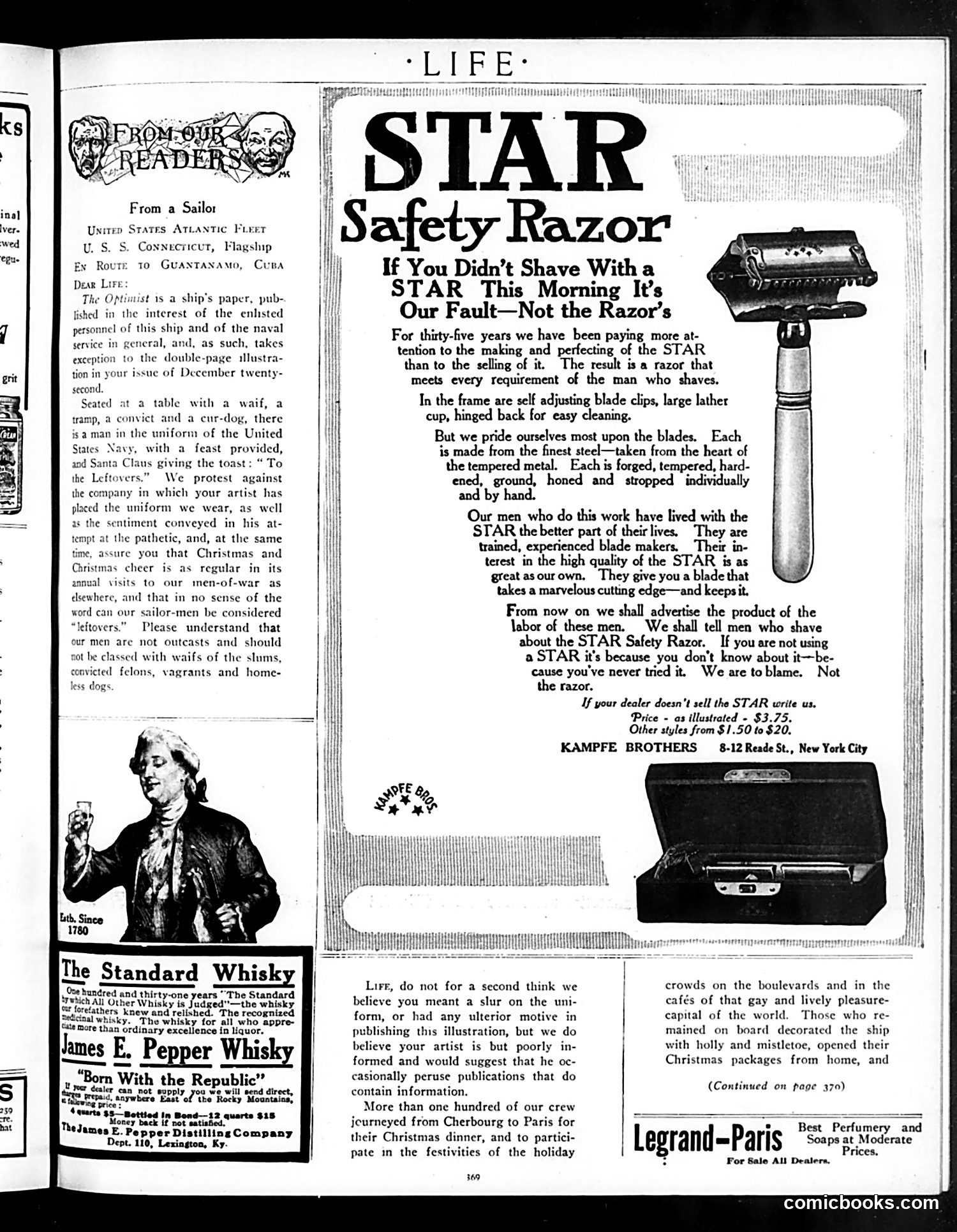
This page contains three separate elements: **1. Letter from a Sailor (left column):** A U.S. Navy sailor protests a previous Life illustration depicting a uniformed sailor seated with "a waif, a tramp, a convict and a cur-dog," apparently receiving charity at Christmas. The sailor argues this unfairly portrays Navy men as social outcasts, insisting sailors receive regular Christmas provisions and should not be grouped with vagrants and criminals. **2. Advertisements:** The page features three ads—James E. Pepper Whisky ("Born with the Republic") and a Star Safety Razor—typical of early 20th-century magazines. These are not satirical but commercial. **3. Continuation of another article (bottom right):** References sailors enjoying Paris leave at Christmas, contrasting with those decorating their ship. **The context:** This reflects post-Civil War/early 20th-century debates about social class and the dignity of working-class servicemen, challenging stereotypes that enlisted sailors were society's dregs. The sailor's respectful protest defends his profession's honor.
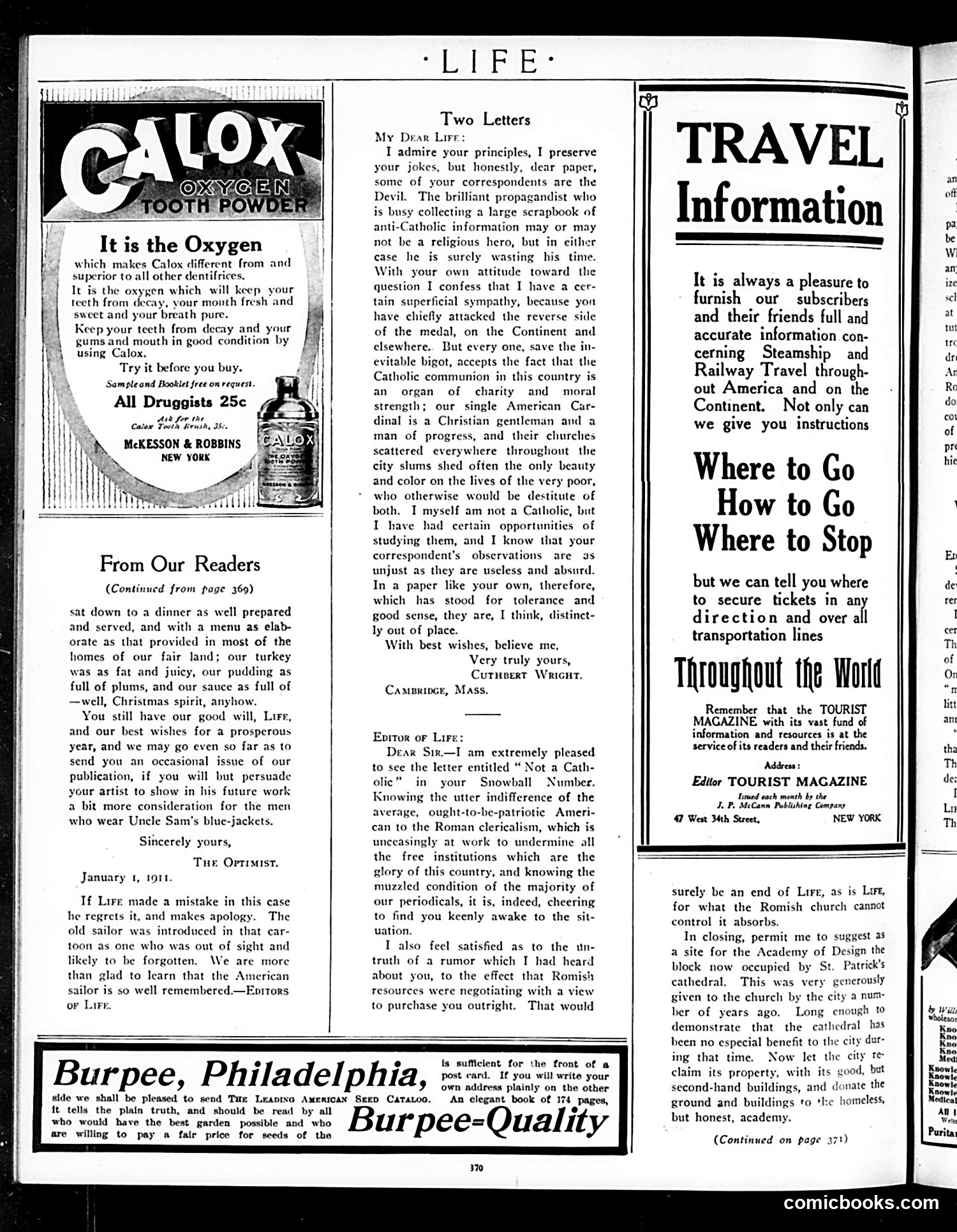
This page consists primarily of **advertisements and reader letters**, not political satire or cartoons requiring historical context. The main content includes: 1. **Calox Tooth Powder ad** (left): A straightforward product advertisement emphasizing oxygen's benefits for dental hygiene. No satire present. 2. **"From Our Readers" section**: Two letters debating anti-Catholic sentiment in America. One correspondent defends Catholics as charitable and progressive; another praises Life for publishing anti-Catholic criticism, warning of supposed "Romish" efforts to undermine American institutions. This reflects genuine early-20th-century religious tensions and nativist concerns about Catholic influence—not satire, but actual reader commentary on divisive social issues. 3. **Travel Information and Burpee Seeds ads** (right/bottom): Standard commercial advertisements. The page lacks cartoons or satirical content that would require historical explanation. It's primarily a vehicle for period advertisements and reader correspondence reflecting authentic contemporary anxieties.
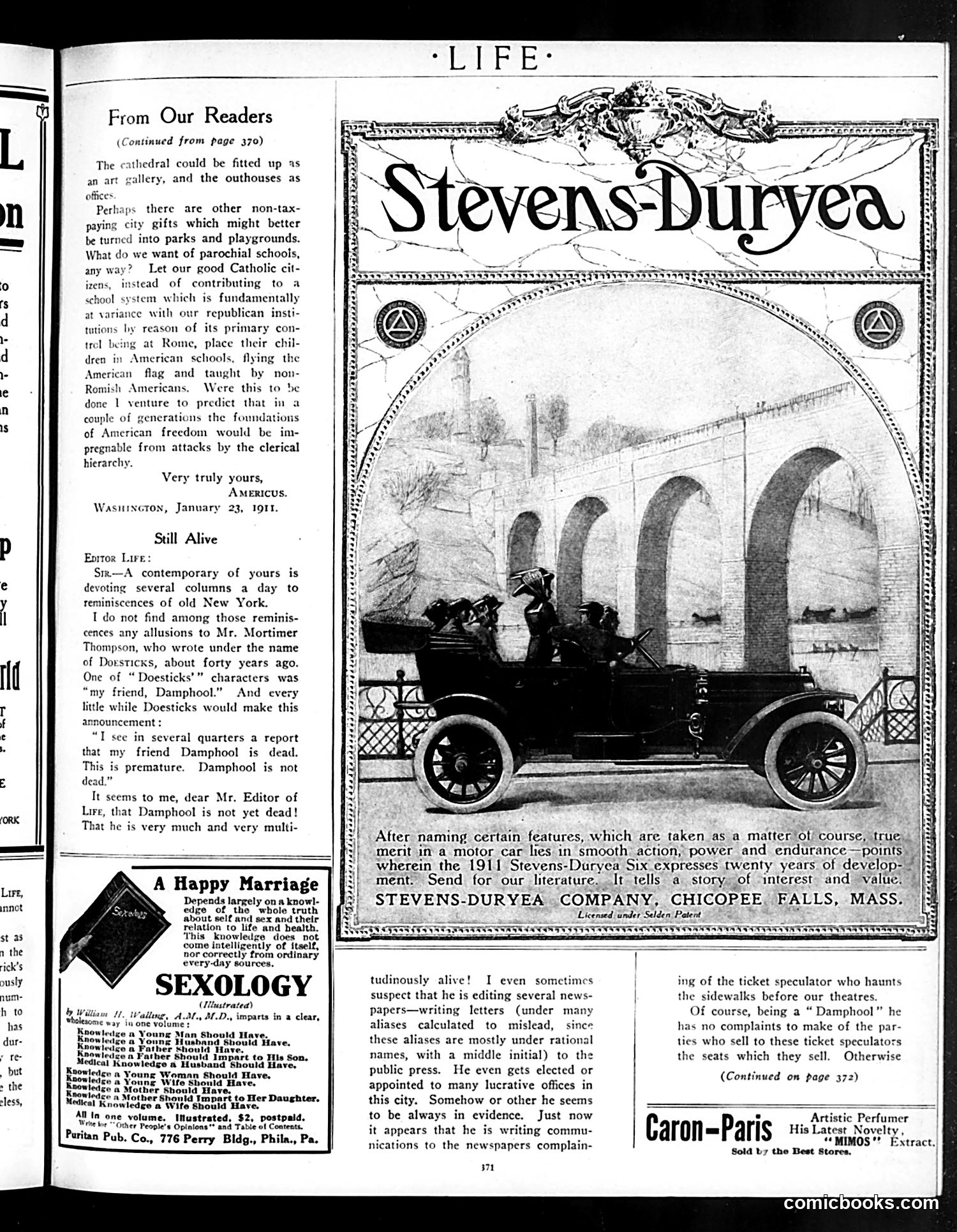
This page contains reader letters and advertisements rather than political cartoons. The key content reflects early 20th-century American tensions: **The "Americus" letter** expresses nativist and anti-Catholic sentiment, arguing that parochial schools undermine American unity because they're controlled from Rome. The writer advocates eliminating Catholic institutions in favor of secular "American schools" to protect republican values from "clerical hierarchy"—reflecting widespread Protestant anxiety about Catholic immigration and influence during this period. **The "Still Alive" letter** references "Damphool," a fictional character from Mortimer Thompson's 1860s satirical writings. The writer notes this character repeatedly claimed not to be dead, then compares contemporary New York's ticket speculators and corrupt officeholders to this fictional bumbler—suggesting such incompetence remains perpetually alive in American civic life. The **Stevens-Duryea automobile advertisement** showcases a luxury vehicle, representing industrial modernity of the era. Overall, this page reflects Progressive Era concerns about immigration, institutional corruption, and modernization.
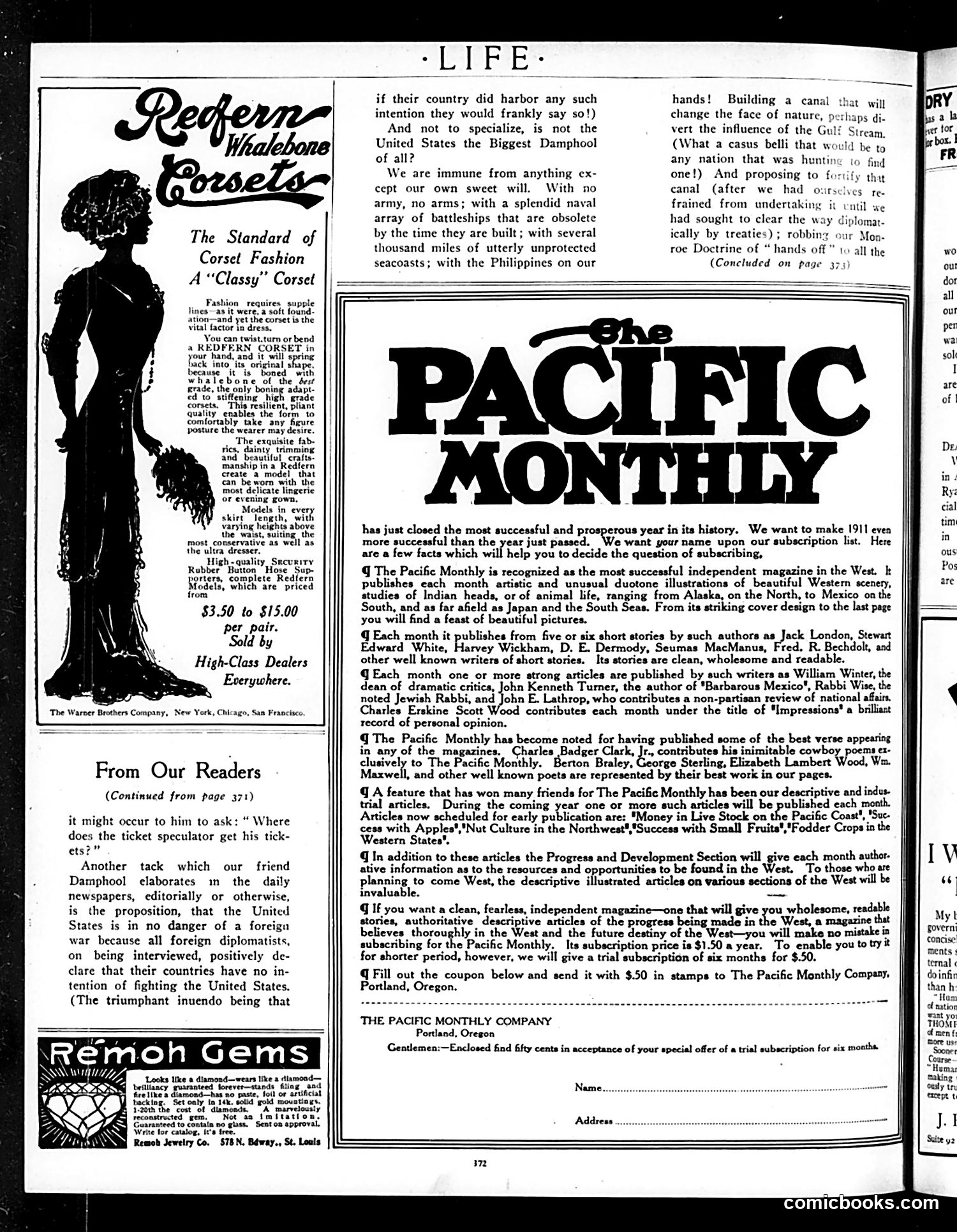
This page contains **political satire criticizing American foreign policy**, likely from around 1910-1911 based on references to "1911" in the text. The political commentary (upper right) mocks U.S. imperial overreach: America claims neutrality while possessing obsolete battleships, unprotected seacoasts, and the Philippines as colonial possessions. The passage sarcastically questions whether the U.S.—described as "the Biggest Damphool of all"—should be lecturing other nations about their intentions, particularly regarding canal construction (likely referencing Panama Canal debates). The satire criticizes American **hypocrisy**: preaching non-intervention ("hands off") via the Monroe Doctrine while simultaneously pursuing imperial expansion and military ambitions. The rest of the page consists of **advertisements** for Redfern corsets and a subscription pitch for *The Pacific Monthly* magazine, unrelated to the political commentary above.
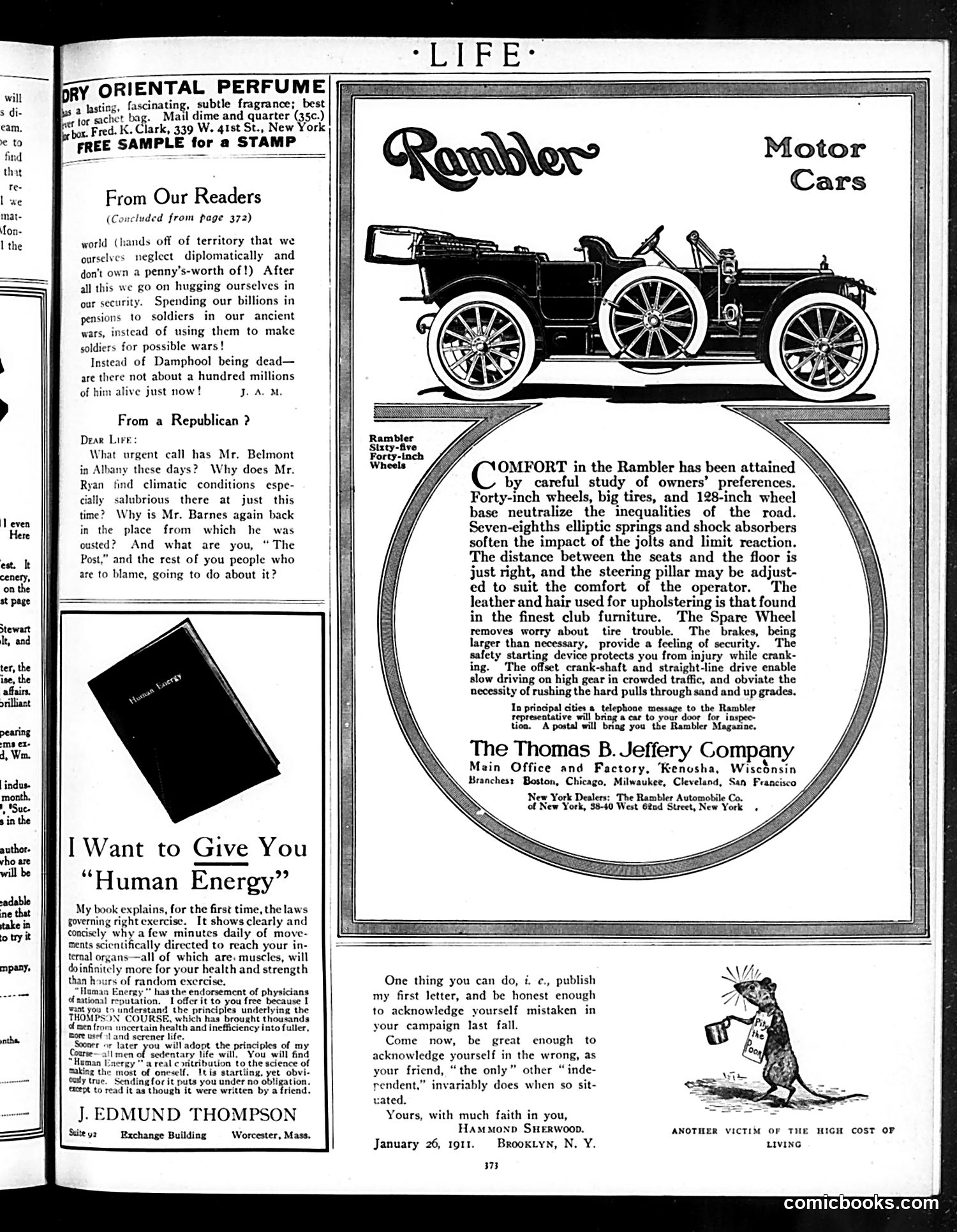
This page is primarily **advertisements and reader letters**, not political satire. The main content includes: **"From Our Readers"** section: Letters to the editor discussing contemporary political figures (Belmont, Ryan, Barnes) and New York politics—specific references unclear without fuller context, but the tone suggests reader frustration with political inaction. **Rambler Motor Cars advertisement**: A full-page illustrated ad showcasing an early automobile with detailed specifications about comfort features (springs, wheels, leather upholstery). This represents the nascent American automobile industry marketing to affluent readers. **"Human Energy" advertisement**: J. Edmund Thompson promotes his self-help course claiming to improve health through directed movement—a common pitch in early 20th-century publications mixing pseudoscience with wellness marketing. The page reflects *Life*'s dual function: satirical commentary paired with advertisements targeting educated, middle-to-upper-class readers interested in modern conveniences and self-improvement.
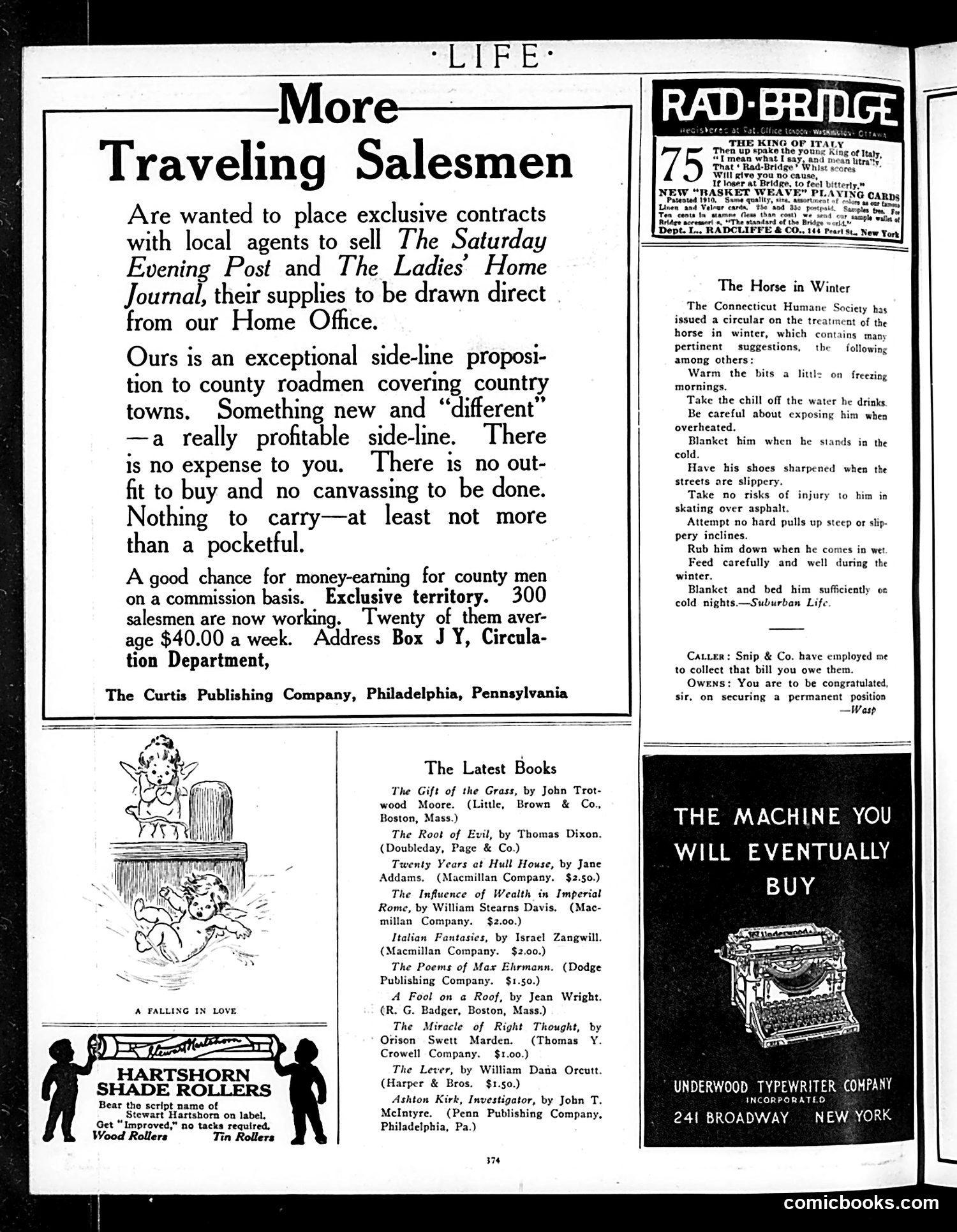
This page is primarily **advertising and book reviews**, not political satire. The main content includes: **Top Left:** A job recruitment ad from Curtis Publishing Company seeking traveling salesmen to sell *The Saturday Evening Post* and *Ladies' Home Journal* on commission in rural areas—positioned as easy, profitable side-work requiring no investment or canvassing. **Right Side:** A genuine advisory piece from the Connecticut Humane Society on winter horse care (warming bits, providing blankets, careful feeding)—practical guidance reflecting early-20th-century concern for animal welfare. **Bottom:** Book advertisements, including a whimsical illustration labeled "A Falling in Love" (likely unrelated satire), and ads for Hartshorn Shade Rollers and Underwood Typewriters. The page reflects period commerce and genteel concerns rather than political commentary. The only mild humor appears in a small exchange between a bill collector and debtor at bottom right.
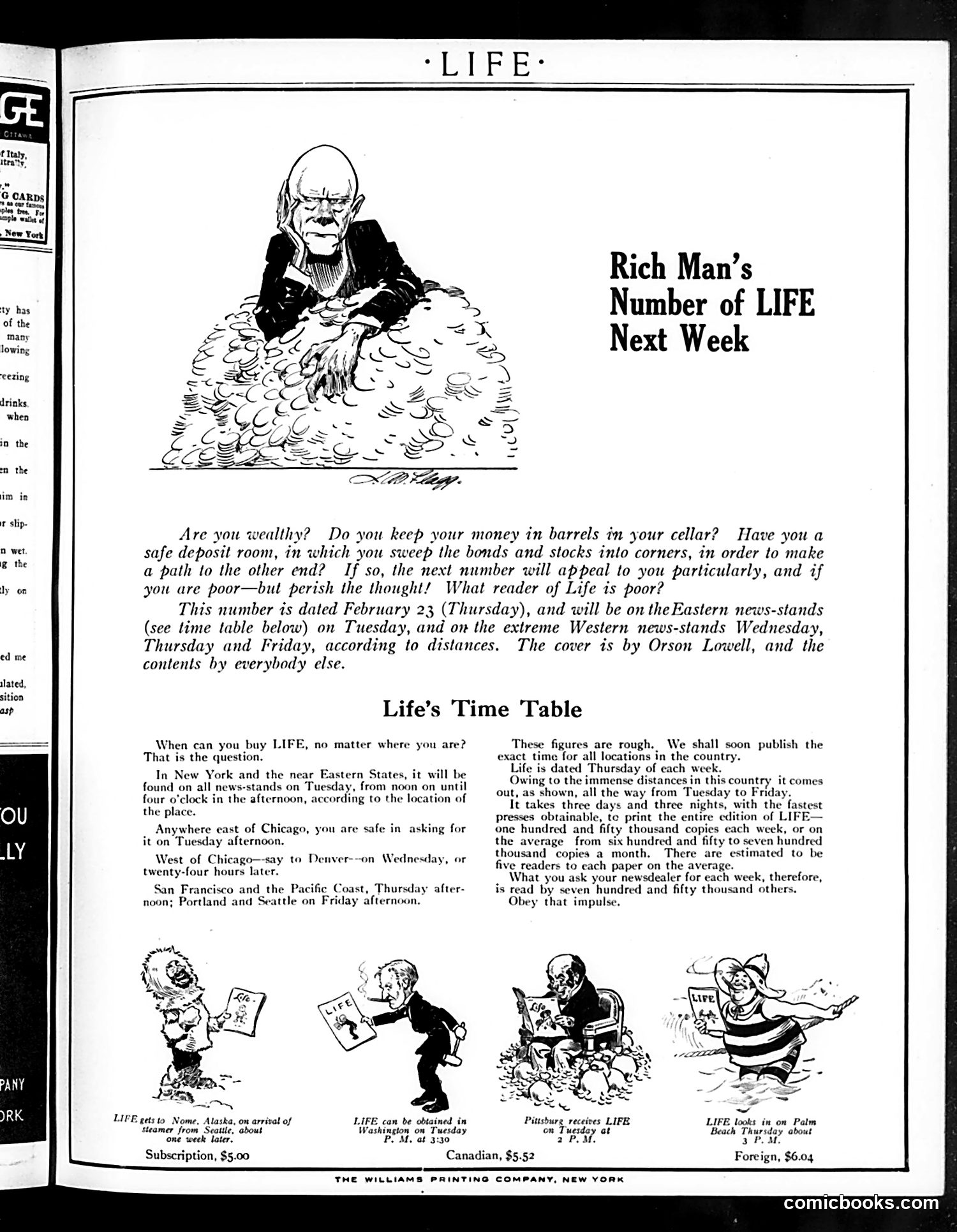
This is a promotional page for an upcoming issue of *Life* magazine (dated February 23), not a political cartoon. The main illustration shows a caricatured wealthy man sitting atop an enormous pile of money—a visual metaphor for extreme wealth. The satire targets **wealthy readers specifically**: the text sarcastically addresses them directly ("Are you wealthy?"), mocking their habits of hoarding cash in barrels and cellars, then adds the barbed aside "and if you are poor—but perish the thought! What reader of Life is poor?" This is ironic commentary on *Life's* actual readership: it was an affluent, educated audience, yet the magazine's editors pretend poverty doesn't exist among their readers—a jab at the insularity and obliviousness of the wealthy. The bulk of the page is practical: a distribution schedule showing when the magazine reaches different U.S. regions, circulation numbers (750,000 readers weekly), and subscription costs. The four small cartoons at bottom illustrate how broadly the magazine circulates geographically.
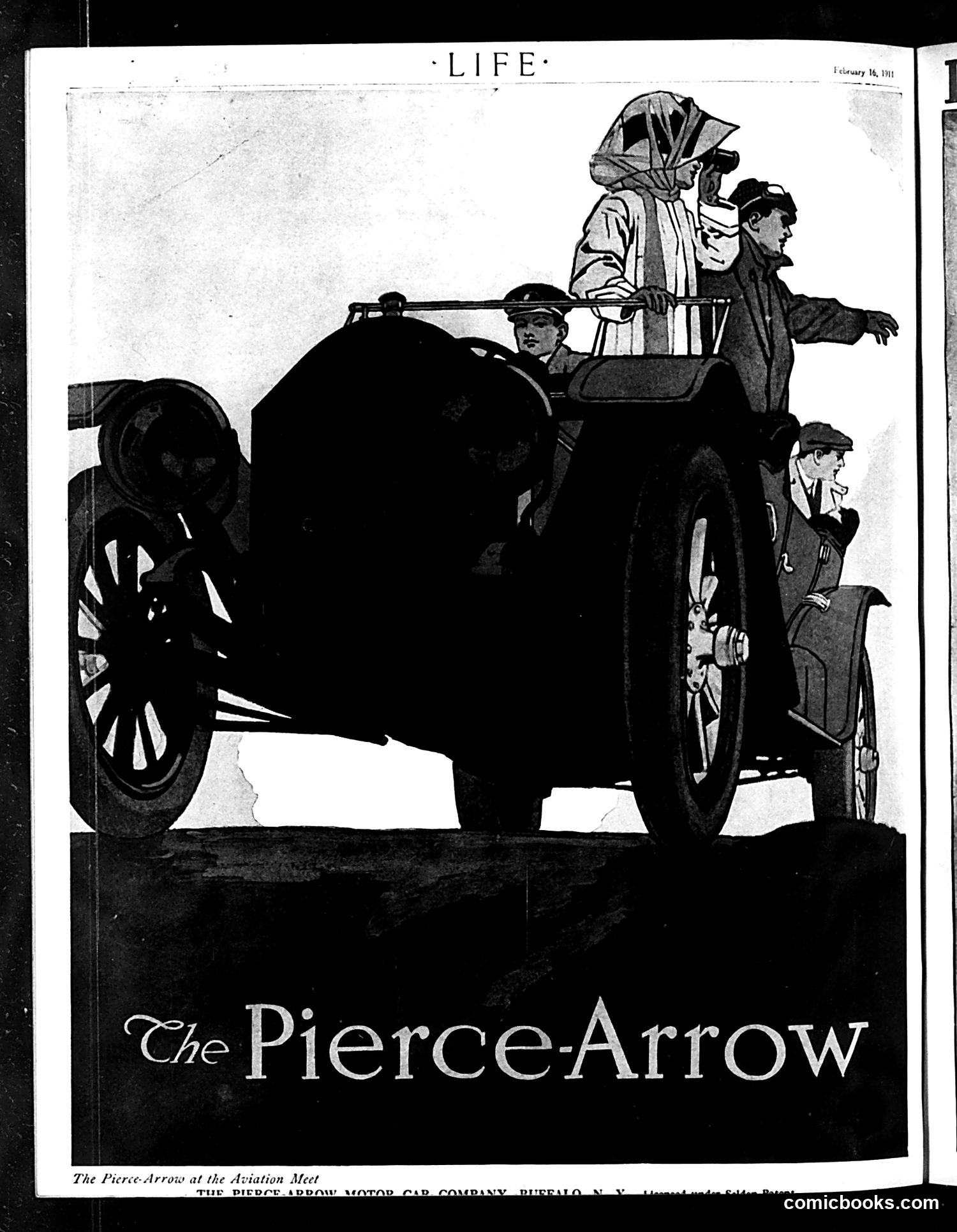
This is a **Pierce-Arrow automobile advertisement** from *Life* magazine (dated February 16, 1911). The image shows a silhouetted racing car with several figures representing different social classes or stereotypes positioned around and atop the vehicle—including what appears to be a wealthy driver, a woman in elaborate dress, and working-class observers. The caption references "The Pierce-Arrow at the Aviation Meet," suggesting this was a prestigious automotive event. The advertisement leverages the era's fascination with speed, aviation technology, and automotive innovation to market Pierce-Arrow as a luxury vehicle associated with modernity and high society. The multiple figures climbing over and around the car suggest the vehicle's appeal across social strata, though the composition emphasizes its status symbol quality.