
Life, 1911-02-16 · page 18 of 44
Life — February 16, 1911 — page 18: what you’re looking at
What you’re looking at
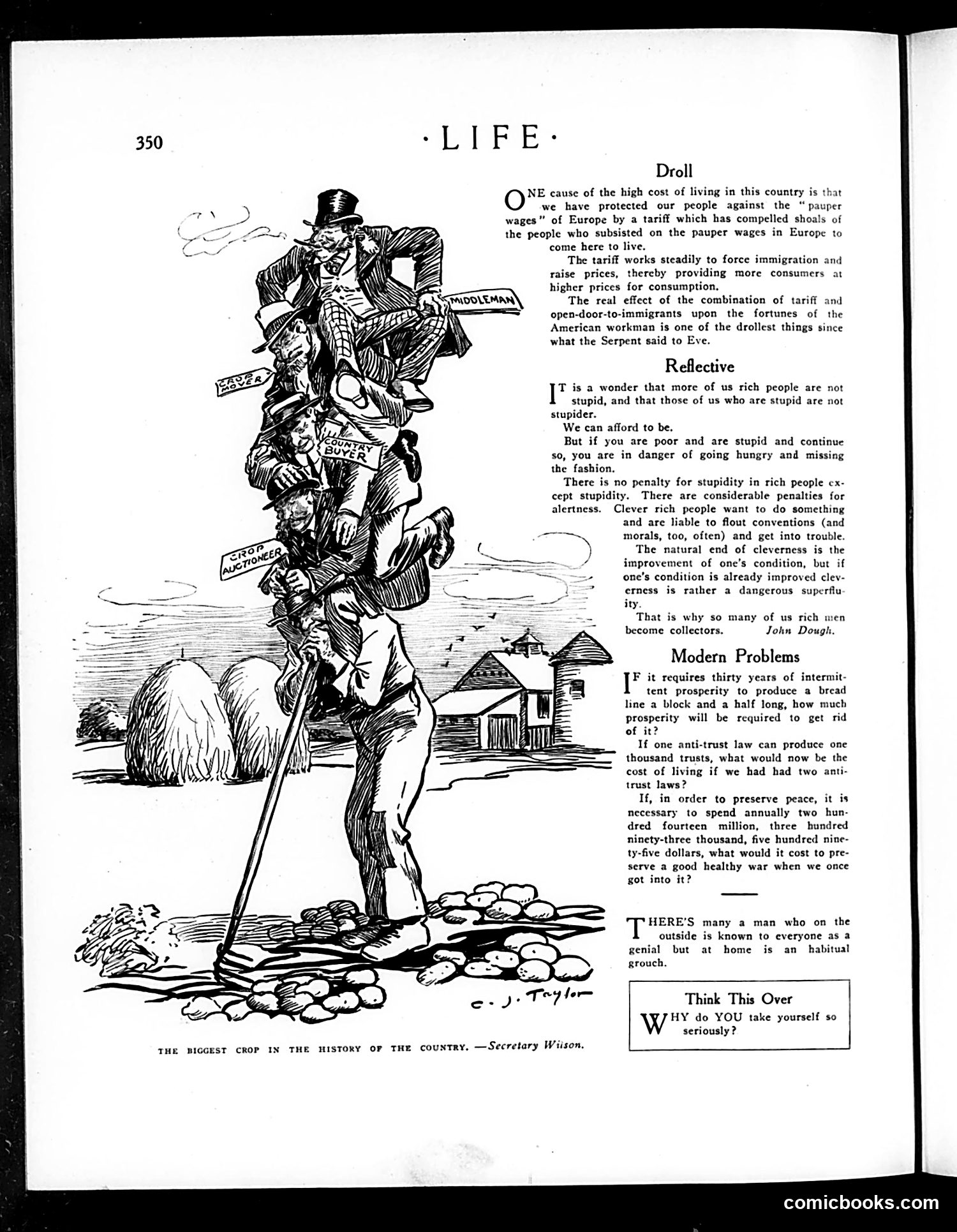
This satirical cartoon by C.J. Taylor critiques U.S. tariff and immigration policy under what appears to be the Wilson administration. The central figure—Uncle Sam—is depicted as a grotesquely tall, spindly character standing atop a massive pile of money, labeled with various economic concerns like "middleman," "tariff," and "buyer." His distorted form suggests the unnatural and unsustainable nature of the economic system. The satire argues that protective tariffs designed to shield American workers from European "pauper wages" paradoxically encourage immigration, flooding the labor market and raising consumer prices. This creates the ironic situation where the tariff harms the very workers it meant to protect. The accompanying text extends the critique to broader economic absurdities—the contradiction between anti-trust laws and trust formation, and massive military spending allegedly justified by peace-keeping. The cartoon suggests that America's economic policies produce grotesque, unintuitive results that contradict their stated intentions.
📄 Transcribed text from this page (OCR, searchable)
Machine-transcribed from the original scan — historical spelling and the odd misread are preserved.
“LITPE* Droll NE cause of the high cost of living in this country is that we have protected our people against the “ pauper wages” of Europe by a tariff which has compelled shoals of the people who subsisted on the pauper wages in Europe to come here to live. The tariff works steadily to force immigration and raise prices, thereby providing more consumers at higher prices for consumption. The real effect of the combination of tariff and open-door-to-immigrants upon the fortunes of the American workman is one of the drollest things since what the Serpent said to Eve. Reflective T is a wonder that more of us rich people are not stupid, and that those of us who are stupid are not stupider. We can afford to be. But if you are poor and are stupid and continue so, you are in danger of going hungry and missing the fashion. There is no penalty for stupidity in rich people cx- cept stupidity. There are considerable penalties for alertness. Clever rich people want to do something and are liable to flout conventions (and ——— morals, too, often) and get into trouble. 5 The natural end of cleverness is the improvement of one’s condition, but if one’s condition is already improved clev- erness is rather a dangerous superflu ity, That is why so many of us rich men become collectors. John Dough. Modern Problems F it requires thirty years of intermit- tent prosperity to produce a bread line a block and a half long, how much Prosperity will be required to get rid of it? If one anti-trust law can produce one thousand trusts, what would now be the cost of living if we had had two anti- trust laws? If, in order to preserve peace, it is necessary to spend annually two hun- dred fourteen million, three hundred ninety-three thousand, five hundred nine- ty-five dollars, what would it cost to pre- serve a good healthy war when we once got into it? HERE’S many a man who on the outside is known to everyone as a genial but at home is an habitual grouch. Think This Over HY do YOU take yourself so seriously ? THE BIGGEST CROP IN THE HISTORY OF THE couNTRY. —Secretary Wiison, comicbooks.com