
Life, 1911-02-16 · page 24 of 44
Life — February 16, 1911 — page 24: what you’re looking at
What you’re looking at
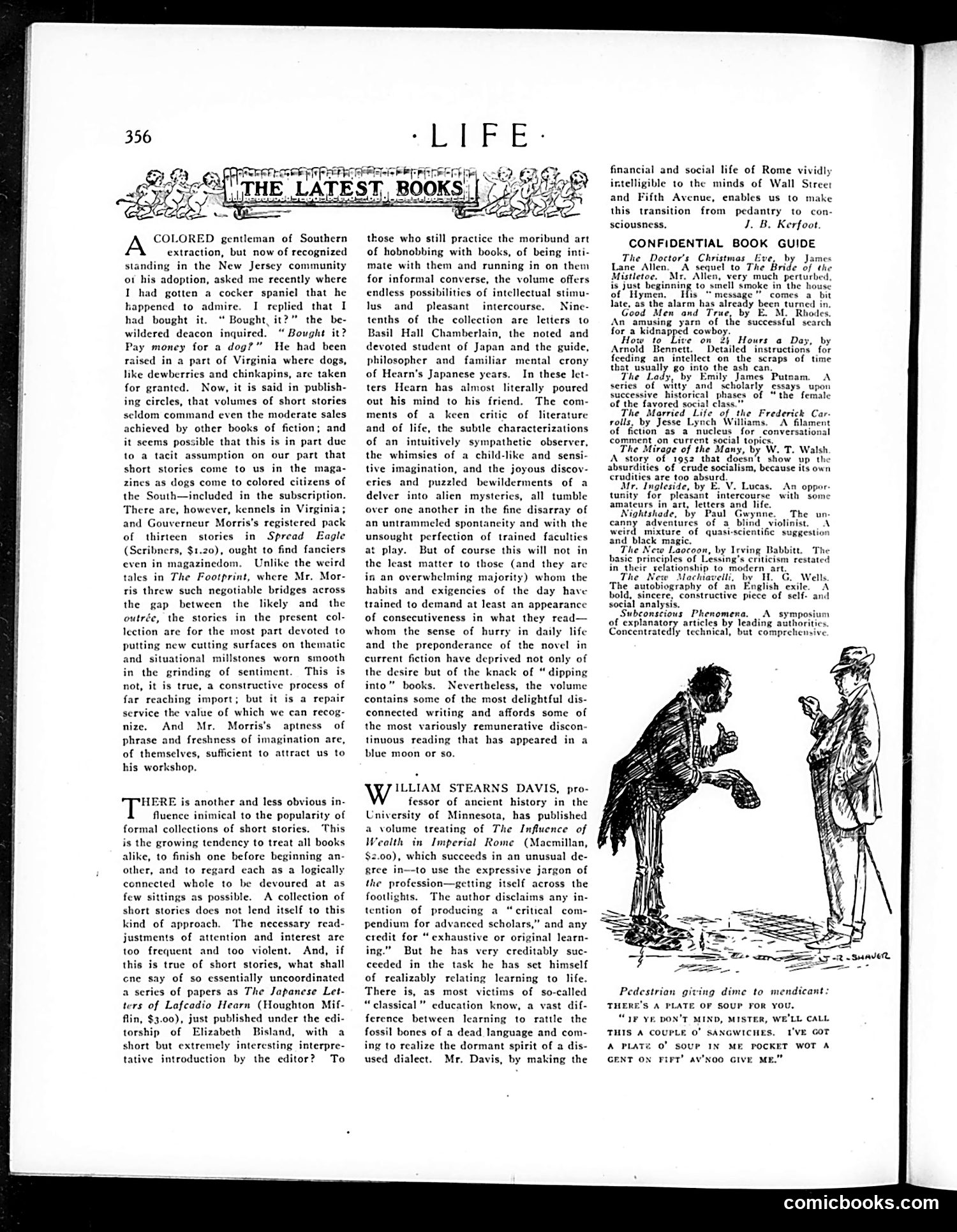
This page features book reviews in Life magazine's characteristic witty style. The main cartoon illustrates a humorous anecdote about a colored gentleman from the South who, when asked where the reviewer obtained his cocker spaniel, expresses shock at paying money for a dog—implying dogs were simply "included" as part of life in the pre-Civil War South, like natural resources. The reviewer uses this joke to critique short story collections, arguing they suffer from being perceived as "free" (like magazine inclusions) rather than standalone purchases. The page reviews three books: Gouverneur Morris's *Spread Eagle* (short stories), and Lafcadio Hearn's *Japanese Letters* (correspondence about Japan). The satire reflects early-20th-century attitudes about reading habits and class, while the opening anecdote relies on stereotypes about Southern Black life for comedic effect typical of the era.
📄 Transcribed text from this page (OCR, searchable)
Machine-transcribed from the original scan — historical spelling and the odd misread are preserved.
COLORED gentleman of Southern extraction, but now of recognized standing in the New Jersey community ot his adoption, asked me recently where I had gotten a cocker spaniel that he happened to admire. I replied that I had bought it. “ Bought, it?” the be- wildered deacon inquired. “ Bought it? Pay money for a dog?” He had been raised in a part of Virginia where dogs, like dewberries and chinkapins, are taken for granted. Now, it is said in publish- ing circles, that volumes of short stories seldom command even the moderate sales achieved by other books of fiction; and it seems possible that this is in part duc to a tacit assumption on our part that short stories come to us in the maga- zines as dogs come to colored citizens of the South—included in the subscription. There are, however, kennels in Virginia; and Gouverneur Morris's registered pack of thirteen stories in Spread Eagle (Scribners, $1.20), ought to find fanciers even in magazinedom. Unlike the weird tales in The Footprint, where Mr. Mor- ris threw such negotiable bridges across the gap between the likely and the outrée, the stories in the present col- lection are for the most part devoted to putting new cutting surfaces on thematic and situational millstones worn smooth in the grinding of sentiment. This is not, it is true, a constructive process of far reaching import; but it is a repair service the value of which we can recog- nize, And Mr. Morris's aptness of phrase and freshness of imagination are, of themselves, sufficient to attract us to his workshop. HERE is another and less obvious in- fluence inimical to the popularity of formal collections of short stories. ‘This is the growing tendency to treat all books alike, to finish one before beginning an- other, and to regard each as a logically connected whole to be devoured at as few sittings as possible. A collection of short stories does not lend itself to this kind of approach. The necessary read- justments of attention and interest are too frequent and too violent. And, if this is true of short stories, what shall ene say of so essentially uncoordinated a series of papers as The Japanese Let- ters of Lafcadio Hearn (Houghton Mif- flin, $3.00), just published under the edi- torship of Elizabeth Bisland, with a short but extremely interesting interpre- tative introduction by the editor? To ULAPAE: - i) those who still practice the moribund art of hobnobbing with books, of being inti- mate with them and running in on them for informal converse, the volume offers endless possibilities of intellectual stimu- lus and pleasant intercourse. Nine- tenths of the collection are letters to Basil Hall Chamberlain, the noted and devoted student of Japan and the guide, philosopher and familiar mental crony of Hearn’s Japanese years. In these let- ters Hearn has almost literally poured out his mind to his friend. The com- ments of a keen critic of literature and of life, the subtle characterizations of an intuitively sympathetic observer, the whimsies of a child-like and sensi- tive imagination, and the joyous discov- eries and puzzled bewilderments of a delver into alien mysteries, all tumble over one another in the fine disarray of an untrammeled spontaneity and with the unsought perfection of trained faculties at play. But of course this will not in the Icast matter to those (and they are in an overwhelming majority) whom the habits and exigencies of the day have trained to demand at least an appearance of consecutiveness in what they read— whom the sense of hurry in daily life and the preponderance of the novel in current fiction have deprived not only of the desire but of the knack of “ dipping into” books. Nevertheless, the volume contains some of the most delightful dis- connected writing and affords some of the most variously remunerative discon- tinuous reading that has appeared in a blue moon or so. ILLIAM STEARNS DAVIS, pro- fessor of ancient history in the University of Minnesota, has published a volume treating of The Influence of Wealth in Imperial Rome (Macmillan, 00), which succeeds in an unusual de- Rtce in--to use the expressive jargon of the profession—getting itself across the footlights. The author disclaims any in- tention of producing a “critical com- pendium for advanced scholars,” and any credit for “exhaustive or original learn- ing.” But he has very creditably suc- ceeded in the task he has set himself of realizably relating learning to life. There is, as most victims of so-called “classical” education know, a vast dif- ference between learning to rattle the fossil bones of a dead language and com- ing to realize the dormant spirit of a dis- used dialect. Mr. Davis, by making the financial and social life of Rome vividly intelligible to the minds of Wall Street and Fifth Avenue, enables us to make this transition from pedantry to con- sciousness, J. B. Kerfoot. CONFIDENTIAL BOOK GUIDE The Doctor's Christmas Eve, by James Lane Allen, sequel to The Bride of the Mistletoe. . Allen, very much perturbed, is just beginning to smell smoke in the house of Hymen. His “message” comes a bit late, as the alarm has already been turned in. Good Men and True, by E. M. Rhodes. An amusing yarn of the successful search for a kidnapped cowboy. How to Live on 2) Hours a Day, by Arnold Bennett. Detailed instructions for feeding an intellect on the scraps of time that usually go into the ash can. The Lady, by Emily James Putnam. A series of witty and scholarly essays upon successive historical phases of “the female of the favored social class.” The Married Life of the Frederick Car. rolls, by Jesse Lynch Williams, A filament of fiction as a nucleus for conversational comment on current social topics, The Mirage of the Many, by W. T. Walsh A story of 1952 that doesn’t show up t absurdities of crude socialism, because its own crudities are too absurd, Mr. Ingleside, by E. V. Lucas. An oppo tunity for pleasant intercourse with some amateurs in art, letters and life. Nightshade, by Paul Gwynne. The un- canny adventures of a blind. violinist. | weird mixture of quasi-scientific suggestion and black magic, The New Laocoon, by Irving Babbitt basic principles of Lessing's criticism restated in their selationship to modern art. The New Machiavelli, by VW. G. Wells ‘The autobiography of an English exile. A bold, ‘sincere, constructive piece of self. and social analysi Subconscious Phenomena. A symposiu of explanatory articles by leading authorities Concentratedly technical, but comprehensive Pedestrian giving dime to mendicant: THERE'S A PLATE OF SoUP FoR you. “UP YE DON’T MIND, MISTER, WE'LL CALL THIS A COUPLE 0" SANGWICHES. I'VE GOT A PLATE O' SOUP IN ME POCKET WOT A GENT ON Firt’ AV'NOO GIVE ME.” comicbooks.com