
Life, 1911-02-16 · page 8 of 44
Life — February 16, 1911 — page 8: what you’re looking at
What you’re looking at
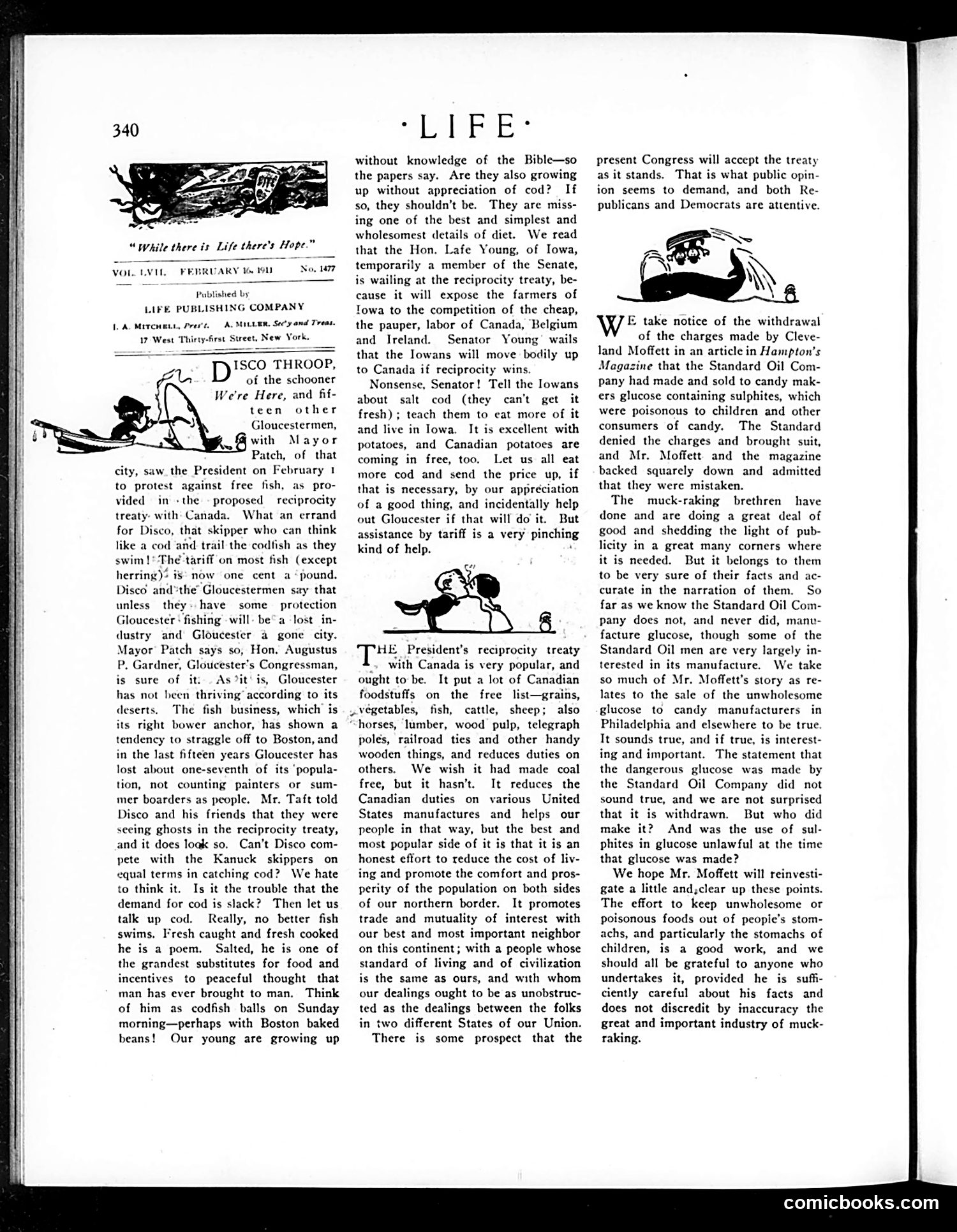
This page contains editorial commentary on the U.S.-Canada reciprocity trade treaty. The cartoons depict figures representing different interests: The left cartoon shows "Disco Throop" (likely a fictional character representing a Gloucester fisherman) complaining about cheap Canadian fish imports threatening the American fishing industry. The right cartoon illustrates a figure struggling with opposing forces, representing the conflicting interests between tariff protection and free trade. The text discusses Senator Lafe Young of Iowa promoting the treaty to benefit farmers, while opposing voices (fishermen, some manufacturers) warn it will harm domestic industries. The editorial expresses concern about whether Congress will accept the treaty given public opinion divisions between Republicans and Democrats on protectionist versus free-trade positions.
📄 Transcribed text from this page (OCR, searchable)
Machine-transcribed from the original scan — historical spelling and the odd misread are preserved.
“While there is Life there's Hope.” VARY 16, 1911 a7 Pablished by LIFE PUBLISHING COMPANY A. MILLER, Sec'y and Treas, 1A. Miron, Presé 17 West Thirty-first eet, New York. ISCO THROOP, of the schooner We're Here, and fif- teen other Gloucestermen, with Mayor Patch, of that city, saw the President on February 1 to protest against free fish, as pro- vided in +the » proposed reciprocity with Canada. What an errand for Disco, that skipper who can think like a cod and trail the codfish as they swim |) ‘The tariff on most fish (except herring) is: now one cent a ‘pound. Disco andthe Gloucestermen say that unless they» have some protection Gloucester‘ fishing will be° a lost in- dustry and Gloucester a gone city. Mayor Patch says so, Hon. Augustus P, Gardner, Gloucester's Congressman, is sure of it: As it’ is, Gloucester has not been thriving’ according to its deserts. The fish business, which’ is its right bower anchor, has shown a tendency to straggle off to Boston, and in the last fifteen years Gloucester has lost about one-seventh of its ‘popula- tion, not counting painters or sum- mer boarders as people. Mr. Taft told Disco and his friends that they were seeing ghosts in the reciprocity treaty, and it does loak so. Can't Disco com- pete with the Kanuck skippers on equal terms in catching cod? We hate to think it. Is it the trouble that the demand for cod is slack? Then let us talk up cod. Really, no better fish swims. Fresh caught and fresh cooked he is a poem. Salted, he is one of the grandest substitutes for food and incentives to peaceful thought that man has ever brought to man. Think of him as codfish balls on Sunday morning—perhaps with Boston baked beans! Our young are growing up lL “*DAIGAE* without knowledge of the Bible—so the papers say. Are they also growing up without appreciation of cod? If so, they shouldn’t be. They are miss- ing one of the best and simplest and wholesomest details of diet. We read that the Hon. Lafe Young, of Iowa, temporarily a member of the Senate, is wailing at the reciprocity treaty, be- cause it will expose the farmers of Towa to the competition of the cheap, the pauper, labor of Canada, ‘Belgium and Ireland. Senator Young’ wails that the Iowans will move bodily up to Canada if reciprocity wins. Nonsense, Senator! Tell the Iowans about salt cod (they can't get it fresh) ; teach them to eat more of it and live in Iowa. It is excellent with potatoes, and Canadian potatoes are coming in free, too. Let us all eat more cod and send the price up, if that is necessary, by our appreciation of a good thing, and incidentally help out Gloucester if that will do it. But assistance by tariff is a very pinchin kind of help. ‘ HEE President’s reciprocity treaty -. with Canada is very popular, and ought to be. It put a lot of Canadian foodstuffs on the free list—grains, »veégetables, fish, cattle, sheep; also “horses, lumber, wood pulp, telegraph poles, railroad ties and other handy wooden things, and reduces duties on others. We wish it had made coal free, but it hasn’t. It reduces the Canadian duties on various United States manufactures and helps our people in that way, but the best and most popular side of it is that it is an honest effort to reduce the cost of liv- ing and promote the comfort and pros- perity of the population on both sides of our northern border. It promotes trade and mutuality of interest with our best and most important neighbor on this continent; with a people whose standard of living and of civilization is the same as ours, and with whom our dealings ought to be as unobstruc- ted as the dealings between the folks in two different States of our Union. There is some prospect that the present Congress will accept the treaty as it stands. That is what public opin- ion seems to demand, and both Re- publicans and Democrats are attentive. W* take notice of the withdrawal of the charges made by Cleve- land Moffett in an article in Hampton's Magazine that the Standard Oil Com- pany had made and sold to candy mak- ers glucose containing sulphites, which were poisonous to children and other consumers of candy. The Standard denied the charges and brought suit, and Mr. Moffett and the magazine backed squarely down and admitted that they were mistaken. The muck-raking brethren have done and are doing a great deal of good and shedding the light of pub- licity in a great many corners where it is needed. But it belongs to them to be very sure of their facts and ac- curate in the narration of them. So far as we know the Standard Oil Com- pany does not, and never did, manv- facture glucose, though some of the Standard Oil men are very largely in- terested in its manufacture. We take so much of Mr. Moffett’s story as re- lates to the sale of the unwholesome glucose to candy manufacturers in Philadelphia and elsewhere to be true. It sounds true, and if true, is interest- ing and important. The statement that the dangerous glucose was made by the Standard Oil Company did not sound true, and we are not surprised that it is withdrawn. But who did make it? And was the use of sul- phites in glucose unlawful at the time that glucose was made? We hope Mr. Moffett will reinvesti- gate a little and,clear up these points. The effort to keep unwholesome or poisonous foods out of people’s stom- achs, and particularly the stomachs of children, is a good work, and we should all be grateful to anyone who undertakes it, provided he is suffi- ciently careful about his facts and does not discredit by inaccuracy the great and important industry of muck- raking. comicbooks.com