
Life, 1911-02-16 · page 14 of 44
Life — February 16, 1911 — page 14: what you’re looking at
What you’re looking at
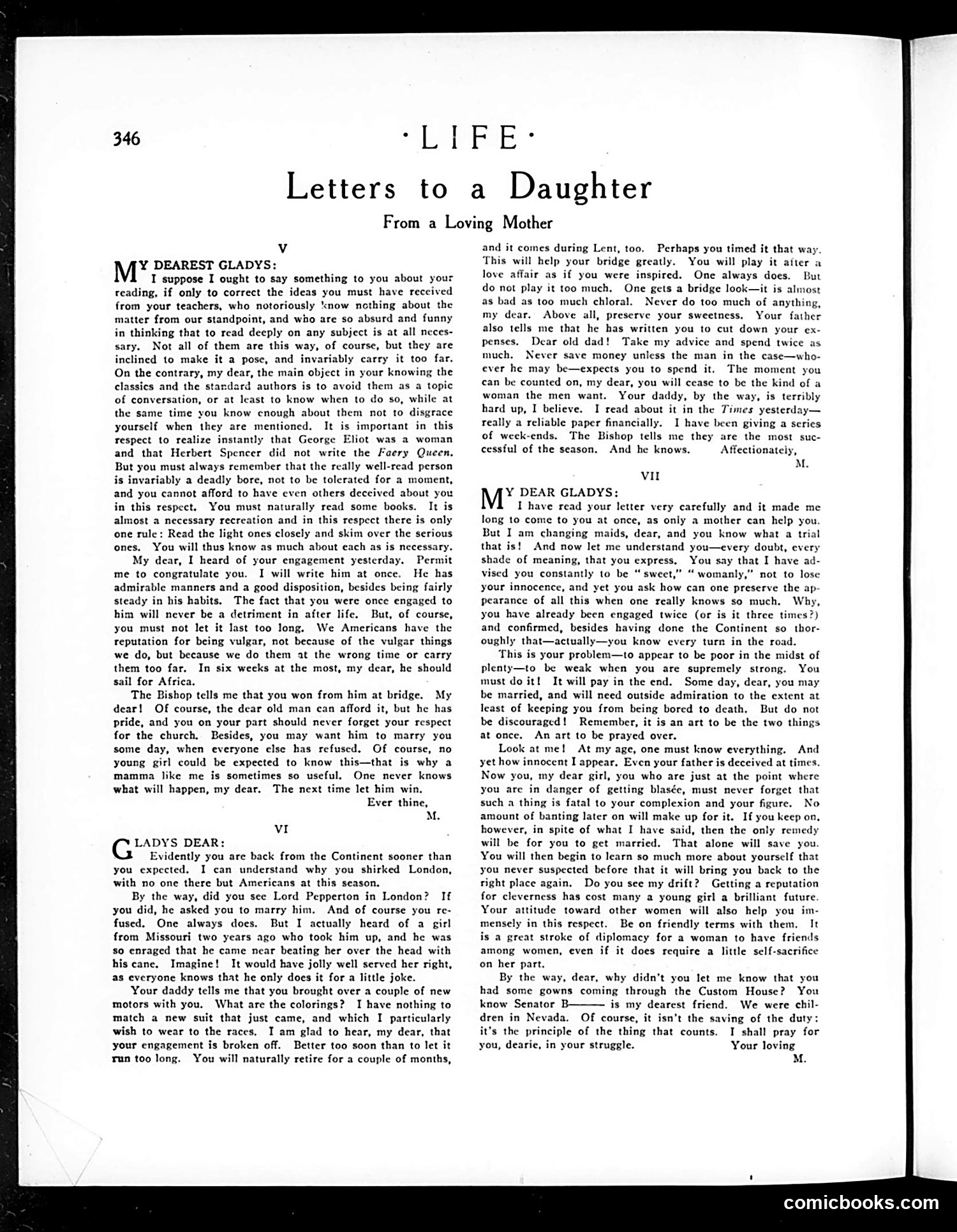
This page contains **satirical advice letters** from a mother to her daughter "Gladys," written in the voice of an upper-class American woman. The satire mocks wealthy society's values and hypocrisy. **Key targets:** - **Women's education**: The mother advises reading classics not to understand them, but to avoid embarrassment in conversation—knowledge as social performance, not genuine learning. - **Marriage as transaction**: Engagements are broken casually; suitors are cultivated for utility (the Bishop might help later); a man can beat a woman "as a joke" if she accepts his proposal. - **Shallow priorities**: Bridge games, motors, racing attire, and social positioning matter more than ethics or genuine relationships. - **Class cynicism**: The mother openly admits manipulation ("a mamma like me is sometimes so useful") and encourages her daughter to exploit others' feelings and finances. The satire works by having the mother state outrageous advice earnestly, exposing the moral emptiness beneath Gilded Age etiquette. It critiques how wealthy women were trained to be decorative, calculating, and morally compromised.
📄 Transcribed text from this page (OCR, searchable)
Machine-transcribed from the original scan — historical spelling and the odd misread are preserved.
“TEMARSE * Letters to a Daughter From a Loving Mother Vv Y DEAREST GLADYS: I suppose I ought to say something to you about your reading, if only to correct the ideas you must have reccived from your teachers, who notoriously know nothing about the matter from our standpoint, and who are so absurd and funny in thinking that to read deeply on any subject is at all neces- sary. Not all of them are this way, of course, but they are inclined to make it a pose, and invariably carry it too far. On the contrary, my dear, the main object in your knowing the classics and the standard authors is to avoid them as a topic of conversation, or at least to know when to do so, while at the same time you know enough about them not to disgrace yourself when they are mentioned. It is important in this respect to realize instantly that George Eliot was a woman and that Herbert Spencer did not write the Faery Queen, But you must always remember that the really well-read person is invariably a deadly bore, not to be tolerated for a moment, and you cannot afford to have even others deceived about you in this respect. You must naturally read some books. It is almost a necessary recreation and in this respect there is only one rule: Read the light ones closely and skim over the serious ones. You will thus know as much about cach as is necessary. My dear, I heard of your engagement yesterday. Permit me to congratulate you. I will write him at once. He has admirable manners and a good disposition, besides being fairly steady in his habits. The fact that you were once engaged to him will never be a detriment in after life. But, of course, you must not let it last too long. We Americans have the reputation for being vulgar, not because of the vulgar things we do, but because we do them at the wrong time or carry them too far. In six weeks at the most, my dear, he should sail for Africa. The Bishop tells me that you won from him at bridge. My dear! Of course, the dear old man can afford it, but he has pride, and you on your part should never forget your respect for the church, Besides, you may want him to marry you some day, when everyone else has refused. Of course, no young girl could be expected to know this—that is why a mamma like me is sometimes so useful, One never knows what will happen, my dear. The next time let him win. Ever thine, M. VI LADYS DEAR: Evidently you are back from the Continent sooner than you expected. I can understand why you shirked London, with no one there but Americans at this season. By the way, did you see Lord Pepperton in London? If you did, he asked you to marry him. And of course you re- fused. One always does. But I actually heard of a girl from Missouri two years ago who took him up, and he was so enraged that he came near beating her over the head with his cane, Imagine! It would have jolly well served her right, as everyone knows that he only does it for a little joke. Your daddy tells me that you brought over a couple of new motors with you. What are the colorings? I have nothing to match a new suit that just came, and which I particularly wish to wear to the races, I am glad to hear, my dear, that your engagement is broken off. Better too soon than to let it run too long. You will naturally retire for a couple of months, and it comes during Lent, too. Perhaps you timed it that way. This will help your bridge greatly. You will play it after a love affair as if you were inspired. One always does. But do not play it too much, One gets a bridge look—it is almost as bad as too much chloral. Never do too much of anything, my dear. Above all, preserve your sweetness. Your father also tells me that he has written you to cut down your ex- penses. Dear old dad! Take my advice and spend twice as much, Never save money unless the man in the case—who- ever he may be—expects you to spend it. The moment you can be counted on, my dear, you will cease to be the kind of a woman the men want. Your daddy, by the way, is terribly hard up, I believe. I read about it in the Times yesterday— really a reliable paper financially, I have been giving a series of week-ends. The Bishop tells me they are the most suc- cessful of the season, And he knows. —— Affectionatel VIL Y DEAR GLADYS: I have read your letter very carefully and it made me long to come to you at once, as only a mother can help you. But I am changing maids, dear, and you know what a trial that is! And now let me understand you—every doubt, ever shade of meaning, that you express, You say that I have ad- vised you constantly to be “sweet,” “ womanly,” not to lose your innocence, and yet you ask how can one preserve the ap- pearance of all this when one really knows so much. W! you have already been engaged twice (or is it three times?) and confirmed, besides having done the Continent so thor- oughly that—actually—you know every turn in the road. This is your problem—to appcar to be poor in the midst of plenty—to be weak when you are supremely strong. You must do it! It will pay in the end. Some day, dear, you may be married, and will need outside admiration to the extent at least of keeping you from being bored to death, But do not be discouraged! Remember, it is an art to be the two things at once. An art to be prayed over, Look at me! At my age, one must know everything. And yet how innocent I appear. Even your father is deceived at times. Now you, my dear girl, you who are just at the point where you are in danger of getting blasée, must never forget that such a thing is fatal to your complexion and your figure. No amount of banting later on will make up for it. If you keep on, however, in spite of what I have said, then the only remedy will be for you to get married. That alone will save you. You will then begin to learn so much more about yourself that you never suspected before that it will bring you back to the right place again. Do you see my drift? Getting a reputation for cleverness has cost many a young girl a brilliant future. Your attitude toward other women will also help you im- mensely in this respect. Be on friendly terms with them. It is a great stroke of diplomacy for a woman to have friends among women, even if it does require a little self-sacrifice on her part. By the way, dear, why didn’t you let me know that you had some gowns coming through the Custom House? You know Senator B——— is my dearest friend. We were chil- dren in Nevada. Of course, it isn’t the saving of the duty: it’s the principle of the thing that counts. I shall pray for you, dearie, in your struggle. Your loving M. comicbooks.com