
Life, 1911-02-16 · page 20 of 44
Life — February 16, 1911 — page 20: what you’re looking at
What you’re looking at
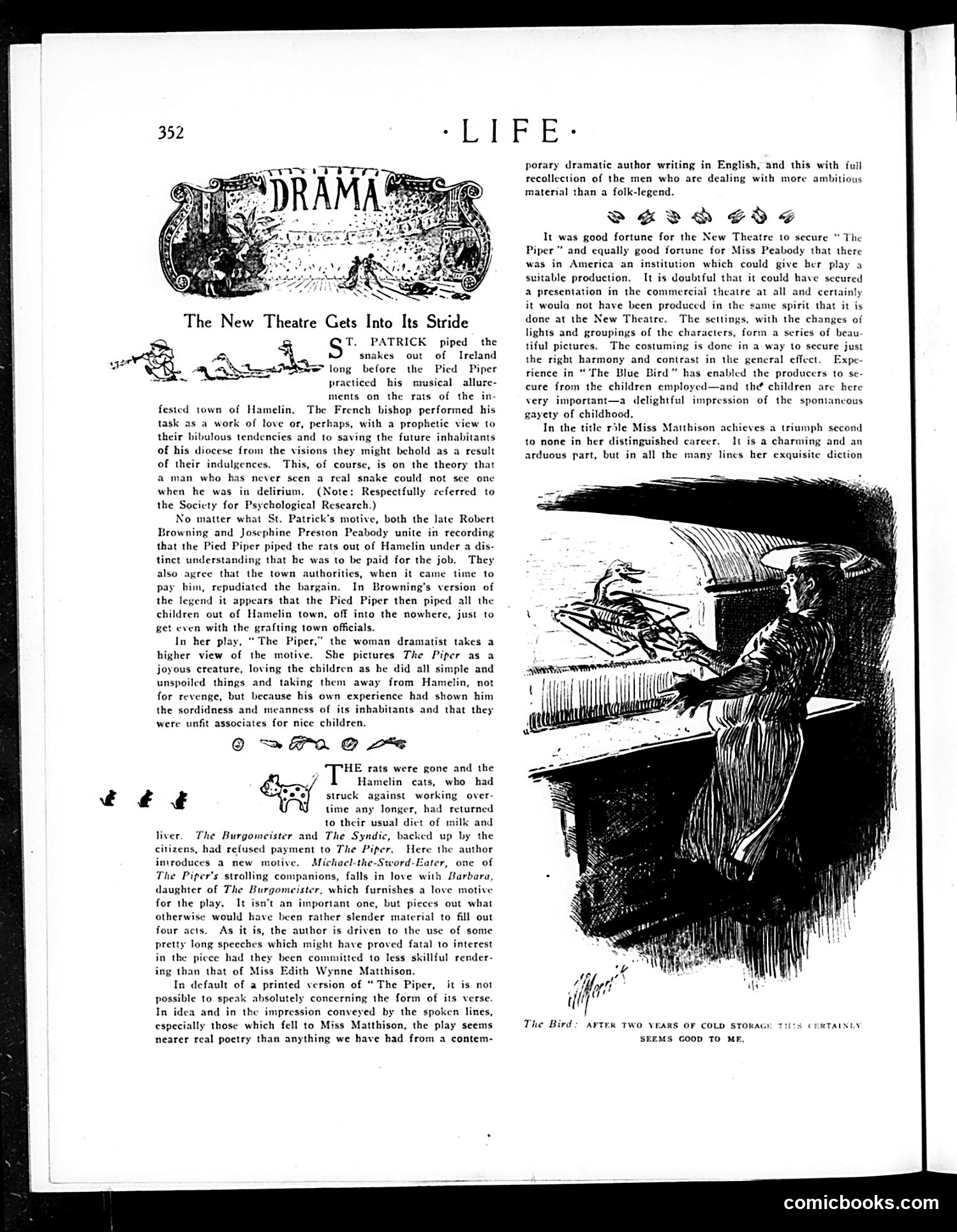
This page discusses Josephine Preston Peabody's play *"The Piper"* at the New Theatre. The article compares Peabody's dramatic interpretation of the Pied Piper legend to Robert Browning's famous poem. The key distinction: Browning portrayed the Piper as vengeful—stealing children because the town officials cheated him. Peabody's version presents him more sympathetically as someone who genuinely loves children and removes them from Hamelin's corrupt, sordid society. The article praises this morally elevated interpretation. The illustration shows a figure (likely the Piper) in medieval dress. The text also notes that Peabody adds a romantic subplot involving the Piper's companion falling for the Burgomeister's daughter—a plot device the reviewer considers somewhat artificial but necessary to fill out the four acts. Overall, the review praises the New Theatre's production values and actress Edith Wynne Matthison's performance.
📄 Transcribed text from this page (OCR, searchable)
Machine-transcribed from the original scan — historical spelling and the odd misread are preserved.
LPP « ee a or a porary dramatic author writing in English, and this with full recollection of the men who are dealing with more ambitious DR AMA. 3 »& maternal than a folk-legend. STE SEZBRHEIE trae It was good fortune for the New Theatre to secure * The Piper” and equally good fortune for Miss Peabody that there was in America an institution which could give her play a suitable production. It is doubtful that it could have sccured a presentation in the commercial theatre at all and certainly it woula not have been produced in the same spirit that it is The New Theatre Gets Into Its Stride done at the New Theatre. The settings, with the changes of lights and groupings of the characters, form a series of beau Ss" PATRICK piped the tiful pictures. The costuming is done in a way to secure just BY snakes out of Ireland the right harmony and contrast in the gencral effect. Expe- MA ANH long before the Pied Piper rience in “‘The Blue Bird” has enabled the producers to si =— practiced his musical allure- cure from the children employed—and thé children are here . ments on the rats of the in- Very jmportant—a delightful impression of the spontancous fested town of Hamelin, The French bishop performed his gayety of childhood. task as a work of love or, perhaps, with a prophetic view to In the title rile Miss Mathison achieves a triumph second their bibulous tendencies and to saving the future inhabitants to none in her distinguished career. It is a charming and an of his diocese from the visions they might behold as a result arduous part, but in all the many lines her exquisite diction of their indulgences. This, of course, is on the theory that a man who has never seen a real snake could not sce one when he was in delirium. (Note: Respectfully referred to the Society for Psychological Research.) No matter what St. Patrick's motive, both the late Robert Browning and Joscphine Preston Peabody unite in recording that the Pied Piper piped the rats out of Hamelin under a dis- tinct understanding that he was to be paid for the job. They also agree that the town authorities, when it came time to pay him, repudiated the bargain. In Browning’s version of the legend it appears that the Pied Piper then piped all the children out of Hamelin town, off into the nowhere, just to get even with the grafting town officials. In her play, “The Piper,” the woman dramatist takes a higher view of the motive. She pictures The Piper as a joyous creature, loving the children as he did all simple and unspoiled things and taking them away from Hamelin, not for revenge, but because his own experience had shown him the sordidness and meanness of its inhabitants and that they were unfit associates for nice children. 0 =F. OO 2e HE rats were gone and the Hamelin cats, who had é € R J SH8e%ef struck against working over time any longer, had returned to their usual dict of milk and liver. The Burgomeister and The Syndic, backed up by the citizens, had refused payment to The Piper. Here the author imroduces a new motive, Michacl-the-Steord-Eater, one of The Piper's strolling companions, falls in love with Barbara, daughter of The Burgomeister, which furnishes a love motive for the play. It isn't an important one, but pieces out what otherwise would have been rather slender material to fill out four acts. As it is, the author is driven to the use of some pretty long speeches which might have proved fatal to interest in the picce had they been committed to less skillful render- ing than that of Miss Edith Wynne Matthison. In default of a printed version of “ The Piper, it is not possible to speak absolutely concerning the form of its verse In idea and in the impression conveyed by the spoken lines, especially those which fell to Miss Matthison, the play seems The Bird: A¥tex TWO YEARS OF COLD STORAGY: THIS CF nearer real poetry than anything we have had from a contem- MS GOOD TO ME. wer comicbooks.com