
A complete issue · 44 pages · 1910
Life — August 4, 1910
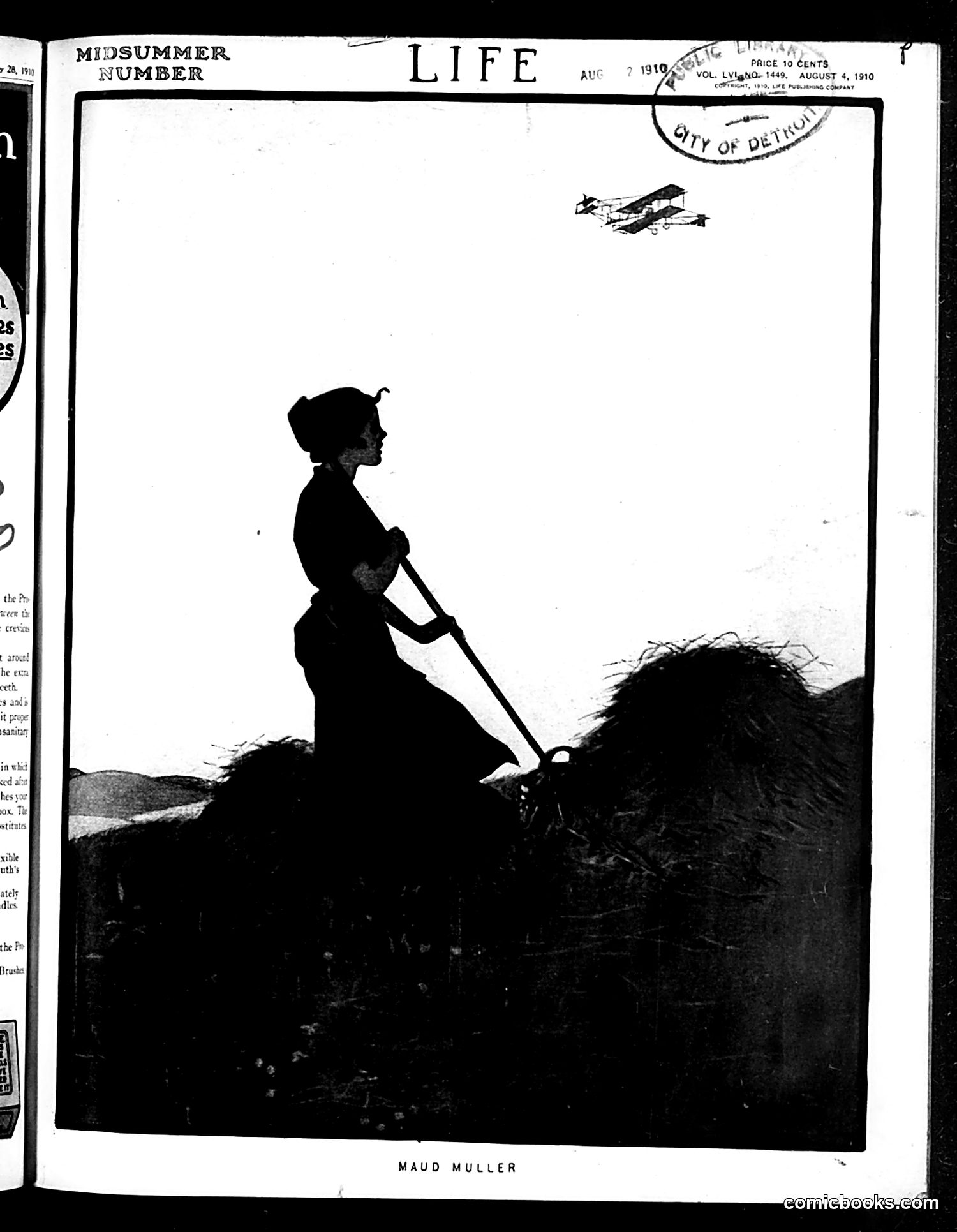
This is the cover of *Life* magazine's "Midsummer Number" from August 4, 1910. The image shows a silhouetted figure labeled "Maud Muller" standing on a hillside, holding a rake, gazing upward at an early airplane flying overhead. The reference is to John Greenleaf Whittier's 1856 poem "Maud Muller," about a farm girl who dreams of a different life while doing rural labor. By placing Whittier's character beneath a modern airplane, the magazine satirizes the gap between rural aspirations and contemporary technological progress. The silhouette style emphasizes her daydreaming nature. This is social commentary on rural life versus modernity during the early aviation era, suggesting that even traditional pastoral figures must now contend with—or dream of—the modern world transforming around them.
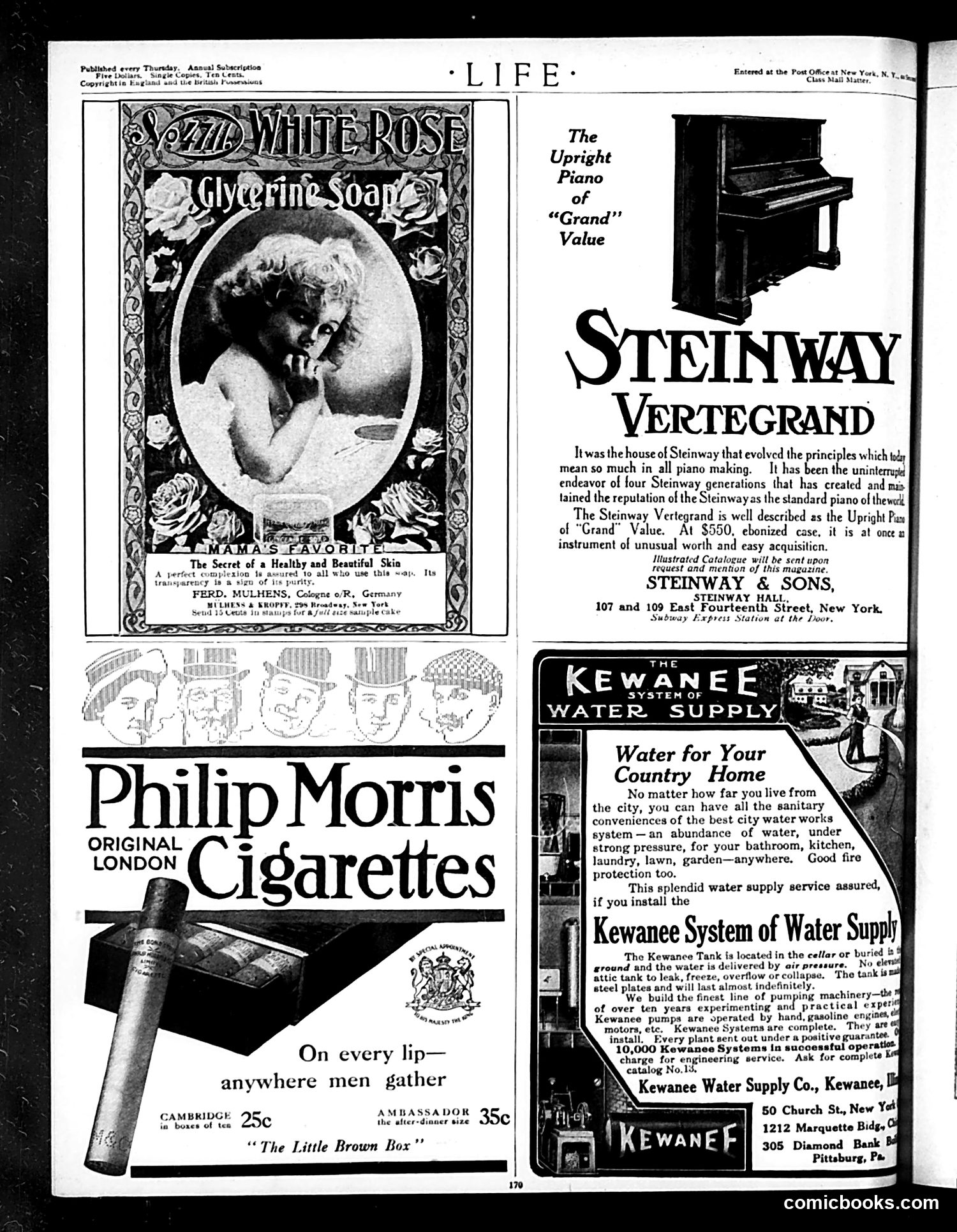
This page contains **advertisements rather than satirical cartoons**. The content includes: 1. **White Rose Glycerine Soap** ad featuring a classical cherub/baby image with decorative rose borders—typical early 20th-century beauty product marketing emphasizing "healthy and beautiful skin." 2. **Philip Morris Cigarettes** ad with five illustrated male faces and the tagline "On every lip—anywhere men gather." This reflects period advertising that normalized smoking and associated cigarettes with masculine social gathering. 3. **Steinway Piano** and **Kewanee Water Supply System** ads promoting luxury goods and home utilities. The page represents early 20th-century consumer culture advertising rather than political satire. The cigarette ad is notable today for its brazen health claims and gender-targeted marketing that would be prohibited in modern advertising.
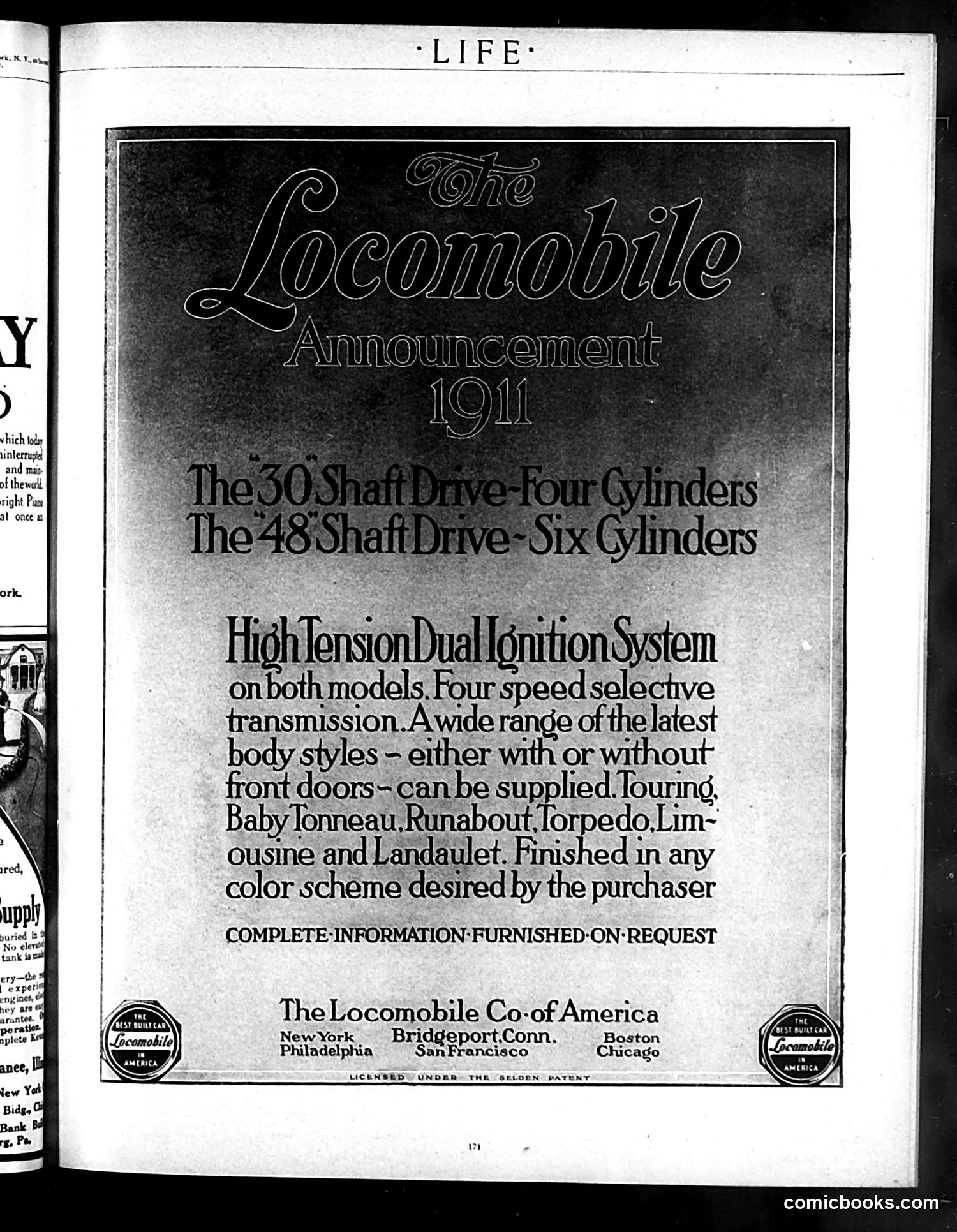
This page is primarily **advertising, not satire or editorial content**. It's a 1911 Locomobile automobile announcement from *Life* magazine. The ad promotes two Locomobile models: a 50-horsepower four-cylinder and a 48-horsepower six-cylinder vehicle. Key features highlighted include a high-tension dual ignition system, four-speed transmission, and various body styles (touring car, Baby Tonneau, Runabout, Torpedo, Limousine, and Landaulet). The advertisement includes the Locomobile Company of America's locations: New York, Philadelphia, Bridgeport Connecticut, San Francisco, Boston, and Chicago. The ad notes it's "licensed under the Selden patent"—a reference to a significant early automotive patent dispute. There is no political or social satire present on this page.
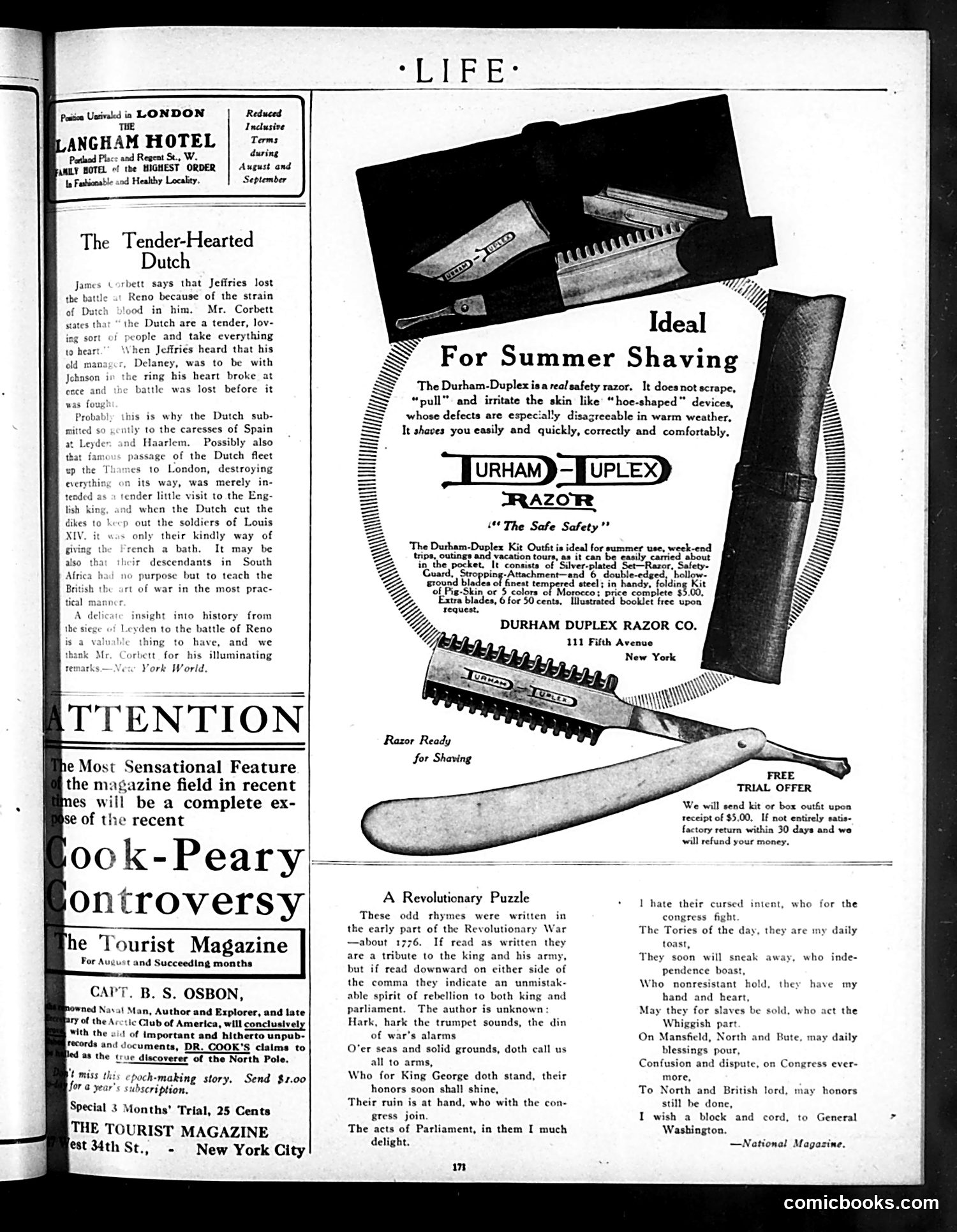
This page is primarily **advertising**, not political satire. The dominant content is a full-page ad for the Durham-Duplex Razor, marketed as "ideal for summer shaving." The ad emphasizes the razor's safety features and ease of use, contrasting it favorably with other designs. The left column contains a brief article titled "The Tender-Hearted Dutch," discussing historical naval conflicts and Dutch character, but this appears unrelated to any cartoon or satire. Below that are advertisements for *The Tourist Magazine* and the "Cook-Peary Controversy" — likely referencing a historical dispute, though the specific context isn't fully clear from this excerpt. The page contains **no political cartoons or satirical imagery** of note. It's a typical early 20th-century magazine page mixing editorial content with commercial advertisements.
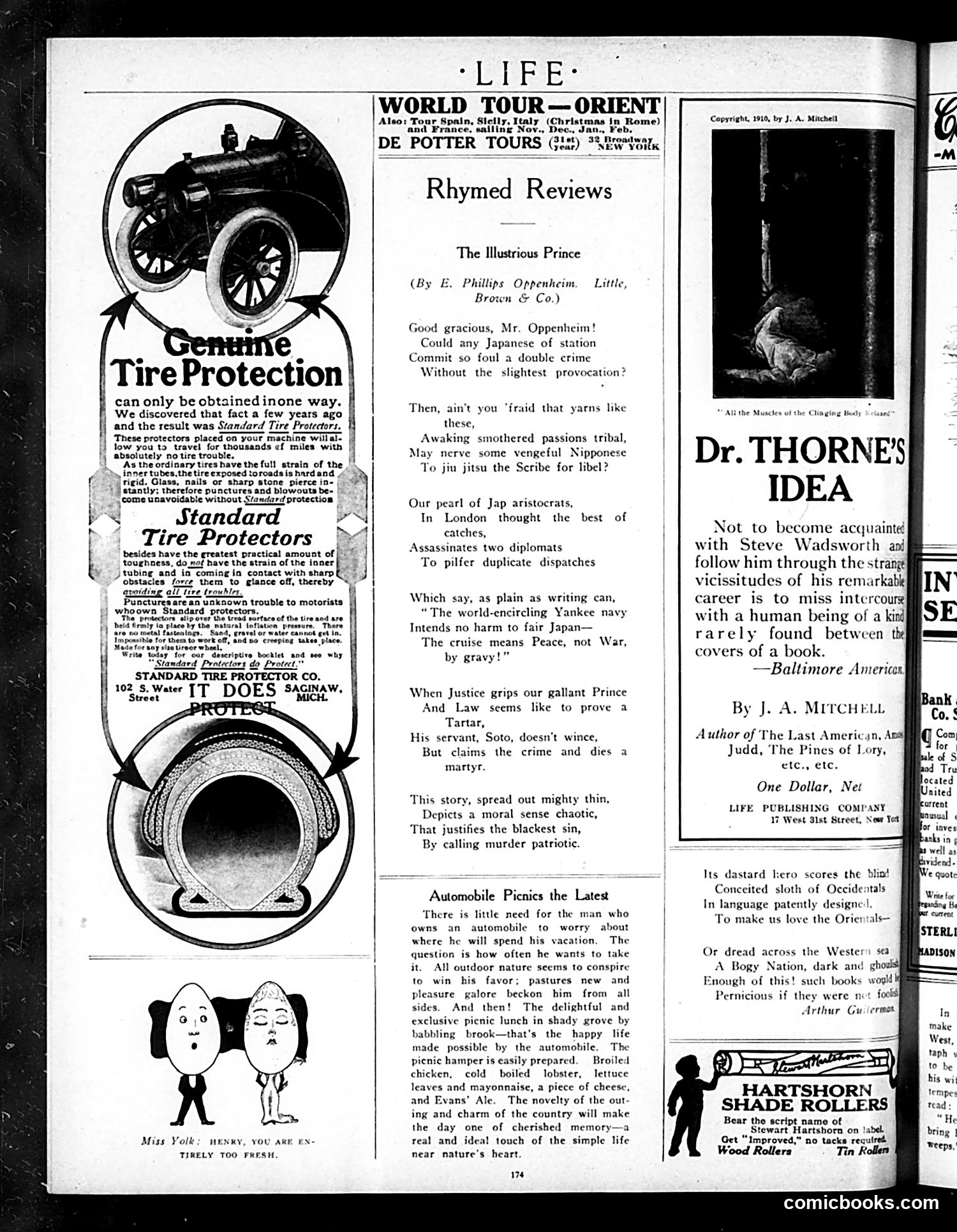
This page is primarily **advertising and literary reviews** rather than political satire. The left side features a **Standard Tire Protectors advertisement** showing an early automobile with emphasized wheels and tires—a product pitch highlighting durability against road hazards. The center contains **"Rhymed Reviews,"** critiquing E. Phillips Oppenheim's novel *The Illustrious Prince*. The verse satirizes the plot as thin melodrama about Japanese station agents, diplomats, and murder presented as patriotic—mocking the book's contrived international intrigue and moral posturing. The right side advertises **J.A. Mitchell's *Dr. Thorne's Idea***, apparently about avoiding romantic entanglement with a protagonist named Steve Wadsworth. Bottom includes a small cartoon of two stylized faces labeled "Miss Volk: Henry, you are entirely too fresh"—likely social commentary on flirtation etiquette, unrelated to politics.
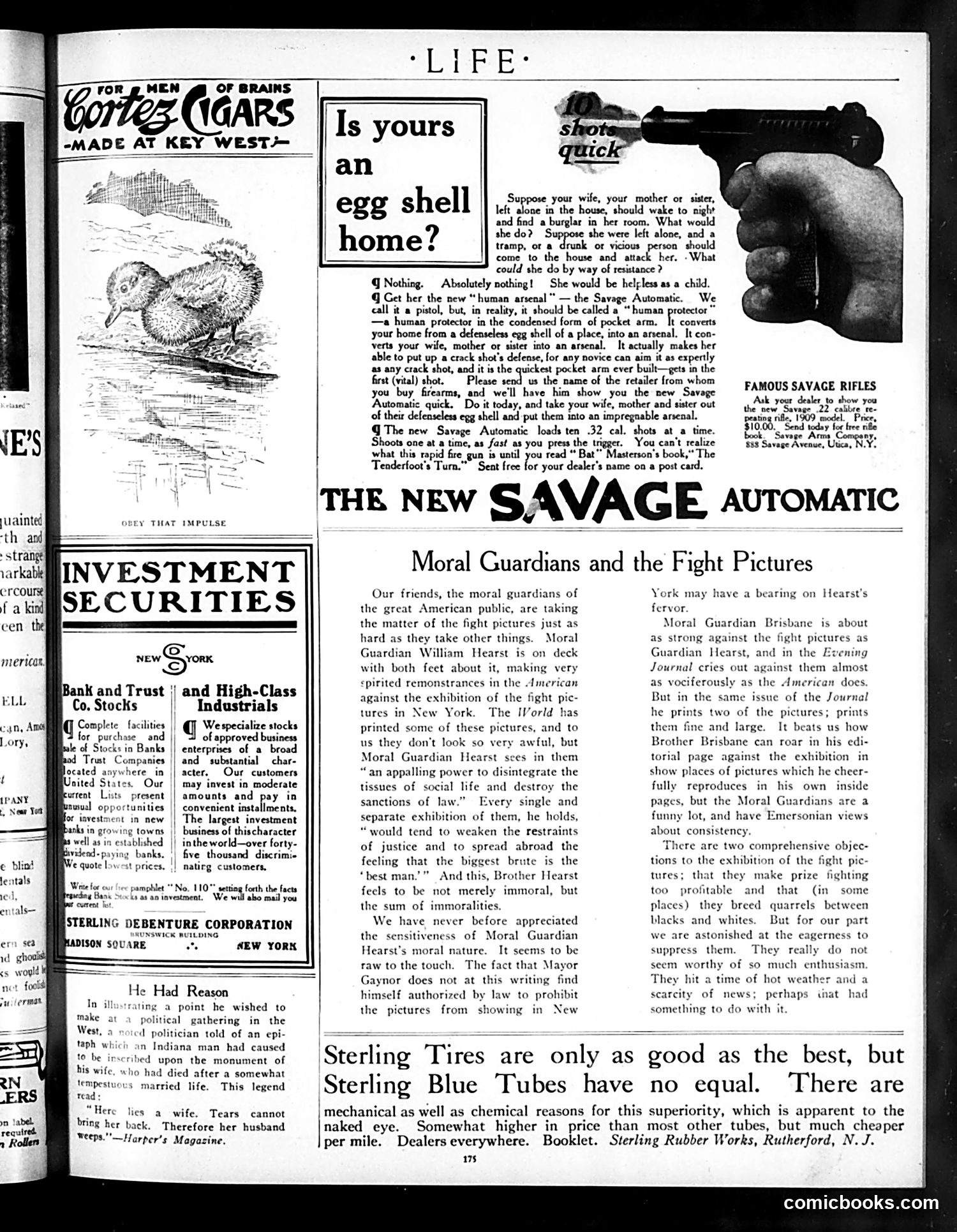
This page is primarily **advertising and editorial content** rather than political satire. The main elements are: 1. **Savage Automatic rifle advertisement** - promoting a self-defense weapon for home protection, with text suggesting it's for protecting wives, mothers, and sisters from home invasion or assault. 2. **"Moral Guardians and the Fight Pictures"** - an editorial discussing Moral Guardian William Hearst's opposition to fight picture exhibitions in New York, debating censorship and public morality. 3. **Investment and tire advertisements** - standard commercial messaging. The Hearst editorial represents early 20th-century debates over **censorship, morality, and what entertainment the public should access**—reflecting tensions between moral reformers and commercial interests that characterized the Progressive Era.
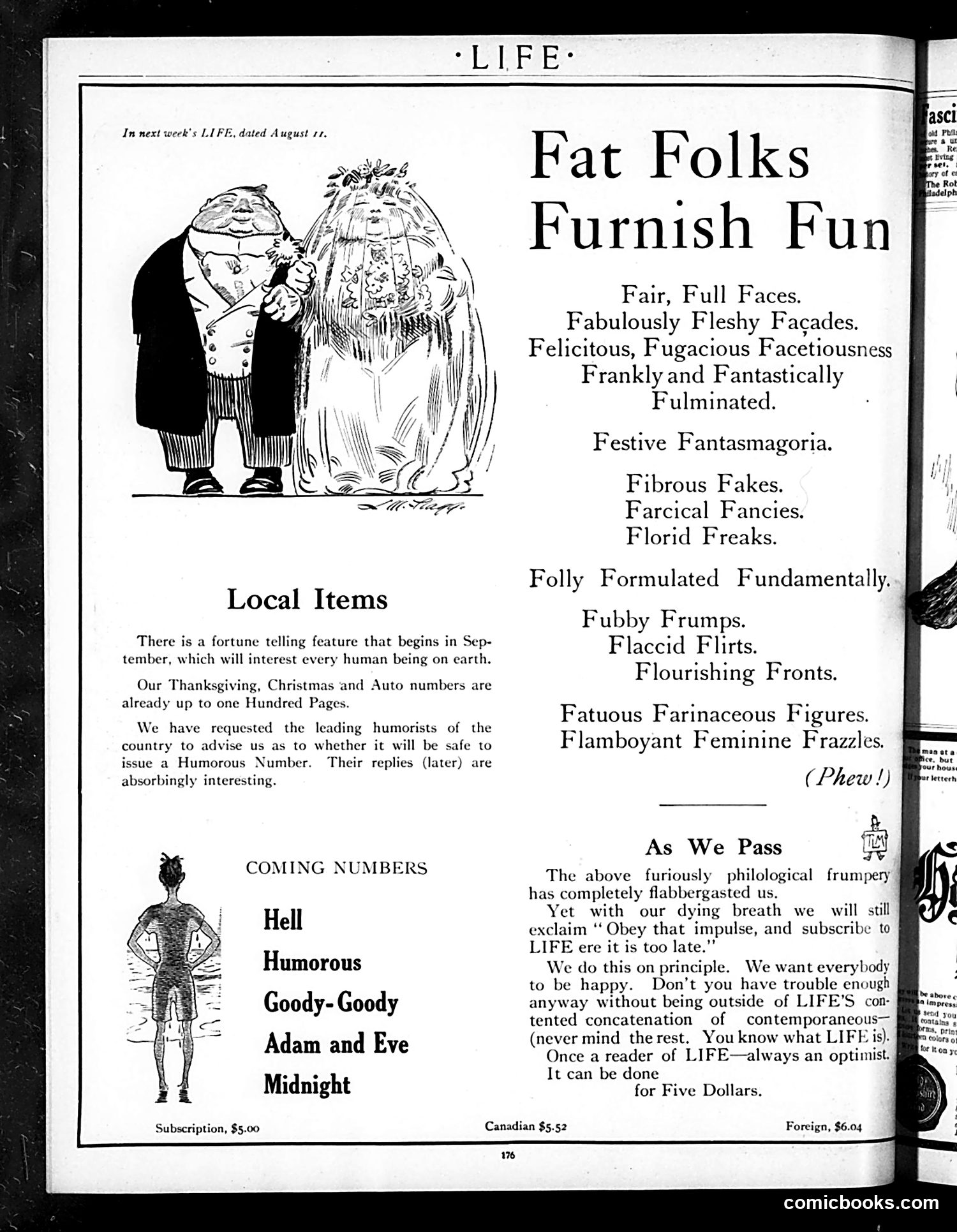
This satirical piece mocks overweight people through exaggerated physical descriptions using alliteration ("Fabulously Fleshy Façades," "Flaccid Flirts," "Fubby Frumps"). The accompanying cartoon shows two rotund figures in formal dress, presented as objects of ridicule and entertainment. The humor relies on body-shaming—treating obesity as inherently comedic and worthy of mockery. The "Local Items" section announces upcoming humorous issues of *Life* magazine, suggesting this content represented mainstream entertainment of the era. By modern standards, this represents crude, cruel satire targeting physical appearance. The piece treats fat people as spectacles for public amusement rather than as individuals, reflecting early-20th-century attitudes that made such mockery culturally acceptable in satirical publications.
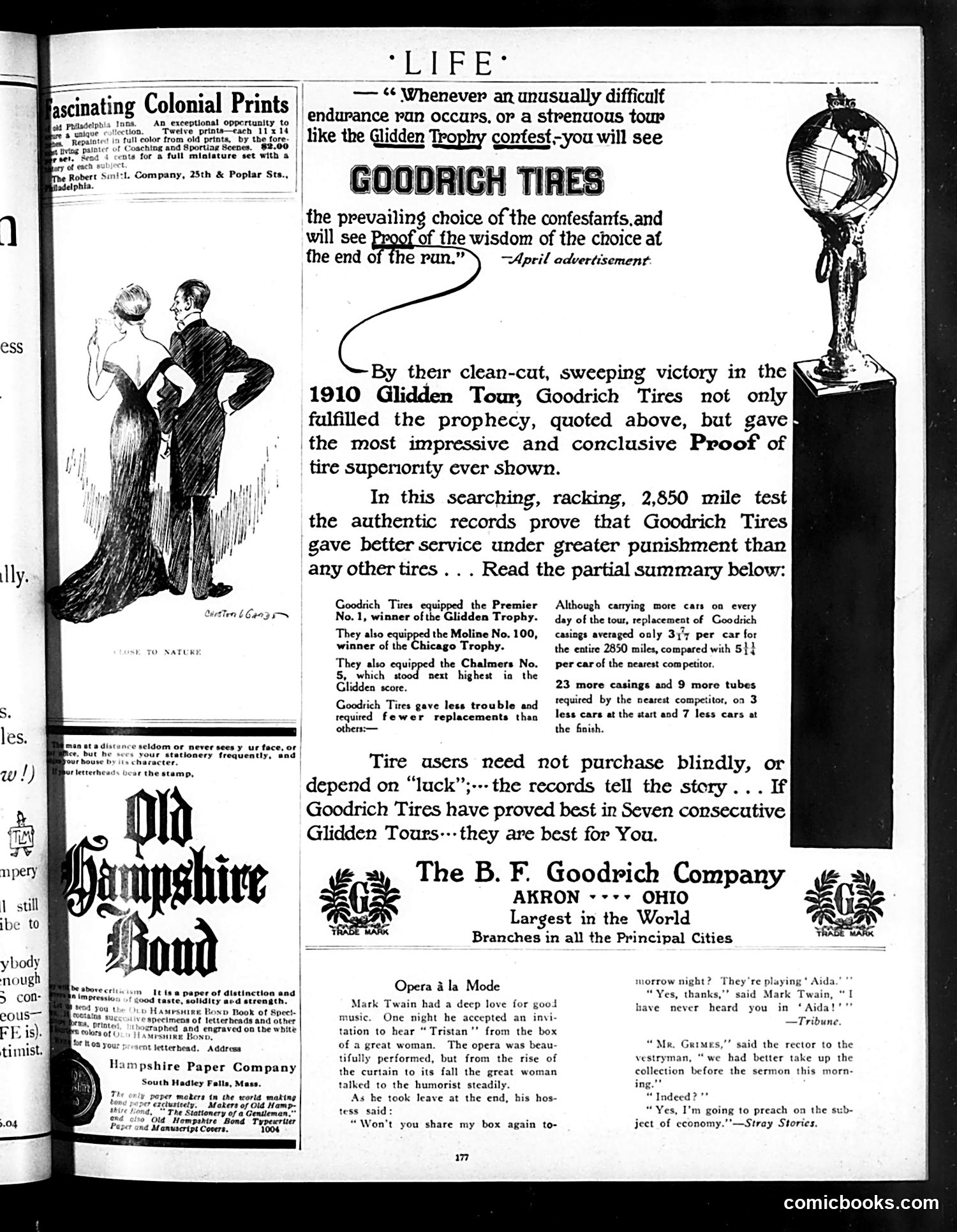
This page is primarily **advertising**, not satirical content. The dominant feature is a Goodrich Tires advertisement celebrating their victory in the 1910 Glidden Trophy automotive endurance contest. The ad uses the trophy image and includes testimonial-style text claiming Goodrich tires outperformed competitors across a 2,850-mile test. The left side contains unrelated advertisements for Colonial Prints and Hampshire Bond paper. At the bottom, there's a brief humor piece titled "Opera à la Mode" about a man invited to the opera by a woman, ending with a joke about economics. The page layout and content reflect Life magazine's typical mix of advertising revenue and light entertainment rather than political satire.
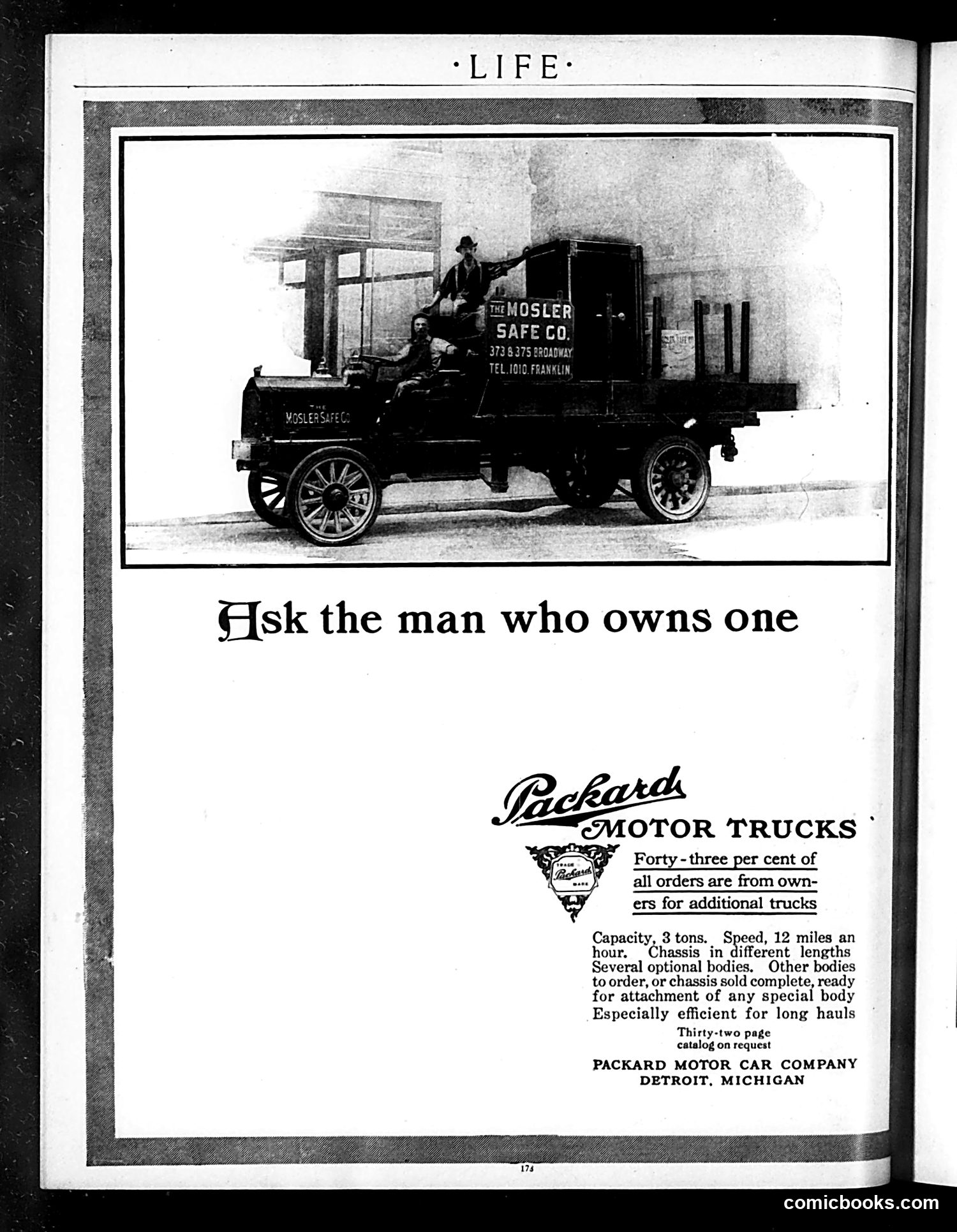
This is a **Packard Motor Trucks advertisement**, not a satirical cartoon. The page shows a photograph of an early motorized delivery truck operated by the Mosler Safe Company, with two men on the vehicle. The ad's appeal—"Ask the man who owns one"—was a common marketing strategy of the early automotive era, relying on word-of-mouth endorsement from satisfied customers. The specific detail that "forty-three per cent of all orders are from owners for additional trucks" attempts to demonstrate the vehicle's reliability and business value through repeat purchases. The truck itself advertised 3-ton capacity and 12 miles-per-hour speed, marketed as "especially efficient for long hauls." This reflects the early 1900s transition from horse-drawn to motorized commercial transport—a significant technological shift for American business.
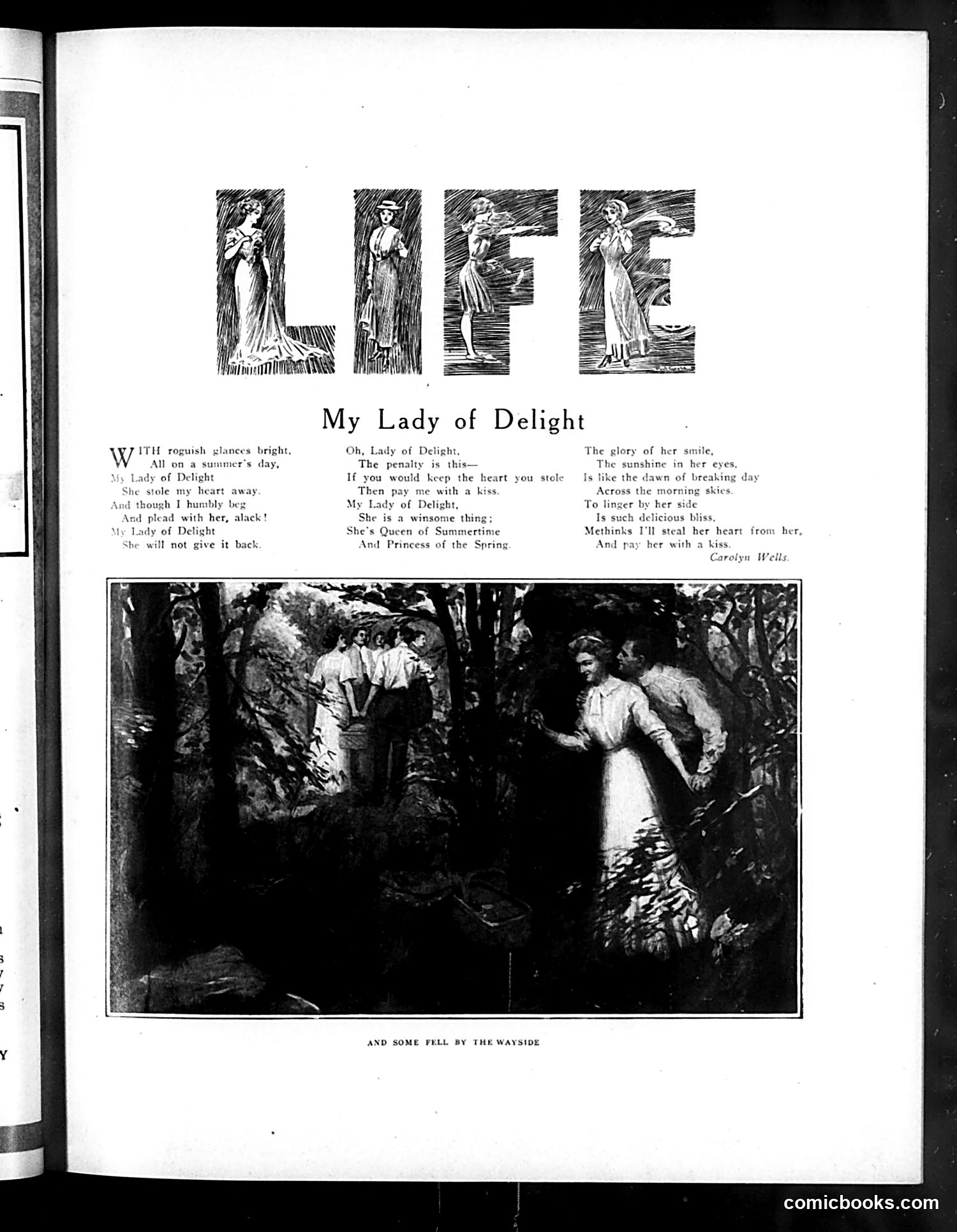
This page features a romantic poem by Carolyn Wells titled "My Lady of Delight," accompanied by decorative illustrated letters spelling "LIFE" and a woodland scene illustration captioned "AND SOME FELL BY THE WAYSIDE." The content is **not political satire**. Rather, it's a sentimental literary piece celebrating an idealized woman—described as a "Queen of Summertime / And Princess of the Spring." The poem expresses romantic devotion, with the speaker willing to sacrifice his heart for her affection. The illustration depicts figures in a forest setting, suggesting a pastoral or romantic encounter. This appears to be a **regular literary/artistic feature** in Life magazine, reflecting early 20th-century popular culture's embrace of romantic idealization rather than satirical commentary.
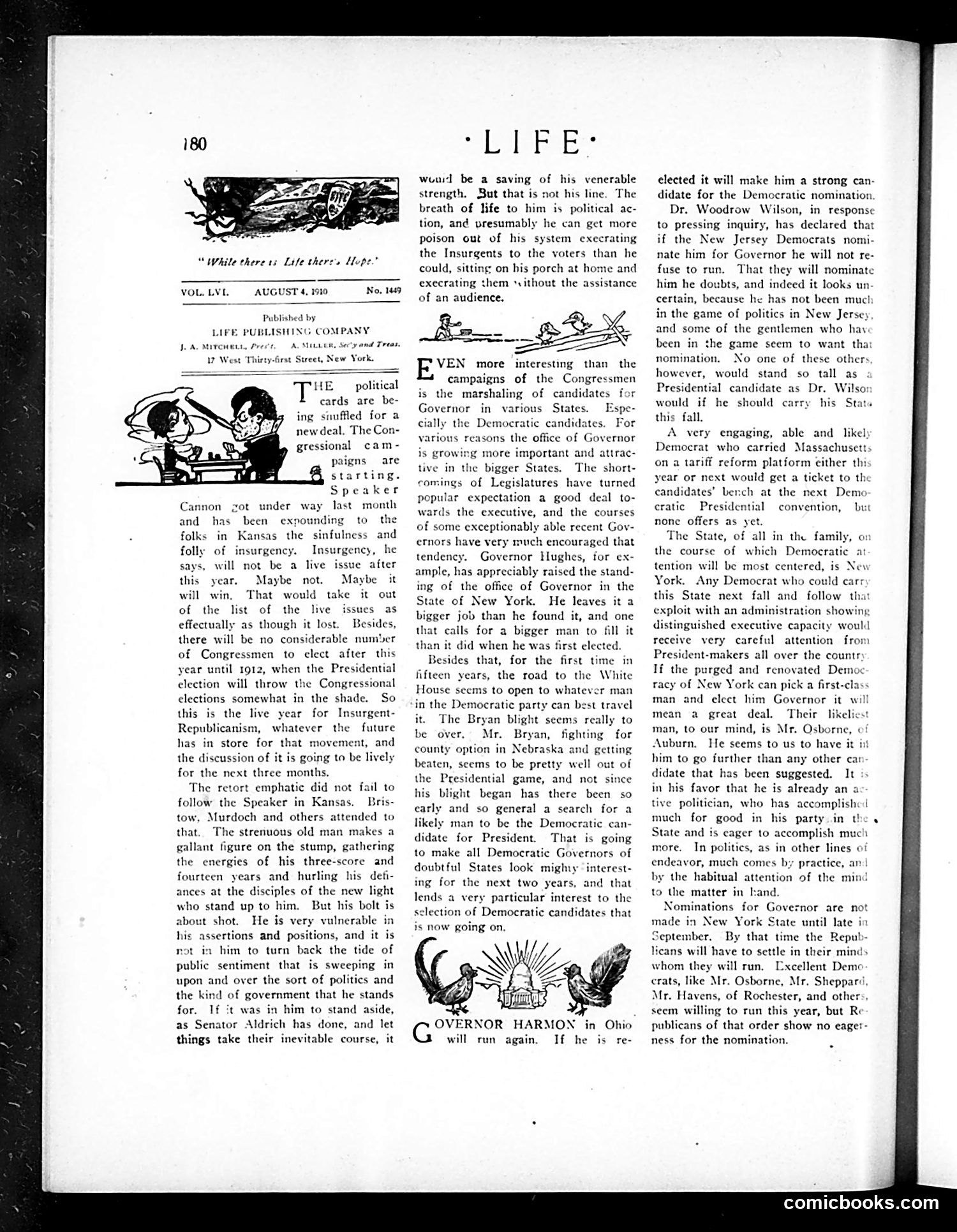
This page contains political commentary on the 1910 congressional elections and upcoming gubernatorial races. The main cartoon shows two figures with exaggerated facial features labeled as political "cards" being shuffled—a visual metaphor for candidates being maneuvered in electoral campaigns. The text discusses Democratic and Republican competition for governorships, particularly mentioning William Jennings Bryan's continued influence in Democratic politics and debates over potential presidential candidates. It references specific states like Nebraska, Ohio, New York, and Massachusetts. The satire critiques the mechanical nature of politics—how candidates are treated as interchangeable pieces rather than genuine leaders—and questions whether established politicians like Bryan will dominate the party's future direction.
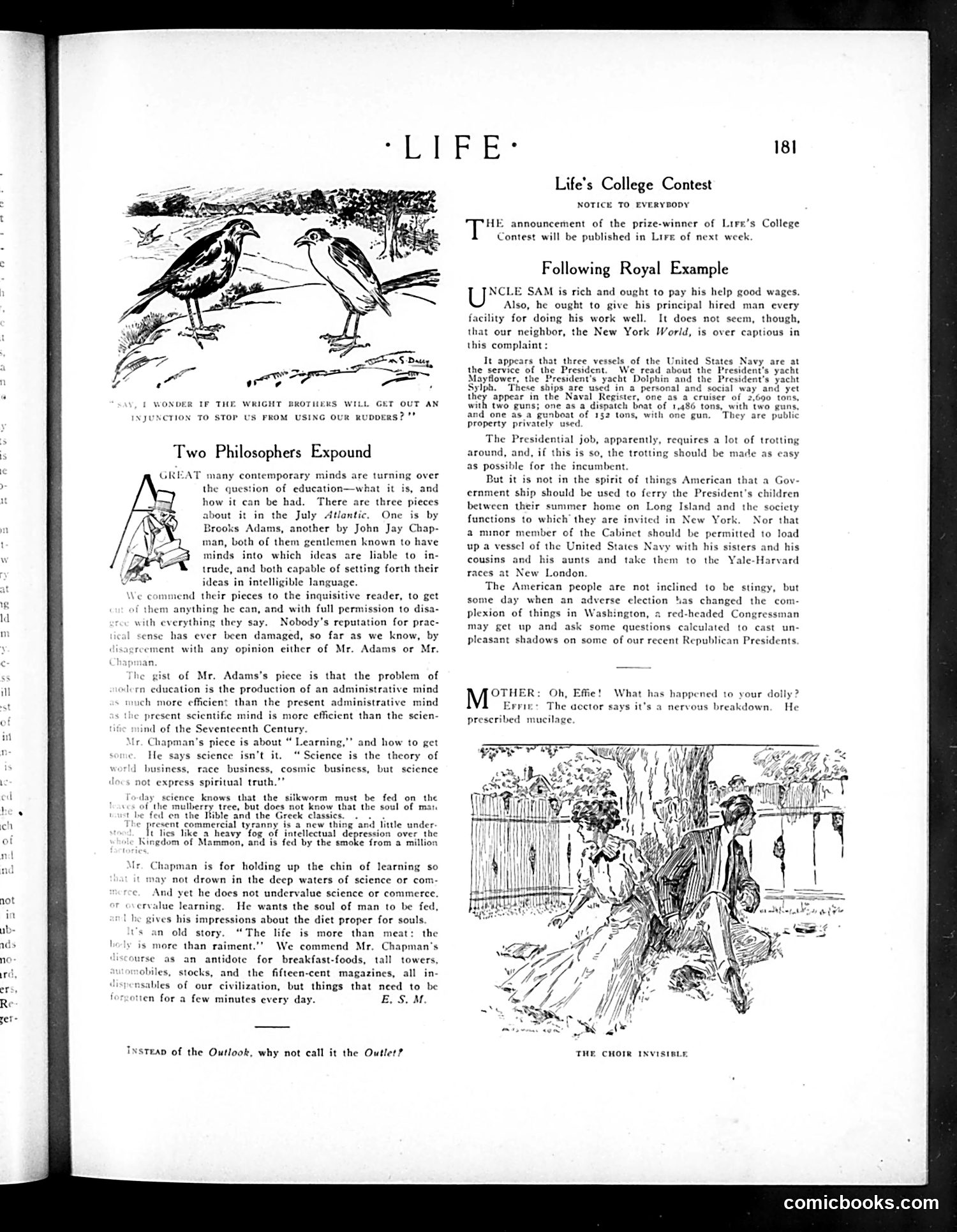
This page contains two unrelated satirical pieces: **"Two Philosophers Expound"** critiques educational philosophy by contrasting two contemporary thinkers—identified as Adams and Chapman—debating whether modern education produces efficient minds. The piece mocks both positions through extended metaphors about feeding souls and learning. **"Life's College Contest"** uses a fictional letter from "Uncle Sam" complaining that a government yacht (the USS Dolphin) was improperly used to transport a Cabinet member's children to social functions. The satire targets perceived government waste and nepotism, suggesting that public property shouldn't serve private interests. The accompanying illustrations show two birds in philosophical debate and a domestic scene labeled "The Choir Invisible." The page represents Life's typical approach: using humor to critique contemporary American politics, education, and government practices.
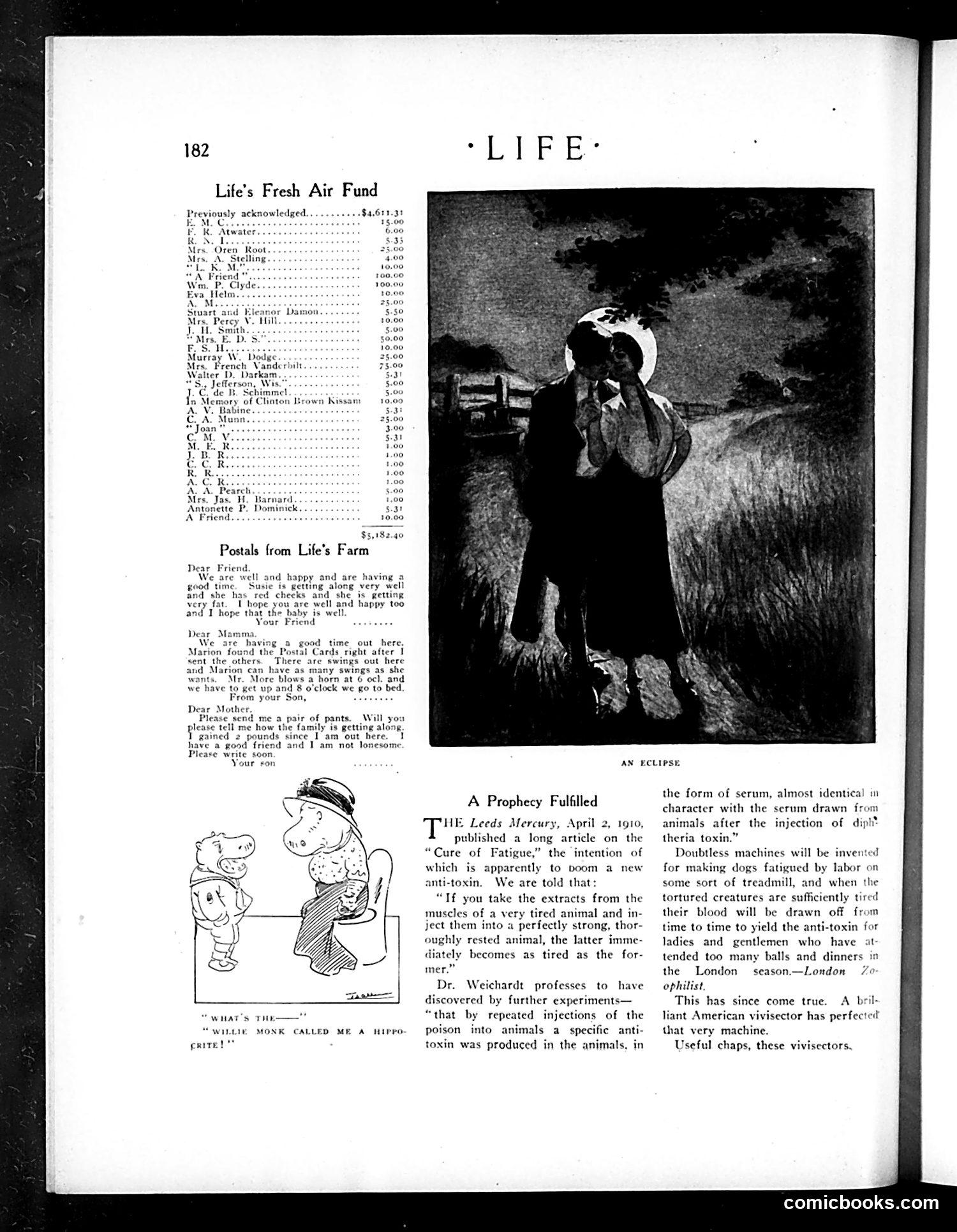
This page contains three distinct elements: **Life's Fresh Air Fund** (top left): A charitable donation list supporting a program that sent urban children to farms for health and rest. The postcards below show letters from children benefiting from the program, describing improved health (gaining weight, developing "red cheeks") and happiness away from city life. **Political Cartoon** (bottom left): A small cartoon captioned "What's the—'Willis Monk called me a hippo-crite!'" This appears to be wordplay on "hippocrite" (combining hippo with hypocrite), likely satirizing someone named Willis Monk, though the specific reference is unclear without additional context. **"A Prophecy Fulfilled"** (right column): An article mocking a 1910 scientific claim that injecting extracts from exhausted animals into rested ones would transfer fatigue. The writer sarcastically suggests this could be weaponized to create machines extracting anti-fatigue serum from tortured dogs—for wealthy socialites attending too many balls. It's satirizing both pseudoscientific vivisection and the idle leisure class.
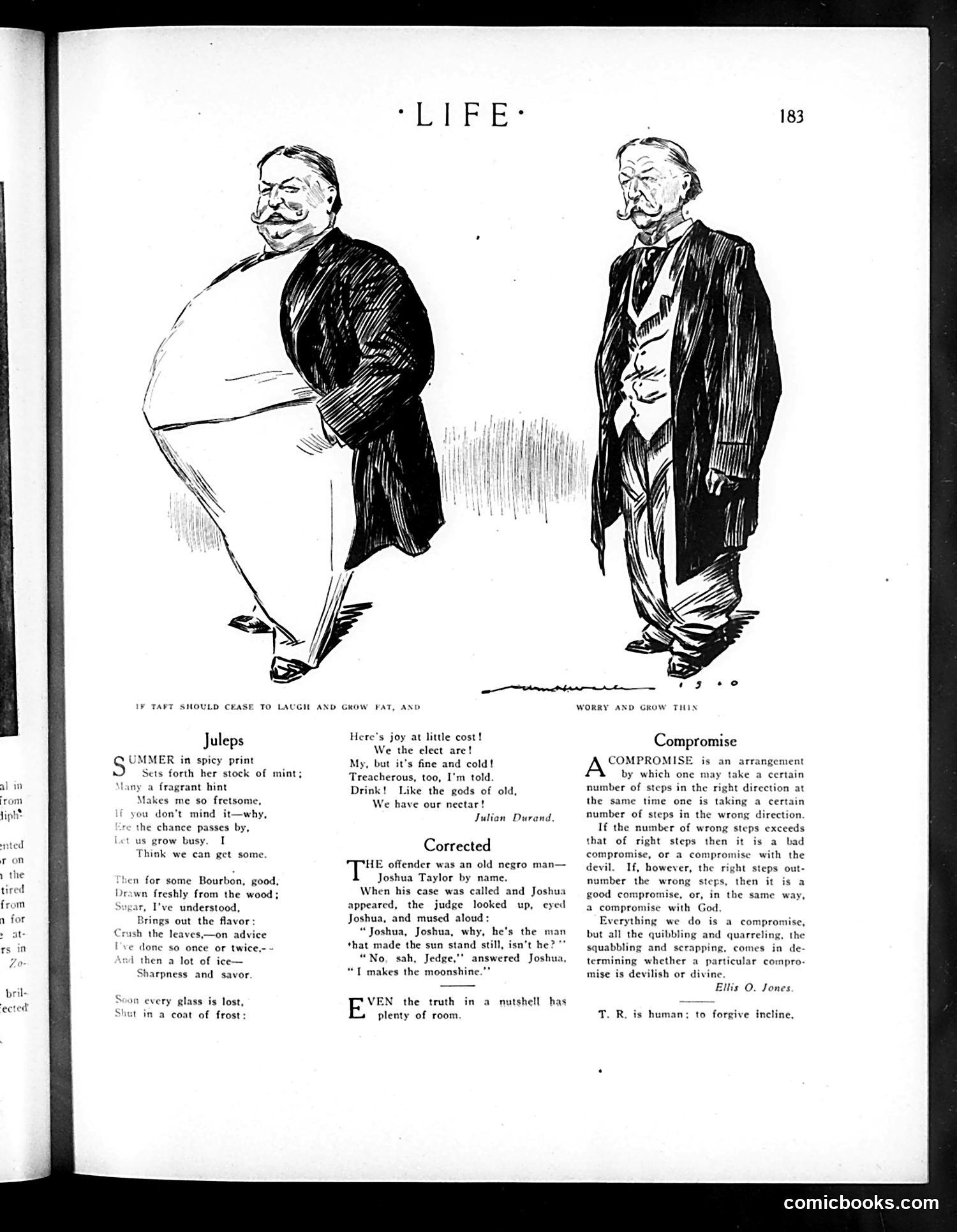
This page contains three distinct pieces of satirical commentary: **"Juleps"** (left): A humorous poem celebrating mint juleps—Southern whiskey drinks—with detailed instructions. The accompanying cartoon shows a portly gentleman, likely representing Southern wealth or leisure culture, indulging in this iconic drink. **"Corrected"** (center): A brief anecdote mocking racial stereotypes. A Black man named Joshua Taylor is brought before a judge, who confuses him with the biblical Joshua. Joshua's witty response about "moonshine" (illegally distilled whiskey) serves as social commentary on prohibition-era lawbreaking and plays on period racial caricatures and dialect humor. **"Compromise"** (right): The serious piece defines political compromise philosophically, distinguishing "good" from "bad" compromise. The final line's reference to "T. R." (Theodore Roosevelt) suggests this critiques his approach to political negotiation, likely during a specific controversy from his presidency or post-presidency period. The contrasting figures illustrate opposing outcomes: one bloated from indulgence, one gaunt from worry.
This story satirizes early 20th-century American newspaper corruption. Reporter Packton has written an exposé criticizing the Columbia Railroad, but his editor demands he soften it because the *Planet* newspaper's owner holds railroad stock and depends on their advertising revenue. The satire targets **press control by corporate interests**: the railroad essentially dictates editorial policy through financial leverage, forcing journalists to suppress truth. When Packton refuses to compromise his integrity, he's forced to resign—but the managing editor warns that the owner will retaliate by blacklisting him with other papers, punishing his principled stand. The story illustrates the "game" of American journalism: reporters must choose between honest reporting and employment. The editor's cynical acceptance ("I've seen some big men who have had some mighty small traits") suggests this corruption is systemic and normalized among the powerful, making individual moral stands economically suicidal.
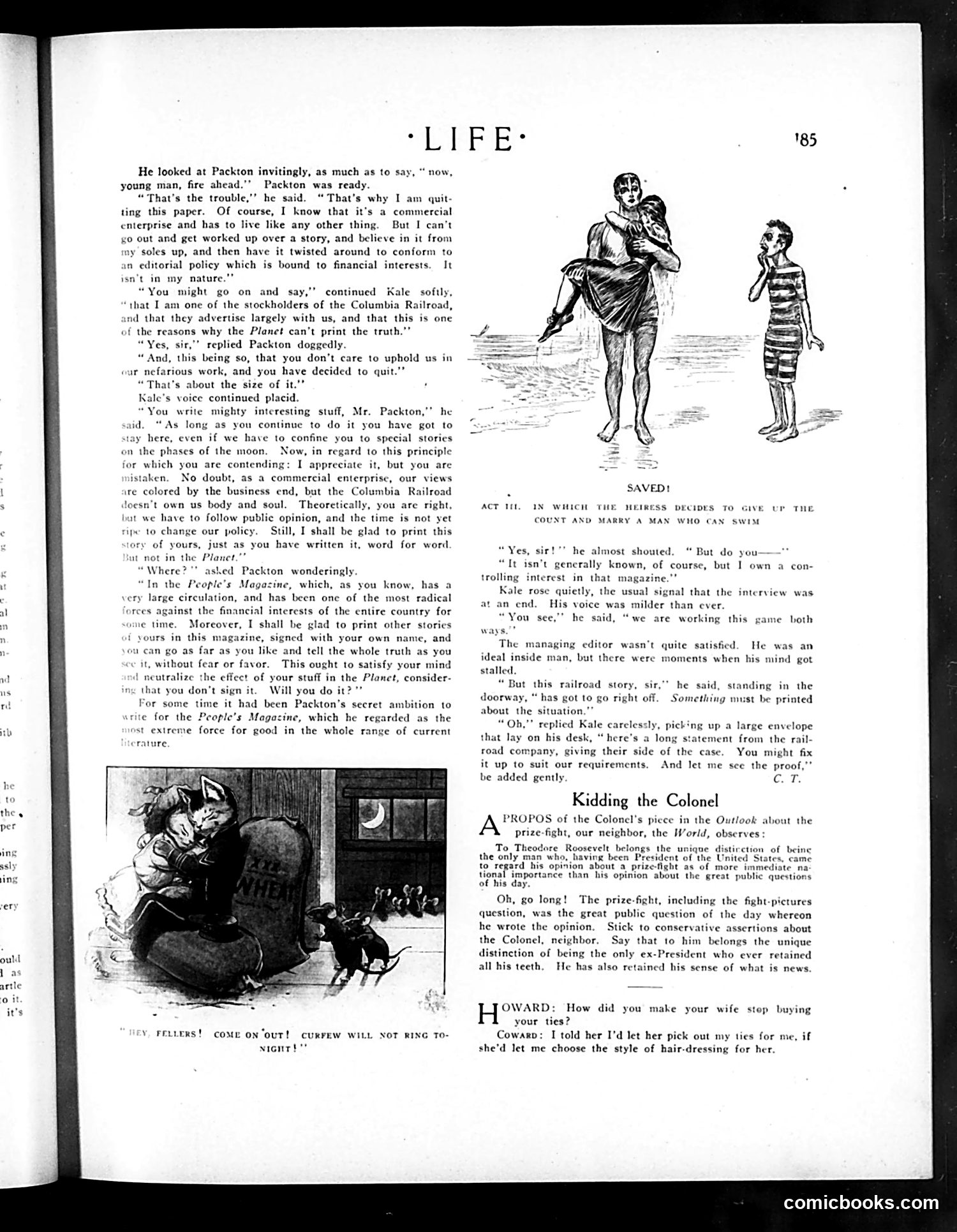
This page contains two distinct pieces of satirical content: **Main Story: "Packton and Kale"** A serialized narrative about journalistic integrity versus corporate control. Packton, a newspaper writer, quits because his stories are edited to serve the financial interests of the Columbia Railroad (which owner Kale secretly controls). The satire's point: wealthy interests disguise their influence through multiple publications—Kale reveals he also owns "The People's Magazine," supposedly a radical force for good, allowing him to control both progressive and mainstream narratives. The joke exposes how capitalists could manipulate public opinion across the political spectrum. **Lower Content: "Kidding the Colonel"** A brief satirical note about Theodore Roosevelt's recent piece in the *Outlook* magazine offering opinions on prizefighting. The text implies Roosevelt, as a former president, inappropriately leveraged his status to comment on matters beyond his expertise—a jab at his public prominence and self-importance. Both pieces mock institutional hypocrisy and powerful figures' hidden influence over public discourse.
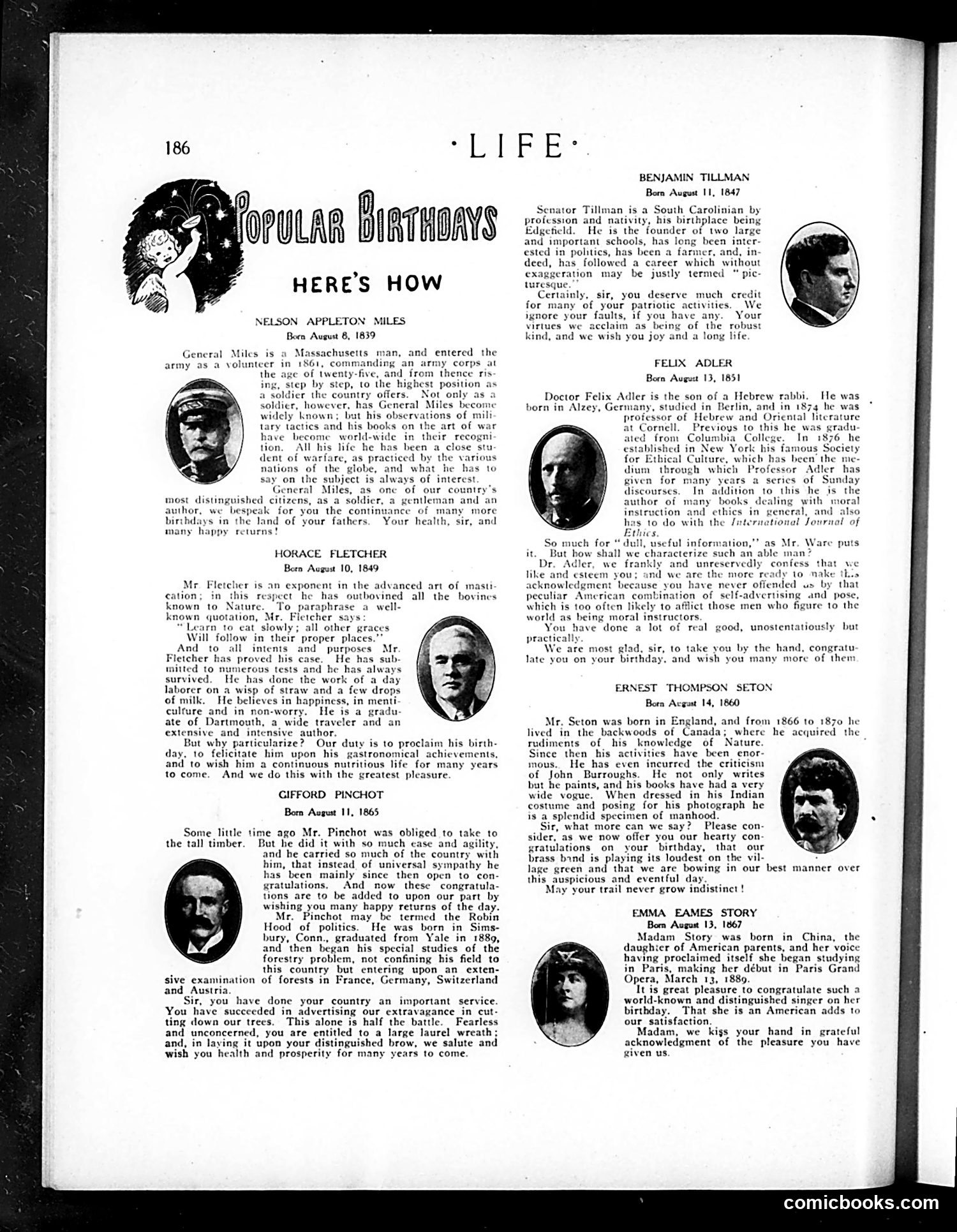
This page celebrates the birthdays of five prominent American figures through brief biographical sketches and portraits: **Nelson Appleton Miles** (general and military theorist), **Horace Fletcher** (known for advocating slow, thorough chewing—"Fletcherism" was a real health fad), **Clifford Pinchot** (conservationist who famously clashed with President Taft over forestry policy—the "tall timber" reference alludes to his forced resignation), **Benjamin Tillman** (South Carolina senator and education founder), and **Felix Adler** (religious scholar and founder of the Ethical Culture movement). The satire is gentle, offering backhanded compliments while studiously ignoring controversial aspects. Notably, Tillman—a white supremacist and Populist firebrand—receives congratulations while the text pointedly states "We ignore your faults, if you have any," a sarcastic nod to his well-known extremism. The page exemplifies Life's approach: celebrating American achievement while winking at readers about public figures' problematic records.
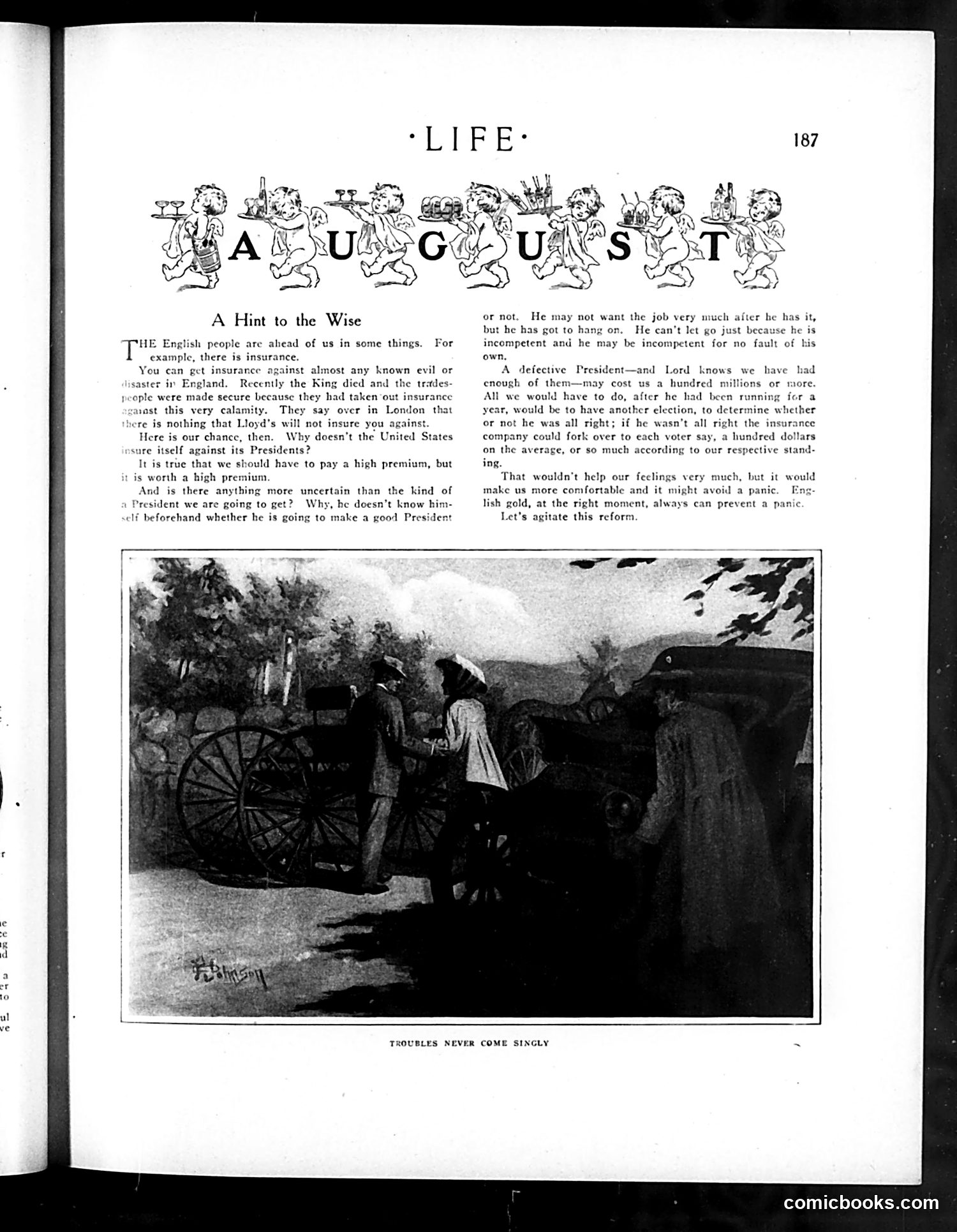
This August 1912 *Life* magazine piece satirizes American presidential politics by proposing "insurance against defective Presidents." The text argues that England's sophisticated insurance system (referencing Lloyd's of London) could solve a uniquely American problem: voters have no protection against incompetent or unwilling presidents who, once elected, must serve their full term regardless of performance. The author sarcastically suggests insuring the nation against presidential failure—noting that bad presidents have cost "a hundred millions or more" and that even a defective president cannot simply resign. The accompanying illustration ("Troubles Never Come Singly") shows a chaotic rural scene with wagon trouble, visually reinforcing the essay's theme that misfortunes cluster together. This reflects genuine 1912 frustration with presidential power and the lack of mechanisms to remove failing leaders mid-term—a concern that would eventually inspire the 25th Amendment (1967).
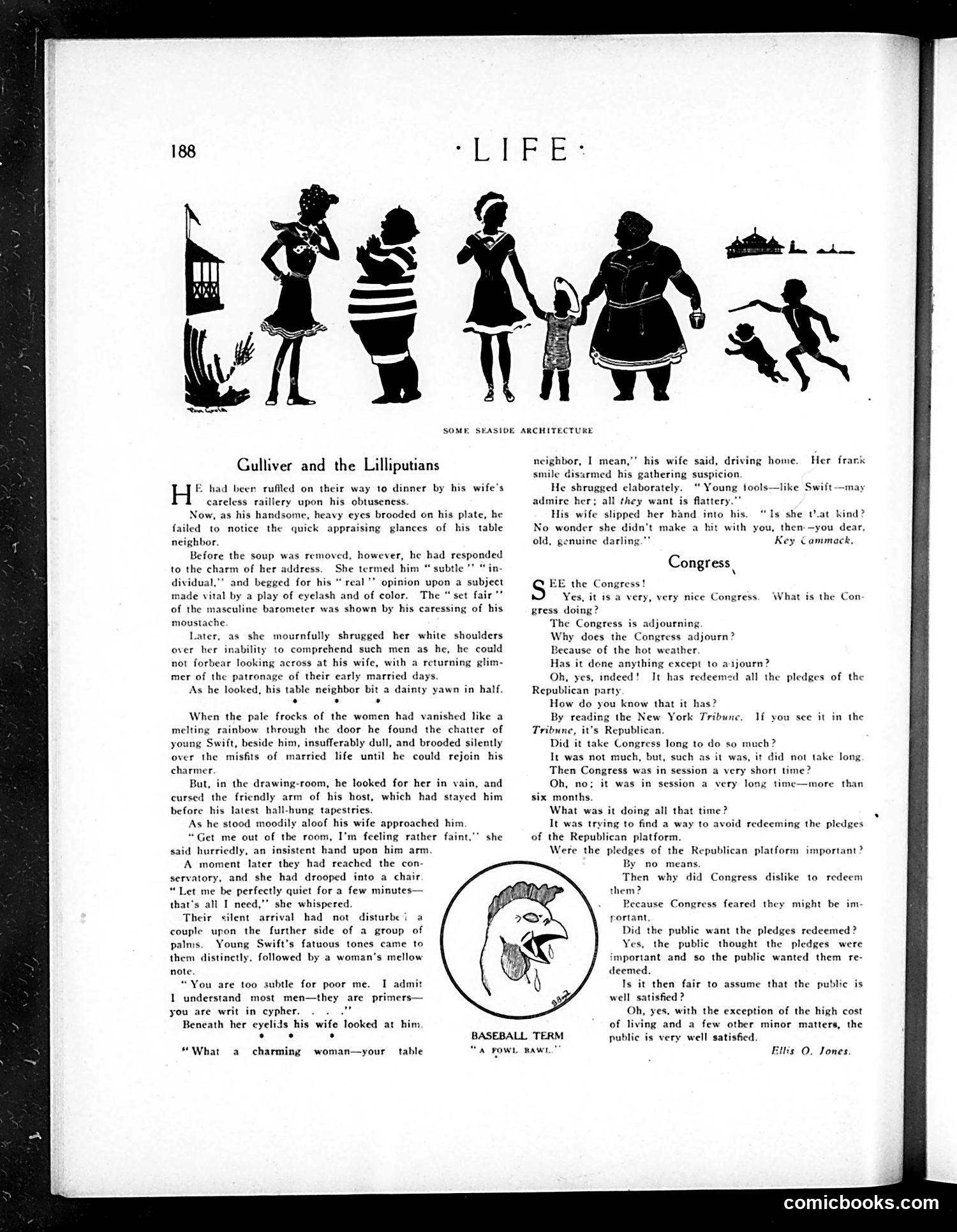
**"Gulliver and the Lilliputians"** is a marital satire using Swift's literary reference as its title. A husband, flattered by an attractive woman at dinner while his wife appears dull, grows attentive to the stranger. He later discovers the woman was actually flattering young Swift (a dinner guest), not himself. His wife's gracious response ("you dear, old, genuine darling") suggests marital wisdom—she understands male vanity and chooses not to compete, securing her position through acceptance rather than jealousy. The satire targets masculine ego and the superficiality of romantic attention. **"Congress"** is a political Q&A mocking the Republican-controlled Congress for adjourning without substantively fulfilling campaign promises. The joke: Congress spent six months avoiding redemption of pledges it deemed unimportant, yet feared the public might think otherwise. The satire critiques political cowardice and the gap between campaign rhetoric and legislative action. The **baseball term illustration** ("A Fowl Rawl") appears decorative, unrelated to surrounding content.
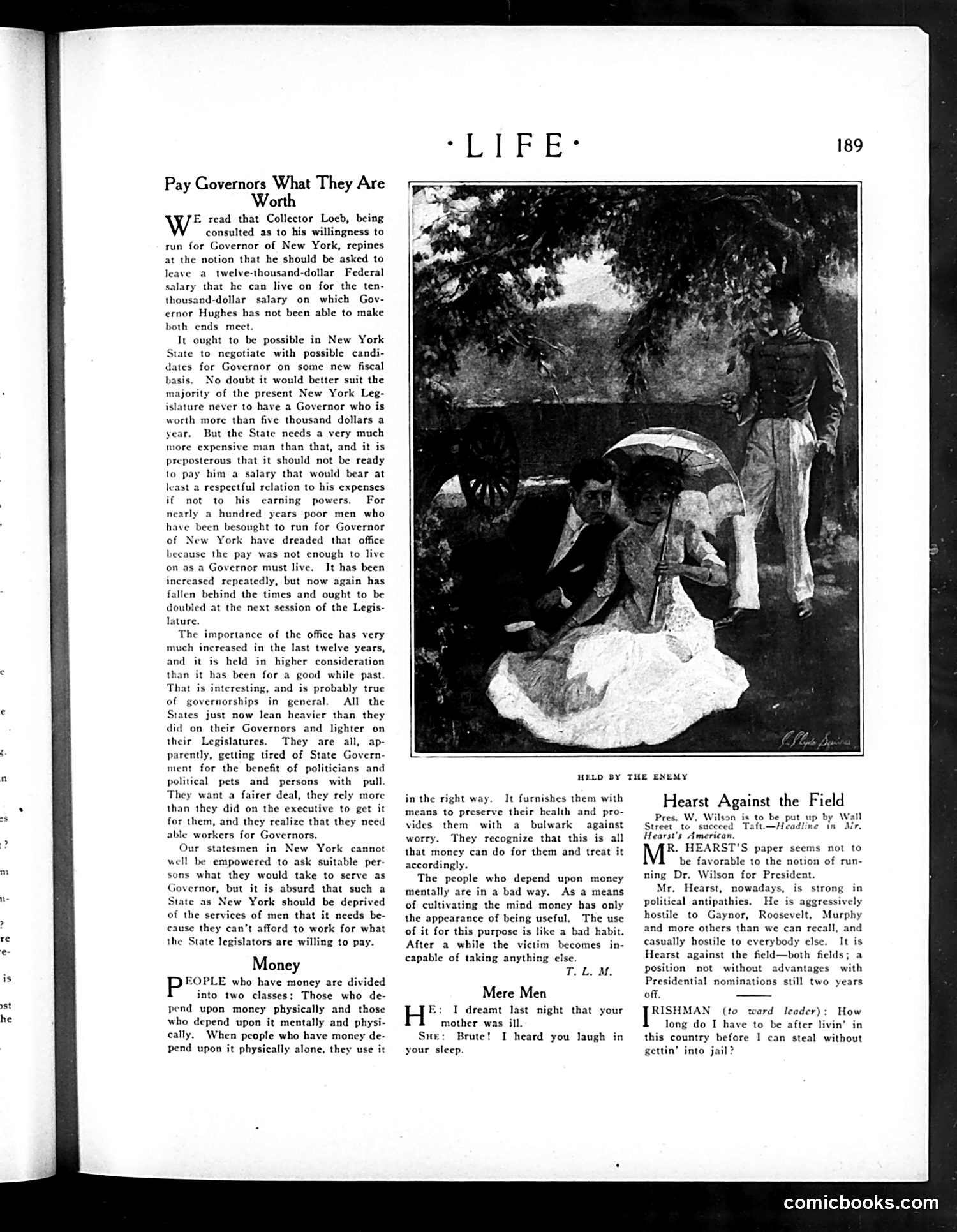
This page from *Life* contains three distinct editorial pieces satirizing American politics circa 1912. **"Pay Governors What They Are Worth"** argues that New York's gubernatorial salary ($10,000) is inadequate, citing Collector Loeb's reluctance to leave a $12,000 Federal position. The piece advocates doubling the governor's pay to attract capable leaders rather than "poor men." **"Money"** offers philosophical commentary on wealth, distinguishing between those who use money for physical wellbeing versus those who become mentally dependent on it—the latter becoming incapable of other pursuits. **"Hearst Against the Field"** mocks William Randolph Hearst's newspaper (*American*) for opposing Wilson's presidential candidacy. The satire notes Hearst is hostile toward numerous political figures (Gaynor, Roosevelt, Murphy) and suggests his contrarian stance—opposing both major party frontrunners—might paradoxically benefit him politically, with the 1912 election still two years away. The cartoon "Held by the Enemy" appears to illustrate a dramatic scene, though its specific political relevance is unclear from the visible context.
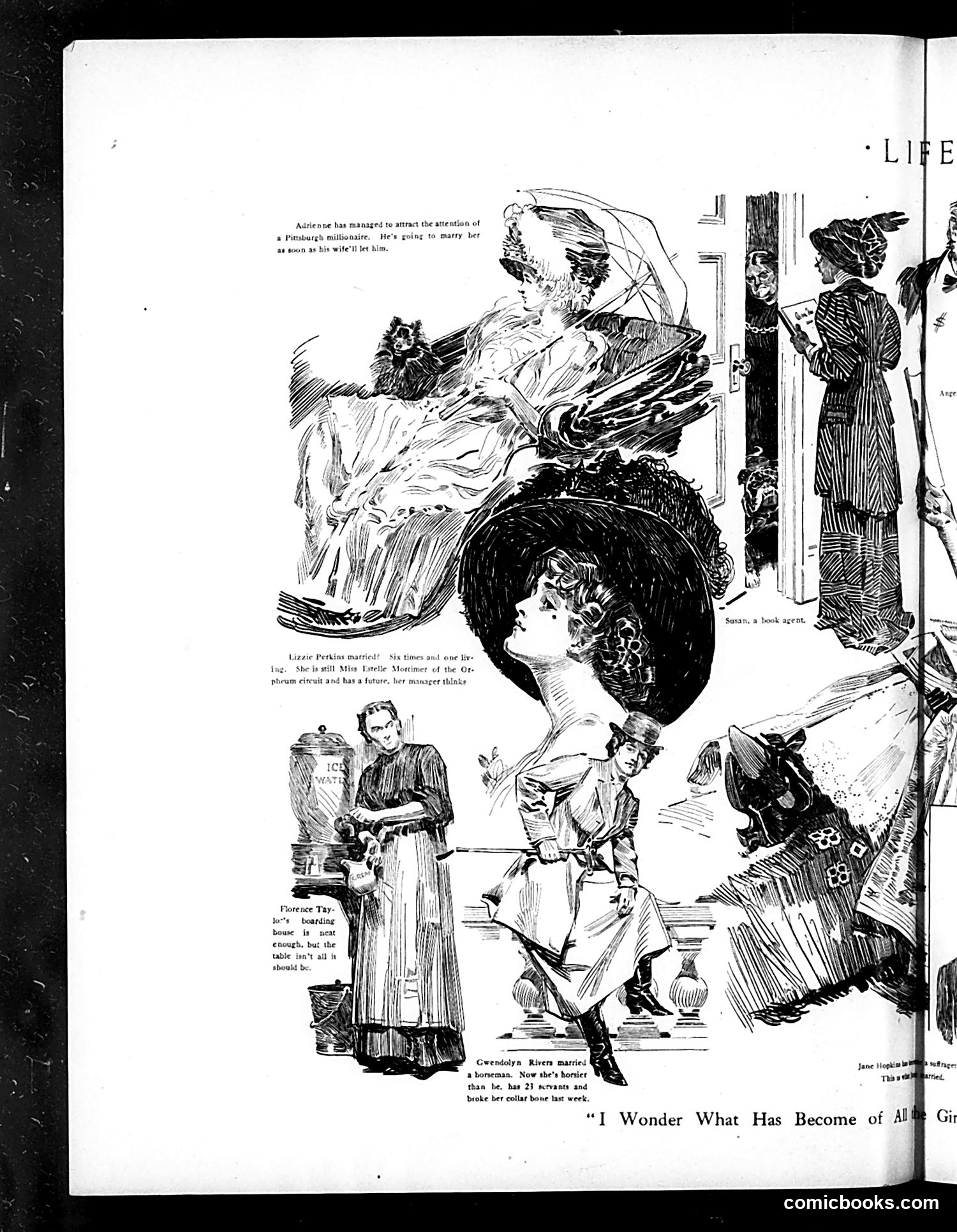
This page satirizes the social anxieties of early 20th-century domestic life. The illustrations show women in various household roles—a maid with cooking implements, a woman at a door, figures in elaborate dress—alongside captions about servants and housekeeping standards. The visible caption mentions "Lizzie Perkins married" six times and is now "Miss Lizzie Stanwood" with "a future, her mistress thinks." Another notes a character whose "house is just enough, but the table isn't all it should be." The satire appears to mock the obsessive class consciousness and servant-management anxieties of wealthy households, poking fun at employers' constant worry about domestic standards and the precarious social status they represented. The title suggests ironic reflection on what's become of various women navigating these rigid social hierarchies.
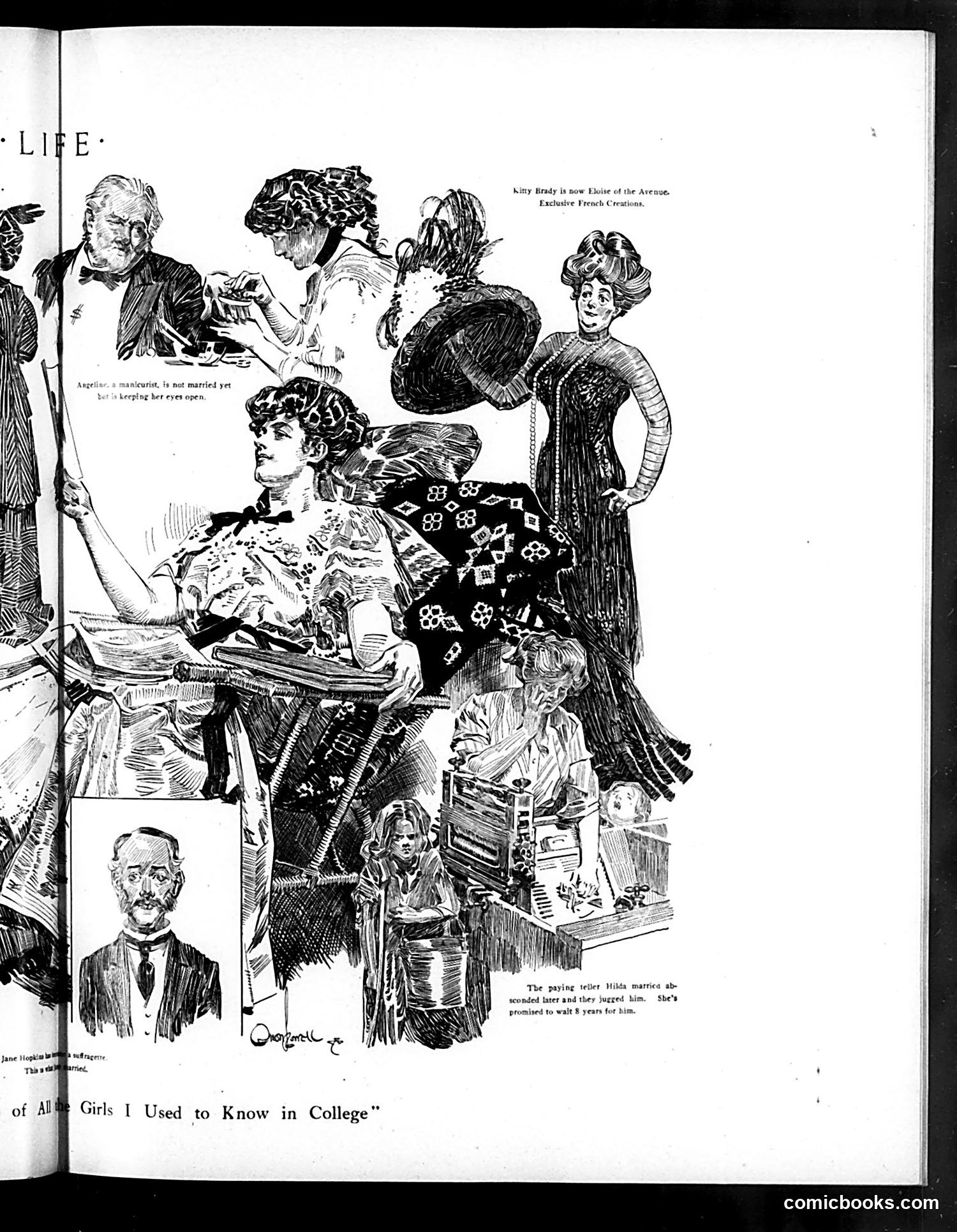
This Life magazine page satirizes social dynamics and romantic entanglements among educated young people. The central illustration depicts various figures—men in formal dress and women in Edwardian-era clothing—arranged in a social scene. The caption references a paving roller who "hides married ab-sconded [with] her and they lugged him. She's promised to wait 5 years for him," suggesting a comedy of romantic complications and class contrasts (a working-class man with a woman from a higher social circle). The title "Of All the Girls I Used to Know in College" indicates nostalgic reminiscence about romantic interests. The overall satire appears to mock the romantic expectations and social pretensions of college-educated people, with the punchline involving an unexpected class collision and delayed matrimonial arrangements.
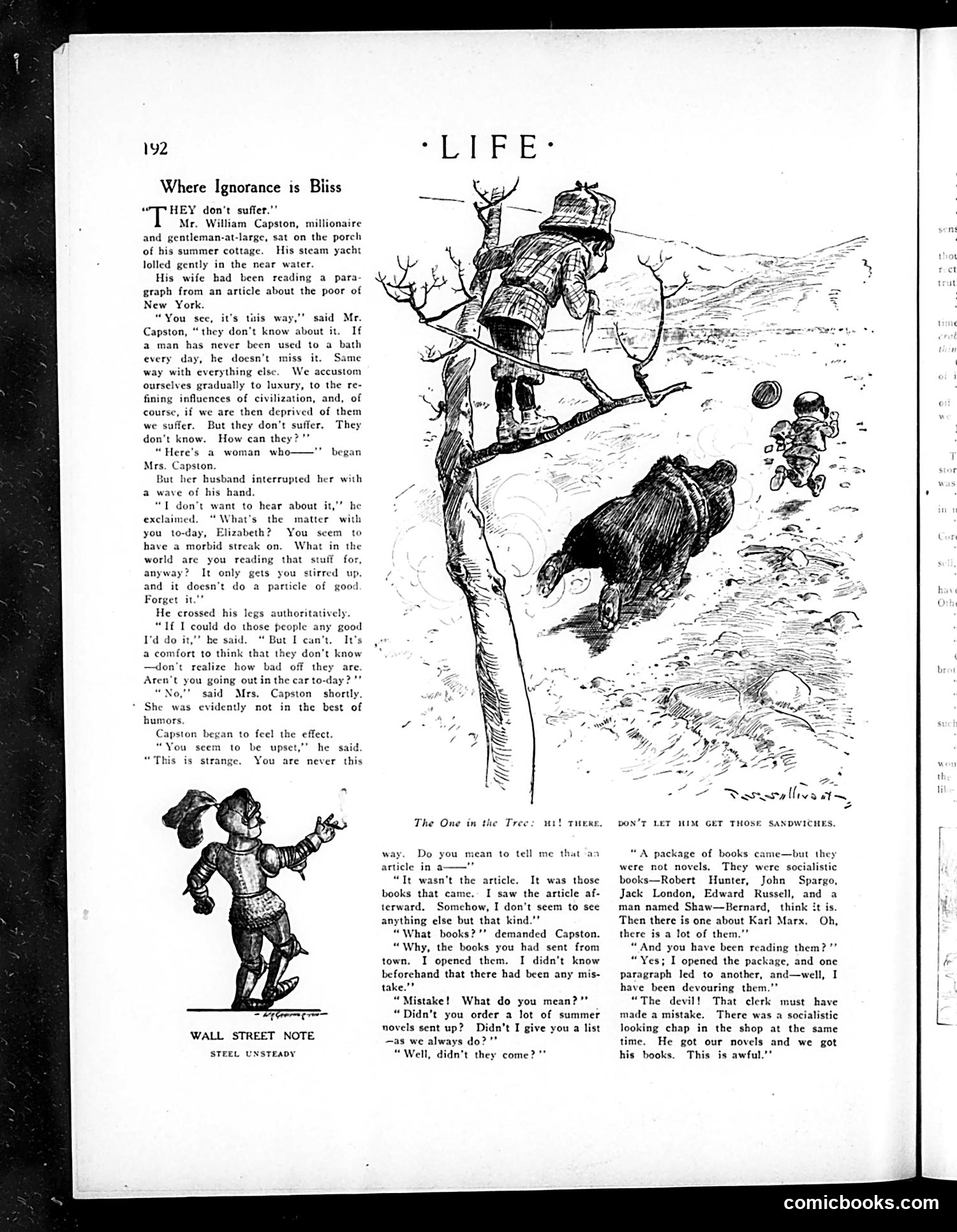
This story satirizes wealthy indifference to social suffering. Mr. Capston, a rich industrialist, argues that poor people don't suffer from deprivation because they've "never known" luxury—so ignorance protects them from unhappiness. His wife challenges this by reading about New York's poor. The satire escalates when Mrs. Capston accidentally receives socialist books (by Robert Hunter, Jack London, Edward Russell, and Bernard Shaw) instead of summer novels. She becomes disturbed after reading them, suggesting the books awaken her conscience. The humor targets Capston's self-serving logic: he comforts himself with the idea that poor people are happily unaware, while simultaneously being horrified when *his own wife* gains awareness through reading. The cartoon exposes the hypocrisy—wealthy people want the poor to remain ignorant so the rich needn't feel guilty, yet fear similar enlightenment spreading to their own class.
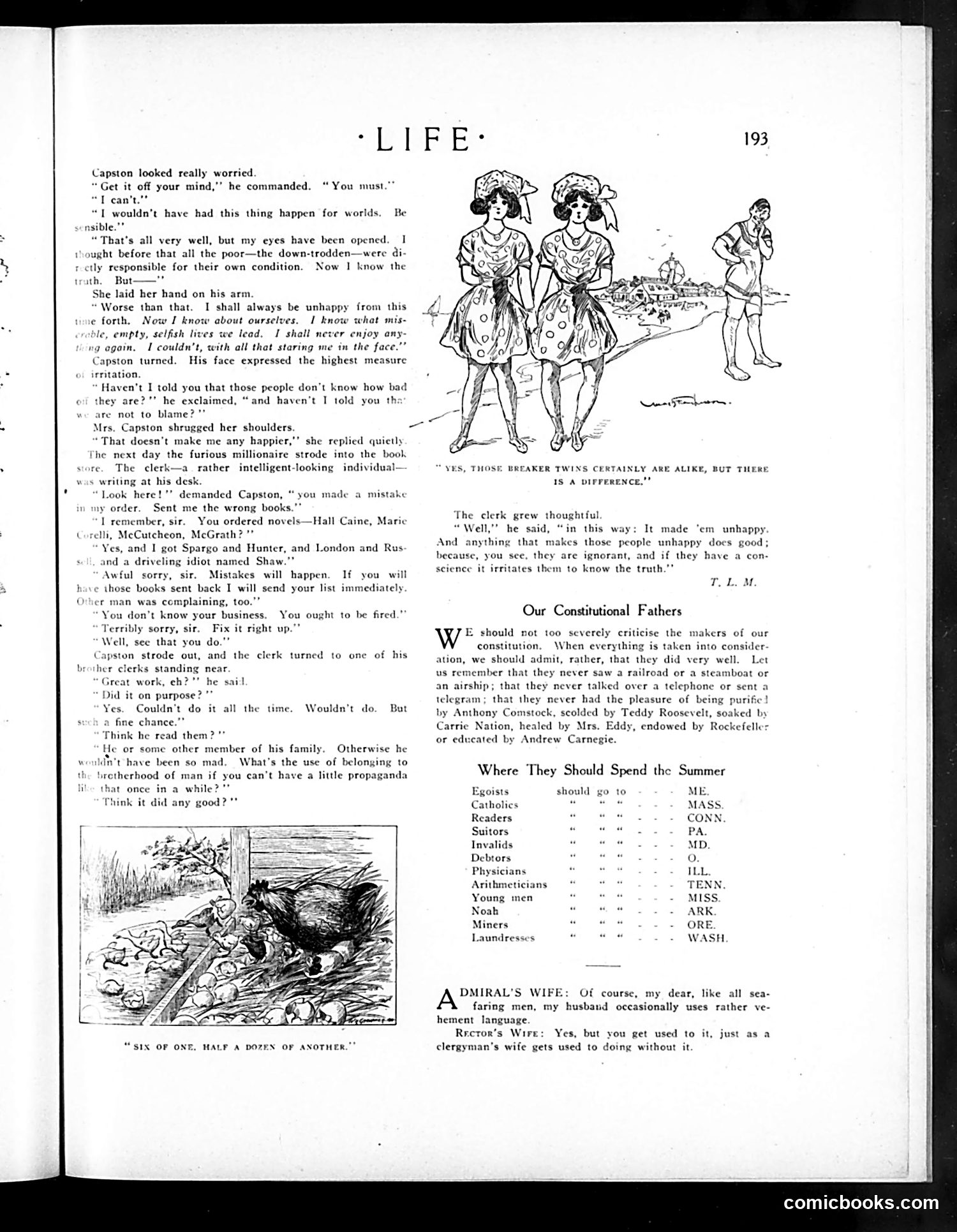
This page contains two satirical pieces: **Main Story: "The Clerk's Propaganda"** A wealthy millionaire (Capston) and his wife discover social inequality. Distressed by this knowledge, Mrs. Capston becomes unable to enjoy her privileged life. Capston, annoyed that she's unhappy, visits a bookstore to complain about receiving "wrong" books—works by social reformers (Spargo, Hunter, London, Shaw) instead of escapist fiction (Hall Caine, Marie Corelli). The intelligent clerk reveals he deliberately sent radical literature to "make 'em unhappy" because "ignorant" wealthy people with consciences will be irritated by learning "the truth." The satire mocks both wealthy people's superficial guilt and the clerk's paternalistic belief that discomfort equals progress. **Secondary Content:** - A joke about constitutional framers who never experienced modern annoyances - A humorous list assigning where various social types "should spend summer" (coded as state abbreviations) - A brief joke about admiral's and clergy wives' marital compromises The page satirizes Gilded Age attitudes toward social reform, wealthy guilt, and class consciousness.
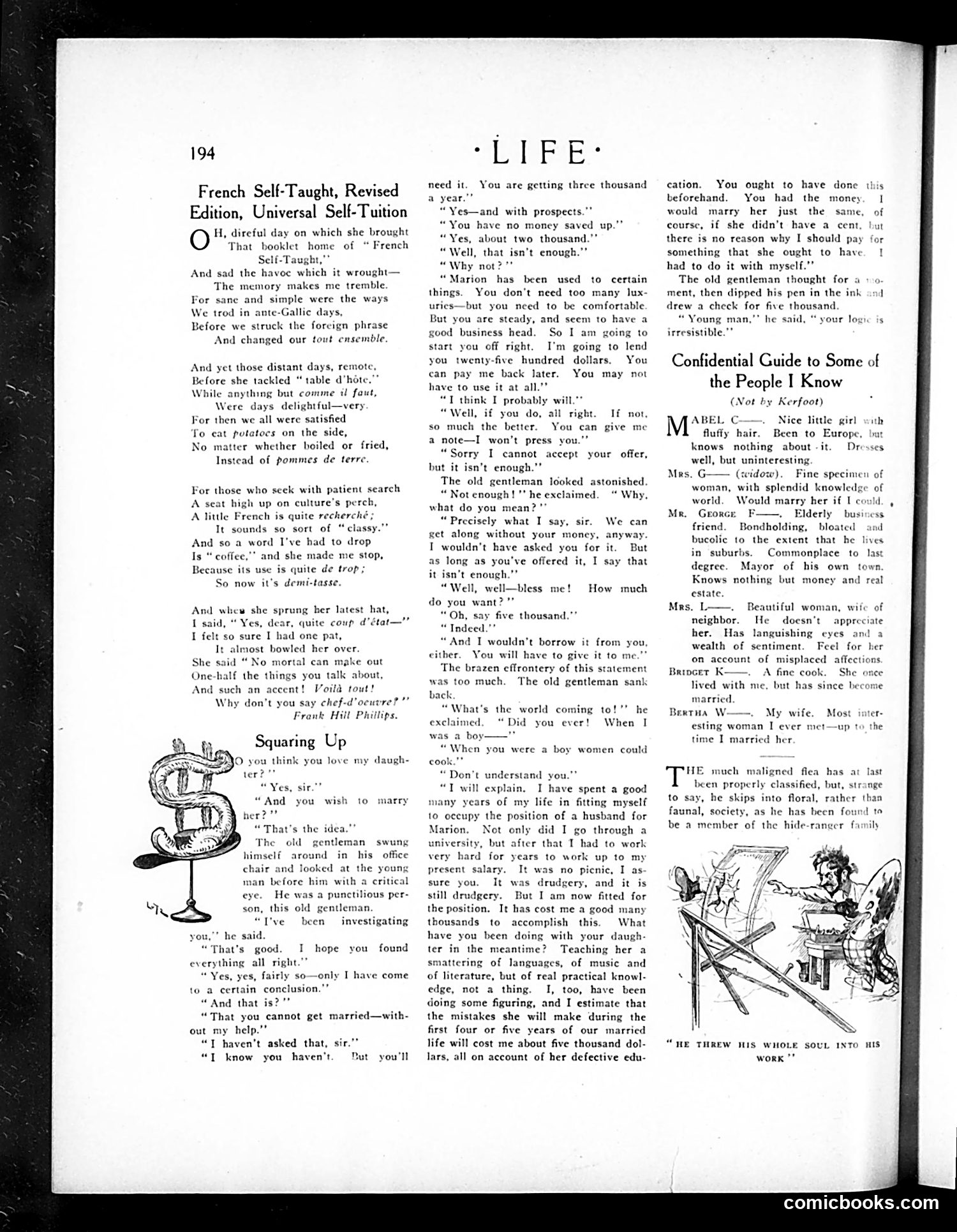
This page contains two satirical pieces about courtship and marriage from early 20th-century Life magazine. **"French Self-Taught"** mocks the pretentiousness of learning French phrases to appear cultured. The narrator's wife adopts French vocabulary (pommes de terre instead of potatoes, coup d'état for a hat), making ordinary conversation absurd and affected. The satire targets social climbing—the idea that sprinkling French into English conversation signals sophistication when it merely signals pretension. **"Squaring Up"** satirizes a young suitor's audacity when his fiancée's wealthy father offers financial help. Rather than gratefully accepting $2,500, the young man demands $5,000—brazenly reframing a gift as insufficient payment. He argues he's spent years educating himself to be worthy of the daughter, so the father should compensate him accordingly. The satire highlights both the young man's entitlement and the father's shock at this inversion of social obligation and gratitude. Both pieces humorously critique social anxieties around class, education, and courtship in their era.
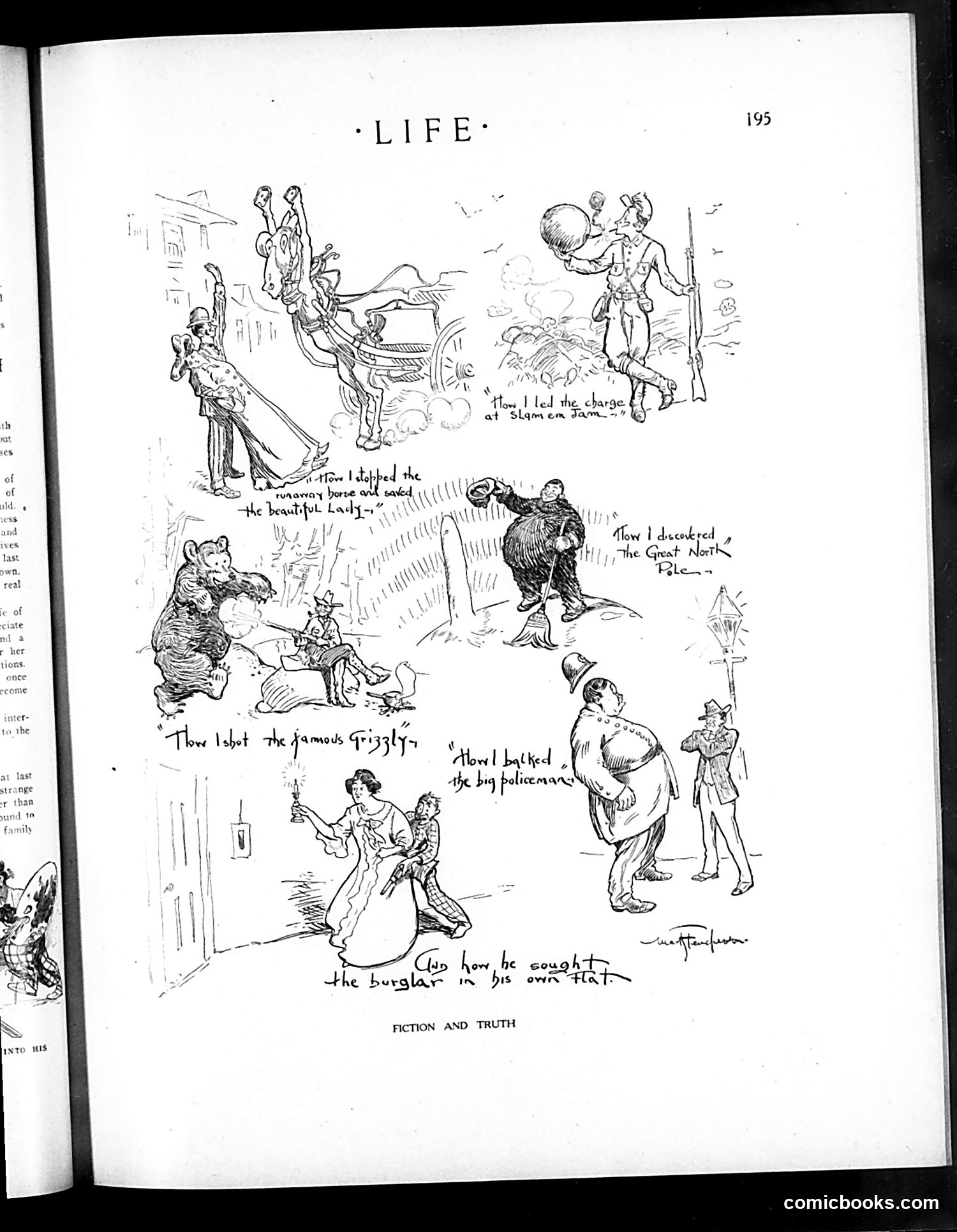
This page satirizes exaggerated military storytelling through six sketched vignettes. Each caption shows a soldier boasting about increasingly dramatic exploits: "How I led the charge at Shamen Jam," "How I stopped the runaway horse and saved the beautiful Lady," "How I shot the famous Grizzly," "How I defeated the Great North Pole," "How I battled the big policeman," and "How he caught the burglar in his own hat." The humor lies in the contrast between each inflated claim and the modest or absurd actual illustration—suggesting soldiers embellish their wartime experiences into fanciful tall tales. The page title "FICTION AND TRUTH" emphasizes this gap between boastful narrative and reality, mocking the tendency of veterans to mythologize their service.
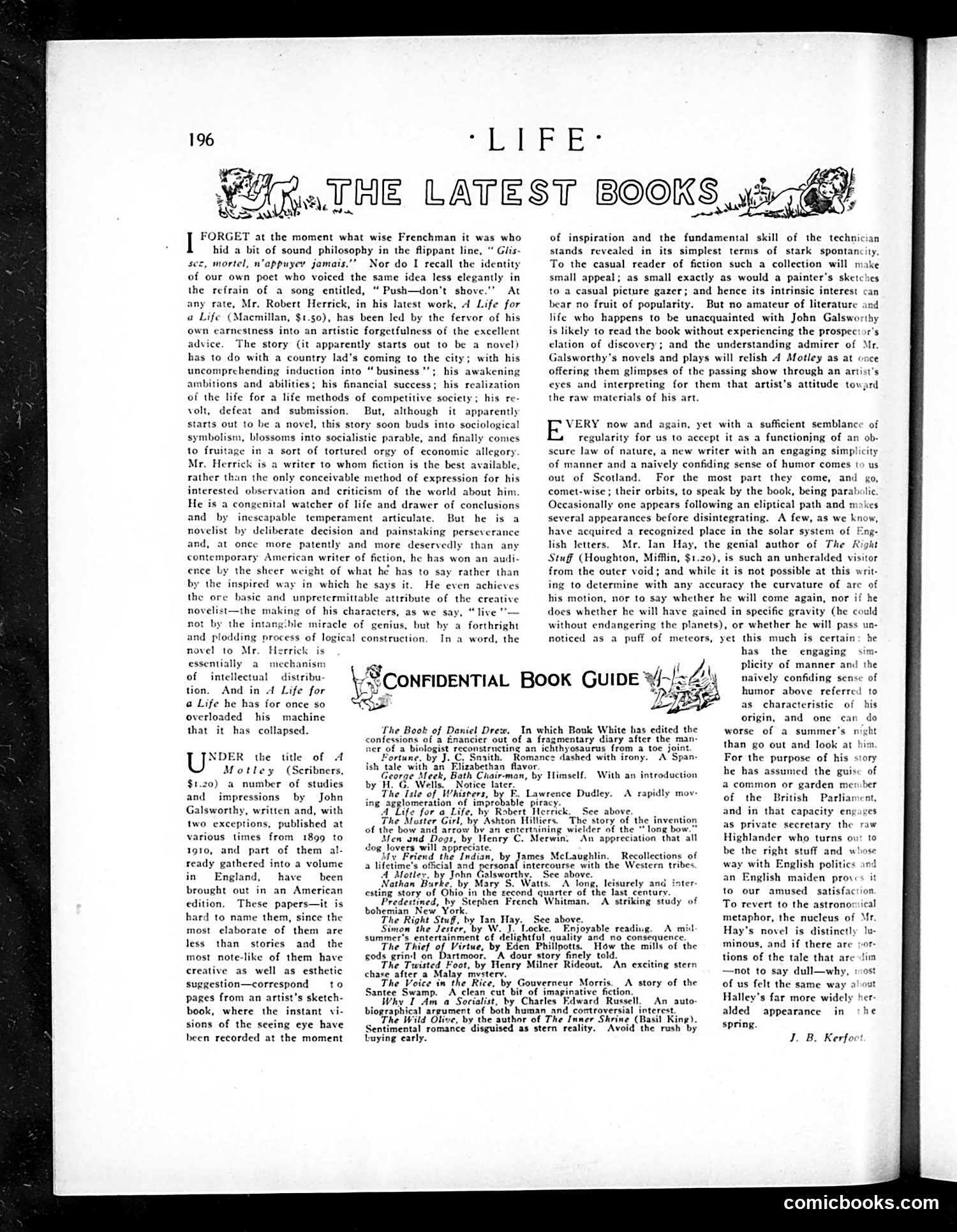
This page from Life magazine reviews contemporary fiction, primarily focusing on Robert Herrick's novel *A Life for a Life*. The critic praises Herrick as a serious social observer whose fiction serves as a vehicle for economic and sociological critique rather than entertainment. The review acknowledges Herrick's weakness: he "overloads his machine" with allegory and symbolism, making the work appeal more to literary scholars than casual readers. The page then shifts to discuss John Galsworthy's *A Motley* and introduces Scottish writer Ian Hay's *The Right Stuff*, commending Hay's engaging simplicity and humor. The "Confidential Book Guide" sidebar lists additional contemporary titles with brief annotations, covering various genres from mystery to romance. The overall tone is that of a sophisticated literary journal addressing educated readers interested in serious fiction addressing social issues—characteristic of Life's early 20th-century positioning as an intellectual satirical publication.
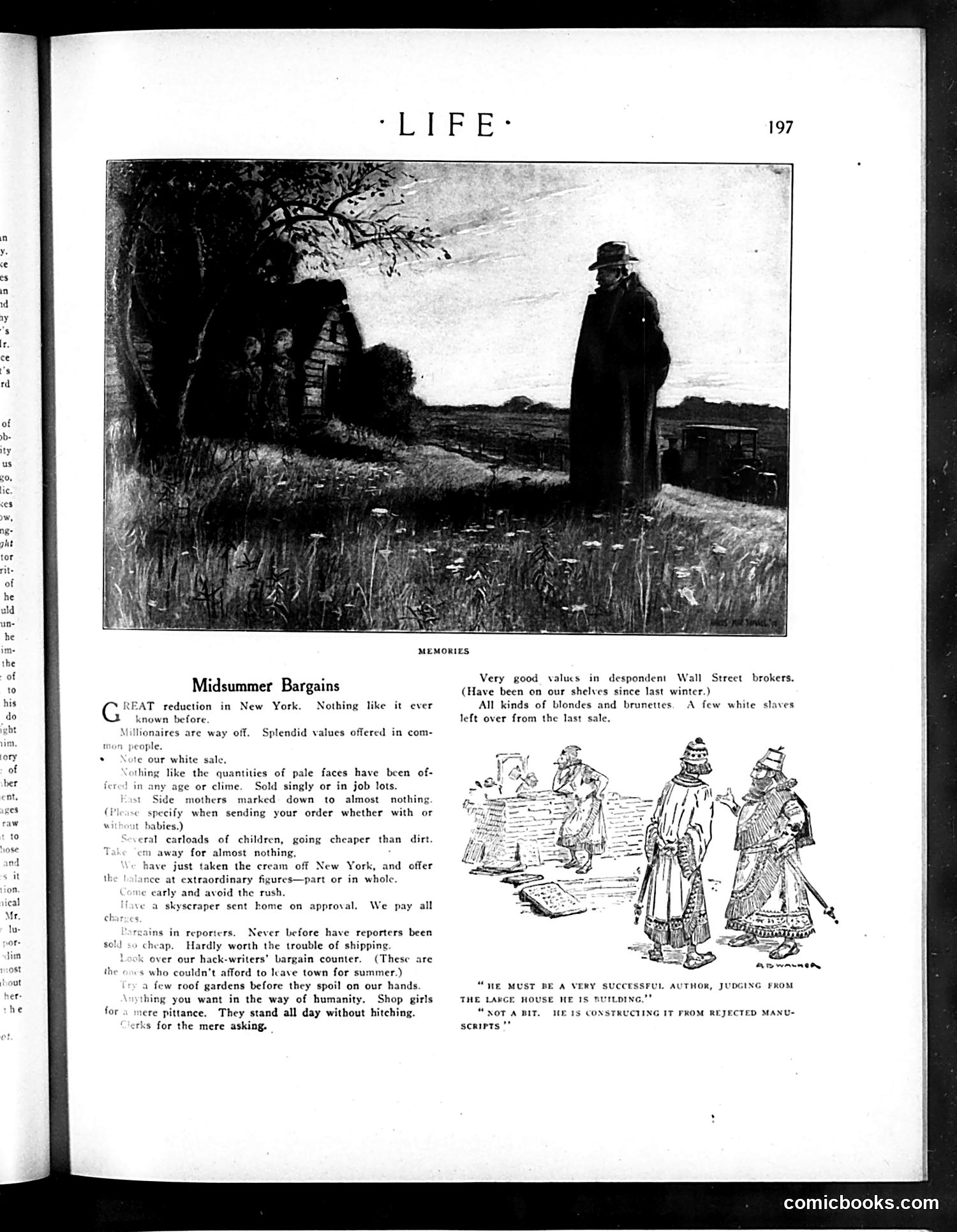
This page satirizes New York's economic inequality and moral bankruptcy during a prosperous period (likely early 1900s). The mock "sale" advertises human beings and city institutions as bargain merchandise: millionaires, society women, children, reporters, hack-writers, shop girls, and "white slaves" are all listed with contemptuous price reductions. The satire attacks: - **Exploitation of labor**: shop girls working without pay or rest - **Human trafficking**: explicit reference to "white slaves" - **Journalism's decline**: reporters and hack-writers treated as disposable commodities - **Class indifference**: the wealthy have abandoned the city, leaving the poor to be "marked down" The accompanying cartoon (lower right) jokes about a struggling author building a mansion from rejected manuscripts—mocking both literary pretension and get-rich-quick fantasies. The overall message: in gilded-age New York, everything—including human dignity—has become a commodity for sale.
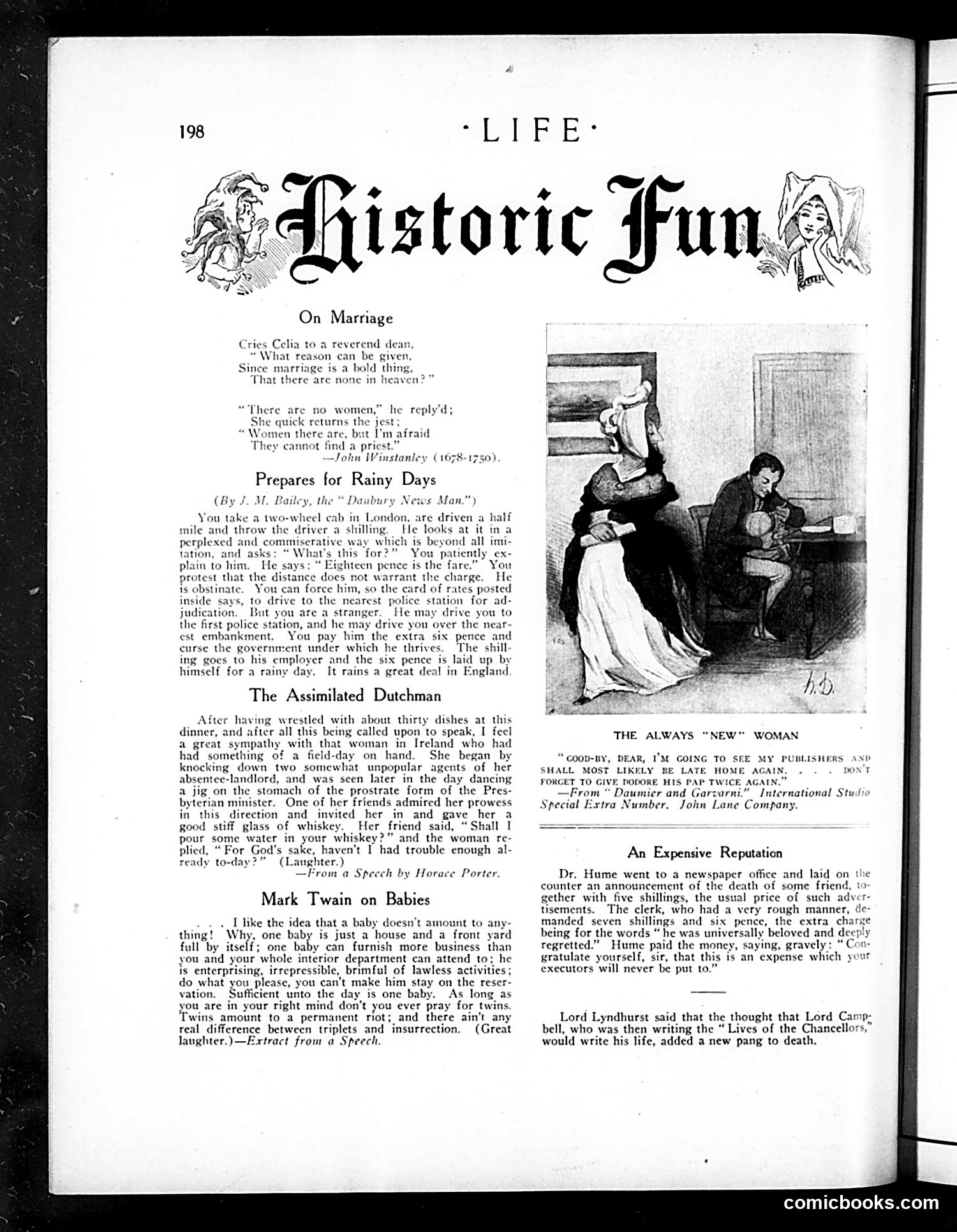
This page from *Life* magazine presents satirical humor on several topics: **"On Marriage"** quotes a witty exchange between a woman (Celia) and a clergyman about why no women exist in heaven—she retorts that women are there, but priests aren't, inverting the clergyman's misogynistic joke. **"Prepares for Rainy Days"** mocks London cab drivers who overcharge passengers, then pocket extra fees as personal savings ("for a rainy day"). **The cartoon** (right) titled "The Always 'New Woman'" depicts a modern woman leaving home to see publishers, neglecting domestic duties—satirizing the emerging independent "New Woman" of the era who pursued careers rather than traditional homemaking. **"Mark Twain on Babies"** uses Twain's humorous exaggeration to describe infants as uncontrollable chaos-agents, warning against twins. **"An Expensive Reputation"** jokes darkly about paying extra newspaper fees for flattering obituary language—suggesting one's reputation costs money even in death. The overall theme: modern social change and human foibles, treated with period satire.
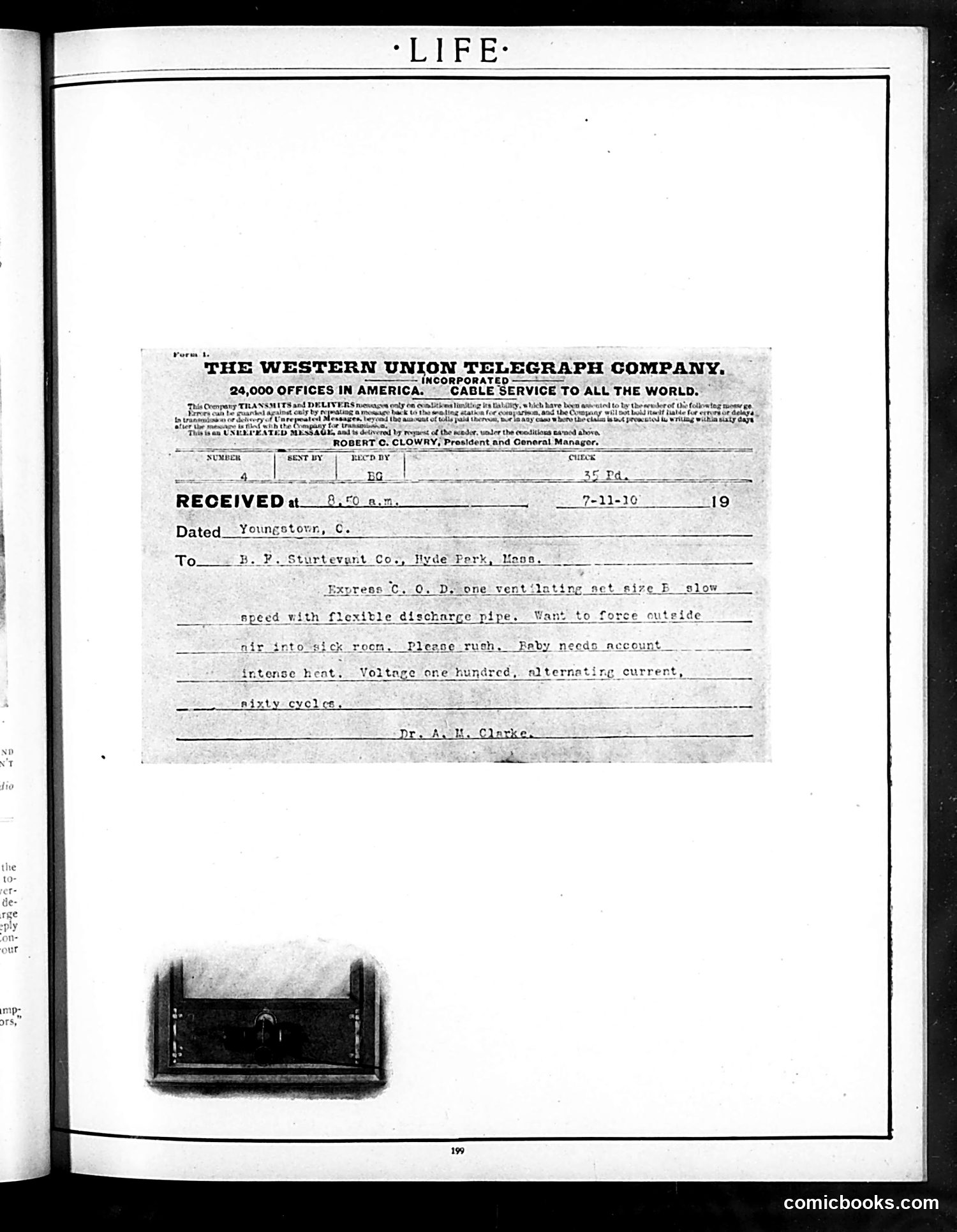
This is **not a cartoon or satirical content**—it's a Western Union telegraph form reproduced in *Life* magazine as a **humorous document itself**. The telegram, dated 7-11-10, is sent from Youngstown to a Massachusetts manufacturing company (B.F. Sturtevant Co.) and requests urgent equipment delivery. The humor lies in the **absurdly technical specifications** for what appears to be a sick baby's needs: "Express C.O.D. one ventilating set size B...flexible discharge pipe...intense heat. Voltage one hundred, alternating current, sixty cycles." The joke is that someone is treating a baby's illness like an industrial engineering problem, requesting high-voltage electrical equipment specifications as medical treatment. It satirizes either **misguided attempts at modern "scientific" medicine** or the sender's complete incompetence in describing actual baby care—treating a sick infant as if it were factory machinery requiring technical specifications rather than simple comfort measures.
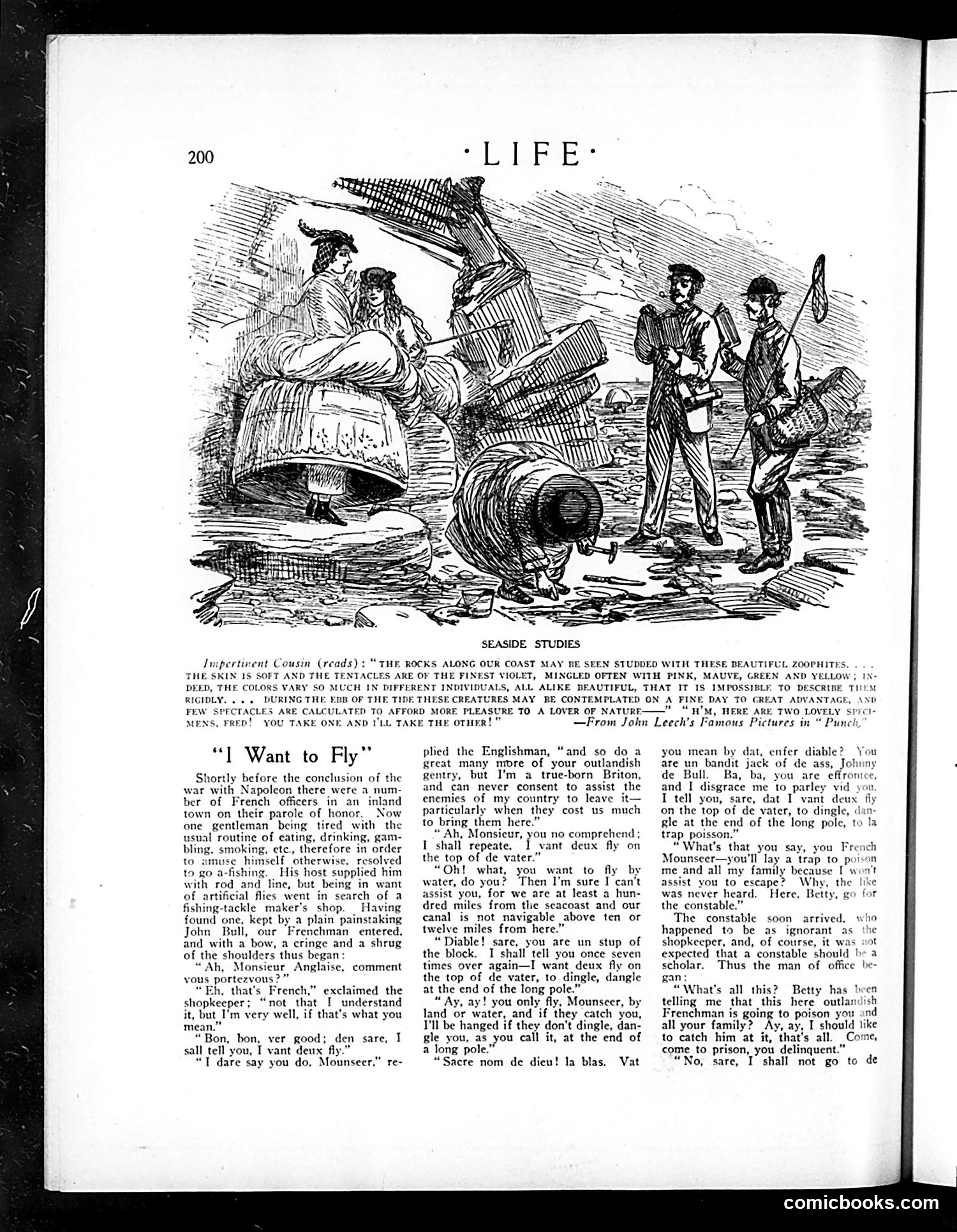
This is a satirical story-cartoon from Life magazine about a language misunderstanding during the Napoleonic Wars. A French officer on parole visits a fishing tackle shop seeking "deux fly" (two flies—fishing lures). The English shopkeeper, John Bull (a personification of Britain), repeatedly misinterprets this as the Frenchman wanting to "fly away" or escape his parole. The satire mocks both parties: the French officer's accent and unclear English, and the shopkeeper's literal-minded obtuseness and suspicion of the foreigner. The joke escalates absurdly—the constable arrives, assumes the Frenchman is plotting to poison the family, and threatens arrest. The humor exploits period anti-French sentiment and xenophobia, while also poking fun at English insularity and inability to understand foreigners. The punchline relies on the double meaning of "fly" and exaggerated misunderstanding of innocent speech as criminal intent.
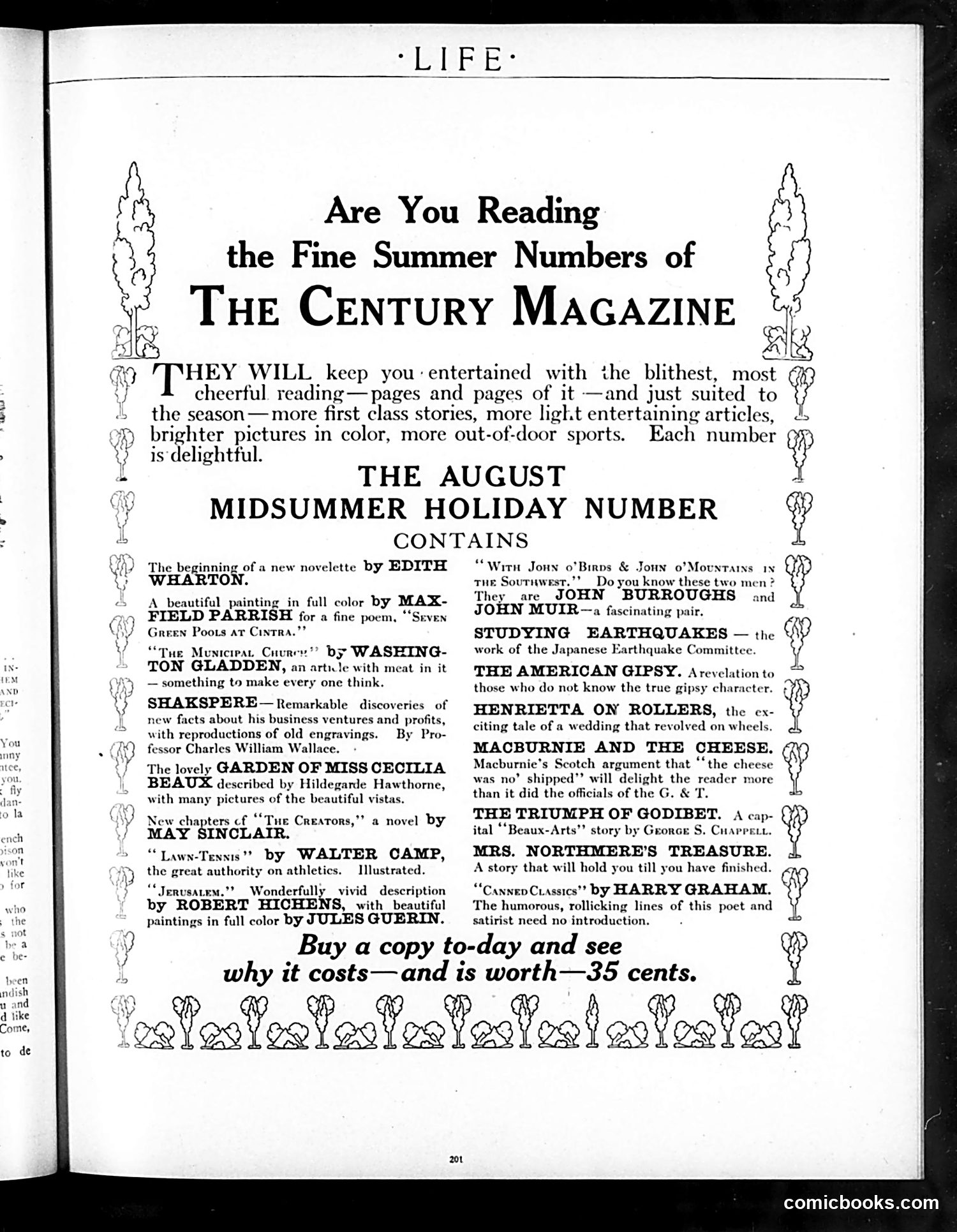
This is primarily an **advertisement for The Century Magazine's August midsummer holiday issue**, not a political cartoon. The page promotes the magazine's summer content to readers of Life, listing prestigious contributors and articles designed to appeal to educated, leisure-class audiences: Edith Wharton's fiction, Maxfield Parrish's artwork, naturalist John Muir and John Burroughs, and articles on topics like Shakespeare's business practices and Japanese earthquakes. The tone is aspirational—the ad emphasizes "first class stories," "cheerful reading," and "out-of-door sports" suited to summer leisure. The price of 35 cents signals this was a premium publication for affluent readers. There is **no political satire or social commentary evident** on this page. It's a straightforward period advertisement using decorative typography and botanical illustrations to market highbrow cultural content to Life's educated readership.
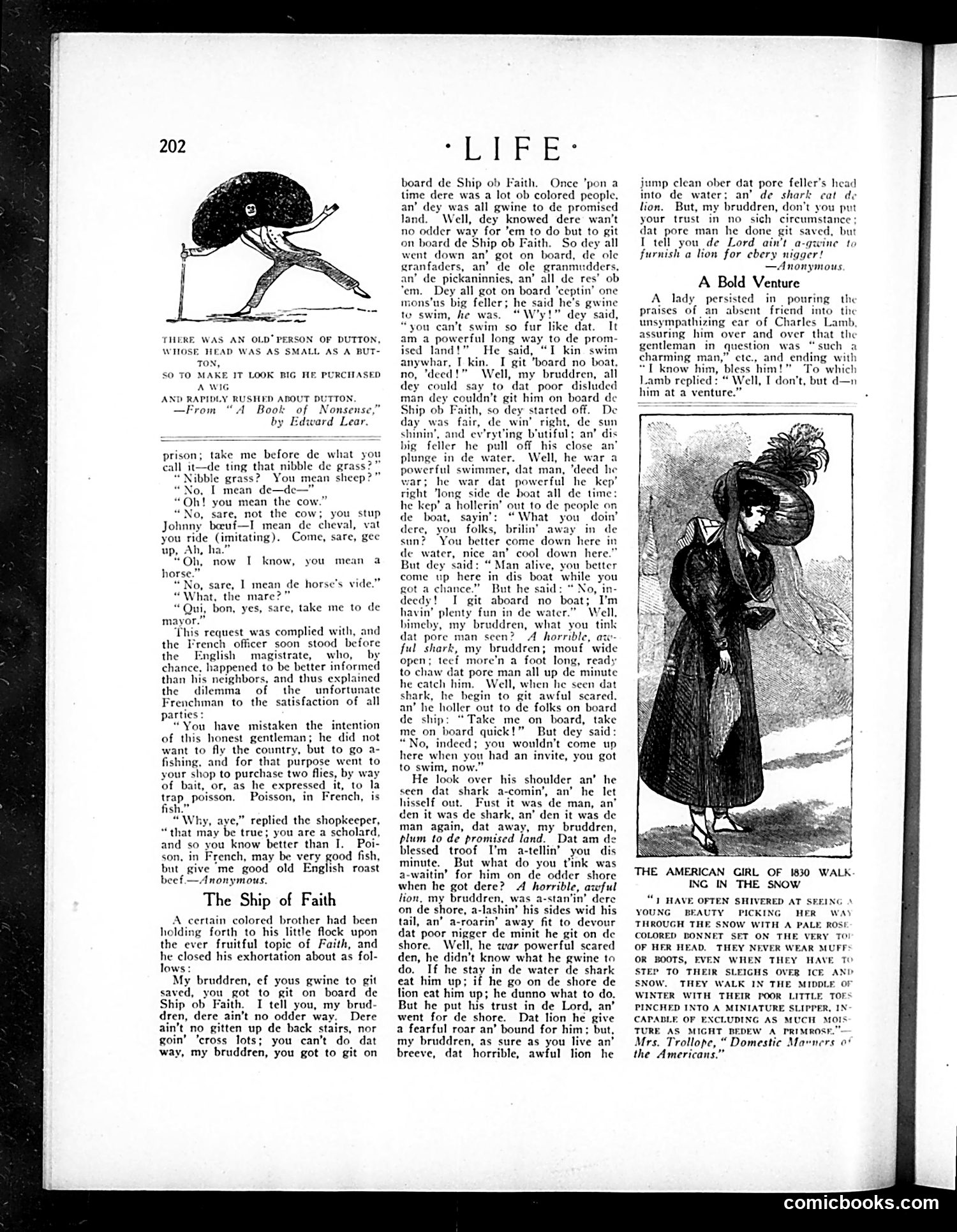
This page contains three distinct pieces of humor: 1. **"Old Person of Dutton"**: An Edward Lear nonsense verse illustrated with a stick-figure caricature—a visual joke about inflating one's appearance through artifice. 2. **"Poison/Poisson" Anecdote**: A dialect humor piece playing on French-English language confusion. A French officer repeatedly mispronounces "flies" (for fishing bait) as he struggles with English, creating comic misunderstandings with an English shopkeeper and magistrate. This reflects 19th-century Anglo-American stereotypes about French speakers. 3. **"The Ship of Faith"**: A sermon-style monologue in exaggerated African American dialect about a man who refuses to board a "Ship of Faith" to reach the promised land, insisting he can swim instead—until a shark appears. The moral is about trusting faith over individual stubbornness. This uses racist dialect conventions common to the era's "humor," though the underlying message concerns religious faith and obedience. All three pieces reflect period attitudes toward language, nationality, and race.
This page contains reader letters to *Life* magazine addressing contemporary social issues. Notable topics include: **Animal Welfare**: A reader challenges *Life's* anti-vivisection stance by asking why they don't also oppose cooking crabs and lobsters alive—exposing perceived inconsistency in animal-rights activism. **Medical Skepticism**: A writer blames vaccination for a child's lockjaw, expressing broader vaccine hesitancy and distrust of "pill-venders." **Beards and Military Masculinity**: A correspondent argues soldiers should wear full beards, citing dignity (invoking Generals Grant and Lee), practicality in weather, and reduced marching weight from eliminating shaving equipment—reflecting early-20th-century debates about masculine appearance and military efficiency. **Military Idleness**: A soldier critiques underutilization of the regular army, detailing the repetitive daily routine (reveille, drills, parades) as wasteful. These letters reveal *Life's* role as a forum for reader debate on hygiene, science, masculinity, and government efficiency.
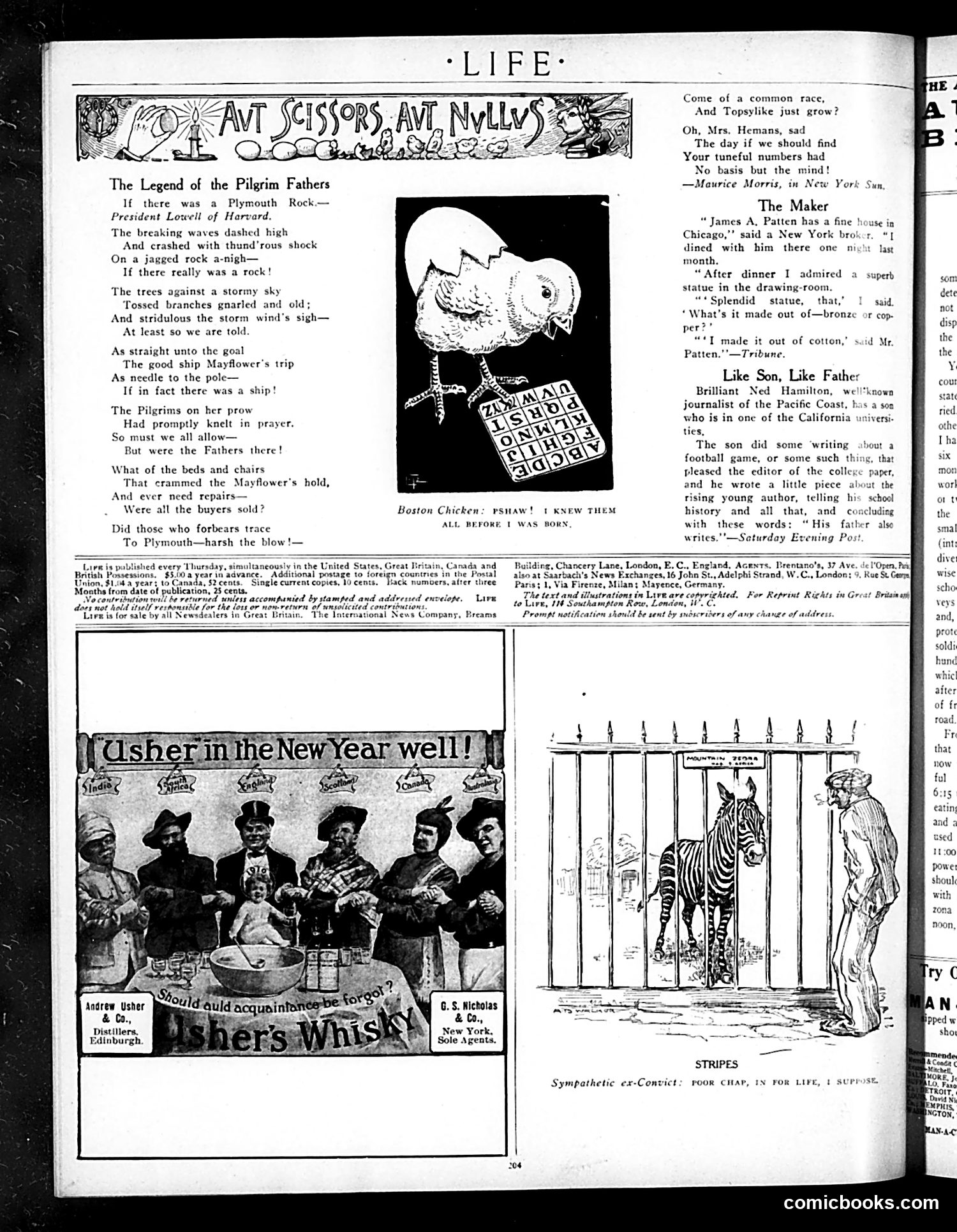
This page contains satirical poetry and humorous anecdotes typical of Life's editorial content. **"The Legend of the Pilgrim Fathers"** mockingly questions the historical accuracy of American founding mythology. The poem sarcastically suggests that iconic elements—Plymouth Rock, the Mayflower ship, the Pilgrims' devotion—may be largely fabricated or exaggerated ("If there really was a rock!"). It's satirizing American historical romanticism and the gap between legend and documented fact. **The three brief anecdotes** ("The Maker," "Like Son, Like Father," "Boston Chicken") are light social humor. "The Maker" jokes about a wealthy businessman (James A. Patten) claiming to have made a statue from cotton—suggesting nouveau riche pretension. "Like Son" humorously notes a young writer received credit partly because his famous father also writes. These poke fun at social climbing and inherited advantage. **"Stripes"** (bottom cartoon) shows a sympathetic convict, likely satirizing criminal justice or social inequality. The page primarily contains advertisements for whiskey interspersed with editorial content.
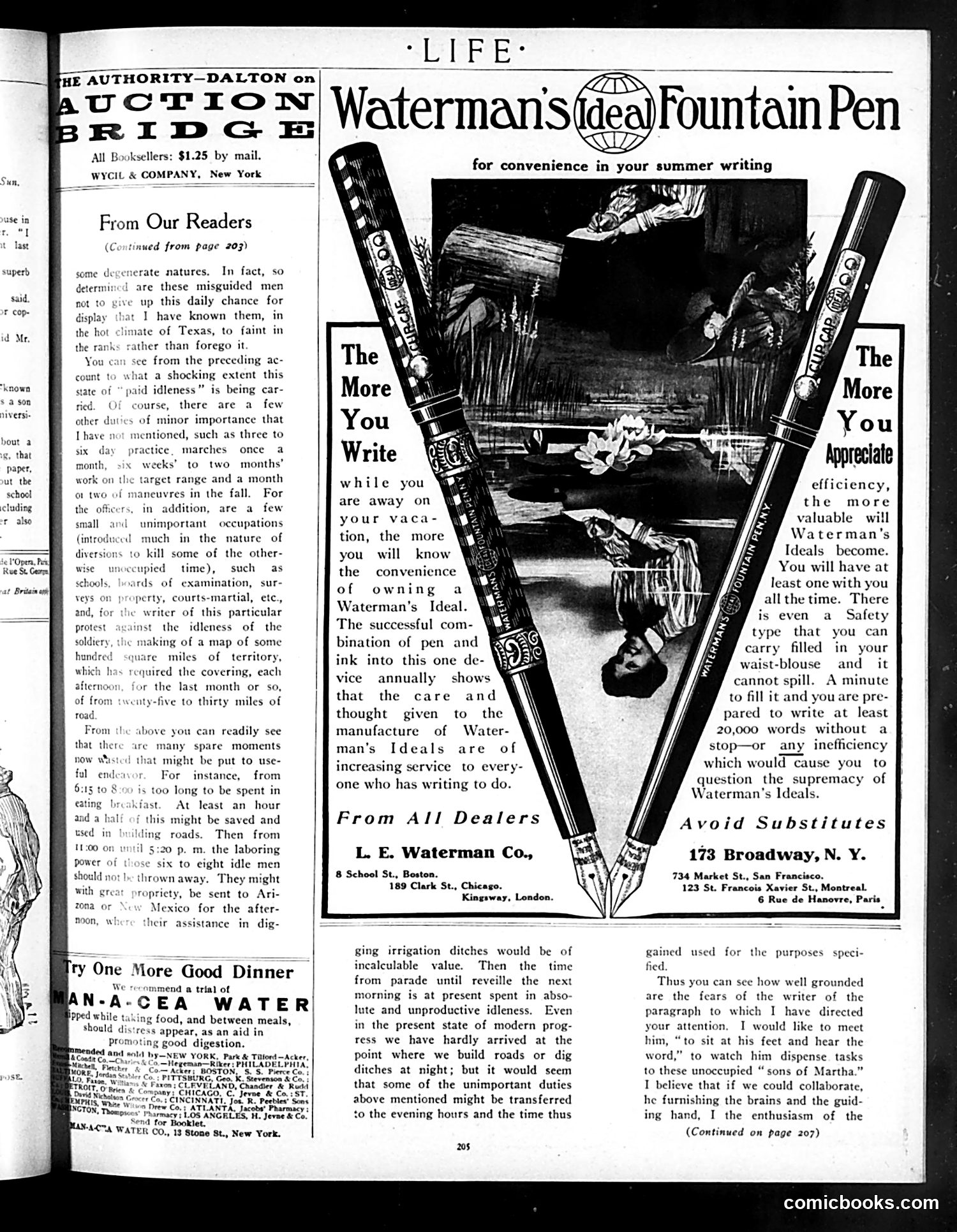
This page contains **no political cartoon**—it's primarily advertising and reader correspondence from an early 20th-century issue of *Life* magazine. The main content includes: 1. **"From Our Readers"**: A lengthy letter criticizing military idleness, arguing that soldiers have excessive free time (6:15-8:00 AM, 11:00 AM-5:20 PM) that should be redirected to productive labor like building roads or irrigation ditches. The writer appears frustrated with what he sees as wasteful military practices. 2. **Waterman's Ideal Fountain Pen Advertisement**: The dominant visual element—a large ad featuring two fountain pens flanking an image of someone writing outdoors. It promotes the pen's reliability and convenience for summer travel and correspondence. 3. **"Try One More Good Dinner"**: A small ad for An-a-cea Water as a digestive aid. The page reflects early 1900s concerns about military efficiency and leisure time, alongside period advertising emphasizing portable writing instruments for the literate classes.
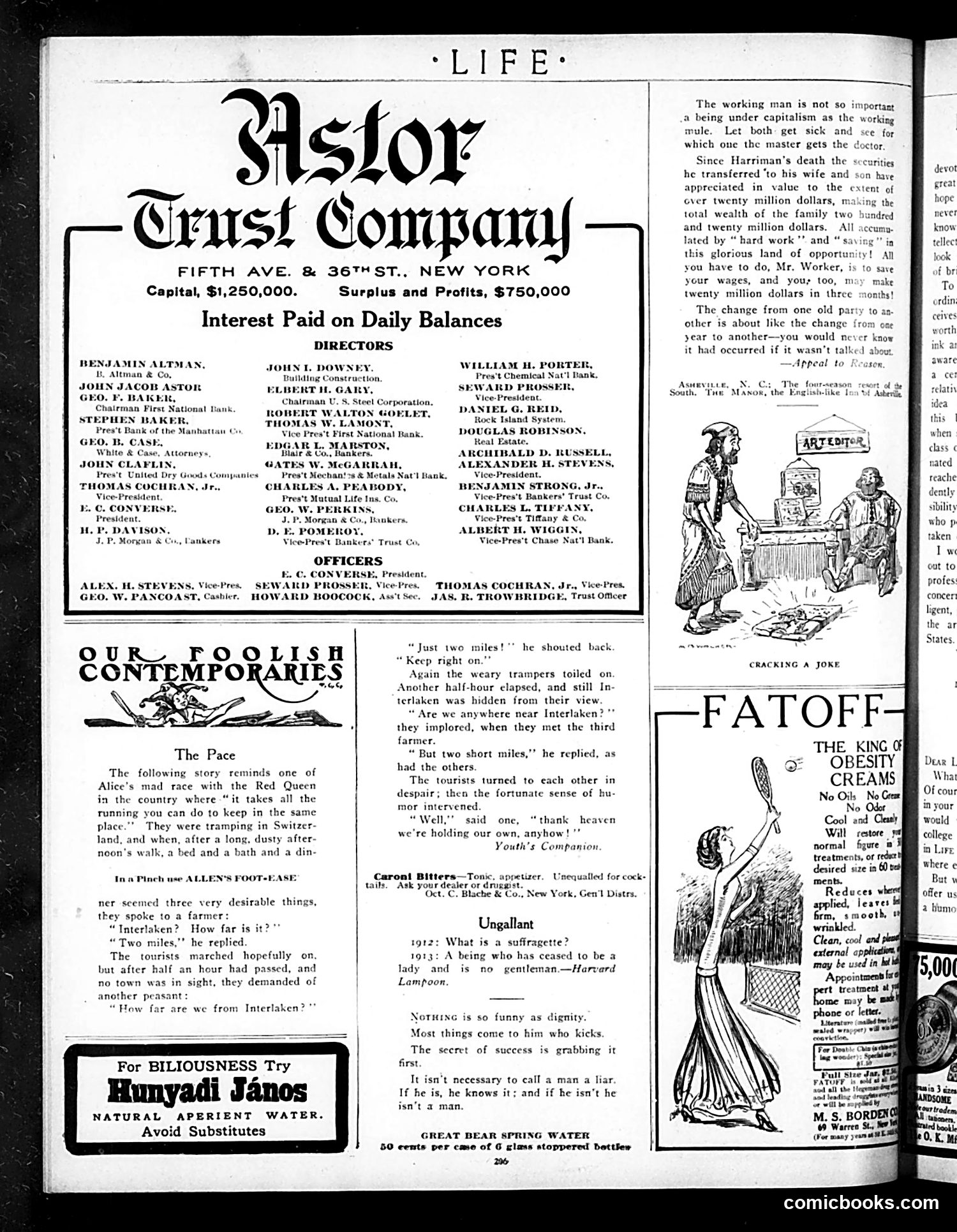
This page contains **primarily advertisements and filler content**, with one notable political-social commentary section. **Main Political Content:** The "Appeal to Labor" text criticizes wealth inequality, specifically referencing **E.H. Harriman's** death and the enormous appreciation of securities transferred to his heirs—twenty million dollars gained through inherited wealth. The satire argues working men fare worse than mules under capitalism and that political change between parties offers no real relief to workers. **The cartoons** are light humor pieces unrelated to politics: "Cracking a Joke" depicts casual conversation; "Fatoff" advertises obesity treatment. **The page is dominated by:** - The Astor Trust Company advertisement (banking/finance company listing directors) - Multiple product advertisements (water, bitters, foot-ease) - Humorous anecdotes ("The Pace," "Ungallant") **Historical context:** This reflects early 20th-century Progressive Era concerns about wealth concentration and labor conditions, written for Life's educated, middle-class readership skeptical of both major parties.
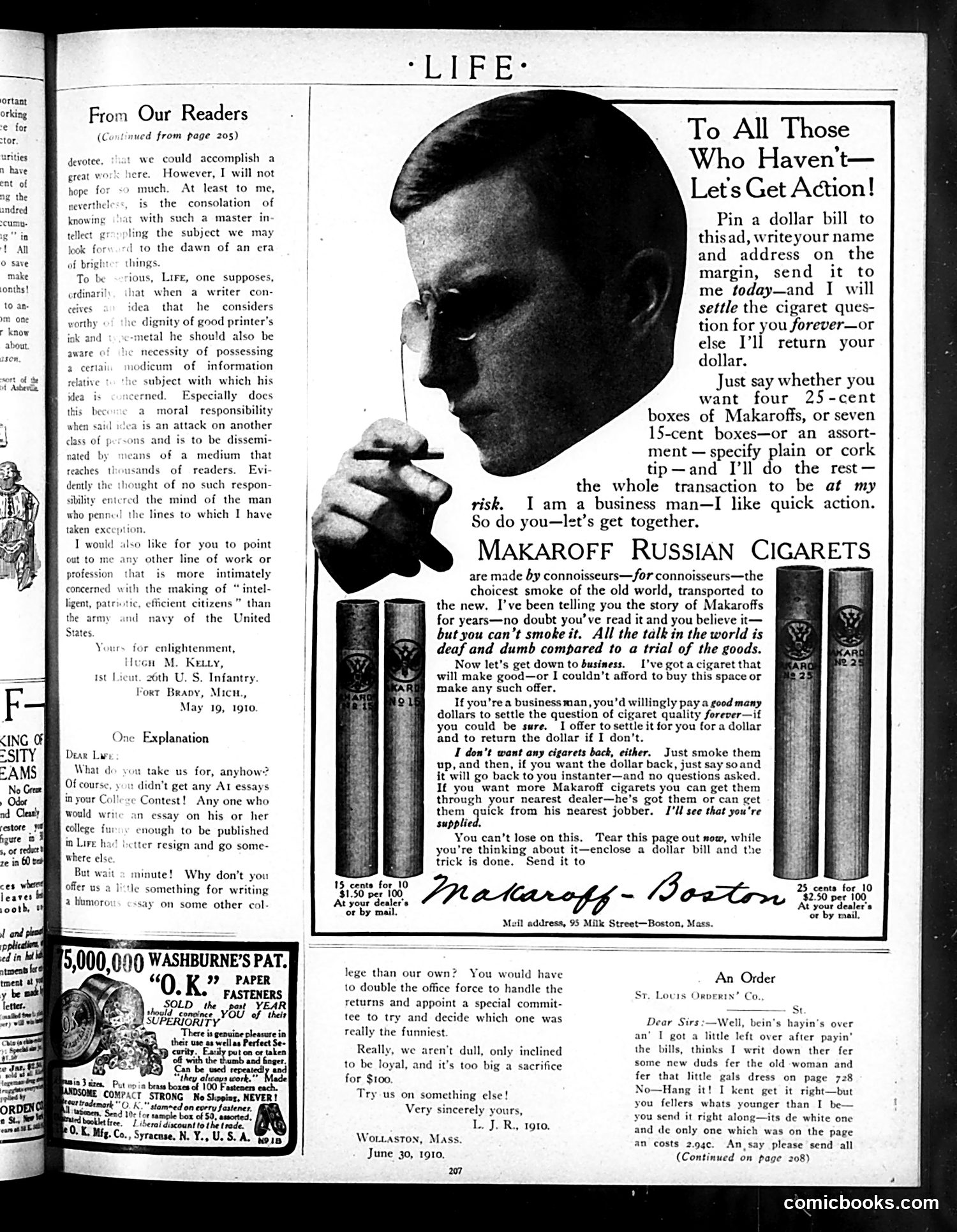
This page contains reader letters and advertisements rather than political cartoons. The dominant content is a full-page advertisement for **Makaroff Russian Cigarettes**, featuring a silhouetted profile of a man smoking. The ad uses a direct-mail marketing scheme: readers send a dollar bill with their name and address to receive cigarettes, with a promise to return the dollar if unsatisfied. This was a confidence-building sales tactic for an unfamiliar luxury product—Russian cigarettes marketed as "the choicest smoke of the old world." The smaller items are reader correspondence addressing Life magazine editors about essay submissions and military service. There's also an advertisement for Washburne's "O.K." paper fasteners at bottom left. **No political satire is present on this page.** It represents early 1900s consumer advertising aimed at middle-class "business men," emphasizing quality, exclusivity, and risk-free purchasing—marketing language that would resonate with the magazine's affluent readership.
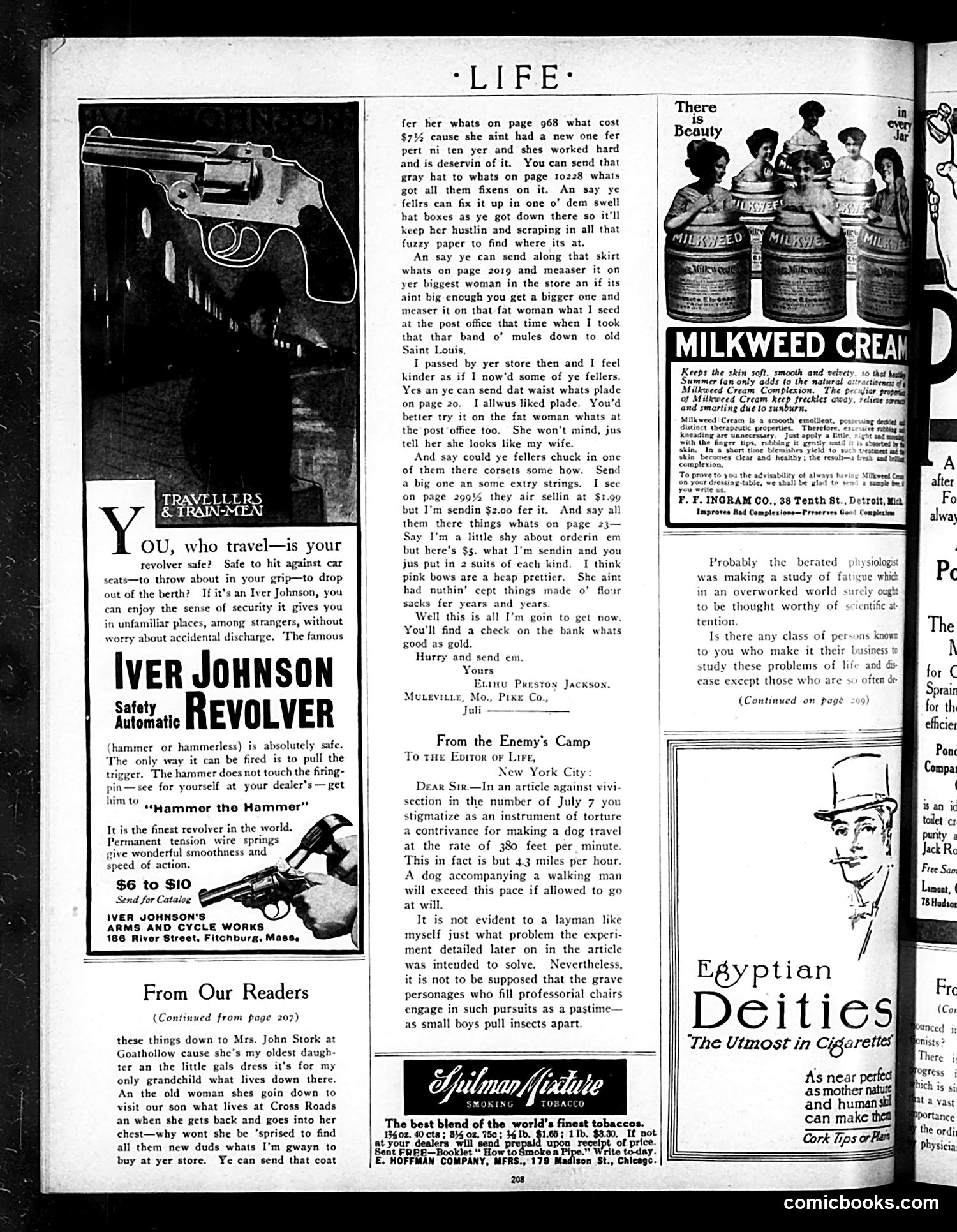
This page is primarily **advertising and reader correspondence**, not satirical cartoons requiring historical context. The main content includes: 1. **Iver Johnson Revolver ad**: Markets a handgun emphasizing safety for travelers, claiming the hammer doesn't touch the firing pin—a sales pitch for personal protection during an era when carrying revolvers was common travel practice. 2. **Reader letters**: A rural correspondent (Eugene Preston Jackson) places a mail-order catalog purchase with charming dialect, requesting women's clothing items by page number for his wife and daughter. This appears designed to entertain readers with authentic rural American speech patterns. 3. **Letter defending vivisection**: A correspondent defends animal experimentation, challenging a previous Life article's criticism of a device making dogs run at high speeds, arguing the pace (4.3 mph) is reasonable and that scientists aren't merely entertaining themselves. The page reflects early 20th-century concerns: mail-order shopping, accessible firearms, and debates over animal research ethics.
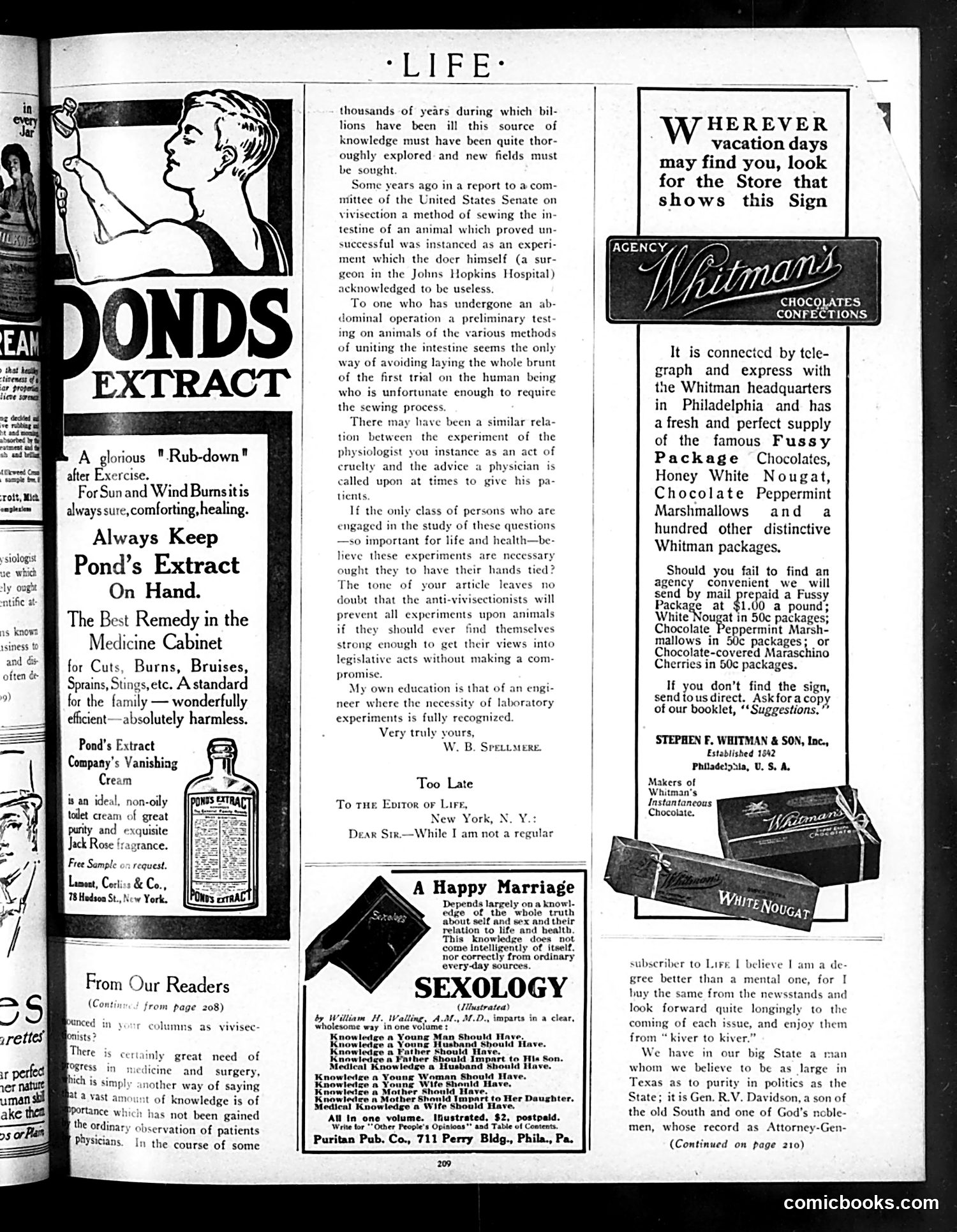
This page mixes **advertisements** with **editorial content** debating **animal testing in medical research**. The main text is a reader's letter defending **vivisection** (animal experimentation) as necessary for surgical advancement. The writer argues that testing procedures on animals—like intestinal-stitching techniques—prevents harm to human patients. He cites a Johns Hopkins surgeon's own acknowledgment of a failed animal test, suggesting controlled animal experiments prevent worse human suffering. The letter defends laboratory experimentation as essential to medical progress, comparing it to engineering's need for controlled testing. The opposing viewpoint (implied in the original letter being answered) apparently criticized animal cruelty in medical research. This reflects **early 20th-century debates** over animal welfare versus scientific necessity—a controversy that persists today but with now-established ethical review boards and alternatives to animal testing that didn't exist then. The page's ads (Pond's Extract, Whitman's Chocolates, Sexology books) are period commercial content, unrelated to the medical debate.
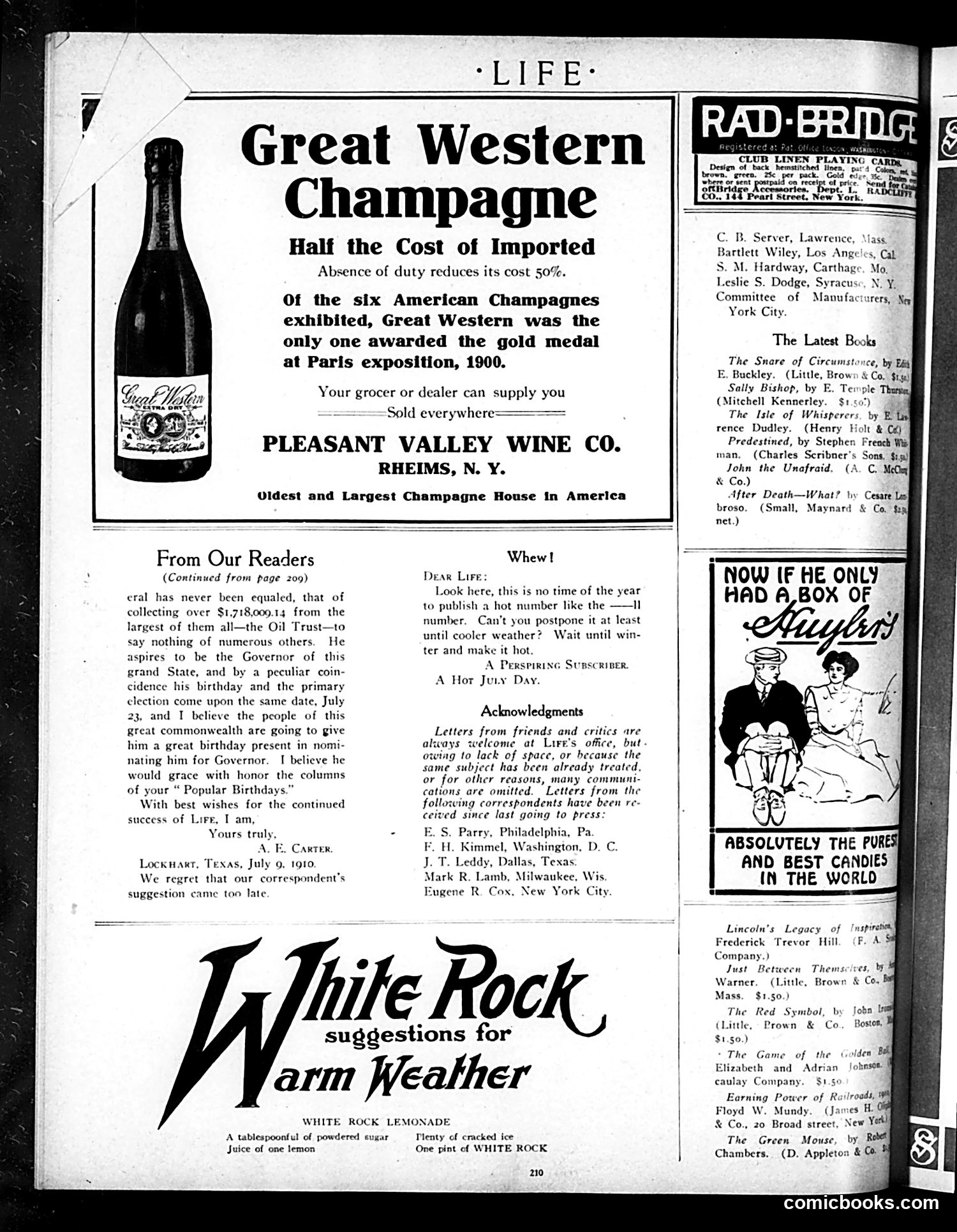
This page is primarily **advertising and reader correspondence**, not satirical content. The advertisements include: - **Great Western Champagne** (Pleasant Valley Wine Co., Rheims, NY): emphasizing it's half the cost of imported champagne and won a gold medal at the 1900 Paris Exposition - **White Rock Lemonade**: a recipe for hot weather - **Saylor's Candies**: claiming to be "absolutely the purest and best candies in the world" - **Rad-Bridge Club Linen Playing Cards** The "From Our Readers" section contains letters from subscribers, including one from A. E. Carter of Lockhart, Texas, discussing a political figure's efforts collecting funds and his aspirations for Governor—apparently someone the writer supports. The only humor appears in a letter titled "Whew!" complaining that publishing a "hot number" during July's heat is poor timing; the writer requests they wait until winter. This is essentially a **reader-engagement and advertising page** with minimal satirical content.
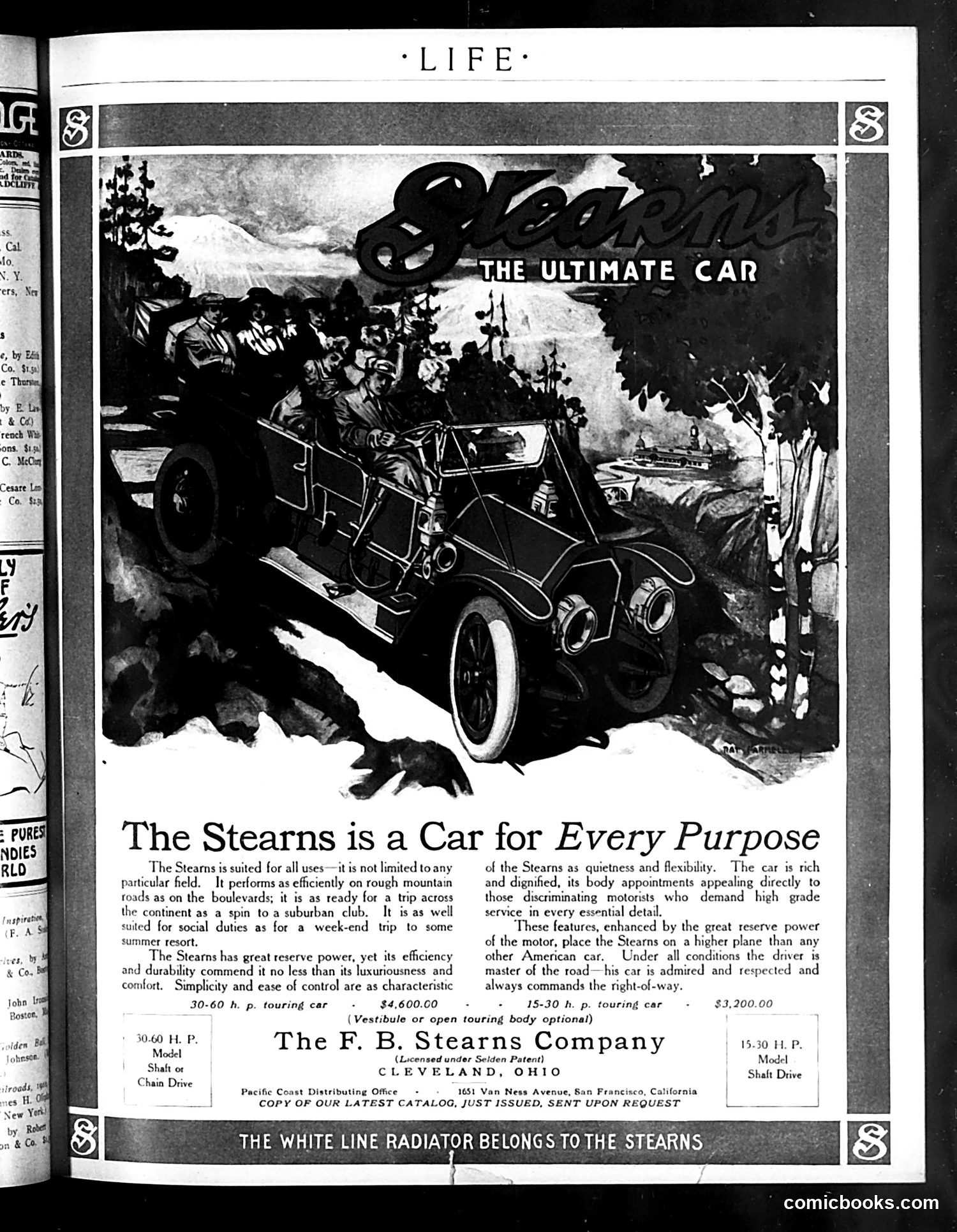
This is primarily a **vintage automobile advertisement**, not political satire. It's a full-page ad from *Life* magazine for the F.B. Stearns Company automobile, based in Cleveland, Ohio. The ad emphasizes the Stearns as "a Car for Every Purpose"—capable on mountain roads, boulevards, and suitable for both business trips and social occasions. The illustrated scene shows well-dressed passengers in a touring car in an idyllic landscape with mountains, water, and trees. The marketing pitch stresses luxury features: "quietness and flexibility," dignified appointments, and "great reserve power." Two models are advertised at $4,600 and $3,200, positioning the Stearns as a premium American automobile commanding respect on the road. This reflects early 1900s car marketing targeting affluent, discriminating buyers. The "White Line Radiator" is highlighted as a distinctive feature. There is no political or satirical content—this is straightforward period advertising.
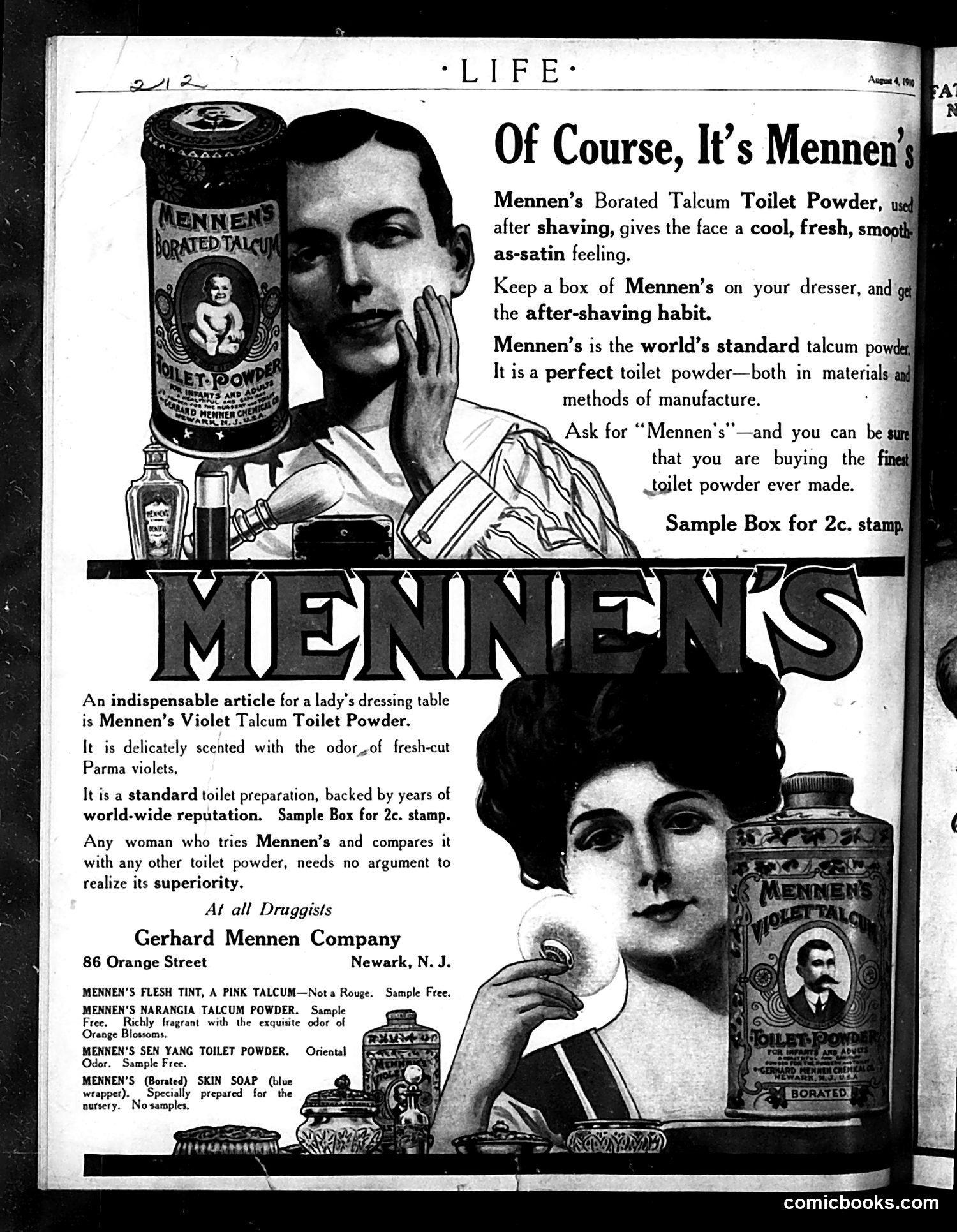
This page is **primarily advertising**, not political satire. It features two full-page advertisements for Mennen's talcum powder products from the Gerhard Mennen Company (Newark, N.J.). The ads use **gendered marketing typical of early 20th-century advertising**: the top half targets men with after-shaving powder ("cool, fresh, smooth as-satin feeling"), while the bottom half markets to women with scented "Violet Talcum Toilet Powder" for the dressing table, emphasizing fragrance (Parma violets, orange blossoms, oriental scents). Both ads feature **photographic portraits**—a man applying powder to his face (top) and a woman with grooming supplies (bottom)—and employ the era's common advertising rhetoric of "world standard" and "superiority" to justify premium pricing. There is **no political satire or cartoon commentary** visible on this page. It is straightforward product advertising with sample offers (2 cents postage).