
Life, 1910-08-04 · page 30 of 44
Life — August 4, 1910 — page 30: what you’re looking at
What you’re looking at
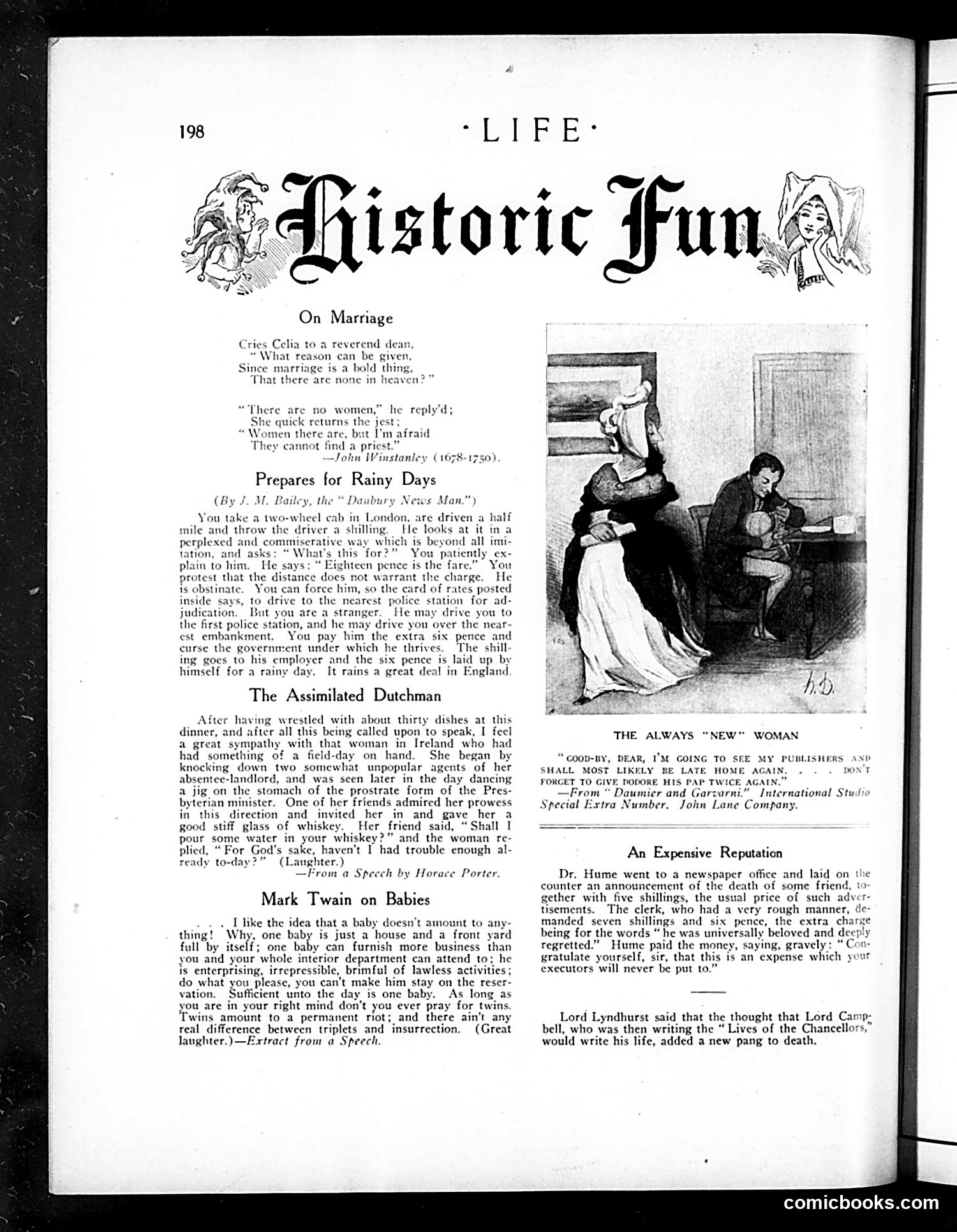
This page from *Life* magazine presents satirical humor on several topics: **"On Marriage"** quotes a witty exchange between a woman (Celia) and a clergyman about why no women exist in heaven—she retorts that women are there, but priests aren't, inverting the clergyman's misogynistic joke. **"Prepares for Rainy Days"** mocks London cab drivers who overcharge passengers, then pocket extra fees as personal savings ("for a rainy day"). **The cartoon** (right) titled "The Always 'New Woman'" depicts a modern woman leaving home to see publishers, neglecting domestic duties—satirizing the emerging independent "New Woman" of the era who pursued careers rather than traditional homemaking. **"Mark Twain on Babies"** uses Twain's humorous exaggeration to describe infants as uncontrollable chaos-agents, warning against twins. **"An Expensive Reputation"** jokes darkly about paying extra newspaper fees for flattering obituary language—suggesting one's reputation costs money even in death. The overall theme: modern social change and human foibles, treated with period satire.
📄 Transcribed text from this page (OCR, searchable)
Machine-transcribed from the original scan — historical spelling and the odd misread are preserved.
On Marriage es Celia to a reverend dean, What reason can be given, Since marri: is a bold th That there are none in heave “There are no women,” he reply’d; She quick returns the jest; “Women there are, but I'm afraid - cannot find a priest. John iWinstantey Prepares for Rainy Days (By J. M. Bailey, the “ Danbury News Man.”) You take a two-wheel cab in London, are driven a half mile and throw the driver a shilling. He looks at it in a perplexed and commiserative way which is beyond all imi- tation, and asks: “What's this for?” You patiently ex- plain to him. He s Eighteen pence is the fare.” You protest that the distance does not warrant the charge. He 1s obstinate, You can force him, so the card of rates posted inside says, to drive to the nearest police station for ad- judication. But you are a stranger. He may drive you to the first police station, and he may drive you over the near- est embankment. You pay him the extra six pence and curse the government under which he thrives. he shill ing goes to his employer and the six pence is laid up by himself for a rainy day. It rains a great deal in Eng! The Assimilated Dutchman After having wrestled with about thirty dishes at this dinner, and after all this being called upon to speak, I feel a great sympathy with that woman in Ireland who had had something of a field-day on hand. She began by knocking down two somewhat unpopular agents of her absentee-landlord, and was seen later in the day dancing a jig on the stomach of the prostrate form of the Pres- byterian minister. One of her friends admired her prowess in this direction and invited her in and gave her a good stiff glass of whiskey. Her_friend said, “Shall I pour some water in your whiskey?” and the woman re- plied, “ For God's sake, haven't I had trouble enough al- ready to-day?” (Laughter.) —From a Speech by Horace Porter. Mark Twain on Babies < I like the idea that a baby doesn’t amount to any- thing! Why, one baby is just a house and a front yard full by itself; one baby can furnish more business than you and your whole interior department can attend to; he is enterprising, irrepressible, brimful of lawless activities ; do what you please, you can’t make him stay on the reser- vation. Sufficient unto the day is one baby. As long as you are in your right mind don’t you ever pray for twins. Twins amount to a permanent riot; and there ain’t any real difference between triplets and insurrection. (Great laughter.) —Extract from a Speech. THE ALWAYS “NEW WOMAN “GoOD-BY, DEAR, I'M GOING TO SEE MY PUBLISHERS AND SHALL MO: LIKELY BE LATE HOME AGAIN. . DONT FORGET TO GIVE PODORE HIS PAP TWICE AGAL —From * Daumier and Garvarni.” International Studio vtra Number. John Lane Company. An Expensive Reputation Dr. Hume went to a newspaper office and laid on t counter an announcement of the death of some friend, gether with five shillings, the usual price of such adver- tisements. The clerk, who had a very rough manner, de- manded seven shillings and six pence, the extra charge being for the words “he was universally beloved and dec regretted.” Hume paid the money, saying, gravel: Co gratulate yourself, sir, that this is an expense which your executors will never be put to.” Lord Lyndhurst said that the thought that Lord Car bell, who was then writing the “Lives of the Chancell would write his life, added a new pang to death, comicbooks.com