
Life, 1910-08-04 · page 24 of 44
Life — August 4, 1910 — page 24: what you’re looking at
What you’re looking at
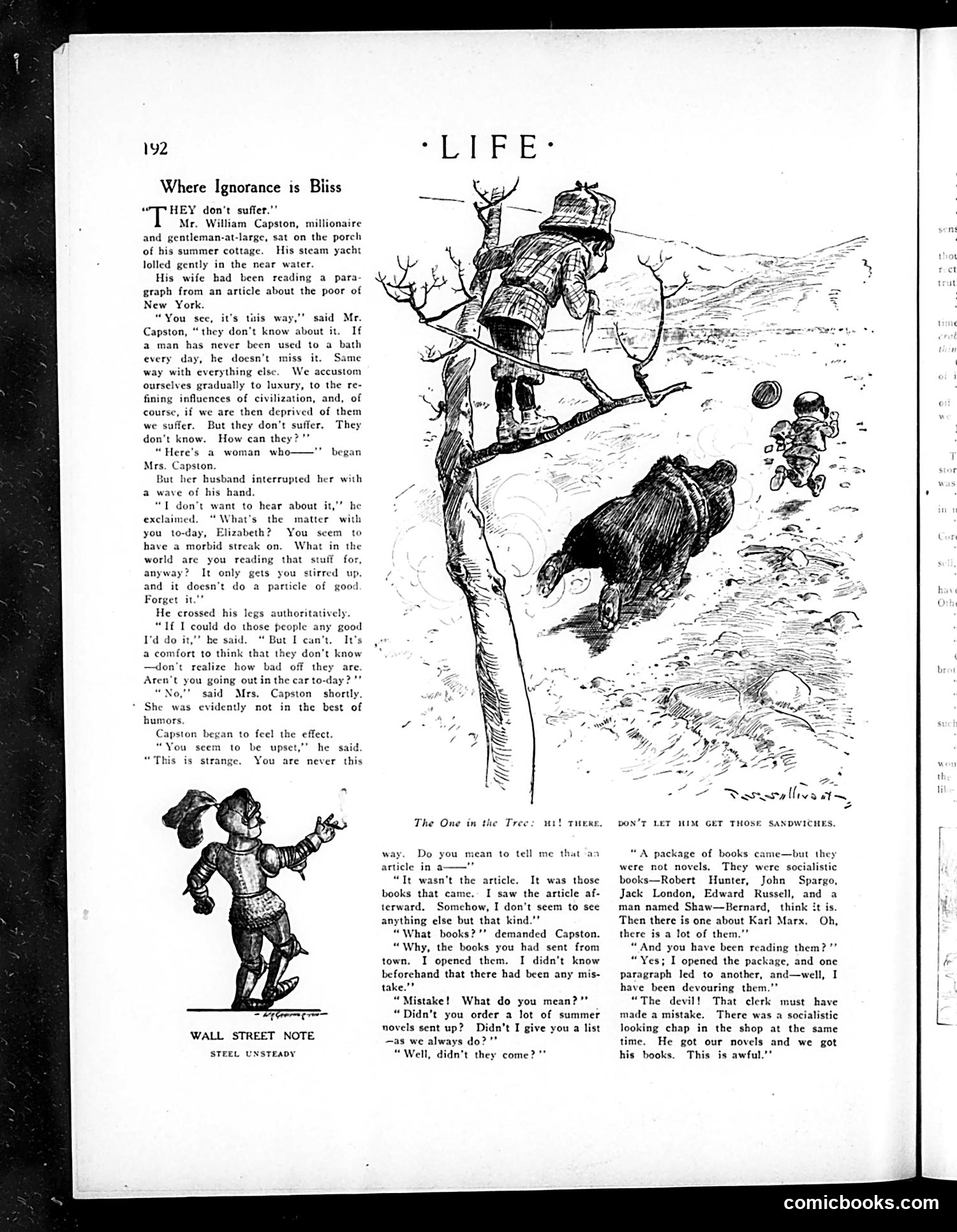
This story satirizes wealthy indifference to social suffering. Mr. Capston, a rich industrialist, argues that poor people don't suffer from deprivation because they've "never known" luxury—so ignorance protects them from unhappiness. His wife challenges this by reading about New York's poor. The satire escalates when Mrs. Capston accidentally receives socialist books (by Robert Hunter, Jack London, Edward Russell, and Bernard Shaw) instead of summer novels. She becomes disturbed after reading them, suggesting the books awaken her conscience. The humor targets Capston's self-serving logic: he comforts himself with the idea that poor people are happily unaware, while simultaneously being horrified when *his own wife* gains awareness through reading. The cartoon exposes the hypocrisy—wealthy people want the poor to remain ignorant so the rich needn't feel guilty, yet fear similar enlightenment spreading to their own class.
📄 Transcribed text from this page (OCR, searchable)
Machine-transcribed from the original scan — historical spelling and the odd misread are preserved.
\y2 Where Ignorance is Biiss “ HEY don't suffer."’ Mr. William Capston, millionaire and gentleman-at-large, sat on the porch of his summer cottage. His steam yacht lolled gently in the near water. His wife had been reading a para graph from an article about the poor of New York. “You see, it’s this way,’’ said Mr. Capston, “they don’t know about it. If a man has never been used to a bath every day, he doesn’t miss it. Same way with everything else. We accustom ourselves gradually to luxury, to the re- fining influences of civilization, and, of course, if we are then deprived of them we suffer. But they don’t suffer. They don’t know. How can they?’’ “Here's a woman who—"’ began Mrs. Capston. But her husband interrupted her with a wave of his hand. “1 don’t want to hear about it,” he exclaimed. “What's the matter with you to-day, Elizabeth? You seem to have a morbid streak on. What in the world are you reading that stuff for, anyway? It only gets you stirred up. and it doesn’t do a particle of good Forget it.”’ He crossed his legs authoritatively. “If I could do those people any good I'd do it,’ be said. “ But I can't. It's a comfort to think that they don’t know —don’t realize how bad off they are. Aren't you going out in the car to-day?" “No,’? said Mrs, Capston shortly. She was evidently not in the best of humors. Capston began to feel the effect. You seem to be ups. he said. “This is strange. You are never this WALL STREET NOTE STEEL UNSTEADY The One in the Tree: uit tiers, way. Do you mean to tell me that aa article in a “Tt wasn’t the article. It was those books that came. I saw the article af- terward. Somchow, I don’t seem to see anything else but that kind.’’ “What books?’’ demanded Capston. “Why, the books you had sent from town. I opened them. I didn't know beforehand that there had been any mis- take.’” “Mistake! What do you mean?’’ “Didn’t you order a lot of summer novels sent up? Didn't I give you a list —as we always do?'* “Well, didn't they come?" — Desasullivea tn 2 DON’T LET MIM GET THOSE SANDWICHES. “A package of books came—but they were not novels, They were socialistic books—Robert Hunter, John Spargo, Jack London, Edward Russell, and a man named Shaw—Bernard, think it is. Then there is one about Karl Marx. Oh, there is a lot of them." nd you have been reading them?’’ Yes; I opened the package, and one paragraph led to another, and—well, I have been devouring them.” “The devil! That clerk must have made a mistake. There was a socialistic looking chap in the shop at the same time. He got our novels and we got his books. This is awful.’” comicbooks.com