
Life, 1910-08-04 · page 16 of 44
Life — August 4, 1910 — page 16: what you’re looking at
What you’re looking at
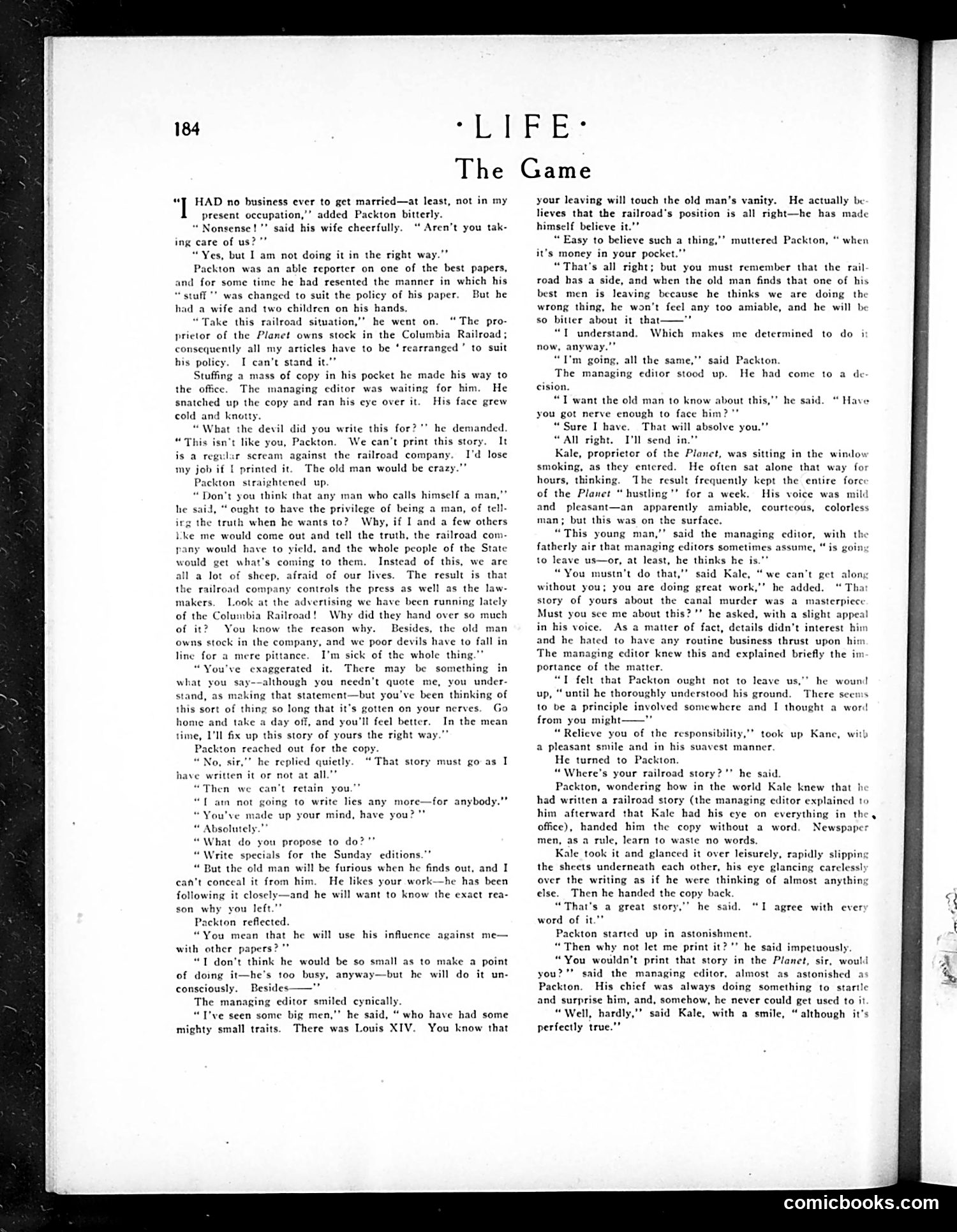
This story satirizes early 20th-century American newspaper corruption. Reporter Packton has written an exposé criticizing the Columbia Railroad, but his editor demands he soften it because the *Planet* newspaper's owner holds railroad stock and depends on their advertising revenue. The satire targets **press control by corporate interests**: the railroad essentially dictates editorial policy through financial leverage, forcing journalists to suppress truth. When Packton refuses to compromise his integrity, he's forced to resign—but the managing editor warns that the owner will retaliate by blacklisting him with other papers, punishing his principled stand. The story illustrates the "game" of American journalism: reporters must choose between honest reporting and employment. The editor's cynical acceptance ("I've seen some big men who have had some mighty small traits") suggests this corruption is systemic and normalized among the powerful, making individual moral stands economically suicidal.
📄 Transcribed text from this page (OCR, searchable)
Machine-transcribed from the original scan — historical spelling and the odd misread are preserved.
Sige The Game HAD no business ever to get married—at least, not in my present occupation,’’ added Packton bitterly. “Nonsense! ’? said his wife cheerfully. “Aren't you tak- ing care of us?" “Yes, but I am not doing it in the right wa Packton was an able reporter on one of the best papers, and for some time he bad resented the manner in which his tuff" was changed to suit the policy of his paper. But he had a wife and two children on his hands. Take this railroad situation,” he went on. “The pro- prietor of the Planet owns stock in the Columbia Railroa consequently all my articles have to be ‘rearranged ’ to suit his policy. I can’t stand it.”” Stuffing a mass of copy in his pocket he made his way to the office. The managing editor was waiting for him. He snatched up the copy and ran his eye over it. His face grew cold and knotty. “What the devil did you write this for?" he demanded. “This isn’t like you, Packton. We can’t print this story. It is a regular scream against the railroad company. I'd lose my job if [printed it. The old man would be crazy.”” Packton straightened up “Don't you think that any man who calls himself a man," he said, “ ought to have the privilege of being a man, of tell- irg the truth when he wants to? Why, if I and a few others lke me would come out and tell the truth, the railroad com- pany would have to yield, and the whole people of the State would get what's coming to them. Instead of this, we are all a lot of sheep, afraid of our lives. The result is th: the railroad company controls the press as well as the law- makers. Look at the advertising we have been running lately of the Columbia Railroad! Why did they hand over so much of it? You know the reason why. Besides, the old man owns stock in the company, and we poor devils have to fall in line for a mere pittance. I'm sick of the whole thing." “You've exaggerated it. There may be something in what you say--although you needn't quote me, you under- stand, as making that statement—but you've been thinking of this sort of thing so long that it’s gotten on your nerves. Go home and take a day off, and you'll feel better. In the mean time, I'll fix up this story of yours the right way.” Packton reached out for the copy. “No, sir,"’ he replied quietly. “That story must go as I have written it of not at all.” Then we can’t retain you.’” { atm not going to write lies any more—for anybody.” le up your mind, have you?" “Write specials for the Sunday editions. “ But the old man will be furious when he finds out, and I can't conceal it from him. He likes your work—he has been following it closely—and he will want to know the exact rea- son why you left Packton reflected. You mean that he with other papers?” “T don't think he would be so small as to make a point of doing it—he’s too busy, anyway—but he will do it un- consciously. Besides The managing editor smiled cynically “T've seen some big men," he said, “who have had some mighty small traits. There was Louis XIV. You know that Muse his influence against me— your leaving will touch the old man’s vanity. He actually be lieves that the railroad’s position is all right—he has made himself believe it. “ Easy to believe such a thing,’ muttered Packton, “ when it's money in your pocket.” “That's all right; but you must remember that the rail road has a side, and when the old man finds that one of his best men is leaving because he thinks we are doing the wrong thing, he won't feel any too amiable, and he will be so bitter about it that——"* “T understand. Which makes me determined to do i now, anyway.”” “I'm going, all the same," said Packton. The managing editor stood up. He had come to a de cision. “T want the old man to know about thi you got nerve enough to face him? “Sure I have. That will absolve you."’ “AML right. I'll send in. Kale, proprietor of the Planct, was sitting in the window smoking, as they entered. He often sat alone that way for hours, thinking. ‘The result frequently kept the entire fore: of the Planet “ hustling’ for a week. His voice was mild and pleasant—an apparently amiable, courteous, colorless an; but this was on the surface. “This young man,’ said the managing editor, with the fatherly air that managing editors sometimes assume, “is goin to leave us—or, at least, he thinks he is.” “You mustn't do that,"” said Kale, “we can’t get along without you; you are doing great work," he added. “That story of yours about the canal murder was a masterpiece Must you see me about this?'’ he asked, with a slight appeal in his voice. As a matter of fact, details didn’t interest him and he hated to have any routine business thrust upon him The managing editor knew this and explained briefly the im portance of the matter. I felt that Packton ought not to leave us,"? he wound up, “until he thoroughly understood his ground. There se to be a principle involved somewhere and I thought a word from you might—" “Relieve you of the responsibility,’ took up Kane, with a pleasant smile and in his suavest manner He turned to Packton. “Where's your railroad story?'? he said. Packton, wondering how in the world Kale knew that he had written a railroad story (the managing editor explained to him afterward that Kale had his eye on everything in th office), handed him the copy without a word. Newspaper men, as a rule, learn to waste no words. Kale took it and glanced it over leisurely, rapidly slippi the sheets underneath each other, his eye glancing carelessly over the writing as if he were thinking of almost anything else. Then he handed the copy back. ‘ “That's a great story,’ he said. “I agree with every ‘ word of it.” Packton started up in astonishment. Then why not let me print it?" he said impetuously. You wouldn't print that story in the Planet, sir, would you?’? said the managing editor, almost as astonished Packton. His chief was always doing something to start! and surprise him, and, somehow, he never could get used to it “Well, hardly,” said Kale, with a smile, “although it’s perfectly true.’” he said. “ Have comicbooks.com