
Life, 1910-08-04 · page 17 of 44
Life — August 4, 1910 — page 17: what you’re looking at
What you’re looking at
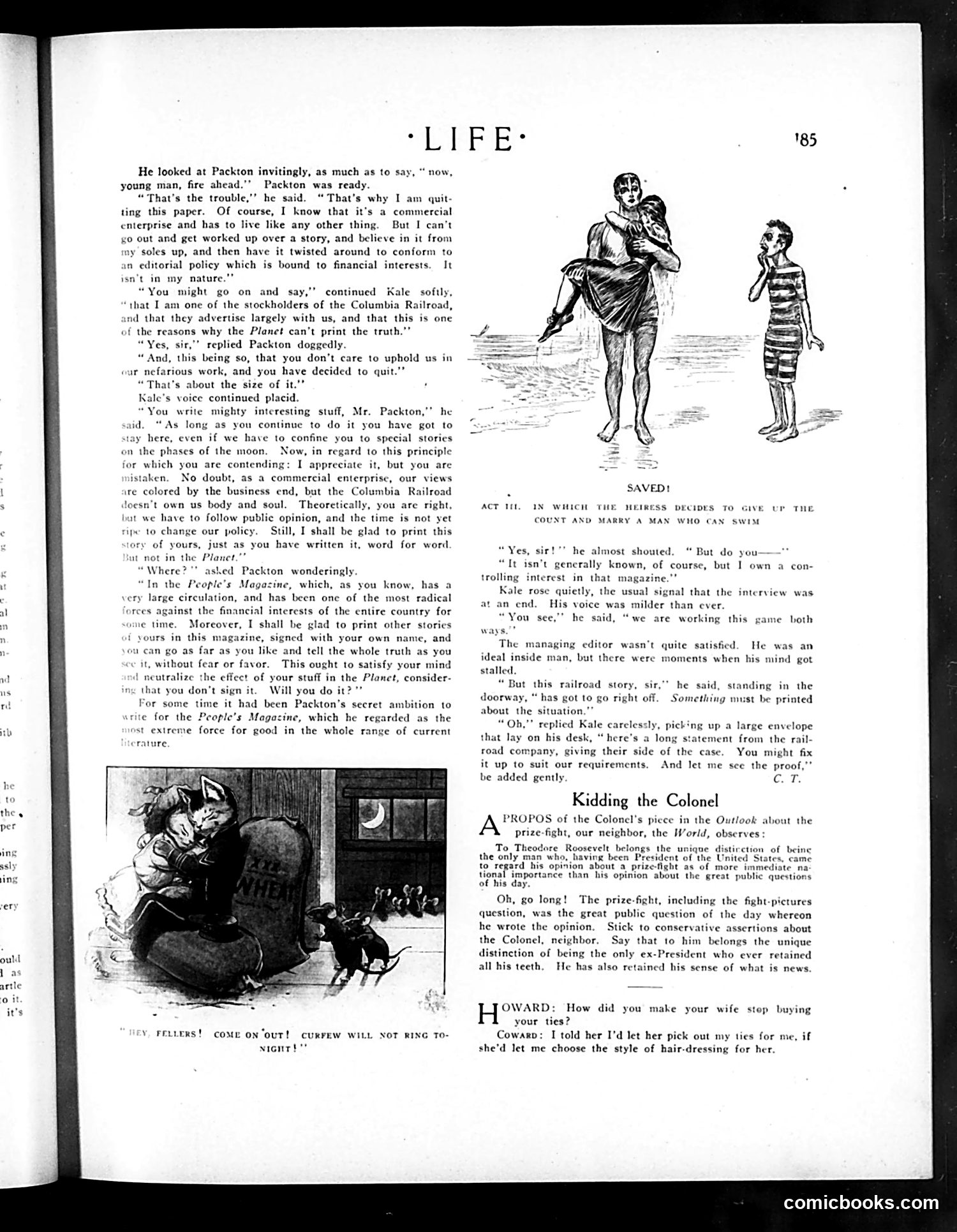
This page contains two distinct pieces of satirical content: **Main Story: "Packton and Kale"** A serialized narrative about journalistic integrity versus corporate control. Packton, a newspaper writer, quits because his stories are edited to serve the financial interests of the Columbia Railroad (which owner Kale secretly controls). The satire's point: wealthy interests disguise their influence through multiple publications—Kale reveals he also owns "The People's Magazine," supposedly a radical force for good, allowing him to control both progressive and mainstream narratives. The joke exposes how capitalists could manipulate public opinion across the political spectrum. **Lower Content: "Kidding the Colonel"** A brief satirical note about Theodore Roosevelt's recent piece in the *Outlook* magazine offering opinions on prizefighting. The text implies Roosevelt, as a former president, inappropriately leveraged his status to comment on matters beyond his expertise—a jab at his public prominence and self-importance. Both pieces mock institutional hypocrisy and powerful figures' hidden influence over public discourse.
📄 Transcribed text from this page (OCR, searchable)
Machine-transcribed from the original scan — historical spelling and the odd misread are preserved.
~LEF'E* He looked at Packton invitingly, as much as to say, “now, young man, fire ahead.’ Packton was ready. “That's the trouble,” he said. “That's why I am quit- ting this paper. Of course, I know that it's a commercial enterprise and has to live like any other thing. But I can't go out and get worked up over a story, and believe in it from ny soles up, and then have it twisted around to confo sn editorial policy which is bound to financial interests isn’t in my nature."” “You might go on and say,’’ continued Kale softly, “that I am one of the stockholders of the Columbia Railroad, the reasons why the Planet can’t print the truth.”” “Yes, sir,” replied Packton doggedly. “And, this being so, that you don’t care to uphold us in our nefarious work, and you have decided to quit.” “That’s about the size of it.”’ Kale’s voice continued placid. “You write mighty interesting stuff, Mr. Packton,’? he said. “As long as you continue to do it you have got to here, even if we have to confine you to special stories on the phases of the moon, Now, in regard to this principle for which you are contending: I appreciate it, but you are istaken. No doubt, as a commercial enterprise, our views re colored by the business end, but the Columbia Railroad loesn’t own us body and soul. Theoretically, you are right, bat we have to follow public opinion, and the time is not yet ripe to change our policy. Still, I shall be glad to print this ory of yours, just as you have written it, word for word jot in the Planet.’” “Where? " ashed Packton wonderingly. “In the People’s Magazine, which, as you know, has a cry large circulation, and has been one of the most radical orces against the financial interests of the entire country for me time. Moreover, I shall be glad to print other stories { yours in this magazine, signed with your own name, and ou can go as far as you like and tell the whole truth as you it, without fear or favor. This ought to satisfy your mind (| neutralize the effect of your stuff in the Planet, consider- that you don’t sign it. Will you do it?” For some time it had been Packton’s secret ambition to rite for the People’s Magazine, which he regarded as the ost extreme force for good in the whole range of current erature Y FRLLERS! COME ON “OUT! CURFEW WILL NOT RING TO- nicut!** SAVED! ACT 11. IN WHICH THE HEIRESS DECIDES TO GIVE UP THE COUNT AND MARRY A MAN WHO CAN SWIM “Yes, sir!'’ he almost shouted. “ But do you— “It isn’t generally known, of course, but I own a con- trolling interest in that magazine." le rose quietly, the usual signal that the interview was His voice was milder than ever. see,"’ he said, “we are working this game both The managing editor wasn’t quite satisfied. He was an ideal inside man, but there were moments when his mind got stalled. “But this railroad story, sir,” he said, standing in the doorway, “ has got to go right off. Something must be printed about the situation.” “Oh,” replied Kale carelessly, picking up a large envelope that lay on his desk, “here's a long statement from the rail- road company, giving their side of the case. You might fix it up to suit our requirements. And let me sce the proof,” be added gently. CT: Kidding the Colonel PROPOS of the Colonel's piece in the Outlook about the prize-fight, our neighbor, the World, observes: To Theodore Roosevelt belongs the unique distirction of beine the only man who, having been President of the United States, came to regard his opinion about a prizefight as of more immediate na tional importance than his opinion about the great public questions of his day. Oh, go long! The prize-fight, including the fight-pictures question, was the great public question of the day whereon he wrote the opinion. Stick to conservative assertions about the Colonel, neighbor, Say that 10 him belongs the unique distinction of being the only ex-President who ever retained all his teeth. He has also retained his sense of what is news OWARD: How did you make your wife stop buying your ties? Cowarp: I told her I'd let her pick out my ties for me, if she'd let me choose the style of hair-dressing for her. comicbooks.com