
Life, 1910-08-04 · page 34 of 44
Life — August 4, 1910 — page 34: what you’re looking at
What you’re looking at
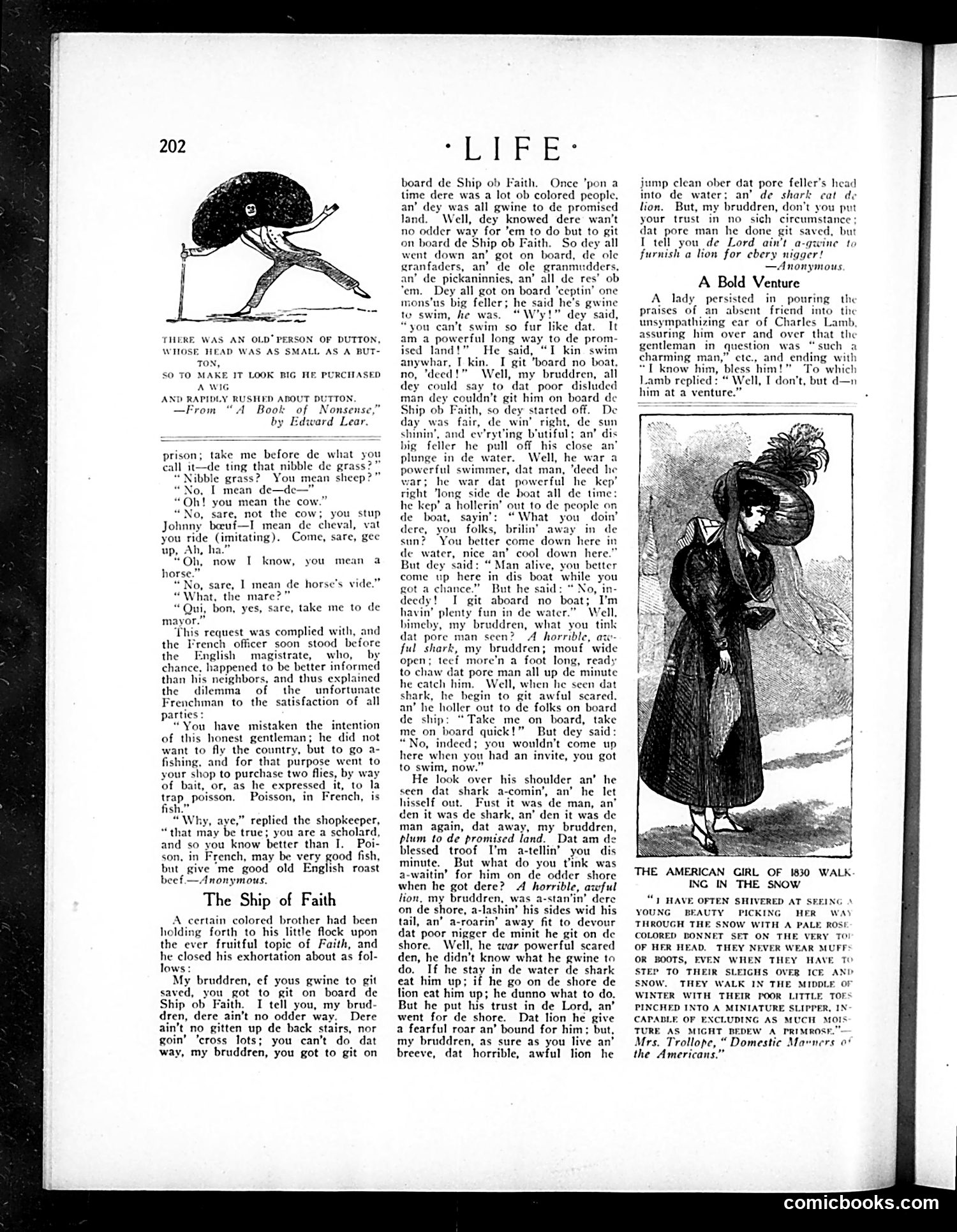
This page contains three distinct pieces of humor: 1. **"Old Person of Dutton"**: An Edward Lear nonsense verse illustrated with a stick-figure caricature—a visual joke about inflating one's appearance through artifice. 2. **"Poison/Poisson" Anecdote**: A dialect humor piece playing on French-English language confusion. A French officer repeatedly mispronounces "flies" (for fishing bait) as he struggles with English, creating comic misunderstandings with an English shopkeeper and magistrate. This reflects 19th-century Anglo-American stereotypes about French speakers. 3. **"The Ship of Faith"**: A sermon-style monologue in exaggerated African American dialect about a man who refuses to board a "Ship of Faith" to reach the promised land, insisting he can swim instead—until a shark appears. The moral is about trusting faith over individual stubbornness. This uses racist dialect conventions common to the era's "humor," though the underlying message concerns religious faith and obedience. All three pieces reflect period attitudes toward language, nationality, and race.
📄 Transcribed text from this page (OCR, searchable)
Machine-transcribed from the original scan — historical spelling and the odd misread are preserved.
THERE WAS AN OLD’ PERSON OF DUTTON, WHOSE HEAD WAS AS SMALL AS A BUT- TON, $0 TO MAKE IT LOOK BIG HE PU A WIG AND RAPIDLY RUSHLED ABOUT DUTTON —From Book of Nonsense,” by Edward Lear. CHASED prison; take me before de what you I it—de ting that nibble de grass? Nibble grass? You mean sheep?” No, I mean de—de—" “Oh! you mean the cow.” “No, sare, not the cow; you stup Johnny beuf—I mean de cheval, vat you ride (imitating). Come, sare, gee up, Ah, hi “Oh, now I horse. . No, sare, 1 mean de horse's vide.” “What, the mare?” “Qui, bon, yes, sare, take me to de mayor. . This request was complied with, and the French officer soon stood before the English magistrate, who, by chance, happened to be better informed than his neighbors, and thus explained the dilemma of the unfortunate Frenchman to the satisfaction of all parties: “You have mistaken the intention of this honest gentleman; he did not want to fly the country, but to go a- fishing, and for that purpose went to your shop to purchase two flies, by way of bait, or, as he expressed it, to la trap poisson. Poisson, in French, is fish.” “Why, aye,” replied the shopkeeper, “that may be true; you are a scholard, and so you know better than I. Poi- son, in French, may be very good fish, but give ‘me good old English roast beef —Anonymous. The Ship of Faith A certain colored brother had been holding forth to his little flock upon the ever fruitful topic of Faith, and he closed his exhortation about as fol- lows: My bruddren, ef yous gwine to git saved, you got to git on board de Ship ob Faith, I tell you, my brud- dren, dere ain't no odder way, Dere ain’t no gitten up de back stairs, nor goin’ ‘cross lots; you can’t do dat way, my bruddren, you got to git on know, you mean a “TE INPSE board de Ship ob Faith. Once 'pon a time dere was a lot ob colored people. an’ dey was all gwine to de promised land. Well, dey knowed dere wan't no odder way for ’em to do but to git on board de Ship ob Faith. So dey all went down an’ got on board, de ole granfaders, an’ de ole granmudders, an’ de pickaninnies, an’ all de res’ ob “em. Dey all got on board 'ceptin’ one mons’us big feller; he said he’s gwine to swim, he was. “ W'y!” dey said, “you can’t swim so fur like dat. It am a powerful long way to de prom- ised land!” He said, “I kin swim anywhar, I kin. I git ’board no boat, no, deed!” Well, my bruddren, all dey could say to ‘dat poor dislided man dey couldn’t git him on board de Ship ob Faith, so dey started off. De day was fair, de win’ right, de sun shinin’, and ev’ryt’ing bD'utiful; an’ dis big feller he pull off his close an’ plunge in de water. Well, he war a powerful swimmer, dat man, ‘deed he r; he war dat powerful he kep’ right ‘long side de boat all de time: he kep’ a hollerin’ out to de people on de boat, sayin’: “What you doin’ dere, you folks, brilin’ away in de sun? You better come down here in de water, nice an’ cool down here But dey said: “ Man alive, you better come up here in dis boat while you got a chance.” But he said: “ No, in- deedy! I git aboard no boat; I'm havin’ plenty fun in de water.” Well, bimeby, my bruddren, what you tink dat pore man scen? ‘A horrible, ate- ful shark, my bruddren; mouf wide open; tecf more’n a foot long, ready to chaw dat pore man all up de minute he catch him, Well, when he seen dat shark, he begin to git awful scared. an’ he holler out to de folks on board de ship: “Take me on board, take me on board quick!” But dey said: “No, indeed; you wouldn't come up here when you had an invite, you got to swim, now.” He look over his shoulder an’ he seen dat shark a-comin’, an’ he let hisself out. Fust it was de man, an’ den it was de shark, an’ den it was de man again, dat aw: my _bruddren, plum to de promised land. Dat am de blessed troof I’m a-tellin’ you dis minute. But what do you tink was a-waitin’ for him_on de odder shore when he got dere? A horrible, awful lion, my bruddren, was a-stan’in’ dere on de shore, shin’ his sides wid his tail, an’ a-roarin’ away fit to devour dat poor nigger de minit he git on de shore. Well, he war powerful scared den, he didn’t know what he gwine to do. If he stay in de water de shark eat him up; if he go on de shore de lion cat him up; he dunno what to do. But he put his trust in de Lord, an’ went for de shore. Dat lion he give a fearful roar an’ bound for him; but, my bruddren, as sure as you live an’ breeve, dat horrible, awful lion he mp clean ober dat pore feller’s head into de water; an’ de shark cat de lion. But, my bruddren, don’t you put your trust in no sich circumstance; dat pore man he done git saved, but I tell you de Lord ain't a-gwine to furnish a lion for ebery nigger! Anonymous A Bold Venture A lady persisted in pouring the praises of an absent friend into. the unsympathizing ear of Charles Lamb, assuring him over and over that the gentleman in question was “such a charming man,” cte., and ending with “T know him, bless him!” To which. Lamb replied: “ Well, I don’t, but d—n him at a venture.” THE AMERICAN GIRL OF 1830 WALK ING IN THE SNOW “| HAVE OFTEN SHIVERED AT SEEING » YOUNG BEAUTY PICKING HER WA) THROUGH THE SNOW WITH A PALE ROS COLORED BONNET SET ON THE VERY TO OF HER HEAD. THEY VER WEAR MUFF> OR BOOTS, EVEN WHEN THEY HAVE Tv STEP TO THEIR SLEIGHS OVER ICE ANI SNOW. THEY WALK IN THE MIDDLE OF WINTER WITH THEIR POOR LITTLE TOFS PINCHED INTO A MINIATURE SLIPPER, IN CAPABLE OF EXCLUDING AS MUCH MOIS TURE AS MIGHT BEDEW A PRIMROSE.” Mrs. Trollope, “ Domestic Mavners o* the Americans.” comicbooks.com