
Life, 1910-08-04 · page 28 of 44
Life — August 4, 1910 — page 28: what you’re looking at
What you’re looking at
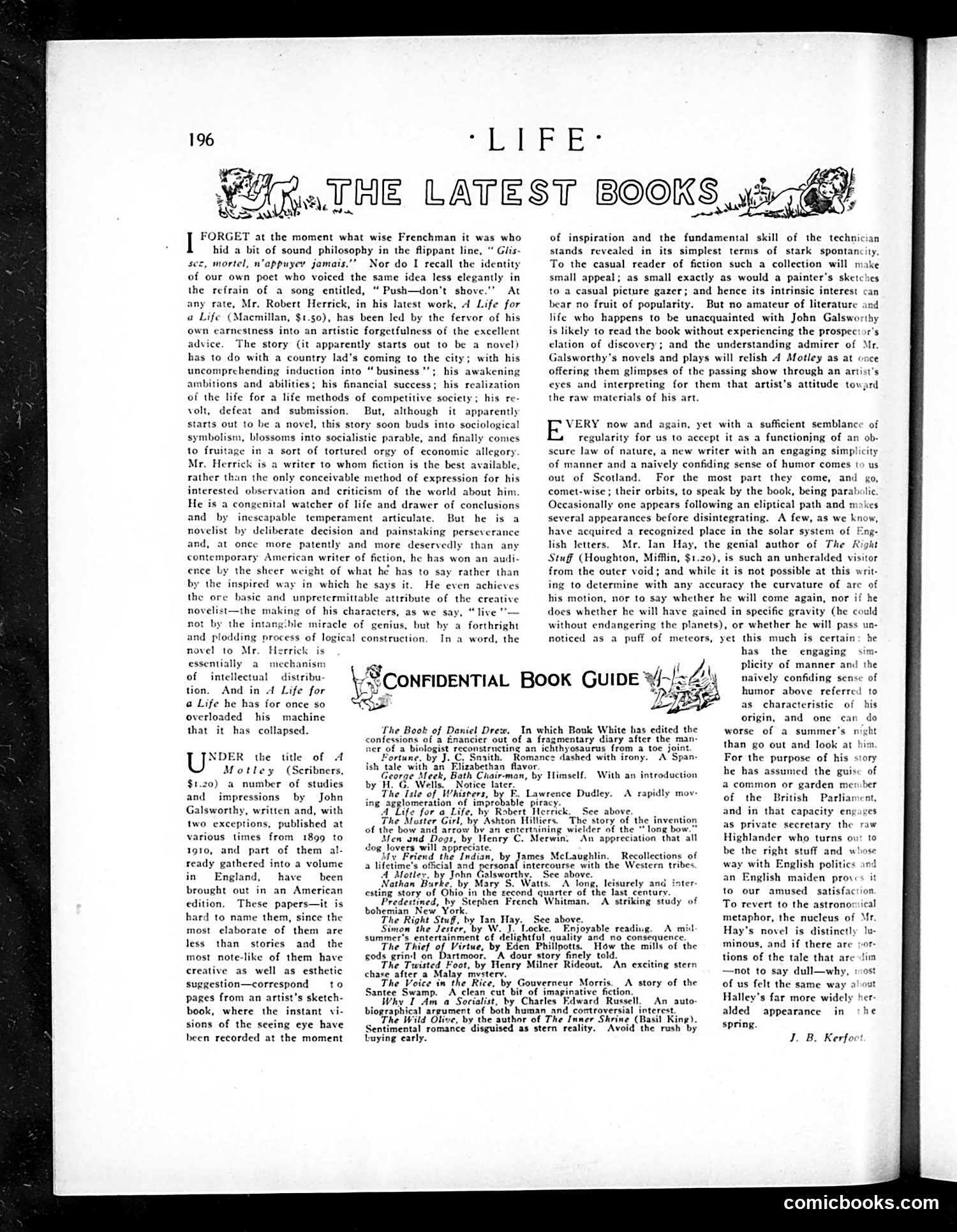
This page from Life magazine reviews contemporary fiction, primarily focusing on Robert Herrick's novel *A Life for a Life*. The critic praises Herrick as a serious social observer whose fiction serves as a vehicle for economic and sociological critique rather than entertainment. The review acknowledges Herrick's weakness: he "overloads his machine" with allegory and symbolism, making the work appeal more to literary scholars than casual readers. The page then shifts to discuss John Galsworthy's *A Motley* and introduces Scottish writer Ian Hay's *The Right Stuff*, commending Hay's engaging simplicity and humor. The "Confidential Book Guide" sidebar lists additional contemporary titles with brief annotations, covering various genres from mystery to romance. The overall tone is that of a sophisticated literary journal addressing educated readers interested in serious fiction addressing social issues—characteristic of Life's early 20th-century positioning as an intellectual satirical publication.
📄 Transcribed text from this page (OCR, searchable)
Machine-transcribed from the original scan — historical spelling and the odd misread are preserved.
“EIRRSES- US SCS addas 6 erm FORGET at the moment what wise Frenchman it was who hid a bit of sound philosophy in the flippant line, “ Glis- sez, mortel, n'appuyev jamais.’" Nor do I recall the identity of our own poet who voiced the same idea less elegantly in the refrain of a song entitled, “ Push—don’t shove.’’ At any rate, Mr, Robert Herrick, in his latest work, 4 Life for a Life (Macmillan, $1.50), has been led by the fervor of his own earnestness into an artistic forgetfulness of the excellent advice. The story (it apparently starts out to be a novel) has to do with a country lad's coming to the city; with his uncomprehending induction into “ business’; his awakening ambitions and abilities; his financial success; his realization of the life for a life methods of competitive society; his re- volt, defeat and submission, But, although it apparently starts out to be a novel, this story soon buds into sociological symbolism, blossoms into socialistic parable, and finally comes to fruitage in a sort of tortured orgy of economic allegory Mr, Herrick is a writer to whom fiction is the best available, rather than the only conceivable method of expression for his interested observation and criticism of the world about him He is a congenital watcher of life and drawer of conclusions and by inescapable temperament articulate. But he is a novelist by deliberate decision and painstaking perseverance and, at once more patently and more deservedly than any contemporary American writer of fiction, he has won an audi- ence by the sheer weight of what he has to say rather than by the inspired way in which he says it. the ore ba He even achieves ¢ and unpretermittable attribute of the creative novelist—the making of his characters, as we s: not by the intangible miracle of genius, but by and plodding process of logical construction novel to Mr. Herrick is essentially a mechanism of intellectual distribu- tion. And in A Life for @ Life he has for once so overloaded his machine y. “live "— forthright In a word, the \SConFIDENTIAL Book GuIDE ¥f-); YORialAE LATEST BOOKS. ~~ of inspiration and the fundamental skill of the technician stands revealed in its simplest terms of stark spontancity. To the casual reader of fiction such a collection will make small appeal; as small exactly as would a painter's sketches to a casual picture gazer; and hence its intrinsic interest can bear no fruit of popularity. But no amateur of literature and life who happens to be unacquainted with John Galsworthy is likely to read the book without experiencing the prospector's elation of discovery; and the understanding admirer of Mr. Galsworthy’s novels and plays will relish A Motley as at once offering them glimpses of the passing show through an artist's eyes and interpreting for them that artist’s attitude toward the raw materials of his art. VERY now and again, yet with a sufficient semblance of regularity for us to accept it as a functioning of an ob- scure law of nature, a new writer with an engaging simplicity of manner and a naively confiding sense of humor comes to us out of Scotland. For the most part they come, and xo, comet-wise ; their orbits, to speak by the book, being parabolic. Occasionally one appears following an eliptical path and makes several appearances before disintegrating. A few, as we know, have acquired a recognized place in the solar system of Eng- lish letters. Mr. Ian Hay, the genial author of The Right Stuf (Houghton, Mifflin, $1.20), is such an unheralded visitor from the outer void; and while it is not possible at this writ- ing to determine with any accuracy the curvature of arc of his motion, nor to say whether he will come again, nor if he does whether he will have gained in specific gravity (he could without endangering the planets), or whether he will pass un- noticed as a puff of meteors, yet this much is certain: he has the engaging sim |. Plicity of manner and the Zz naively confiding sense of Des “Yee, humor above referred to Lge as characteristic of his origin, and one can do that it has collapsed. | faa the Motley $1.20) a number of studies and impressions by John Galsworthy, written and, with two exceptions, published at various times from 1899 to 1910, and part of them al- ready gathered into a volume in England, have been brought out in an American edition. These papers—it is hard to name them, since the most elaborate of them are less than stories and the most note-like of them have creative as well as esthetic suggestion—correspond to pages from an artist's sketch- book, where the instant vi- sions of the seeing eye have been recorded at the moment title of A (Scribners, The Book of Daniel Drew. In which Bouk White has edited the confessions of a Enancier out of a fragmentary diary after the man cr of a biologist reconstructing an ichthyosaurus from a toc joint Fortune, by J.C, Snaith, Romancz dashed with irony. A Span- ish tale with an Elizabethan flavor. George Meek, Bath Chair-man, by Himself. by H. G. Wells” Notice later. The Isle of Whisters, by F. Lawrence Dudley. ing agglomeration of improbable piracy. A Life for a Life, by Robert Herrick, See above. The Muster Girl, by Ashton Hilliers. The story of the invention of the bow and arrow by an entertaining wielder of the “ long bow. Men and Dogs, by Henry C. Merwin, An appreciation that all dog lovers will appreciate. My Friend the Indian, by James McLaughlin. Recollections of a lifetime's official and personal intercourse with the Western tribes A Motley. by John Galsworthy. See above. Nathan Burke, by Mary S. Watts. A long, leisurely anc esting story of Ohio in the second quarter of the last centur Predestined, by Stephen French Whitman, A striking study bohemian New’ York. The Right Stuf, by Tan Hay, See above. : Simon the Jester, by W. J. Locke. oyable reading. A summer's entertainment of delightful quality and no consequence. The Thief of Virtue, by Eden Phillpotts, Haw the mills of the sods grind on Dartmoor. A dour story finely told. ee The Twisted Foot, by Henry Milner Rideout. An exciting stern chase after a Malay mvsterv. ; The Voice in the Rice, by Gouverneur Morris. A story of the Santee Swamp. A clean cut bit of imaginative fiction. Why I Am a Socialist, by Charles Edward Russell, An auto- biographical argument of both human_and controversial interest The Wild Olive, by the author of The Inner Shrine (Basil King). Sentimental romance disguised as stern reality. Avoid the rush by tuying early. With an introduction A rapidly mov worse of a summer's night than go out and look at him For the purpose of his story he has assumed the guise of a common or garden meniber of the British Parliament, and in that capacity engages as private secretary the raw Highlander who turns ov: to be the right stuff and whose way with English politics and an English maiden proves it to our amused satisfaction To revert to the astronomical metaphor, the nucleus of Mr. Hay’s novel is distinctly lu- minous, and if there are por tions of the tale that are vim —not to say dull—why, most of us felt the same way alout Halley's far more widely her- alded appearance in she spring J. B. Kerfoot comicbooks.com