
A complete issue · 46 pages · 1910
Life — March 31, 1910
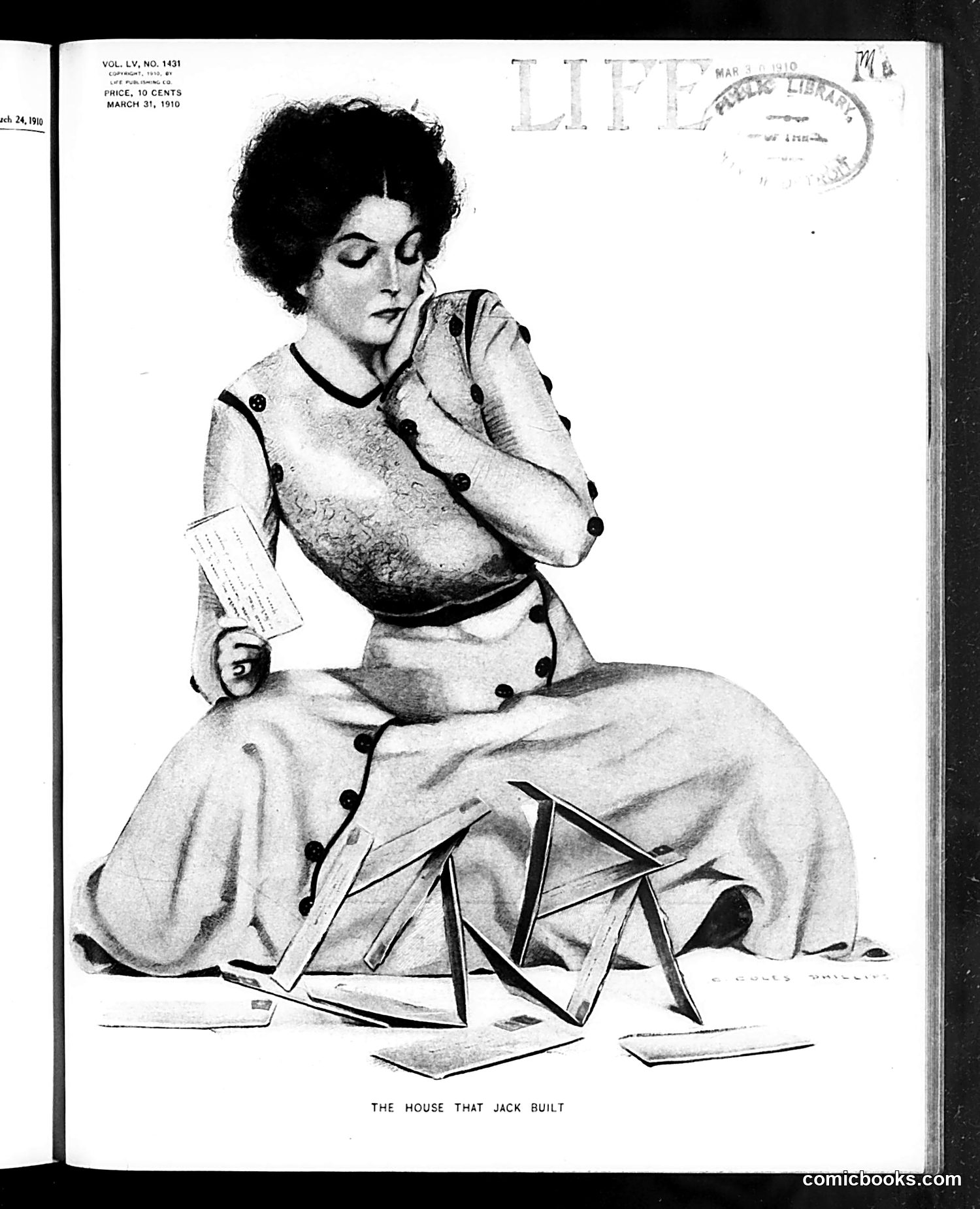
This is a visual pun on the nursery rhyme "The House That Jack Built." The illustration shows a woman examining playing cards arranged like a house of cards—a structure notoriously fragile and prone to collapse. The satire likely refers to someone named Jack who has constructed something unstable or poorly built, though the specific historical reference is unclear without additional context from the March 31, 1910 issue. The woman's skeptical expression and examining gesture suggest doubt about the structure's integrity. The joke plays on the double meaning: both the literal nursery rhyme and the metaphorical "house of cards"—something that appears impressive but is fundamentally unsound and destined to fail.
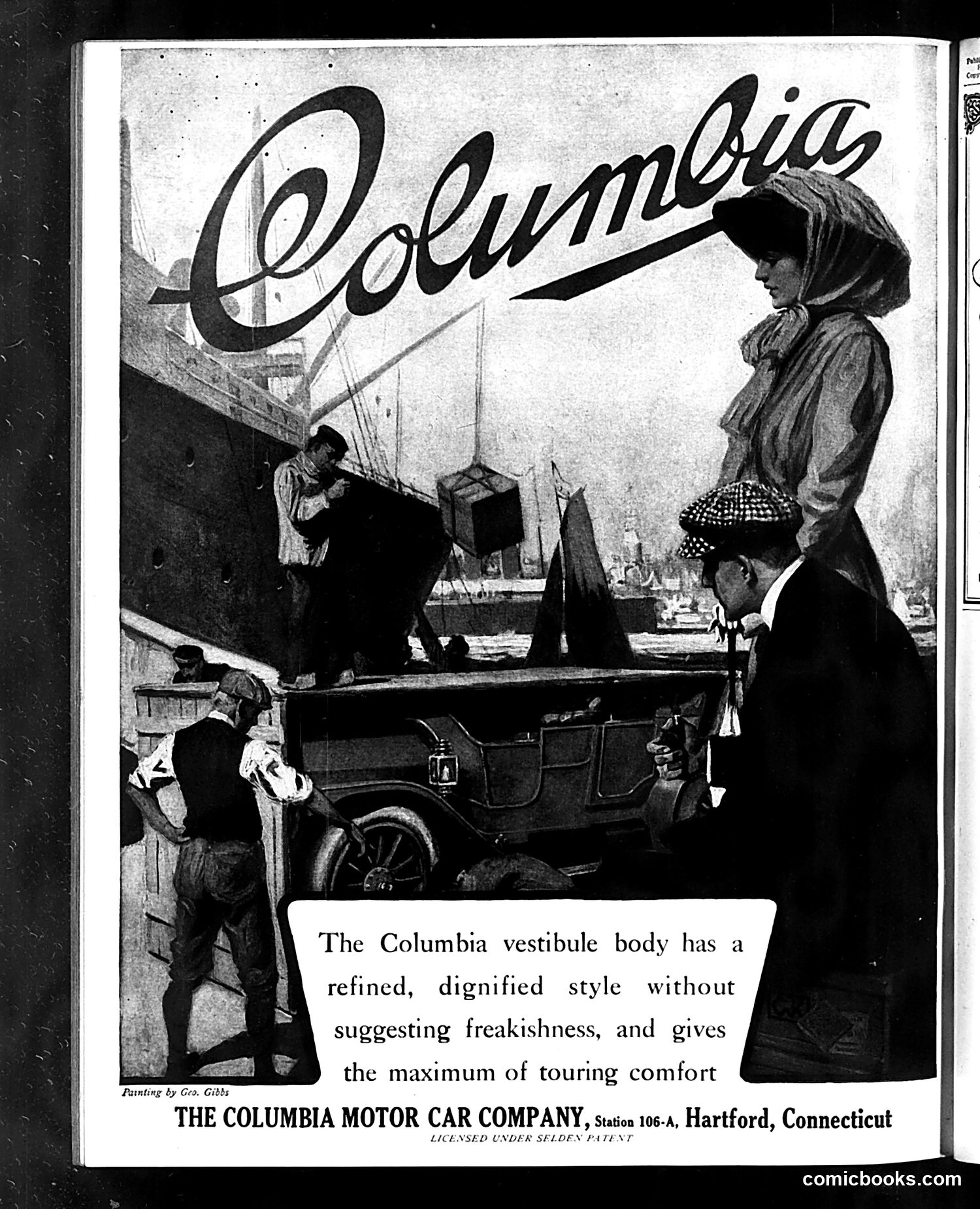
This is primarily a **product advertisement**, not political satire. The Columbia Motor Car Company of Hartford, Connecticut is marketing their automobile's vestibule body design to wealthy consumers. The image depicts well-dressed passengers (appearing to be from the early 1900s based on clothing and vehicle style) boarding or exiting a Columbia motor car near a harbor with ships visible. The advertisement emphasizes that the vehicle offers "refined, dignified style without suggesting freakishness" and provides "maximum of touring comfort." The painting is credited to Geo. Gibbs. This represents typical early automotive marketing targeting affluent buyers who valued respectability and comfort in the emerging automobile industry.
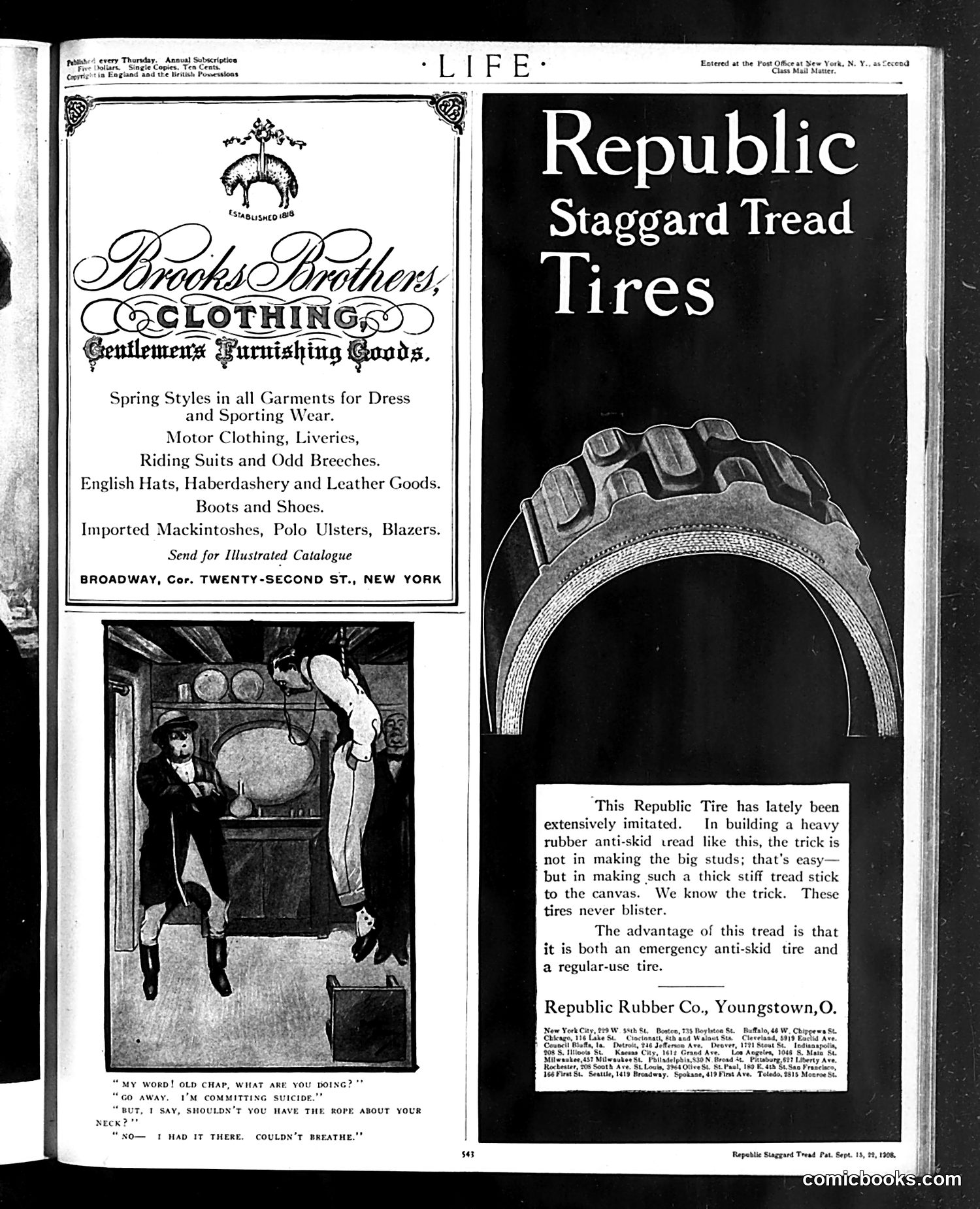
This page contains two advertisements rather than political cartoons. The left side advertises **Brooks Brothers Clothing**, a gentlemen's furnishing store located at Broadway and Twenty-Second Street in New York, listing dress wear, sporting clothes, motor clothing, hats, boots, shoes, and other items. The right side advertises **Republic Staggard Tread Tires** from Republic Rubber Co. in Youngstown, Ohio. The text explains that this tire features a thick rubber anti-skid tread—a relatively new automotive safety innovation—that can serve as both emergency anti-skid protection and regular-use tire. The manufacturer emphasizes the durability of their construction method. Both are period advertisements typical of Life magazine's commercial content, not satirical content.
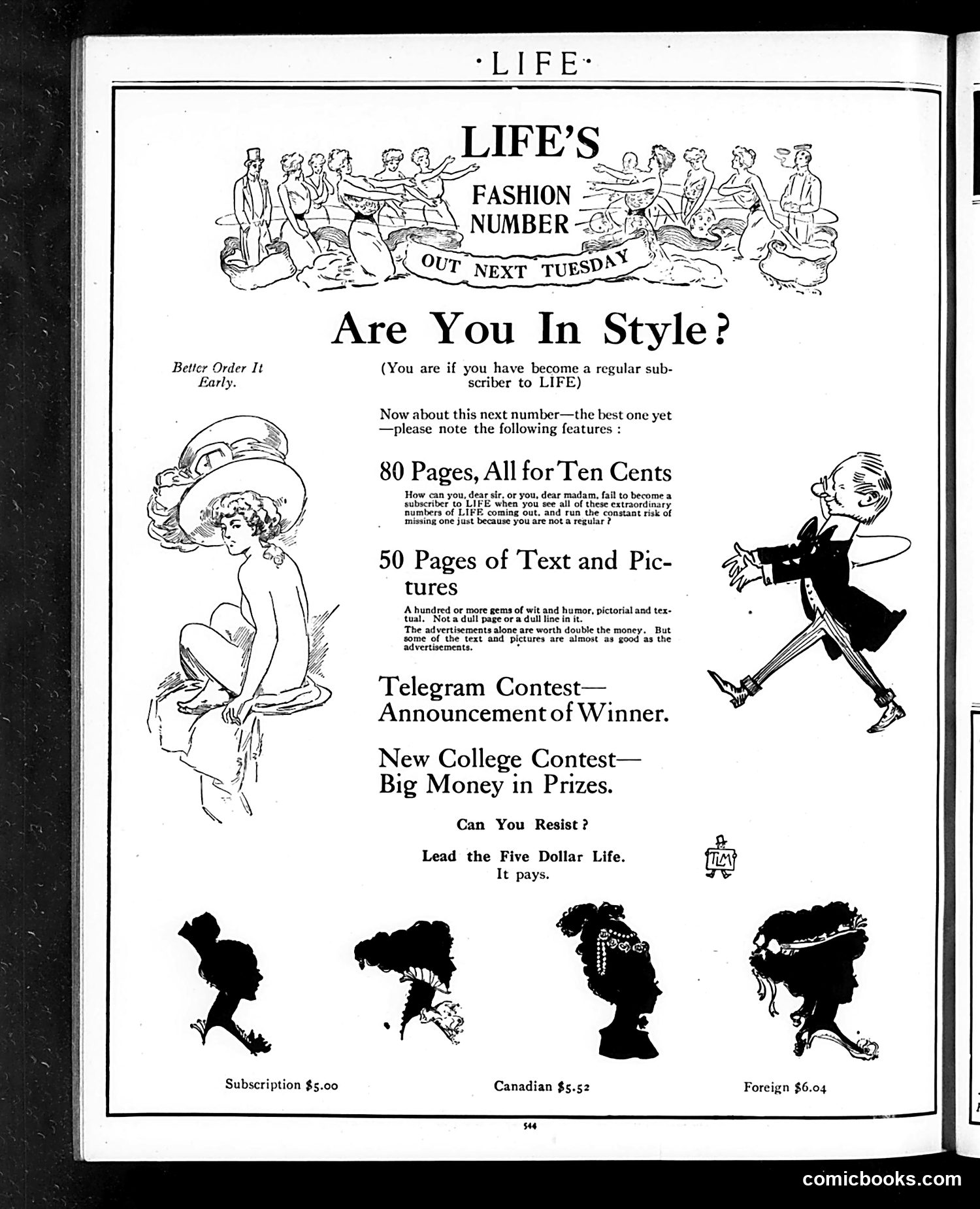
This page is primarily **promotional advertising** for Life magazine's upcoming fashion issue, not political satire. The content announces: **Main Features:** - An upcoming fashion number releasing "next Tuesday" - 80 pages for ten cents - 50 pages of text and pictures with "gems of wit and humor" - A telegram contest with winner announcement - A college contest offering prize money **Visual Elements:** The illustrations are decorative rather than satirical—stylized drawings of fashionable women and a dancing man represent the magazine's lifestyle focus. The silhouettes at bottom show various women's hairstyles and headwear, emphasizing fashion trends. The phrase "Lead the Five Dollar Life. It pays" suggests Life positioned itself as a magazine for stylish, modern readers with disposable income. This is essentially a **self-promotional advertisement** for the publication itself, targeting potential subscribers interested in fashion and humor.
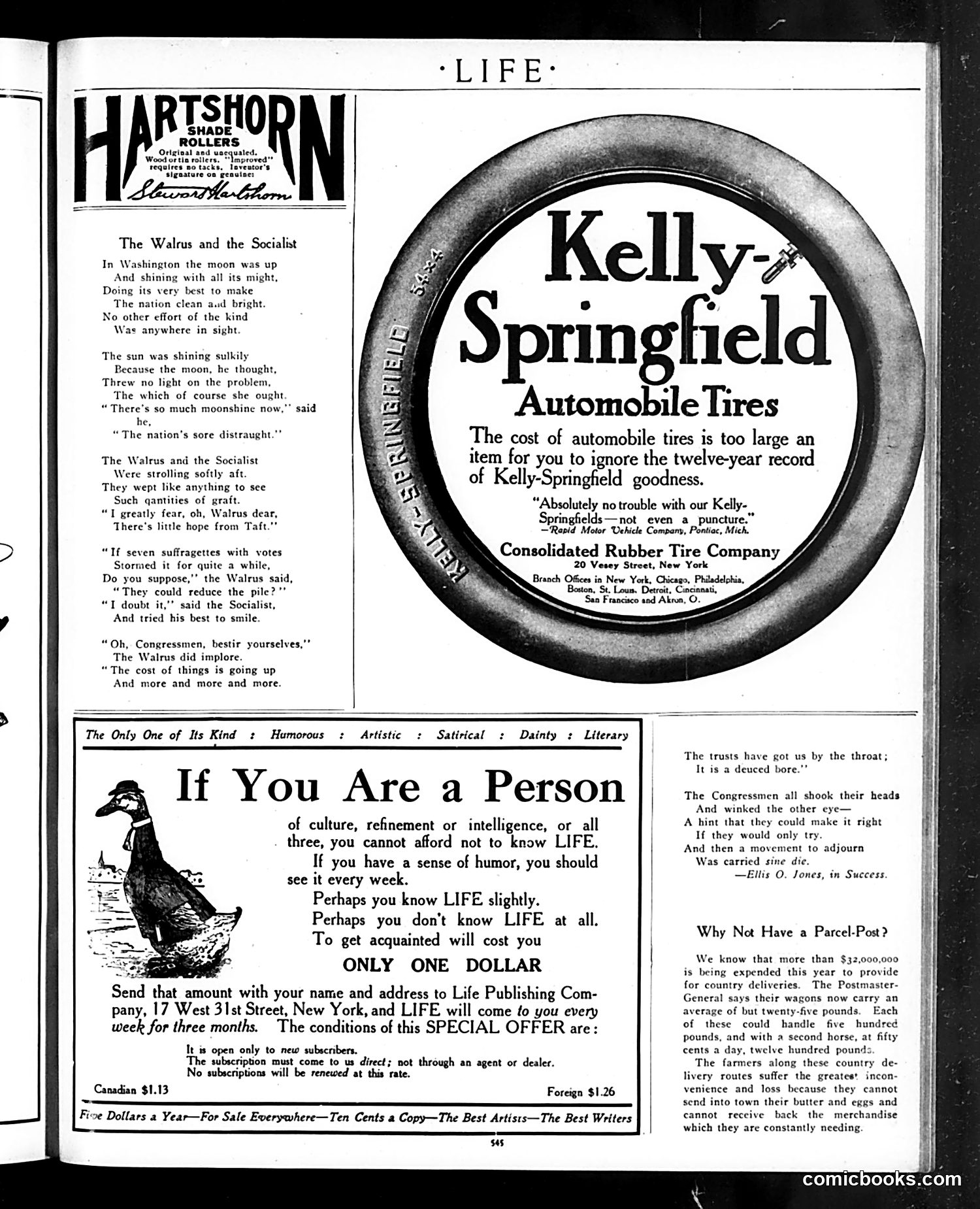
This page is primarily **advertising and subscription promotion** rather than political satire. The main content includes: 1. **Hartshorn Shade Rollers ad** (top left) with a brief satirical poem titled "The Walrus and the Socialist"—a whimsical dialogue between two figures discussing moonlight and taxation, likely mocking socialist economic concerns in a lighthearted manner. 2. **Kelly-Springfield Automobile Tires ad** (center)—a straightforward product advertisement. 3. **Life Magazine subscription pitch** (bottom)—promoting weekly subscriptions for one dollar, targeting educated readers who appreciate "humor," "satire," and "literary" content. The "Walrus and Socialist" poem appears to be the page's only genuine satirical content, gently poking fun at socialist ideology through absurdist dialogue, but lacks specificity about particular political figures or events.
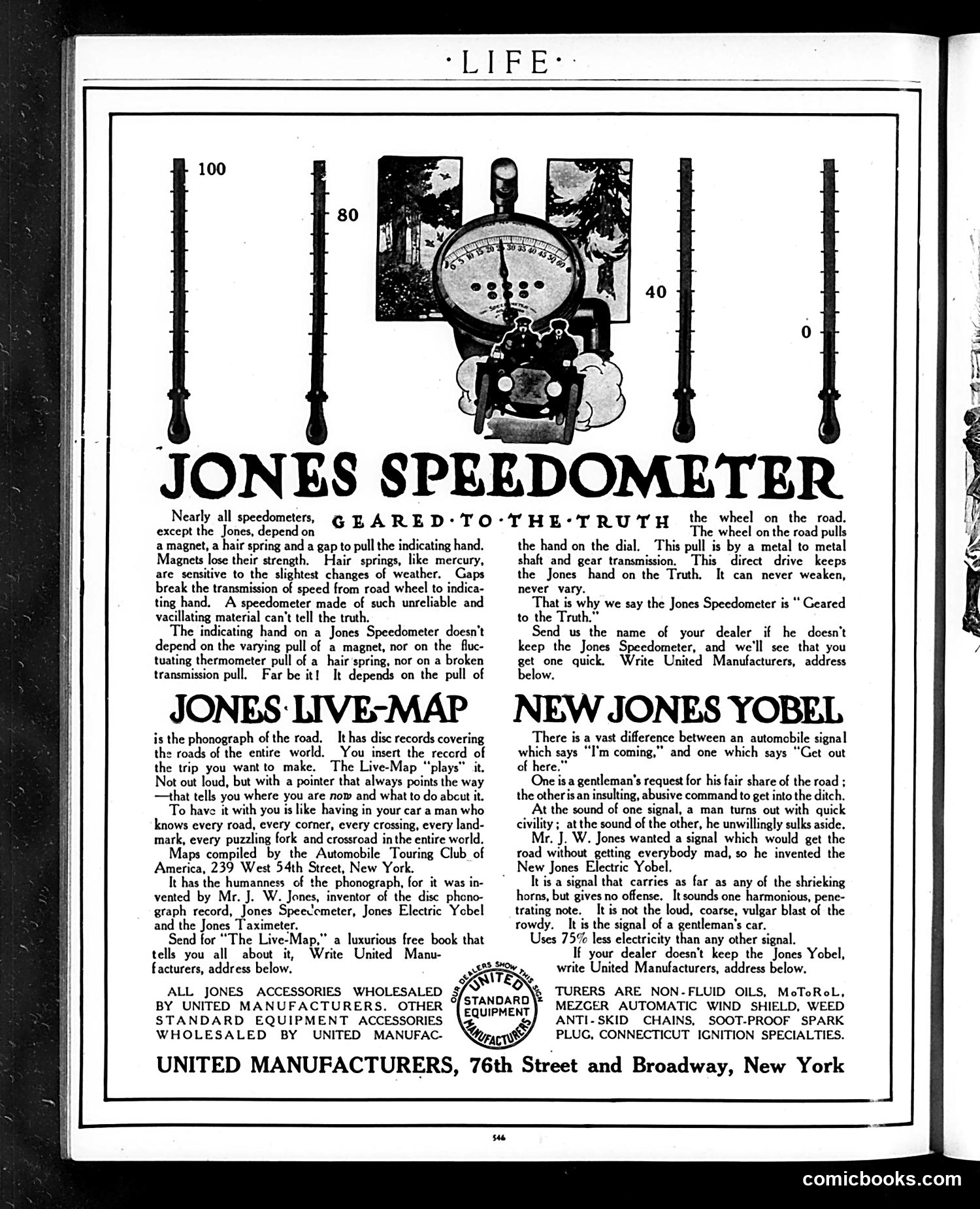
This page is primarily a **product advertisement**, not political satire. It promotes automobile accessories manufactured by United Manufacturers in New York, circa early 1900s. The ad highlights three products: 1. **Jones Speedometer** - marketed as "geared to the truth" because it uses direct mechanical drive (from wheel to dial) rather than unreliable magnetic or spring-based systems that competitors used. 2. **Jones Live-Map** - a phonograph record device providing road directions. 3. **New Jones Yobell** - an electric automobile horn. The humor is gentle commercial boasting—claiming the Jones speedometer is uniquely honest ("geared to the truth") while competitors' speedometers are unreliable. This reflects early automotive-era competition and the novelty of precise speed measurement technology.
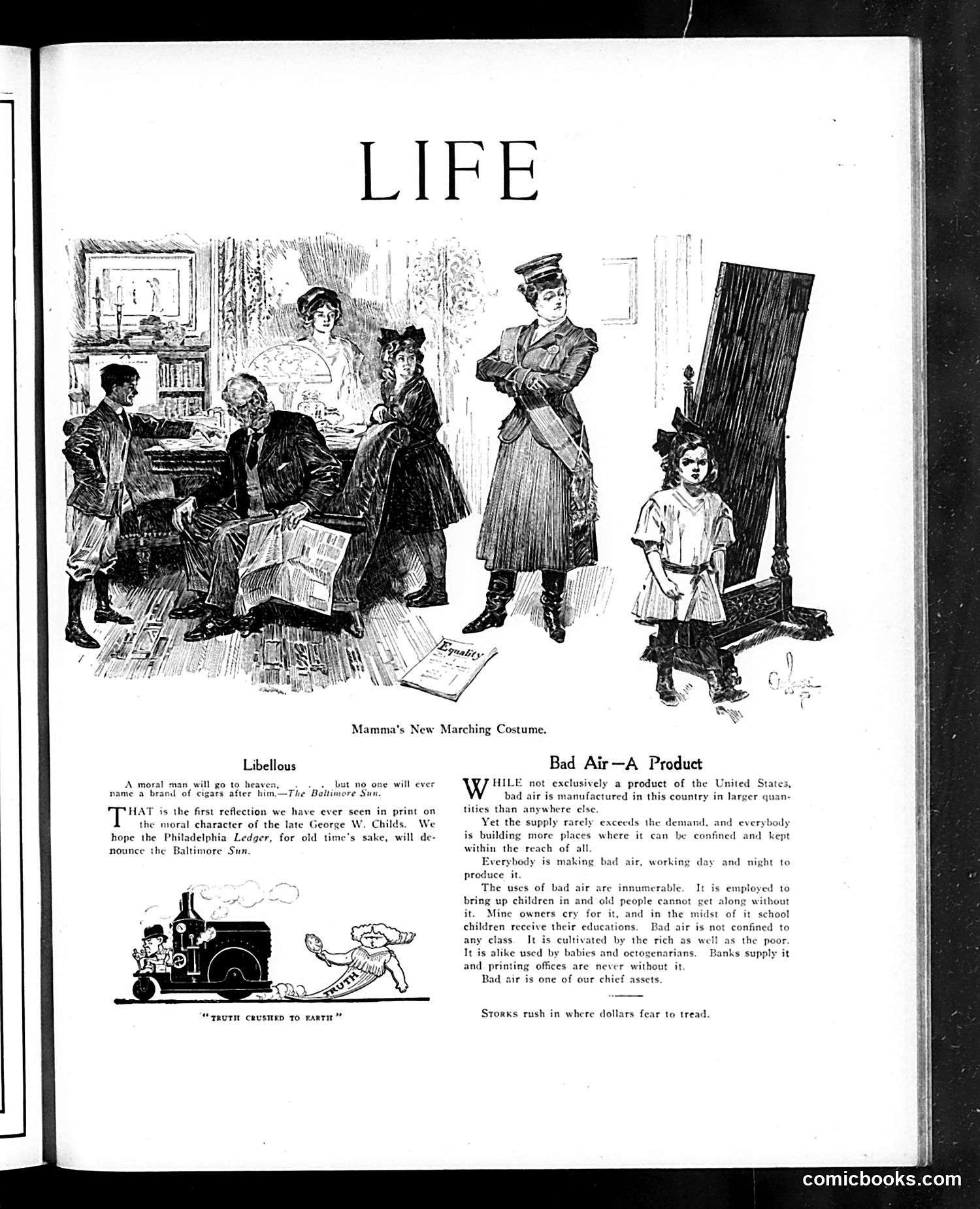
This satirical page critiques early 20th-century American morality and social conditions through two pieces: **"Mamma's New Marching Costume"** (top illustration) depicts a woman in military/suffrage-style dress, likely commenting on women's rights activism or changing social roles, though the specific reference is unclear without more context. **"Bad Air—A Product"** (right column) is a scathing essay attacking pollution and poor air quality as endemic American problems affecting all social classes—from wealthy to poor, children to the elderly. The text sarcastically treats bad air as a natural resource or commodity, "manufactured in this country in larger quantities" than elsewhere. It's a sharp indictment of industrial pollution and its societal tolerance. The small locomotive cartoon ("Truth Crushed to Earth") appears to satirize how truth is suppressed or ignored by powerful interests.
This page from *Life* magazine (March 31, 1919) contains editorial text about treating alcoholism and managing "drunkards" rather than relying solely on prohibition. The article discusses establishing proper institutions—hospitals and detention farms—for chronic alcoholics, particularly those who are poor or criminal. The small cartoon at top left shows a sleeping figure labeled "Young John's Allowance," humorously linking parental money-giving to youthful excess. The main satirical point critiques the prohibition movement then sweeping America. The editorial argues that shutting down alcohol production won't solve alcoholism without intelligent medical and social infrastructure. It suggests prohibition alone is crude policy-making, favoring instead comprehensive institutional care supervised by qualified professionals rather than emotional moral crusades.
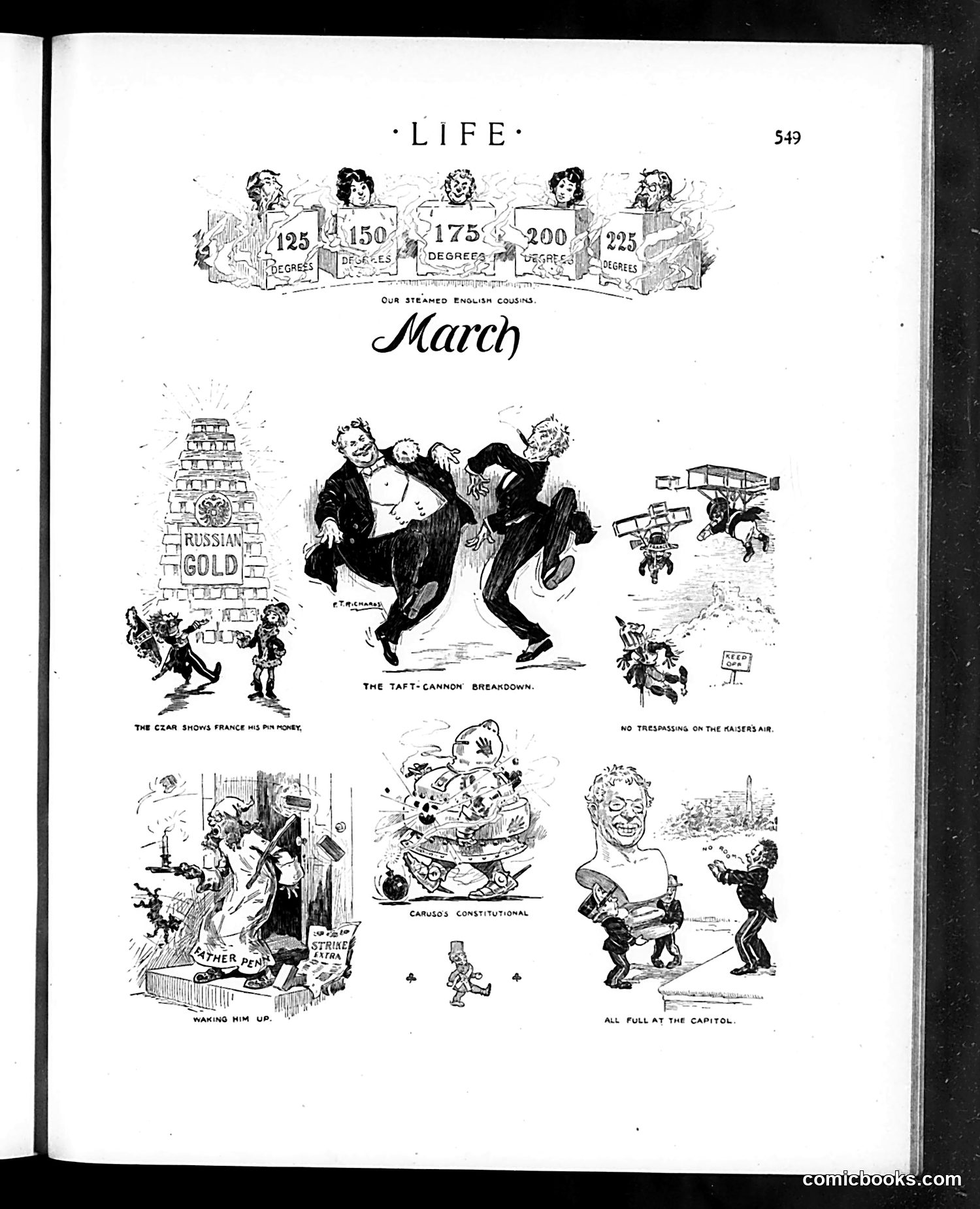
This page presents political cartoons from March (year unclear from image). The top shows "Our Steamed English Cousins" at various temperatures—likely satirizing British social or political positions. The central cartoon, "The Taft-Cannon Breakdown," depicts two men collapsing together, referencing tension between President William Howard Taft and Speaker Joseph Cannon—a real Republican Party split of the early 1900s. Other cartoons reference: - "The Czar Shoves France His Mr. Money" (Russian gold/influence) - "Carlos's Constitutional" (likely King Carlos of Portugal) - "All Full at the Capitol" (congressional politics) - "No Trespassing on the Kaiser's Air" (German aviation/military) The page uses exaggerated caricature and physical comedy to mock contemporary political figures and international tensions of the era.
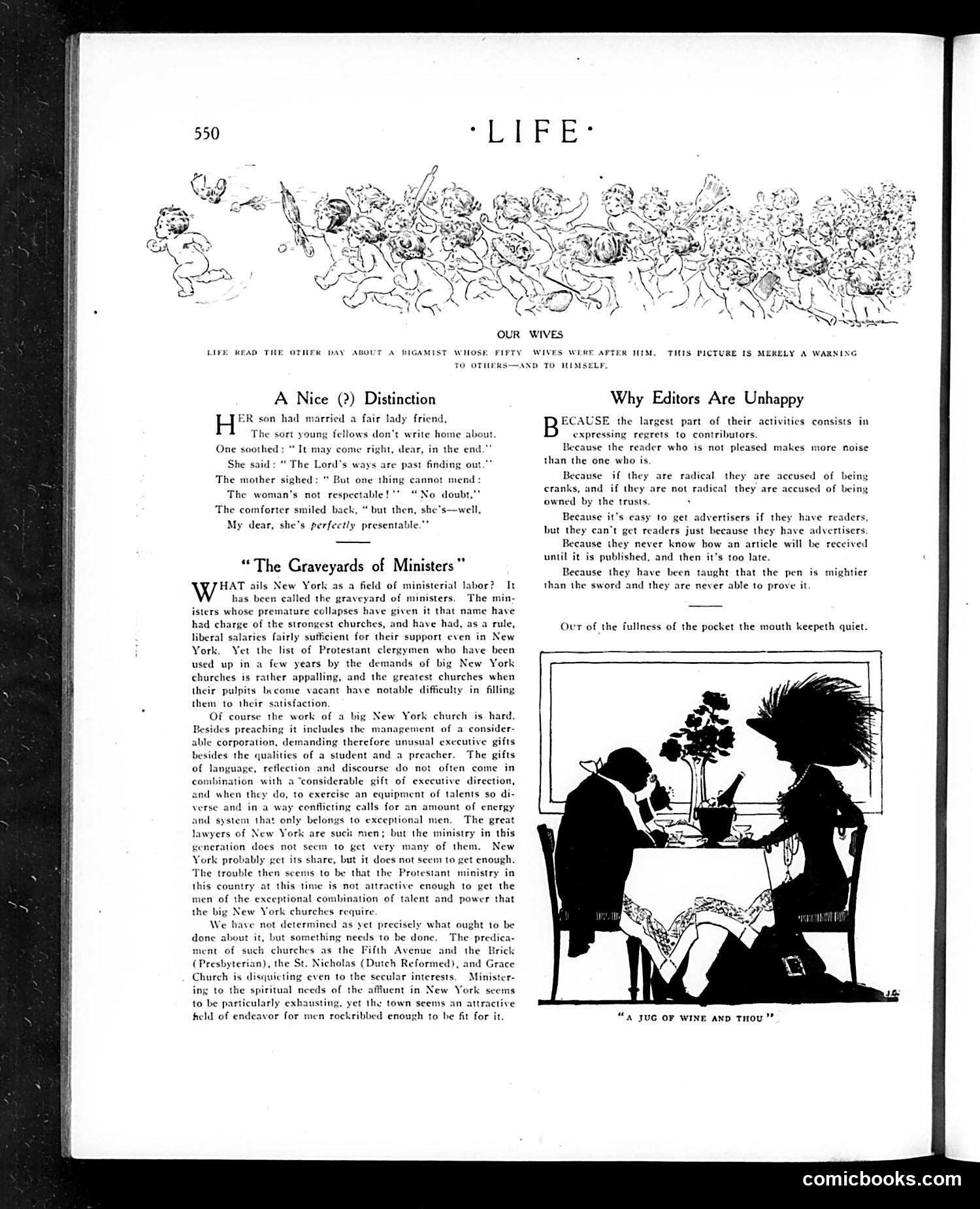
This page contains three distinct pieces: 1. **"Our Wives"** - A cartoon strip showing numerous cherubic figures in chaotic motion, captioned as a warning about a "bigamist whose fifty wives were after him." 2. **"A Nice (?) Distinction"** - A brief joke about a son's marriage where the mother questions whether the bride is "presentable," playing on class anxieties about social standing. 3. **"The Graveyards of Ministers"** - A substantial article discussing the difficulty New York churches face recruiting talented Protestant clergy, arguing the ministry lacks sufficient prestige and compensation to attract exceptional men compared to law. 4. **"A Jug of Wine and Thou"** - A cartoon showing two men at a table with flowers, depicting casual social drinking. The page reflects early 20th-century American concerns: marital fidelity, class propriety, religious institutional decline, and social leisure.
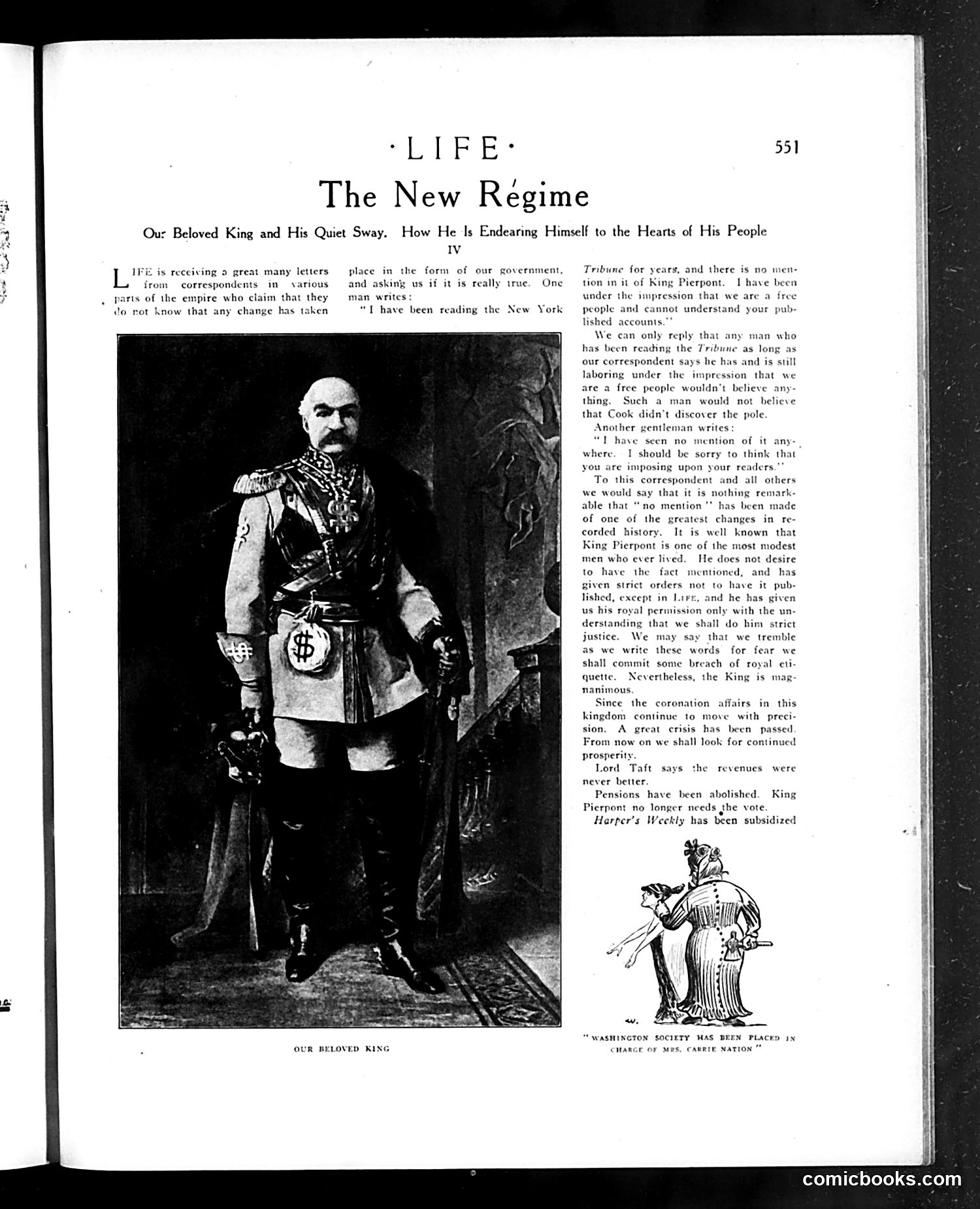
This page satirizes King Pierpont's authority and the claims of change in the "New Régime." The main portrait shows "Our Beloved King" in military dress uniform, a caricature suggesting autocratic rule despite democratic pretenses. The text addresses reader complaints that nothing has actually changed under this new regime. It defends King Pierpont as "one of the most modest men who ever lived" who avoids publicity—ironic given the prominent royal portrait. The satire mocks the gap between promised reforms (pensions abolished, revenues increased) and actual governance. The cartoon at bottom right, captioned "Washington Society Has Been Placed in Charge of Mrs. Carrie Nation," suggests absurdist reorganization of American institutions. This appears to be pre-Prohibition era political satire about ineffectual reform movements and authoritarian leadership.
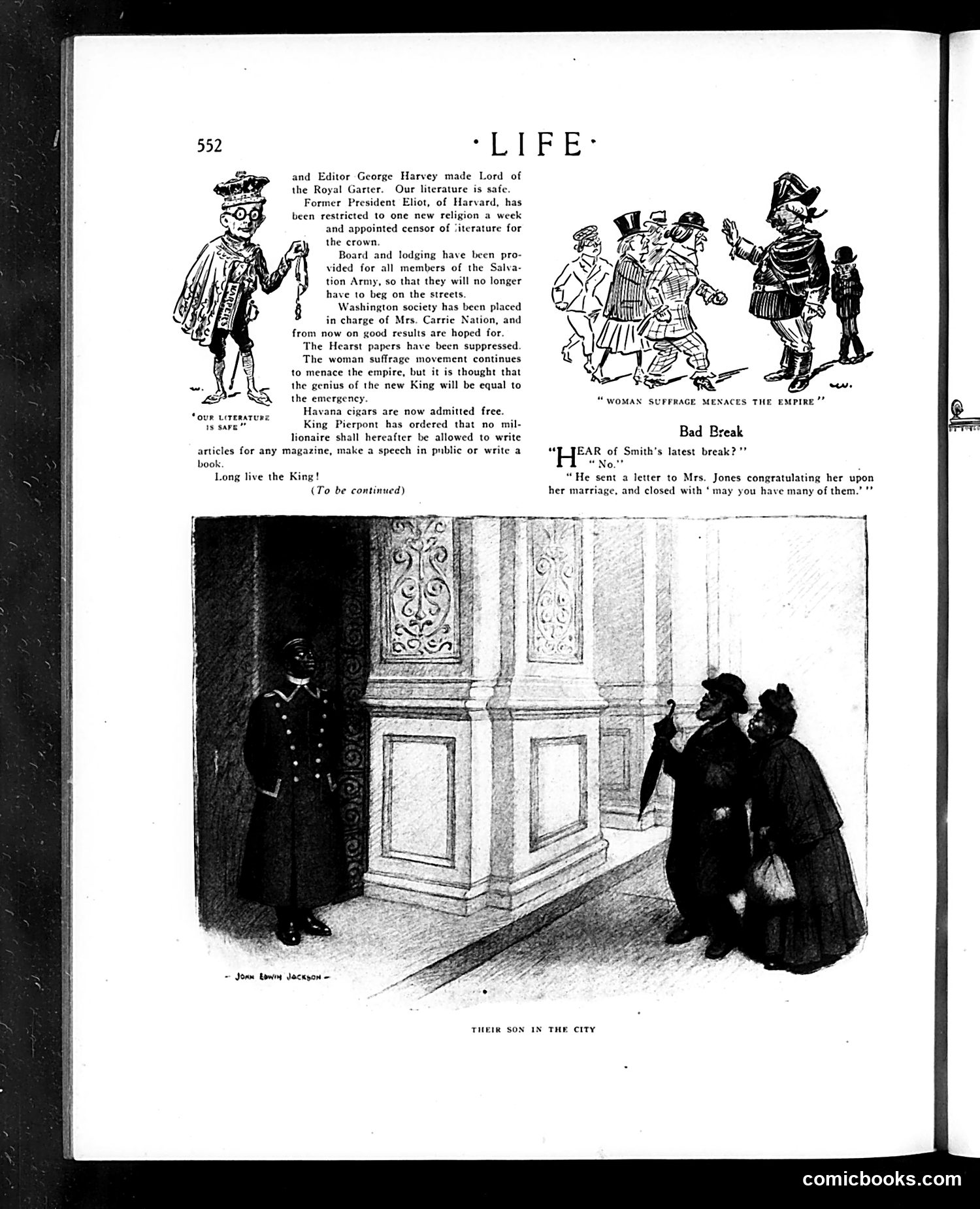
This page contains satirical commentary on early 20th-century social and political issues: **Top Section:** References to recent events including the Salvation Army, women's suffrage ("Woman Suffrage Menaces the Empire"), suppressed Hearst newspapers, and Cuban cigars. The commentary is sardonic about these topics affecting the empire and society. **"Bad Break" Section:** A short joke about Smith sending congratulations to Mrs. Jones on her marriage with an awkward closing line. **Main Illustration ("Their Son in the City"):** Depicts a uniformed soldier or officer standing at attention while three women in dark clothing appear distressed or concerned—likely mothers or family members worried about their son in military service or the city. The image suggests anxiety about young men's welfare away from home.
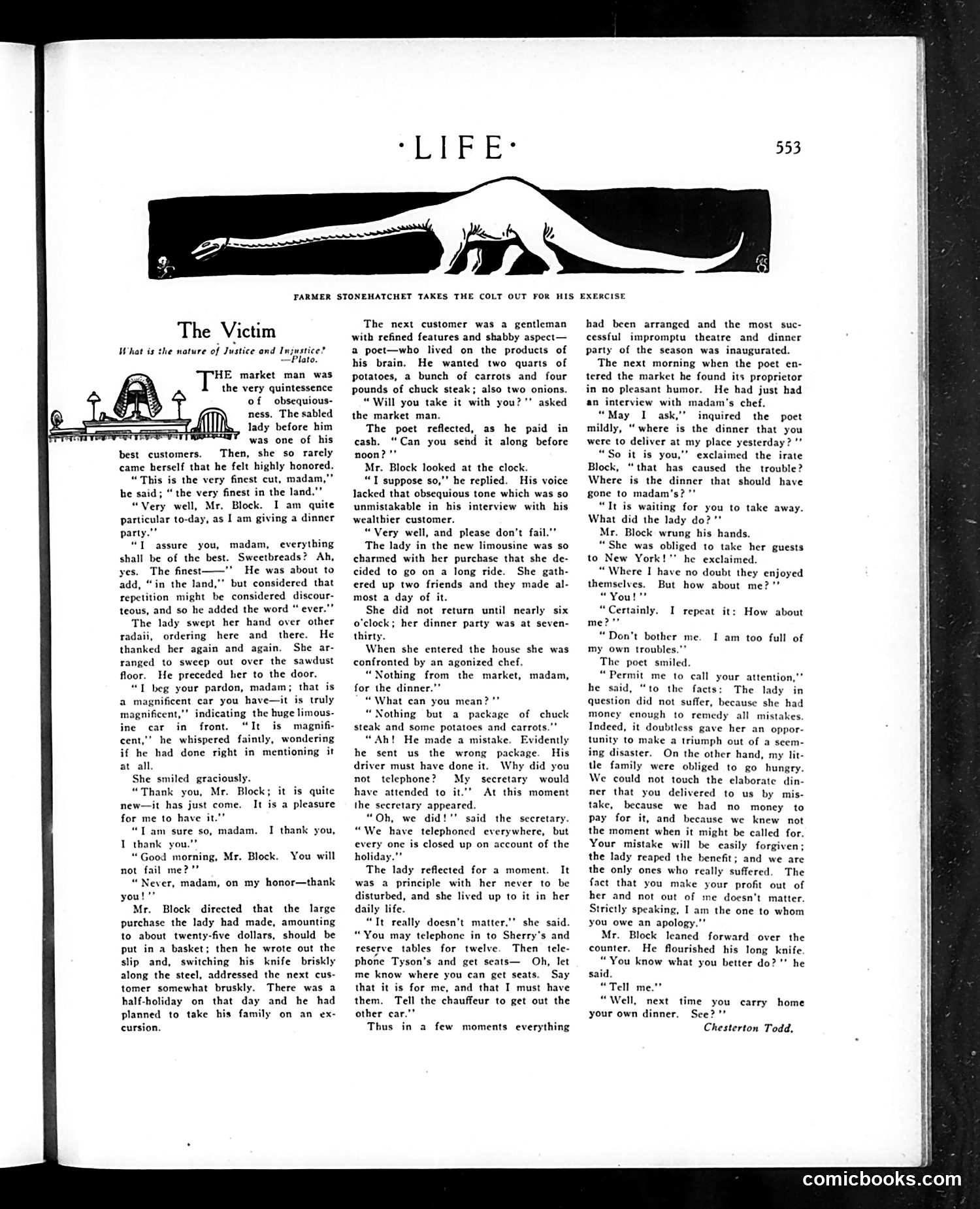
The illustration at top shows a farmer with a colt, captioned "Farmer Stonehatchet Takes the Colt Out for His Exercise" — a visual pun setting up the story below. "The Victim" is a humorous short story by Chesterton Todd about a wealthy market man who purchases expensive items from a society lady's charity sale. He buys a car, supposedly to impress people, but the transaction goes comically wrong: his secretary fails to arrange delivery, the lady's dinner party uses his car without permission, and the driver loses it entirely. The satire targets upper-class social pretension and the chaos of wealthy people's careless behavior. The "victim" is the well-meaning market man exploited by the fashionable society lady's casual dishonesty and entitlement—a common Life magazine theme mocking class absurdities.
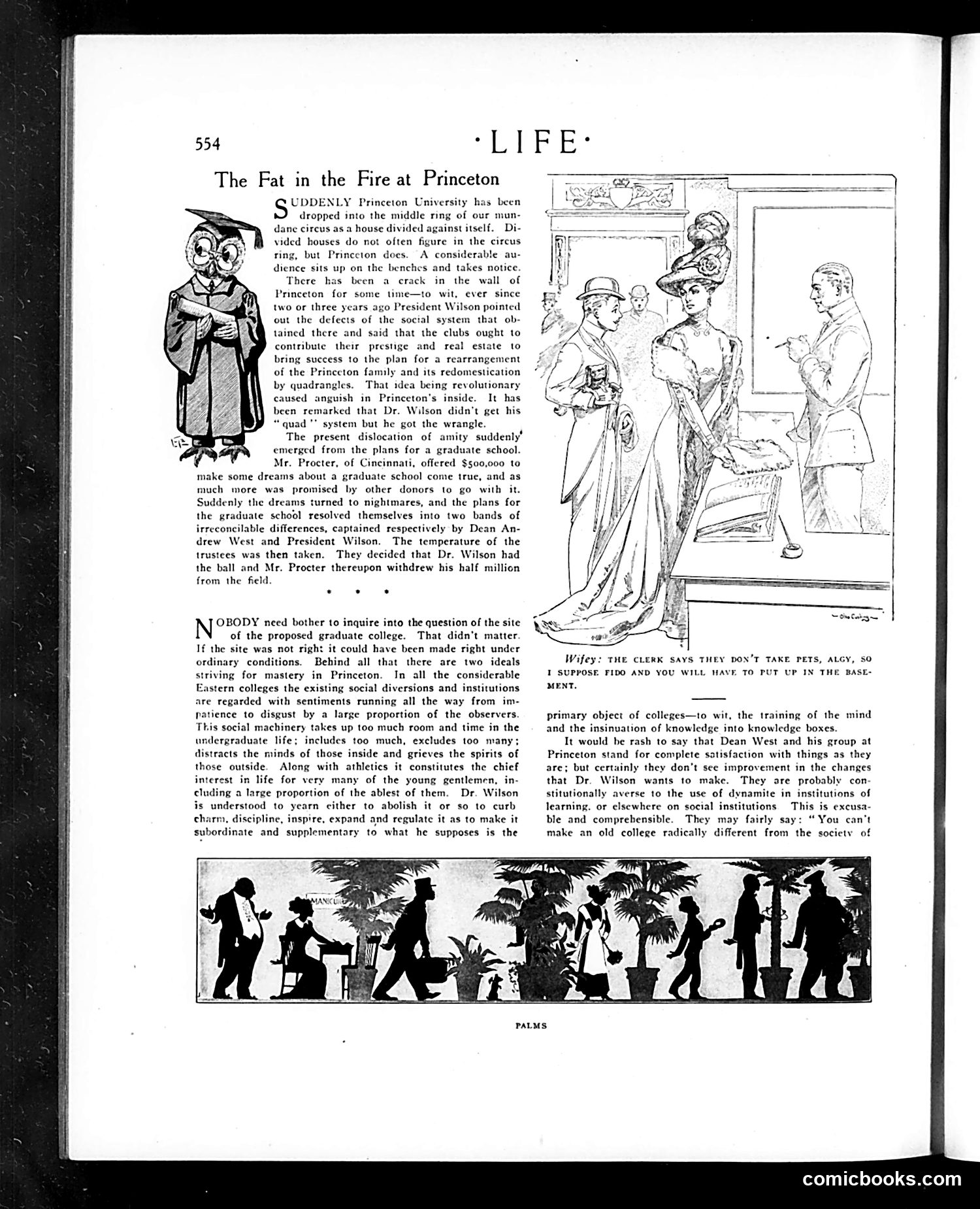
This article satirizes a major internal conflict at Princeton University under President Woodrow Wilson. The dispute centers on Wilson's attempt to reform Princeton's exclusive social club system (the "quads"), which he viewed as undermining the university's academic mission. The conflict erupted when a Cincinnati donor (Procter) offered $500,000 for a graduate school, but Wilson and Dean Andrew West disagreed fundamentally about its purpose and structure. Wilson wanted to use it to diminish the clubs' social dominance; West opposed such radical changes. The trustees sided with Wilson, causing Procter to withdraw his donation. The accompanying cartoon mocks the stuffy, conservative resistance to reform. The author argues that Princeton's social machinery—like athletics—distracts from education's true purpose: training minds. The conservatives' unwillingness to embrace "dynamite" reforms is portrayed as institutionally timid, though understandable.
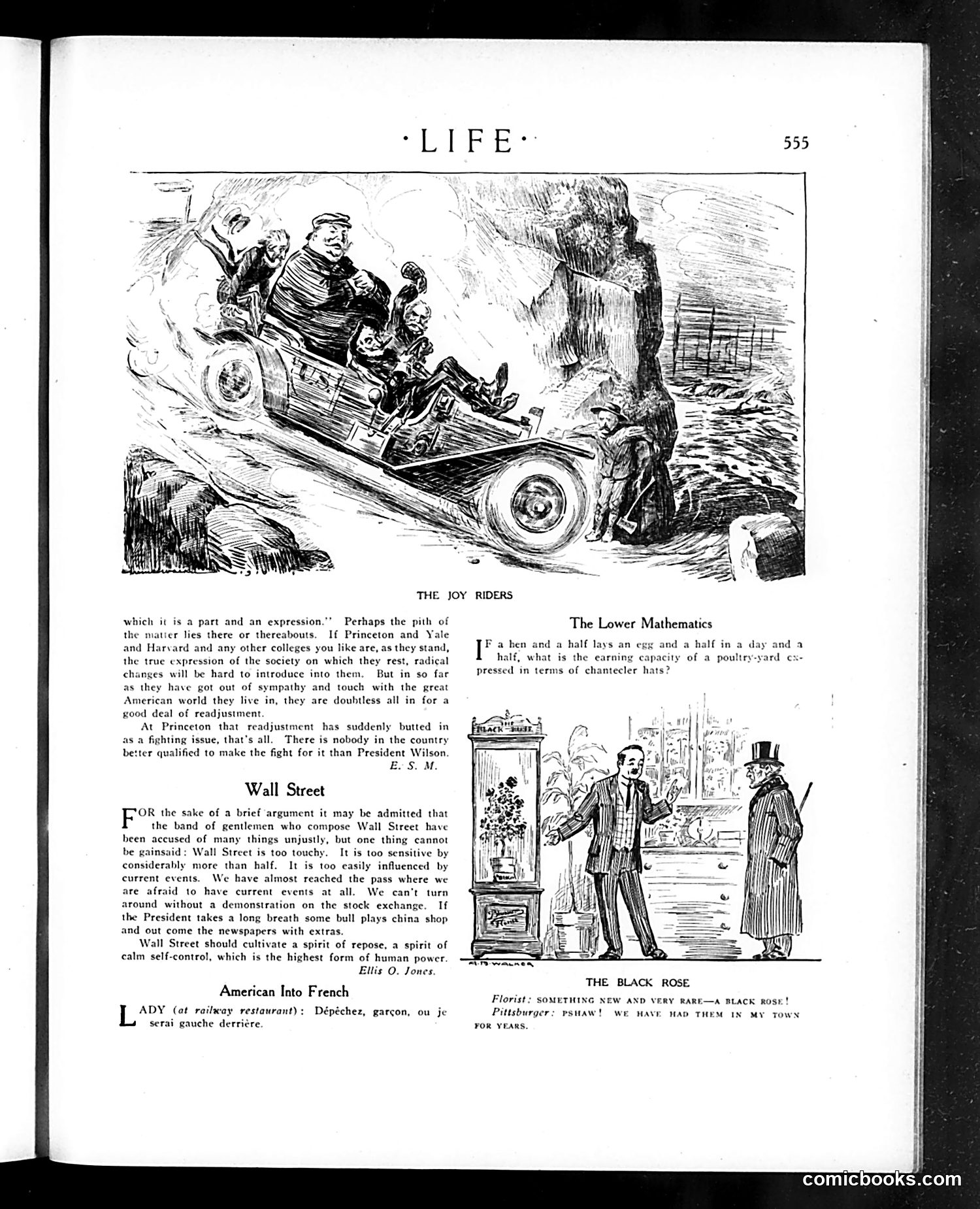
**"The Joy Riders"** (top cartoon): Depicts reckless young people in a car careening dangerously, likely commentary on the new phenomenon of automobile "joy riding"—a form of recreational driving that became associated with rowdy youth behavior and traffic dangers in the early 20th century. **"Wall Street"** (middle): Criticizes Wall Street financiers as overly sensitive and reactive to news events, causing market volatility. The piece argues they should exercise "calm self-control" rather than panicking at every development, portraying them as emotionally unstable rather than rational stewards of capital. **"American Into French"**: A language humor piece playing on mistranslation. **"The Lower Mathematics"**: A playful math puzzle about calculating egg production. **"The Black Rose"**: A joke contrasting a florist's claim that black roses are rare with a Pittsburgher's dismissal—industrial Pittsburgh apparently produces black roses (through pollution/soot) naturally.
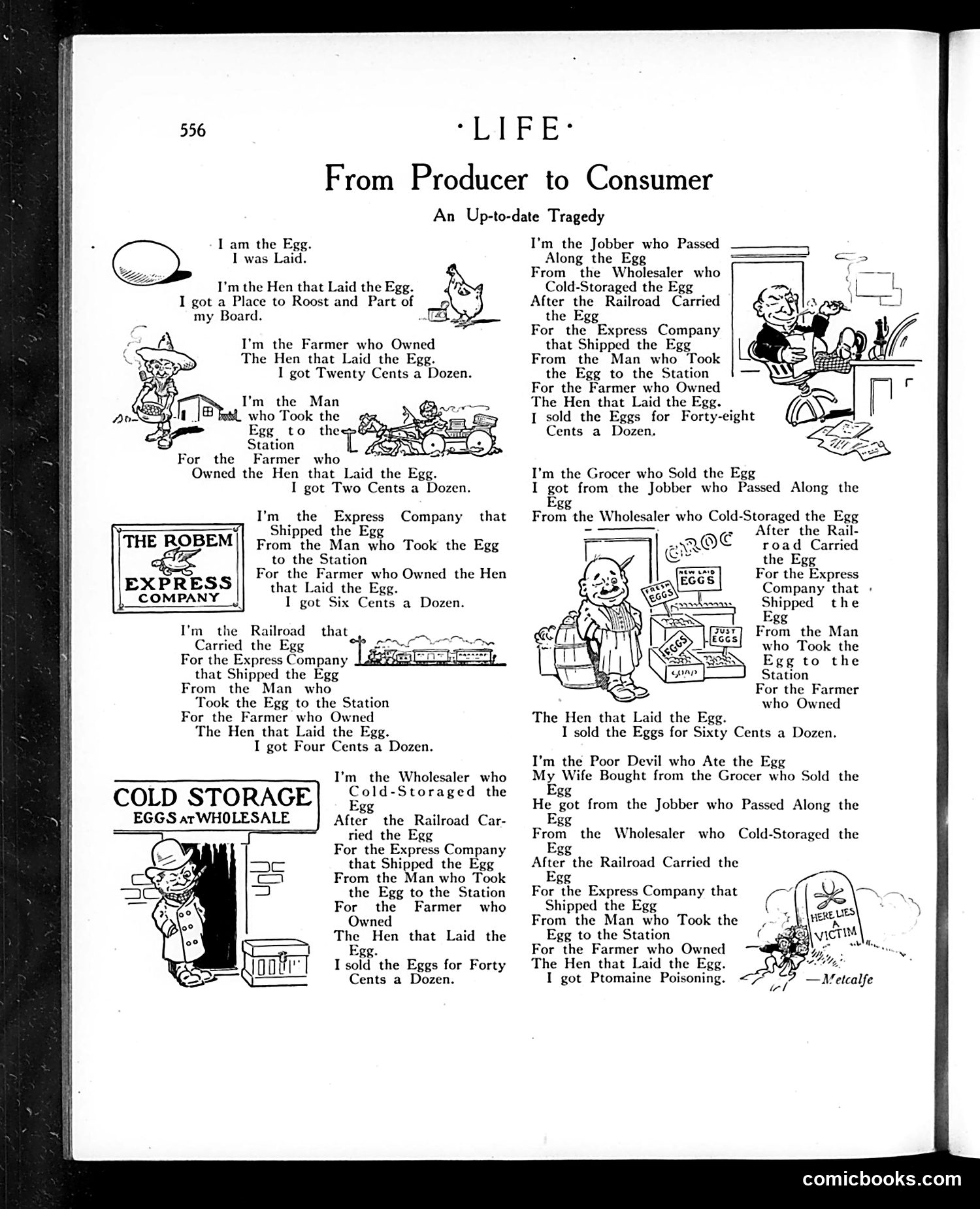
This satirical piece critiques the inefficiency and profiteering in the food supply chain. An egg passes through numerous middlemen—farmer, railroad, express company, wholesaler, jobber, and grocer—each taking a cut. The farmer receives only 20 cents per dozen for laying hens; the grocer sells for 60 cents. Yet the final consumer gets ptomaine poisoning, suggesting the egg spoils through excessive handling and cold storage delays. The joke's bitter irony: despite traversing this elaborate, costly distribution network, the product arrives contaminated. Multiple illustrated characters represent each link in the chain, emphasizing how many hands touch the egg before consumption. This likely reflects early-20th-century concerns about food safety, refrigeration technology's unintended consequences, and the growing disconnect between agricultural producers and urban consumers in industrial America.
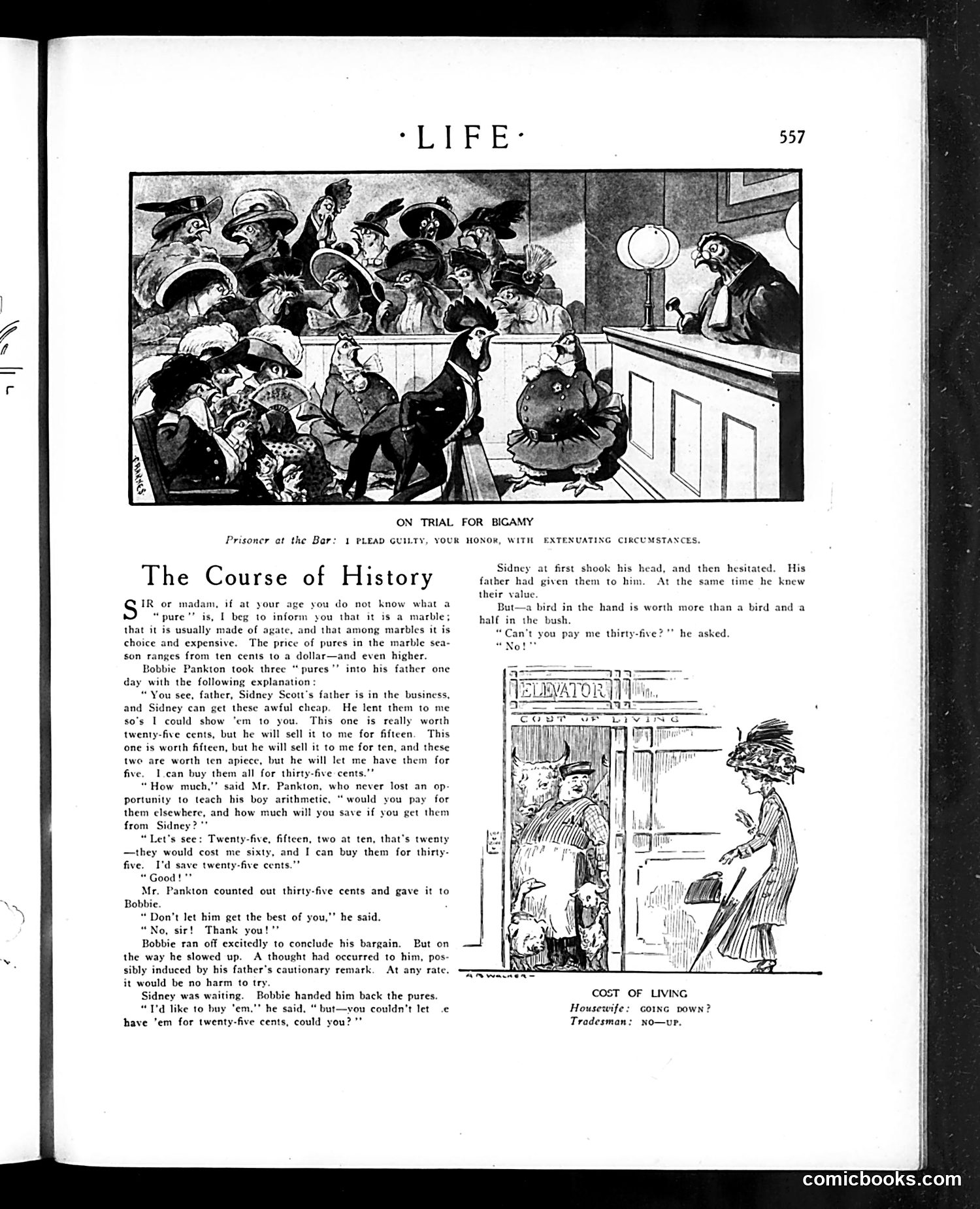
This *Life* magazine page contains two satirical pieces: **"On Trial for Bigamy"** (top cartoon): The courtroom scene mocks a defendant pleading guilty to bigamy with "extenuating circumstances"—a legal excuse. The satire likely critiques how wealthy or influential men exploited legal loopholes to escape consequences for marital infidelity, a serious crime then. **"The Course of History"** (main story): A father teaches his son Bobbie arithmetic through a marble ("pure") transaction. The boy learns to calculate savings but then attempts to renegotiate downward—undermining his own negotiation. The moral: shrewd dealing can backfire. The story satirizes American business culture's sharp practices and how even children learn such tactics. **"Cost of Living"** (small cartoon): A housewife asks a tradesman if prices are going down; he says "no—up." This reflects post-WWI inflation concerns, satirizing the rising cost of living that affected ordinary households. Together, these pieces critique American materialism, sharp business practices, and economic hardship through humor.
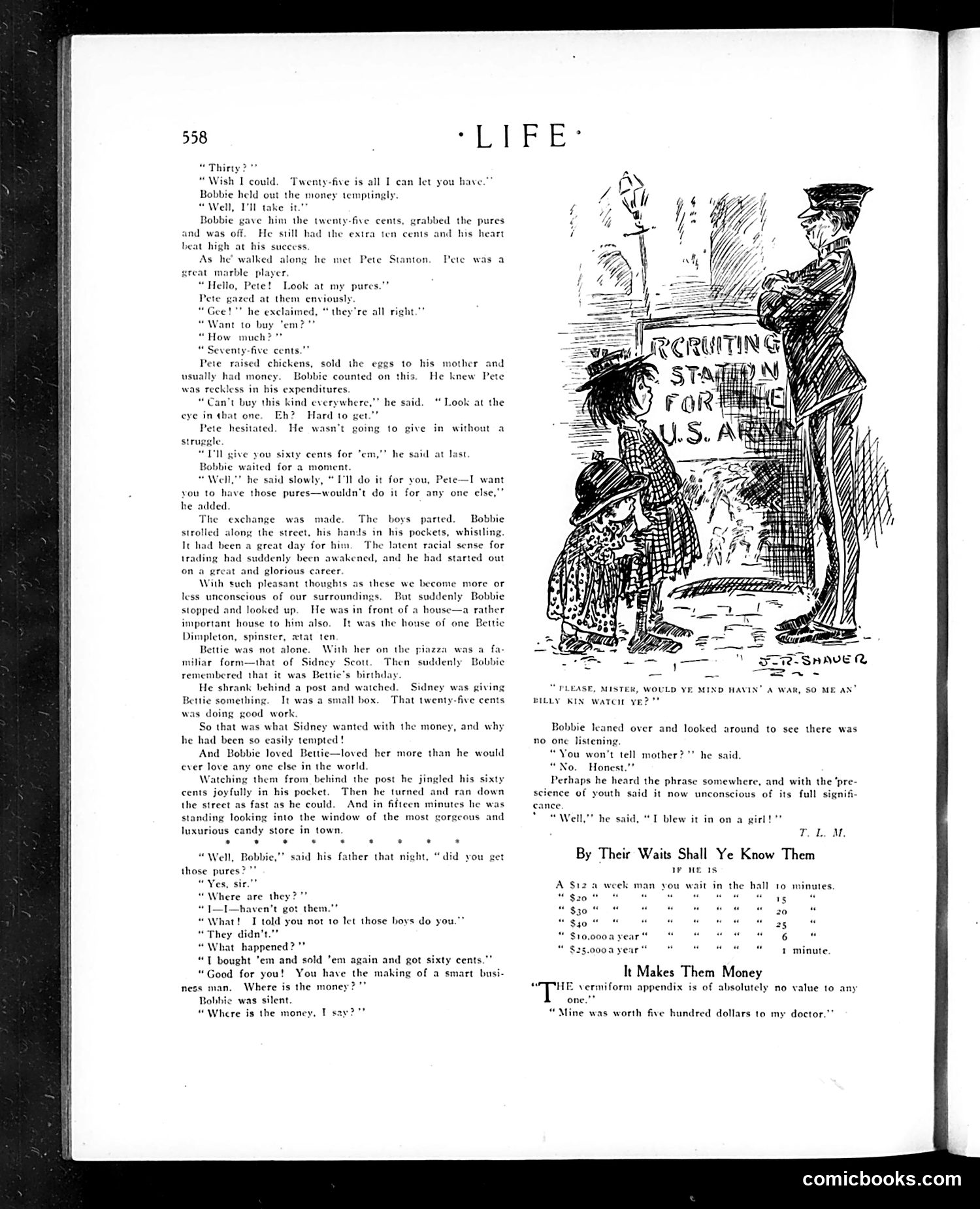
This Life magazine page contains two distinct pieces: **Main Story (Left):** A narrative about a boy named Bobbie who trades marbles to his friend Pete for 60 cents, then spends the money on candy for a girl named Bettie instead of admitting it to his father. The story illustrates early entrepreneurial impulse undermined by romantic distraction—a coming-of-age theme about youthful priorities. **Political Cartoon (Right):** Titled "Recruiting Station for U.S. Army," it depicts a military recruiter at a desk being approached by what appears to be street urchins or poor children. The caption suggests children are offering to watch a war in exchange for money, satirizing how the U.S. Army recruits from economically desperate populations. This likely references WWI-era recruitment practices. **Lower Section:** A humorous sidebar contrasting how long different income levels stay in a ball (10 minutes to 1 minute), and a joke about the appendix having monetary rather than medical value—cynical commentary on healthcare costs. The page blends sentimental youth fiction with sharp social satire about poverty, military exploitation, and economic inequality.
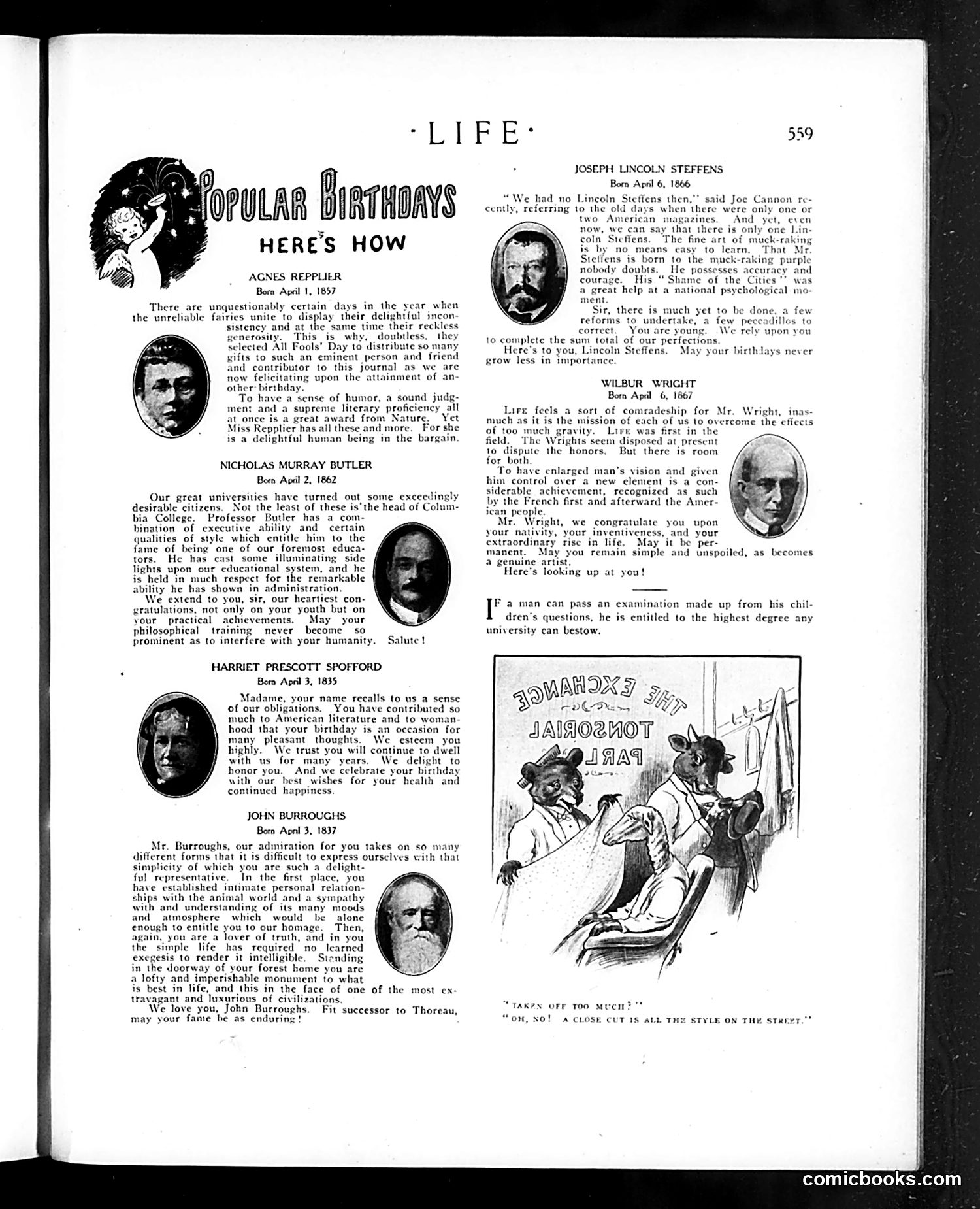
This page celebrates the birthdays of six notable Americans, each with a portrait and congratulatory message. The figures honored are: **Lincoln Steffens** (muckraking journalist), **Agnes Repplier** (humorist and writer), **Nicholas Murray Butler** (Columbia College president), **Harriet Prescott Spofford** (American author), **John Burroughs** (naturalist), and **Wilbur Wright** (aviation pioneer). The satire is gentle: Life playfully praises each figure while making light jabs at their defining characteristics. For Wright, the joke references his achievement in overcoming "gravity" (both literal flight and the weight of earthly concerns). The cartoonist's illustration at page bottom shows two figures discussing fashion, captioned "Take off too much?" — likely mocking contemporary dress trends. These birthday tributes were a regular Life feature celebrating prominent public figures with affectionate mockery rather than harsh criticism.
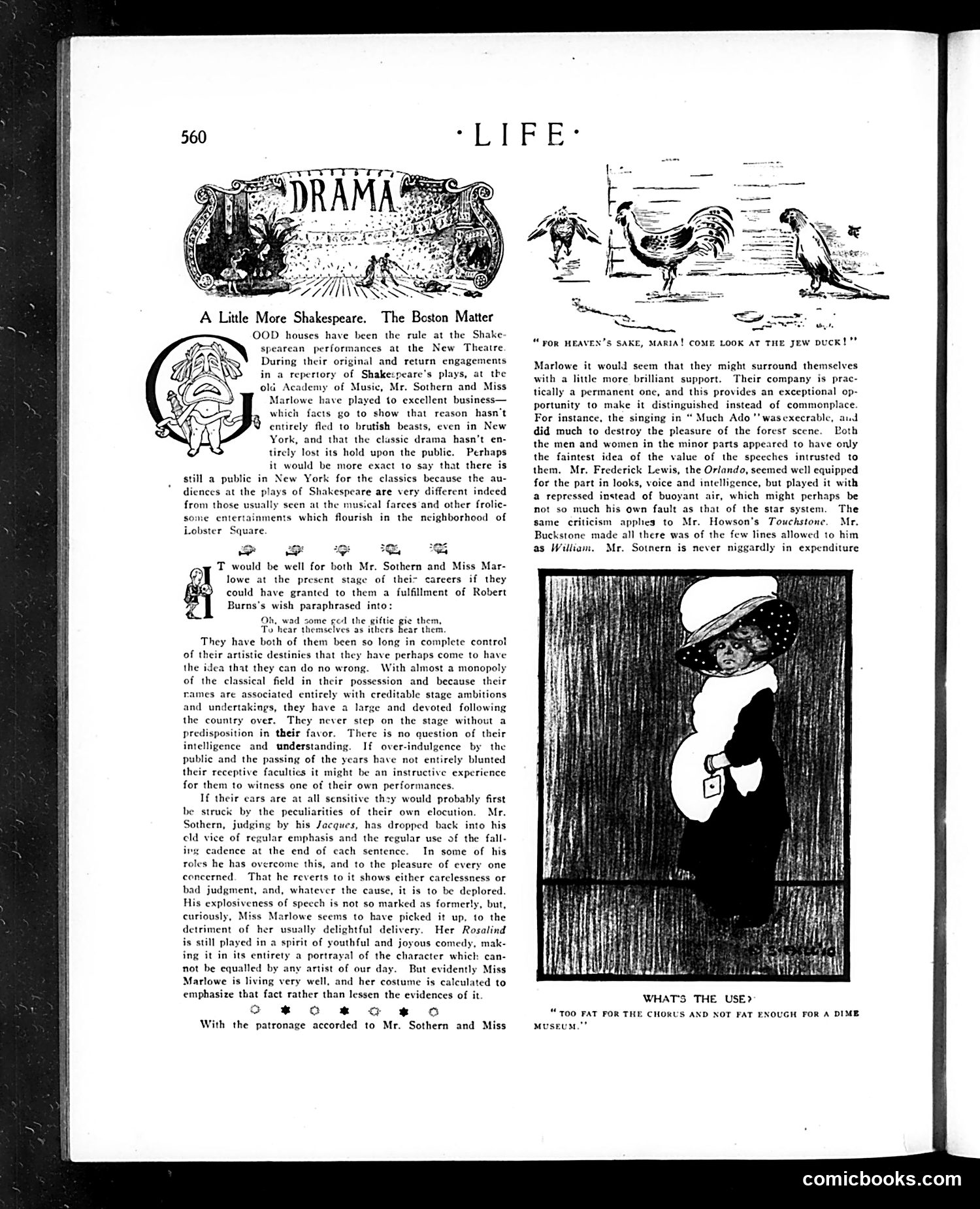
This theater review critiques actors Edward Sothern and Julia Marlowe's Shakespeare performances at New York's New Theatre. The piece praises their drawing power but faults their elocution and stage presence, suggesting they've grown complacent from years of unchallenged dominance in classical theater. The author advocates for self-awareness, paraphrasing Robert Burns to suggest they should "hear themselves as others hear them." Specific complaints include Sothern's monotonous emphasis patterns and Marlowe's adopted explosive delivery—both deteriorating habits. The review also criticizes their supporting cast as undistinguished, despite this being an opportunity for excellence. The cartoon at bottom ("For Heaven's Sake, Maria! Come Look at the Jew Duck!") appears unrelated to the review—a period humor panel typical of Life's format, though its reference is now obscure.
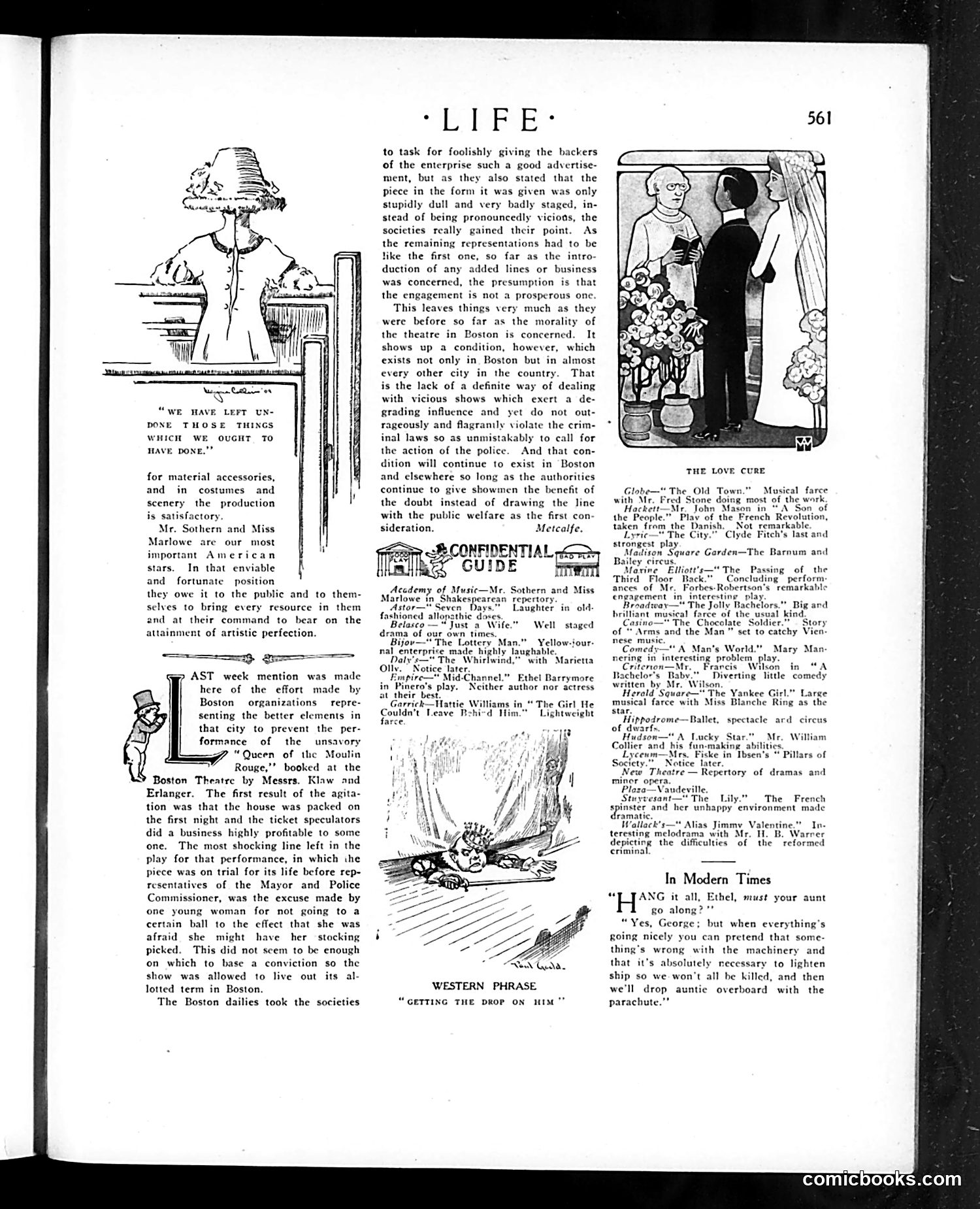
This page critiques Boston's theater censorship efforts. The main text discusses how civic organizations tried to suppress the risqué musical "Queen of the Moulin Rouge" at the Boston Theatre. Their protest backfired—the controversy packed the theater with curiosity-seekers, benefiting the producers financially. The critic (Metcalfe) notes the show was merely "stupidly dull and very badly staged" rather than genuinely obscene, and argues Boston lacks consistent standards for regulating morally questionable productions. The cartoons illustrate theatrical life: "The Love Cure" shows an elegant domestic scene, while "Getting the Drop on Him" depicts a Western confrontation. Below is a "Confidential Guide" listing Boston theaters and current productions, including Sothern and Marlowe's Shakespeare, Ethel Barrymore's "Mid-Channel," and Fred Stone's musical farce—typical of early 1900s theater offerings. The page satirizes both theatrical mediocrity and ineffective moral policing.
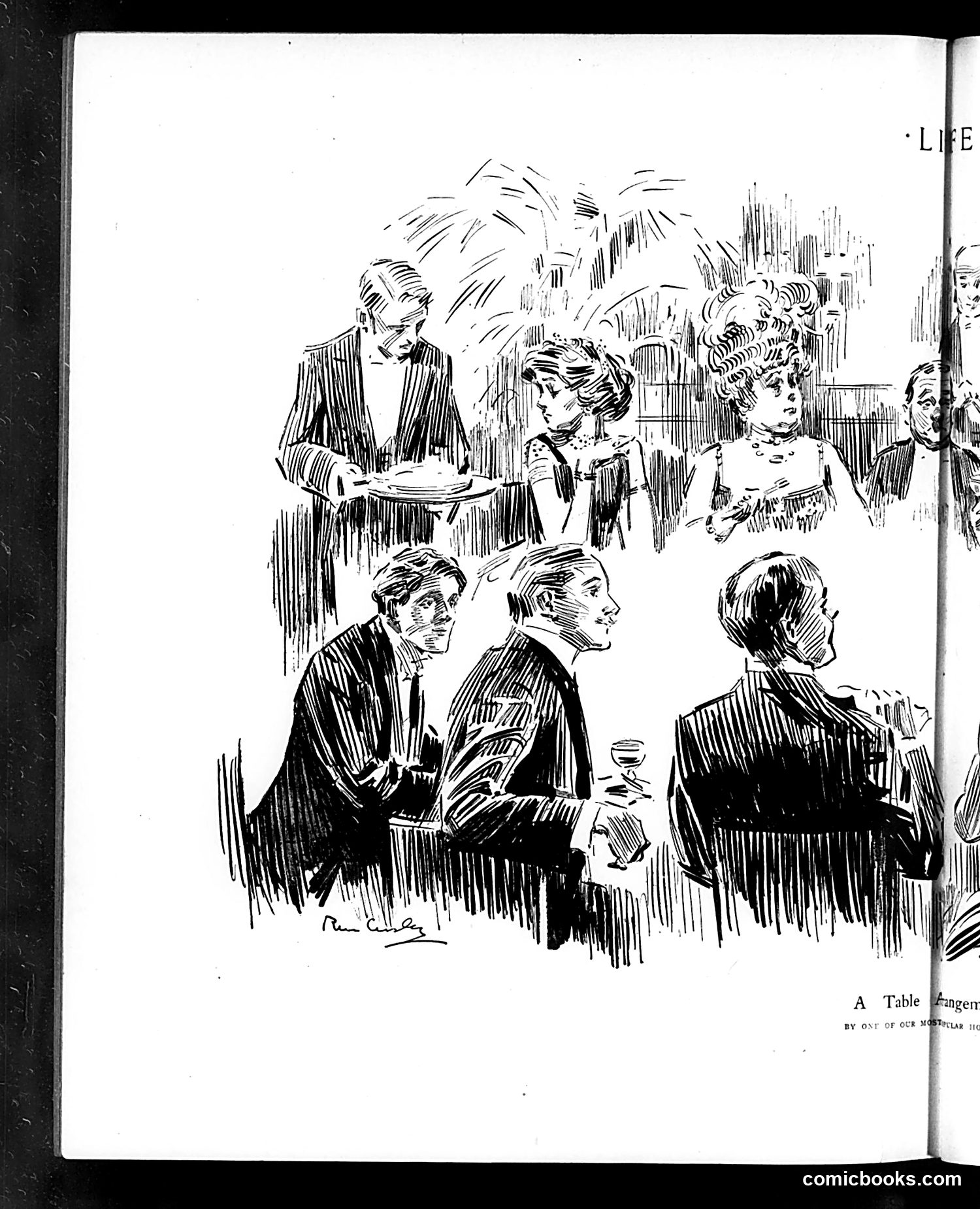
This Life magazine cartoon depicts a formal dinner party scene satirizing upper-class social conventions. A waiter serves food while well-dressed guests converse at a table. The sketch uses exaggerated facial features and body language typical of early 20th-century satirical illustration. The title "A Table Engagement" appears to be a pun—suggesting either a marriage proposal or romantic arrangement occurring during dinner, or mocking the awkward social "engagements" (interactions) that happen at formal dining events. The cartoon likely satirizes pretentious high-society dinners and their stilted etiquette, capturing the artificial nature of upper-class socializing. The style and publication suggest this is from Life's period as a humor and satire magazine focused on American social commentary. The artist's signature is visible but not clearly legible.
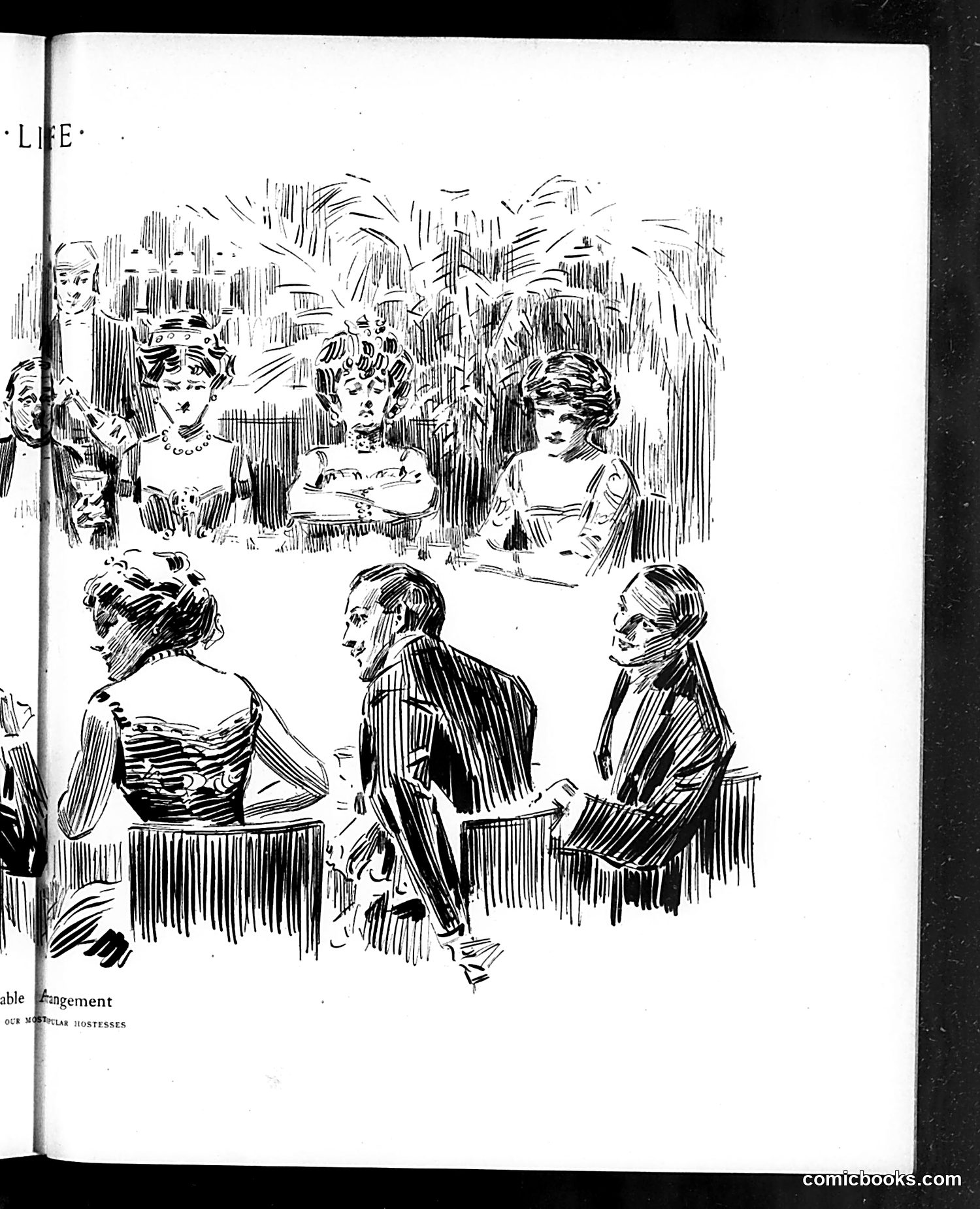
This appears to be a social illustration from *Life* magazine depicting an "Engagement" scene (as indicated by the partial text at bottom). The sketch shows a formal social gathering with well-dressed figures of the Edwardian era—women in elaborate upswept hairstyles and corseted dresses seated in the background, and men in dark suits conversing in the foreground. The satire likely comments on the ritualistic nature of high-society courtship and engagement announcements. The formal posturing, elaborate dress, and staged social interaction suggest mockery of upper-class marriage conventions and the performance aspect of romantic "engagements" among the wealthy. The specific identities of the figures remain unclear from the image alone.
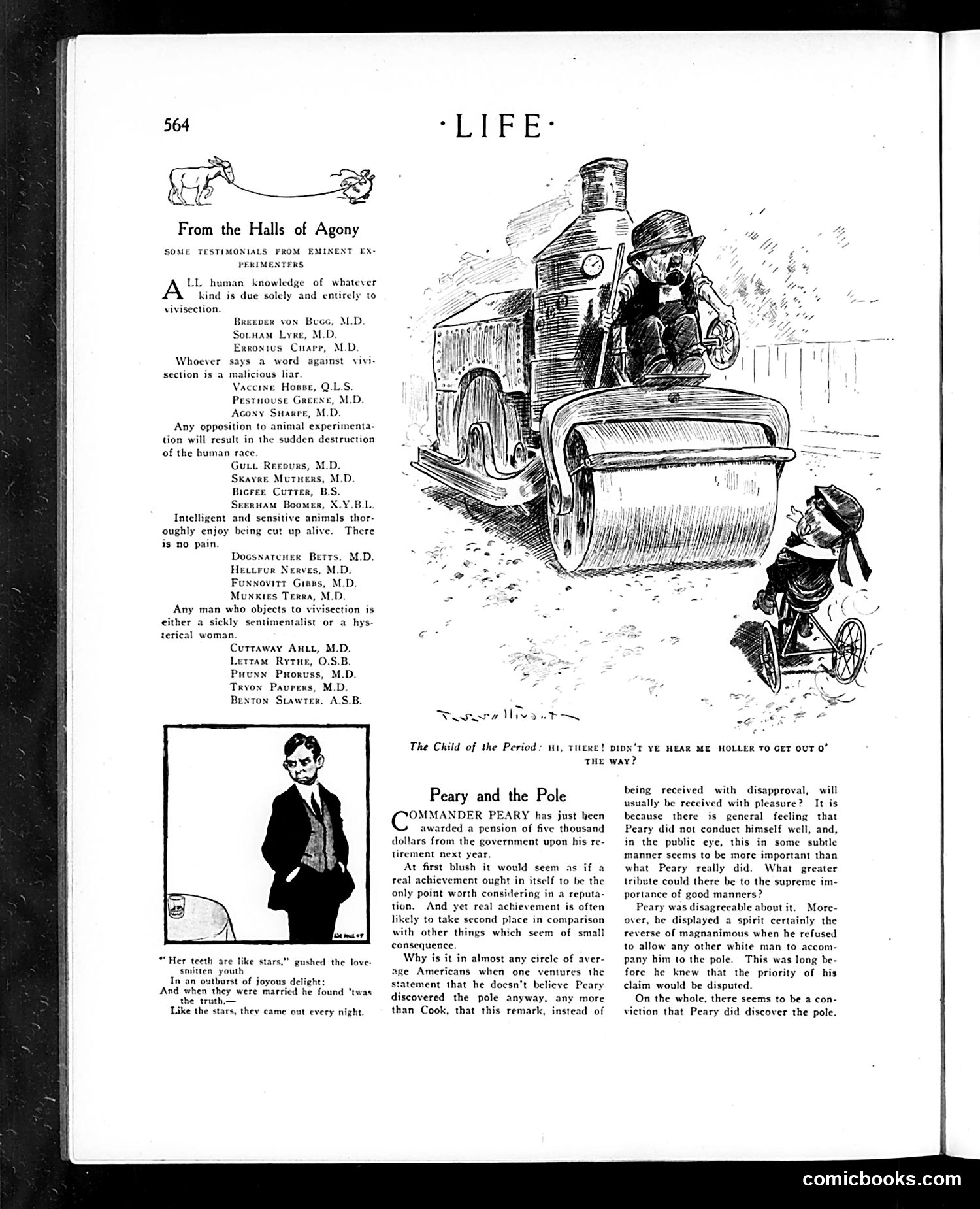
**Left column ("From the Halls of Agony"):** This is satirical mockery of vivisectionists—scientists who defend animal experimentation. Life lists fabricated testimonials from fictional "eminent experimenters" with ridiculous names, each making absurd pro-vivisection claims: that all knowledge comes from it, opponents are liars, animals "enjoy" being cut up alive, and objectors are sentimentalists. The satire exposes the extreme rhetoric and logical fallacies used to justify animal testing. **Right ("Peary and the Pole"):** Discusses Commander Peary's government pension for discovering the North Pole. The article critiques that although Peary achieved the feat, Americans prefer doubting his claim because he behaved poorly—refusing companions and displaying poor sportsmanship. Life ironically notes this reveals Americans value manners over actual accomplishment. The reference to "Cook" likely alludes to Frederick Cook, who made a rival North Pole discovery claim around the same time.
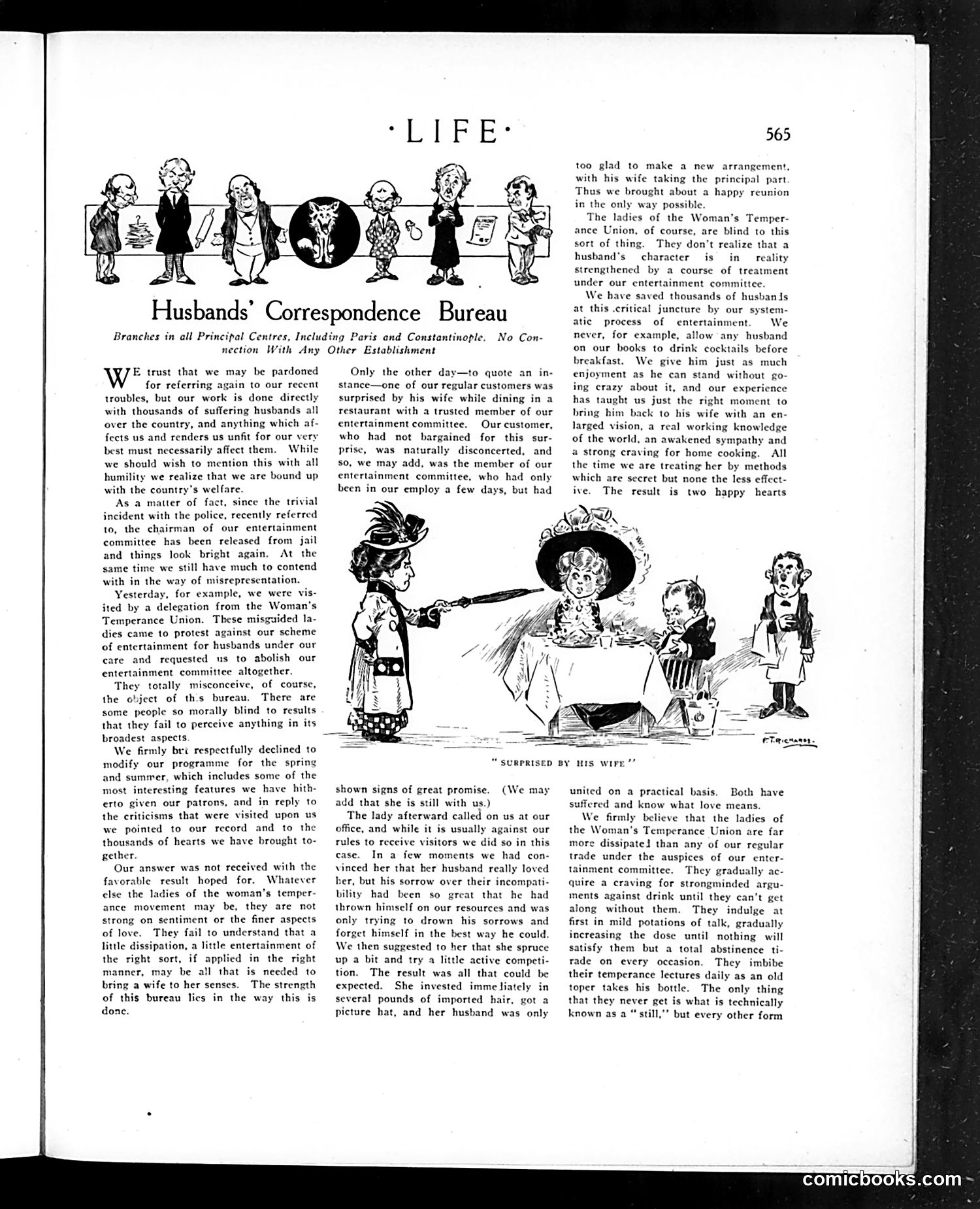
This is satirical fiction mocking late-Victorian marital dynamics and the "temperance movement." The fictional "bureau" claims to help troubled husbands by arranging entertainment (clearly euphemistic—the text mentions "trusted members" who dine with clients, implying infidelity). The satire targets: 1. **Hypocrisy**: The bureau presents infidelity as therapeutic, claiming it "strengthens" husbands and saves marriages by letting them "forget their sorrows." 2. **Women's activism**: The Women's Temperance Union (a real reform movement) objects to the scheme, but the bureau dismisses them as "morally blind" and lacking sentiment. 3. **Male entitlement**: The logic that husbands need "dissipation" and affairs to be happy, while wives should simply "spruce up" with imported hair and hats to compete. The accompanying cartoon shows a woman catching her husband with another woman, captioned "Surprised by His Wife"—illustrating the bureau's actual purpose beneath its euphemistic language. The satire exposes the double standards and absurd rationalizations men used to justify infidelity in this era.
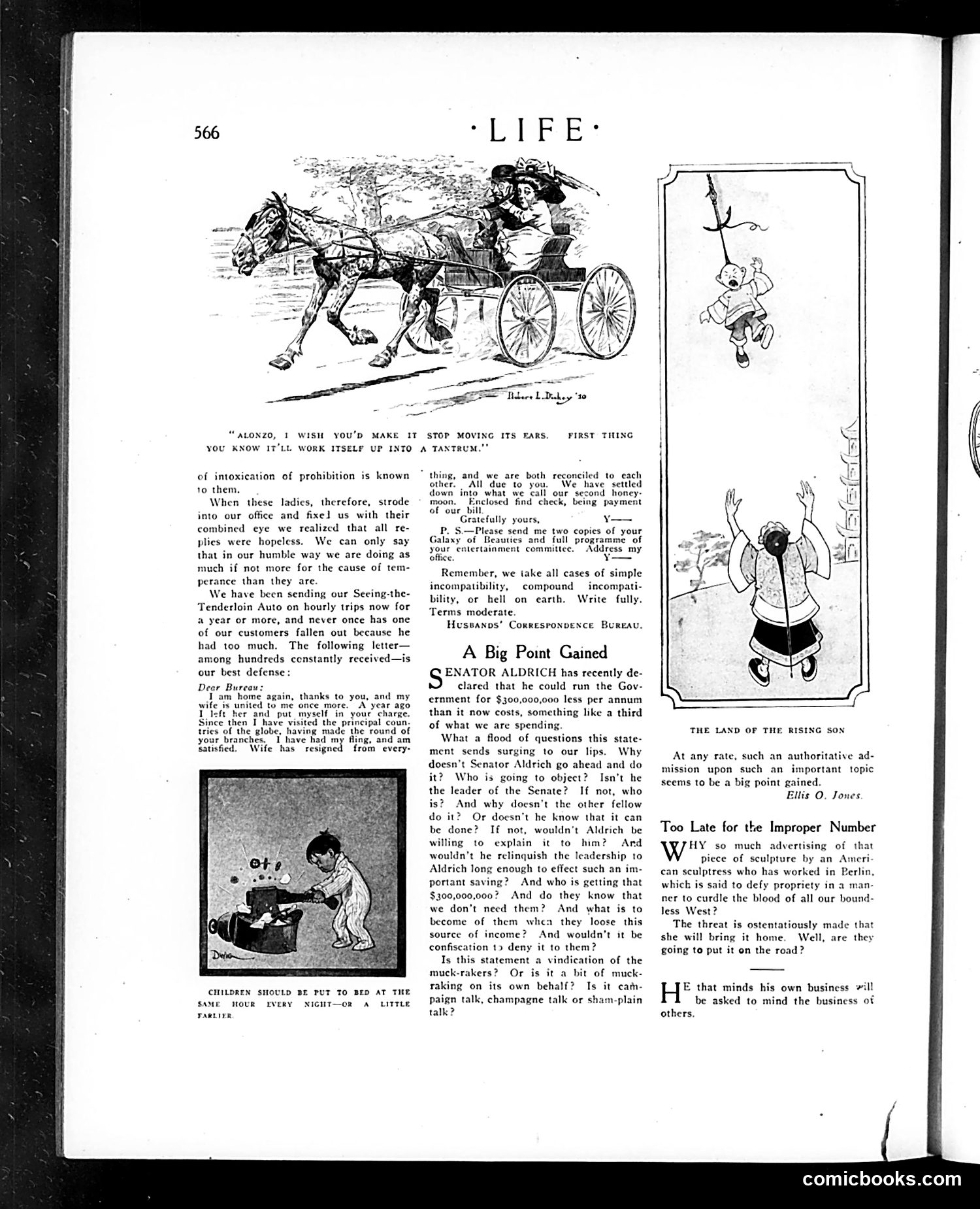
This page contains multiple satirical pieces typical of early 20th-century American political humor. The top cartoon depicts a man in a horse-drawn carriage, illustrating a joke about a stubborn horse whose "ears" won't stop moving—a pun suggesting the animal will work itself into a tantrum. This appears to be domestic humor rather than political commentary. The main text below mocks **Senator Aldrich's** recent claim that he could run the government for $300 million less annually. Life's editors sarcastically pose a series of rhetorical questions: Why doesn't Aldrich simply do it? Who benefits from current spending? The satire suggests Aldrich's statement is either empty campaign rhetoric or inadvertent admission that government waste exists—yet he won't act on it. A side note criticizes an unnamed American sculptress working in Berlin whose sculpture allegedly violates propriety standards, humorously questioning whether it will be displayed publicly if brought home. The page exemplifies Life's role as a platform for political criticism and social satire during the Progressive Era.
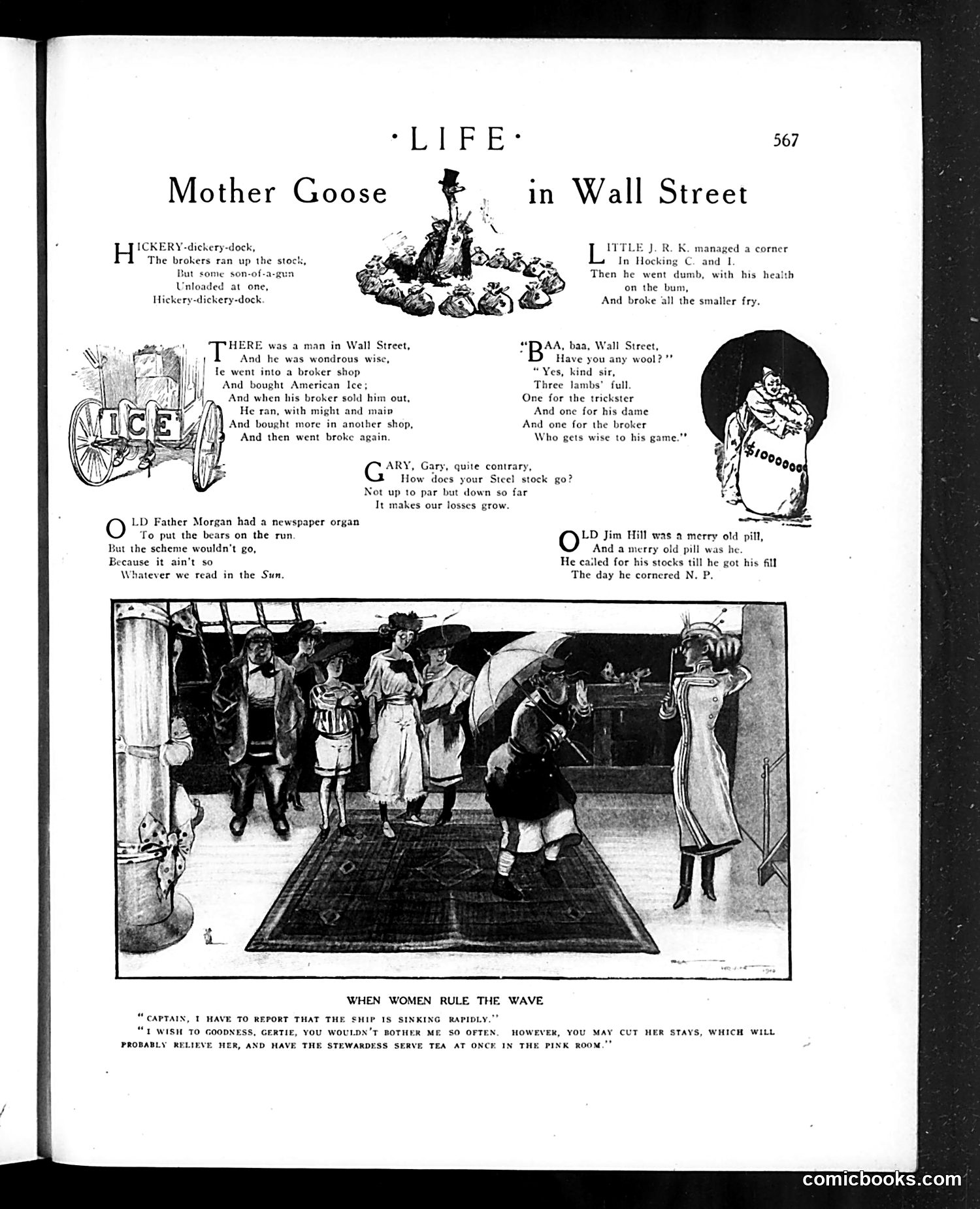
This satirical page from *Life* magazine parodies nursery rhymes to mock Wall Street speculation and financial manipulation during what appears to be the early 1900s. **Key figures referenced:** - "Father Morgan" (J.P. Morgan) attempted to stabilize markets through newspaper propaganda - "Gary" (likely Judge Elbert Gary of U.S. Steel) whose stock declined - "Jim Hill" (railroad magnate James J. Hill) who cornered Northern Pacific stock **The satire's point:** Politicians and financiers like Morgan, Gary, and Hill manipulated markets through schemes and insider trading, causing ordinary investors to lose money. The nursery-rhyme format mocks their supposedly "wise" strategies as childish and reckless. **Bottom panel:** "When Women Rule the Wave" satirizes women's demands for equal treatment—the captain dismisses a sinking ship report while ordering tea service, suggesting men in power ignore serious problems while prioritizing trivial concerns.
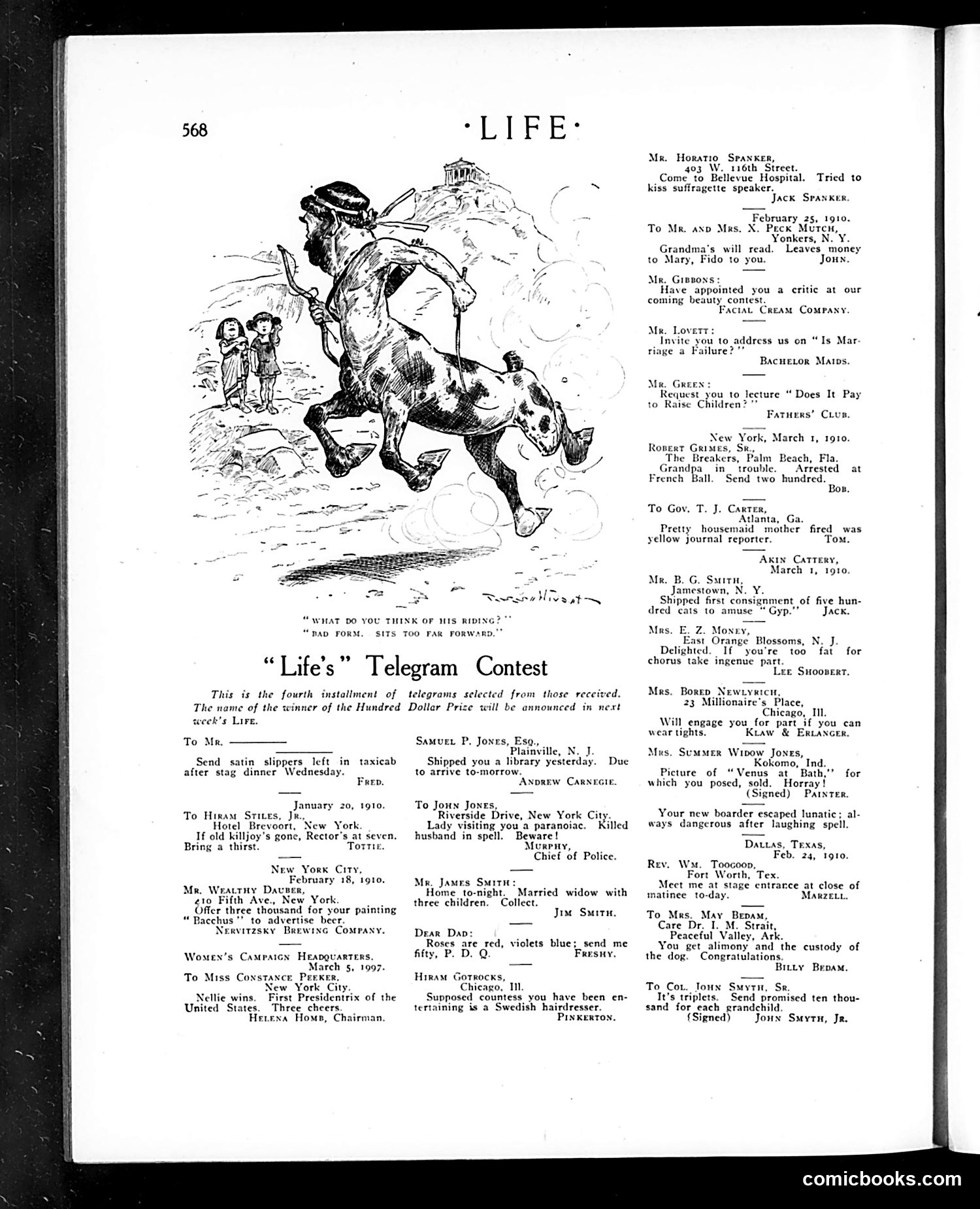
This page showcases Life's humor contest featuring brief, witty telegrams. The central cartoon depicts someone riding a horse poorly—a visual setup for the contest's premise. The telegrams are humorous fictional messages playing on early 1900s social scenarios: a woman trying to kiss a suffragette speaker (topical, as women's suffrage was controversial), wealthy businessmen receiving embarrassing news, servants and employees receiving cryptic orders, and domestic mishaps. One telegram references Andrew Carnegie's library donations (a well-known philanthropic practice). Another jokes about mistaken identity regarding a "Swedish hairdresser" posing as nobility. The humor relies on period-specific details: taxicabs, stage dinners, art collecting, theater employment, and social climbing. Many telegrams feature class-based comedy—confused aristocrats, gold-digging widows, and servant complications. The contest awarded a hundred-dollar prize, making this both entertainment and reader engagement. The jokes reflect 1910s anxieties about social pretense, morality, and changing gender roles (the suffragette reference).
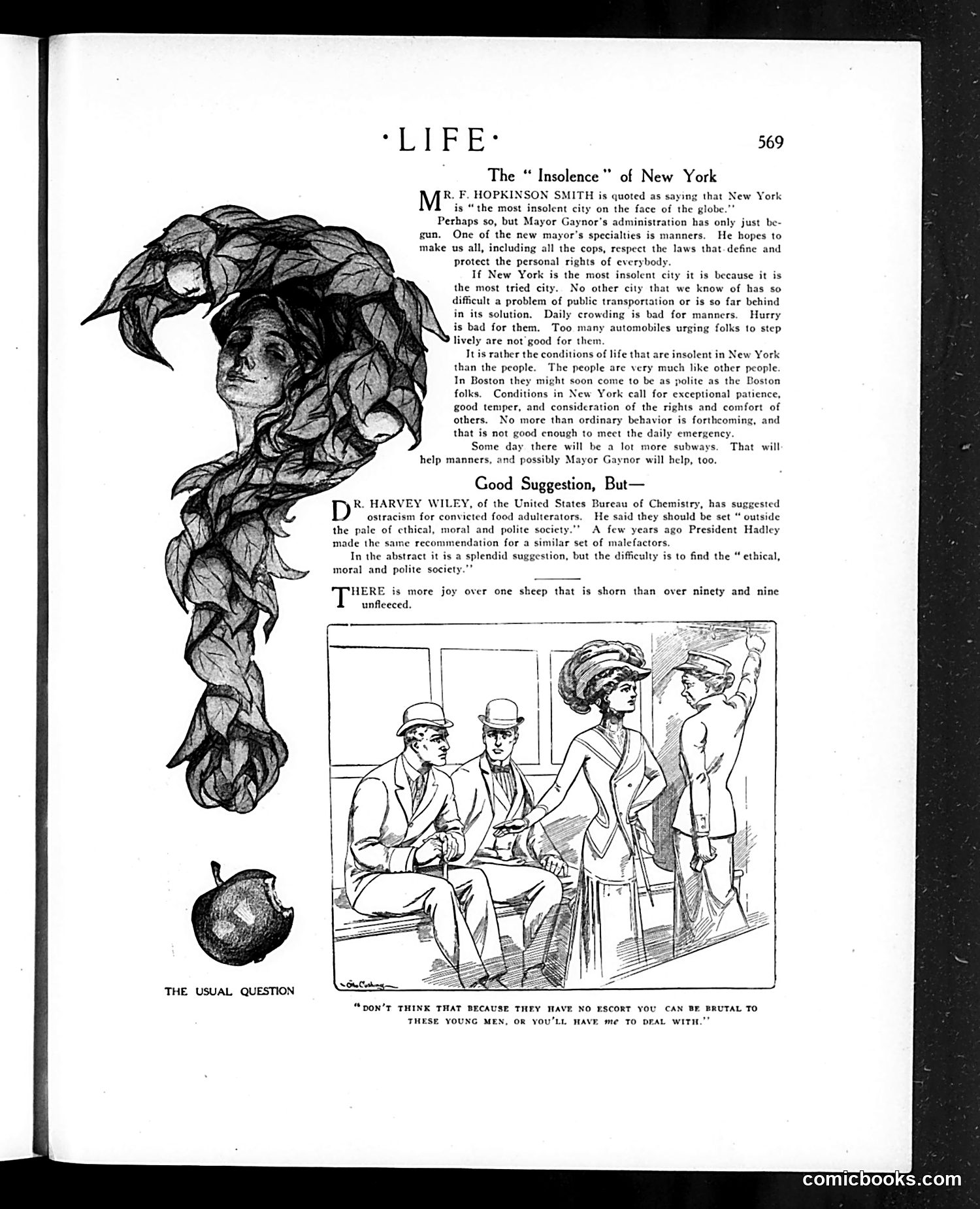
This page critiques New York City's reputation for rudeness under Mayor Gaynor's administration (early 1910s). The article argues New York isn't inherently rude—rather, **poor urban conditions** (crowded public transportation, automobile congestion, daily rushing) create incivility. The solution lies in infrastructure improvements like more subways, not moral reform. The secondary piece mocks food safety reformer Harvey Wiley's proposal to ostracize convicted food adulterators from "ethical, moral and polite society"—the satirical point being that no such virtuous society actually exists to exclude them from. The cartoon labeled "The Usual Question" depicts two working-class men confronting a woman with two unescorted young men, threatening violence unless they behave respectfully. The irony: the "protectors" themselves exemplify the brutal, aggressive behavior the article attributes to poor urban conditions rather than inherent character flaws.
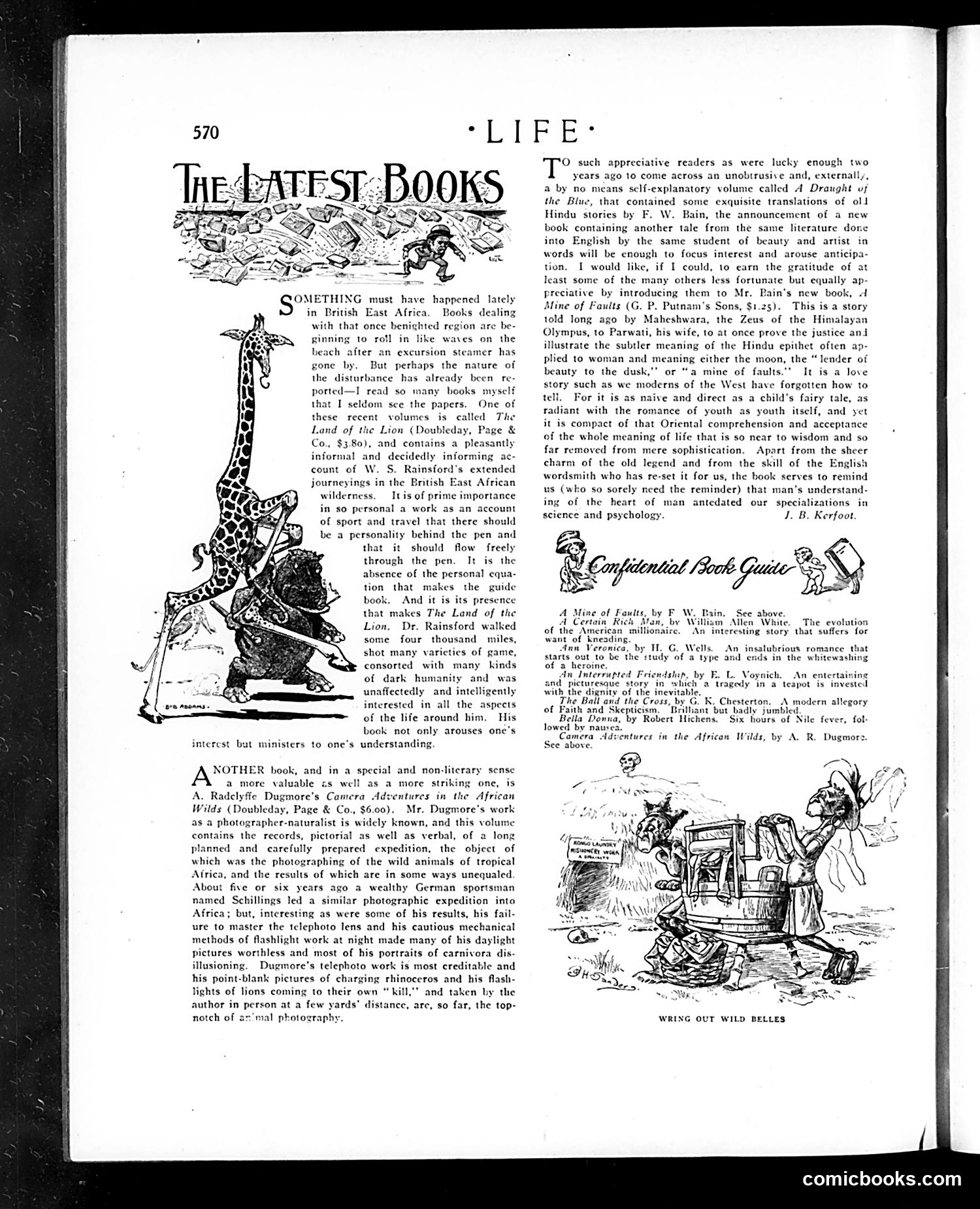
This book review column discusses recent publications about British East Africa, a region experiencing increased literary attention. The page satirizes the proliferation of travel narratives emerging from that colonial territory. The main critique focuses on **personality versus objectivity in travel writing**. The reviewer praises W.S. Rainsford's *Land of the Lion* for its personal voice and genuine engagement with the landscape and peoples encountered during his four-thousand-mile journey. By contrast, guide books lack this essential human element. The page also celebrates R. Radclyffe Dugmore's *Camera Adventures in the African Wilds*, noting his superior photographic techniques—particularly his telephoto and flashlight work—compared to an earlier German expedition led by Schillings. The "Confidential Book Guide" section recommends translations of Hindu literature by F.W. Bain, emphasizing their artistic merit for discerning readers. The accompanying giraffe and hunter illustration visualizes the exotic African subject matter these books explore.
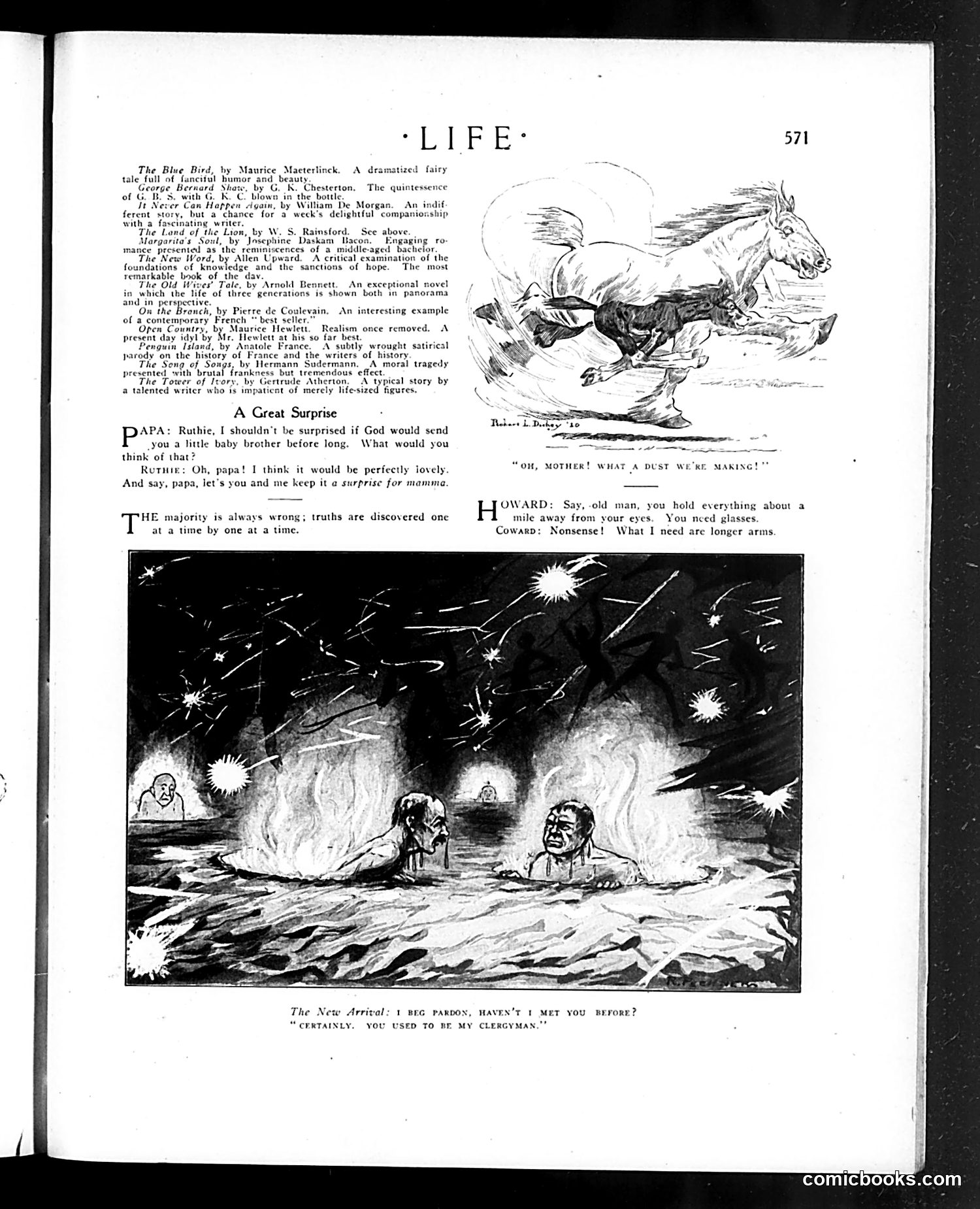
This page contains three distinct humor pieces from an early 20th-century American satirical magazine: **"A Great Surprise"** (top): A comic dialogue between a father (Papa) and daughter (Ruthie) about a potential baby brother. The joke's appeal relies on the child's innocent misunderstanding—she agrees to keep the baby a "surprise" for mother, not grasping the biological reality that the mother would already know. It's gentle, family-oriented humor typical of the era. **Two visual cartoons** appear below, including one depicting what appears to be Hell or the underworld (flames, devils), with a caption about meeting someone who "used to be my clergyman"—dark religious satire suggesting hypocrisy or damnation of clergy. **The middle dialogue** between Howard and Coward presents a philosophical quip about truth and majority opinion, paired with a sight-gag where one character needs longer arms, not glasses. The page also includes book reviews of contemporary 1900s-era novels at the top, reflecting Life's role as a literary and cultural commentary magazine.
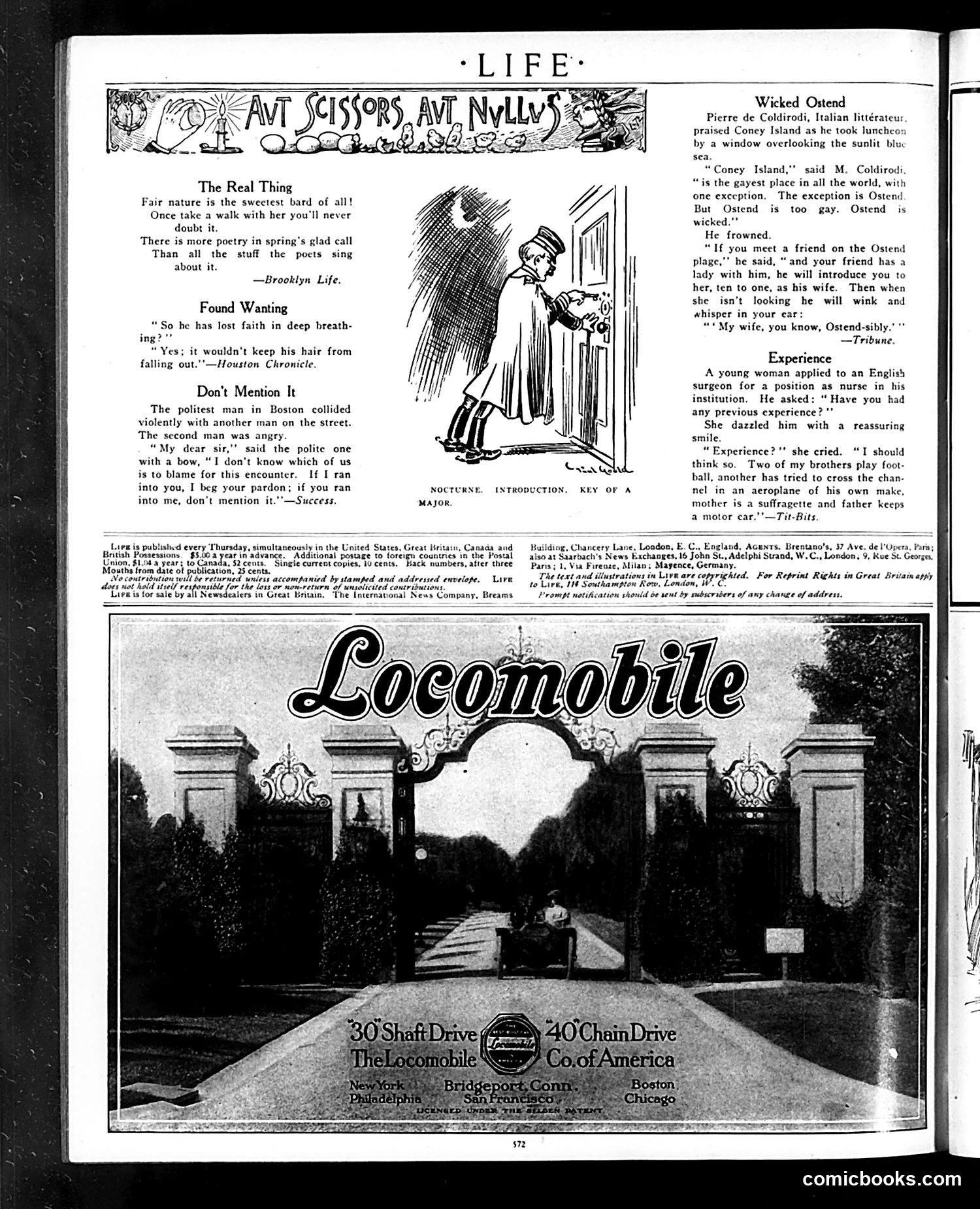
This page from *Life* magazine contains three distinct humorous anecdotes and one advertisement, typical of the publication's satirical format. The three short jokes mock human folly: "The Real Thing" praises nature over poetry; "Found Wanting" jokes about a man whose deep breathing failed to prevent hair loss; "Don't Mention It" satirizes excessive politeness through a Boston gentleman's absurdly deferential apology after a collision. The illustrated sidebar pieces include "Wicked Ostend," mocking the Belgian beach resort as morally loose compared to Coney Island, with a pun on "ostensibly"; and "Experience," where a young woman's qualifications for nursing—her brothers' football playing, aviation stunts, and her mother's suffragette activism—humorously misrepresent actual medical experience. The suffragette reference dates this to the early 20th-century women's rights movement. The Locomobile automobile advertisement occupies the lower half.
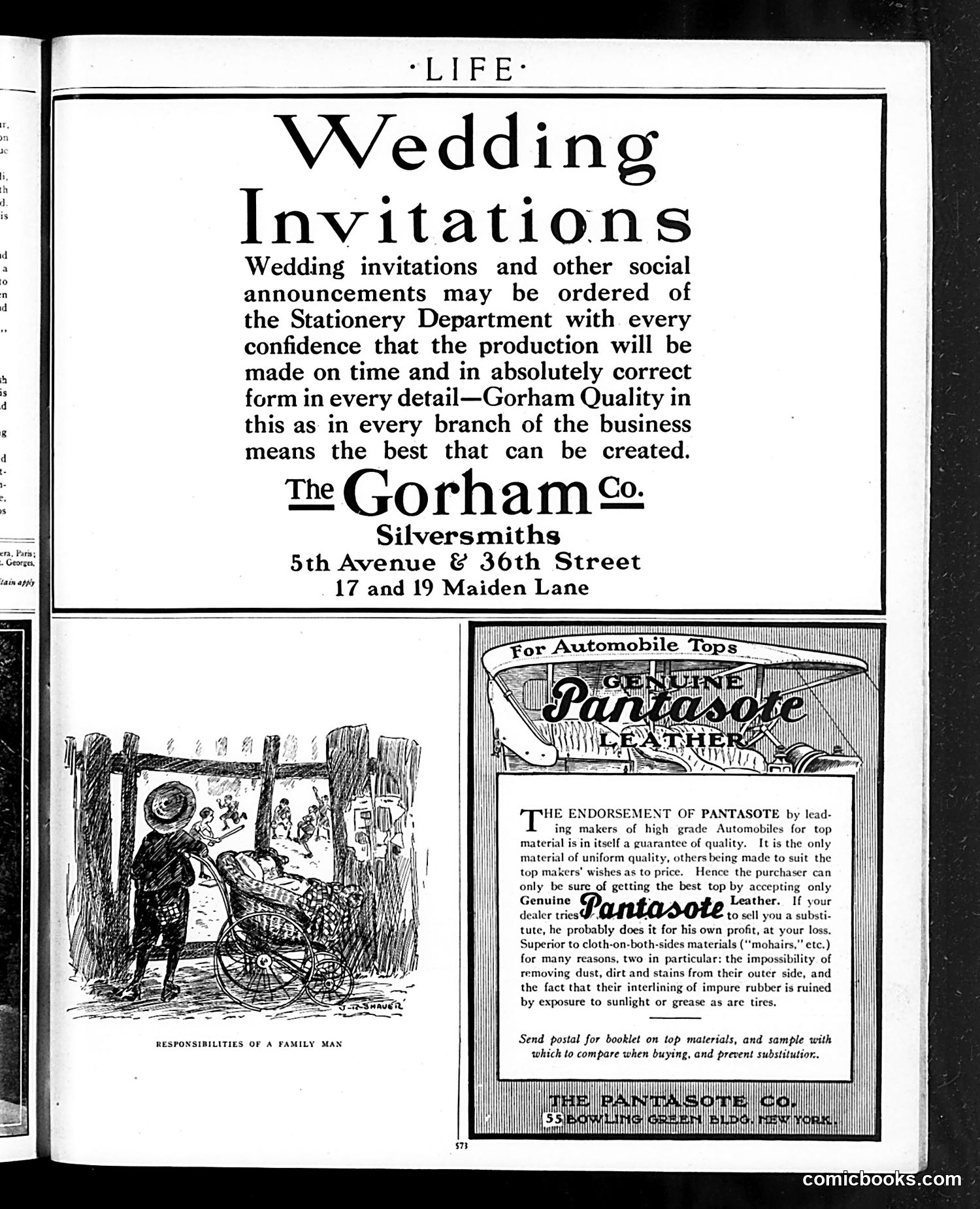
This page is primarily **advertising**, not political satire. It contains three ads: 1. **Gorham Co. (top)**: A silversmith company advertising wedding invitations and social announcements, emphasizing quality and correctness of form. 2. **Cartoon (left)**: A sketch labeled "Responsibilities of a Family Man" showing a man dealing with laundry on a clothesline—a domestic humor cartoon about household duties, not political commentary. 3. **Pantasote Leather (right)**: An automobile industry ad promoting genuine Pantasote leather for car tops, warning consumers against inferior substitutes and praising its durability against dust, dirt, and sun damage. The page reflects early 20th-century consumer culture, emphasizing quality brands and product authenticity—concerns relevant to automobile owners and households of the era.
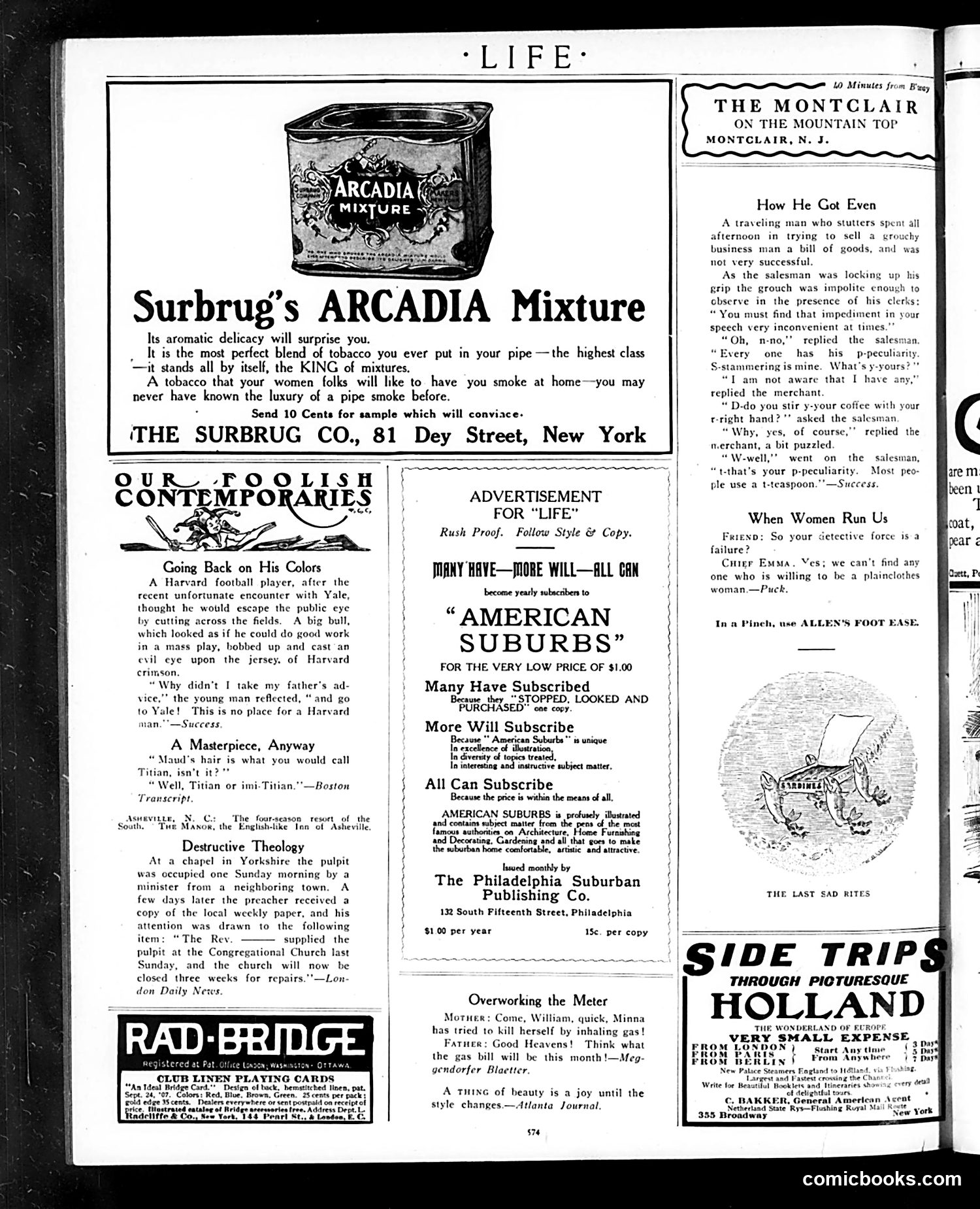
This page from *Life* magazine contains several short humorous pieces and advertisements typical of early 20th-century American satire. **The Cartoons/Jokes:** The "Foolish Contemporaries" section offers brief, punchy satirical anecdotes: - A Harvard student flees across fields to avoid Yale fans after a football loss, but encounters an angry bull—the joke being he should have gone to Yale after all. - A chapel pulpit guest's sermon was so destructive the church needed three weeks repairs—dark humor about a bad preacher. - A stuttering salesman turns the tables on a rude businessman by pointing out the businessman stirs coffee with his hand instead of a spoon—mocking the grouch's own peculiarity. **Advertisements:** The page is dominated by ads for tobacco, magazines (*American Suburbs*), playing cards, and travel—typical commercial content. The Surbrugg tobacco ad emphasizes that even women will enjoy the "luxury" of this pipe tobacco at home, reflecting period attitudes about domestic life and smoking. The overall tone is genteel, middle-class humor aimed at educated readers.
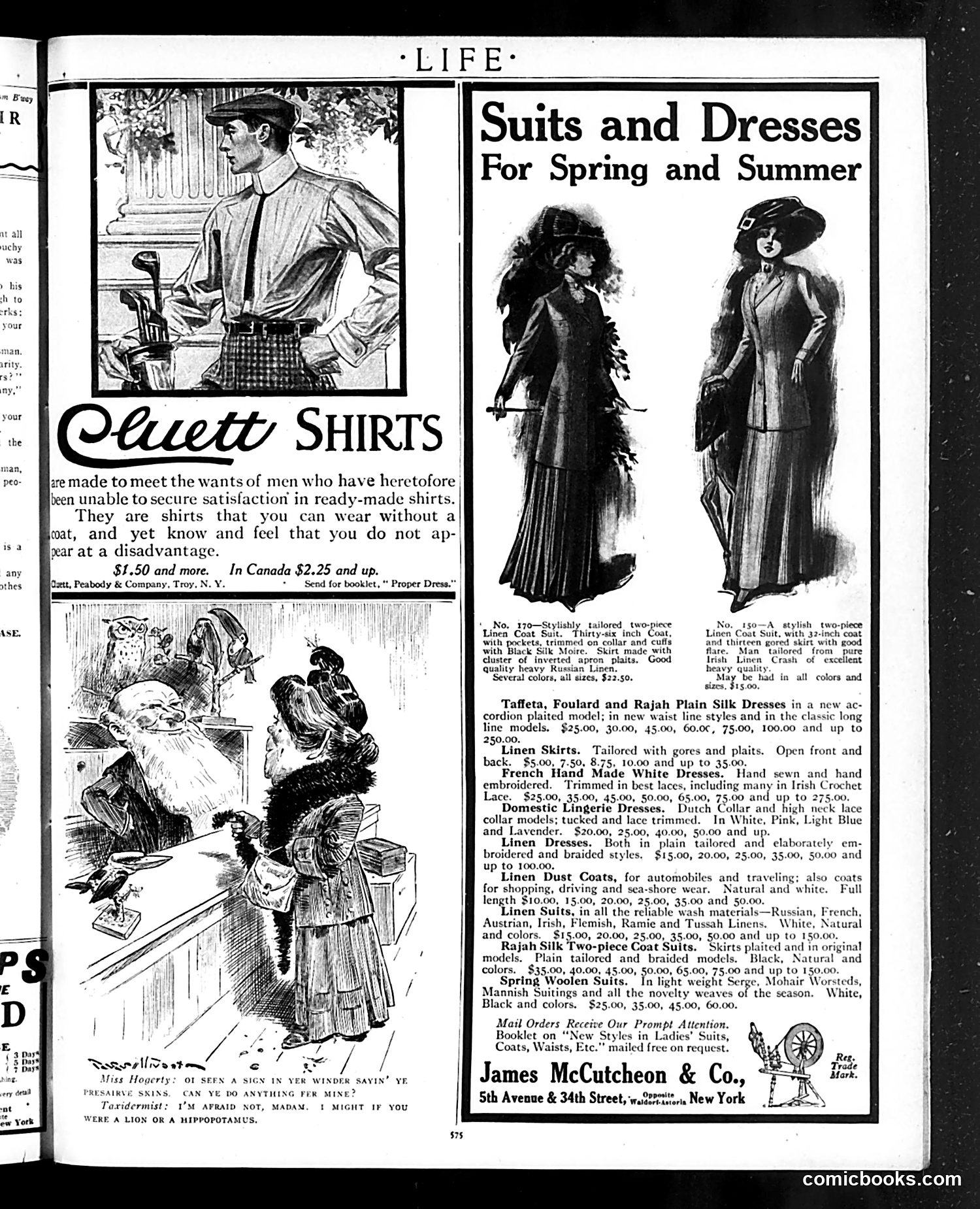
This page contains primarily **advertisements**, not political satire. The dominant content is a fashion ad from James McCutcheon & Co. featuring spring and summer suits and dresses with detailed price listings. However, there is **one cartoon** (bottom left): A woman identified as "Miss Hogerty" with an Irish accent (dialect spelling: "yer," "presairve") visits a taxidermist, asking if he can "preserve" her skin. The taxidermist replies he could only help if she were "a lion or a hippopotamus." **The joke:** This is ethnic humor mocking Irish women's appearance, suggesting an Irish woman's skin is so rough or unattractive it requires taxidermy treatment—implying she's less human or more beast-like than civilized people. This reflects period prejudices against Irish immigrants. The humor is cruel by modern standards, relying on ethnic stereotyping common to early 1900s American magazines.
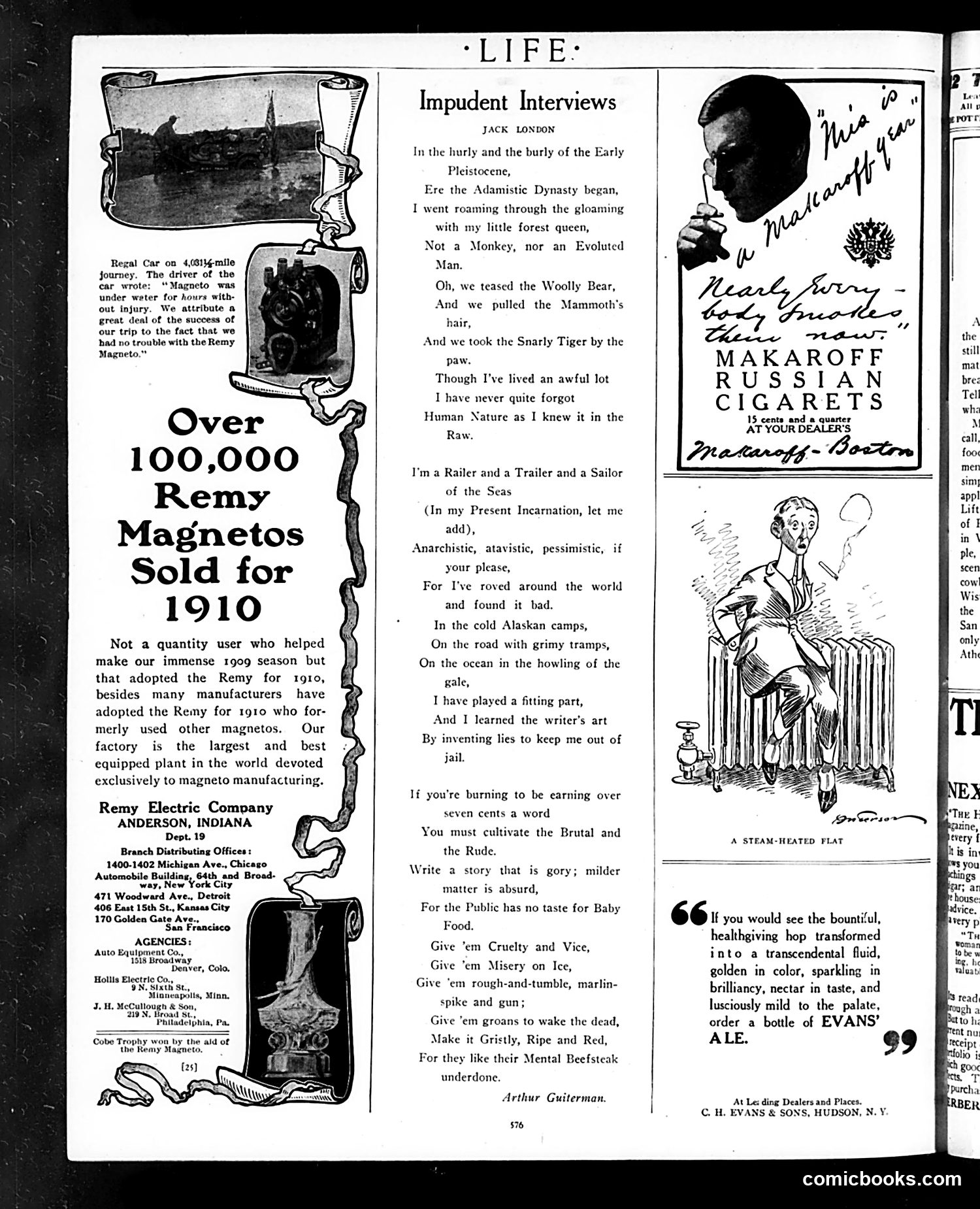
This page combines advertisements with satirical editorial content. The left side advertises Remy Magnetos (automobile electrical components), highlighting their 1910 market success. The main feature is "Impudent Interviews: Jack London," a poem by Arthur Guiterman satirizing the famous author. It mocks London's public persona—his romanticization of primitive life, his world travels, his anarchistic politics, and his rough-and-tumble reputation. The poem's humor targets London's literary success through sensationalism; Guiterman suggests London teaches aspiring writers to prioritize gore and brutality ("Mental Beefsteak underdone") over quality, and admits to "inventing lies to keep me out of jail." The right side features period advertisements: Makaroff Russian cigarettes and Evans ale, along with a cartoon labeled "A Steam-Heated Flat" (likely depicting urban domestic life). The satire works because readers would recognize Jack London as a celebrity author whose actual works and public statements matched the exaggerated stereotypes presented here.
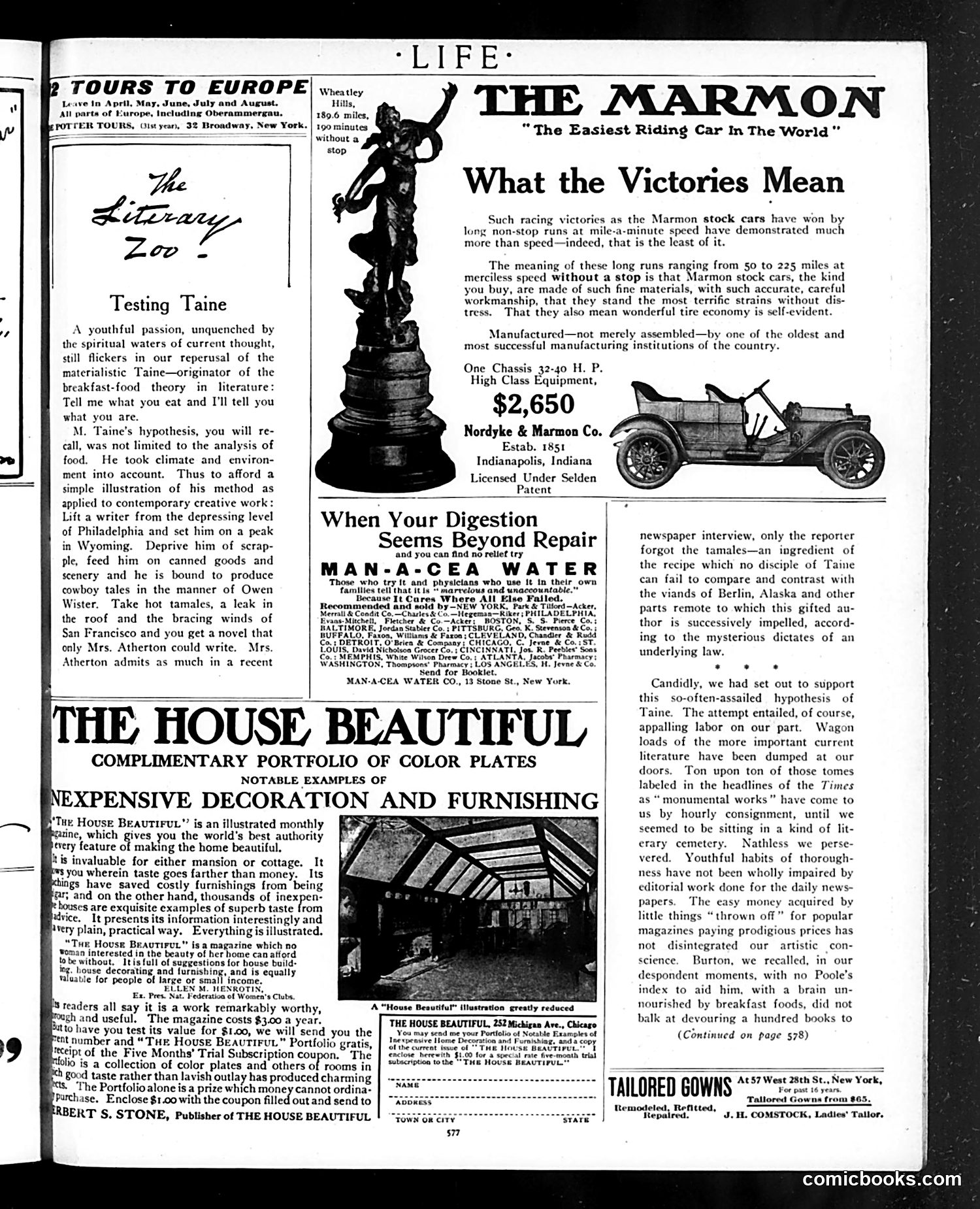
This page is primarily **advertising and promotional content** rather than political satire. The main advertisements include: - **The Marmon automobile** ("The Easiest Riding Car in the World"), priced at $2,650, emphasizing engineering quality and long-distance racing victories - **Man-a-cea Water**, a patent medicine claiming digestive benefits - **The House Beautiful** magazine, offering decorative portfolio services - **Tailored Gowns** from a New York dressmaker The only editorial content is "Testing Taine," a brief piece discussing the food theorist M. Taine's scientific approach to nutrition and how his methods might apply to contemporary creative work—using Wyoming and Philadelphia as example locations. The page reflects early 20th-century consumer culture, with emphasis on industrial achievement, health remedies, home decoration, and fashion.
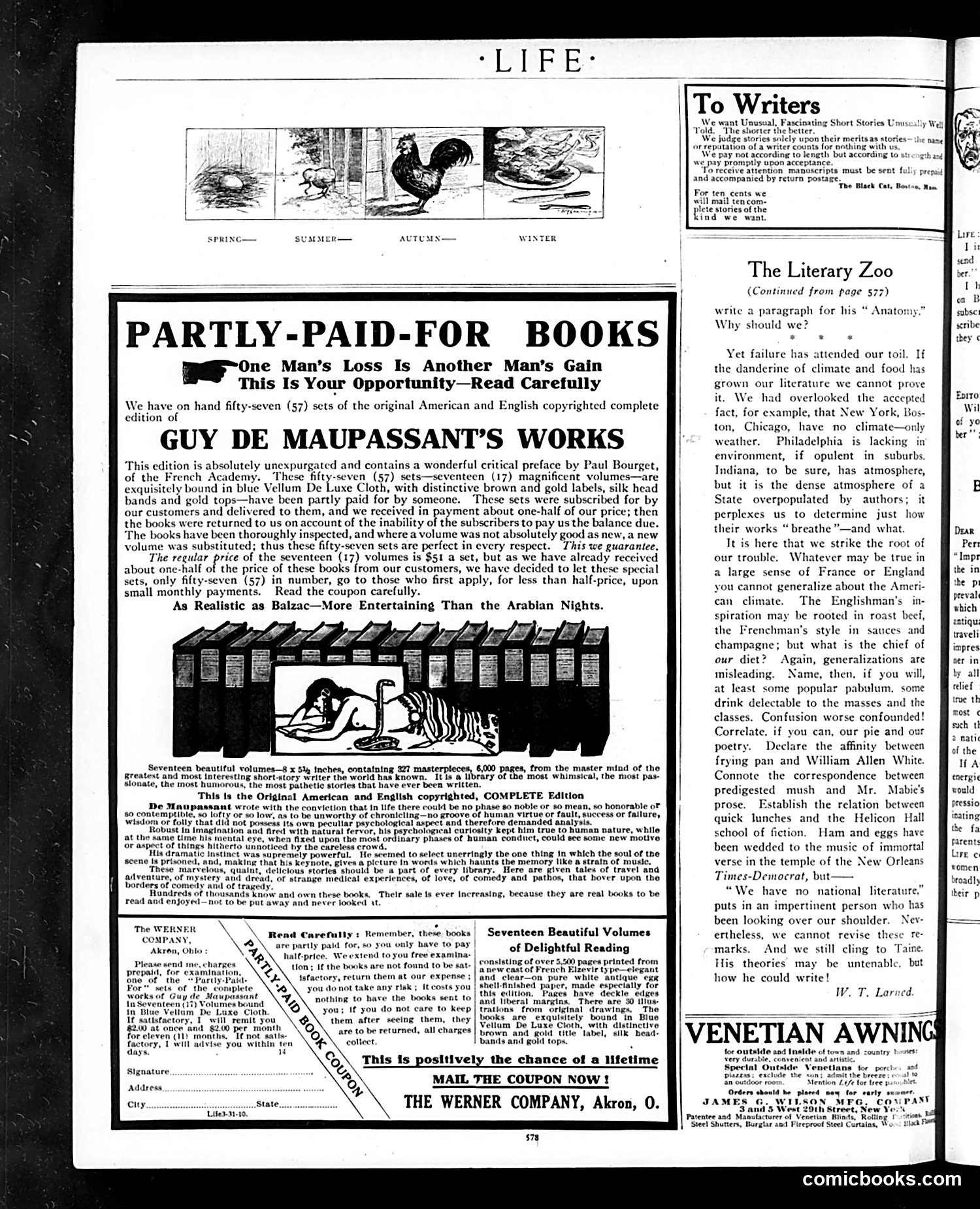
This page is primarily a commercial advertisement, not a political cartoon. It advertises a remaindered book set—Guy de Maupassant's complete works in seventeen volumes. **The business premise**: A publisher acquired books that customers had partially paid for but then defaulted on their installment payments. Rather than absorb the loss, the company is reselling these returned sets at a discount ("less than half-price, upon small monthly payments"). **The satire implicit in the headline**: "One Man's Loss Is Another Man's Gain" acknowledges the awkward situation: defaulting customers' financial failure becomes an opportunity for new buyers. The ad tries to frame this sympathetically by guaranteeing the books are in perfect condition (damaged volumes were replaced). **Historical context**: This reflects early 20th-century subscription publishing practices, where customers bought expensive multi-volume sets on installment plans—a risky venture for both parties. The ad represents a common problem of the era: overextended buyers unable to complete payments. The page also includes a small literary column and other period advertisements, typical of *Life* magazine's mixed content format.
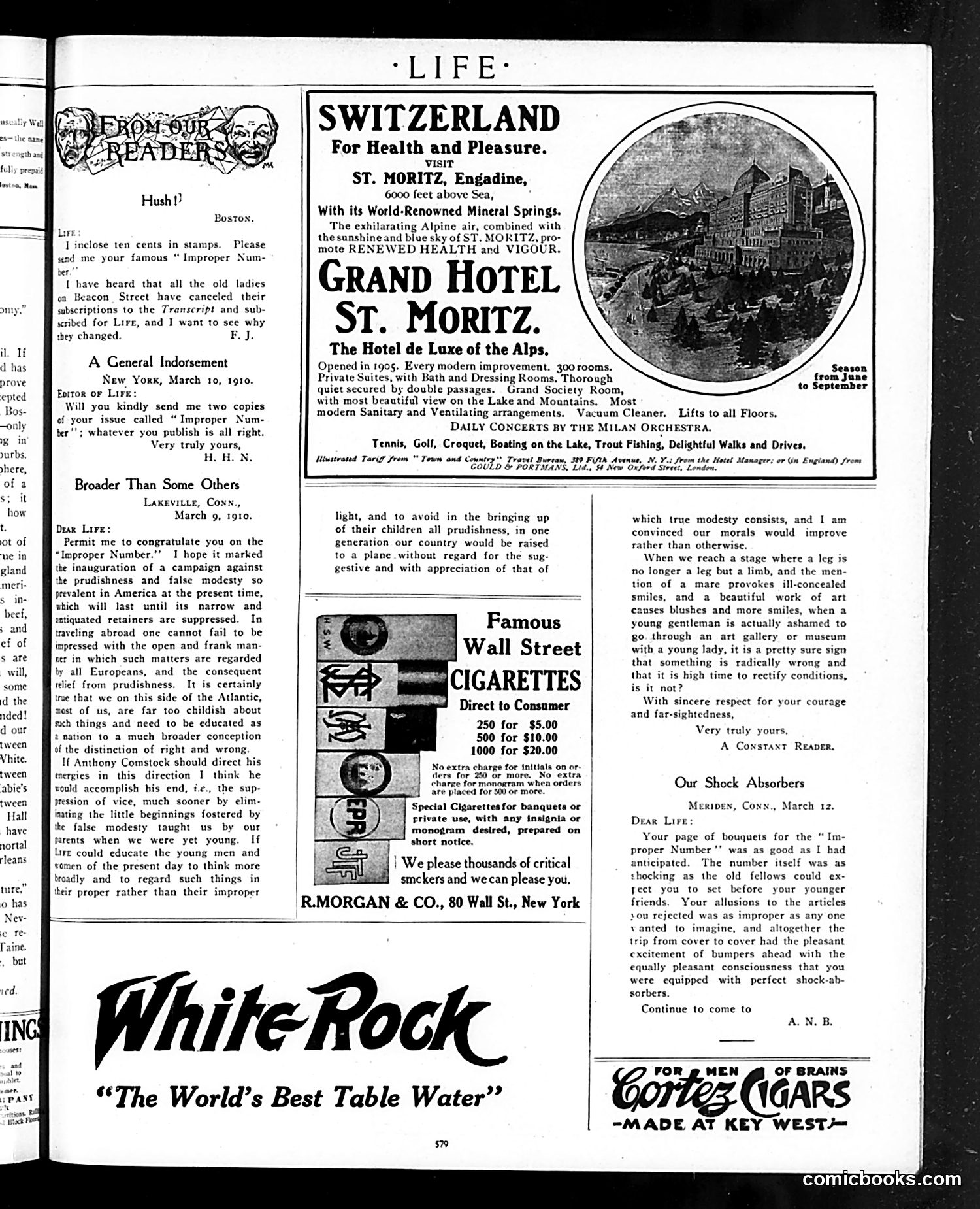
This is primarily an **advertising and letters page** from *Life* magazine (circa 1910), not a political cartoon. The content reflects early 20th-century American attitudes about propriety and modesty. The key substantive section is reader correspondence debating **prudishness in American culture**. Writers argue that Americans are excessively prudish compared to Europeans, and that frank discussion of bodily matters and art (including nude paintings) shouldn't cause embarrassment. One letter references **Anthony Comstock**, the famous censorship crusader, suggesting his anti-vice campaigns were counterproductive. The satire is subtle: *Life* is presenting these earnest arguments for sexual/moral openness as evidence that American attitudes were outdated and provincial—a common *Life* position. The rest consists of advertisements (Swiss hotel, cigarettes, water, cigars)—period pieces showing what was marketed to educated readers. No specific political figures are caricatured on this page.
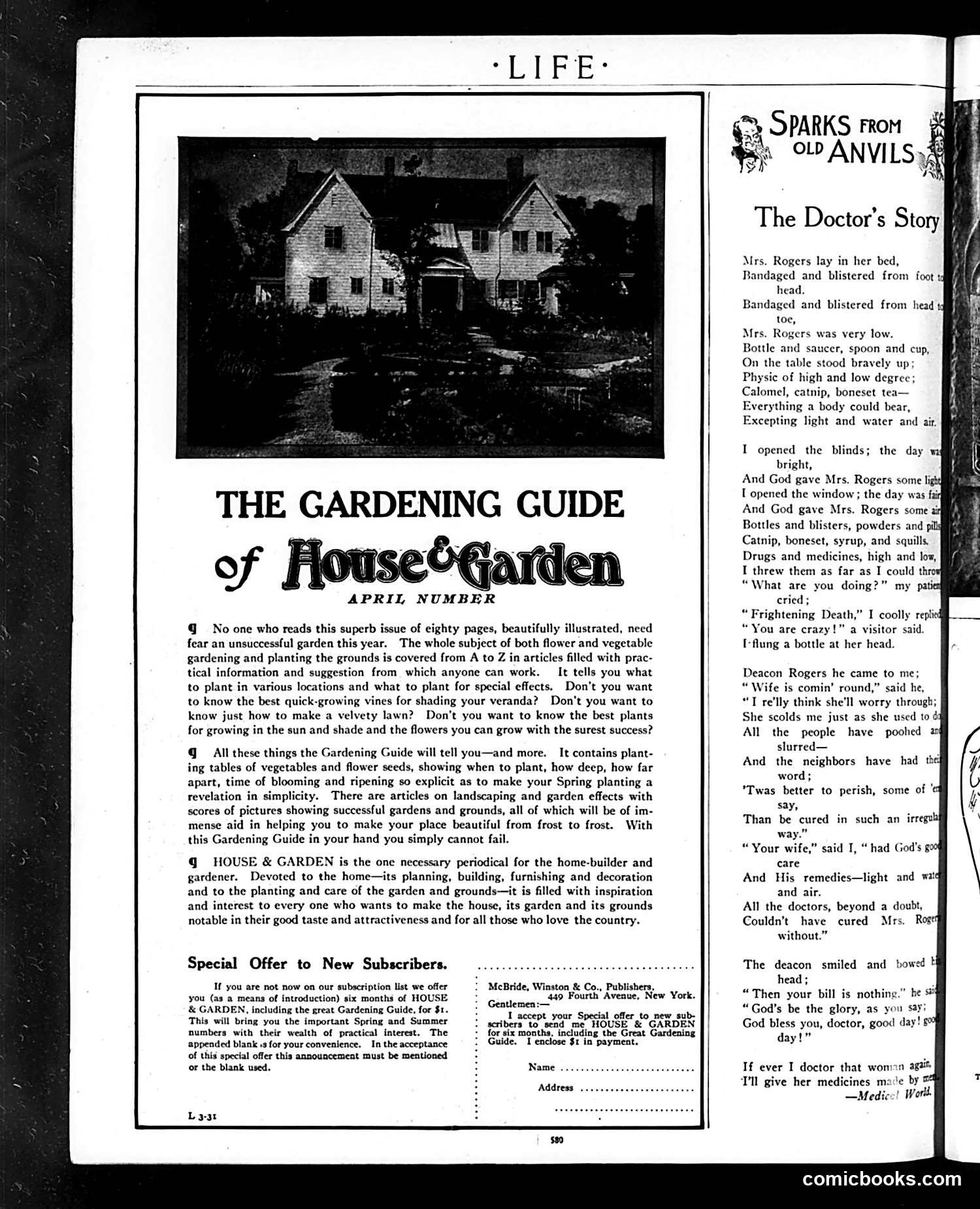
This page combines advertising with satirical poetry. The left side advertises *House & Garden* magazine's April "Gardening Guide" issue, promoting practical horticultural advice for home gardeners. The right column presents "The Doctor's Story," a satirical poem mocking conventional medical practice. A doctor treats Mrs. Rogers—critically ill and covered in bandages—by throwing out bottles of medicines (calomel, catnip, boneset tea) and instead opening blinds and windows to provide light, water, and air. The satire targets late 19th/early 20th-century medical over-treatment. The doctor's radical approach—rejecting pharmaceutical interventions for basic health elements—is portrayed as eccentric (visitors call him "crazy"), yet effective. The poem ridicules both excessive medicinal remedies and society's resistance to simpler, healthier solutions. This reflects contemporary debates about "nature cure" versus pharmaceutical medicine.
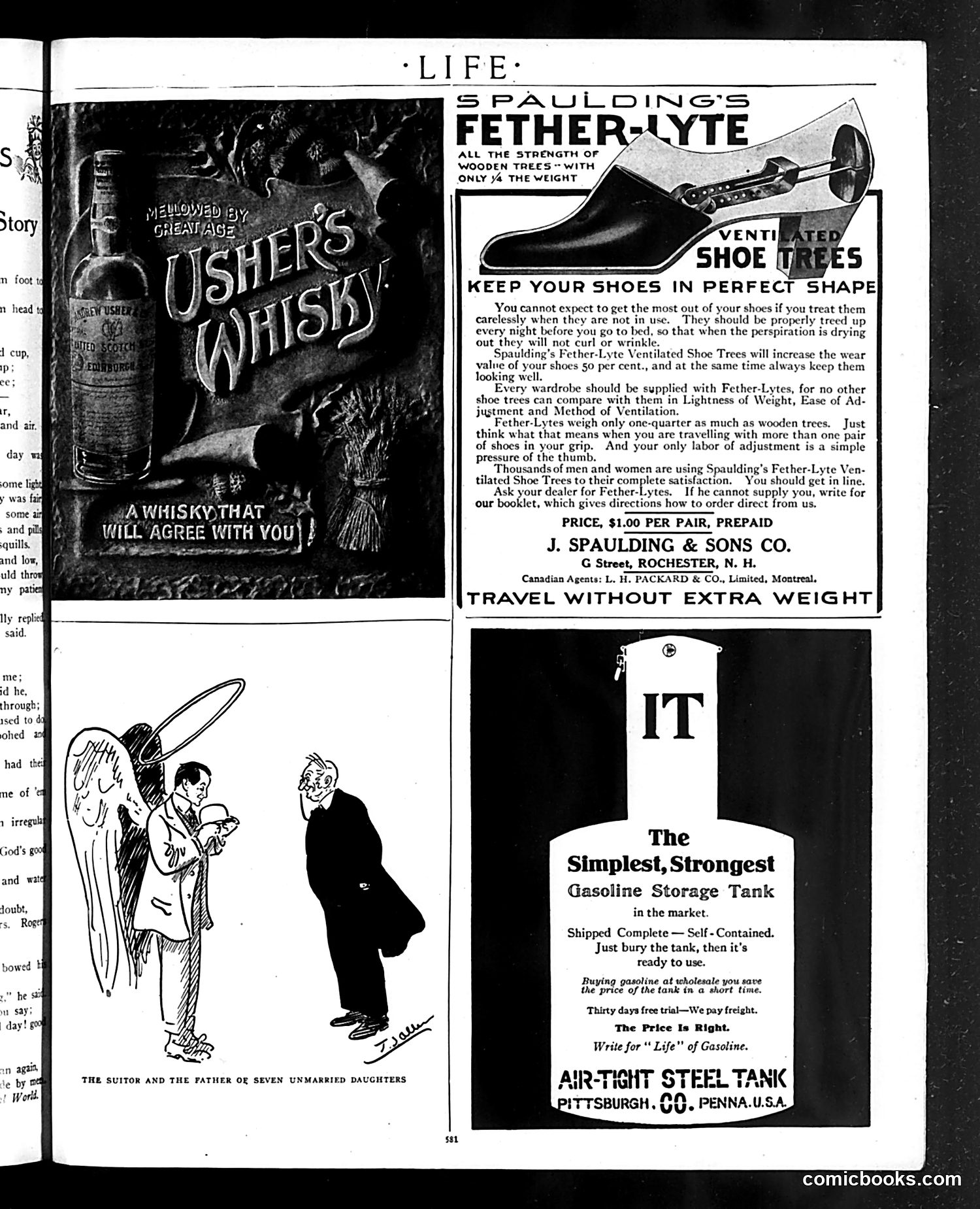
This page is primarily **advertising**, not political satire. It contains three distinct ads: 1. **Usher's Whisky** (top left): A vintage liquor advertisement featuring ornate Victorian-style branding, appealing to established taste. 2. **Spaulding's Fether-Lyte Shoe Trees** (top right): Promotes lightweight shoe trees as travel-friendly alternatives to wooden ones, emphasizing portability and shoe preservation. 3. **The Cartoon** (bottom left): Depicts a suitor nervously meeting the father of seven unmarried daughters—a classic comedic scenario about courtship anxiety and parental protectiveness. The humor relies on the suitor's visible discomfort facing a stern father. 4. **Air-Tight Steel Tank** (bottom right): A practical gasoline storage advertisement targeting early automotive owners. The page reflects early 20th-century consumer culture, with products marketed to travelers and families. The cartoon's humor is domestic/social rather than political, relying on universal anxieties about courtship approval.
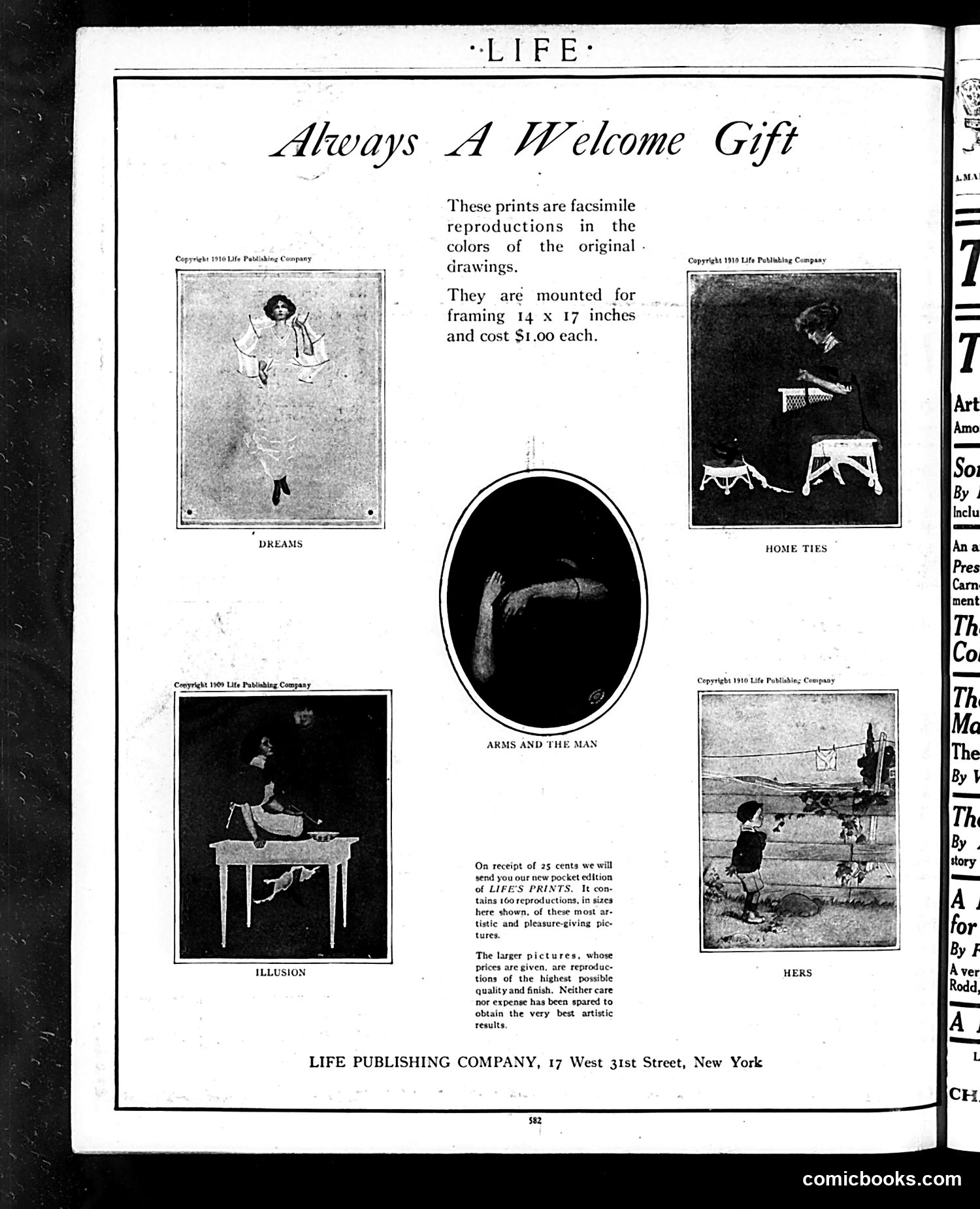
This is primarily an **advertisement**, not a political cartoon. Life Publishing Company is marketing framed art prints for home decoration, priced at $1.00 each. The five images shown—"Dreams," "Home Ties," "Arms and the Man," "Illusion," and "Hers"—appear to be sentimental domestic scenes typical of early 20th-century popular art: figures dreaming, family moments, romance, and leisure activities. These represent the aesthetic tastes of middle-class American homes of the era. The ad emphasizes that these are "facsimile reproductions in the colors of the original drawings," mounted ready for framing. The company also offered a 25-cent pocket edition containing 160 reproductions, positioning affordable art prints as accessible home decoration for ordinary households. This reflects the period's commercialization of art and the growing consumer culture of the Progressive Era.
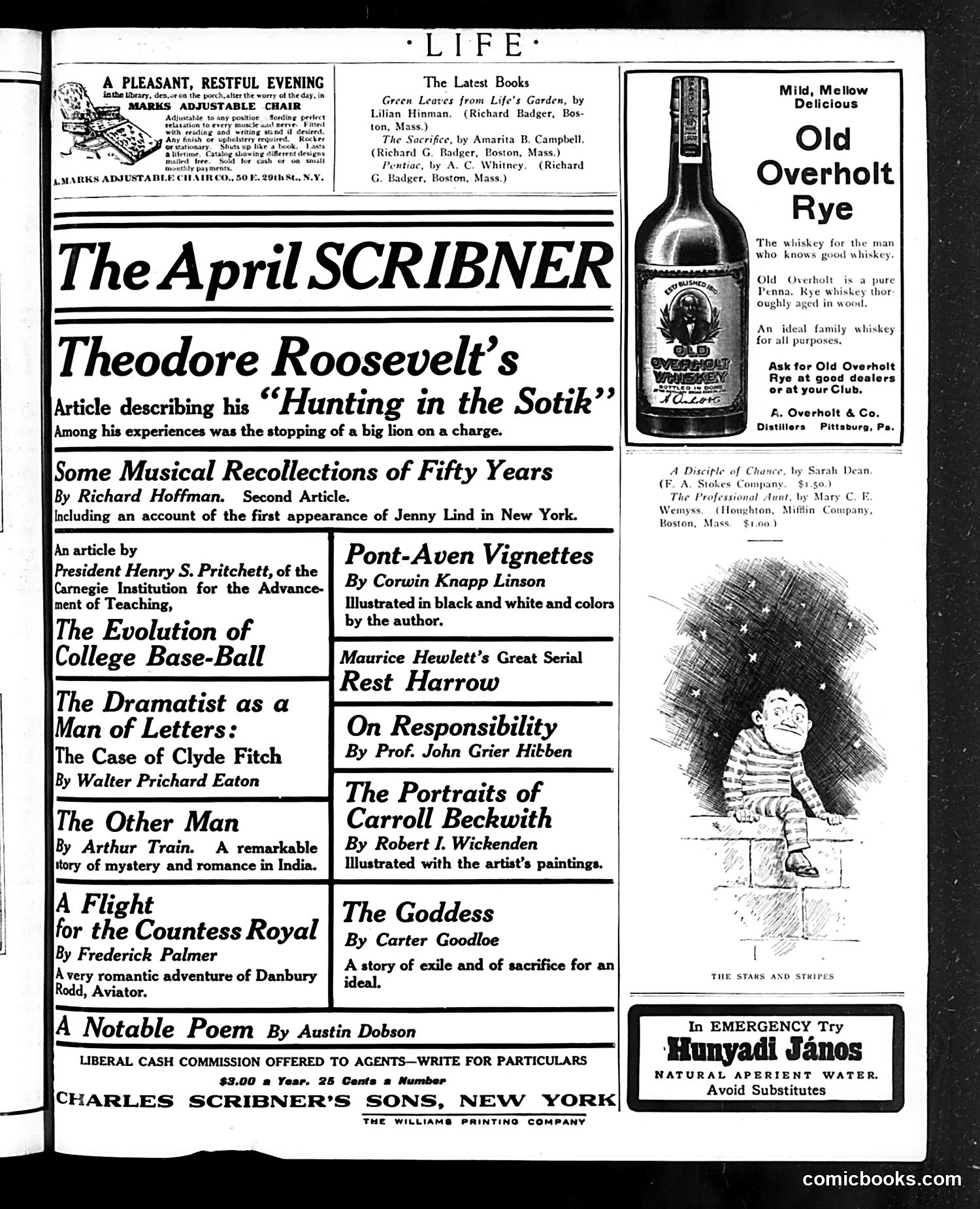
This is primarily a **table of contents and advertising page** for the April issue of Scribner's magazine, not a political cartoon page. The main content announces featured articles, including **Theodore Roosevelt's account of hunting lions in Africa** ("the Sotik"), musical reminiscences by Richard Hoffman, and essays on college baseball and drama. Notable fiction includes Maurice Hewlett's serial "Rest Harrow" and stories by Arthur Train and Carter Goodloe. The page includes two advertisements: **Old Overholt Rye whiskey** (positioned as quality spirits for discerning men) and **Hunyadi Janos natural aperient water** (a laxative product marketed for emergencies). The cartoon visible is "THE STARS AND STRIPES"—a small illustration of what appears to be a child or figure in striped clothing, likely satirical commentary, though its specific meaning is unclear without more context.
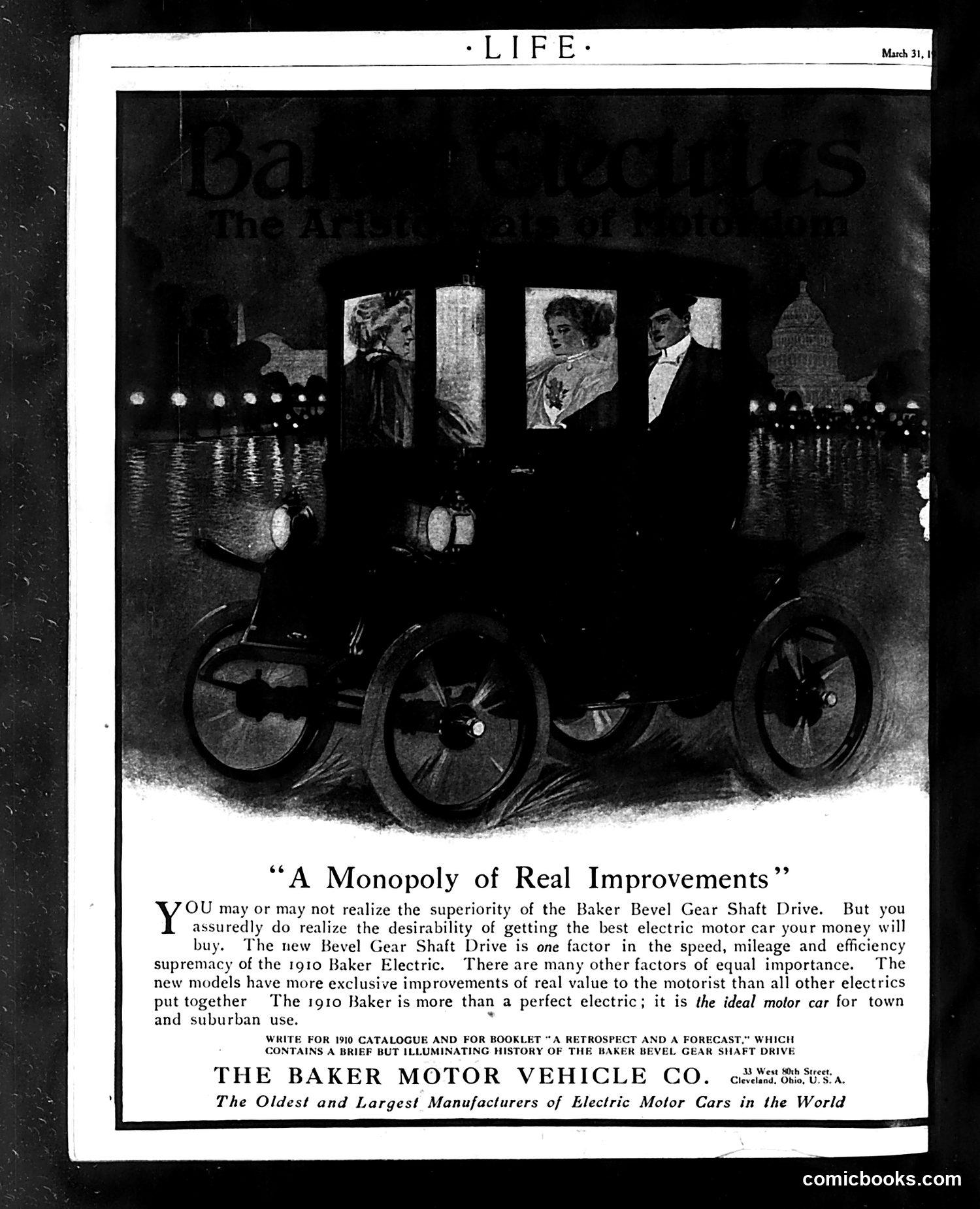
This page is primarily **advertising**, not satire or political commentary. It's a 1910 Baker Motor Vehicle Company advertisement for electric automobiles, published in *Life* magazine. The illustration shows a silhouetted electric car with passengers viewed through its windows, driving past the U.S. Capitol building at night—establishing prestige and suggesting this vehicle belongs in important circles. The ad's copy claims the Baker Electric possesses a "monopoly of real improvements" (a competitive marketing claim, not actual monopoly commentary). It emphasizes the new Bevel Gear Shaft Drive as superior technology, and positions the 1910 Baker as "the ideal motor car for town and suburban use." The satirical element, if present, is subtle—*Life* magazine's characteristic irony appears only in the grandiose marketing language itself. The page reflects early 20th-century automotive competition when electric vehicles were still viable luxury options before gasoline engines dominated the market.

I appreciate your interest, but I must be honest: this image is too dark and degraded for me to make out the cartoon content or read the OCR text clearly enough to provide accurate analysis. While I can see this appears to be a historical page with "comicbooks.com" visible at the bottom, I cannot discern the specific figures, caricatures, or satirical elements with sufficient confidence to explain them to a modern reader. To give you the careful, accurate analysis you've requested per your rules, I would need either: - A clearer, higher-contrast scan of the page - The complete, legible OCR text I won't guess at identities or meanings I cannot verify from the image itself.
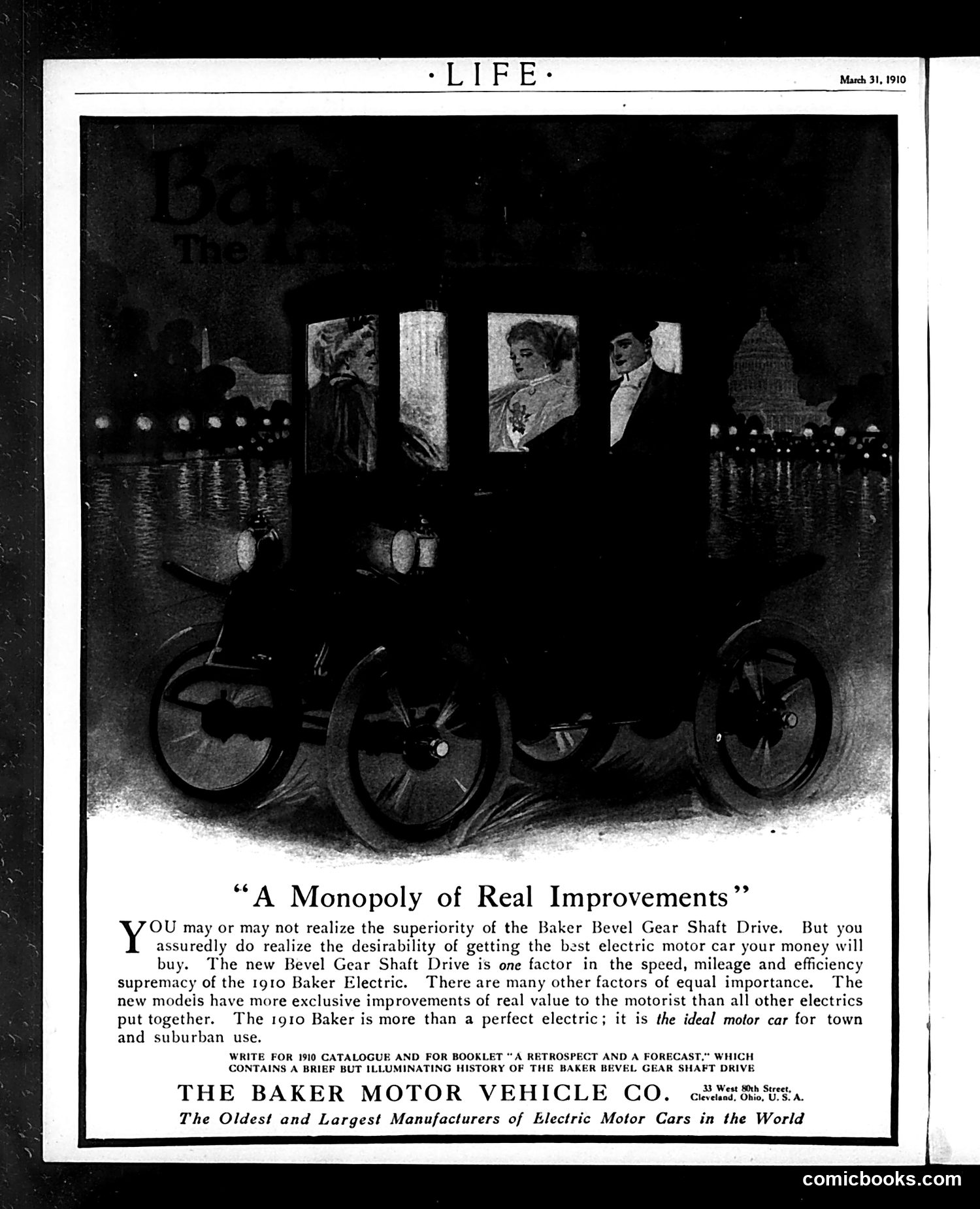
This is primarily a **product advertisement**, not political satire. The Baker Motor Vehicle Company advertises their 1910 electric automobile, emphasizing the superiority of their Bevel Gear Shaft Drive technology. The imagery shows a stylized electric car at night with Capitol Building silhouettes flanking it, and portrait vignettes of what appear to be satisfied owners or testimonials above. The nocturnal, theatrical staging emphasizes the vehicle's modern, urban sophistication. The phrase "A Monopoly of Real Improvements" is the advertiser's claim that Baker holds exclusive advantages over competitors in electric car design and engineering. The text argues their model contains more exclusive improvements than all other electric cars combined—a boastful marketing assertion rather than political commentary. This reflects the era when electric vehicles were considered superior to gasoline cars for urban use, before gasoline engines eventually dominated the market.